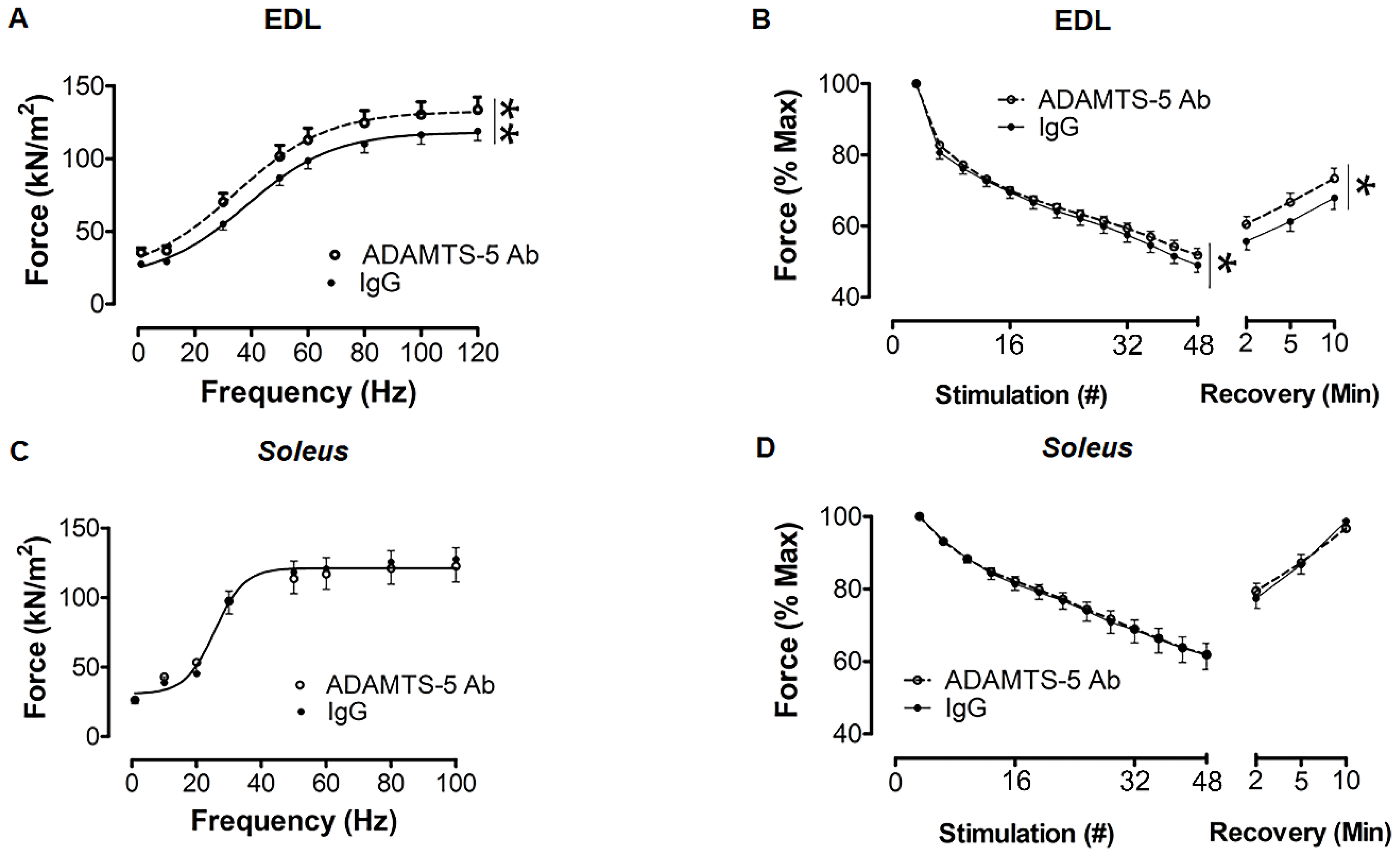
Erratum: Treatment of Dystrophic mdx Mice with an ADAMTS-5 Specific Monoclonal Antibody Increases the Ex Vivo Strength of Isolated Fast Twitch Hindlimb Muscles. Biomolecules 2020, 10, 416

Reference
- Addinsall, A.B.; Forgan, L.G.; McRae, N.L.; Kelly, R.W.; McDonald, P.L.; McNeil, B.; McCulloch, D.R.; Stupka, N. Treatment of Dystrophic mdx Mice with an ADAMTS-5 Specific Monoclonal Antibody Increases the Ex Vivo Strength of Isolated Fast Twitch Hindlimb Muscles. Biomolecules 2020, 10, 416. [Google Scholar] [CrossRef] [PubMed]

© 2020 by the authors. Licensee MDPI, Basel, Switzerland. This article is an open access article distributed under the terms and conditions of the Creative Commons Attribution (CC BY) license (http://creativecommons.org/licenses/by/4.0/).
Share and Cite
Addinsall, A.B.; Forgan, L.G.; McRae, N.L.; Kelly, R.W.; McDonald, P.L.; McNeill, B.; McCulloch, D.R.; Stupka, N. Erratum: Treatment of Dystrophic mdx Mice with an ADAMTS-5 Specific Monoclonal Antibody Increases the Ex Vivo Strength of Isolated Fast Twitch Hindlimb Muscles. Biomolecules 2020, 10, 416. Biomolecules 2020, 10, 1053. https://doi.org/10.3390/biom10071053
Addinsall AB, Forgan LG, McRae NL, Kelly RW, McDonald PL, McNeill B, McCulloch DR, Stupka N. Erratum: Treatment of Dystrophic mdx Mice with an ADAMTS-5 Specific Monoclonal Antibody Increases the Ex Vivo Strength of Isolated Fast Twitch Hindlimb Muscles. Biomolecules 2020, 10, 416. Biomolecules. 2020; 10(7):1053. https://doi.org/10.3390/biom10071053
Chicago/Turabian StyleAddinsall, Alex B., Leonard G. Forgan, Natasha L. McRae, Rhys W. Kelly, Penny L. McDonald, Bryony McNeill, Daniel R. McCulloch, and Nicole Stupka. 2020. "Erratum: Treatment of Dystrophic mdx Mice with an ADAMTS-5 Specific Monoclonal Antibody Increases the Ex Vivo Strength of Isolated Fast Twitch Hindlimb Muscles. Biomolecules 2020, 10, 416" Biomolecules 10, no. 7: 1053. https://doi.org/10.3390/biom10071053
APA StyleAddinsall, A. B., Forgan, L. G., McRae, N. L., Kelly, R. W., McDonald, P. L., McNeill, B., McCulloch, D. R., & Stupka, N. (2020). Erratum: Treatment of Dystrophic mdx Mice with an ADAMTS-5 Specific Monoclonal Antibody Increases the Ex Vivo Strength of Isolated Fast Twitch Hindlimb Muscles. Biomolecules 2020, 10, 416. Biomolecules, 10(7), 1053. https://doi.org/10.3390/biom10071053