Article

Semirelativistic BSR–RMT Interface: Photoionization of Highly Charged Two-Electron Ions

Department of Physics and Astronomy, Drake University, Des Moines, IA 50311, USA
*
Author to whom correspondence should be addressed.
Atoms 2026, 14(8), 66; https://doi.org/10.3390/atoms14080066
Submission received: 25 June 2026 / Revised: 28 July 2026 / Accepted: 29 July 2026 / Published: 1 August 2026

Abstract

We outline an intermediate step toward a semirelativistic BSR–RMT interface by using inner-region structure information generated with the B-spline R-matrix (BSR) method as the input to the Seaton/Badnell STGF/STGBF outer-region asymptotic codes used in R-matrix photoionization calculations. The long-term goal is to exploit the compact, nonorthogonal, term-dependent target descriptions available in BSR for time-dependent R-matrix calculations with the R matrix with time dependence (RMT) method, especially for processes sensitive to semirelativistic and spin-orbit effects. To probe these effects, we consider the ground-state photoionization of Ne8+, Ar16+, Fe24+, and Kr34+, focusing on resonance structures and the singlet-triplet separation of the predominantly 2 s 2 p 3 P o and 2 s 2 p 1 P o autoionizing states and their spin-orbit mixing. For Fe24+, we also analyze higher resonances and the region between the ionic thresholds, with R-matrix I (RM-I) calculations using Badnell’s version for comparison. The BSR results agree well overall with the available Iron Project data and with the NIST separations between the predominantly 2 s 2 p 3 P o and 2 s 2 p 1 P o levels. Since semirelativistic RMT currently uses RM-I input; the successful interfacing of BSR inner-region data with STGF/STGBF codes that likewise use RM-I input represents a direct precursor to semirelativistic BSR–RMT capability.

1. Introduction

The R-matrix method is one of the primary ab initio approaches used to treat electron scattering from atoms, ions, and molecules, as well as photoionization processes [1,2]. Its advantage is derived from separating configuration space into an inner region, where correlation and exchange effects are treated explicitly, and an outer region, where the free electron interacts only with the long-range field of the residual ion. This partitioning has made R-matrix theory very successful in both time-independent collision and photoionization processes [1] and, more recently, in time-dependent laser–atom interactions [3].
The B-spline R-matrix (BSR) method introduced by Zatsarinny [4,5] facilitated the use of nonorthogonal, term-dependent one-electron orbitals, increasing the flexibility with which atomic systems can be described. This feature is especially useful when high-quality target descriptions can be achieved with compact configuration expansions. The availability of such target descriptions is connected to the multiconfiguration Hartree–Fock (MCHF) and multiconfiguration Dirac–Hartree–Fock (MCDHF) tradition developed by Froese Fischer and collaborators [6,7,8], while further relativistic and semirelativistic extensions to atomic structure, scattering, and laser–atom physics are connected to the broad legacy of Grant and collaborators [9]. The present work is therefore a natural contribution to this Special Issue dedicated to these two pioneers.
Time-dependent laser–atom interactions have recently become tractable in R-matrix theory via R matrix with time dependence (RMT), which solves the time-dependent Schrödinger equation using a close-coupled R-matrix inner-region basis coupled to an outer-region finite-difference grid [3]. Semirelativistic RMT has utilized RM-I input to study spin-orbit-induced dynamics in carbon [10] and krypton [11,12], and RMT has also been used to study resonance-sensitive under-threshold RABBITT in neon [13]. In such applications, accurate descriptions of both the N-electron target and the bound and continuum ( N + 1 ) -electron systems are required.
The idea of interfacing BSR, with its clear advantages in certain use cases, with RMT was first advocated in Ref. [14], while a first BSR–RMT implementation has recently been achieved for L S -coupled, single-configuration targets [15]. The next goal is to treat systems built with multiconfigurational target states in any coupling scheme, facilitating semirelativistic laser–atom calculations. The current semirelativistic RMT workflow uses RM-I-type structure input, whereas BSR can provide more flexible and compact target descriptions. In this paper, on the way to a fully time-dependent implementation, an intermediate goal is reported: BSR inner-region data are connected to the same class of asymptotic/outer-region machinery used in the semirelativistic RM-I pathway.
The BSR inner-region data are generated for highly charged two-electron ions, where strong spin-orbit effects occur, and interfaced with the STGF/STGBF-type outer-region codes documented by Badnell [16] to complete example photoionization calculations. These codes are related to the classic R-matrix and Seaton asymptotic programs used, for example, in the Opacity/Iron Project collaborations [17,18]. The usual photoionization route in BSR employs the Crees ASYPCK package [19], which has been widely used with BSR, including in a recent calculation of the photoionization of neon [20]. For the present highly charged systems, however, this route did not produce usable cross-sections, whereas replacing the asymptotic stage with the STGF/STGBF-type outer-region codes resolved the issue.
Highly charged helium-like ions are simple enough that BSR and RM-I calculations can be compared in a controlled way, while also exhibiting strong Breit–Pauli effects and spin-orbit splitting that grow with increasing nuclear charge. The selected ions, Ne8+, Ar16+, Fe24+, and Kr34+, include systems of potential experimental interest, and Iron Project/NORAD data are available for Ne8+, Ar16+, and Fe24+ [21,22,23,24]. Kr34+ is an even heavier ion for which we could not find cross-sections in the literature. The primary physics studied here are the splitting of the 2 s 2 p 1 , 3 P 1 o autoionizing states and, for Fe24+, the further excited 2 s n p ( J = 1 o ) clusters and the region between the 2 s 1 / 2 = 2 p 1 / 2 and 2 p 3 / 2 ionic thresholds. All quantities and equations are expressed in atomic units unless stated otherwise.

2. Method

2.1. Close-Coupling Description

We consider the single-photon ionization of the ground state of a two-electron ion,
h ν + X ( Z − 2 ) + ( 1 s 2 S 0 e 1 ) → X ( Z − 1 ) + ( n ℓ j ) + e − ,
where X = Ne, Ar, Fe, or Kr. The residual-ion target structure is described by four states:
1 s 1 / 2 , 2 s 1 / 2 , 2 p 1 / 2 , 2 p 3 / 2 .
In the one-electron Breit–Pauli model, as in the Dirac picture, the 2 s 1 / 2 and 2 p 1 / 2 target thresholds are degenerate, while 2 p 3 / 2 is higher in energy due to spin-orbit interaction. This results in the threshold structure discussed below.
The standard close-coupling description in R-matrix theory for the ( N + 1 ) -electron wave function in the inner region is
Ψ k J π = A ∑ i Φ i J i π i ( X N ; r ^ N + 1 σ N + 1 ) 1 r N + 1 F i k ( r N + 1 ) + ∑ j c j k χ j J π ,
where A is the antisymmetrization operator, Φ i are channel functions in which the target states are coupled to the continuum electron, and the square-integrable terms χ j describe short-range correlation and closed-channel effects. Since the initial two-electron ground state has J π = 0 e , the final states following single photoionization have symmetry J π = 1 o .
We solve the time-independent Schrödinger equation, where one-body Breit–Pauli mass-velocity, Darwin, and spin-orbit terms are added to the nonrelativistic Coulomb Hamiltonian:
H BP = H NR + H MV + H D + H SO .
Spin-other-orbit, orbit-orbit, and other two-body Breit terms are not considered in the present work. QED and finite nuclear mass corrections are likewise ignored. These omissions affect absolute resonance positions, especially as Z increases, but do not affect the present use of these calculations as controlled tests of the BSR interface with the Seaton/Badnell asymptotic codes.
The BSR calculations employ a short-range perturber, represented by the rightmost term in Equation (3), to give an improved two-electron ground state, 1 s 2 S 0 e 1 . In all ions, this perturber is generated in MCHF using the Hamiltonian in Equation (4) and consists of three configurations: 1 s 2 S e 1 , 2 s 2 S e 1 , and 2 p 2 S e 1 . In Kr34+, changing from three to six configurations as a spot check changed the ground-state energy by only 0.014 Ry. Since the present purpose is not the exact position of the autoionizing resonances, three-configuration perturbers were used for all ions studied.
Table 1 shows the ground and ionic binding energies, along with the ionic thresholds obtained in the present BSR calculations benchmarked against the NIST values. The RM-I and Iron Project quantities are used below for comparing the predicted cross-sections, and the relevant n = 2 , J π = 1 o -level separations are discussed in Section 4.2.

2.2. Photoionization Cross-Section

The total photoionization cross-section is proportional to the square of the E 1 dipole matrix element between the initial ground state and the energy-normalized continuum functions describing the final ionized state. The form of the photoionization cross-section is given by
σ ( ω ) = 4 π 2 α ω 2 J 0 + 1 ∑ f 〈 Ψ f − | | D | | Ψ 0 〉 2 ,
where J 0 = 0 for the 1 s 2 S 0 e 1 ground state, D = ∑ i r i is the length-form E 1 dipole operator, ħ ω is the energy difference between the initial and final state, and the sum in general includes all open photoionization channels; here, this is only the J = 1 o symmetry. All results in this paper are reported in the length gauge, although velocity–form matrix elements were evaluated as an internal check. In particular, the excellent length–velocity agreement for the broad photoionization cross sections for Kr34+ is discussed in Section 4.1.
The BSR calculations for all four ions and the RM-I benchmark calculations for Fe24+ and Kr34+ employed the four-target-state model consisting of 1 s 1 / 2 , 2 s 1 / 2 , 2 p 1 / 2 , and 2 p 3 / 2 and the “NR + one-body BP” Hamiltonian of Equation (4). The one-electron (hydrogenic) target orbitals were re-generated using MCHF for BSR and simply read for RM-I in their analytically known nonrelativistic Slater-type representation. The BSR target and continuum orbitals employed an order-12 B-spline basis on a semi-exponential radial grid with h = 0.0303 / Z near the origin and h max = 0.01 . The BSR calculations used box radii R = 3.9 , 2.2, 1.5, and 1.1, with corresponding numbers of B-splines N s = 441 , 291, 234, and 204 for Ne8+, Ar16+, Fe24+, and Kr34+, respectively. The RM-I calculations used R = 1.724 and 1.2068 and continuum bases of 40 and 45 orbitals for Fe24+ and Kr34+, respectively. For both BSR and RM-I, the R values were selected such that the target and initial-state orbitals were negligible at the boundary, and spot checks with larger radii left the cross-sections reported in this manuscript unchanged. In BSR, the other grid parameters were chosen conservatively, while N s was determined implicitly according to the values of R and h max .
The BSR calculations generate the inner-region quantities required for photoionization, including ( N + 1 ) -electron eigenvalues and eigenvectors, surface amplitudes, channel information, and dipole matrix elements. These quantities were subsequently processed by the STGB/STGF/STGBF outer-region suite [16]. The RM-I calculations were performed with the classic Belfast inner-region chain, including the RECUPD ( j K ) recoupling stage, followed by the same outer-region treatment. Agreement between BSR and RM-I therefore validated that the BSR inner-region information was successfully interfaced with the STGB/STGF/STGBF asymptotic codes developed for RM-I. This is a key intermediate step toward a semirelativistic BSR–RMT interface.

3. Computational Advances: BSR Coupled to STGF/STGBF

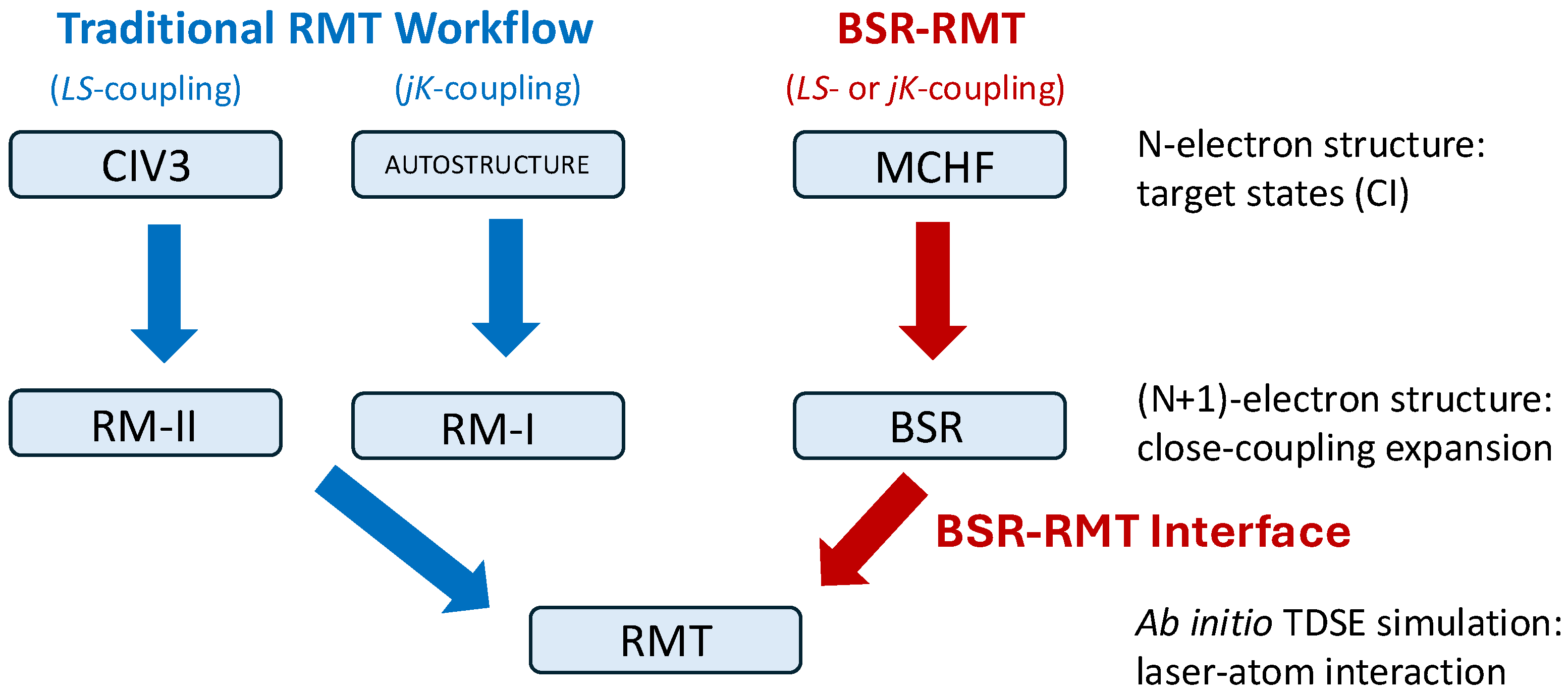
Figure 1 summarizes the current RMT workflow and highlights the goal of the long-term BSR–RMT interface project. The standard atomic usage of RMT is taking the RM-II structure input for nonrelativistic calculations and RM-I input for semirelativistic calculations. A working BSR–RMT interface has recently been demonstrated for L S -coupled, single-configuration targets [15]; the next goal is a semirelativistic version in which the channel, symmetry, and dipole information is modeled after intermediate-coupling RM-I input. The present time-independent photoionization calculations neither require time propagation nor interface with RMT directly. Rather, they demonstrate that BSR inner-region data can be translated into the RM-I-style input required by semirelativistic R-matrix outer-region codes.
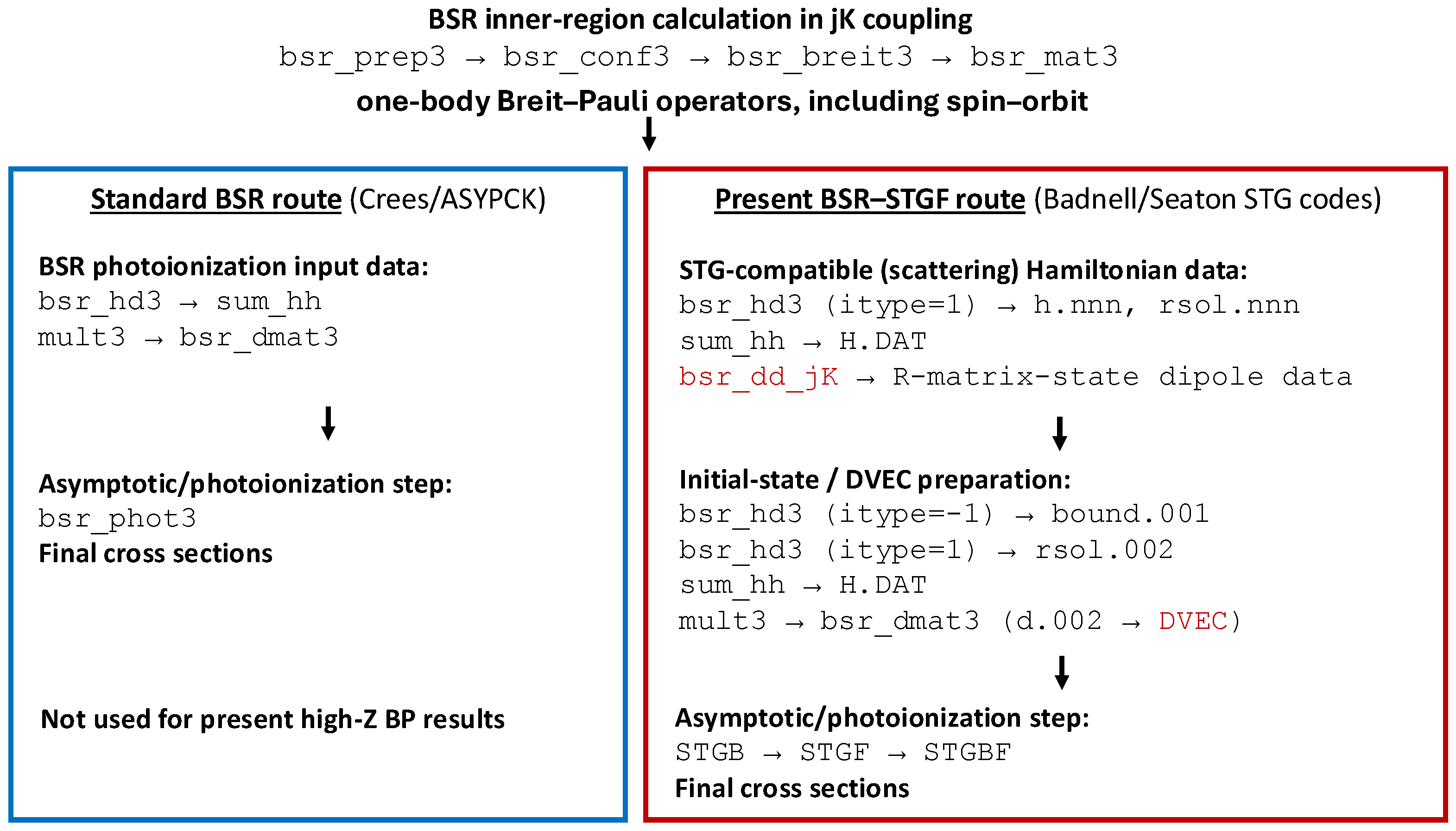
Figure 2 exhibits the key difference between the standard handling of photoionization in BSR and the method used here. Since this is a semirelativistic calculation, the target file must indicate intermediate j K coupling, and both the bsr_breit3 and bsr_mat3 programs are executed in semirelativistic mode with the one-body Breit–Pauli mass-velocity, Darwin, and spin-orbit operators included [4]. The usual BSR photoionization proceeds through bsr_phot3, which interfaces the BSR inner-region data with the Crees/ASYPCK asymptotic package [19].
For the highly charged two-electron systems considered here, this path did not produce usable photoionization cross-sections. Beyond a certain energy, which becomes progressively lower for heavier systems, the ASYPCK route yielded nonphysical cross-sections. The scattering wave functions generated by ASYPCK possessed incorrect regular/irregular Coulomb asymptotic behavior and correspondingly had unphysical eigenphases. The exact failure point within ASYPCK has not yet been identified. Fortunately, the Crees/ASYPCK asymptotic package is not native to BSR and, as described in the BSR write-up [4], BSR can be interfaced with other outer-region codes for photoionization. We therefore retained the BSR inner-region calculation but replaced the asymptotic stage with the Seaton/Badnell STG workflow [16]. We recommend that users performing calculations with highly ionized systems and/or high ejected-electron energies carefully inspect the asymptotic solutions from the package and the resulting observables. If unphysical results are obtained, we further recommend replacing the ASYPCK asymptotic package with the STGF/STGBF one according to the current workflow.
In the present route, two preparation steps are required within BSR. First, bsr_hd3 is run in photoionization mode, yielding the h.nnn files and the inner-region solutions rsol.nnn; sum_hh then produces H.DAT, and bsr_dd_jK generates the j K -coupled dipole information between R-matrix solutions. Second, the initial bound state and final photoionization state are prepared with bsr_hd3 and sum_hh, after which mult3 and bsr_dmat3 produce d.002, equivalent to the DVEC file required by STGBF.
In a pure RM-I calculation, the bound-free preparation includes a PREBF step between STGF and STGBF, which produces DVEC. In the present BSR–STGF workflow, DVEC is generated in BSR via the sequence shown on the right side in Figure 2.
This interface is intentionally simple. It does not replace RM-I for Breit–Pauli photoionization or scattering nor does it yet provide a working interface for semirelativistic BSR–RMT computations. Its aim is to show that BSR inner-region data can be made compatible with the outer-region framework used in semirelativistic R-matrix photoionization calculations. Since RMT uses RM-I-style input for such calculations, including quantities sensitive to spin-orbit effects [11,12], the present BSR–STGF/STGBF implementation is a direct precursor to semirelativistic BSR–RMT.

4. Example: Photoionization of Highly Charged Two-Electron Ions

4.1. Broad Total Cross-Sections

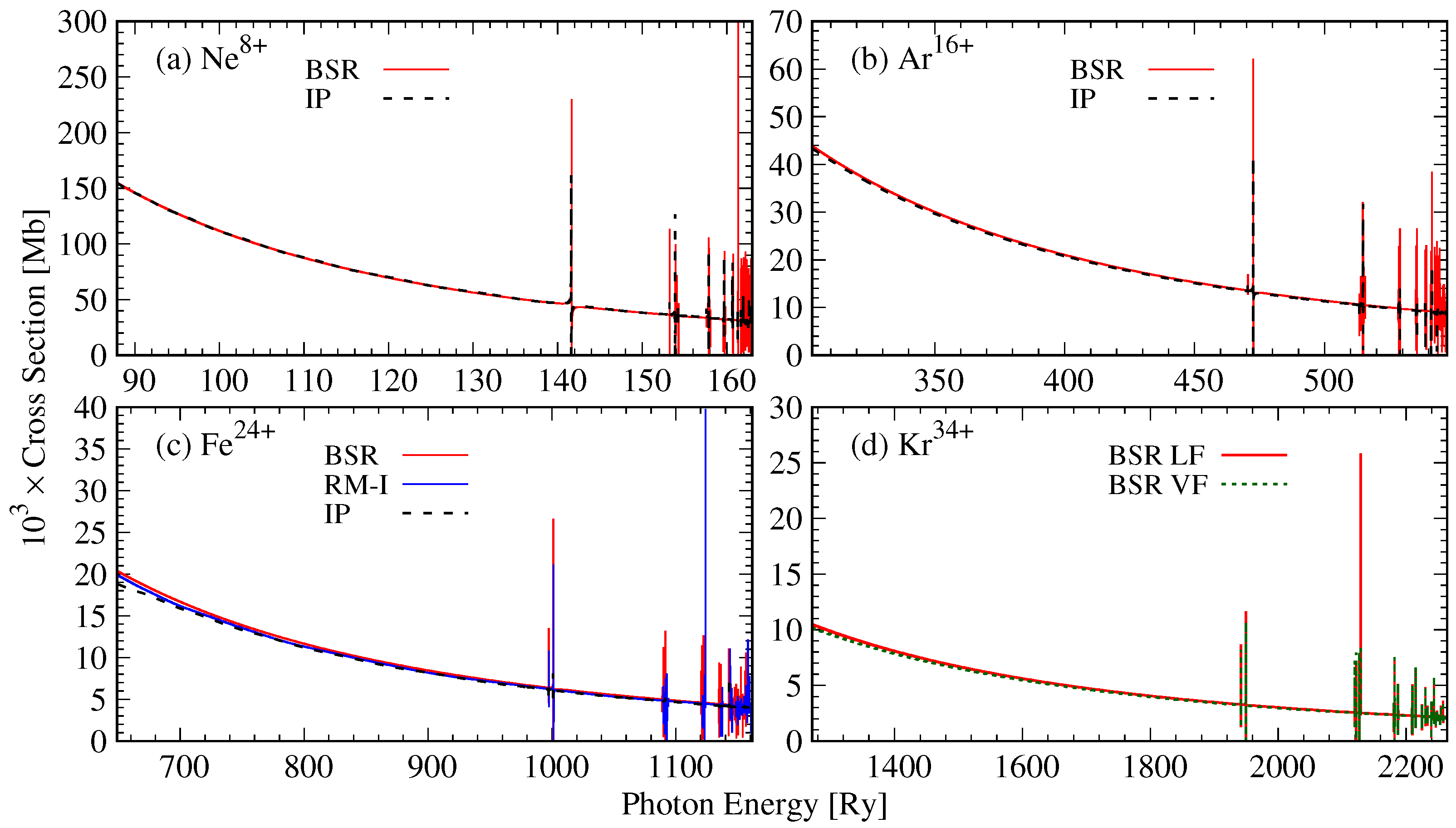
Figure 3 displays the total ground-state photoionization cross-sections for Ne8+, Ar16+, Fe24+, and Kr34+, spectroscopically denoted as Ne IX, Ar XVII, Fe XXV, and Kr XXXV. All results labeled “BSR” exhibited in this paper are those obtained via BSR–STGF/STGBF pathway described in Sec. III. The results labeled “RM-I” refer to the present RM-I calculations, which also use the STGF/STGBF asymptotic pathway. The cross-sections are plotted as functions of photon energy to test the overall two-electron spectrum, including the ground-state energy. For Ne8+, Ar16+, and Fe24+, the BSR results agree closely with Iron Project/NORAD data [21,22,23], despite the more elaborate target descriptions, two-body Breit–Pauli terms, and radiation damping included in those calculations. For Fe24+, the present RM-I results obtained using Badnell’s code [16] are also shown. No corresponding Kr34+ comparison data were found. All results are in the length form, except that both length and velocity forms are shown for Kr34+ as an internal gauge consistency check.
The agreement in Figure 3 provides the first evidence that the BSR inner-region data were successfully interfaced with the STGF/STGBF outer-region codes outlined in Figure 2. The purpose is not to claim new physics in the broad background cross-sections, which have already been extensively studied in the Iron Project/NORAD work [24], but to show that the present BSR–STGF/STGBF route yields the expected scale and structure.

4.2. The 2 s 2 p 1 , 3 P o Resonance Region

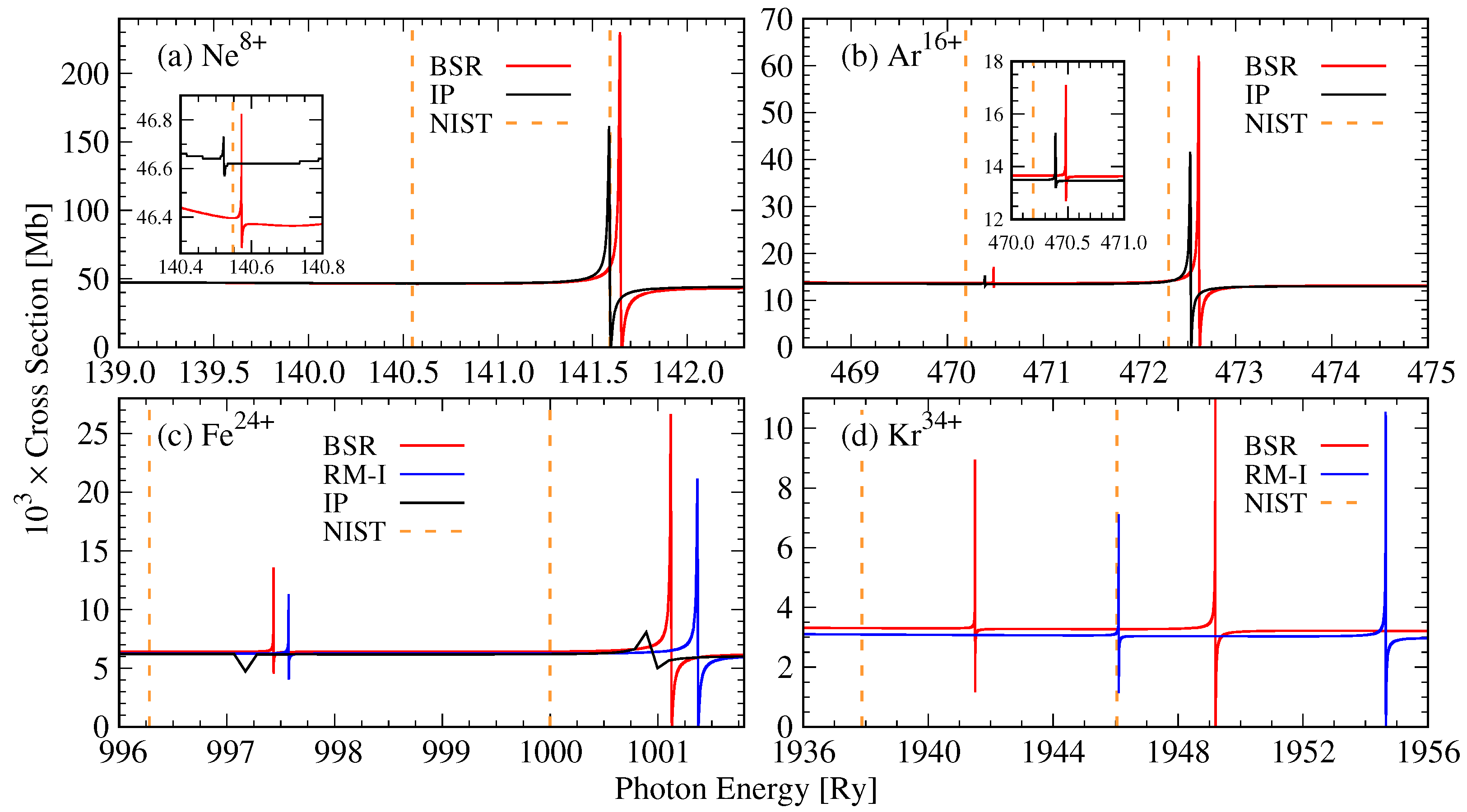
Figure 4 displays the n = 2 autoionizing resonance region, where the dominant L S -coupled features are the 2 s 2 p 1 P o and 2 s 2 p 3 P o states. In the present intermediate-coupling calculations, both contribute to the observed J π = 1 o resonances. As in Figure 3, we plot versus photon energy in order to compare two-electron excitation energies with NIST.
The n = 2 autoionizing features provide a sensitive test of the semirelativistic target and two-electron close-coupled structure. With increasing Z, spin-orbit mixing becomes stronger, modifying the separation between the two J π = 1 o resonances, making the two features easier to distinguish from one another, and rendering the predominantly triplet resonance distinguishable from the background. The BSR, RM-I, and Iron Project/NORAD results show good approximate agreement with each other and with NIST, and the splittings in Table 2 indicate that the dominant spin-orbit structure is handled correctly. These resonance energies are not intended as high-precision spectroscopic benchmarks: the present BSR calculations omit two-body Breit–Pauli, QED, finite nuclear mass, and finite-nuclear-size corrections. High-precision structure calculations including these effects, such as [25,26,27], should be consulted for precise energies.
The splitting in Table 2 is distinct from the absolute resonance positions and is the more relevant test of the spin-orbit effect of interest for future BSR–RMT applications. It probes the relative positions of the two features rather than the absolute energy zero. The increasing discrepancy with Z is consistent with the growing importance of omitted QED, two-body Breit, and higher-order relativistic effects, which can affect the P 1 o 1 – P 1 o 1 separation. Additionally, the relatively simple target and perturber structure used in the present calculations could also contribute to this observed discrepancy. As such, no empirical shifting is applied; the present comparison is used to verify the resonance structure produced by the BSR–STGF/STGBF implementation.
Figure 4. Photoionization cross-sections in n = 2 autoionizing resonance region for Ne8+, Ar16+, Fe24+, and Kr34+ are displayed versus photon energy in Ry. Insets for Ne8+ and Ar16+ show the much weaker triplet resonance. Also shown are the Iron Project/NORAD (IP) data [21,22,23]. Vertical markers denote the NIST energies of the 2 s 2 p 1 , 3 P 1 o states for each ion [28].
Atoms 14 00066 g004

4.3. Higher-n Resonance Clusters in Fe24+

We examine the higher-n resonance structure of Fe24+ in more detail, comparing BSR and RM-I calculations with Iron Project data, although the latter lack the resolution to provide an ideal benchmark. The higher-n resonance clusters illustrate the intermediate-coupling channel structure: in L S coupling, only 2 s n p 1 , 3 P o autoionizing states would be present, while here the 2 s 1 / 2 , 2 p 1 / 2 , and 2 p 3 / 2 ionic states couple with outer-electron orbitals to form J π = 1 o states.
For the n = 2 cluster shown in Figure 4, the relevant orbitals are the 2 s 1 / 2 , 2 p 1 / 2 , and 2 p 3 / 2 ionic states. The only odd-parity J = 1 channels are 2 s 1 / 2 2 p 1 / 2 and 2 s 1 / 2 2 p 3 / 2 . For n > 2 , the outer electron coupled to one n = 2 orbital is obtained from the BSR close-coupling/B-spline continuum basis, not from additional target states. The seven allowed J π = 1 o channels are 2 s 1 / 2 n p 1 / 2 , 2 s 1 / 2 n p 3 / 2 , 2 p 1 / 2 n s 1 / 2 , 2 p 3 / 2 n s 1 / 2 , 2 p 1 / 2 n d 3 / 2 , 2 p 3 / 2 n d 3 / 2 , and 2 p 3 / 2 n d 5 / 2 .
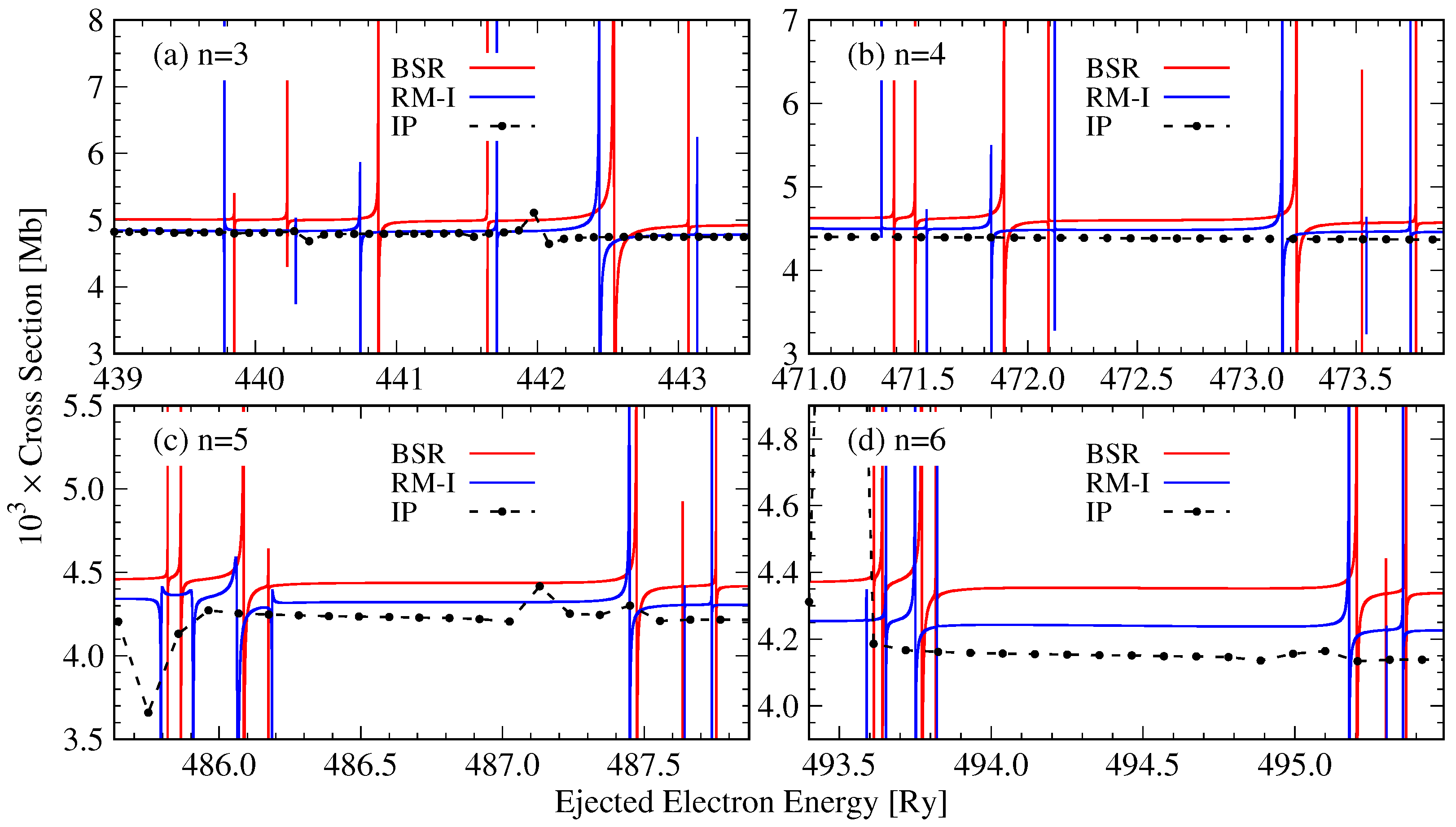
Figure 5 shows this seven-channel resonance structure for the n = 3 –6 clusters of Fe24+. Unlike Figure 3 and Figure 4, the cross-section is plotted versus ejected electron energy, fixing the n = 2 ionic threshold and facilitating a more precise comparison of the resonance features between methods. It is evident that the two sets of features that contain coupling to (1) the 2 s 1 / 2 and 2 p 1 / 2 orbitals and (2) the 2 p 3 / 2 orbital are progressively separated as n increases, converging on the 1.52 Ry separation between these thresholds.
The agreement between BSR and RM-I for the detailed n = 3 –6 resonance structure in Figure 5 further demonstrates the successful use of BSR inner-region data with the STGF/STGBF asymptotic codes.

4.4. Fine-Structure Threshold Region

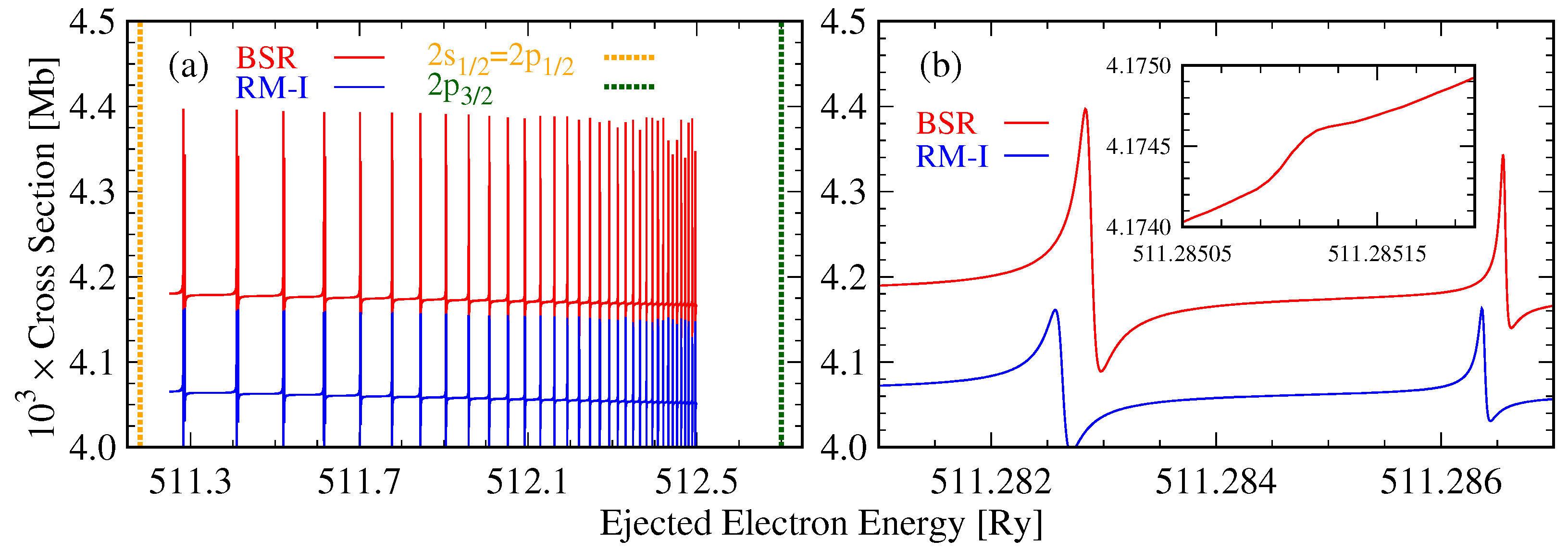
Figure 6 shows the Fe24+ photoionization structure between the degenerate 2 s 1 / 2 = 2 p 1 / 2 threshold and the slightly higher, spin-orbit-shifted 2 p 3 / 2 threshold. As in Figure 5, we plot the cross-section against ejected-electron energy to fix the threshold positions. Panel (a) shows the between-threshold region up to the point where the resonances become too densely spaced to display clearly. Panel (b) exhibits the first cluster above the 2 s 1 / 2 = 2 p 1 / 2 threshold, where only the three channels converging to the 2 p 3 / 2 threshold contribute: 2 p 1 / 2 n d 3 / 2 , 2 p 3 / 2 n d 3 / 2 , and 2 p 3 / 2 n d 5 / 2 . The central feature is very weak and is shown in the inset.
The dense resonances between thresholds are highly sensitive to channel coupling, and the BSR and RM-I methods almost perfectly replicate the same features. The background and exact resonance magnitudes are not expected to completely agree since the inner-region representations are not exactly the same. The salient point is that the BSR-based calculation yields an essentially identical between-threshold structure as RM-I when both are passed through the STGF/STGBF machinery.

5. Discussion and Conclusions

The purpose of the present manuscript is to document a computational realization, not a high-precision structure calculation. BSR inner-region data were successfully interfaced with Seaton/Badnell STGF/STGBF-type outer-region photoionization codes in example calculations of semirelativistic photoionization cross-sections for highly charged two-electron ions. This BSR–STGF/STGBF interface represents an intermediate step towards the ultimate goal of a semirelativistic BSR–RMT interface. Here, the BSR inner-region information, including R-matrix, energy data, surface amplitudes, and dipole matrices, was shown to be compatible with asymptotic codes that typically require input from RM-I. This parallels the situation with semirelativistic RMT, which likewise uses RM-I input, while the goal is to use BSR input data.
The heavy helium-like ions were chosen to validate this workflow on systems that are incidentally of potential experimental interest. The total photoionization cross-sections, n = 2 autoionizing resonances, and Fe24+ higher-n and threshold-region structures show good agreement between BSR, RM-I, Iron Project/NORAD data [21,22,23], and NIST energies [28], where applicable. For Kr34+, for which no cross-sections were found in the literature, the length and velocity forms of the photoionization cross-section are in excellent agreement. Together, these comparisons confirm that the BSR inner-region data are being translated successfully into the STGF/STGBF framework.
It should be mentioned that the fully relativistic Dirac atomic R-matrix code (DARC) [29] of Norrington and Grant is a complementary approach for this problem. DARC has an advantage especially for systems with a high nuclear charge, since it treats relativistic effects nonperturbatively when these effects are no longer small. The BSR-based semirelativistic methods, including the present usage as well as the BSR–RMT interface, have the advantages of using term-dependent nonorthogonal orbitals allowing for compact close-coupling expansions, overcoming certain difficulties sometimes encountered in the standard R-matrix expansions. The present demonstration serves to validate the use of BSR inner-region data as RM-I-like input for STGF/STGBF and eventually for RMT and is not intended to serve as a benchmark against DARC or any other calculation.
This work also identifies a practical limitation of the current BSR workflow for photoionization calculations, which uses the Crees/ASYPCK package within the BSR_PHOT3 module. For the highly charged two-electron ions studied here, that route does not produce usable cross-sections beyond an energy that decreases with increasing Z. Replacing Crees/ASYPCK by the STGF/STGBF asymptotic codes of Badnell and Seaton completely ameliorated the problem, as illustrated in Figure 2.
We will next translate this knowledge directly to the time-dependent problem to complete the semirelativistic BSR–RMT program. Semirelativistic RMT, using RM-I input, has been used to calculate spin-orbit-sensitive properties with important implications for ultrafast dynamics [11,12]. Although not demonstrated in the present study, which uses one-electron orthogonal orbitals, BSR offers a more flexible and compact target description than RM-I due to term-dependent nonorthogonal orbitals, opening the possibility for the treatment of complex, open-shell systems. The present BSR–STGF/STGBF calculation, which compares well with RM-I, therefore constitutes a clear practical step towards a complete semirelativistic BSR–RMT interface. Once implemented, BSR–RMT can be used to achieve both very accurate structure and inclusion of spin-orbit dynamics—ingredients essential to attosecond delays, under-threshold RABBITT, high-harmonic generation, and pump–probe schemes in heavier atoms.

Author Contributions

The project was conceived by A.T.B. and K.B. Both authors carried out the calculations and analyzed and interpreted the results. The initial draft of this manuscript was prepared by A.T.B. Both authors reviewed and approved the final version. All authors have read and agreed to the published version of the manuscript.

Funding

This work was supported by the National Science Foundation under grant Nos. PHY-2110023 and PHY-2408484, with computational resources provided by the ACCESS allocation PHY-090031 on Stampede-2 and Frontera at the Texas Austin Computing Center and on Expanse at the San Diego Supercomputing Center.

Data Availability Statement

The photoionization data sets generated during the current study are available from the corresponding author upon request. The script used to implement the BSR–STGF interface is described in Figure 2 and the surrounding discussion.

Acknowledgments

The authors would like to acknowledge pioneering work by Oleg Zatsarinny and Charlotte Froese Fischer, for their developments of BSR and MCHF, respectively. It is another interface of sorts, between MCHF and BSR, that allows BSR to generate flexible representations for complex atomic systems.

Conflicts of Interest

The authors declare no conflicts of interest. The funders had no role in the design of this study; in the collection, analyses, or interpretation of data; in the writing of this manuscript, or in the decision to publish the results.

References

  1. Burke, P.G. R-Matrix Theory of Atomic Collisions: Application to Atomic, Molecular and Optical Processes; Springer: Berlin/Heidelberg, Germany, 2011. [Google Scholar] [CrossRef] [Scilit]
  2. Berrington, K.A.; Eissner, W.B.; Norrington, P.H. RMATRX1: Belfast atomic R-matrix codes. Comput. Phys. Commun. 1995, 92, 290–420. [Google Scholar] [CrossRef] [Scilit]
  3. Brown, A.C.; Armstrong, G.S.J.; Benda, J.; Clarke, D.D.A.; Wragg, J.; Hamilton, K.R.; Mašín, Z.; Gorfinkiel, J.D.; van der Hart, H.W. RMT: R-matrix with time-dependence. Solving the semi-relativistic, time-dependent Schrödinger equation for general, multielectron atoms and molecules in intense, ultrashort, arbitrarily polarized laser pulses. Comput. Phys. Commun. 2020, 250, 107062. [Google Scholar] [CrossRef] [Scilit]
  4. Zatsarinny, O. BSR: B-spline atomic R-matrix codes. Comput. Phys. Commun. 2006, 174, 273–356. [Google Scholar] [CrossRef] [Scilit]
  5. Zatsarinny, O.; Bartschat, K. The B-spline R-matrix method for atomic processes: Application to atomic structure, electron collisions and photoionization. J. Phys. B At. Mol. Opt. Phys. 2013, 46, 112001. [Google Scholar] [CrossRef] [Scilit]
  6. Froese Fischer, C.; Brage, T.; Jönsson, P. Computational Atomic Structure: An MCHF Approach; Institute of Physics Publishing: Bristol, UK, 1997. [Google Scholar]
  7. Fischer, C.F.; Tachiev, G.; Gaigalas, G.; Godefroid, M.R. An MCHF atomic-structure package for large-scale calculations. Comput. Phys. Commun. 2007, 176, 559–579. [Google Scholar] [CrossRef] [Scilit]
  8. Fischer, C.F.; Godefroid, M.; Brage, T.; Jönsson, P.; Gaigalas, G. Advanced multiconfiguration methods for complex atoms: I. Energies and wave functions. J. Phys. B At. Mol. Opt. Phys. 2016, 49, 182004. [Google Scholar] [CrossRef] [Scilit]
  9. Grant, I.P. Relativistic Quantum Theory of Atoms and Molecules: Theory and Computation; Springer: New York, NY, USA, 2007. [Google Scholar] [CrossRef] [Scilit]
  10. Rey, H.F.; van der Hart, H.W. Probing spin-orbit-interaction-induced electron dynamics in the carbon atom by multiphoton ionization. Phys. Rev. A 2014, 90, 033402. [Google Scholar] [CrossRef] [Scilit]
  11. Wragg, J.; Clarke, D.D.A.; Armstrong, G.S.J.; Brown, A.C.; Ballance, C.P.; van der Hart, H.W. Resolving Ultrafast Spin-Orbit Dynamics in Heavy Many-Electron Atoms. Phys. Rev. Lett. 2019, 123, 163001. [Google Scholar] [CrossRef] [Scilit] [PubMed]
  12. Wragg, J.; Ballance, C.P.; van der Hart, H.W. Breit–Pauli R-matrix approach for the time-dependent investigation of ultrafast processes. Comput. Phys. Commun. 2020, 254, 107274. [Google Scholar] [CrossRef] [Scilit]
  13. Moioli, M.; Popova, M.M.; Hamilton, K.R.; Ertel, D.; Busto, D.; Makos, I.; Kiselev, M.D.; Yudin, S.N.; Ahmadi, H.; Schröter, C.D.; et al. Role of intermediate resonances in attosecond photoelectron interferometry in neon. Phys. Rev. Res. 2025, 7, 023034. [Google Scholar] [CrossRef] [Scilit]
  14. Schneider, B.I.; Hamilton, K.R.; Bartschat, K. Generalizations of the R-Matrix Method to the Treatment of the Interaction of Short-Pulse Electromagnetic Radiation with Atoms. Atoms 2022, 10, 26. [Google Scholar] [CrossRef] [Scilit]
  15. Del Valle, J.C.; Bondy, A.T.; Saha, S.; Hamilton, K.R.; Bartschat, K. Interfacing the B-Spline R-Matrix and R-Matrix with Time Dependence Computer Codes: An Update. Atoms 2025, 13, 75. [Google Scholar] [CrossRef] [Scilit]
  16. Badnell, N.R. Classic R-Matrix and Related Codes: Write-Up. UK RmaX/AMDPP Online Code Documentation, 2018. 19 November 2018. Available online: https://amdpp.phys.strath.ac.uk/UK_RmaX/codes/serial/WRITEUP (accessed on 20 May 2026).
  17. Berrington, K.A.; Burke, P.G.; Butler, K.; Seaton, M.J.; Storey, P.J.; Taylor, K.T.; Yan, Y. Atomic data for opacity calculations. II. Computational methods. J. Phys. B At. Mol. Phys. 1987, 20, 6379–6397. [Google Scholar] [CrossRef] [Scilit]
  18. Scott, N.S.; Taylor, K.T. A general program to calculate atomic continuum processes incorporating model potentials and the Breit–Pauli Hamiltonian within the R-matrix method. Comput. Phys. Commun. 1982, 25, 347–387. [Google Scholar] [CrossRef] [Scilit]
  19. Crees, M.A. ASYPCK, a program for calculating asymptotic solutions of the coupled equations of electron collision theory. Comput. Phys. Commun. 1980, 19, 103–137. [Google Scholar] [CrossRef] [Scilit]
  20. Bondy, A.T.; Saha, S.; del Valle, J.C.; Hamilton, K.R.; Bartschat, K. The B-spline R-matrix method applied to photoionisation of neon. J. Phys. B At. Mol. Opt. Phys. 2026, 59, 105002. [Google Scholar] [CrossRef] [Scilit]
  21. Nahar, S.N.; Pradhan, A.K.; Zhang, H.L. Electron-Ion Recombination Rate Coefficients and Photoionization cross-sections for Astrophysically Abundant Elements. V. Relativistic Calculations for Fe XXIV and Fe XXV for X-Ray Modeling. Astrophys. J. Suppl. Ser. 2001, 133, 255–267. [Google Scholar] [CrossRef] [Scilit]
  22. Nahar, S.N.; Pradhan, A.K. Electron-Ion Recombination Rate Coefficients and Photoionization cross-sections for Astrophysically Abundant Elements. X. Ne VIII and Ne IX for UV and X-Ray Modeling. Astrophys. J. Suppl. Ser. 2006, 162, 417–427. [Google Scholar] [CrossRef] [Scilit]
  23. Nahar, S.N. Photoionization of Ar XVI and Ar XVII. J. Quant. Spectrosc. Radiat. Transf. 2013, 117, 15–20. [Google Scholar] [CrossRef] [Scilit]
  24. Nahar, S.N. Database NORAD-Atomic-Data for Atomic Processes in Plasma. Atoms 2020, 8, 68. [Google Scholar] [CrossRef] [Scilit]
  25. Si, R.; Guo, X.L.; Wang, K.; Li, S.; Yan, J.; Chen, C.Y.; Brage, T.; Zou, Y.M. Energy levels and transition rates for helium-like ions with Z = 10–36. Astron. Astrophys. 2016, 592, A141. [Google Scholar] [CrossRef] [Scilit]
  26. Goryaev, F.F.; Vainshtein, L.A.; Urnov, A.M. Atomic data for doubly-excited states 2lnl′ of He-like ions and 1s2lnl′ of Li-like ions with Z = 6–36 and n = 2, 3. At. Data Nucl. Data Tables 2017, 113, 117–257. [Google Scholar] [CrossRef] [Scilit]
  27. Yerokhin, V.A.; Surzhykov, A. Theoretical energy levels of 1sns and 1snp states of helium-like ions. J. Phys. Chem. Ref. Data 2019, 48, 033104. [Google Scholar] [CrossRef] [Scilit]
  28. Kramida, A.; Ralchenko, Y.; Reader, J.; NIST ASD Team. NIST Atomic Spectra Database, Version 5.12; National Institute of Standards and Technology: Gaithersburg, MD, USA, 2024. [Google Scholar] [CrossRef] [Scilit]
  29. Norrington, P.; Grant, I. Electron scattering from Ne II using the relativistic R-matrix method. J. Phys. B At. Mol. Phys. 1981, 14, L261–L267. [Google Scholar] [CrossRef] [Scilit]
Figure 1. Broad workflow for treating laser-atom interactions in RMT. The traditional RM-I/II pathway is shown on the left, while the BSR–RMT interface project is shown on the right. The present work is an intermediate step toward the semirelativistic ( j K -coupling) BSR–RMT interface.
Atoms 14 00066 g001
Figure 2. Schematic comparison of the usual BSR photoionization pathway and the present BSR–STGF/STGBF implementation. The standard route uses bsr_phot3 with Crees/ASYPCK, while the present route interfaces BSR inner-region Hamiltonian and dipole information with the Badnell/Seaton STGF/STGBF outer-region codes. Here, DVEC is generated in BSR, replacing the PREBF step in the Badnell RM-I workflow.
Atoms 14 00066 g002
Figure 3. Total photoionization cross-sections for Ne8+, Ar16+, Fe24+, and Kr34+ from their two-electron ground states, shown versus photon energy in Ry. BSR results are compared with Iron Project/NORAD data for Ne8+ [22], Ar16+ [23], and Fe24+ [21], and with present RM-I calculation for Fe24+. For Kr34+, no literature cross-sections were found, and both the length and velocity forms are shown. All other results are in the length form.
Atoms 14 00066 g003
Figure 5. Higher-n resonance clusters in total photoionization cross-sections of Fe24+ versus ejected-electron energy. Present BSR and RM-I results are compared with Iron Project/NORAD data [21]. Each n = 3 –6 cluster exhibits the seven allowed J π = 1 o channels.
Atoms 14 00066 g005
Figure 6. Photoionization structure between the 2 s 1 / 2 = 2 p 1 / 2 and 2 p 3 / 2 ionic thresholds in Fe24+, plotted versus ejected-electron energy. Panel (a) shows the between-threshold region; vertical markers indicate the two BSR ionic thresholds at 511.183 Ry and 512.703 Ry. Panel (b) displays the first cluster above the j = 1 / 2 threshold, with an inset zoomed in on the greatly suppressed middle feature. BSR and RM-I calculations are compared.
Atoms 14 00066 g006
Table 1. Two-electron and ionic ground state energies and one-electron target threshold energies for selected highly charged two-electron ions. The two-electron and residual ionic ground state energies, E gs ( 2 e ) and E gs ( 1 e ) , are given as negative binding energies. The rightmost three columns give the positions of the 2 p 1 / 2 , 2 s 1 / 2 and 2 p 3 / 2 ionic thresholds, respectively, measured relative to the ionic ground state. NIST values are accurate to the number of figures quoted. All values are in Ry.
IonSource E gs ( 2 e ) E gs ( 1 e ) E ( 2 p 1 / 2 ) E ( 2 s 1 / 2 ) E ( 2 p 3 / 2 )
Ne8+BSR−188.017−100.13375.09275.09275.125
NIST−188.010−100.12075.07975.08075.112
Ar16+BSR−628.310−325.398243.961243.961244.310
NIST−628.185−325.322243.882243.893244.236
Fe24+BSR−1331.100−682.084511.183511.183512.703
NIST−1330.757−681.898510.960511.001512.519
Kr34+BSR−2589.704−1318.360987.373987.373992.963
NIST−2589.553−1318.289987.036987.163992.891
Table 2. Splitting between the two J π = 1 o n = 2 autoionizing states for the highly charged two-electron ions studied, which are displayed in Figure 4. The states are identified in NIST [28] according to their dominant L S -coupled character, and the splitting is Δ E = E ( 2 s 2 p P 1 o 1 ) − E ( 2 s 2 p P 1 o 3 ) . The final column gives the difference between the BSR and NIST values. All values are in Ry.
IonIP/NORADRM-IBSRNISTBSR–NIST
Ne8+1.071–1.0721.044 (20)0.028
Ar16+2.143–2.1332.110 (71)0.023
Fe24+3.7943.793.693.72 (14)−0.03
Kr34+––7.698.16 (31)−0.47
Disclaimer/Publisher’s Note: The statements, opinions and data contained in all publications are solely those of the individual author(s) and contributor(s) and not of MDPI and/or the editor(s). MDPI and/or the editor(s) disclaim responsibility for any injury to people or property resulting from any ideas, methods, instructions or products referred to in the content.