

Article

Elastic Electron Scattering from Zn, Cd, and Hg

by
Mehrdad Adibzadeh
1,* and
Constantine E. Theodosiou
2
1
Department of Physics, University of West Florida, Pensacola, FL 32514, USA
2
Department of Mathematics and Physics, Manhattan University, New York, NY 10471, USA
*
Author to whom correspondence should be addressed.
Atoms 2026, 14(7), 50; https://doi.org/10.3390/atoms14070050
Submission received: 28 April 2026 / Revised: 16 June 2026 / Accepted: 21 June 2026 / Published: 27 June 2026

Abstract

We present an extensive set of theoretical results for differential, integrated, and momentum-transfer cross sections for the elastic scattering of electrons by zinc, cadmium, and mercury. Our approach is a self-consistent relativistic calculation, with a semi-empirically adjustable cutoff radius of the polarization potential. This study further extends the application of our method of calculations, previously employed for stable inert gases and alkaline-earth metals. Based on the satisfactory agreement of our previous investigations with experimental values and other precise theoretical results, we expect to provide a set of accurate data for Zn, Cd and Hg.
PACS:
34.80.Bm

1. Introduction

The study of elastic scattering of electrons off atoms provides a fundamental understanding of their interaction, atomic structure, and even that of matter in bulk. Aside from fundamental scientific reasons, these studies provide a data basis for applications. In the case of heavy metal atoms, electron scattering has been an important component of investigations involving plasmas in both basic research and industrial applications. Mercury has drawn the most interest in both experiment and theory in the past hundred years not only due to its large atomic number and the importance of relativistic effects in such an atom, but for its application in the development of fluorescent and discharge lamps. Similarly, zinc has also drawn attention to itself in the past fifteen years as a replacement for mercury in high-intensity discharge lamps to limit some negative environmental impacts of mercury in such lamps.
In our previous works, we extended our semi-empirical approach for closed-shell inert gas atoms [1] to stable alkaline-earth metals [2,3], all representing quasi-two-electron atoms. Hence we wanted to test the effectiveness of our approach for other quasi-two-electron atoms, i.e., zinc (Zn), cadmium (Cd) and mercury (Hg).
In the case of zinc, the experimental data on cross sections for elastic collision of electrons are fairly limited. Dating back to the 1930s, they include the works of Brode [4], Childs and Massey [5], Williams and Bozinis [6], Burrow et al. [7], and Marinković et al. [8].
In the early 1990s, only three theoretical works provided elastic-cross sections for zinc: those of McGarrah et al. [9], Yuan and Zhang [10] and Kumar et al. [11]. After the proposal for zinc’s possible application in discharge lamps [12], theoretical interest in cross sections for zinc has increased over the past two decades, comprising the works of White et al. [13], Fursa et al. [14], Zatsarinny and Bartschat [15], Bostock et al. [16], McEachran et al. [17], and Arretche et al. [18].
Experimental measurements of cross sections for cadmium also date back to the 1930s. They include the works of Brode [4], Childs et al. [5], Burrow et al. [7], Nogueira et al. [19], Marinković et al. [20], Kontros et al. [21,22], Sullivan et al. [23], and most recently Marinković et al. [24].
Theoretical calculations of cross sections for elastic scattering of electrons off cadmium atoms are given by Pangantiwar and Srivastava [25], McGarrah et al. [9], Nahar [26], Madison et al. [27], Yuan and Zhang [10], Berrington et al. [28], Haque et al. [29], Arretche et al. [18], and Marinković et al. [24].
The first experimental studies of mercury cross sections for electron scattering occurred a hundred years ago. The body of experimental literature consists of the works of Maxwell [30], Beuthe [31], Jones [32], Brode [33], Arnot [34], Palmer [35], Kessler and Lindner [36], Deichsel et al. [37], Bromberg [38], Gronemeier [39], Düweke et al. [40], Burrow et al. [7], Jost and Ohnemus [41], Hanne et al. [42], Holtkamp et al. [43], Peitzmann and Kessler [44], Panajotović et al. [45], and Zubek et al. [46].
Theoretical calculations of cross sections for electron scattering from mercury are provided in the works of McCutchen [47], Fink and Yates [48], Rockwood [49], Walker [50], Lam [51], Elford [52], McEachran and Stauffer [53], England and Elford [54], Sienkiewicz [55], Fursa et al. [56], Fursa and Bray [57], McEachran and Elford [58], Zatsarinny and Bartschat [59], Bostock et al. [60], and Haque et al. [29,61].
While there are several theoretical works on these atoms, the more sophisticated approaches include inelastic scattering channels and are limited to lower impact energies because of their complexity, e.g., large basis set functions. The single-channel approaches, e.g., distorted wave and optical potential, extend to medium and higher energies. They do not all agree with one another, depending on the interaction potentials used. Our approach and its results provide overall a dependable data set over an extensive impact energy range. Yet, it ignores inelastic channels and thus it is less successful in the neighborhood of atomic resonances.

2. Brief Review of the Theoretical and Computational Approach

In the present work, we follow the same method of calculations described in our previous papers [1,2,3]. For a more detailed discussion on the choices of static atomic, exchange, and polarization potentials, as well as the analytical and numerical methodology, we refer the reader to Ref. [2]. To recap, we performed the standard method of partial-wave expansion in potential scattering, where the phase shifts were obtained by solving the stationary Dirac–Slater equation. The present choices for central static atomic, exchange, and polarization potential in the Dirac Hamiltonian are the same as those of Refs. [2,3].
This combination of potentials was obtained through an exhaustive analysis and comparison with a collection of all appropriate experimental and theoretical results on elastic electron scattering by a number of closed-shell atoms, namely inert gases and alkaline-earth metals. The result was a combination of the central static atomic, exchange, and polarization potentials that produced a consistent agreement between the calculated cross sections and some reliable experimental and theoretical results at different collision energies. Then the calculations were extended to a much broader energy range.
In this work, we applied the same meticulous methodology to Zn, Cd and Hg to confirm our choices and to obtain the only free parameter in this work: the cutoff radius of the polarization potential. Through this analysis, the most consistent combination of potentials for Zn, Cd, and Hg was determined to be the Dirac–Slater atomic potential V S ( r ) [62], the semi-classical exchange potential expression outlined by Furness and McCarthy [63]
V E ( r ) = 1 2 | E V S ( r ) | [ | E V S ( r ) | 2 + 4 π ρ ( r ) ] 1 2 ,
and the polarization potential [64,65] in the form
V P ( r ) = α d 2 ( r 2 + r c 2 ) 2 .
In the above equation, α d and r c are the static atomic polarizability and the cutoff radius, respectively. The static polarizabilities were taken from the theoretical values of Kolb et al. [66]. They are 50.8 a 0 3 , 63.7 a 0 3 and 44.9 a 0 3 for Zn, Cd, and Hg, respectively.
Similar to our previous works, to determine the cutoff radius, we required r c to be a smooth, continuous and finite function of the scattered electron energy E. We further confirmed the functional behavior of this energy-dependent cutoff radius to be similar to those we used for alkaline-earth-metal atoms [2,3] through comparisons with dependable theoretical and experimental data. The cutoff radius for zinc was determined to be (in atomic units)
r c ( E ) = 1 3 ln ( E R ) + r 4 s E 45 eV , 3.85 E < 45 eV ,
for cadmium,
r c ( E ) = 1 3 ln ( E R ) + r 5 s E 30 eV , 4.0 E < 30 eV ,
and for mercury,
r c ( E ) = 1 3 ln ( E R ) + r 6 s E 20 eV , 3.6 E < 20 eV .
Here, E is the energy of the incident electron in eV, R is the Rydberg constant ( R = 13.605 691 72 eV), and r 4 s = 2.680 a 0 , r 5 s = 2.978 a 0 and r 6 s = 3.045 a 0 are the expectation values of zinc’s 4 s shell, cadmium’s 5 s shell, and mercury’s 6 s shell radii, respectively. The cutoff radii for low energies are set to constant values to avoid the anomaly caused by the logarithmic term. For more discussion on this constant value and its behavior below an energy threshold, the reader may consult Ref. [2]. Additionally, to obtain the low-energy constant values for r c , comparisons with accurate theoretical data for integrated cross sections were also used as guidance. Similar to our previous works, we used our modified version of the code by Salvat et al. [62] in our calculations. Our modifications to code include the addition and efficacy testing of several forms of exchange and polarization potentials. It is worth mentioning that the radial numerical integration for all three atoms extended to about 1000 a 0 depending on the static atomic potential’s drop-off radius. Throughout this work and for all considered energies, we used up to 150 partial-wave phase shifts.

3. Results

One of our objectives in this work was to compare our calculations with all available experimental measurements to date. To maintain graph readability, when comparing our values with other works, we will limit the comparisons to the most recent and reliable data whenever possible. We also avoid the placement of error bars on experimental data if the uncertainty may be encompassed through an appropriate size of the marker. Before presenting our results for each atom, we must emphasize the fact that our method of calculations, which utilizes a semi-empirical polarization potential (SEPP), is strictly a single-channel approach, focused on the elastic electron atom scattering. As our results have shown, at impact energies near inelastic channels, our approach is expected to fall short in its predictions. The collection of theoretical data produced in this work is available through supplementary materials in electronic format.

3.1. Zinc

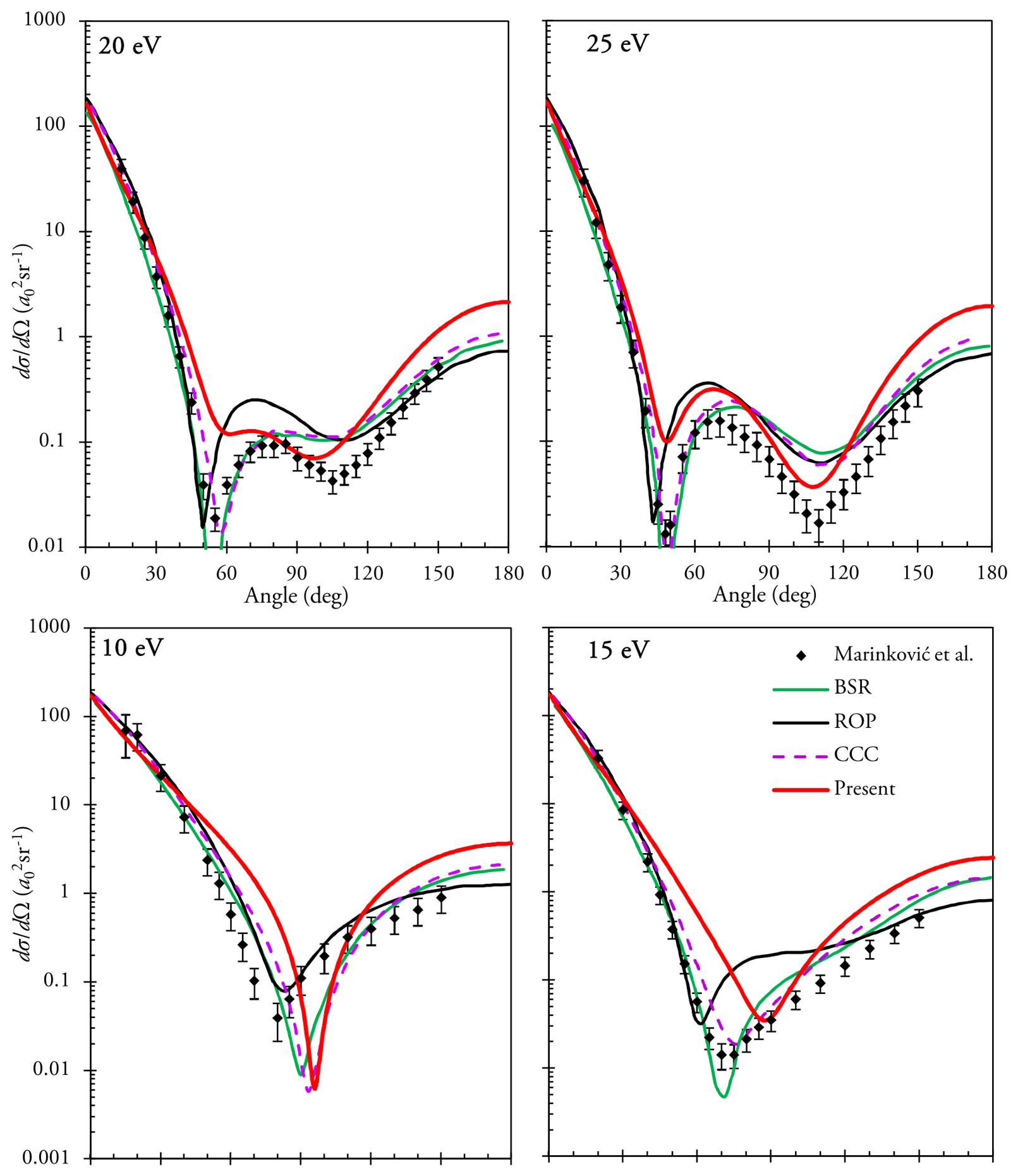
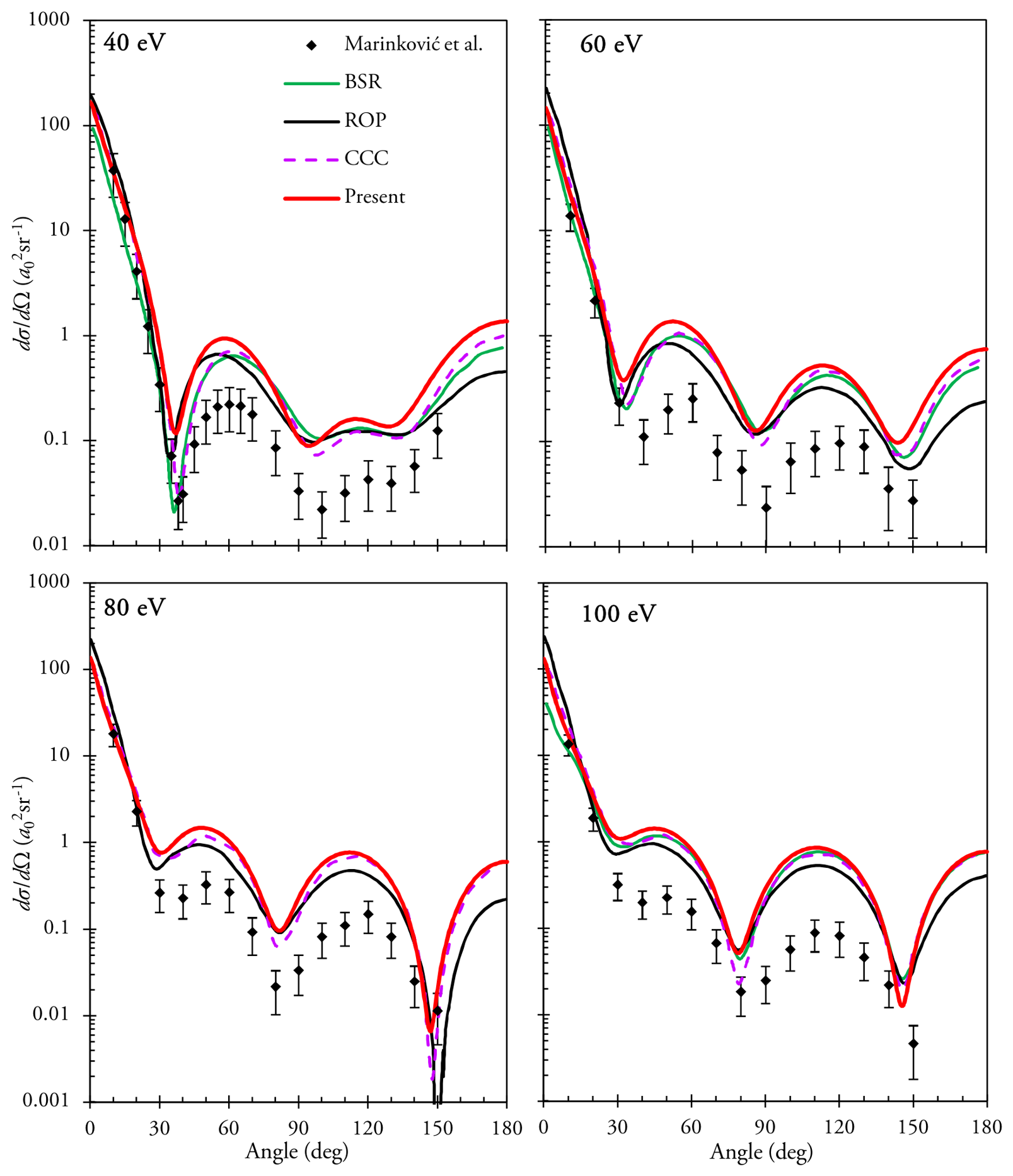
Our elastic differential cross section (DCS) values are shown in Figure 1 and Figure 2. They consist of comparisons with experiments and other theoretical approaches, including the relativistic optical potential (ROP) calculations of Marinković et al. [8], the B-spline R-matrix (BSR) methodology of Zatsarinny et al. [15], and the 206-state convergent close coupling (CCC) formulation of Fursa et al. [14]. Our DCS results are in overall good agreement with other theoretical works for energies above 20 eV.
The agreement between theory and the experimental work of Marinković et al. [8] in all incident energies displayed in Figure 1 and Figure 2 is rather qualitative. This is quite interesting as the agreement between theoretical results for energies above 20 eV is remarkable. For energies E 20 eV , our DCS predictions do not inclusively agree with other theoretical results. Considerable disagreements exist on the locations of DCS minima with other calculations, except for 10 eV projectile energy, where our DCS values indicate the same minimum as that predicted by CCC calculations.
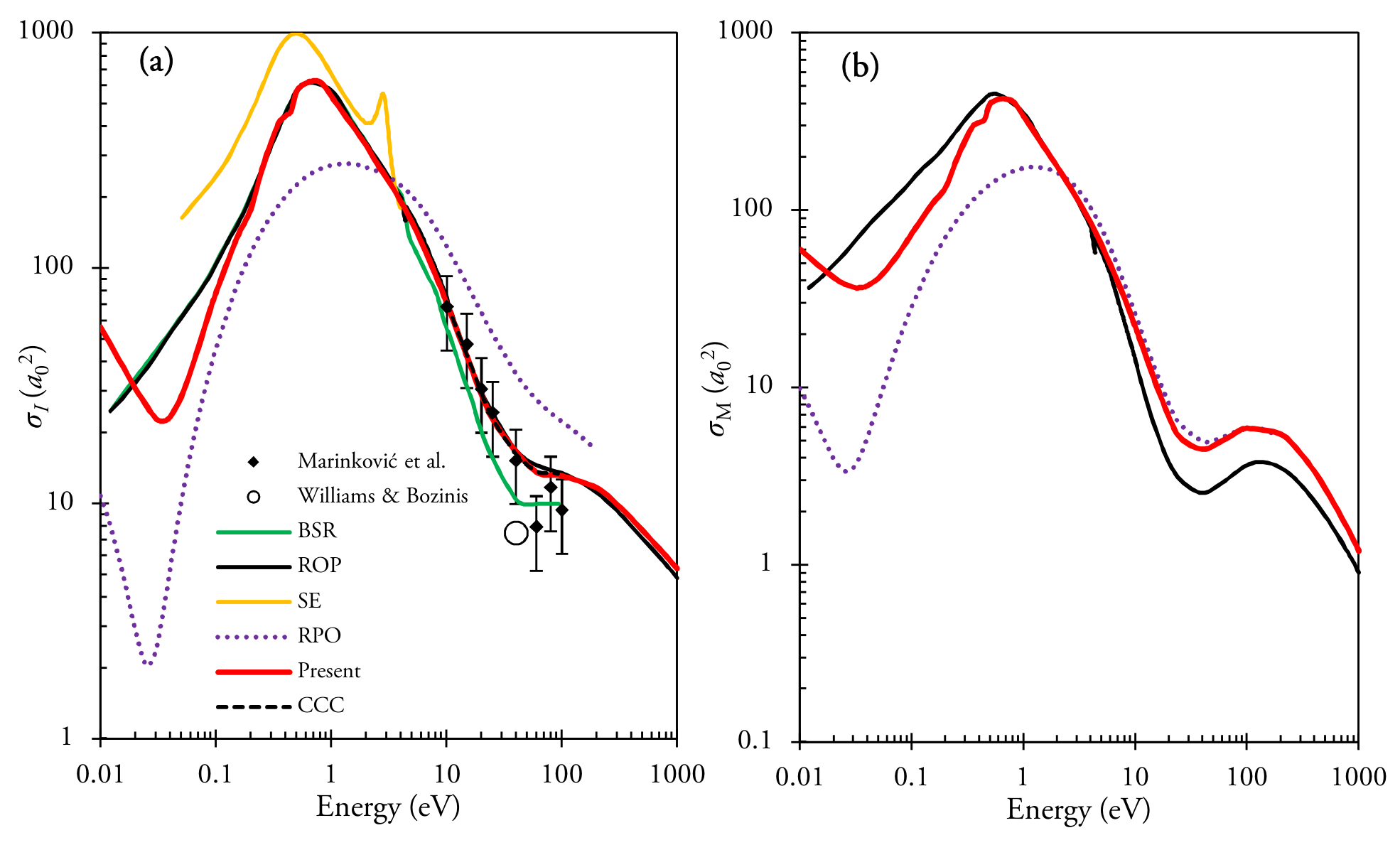
Our elastic angle-integrated cross section (ICS), σ I , and momentum-transfer cross section (MTCS), σ M , are presented in Figure 3. Our predictions for ICS are in very good agreement with the experimental values of Marinković et al. [8] and CCC calculations for energies between 10 eV and 100 eV. Additionally, our ICS values are in good agreement with BSR and ROP values down to 0.2 eV, where our ICS curve dives toward a Ramsauer–Townsend (RT) minimum [67] at about 0.06 eV. Our curve for σ I exhibits a maximum at the same energy as those of BSR and ROP calculations (about 0.7 eV). From right above the threshold for the ( 4 s 4 p ) 3 P 0 state excitation (∼4 eV) our ICS values do not follow, but stay higher than those of BSR calculations toward 100 eV, while being in good agreement with the experiment. That is also the case for the values of the other theoretical calculations in this energy region. The semi-empirical (SE) calculations of Arretche et al. [18] at low energies, and the relativistic polarized-orbital (RPO) calculations of White et al. [13] over a large energy interval, do not agree with the other theoretical results or the experiment, as seen in Figure 3a.
There are no experimental data for the zinc momentum-transfer cross sections, which makes comparisons purely theoretical. While in close agreement with the RPO values of White et al. [13] at high energies, our MTCS values sit higher than those of the ROP calculations down to about 7 eV. From that energy down to the maximum value of MTCS, around 0.7 eV, our σ M values stay in a tight agreement with the ROP’s. Further toward lower energies, our MTCS values present an RT minimum at about 0.06 eV. The ROP values exhibit no RT minimum. The agreement between our values and those of the RPO calculations [13] also ends below 2 eV. Nonetheless, it is noted that the RPO values also demonstrate an RT minimum at a slightly lower energy than ours.
To visualize the global behavior of the elastic differential cross section as a function of impact energy and scattering angle for elastic electron–zinc scattering, we present, in Figure 4, a three-dimensional (3D) graph of the DCS. The 3D graph of zinc cross sections as the energy of incident electrons increases reflects the atomic structure of zinc as well as the dynamics of the collision. A classical view toward this is that of a diffraction pattern. For slow electrons, the outer stretch of the atom is the target, and by optical analogy we expect the diffraction maxima to move toward smaller scattering angles as the wavelength of the incident electron decreases, i.e., the impact energy increases. Nevertheless, as the wavelength of the impacting electron decreases, it penetrates into the atom and reveals its electronic shell structure through the creation of more minima and maxima at intermediate angles. This continues until the wavelength of the electron becomes small enough to only be scattered by the most inner shell of the atom. In the case of zinc we observe a single minimum, as a function of scattering angle, at low energies, which grows to two and then three minima as energy increases, and finally the pattern reduces to a shallow minimum at high energies. This behavior reflects the existence of three fully occupied shells in zinc, K ( n = 1 ) , L ( n = 2 ) , and M ( n = 3 ) , inside the partially filled N ( n = 4 ) shell. The development of the angular distribution of the intensity of scattered electrons as the energy increases, exhibited in the 3D graph for zinc, shows why scattering experiments are so fundamental in our understanding of atomic structure.

3.2. Cadmium

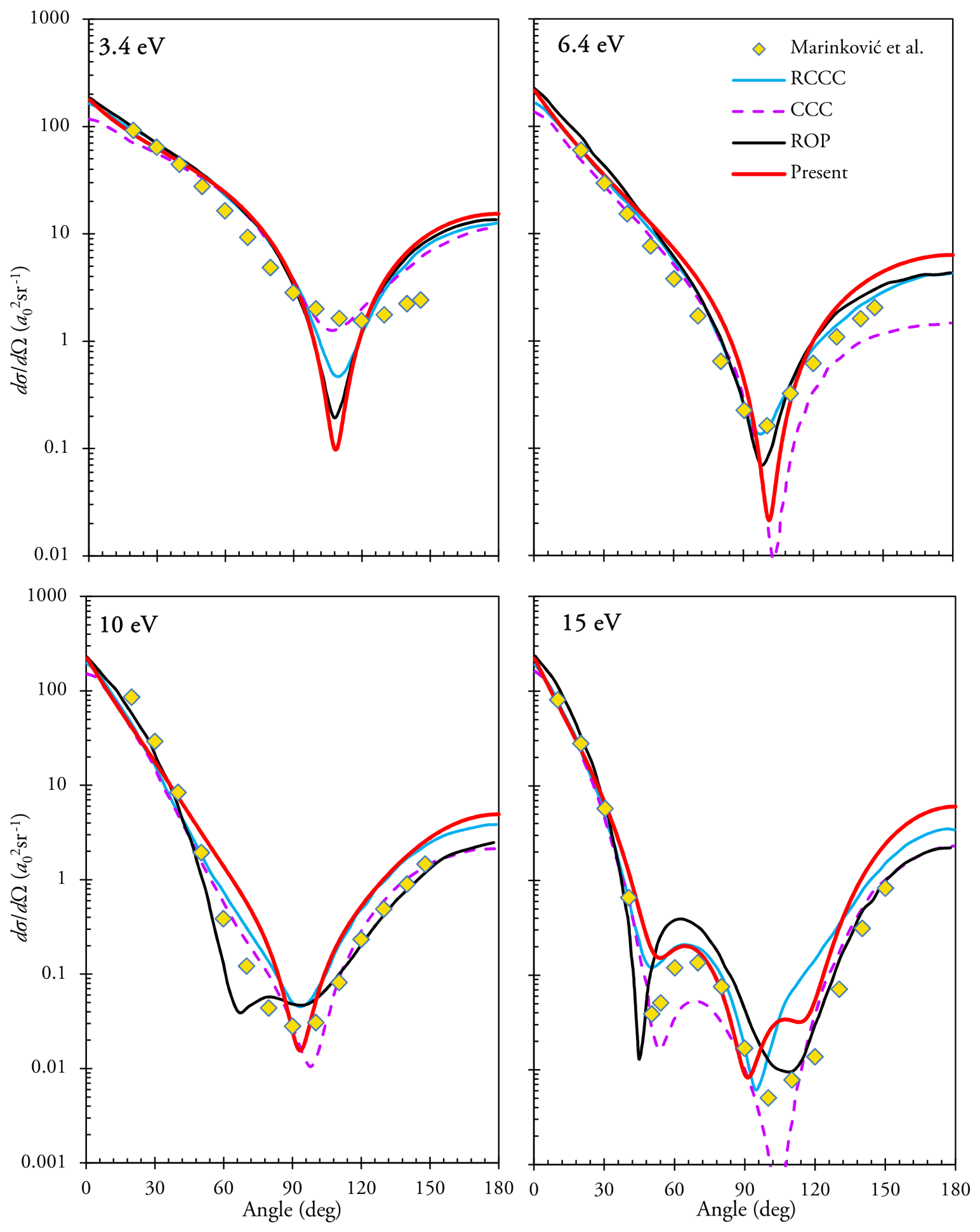
The present DCS results are shown in Figure 5, Figure 6 and Figure 7. These figures display comparisons with the experimental values of Marinković et al. [20] and Nogueira et al. [19]. Data of other displayed theoretical investigations, in those figures, include 200−state relativistic convergent close coupling (RCCC), 183−state CCC accompanied by the ROP calculations of Berrington et al. [28], and the semi-relativistic distorted-wave approach of Madison et al. [27].
Our differential cross sections are in overall good agreement with the experimental data of Marinković et al. [20]. At 3.4 eV, there is a marked disagreement between our DCS values and that of Marinković et al. [20] for angles larger than 90 . Other theoretical results display the same disagreement with the experiment at 3.4 eV impact energy. Our cross sections in Figure 5 show an interesting conformity at all impact energies with the RCCC and CCC values. At 15 eV, they follow the RCCC values more closely.
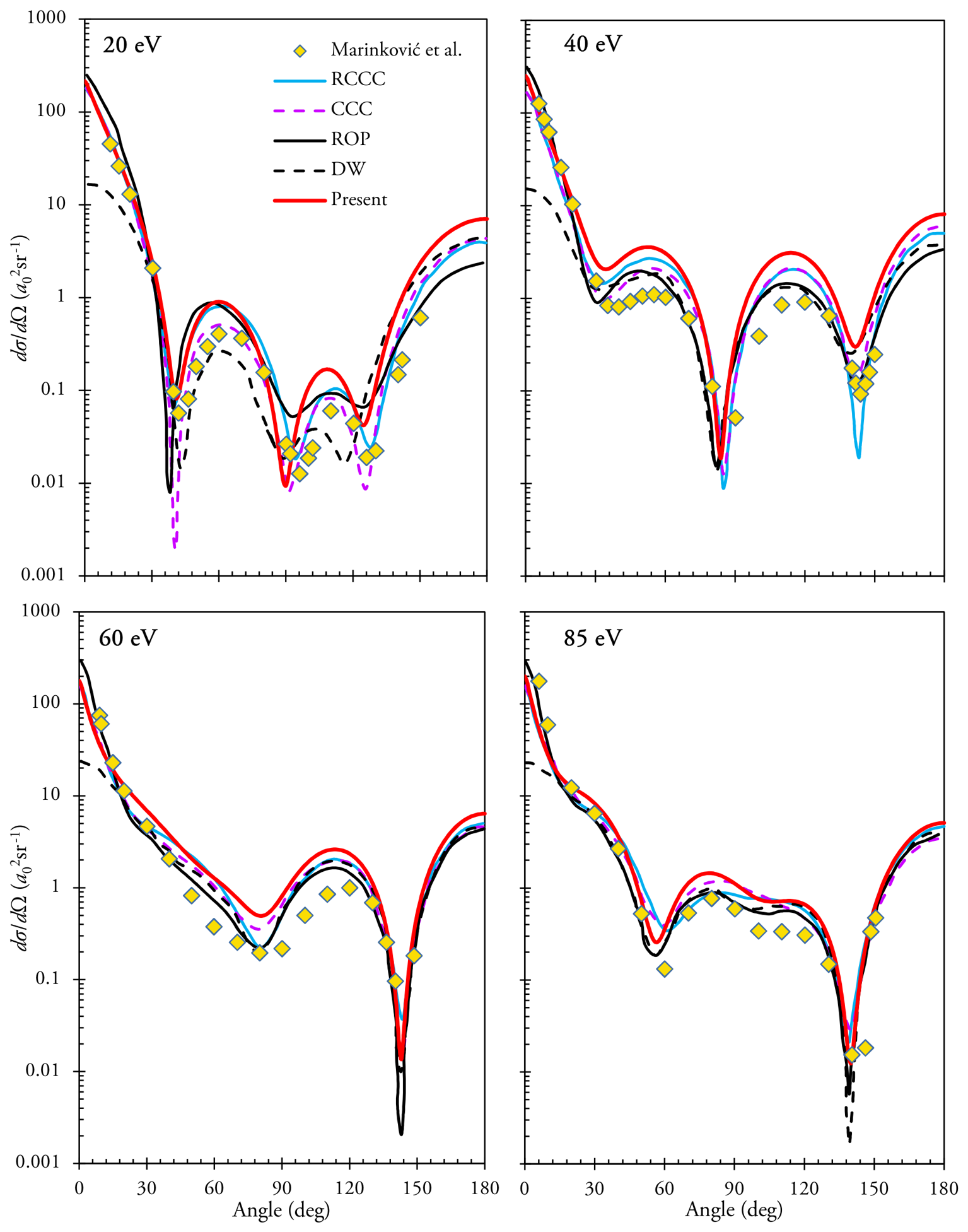
At all impact energies shown in Figure 6, the present values show very good agreement with the ROP, RCCC and CCC results, particularly with the RCCC and CCC calculations at 60 and 85 eV. Disagreements of about an order of magnitude are observed with DW calculations at small scattering angles for all energies in Figure 6. Other theoretical results note the same disagreement with DW values in the very forward direction.
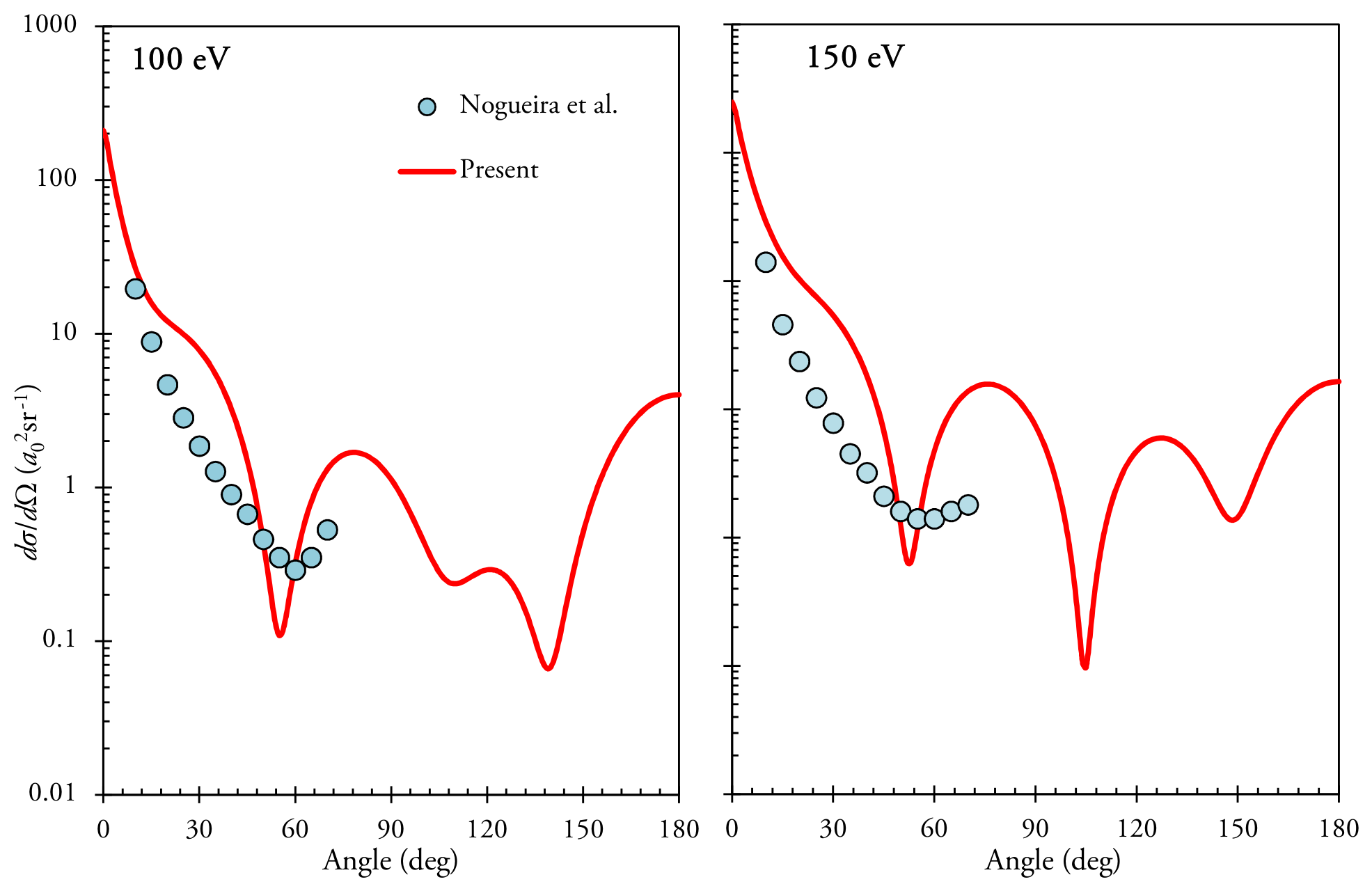
The present DCS results at 100 and 150 eV are compared with the experimental data of Nogueira et al. [19] in Figure 7. Within its limited angular range, the experiment displays pronounced differences with our DCS values. There are no other theoretical data at these two energies for comparison; however, we expect that our theoretical predictions are accurate.
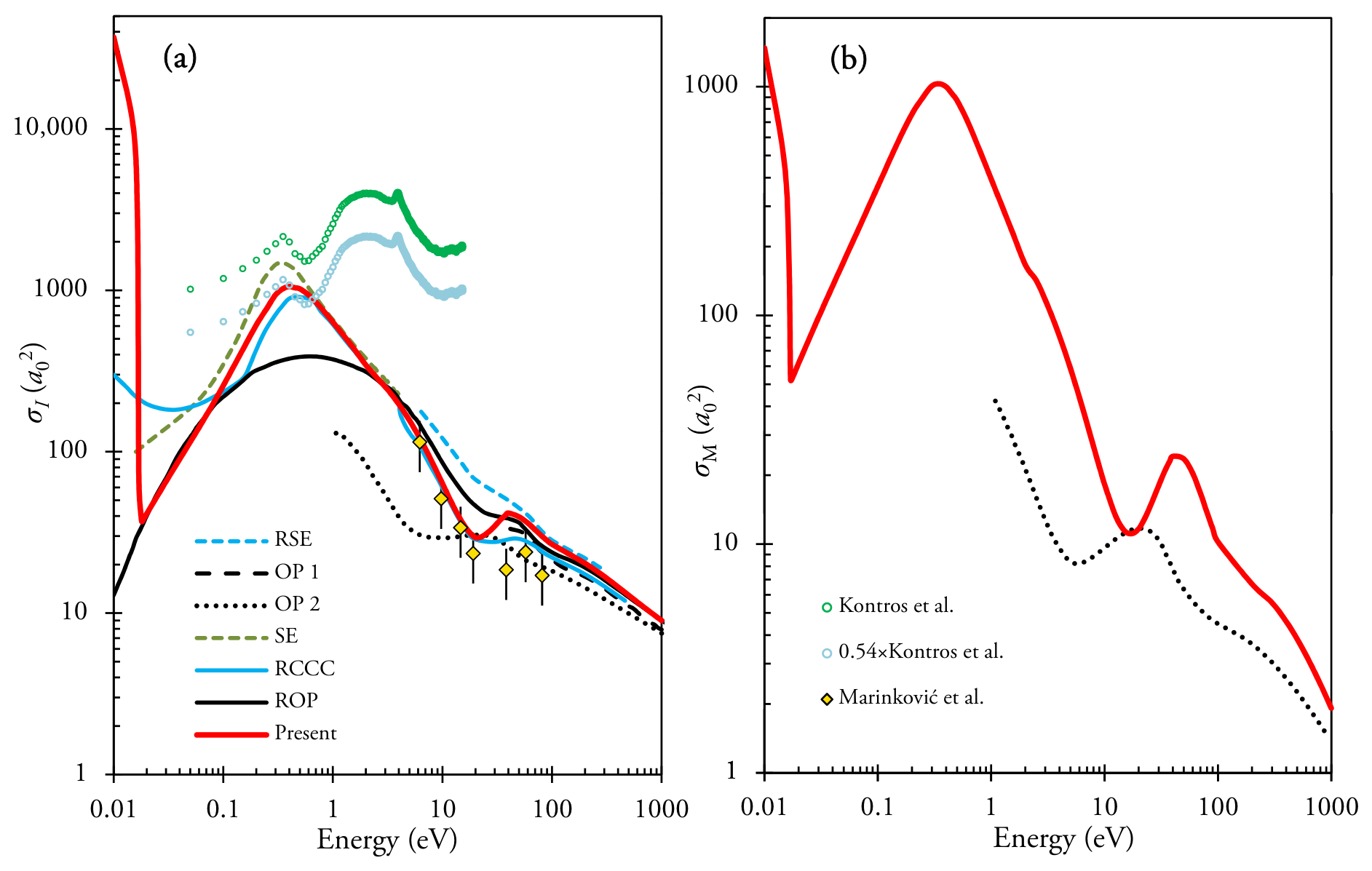
Our ICS and MTCS curves for energies between 0.01 and 1000 eV are presented in Figure 8a and Figure 8b, respectively. The experimental ICS data of Kontros et al. [21] within the energy range of 0.05 to 4 eV indicate a local ICS maximum at around 0.45 eV. Our ICS values exhibit an absolute maximum at 0.4 eV. We took the liberty of renormalizing the relative experimental data of Kontros et al. [21] by a multiplicative factor of 0.54. The agreement below 0.5 eV is acceptable; above that value the experimental data indicate the opening of other excitation channels before reaching the ionization limit. Our calculations are in reasonably good agreement with the recent measurements of Marinković et al. [24]. Agreement between our ICS values and those of other theoretical works is, however, varying. The agreement with the optical potential (OP) calculations of McGarrah et al. [9] and Haque et al. [29] is qualitative, down to 30 eV. Although our ICS values are in excellent agreement with those of the relativistic semi-empirical (RSE) approach of Nahar [26] from 200 down to 30 eV, for energies lower than 30 eV there is considerable disagreement. The ICS values of the semi-empirical (SE) calculations of Arretche et al. [18] are in excellent agreement with our values down to about 1 eV, but below 1 eV they display only a comparable behavior down to 0.08 eV. The RCCC values of Marinković et al. [24] are in overall good agreement with our calculations. The RCCC results are lower than ours for energies above 20 eV, displaying a better agreement with the experiment. Similar to zinc, our ICS values indicate an RT minimum, here at about 0.018 eV. Only the RCCC calculations exhibit a minimum in that area, albeit a broader one. It is worth noting that the energy ranges are extremely narrow in this region.
Similar to zinc, there are no experimental measurements for the cadmium momentum-transfer cross sections and only one set of theoretical data, that of the optical potential (OP 2) calculations of Haque et al. [29]. The comparison shows, at best, a qualitative agreement between the two approaches. Our MTCS curve also displays an RT minimum at about 0.018 eV, where there are no other data to be compared with.
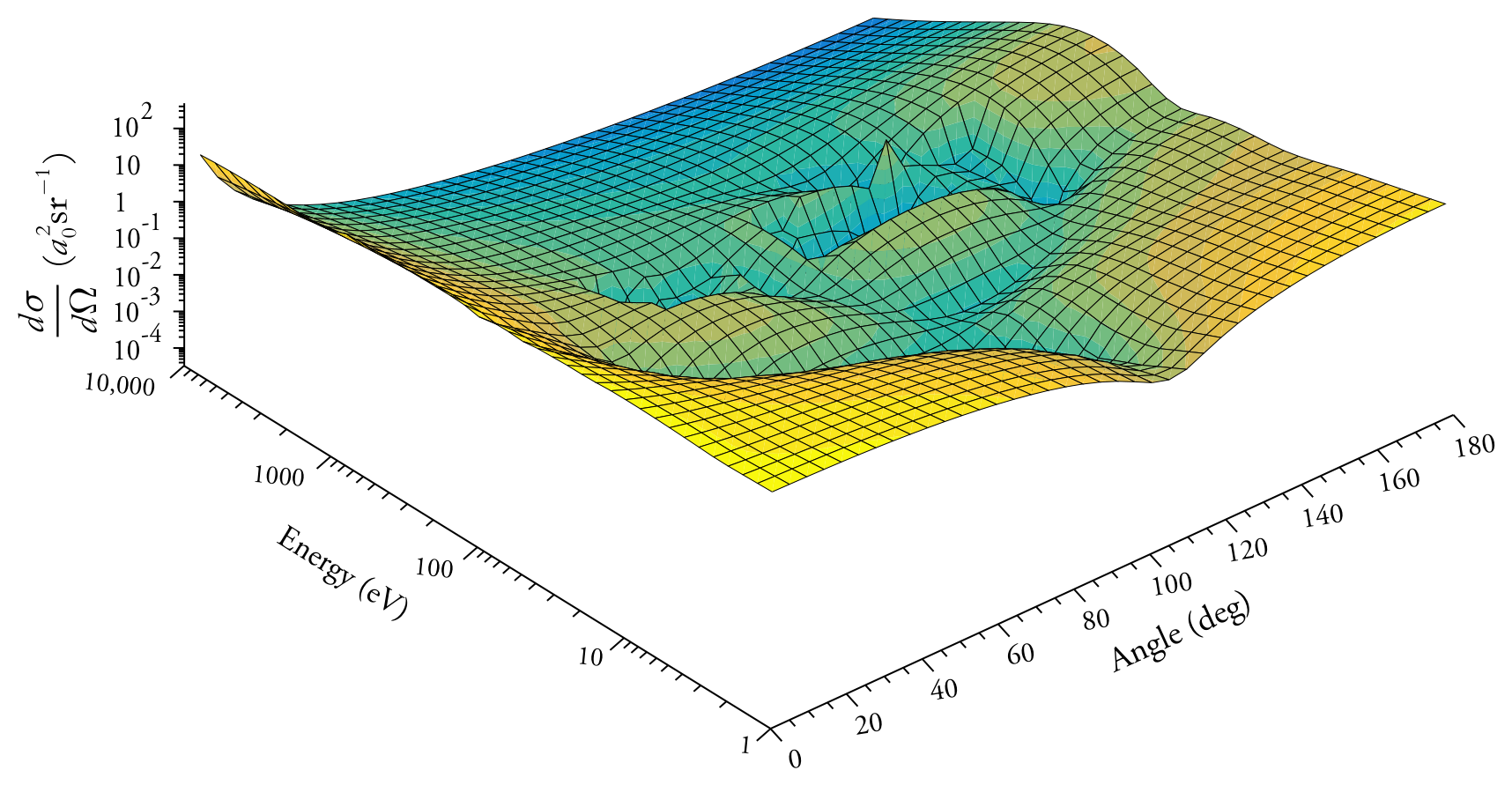
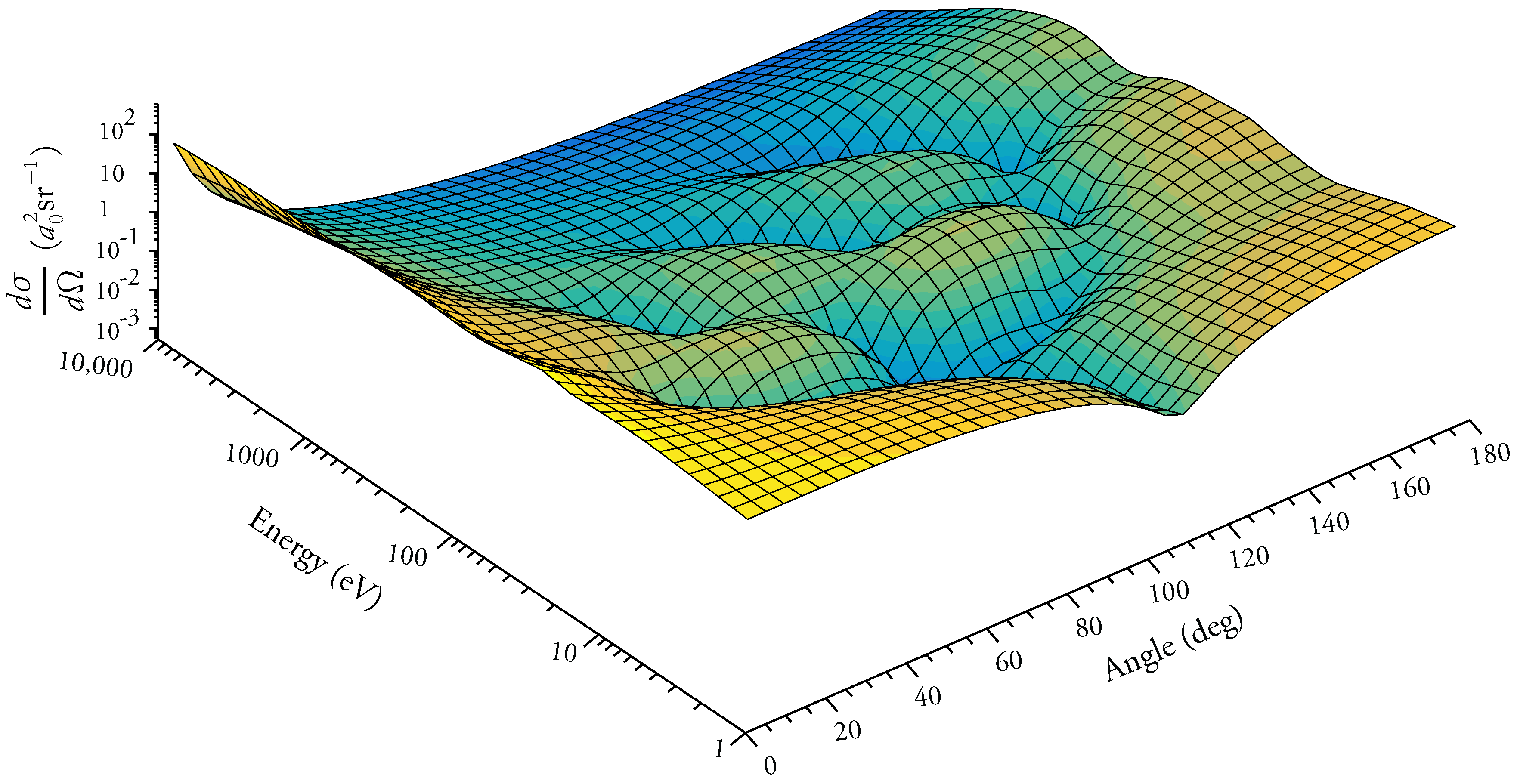
A 3D graph of DCS versus energy and the scattering angle for elastic electron–cadmium scattering is presented in Figure 9. Compared to that of zinc, shown in Figure 4, cadmium’s 3D graph presents a more complex atomic structure, as expected. Similar to zinc, cadmium’s 3D graph of cross sections gives a comprehensive picture of the energy evolution of the scattering process. The optical analogy is even more visible for cadmium than zinc. Low-energy electrons are primarily scattered into small angles with a single drop in the intensity of scattered current. Like zinc, the pattern shows a single minimum in angle, evolving with increasing impact energy to two and finally three distinct minima, before becoming a shallow single minimum. Cadmium has three ( K , L , and M) fully occupied shells. Even though the M ( n = 4 ) shell is being filled, it is not completely full, since the 4 f subshell has not been occupied yet. This happens later, in mercury, where we see its full effect.
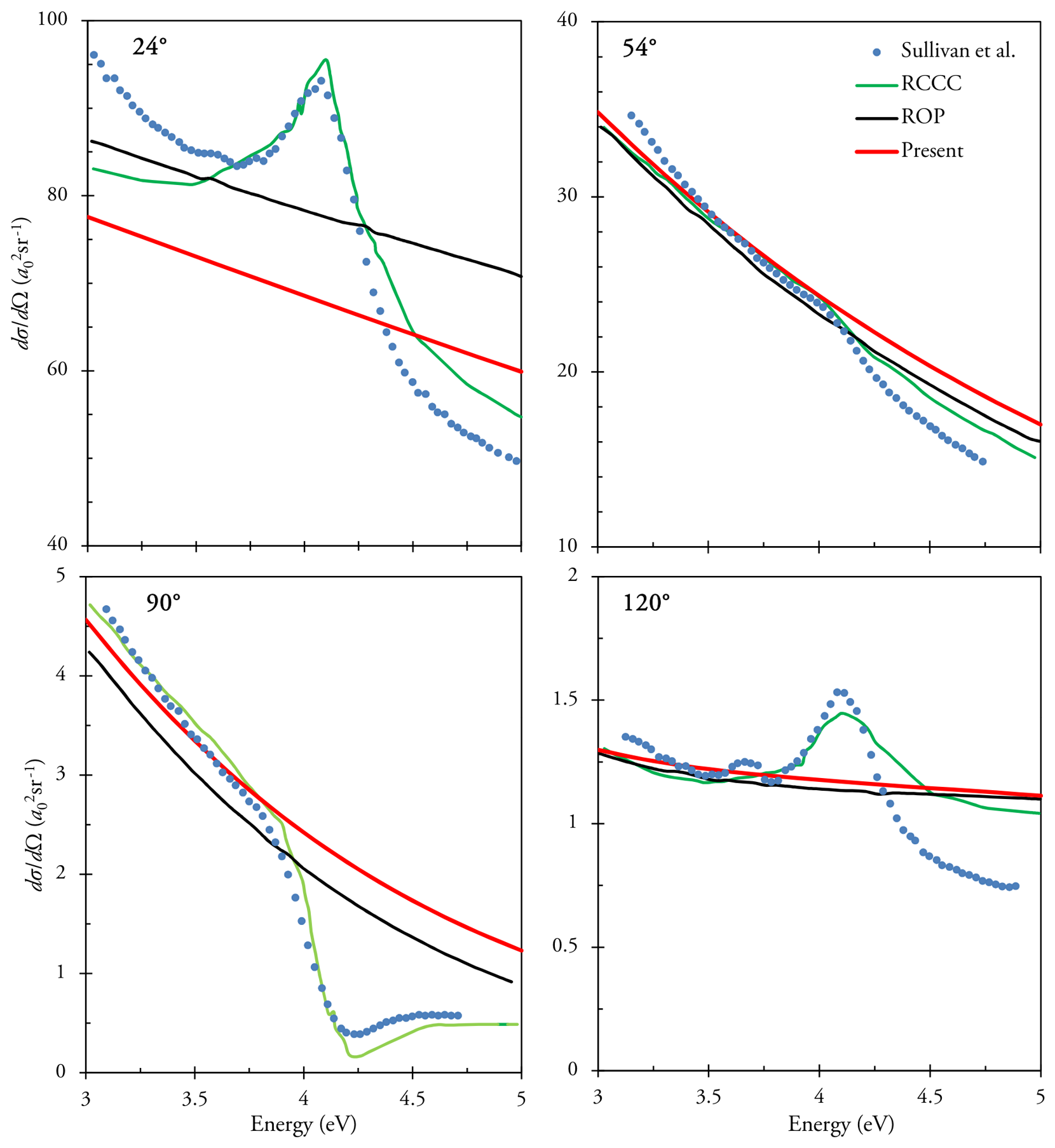
Finally, in Figure 10, we compare our DCS values at low-energy elastic electron–cadmium scattering at various scattering angles with those of experimental and other theoretical results. The purpose of obtaining the cross sections shown in the graphs was to demonstrate the existence of a low-energy resonance structure and its subsequent effect on the elastic e-Cd scattering. Clearly, the 55-state RCCC calculation of Berrington et al. [28] confirms the existence of such resonance structures in very good agreement with the experimental data of Sullivan et al. [23]. Our DCS predictions and those of the ROP method [28] show no sign of resonance in the elastic scattering spectrum, which was expected from a single-channel approach.

3.3. Mercury

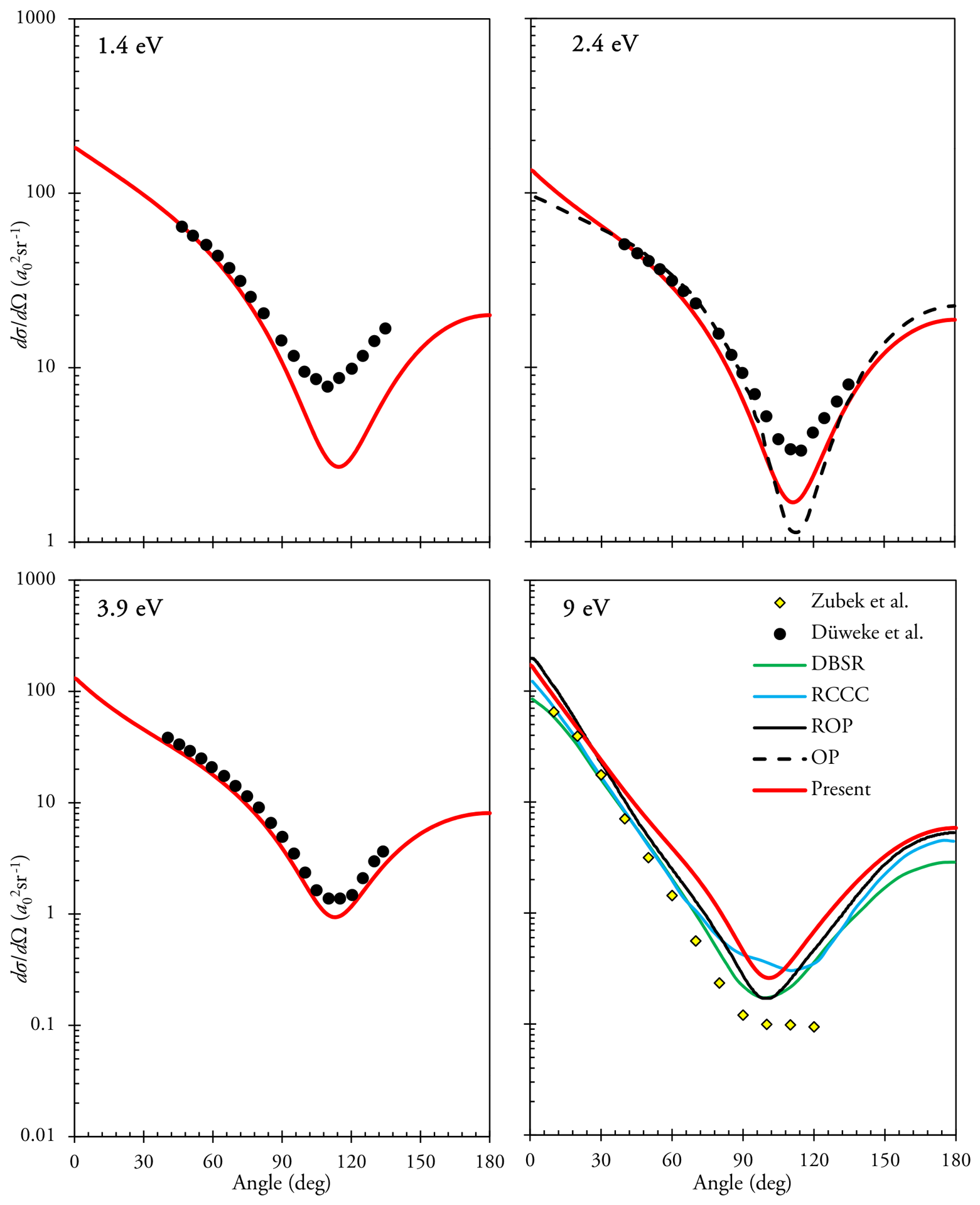
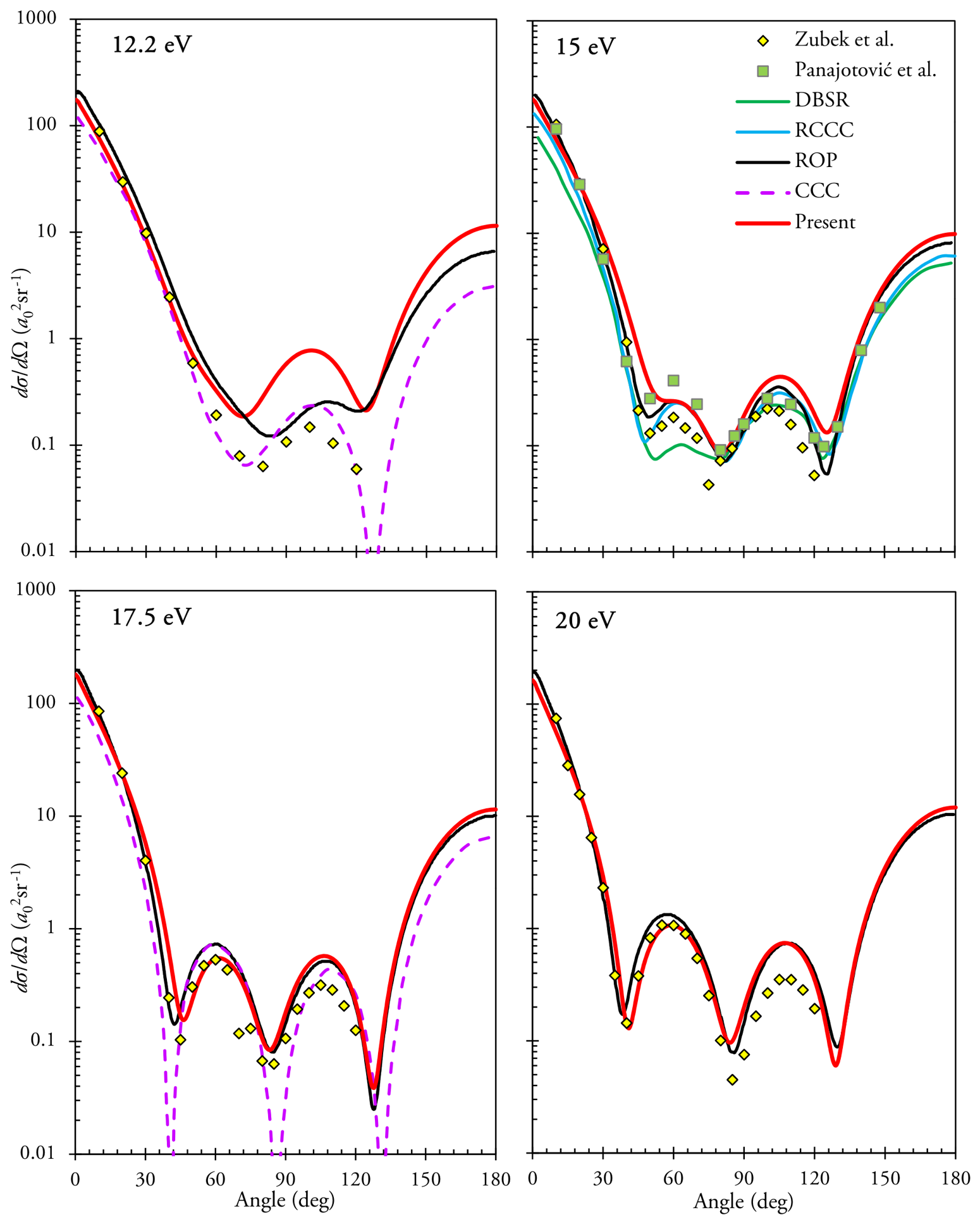
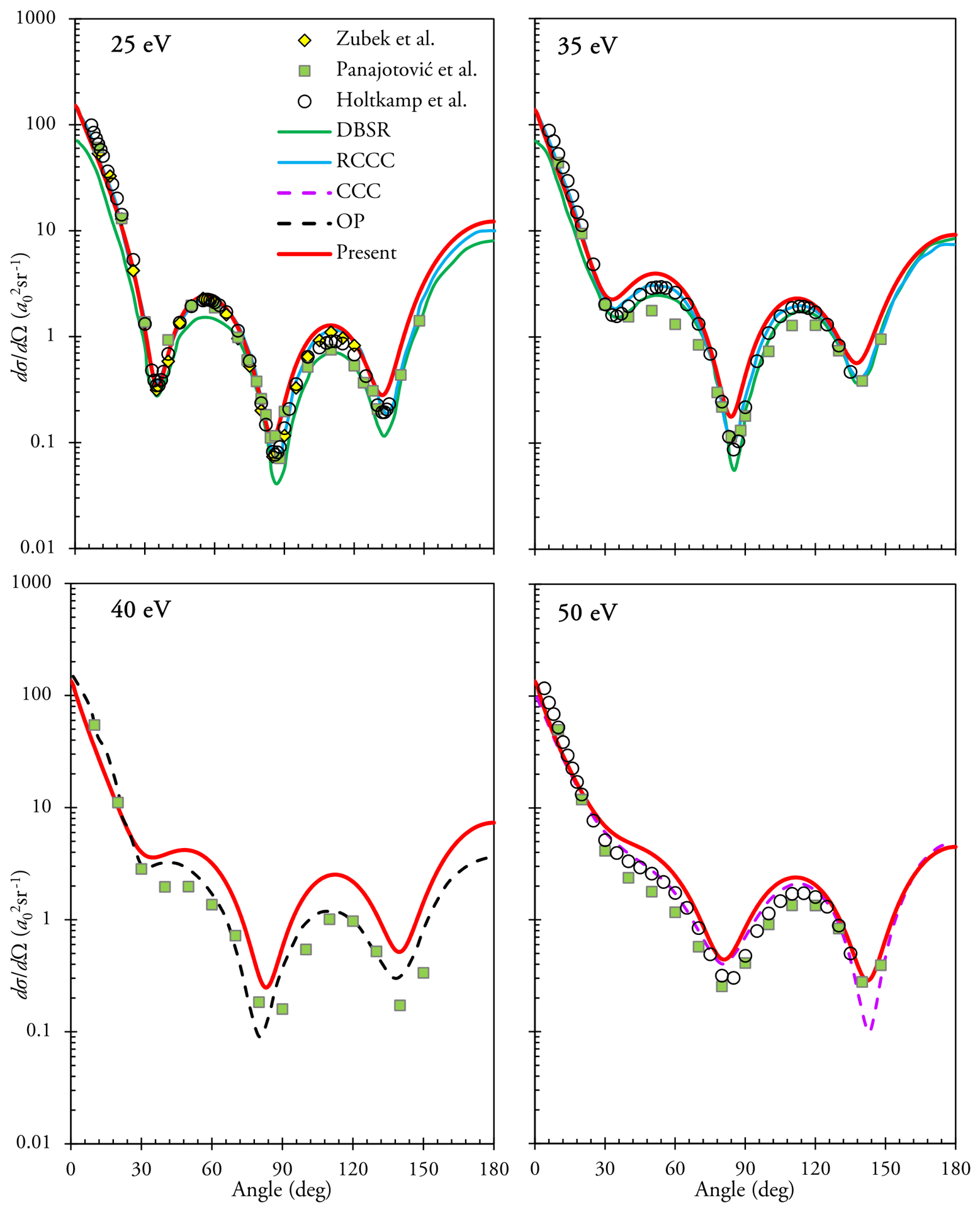
We present our DCS values for elastic electron scattering off mercury in Figure 11, Figure 12, Figure 13, Figure 14 and Figure 15. Comparisons are made with the experimental works of Zubek et al. [46], Düweke et al. [40], Panajotović et al. [45], Holtkamp et al. [43], Bromberg [38], Peitzmann and Kessler [44] and Kessler and Lindner [36] as well as a collection of theoretical works, which includes the 36-state Dirac B-spline R-matrix (DBSR) calculations of Zatsarinny and Bartschat [59], the 193-state RCCC investigation of Bostock et al. [60], the 54-state CCC formulation of Fursa et al. [56], the frozen-core Dirac–Fock potential, the polarization model potential (ROP) calculations of Sienkiewicz [55], and the Dirac relativistic partial-wave analysis and complex projectile-atom optical potential (OP) investigation of Haque et al. [29].
Our differential cross sections are in excellent agreement with the measurements of Düweke et al. [40] at 3.9 eV, while at 1.4 and 2.4 eV our DCS minimum is more pronounced. At 9 eV the displayed theoretical results are more or less in agreement on the position of DCS minimum, around 100 . The experimental data of Zubek et al. [46] do not display a clear minimum, although the data do not extend beyond 120 .
At 12.2 eV impact energy, our DCS values agree with the experimental data [46] only in the forward scattering angles, while CCC predictions are in excellent agreement with experiment throughout. The present DCS curve at 15 eV displays three minima but overall favors the measurements of Panajotović et al. [45] over those of Zubek et al. [46]. Above 15 eV and through 25 eV, our differential cross sections display very good agreement with the experimental data of Zubek et al. [46]. At 17.5 eV, our values slightly disagree on the positions of the minima with the ROP [55] and CCC [56] results, and on their depths with the CCC [56] predictions. The same disagreements on the positions of the minima are observed for 20 eV impact energy with the ROP [55], where our DCS values are in excellent agreement with the experiment in the forward scattering angles up to 90 and good agreement through 120 .
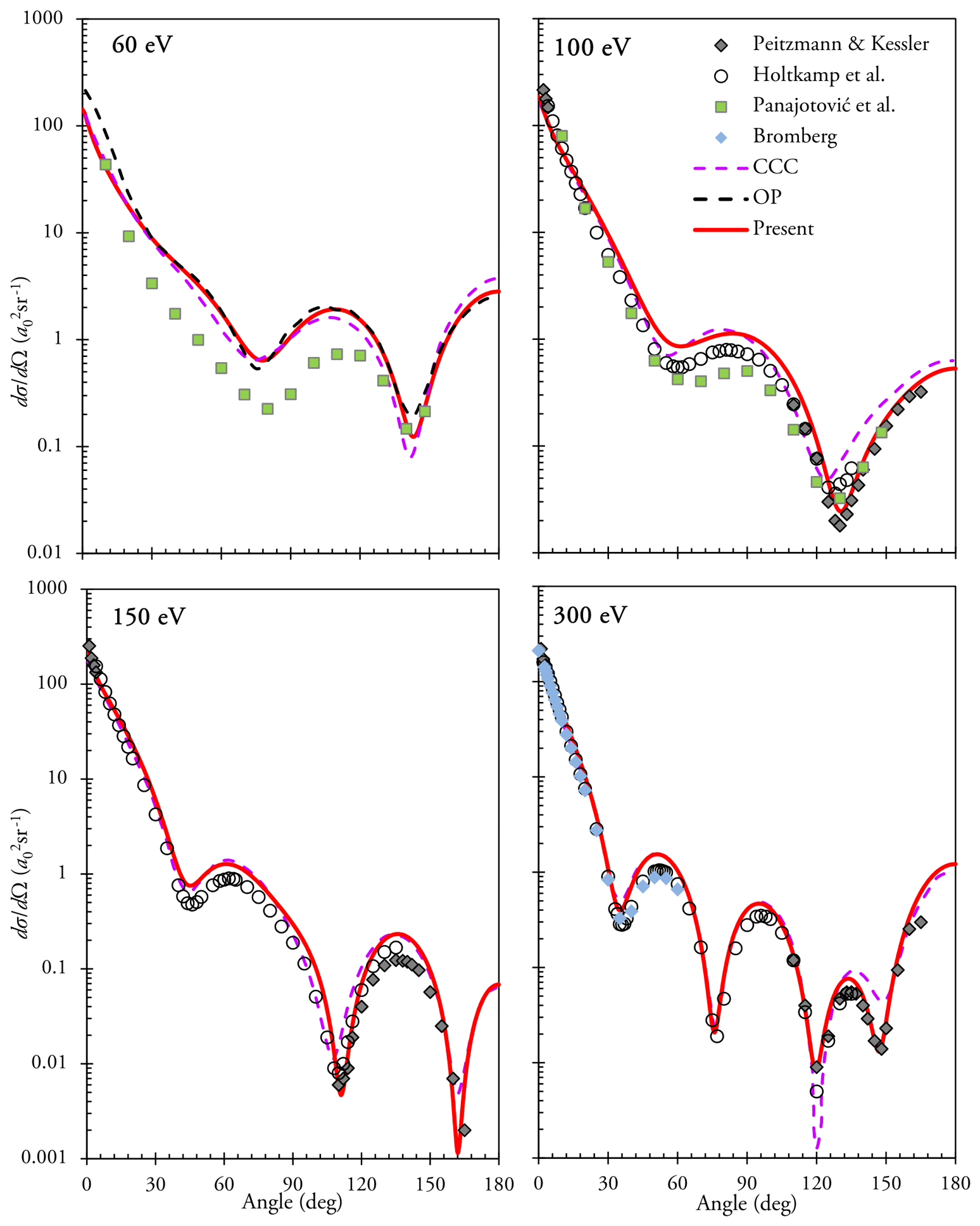
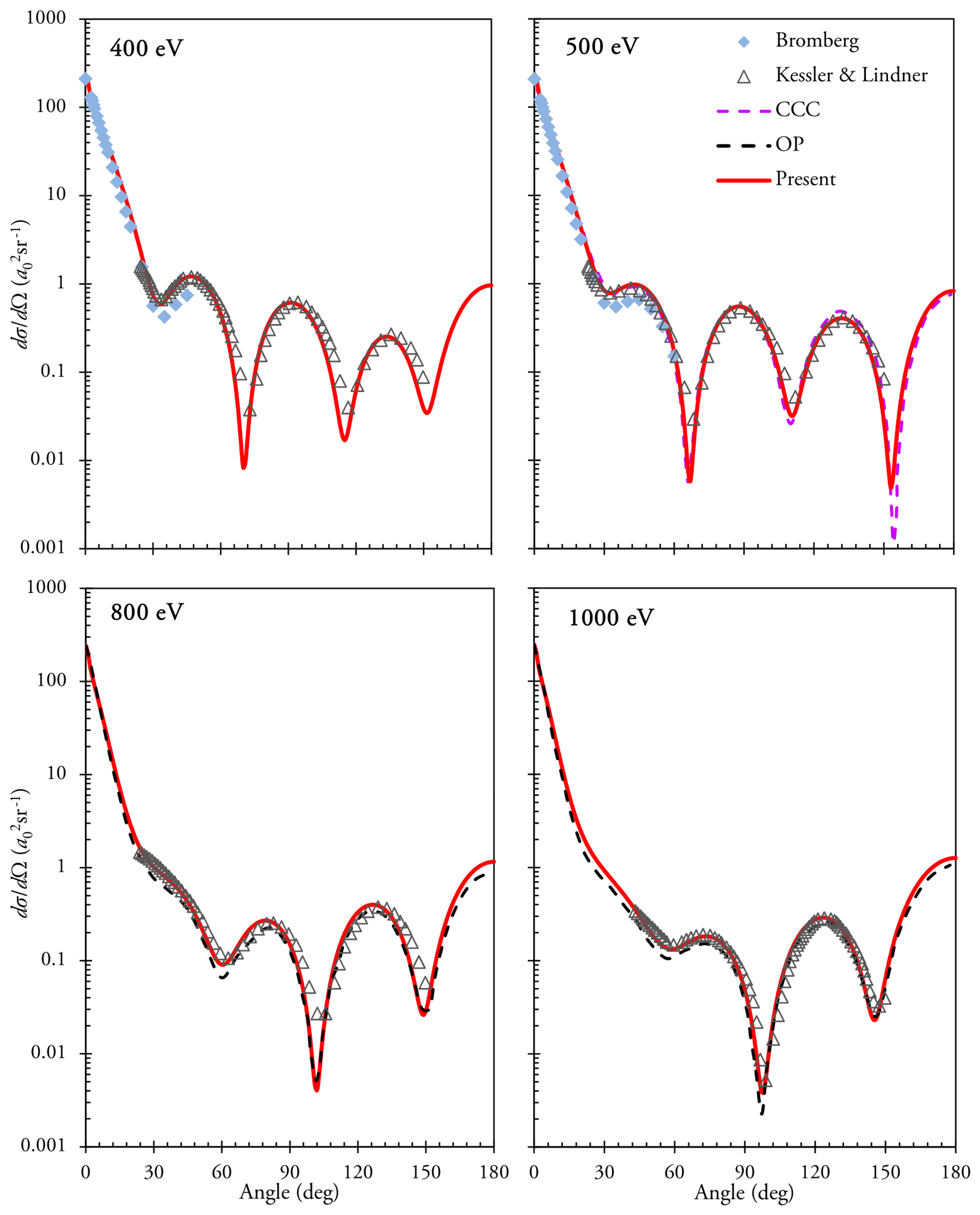
At 25 and 35 eV, single- and multi-channel calculations are in very good agreement with each other and the experimental data. This implies the quality of the scattering potential is the deterministic factor in cross section calculations at such energies. Comparing with the experimental data of Panajotović et al. [45] at 40 and 60 eV, we observe agreement in the shape but discrepancy in the scale of the data. There is, however, good agreement at 50 and 100 eV with the measurements of Panajotović et al. [45]. At energies higher than 100 eV, our DCS predictions are in excellent agreement with various experimental data and, to some extent, with other theoretical works. These agreements include the measurements of Holtkamp et al. [43], available between 25 eV and 300 eV, which are in excellent agreement with various theories, and the experimental data of Peitzmann and Kessler [44], for 100 eV and 150 eV, as well as those of Bromberg [38] for 300 eV. At 400, 500, 800, and 1000 eV, the experimental data of Bromberg [38] and Kessler and Lindner [36] agree well with our predictions, as well as those of the CCC [56] and OP [29] calculations. Altogether, previous theoretical results are not available below 9 eV impact energy, above which they agree remarkably well, except for the CCC values that display deeper minima.
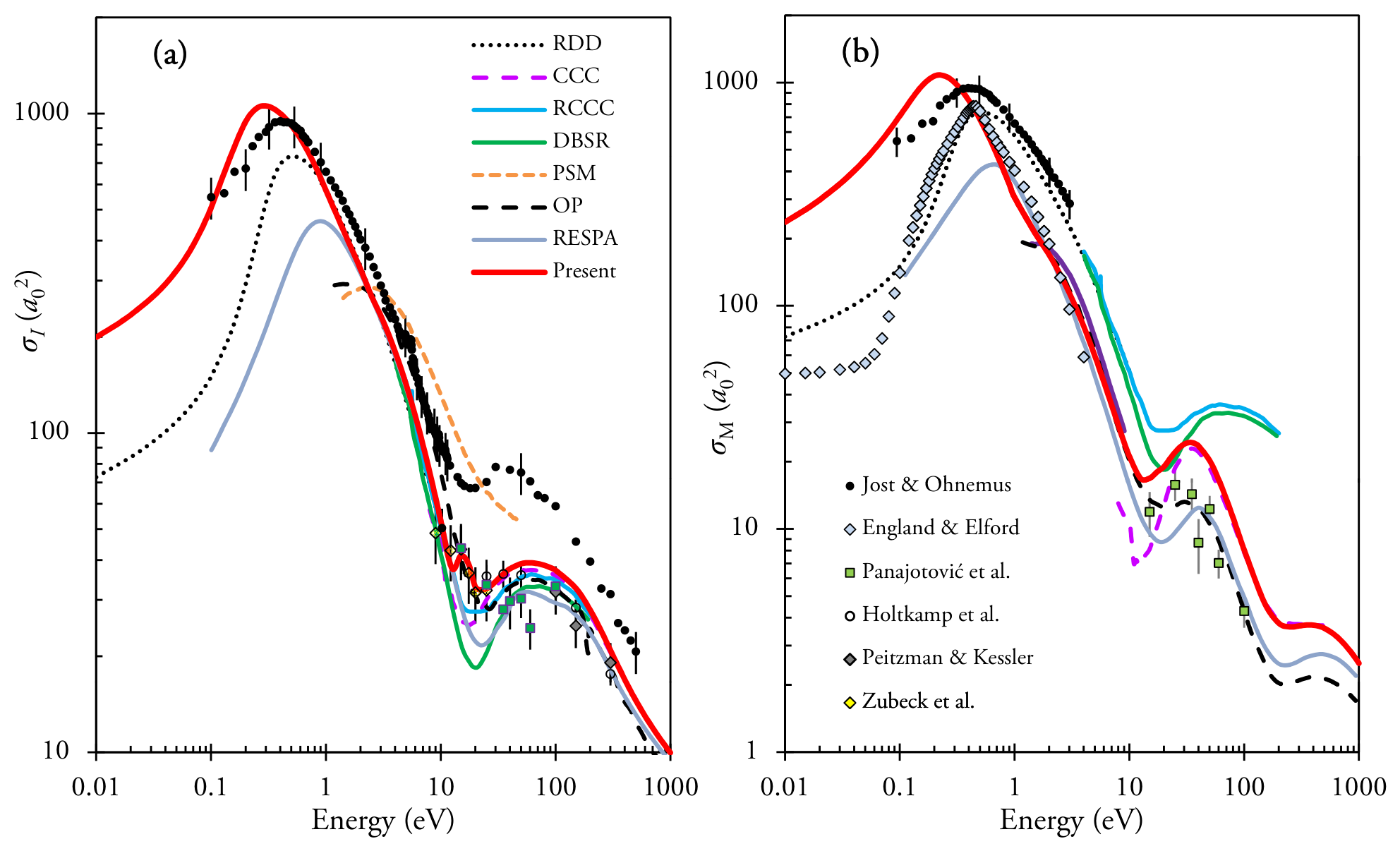
Figure 16a,b display comparisons of our ICS and MTCS values with experiments and other theoretical works for elastic electron scattering from mercury for energies between 0.01 and 1000 eV. These comparisons include a number of the aforementioned works. They also include measurements by Jost and Ohnemus [41] and England and Elford [54], as well as the potential scattering model (PSM) calculations of McEachran and Stauffer [53] and the relativistic dynamic distortion (RDD) calculations of McEachran et al. [58].
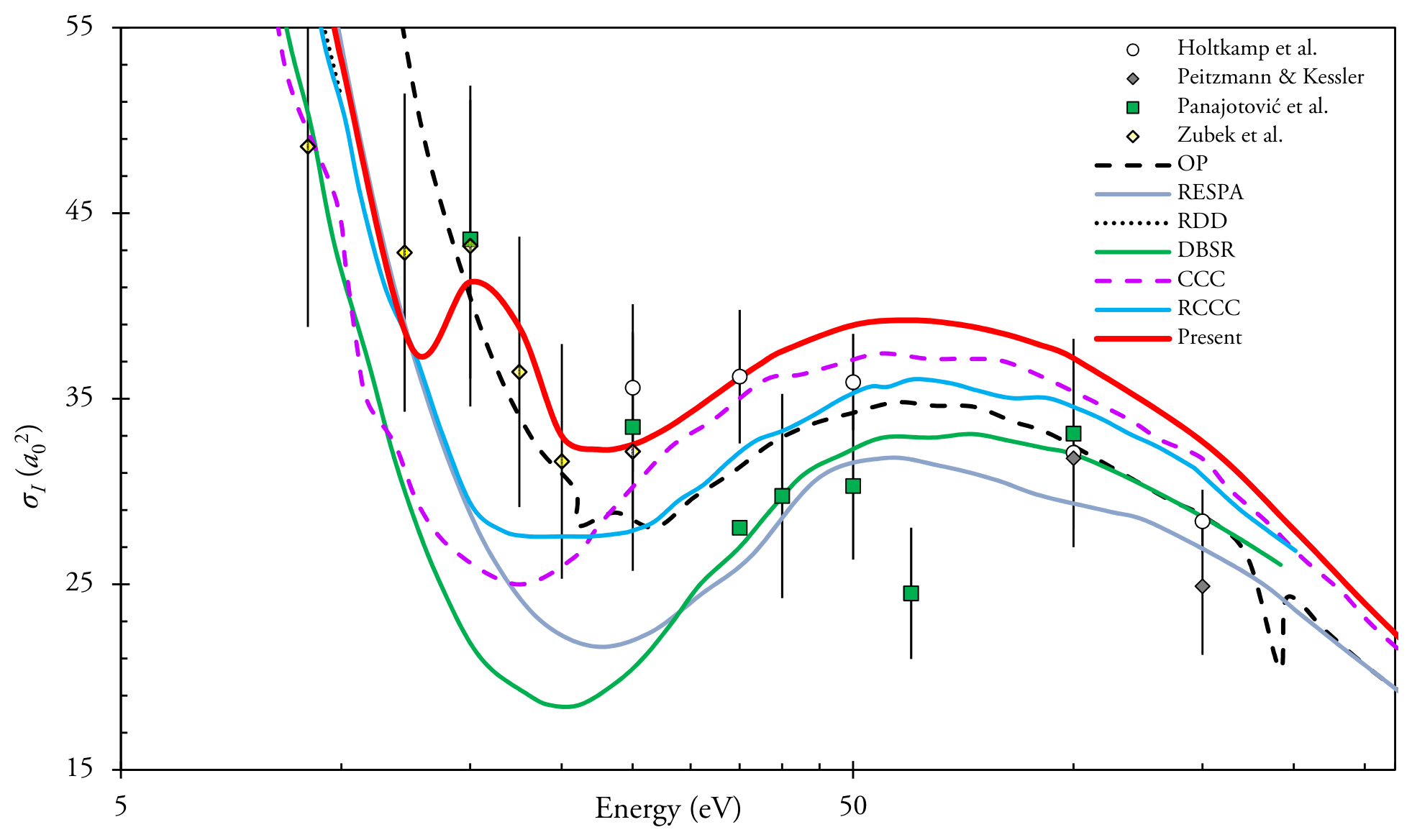
The experimental ICS data by Zubek et al. [46], Holtkamp et al. [43], and Peitzmann and Kessler [44] show close agreement within the energy range of 10 to 300 eV wherever they overlap. Our ICS values display excellent agreement with the values from experiment and convergent close coupling calculations [56,60] down to low impact energies. At energies between 10 and 25 eV, our ICS curve closely follows the experimental data of Zubek et al. [46], while disagreeing with other theoretical values, e.g., the DBSR [59] values which exhibit a significantly deeper minimum in this energy region compared to others. For energies below 10 eV, our ICS values are in excellent agreement with the DBSR [59] and RCCC [60] values. The experimental data of Jost and Ohnemus [41] agree well with our calculations from 0.1 eV up to about 5 eV. Thereafter, the experimental values are higher since they include the onset of inelastic channels.
To emphasize the degree of agreement between various theories and experiments, we show in Figure 17 an enlarged portion of the ICS graph for energies between 5 and 275 eV. Of all calculations, ours uniquely predicts a structure around 15 eV, which seems to be corroborated by the data of Zubek et al. [46].
Unlike zinc and cadmium, for the mercury momentum-transfer cross sections there are three experimental measurements, i.e., Refs. [41,45,54], as well as six other theoretical treatments, i.e., Refs. [29,53,56,58,59,60]. Our data exhibit a “behavioral” agreement with the measurements of Panajotović et al. [45] at energies between 10 and 100 eV and some agreement with the experiment by Jost and Ohnemus [41] between 0.1 and 1 eV. The experimental data of England and Elford [54], while displaying a similar shape to that of Jost and Ohnemus [41], are in good agreement with our values down to 0.4 eV. The theoretical results of the RDD method [58] overlap fittingly with the experimental data of Jost and Ohnemus [41] down to 0.9 eV while sitting higher than our values.
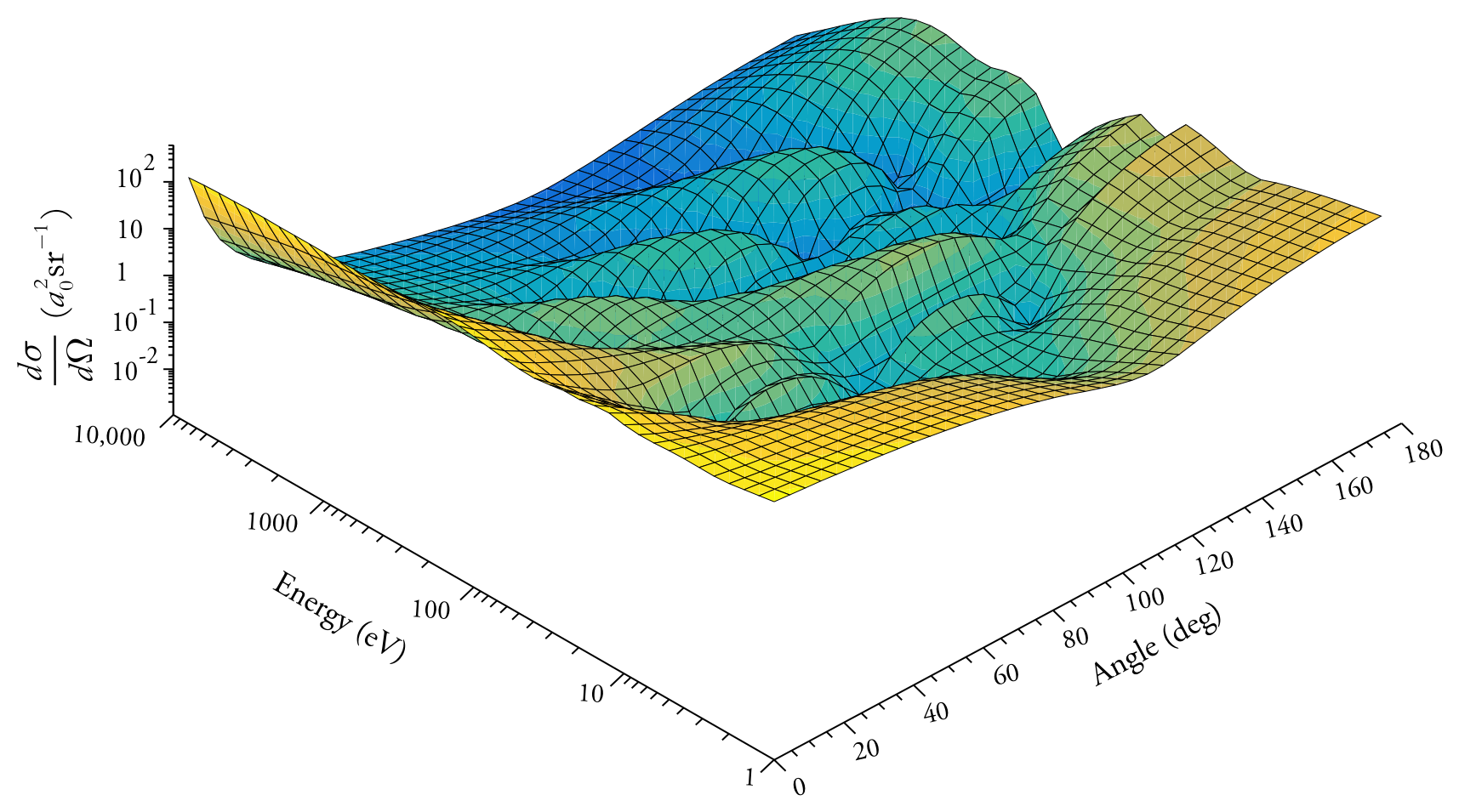
Finally, we present a 3D graph of DCS versus energy and the scattering angle for elastic scattering of electrons off mercury in Figure 18. Compared to zinc and cadmium, mercury’s 3D graph of differential cross sections exhibits a more profound diffraction pattern. The formation and progression of minima and maxima at different angles in the intensity of scattered electrons through the optical analogy are more comprehensive for mercury. While slow scattered electrons attain a single minimum at around 90 degrees, as impact energy increases the pattern displays two, three, and eventually four minima, before returning to a single shallow minimum at very high energies. As mentioned in the case of cadmium, in mercury the 4 f subshell is now fully filled, and collapses physically within the M shell, inside the partially filled N and O ( n = 5 ) shells. This is reflected in the number of minima observed. A good discussion on the physical size of atomic (sub)shells as they fill across the Periodic System is given by Fano et al. [68].

4. Conclusions

We now have extended our method of calculations for inert gases and alkaline-earth-metal atoms to Zn, Cd, and Hg with the outer shell configuration n d 10 ( n + 1 ) s 2 . Our method is relatively simple: a self-consistent relativistic calculation of the target potential plus an exchange and a polarization potential with only one adjustable parameter, the cutoff radius of the polarization potential. Our DCS values compare well with most of the available experimental DCS data and other sophisticated calculations; additionally, they extend well into higher impact energies. Our 3D graphs show the global behavior of the cross sections and indicate the imaging of the electronic structure of the target atoms in the scattered electron angular distributions. An a posteriori review of our earlier results on He, Be, Ne, Mg, Ar, Ca, Kr, Sr, Xe, and Ba [1,2,3] corroborates the association of the number of minima in the DCS with the number of fully occupied shells in the respective target atoms. The present ICS values also reached good agreement with the results of other calculations. Comparisons between our cross sections with prior theoretical results generated both agreements and disagreements. The latter were present when the effect of virtual excitation of core states was important. This was particularly the case for cadmium. We believe our present extensive study, together with the other dependable calculations referred to in the current paper, can serve to identify the experimental data that are the most accurate. In summary, we expanded the available data on elastic electron scattering from zinc, cadmium and mercury over a broad energy range to serve as guidance for future relevant experimental efforts.

Supplementary Materials

The following supporting information can be downloaded at: https://www.mdpi.com/article/10.3390/atoms14070050/s1.

Author Contributions

Conceptualization, M.A. and C.E.T.; methodology, M.A. and C.E.T.; software, M.A. and C.E.T.; validation, M.A. and C.E.T.; formal analysis, M.A. and C.E.T.; data curation, M.A. and C.E.T.; writing—original draft preparation, M.A.; writing—review and editing, M.A. and C.E.T.; visualization, M.A.; supervision, M.A. and C.E.T. All authors have read and agreed to the published version of the manuscript.

Funding

This research received no external funding.

Data Availability Statement

The original contributions presented in this study are included in the article/supplementary material. Further inquiries can be directed to the corresponding author.

Conflicts of Interest

The authors declare no conflicts of interest.

References

  1. Adibzadeh, M.; Theodosiou, C.E. Elastic electron scattering from inert-gas atoms. At. Data Nucl. Data Tables 2005, 91, 8–76. [Google Scholar] [CrossRef]
  2. Adibzadeh, M.; Theodosiou, C.E. Elastic electron scattering from Ba and Sr. Phys. Rev. A 2004, 70, 052704. [Google Scholar] [CrossRef]
  3. Adibzadeh, M.; Theodosiou, C.E.; Harmon, N.J. Elastic Electron Scattering from Be, Mg, and Ca. Atoms 2024, 12, 33. [Google Scholar] [CrossRef]
  4. Brode, R.B. The Absorption Coefficient for Slow Electrons in Cadmium and Zinc Vapors. Phys. Rev. 1930, 35, 504–508. [Google Scholar] [CrossRef]
  5. Childs, E.C.; Massey, H.S.W.; Rutherford, E. The scattering of electrons by metal vapours. I.—Cadmium. Proc. R. Soc. Lond. Ser. A Contain. Pap. Math. Phys. Character 1933, 141, 473–483. [Google Scholar] [CrossRef]
  6. Williams, W.; Bozinis, D. Electron impact excitation of zinc vapor at 40 eV. Phys. Rev. A 1975, 12, 57–59. [Google Scholar] [CrossRef]
  7. Burrow, P.D.; Michejda, J.A.; Comer, J. Low-energy electron scattering from Mg, Zn, Cd and Hg: Shape resonances and electron affinities. J. Phys. B At. Mol. Phys. 1976, 9, 3225. [Google Scholar] [CrossRef]
  8. Marinković, B.P.; Panajotović, R.; Šević, D.; McEachran, R.P.; García, G.; Blanco, F.; Brunger, M.J. Experimental and theoretical cross sections for elastic electron scattering from zinc. Phys. Rev. A 2019, 99, 062702. [Google Scholar] [CrossRef]
  9. McGarrah, D.B.; Antolak, A.J.; Williamson, W.J. Elastic scattering of electrons by free and bound zinc and cadmium atoms. J. Appl. Phys. 1991, 69, 6812–6816. [Google Scholar] [CrossRef]
  10. Yuan, J.; Zhang, Z. Elastic cross sections of electron scattering with Zn and Cd atoms below 4 eV. Phys. Rev. A 1992, 45, 535–537. [Google Scholar] [CrossRef] [PubMed]
  11. Kumar, P.; Jain, A.K.; Tripathi, A.N.; Nahar, S.N. Spin-polarization parameters and cross sections for electron scattering from zinc and lead atoms. Phys. Rev. A 1994, 49, 899–907. [Google Scholar] [CrossRef] [PubMed]
  12. Born, M. Investigations on the replacement of mercury in high-pressure discharge lamps by metallic zinc. J. Phys. D Appl. Phys. 2001, 34, 909. [Google Scholar] [CrossRef]
  13. White, R.D.; McEachran, R.P.; Robson, R.E.; Elford, M.T.; Bartschat, K. Cross sections and transport coefficients for electrons in Zn vapour. J. Phys. D Appl. Phys. 2004, 37, 021. [Google Scholar] [CrossRef]
  14. Fursa, D.V.; Bray, I.; Panajotović, R.; Šević, D.; Pejčev, V.; Filipović, D.M.; Marinković, B.P. Excitations of 1P levels of zinc by electron impact on the ground state. Phys. Rev. A 2005, 72, 012706. [Google Scholar] [CrossRef]
  15. Zatsarinny, O.; Bartschat, K. Benchmark calculations for electron collisions with zinc atoms. Phys. Rev. A 2005, 71, 022716. [Google Scholar] [CrossRef]
  16. Bostock, C.J.; Fursa, D.V.; Bray, I. Relativistic convergent close-coupling method calculation of the spin polarization of electrons scattered elastically from zinc and mercury. Phys. Rev. A 2012, 85, 062707. [Google Scholar] [CrossRef]
  17. McEachran, R.P.; Marinković, B.P.; García, G.; White, R.D.; Stokes, P.W.; Jones, D.B.; Brunger, M.J. Integral Cross Sections for Electron–Zinc Scattering over a Broad Energy Range (0.01–5000 eV). J. Phys. Chem. Ref. Data 2020, 49, 013102. [Google Scholar] [CrossRef]
  18. Arretche, F.; Tenfen, W.; Sahoo, B.K. Semiempirical Calculations on Low-Energy Electron Scattering by Zn and Cd Atoms. Atoms 2022, 10, 69. [Google Scholar] [CrossRef]
  19. Nogueira, J.C.; Newell, W.R.; Johnston, W.M. Elastic scattering of electrons from cadmium. J. Phys. B At. Mol. Phys. 1987, 20, L537. [Google Scholar] [CrossRef]
  20. Marinković, B.; Pejčev, V.; Filipović, D.; Vušković, L. Elastic and inelastic electron scattering by cadmium. J. Phys. B At. Mol. Opt. Phys. 1991, 24, 1817. [Google Scholar] [CrossRef]
  21. Kontros, J.E.; Szótér, L.; Chernyshova, I.V.; Shpenik, O.B. Cross sections of slow electron scattering by cadmium atoms. J. Phys. B At. Mol. Opt. Phys. 2002, 35, 2195. [Google Scholar] [CrossRef]
  22. Kontros, J.E.; Chernyshova, I.V.; Shpenik, O.B. Elastic scattering of low-energy electrons by cadmium atoms. Tech. Phys. 2003, 48, 964–968. [Google Scholar] [CrossRef]
  23. Sullivan, J.P.; Burrow, P.D.; Newman, D.S.; Bartschat, K.; Michejda, J.A.; Panajotovic, R.; Moghbelalhossein, M.; McEachran, R.P.; Buckman, S.J. An experimental and theoretical study of transient negative ions in Mg, Zn, Cd and Hg. New J. Phys. 2003, 5, 159. [Google Scholar] [CrossRef]
  24. Marinković, B.; McEachran, R.; Fursa, D.; Bray, I.; Umer, H.; Blanco, F.; Brunger, M.; Campbell, L.; Jones, D. Cross sections for electron scattering from cadmium: Theory and experiment. J. Phys. Chem. Ref. Data 2023, 52, 023102. [Google Scholar]
  25. Pangantiwar, A.W.; Srivastava, R. Elastic scattering of electrons and positrons by the cadmium atom. Phys. Rev. A 1989, 40, 2346–2350. [Google Scholar] [CrossRef] [PubMed]
  26. Nahar, S.N. Cross sections and spin polarizations for e± scattering from cadmium. Phys. Rev. A 1991, 43, 2223–2236. [Google Scholar] [CrossRef] [PubMed]
  27. Madison, D.H.; Bartschat, K.; Srivastava, R. Distorted-wave calculation of elastic and inelastic scattering of electrons from cadmium. J. Phys. B At. Mol. Opt. Phys. 1991, 24, 1839. [Google Scholar] [CrossRef]
  28. Berrington, M.J.; Bostock, C.J.; Fursa, D.V.; Bray, I.; McEachran, R.P.; Stauffer, A.D. Calculations of electron scattering from cadmium. Phys. Rev. A 2012, 85, 042708. [Google Scholar] [CrossRef][Green Version]
  29. Haque, M.M.; Haque, A.K.; Uddin, M.A.; Maaza, M.; Patoary, M.A.R.; Basak, A.K.; Saha, B.C. Chapter One-Elastic scattering of e± by Cd, Hg, and Pb atoms at 1 eV ≤ Ei ≤ 1 GeV. In Advances in Quantum Chemistry; Brändas, E.J., Ed.; Academic Press: Cambridge, MA, USA, 2021; Volume 84, pp. 1–72. [Google Scholar] [CrossRef]
  30. Maxwell, L.R. The Mean Free Path of Electrons in Mercury Vapor. Proc. Natl. Acad. Sci. USA 1926, 12, 509–514. [Google Scholar] [CrossRef] [PubMed]
  31. Beuthe, H. Über das Verhalten von langsamen Elektronen im Quecksilberdampf. Ann. Phys. 1928, 389, 949–975. [Google Scholar] [CrossRef]
  32. Jones, T.J. Absorption Coefficient of Slow Electrons in Mercury Vapor. Phys. Rev. 1928, 32, 459–466. [Google Scholar] [CrossRef]
  33. Brode, R.B. The absorption coefficient for slow electrons in mercury vapour. Proc. R. Soc. Lond. Ser. A Contain. Pap. Math. Phys. Character 1929, 125, 134–142. [Google Scholar] [CrossRef]
  34. Arnot, F.L. The diffraction of electrons in mercury vapour. Proc. R. Soc. Lond. Ser. A Contain. Pap. Math. Phys. Character 1931, 130, 655–667. [Google Scholar] [CrossRef]
  35. Palmer, R.R. The Effect of Resolving Power on Measurements of the Absorption Coefficient of Electrons in Gases. Phys. Rev. 1931, 37, 70–81. [Google Scholar] [CrossRef]
  36. Kessler, J.; Lindner, H. Streuung von Elektronen an Quecksilberatomen im Energiebereich 200 bis 4000 eV. Z. Phys. 1965, 183, 1–9. [Google Scholar] [CrossRef]
  37. Deichsel, H.; Reichert, E.; Steidl, H. Elektronenpolarisation im Energiebereich unterhalb 50 eV durch Streuung an freien Hg-Atomen. Z. Phys. 1966, 189, 212–216. [Google Scholar] [CrossRef]
  38. Bromberg, J.P. Absolute Differential Cross Sections of Elastically Scattered Electrons. II. A Polarization Scattering Potential for Hg at 500, 400, and 300 eV. J. Chem. Phys. 1969, 51, 4117–4122. [Google Scholar] [CrossRef]
  39. Gronemeier, K.H. Winkelverteilung von elastisch und mit 6, 7 eV-Energieverlust an freien Hg-Atomen gestreuten Elektronen. Z. Phys. A Hadron. Nucl. 1970, 232, 483–488. [Google Scholar] [CrossRef]
  40. Düweke, M.; Kirchner, N.; Reichert, E.; Schon, S. Spin polarization in low-energy electron scattering from mercury. J. Phys. B At. Mol. Phys. 1976, 9, 1915. [Google Scholar] [CrossRef]
  41. Jost, K.; Ohnemus, B. Absolute total cross sections for electron-mercury scattering. Phys. Rev. A 1979, 19, 641–654. [Google Scholar] [CrossRef]
  42. Hanne, G.F.; Kollath, K.J.; Wubker, W. Electron spin polarisation resulting from elastic scattering of electrons by mercury atoms between 8 and 18 eV collision energy. J. Phys. B At. Mol. Phys. 1980, 13, L395. [Google Scholar] [CrossRef]
  43. Holtkamp, G.; Jost, K.; Peitzmann, F.J.; Kessler, J. Absolute differential cross sections for elastic electron scattering from mercury. J. Phys. B At. Mol. Phys. 1987, 20, 4543. [Google Scholar] [CrossRef]
  44. Peitzmann, F.J.; Kessler, J. Cross-check of elastic differential cross sections and measurement of excitation and ionization cross section for electron-mercury scattering. J. Phys. B At. Mol. Opt. Phys. 1990, 23, 4005. [Google Scholar] [CrossRef]
  45. Panajotović, R.; Pejčev, V.; Konstantinović, M.; Filipović, D.; Bočvarski, V.; Marinković, B. Elastic and inelastic electron scattering by mercury. J. Phys. B At. Mol. Opt. Phys. 1993, 26, 1005. [Google Scholar] [CrossRef]
  46. Zubek, M.; Danjo, A.; King, G.C. Differential cross sections for elastic electron scattering by mercury in the energy range 9 to 25 eV. J. Phys. B At. Mol. Opt. Phys. 1995, 28, 4117. [Google Scholar] [CrossRef]
  47. McCutchen, C.W. Drift Velocity of Electrons in Mercury Vapor and Mercury Vapor—CO2 Mixtures. Phys. Rev. 1958, 112, 1848–1851. [Google Scholar] [CrossRef]
  48. Fink, M.; Yates, A.C. Theoretical electron scattering amplitudes and spin polarizations: Selected targets, electron energies 100 to 1500 eV. At. Data Nucl. Data Tables 1969, 1, 385–456. [Google Scholar] [CrossRef]
  49. Rockwood, S.D. Elastic and Inelastic Cross Sections for Electron-Hg Scattering from Hg Transport Data. Phys. Rev. A 1973, 8, 2348–2358. [Google Scholar] [CrossRef]
  50. Walker, D.W. Low-energy electron scattering from mercury. J. Phys. B At. Mol. Phys. 1975, 8, L161. [Google Scholar] [CrossRef]
  51. Lam, L.T.S.F. Relativistic effects in electron scattering by atoms. I. Elastic scattering by mercury. Aust. J. Phys. 1980, 33, 261. [Google Scholar] [CrossRef]
  52. Elford, M.T. The momentum transfer cross section for electrons in mercury vapour from 0.1 to 5 eV. Aust. J. Phys. 1980, 33, 251–259. [Google Scholar] [CrossRef][Green Version]
  53. McEachran, R.P.; Stauffer, A.D. Spin polarisation of electrons elastically scattered from mercury. J. Phys. B At. Mol. Phys. 1987, 20, 5517. [Google Scholar] [CrossRef]
  54. England, J.; Elford, M. Momentum transfer cross section for electrons in mercury vapour derived from drift velocity measurements in mercury vapour? Gas Mixtures. Aust. J. Phys. 1991, 44, 647–676. [Google Scholar] [CrossRef]
  55. Sienkiewicz, J.E. Differential cross sections for elastic scattering of electrons by mercury. J. Phys. B At. Mol. Opt. Phys. 1997, 30, 1261. [Google Scholar] [CrossRef]
  56. Fursa, D.V.; Bray, I.; Lister, G. Cross sections for electron scattering from the ground state of mercury. J. Phys. B At. Mol. Opt. Phys. 2003, 36, 4255. [Google Scholar] [CrossRef]
  57. Fursa, D.V.; Bray, I. Electron scattering from the ground state of mercury. AIP Conf. Proc. 2003, 697, 175–180. [Google Scholar] [CrossRef]
  58. McEachran, R.P.; Elford, M.T. The momentum transfer cross section and transport coefficients for low energy electrons in mercury. J. Phys. B At. Mol. Opt. Phys. 2003, 36, 427. [Google Scholar] [CrossRef]
  59. Zatsarinny, O.; Bartschat, K. Fully relativistic B-spline R-matrix calculations for electron collisions with mercury. Phys. Rev. A 2009, 79, 042713. [Google Scholar] [CrossRef]
  60. Bostock, C.J.; Fursa, D.V.; Bray, I. Relativistic convergent close-coupling method applied to electron scattering from mercury. Phys. Rev. A 2010, 82, 022713. [Google Scholar] [CrossRef]
  61. Haque, M.M.; Haque, A.K.F.; Bhattacharjee, P.P.; Uddin, M.A.; Patoary, M.A.R.; Basak, A.K.; Maaza, M.; Saha, B.C. Relativistic treatment of scattering of electrons and positrons by mercury atoms. Mol. Phys. 2019, 117, 2303–2319. [Google Scholar] [CrossRef]
  62. Salvat, F.; Fernández-Varea, J.; Williamson, W. Accurate numerical solution of the radial Schrödinger and Dirac wave equations. Comput. Phys. Commun. 1995, 90, 151–168. [Google Scholar] [CrossRef]
  63. Furness, J.B.; McCarthy, I.E. Semiphenomenological optical model for electron scattering on atoms. J. Phys. B At. Mol. Phys. 1973, 6, 2280. [Google Scholar] [CrossRef]
  64. Bates, D.R. The quantal calculation of the photo-ionization cross section of atomic potassium. Proc. R. Soc. Lond. Ser. Math. Phys. Sci. 1947, 188, 350–357. [Google Scholar] [CrossRef]
  65. Migdalek, J.; Kim, Y.K. Core polarization and oscillator strength ratio anomaly in potassium, rubidium and caesium. J. Phys. B At. Mol. Opt. Phys. 1998, 31, 1947. [Google Scholar] [CrossRef]
  66. Kolb, D.; Johnson, W.R.; Shorer, P. Electric and magnetic susceptibilities and shielding factors for closed-shell atoms and ions of high nuclear charge. Phys. Rev. A 1982, 26, 19–31. [Google Scholar] [CrossRef]
  67. Brode, R.B. The Quantitative Study of the Collisions of Electrons with Atoms. Rev. Mod. Phys. 1933, 5, 257–279. [Google Scholar] [CrossRef]
  68. Fano, U.; Theodosiou, C.E.; Dehmer, J.L. Electron-optical properties of atomic fields. Rev. Mod. Phys. 1976, 48, 49–68. [Google Scholar] [CrossRef]
Figure 1. Differential cross sections for elastic electron scattering from zinc at 10, 15, 20 and 25 eV. The legend in the figure describes markers for the present work; the experiment of Marinković et al. [8]; and other theoretical approaches: BSR [15], ROP [8] and 206−state CCC [14].
Atoms 14 00050 g001
Figure 2. Same as for Figure 1 but at 40, 60, 80 and 100 eV projectile energies.
Atoms 14 00050 g002
Figure 3. Integrated (a) and momentum-transfer (b) cross sections for elastic electron scattering from zinc. The legend in the figure describes markers for the present work; the experiments of Marinković et al. [8] and Williams and Bozinis [6]; and other theoretical approaches: BSR [15], ROP [8], 206−state CCC [14], SE [18] and RPO [13].
Atoms 14 00050 g003
Figure 4. A three−dimensional view of a differential cross section for elastic electron scattering from zinc.
Atoms 14 00050 g004
Figure 5. Differential cross sections for elastic electron scattering from cadmium at 3.4, 6.4, 10 and 15 eV. The legend in the figure describes markers for the present work; the experiment of Marinković et al. [8]; and other theoretical approaches: 200−state RCCC, ROP and 183−state CCC calculations of Ref. [28].
Atoms 14 00050 g005
Figure 6. Same as for Figure 5 but at 20, 40, 60 and 85 eV projectile energies and with the additional theoretical work of the DW calculations in Ref. [27].
Atoms 14 00050 g006
Figure 7. Same as for Figure 6 but at 100 and 150 eV projectile energies compared with the sole experimental data of Nogueira et al. [19].
Atoms 14 00050 g007
Figure 8. Integrated (a) and momentum-transfer (b) cross sections for elastic electron scattering from cadmium. The legends in the figure describe markers for the present work; the experiments of Nogueira et al. [19], Kontros et al. [21] and Marinković et al. [24]; and other theoretical approaches: RSE [26], SE [18], OP 1 [9], OP 2 [29], RCCC [24] and ROP [24].
Atoms 14 00050 g008
Figure 9. A three−dimensional view of a differential cross section for elastic electron scattering from cadmium.
Atoms 14 00050 g009
Figure 10. Differential cross sections for elastic electron scattering from cadmium at scattering angles of 24 , 54 , 90 and 120 versus projectile energy. The legend in the figure describes markers for the present work; the experiment of Sullivan et al. [23]; and other theoretical approaches: the RCCC and ROP calculations of Ref. [28].
Atoms 14 00050 g010
Figure 11. Differential cross sections for elastic electron scattering from mercury at 1.4, 2.4, 3.9 and 9 eV. The legend in the figure describes markers for the present work; the experiments of Zubek et al. [46] and Düweke et al. [40]; and other theoretical approaches: 36−state DBSR [59], 193−state RCCC [60], ROP [55] and OP [29] calculations.
Atoms 14 00050 g011
Figure 12. Differential cross sections for elastic electron scattering from mercury at 12.2, 15, 17.5 and 20 eV. The legend in the figure describes markers for the present work; the experiments of Zubek et al. [46] and Panajotović et al. [45]; and other theoretical approaches: 36−state DBSR [59], 193−state RCCC [60], ROP [55] and 54−state CCC [56] calculations.
Atoms 14 00050 g012
Figure 13. Differential cross sections for elastic electron scattering from mercury at 25, 35, 40 and 50 eV. The legend in the figure describes markers for the present work; the experiments of Zubek et al. [46], Panajotović et al. [45] and Holtkamp et al. [43], for which the size of the marker demonstrates the error; and other theoretical approaches: 36−state DBSR [59], 193−state RCCC [60], 54−state CCC [56] and OP [29] calculations.
Atoms 14 00050 g013
Figure 14. Differential cross sections for elastic electron scattering from mercury at 60, 100, 150 and 300 eV. The legend in the figure describes markers for the present work; the experiments of Panajotović et al. [45], Holtkamp et al. [43], Peitzmann and Kessler [44] and Bromberg [38]; and other theoretical approaches: 54−state CCC [56] and OP [29] calculations.
Atoms 14 00050 g014
Figure 15. Differential cross sections for elastic electron scattering from mercury at 400, 500, 800 and 1000 eV. The legend in the figure describes markers for the present work; the experiments of Bromberg [38] and Kessler and Lindner [36]; and other theoretical approaches: 54−state CCC [56] and OP [29] calculations.
Atoms 14 00050 g015
Figure 16. Integrated (a) and momentum-transfer (b) cross sections for elastic electron scattering from mercury. The legends in the figure describe markers for the present work; the experiments of Zubek et al. [46], Panajotović et al. [45], Holtkamp et al. [43], Peitzmann and Kessler [44], Jost and Ohnemus [41] and England and Elford [54]; and other theoretical approaches: 36−state DBSR [59], 193−state RCCC [60], 54−state CCC [56], OP [29]. PSM [53] and RDD [58] calculations.
Atoms 14 00050 g016
Figure 17. A magnified view of the integrated cross section plot of Figure 16 for the impact energies between 5 and 275 eV. The same caption as that of Figure 16 applies.
Atoms 14 00050 g017
Figure 18. A three−dimensional view of a differential cross section for elastic electron scattering from mercury.
Atoms 14 00050 g018
Disclaimer/Publisher’s Note: The statements, opinions and data contained in all publications are solely those of the individual author(s) and contributor(s) and not of MDPI and/or the editor(s). MDPI and/or the editor(s) disclaim responsibility for any injury to people or property resulting from any ideas, methods, instructions or products referred to in the content.