1. Introduction
This work provides a new fully relativistic dataset for low-energy elastic electron–strontium scattering, including differential cross sections and spin-polarization (Sherman) functions in the energy range 0.001–15 eV. The calculations extend our recent near-threshold study of the
s-wave scattering length [
1] to angle- and spin-resolved observables, using a consistent Dirac treatment of exchange together with a model polarization potential. In particular, the present results fill a gap in the ultralow-energy region, where reliable data for strontium remain very limited, especially for spin-dependent quantities.
The scattering of electrons by atoms has long been a fundamental tool for probing atomic structure and collision dynamics. At low incident energies, only a few partial waves contribute significantly, so the resulting observables become especially sensitive to exchange and polarization effects. Differential and spin-polarization cross sections are, therefore, particularly valuable for characterizing the underlying interaction.
Compared with noble gases, quasi-two-valence-electron systems such as strontium have received less systematic attention, despite their importance in modern atomic physics. As a heavy alkaline-earth atom, strontium is relevant to cold-atom experiments, optical frequency standards, plasma modeling, and collisional-radiative studies. Accurate low-energy electron–strontium scattering data are, therefore, important both for testing theoretical descriptions of moderately complex atoms and for supporting future experimental work. Of particular relevance to the present work, ultralong-range Rydberg molecules formed in cold strontium gases have recently been identified as a sensitive probe of low-energy electron–strontium scattering at energies not readily reached by conventional electron-beam techniques [
2]; their theoretical interpretation within local frame-transformation theory requires accurate electron–perturber scattering parameters as a key input [
3].
Available information on electron–strontium scattering is still rather limited. Experimental studies have focused mainly on total elastic cross sections in the 0.1–10 eV range, notably those of Romanyuk et al. [
4] and Kazakov et al. [
5], which were found to be consistent with Fabrikant’s two-state close-coupling calculations [
6]. On the theoretical side, relativistic polarized-orbital calculations were reported by Szmytkowski and Sienkiewicz [
7], while Yuan and co-workers presented a series of studies of differential cross sections in the same energy range [
8,
9,
10,
11]. Further calculations based on semi-empirical or optical-potential approaches were given by Adibzadeh and Theodosiou [
12], Kelemen et al. [
13], Gribakin et al. [
14], and Kumar et al. [
15].
In the present work, we perform a fully relativistic calculation of differential cross sections and Sherman functions for elastic electron scattering from strontium in the 0.001–15 eV energy range, with particular emphasis on the near-threshold region. The target is described by multi-configuration Dirac–Hartree–Fock wavefunctions obtained with the
GRASP2018 package [
16], while the continuum states and phase shifts are generated with the recently developed
GRASPC extension [
17]. This framework provides a consistent treatment of relativistic, exchange, and polarization effects and enables the calculation of new low-energy cross section data for strontium.
To summarize, the new contributions of this work are as follows:
(i) It presents the first fully relativistic dataset for elastic electron–strontium (e–Sr) scattering, which includes the total cross section (TCS), momentum transfer cross section (MTCS), differential cross section (DCS), and spin asymmetry . This dataset combines a multi-configuration Dirac-Hartree-Fock (MCDHF) description of the target with explicit non-local exchange effects in the continuum, addressing both large and small spinor components.
(ii) It includes the first systematic calculation of differential and spin-polarization cross sections in the energy range of to eV, where no prior data exist.
(iii) It showcases the application and validation of the recently developed GRASPC extension to a complex scattering problem, establishing a benchmark for the community’s use of this public package.
This paper is organized as follows.
Section 2 outlines the theoretical formalism and computational model.
Section 3 gives details of the calculations,
Section 4 presents and discusses the results,
Section 5 summarizes the uncertainty analysis, and
Section 6 contains the conclusions.
2. Method of Calculation
A concise overview of the computational framework is given below; further details are provided in Ref. [
18].
2.1. Calculation of Bound States
Target atomic wavefunctions (ASFs)
are obtained with the latest version (GRASP2018) of the fully relativistic
GRASP package [
16,
19,
20,
21]. Each ASF is expanded over configuration state functions (CSFs)
,
with mixing coefficients
determined variationally.
GRASP solves the Dirac–Coulomb (optionally Dirac–Coulomb–Breit) equations to yield ASFs suitable for subsequent property calculations. Spectroscopic labeling uses
-coupled CSFs with transformation to the
scheme as needed [
22,
23].
2.2. Calculation of Continuum States
Continuum spinors are generated using
GRASPC [
17] by solving the radial Dirac equations [
24]
where
and
are the large and small components,
(a.u.), and
is the projectile energy. The relativistic angular quantum number is
for
. The static potential
includes the nuclear field and frozen-core electrons [
20];
and
account for exchange on the large/small components.
Target polarization is represented by the model dipole potential [
25]
with static dipole polarizability
and a cutoff parameter
(from the outermost orbital radius
). The inclusion of a polarization potential is essential in low-energy electron scattering from neutral atoms. This term represents the leading correlation correction beyond the static and exchange interactions and has a strong influence on near-threshold phase shifts and scattering lengths. This is particularly important for Sr, whose relatively large dipole polarizability makes the long-range attraction non-negligible even at very low collision energies. The cutoff parameter
regularizes the potential in the inner region. In that region, the interaction is no longer governed solely by the induced dipole term, and part of the short-range physics is already represented by the static potential, explicit exchange, and the correlated MCDHF description of the target. The adopted regularized form is finite at small
r and smoothly approaches the physical dipole limit for
. By relating the cutoff to the radius of the outermost orbital, the onset of the polarization interaction is connected to the actual spatial extent of the target rather than introduced as a purely empirical fitting parameter.
A key methodological feature of the current implementation is the explicit treatment of the exchange interaction through the non-local terms
and
, which appear in Equations (
2) and (
3). These terms are derived from the bound-state orbitals of the MCDHF target and act independently on the large and small components of the continuum spinor. Most previous calculations of low-energy electron–strontium (e–Sr) scattering employed local exchange approximations—such as the Hara or Furness–McCarthy parametrizations—or utilized semi-empirical optical potentials in which the exchange contribution is incorporated into adjustable parameters fitted to experimental data. To our knowledge, this calculation is the first to combine, for the e–Sr system, (i) an MCDHF description of the target, (ii) a fully relativistic four-component treatment of the continuum, and (iii) explicit non-local exchange acting on both components of the spinor.
2.3. Calculation of Phase Shifts
Partial-wave phase shifts
are extracted by integrating Equations (
2) and (
3) and matching the large-
r solution to the free-particle form,
where
and
are spherical Bessel/Neumann functions,
(a.u.), and
is a normalization constant. The index
uniquely determines
for each partial wave.
2.4. Calculation of Differential Cross Section and Sherman Function
Once the phase shifts for the two spin-coupling channels, () and (), are known, the differential cross section and the Sherman function can be constructed in the standard partial-wave formalism for relativistic electron–atom scattering.
The Sherman function
, also known as the spin-polarization function, describes the spin asymmetry created in the elastic scattering of an initially polarized electron beam. For an electron that is transversely polarized in a direction perpendicular to the scattering plane,
represents the up–down asymmetry in the intensity of the scattered beam. Mathematically, it can be expressed in terms of the partial-wave amplitudes as follows,
where
and
are the direct and spin-flip amplitudes, respectively [
26]. In the non-relativistic limit, the Sherman function is identically zero; however, its non-zero values indicate the presence of spin-orbit coupling in the interaction between the projectile and the target. This function is a primary observable in Mott-polarimetry experiments.
The corresponding expressions for the direct and spin-flip amplitudes, as well as for the differential cross section, are well known and may be found in Ref. [
26].
2.5. Calculation of Total and Momentum-Transfer Cross Sections
The total and momentum-transfer cross sections are obtained from the differential cross section by integration over the scattering angle. For numerical calculations, it is convenient to use the equivalent partial-wave expressions
and
see, for example, Ref. [
26].
3. Computations
3.1. Bound States
The target-atom structure was computed with
GRASP2018 using the MCDHF method. Starting from a Dirac–Hartree–Fock (DHF) reference, we enlarged the active space in successive layers (L1–L4) by allowing valence–valence, core–valence and core–core excitations to orbitals with increasing principal quantum numbers. The construction of each layer and the associated uncertainty analysis are discussed in
Section 5. The cutoff parameter
used in the polarization potential was taken from the ground-state expectation value obtained in the largest active space (L4).
3.2. Continuum States
Continuum orbitals were generated with the recently developed GRASPC extension of the GRASP code [
17]. Here, the radial Dirac equations were integrated outward with
as the boundary conditions. Details of the continuum construction and phase-shift extraction are provided in Refs. [
27,
28].
In this work, phase shifts for partial waves from to were calculated. For such low energies of the scattered electron, the phase shifts for higher partial waves were approximately equal to zero, and their contribution to the calculated cross sections was negligible.
4. Results and Discussion
4.1. Total and Momentum-Transfer Cross Sections
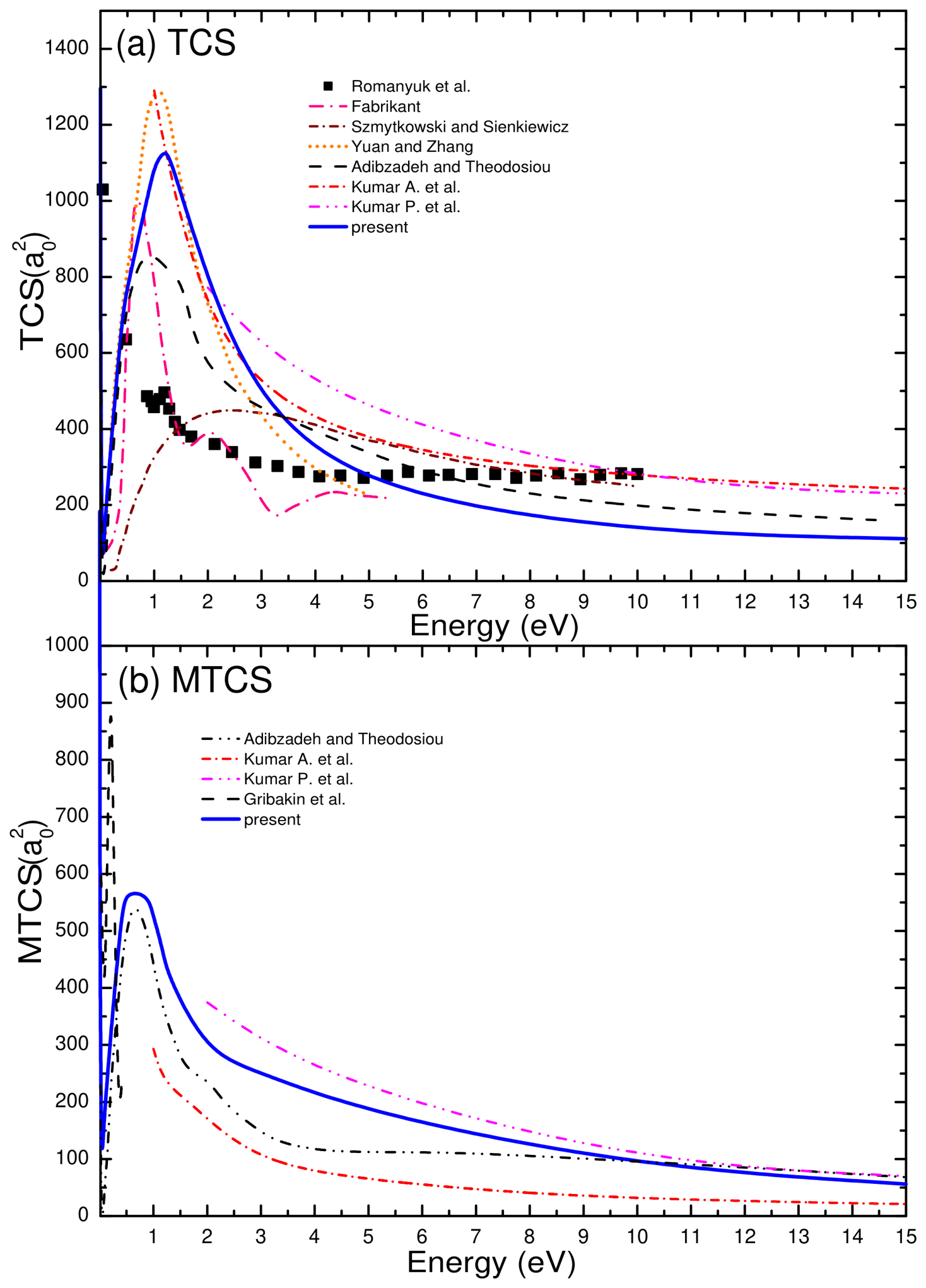
Figure 1 summarizes our elastic total cross sections (TCS) and momentum-transfer cross sections (MTCS) in the range
–15 eV, together with representative literature data. Consistent with earlier studies, the TCS exhibits a broad maximum near
eV. Below
eV, correlation and exchange effects become increasingly important; in this regime, our calculations, together with selected theories, indicate the approach to a shallow minimum in the
–
eV interval. The MTCS shows a similar trend and places its minimum around
eV.
Table 1 provides selected numerical values and highlights the dispersion among published curves, especially at low energies where the sensitivity to target polarization is greatest.
The agreement between the current total cross section (TCS) and the experimental data of Romanyuk et al. [
4] is comparable to that of other modern theoretical works, as shown in
Figure 1. The available measurements consist of individual data points obtained using the time-of-flight method, which requires precise calibration based on target density and detector response.
There is considerable variation among the theoretical curves at energies below 3 eV, including our results. This variation highlights the well-known sensitivity of the electron–strontium TCS to the polarization potential and to how exchange effects in the continuum are treated. Systematic absolute measurements in the near-threshold region are still lacking, and our current calculations serve as a theoretical reference for comparison with future experimental work.
4.2. Differential Cross Sections
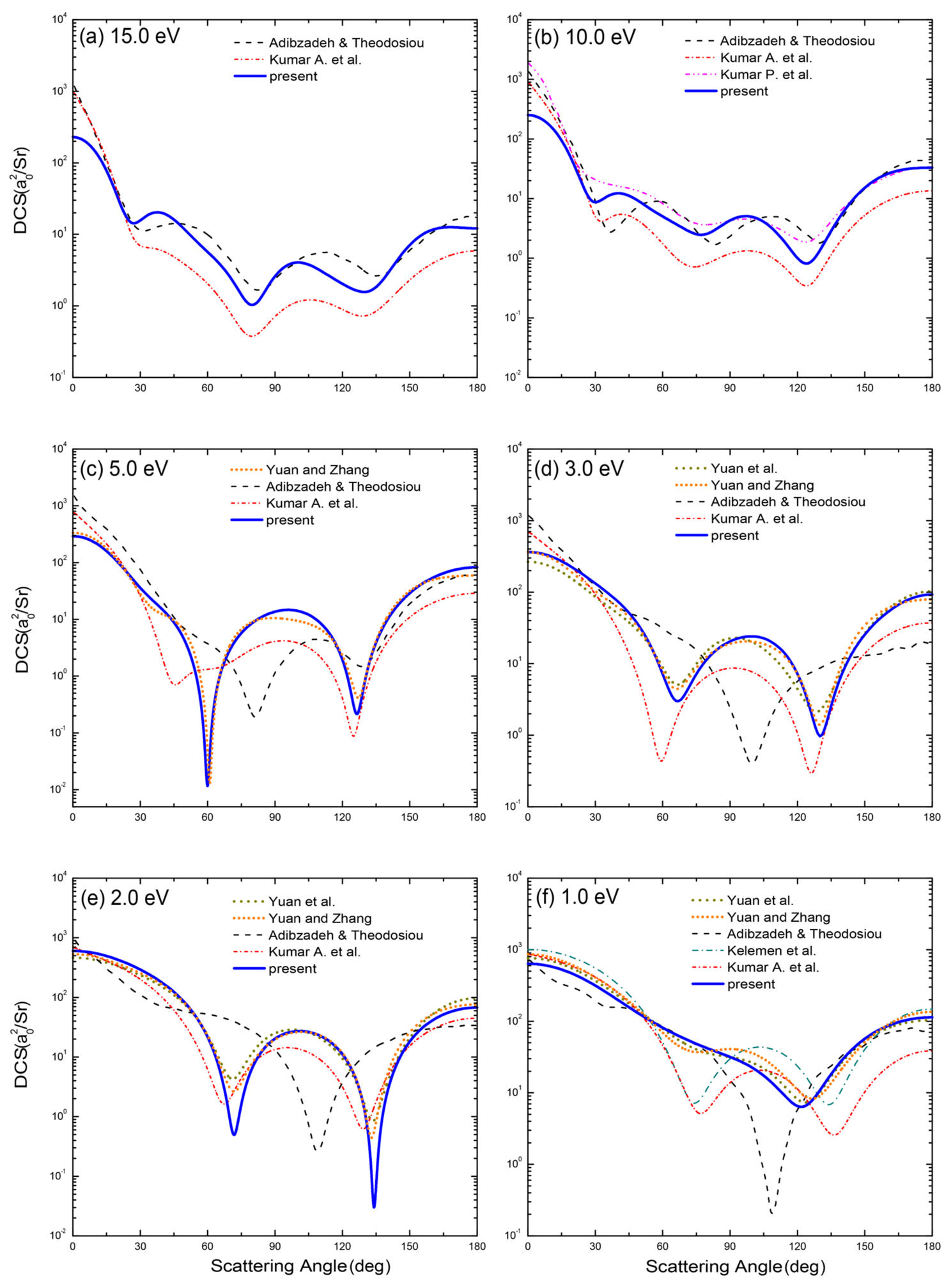
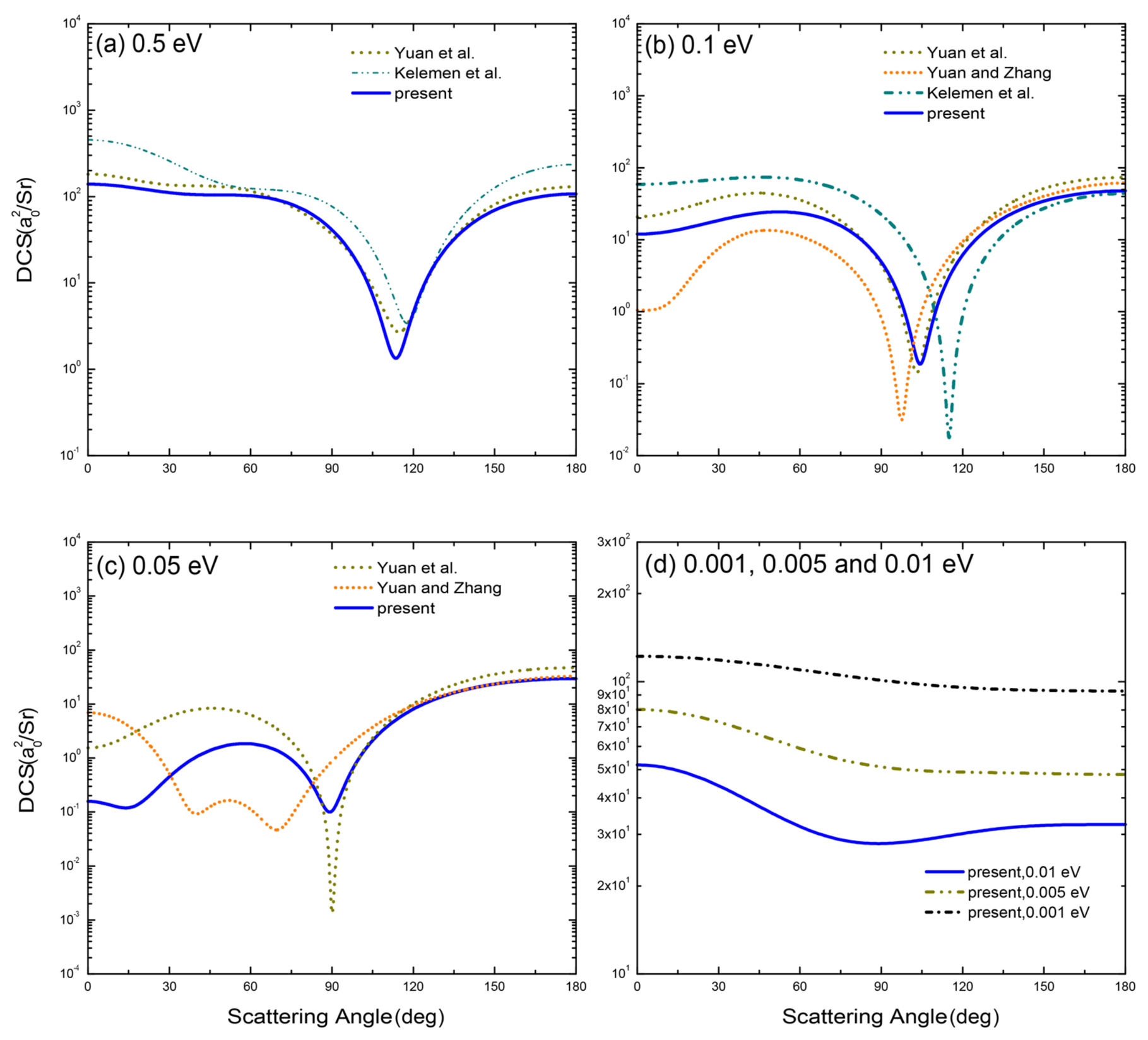
Differential elastic cross sections (DCSs) are presented in
Figure 2 and
Figure 3. For energies between 1 and 5 eV, our results agree closely with the static-exchange-plus-polarization calculations of Yuan and co-workers [
8] across most scattering angles, and they remain consistent with other optical-potential treatments. At
= 0.5 eV, the level of agreement with Yuan et al. [
8] remains very good, while modest deviations appear at
= 0.1 eV: above
, our curve essentially coincides with Yuan et al. [
8], whereas noticeable differences arise at smaller angles, where forward scattering is most sensitive to the long-range polarization tail. At
= 0.05 eV, our DCS shares qualitative features with that of Yuan et al. [
8], but differs from the alternative formulation of Yuan and Zhang [
9], which predicts two shallow forward-angle minima not supported by the present treatment. At
= 0.01 eV, the various low-energy curves become nearly parallel. In the ultralow-energy limit (
and
eV), no reference data are available for comparison; our DCSs remain smooth and show no signatures of low-lying shape resonances over the full angular range.
At forward angles, the current DCS shows significant differences when compared to those of Kumar A. et al. [
15] and Adibzadeh and Theodosiou [
12]. This region is primarily influenced by long-range polarization interactions, and the variations observed among the published curves can be attributed to different selections of static dipole polarizability and the short-range regularization of the polarization potential. In this calculation, we adopt a dipole polarizability of
a.u., based on the latest compilation by Schwerdtfeger and Nagle [
31]. We also utilize an ab initio cutoff
derived from the outermost orbital of the L4 Multi-Configuration Dirac–Fock (MCDHF) calculation, with no additional adjustable parameters. In contrast, the semi-empirical optical potential proposed by Adibzadeh and Theodosiou incorporates an adjustable parameter fitted to total cross section (TCS) data and is based on an older dipole polarizability value of
a.u. from Kolb’s work [
32]. Kumar A. et al. use a complex optical potential, which affects the absorptive part and modifies the forward-angle behavior, relying on a different compilation for the polarizability. The forward-angle DCS is most directly influenced by these methodological differences. We identify it as the most polarization-sensitive quantity in our uncertainty discussion (
Section 5).
4.3. Spin Polarization (Sherman Function)
The quantity
(Equation (
6)) quantitatively measures how spin–orbit coupling affects the distribution of scattering intensity between spin-up and spin-down channels. Typically, large values of
are observed near the minima of the unpolarized differential cross section (DCS), where the direct scattering amplitude
is small, making the spin-flip contribution
relatively more significant. These structures serve as sensitive probes for analyzing the spin-dependent aspects of the scattering potential.
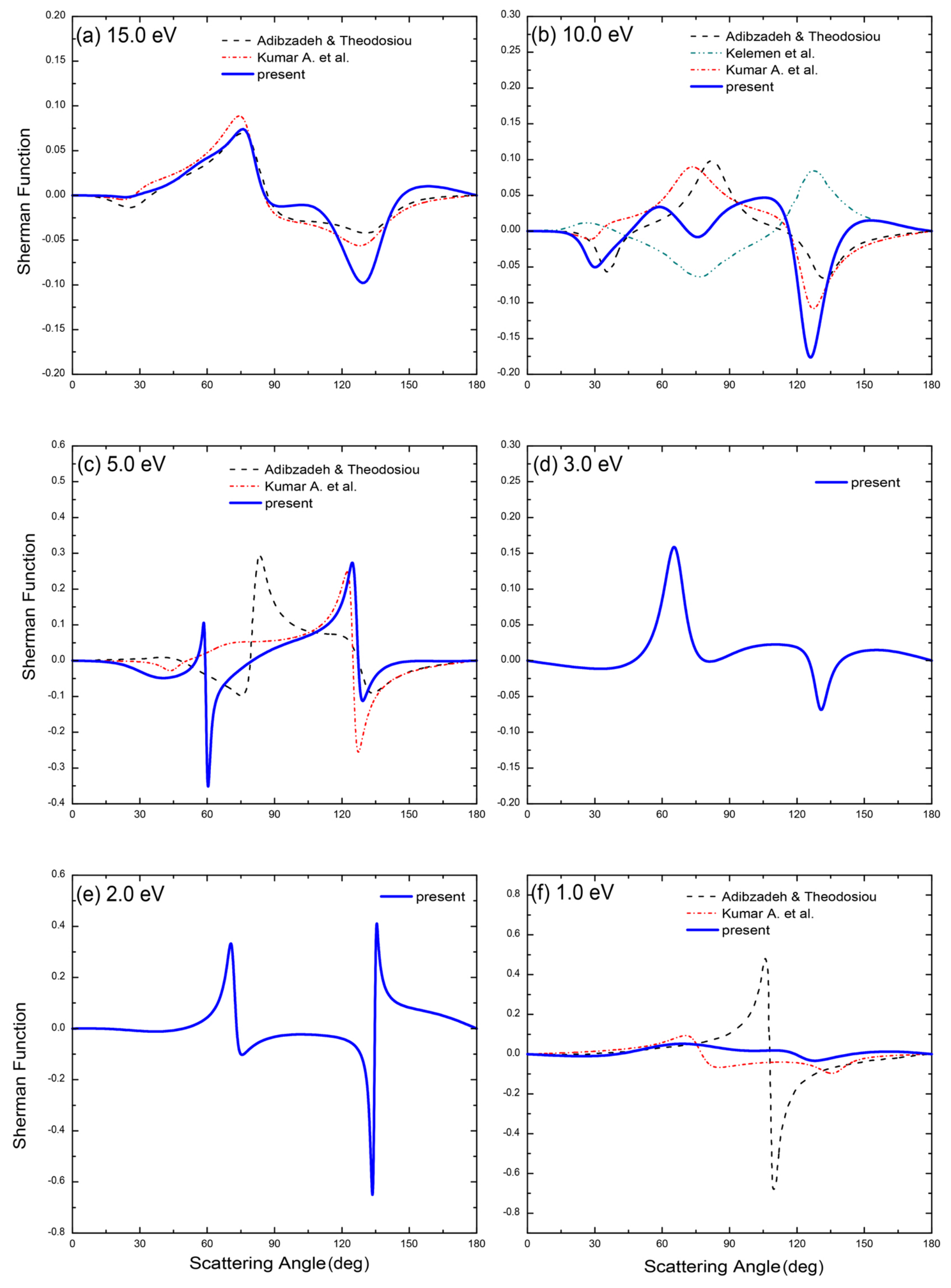
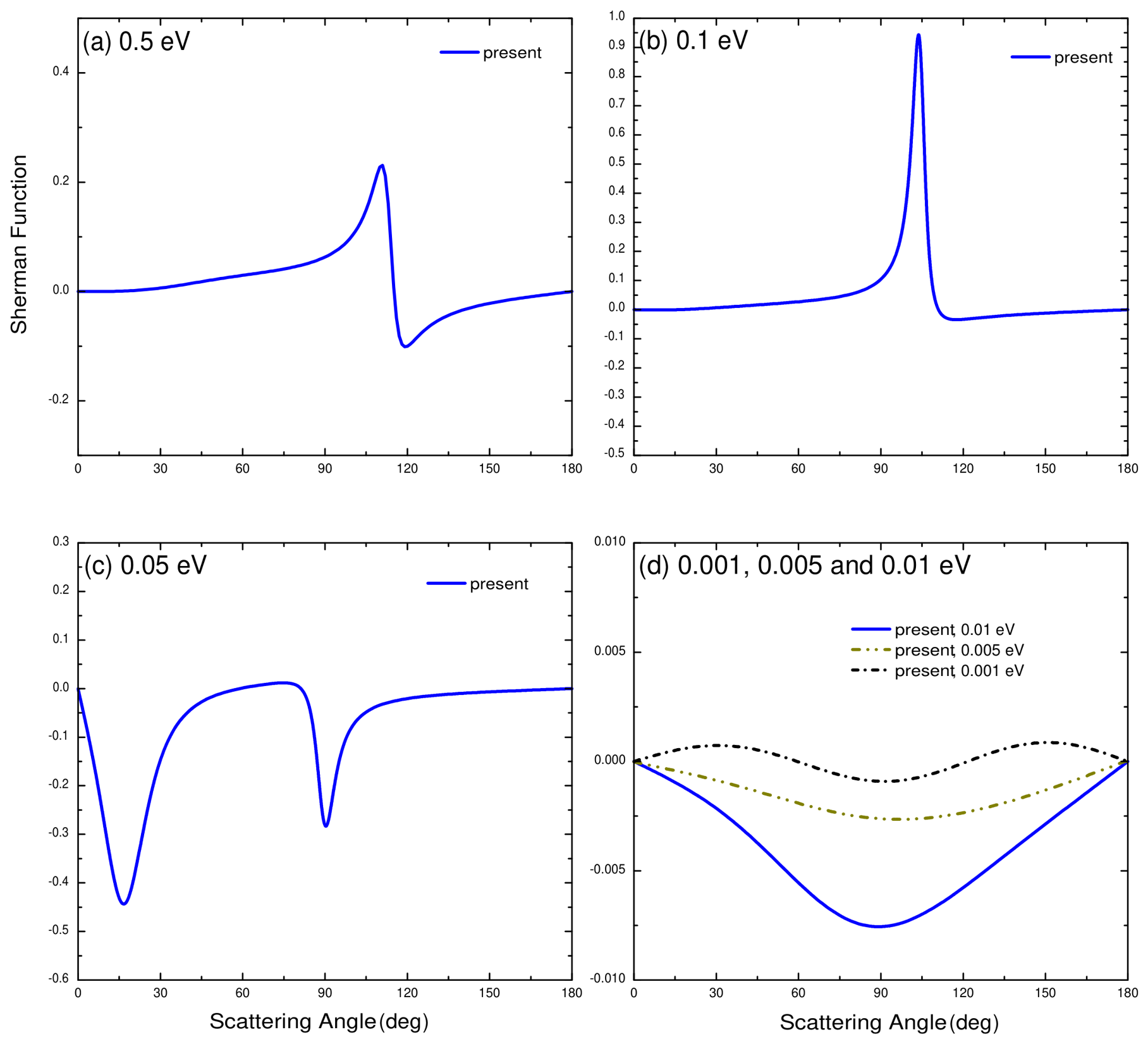
Figure 4 and
Figure 5 display the calculated Sherman function
for
= 1–15 eV and for
= 0.001–0.5 eV, respectively. Where comparisons are possible at the higher energies, our results follow the overall trends reported by Adibzadeh and Theodosiou [
12], Kelemen et al. [
13], and Kumar et al. [
15]. In most cases, the angular dependence reflects relatively weak but systematic spin asymmetries arising from relativistic spin–orbit coupling in the scattering potential. At the same time, the curves at intermediate energies, especially around 2 and 5 eV, show localized positive and negative excursions. These sharp structures are expected when the spin asymmetry is enhanced in angular regions where the differential cross section passes through a deep minimum or near-minimum, so that relatively small differences between the spin-dependent amplitudes produce a comparatively large variation in
. Accordingly, these features should be interpreted mainly as interference effects associated with the angular minima of the DCS, rather than as evidence of uniformly large spin polarization over the full angular range. In the sub-eV region,
diminishes rapidly with decreasing energy and becomes extremely small (within the
scale) at
–
eV, reflecting the dominance of the lowest partial waves and the weak net spin–orbit interference in this limit.
4.4. Low-Energy Behavior and Partial-Wave Interpretation
The structures discussed above can be interpreted in terms of the interference among the s- and p-wave phase shifts modified by the dipole polarization potential. The shallow TCS/MTCS minimum near – eV is consistent with the approach to a Ramsauer–Townsend-like region reported for heavy alkaline-earth atoms, and its position is known to be sensitive to the strength and short-range cutoff of the polarization potential. Using the recommended static dipole polarizability places the MTCS minimum close to eV and yields DCS angular patterns compatible with the best-performing static-exchange-plus-polarization models. Within the present calculations, we find no evidence for additional low-lying shape resonances down to eV.
4.5. Importance of Relativistic Effects
Several observables discussed here are intrinsically relativistic, while others are sensitive to spin–orbit interactions in the electron–strontium (e–Sr) system. We summarize their roles as follows:
The Sherman function,
, is identically zero in the non-relativistic limit because the spin-flip amplitude,
, vanishes in the absence of spin–orbit coupling. Therefore, the non-zero values reported in
Figure 4 and
Figure 5 serve as a direct quantitative measure of spin-orbit effects in the elastic e–Sr interaction.
The spin–orbit splitting between continuum phase shifts, (for ) and (for ), is small but not negligible for . At eV, this splitting amounts to a few percent of the average phase shift magnitude. While this is small compared to the phase shifts themselves, it is sufficient to produce the angular structures observed in and the fine structure of the DCS near its minima.
For the integrated total cross section (TCS) and the momentum transfer cross section (MTCS), the spin–orbit contribution is at the percent level. However, for the DCS at intermediate angles—where unpolarized scattering passes through minima—the relative contribution is enhanced. In this case, the difference between a non-relativistic treatment and a fully relativistic one can be qualitative, exemplified by the partial filling-in of minima due to spin–orbit interference.
Using a fully relativistic four-component continuum spinor, which treats both large and small components consistently, is essential not only for understanding but also for capturing the angular fine structure of the DCS in a heavy target such as strontium (Sr, ). The MCDHF target description ensures a consistent level of internal structure accuracy.
5. Uncertainty Estimates
The uncertainties in the present results arise mainly from three sources: the finite expansion of the target atomic state functions, the adopted form of the polarization potential, and the numerical extraction of phase shifts. Of these, the dominant contribution is associated with the polarization model, particularly in the near-threshold region where the observables are most sensitive to the long-range interaction. This is consistent with the discussion in
Section 4, where the low-energy TCS/MTCS structure and the forward-angle DCS are found to depend strongly on polarization effects.
The uncertainty related to the bound-state description was estimated by enlarging the active space layer by layer up to the L4 model. As shown in
Table 2, the relative change in a representative phase shift (
= 1 eV,
) decreases to below
between the L3 and L4 layers, indicating satisfactory convergence of the target representation. The omission of Breit interaction, vacuum polarization, and self-energy corrections is not expected to affect the present observables significantly; within the accuracy of this work, these effects are small compared with the uncertainty associated with the polarization potential.
The polarization potential depends on the static dipole polarizability
and the cutoff parameter
. The latter was taken from the largest active-space calculation (L4), while
was adopted from [
31]. Varying
within its quoted uncertainty (
) changes the phase shifts by less than
. Therefore, we conclude that the qualitative features of the calculated cross sections are robust, whereas the exact position and depth of the shallow minimum near
–
eV, as well as the forward-angle DCS below about
eV, remain the most model-sensitive quantities.
The numerical uncertainty connected with the continuum integration and asymptotic matching was controlled by comparing the calculated wavelength far from the origin with the theoretical value . The agreement was better than , and the resulting numerical error was estimated to be no larger than about . In addition, partial waves up to were included, and higher partial waves were found to be negligible in the energy range considered. Overall, the main conclusions of the present work are robust at the qualitative level, while the near-threshold integrated cross sections and low-energy angular distributions retain some dependence on the adopted polarization model.
It is important to clearly define the limitations of the current static-exchange-plus-polarization framework. This framework does not account for inelastic channel coupling, such as the threshold structures associated with excited states of strontium (Sr). Accurately describing these phenomena would require a close-coupling or R-matrix calculation. In the elastic-channel approximation used in this analysis, the model dipole polarization potential serves as the primary correlation correction. However, it does not fully capture the complete non-local energy and angular-momentum-dependent optical potential that arises in many-body treatments. Therefore, the results presented here should be viewed as a relativistic, exchange-consistent benchmark within the static-exchange-plus-polarization framework. They are complementary to future R-matrix calculations but should not be considered a substitute.
6. Conclusions
We have presented fully relativistic calculations of elastic electron–strontium scattering observables in the energy range 0.001–15 eV, combining MCDHF target wavefunctions from GRASP2018 with continuum orbitals generated by GRASPC and a model dipole polarization potential. In this way, a consistent set of total, momentum-transfer, and differential cross sections, together with Sherman functions, has been obtained for a target for which reliable low-energy data remain limited, especially in the ultralow-energy region.
The present results reproduce several robust features of low-energy elastic e–Sr scattering. The total cross section exhibits a broad maximum near 1 eV, while the momentum-transfer cross section shows a shallow minimum in the vicinity of 0.05–0.06 eV. The differential cross sections are in good agreement with the best available static-exchange-plus-polarization calculations over much of the 1–5 eV range, whereas at lower energies, visible differences appear mainly in the forward hemisphere, where the observables are most sensitive to the long-range polarization interaction. In the ultralow-energy region, the calculated DCS remain smooth and show no evidence of additional low-lying shape resonances down to eV within the present model.
The calculated Sherman functions follow the general trends reported in earlier optical-potential and semi-empirical studies at higher energies. As the collision energy decreases into the sub-eV region, the spin asymmetry rapidly becomes very small, reaching the level or below at – eV. This behavior is consistent with the dominance of the lowest partial waves and the corresponding reduction of spin–orbit effects close to threshold.
The uncertainty analysis indicates that the main qualitative conclusions of the present work are robust. In particular, the convergence of the target description, the omission of Breit/QED corrections, and the numerical extraction of phase shifts are not expected to alter the overall trends. The principal source of uncertainty is associated with the adopted polarization model. Accordingly, the exact position and depth of the shallow near-threshold minimum, as well as the low-energy forward-angle DCS, should be regarded as the most model-sensitive quantities.
We recognize that directly measuring the Sherman function at meV energies is still difficult with conventional Mott polarimetry. The small magnitudes of predicted in the to eV range should not be viewed as immediate experimental targets. The primary value of this ultralow-energy data lies in its theoretical implications: it establishes the expected behavior of the lowest partial waves and the resultant suppression of spin–orbit interference near the threshold. Additionally, it provides reference data for future ab initio polarization treatments and close-coupling extensions. Emerging cold-electron sources, which are based on photoionization of ultracold atomic samples, may eventually make some of these regimes accessible. However, we do not speculate on the timeline for this development.
In summary, the current results provide a fully relativistic and exchange-consistent dataset for elastic electron–strontium (e–Sr) scattering, extending into the previously unexplored energy range of
to
eV. This dataset serves as a benchmark for the recently released GRASPC extension, which will be available for future community use. When combined with our recent calculation of scattering lengths [
1], this dataset forms a coherent low-energy e–Sr resource relevant to both Rydberg-molecule physics and electron-collision modeling. Additionally, it should prove useful for future calculations that involve more detailed treatments of target polarization and channel coupling.
The scattering length data published separately [
1], along with the angle-resolved data from this work, create a coherent dataset for low-energy electron interactions with strontium. This dataset can be beneficial for both the Rydberg-molecule community—which can utilize the threshold parameters—and the broader low-energy electron scattering community, which can take advantage of the provided cross sections and spin polarization functions.
Author Contributions
P.S. developed the research methodology, conducted the investigation, provided and managed resources, developed the software, performed data curation and validation, created visualizations, and prepared the original draft of the manuscript. M.P.P. contributed to the methodology, conducted the investigation, performed formal analysis and validation, and contributed to writing the original draft. M.S. provided resources supporting the research, including the acquisition and management of comparative data. J.E.S. conceptualized and supervised the study, contributed to the investigation and validation, and contributed to writing the original draft. All authors have read and agreed to the published version of the manuscript.
Funding
This research received no external funding.
Institutional Review Board Statement
Not applicable.
Data Availability Statement
The text files with continuum orbitals generated in the present work are publicly available in the Bridge of Knowledge Open Data Repository:
https://doi.org/10.34808/jz2g-8f37.
Acknowledgments
We are grateful to the late Ian Grant and Charlotte Froese Fischer for their support and encouragement in conducting this line of research. The calculations were performed on the computer of the Tricity Academic Computer Network (TASK).
Conflicts of Interest
The authors declare no conflicts of interest.
References
- Syty, P.; Piłat, M.P.; Sienkiewicz, J.E. Low-energy phase shifts and scattering length of strontium from Dirac-Coulomb and polarization potential modeling. At. Data Nucl. Data Tables 2026, 168, 101783. [Google Scholar] [CrossRef]
- Dunning, F.B.; Kanungo, S.K.; Yoshida, S. Ultralong-range Rydberg molecules. J. Phys. B At. Mol. Opt. Phys. 2024, 57, 212002. [Google Scholar] [CrossRef]
- Giannakeas, P.; Eiles, M.T.; Robicheaux, F.; Rost, J.M. Generalized local frame-transformation theory for ultralong-range Rydberg molecules. Phys. Rev. A 2020, 102, 033315. [Google Scholar] [CrossRef]
- Romanyuk, N.I.; Shepnik, O.B.; Zapesochny, I.P. Cross sections and characteristics of electron scattering by calcium, strontium, and barium atoms. JETP Lett. 1980, 32, 452. [Google Scholar]
- Kazakov, S.M.; Romanyuk, N.I.; Khristoforov, O.V.; Shpenik, O.B. Resonance effects observed on interaction of slow electrons with strontium atoms. Opt. Spectrosc. 1985, 59, 38. [Google Scholar]
- Fabrikant, I.I. Atomic Processes; Peterkopf, R.K., Ed.; Zinante: Riga, Latvia, 1975; p. 80. [Google Scholar]
- Szmytkowski, R.; Sienkiewicz, J.E. Elastic scattering of electrons by strontium and barium atoms. Phys. Rev. A 1994, 50, 4007. [Google Scholar] [CrossRef] [PubMed]
- Yuan, J.; Zhang, Z.; Wan, H. Elastic scattering of low-energy electrons with Sr atoms. Phys. Rev. A 1990, 41, 4732. [Google Scholar] [CrossRef]
- Yuan, J.; Zhang, Z. Alternative static-exchange formalism: Low-energy electron scattering with heavy alkaline-earth atoms. Phys. Rev. A 1990, 42, 5363. [Google Scholar] [CrossRef]
- Yuan, J.; Zhang, Z. Enhanced spin polarization of elastic electron scattering from alkaline-earth-metal atoms in Ramsauer-Townsend and low-lying shape resonance regions. Phys. Rev. A 1993, 48, 2018. [Google Scholar] [CrossRef]
- Yuan, J. Intra-atomic relativistic effects on the spin polarization in low-energy electron scattering from Ca, Sr, Ba, and Yb atoms. Phys. Rev. A 1995, 52, 4647. [Google Scholar] [CrossRef] [PubMed]
- Adibzadeh, M.; Theodosiou, C.E. Elastic electron scattering from Ba and Sr. Phys. Rev. A 2004, 70, 052704. [Google Scholar] [CrossRef]
- Kelemen, V.; Remeta, E.Y.; Sabad, E.P. Scattering of electrons by Ca, Sr, Ba and Yb atoms in the 0-200 eV energy region in the optical potential model. J. Phys. B At. Mol. Opt. Phys. 1995, 28, 1527. [Google Scholar] [CrossRef]
- Gribakin, G.F.; Gul’tsev, B.V.; Ivanov, V.K.; Kuchiev, M.Y. Interaction of an alkaline-earth atom with an electron: Scattering, negative ion and photodetachment. J. Phys. B At. Mol. Opt. Phys. 1990, 23, 4505. [Google Scholar] [CrossRef]
- Kumar, A.; Abdullah, M.N.A.; Haque, A.K.F.; Singh, I.; Uddin, M.A. Elastic scattering of electrons by Sr atom: A study of critical minima and spin polarization. J. Phys. Commun. 2019, 3, 065001. [Google Scholar] [CrossRef]
- Froese Fischer, C.; Gaigalas, G.; Jönsson, P.; Bieroń, J. GRASP2018—A Fortran 95 version of the General Relativistic Atomic Structure Package. Comput. Phys. Commun. 2019, 237, 184–187. [Google Scholar] [CrossRef]
- Syty, P.; Piłat, M.P.; Sienkiewicz, J.E. GRASPC–GRASP package adapted for the generation of continuum orbitals wave functions. Comput. Phys. Commun. 2025, 315, 109691. [Google Scholar] [CrossRef]
- Syty, P.; Piłat, M.P.; Sienkiewicz, J.E. Calculation of electron scattering lengths on Ar, Kr, Xe, Rn and Og atoms. J. Phys. B At. Mol. Opt. Phys. 2024, 57, 175202. [Google Scholar] [CrossRef]
- Fischer, C.F.; Godefroid, M.; Brage, T.; Jönsson, P.; Gaigalas, G. Advanced multiconfiguration methods for complex atoms: I. Energies and wave functions. J. Phys. B At. Mol. Opt. Phys. 2016, 49, 182004. [Google Scholar] [CrossRef]
- Grant, I.P.; McKenzie, B.J.; Norrington, P.H.; Mayers, D.F.; Pyper, N.C. An atomic multiconfigurational Dirac-Fock package. Comput. Phys. Commun. 1980, 21, 207–231. [Google Scholar] [CrossRef]
- Jönsson, P.; Godefroid, M.; Gaigalas, G.; Ekman, J.; Grumer, J.; Li, W.; Li, J.; Brage, T.; Grant, I.P.; Bieroń, J.; et al. An Introduction to Relativistic Theory as Implemented in GRASP. Atoms 2023, 11, 7. [Google Scholar] [CrossRef]
- Gaigalas, G.; Žalandauskas, T.; Rudzikas, Z. LS–jj transformation matrices for a shell of equivalent electrons. At. Data Nucl. Data Tables 2003, 84, 99–190. [Google Scholar] [CrossRef]
- Gaigalas, G.; Zalandauskas, T.; Fritzsche, S. Spectroscopic LSJ notation for atomic levels obtained from relativistic calculations. Comput. Phys. Commun. 2004, 157, 239–253. [Google Scholar] [CrossRef]
- Grant, I.P. Relativistic Quantum Theory of Atoms and Molecules; Springer: New York, NY, USA, 2007. [Google Scholar]
- Baylis, W.E. Correlation and relativistic effects in atoms and small molecules. In Proceedings of the 12. Summer School on Quantum Optics, Frombork, Poland, 2–8 September 1985; Volume 32. [Google Scholar]
- Kessler, J. Polarized Electrons; Springer: Berlin/Heidelberg, Germany, 1976. [Google Scholar] [CrossRef]
- Syty, P.; Sienkiewicz, J.E.; Fritzsche, S. Relativistic multiconfiguration method in low energy scattering of electrons from xenon atoms. Rad. Phys. Chem. 2003, 68, 301. [Google Scholar] [CrossRef]
- Syty, P.; Sienkiewicz, J.E.; Radžiūtė, L.; Gaigalas, G.; Rynkun, P.; Bieroń, J. Continuum wave functions for estimating the electric dipole moment: Calculation based on a multiconfiguration Dirac-Hartree-Fock approximation. Phys. Rev. A 2019, 99, 012514. [Google Scholar] [CrossRef]
- Kumar, P.; Jain, A.K.; Tripathi, A.N.; N., N.S. Spin polarization and cross sections of electrons elastically scattered from heavy alkaline-earth atoms. Z. Phys. D 1994, 30, 149. [Google Scholar] [CrossRef]
- Gribakin, G.F.; Gul’tsev, B.V.; Ivanov, V.K.; Kuchiev, M.Y.; Tančić, A.R. Momentum transfer cross sections for slow electron elastic scattering on Ca, Sr and Ba atoms. Phys. Lett. A 1992, 16, 473. [Google Scholar] [CrossRef]
- Schwerdtfeger, P.; Nagle, J.K. 2018 Table of static dipole polarizabilities of the neutral elements in the periodic table. Mol. Phys. 2019, 117, 1200–1225. [Google Scholar] [CrossRef]
- Kolb, D.; Johnson, W.R.; Shorer, P. Electric and magnetic susceptibilities and shielding factors for closed-shell atoms and ions of high nuclear charge. Phys. Rev. A 1982, 26, 19–31. [Google Scholar] [CrossRef]
| Disclaimer/Publisher’s Note: The statements, opinions and data contained in all publications are solely those of the individual author(s) and contributor(s) and not of MDPI and/or the editor(s). MDPI and/or the editor(s) disclaim responsibility for any injury to people or property resulting from any ideas, methods, instructions or products referred to in the content. |