Article

Two-Atom Superradiance Including Magnetic State Degeneracy

Physics Department, University of Michigan, Ann Arbor, MI 48109-1040, USA
Atoms 2026, 14(2), 12; https://doi.org/10.3390/atoms14020012
Submission received: 5 January 2026 / Revised: 29 January 2026 / Accepted: 4 February 2026 / Published: 6 February 2026

Abstract

The radiation pattern emitted by two atoms, interacting with each other via the vacuum radiation field, has been calculated, including effects of magnetic state degeneracy for atoms with a ground state having G = 0 angular momentum and an excited state having H = 1 angular momentum. For an initial condition in which both atoms are inverted, the time-integrated radiation pattern is identical to that for non-interacting atoms if the atoms lie on the z-axis, but differs if the atoms lie on the x-axis. The underlying dynamics giving rise to this behavior are examined.

1. Introduction

In what has become a classic paper, Lehmberg [1] calculated the radiation pattern emitted by two atoms prepared in an arbitrary superposition of their internal states. The atoms were modeled as two-level atoms and interacted with each other only via their coupling to the vacuum radiation field, in dipole approximation. For atoms prepared in a completely inverted state (both atoms in their excited states), this two-atom system constitutes the simplest example of Dicke superradiance [2] from a completely inverted state. Somewhat surprisingly, Lehmberg found that, for a completely inverted initial state, the time-integrated radiation pattern (TIRP) was identical to that for non-interacting atoms. Clemens et al. [3] extended the calculation to three or more atoms on a line and found that the TIRP was no longer that of the individual atoms. As far as I am aware, there was no simple physical explanation given to explain these results.
The goal of this paper is to extend Lehmberg’s two-atom calculation to include magnetic state degeneracy. A general expression will be derived for the radiation pattern for atoms having a ground state with total angular momentum G and an excited state having total angular momentum H. The expressions will be evaluated explicitly for a G = 0 to H = 1 transition, when the atoms are prepared in their fully inverted state by a σ + polarized field incident in the z direction. It will be seen that the radiation pattern depends critically on the orientation of the atoms. For atoms on the z-axis, the problem effectively reduces to the two-level approximation and the TIRP is that of the individual atoms. However, for atoms on the x-axis, this is no longer the case and there is a contribution to the TIRP arising from the interaction between the two atoms. The radiation pattern in this limit exhibits features that are reminiscent of those associated with the interference pattern of two radiating dipoles, even though the expectation value of the dipole moment operator of each atom is identically equal to zero at all times.
There have been a few other calculations of superradiance including magnetic state degeneracy. Crubellier [4] developed a general theory based on irreducible tensor representations of the various operators. Specific calculations were carried out for model systems and for a G = 1 / 2 to an H = 1 / 2 transition [5]. However, these calculations did not focus on the specific features of the TIRP for two atoms. By examining the dependence of the TIRP on the orientation of the two atoms, one can obtain some insight into the reason why the TIRP is independent of atom–atom separation in the two-level approximation. We will see that interaction-induced transfer from a magnetic sublevel of one atom to a different magnetic sublevel of the other atom plays a critical role.

2. Field Intensity

A hybrid approach is used, in which the source-field expressions for the field operators are obtained, making neither the rotating wave approximation (RWA) nor the Weisskopf–Wigner approximation (WWA) [6], but the subsequent evaluation of the expectation values of operators are evaluated using both the RWA and WWA [7,8]. Such an approach greatly simplifies the problem and is consistent with energy conservation. With this approach, the total field intensity per unit solid angle in the radiation zone, denoted by I ( Ω , t ) , for an H to G transition can be written as
I ( Ω , t ) = 2 ϵ 0 c R 2 E s R , t · E s + R , t = 3 8 π ω 0 γ H P ( Ω , t ) + Q ( Ω , t ) ,
where E s + R , t = E s R , t is the radiation zone positive frequency component of the source field operator [9], γ H is the excited state decay rate of an isolated atom, ω 0 is the H to G transition frequency, Ω = θ , ϕ is the solid angle of emission, and P ( Ω , t ) and Q ( Ω , t ) are population and interference terms, respectively. The population term in RWA is given by [9]
P ( Ω , t ) = m H , m H = H H m G = G G j = 1 N α , β , β = 1 3 M β , G , H , m G , m H * M β , G , H , m G , m H × f α β g α β ( θ , ϕ ) f α β g α β ( θ , ϕ ) σ ( j ) m H , m H , t r
where
(3a) M 1 , G , H , m G , m H = 1 2 2 H + 1 2 G + 1 H 1 G m H 1 m G H 1 G m H 1 m G , (3b) M 2 , G , H , m G , m H = i 2 2 H + 1 2 G + 1 H 1 G m H 1 m G + H 1 G m H 1 m G , (3c) M 3 , G , H , m G , m H = 2 H + 1 2 G + 1 H 1 G m H 0 m G ,
(4a)     f α β = 2 / 3 δ α , β ; (4b) g 11 ( θ , ϕ ) = 3 cos 2 θ 1 6 + sin 2 θ cos 2 ϕ 2 ; (4c) g 22 ( θ , ϕ ) = 3 cos 2 θ 1 6 sin 2 θ cos 2 ϕ 2 ; (4d) g 33 ( θ , ϕ ) = 3 cos 2 θ 1 3 ; (4e) g 12 ( θ , ϕ ) = g 21 = sin 2 θ sin 2 ϕ / 2 ; (4f) g 13 ( θ , ϕ ) = g 31 = sin θ cos θ cos ϕ ; (4g) g 23 ( θ , ϕ ) = g 32 = sin θ cos θ sin ϕ .
δ α , β is a Kronecker delta, σ ( j ) m H , m H , t is an excited state operator for atom j for which
σ ( j ) m H , m H , 0 = H m H H m H ( j ) ,
N is the number of atoms, t r = t R / c is the retarded time, and the square brackets are Clebsch–Gordan coefficients. The interference term Q ( Ω , t ) in RWA is given by
Q ( Ω , t ) = m H , m H = H H m G , m G = G G j , j = 1 N α , β , β = 1 3 1 δ j , j e i k 0 · R j j × M β , G , H , m G , m H * M β , G , H , m G , m H × f α β g α β ( θ , ϕ ) f α β g α β ( θ , ϕ ) σ ( j ) m H , m G , t r σ ( j ) m G , m H , t r ,
where R j j = R j R j , σ ( j ) m H , m G , t is a raising operator, σ ( j ) m G , m H , t is a lowering operator, and
k 0 = ω 0 c R ^ .
The raising and lowering operators are written in an interaction representation.
For uncorrelated atoms,
σ ( j ) m H , m G , t σ ( j ) m G , m H , t = σ ( j ) m H , m G , t σ ( j ) m G , m H , t .
Interference in the radiation pattern between the two atoms occurs only if the expectation values of the dipole moment operator of the individual atoms is nonvanishing. For correlated atoms, however, interference in the radiation pattern can occur even if the expectation value of the dipole moment operator of each atom is zero.
The calculation of the expectation values increases in complexity with increasing atom number and increasing values of G and H. In this paper, the calculation is restricted to two atoms. In an individual atom basis and in RWA and WWA, the state amplitude b m H , m G for atom 1 to be in H m H and atom 2 to be in state G m G evolves as [10]
b ˙ m H , m G = ( γ H / 2 ) b m H , m G ( γ H / 2 ) m H = H H m G = G G T m H , m G ; m G , m H ; R 12 b m G , m H ,
where
T m H , m G ; m G , m H ; R 12 = 3 G 1 H m G q m H G 1 H m G q m H S q , q ; R 12 ,
S q , q ; R 12 = = 0 2 m = ( i ) ( 1 ) m d Ω k , m × ϵ k ( θ k ) q ϵ k ( θ k ) q * + ϵ k ( ϕ k ) q ϵ k ( ϕ k ) q * × h ( k R j j ) sin θ k Y m ( θ k , ϕ k ) Y , m ( θ 12 , ϕ 12 ) ,
(12a) ϵ k θ k = cos θ k cos ϕ k x ^ + cos θ k sin ϕ k y ^ sin θ k z ^ , (12b) ϵ k ϕ k = sin ϕ k x ^ + cos ϕ k y ^ ,
ϵ ± 1 = ϵ x ± i ϵ y 2 ; ϵ 0 = ϵ z
R 12 = R 1 R 2 = R 21 sin θ 12 cos ϕ 12 x ^ + sin θ 12 sin ϕ 12 y ^ + cos θ 12 z ^ ,
where the Y m are spherical harmonics and h is a spherical Hankel function. It has been assumed that γ H R 21 / c 1 , so that retardation can be neglected in calculating the coupling between the atoms.
To calculate the various expectation values needed in Equations (2) and (6), it is convenient to diagonalize Equations (9). In this manner, one can obtain a molecular-state basis, in which the evolution equations for the expectation values take on a much simpler form than that on the individual atom basis. However, the calculation of the expectation values increases in complexity with increasing atom number and increasing values of G and H, since it becomes necessary to diagonalize a 2 G + 1 ( 2 H + 1 ) matrix.
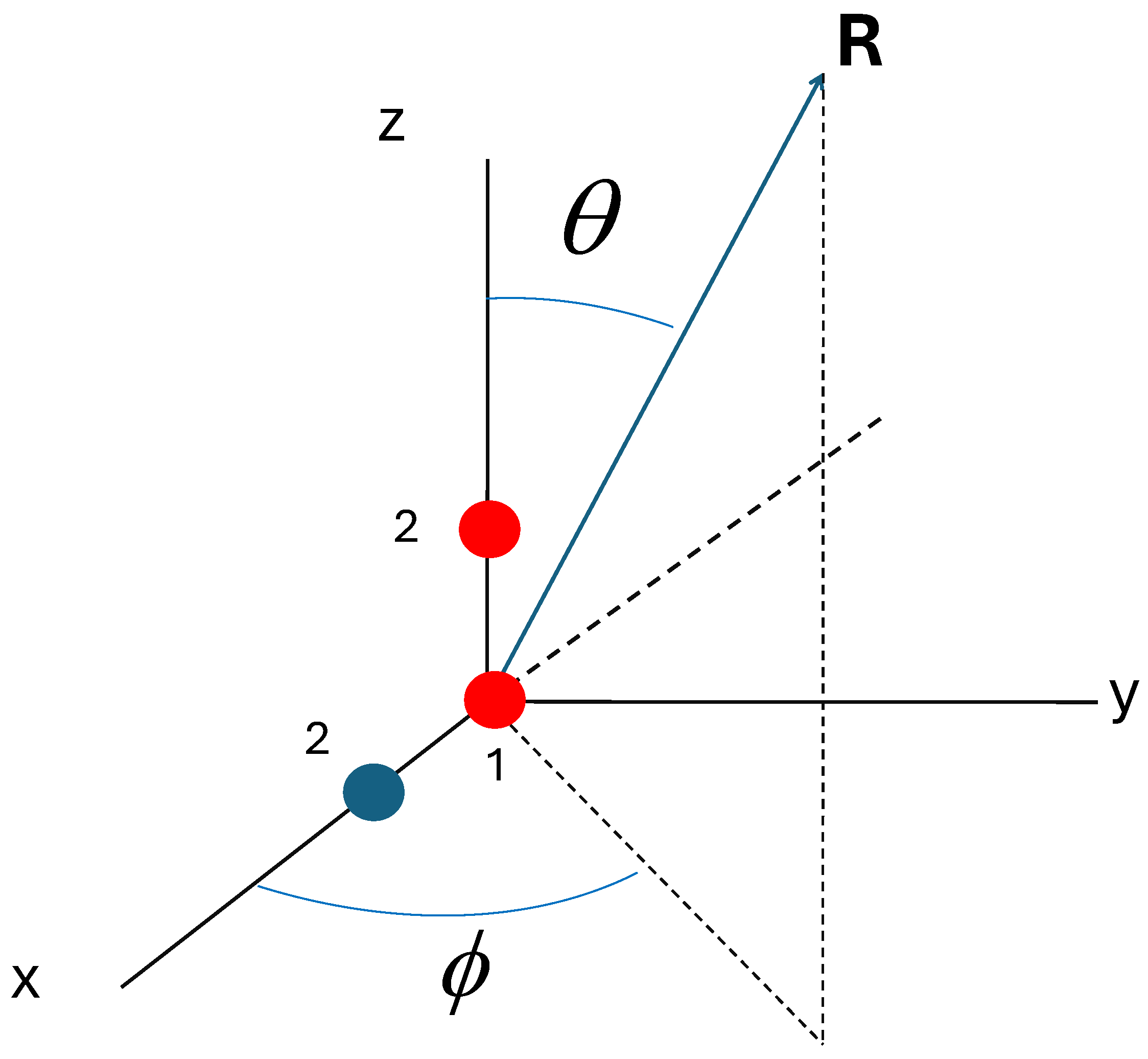
As a specific example, I now consider G = 0 , and H = 1 , for atoms prepared in a fully-inverted state using a σ + polarized pulse propagating in the z-direction; that is, both atoms are prepared in a state having m H = 1 . It is assumed that the temporal envelope of the pulse is sufficiently small to allow for “instantaneous” excitation of the atoms into the totally-inverted state. Atom 1 is located at the origin and atom 2 at R 21 = R 2 . Two cases will be considered: atoms on the z-axis and atoms on the x-axis (see Figure 1).

2.1. Atoms on the z-Axis

This is effectively the case considered by Lehmberg. For our initial conditions and with θ 12 = π and ϕ 12 = 0 , the only nonvanishing state amplitudes are b ( 1 ) b 1 , 0 and b ( 2 ) b 0 , 1 , for which Equations (9) reduce to
(15a) b ˙ ( 1 ) = γ b ( 1 ) γ p 1 x 0 + i q 1 x 0 b ( 2 ) , (15b) b ˙ ( 2 ) = γ b ( 2 ) γ p 1 x 0 + i q 1 x 0 b ( 1 ) ,
where
(16a) p 1 ξ = 3 2 sin ξ ξ + cos ξ ξ 2 sin ξ ξ 3 , (16b) q 1 ξ = 3 2 cos ξ ξ + sin ξ ξ 2 + cos ξ ξ 3 ,
x 0 = k 0 R 21 ,
and γ = γ H / 2 . In this case, the eigenkets and eigenfrequencies can be written as
(18a) G = g g ; ω G = 0 , (18b) A = 1 g + g 1 2 ; ω A = ω 0 + γ q 1 x 0 , (18c) B = 1 g g 1 2 ; ω B = ω 0 γ q 1 x 0 , (18d) E = 11 ; ω E = 2 ω 0 ,
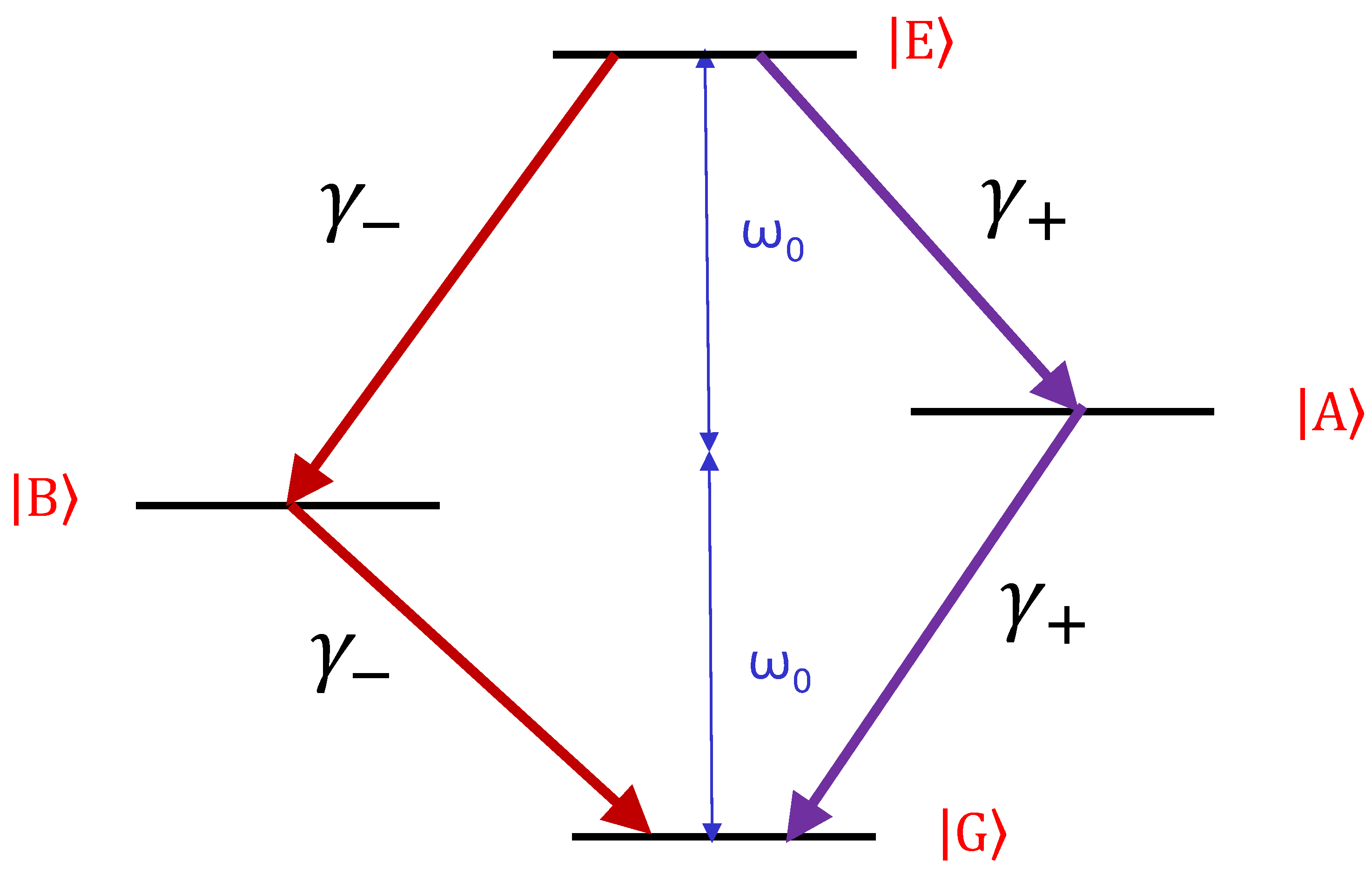
where g corresponds to G = 0 , m G = 0 and 1 to H = 1 , m H = 1 ; see Figure 2. In terms of these eigenkets,
(19a) σ ( 1 ) m H , m H , t + σ ( 2 ) m H , m H , t = ρ A A t + ρ B B t + 2 ρ E E t δ m H , 1 δ m H , 1 , (19a) σ ( 2 ) m H , 0 , t σ ( 1 ) 0 , m H , t = 1 2 ρ A A t ρ A B t ρ B B t + ρ B A t δ m H , 1 δ m H , 1 ,
the population term P ( Ω , t ) reduces to
P ( Ω , t ) = 1 + cos 2 θ 2 ρ A A t r + ρ B B t r + 2 ρ E E t r
and the interference term Q ( Ω , t ) to
Q ( Ω , t ) = 1 + cos 2 θ 2 Re e i x 0 cos θ ρ A A t r ρ B B t r ρ A B t r + ρ B A t r .
The evolution equations for density matrix elements are carried out in the standard fashion [9] and one finds
(22a) ρ ˙ G G t = γ + ρ A A t + γ ρ B B t , (22b) ρ ˙ A A t = γ + ρ A A t + γ + ρ E E t , (22c) ρ ˙ B B t = γ ρ B B t + γ ρ E E t , (22d) ρ ˙ E E t = 2 γ H ρ E E t , (22e) ρ ˙ A B t = γ H 1 + i q 1 x 0 ρ A B t , (22f) ρ B A t = ρ A B t * ,
where
γ ± = γ H 1 ± p 1 x 0 .
The solution of these equations for the initial condition ρ E E 0 = 1 is
(24a) ρ E E t = e 2 γ H t , (24b) ρ A A t = γ + e γ + t e 2 γ H t 2 γ H γ + , (24c) ρ B B t = γ e γ t e 2 γ H t 2 γ H γ , (24d) ρ A B t = ρ B A t = 0 .
We can now understand why the time-integrated interference term vanishes. Although ρ A A t corresponds to superradiant emission with a decay rate greater than γ H and ρ B B t corresponds to subradiant emission with a decay rate smaller than γ H ,
0 d t ρ A A t = 0 d t ρ B B t = 1 2 γ H ,
implying that the time-integrated interference term is
0 d t Q ( Ω , t ) = 0 .
The vanishing of the interference terms is necessary, but not sufficient, to guarantee that the TIRP is that of noninteracting atoms. In general, one would expect the contribution to the TIRP signal of the population term to also depend on interatomic separation owing to interactions. However, in this case,
I ( Ω ) = 3 8 π ω 0 γ H 0 d t P ( Ω , t ) = 3 8 π ω 0 1 + cos 2 θ ,
which is the result for noninteracting atoms.
The fact that the TIRP signal is identical to that for noninteracting atoms can be traced to the decay scheme indicated in Figure 2. There are two decay channels, E A G and E B G . The ratio of the decay rate on the lower branch of a channel to that on the upper branch is equal to 1/2 the number of channels. Moreover, decay from state E does not produce a coherence between states A and B . As a consequence of these two conditions, the TIRP interference term vanishes and the TIRP population term is independent of interatomic spacing. As we shall see, if either of these conditions is violated, the TIRP interference term no longer vanishes and the TIRP population term becomes dependent on interatomic spacing. It is also interesting to note that, for arbitrary initial conditions, the TIRP is no longer that of the individual atoms, even for atoms on the z-axis; that is, only for a fully inverted initial state does the TIRP reduce to that for non-interacting atoms.

2.2. Atoms on the x-Axis

The situation changes for atoms on the x-axis. For our initial conditions, the only nonvanishing state amplitudes are b 1 ( 1 ) b 1 , 0 , b 1 ( 2 ) b 0 , 1 , b 1 ( 1 ) b 1 , 0 , b 1 ( 2 ) b 0 , 1 , for which Equations (9) reduce to
b ˙ 1 ( 1 ) = γ b 1 ( 1 ) γ a b 1 ( 2 ) γ b b 1 ( 2 ) ,
b ˙ 1 ( 2 ) = γ b 1 ( 2 ) γ a b 1 ( 1 ) γ b b 1 ( 1 ) ,
b ˙ 1 ( 1 ) = γ b 1 ( 1 ) γ a b 1 ( 2 ) γ b b 1 ( 2 ) ,
b ˙ 1 ( 2 ) = γ b 1 ( 2 ) γ a b 1 ( 1 ) γ b b 1 ( 1 ) ,
where
γ a = γ p a x 0 + i q a x 0 ,
γ b = γ p b x 0 + i q b x 0 ,
p a ξ = 3 4 sin ξ ξ cos ξ ξ 2 + sin ξ ξ 3 ,
q a ξ = 3 4 cos ξ ξ + sin ξ ξ 2 + cos ξ ξ 3 ,
p b ξ = 3 4 sin ξ ξ + 3 cos ξ ξ 2 3 sin ξ ξ 3 ,
q b ξ = 3 4 cos ξ ξ + 3 sin ξ ξ 2 + 3 cos ξ ξ 3 .
Note that, for ξ 1 , q b ξ > 0 and q a ξ < 0 . The eigenkets can be written as
(30a) G = g g , (30b) A = 1 g + g 1 + 1 , g + g , 1 2 , (30c) B = 1 g + g 1 1 , g g , 1 2 , (30d) C = 1 g g 1 1 , g g , 1 2 , (30e) D = 1 g g 1 + 1 , g g , 1 2 , (30f) E = 11 ,
where 1 corresponds to H = 1 , m H = 1 . The corresponding eigenfrequencies are
(31a) ω G = 0 , (31b) ω A = ω 0 + γ q a x 0 + q b x 0 , (31c) ω B = ω 0 + γ q a x 0 q b x 0 , (31d) ω C = ω 0 γ q a x 0 q b x 0 , (31e) ω D = ω 0 γ q a x 0 + q b x 0 , (31f) ω E = 2 ω 0 .
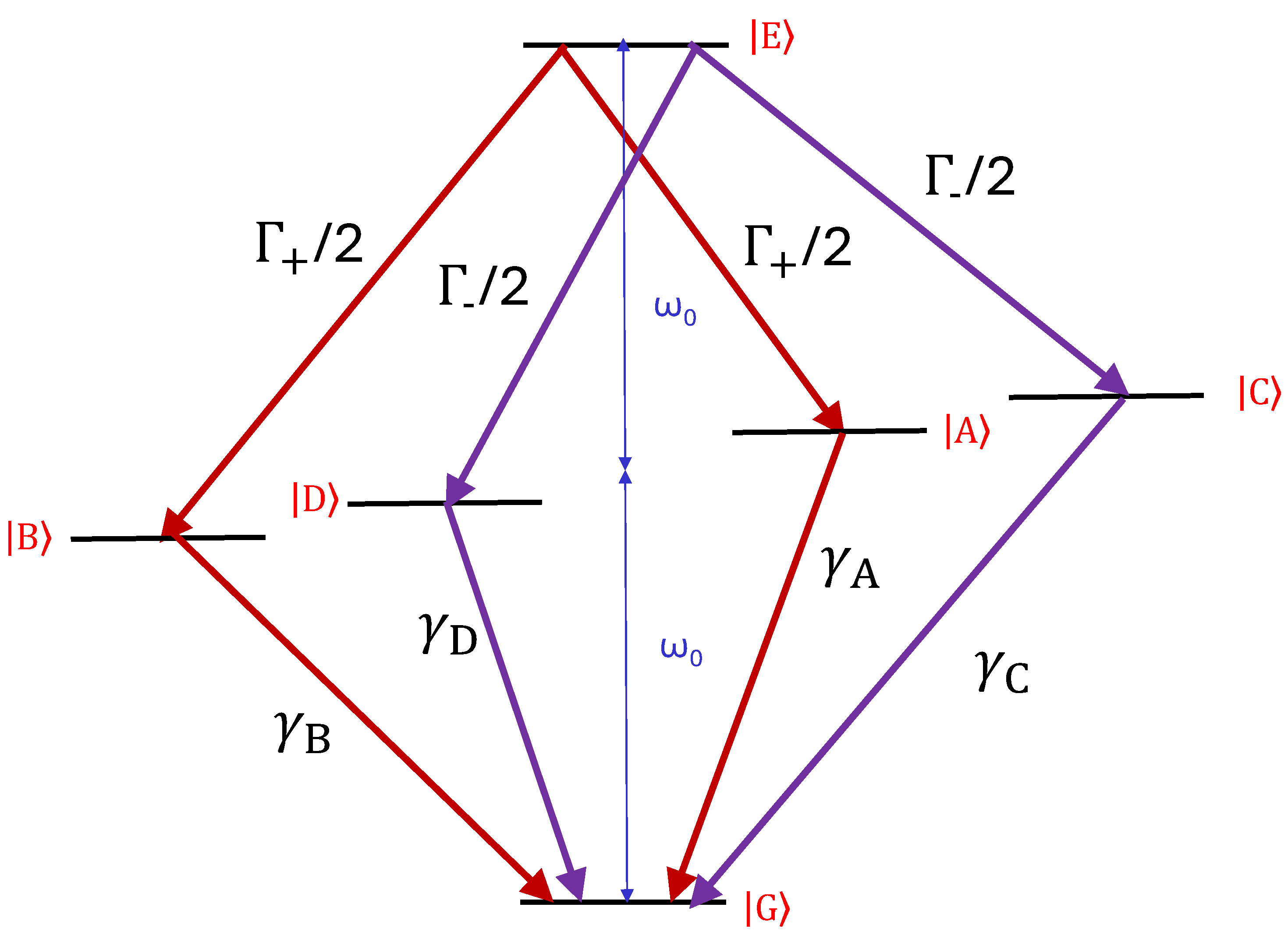
For ξ 1 , ω C > ω A > ω D > ω B (see Figure 3).
In this molecular basis, the population term P ( Ω , t ) reduces to
P ( Ω , t ) = 1 + cos 2 θ 2 ρ A A t r + ρ B B t r + ρ C C t r + ρ D D t r + 2 ρ E E t r + sin 2 θ cos 2 ϕ 2 ρ A A t r ρ B B t r ρ C C t r + ρ D D t r i sin 2 θ sin 2 ϕ 2 ρ A B t r ρ B A t r ρ C D t r + ρ D C t r
and the interference term Q ( Ω , t ) to
Q ( Ω , t ) = 1 + cos 2 θ 2 Re e i x 0 sin θ cos ϕ ρ A A t r + ρ B B t r ρ C C t r ρ D D t r + ρ C B t r ρ B C t r ρ A D t r + ρ D A t r + sin 2 θ cos 2 ϕ 2 Re e i x 0 sin θ cos ϕ ρ A A t r + ρ C C t r ρ B B t r ρ D D t r + ρ B C t r ρ C B t r + ρ D A t r ρ A D t r sin 2 θ sin 2 ϕ 2 Re i e i x 0 sin θ cos ϕ ρ A B t r ρ B A t r + ρ C D t r ρ D C t r ρ C A t r ρ A C t r + ρ D B t r + ρ B D t r .
The evolution equations for density matrix elements is carried out in the standard fashion [9] and one finds
(34a) ρ ˙ G G t = γ A ρ A A t + γ B ρ B B t + γ C ρ C C t + γ D ρ D D t , (34b) ρ ˙ A A t = γ A ρ A A t + Γ + 2 ρ E E t , (34c) ρ ˙ B B t = γ B ρ B B t + Γ + 2 ρ E E t , (34d) ρ ˙ C C t = γ C ρ C C t + Γ 2 ρ E E t , (34e) ρ ˙ D D t = γ D ρ D D t + Γ 2 ρ E E t , (34f) ρ ˙ E E t = 2 γ H ρ E E t , (34g) ρ ˙ A B t = Γ + + i s ρ A B t + Γ + 2 ρ E E t , (34h) ρ ˙ A C t = γ H 1 + p b x 0 + i q a x 0 ρ A C t , (34i) ρ ˙ A D t = γ H 1 + i q a x 0 + q b x 0 ρ A D t , (34j) ρ ˙ B C t = γ H 1 + i q a x 0 q b x 0 ρ B C t , (34k) ρ ˙ B D t = γ H 1 p b x 0 + i q a x 0 ρ B D t , (34l) ρ ˙ C D t = Γ + i s ρ C D t + Γ 2 ρ E E t , (34m) ρ i j t = ρ j i t * ,
where
(35a) Γ ± = γ H 1 ± p a x 0 , (35b) γ A = γ H 1 + p a x 0 + p b x 0 , (35c) γ B = γ H 1 + p a x 0 p b x 0 , (35d) γ C = γ H 1 p a x 0 + p b x 0 , (35e) γ D = γ H 1 p a x 0 p b x 0 , (35f)       s = γ H q b x 0 ,
(see Figure 3). As x 0 0 , Γ + , γ A , γ B 2 γ H and Γ , γ C , γ D 0 . There is now an “in term” for the A B and C D coherences. The solution (for the initial condition ρ E E 0 = 1 ) is
(36a) ρ A A t = Γ + 2 e γ A t e 2 γ H t 2 γ H γ A , (36b) ρ B B t = Γ + 2 e γ B t e 2 γ H t 2 γ H γ B , (36c) ρ C C t = Γ 2 e γ C t e 2 γ H t 2 γ H γ C , (36d) ρ D D t = Γ 2 e γ D t e 2 γ H t 2 γ H γ D , (36e) ρ A B t = Γ + 2 e Γ + + i s t e 2 γ H t 2 γ H Γ + + i s , (36f) ρ C D t = Γ 2 e Γ + i s t e 2 γ H t 2 γ H Γ + i s , (36g) ρ A C t = ρ A D t = ρ B C t = ρ B D t = 0 .
If these solutions are substituted into Equations (32) and (33), the (dimensionless) time-integrated signal
S ( Ω ) = I ( Ω ) 3 8 π ω 0 γ H = 0 d t P ( Ω , t ) + Q ( Ω , t )
can be written as
S ( Ω ) = S 1 ( Ω ) + S 2 ( Ω ) + S 3 ( Ω ) ,
where
(39a) S 1 ( Ω ) = 1 + cos 2 θ 8 4 + Γ + γ A + Γ + γ B 1 + cos α + Γ γ C + Γ γ D 1 cos α , (39b) S 2 ( Ω ) = sin 2 θ 8 cos 2 ϕ Γ + γ A Γ + γ B 1 + cos α Γ γ C Γ γ D 1 cos α , S 3 ( Ω ) = i sin 2 θ 8 sin 2 ϕ Γ + Γ + + i s Γ + Γ + i s 1 + cos α (39c) Γ Γ + i s Γ Γ + i s 1 cos α ,
and
α = x 0 sin θ cos ϕ .
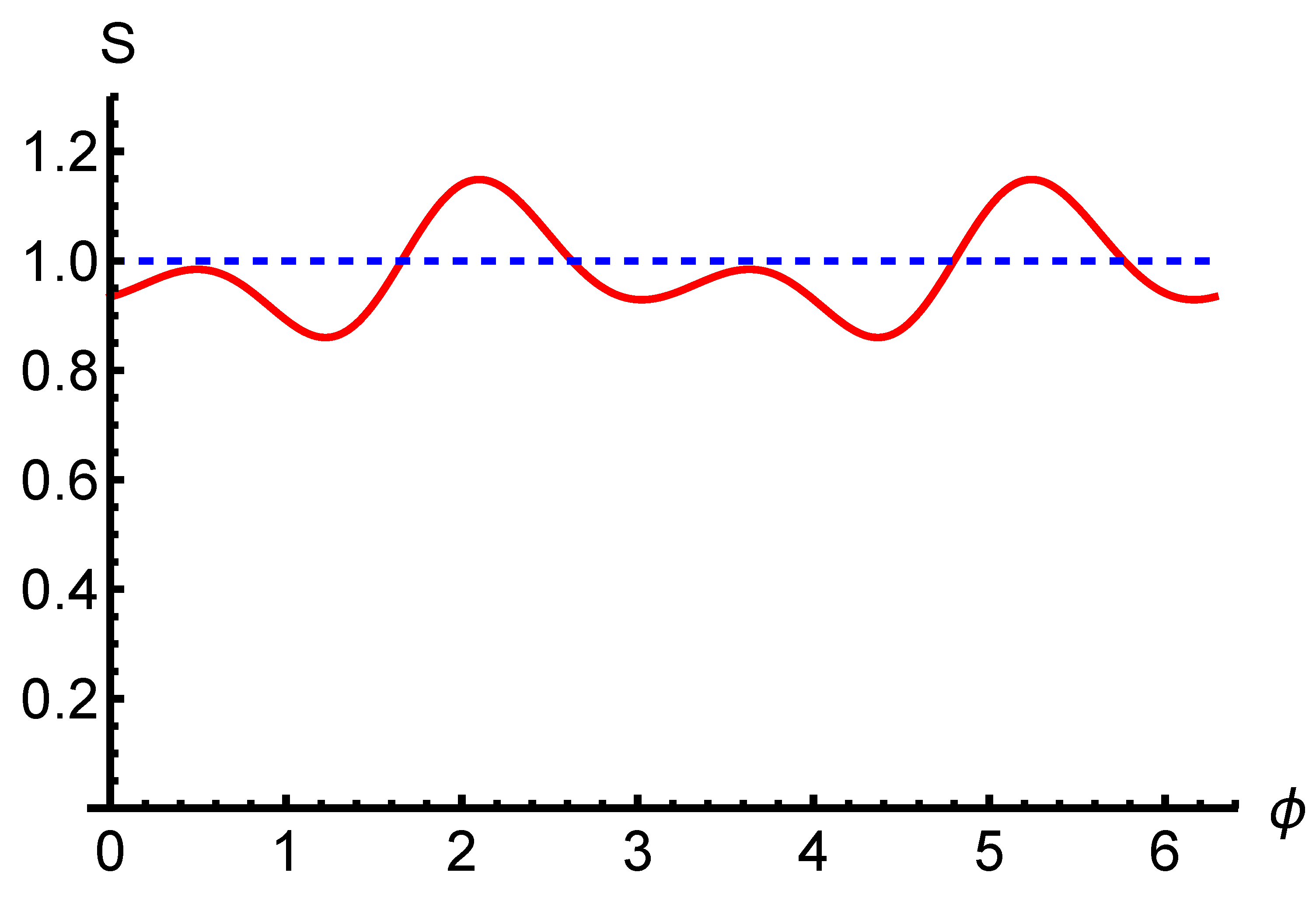
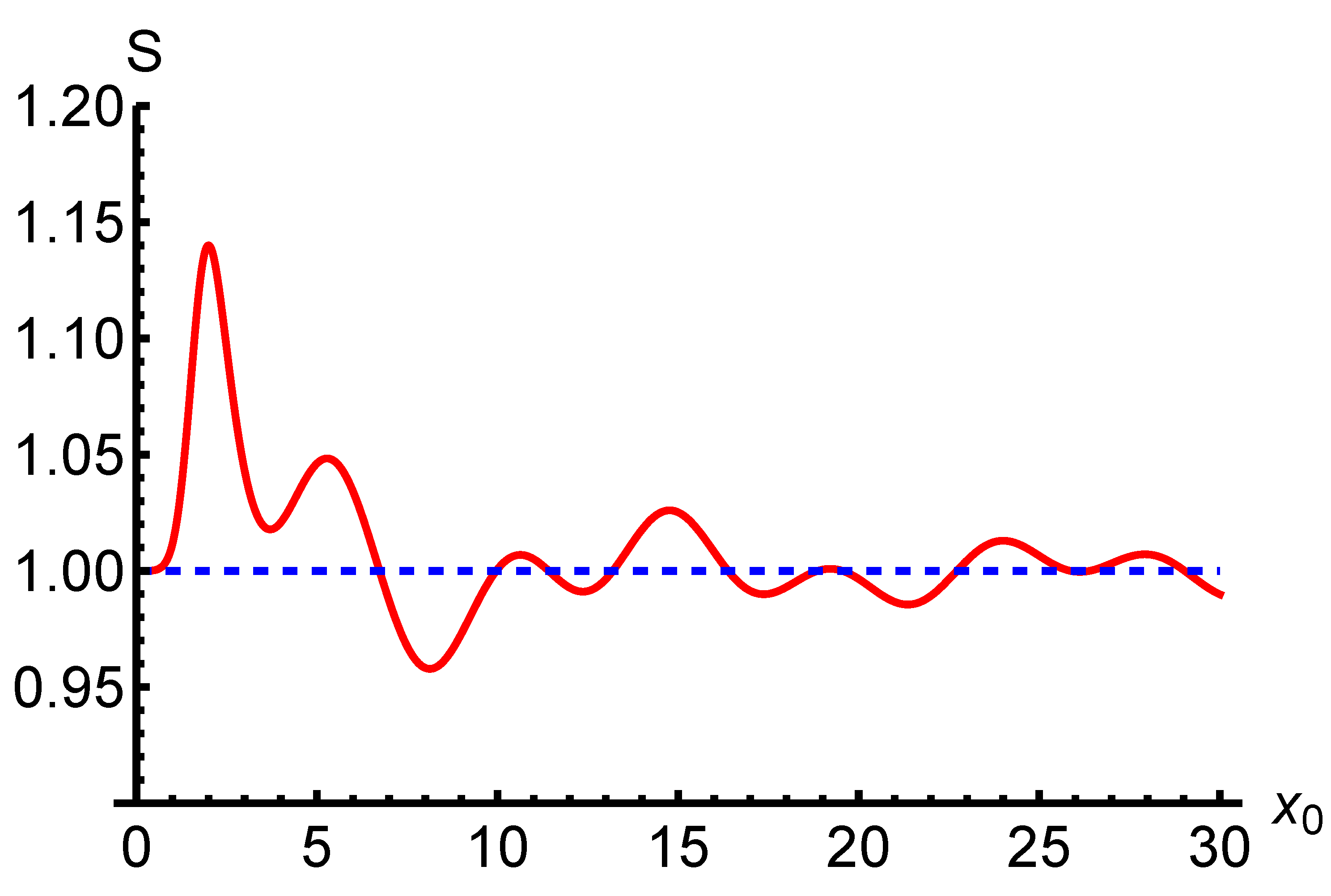
The time-integrated radiation pattern S ( Ω ) is no longer that of independent atoms, S 0 ( Ω ) = 1 + cos 2 θ . In Figure 4, the solid red curve is a plot of S ( Ω ) as a function of ϕ for θ = π / 2 and x 0 = 2 , whereas the dashed blue line is the independent atom result, S 0 ( π / 2 , ϕ ) = 1 . The deviation of the intensity from the independent atom result is significant only for x 0 = k 0 R 21 of order unity. When x 0 1 , the atoms are separated by a distance that is sufficiently large to eliminate all interactions, S 1 ( Ω ) S 0 ( Ω ) , S 2 ( Ω ) 0 , S 3 ( Ω ) 0 , and one recovers the independent atom result. On the other hand, for x 0 1 , the frequency separation s between levels A and B and between levels C and D is sufficiently large to wash out the coherence “in terms.” That is, S 3 ( Ω ) 0 . It also follows that S 1 ( Ω ) S 0 ( Ω ) , S 2 ( Ω ) 0 in the limit x 0 1 , so that we again recover the independent atom result. In Figure 5, S ( π / 2 , ϕ = 2 ) is plotted as a function of x 0 . It is seen that S ( π / 2 , ϕ = 2 ) S 0 ( π / 2 , ϕ = 2 ) = 1 for x 0 1 and x 0 1 . The comparison between S ( Ω ) and S 0 ( Ω ) for other values of θ and ϕ is qualitatively similar.
Although we recover the independent atom limit for both x 0 1 and x 0 1 , the physics behind these two limits is very different. For x 0 1 , we encounter a situation similar to that found for atoms on the z-axis. That is, there are four independent decay channels, the interference term vanishes, and the ratio of the lower to upper decay rate in each channel is one-half the number of channels. On the other hand, both the population and interference terms contribute to S ( Ω ) when x 0 1 . They combine to produce the independent atom result.
Explicitly, for x 0 1 ,
S ( Ω ) S 0 ( Ω ) + 3 sin 2 θ 8 x 0 cos α sin 2 ϕ x 0
with the S 0 ( Ω ) term arising solely from the population term and the correction term arising solely from the interference term. On the other hand, for x 0 1 , writing S n ( Ω ) = P n + Q n ( n = 1 , 2 , 3 ), one finds
(42a) P 1 ( Ω ) 33 32 S 0 ( Ω ) ; Q 1 ( Ω ) 1 32 S 0 ( Ω ) ; S 1 ( Ω ) S 0 ( Ω ) , (42b) P 2 ( Ω ) 3 32 sin 2 θ cos 2 ϕ ; Q 2 ( Ω ) 3 32 sin 2 θ cos 2 ϕ ; S 1 ( Ω ) 0 , (42c) P 3 ( Ω ) 0 ; Q 3 ( Ω ) 0 ; S 3 ( Ω ) 0 ,
clearly showing that the interference terms contribute.

3. Summary

In summary, the radiation pattern emitted by two atoms, interacting with each other via the vacuum radiation field, has been calculated, including effects of magnetic state degeneracy for atoms with a ground state having G = 0 angular momentum and an excited state having H = 1 angular momentum. For an initial condition in which both atoms are inverted, the time-integrated radiation pattern (TIRP) is identical to that for non-interacting atoms if the atoms lie on the z-axis, but differs if the atoms lie on the x-axis. Interaction-induced transfer from a magnetic sublevel of one atom to a different magnetic sublevel of the other atom can occur only if both atoms do not lie on the z-axis and such a transfer results in the TIRP no longer being that of individual atoms. Admittedly, the underlying physical reason why the TIRP pattern for atoms on the z-axis reduces to that of individual atoms only for an initially fully inverted state remains somewhat elusive. Although I have concentrated on the radiation pattern, there are other quantities of physical interest that can be calculated, such as the total angular momentum and energy in the radiated field.

Funding

This research is supported by the Air Force Office of Scientific Research under Grant No, FA9550-23-1-0172 and the National Science Foundation under Grant No. 2512474.

Data Availability Statement

The Mathematica notebook used in these calculations is available from the author on request.

Conflicts of Interest

The author declares no conflicts of interest.

References

  1. Lehmberg, R.H. Radiation from an N-Atom System. II. Spontaneous Emission from a Pair of Atoms. Phys. Rev. A 1970, 2, 889–896. [Google Scholar] [CrossRef]
  2. Dicke, R.H. Coherence in Spontaneous Radiation Processes. Phys. Rev. 1954, 93, 99–110. [Google Scholar] [CrossRef]
  3. Clemens, J.P.; Horvath, L.; Sanders, B.C.; Carmichael, H.J. Collective spontaneous emission from a line of atoms. Phys. Rev. A 2003, 68, 023809. [Google Scholar] [CrossRef]
  4. Crubellier, A. Level-degeneracy effects in superradiance theory. Phys. Rev. A 1977, 15, 2430–2438. [Google Scholar] [CrossRef]
  5. Crubellier, A.; Schweighofer, M.G. Level-degeneracy effects in superradiance theory. Calculations for a j=1/2 to j=1/2 transition. Phys. Rev. A 1978, 18, 1797–1815. [Google Scholar] [CrossRef]
  6. Weisskopf, V.; Wigner, E. Berechnung der natüauf grund der diracschen lichttheorie (Calculation of the natural line width on the basis of Dirac’s theory of light). Z. Fur Phys. 1930, 92, 54–73, Reprinted in At. Spectra 1967, 304–327. [Google Scholar]
  7. Stokes, A. Vacuum source-field correlations and advanced waves in quantum optics. Quantum 2018, 2, 46. [Google Scholar] [CrossRef]
  8. Berman, P.R.; Milonni, P.W. Spontaneous emission in dipole approximation revisited. Phys. Rev. A, 2026; in press. [Google Scholar]
  9. Berman, P.R.; Malinovsky, V.S. Principles of Laser Spectroscopy and Quantum Optics; Princeton University Press: Princeton, NJ, USA, 2001; Chapters 16 and 19. [Google Scholar]
  10. Fu, H.; Berman, P.R. Microscopic theory of spontaneous decay in a dielectric. Phys. Rev. A 2005, 72, 022104. [Google Scholar] [CrossRef]
Figure 1. A schematic representation of the geometry used in the calculation. The radiation pattern is evaluated at a distance R from the origin, with polar angle θ and azimuthal angle ϕ . With atom 1 at the origin, two cases are considered: atom 2 on the z-axis (red dot) or atom 2 on the x-axis (blue dot).
Atoms 14 00012 g001
Figure 2. Molecular basis level scheme for atoms on the z-axis. The intermediate-state eigenfrequencies are ω A = ω 0 + γ q 1 and ω B = ω 0 γ q 1 .
Atoms 14 00012 g002
Figure 3. Molecular basis level scheme for atoms on the x-axis. The intermediate-state eigenfrequencies are ω A = ω 0 + γ q a + q b , ω B = ω 0 + γ q a q b , ω C = ω 0 γ q a q b , and ω D = ω 0 γ q a + q b .
Atoms 14 00012 g003
Figure 4. Dimensionless radiated intensity S (red curve) as a function of ϕ for atoms on the x-axis for x 0 = k 0 R 21 = 2 and θ = π / 2 . The dashed blue line is the independent atom result. The angles θ and ϕ are the polar and azimuthal angles of the radiation pattern.
Atoms 14 00012 g004
Figure 5. Dimensionless radiated intensity S (red curve) as a function of x 0 = k 0 R 21 for atoms on the x-axis for θ = π / 2 and ϕ = 2 . The dashed blue line is the independent atom result. The independent atom limit is recovered for both x 0 1 and x 0 1 .
Atoms 14 00012 g005
Disclaimer/Publisher’s Note: The statements, opinions and data contained in all publications are solely those of the individual author(s) and contributor(s) and not of MDPI and/or the editor(s). MDPI and/or the editor(s) disclaim responsibility for any injury to people or property resulting from any ideas, methods, instructions or products referred to in the content.