
Abstract
This study investigates the ionization balance of Sn ions in an electron beam ion trap (EBIT). Highly charged Sn ions are produced via collisions with a quasi-monochromatic electron beam, and the charge state distribution is analyzed using a Wien filter. Significant Sn15+ production occurs at electron energies below the ionization potential of Sn14+ (379 eV). Calculations attribute this to electron-impact ionization from metastable Sn14+ states.
1. Introduction
Highly charged ions (HCIs) are of great interest in plasma physics and precision measurements in tests of fundamental physics [1,2,3,4,5,6]. In particular, ionization balance involving heavy ions is critical for understanding energy deposition in plasmas. Metastable states in HCIs, due to their long lifetime, tend to retain the electron population once excited. These long-lived states can significantly affect the charge state distribution (CSD), making them important for accurate plasma modeling [7,8].
An EBIT provides a controlled environment for probing such effects in detail. By generating and confining HCIs using a quasi-monochromatic electron beam, EBITs enable precise measurements of charge states and excitation dynamics. Combined with theoretical models, they are powerful tools for investigating metastable-related ionization processes [9,10,11,12].
In this work, we investigate the ionization equilibrium of highly charged tin ions in an EBIT with various electron-impact energies. We report the observation of electron excitation ionization in a low-density plasma.
2. Experiment
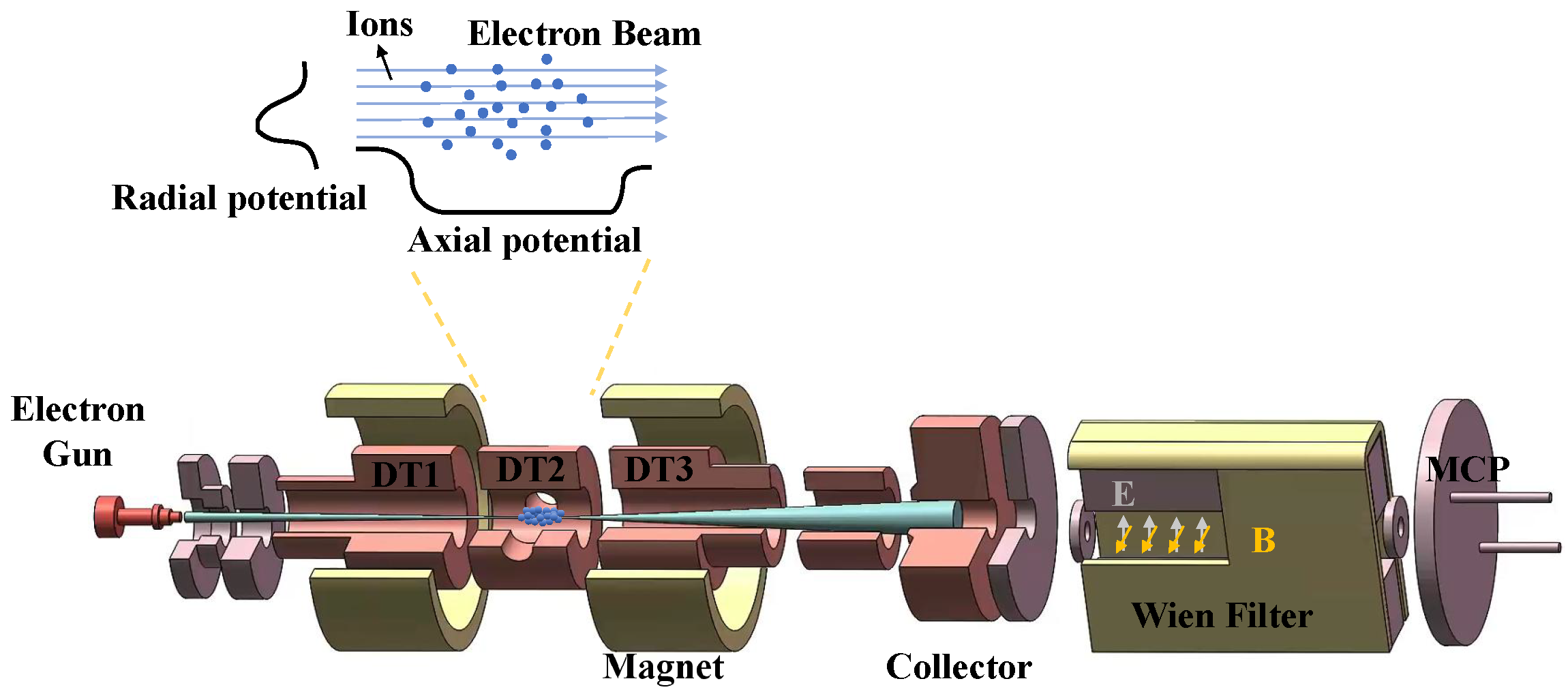
The experiments were performed using the low-energy permanent-magnet EBIT, CUBIT [13,14], as shown in Figure 1. Electrons are emitted from a LaB6 cathode and accelerated by the potential difference between the cathode and the central drift tube (DT). The beam is simultaneously radially compressed by a 0.56 T magnetic field generated by a permanent magnet. Injected neutral atoms undergo successive electron-impact ionization to form highly charged ions. These ions are axially confined by an electrostatic potential well and radially by the combined effects of the magnetic field and the electron beam space charge. A charge-state diagnostic system, comprising a Wien filter and a microchannel plate (MCP) detector, enables direct CSD analysis within the trap.
Figure 1.
Schematic view of the experimental setup.
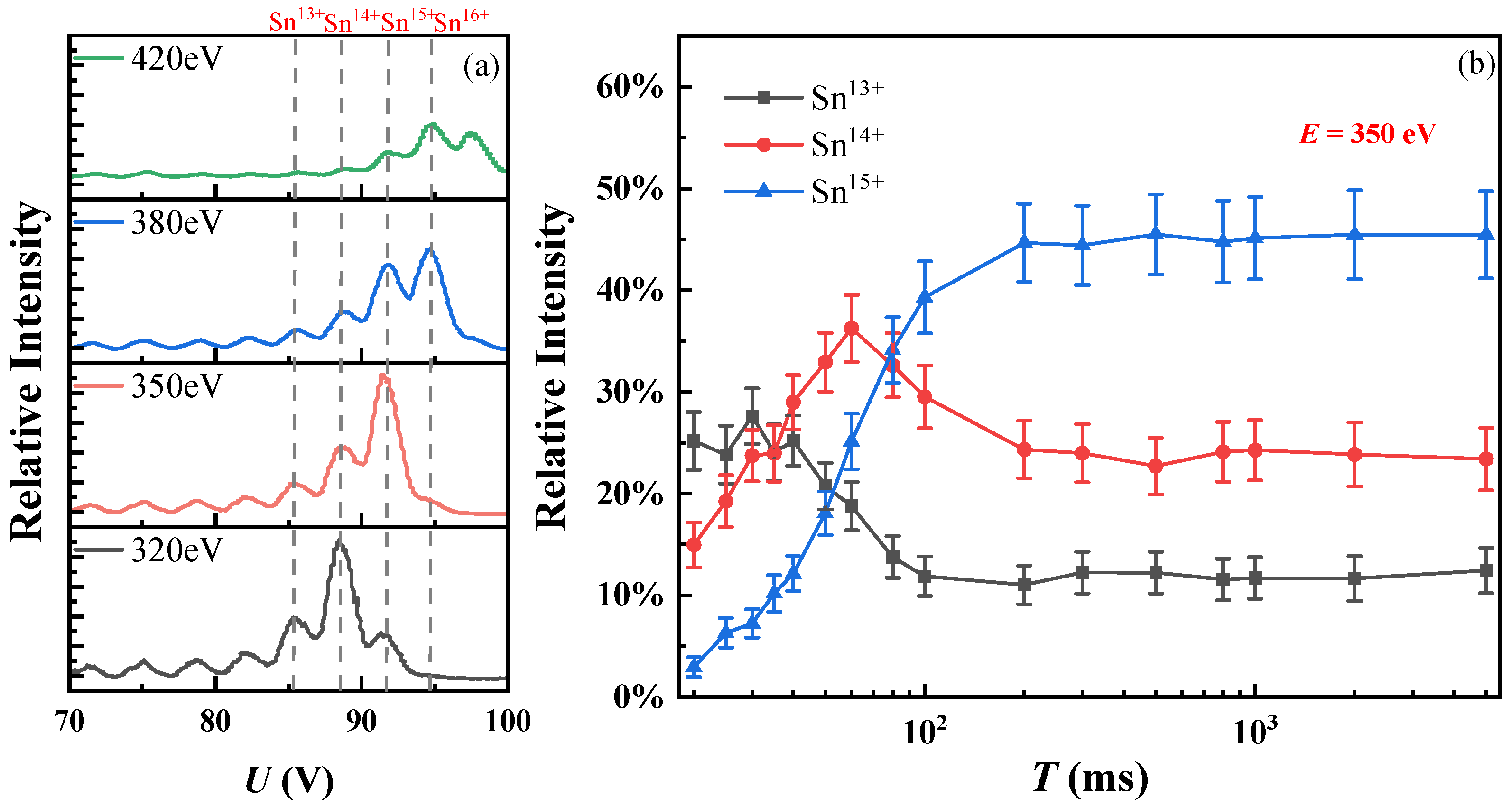
Upon reaching ionization equilibrium within the EBIT, the ions were extracted by lowering the potential of DT3, and their abundances were measured using the CSD analyzer. Sn15+ ions were unexpectedly detected at an electron beam energy of 320 eV, well below the ionization potential of Sn14+ (379 eV) [15]. Figure 2a shows the CSDs at selected energies, each taken after a 1 s confinement time. Figure 2b presents the time evolution of – abundances at 350 eV, indicating that equilibrium is reached at 500 ms. A 1 s duration was thus used for subsequent measurements to ensure equilibrium. During the measurements, the electron beam current was kept at 5 mA, and the beam energy was scanned from 265 eV to 450 eV.
Figure 2.
(a) Charge state distributions of Sn ions at different incident electron energies. Dashed lines show the peak positions of corresponding tin ions. (b) Time evolution of the abundance of Sn13+ to Sn15+ ions at an electron beam energy of 350 eV.
3. Theoretical Calculations
In this study, FAC (Flexible Atomic Code) [16] was employed to determine the energy levels, electron-impact excitation, radiative recombination cross-sections, and transition probabilities of Sn14+.
In the EBIT, the plasma has low electron density and a nearly monoenergetic electron energy distribution [17]. Under these conditions, the population of an energy level j is mainly governed by electron collisional excitation and de-excitation, along with spontaneous radiative decay. Processes such as dielectronic recombination, three-body recombination, charge exchange, and ion escape are negligible and thus omitted. The population rate equation for level i is given by
Here, is the spontaneous emission rate, while and denote the electron-impact excitation and de-excitation rates, respectively. At steady state, , and together with the normalization , the level populations can be obtained.
In this study, the level structure and atomic processes of Sn14+ were analyzed. The main configurations used in the calculations are listed in Table 1, with a total of 22,988 levels considered.
Table 1.
The configurations included in the RCI-CRM calculations for Sn14+.
4. Results and Discussion
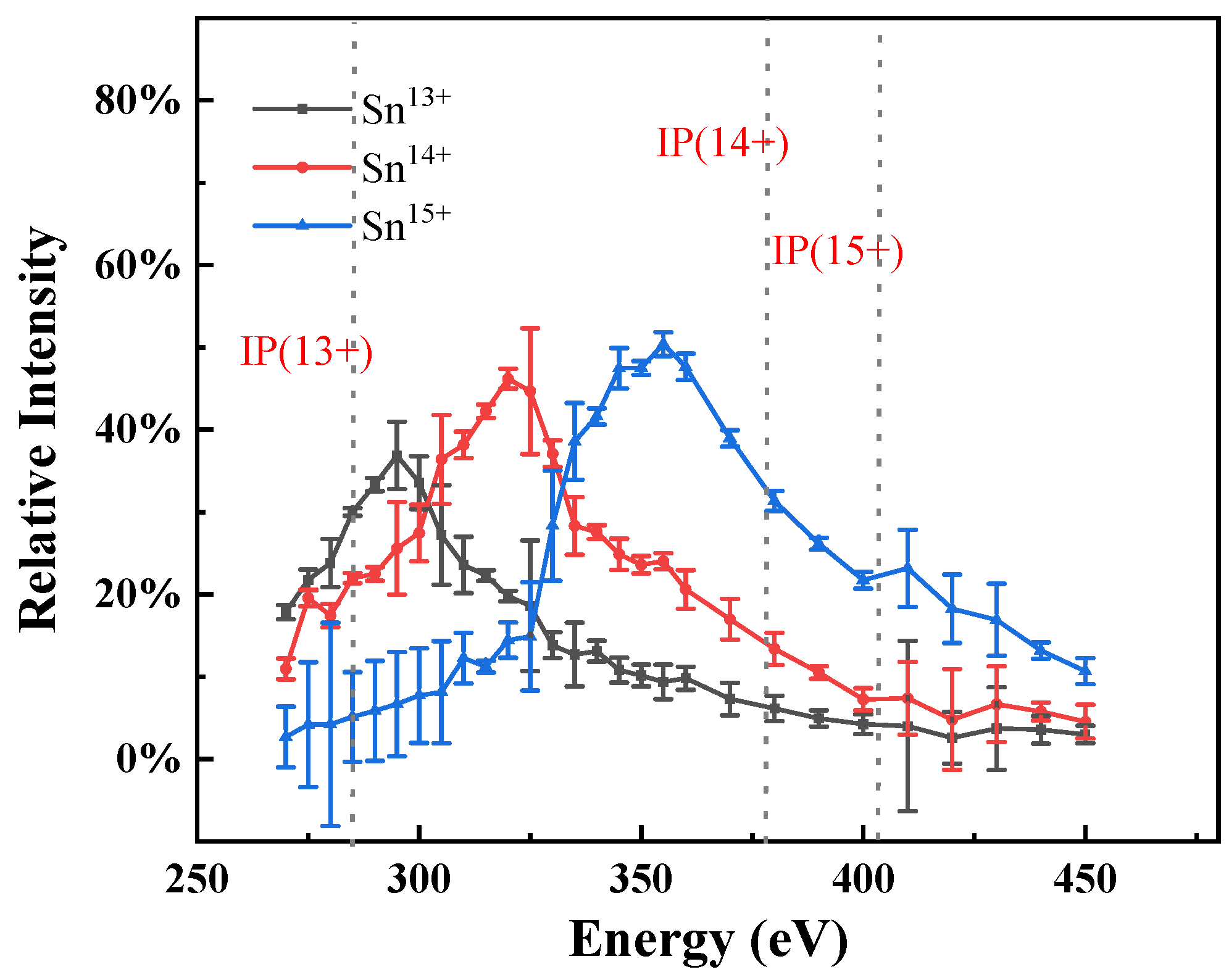
The results obtained at electron beam energies ranging from 265 eV to 450 eV are presented in Figure 3. As shown in the figure, ions begin to appear at an electron energy of 265 eV, which is significantly lower than the ionization potential of (379 eV). The relative abundance of ions reaches a maximum of approximately 50% at 355 eV and subsequently decreases with increasing electron energy. This behavior suggests that metastable ionization processes may have contributed to the transition from to , and possibly also to the subsequent ionization from to . Furthermore, there is a clear difference in the rate of increase of the abundance between the 265–320 eV and 320–355 eV energy intervals. We therefore hypothesize that multiple metastable ionization channels are involved, which will be examined in more detail in the following theoretical analysis section.
Figure 3.
The abundance of , , and ions at different electron energies. The three dashed lines from left to right indicate the positions of the ionization energies of , , and , respectively.
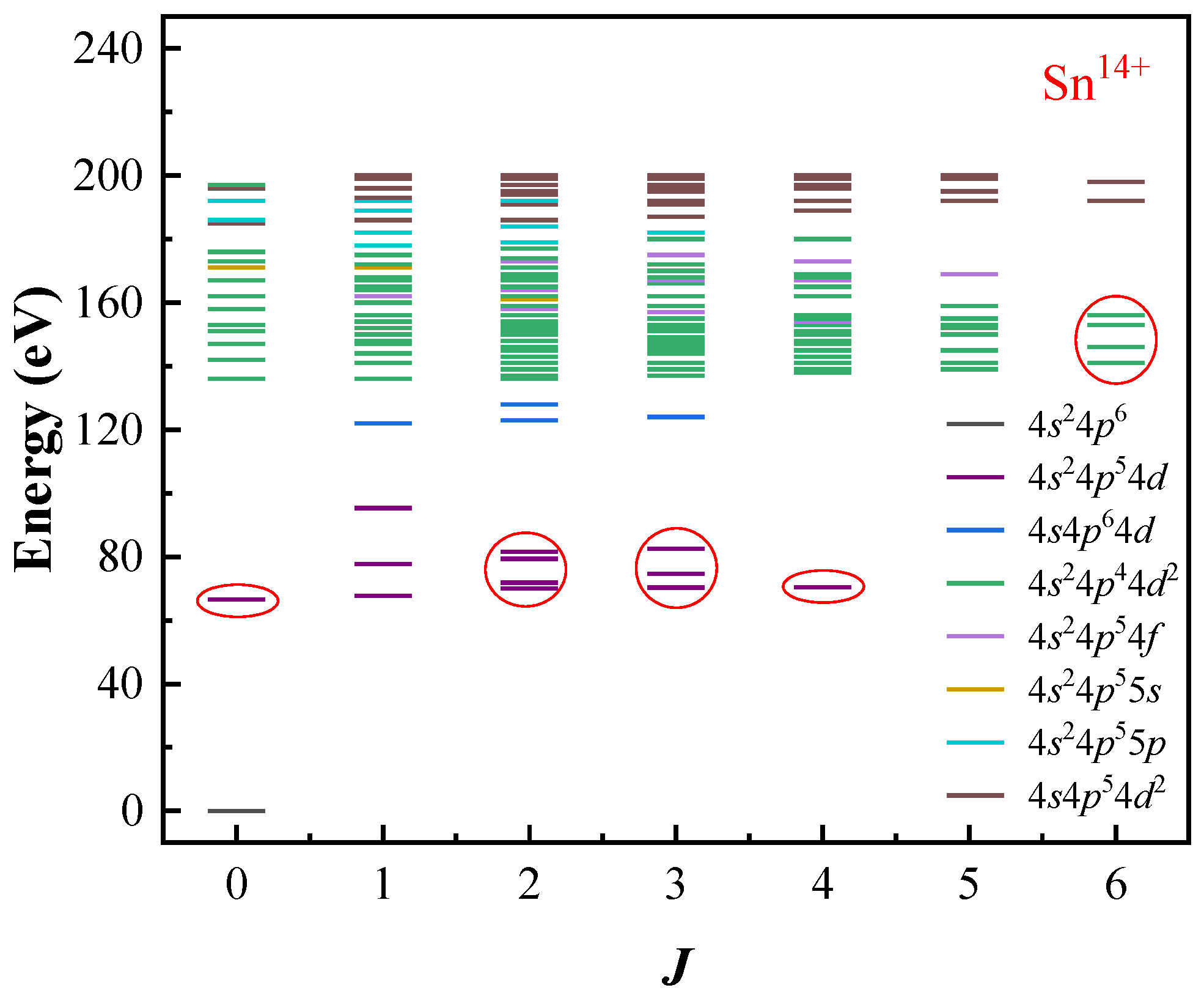
Figure 4 shows the distribution of the energy level of below the excitation energy of 200 eV. These levels, originating from the configurations listed in Table 1, include several metastable states with long lifetimes, particularly those associated with the and configurations. The relatively high excitation energies (ranging from 70 eV to 150 eV) and the extended lifetimes of these levels suggest that they can serve as initial states for ionization processes, especially in environments where the electron energy is insufficient to ionize the ground state directly. This interpretation is supported by experimental observations presented in Figure 3, where ions are detected at electron beam energies as low as 265 eV. The presence of these ions implies that metastable ionization pathways are active.
Figure 4.
Energy levels of Sn14+ calculated with FAC. The parts denoted by circles are metastable states with a high electron population.
To investigate the ionization dynamics and level population behavior of in the EBIT environment, a steady-state collisional-radiative model (CRM) was employed. This model incorporates the dominant atomic processes under EBIT conditions, including electron collisional excitation and de-excitation, as well as spontaneous radiative decay. Electron-impact ionization and radiative recombination were not considered in the level population calculation. Transitions between all single and double excited configurations were considered, including electric dipole (E1), electric quadrupole (E2), magnetic dipole (M1), and magnetic quadrupole (M2) transitions.
The simulations were performed using the experimental parameters, including an electron beam current of 5 mA and an electron density of cm−3 [18,19]. The incident electron beam energies were corrected based on the calibration model described in the Section 2, yielding adjusted energies of 271, 322, 352, and 377 eV. The resulting populations of the highest-lying energy levels under these conditions are summarized in Table 2. Their corresponding lifetimes are also listed in the same table for reference. The lifetime of the second level, , is effectively infinite in the present calculation, since single-photon decay is completely forbidden for this state and the two-photon transition is extremely weak. It is worth noting that the EBIT magnetic field may have an effect on its lifetime due to magnetic-field-induced transitions. Magnetic-field-induced mixing between the states and was estimated using the method introduced in [20], and the mixing coefficient was found to be smaller than at . Since the transition amplitude induced by magnetic interactions can be expressed as , with , the estimated contribution is on the order of . Therefore, the magnetic-field-induced transition can be neglected.
Table 2.
The 14 levels with the highest population for Sn14+ at different incident electron energies.
Table 2 reveals that the metastable configuration , particularly the level, consistently exhibits the highest population among all configurations at the four impact electron energies, reaching a peak of 29.2% at 352 eV. This metastable state may dominate in the intermediate stages of the ionization process of . In contrast, the ground-state configuration maintains a relatively stable population ranging from 13% to 20%, with its maximum population (20.0%) observed at 377 eV. The other levels with lower total angular momentum quantum numbers () also show substantial populations, typically ranging between 6% and 13%. These levels, with longer lifetimes and lower radiative decay rates, serve as metastable states that significantly contribute to multi-step ionization dynamics. Highly excited configurations such as and begin to emerge. However, their populations remain consistently below 3%, reflecting their limited stability and transient existence before undergoing further ionization.
Overall, the population distributions in Table 2 may suggest the involvement of two possible ionization pathways for . One is likely associated with metastable states, which dominate the population and could serve as favorable precursors for ionization. The other may involve direct excitation to higher configurations such as and , which, although weakly populated, appear at higher excitation energies and might contribute to ionization toward at low incident electron energies.
5. Conclusions
We studied the ionization dynamics of Sn14+ ions in an EBIT under controlled electron energies. Sn15+ ions were produced even below the ionization potential of Sn14+, which is attributed to ionization from metastable states. We observed double-electron excitation ionization in a low-density plasma. Experimental and theoretical results confirm multiple ionization pathways and reveal the complexity of EBIT ionization processes.
Author Contributions
Conceptualization, K.Y. and J.X.; methodology, K.Y. and J.X.; validation, Q.G., Z.C. and F.J.; formal analysis, Q.G. and Z.C.; investigation, Q.G., W.X. and F.J.; resources, K.Y. and Y.Z.; data curation, Q.G and Z.C.; writing—original draft preparation, Q.G. and Z.C.; writing—review and editing, K.Y., X.D. and J.X.; supervision, K.Y. and Y.Z.; project administration, K.Y. and X.D.; funding acquisition, X.D. and K.Y. All authors have read and agreed to the published version of the manuscript.
Funding
This research was funded by the Foundation of National Key Laboratory of Computational Physics China, and the National Natural Science Foundation of China through Grant No.12274352.
Data Availability Statement
Data are contained within the article.
Conflicts of Interest
The authors declare no conflicts of interest.
References
- Dou, L.J.; Jin, R.; Sun, R.; Xie, L.Y.; Huang, Z.K.; Li, J.M.; Ma, X.W.; Gao, X. Relativistic eigenchannel R-matrix studies of the strong intrashell electron correlations in highly charged Ar13+ ions. Phys. Rev. A 2020, 101, 032508. [Google Scholar] [CrossRef]
- Richter, J.; Togawa, M.; Crespo López-Urrutia, J.R.; Surzhykov, A. Hanle effect for lifetime analysis: Li-like ions. J. Astron. Instrum. 2025, 20, C03003. [Google Scholar] [CrossRef]
- Ralchenko, Y. Collisional-Radiative Modeling for Highly-Charged Ions of Tungsten. Fusion Res. 2013, 8, 2503024. [Google Scholar] [CrossRef]
- Safronova, M.S.; Dzuba, V.A.; Flambaum, V.V.; Safronova, U.I.; Porsev, S.G.; Kozlov, M.G. Highly Charged Ions for Atomic Clocks, Quantum Information, and Search for α variation. Phys. Rev. Lett. 2014, 113, 030801. [Google Scholar] [CrossRef] [PubMed]
- Safronova, M.S.; Dzuba, V.A.; Flambaum, V.V.; Safronova, U.I.; Porsev, S.G.; Kozlov, M.G. Atomic properties of Cd-like and Sn-like ions for the development of frequency standards and search for the variation of the fine-structure constant. Phys. Rev. A 2014, 90, 052509. [Google Scholar] [CrossRef]
- Safronova, M.S.; Dzuba, V.A.; Flambaum, V.V.; Safronova, U.I.; Porsev, S.G.; Kozlov, M.G. Highly charged Ag-like and In-like ions for the development of atomic clocks and the search for α variation. Phys. Rev. A 2014, 90, 042513. [Google Scholar] [CrossRef]
- Kromer, K.; Lyu, C.; Door, M.; Filianin, P.; Harman, Z.; Herkenhoff, J.; Indelicato, P.; Keitel, C.H.; Lange, D.; Novikov, Y.N.; et al. Observation of a Low-Lying Metastable Electronic State in Highly Charged Lead by Penning-Trap Mass Spectrometry. Phys. Rev. Lett. 2023, 131, 223002. [Google Scholar] [CrossRef] [PubMed]
- Rosner, M.K.; Rehbehn, N.H.; Crespo López-Urrutia, J.R. Experimental and theoretical Ritz–Rydberg analysis of the electronic structure of highly charged ions of lead and bismuth by optical spectroscopy. J. Phys. B At. Mol. Opt. Phys. 2024, 57, 055001. [Google Scholar] [CrossRef]
- Scheers, J.; Shah, C.; Ryabtsev, A.; Bekker, H.; Torretti, F.; Sheil, J.; Czapski, D.A.; Berengut, J.C.; Ubachs, W.; López-Urrutia, J.R.C.; et al. EUV spectroscopy of highly charged Sn13+−Sn15+ ions in an electron-beam ion trap. Phys. Rev. A 2020, 101, 062511. [Google Scholar] [CrossRef]
- Kimura, N.; Priti; Numadate, N.; Kodama, R.; Nakamura, N. Anomalous plasma ionization balance induced by 5s and 4f metastable states. Phys. Rev. A 2023, 108, 032818. [Google Scholar] [CrossRef]
- Lu, Q.; He, J.; Tian, H.; Li, M.; Yang, Y.; Yao, K.; Chen, C.; Xiao, J.; Li, J.G.; Tu, B.; et al. Observation of indirect ionization of W7+ in an electron-beam ion-trap plasma. Phys. Rev. A 2019, 99, 042510. [Google Scholar] [CrossRef]
- Windberger, A.; Torretti, F.; Borschevsky, A.; Ryabtsev, A.; Dobrodey, S.; Bekker, H.; Eliav, E.; Kaldor, U.; Ubachs, W.; Hoekstra, R.; et al. Analysis of the fine structure of Sn11+−Sn14+ ions by optical spectroscopy in an electron-beam ion trap. Phys. Rev. A 2016, 94, 012506. [Google Scholar] [CrossRef]
- He, Z.; Meng, J.; Li, Y.; Jia, F.; Khan, N.; Niu, B.; Huang, L.; Hu, Z.; Li, J.; Wang, J.; et al. Magnetic-dipole lines in Fe-like and Mn-like molybdenum ions. J. Quant. Spectrosc. Radiat. Transfer 2022, 288, 108276. [Google Scholar] [CrossRef]
- Wu, C.; Ding, X.; Guo, Q.; Liu, J.; Yao, K.; Fu, Y.; Dong, C. Stepwise ionization of Mo14+ ions in an electron-beam ion trap: The importance of the metastable level. Phys. Rev. A 2025, 111, 042818. [Google Scholar] [CrossRef]
- Rodrigues, G.; Indelicato, P.; Santos, J.; Patté, P.; Parente, F. Systematic calculation of total atomic energies of ground state configurations. At. Data Nucl. Data Tables 2004, 86, 117–233. [Google Scholar] [CrossRef]
- Gu, M.F. The flexible atomic code. Can. J. Phys. 2008, 86, 675–689. [Google Scholar] [CrossRef]
- Jonauskas, V.; Masys, Š.; Kynienė, A.; Gaigalas, G. Cascade emission in electron beam ion trap plasma. J. Quant. Spectrosc. Radiat. Transfer 2013, 127, 64–69. [Google Scholar] [CrossRef][Green Version]
- Shimizu, E.; Ali, S.; Tsuda, T.; Sakaue, H.A.; Kato, D.; Murakami, I.; Hara, H.; Watanabe, T.; Nakamura, N. Measurements of density dependent intensity ratios of extreme ultraviolet line emission from Fe X, XI, and XII. Astron. Astrophys. 2017, 601, A111. [Google Scholar] [CrossRef]
- Nakamura, N.; Numadate, N.; Kono, Y.; Murakami, I.; Kato, D.; Sakaue, H.; Hara, H. Electron Density Dependence of Extreme Ultraviolet Line Intensity Ratios in Ar XIV. Astrophys. J. 2021, 921, 115. [Google Scholar] [CrossRef]
- Grumer, J.; Li, W.; Bernhardt, D.; Li, J.; Schippers, S.; Brage, T.; Jönsson, P.; Hutton, R.; Zou, Y. Effect of an external magnetic field on the determination of E1M1 two-photon decay rates in Be-like ions. Phys. Rev. A 2013, 88, 022513. [Google Scholar] [CrossRef]
Disclaimer/Publisher’s Note: The statements, opinions and data contained in all publications are solely those of the individual author(s) and contributor(s) and not of MDPI and/or the editor(s). MDPI and/or the editor(s) disclaim responsibility for any injury to people or property resulting from any ideas, methods, instructions or products referred to in the content. |
© 2025 by the authors. Licensee MDPI, Basel, Switzerland. This article is an open access article distributed under the terms and conditions of the Creative Commons Attribution (CC BY) license (https://creativecommons.org/licenses/by/4.0/).