
Article

Proton Interactions with Biological Targets: Inelastic Cross Sections, Stopping Power, and Range Calculations

by
Camila Strubbia Mangiarelli
1,2,3,
Verónica B. Tessaro
1,2,
Michaël Beuve
3 and
Mariel E. Galassi
1,2,*
1
Grupo de Física Biomédica, Instituto de Física de Rosario, Consejo Nacional de Investigaciones Científicas y Técnicas (CONICET)-Universidad Nacional de Rosario (UNR), Rosario S2000, Argentina
2
Facultad de Ciencias Exactas, Ingeniería y Agrimensura, Universidad Nacional de Rosario (UNR), Rosario S2000, Argentina
3
Institut de Physique des 2 Infinis de Lyon (IP2I), CNRS/IN2P3, Université Lyon 1, 69100 Villeurbanne, France
*
Author to whom correspondence should be addressed.
Atoms 2025, 13(10), 83; https://doi.org/10.3390/atoms13100083
Submission received: 25 August 2025 / Revised: 15 September 2025 / Accepted: 18 September 2025 / Published: 24 September 2025
(This article belongs to the Section Atomic, Molecular and Nuclear Spectroscopy and Collisions)

Abstract

Proton therapy enables precise dose delivery to tumors while sparing healthy tissues, offering significant advantages over conventional radiotherapy. Accurate prediction of biological doses requires detailed knowledge of radiation interactions with biological targets, especially DNA, a key site of radiation-induced damage. While most biophysical models (LEM, mMKM, NanOx) rely on water as a surrogate, this simplification neglects the complexity of real biomolecules. In this work, we calculate the stopping power and range of protons in liquid water, dry DNA, and hydrated DNA using semi-empirical cross sections for ionization, electronic excitation, electron capture, and electron loss by protons and neutral hydrogen in the 10 keV–100 MeV energy range. Additionally, ionization cross sections for uracil are computed to explore potential differences between DNA and RNA damage. Our results show excellent agreement with experimental and ab initio data, highlighting significant deviations in stopping power and range between water and DNA. Notably, the stopping power of DNA exceeds that of water at most energies, reducing proton ranges in dry and hydrated DNA by up to 20% and 26%, respectively. These findings provide improved input for Monte Carlo simulations and biophysical models, enhancing RBE predictions and dose accuracy in hadrontherapy.

1. Introduction

In recent decades, there has been a growing shift toward the use of more advanced modalities for cancer treatment, such as hadrontherapy, which includes proton and heavy ion therapy. Although conventional radiotherapy with photon and electron beams is still employed in nearly 90% of cases, proton therapy has attracted increasing attention due to its ability to deliver highly localized doses while minimizing damage to surrounding healthy tissues [1,2]. This advantage stems from the characteristic energy deposition profile of proton beams, known as the Bragg peak, which enables greater sparing of normal tissues and allows for tumor dose escalation, thereby potentially improving therapeutic outcomes.
A major challenge in proton therapy is the precise estimation of Relative Biological Effectiveness (RBE), which quantifies the increased biological damage caused by protons compared to reference radiation [3,4]. RBE depends on various physical parameters, such as the dose, radiation type, and energy, as well as biological parameters, including the cell line, cell cycle phase, and cellular environment. This complex dependency has led to the development of biophysical models to predict RBE with sufficient accuracy for treatment planning and optimization. Although a constant RBE value of 1.1 is currently adopted in clinical practice, estimations obtained from biophysical models implemented in the treatment planning systems (TPSs) of hadrontherapy facilities worldwide—such as the first version of the Local Effect Model (LEM) [5] and the modified Microdosimetric Kinetic Model (mMKM) [6,7]—can exceed the recommended uncertainty limit of 5%. Currently, biophysical models consider the interactions of protons and secondary particles with liquid water. For instance, the LEM [5] and mMKM [6,7] employ a radial dose distribution determined in liquid water. In microdosimetry models, such as the MKM [8,9], or nanodosimetry approaches, such as NanOx [10,11,12], the calculation of specific energy is performed in liquid water. However, DNA damage is likely the main source of lethal effects in all these models, and predictions might be improved by explicitly accounting for interactions with DNA through adapted Monte Carlo (MC) simulations.
MC simulations play a crucial role in modeling proton transport and energy deposition at the nanometric scale. Among the most widely used toolkits, Geant4 and its Geant4-DNA extension [13] enable step-by-step track structure simulations in liquid water, which is commonly used as a surrogate for biological tissue. However, this approximation overlooks the molecular complexity of DNA and RNA, which can potentially lead to inaccuracies in predicting radiation-induced damage. A more refined approach involves incorporating explicit molecular targets, such as DNA components (e.g., nucleobases and backbone molecules), into the simulation framework, thereby improving stopping power calculations and enhancing the predictive accuracy of biophysical models [14]. Although Geant4-DNA includes interaction cross sections for DNA components, these models are currently applicable only to electrons. For protons, available data are limited to ionization processes in molecular precursors of DNA, such as tetrahydrofuran or purine [15]. Evidence pointing out the relevance of considering a more realistic biological medium to account for energy deposition at the micrometric and nanometric scales (used as input in biophysical mechanistic models like the LEM) has already been reported in the literature. Alcocer-Ávila et al. [16] showed nucleus–dose differences through MC simulations considering particle impact—DNA inelastic cross sections—while Champion et al. [17] compared average deposited energies and demonstrated potential deviations at the nanometric scale.
Previous studies estimated the stopping power and range of protons using both semi-empirical and ab-initio models to describe the inelastic processes underlying radiation–matter interactions. Alcocer-Ávila et al. [16] employed the prior CDW-EIS model to account for ionization and electron capture, while applying semi-empirical models to the remaining inelastic processes. Their calculations encompassed the DNA nucleobases and were extended to hydrated DNA. In contrast, Harakat et al. [18] adopted Rudd’s semi-empirical model for ionization and parameterized functions for electronic excitation and electron capture, without incorporating secondary processes following charge exchange—such as ionization and excitation by neutral hydrogen impact or electron loss. Furthermore, their results were restricted to isolated DNA nucleobases and did not include the complete DNA structure.
This study aims to provide semi-empirical cross sections, stopping power, and proton ranges in liquid water and in dry and hydrated DNA, thereby generating a benchmark dataset for future MC track structure simulations and biophysical RBE models. By incorporating all relevant inelastic processes—ionization, electronic excitation, electron capture, and electron loss—for both protons and neutral hydrogen, this work seeks to provide a more complete and realistic description of energy deposition in biological media at the nanometric scale. Furthermore, the ionization cross section of uracil is evaluated to explore potential differences in radiation-induced damage between DNA and RNA. In addition, the use of semi-empirical cross sections provides a practical advantage for future MC track structure simulations, as it significantly reduces the computational time compared to fully ab initio calculations, thereby facilitating their implementation in biophysical modeling.

2. Materials and Methods

To compute the physical parameters relevant to proton interactions with biological targets involved in the calculation of the RBE, we first determined the cross sections for each inelastic process. These calculations were performed for the nucleobases of DNA and RNA, the sugar-phosphate backbone, and liquid water. The inelastic processes considered in this study include ionization and electronic excitation induced by both protons and neutral hydrogen impact, as well as charge exchange mechanisms. Once the cross sections were obtained, we proceeded to calculate the stopping power and range in DNA.
The biological matter at the nanometric scale was modeled by adopting a representative nucleotide structure as a nucleobase pair—either adenine–thymine (A-T) or cytosine–guanine (C–G)—together with two sugar-phosphate backbones (C5H10PO5) [19]. The four primary nucleobases in DNA—adenine (C5H5N5), thymine (C5H6N2O2), cytosine (C4H5N3O), and guanine (C5H5N5O)—encode genetic information. In addition, uracil (C4H4N2O2)—the nucleobase that replaces thymine in RNA—was also evaluated. Although no stopping power or range calculations were performed for RNA, this analysis allows for a preliminary comparison of the radiation response of DNA and RNA components at the molecular level.
An equivalent unit of the DNA molecule was constructed based on a composition of 58% A-T and 42% C–G base pairs [20]. This equivalent unit represents a statistical average of the DNA composition and was used to estimate physical properties per base pair, such as mass density and electron density, assuming a uniform material. Two hydration levels were considered: “dry DNA”, without considering water molecules; and “hydrated DNA”, in which 18 water molecules per nucleotide were included. The latter choice reproduces the characteristic density of B-DNA (∼1.29 g/cm3) and provides a more realistic representation of biological conditions. A more detailed description of this approach can be found in Champion et al. [17]. The construction of these equivalent DNA units, including the calculation of molecular fractions and the corresponding stopping power, is detailed in Appendix A.

2.1. Cross Sections

2.1.1. Ionization

Proton Impact
The Rudd model [21] is widely used in various MC transport codes, including GEANT4-DNA [22]. It is based on the First Born Approximation (FBA) and is fitted to available experimental data across the entire energy range (particularly intermediate and low energies) using a semi-empirical expression. Equation (1) provides the analytical expression for the single differential cross section as a function of the kinetic energy E of the secondary electron emitted in the ionization of an orbital j.
d σ j d E ( T ) = S j B j F 1 ( v ) + w F 2 ( v ) ( 1 + w ) 3 { 1 + exp [ α ( w w c / v ) ] }
The dimensionless variables used in this work were w = E / B j , and v 2 = T / B j , with B j representing the binding energy of the orbital j, and T representing the kinetic energy of an electron with the same velocity as the proton:
v e = v p T = m 0 e m 0 p E p
with m 0 e and m 0 p , and E p representing the energy of the incident proton.
In particular, for water, the vapor binding energies were used (Table 1), and for the DNA and RNA components, the binding energies for each orbital are presented in Table A2 in Appendix B. S j = 4 π a 0 2 N j ( R / B j ) 2 , where N j is the number of electrons in the orbital j; a 0 = 0.52917706 × 10 8 cm is the Bohr radius; R = 13.6 eV is the Rydberg energy, w c = 4 v 2 2 v R / 4 B j ; and α is a numerical parameter related to the relative size of the target molecule.
F 1 and F 2 are functions that contribute to the low- and high-energy parts, respectively, and are given by the following:
F 1 ( v ) = L 1 ( v ) + H 1 ( v )
F 2 ( v ) = L 2 ( v ) H 2 ( v ) L 2 ( v ) + H 2 ( v )
where
L 1 ( v ) = C 1 v D 1 1 + E 1 v D 1 + 4
H 1 ( v ) = A 1 ln ( 1 + v 2 ) v 2 + B 1 / v 2
L 2 ( v ) = C 2 v D 2
H 2 ( v ) = A 2 v 2 + B 2 v 4
The parameters A 1 , B 1 , C 1 , D 1 , E 1 , A 2 , B 2 , C 2 , D 2 , and α are presented in Table 2.
In this work, we used an approach proposed by Dingfelder et al. [23], which proposes that the single differential cross section d σ / d E for liquid water is given by
d σ d E = j G j d σ j d E
where G j are partition factors that adjust the different contributions of each subshell for liquid water to the results obtained from the FBA. The binding energies for liquid and vapor water, the occupation number N j , and the G j factors, corresponding to each molecular orbital are arranged in Table 1.
The single differential ionization cross section for each nucleobase was determined according to Equation (1), relying on the fitting parameters in Table 2 [24]. The binding energies of the studied molecules were extracted from [25]. The occupancy number for each molecular orbital is equal to 2 [26]. The parameters in Table 2 come from a fit of experimental data of single differential cross sections by proton impact on the adenine molecule for energy transfers between 10 eV and 1 keV [27].
Following these ideas, Francis et al. [24] performed scaling according to the experimental data for hydrocarbons (methane, ethane, ethylene, acetylene, benzene, and hydrogen, considered tissue-equivalent gases) measured by Wilson & Toburen [28], by dividing the cross sections by the number of weakly bonded valence electrons of the hydrocarbon, then multiplying the result by the number of electrons in the adenine molecule (N = 50). The same parameters obtained from the fit for adenine were applied to each of the nucleobases, and were extended in this study to uracil and the sugar-phosphate backbone.
The total ionization cross section was obtained by numerically integrating Equation (9) as a function of the kinetic energy E of the emitted electron. The maximum energy that the emitted electron can acquire is E m a x = 4 T , calculated by applying classical analysis.
In this study, a relativistic high-velocity particle approach was used to derive the ionization cross sections [21,29]. According to the FBA, which applies to electromagnetic interactions, the ionization cross section is proportional to the square of the projectile charge, Z p r o j 2 , and depends primarily on the projectile velocity rather than on its mass. As a result, particles with the same charge magnitude and velocity, such as a proton and an electron, are expected to have similar single differential cross sections, even though their masses and kinetic energies differ. For relativistic energies,
v e = v p T r e l = m 0 e v p 2 2 = m 0 e c 2 2 1 1 ( 1 + E p / m 0 p c 2 ) 2
where c is the speed of light in a vacuum. Therefore, the single ionization cross section (Equation (1)) can now be calculated in terms of T r e l .
Neutral Hydrogen Impact
As protons traverse the medium, they can interact with target electrons through electron capture (process described in Section 2.1.3), thereby transforming the protons into neutral hydrogen projectiles. These hydrogen atoms, while propagating through the medium, can also induce target ionization. In high-energy collisions, the ionization cross sections for neutral hydrogen impact differ from those for proton impact because of several factors. These factors include the screening of the nuclear charge by the bound electron of the hydrogen atom, the contributions to the electron spectrum from the removal of this electron, and the interactions between the hydrogen electron and the target electrons. The magnitude of these effects varies depending on the energy of the projectile, as well as on the energy and emission angle of the electron ejected from the target molecule.
After extensive analysis, Dingfelder et al. [23] selected the secondary electron spectrum for proton impact as a reference, introducing modifications via a function g ( E H 0 ) that depends only on the energy of the incident particle E H 0 . Based on the work of Bolorizadeh & Rudd [30] and Toburen [31], Dingfelder et al. characterized g ( E H 0 ) as follows: at low incident energies, g ( E H 0 ) remains constant and greater than one, whereas at higher energies, it decreases to slightly below one due to the screening effect of the hydrogen-bound electron on the nuclear charge. Consequently, the single differential ionization cross section for neutral hydrogen impact is expressed by the following equation:
d σ d E H 0 = g ( E H 0 ) d σ d E H +
with
g ( E H 0 ) = 0.8 1 + exp log ( E H 0 ) 4.2 0.5 1 + 0.9
The parameters were determined using experimental data on water vapor as a reference, with the cross section contributions adjusted to align with the total stopping cross section for liquid water [23,32]. As a result, the total ionization cross section for neutral hydrogen impact is 1.7 times greater than that for proton impact at low incident particle energies, and 0.9 times smaller at higher energies.

2.1.2. Electronic Excitation

Currently, no experimental measurements are available for proton impact excitation cross sections in either vapor or liquid water. As a result, semi-empirical approaches are commonly used, in which proton excitation cross sections are estimated by extrapolating from photon and electron excitation data, following known scaling trends. These estimations are based on the FBA.
In this study, a semi-empirical model for proton impact was adopted, based on a velocity-scaling approach derived from electron excitation cross sections and extended to cover lower proton energies. This methodology was originally proposed by Miller & Green [33]. The cross section for a given excitation level k is represented by the following analytic form:
σ e x c , k p r o t ( E p ) = a 0 ( n e a ) Ω ( E p W ) ν J Ω + ν + E p Ω + ν
where a 0 = 10 16 cm2, n e is the number of electrons of the target molecule, E p is the proton impact energy [eV], and W is the ionization potential [eV]. ν and Ω are dimensionless parameters, while a and J are energy-dimensional parameters [eV].
The parameters a and Ω determine the asymptotic behavior of the excitation cross section at high projectile energies. Their values are derived by comparing the velocity dependence of electron and proton cross sections as predicted by the FBA. On the other hand, the parameters J and ν govern the shape of the cross section at low energies, and are determined empirically by fitting excitation data across a range of different target molecules [34]. Additionally, the parameters J and a are related to the maximum value of the electron excitation cross section, σ m a x e , which occurs at a characteristic electron energy T m a x . Thus, J and a are given by
J = C 2 M m T m a x Ω ν 1 / ( Ω + ν )
a = C 2 M m T m a x n e C 1 σ m a x e ( Ω + ν ) σ 0 ν 1 / Ω
where C 1 and C 2 are parameters related to Ω and ν . The derivation of Equations (14) and (15) is complicated and not unique, as described in detail by [33]. They also make recommendations for the other parameters: ν = 1 , C 1 = 4 , C 2 = 0.25 , if Ω 1 and ν = 2 , C 1 = 4 , C 2 = 1 , if Ω 1 . The parameters a and Ω were selected in such a way that the semi-empirical approach agrees with the results obtained in the limit at high energies of the FBA [23]. In detail, Ω represents the slope of the cross section, and C 1 is used to fit the magnitude of the cross section for incident proton energies above 500 keV. The parameters ν and C 2 are taken from the recommendations of Miller & Green [33].
Table 3 reports the fitting parameters [23] used to calculate the excitation cross section of the water molecule by proton impact (Equation (13)).
In the case of DNA components (basis and SPB), neither experimental data nor theoretical predictions are available. Therefore, the excitation cross sections were obtained by applying a simple scaling procedure. From the total cross sections of liquid water, the total cross section for a given DNA component was calculated as follows:
σ e x c D N A i ( T ) = σ e x c w a t e r ( T ) n e i n e w a t e r
where T is the incident electron energy, n e w a t e r = 10 is the number of electrons of the water molecule, and n e i is the number of electrons of the given DNA component i ( n e A = 70 , n e C = 58 , n e T = 66 , n e G = 78 , n e U = 58 , and n e S P B = 96 ). The scaling procedure adopted in the present work (based on the number of electrons in the target) was introduced by Wilson & Toburen [28] to study the ionization process in gases of biological interest, and also applied in the work of Alcocer-Ávila et al. [16] to calculate excitation cross sections in biological molecules.
To determine the excitation cross section for neutral hydrogen in liquid water, the same analytical formula (Equation (13)) as for proton impact was used. In this study, we adopted the approach of Uehara et al. [35], who proposed modifying one of the fitting parameters in water. Specifically, the parameter a is adjusted to 3 / 4 of its value for protons. Regarding the relativistic approach described in the previous section, the same approach was adopted to calculate these excitation cross sections.

2.1.3. Electron Capture and Electron Loss

Electron capture is an inelastic process that occurs when a positively charged ion interacts with an atom or molecule. During the collision, an electron from the target molecule is transferred to a bound state of the projectile, resulting in a change in the projectile’s charge state (for example, a proton H + becoming a neutral hydrogen atom H 0 ). In the following, the subscript 1 denotes the charge state 1 (i.e., proton), and the subscript 0 denotes the charge state 0 (i.e., neutral hydrogen). We employed the method proposed by Dingfelder et al. [23] for liquid water, which represents the electron capture cross section through an analytic formula. This formula consists of straight-line segments for low and high proton energies on a doubly logarithmic scale, with a power law connection between segments. Specifically, the electron capture cross section, σ 10 , is expressed by
σ 10 ( E p ) = 10 Y ( X )
where
X = log ( E p )
Y ( X ) = [ a 0 X + b 0 c 0 ( X x 0 ) d 0 Θ ( X x 0 ) ] Θ ( x 1 X ) + ( a 1 X + b 1 ) Θ ( X x 1 )
Θ ( x ) represents the Heaviside step function, and E p the energy of the incident proton [eV]. The parameters a 0 and b 0 define the low-energy straight line, while a 1 and b 1 characterize the high-energy straight line. The parameters c 0 and d 0 describe the power law that connects the two straight lines, with the transition occurring at x 0 . The parameters x 1 and b 1 are calculated as follows:
x 1 = a 0 a 1 c 0 d 0 1 / ( d 0 1 ) + x 0
b 1 = ( a 0 a 1 ) x 1 + b 0 c 0 ( x 1 x 0 ) d 0
These parameters were selected based on experimental data for water vapor, ensuring that the σ 10 lines were consistent with the data from Lindsay et al. [36] and Dagnac et al. [37] at low and medium energies, and with the data from Toburen [38] at higher energies. In addition, the contributions of the cross sections to the total stopping cross section were adjusted to agree with the recommended values for the liquid phase [32]. The parameter set is presented in Table 4.
The electron loss process plays a crucial role in studying the equilibrium charge fractions of a beam as it traverses a medium. Some protons in the beam may capture an electron, becoming neutral hydrogen atoms; however, in subsequent collisions, they can lose this electron and revert to protons. Therefore, understanding the electron loss cross section is essential. In this work, we employed the semi-empirical expressions proposed by Rudd et al. [39] for liquid water. The total electron-loss cross section, σ 01 , is given by
σ 01 ( E p ) = 1 σ l o w ( E p ) + 1 σ h i g h ( E p ) 1
The low-energy term is given by
σ l o w ( E p ) = 4 π a 0 2 C T R y D
where C = 2.1 and D = 0.76.
The term corresponding to high energies is given by
σ h i g h ( E p ) = 4 π a 0 2 C R y T A ln 1 + R y T + B
with parameters A = 2.835 and B = 0.31.
Following the same approach adopted for the excitation cross sections, the electron capture and electron loss cross sections for the DNA components were obtained by applying the scaling procedure based on the number of electrons in each molecule (Equation (16)).
These charge-changing processes, electron capture and electron loss, play a key role in determining the equilibrium charge state of the projectile as it traverses the medium. In particular, they influence the probability that the projectile is in either the proton or the neutral hydrogen state, and thus contribute significantly to the total stopping cross section.

2.2. Stopping Power

The stopping power quantifies the average energy lost by a charged particle per unit path length as it traverses a medium. For proton impact, two components can be distinguished: the electronic stopping power ( S e l e c t ), arising from inelastic collisions with the target-bound electrons, and the nuclear stopping power ( S n u c ), arising from interactions with atomic nuclei. The total stopping power is then given by
S t o t = S e l e c t + S n u c

2.2.1. Electronic Stopping Power

The electronic stopping power by proton impact was determined from the electronic stopping cross section ( ϵ ), which is a useful quantity when describing the energy loss of particles when passing through a medium, with units of eV cm2. The relation between ϵ and the electronic stopping power (MeV/cm) is
ϵ ( E p ) = 10 21 M m N A 1 ρ m S e l e c ( E p ) [ 10 15 eV cm 2 ]
where E p is the initial proton kinetic energy, ρ m and M m are the density and the molar mass of the medium, respectively, and N A is the Avogadro number. These parameters are presented in Table A1 in Appendix A.
As protons propagate through a medium, they undergo continuous electron capture and loss, establishing a dynamic charge equilibrium. These charge exchange processes play a significant role in determining the stopping cross section, as the interaction of the projectile in its different charge states strongly affects the total energy loss.
The stopping cross section of a charged ion in a medium is described using the charge state formalism [40,41]. In this study, only single-electron capture and loss processes were taken into account, while the effects of multielectron interactions were ignored. Consequently, ϵ was expressed as the sum of contributions from the two relevant charge states of the projectile, 0 (neutral hydrogen) and 1 (proton):
ϵ = Φ 0 ϵ 0 + Φ 1 ϵ 1
where Φ i is the probability of finding the ion at the charge state i, and ϵ i is the stopping electronic cross section of the charge state i, with i = 0 , 1 .
In the framework of the Continuous Slowing Down Approximation (CSDA), it is assumed that the particle loses its energy continuously as it goes through the medium by means of inelastic collisions. The electronic stopping cross sections for each charge state were obtained by the following expressions:
ϵ 0 = ϵ H 0 i o n i z + ϵ H 0 e x c + ϵ H 0 l o s s = j ( E + B j ) d σ j i o n i z , H 0 d E d E + k σ k e x c , H 0 Δ E k e x c , H 0 + σ 01 Δ E 01
ϵ 1 = ϵ H + i o n i z + ϵ H + e x c + ϵ H + c a p t = j ( E + B j ) d σ j i o n i z , H + d E d E + k σ k e x c , H + Δ E k e x c , H + + σ 10 Δ E 10
where ( E + B j ) is the energy delivered by the projectile, with E representing the kinetic energy of the emitted electron and B j representing the binding energy of each orbital (it should be noted that the water molecule in its liquid state was called I j ); d σ j i o n i z / d E is the differential single ionization cross section for H 0 or H + impact as it corresponds; σ k e x c is the electron excitation cross section for each excited state k; and σ 01 and σ 10 are the electron loss and electron capture cross sections, respectively. Δ E corresponds to the energies delivered to the medium in each of the processes.
Equation (27) can be rewritten as
ϵ = Φ 0 ( ϵ H 0 i o n i z + ϵ H 0 e x c + σ 01 Δ E 01 ) + Φ 1 ( ϵ H + i o n i z + ϵ H + e x c + σ 10 Δ E 10 )
where the probabilities of finding the ion in the charged state Φ 0 and Φ 1 [23] are as follows:
Φ 0 = σ 10 σ 01 + σ 10
Φ 1 = σ 01 σ 01 + σ 10
For the calculation of the stopping power in dry and hydrated DNA, the stopping cross section was first determined for each nucleobase, the sugar-phosphate backbone, and water, using all the cross sections of the inelastic processes already described.

2.2.2. Nuclear Stopping Power

As previously mentioned, nuclear stopping power arises from elastic and inelastic collisions between the projectile and atomic nuclei in the medium. These nuclear interactions have significant implications in hadrontherapy: (i) they lead to a reduction in beam fluence, as the number of surviving particles at depth x depends on the inelastic nuclear cross section; and (ii) they modify dose distributions. Near the Bragg peak, secondary particles contribute significantly to energy deposition, altering peak height and, in the case of heavy ion irradiation, extending the dose beyond the peak due to the production of lighter, longer-range fragments. Additionally, low-energy secondary particles—including neutrons—generate a low-dose envelope surrounding the beam. While this contribution may be negligible for a single beam, it can acquire dosimetric and biological significance when thousands of beams are delivered, as charged fragments can be particularly damaging.
Given these effects, accounting for nuclear stopping power in proton interactions becomes particularly relevant. A common approach to estimate it is Bragg’s additivity rule, which defines the nuclear stopping cross section for a molecule as
ϵ m o l n u c = i n i ϵ i n u c
where ϵ m o l n u c is the nuclear stopping cross section of the molecular target, n i is the number of atoms of type i, and ϵ i n u c is the nuclear stopping cross section of atom i.
In terms of mass nuclear stopping power, this equation can be rewritten as
S m o l n u c = i n i M i S i n u c M m o l
where M i is the molar mass.
The nuclear stopping power for proton impact on each target composing water molecules, DNA and RNA nucleobases, and the sugar-phosphate backbone, i.e., C, H, P, O, and N, was obtained from ICRU Report 49 [32].

2.3. Range

We calculated the proton range according to the CSDA as follows:
R C S D A ( E p ) = E p 0 d E S t o t ( E )
where Ep is the incident proton energy and S t o t ( E ) = S e l e c t ( E ) + S n u c ( E ) is the total stopping power as a function of the kinetic energy E.
We emphasize that the reported range corresponds to the mean path length of the ion, rather than its projected range.
Since the models studied in this work are not valid for impact energies below 10 keV, the calculation was carried out by dividing the integral in Equation (35) into two parts:
R C S D A ( E p ) = E p 10 keV d E S t o t ( E ) + R r e s ( 10 keV )
where the residual range R r e s ( 10 keV ) = 10 keV 0 d E S t o t ( E ) accounts for the distance a 10 keV proton would travel before stopping. For liquid water, this value was obtained from ICRU Report 49 [32], which provided a CSDA range of approximately 322 nm at 10 keV. This correction was added uniformly to all proton range calculations to ensure a consistent energy cutoff. For media where no reference value is available (such as DNA), the same residual range as in water was assumed and error bars were included in the results to reflect the associated uncertainty (see Section 3.3).

3. Results and Discussion

3.1. Cross Sections

In this section, we present the results corresponding to the cross sections obtained for the different processes studied, by proton and neutral hydrogen impact on liquid water and DNA and RNA nucleobases, as well as on the sugar-phosphate backbone, within the energy range of 10 keV to 100 MeV.

3.1.1. Ionization

Proton Impact
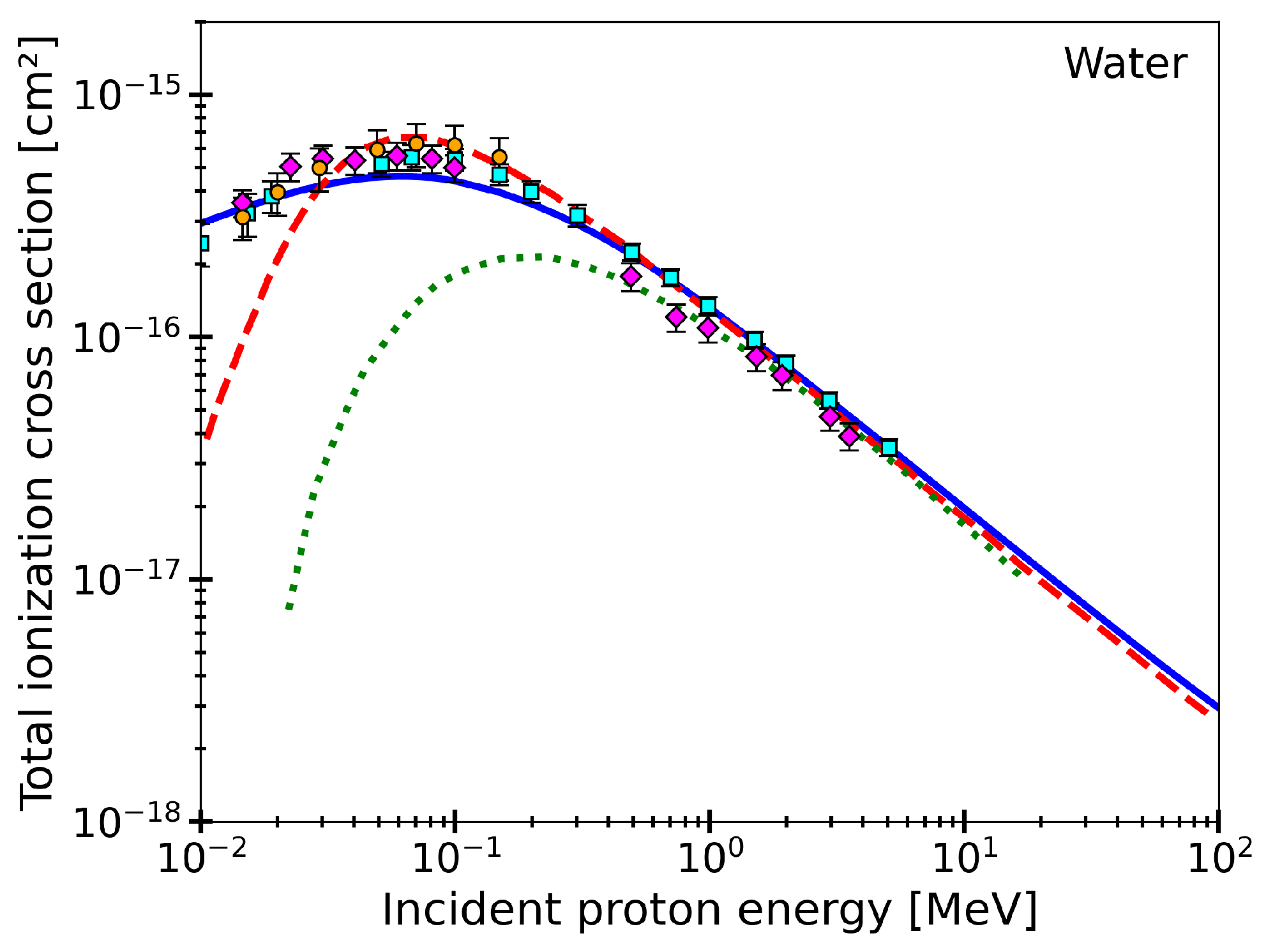
Figure 1 shows the total ionization cross section in liquid water obtained using the semi-empirical Rudd/Dingfelder model, compared with ab initio CDW-EIS calculations by Alcocer-Ávila et al. [16] and with the results of De Vera et al. [42] for electron impact, derived using the dielectric formalism. The CDW-EIS model is a quantum-mechanical distorted-wave approach that incorporates the two-centre Coulomb interactions between the electron and both the residual target and the projectile [43,44], in contrast to the one-centre FBA. On the other hand, the formalism used by De Vera et al. [42] is based on the dielectric theory, enabling ab initio calculations of total ionization cross sections and the associated energy distribution of the emitted electrons. This method explicitly accounts for the molecular electronic structure and the condensed nature of the target by using the medium’s energy loss function and introducing low-energy corrections to the FBA. As a result, it provides reliable predictions over a broad range of electron energies, from a few eV up to the MeV scale, without requiring empirical fitting.
Experimental data from Rudd et al. [39] and Bolorizadeh & Rudd [30] for vapor water, as well as from Luna et al. [45] for liquid water, are also shown in Figure 1. Our semi-empirical calculations exhibit good agreement with the experimental results from Rudd et al. [39]. These data have an uncertainty of 20% for incident proton energies of 10 keV, 15% for 25 keV, 10% for 100 keV, and 8% for above 500 keV. The agreement between the Rudd/Dingfelder model and the recommended data is expected, as the fitting parameters were chosen to ensure consistency with experimental cross section trends.
For energies above 40 keV, results from Alcocer-Ávila et al. [16] also show good agreement with the experimental data. However, at lower energies, the CDW-EIS model underestimates the cross section compared to the semi-empirical approach. This discrepancy is attributed to the limitations of perturbative methods at low energies, where electron correlation and target polarization effects become increasingly relevant.
Finally, the results of De Vera et al. [42] agree well with the data at energies above 500 keV. Since their electron impact cross sections are scaled to proton impact conditions using the velocity relation in Equation (2), a decrease at intermediate and low proton energies is expected.
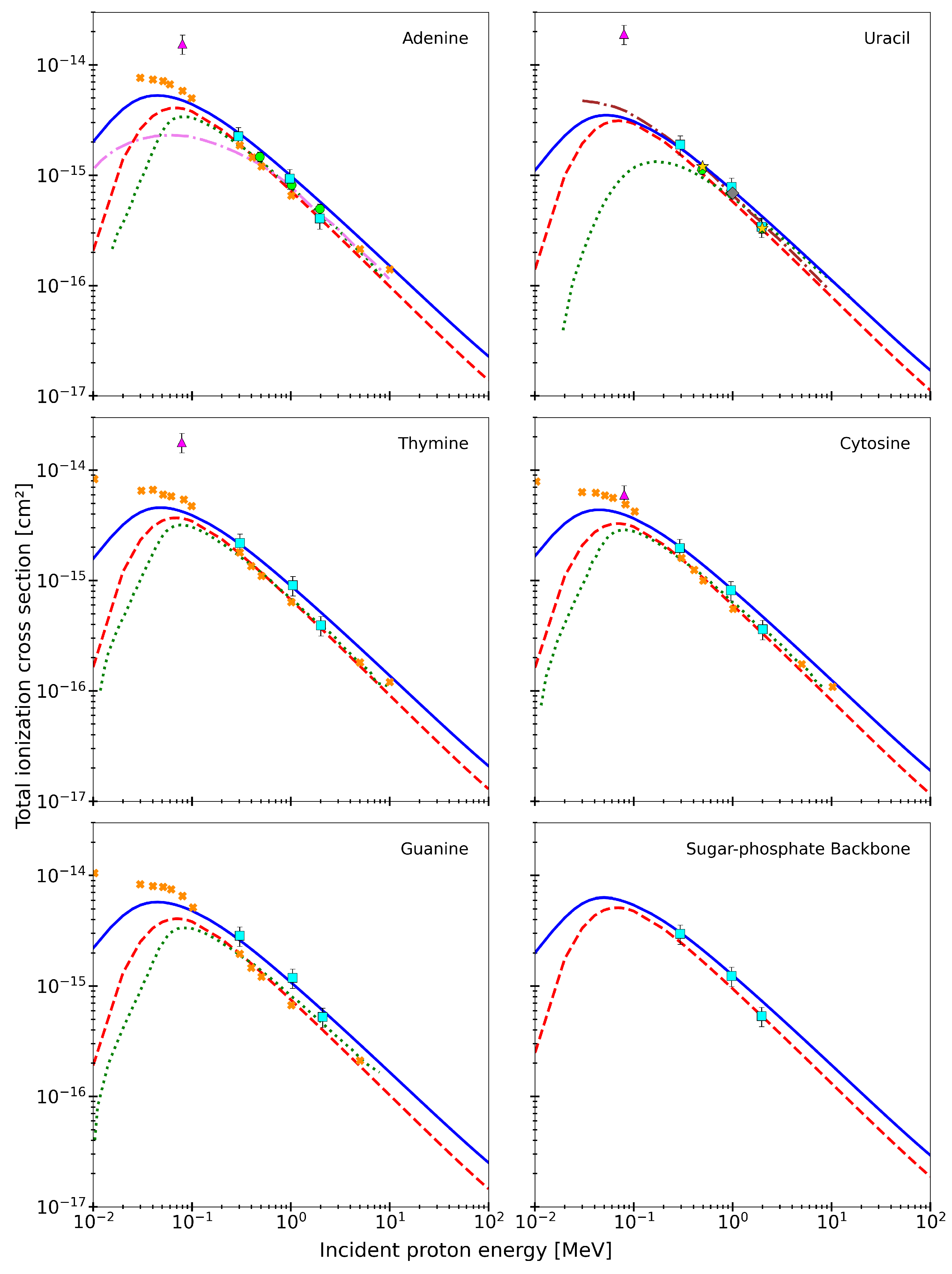
Figure 2 shows the total ionization cross sections obtained with the Rudd semi-empirical model, using the parameter set proposed by Francis et al. [24], for DNA and RNA nucleobases and the sugar-phosphate backbone. These results are compared with CDW-EIS calculations by Galassi et al. [26], data from DeVera et al. [42] for electron impact, and CTMC predictions from Champion et al. [46] based on a semi-classical trajectory Monte Carlo (CTMC) approach.
The CDW-EIS calculations exhibit a decrease in the cross section for proton energies below 80–100 keV, a behavior also observed in liquid water. At higher energies, the semi-empirical calculations overestimate the CDW-EIS results by up to 40% at a proton incident energy of 100 MeV. The results from De Vera et al. [42] for electron impact follow a similar trend, showing close agreement with those for liquid water. For adenine, the calculations by Lüdde et al. [47] show good agreement with CDW-EIS for proton energies above 500 keV. Lüdde et al. employed the independent-atom model combined with the pixel counting method (IAM-PCM), which considers the geometric overlap of atomic cross sections within a molecule, yielding improved agreement at low energies compared to simpler approaches such as the Bragg additivity rule. For uracil, the curve obtained by Purkait et al. [48] using the three-body distorted wave model within the independent electron approximation exhibits excellent agreement with both the Rudd model and CDW-EIS in the 200 keV–2 MeV range. However, at energies below 200 keV, discrepancies reach up to 50% relative to the Rudd model and up to 140% relative to CDW-EIS. For energies above 2 MeV, these differences decrease to 20% and 10%, respectively.
Experimental data from Iriki et al. [27] for adenine and uracil, as well as from Wilson & Toburen [28] for all nucleobases and the sugar-phosphate backbone, show good agreement with the Rudd model for protons in the 300 keV–2 MeV range, with relative differences between 1.3% and 26%, depending on the molecular target and energy. For uracil, excellent agreement is observed with the experimental data of Champion et al. [49] at 1 MeV and those of Itoh et al. [50] at 0.5, 1, and 2 MeV. In contrast, experimental values reported by Tabet et al. [51] for adenine, thymine, and uracil at 80 keV, subject to uncertainties of 20%, show significant discrepancies relative to theoretical predictions. The CTMC simulations by Champion et al. [46] exhibit discrepancies of 50% for energies below 100 keV and differences of 6% in the 200 keV–10 MeV range when compared to the Rudd model. These results confirm the overall robustness of the Rudd model in the intermediate-to-high energy range, despite its limitations at lower energies.
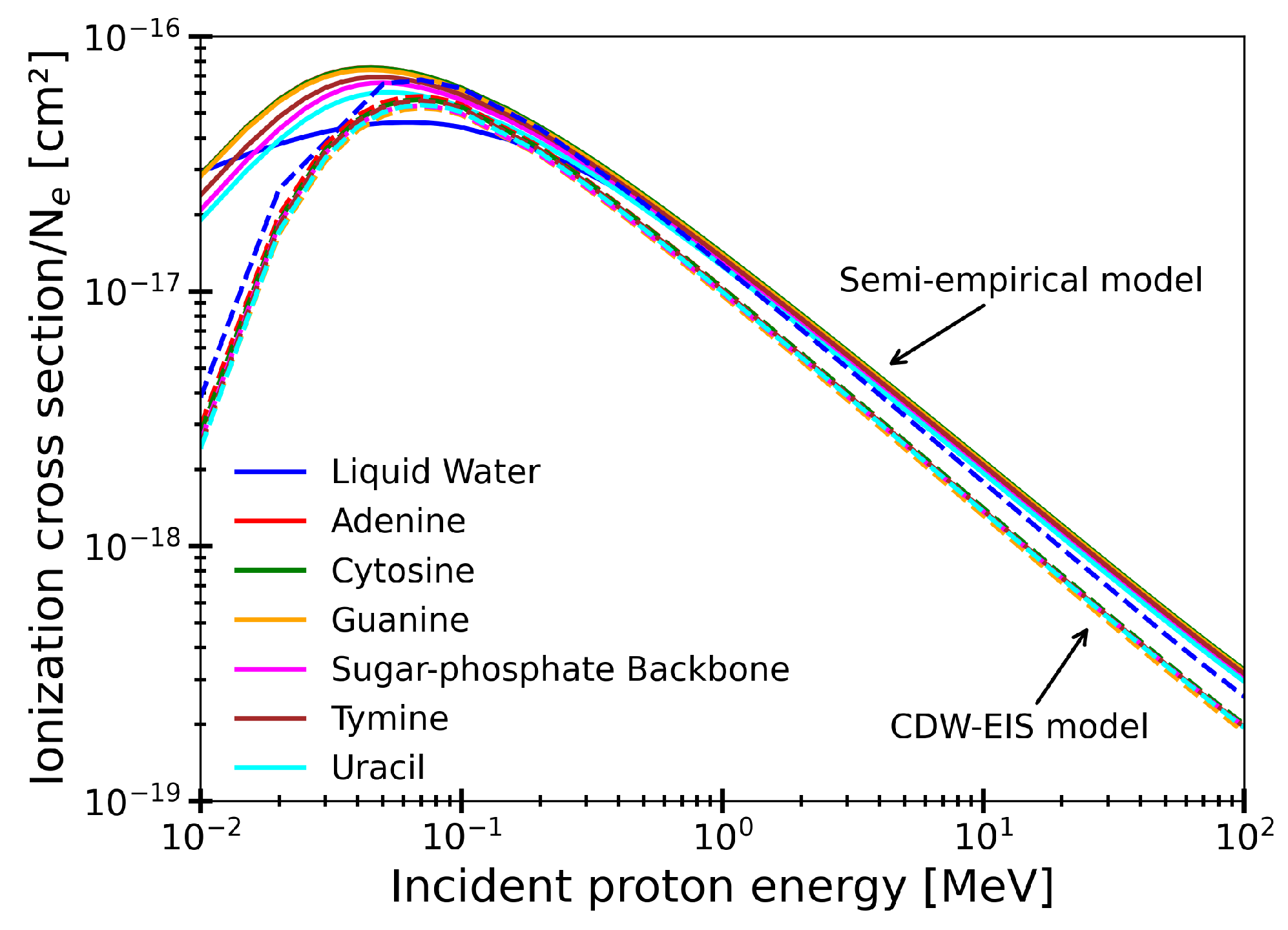
Figure 3 shows the ionization cross sections, normalized by the number of target electrons, for the different biomolecular targets as a function of the incident proton energy. At proton energies above approximately 0.3 MeV, the normalized ionization cross sections for all targets converge and largely overlap, indicating that the probability of ionization per electron becomes very similar across these biological molecules and liquid water at high energies. This convergence suggests that, from a spatial perspective, the mean free path of protons in these different media is comparable, consistent with the findings reported by Galassi et al. [26] using the CDW-EIS model. At lower proton energies, slight deviations between targets are observed, which can be attributed to differences in the molecular structure and electron binding energies.
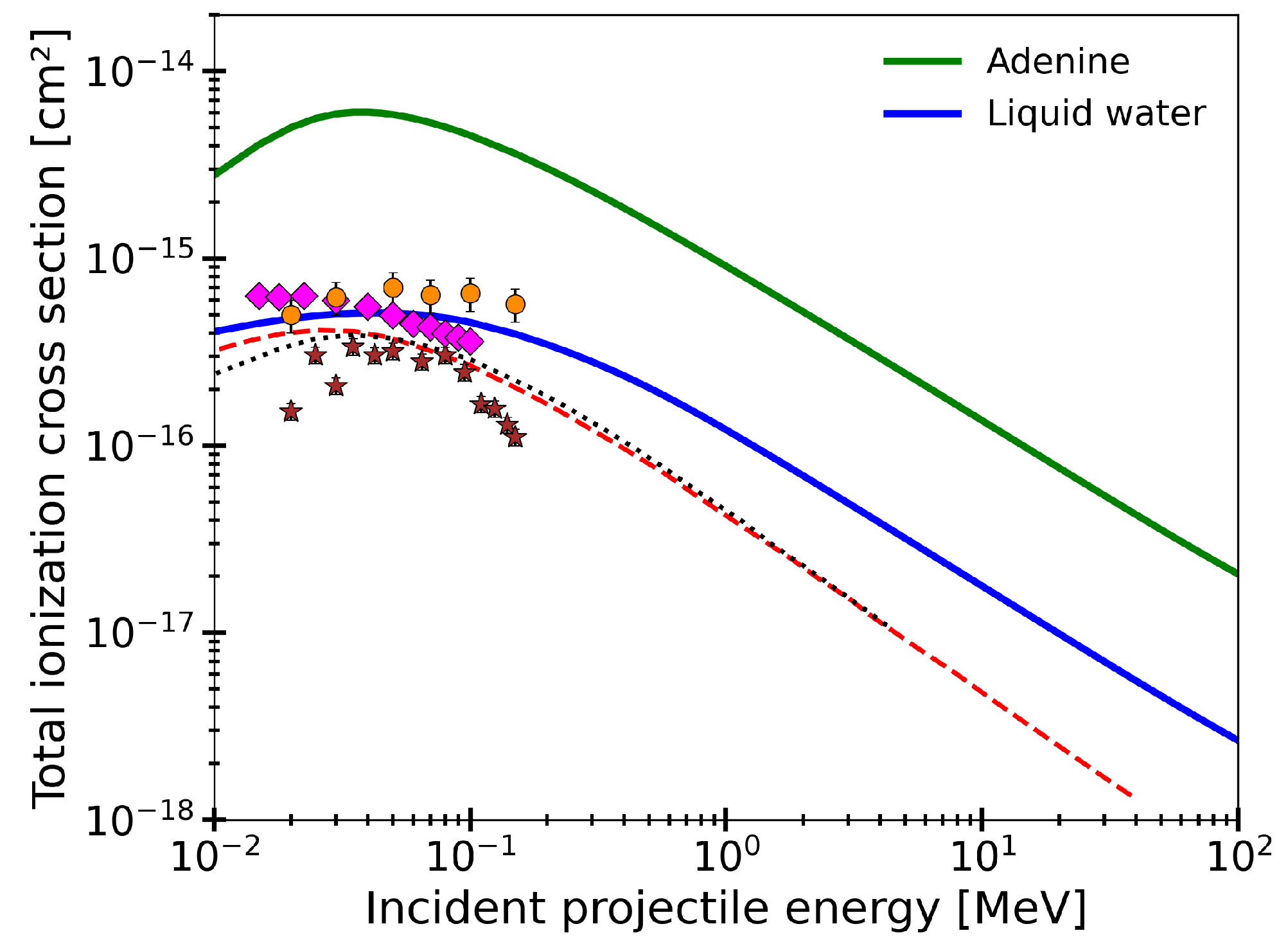
Neutral Hydrogen Impact
Since no studies are available in the literature on the cross sections for neutral hydrogen impact on DNA and RNA nucleobases or the sugar-phosphate backbone, in Figure 4, we compare results obtained using the Rudd/Dingfelder model for liquid water with those from CDW-EIS models [16,52] for vapor water, as well as with experimental data for both liquid water [45] and vapor water [30,53]. As can be observed, the Rudd/Dingfelder curve is in very good agreement with the experimental data. The measurements by Luna et al. [45] for liquid water show relative differences of between 2.5% and 40% with our results, being less than 10% in the 0.04–0.06 MeV region and reaching up to 40% at lower energies (0.015 MeV). These measurements were performed using a time-of-flight mass analysis setup, which allowed the detection of charged water fragments (H2O+, OH+, H+ and O+), focusing on dissociative and non-dissociative ionization pathways. In a complementary approach, Gobet et al. [53] employed an event-by-event coincidence technique that measured the charge state of the projectile alongside the target fragments, allowing for a clear separation between target ionization and projectile ionization. In the case of the measurements by Bolorizadeh & Rudd [30], we present their results as the difference between σ and σ ( E L C ) . σ denotes the total electron production arising from both target and projectile ionization, while σ ( E L C ) corresponds to the “electron loss to the continuum” ( E L C ) , caused by the separation of electrons from the projectile. To obtain single differential and total electron production cross sections, the authors integrated the measured doubly differential cross sections across relevant emission angles.
Finally, differences of up to approximately 75% are observed at projectile energies of up to 4 MeV when comparing our results with those of Alcocer-Ávila et al. [16] and Quinto et al. [52]. In the same figure, the curve obtained for adenine is presented for comparison with the liquid water ionization cross section.

3.1.2. Electronic Excitation

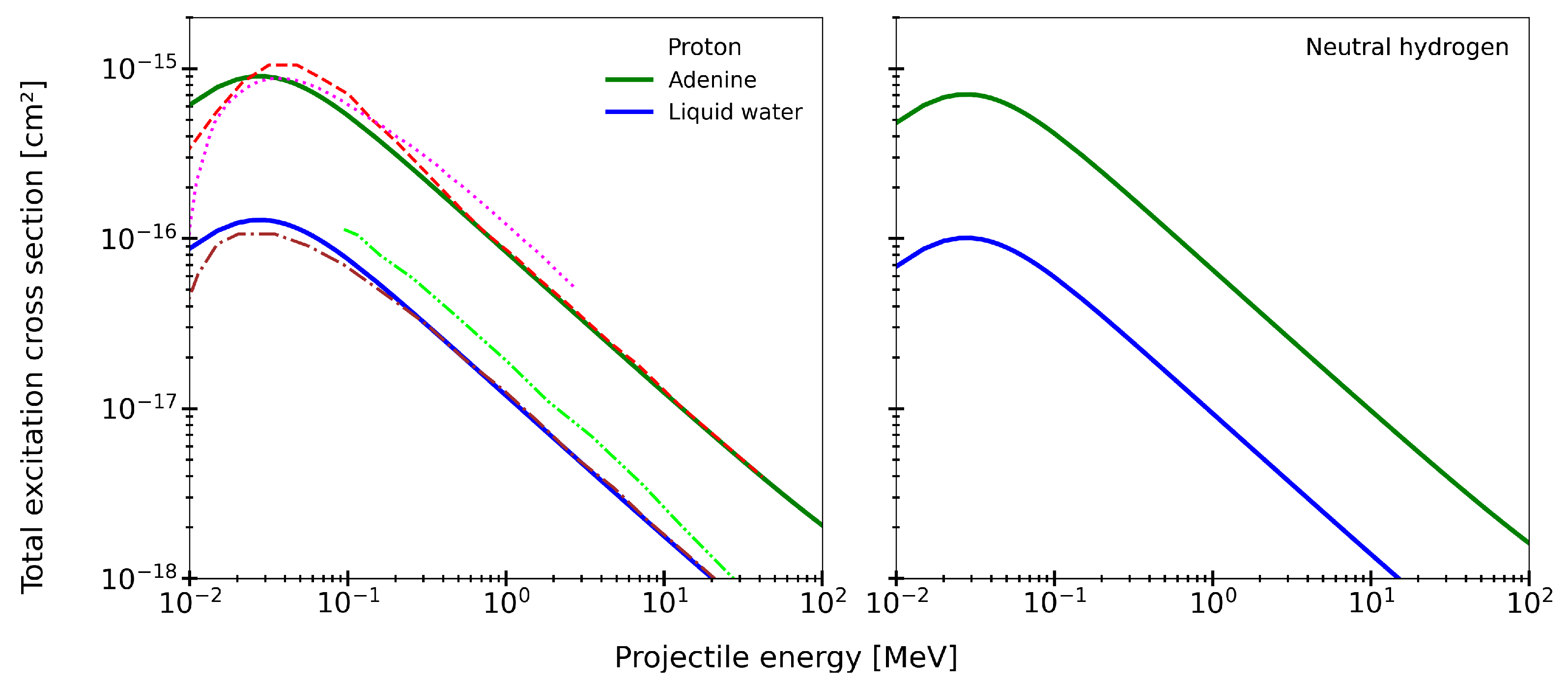
Figure 5 presents the total electronic excitation cross sections for liquid water and adenine under proton impact and neutral hydrogen impact, calculated with the semi-empirical model of Miller & Green. Due to the lack of experimental data for this process under proton impact, we compare our results with other theoretical calculations: Plante et al. [21] and Cobut et al. [54] for liquid water, and Harakat et al. [18] and De Vera et al. [42] for adenine.
For proton impact on liquid water, our results exhibit very good agreement with the calculations by Plante et al. [21], with deviations of up to 30% at energies near 10 keV. In contrast, they are up to 70% lower than those reported by Cobut et al. [54]. Both Plante et al. [21] and Cobut et al. [54] use a semi-empirical model based on the FBA and the energy loss function, where the excitation cross section is obtained by integrating over energy loss contributions modeled by Gaussian-like functions for discrete excitation levels and a separate function for plasmon excitation. However, Plante et al. restrict their calculation to only a few well-known excitation levels (such as A ˜ 1 B 1 , B ˜ 1 A 1 , and plasmon excitation), whereas Cobut et al. consider a more extensive decomposition of the energy loss function.
In the case of adenine, our results closely match those of Harakat et al. [18] above 500 keV. However, the peak of the excitation cross section appears at different energies: 45 keV in Harakat et al. [18] and 30 keV in our results, showing a 16% discrepancy. A similar trend is observed when comparing our excitation cross section with that reported by De Vera et al. [42] for electron impact on adenine, consistent with previous findings for the ionization cross section. It is worth noting that Harakat et al. estimate the excitation cross section of adenine using a semi-empirical approach based on velocity scaling and molar mass scaling from water. They derive excitation cross sections analytically from the ionization cross section through fitted ratios, assuming a similarity in energy loss per unit mass between water and DNA molecules. Since no ab initio theoretical models or experimental data exist for the excitation cross section by neutral hydrogen impact on liquid water and adenine, only our results are presented in the figure.

3.1.3. Electron Capture and Electron Loss

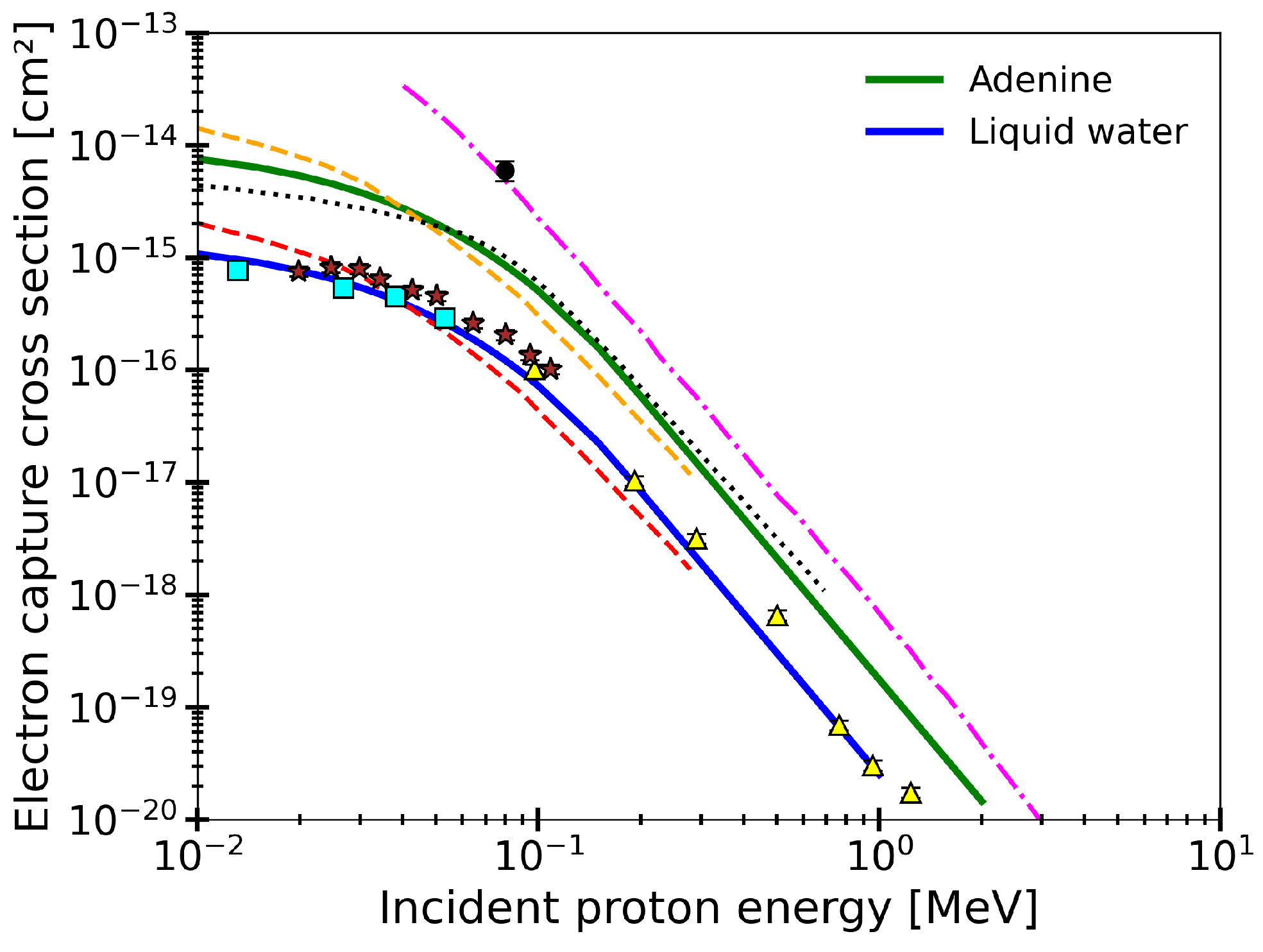
Figure 6 shows the electron capture cross section for protons in liquid water and adenine. Our results—calculated using the semi-empirical model by Dingfelder et al. [23]—are compared with prior CDW-EIS calculations by Alcocer-Ávila et al. [16], as well as with experimental data for water vapor from Toburen et al. [38], Dagnac et al. [37], and Gobet et al. [55]. The experimental data show very good agreement with our results, which is expected since the model parameters were specifically fitted to reproduce these data.
For adenine, our results are also compared with experimental data from Tabet et al. [51] and with theoretical calculations from Lüdde et al. [47] and Purkait et al. [48]. Very good agreement is observed between the curves of Alcocer-Ávila et al. and Lüdde et al., while larger discrepancies are found when comparing with the curve from Purkait et al. and the experimental data from Tabet et al.
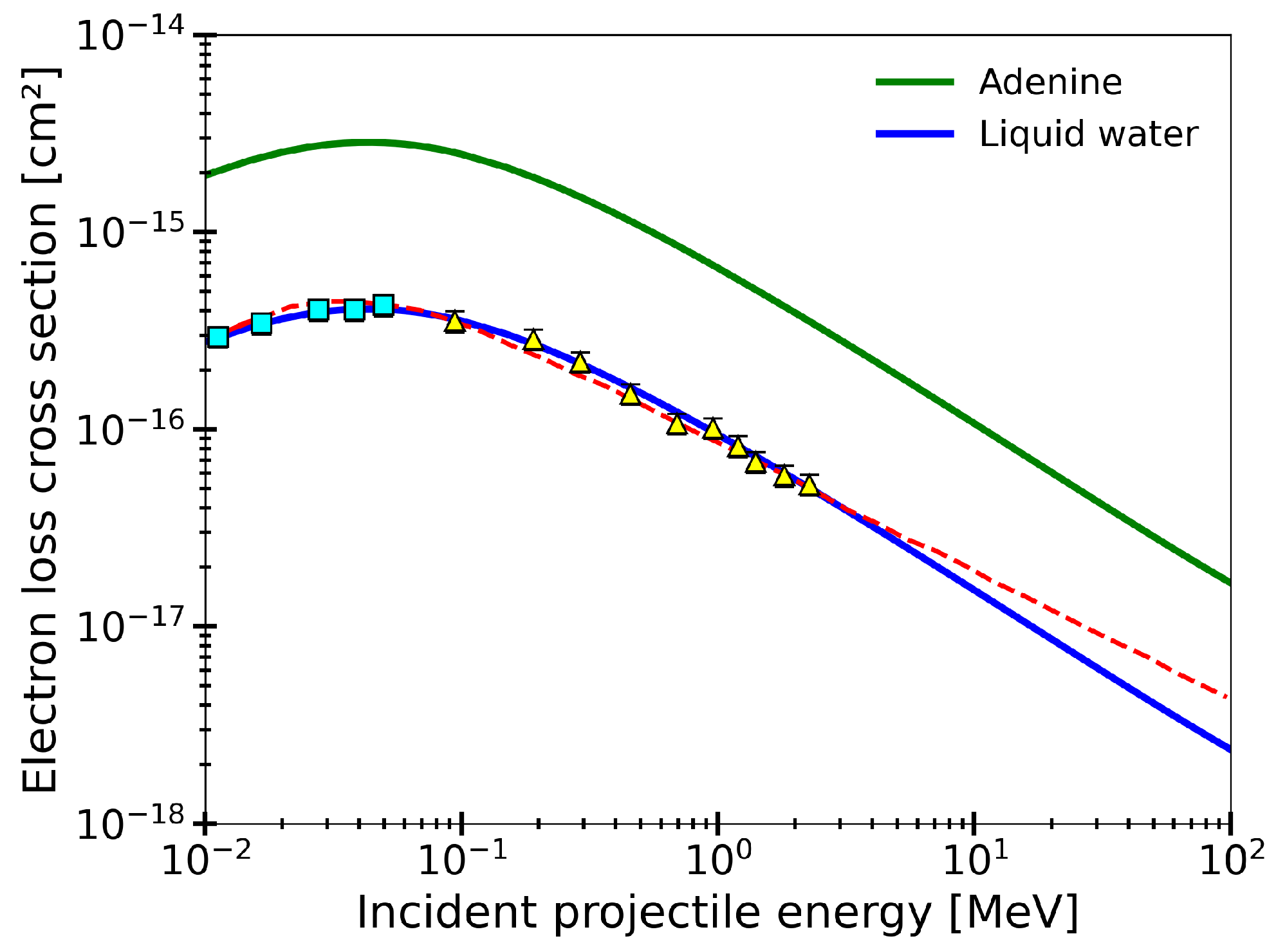
The electron loss cross section for neutral hydrogen in liquid water and adenine—calculated using the semi-empirical model of Rudd et al. [39]—is presented in Figure 7 in comparison with calculations from Alcocer-Ávila et al. [16] and experimental data from Toburen et al. [38] and Dagnac et al. [37] for water vapor, showing very good agreement. Both experimental datasets report an estimated uncertainty of approximately 12%. No electron loss cross section data for neutral hydrogen impact on adenine are available in the literature, either from theoretical models or experimental measurements.

3.2. Stopping Power

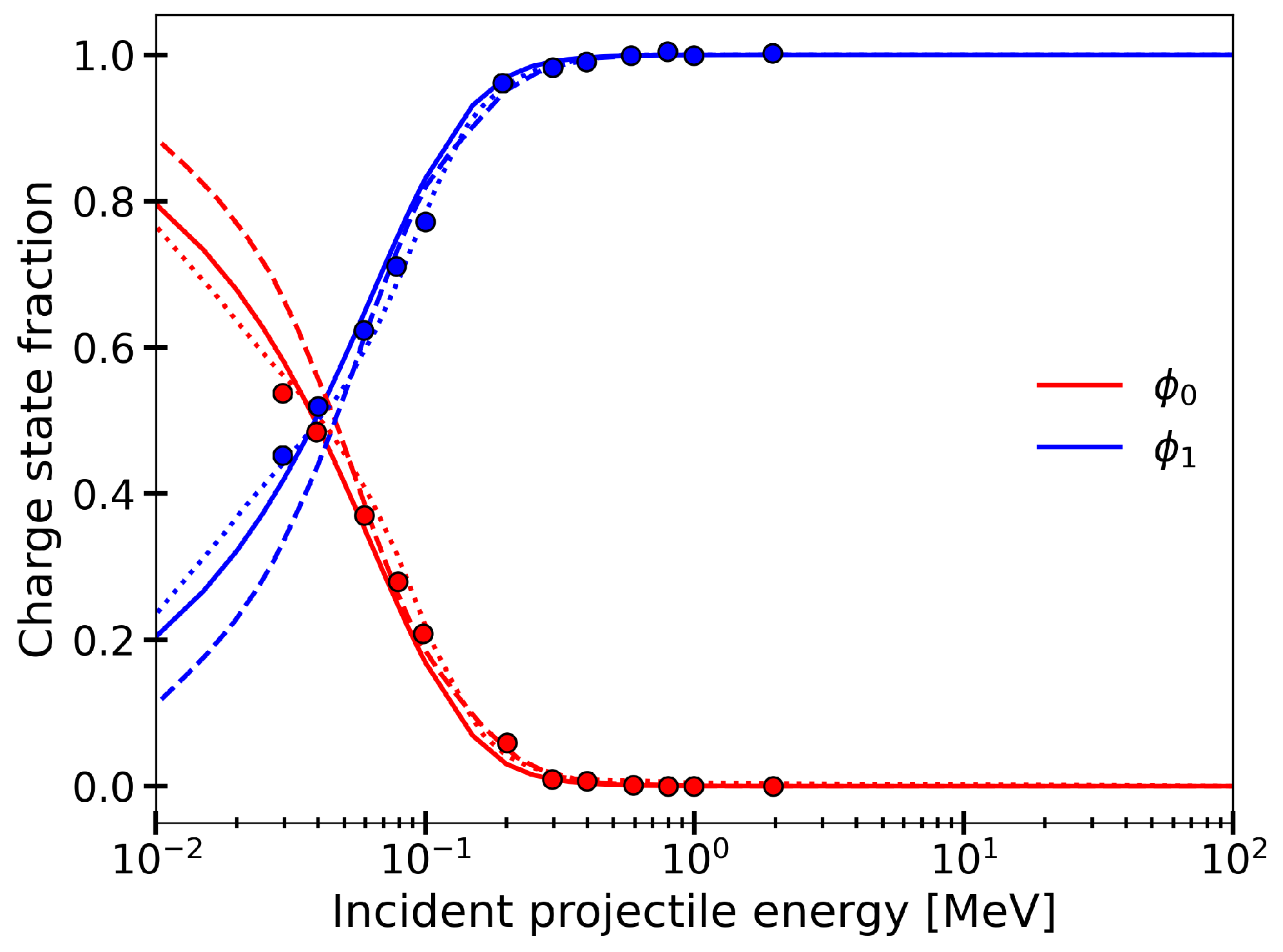
Charge state fractions for proton impact on liquid water, determined according to Equations (31) and (32), are shown in Figure 8. Although experimental data for proton charge state fractions in liquid water are scarce, it is common to compare model predictions for liquid water with experimental measurements in water vapor due to the lack of direct liquid-phase data and the relevance of both phases in radiobiological contexts [56]. Bernal et al. [56] showed that the charge state fractions in liquid water exhibit a clear dependence on proton energy, with a significant increase in the fraction of H+ ions above 400 keV.
Our semi-empirical model predictions show very good agreement with the experimental data from Barnett et al. [57] for water vapor, with an uncertainty below 5% at impact energies above 40 keV. We also compare our results with those of Alcocer-Ávila et al. [16] for water vapor, where electron capture was calculated using the prior CDW-EIS model; noticeable deviations up to 10% appear below 70 keV. Given the sensitivity of charge state fractions to the theoretical treatment of electron capture, these discrepancies highlight the influence of different modeling approaches in this energy regime. Since the electron capture and electron loss cross sections for each of the molecules that compose DNA are scaled from the corresponding cross sections in water, the resulting charge state fractions for each of these components are identical to those obtained for liquid water. Therefore, they are not presented separately in the results.
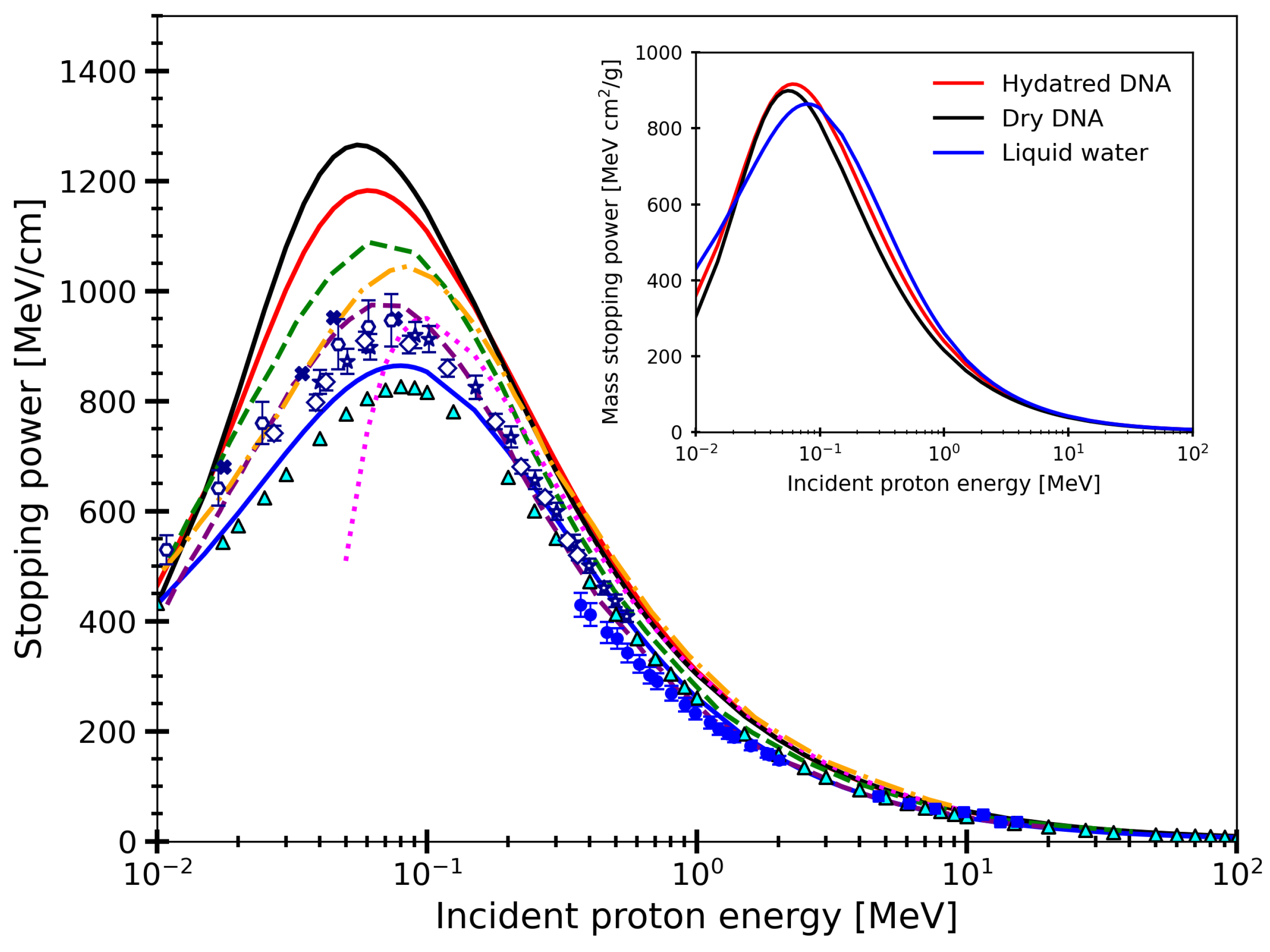
Figure 9 presents the total stopping power for proton impact on liquid water, hydrated DNA, and dry DNA, as obtained in this work, along with comparisons to other theoretical models and experimental data. To facilitate a more detailed analysis, results are plotted on a linear scale.
For liquid water, our results are compared with experimental data from Shimizu et al. [58] and Siiskonen et al. [59]. For water vapor, comparisons include measurements from Reynolds et al. [60], Phillips et al. [61], Mitterschiffthaler & Bauer [62], and Baek et al. [63]. Overall, good agreement is observed, particularly for projectile energies above 200 keV. At lower energies, our results tend to slightly underestimate experimental values, which can be attributed to the limited availability of experimental data for liquid water in this energy range. It is well known that stopping power is reduced in the liquid phase due to medium polarization effects. The observed discrepancy with respect to the ICRU Report 49 [32] reference values for liquid water remains within 7% throughout the studied energy range.
For DNA, since no experimental data are available, our results are compared with other theoretical models: Tan et al. [20] and Abril et al. [64] for dry DNA, both based on dielectric formalism, and Alcocer-Ávila et al. [16] for hydrated DNA. At high energies (>200 keV), all models exhibit excellent agreement. However, discrepancies with the Alcocer-Ávila et al. curve emerge in the intermediate- and low-energy regions, primarily due to differences in the electronic stopping models employed. Our results indicate that the maximum total stopping power varies depending on the medium: 1265 MeV/cm at 55 keV for dry DNA, 1183 MeV/cm at 60 keV for hydrated DNA, and 864 MeV/cm at 80 keV for liquid water. The higher stopping power in dry DNA compared to hydrated DNA is primarily attributed to its higher mass density, which increases the probability of interactions per unit path length. This effect, combined with differences in electronic structure, contributes to the observed variations in energy deposition.
The inset in Figure 9 shows the mass stopping power for protons in liquid water, hydrated DNA, and dry DNA. This quantity was obtained by dividing the total stopping power by the mass density of the medium. The curves show different positions for the stopping power maxima depending on the target. Between 20 keV and 100 keV, both hydrated and dry DNA exhibit a mass stopping power approximately 10% higher than that of liquid water. In contrast, for energies below 20 keV and above 100 keV, water displays higher values—by about 20%—compared to both DNA types.
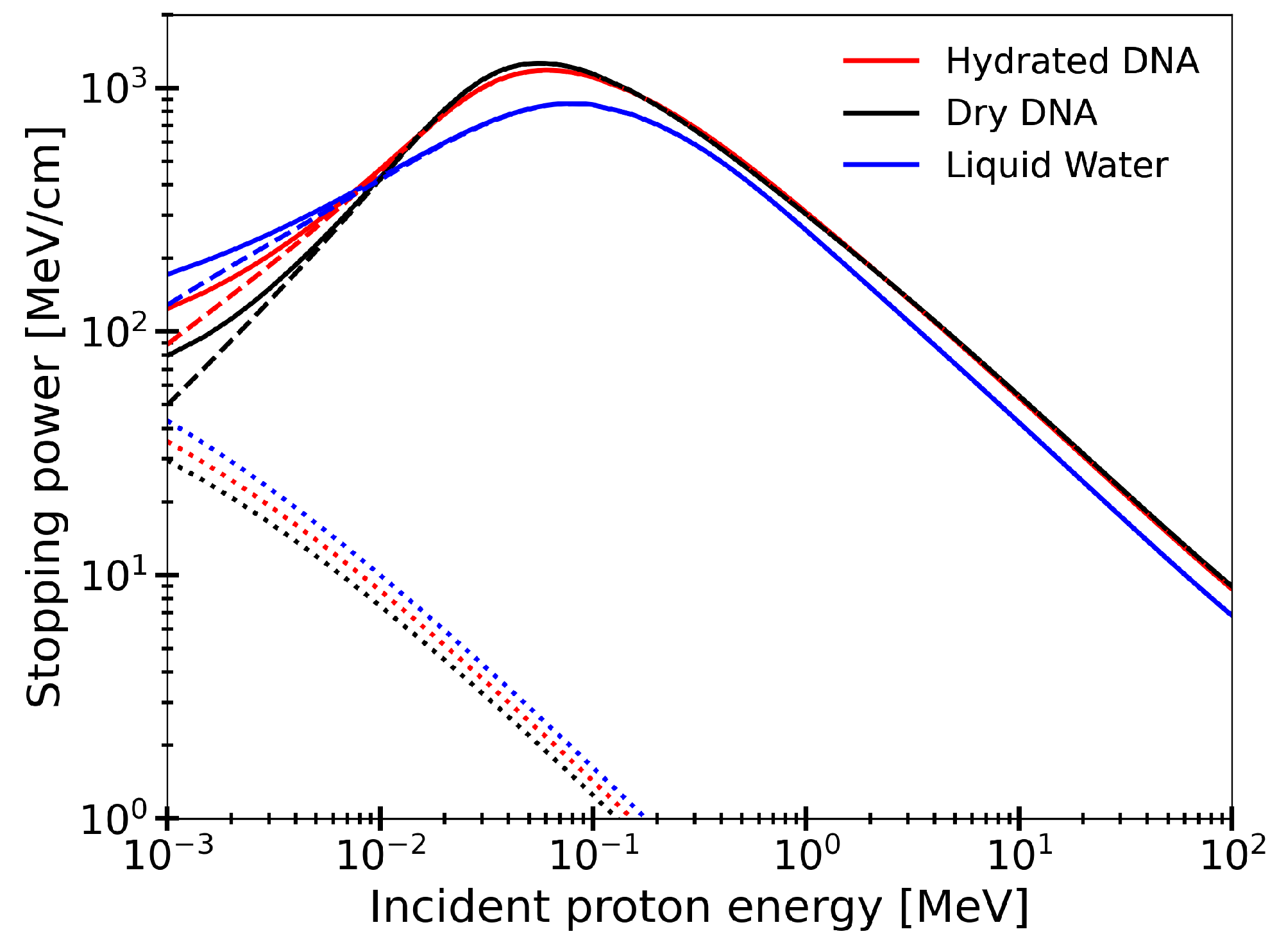
Figure 10 shows the total, electronic, and nuclear stopping power of protons in liquid water, hydrated DNA, and dry DNA. As expected, nuclear stopping is relevant only at very low energies (<10 keV)—outside the main energy range considered here—where it contributes noticeably to the total energy loss. At 10 keV, it represents about 2% of the total stopping power, but its contribution rapidly becomes negligible as the energy increases. A more detailed analysis at very low energies in future work could provide further insights into the role of nuclear interactions in energy deposition at the nanoscale.

3.3. Range

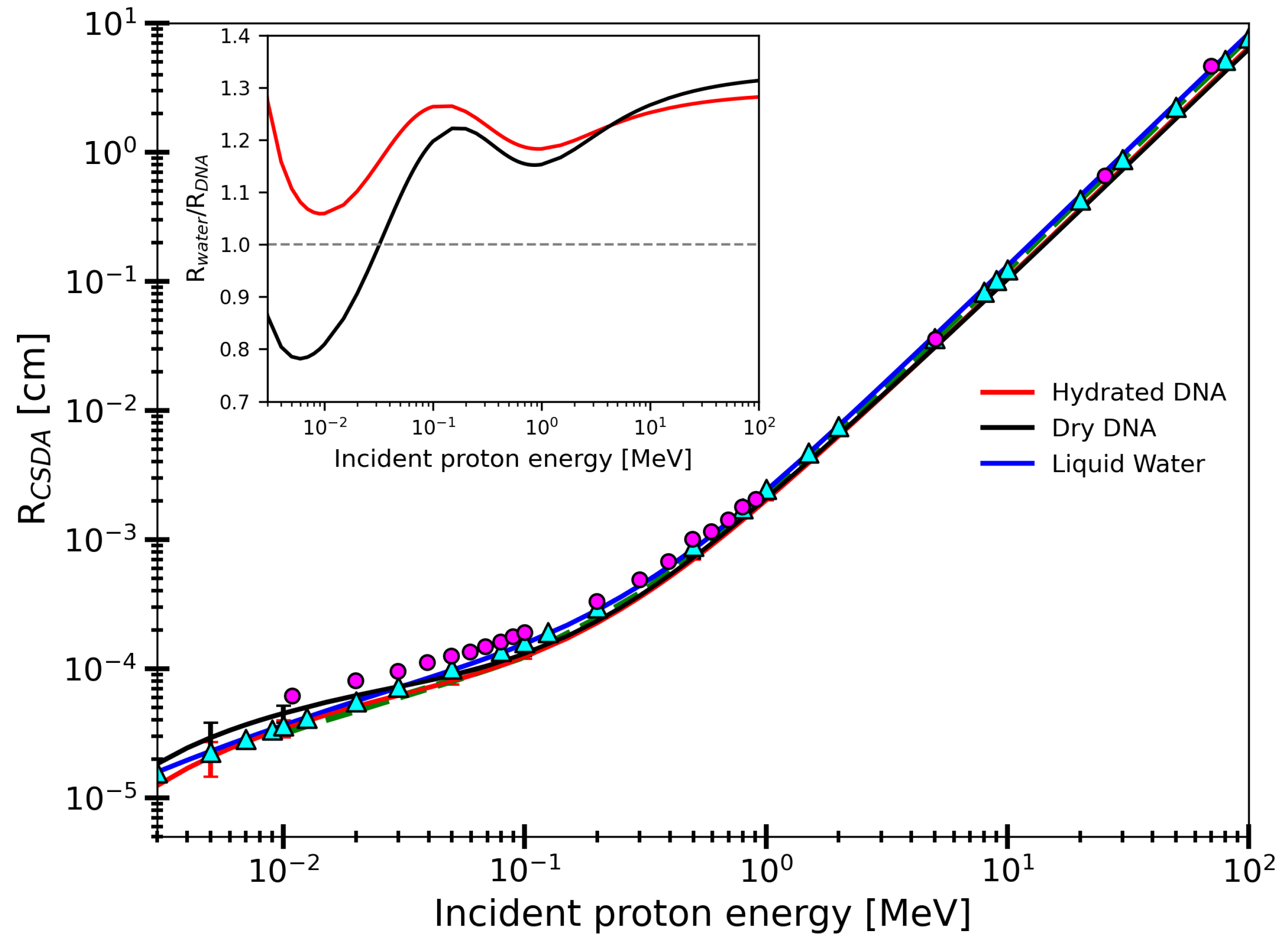
Figure 11 shows the proton range in liquid water, dry DNA, and hydrated DNA. At low energies, range calculations are affected by the cutoff energy; therefore, a correction was applied to account for the residual distance travelled by a 10 keV proton before stopping completely. Following the methodology proposed by Alcocer-Ávila et al. [16], the continuous slowing down approximation range ( R C S D A ) was first obtained and then corrected by adding the residual range ( R r e s ) of 10 keV protons in liquid water, as recommended in ICRU Report 49 [32] (approximately 322 nm). In the absence of reference values for DNA, uncertainties were estimated and represented as error bars, particularly below 0.1 MeV, where they are significant: about 30% at 5 keV, 15% at 10 keV, and less than 1% at 0.5 MeV. Above 1 MeV, the correction becomes negligible, introducing deviations smaller than 1%.
Our results are compared with particle range reference data from ICRU Report 49 [32] and theoretical models from Francis et al. [65] for liquid water, as well as with hydrated DNA data from Alcocer-Ávila et al. [16]. Francis et al. [65] derived proton ranges using the Geant4-DNA processes implemented in the Geant4 MC simulation toolkit. Unlike the models considered here, their approach only included electronic stopping power from semi-empirical models, and neglected neutral hydrogen excitation or nuclear stopping power, which can significantly affect energy loss at low proton energies. As a result, their values overestimate the proton range below 1 MeV when compared with our corrected CSDA range, with differences reaching up to 60% at 10 keV and diminishing with increasing energy.
The reference values from ICRU Report 49 [32] for protons in liquid water, derived from experimental and semi-empirical models, are generally lower than our corrected CSDA range above 1 MeV. The discrepancy is less than 10% across the studied energy interval and nearly vanishes at low energies.
An overall good agreement is observed between our calculations and those of Alcocer-Ávila et al. [16], reinforcing the validity of our approach. When comparing with their results for hydrated DNA, the percentage differences range from approximately 10% at low energies (10 keV), increasing up to about 20% at high energies (100 MeV).
To clarify the biological relevance of these results, the difference in the proton range between liquid water and hydrated DNA reaches approximately 5 μ m for 1 MeV protons, with a range of about 25 μ m in water and 20 μ m in DNA. Although this difference is negligible in the context of treatment planning, where distal safety margins typically exceed 1 mm and are defined as 3.5% of the prescribed range plus 1 mm to account for uncertainties [66], it becomes relevant at the cellular scale. In fact, this 5 μ m range reduction represents nearly 20% of the total proton path in hydrated DNA, which is comparable to the size of a biological cell. This highlights the importance of accurate range modeling in microdosimetric studies and subcellular damage simulations.
The inset in Figure 11 illustrates the ratio of the proton range in liquid water to that in dry and hydrated DNA as a function of incident energy. For hydrated DNA, the ratio R w a t e r / R D N A remains greater than 1 across the entire energy range, indicating that protons travel farther in liquid water than in DNA. This implies that hydrated DNA is more effective in slowing down protons due to its higher stopping power. A similar trend is observed for dry DNA, except at energies below approximately 30 keV, where the ratio becomes less than or even close to 1. In this low-energy regime, dry DNA is no longer more efficient than liquid water in stopping protons. For example, a 100 keV proton travels about 26% further in liquid water than in hydrated DNA, and about 20% further than in dry DNA, illustrating the magnitude of the difference at intermediate energies.
Although our calculations employ uniform DNA models, recent reviews emphasize that structural arrangements—such as groove-localized hydration, nucleosomal packaging, and higher-order chromatin organization—are expected to further influence cross sections and stopping power [14]. Thus, our dataset provides a benchmark for uniform-DNA models, to be extended with geometrical refinements in future MC implementations.

4. Conclusions

The total stopping power and range of protons in liquid water and DNA were calculated using semi-empirical models based on cross sections of the main inelastic processes, namely ionization, electronic excitation, electron capture, and electron loss. The results for liquid water are in good agreement with the internationally recommended values, experimental data, and previous theoretical calculations across most of the proton energy range considered (10 keV–100 MeV). Similarly, the semi-empirical models applied to dry and hydrated DNA, fitted to experimental or recommended data, exhibit excellent agreement with available measurements and ab initio theoretical calculations, particularly at higher proton energies. Regarding the proton range, good overall agreement was observed throughout most of the energy range, although significant discrepancies remain below 100 keV, highlighting the need for improved modeling in this region.
The observed differences, reaching up to 60% for dry DNA and 40% for hydrated DNA in terms of stopping power, and around 20% for the proton range in both cases, underscore the importance of selecting an appropriate biological medium for damage calculations. These deviations highlight the role of molecular composition in determining energy loss at the nanometric scale, which is directly relevant for DNA damage induction. While the impact of including the proton interactions with the DNA molecule in biophysical models remains to be quantified, our findings indicate that better modelization of the target may significantly influence the predicted biological outcomes. Importantly, the semi-empirical cross sections reported in this study provide a critical dataset for future MC track structure simulations that explicitly include DNA as a target, accounting for biological geometries such as groove localization, nucleosomal packaging, and higher-order chromatin organization [14]. Such simulations will also incorporate the large population of low-energy secondary electrons—well known as the main contributors to biological damage—thereby enabling a more realistic evaluation of RBE and revealing possible deviations from water-based predictions. Furthermore, our semi-empirical approach offers a computationally efficient alternative to fully theoretical cross section calculations, facilitating its integration into advanced simulation frameworks.
These findings open new avenues toward a more accurate molecular-level description of targets in hadrontherapy. In particular, future studies could further investigate the influence of inner electronic shells and different orbital descriptions of DNA components to refine proton–target interaction models within realistic biological environments.

Author Contributions

Conceptualization, M.E.G.; methodology, C.S.M., V.B.T. and M.E.G.; software, C.S.M., V.B.T. and M.E.G.; validation, C.S.M., V.B.T. and M.E.G.; formal analysis, C.S.M. and M.E.G.; investigation, C.S.M.; resources, M.E.G.; data curation, C.S.M.; writing—original draft preparation, C.S.M.; writing—review and editing, V.B.T., M.E.G. and M.B.; visualization, C.S.M.; supervision, M.E.G.; project administration, M.E.G.; funding acquisition, M.E.G. and M.B. All authors have read and agreed to the published version of the manuscript.

Funding

This research was funded by the European Commission Horizon MSCA-SE Project MAMBA (Grant No. 101131245), Universidad Nacional de Rosario (UNR) (PID-UNR 80020190300129UR), and LABEX PRIMES (ANR-11-LABX-0063) of Université de Lyon within the program “Investissements d’Avenir” (Grant No. ANR-11-IDEX-0007).

Data Availability Statement

Data are contained within this article.

Acknowledgments

We gratefully acknowledge the financial support from the European Commission Horizon MSCA-SE Project MAMBA (Grant No. 101131245), the Consejo Nacional de Investigaciones Científicas y Técnicas (CONICET), the Universidad Nacional de Rosario (PID-UNR 80020190300129UR), and LABEX PRIMES (ANR-11-LABX-0063) of Université de Lyon within the program “Investissements d’Avenir” (Grant No. ANR-11-IDEX-0007), operated by the French National Research Agency (ANR). We also acknowledge the support received from the French National Institute of Health and Medical Research (Inserm) through the call “Apports à l’oncologie de la physique, de la chimie et des sciences de l’ingénieur” (Grant No. 20CP176–00).

Conflicts of Interest

The authors declare no conflicts of interest.

Abbreviations

The following abbreviations are used in this manuscript:
RBERelative Biological Effectiveness
TPSTreatment Planning Systems
LEMLocal Effect Model
mMKMmodified Microdosimetric Kinetic Model
NanOxNanodosimetry and Oxidative Stress
MCMonte Carlo
CDW-EISContinuum Distorted Wave—Eikonal Initial State
FBAFirst Born Approximation
CSDAContinuous Slowing Down Approximation
CTMCClassical-Trajectory Monte Carlo

Appendix A. Construction of the Equivalent DNA Unit

We define an equivalent nucleotide unit of DNA based on the base composition reported by Tan et al. [20]—58% adenine (A)–thymine (T) pairs and 42% cytosine (C)–guanine (G) pairs with two sugar-phosphate backbones (SPBs) [19]. Thus, the relative numbers of molecules per equivalent unit N i are
N A = N T = 0.58 , N C = N G = 0.42 , N S P B = 2 , N H 2 O = 18 ( only for hydrated DNA )
The total number of nucleobases per unit is
N n = N A + N T + N C + N G = 2
From this, the molecular fractions f i of each base are
f i = N i N n , i = A , T , C , G
which yields
f A = f T = 0.29 , f C = f G = 0.21
The molar mass of the equivalent DNA unit is obtained as
M D N A = i N i M i
where M i is the molar mass of molecule i, presented in Table A1.
Following the work of Alcocer et al. [16], the corresponding mass fractions were 12.6% A, 11.8% T, 7.5% C, 10.2% G and 57.9% SPB. Considering that DNA is hydrated under physiological conditions, we considered hydrated DNA, incorporating 18 water molecules per nucleotide, adjusting the mass fractions to 8.3% A, 7.7% T, 4.9% C, 6.7% G, 38.1% SPB, and 34.3% water. These values are consistent with Birnie et al. [67], who estimated that approximately 50 moles of water per mole of nucleotide are needed to reach a mass density of 1.29 g/cm3.
Table A1. Mass density [24] and molar mass [20] for each target under study.
ComponentMass Density [g/cm3]Molar Mass [g/mol]
Liquid water1.0018.00
Adenine1.60135.14
Thymine1.23126.12
Cytosine1.55111.11
Guanine2.20151.14
Sugar-phosphate backbone180.00
Uracil1.32112.09
Dry DNA1.407662.00
Hydrated DNA1.29947.80
The molecular density of component i, ρ i [molecules/cm3], is calculated as follows:
ρ i = N i · N A · ρ m , D N A M D N A
where N A is Avogadro’s number [molecules/mol], ρ m , D N A is the DNA mass density (see Table A1), and i = A , T , C , G , S P B (plus H 2 O for hydrated DNA).
The electron density of DNA [e/cm3] is then
ρ e , D N A = i n e i ρ i ,
where n e i is the total number of electrons per molecule type i [e/molecule].
The electronic stopping power of DNA is expressed in terms of the electronic stopping cross sections ϵ as
S i , e l e c = ρ i ϵ i
The electronic stopping power of dry DNA is then
S D N A , e l e c = i = A , T , C , G ρ i ϵ i + ρ S P B ϵ S P B = N A ρ m , D N A M D N A i = A , T , C , G N i ϵ i + N S P B ϵ S P B
or equivalently, in terms of molecular fractions,
S D N A , e l e c = N A ρ m , D N A N n M D N A i = A , T , C , G f i ϵ i + N A ρ m , D N A N S P B M D N A ϵ S P B
For hydrated DNA, the water contribution is included analogously through f H 2 O ϵ H 2 O .

Appendix B. Binding Energy Tables for DNA/RNA Components

Table A2. Binding energies B j [eV] of each orbital j for DNA and RNA components used in Rudd Model. Taken from [26].
Molecular OrbitalAdenineThymineGuanineCytosineUracilSugar-Phosphate Backbone
18.449.148.248.949.510.53
29.9810.9311.1410.0510.9710.64
310.5511.3511.3610.6711.3610.88
411.3912.1311.8011.4212.2311.65
511.7113.2911.8313.1513.711.73
612.8814.4712.3914.5314.9311.97
713.514.6813.0815.6115.6412.27
815.2314.8115.3416.4715.8212.41
916.3415.5716.6216.816.8212.73
1016.8515.9916.7617.0217.4812.7
1117.2916.3616.9318.3117.6313.06
1217.517.4417.6219.4718.7113.69
1318.4217.6218.5120.6320.2314.31
1418.9918.5918.8720.7421.2014.91
1520.120.2819.7123.7923.6215.13
1621.3220.3820.6024.2824.4615.56
1722.8623.5120.8828.9328.7115.84
1823.8924.0822.6631.7932.7016.54
1924.425.5323.3034.1434.5617.39
2028.3529.2324.8035.3337.0817.52
2131.4132.6525.3037.737.9217.96
2232.334.4628.98302.18293.8518.86
2333.9837.0932.88304.47296.0820.84
2435.6837.8534.05305.09297.2821.69
2537.47293.5634.24305.69298.3121.80
26303.09294.2737.55417.42407.9824.76
27304.5296.0338.28418.83408.527.84
28304.85297.4239.2419.8536.4428.33
29304.85298.44311.53550.88536.4433.17
30305.33408.28313.1534.67
31418.63408.68313.7936.35
32418.84536.74314.9336.76
33419.22536.87315.9338.18
34419.27431.02149.58
35420.79431.10149.61
36432.32149.61
37432.91207.08
38432.94303.73
39568.45304.55
40304.90
41305.23
42305.48
43554.24
44554.24
45555.91
46556.77
47556.80
482165.16

References

  1. Mohan, R. A review of proton therapy–Current status and future directions. Prec. Rad. Onc. 2022, 6, 164–176. [Google Scholar] [CrossRef] [PubMed]
  2. Tinganelli, W.; Durante, M. Carbon Ion Radiobiology. Cancers 2020, 12, 3022. [Google Scholar] [CrossRef] [PubMed]
  3. Schardt, D.; Elsässer, T.; Schulz-Ertner, D. Heavy-ion tumor therapy: Physical and radiobiological benefits. Rev. Mod. Phys. 2010, 82, 383–425. [Google Scholar] [CrossRef]
  4. Karger, C.P.; Peschke, P. RBE and related modeling in carbon-ion therapy. Phys. Med. Biol. 2018, 63, 01TR02. [Google Scholar] [CrossRef]
  5. Scholz, M.; Kellerer, A.M.; Kraft-Weyrather, W.; Kraft, G. Computation of cell survival in heavy ion beams for therapy. Radiat. Environ. Biophys. 1997, 36, 59–66. [Google Scholar] [CrossRef]
  6. Kase, Y.; Kanai, T.; Matsumoto, Y.; Furusawa, Y.; Okamoto, H.; Asaba, T.; Sakama, M.; Shinoda, H. Microdosimetric measurements and estimation of human cell survival for heavy-ion beams. Radiat. Res. 2006, 166, 629–638. [Google Scholar] [CrossRef]
  7. Inaniwa, T.; Furukawa, T.; Kase, Y.; Matsufuji, N.; Toshito, T.; Matsumoto, Y.; Furusawa, Y.; Noda, K. Treatment planning for a scanned carbon beam with a modified microdosimetric kinetic model. Phys. Med. Biol. 2010, 55, 6721–6737. [Google Scholar] [CrossRef]
  8. Hawkins, R.B. A statistical theory of cell killing by radiation of varying linear energy transfer. Radiat. Res. 1994, 140, 366–374. [Google Scholar] [CrossRef]
  9. Hawkins, R.B. A microdosimetric-kinetic model of cell death from exposure to ionizing radiation of any LET, with experimental and clinical applications. Int. J. Radiat. Biol. 1996, 69, 739–755. [Google Scholar] [CrossRef]
  10. Cunha, M.; Monini, C.; Testa, E.; Beuve, M. NanOx, a new model to predict cell survival in the context of particle therapy. Phys. Med. Biol. 2017, 62, 4. [Google Scholar] [CrossRef] [PubMed]
  11. Monini, C.; Cunha, M.; Testa, E.; Beuve, M. Study of the Influence of NanOx Parameters. Cancers 2018, 10, 87. [Google Scholar] [CrossRef]
  12. Alcocer-Ávila, M.; Monini, C.; Cunha, M.; Testa, É.; Beuve, M. Formalism of the NanOx biophysical model for radiotherapy applications. Front. Phys. 2023, 11, 1011062. [Google Scholar] [CrossRef]
  13. Kyriakou, I.; Sakata, D.; Tran, H.N.; Perrot, Y.; Shin, W.-G.; Lampe, N.; Zein, S.; Bordage, M.C.; Guatelli, S.; Villagrasa, C.; et al. Review of the Geant4-DNA Simulation Toolkit for Radiobiological Applications at the Cellular and DNA Level. Cancers 2021, 14, 35. [Google Scholar] [CrossRef]
  14. Khanna, R.; Reinwald, Y.; Hugtenburg, R.; Bertolet, A.; Serjouei, A. Review of the geometrical developments in GEANT4-DNA: From a biological perspective. Rev. Phys. 2025, 13, 100110. [Google Scholar] [CrossRef] [PubMed]
  15. Arce, P.; Archer, J.W.; Arsini, L. et al. Results of a Geant4 benchmarking study for bio-medical applications, performed with the G4-Med system. Med Phys. 2025, 52, 2707–2761. [Google Scholar] [CrossRef] [PubMed]
  16. Alcocer-Ávila, M.E.; Quinto, M.A.; Monti, J.M.; Rivarola, R.D.; Champion, C. Proton transport modeling in a realistic biological environment by using TILDA-V. Sci. Rep. 2019, 9, 14030. [Google Scholar] [CrossRef]
  17. Champion, C.; Quinto, M.A.; Monti, J.M.; Galassi, M.E.; Weck, P.F.; Fojón, O.A.; Hanssen, J.; Rivarola, R.D. Erratum: Water versus DNA: New insights into proton track-structure modelling in radiobiology and radiotherapy. Phys. Med. Biol. 2015, 60, 7805–7828. [Google Scholar] [CrossRef]
  18. Harakat, N.; Khouaja, A.; Inchaouh, J.; Krim, M.; Bouhssa, M.L.; Fiak, M.; Housni, Z.; Benjelloun, M.; Mouadil, M.; Elabssaoui, Y.; et al. Study of the physical step interaction of the proton with DNA molecules using analytical approach and Monte-Carlo simulation. Jpn. J. Appl. Phys. 2021, 60, 106001. [Google Scholar] [CrossRef]
  19. LaVerne, J.A.; Pimblott, S.M. Electron energy-loss distributions in solid, dry DNA. Radiat. Res. 1995, 141, 208–215. [Google Scholar] [CrossRef]
  20. Tan, Z.; Xia, Y.; Zhao, M.; Liu, X. Proton stopping power in a group of bioorganic compounds over the energy range of 0.05–10 MeV. Nuc. Inst. Met. Phys. Res. B 2006, 248, 1–6. [Google Scholar] [CrossRef]
  21. Plante, I.; Cucinotta, F.A. Ionization and excitation cross sections for the interaction of HZE particles in liquid water and application to Monte Carlo simulation of radiation tracks. New Jour. Phys. 2008, 10, 125020. [Google Scholar] [CrossRef]
  22. Incerti, S.; Kyriakou, I.; Bernal, M.A.; Bordage, M.C.; Francis, Z.; Guatelli, S.; Ivanchenko, V.; Karamitros, M.; Lampe, N.; Lee, S.B.; et al. Geant4-DNA example applications for track structure simulations in liquid water: A report from the Geant4-DNA project. Med. Phys. 2018, 45, e722–e739. [Google Scholar] [CrossRef]
  23. Dingfelder, M.; Inokuti, M.; Paretzke, H.G. Inelastic-collision cross-section of liquid water for interactions of energetic protons. Rad. Phys. Chem. 2000, 59, 255–275. [Google Scholar] [CrossRef]
  24. Francis, Z.; El Bitar, Z.; Incerti, S.; Bernal, M.A.; Karamitros, M.; Tran, H.N. Calculation of lineal energies for water and DNA bases using the Rudd model cross sections integrated within the Geant4-DNA processes. J. Appl. Phys. 2017, 122, 014701. [Google Scholar] [CrossRef]
  25. Mozejko, P.; Sanche, L. Cross section calculations for electron scattering from DNA and RNA bases. Rad. Env. Bio. 2003, 42, 201–211. [Google Scholar] [CrossRef] [PubMed]
  26. Galassi, M.E.; Champion, C.; Weck, P.F.; Rivarola, R.D.; Fojón, O.; Hanssen, J. Quantum-mechanical predictions of DNA and RNA ionization by energetic proton beams. Phys. Med. Biol. 2012, 57, 2081–2099. [Google Scholar] [CrossRef] [PubMed]
  27. Iriki, Y.; Kikuchi, Y.; Imai, M.; Itoh, A. Absolute doubly differential cross sections for ionization of adenine by 1.0-MeV protons. Phys. Rev. A 2011, 84, 052719. [Google Scholar] [CrossRef]
  28. Wilson, W.E.; Toburen, L.H. Electron emission from proton-hydrocarbon-molecule collisions at 0.3–2.0 MeV. Phys. Rev. A 1975, 11, 1303–1308. [Google Scholar] [CrossRef]
  29. Tessaro, V.B.; Gervais, B.; Poignant, F.; Beuve, M.; Galassi, M.E. Monte Carlo transport of swift protons and light ions in water: The influence of excitation cross sections, relativistic effects, and Auger electron emission in W-values. Phys. Medica 2021, 88, 71–85. [Google Scholar] [CrossRef] [PubMed]
  30. Bolorizadeh, M.A.; Rudd, M.E. Angular and energy dependence of cross sections for ejection of electrons from water vapor. III. 20–150 keV neutral-hydrogen impact. Phys. Rev. A 1986, 33, 893–896. [Google Scholar] [CrossRef]
  31. Toburen, L.H. Ionisation and charge-transfer: Basic data for track structure calculations. Radiat. Environ. Biophys. 1998, 37, 221–233. [Google Scholar] [CrossRef]
  32. International Commission on Radiation Units and Measurements. ICRU Report 49. Stopping Power and Ranges for Protons and Alpha Particles; ICRU: Bethesda, MD, USA, 1993. [Google Scholar]
  33. Miller, J.H. & Green, A.E.S. Proton energy degradation in water vapor. Rad. Res. 1973, 54, 343–363. [Google Scholar]
  34. Green, A.E.S. & McNeal, R.J. Analytic cross sections for inelastic collisions of protons and hydrogen atoms with atomic and molecular gases. J. Geophys. Res. 1971, 76, 133–144. [Google Scholar]
  35. Uehara, S.; Toburen, L.; Wilson, W.; Goodhead, D.; Nikjoo, H. Calculations of electronic stopping cross sections for low-energy protons in water. Rad. Phys. Chem. 2000, 59, 1–11. [Google Scholar] [CrossRef]
  36. Lindsay, B.G.; Sieglaff, D.R.; Smith, K.A.; Stebbings, R.F. Charge transfer of 0.5-, 1.5-, and 5-keV protons with H2O: Absolute differential and integral cross sections. Phys. Rev. A 1997, 55, 3945–3946. [Google Scholar] [CrossRef]
  37. Dagnac, R.; Blanc, D.; Molina, D. A study on the collision of hydrogen ions H1+, H2+ and H3+ with a water-vapour target. J. Phys. B 1970, 3, 1239–1251. [Google Scholar]
  38. Toburen, L.H.; Nakai, M.Y.; Langley, R.A. Measurement of high-energy charge-transfer cross sections for incident protons and atomic hydrogen in various gases. Phys. Rev. 1968, 171, 114–122. [Google Scholar] [CrossRef]
  39. Rudd, M.E.; Kim, Y.-K.; Madison, D.H.; Gallagher, J.W. Electron production in proton collisions with and molecules: Total cross sections. Rev. Mod. Phys. 1985, 57, 965. [Google Scholar] [CrossRef]
  40. Bates, D.R.; Griffng, G.W. Inelastic collisions between heavy particles I: Excitation and ionisation of hydrogen atoms in fast encounters with protons and with other hydrogen atoms. Proc. Phys. Soc. Lond. Sect. A 1953, 66, 961–971. [Google Scholar] [CrossRef]
  41. Allison, S.K.; Warshaw, S.D. Passage of heavy particles through matter. Rev. Mod. Phys. 1953, 25, 779–817. [Google Scholar] [CrossRef]
  42. De Vera, P.; Abril, I.; Garcia-Molina, R. Excitation and ionisation cross-sections in condensed-phase biomaterials by electrons down to very low energy: Application to liquid water and genetic building blocks. Phys. Chem. Chem. Phys. 2021, 23, 5079. [Google Scholar] [CrossRef]
  43. Rivarola, R.D.; Galassi, M.E.; Fainstein, P.D.; Champion, C. Computation of distorted wave cross sections for high-energy inelastic collisions of heavy ions with water molecules. Adv. Quant. Chem. 2013, 65, 231–267. [Google Scholar]
  44. Stolterfoht, N.; DuBois, R.D.; Rivarola, R.D. Electron Emission in Heavy Ion-Atom Collisions; Springer Series on Atoms and Plasmas; Springer: Berlin/Heidelberg, Germany, 1997. [Google Scholar]
  45. Luna, H.; de Barros, A.L.F.; Wyer, J.A.; Scully, S.W.J.; Lecointre, J.; Garcia, P.M.Y.; Sigaud, G.M.; Santos, A.C.F.; Senthil, V.; Shah, M.B.; et al. Water-molecule dissociation by proton and hydrogen impact. Phys. Rev. A 2007, 75, 042711. [Google Scholar] [CrossRef]
  46. Champion, C.; Lekadir, H.; Galassi, M.E.; Fojón, O.; Rivarola, R.D.; Hanssen, A.J. Theoretical predictions for ionization cross sections of DNA nucleobases impacted by light ions. Phys. Med. Biol. 2010, 55, 6053–6067. [Google Scholar] [CrossRef]
  47. Lüdde, H.J.; Horbatsch, M.; Kirchner, T. Electron capture and ionization cross-section calculations for proton collisions with methane and the DNA and RNA nucleobases. Eur. Phys. J. D 2019, 73, 249. [Google Scholar] [CrossRef]
  48. Purkait, K.; Samaddar, S.; Jana, D.; Purkait, M. Ionization and Electron Capture Cross Sections for Single-Electron Removal from Biological Molecules by Swift Ion. Braz. Jour. Phys. 2020, 51, 1–12. [Google Scholar] [CrossRef]
  49. Champion, C.; Galassi, M.E.; Weck, P.F.; Incerti, S.; Rivarola, R.D.; Fojón, O.; Hanssen, J.; Iriki, Y.; Itoh, A. Proton-induced ionization of isolated uracil molecules: A theory/experiment confrontation. Nucl. Inst. Meth. Phys. Res. B 2013, 314, 66–70. [Google Scholar] [CrossRef]
  50. Itoh, A.; Iriki, Y.; Imai, M.; Champion, C.; Rivarola, R.D. Cross sections for ionization of uracil by MeV-energy proton impact. Phys. Rev. A 2013, 88, 052711. [Google Scholar] [CrossRef]
  51. Tabet, J.; Eden, S.; Feil, S.; Abdoul-Carime, H.; Farizon, B.; Farizon, M.; Ouaskit, S.; Märk, T.D. Absolute total and partial cross sections for ionization of nucleobases by proton impact in the Bragg peak velocity range. Phys. Rev. A 2010, 82, 022703. [Google Scholar] [CrossRef]
  52. Quinto, M.A.; Esponda, N.J.; Larouze, A.; Champion, C.; Rivarola, R.D.; Monti, J.M. Target Ionization and Electron Loss Processes Induced by Neutral and Charged Hydrogen and Helium Projectiles in Water Molecule. In Advances in Atomic Molecular Collisions; Springer Nature: Singapore, 2024; pp. 183–200. [Google Scholar]
  53. Gobet, F.; Eden, S.; Coupier, B.; Tabet, J.; Farizon, B.; Farizon, M.; Gaillard, M.J.; Ouaskit, S.; Carré, M.; Märk, T.D. Electron-loss and target ionization cross sections for water vapor by 20–150 keV neutral atomic hydrogen impact. Chem. Phys. Lett. 2006, 421, 68–71. [Google Scholar]
  54. Cobut, V.; Frongillo, Y.; Patau, J.P.; Goulet, T.; Fraser, M.J.; Jay-Gerin, J.P. Monte Carlo simulation of fast electron and proton tracks in liquid water-I. Physical and physicochemical aspects. Radiat. Phys. Chem. 1998, 51, 229–244. [Google Scholar]
  55. Gobet, F.; Farizon, B.; Farizon, M.; Gaillard, M.J.; Carré, M.; Lezius, M.; Scheier, P.; Märk, T.D. Total, partial, and electron-capture cross sections for ionization of water vapor by 20–150 keV protons. Phys. Rev. Lett. 2001, 86, 3751. [Google Scholar] [CrossRef]
  56. Bernal, M.A. Evaluation of the mean energy deposit during the impact of charged particles on liquid water. Phys. Med. Biol. 2012, 57, 1745–1757. [Google Scholar] [CrossRef]
  57. Barnett, C.F.; Ray, J.A.; Ricci, E.; Wilker, M.I.; McDaniel, E.W.; Thomas, E.W.; Gilbody, H.B. Atomic Data for Controlled Fusion Research (No. ORNL–5206 (VOL. 1)); Oak Ridge National Lab: Oak Ridge, TN, USA, 1977. [Google Scholar]
  58. Shimizu, M.; Hayakawa, T.; Kaneda, M.; Tsuchida, H.; Itoh, A. Stopping cross-sections of liquid water for 0.3–2.0 MeV protons. Vacuum 2010, 84, 1002–1004. [Google Scholar] [CrossRef]
  59. Siiskonen, T.; Kettunen, H.; Peräjärvi, K.; Javanainen, A.; Rossi, M.; Trzaska, W.H.; Turunen, J.; Virtanen, A. Energy loss measurement of protons in liquid water. Phys. Med. Biol. 2011, 56, 2367–2374. [Google Scholar] [CrossRef] [PubMed]
  60. Reynolds, H.K.; Dunbar, D.N.F.; Wenzel, W.A.; Whaling, W. The stopping cross section of gases for protons, 30–600 kev. Phys. Rev. 1953, 92, 742–748. [Google Scholar] [CrossRef]
  61. Phillips, J.A. The energy loss of low energy protons in some gases. Phys. Rev. 1953, 90, 532–537. [Google Scholar]
  62. Mitterschiffthaler, C. & Bauer, P. Stopping cross section of water vapor for hydrogen ions. Nucl. Instrum. Meth. B 1990, 48, 58–60. [Google Scholar]
  63. Baek, W.Y.; Grosswendt, B.; Willems, G. Ionization ranges of protons in water vapour in the energy range 1–100 keV. Radiat. Prot. Dosim. 2006, 122, 32–35. [Google Scholar] [CrossRef]
  64. Abril, I.; Garcia-Molina, R.; Denton, C.D.; Kyriakou, I.; Emfietzoglou, D. Energy loss of hydrogen-and helium-ion beams in DNA: Calculations based on a realistic energy-loss function of the target. Radiat. Res. 2011, 175, 247–255. [Google Scholar] [CrossRef] [PubMed]
  65. Francis, Z.; Incerti, S.; Karamitros, M.; Tran, H.N.; Villagrasa, C. Stopping power and ranges of electrons, protons and alpha particles in liquid water using the Geant4-DNA package. Nuc. Inst. Meth. Phys. Res. B 2011, 269, 2307–2311. [Google Scholar] [CrossRef]
  66. Paganetti, H. Proton Beam Therapy; IOP Publishing: Bristol, UK, 2017; pp. 1–23. [Google Scholar]
  67. Birnie, G.; Rickwood, D.; Hell, A. Buoyant densities and hydration of nucleic acids, proteins and nucleoprotein complexes in metrizamide. Biochim. Biophys. Acta Nucleic Acids Protein Synth. 1973, 331, 283–294. [Google Scholar] [CrossRef] [PubMed]
Figure 1. Total ionization cross section for protons in liquid water calculated with Rudd/Dingfelder model (blue solid line), compared with CDW-EIS ab initio results from Alcocer-Ávila et al. [16] (red dashed line), and with electron impact results from De Vera et al. [42] for liquid water (green dotted line). Experimental data are also shown: Rudd et al. [39] (cyan squares) and Bolorizadeh & Rudd [30] (orange circles) for vapor water, and Luna et al. [45] (magenta diamonds) for liquid water.
Atoms 13 00083 g001
Figure 2. Total ionization cross sections for protons in DNA and RNA nucleobases and sugar-phosphate backbone calculated with Rudd model (blue solid line), compared with theoretical results from Galassi et al. [26] (red dashed line), DeVera et al. [42] (green dotted line) for electron impact, Lüdde et al. [47] (pink dash–dot line), and Purkait et al. [48] (brown dash–dot line), and CTMC predictions from Champion et al. [46] (orange crosses). Experimental data from Iriki et al. [27] (green circles), Wilson & Toburen [28] (cyan squares), Champion et al. [49] (grey diamonds), Itoh et al. [50] (yellow stars), and Tabet et al. [51] (magenta triangles) are also included.
Atoms 13 00083 g002
Figure 3. Total ionization cross sections normalized by number of target electrons for liquid water, adenine, cytosine, guanine, thymine, uracil, and sugar-phosphate backbone as a function of incident proton energy. Curves calculated in this work using semi-empirical models are represented with solid lines, and curves calculated with CDW-EIS model by Galassi et al. [26] are shown with dashed lines.
Atoms 13 00083 g003
Figure 4. Total ionization cross section for neutral hydrogen in liquid water (blue) and adenine (green)—calculated with Rudd/Dingfelder model—are shown as solid lines. Theoretical results from Alcocer-Ávila et al. [16] (red dashed line) and Quinto et al. [52] (black dotted line) for vapor water, and experimental data of Luna et al. [45] (magenta diamonds) for liquid water, and Bolorizadeh & Rudd [30] (orange circles) and Gobet et al. [53] (brown stars) for vapor water, are shown.
Atoms 13 00083 g004
Figure 5. Total electronic excitation cross sections for liquid water (blue) and adenine (green) by proton impact (left) and by neutral hydrogen impact (right), calculated with semi-empirical model of Miller & Green [33], are shown as solid lines. Results are compared with theoretical results: Plante et al. [21] (brown dash–dot line) and Cobut et al. [54] (light green dash–double-dot line) for liquid water, and Harakat et al. [18] (red dashed line) and De Vera et al. [42] (magenta dotted line) for adenine.
Atoms 13 00083 g005
Figure 6. Electron capture cross sections for protons in liquid water (blue) and adenine (green), calculated using semi-empirical model of Dingfelder et al. [23], are shown as solid lines. Results include calculations by Alcocer-Ávila et al. [16] for water vapor (red dashed line) and adenine (orange dashed line); theoretical predictions for adenine by Lüdde et al. [47] (black dotted line) and Purkait et al. [48] (magenta dash–dot line); and experimental data for adenine from Tabet et al. [51] (black circles). For water vapor, experimental data from Toburen et al. [38] (yellow triangles), Dagnac et al. [37] (cyan squares), and Gobet et al. [55] (brown stars) are also included.
Atoms 13 00083 g006
Figure 7. Electron loss cross sections for neutral hydrogen in liquid water (blue) and adenine (green), calculated using semi-empirical model of Rudd et al. [39], are shown as solid lines. Results are compared with calculations from Alcocer-Ávila et al. [16] (red dashed line), and with experimental data from Dagnac et al. [37] (cyan squares) and Toburen et al. [38] (yellow triangles) for water vapor.
Atoms 13 00083 g007
Figure 8. Charge state fractions for proton impact on liquid water (solid lines) compared with calculations by Bernal et al. [56] (dotted lines) for liquid water, and results from Alcocer-Ávila et al. [16] (dashed lines) for vapor water. Experimental data from Barnett et al. [57] (circles) for water vapor are also included.
Atoms 13 00083 g008
Figure 9. Total stopping power for proton impact on liquid water, hydrated DNA, and dry DNA. Reference values and experimental data for liquid water—ICRU Report 49 [32] (cyan triangles), Shimizu et al. [58] (circles), and Siiskonen et al. [59] (squares)—and for vapor water—Reynolds et al. [60] (stars), Phillips et al. [61] (hexagons), Mitterschiffthaler & Bauer [62] (diamonds), and Baek et al. [63] (crosses)—are shown in comparison. Also shown are theoretical models: Tan et al. [20] (magenta dotted line) and Abril et al. [64] (orange dashed-dotted line) for dry DNA, and Alcocer-Ávila et al. [16] (dashed line) for hydrated DNA (green) and liquid water (purple). The inset figure shows the mass stopping power for protons.
Atoms 13 00083 g009
Figure 10. Total (solid line), electronic (dashed line), and nuclear (dotted line) stopping power for proton impact on liquid water, hydrated DNA, and dry DNA.
Atoms 13 00083 g010
Figure 11. Proton range in liquid water and dry and hydrated DNA (solid lines) compared with theoretical data from ICRU Report 49 [32] (cyan triangles) and Francis et al. [65] (magenta circles) for liquid water, and Alcocer-Ávila et al. [16] (green dashed line) for hydrated DNA. Inset figure shows R w a t e r / R D N A ratio, where R w a t e r ( R D N A ) stands for the range of protons in water (DNA).
Atoms 13 00083 g011
Table 1. Binding energies for liquid ( I j ) and vapor ( B j ) water, number of electrons N j , and G j factors, for each molecular orbital [23].
Molecular OrbitalIj [eV]Bj [eV]NjGj
1a1539.00539.7021.00
2a132.3032.2020.52
1b216.0518.5521.11
3a113.3914.7321.11
1b110.7912.6120.99
Table 2. Rudd model parameters used for calculation of single differential ionization cross sections of proton impact in liquid water and DNA and RNA components [24].
ParameterLiquid WaterDNA and RNA ComponentsInner Orbitals
A 1 1.021.181.25
B 1 82.014.000.50
C 1 0.450.361.00
D 1 −0.800.521.00
E 1 0.383.003.00
A 2 1.070.901.10
B 2 14.64.301.30
C 2 0.601.801.00
D20.041.400.00
α 0.640.610.66
Table 3. Fitting parameters for the calculation of the excitation cross section of the water molecule by proton impact.
Excited StateW [eV]a [eV]J [eV] Ω ν
A ˜ 1 B 1 8.1787619,8200.851
B ˜ 1 A 1 10.13208423,4900.881
Ryd A + B11.31137327,7700.881
Ryd C + D12.9169230,8300.781
Diffuse bands14.5090033,0800.781
Table 4. Parameters for the calculation of electron capture cross sections of water molecules by proton impact [23].
a0−0.180
b0−18.22
c00.215
d03.550
a1−3.600
b1−1.997
x03.450
x15.251
Disclaimer/Publisher’s Note: The statements, opinions and data contained in all publications are solely those of the individual author(s) and contributor(s) and not of MDPI and/or the editor(s). MDPI and/or the editor(s) disclaim responsibility for any injury to people or property resulting from any ideas, methods, instructions or products referred to in the content.