Communication

Might the 2PN Perihelion Precession of Mercury Become Measurable in the Next Future?

Ministero dell’Istruzione, dell’Università e della Ricerca (M.I.U.R.), Viale Unità di Italia 68, I-70125 Bari, Italy
Universe 2023, 9(1), 37; https://doi.org/10.3390/universe9010037

Submission received: 13 December 2022 / Revised: 30 December 2022 / Accepted: 31 December 2022 / Published: 4 January 2023

Abstract

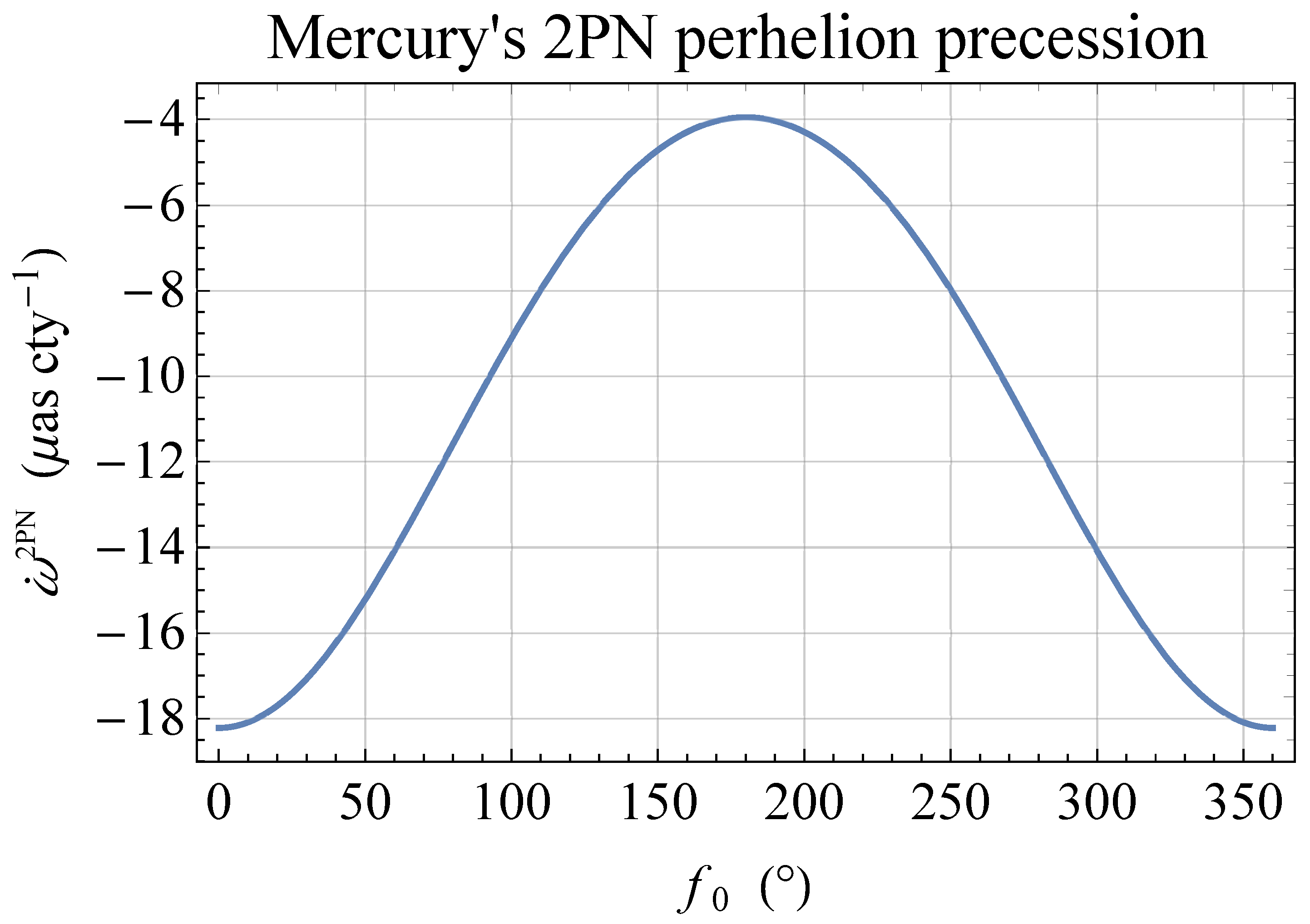
The Hermean average perihelion rate ω˙2PN, calculated to the second post-Newtonian (2PN) order with the Gauss perturbing equations and the osculating Keplerian orbital elements, ranges from 18 to 4 microarcseconds per century μascty1, depending on the true anomaly at epoch f0. It is the sum of four contributions: one of them is the direct consequence of the 2PN acceleration entering the equations of motion, while the other three are indirect effects of the 1PN component of the Sun’s gravitational field. An evaluation of the merely formal uncertainty of the experimental Mercury’s perihelion rate ω˙exp recently published by the present author, based on 51 years of radiotechnical data processed with the EPM2017 planetary ephemerides by the astronomers E.V. Pitjeva and N.P. Pitjev, is σω˙exp8μascty1, corresponding to a relative accuracy of 2×10⁷ for the combination 2+2γβ/3 of the PPN parameters β and γ scaling the well known 1PN perihelion precession. In fact, the realistic uncertainty may be up to ≃10–50 times larger, despite reprocessing the now available raw data of the former MESSENGER mission with a recently improved solar corona model should ameliorate our knowledge of the Hermean orbit. The BepiColombo spacecraft, currently en route to Mercury, might reach a 107 accuracy level in constraining β and γ in an extended mission, despite 106 seems more likely according to most of the simulations currently available in the literature. Thus, it might be that in the not-too-distant future, it will be necessary to include the 2PN acceleration in the Solar System’s dynamics as well.
Keywords: experimental studies of gravity; experimental tests of gravitational theories experimental studies of gravity; experimental tests of gravitational theories