

Geometric Cosmology Models: Statistical Analysis with Observational Data


Abstract
1. Introduction
2. Geometric Cosmology Theories
- 1.
- The equations of motion for a maximally symmetric spacetime are of second order. In addition, no other particle propagates but the massless graviton.
- 2.
- The theory admits single-function solutions in a maximally symmetric space-time, including Taub-NUT/Bolt solutions.
- 3.
- The field equations for a Friedmann–Lemaître–Robertson–Walker metric (FLRW) are of second order.
2.1. GILA Model
2.2. GR Deformation
2.3. Geometric Cosmology with Non-GR Contribution
2.4. Late-Time Background Evolution
3. Observational Data
3.1. Pantheon Plus + SH0ES (PPS)
3.2. Cosmic Chronometers
3.3. Globular Clusters
4. Methodology
- For the GILA model, we fix the energy scale in units of and explore the parameter subspace (we recall that is the absolute B-band magnitude of type Ia supernovae). This particular value of is motivated by the requirement that the effects of the theory manifest at late times; therefore, the associated energy scale is fixed close to its present value (). This choice is based on the analyses previously carried out for the GILA model in Refs. [17,18].
- For the GR deformation model, we fix , which is in agreement with the constraint given by Will [40] from solar system tests. The free parameter subspace is .
- For the geometric cosmology with no GR contribution, we fix , which is a subspace that involves the case when the linear Ricci curvature scalar is not considered in the action. The free parameter subspace is .
- 1.
- For each family of models (fixed values of in the GILA model or s in the remaining models), we construct a 20 × 20 × 20 grid over the parameter space and assign to each point of the grid the probability for Monte Carlo sampling.
- 2.
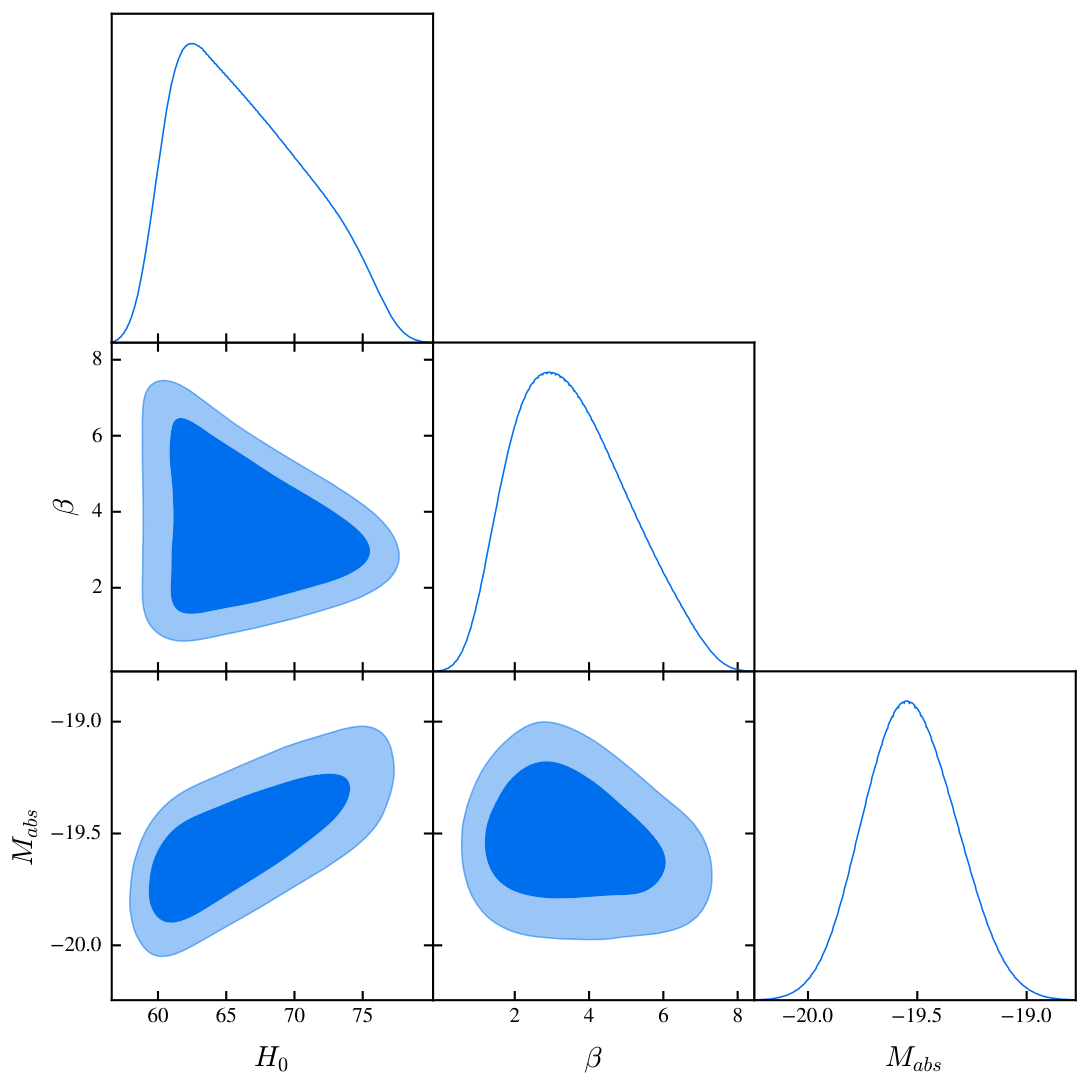
- We sample from this distribution (as a consistency check, we verified that our results are robust against the choice of grid resolution by rerunning the entire analysis on grids with five times the initial number of points, finding no significant differences) and then proceed in the usual way to obtain two-dimensional contour plots and one-dimensional marginalized posteriors for each data set separately.
- 3.
- We repeat steps 1 and 2, but using SNIa data instead of CC.
- 4.
- We then verify that the resulting confidence regions from both data sets overlap in some region, ensuring that each model under study can simultaneously account for both data sets with the same set of free parameters.
- 5.
- For each family of models (fixed values of in the GILA model or s in the remaining models), we build a low-resolution grid of in the respective parameter space. For each point on the grid, we compute the total (CC and SNIa data).
- 6.
- For each point on the grid, we compute the corresponding age of the universe (AoU).
- 7.
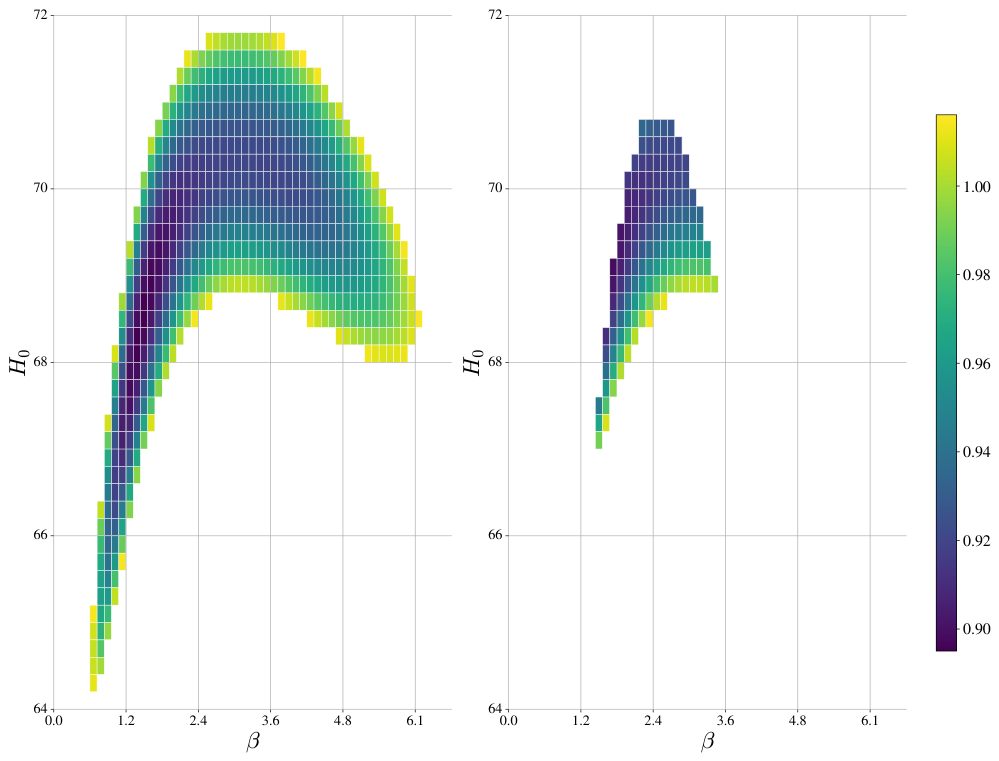
- Those points on the grid that meet the requirement are excluded from the grid. Figure 1 illustrates this step for the case.
- 8.
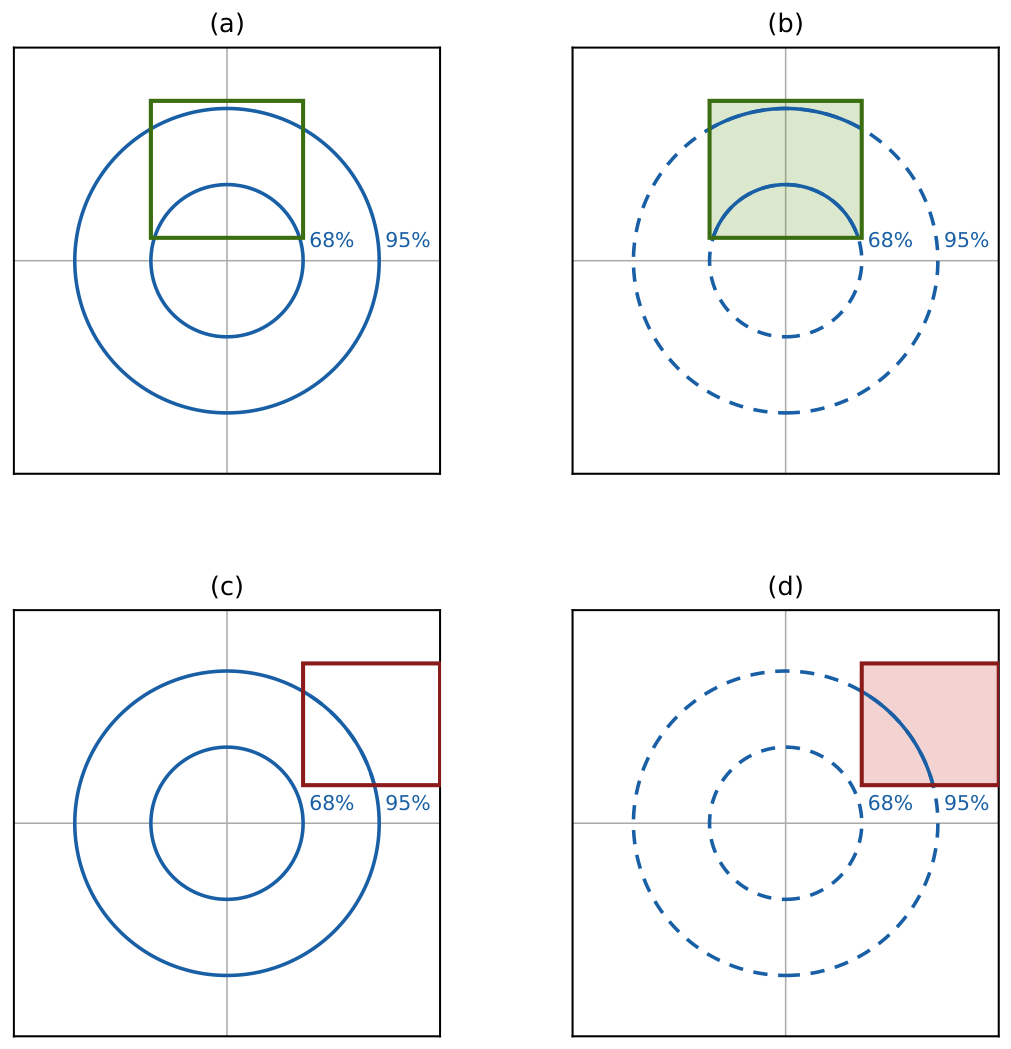
- For each family of models, we evaluate whether there are enough surviving points. In other words, we want to determine whether the cosmological models excluded by the age-of-the-universe condition fall within the 68% confidence region of the three-dimensional probability distribution defined by the SNIa and CC data. Given , the minimum value of the reduced chi-squared of all surviving points, and , the quantile function for (the value represents the normalized chi-squared threshold corresponding to the 68.3% confidence level for k degrees of freedom, where denotes the inverse cumulative distribution function (or percent point function) of the chi-squared distribution), the condition is (it is important to note that the 68% confidence region in one dimension—which is the level conventionally reported for confidence intervals—corresponds to a 39% confidence region in two dimensions and to 19.9% in three dimensions. In our analysis, we adopt the 68% confidence region in the full three-dimensional parameter space, which corresponds to 98.3% confidence in one dimension. This means that a family of models is discarded only if the minimum value among the points that survive the globular cluster age constraint falls outside the 98.3% confidence level of the one-dimensional marginalized distribution, or equivalently, outside the 82.9% confidence level of the two-dimensional marginalized distribution. The adopted criterion is therefore conservative when ruling out a family of models). If this holds, we proceed to the following step. If not, the family of models is ruled out on the basis of the globular cluster age constraint. Figure 1 and Figure 2 illustrate this step in two dimensions, whereas the procedure itself refers to the full three-dimensional posterior distribution. Table 2 and Table 3 show the results of this procedure when applied to different families that belong to the GILA and GR-deformation models. Note that all GR-deformation models are ruled out at this stage because they cannot meet the globular cluster constraint.
- 9.
- We construct the probability distribution for the Monte Carlo sampling, using a narrower grid of in the regions of the parameter space that were not discarded in the previous stage. For each point on the grid, we assign the value of the corresponding likelihood , where .
- 10.
- We sample from the distribution constructed in the previous step to build the 2D contour plots and 1D posterior distributions.
5. Results
5.1. Gila Model
5.2. GR-Deformation
5.3. Geometric Cosmology with Non-GR Contribution
6. Discussion and Conclusions
- 1.
- Some of the non-GR-contribution models analyzed in this paper can be ruled out because the parameter intervals obtained from CC are inconsistent with those obtained from SNIa.
- 2.
- The GR-deformation models considered in this paper and the non-GR contribution models that were not discarded due to inconsistency between CC and SNIa constraints can be ruled out because their predicted age of the universe is lower than the age inferred from globular clusters.
- 3.
- For the GILA model, we find three particular choices of the coefficients r and s that can explain the CC and PPS data and also predict an age of the universe consistent with globular cluster data. For these models, we were able to estimate confidence intervals for the free parameters. However, model comparison criteria show that CDM is favored by the data against these models.
Author Contributions
Funding
Data Availability Statement
Acknowledgments
Conflicts of Interest
Appendix A. Exponential Convergence
Appendix A.1. The GILA Model
Appendix A.2. GR-Deformation
Appendix A.3. Non-GR Contribution
References
- Planck Collaboration; Aghanim, N.; Akrami, Y.; Ashdown, M.; Aumont, J.; Baccigalupi, C.; Ballardini, M.; Banday, A.J.; Barreiro, R.B.; Bartolo, N.; et al. Planck 2018 results. VI. Cosmological parameters. Astron. Astrophys. 2020, 641, A6. [Google Scholar] [CrossRef]
- Riess, A.G.; Yuan, W.; Macri, L.M.; Scolnic, D.; Brout, D.; Casertano, S.; Jones, D.O.; Murakami, Y.; An, G.S.; Breuval, L.; et al. A Comprehensive Measurement of the Local Value of the Hubble Constant with 1 km s−1 Mpc−1 Uncertainty from the Hubble Space Telescope and the SH0ES Team. Astrophys. J. Lett. 2022, 934, L7. [Google Scholar] [CrossRef]
- Abdul Karim, M.; Aguilar, J.; Ahlen, S.; Alam, S.; Allen, L.; Prieto, C.A.; Alves, O.; An, A.; Andrade, U.; Armengaud, E.; et al. DESI DR2 results. II. Measurements of baryon acoustic oscillations and cosmological constraints. Phys. Rev. D 2025, 112, 083515. [Google Scholar] [CrossRef]
- Chevallier, M.; Polarski, D. Accelerating Universes with Scaling Dark Matter. Int. J. Mod. Phys. D 2001, 10, 213–223. [Google Scholar] [CrossRef]
- Linder, E.V. Exploring the Expansion History of the Universe. Phys. Rev. Lett. 2003, 90, 091301. [Google Scholar] [CrossRef] [PubMed]
- Ratra, B.; Peebles, P.J.E. Cosmological consequences of a rolling homogeneous scalar field. Phys. Rev. D 1988, 37, 3406–3427. [Google Scholar] [CrossRef]
- Shankaranarayanan, S.; Johnson, J.P. Modified theories of gravity: Why, how and what? Gen. Relativ. Gravit. 2022, 54, 44. [Google Scholar] [CrossRef]
- Sotiriou, T.P. Gravity and Scalar Fields. In Modifications of Einstein’s Theory of Gravity at Large Distances; Springer International Publishing: Cham, Switzerland, 2015; pp. 3–24. [Google Scholar]
- Arciniega, G.; Edelstein, J.D.; Jaime, L.G. Towards geometric inflation: The cubic case. Phys. Lett. B 2020, 802, 135272. [Google Scholar] [CrossRef]
- Bueno, P.; Cano, P.A. Einsteinian cubic gravity. Phys. Rev. D 2016, 94, 104005. [Google Scholar] [CrossRef]
- Bueno, P.; Cano, P.A.; Min, V.S.; Visser, M.R. Aspects of general higher-order gravities. Phys. Rev. D 2017, 95, 044010. [Google Scholar] [CrossRef]
- Cisterna, A.; Grandi, N.; Oliva, J. On four-dimensional Einsteinian gravity, quasitopological gravity, cosmology and black holes. Phys. Lett. B 2020, 805, 135435. [Google Scholar] [CrossRef]
- Arciniega, G.; Bueno, P.; Cano, P.A.; Edelstein, J.D.; Hennigar, R.A.; Jaime, L.G. Geometric Inflation. Phys. Lett. B 2020, 802, 135242. [Google Scholar] [CrossRef]
- Arciniega, G.; Bueno, P.; Cano, P.A.; Edelstein, J.D.; Hennigar, R.A.; Jaime, L.G. Cosmic inflation without inflaton. Int. J. Mod. Phys. D 2019, 28, 1944008. [Google Scholar] [CrossRef]
- Arciniega, G.; Jaime, L.; Piccinelli, G. Inflationary predictions of Geometric Inflation. Phys. Lett. B 2020, 809, 135731. [Google Scholar] [CrossRef]
- Akrami, Y.; Arroja, F.; Ashdown, M.; Aumont, J.; Baccigalupi, C.; Ballardini, M.; Banday, A.J.; Barreiro, R.B.; Bartolo, N.; Basak, S.; et al. Planck 2018 results. X. Constraints on inflation. Astron. Astrophys. 2020, 641, A10. [Google Scholar] [CrossRef]
- Jaime, L.G. On the viability of the evolution of the universe with Geometric Inflation. Phys. Dark Univ. 2021, 34, 100887. [Google Scholar] [CrossRef]
- Jaime, L.G.; Arciniega, G. A unified geometric description of the Universe: From inflation to late-time acceleration without an inflaton nor a cosmological constant. Phys. Lett. B 2022, 827, 136939. [Google Scholar] [CrossRef]
- Arciniega, G.; Jaime, L.G.; Landau, S.J.; Leizerovich, M. On Geometric Cosmology. arXiv 2025, arXiv:2504.00124. [Google Scholar]
- Bueno, P.; Cano, P.A. Four-dimensional black holes in Einsteinian cubic gravity. Phys. Rev. D 2016, 94, 124051. [Google Scholar] [CrossRef]
- Bueno, P.; Cano, P.A.; Hennigar, R.A. (Generalized) quasi-topological gravities at all orders. Class. Quant. Grav. 2020, 37, 015002. [Google Scholar] [CrossRef]
- Bueno, P.; Cano, P.A.; Hennigar, R.A.; Lu, M.; Moreno, J. Generalized quasi-topological gravities: The whole shebang. Class. Quant. Grav. 2023, 40, 015004. [Google Scholar] [CrossRef]
- Moreno, J.; Murcia, A.J. Classification of generalized quasitopological gravities. Phys. Rev. D 2023, 108, 044016. [Google Scholar] [CrossRef]
- Moreno, J.; Murcia, A.J. Cosmological higher-curvature gravities. Class. Quant. Grav. 2024, 41, 135017. [Google Scholar] [CrossRef]
- Scolnic, D.; Brout, D.; Carr, A.; Riess, A.G.; Davis, T.M.; Dwomoh, A.; Jones, D.O.; Ali, N.; Charvu, P.; Chen, R.; et al. The Pantheon+ Analysis: The Full Data Set and Light-curve Release. Astrophys. J. 2022, 938, 113. [Google Scholar] [CrossRef]
- Scolnic, D.M.; Jones, D.O.; Rest, A.; Pan, Y.C.; Chornock, R.; Foley, R.J.; Huber, M.E.; Kessler, R.; Narayan, G.; Riess, A.G.; et al. The Complete Light-curve Sample of Spectroscopically Confirmed SNe Ia from Pan-STARRS1 and Cosmological Constraints from the Combined Pantheon Sample. Astrophys. J. 2018, 859, 101. [Google Scholar] [CrossRef]
- Leizerovich, M.; Kraiselburd, L.; Landau, S.; Scóccola, C.G. Testing f (R) gravity models with quasar x-ray and UV fluxes. Phys. Rev. D 2022, 105, 103526. [Google Scholar] [CrossRef]
- Negrelli, C.; Kraiselburd, L.; Landau, S.; Scóccola, C.G. Testing Modified Gravity theory (MOG) with Type Ia Supernovae, Cosmic Chronometers and Baryon Acoustic Oscillations. J. Cosmol. Astropart. Phys. 2020, 2020, 015. [Google Scholar] [CrossRef]
- Simon, J.; Verde, L.; Jimenez, R. Constraints on the redshift dependence of the dark energy potential. Phys. Rev. D 2005, 71, 123001. [Google Scholar] [CrossRef]
- Stern, D.; Jimenez, R.; Verde, L.; Kamionkowski, M.; Stanford, S.A. Cosmic chronometers: Constraining the equation of state of dark energy. I: H(z) measurements. J. Cosmol. Astropart. Phys. 2010, 2, 008. [Google Scholar] [CrossRef]
- Moresco, M.; Cimatti, A.; Jimenez, R.; Pozzetti, L.; Zamorani, G.; Bolzonella, M.; Dunlop, J.; Lamareille, F.; Mignoli, M.; Pearce, H.; et al. Improved constraints on the expansion rate of the Universe up to z∼1.1 from the spectroscopic evolution of cosmic chronometers. J. Cosmol. Astropart. Phys. 2012, 8, 006. [Google Scholar] [CrossRef]
- Zhang, C.; Zhang, H.; Yuan, S.; Liu, S.; Zhang, T.J.; Sun, Y.C. Four new observational H(z) data from luminous red galaxies in the Sloan Digital Sky Survey data release seven. Res. Astron. Astrophys. 2014, 14, 1221–1233. [Google Scholar] [CrossRef]
- Moresco, M. Raising the bar: New constraints on the Hubble parameter with cosmic chronometers at z ∼ 2. Mon. Not. Roy. Astron. Soc. 2015, 450, L16–L20. [Google Scholar] [CrossRef]
- Moresco, M.; Pozzetti, L.; Cimatti, A.; Jimenez, R.; Maraston, C.; Verde, L.; Thomas, D.; Citro, A.; Tojeiro, R.; Wilkinson, D. A 6% measurement of the Hubble parameter at z~0.45: Direct evidence of the epoch of cosmic re-acceleration. J. Cosmol. Astropart. Phys. 2016, 5, 014. [Google Scholar] [CrossRef]
- Valcin, D.; Bernal, J.L.; Jimenez, R.; Verde, L.; Wandelt, B.D. Inferring the age of the universe with globular clusters. J. Cosmol. Astropart. Phys. 2020, 2020, 002. [Google Scholar] [CrossRef]
- Christlieb, N. Age determination of metal-poor halo stars using nucleochronometry. Astron. Nachrichten 2016, 337, 931. [Google Scholar] [CrossRef]
- Catelan, M. The ages of (the oldest) stars. In Proceedings of the Rediscovering Our Galaxy; Chiappini, C., Minchev, I., Starkenburg, E., Valentini, M., Eds.; IAU Symposium; University of Bristol: Bristol, UK, 2018; Volume 334, pp. 11–20. [Google Scholar] [CrossRef]
- Jeakel, A.P.; Silva, J.P.d.; Velten, H. Revisiting f (R, T) cosmologies. Phys. Dark Universe 2024, 43, 101401. [Google Scholar] [CrossRef]
- Fixsen, D.J. The Temperature of the Cosmic Microwave Background. Astrophys. J. 2009, 707, 916–920. [Google Scholar] [CrossRef]
- Will, C.M. Theory and Experiment in Gravitational Physics; Cambridge University Press: Cambridge, UK, 2018. [Google Scholar]
- McElreath, R. Statistical Rethinking: A Bayesian Course with Examples in R and Stan; CRC Press: Boca Raton, FL, USA, 2016. [Google Scholar]
- Leizerovich, M. GC_MC: Geometric Cosmology MC Analysis Code and Data. 2026. Available online: https://github.com/matiasleize/GC_MC (accessed on 27 February 2026).



| Parameter | GILA | GR-Deformation | No GR Contr. | CDM |
|---|---|---|---|---|
| × | × | × | ||
| × | × | |||
| × | × | × |
| GILA | AIC/ BIC | ||
|---|---|---|---|
| × | − | − | |
| × | − | − | |
| ✓ | |||
| ✓ | |||
| ✓ | |||
| × | − | − | |
| × | − | − | |
| × | − | − | |
| × | − | − | |
| × | − | − |
| s | GR-Deformation |
|---|---|
| 2 | × |
| 3 | × |
| 4 | × |
| 5 | × |
| 6 | × |
| 7 | × |
| CDM | ||||
|---|---|---|---|---|
| GILA Model | Exponents | |||
Disclaimer/Publisher’s Note: The statements, opinions and data contained in all publications are solely those of the individual author(s) and contributor(s) and not of MDPI and/or the editor(s). MDPI and/or the editor(s) disclaim responsibility for any injury to people or property resulting from any ideas, methods, instructions or products referred to in the content. |
© 2026 by the authors. Licensee MDPI, Basel, Switzerland. This article is an open access article distributed under the terms and conditions of the Creative Commons Attribution (CC BY) license.
Share and Cite
Leizerovich, M.; Jaime, L.G.; Landau, S.J.; Arciniega, G. Geometric Cosmology Models: Statistical Analysis with Observational Data. Universe 2026, 12, 129. https://doi.org/10.3390/universe12050129
Leizerovich M, Jaime LG, Landau SJ, Arciniega G. Geometric Cosmology Models: Statistical Analysis with Observational Data. Universe. 2026; 12(5):129. https://doi.org/10.3390/universe12050129
Chicago/Turabian StyleLeizerovich, Matías, Luisa G. Jaime, Susana J. Landau, and Gustavo Arciniega. 2026. "Geometric Cosmology Models: Statistical Analysis with Observational Data" Universe 12, no. 5: 129. https://doi.org/10.3390/universe12050129
APA StyleLeizerovich, M., Jaime, L. G., Landau, S. J., & Arciniega, G. (2026). Geometric Cosmology Models: Statistical Analysis with Observational Data. Universe, 12(5), 129. https://doi.org/10.3390/universe12050129