


Abstract
We explore a phenomenological extension of the Polyakov–Nambu–Jona-Lasinio (PNJL) model by introducing a curvature-sensitive effective contribution to the Polyakov-loop potential, motivated by the hypothesis that the non-perturbative QCD vacuum in the confined phase may retain a residual sensitivity to cosmic expansion. In a spatially flat FLRW background, this modification reduces to a term proportional to , which naturally vanishes in the deconfined regime and behaves as an effective dynamical vacuum component at late times, without invoking a fundamental cosmological constant. The construction provides an effective thermodynamic description of the QCD sector within an adiabatic framework and introduces a minimal phenomenological extension characterized by the exponent d and the amplitude parameter . We analyze the cosmological implications at the background level and compare the model with low-redshift observations, including cosmic chronometers, Type Ia supernovae, HII galaxies, and quasars. Using Bayesian Monte Carlo techniques, we constrain the model parameters and compare its performance with the ΛCDM. Our results indicate that the modified PNJL cosmology provides a statistically competitive fit to current data while allowing small departures from the ΛCDM within observational uncertainties. We also investigate the impact of the coupling on the QCD phase diagram and the critical end point. The framework offers a tractable effective approach to connect confinement physics with late-time cosmology and suggests directions for further theoretical development in QCD under curved backgrounds.
1. Introduction
Modern cosmology relies on General Relativity (GR) and the cosmological principle of homogeneity and isotropy to describe the large-scale structure and dynamics of the Universe. Within this framework, the Friedmann–Lemaître–Robertson–Walker (FLRW) metric and the associated Friedmann equations provide a robust foundation for modeling cosmic expansion. By incorporating various energy components—radiation, baryonic matter, neutrinos, dark matter (DM), and dark energy (DE)—the standard model, known as the ΛCDM, has proven to be remarkably successful in describing cosmological observations.
The inclusion of a cosmological constant in Einstein’s field equations accounts for the observed late-time accelerated expansion of the Universe, initially discovered through type Ia supernova measurements [1,2]. In the ΛCDM model, dark energy is characterized by an equation of state , corresponding to a vacuum energy that remains constant in time and space. However, this interpretation introduces profound theoretical challenges. The most notable is the so-called cosmological constant problem: Quantum field theory predicts vacuum energy densities that exceed the observed value by up to 120 orders of magnitude [3,4]. Alternative interpretations of vacuum energy, based on effective models or thermodynamic considerations, have also been explored [5].
To address these tensions, the cosmological community has proposed a wide range of dynamical dark energy models, including parameterized frameworks such as the phenomenologically emergent dark energy (PEDE) and generalized emergent dark energy (GEDE) [6,7,8,9]. Other approaches include models based on holographic and entropic principles [10,11], variable curvature scenarios [12], and a range of theoretical proposals, including modifications to GR. These models aim to explain cosmic acceleration without invoking a fundamental cosmological constant. For comprehensive reviews covering dynamical, geometrical, and modified gravity approaches, see [13,14].
Recent observational analyses further motivate these efforts. For instance, results from the Dark Energy Spectroscopic Instrument (DESI) have hinted at deviations from a pure ΛCDM expansion, favoring scenarios with a mildly dynamical dark energy component [15]. This ongoing debate highlights the need for novel perspectives grounded in well-established physics.
In this context, the role of strong interactions becomes particularly intriguing. Quantum Chromodynamics (QCD), the gauge theory of the strong nuclear force, governs the behavior of strongly interacting matter and features a rich vacuum structure shaped by phenomena such as confinement and spontaneous chiral symmetry breaking. These features are most prominent in the nonperturbative regime, especially relevant in the early Universe, where the transition from a deconfined quark–gluon plasma to confined hadronic matter occurred.
The thermodynamics of this transition can be effectively modeled using the Polyakov–Nambu–Jona-Lasinio (PNJL) model [16,17,18], which extends the NJL framework by including the Polyakov loop as an order parameter for confinement. The PNJL model has been widely used to study the QCD phase diagram, including the location of the critical end point (CEP) and the interaction between chiral symmetry and color confinement [19,20].
Despite its success in describing finite-temperature QCD, the PNJL model is usually treated in isolation from cosmological dynamics. However, some authors have speculated that the expansion of the Universe could influence the QCD vacuum structure [21,22,23], potentially inducing effective contributions to dark energy. These ideas are typically inspired by non-perturbative effects or topological vacuum fluctuations in curved spacetimes.
Motivated by these considerations, we propose a phenomenological extension of the Polyakov–Nambu–Jona-Lasinio (PNJL) model by introducing a coupling between the Polyakov-loop potential and the Hubble parameter . The coupling term, proportional to , will introduce a power-law sensitivity to the expansion rate of the Universe, where the exponent d encapsulates the strength and nature of the cosmological backreaction on the QCD vacuum. This term is suppressed in the deconfined phase through a function that ensures the modification is active only in the confined regime. This approach reflects the hypothesis that the strongly coupled QCD vacuum, dominant in the confined phase, could be sensitive to the large-scale expansion of the Universe, thus acting as an effective, dynamical component of dark energy.
We explore the cosmological implications of this modification by deriving the resulting Friedmann equations and constraining the model parameters using a combination of cosmic chronometers, type Ia supernovae, quasars, and HII galaxies. In parallel, we investigate the impact of the proposed coupling on the QCD phase diagram, including its effect on chiral and deconfinement transitions, and the location of the critical end point (CEP).
This paper is organized as follows. In Section 2, we review the standard PNJL model and its role in the description of QCD thermodynamics. In Section 3, we introduce the coupling to the Hubble parameter and justify its functional form. Section 4 derives the modified cosmological equations caused by the chromodynamic interactions. In Section 5, we describe the datasets used for parameter estimation, and Section 6 presents our cosmological and QCD results. Finally, in Section 7, we summarize our findings and discuss future directions1.
2. PNJL Model of QCD
The Polyakov–Nambu–Jona-Lasinio model is a highly effective field theory employed to elucidate the non-perturbative regime of QCD. It extends the Nambu–Jona-Lasinio (NJL) model by incorporating the Polyakov loop, which serves as an order parameter for the confinement–deconfinement transition at finite temperatures. This model provides a unified framework to study both the chiral symmetry breaking and the confinement properties of QCD, thereby positioning it as a potent instrument for unraveling the thermodynamic behavior of strongly interacting matter [16,17].
The Lagrangian density for the two-flavor PNJL model in the sector is given by [24,25]
where is the covariant derivative, incorporating the coupling to the background gluonic field. In the context of the PNJL model in QCD, the covariant derivative includes a static temporal gluon background field , introduced to model the coupling of quarks to the Polyakov loop. This background field is not dynamic; its function is to encode the thermal expectation value of the Wilson loop in imaginary time, which defines the traced Polyakov loop . The spatial components of are neglected, and only contributes to the temporal gauge. The parameter denotes the current quark mass, assumed equal for the up and down quarks due to isospin symmetry. The constant G is the effective coupling, and is the quark chemical potential. The matrices are the Pauli matrices acting in flavor space, and is the usual Dirac matrix associated with chiral structure. Finally, represents the effective Polyakov-loop potential, which depends on the traced Polyakov loop and the temperature T.
The Polyakov loop, , is a crucial order parameter in effective QCD models, characterizing the breaking of the center symmetry of the color gauge group. In this work, we consider two light quark flavors () and three colors (), following the standard setup of effective PNJL models. This approach enables the PNJL model to accurately characterize the transition from a confined hadronic state to a deconfined quark–gluon plasma. Effective QCD models at finite temperature and density are formulated through the thermodynamic potential as [26,27].
The term represents the quark energy, while M denotes the dynamically generated quark mass. In practice, the Polyakov-loop potential cannot be derived from first principles and is instead modeled through effective forms that capture the thermodynamic behavior of QCD near the confinement–deconfinement transition. Following Refs. [24,28], we adopt a used parameterization fitted to reproduce lattice QCD results at zero and finite chemical potential. Thus, the form used in this work is given by,
where the temperature-dependent coefficients control the behavior of the Polyakov-loop potential with parameters , , , , MeV, , and
Unlike the NJL model, which lacks a direct description of confinement, the PNJL model provides a more complete thermodynamic picture by incorporating the effects of a background gluon field. The effective potential captures essential features of the deconfinement transition, while the NJL interaction term accounts for spontaneous chiral symmetry breaking. This unified treatment enables the PNJL model to describe the transition from hadronic matter to quark–gluon plasma more accurately.
It is important to emphasize that the PNJL model should be understood as an effective framework that captures key qualitative features of QCD, rather than a fundamental description. In this work, we adopt a phenomenological perspective and explore the possible implications of coupling the QCD vacuum structure to the cosmological expansion rate. This approach is intended as an exploratory extension, aimed at identifying potential connections between confinement dynamics and cosmological evolution, rather than as a direct derivation from first-principles QCD.
In this context, the PNJL framework provides a tractable setting in which such a hypothesis can be implemented and studied. In the next section, we introduce a phenomenological extension that incorporates this coupling through the Hubble parameter.
3. Modified PNJL Model
The Polyakov loop, , plays a central role in this framework, serving as a fundamental order parameter in effective QCD models. It characterizes the spontaneous break of the center symmetry of the color gauge group, which is closely related to the confinement–deconfinement transition [19,20], and its dynamics are described by the effective Polyakov-loop potential , which summarizes the thermodynamic behavior of the strongly interacting medium near the transition region [18].
Motivated by studies of the QCD vacuum in curved backgrounds and expanding spacetimes [21,23,29], we explore the possibility that confinement dynamics encoded in may be weakly sensitive to the large-scale expansion of the Universe. These analyses suggest that vacuum condensates and topological fluctuations of strongly interacting fields can receive curvature- or expansion-dependent corrections in FLRW geometries. Although these effects are typically very small at present times, they may nonetheless induce an effective contribution to the dark sector.
Guided by these ideas, we introduce a minimal, phenomenological coupling between the Polyakov-loop potential and the Hubble parameter . Both the QCD scale and have dimensions of mass, in natural units, which allows us to construct a dimensionally consistent modification of the effective potential without resorting to higher-order curvature invariants. To keep track of the overall scale, we introduce a constant with dimensions of energy density (), while the dimensionless ratio controls the relative strength of the correction at a given cosmic epoch, with the present-day Hubble parameter.
The modified Polyakov-loop potential is then expressed as
where is the standard PNJL potential, controls the amplitude of the cosmological correction and is fixed to throughout the analysis, d is a real exponent obtained from the cosmological fits that parametrizes how the QCD vacuum responds to the expansion rate, and is a dimensionless function that modulates the effect of the coupling in different phases of QCD.
The new term in Equation (5) is designed to satisfy two basic requirements: (a) it should be relevant only in the confined phase, where non-perturbative vacuum effects dominate; and (b) it should be strongly suppressed in the deconfined phase, in order not to interfere with the thermodynamics of the quark–gluon plasma and with early-Universe physics such as Big Bang nucleosynthesis and the CMB. These conditions are implemented through the function , which we choose to depend only on the gauge-invariant combination . In particular, we adopt the simple quadratic form
which satisfies
and
This suppression mechanism is not implemented explicitly in the cosmological background equations used in this work, but rather provides the physical motivation for restricting the effective description to the low-redshift regime where .
The derivatives of f with respect to and ,
are regular and do not introduce singularities in the equations of motion for the mean fields. Therefore, the modified potential remains smooth across the transition region.
With this construction, the influence of the Hubble parameter is maximal when the system is deeply confined (), where the QCD vacuum structure is dominated by non-perturbative condensates, and it gradually switches off as the system approaches the deconfined phase (). This matches the physical expectation that any cosmological backreaction on the QCD vacuum should be most relevant in the strongly coupled regime, while becoming negligible in the quark–gluon plasma.
The modified term in Equation (5) also induces a corresponding change in the total thermodynamic potential,
which in turn affects the chiral and deconfinement transitions and the location of the critical end point in the phase diagram. In addition, when evaluated at a fixed cosmic epoch, the extra contribution proportional to can be interpreted as an effective, dynamical dark-energy component in the Friedmann equations, as discussed in the next section.
Adiabatic Approximation and Cosmological Consistency
In our framework, the QCD and cosmological sectors are coupled through the modified Polyakov-loop potential introduced in Equation (5). However, the respective energy scales differ by many orders of magnitude. The characteristic scale governing QCD thermodynamics is , whereas the present Hubble parameter is extremely small, . The ratio,
implies that the cosmic expansion is effectively static from the point of view of QCD dynamics. This enormous hierarchy allows an adiabatic approximation, in which acts as an external parameter: the thermodynamic potential of the PNJL model is evaluated at a fixed cosmological epoch, without requiring a dynamical backreaction on the gap equations.
This separation of scales justifies treating as a slow, external variable in the QCD sector. Within this adiabatic approximation, the thermodynamic potential is evaluated at a fixed but representative value of the expansion rate, rather than being dynamically evolved along the full cosmological history. In practice, the modification is implemented through the factor , which is treated as an effective parameter encoding the influence of the cosmological background. This allows us to explore how different values of d modify the thermodynamic behavior of the model within a controlled and computationally tractable setup.
At the same time, although the PNJL thermodynamics are computed at fixed , the parameter d appearing in the modification is directly inherited by the cosmological sector, entering the Friedmann equation as a contribution proportional to . The cosmological implications of this term—including its interpretation as a dynamical dark-energy component and its effect on the Hubble expansion history—are analyzed in detail in the next section.
This interpretation is consistent with previous studies in which is introduced as an external parameter encoding the influence of cosmic expansion on QCD vacuum contributions [21,29]. Within this adiabatic scheme, the QCD sector can be treated as effectively thermodynamic, while the cosmological evolution retains a phenomenological imprint of the strongly coupled regime through the exponent d.
4. The Cosmology
The modification introduced in Equation (5) adds to the QCD thermodynamic potential a contribution proportional to , modulated by the function . When evaluated at a fixed cosmic epoch, this term behaves as a vacuum-like energy density. In this section, we show explicitly how this contribution enters the Friedmann equations and how the parameter d characterizes the resulting cosmological dynamics.
4.1. From the Modified PNJL Potential to the Friedmann Equation
At a given epoch t, the additional contribution to the effective potential,
acts as a homogeneous energy density in the stress–energy tensor. In the confined phase, where , and because (7), we have . Thus, it is possible to define
Therefore, we associate with an effective energy density, , and introduce a corresponding energy–momentum tensor , treating it as a perfect fluid at the background level. Consistency with the Einstein equations, together with the Bianchi identities, implies the conservation condition within this effective description. This requirement leads to , with equation of state
In this case, our Einstein field equation takes the form
where stand and QCD refer to the stress–energy tensor of standard fluids (baryons, radiation, etc.) and QCD contributions, respectively, associated with perfect fluids, and is the Einstein tensor.
Then, both contributions of the stress–energy tensor follow the standard continuity equation, with the following expression
The continuity equation is valid for standard fluids and the QCD contribution that transits from the PNJL EoS at QCD scales (see details in Section 3).
Solving Equation (15), the Friedmann equation yields
The new term acts as an effective, dynamical dark-energy density whose time evolution is determined by the expansion rate itself. The standard ΛCDM model is recovered in the limit , for which the correction reduces to a constant value C, which originates from the modified PNJL potential, and for we have a term that evolves like a dynamical dark energy.
This approach preserves the standard form of General Relativity by incorporating the QCD-induced term as an additional energy component in the Friedmann equations, while keeping the continuity equation unaltered. As can be observed, the parameter d is inherited from Equation (5), uncovering information on QCD eras.
4.2. The Dimensionless Friedmann Equation
Introducing the normalized Hubble parameter and the usual density parameters and , Equation (17) becomes
where the dimensionless parameter
characterizes the strength of the QCD-induced contribution relative to .
Evaluating Equation (18) at gives the constraint
which is the analogue of the standard Friedmann relation. For , the term plays the role of an effective cosmological constant.
4.3. The Cosmographic Parameters
To assess the impact of the parameter d on the expansion, and to enable a model-independent comparison with the ΛCDM, we compute three cosmographic quantities: the deceleration parameter , the jerk parameter , and the effective equation of state . These quantities depend only on derivatives of and are independent of the theoretical origin of the energy components.
The deceleration parameter is defined as
while the jerk parameter reads
Finally, the effective equation of state associated with the total perfect cosmic fluid is
where the subscript “eff” means that all fluids are involved in the EoS. Even when the observational constraints favor those values of d close to zero, these diagnostics remain sensitive to small deviations from the ΛCDM and therefore provide a useful tool for identifying the dynamical character of the QCD-induced contribution in Equation (17).
The next section describes the datasets and statistical methods used to constrain the parameter space and to assess the viability of the model compared to the standard ΛCDM cosmology.
5. Datasets
To constrain the free parameters of the QCD-modified cosmological model, we define the parameter space as , where h is the dimensionless Hubble parameter, denotes the total matter density parameters, and d is the exponent characterizing the dynamical behavior of the QCD-induced contribution in Equation (18). The parameter is not an independent quantity, as it is fixed by the Friedmann constraint at through Equations (19) and (20), with computed from the standard cosmic microwave background temperature.
Constraints on these parameters are obtained through a combination of recent observational datasets, including cosmic chronometers, Type Ia supernovae, hydrogen-II galaxies, and intermediate-luminosity quasars. We perform statistical analysis using a Markov Chain Monte Carlo (MCMC) approach via the Emcee Python 3 package [30]. To ensure chain convergence, we monitor the autocorrelation function and adopt 2000 chains of 200 steps each, adopting Gaussian priors for and , and a uniform prior for . We adopt these Gaussian priors on h and with the aim of deriving more stringent constraints on the characteristic parameter d of the QCD model by propagating their uncertainties into the inferred values of d, rather than fixing these parameters a priori. In the following, we summarize the dataset.
- Cosmic chronometers(CCs): A sample of 33 measurements of the Hubble parameter that covers a redshift region of . The CC sample contains 15 correlated measurements and 18 points of considered uncorrelated [31,32,33,34,35,36]. To constrain the space parameter of the model, the -function is defined aswhere the sum in the first term runs over all uncorrelated points, while the second term operates over the correlated sample. is the inverse of the covariance matrix of the vector , corresponding to the difference between the observed and theoretical vectors of H.
- Type Ia supernovae(SNIa): The Pantheon+ dataset [37,38] contains 1701 correlated measurements of the distance modulus in the redshift region . We use a function for correlated data to eliminate contributions of nuisance parameters defined as [39]whereand is the vector of the difference between the theoretical and observed distance modulus, defined aswhich is related to the luminosity distance ,Here, c is the speed of light, is the transpose of the unit vector and is the covariance matrix.
- Hydrogen II galaxies(HIIGs): This sample includes 181 distance modulus measurements of low-mass () compact systems with star-forming regions, covering [40,41]. To compare the QCD model to data, the -function is built aswhere is the distance modulus and its uncertainty observed at the redshift and is its theoretical quantity.
- Intermediate-luminosity quasars(QSOs): Composed of 120 angular size measurements from ultra-compact radio sources in the region [42], this dataset is analyzed with an uncorrelated function , marginalizing potential nuisance parameters related to the distance modulus. Thus, an uncorrelated -function is used aswhere is the observed measurement and its corresponding uncertainty at redshift , and is the theoretical counterpart estimated through the relation , where is the angular diameter distance related to the luminosity distance through and is an intrinsic length of the QSO fixed to pc [42].
6. Results
6.1. Cosmology Results
The cosmological implications of the QCD-modified Friedmann equation are now examined using the datasets described in the previous section and covering a redshift region up to when the QSO sample is added. The parameters are jointly constrained, while the constant is fixed by the Friedmann constraint. Table 1 summarizes the resulting median values and 68% () confidence intervals for several data combinations. In all cases, the best-fit values of the exponent d cluster around zero, indicating that the QCD-induced term behaves very similarly to a cosmological constant. This is consistent with the expectation that the coupling to the Hubble rate should be small at the present epoch. Furthermore, the standard deviations of the posterior distributions for h and remain essentially unchanged relative to their prior values, indicating that the available data provide only weak additional constraints on these parameters2. However, the constraints do not force d to be exactly zero, and small deviations from ΛCDM remain allowed within 1.
Table 1.
Median values and their confidence interval for the QCD cosmology and ΛCDM using CC, SNIa, HIIG and QSO datasets. The standard deviations of the posterior distribution for h and are dominated by their prior, as the likelihood provides only weak constraints.
To better understand the dynamical character of the model, we compute the cosmographic quantities , and . These functions depend only on and its derivatives and are therefore sensitive even to small variations in d. Importantly, they provide a model-independent diagnostic: their interpretation does not rely on the microscopic origin of the energy component but only on its impact on the background expansion. This justifies their use even when d is close to zero, addressing potential concerns about the relevance of Equations (21)–(23).
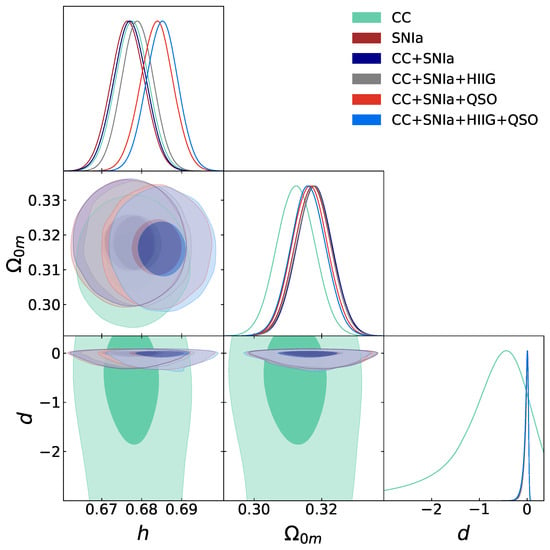
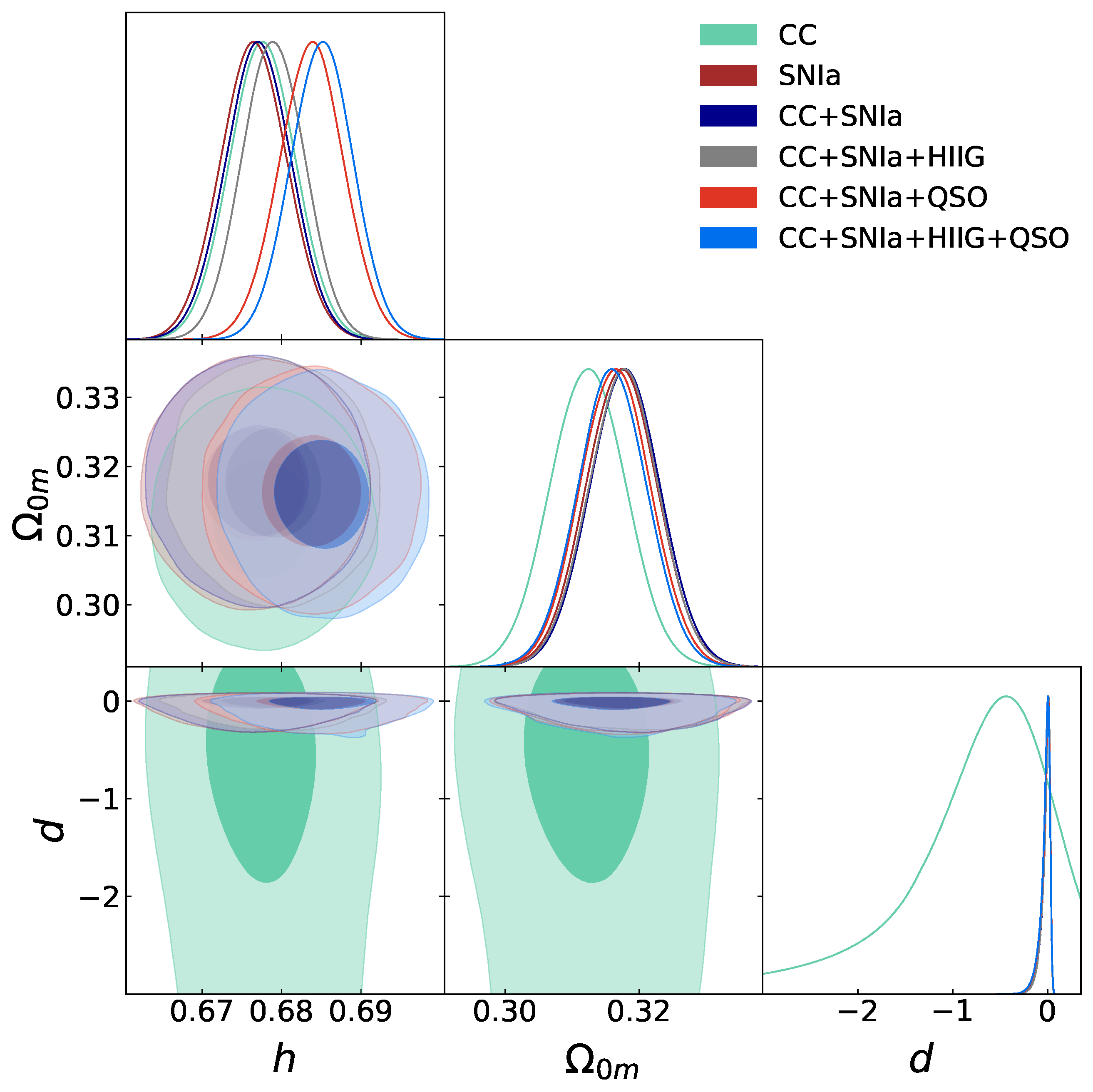
Figure 1 shows the 1D posterior distributions and the 2D confidence contours at the confidence level and () for the parameters of the QCD model using multiple datasets. As we expected, the combination of CC and SNIa yields significantly tighter constraints, particularly in the parameter d that quantifies deviations from behavior similar to ΛCDM. We do not observe strong degeneracies between d and other cosmological parameters, with all datasets consistently favoring values clustered around .
Figure 1.
1D posterior distributions and 2D contours at (inner region) and (outermost region) CL for different data combinations for QCD model.
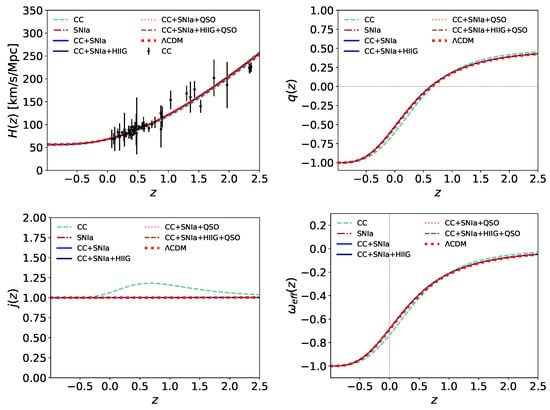
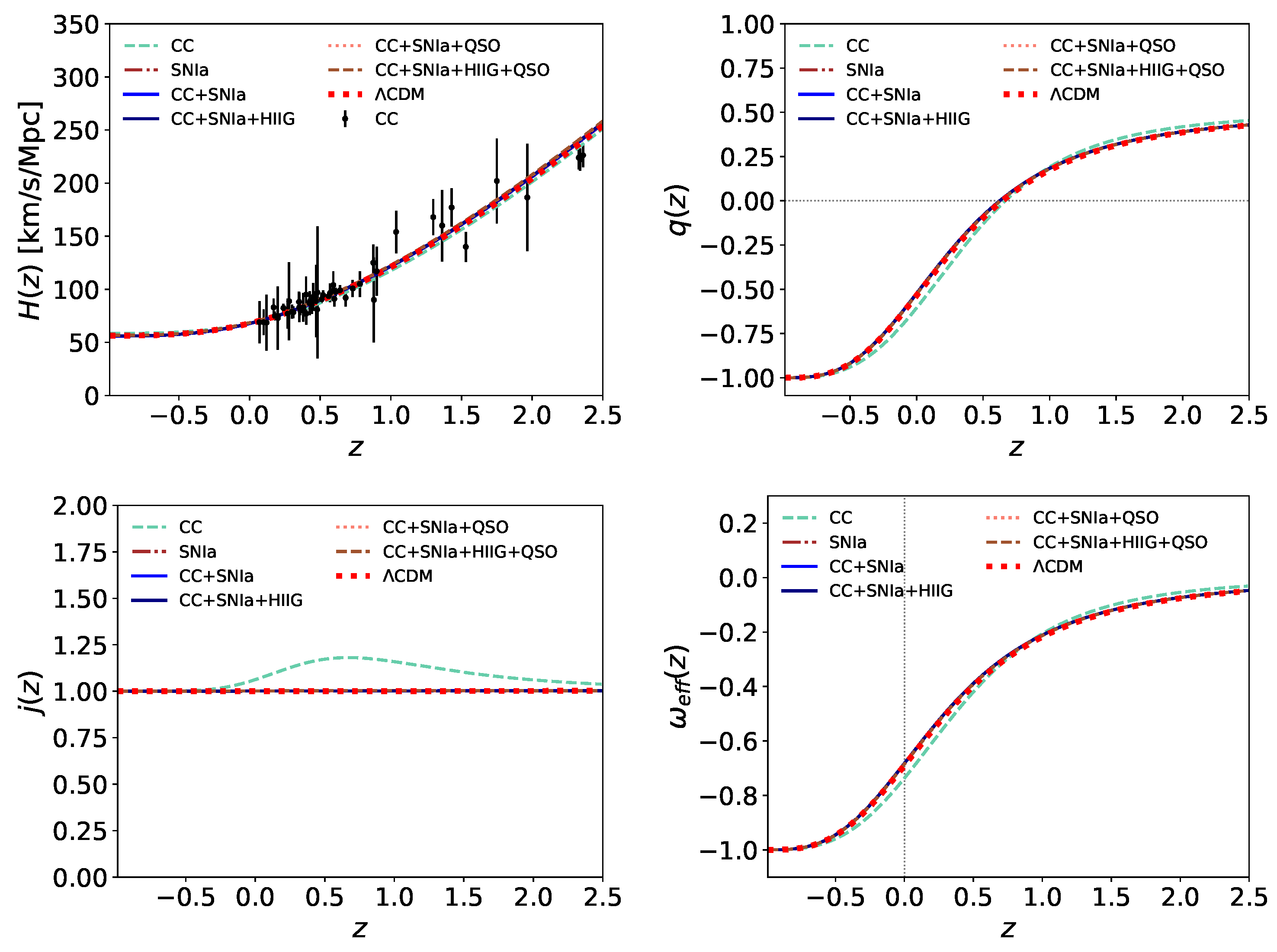
Figure 2 presents the reconstructed evolution of the Hubble parameter , the deceleration parameter , the jerk parameter , and the effective EoS for the QCD-modified cosmology, using several combined datasets. We find that the behavior aligns with the expectations of the ΛCDM at low redshifts, allowing only minor deviations. The deceleration parameter exhibits a smooth transition from deceleration to acceleration, while the jerk parameter remains close to the canonical value as expected for a nearly constant dark-energy component and supporting the model’s consistency with the observed expansion history.
Figure 2.
Reconstruction of the Hubble parameter, and the deceleration parameter (top panel), and jerk parameter and the effetive equation of state (bottom panel) for different data combinations for the QCD model in the redshift range using different data combinations. The standard ΛCDM is included as red dashed lines.
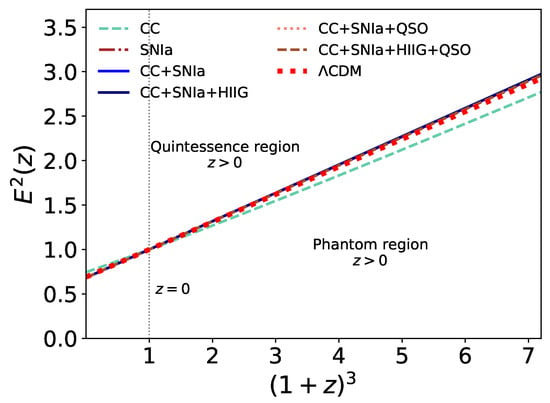
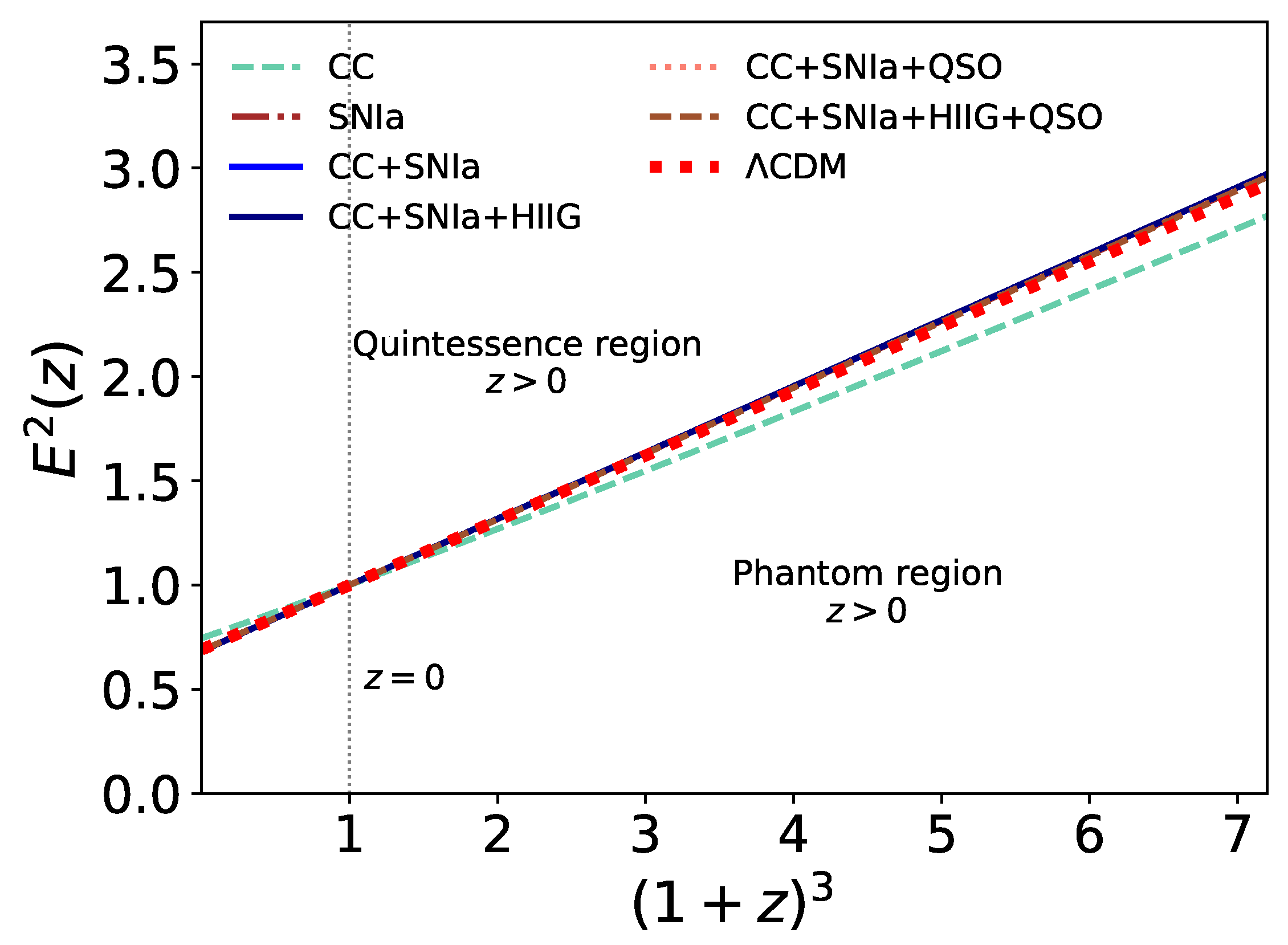
Figure 3 displays as a function of , allowing geometric comparison between the model and the ΛCDM, highlighting regions where DE behaves as a cosmological constant, quintessence, or a phantom field. Notably, subtle differences arise: the Universe appears to emerge from a phantom field (under the CC-only constraint) or quintessence (under other constraints) at , converging to a cosmological constant at . In the future (), the model suggests a tendency towards quintessence-like behavior.
Figure 3.
vs for the QCD model for different data combinations. The standard ΛCDM is included as red dashed lines.
The parameter d controls the scaling behavior of the QCD-induced energy density term . Our analysis reveals that the best-fit values for d agree with values near zero, effectively reproducing the standard expansion history of the ΛCDM while introducing subtle but observationally significant deviations. A positive value of d indicates that this term dilutes with cosmic time, corresponding to a transient or emergent dark energy component that played a more dominant role in the past. In contrast, a slightly negative d produces a slowly growing contribution that could eventually dominate the future expansion, potentially driving a phase of superacceleration. Remarkably, our constrained best-fit value, , remains sufficiently small to prevent late-Universe instabilities or divergences. This result strongly suggests that the proposed QCD coupling in our model acts as a stable dynamical modification to the vacuum energy, with observational consequences that remain consistent with current cosmological data.
Finally, as a statistical comparison between the QCD-modified model and the ΛCDM, we use Akaike’s Information Criterion (AIC) [43,44], defined as:
where is the chi-square of the best fit value and k is the number of free parameters (fitted). The preferred model is the one with the lowest AIC value. The interpretation of the AIC difference (ΔAIC) is as follows:
- If ΔAIC , both models are equally supported by the data.
- If ΔAIC , the data still support the given model but less than the preferred one.
- If ΔAIC , the observations do not support the given model.
Furthermore, we compute the Bayesian Information Criterion (BIC) [45], defined as:
where N is the sample size. The BIC imposes a stronger penalty on model complexity than the AIC. Similarly to AIC, the best model corresponds to the lowest BIC value. The interpretation of the difference in BIC (ΔBIC) is as follows:
- If ΔBIC , there is no significant evidence against the model.
- If ΔBIC , there is modest evidence against the candidate model.
- If ΔBIC , the evidence against the model is strong.
- If ΔBIC , the evidence against the model is very strong.
Table 2 shows the values of ΔAIC = − and ΔBIC = − . In this notation, negative values of these differences mean that the lowest value of AIC (BIC) corresponds to the QCD-modified cosmology. According to the AIC, both models are equally supported by the combined datasets. However, when applying a stronger penalization for model complexity, as implemented by the BIC, only the SNIa dataset provides evidence disfavoring the QCD-modified model, while for the remaining datasets the conclusions remain consistent with those obtained from the AIC analysis.
Table 2.
Statistical comparison between the QCD-modified model and ΛCDM using Akaike and Bayesian Information Criteria. ΔAIC = − and = − represent the difference between the QCD cosmology and the ΛCDM values. Negative values of Δ represent a preference for the QCD-modified cosmology.
According to the AIC and BIC, both models are equally supported by multiple datasets.
6.2. QCD Results
We now examine the impact of cosmological coupling on the QCD thermodynamics predicted by the modified PNJL model. Before presenting the results, it is important to clarify the methodology, since the QCD sector operates at a vastly different energy scale from cosmology and all parameters must be fixed consistently.
6.2.1. Methodology and Parameter Fixing
All PNJL parameters entering the standard Polyakov-loop potential —namely , , , , , and —are kept fixed to their usual values obtained from lattice QCD calibrations. No cosmological observation modifies these quantities.
The only modification to the thermodynamic potential is the additional term in Equation (12), introduced in Equation (5). Since the relevant QCD physics occurs at temperatures of order –, whereas the Hubble parameter at the present epoch is extremely small , the cosmic expansion may be treated as effectively static from the perspective of QCD. As explained in Section 3, this justifies an adiabatic approximation in which H acts as an external input.
With all PNJL parameters fixed and only d varied, the gap equations are solved to obtain the temperature dependence of the relevant order parameters—the dynamical quark mass, the chiral condensate, and the Polyakov loop—and their susceptibilities. These solutions allow us to explore the thermodynamic consequences of the cosmological coupling, including its impact on the thermal evolution of the chiral and Polyakov-loop sectors, the phase transitions, and the CEP, in direct comparison with the standard PNJL model and its finite-volume MRE extensions.
6.2.2. Thermal Evolution and Phase Transitions
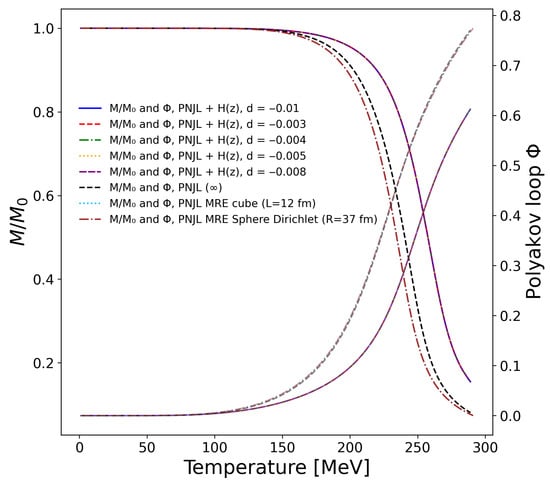
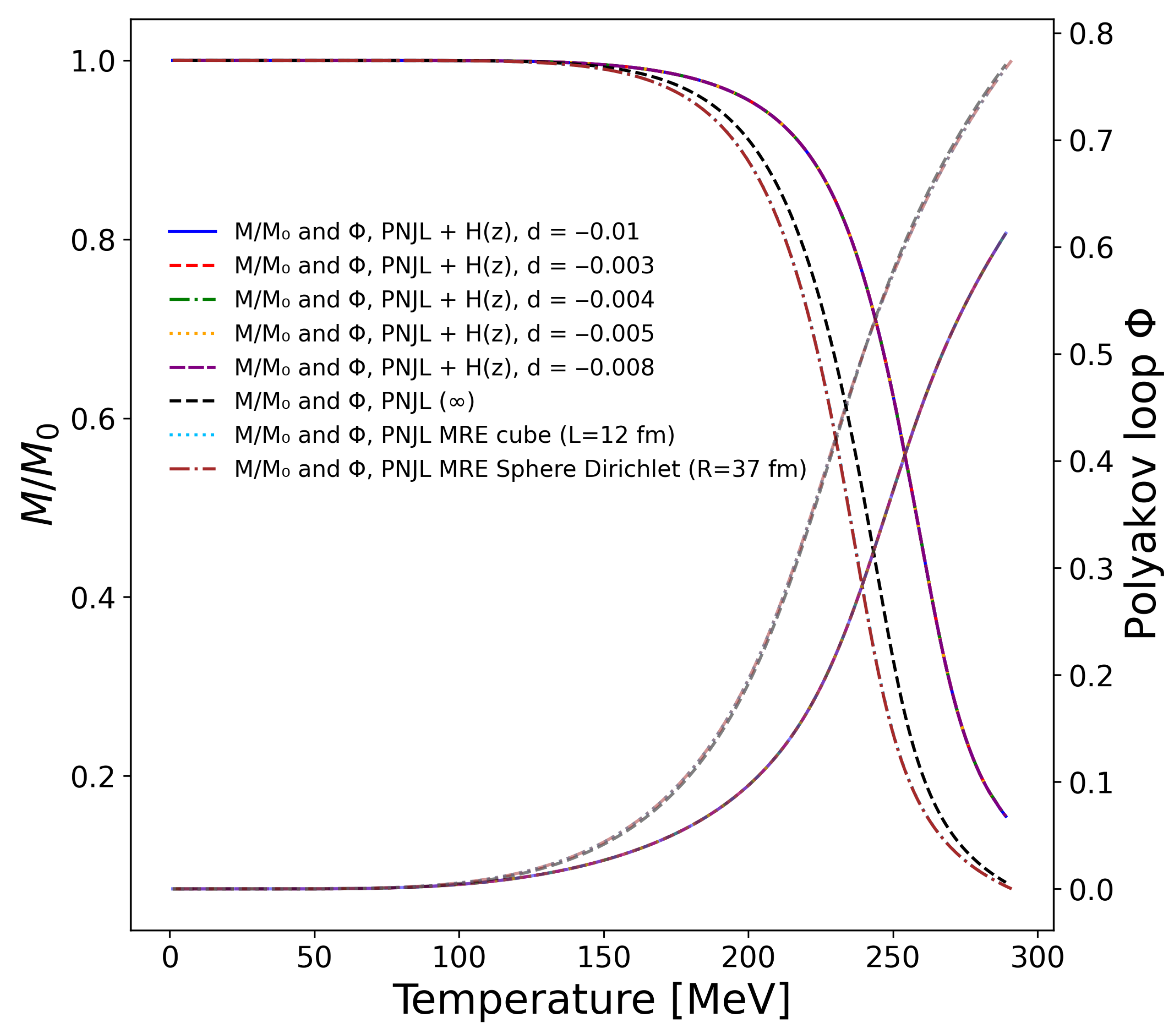
Figure 4 displays the thermal behavior of the normalized chiral condensate () and the Polyakov loop (), representing the thermal evolution in different scenarios, the standard PNJL model, the finite volume extensions using the Multiple Reflection Expansion (MRE) for both cubic and spherical geometries, and our modified PNJL model with cosmological coupling. For the finite-volume corrections, we adopt the MRE approach, which modifies the density of states by including surface and curvature contributions. This method has been successfully used in QCD effective models to account for confinement in finite geometries, e.g., in heavy-ion or astrophysical contexts [46,47]. In our study, the MRE provides a reference scenario to compare with the effects induced by the cosmological coupling.
Figure 4.
Chiral condensate and Polyakov loop as a function of temperature for the modified PNJL model.
As seen in Figure 4, the transition associated with both chiral restoration and deconfinement occurs in a smooth crossover manner, consistent with QCD at zero chemical potential. The thermal transition associated with chiral symmetry restoration occurs first for finite-volume models, in particular in the MRE Dirichlet configuration for a sphere, as compared to the standard PNJL model in the infinite-volume limit. This behavior agrees with the expected strengthening of the confinement effects in reduced volumes. On the other hand, PNJL models incorporating the cosmological coupling show slightly delayed transitions, indicating that the expansion of the Universe, modeled by the term, has a smoothing effect on the phase change. Furthermore, variations in the exponent d produce only minimal differences in critical behavior, suggesting that the model is not sensitive to this parameter at .
The Polyakov loop, which acts as an order parameter for deconfinement, shows the expected behavior in all models; at low temperatures the parameter is practically zero, and with increases in temperature the parameter starts to grow until approaching unity. Among the different scenarios, the MRE finite-volume models show an earlier rise in , indicating a lower deconfinement temperature, while the standard PNJL model shows a more delayed transition. The models with cosmological coupling show an even later onset of deconfinement, suggesting that the expansion of the Universe weakens the onset of color deconfinement. Moreover, the curves for different values of the exponent d overlap almost completely, reflecting that the Polyakov loop also depends weakly on this parameter under the conditions considered.
The interplay between quark deconfinement and chiral symmetry restoration remains a central question in QCD thermodynamics. To explore this connection, we also consider the temperature at which the normalized chiral condensate intersects the Polyakov loop . This crossing provides a qualitative indicator of the relative behavior of both order parameters, rather than a precise definition of the transition temperature. As shown in Table 3, the intersection occurs within a narrow temperature range between 240 and 260 MeV in all models. These values are model-dependent and reflect the specific PNJL parametrization employed, rather than the physical QCD crossover temperature. The near coincidence illustrates the close correlation between the chiral and deconfinement sectors under the conditions studied. The intersection values lie between 0.45 and 0.50, indicating a partial restoration of both order parameters, consistent with a smooth crossover at zero chemical potential.
Table 3.
Characteristic temperatures obtained within the PNJL framework for different model configurations. denotes the temperature at which the normalized chiral condensate and the Polyakov loop intersect. The column reports the common value at that intersection point. These values are model-dependent and are included for comparative purposes.
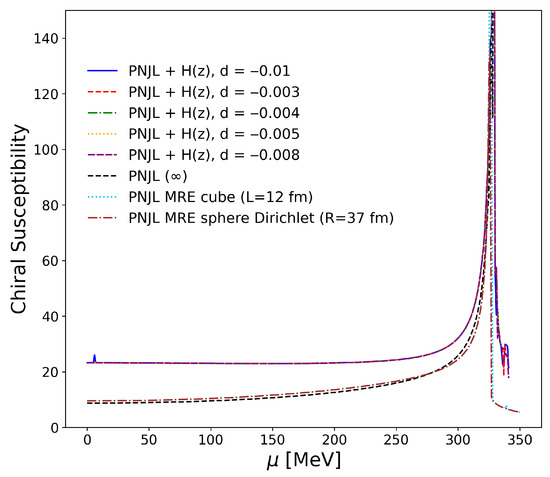
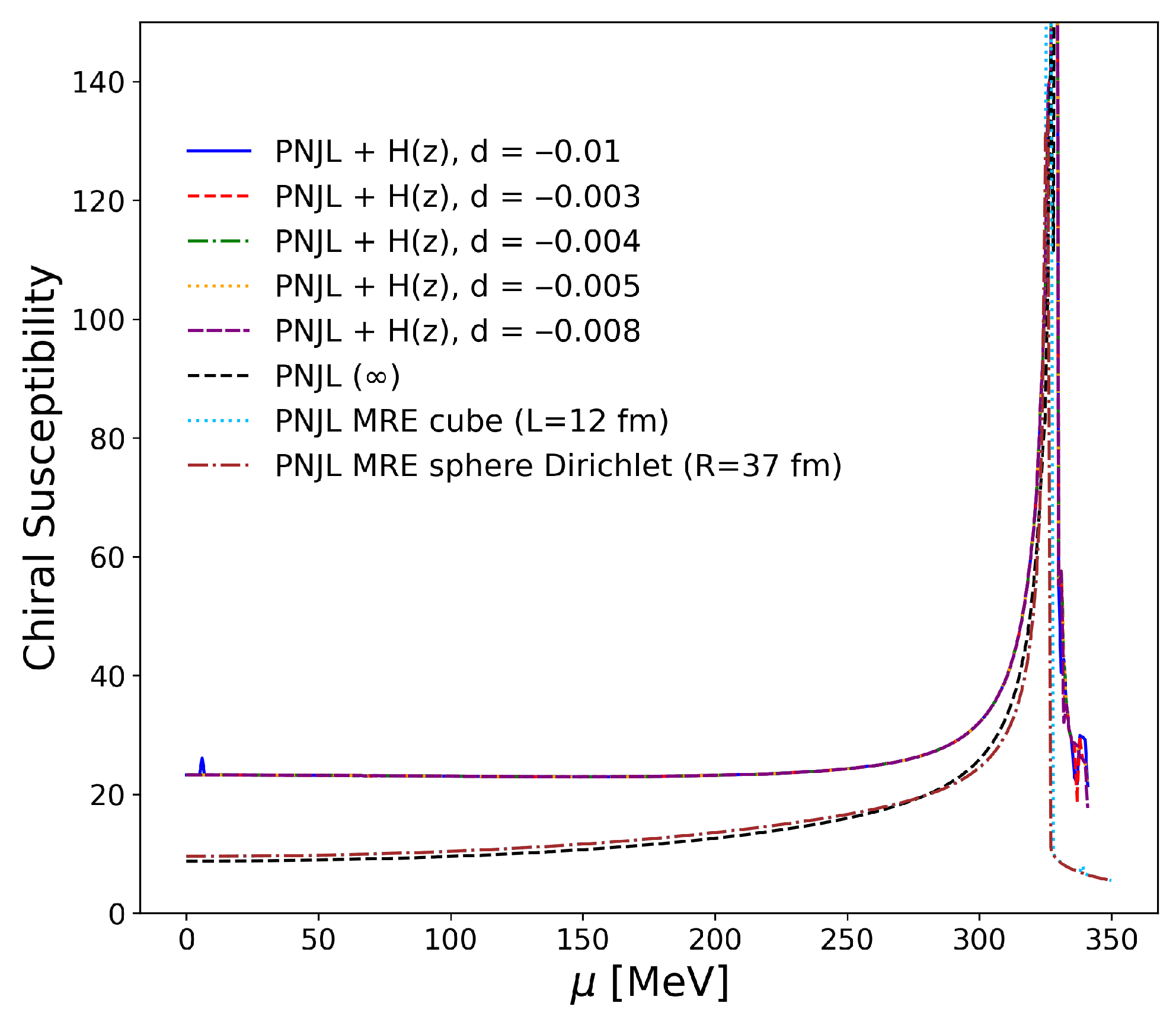
Figure 5 displays the maximal value of the chiral susceptibility as a function of the chemical potential for different configurations of the PNJL model. This observation provides a sensitive probe of the thermal behavior of the system and is commonly used to explore the phase structure of effective QCD models. The interpretation of these results and their implications for the critical end point are discussed in the following subsection.
Figure 5.
Maximal chiral susceptibility as a function of the chemical potential for the PNJL model in different configurations: finite volume with MRE (cube fm, sphere fm), standard PNJL, and the PNJL model with coupling.
6.2.3. Critical End Point (CEP)
To locate the critical point, we follow a geometric criterion inspired by Ref. [46], designed to identify the onset of critical behavior in the chiral susceptibility. In effective QCD models, the susceptibility does not exhibit a strict divergence due to finite numerical resolution, but rather develops increasingly pronounced peaks as the system approaches the CEP. To characterize this behavior, we compute the chiral susceptibility over the plane and evaluate the local slope between consecutive points along lines of constant chemical potential. When the angular inclination of the susceptibility profile exceeds , corresponding to a near-vertical growth in the susceptibility, we take this as a numerical indicator of critical-like behavior. The associated coordinates are then used to identify the CEP region. The angular criterion employed here should therefore be understood as a practical numerical diagnostic of the rapid growth of the chiral susceptibility, rather than as a physical definition of the critical point. Accordingly, the extracted CEP location should be interpreted qualitatively, and with the understanding that its precise value may depend on the specific numerical prescription and resolution adopted.
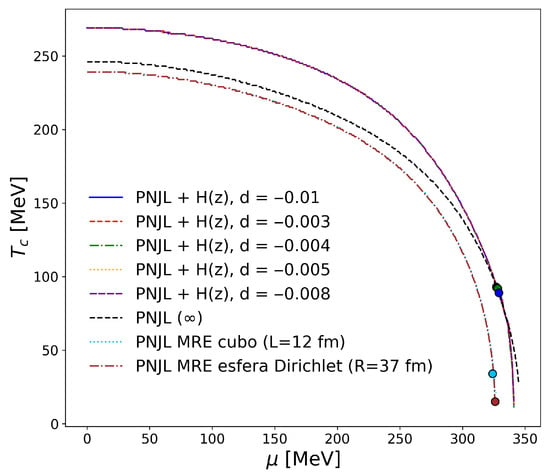
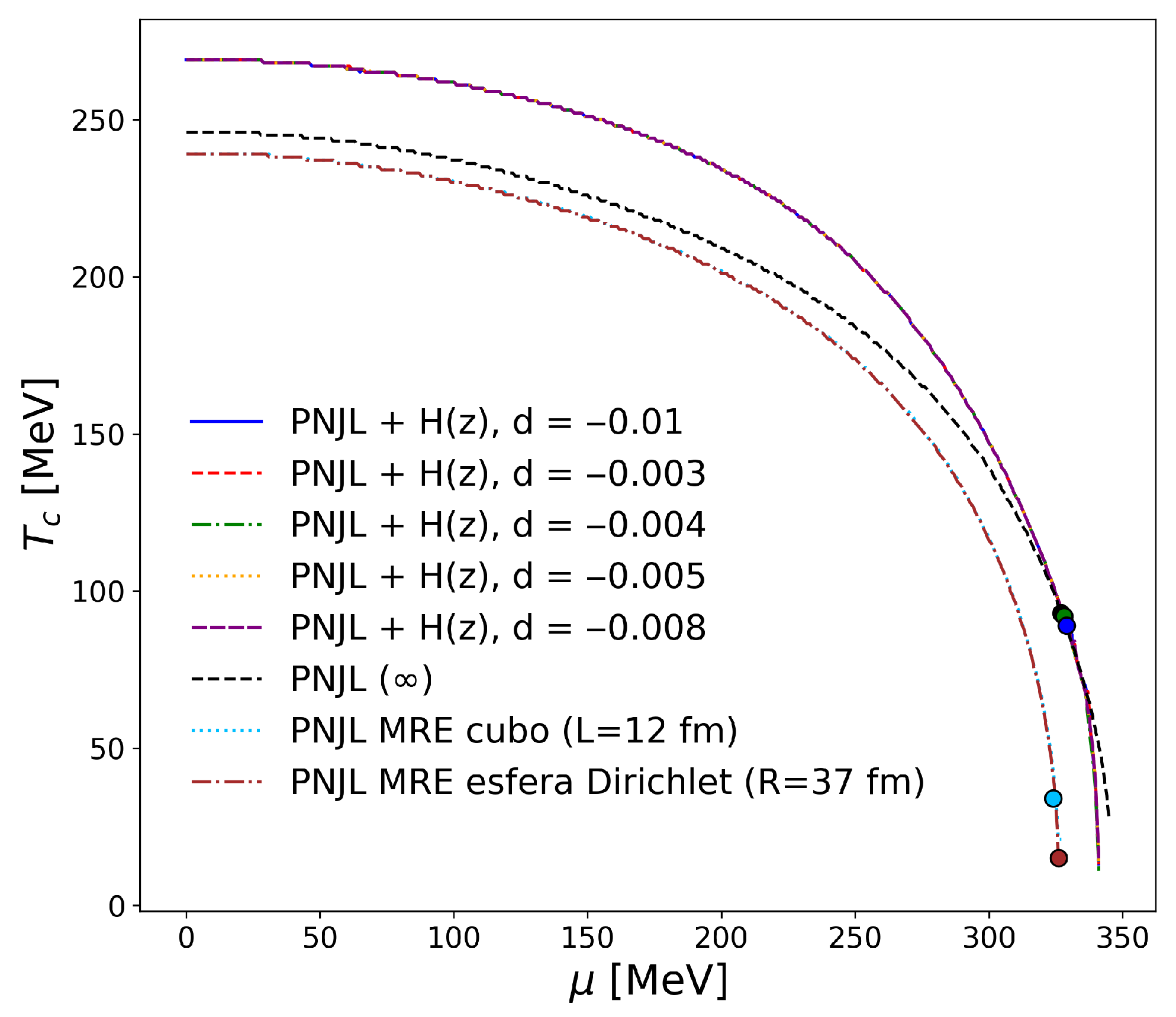
Then, taking the maximum value of the chiral susceptibility for each variation in the parameters of T and , the phase diagram is constructed (Figure 6). Table 4 summarizes the critical points for each modification, which should be interpreted as qualitative estimates obtained from the numerical diagnostic described above. As can be seen, the curve corresponding to the modified models with coupling is shifted toward higher temperatures and chemical potentials, indicating that more extreme conditions are required for symmetry restoration to occur. Despite the overall shift of the transition line in the plane, the location of the CEP for models that include the parameter appears to be surprisingly close to the value of the standard PNJL model. This suggests that, although the cosmological coupling acts as a stabilizing force that delays the restoration of chiral symmetry and deconfinement, it does not substantially alter the local curvature or the location of the critical point.
Figure 6.
Phase diagram in the – plane for different QCD effective models. The solid, dashed, and dash–dotted colored curves represent the confinement–deconfinement transition lines for the PNJL model with cosmological correction (for various values of d). The black curve corresponds to the standard PNJL model, while the cyan and brown curves represent the PNJL model with finite volume corrections using the MRE approximation for a cube () and a sphere with Dirichlet boundary conditions (), respectively. Critical end points (CEPs) for each configuration are indicated by colored markers.
Table 4.
Coordinates of the critical end point (CEP) for different variants of the PNJL model.
These results are consistent with our theoretical motivation behind the structure associated with . Recall that the function was constructed to enhance the cosmological influence in the confined phase () and suppress it in the deconfined phase (). As a result, we observe a significant shift in the phase boundary at low temperatures and chemical potentials, precisely where the vacuum structure of QCD predominates and the influence of cosmic expansion is expected to be strongest.
However, near the CEP, where the system approaches the deconfined regime, the coupling to becomes negligible. This provides a natural interpretation for why the critical endpoint remains close to that obtained in the standard PNJL model. This behavior suggests that the parameter associated with the cosmological expansion affects the dynamics of QCD, but has little impact in the high-energy perturbative regime.
Overall, the QCD results confirm that the cosmological coupling behaves as expected: it modifies the vacuum structure in the confined phase while leaving the high-temperature regime and the critical end point largely unchanged.
7. Conclusions and Discussions
In this work, we have explored a phenomenological extension of the PNJL model in which the Polyakov-loop potential is coupled to the cosmic expansion rate through a term of the form . This modification aims to capture the possibility that non-perturbative QCD vacuum effects in the confined phase may carry a residual imprint of the large-scale dynamics of the Universe. The construction preserves the thermodynamic consistency of the PNJL framework, requires only a single new exponent d, and is built to vanish naturally in the deconfined regime where . The introduction of the coupling term suppresses contributions in the deconfined regime and allows the model to effectively mimic the dark energy at late times without requiring it to be fundamental or constant. This may provide an alternative perspective on long-standing theoretical challenges, such as the cosmological constant problem [3,4,48], and aligns with recent observational tensions pointing toward deviations from a pure ΛCDM model, including those reported by [9,49,50] and other studies [15].
We have also shown how this coupling leads to an effective dynamical dark-energy contribution in the Friedmann equation, where the constant arises directly from the modified Polyakov potential. This establishes a clear and explicit connection between the QCD sector and the cosmological expansion. The resulting cosmology reduces to ΛCDM when , while allowing for a controlled deviation determined by the exponent d.
Using a combination of low-redshift datasets (cosmic chronometers, Type Ia supernovae, HII galaxies and quasars), we find that the observational constraints favor values of d that are statistically consistent with zero but still allow for small departures from the ΛCDM at the level. The reconstructed expansion history shows that the model behaves very similarly to a cosmological constant at present, while permitting mild quintessence- or phantom-like trends at intermediate redshifts. Cosmographic diagnostics confirm that these deviations remain small and compatible with current uncertainties.
The QCD sector exhibits behavior consistent with the expectations of effective models. The cosmological coupling slightly delays both chiral restoration and deconfinement transitions by stabilizing the confined vacuum, yet the overall structure of the crossover remains intact. Importantly, within the qualitative resolution of the present numerical analysis, the location of the critical end point remains close to that obtained in the standard PNJL model. This is a direct consequence of the suppression factor , which ensures that the coupling has negligible impact in the deconfined regime where the CEP resides.
From an observational point of view, the model performs comparably to the ΛCDM in fitting low-redshift observables (SNIa, CC), while introducing a physically motivated dynamical component that vanishes at early times. This behavior avoids potential tensions with Big Bang nucleosynthesis and the CMB, provided the function effectively suppresses early-time contributions. Additionally, an interesting behavior is observed in Figure 3, where a past Phantom behavior is subtly observed in CC constraints, having an interesting correlation with the recent results from the Dark Energy Spectroscopic Survey (DESI) collaboration [15]. Meanwhile, for the other constraints it is observed that quintessence behavior and a tendency to a cosmological constant at are expected; finally, a future () dominance of quintessence () is shown according to Figure 3. We also observe from the AIC and BIC results that the ΛCDM and QCD cosmology are equally supported for most of the datasets considered, with the exception of the single-SNIa sample, for which the BIC indicates strong statistical evidence against the QCD cosmological model. Furthermore, from the 2D contours of the fitted parameters (see Figure 1 and Table 1), we can observe that the constraints of the extra parameter d are in agreement with the case , in which the ΛCDM is recovered, suggesting that there is no positive evidence for this extended model for the present low-redshift data.
From a phenomenological standpoint, this framework offers a tractable path to bridge the non-perturbative QCD vacuum with cosmological dynamics. Future developments could investigate whether such coupling terms arise naturally from effective QCD theories in curved spacetime or from holographic QCD constructions adapted to expanding backgrounds. Additionally, lattice QCD simulations incorporating curvature or time-dependent metrics may provide insight into the behavior of confinement under cosmological conditions. Upcoming high-precision cosmological surveys, such as Euclid [51] and LSST [52], may also test the predictions of the model, particularly with regard to the evolution of the Hubble parameter and deviations from the ΛCDM at intermediate redshifts.
From a theoretical point of view, the coupling term is phenomenologically motivated. Although it preserves the dimensional structure of the Polyakov potential and aligns with the qualitative behavior expected in confined QCD phases, its origin from first-principles QCD or quantum field theory in curved spacetime remains to be developed. Possible directions include deriving the correction from the effective action of QCD in curved FLRW backgrounds or from holographic QCD models under cosmological conditions
Overall, the present work provides a consistent and observationally viable link between QCD confinement physics and the late-time acceleration of the Universe, offering a minimal and testable alternative to a fundamental cosmological constant.
Author Contributions
Conceptualization, J.R.S., H.M.-H., A.H., A.H.-A. and M.A.G.-A.; methodology, J.R.S., H.M.-H., A.H., A.H.-A. and M.A.G.-A.; software, J.R.S., H.M.-H., A.H., A.H.-A. and M.A.G.-A.; validation, J.R.S., H.M.-H., A.H., A.H.-A. and M.A.G.-A.; formal analysis, J.R.S., H.M.-H., A.H., A.H.-A. and M.A.G.-A.; investigation, J.R.S., H.M.-H., A.H., A.H.-A. and M.A.G.-A.; resources, J.R.S., H.M.-H., A.H., A.H.-A. and M.A.G.-A.; data curation, J.R.S., H.M.-H., A.H., A.H.-A. and M.A.G.-A.; writing—original draft preparation, J.R.S., H.M.-H., A.H., A.H.-A. and M.A.G.-A.; writing—review and editing, J.R.S., H.M.-H., A.H., A.H.-A. and M.A.G.-A.; visualization, J.R.S., H.M.-H., A.H., A.H.-A. and M.A.G.-A. All authors have read and agreed to the published version of the manuscript.
Funding
This research received no external funding.
Data Availability Statement
The original contributions presented in this study are included in the article.
Acknowledgments
We thank the anonymous referees for their thoughtful remarks and suggestions. We thank the support of José Rubén Morones Ibarra for the improvement of the paper. A.H.A. is grateful for the support from Luis Aguilar, Alejandro de León, Carlos Flores, and Jair García of the Laboratorio Nacional de Visualización Científica Avanzada. M.A.G.-A. acknowledges support from cátedra Marcos Moshinsky, SECIHTI for the support with the National Research System (SNII) grant and the project 0056 from Universidad Iberoamericana: Nuestro Universo en Aceleración, energía oscura o modificaciones a la relatividad general. The numerical analysis was also carried out by the Numerical Integration for Cosmological Theory and Experiments in High-energy Astrophysics (Nicte Ha) cluster at IBERO University, acquired through cátedra MM support. A.H.A. and M.A.G.-A. acknowledge partial support from project ANID Vinculación Internacional FOVI220144. H.M-H. acknowledges support from SECIHTI CBF2023-2024-1630.
Conflicts of Interest
The authors declare no conflicts of interest.
Abbreviations
The following abbreviations are used in this manuscript:
| GR | General Relativity |
| FLRW | Friedmann–Lemaître–Robertson–Walker |
| QCD | Quantum Chromodynamics |
| PNJL | Polyakov–Nambu–Jona-Lasinio |
| NJL | Nambu–Jona-Lasinio |
| CEP | Critical End Point |
| DM | Dark Matter |
| DE | Dark Energy |
| CMB | Cosmic Microwave Background |
| CCs | Cosmic Chronometers |
| SNIa | Type Ia Supernovae |
| HIIG | H ii Galaxies |
| QSO | Quasi-Stellar Object |
| MCMC | Markov Chain Monte Carlo |
| AIC | Akaike Information Criterion |
| BIC | Bayesian Information Criterion |
| MRE | Multiple Reflection Expansion |
| EoS | Equation of State |
Notes
| 1 | We henceforth use units in which . |
| 2 | The covariance matrix of the posterior distribution can be written as , where and denote the prior and likelihood covariance matrices, respectively. When the likelihood is weakly informative , one naturally obtains . |
References
- Riess, A.G.; Filippenko, A.V.; Challis, P.; Clocchiatti, A.; Diercks, A.; Garnavich, P.M.; Gillil, R.L.; Hogan, C.J.; Jha, S.; Kirshner, R.P.; et al. Observational Evidence from Supernovae for an Accelerating Universe and a Cosmological Constant. Astron. J. 1998, 116, 1009. [Google Scholar] [CrossRef] [Scilit]
- Perlmutter, S.; Aldering, G.; Goldhaber, G.; Knop, R.A.; Nugent, P.; Castro, P.G.; Deustua, S.; Fabbro, S.; Goobar, A.; Groom, D.E.; et al. Measurements of Ω and Λ from 42 High-Redshift Supernovae. Astrophys. J. 1999, 517, 565. [Google Scholar] [CrossRef] [Scilit]
- Zeldovich, Y.B. The cosmological constant and the theory of elementary particles. Sov. Phys. Uspekhi 1968, 11, 381. [Google Scholar] [CrossRef] [Scilit]
- Weinberg, S. The cosmological constant problem. Rev. Mod. Phys. 1989, 61, 1. [Google Scholar] [CrossRef] [Scilit]
- Alcántara-Pérez, Y.B.; García-Aspeitia, M.A.; Martínez-Huerta, H.; Hernández-Almada, A. MeV Dark Energy Emission from a De Sitter Universe. Universe 2023, 9, 513. [Google Scholar] [CrossRef] [Scilit]
- Li, X.; Shafieloo, A. Evidence for Emergent Dark Energy. Astrophys. J. 2020, 902, 58. [Google Scholar] [CrossRef] [Scilit]
- Koo, H.; Shafieloo, A.; Keeley, R.E.; L’Huillier, B. Model-independent Constraints on Type Ia Supernova Light-curve Hyperparameters and Reconstructions of the Expansion History of the Universe. Astrophys. J. 2020, 899, 9. [Google Scholar] [CrossRef] [Scilit]
- Hernández-Almada, A.; Mendoza-Martínez, M.L.; García-Aspeitia, M.A.; Motta, V. Phenomenological emergent dark energy in the light of DESI Data Release 1. Phys. Dark Univ. 2024, 46, 101668. [Google Scholar] [CrossRef] [Scilit]
- Hernández-Almada, A.; Leon, G.; Magaña, J.; García-Aspeitia, M.A.; Motta, V. Generalized Emergent Dark Energy: Observational Hubble data constraints and stability analysis. Mon. Not. Roy. Astron. Soc. 2020, 497, 1590–1602. [Google Scholar] [CrossRef] [Scilit]
- Barrow, J.D. The Area of a Rough Black Hole. Phys. Lett. B 2020, 808, 135643. [Google Scholar] [CrossRef] [Scilit]
- Abreu, E.M.C.; Ananias Neto, J. Black holes thermodynamics from a dual Kaniadakis entropy. Europhys. Lett. 2021, 133, 49001. [Google Scholar] [CrossRef] [Scilit]
- Esteban-Gutiérrez, A.; García-Aspeitia, M.A.; Hernández-Almada, A.; Magaña, J.; Motta, V. On a model of variable curvature that mimics the observed Universe acceleration. Phys. Dark Univ. 2025, 48, 101870. [Google Scholar] [CrossRef] [Scilit]
- Motta, V.; García-Aspeitia, M.A.; Hernández-Almada, A.; Magaña, J.; Verdugo, T. Taxonomy of Dark Energy Models. Universe 2021, 7, 163. [Google Scholar] [CrossRef] [Scilit]
- Di Valentino, E.; Said, J.L.; Riess, A.; Pollo, A.; Poulin, V.; Gómez-Valent, A.; Weltman, A.; Palmese, A.; Huang, C.D.; van de Bruck, C.; et al. The CosmoVerse White Paper: Addressing Observational Tensions in Cosmology with Systematics and Fundamental Physics. Phys. Dark Universe 2025, 49, 101965. [Google Scholar] [CrossRef] [Scilit]
- Abdul Karim, M.; Aguilar, J.; Ahlen, S.; Alam, S.; Allen, L.; Prieto, C.A.; Alves, O.; Anand, A.; Andrade, U.; Armengaud, E.; et al. DESI DR2 Results II: Measurements of Baryon Acoustic Oscillations and Cosmological Constraints. Phys. Rev. D 2025, 112, 083515. [Google Scholar] [CrossRef] [Scilit]
- Mukherjee, T.K.; Chen, H.; Huang, M. Chiral condensate and dressed Polyakov loop in the Nambu–Jona-Lasinio model. Phys. Rev. D 2010, 82, 034015. [Google Scholar] [CrossRef] [Scilit]
- Nishimura, H.; Ogilvie, M.C. Polyakov–Nambu–Jona-Lasinio model for adjoint fermions with periodic boundary conditions. Phys. Rev. D 2010, 81, 014018. [Google Scholar] [CrossRef] [Scilit]
- Fukushima, K. Chiral effective model with the Polyakov loop. Phys. Lett. B 2004, 591, 277–284. [Google Scholar] [CrossRef] [Scilit]
- Fukushima, K.; Skokov, V. Polyakov loop modeling for hot QCD. Prog. Part. Nucl. Phys. 2017, 96, 154–199. [Google Scholar] [CrossRef] [Scilit]
- Gattringer, C. Flux representation of an effective Polyakov loop model for QCD thermodynamics. Nucl. Phys. B 2011, 850, 242–252. [Google Scholar] [CrossRef] [Scilit]
- Holdom, B. From confinement to dark energy. Phys. Lett. B 2011, 697, 351–356. [Google Scholar] [CrossRef] [Scilit]
- Urban, F.R.; Zhitnitsky, A.R. The QCD nature of Dark Energy. Nucl. Phys. B 2010, 835, 135–173. [Google Scholar] [CrossRef] [Scilit]
- Ohta, N. Dark Energy and QCD Ghost. Phys. Lett. B 2011, 695, 41–44. [Google Scholar] [CrossRef] [Scilit]
- Ratti, C.; Thaler, M.A.; Weise, W. Phases of QCD: Lattice thermodynamics and a field theoretical model. Phys. Rev. D 2006, 73, 014019. [Google Scholar] [CrossRef] [Scilit]
- Abuki, H.; Anglani, R.; Gatto, R.; Nardulli, G.; Ruggieri, M. Chiral crossover, deconfinement, and quarkyonic matter within a Nambu–Jona-Lasinio model with the Polyakov loop. Phys. Rev. D 2008, 78, 034034. [Google Scholar] [CrossRef] [Scilit]
- Hansen, H.; Alberico, W.M.; Beraudo, A.; Molinari, A.; Nardi, M.; Ratti, C. Mesonic correlation functions at finite temperature and density in the PNJL model. Phys. Rev. D 2007, 75, 065004. [Google Scholar] [CrossRef] [Scilit]
- Ghosh, S.K.; Mukherjee, T.K.; Mustafa, M.G.; Ray, R. Susceptibilities and speed of sound from PNJL model. Phys. Rev. D 2006, 73, 114007. [Google Scholar] [CrossRef] [Scilit]
- Fukushima, K. Phase diagrams in the three-flavor Nambu–Jona-Lasinio model with the Polyakov loop. Phys. Rev. D 2008, 77, 114028. [Google Scholar] [CrossRef] [Scilit]
- Urban, F.R.; Zhitnitsky, A.R. The P-Odd Universe, Dark Energy and QCD. Phys. Rev. D 2011, 83, 123532. [Google Scholar] [CrossRef] [Scilit]
- Foreman-Mackey, D.; Hogg, D.W.; Lang, D.; Goodman, J. emcee: The MCMC Hammer. Publ. Astron. Soc. Pac. 2013, 125, 306–312. [Google Scholar] [CrossRef] [Scilit]
- Moresco, M.; Cimatti, A.; Jimenez, R.; Pozzetti, L.; Zamorani, G.; Bolzonella, M.; Dunlop, J.; Lamareille, F.; Mignoli, M.; Pearce, H.; et al. Improved constraints on the expansion rate of the Universe up to z ∼ 1.1 from the spectroscopic evolution of cosmic chronometers. J. Cosmol. Astropart. Phys. 2012, 2012, 6. [Google Scholar] [CrossRef] [Scilit]
- Moresco, M. Raising the bar: New constraints on the Hubble parameter with cosmic chronometers at z ∼ 2. Mon. Not. R. Astron. Soc. Lett. 2015, 450, L16–L20. [Google Scholar] [CrossRef] [Scilit]
- Moresco, M.; Pozzetti, L.; Cimatti, A.; Jimenez, R.; Maraston, C.; Verde, L.; Thomas, D.; Citro, A.; Tojeiro, R.; Wilkinson, D. A 6% measurement of the Hubble parameter at z ∼ 0.45: Direct evidence of the epoch of cosmic re-acceleration. J. Cosmol. Astropart. Phys. 2016, 2016, 14. [Google Scholar] [CrossRef] [Scilit]
- Moresco, M.; Jimenez, R.; Verde, L.; Cimatti, A.; Pozzetti, L. Setting the Stage for Cosmic Chronometers. II. Impact of Stellar Population Synthesis Models Systematics and Full Covariance Matrix. Astrophys. J. 2020, 898, 82. [Google Scholar] [CrossRef] [Scilit]
- Jiao, K.; Borghi, N.; Moresco, M.; Zhang, T.J. New Observational H(z) Data from Full-spectrum Fitting of Cosmic Chronometers in the LEGA-C Survey. Astrophys. J. Suppl. Ser. 2023, 265, 48. [Google Scholar] [CrossRef] [Scilit]
- Tomasetti, E.; Moresco, M.; Borghi, N.; Jiao, K.; Cimatti, A.; Pozzetti, L.; Carnall, A.C.; McLure, R.J.; Pentericci, L. A new measurement of the expansion history of the Universe at z = 1.26 with cosmic chronometers in VANDELS. Astron. Astrophys. 2023, 679, A96. [Google Scholar] [CrossRef] [Scilit]
- Scolnic, D.M.; Jones, D.O.; Rest, A.; Pan, Y.C.; Chornock, R.; Foley, R.J.; Huber, M.E.; Kessler, R.; Narayan, G.; Riess, A.G.; et al. The complete light-curve sample of spectroscopically confirmed SNe Ia from pan-STARRS1 and cosmological constraints from the combined pantheon sample. Astrophys. J. 2018, 859, 101. [Google Scholar]
- Brout, D.; Scolnic, D.; Popovic, B.; Riess, A.G.; Carr, A.; Zuntz, J.; Kessler, R.; Davis, T.M.; Hinton, S.; Jones, D.; et al. The Pantheon+ Analysis: Cosmological Constraints. Astrophys. J. 2022, 938, 110. [Google Scholar] [CrossRef] [Scilit]
- Conley, A.; Guy, J.; Sullivan, M.; Regnault, N.; Astier, P.; Balland, C.; Basa, S.; Carlberg, R.G.; Fouchez, D.; Hardin, D.; et al. Supernova constraints and systematic uncertainties from the first three years of the supernova legacy survey. Astrophys. J. Suppl. Ser. 2010, 192, 1. [Google Scholar] [CrossRef] [Scilit]
- González-Morán, A.L.; Chávez, R.; Terlevich, R.; Terlevich, E.; Bresolin, F.; Fernández-Arenas, D.; Plionis, M.; Basilakos, S.; Melnick, J.; Telles, E. Independent cosmological constraints from high-z H II galaxies. Mon. Not. R. Astron. Soc. 2019, 487, 4669–4694. [Google Scholar] [CrossRef] [Scilit]
- González-Morán, A.L.; Chávez, R.; Terlevich, E.; Terlevich, R.; Fernández-Arenas, D.; Bresolin, F.; Plionis, M.; Melnick, J.; Basilakos, S.; Telles, E. Independent cosmological constraints from high-z H ii galaxies: New results from VLT-KMOS data. Mon. Not. R. Astron. Soc. 2021, 505, 1441–1457. [Google Scholar] [CrossRef] [Scilit]
- Cao, S.; Zheng, X.; Biesiada, M.; Qi, J.; Chen, Y.; Zhu, Z.-H. Ultra-compact structure in intermediate-luminosity radio quasars: Building a sample of standard cosmological rulers and improving the dark energy constraints up to z 3. Astron. Astrophys. 2017, 606, A15. [Google Scholar] [CrossRef] [Scilit]
- Akaike, H. A new look at the statistical model identification. IEEE Trans. Autom. Control 1974, 19, 716–723. [Google Scholar] [CrossRef] [Scilit]
- Sugiura, N. Further analysts of the data by akaike’s information criterion and the finite corrections. Commun. Stat.-Theory Methods 1978, 7, 13–26. [Google Scholar] [CrossRef] [Scilit]
- Schwarz, G. Estimating the Dimension of a Model. Ann. Stat. 1978, 6, 461–464. [Google Scholar] [CrossRef] [Scilit]
- Saucedo, J.; Paz, A.; Flores-Baez, F.; Ibarra, J. Influence of the regularization scheme in the QCD phase diagram in the PNJL model. Open Phys. 2023, 21, 133. [Google Scholar] [CrossRef] [Scilit]
- Kiriyama, O.; Kodama, T.; Koide, T. Finite-size effects on the QCD phase diagram. arXiv 2006, arXiv:0602086. [Google Scholar] [CrossRef] [Scilit]
- Carroll, S.M. The Cosmological constant. Living Rev. Rel. 2001, 4, 1. [Google Scholar] [CrossRef] [Scilit]
- Zhao, G.B.; Raveri, M.; Pogosian, L.; Wang, Y.; Crittenden, R.G.; Handley, W.J.; Percival, W.J.; Beutler, F.; Brinkmann, J.; Chuang, C.; et al. Dynamical dark energy in light of the latest observations. Nat. Astron. 2017, 1, 627–632. [Google Scholar] [CrossRef] [Scilit]
- Di Valentino, E.; Anchordoqui, L.A.; Akarsu, O.; Ali-Haimoud, Y.; Amendola, L.; Arendse, N.; Asgari, M.; Ballardini, M.; Basilakos, S.; Battistelli, E.; et al. Snowmass2021—Letter of interest cosmology intertwined II: The hubble constant tension. Astropart. Phys. 2021, 131, 102605. [Google Scholar] [CrossRef] [Scilit]
- Amendola, L.; Appleby, S.; Avgoustidis, A.; Bacon, D.; Baker, T.; Baldi, M.; Bartolo, N.; Blanchard, A.; Bonvin, C.; Borgani, S.; et al. Cosmology and fundamental physics with the Euclid satellite. Living Rev. Rel. 2018, 21, 2. [Google Scholar] [CrossRef] [Scilit]
- Blum, B.; Digel, S.W.; Drlica-Wagner, A.; Habib, S.; Heitmann, K.; Ishak, M.; Jha, S.W.; Kahn, S.M.; Mandelbaum, R.; Marshall, P.; et al. Snowmass2021 Cosmic Frontier White Paper: Rubin Observatory after LSST. arXiv 2022, arXiv:2203.07220. [Google Scholar] [CrossRef] [Scilit]

Disclaimer/Publisher’s Note: The statements, opinions and data contained in all publications are solely those of the individual author(s) and contributor(s) and not of MDPI and/or the editor(s). MDPI and/or the editor(s) disclaim responsibility for any injury to people or property resulting from any ideas, methods, instructions or products referred to in the content. |
© 2026 by the authors. Licensee MDPI, Basel, Switzerland. This article is an open access article distributed under the terms and conditions of the Creative Commons Attribution (CC BY) license.