Communication

Radiative Corrections to the Nucleon Isovector gV and gA

1
Institute of Theoretical Physics, Chinese Academy of Sciences, Beijing 100190, China
2
School of Physical Sciences, University of Chinese Academy of Sciences, Beijing 100049, China
3
School of Fundamental Physics and Mathematical Sciences, Hangzhou Institute for Advanced Study, UCAS, Hangzhou 310024, China
4
International Centre for Theoretical Physics Asia-Pacific, Beijing 100190/Hangzhou 310024, China
*
Author to whom correspondence should be addressed.
Universe 2026, 12(4), 109; https://doi.org/10.3390/universe12040109
Submission received: 11 March 2026 / Revised: 2 April 2026 / Accepted: 8 April 2026 / Published: 9 April 2026
(This article belongs to the Special Issue Neutrino Oscillations and Interactions)

Abstract

Electroweak, QCD, and QED radiative corrections to the nucleon low-energy coupling constants g V and g A are enhanced by large perturbative logarithms between the electroweak and hadronic scale, as well as between the hadronic scale and the low-energy MeV scale. Additionally, higher-order pion-mass splitting corrections to the nucleon axial-vector charge might be large. By consistently incorporating these effects, we provide an updated relation between the lattice-QCD and physical g A , finding a total radiative correction of 3.5 ( 2.1 ) % ( 5.6 ( 0.7 ) % ). This leads to an expected lattice-QCD result of g A QCD = 1.265 ( 26 ) ( g A QCD = 1.240 ( 9 ) ) when based on a combination of lattice-QCD and data-driven (or only data-driven) inputs, respectively. Future phenomenological, chiral perturbation theory, and lattice-QCD studies can improve both the central value and the uncertainty of this estimate.

1. Introduction

Low-energy charged-current electroweak processes involving nucleons, such as neutron beta decay and inverse beta decay (antineutrino-proton scattering), are characterized by the Fermi coupling constant, the Cabibbo–Kobayashi–Maskawa matrix element V u d , and the nucleon isovector vector g V and axial-vector g A coupling constants. These processes are now measured with extraordinary precision, with state-of-the-art results provided by the UCN τ [1], PERKEO-III [2,3], and JUNO [4,5,6,7] collaborations. For example, the neutron lifetime is known at the 2 × 10 4 level [1], and reactor antineutrino experiments such as JUNO are providing increasingly precise data [4,7].
At this level of experimental accuracy, electroweak, quantum chromodynamics (QCD), and quantum electrodynamics (QED) radiative corrections become essential for extracting fundamental parameters from data [8,9,10,11]. The dominant theoretical uncertainty in these corrections originates from hadronic contributions, whose precise determination remains a central challenge in modern electroweak and hadronic physics [8,12,13,14,15,16,17,18,19,20,21]. Remarkably, first-principle lattice-QCD simulations are being used now to compute these hadronic effects [18,19], enabling, for instance, a determination of g V using only Standard Model inputs [8].
The next major milestone is the determination of g A from the first principles within the Standard Model. Achieving this goal requires precise relations that connect lattice-QCD quantities to their experimentally measured counterparts, which is a topic of active research [8,9,22,23]. A proposed relation based on the heavy-baryon chiral perturbation theory (HBChPT) [22] suggested that radiative corrections are dominated by leading order (LO) and next-to-leading order (NLO) HBChPT contributions. Subsequent analysis [9] expressed all LO and NLO HBChPT contributions in terms of matrix elements of quark currents, presented contributions from scales above the energy of hadronic physics, and discussed renormalization group evolution between the scale of hadronic physics and MeV energy. In this work, we improve Ref. [22] by including large logarithms and evaluating the unknown low-energy coupling constant. To account for all hadronic corrections, we add contributions from correlation functions involving three currents, as well as several unexplored two-current correlation functions, to the diagrammatic evaluation of the γ W box diagram [24].
In this communication, we numerically analyze large logarithms and hadronic contributions in radiative corrections to g A . We show that the dominant electroweak, QCD, and QED corrections to both g V and g A are governed by large perturbative logarithms, as well as leading and next-to-leading-order HBChPT contributions from Ref. [22]. To guide future Standard Model determinations of g A , we present an updated numerical evaluation of radiative corrections.

2. Materials and Methods

We begin our analysis of radiative corrections to g V and g A by identifying the leading contributions enhanced by large logarithms. The dominant part of these corrections arises from universal logarithms between the electroweak scale and hadronic scale, as well as between the hadronic scale and the characteristic MeV scale of experiment. In the leading-logarithm (LL) approximation, the corrections at the electron mass scale μ χ = m e are [8,9,12]1
δ g V LL μ χ = m e = δ g A LL μ χ = m e g A 0 = α π ln M Z μ 0 α S 4 π ln M W μ 0 + 3 4 ln μ 0 m e 2.36 ( 2 ) % ,
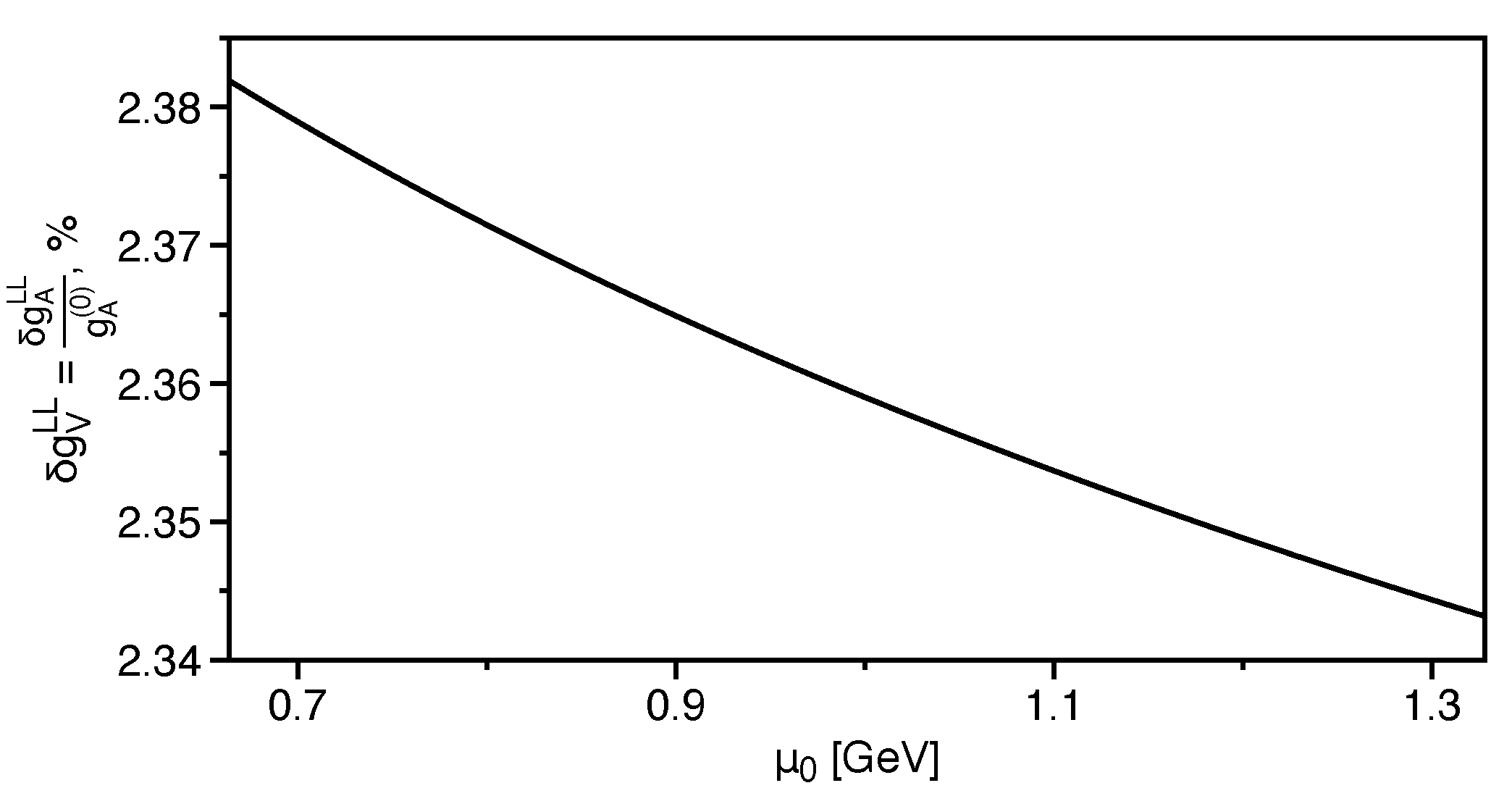
with the electromagnetic coupling constant α and the strong coupling constant α S . M W and M Z denote the electroweak-scale masses of the W and Z bosons, respectively. The hadronic scale is taken as μ 0 m N , with the nucleon mass m N , and g A 0 1.27 [22] denotes the axial-vector charge in the chiral limit without radiative corrections. To estimate the associated uncertainty, we vary μ 0 within the range m N 2 , 2 m N and show the dependence of these LL results on the hadronic scale μ 0 in Figure 1.
The full one-loop result for the radiative correction becomes independent of the scale μ 0 once the relevant hadronic contributions are taken into account. In the following, we illustrate this explicitly for the vector coupling constant. The one-loop result including the leading QCD logarithm δ g V 1 loop + LL is obtained by accounting for the constant term and hadronic corrections in Equation (1) as
δ g V 1 loop + LL μ χ = m e = α π ln M Z μ 0 α S 4 π ln M W μ 0 + 3 4 ln μ 0 m e 5 α 16 π e 2 i d 4 q 2 π 4 ν 2 + Q 2 Q 4 T ¯ 3 ( ν , Q 2 ) 2 m N ν ,
where we take the strong coupling constant α S at the electroweak matching scale. Here, Q 2 = q 2 denotes the virtuality and ν = v · q = q 0 is the energy transfer in the nucleon rest frame, with v = ( 1 , 0 , 0 , 0 ) . The invariant amplitude independent of the spin of the nucleon in the Compton scattering forward Compton scattering in the isoscalar channel T ¯ 3 is subtracted at large Q 2 using a μ 0 -dependent operator product expansion (OPE) term [8]:
T ¯ 3 ( ν , Q 2 ) = T 3 ( ν , Q 2 ) 4 3 m N ν Q 2 + μ 0 2 1 α S π .
The constant term 5 α 16 π yields 0.073 % , while the hadronic contribution for μ 0 = m N is evaluated as 0.156 ( 12 ) % [8,12,13,14,15,16,17]. The resulting correction to the vector coupling constant,
δ g V 1 loop + LL μ χ = m e = 2.444 ( 12 ) % ,
with an uncertainty estimate from the hadronic input but without perturbative errors, is independent of the hadronic scale μ 0 with a cancellation between logarithms in Equation (3) and the logarithm from the OPE term in T ¯ 3 . The resummation of leading logarithms and inclusion of next-to-leading logarithmic corrections according to Refs. [8,25] increases the radiative correction to the vector coupling constant by 0.055 % . Adding also the uncertainty estimate by varying the matching scales and the hadronic scale μ 0 , we obtain
δ g V μ χ = m e = 2.499 ( 13 ) % .
In complete analogy with Equation (3), the one-loop radiative correction to the axial-vector coupling constant, including the leading QCD logarithm, δ g A 1 loop + LL can be written as
δ g A 1 loop + LL μ χ = m e g A 0 = α π ln M Z μ 0 α S 4 π ln M W μ 0 + 3 4 ln μ 0 m e 5 α 16 π + δ g A extra g A 0
+ 2 e 2 g A 0 i d 4 q 2 π 4 ν 2 2 Q 2 3 Q 2 S ¯ 1 ( ν , Q 2 ) Q 2 ν 2 Q 2 S 2 ( ν , Q 2 ) m N ν ,
δ g A extra g A 0 = Δ g ¯ A QCD + QED λ γ , μ 0 g A 0 + e 2 i d 4 q ( 2 π ) 4 2 m ¯ t V P q , v t ¯ V A q , v q 2 λ γ 2 .
The OPE-subtracted nucleon spin-dependent forward Compton scattering invariant amplitudes in the isovector channel S ¯ 1 and S 2 yield a correction of 0.169 ( 6 ) % [24] for μ 0 = m N . The term δ g A extra , often omitted in precise evaluations [24], must be included for a complete result. Here, Δ g ¯ A QCD + QED λ γ , μ 0 is the OPE-subtracted QED radiative correction to the nucleon matrix element of the axial-vector quark current, evaluated in the Feynman gauge, ξ = 1 ,2 with infrared regularization by the photon mass λ γ . The integral of the second term in δ g A extra involves OPE-subtracted two-current correlation functions: vector-pseudoscalar t V P , with the isospin-averaged quark mass m ¯ , and vector–axial-vector t ¯ V A , that cancel both the infrared divergence and residual μ 0 dependence from Δ g ¯ A QCD + QED λ γ , μ 0 . The explicit definitions for hadronic objects t V P and t ¯ V A are presented in Ref. [9]. In this work, we provide the first numerical estimates of the term δ g A extra .
The term δ g A extra can be evaluated solely in lattice QCD. However, it is instructive to discuss dominant contributions to this object. First, the leading contributions in δ g A extra from one-pion intermediate states together with a corresponding dependence on the nucleon isovector magnetic moment, cancel exactly between two terms in δ g A extra [9]. Two-pion intermediate states generate a large logarithm as well as the next-to-leading order contribution, expressed in terms of the NLO HBChPT low-energy coupling constants (LECs) c 3 and c 4 , as
δ g A extra g A 0 Z π 1 + 3 g A 0 2 2 α π ln m N m π + 2 α Z π m π c 4 c 3 + 3 8 m N + 9 16 g A 0 2 m N + δ g A extra , N g A 0 + δ g A extra , inel g A 0 2.9 ( 0.3 ) % , c 4 N 3 LO c 3 N 3 LO 2.2 ( 0.2 ) % , c 4 NLO c 3 NLO 1.6 ( 0.1 ) % , c 4 Born c 3 Born 0.7 ( 2.1 ) % , 2 c 4 c 3 LQCD c 4 N 3 LO + δ g A extra , N g A 0 + δ g A extra , inel g A 0 ,
where we have chosen the nucleon mass as the ultraviolet cutoff in the logarithmic term, and m π denotes the pion mass. The uncertainty is estimated by adding, in quadrature, the power-counting uncertainty of the NLO contribution to the uncertainty on the coupling constant c 4 c 3 . The parameter Z π 0.81 is the QED isospin-breaking LEC responsible for the electromagnetic pion-mass splitting.
The NLO HBChPT LECs c 3 and c 4 enter the second term. Phenomenological determinations from π N scattering data [26,27] provide the following values (errors added in quadrature):
c 3 NLO = 3.61 ( 5 ) GeV 1 , c 4 NLO = 2.17 ( 3 ) GeV 1 , c 4 NLO c 3 NLO = 5.78 ( 6 ) GeV 1 ,
c 3 N 3 LO = 5.61 ( 6 ) GeV 1 , c 4 N 3 LO = 4.26 ( 4 ) GeV 1 , c 4 N 3 LO c 3 N 3 LO = 9.87 ( 7 ) GeV 1 .
The fit results change significantly going from NLO to N2LO but stabilize at N3LO [26,27]. Since our calculation is performed at NLO in HBChPT, we estimate the systematic uncertainty from the difference between the NLO and the more complete N3LO values (rather than using N2LO). The combination 2 c 4 NLO c 3 NLO = 7.95 ( 8 ) GeV 1 ( 2 c 4 N 3 LO c 3 N 3 LO = 14.13 ( 0.10 ) GeV 1 ) can also be extracted from the m π 3 dependence of the nucleon axial-vector charge g A . However, a recent lattice-QCD calculation [28] gives a value an order of magnitude smaller 2 c 4 c 3 LQCD = 0.85 ( 0.25 ) GeV 1 . Using this lattice-QCD result together with the phenomenological extraction of c 3 or c 4 as an input, we obtain the relevant combination of LECs c 4 c 3 = 2 c 4 c 3 LQCD c 4 NLO = 1.32 ( 0.25 ) GeV 1 and c 4 c 3 = 2 c 4 c 3 LQCD c 4 N 3 LO = 3.41 ( 0.25 ) GeV 1 . For the central value of the QED correction with lattice-QCD input 2 c 4 c 3 LQCD , we adopt the LEC c 4 N 3 LO : c 4 c 3 = 2 c 4 c 3 LQCD c 4 N 3 LO = 3.4 ( 13.3 ) GeV 1 , and assign a systematic uncertainty by taking the difference with the value obtained from the largest alternative combination, resulting in the largest error estimate in our evaluations. We also apply, for the first time, the Born approximation with only the nucleon intermediate state to determine the NLO HBChPT LECs from the expressions in Appendix D of Ref. [9]. We then evaluate the LECs of interest as3
c 3 Born = g A 0 2 4 m N 3 2 + g A 0 2 g A 0 2 π m π 4 π F π 2 = 1.2 ( 0.4 ) GeV 1 ,
c 4 Born = g A 0 2 4 m N + 1 + g A 0 2 g A 0 2 π m π 4 π F π 2 = 0.9 ( 0.2 ) GeV 1 ,
with the pion decay constant F π 92.4 MeV , and estimate the error as the nucleon-state contribution to these LECs. The Born result for 2 c 4 Born c 3 Born = 3.0 ( 0.8 ) GeV 1 is also in tension both with lattice QCD [28] and fits to the experimental data [26,27]. Thus, it is worthwhile to explore whether additional combinations of c 3 and c 4 can be constrained using the light-quark mass dependence of isoscalar nucleon charges, such as isoscalar scalar charge, as well as to determine c 3 and c 4 directly from nucleon matrix elements as described in Appendix D of Ref. [9]. Isovector charges have been precisely determined from lattice QCD in Ref. [29]. Moreover, a lattice-QCD determination of δ g A extra would directly constrain the low-energy coupling constant c 4 c 3 and clarify the HBChPT convergence pattern.
For estimating the size of hadronic corrections, we separate the Born contribution from nucleon states, δ g A extra , N , in Equation (10), and indicate inelastic contributions as δ g A extra , inel . According to evaluations of typical hadronic objects in Refs. [8,30,31,32,33], the nucleon intermediate state contribution is either dominant or has a comparable size to inelastic excitations. We get 0.0127 ( 2 ) % and 0.222 ( 3 ) % for the nucleon-state contribution to two terms in δ g A extra of Equation (8), respectively. We describe the details of this calculation in Appendix A and investigate Ward identities for the nucleon state by evaluating hadronic objects from an alternative decomposition of radiative corrections in Appendix B.
Accounting for the constant term and the hadronic contribution from the second line of Equation (7), we obtain the one-loop radiative correction, including the leading QCD logarithm, to the axial-vector coupling constant δ g A 1 loop + LL ,
δ g A 1 loop + LL μ χ = m e g A 0 = 2.457 ( 6 ) % + δ g A extra g A 0 = 5.5 ( 0.7 ) % , c 4 N 3 LO c 3 N 3 LO 4.9 ( 0.7 ) % , c 4 NLO c 3 NLO 4.3 ( 0.4 ) % , c 4 Born c 3 Born 3.4 ( 2.1 ) % , 2 c 4 c 3 LQCD c 4 N 3 LO .
For the uncertainty estimate in the first two lines (the third line), we add 0.2 % uncertainty from the variation of the hadronic scale under the logarithm in Equation (10) to 0.7 % difference between results with NLO and N3LO couplings ( 0.1 % from the nucleon-state contribution in c 4 Born c 3 Born ) and to 0.3 % difference in the evaluation of the nucleon intermediate state contribution between Appendix A and Appendix B in quadrature, respectively. Compared to previous estimates [24], this analysis consistently incorporates the large logarithmic enhancements at the one-loop level, explicitly accounts for contributions from all two- and three-current correlation functions, and includes the associated uncertainty.
As in the case of the vector coupling constant, we further include the next-to-leading logarithmic corrections and resummation, and obtain4
δ g A μ χ = m e g A 0 = 2.513 ( 8 ) % + δ g A extra g A 0 = 5.6 ( 0.7 ) % , c 4 N 3 LO c 3 N 3 LO 5.0 ( 0.7 ) % , c 4 NLO c 3 NLO 4.4 ( 0.4 ) % , c 4 Born c 3 Born 3.5 ( 2.1 ) % , 2 c 4 c 3 LQCD c 4 N 3 LO .

3. Results and Discussion

It is instructive to separate the contributions from the uncertain c 4 c 3 , the remaining uncertain hadronic corrections, and the precisely calculable perturbative contribution. The resulting radiative correction can be decomposed into three terms:
g A g A QCD g V 1 = 0.033 ( 15 ) % + 2 α Z π m π ( c 4 c 3 ) + δ g A had g A QCD g V ,
where g A QCD denotes the axial-vector charge in the isospin limit. The first term contains the difference of γ W box contributions to g A and g V , as well as higher-order remnants.5 The second term depends on the combination c 4 c 3 of the NLO HBChPT LECs c 3 and c 4 . This term has a sizable uncertainty as discussed in the previous section, with the coefficient 2 α Z π m π = 0.16 ( 2 ) GeV and an uncertainty estimate from the HBChPT power counting. The third term represents the hadronic contributions δ g A extra but explicitly removes the dependence on c 4 c 3 ,
δ g A had g A QCD g V = δ g A extra g A QCD g V 2 α Z π m π c 4 c 3 1.5 ( 0.4 ) % .
The corresponding uncertainty is given by 0.3 % difference in the evaluation of the nucleon intermediate state contribution between Appendix A and Appendix B and 0.2 % uncertainty from the variation of the hadronic scale under the logarithm in Equation (10) added in quadrature. The correction in Equation (18) does not depend on the scale and is free from large logarithms of Equation (1).
For various c 4 c 3 inputs considered above, we obtain
g A g A QCD g V 1 = 3.0 ( 0.7 ) % , c 4 N 3 LO c 3 N 3 LO 2.3 ( 0.7 ) % , c 4 NLO c 3 NLO 1.8 ( 0.4 ) % , c 4 Born c 3 Born 0.8 ( 2.1 ) % , 2 c 4 c 3 LQCD c 4 N 3 LO .
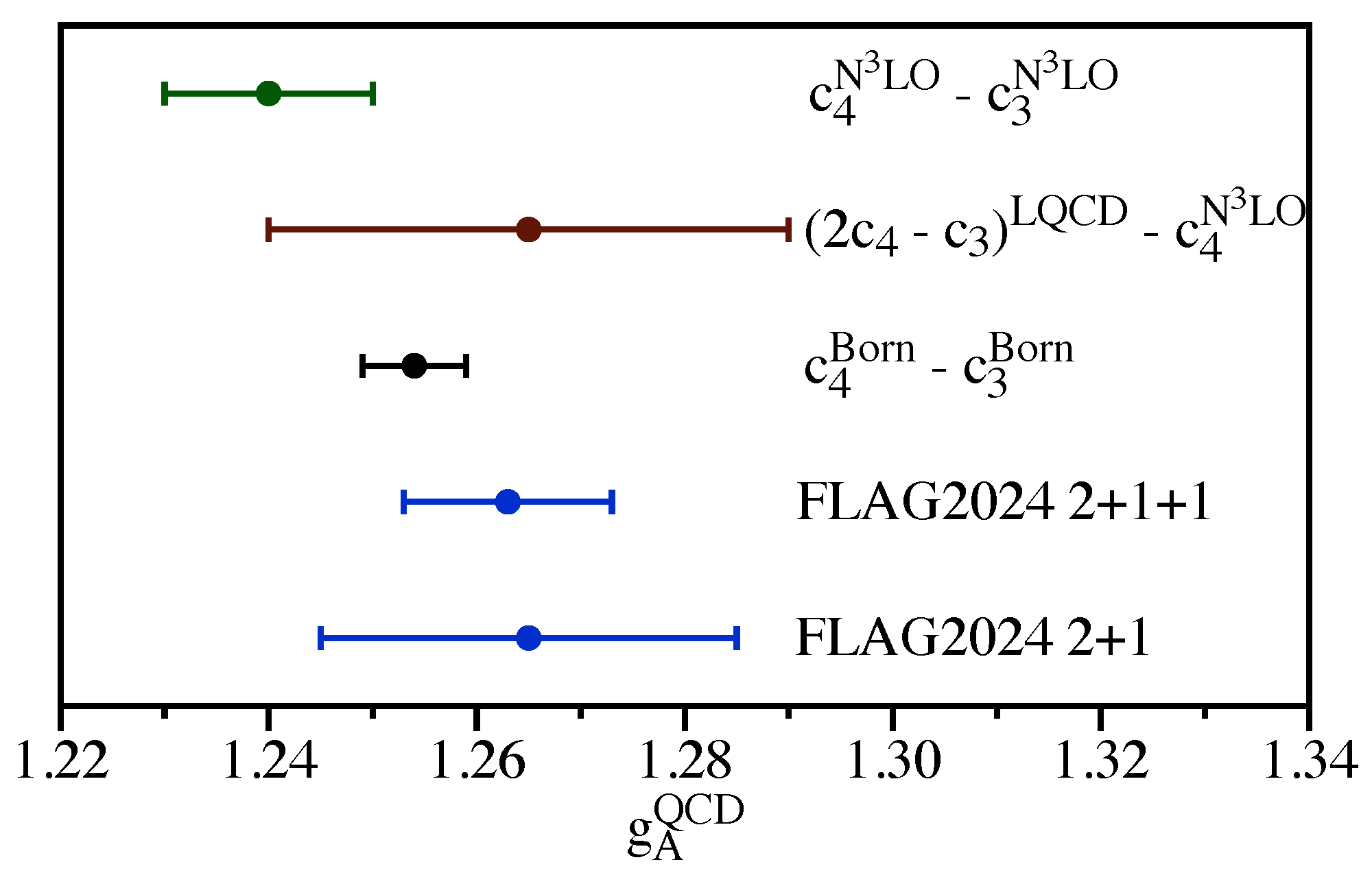
As our final result for relating lattice-QCD determinations to experimental measurements, we quote Equation (20). Based on the current experimental value of the axial-vector to vector coupling constant ratio g A g V = 1.2753 ( 13 ) [36] and N3LO LECs [26,27], we expect the lattice-QCD result for the axial-vector charge g A QCD = 1.240 ( 9 ) . Exploiting the strong lattice-QCD constraint on NLO HBChPT LECs and estimating the systematic uncertainty by taking the largest difference between alternative inputs, we get g A QCD = 1.265 ( 26 ) .
We present our results for the nucleon axial-vector charge in Figure 2 and compare them to the Flavour Lattice Averaging Group (FLAG) average of lattice-QCD calculations [37,38,39,40,41,42,43,44,45,46,47,48,49,50,51], which itself comprises data from both 2 + 1 + 1 and 2 + 1 flavour simulations distinguishing between calculations with and without a dynamical charm quark in the sea. We find a tension between our result based on N3LO fits for the coupling constants c 3 and c 4 and modern lattice-QCD determinations. Including the lattice-QCD constraint on 2 c 4 c 3 [28] and inflating the error bars or estimating the LECs c 3 and c 4 within the Born approximation removes the tension. This situation underscores the need for a direct lattice-QCD determination of the hadronic QED corrections to g A and/or for improved lattice-QCD constraints on the next-to-leading-order HBChPT low-energy coupling constants c 3 and c 4 , as well as for improvements in phenomenological and ChPT analyses.

Author Contributions

Conceptualization, O.T. and Y.-B.Y.; Methodology, O.T.; Validation, O.T. and Y.-B.Y.; Formal analysis, O.T.; Investigation, O.T.; Resources, O.T.; Data curation, O.T. and Y.-B.Y.; Writing—original draft, O.T.; Writing—review and editing, O.T. and Y.-B.Y.; Visualization, O.T. and Y.-B.Y.; Supervision, Y.-B.Y.; Project administration, O.T.; Funding acquisition, O.T. and Y.-B.Y. All authors have read and agreed to the published version of the manuscript.

Funding

This research was funded by the National Science Foundation of China under Grants No. 12347105, 12525504, 12293060, 12293062, and 12447101.

Data Availability Statement

No new data were created or analyzed in this study.

Acknowledgments

Wolfram Mathematica 12.0 [52] and DataGraph 5.5 [53] were extremely useful in this work.

Conflicts of Interest

The authors declare no conflicts of interest.

Abbreviations

The following abbreviations are used in this manuscript:
FLAGFlavour Lattice Averaging Group
HBChPTHeavy Baryon Chiral Perturbation Theory
LECLow-Energy Coupling Constant
LLLeading Logarithm
LOLeading Order
LQCDLattice Quantum Chromodynamics
NLONext-to-Leading Order
MeVMegaelectronVolt
OPEOperator Product Expansion
QCDQuantum Chromodynamics
QEDQuantum Electrodynamics

Appendix A. Nucleon-State Contribution to δ g A extra

In this Appendix, we present the evaluation of the nucleon-state contribution δ g A extra , N to δ g A extra in Equation (8):
δ g A extra g A 0 = e 2 m ¯ b ρ b λ g A 0 i d 4 q ( 2 π ) 4 g μ ν t ¯ A V V μ ν λ ρ q , v + t ¯ A V V , 0 μ ν λ ρ q , v q 2 λ γ 2 + 2 i π δ v · r Δ em m N | r λ = 0 + e 2 i d 4 q ( 2 π ) 4 2 m ¯ t V P q , v t ¯ V A q , v q 2 λ γ 2 ,
with the momentum insertion in the axial-vector current r λ , an arbitrary vector b: b 2 = 1 , b · v = 0 , and the nucleon electromagnetic correction to the isospin-averaged nucleon mass,
Δ em m N = e 2 2 d 4 q ( 2 π ) 4 g μ ν τ V V μ ν q , v + τ V V , 0 μ ν q , v q 2 .
The pure imaginary term 2 i π δ v · r Δ em m N cancels the nucleon pole singularity from t A V V . The hadronic objects t A V V ( τ V V ) are defined in terms of the axial-vector quark bilinear and two vector currents (two vector currents) in Ref. [9].
We describe the evaluation of Δ g ¯ A QCD + QED in Appendix A.1, while the contribution from the nucleon two-current correlation function 2 m ¯ t V P t ¯ V A is presented in Appendix A.2.

Appendix A.1. Contribution from Three-Current Correlation Functions

The nucleon-state contribution from three-current correlation functions in Equation (A1) can be expressed as
α 8 π d Q 2 β m N 2 1 2 β 3 + β 4 1 + β F 1 p F 1 n + 1 β 1 + β 1 + β 2 F 1 p F 2 n + F 1 n F 2 p + 1 + β + β 3 1 + β 2 F 2 p F 2 n = 0.0127 ( 2 ) % ,
with the dimensionless parameter β = 1 + 4 m N 2 Q 2 , exploiting the standard notations for nucleon form factors and fits to the experimental data from Ref. [54].

Appendix A.2. Contribution from Two-Current Correlation Functions

We express the contribution from t ¯ V A in terms of the nucleon form factors as
e 2 i d 4 q ( 2 π ) 4 t ¯ V A q , v q 2 α 12 π d Q 2 m N 2 1 β 1 + β β + 1 2 G M V F A g A 0 = 0.144 ( 3 ) % ,
exploiting the nucleon axial-vector form factor from Refs. [55,56].
Corrections from the integral of t V P beyond the leading pion-pole contribution t V P 1 π are chirally suppressed [9], i.e.,
e 2 i d 4 q ( 2 π ) 4 2 m ¯ t V P q , v t V P 1 π q , v q 2 λ γ 2 = α π O m π 2 m N 2 , m π 2 4 π F π 2 0.006 % .
It is instructive to analyze also the expression in terms of the nucleon form factors for the nucleon-state contribution from t V P ,
e 2 i d 4 q ( 2 π ) 4 2 m ¯ t V P q , v q 2 λ γ 2 α 4 π d Q 2 Q 2 1 β 1 + β F 1 V + 5 + 4 β 3 1 + β 2 F 2 V F A Q 2 2 m N 2 F P g A 0 .
The F 2 V term yields 0.046 % . The leading pion-pole contribution t V P 1 π is included as a part of the nucleon form factors. Subtracting it from Equation (A6), we obtain the finite nucleon-state contribution from t V P : 0.078 % .

Appendix B. Alternative Decomposition and Ward Identities

In this Appendix, we present the evaluation of the nucleon-state contribution δ g A extra , N to δ g A extra expressed in terms of alternative hadronic objects as
δ g A extra g A 0 = e 2 i d 4 q ( 2 π ) 4 2 m ¯ t V P q , v q 2 λ γ 2 + Δ em m N m N α 8 π + e 2 m ¯ b ρ b λ g A 0 r λ i d 4 q ( 2 π ) 4 g μ ν t P V V μ ν ρ r , q , v + t P V V , 0 μ ν ρ r , q , v q 2 λ γ 2 + 2 i π δ v · r Δ em m N | r λ = 0 ,
with the momentum insertion in the pseudoscalar density r λ . The hadronic objects t P V V are defined in terms of the pseudoscalar quark bilinear and two vector currents in Ref. [9].
We describe the evaluation of the integral from the nucleon three-current correlation functions in Appendix B.1, while the contribution from the nucleon two-current correlation functions is presented in Appendix B.2. In Appendix B.3, we compare the results from Appendix A and Appendix B.

Appendix B.1. Contribution from Three-Current Correlation Functions

The nucleon-state contribution from three-current correlation functions in Equation (A7) can be expressed as
α 8 π d Q 2 β m N 2 1 β 1 + β 1 β 1 + β 2 F 1 p F 1 n + 1 β 3 2 β 2 F 1 p F 2 n + F 1 n F 2 p 1 + 2 β F 2 p F 2 n = 0.1558 ( 5 ) % .

Appendix B.2. Contribution from Two-Current Correlation Functions

Corrections from t V P are described in Appendix A.2, while additional two-current corrections correspond to the relative Born contribution to the isospin-averaged nucleon mass. We update the value according to Ref. [33] 0.017 ( 1 ) % with a new result 0.0166 ( 2 ) % that accounts for recent progress in extracting the nucleon vector form factors [54].

Appendix B.3. Discussion of Ward Identities

After adding the nucleon-state contribution of Equation (A8) and the constant term in Equation (A7) to the nucleon-state terms in the isospin-averaged nucleon mass shift, the difference to Equation (A1) is 0.30 % that is an expected order of magnitude for inelastic contributions. We exploit this number for uncertainty estimates.

Notes

1
We exploit the dimensional regularization in d = 4 2 ε dimensions with the chiral version of modified minimal subtraction scheme subtracting
1 ε γ E + ln 4 π + 1 .
2
An extra term has to be added to relate Δ g ¯ A QCD + QED λ γ , μ 0 to the OPE-subtracted QED radiative correction in an arbitrary R ξ gauge Δ g ¯ A QCD + QED ξ , λ γ , μ 0 ,
Δ g ¯ A QCD + QED λ γ , μ 0 g A 0 = Δ g ¯ A QCD + QED ξ , λ γ , μ 0 g A 0 + 1 ξ 2 α π ln λ γ 2 μ 0 2 + a ξ ln a ξ 1 a ξ ,
with the arbitrary parameter a that enters the gauge-dependent piece of the photon propagator as 1 / q 2 a ξ λ γ 2 .
3
The other NLO HBChPT LECs are c 2 Born = 3 8 g A 0 2 m N + π m π 4 π F π 2 = 0.3 ( 0.1 ) and κ 1 Born = m N π m π 4 π F π 2 = 1.9 ( 0.3 ) . Exploiting the constraint on the nucleon isovector magnetic moment κ 1 , the Wilson coefficient c 4 can be estimated as c 4 = κ 1 4 m N g A 0 2 4 m N + g A 0 4 π m π 4 π F π 2 = 1.4 ( 0.4 ) GeV 1 validating our uncertainty estimate.
4
For reference, we also present the correction δ g A at the chiral scale of the nucleon mass
δ g A μ χ = m N g A 0 = 4.2 ( 0.7 ) % , c 4 N 3 LO c 3 N 3 LO 3.6 ( 0.7 ) % , c 4 NLO c 3 NLO 3.0 ( 0.4 ) % , c 4 Born c 3 Born 2.1 ( 2.1 ) % , 2 c 4 c 3 LQCD c 4 N 3 LO .
5
Explicitly, these remnants are δ g A δ g A extra g A 0 g V g A 0 g A QCD 1 = 0.110 % , where we take the HBChPT input from Refs. [34,35], δ g A δ g A extra g V 1 g A 0 1 g V 1 < 0.0004 % , and 1 C β r g V C β r δ g A g A 0 g A QCD 1 = 0.058 0.075 % for a range of values δ g A extra in this work. C β r = 1 + O α is the semileptonic Wilson coefficient in the low-energy effective field theory of quarks and leptons, evaluated at the GeV renormalization scale.

References

  1. Gonzalez, F.M. et al. [UCNτ Collaboration]. Improved neutron lifetime measurement with UCNτ. Phys. Rev. Lett. 2021, 127, 162501. [Google Scholar] [CrossRef] [PubMed]
  2. Märkisch, B.; Mest, H.; Saul, H.; Wang, X.; Abele, H.; Dubbers, D.; Klopf, M.; Petoukhov, A.; Roick, C.; Soldner, T.; et al. Measurement of the weak axial-vector coupling constant in the decay of free neutrons using a pulsed cold neutron beam. Phys. Rev. Lett. 2019, 122, 242501. [Google Scholar] [CrossRef] [PubMed]
  3. Dubbers, D.; Saul, H.; Märkisch, B.; Soldner, T.; Abele, H. Exotic decay channels are not the cause of the neutron lifetime anomaly. Phys. Lett. B 2019, 791, 6–10. [Google Scholar] [CrossRef]
  4. An, F. et al. [JUNO Collaboration]. Neutrino physics with JUNO. J. Phys. G 2016, 43, 030401. [Google Scholar]
  5. Abusleme, A. et al. [JUNO Collaboration]. JUNO physics and detector. Prog. Part. Nucl. Phys. 2022, 123, 103927. [Google Scholar]
  6. Abusleme, A. et al. [JUNO Collaboration]. Sub-percent precision measurement of neutrino oscillation parameters with JUNO. Chin. Phys. C 2022, 46, 123001. [Google Scholar] [CrossRef]
  7. Abusleme, A. et al. [JUNO Collaboration]. First measurement of reactor neutrino oscillations at JUNO. arXiv 2025, arXiv:2511.14593. [Google Scholar]
  8. Cirigliano, V.; Dekens, W.; Mereghetti, E.; Tomalak, O. Effective field theory for radiative corrections to charged-current processes: Vector coupling. Phys. Rev. D 2023, 108, 053003. [Google Scholar] [CrossRef]
  9. Cirigliano, V.; Dekens, W.; Mereghetti, E.; Tomalak, O. Effective field theory for radiative corrections to charged-current processes. II. Axial-vector coupling. Phys. Rev. D 2025, 111, 053005. [Google Scholar]
  10. Tomalak, O. Theory of inverse beta decay for reactor antineutrinos. arXiv 2025, arXiv:2512.07956. [Google Scholar] [CrossRef]
  11. Tomalak, O. On radiative corrections to inverse beta decay at low energies. arXiv 2025, arXiv:2512.07957. [Google Scholar] [CrossRef]
  12. Marciano, W.J.; Sirlin, A. Improved calculation of electroweak radiative corrections and the value of Vud. Phys. Rev. Lett. 2006, 96, 032002. [Google Scholar] [CrossRef] [PubMed]
  13. Seng, C.-Y.; Gorchtein, M.; Ramsey-Musolf, M.J. Dispersive evaluation of the inner radiative correction in neutron and nuclear β decay. Phys. Rev. D 2019, 100, 013001. [Google Scholar] [CrossRef]
  14. Seng, C.-Y.; Gorchtein, M.; Patel, H.H.; Ramsey-Musolf, M.J. Reduced hadronic uncertainty in the determination of Vud. Phys. Rev. Lett. 2018, 121, 241804. [Google Scholar] [CrossRef] [PubMed]
  15. Czarnecki, A.; Marciano, W.J.; Sirlin, A. Radiative corrections to neutron and nuclear beta decays revisited. Phys. Rev. D 2019, 100, 073008. [Google Scholar] [CrossRef]
  16. Hayen, L. Standard model O (α) renormalization of gA and its impact on new physics searches. Phys. Rev. D 2021, 103, 113001. [Google Scholar] [CrossRef]
  17. Shiells, K.; Blunden, P.G.; Melnitchouk, W. Electroweak axial structure functions and improved extraction of the Vud CKM matrix element. Phys. Rev. D 2021, 104, 033003. [Google Scholar] [CrossRef]
  18. Feng, X.; Gorchtein, M.; Jin, L.-C.; Ma, P.-X.; Seng, C.-Y. First-principles calculation of electroweak box diagrams from lattice QCD. Phys. Rev. Lett. 2020, 124, 192002. [Google Scholar] [CrossRef]
  19. Ma, P.-X.; Feng, X.; Gorchtein, M.; Jin, L.-C.; Liu, K.-F.; Seng, C.-Y.; Wang, B.-G.; Zhang, Z.-L. Lattice QCD calculation of electroweak box contributions to superallowed nuclear and neutron beta decays. Phys. Rev. Lett. 2024, 132, 191901. [Google Scholar] [CrossRef]
  20. Crosas, Ó.L.; Mereghetti, E. Radiative corrections to superallowed beta decays at O (α2Z). J. High Energy Phys. 2026, 2, 114. [Google Scholar] [CrossRef]
  21. Cao, Z.; Hill, R.J.; Plestid, R.; Vander Griend, P. The 2 correction to superallowed beta decays in effective field theory and implications for |Vud|. arXiv 2025, arXiv:2511.05446. [Google Scholar]
  22. Cirigliano, V.; de Vries, J.; Hayen, L.; Mereghetti, E.; Walker-Loud, A. Pion-induced radiative corrections to neutron β decay. Phys. Rev. Lett. 2022, 129, 121801. [Google Scholar] [CrossRef]
  23. Seng, C.-Y. Hybrid analysis of radiative corrections to neutron decay with current algebra and effective field theory. J. High Energy Phys. 2024, 7, 175. [Google Scholar] [CrossRef]
  24. Gorchtein, M.; Seng, C.-Y. Dispersion relation analysis of the radiative corrections to gA in neutron β decay. J. High Energy Phys. 2021, 10, 053. [Google Scholar] [CrossRef]
  25. Hill, R.J.; Tomalak, O. On the effective theory of neutrino-electron and neutrino-quark interactions. Phys. Lett. B 2020, 805, 135466. [Google Scholar] [CrossRef]
  26. Hoferichter, M.; Ruiz de Elvira, J.; Kubis, B.; Meissner, U. Matching pion-nucleon Roy-Steiner equations to chiral perturbation theory. Phys. Rev. Lett. 2015, 115, 192301. [Google Scholar] [CrossRef]
  27. Hoferichter, M.; Ruiz de Elvira, J.; Kubis, B.; Meissner, U. Roy–Steiner-equation analysis of pion–nucleon scattering. Phys. Rep. 2016, 625, 1–88. [Google Scholar]
  28. Hall, Z.B.; Pefkou, D.A.; Meyer, A.S.; Richardson, T.R.; Briceño, R.A.; Clark, M.A.; Hoferichter, M.; Mereghetti, E.; Monge-Camacho, H.; Morningstar, C.; et al. Signs of Non-Monotonic Finite-Volume Corrections to gA. arXiv 2025, arXiv:2503.09891. [Google Scholar]
  29. Wang, J.; Hu, Z.; Ji, X.; Jiang, X.; Su, Y.; Sun, P.; Yang, Y. Precision determination of nucleon iso-vector scalar and tensor charges at the physical point. arXiv 2025, arXiv:2511.02326. [Google Scholar]
  30. Tomalak, O.; Pasquini, B.; Vanderhaeghen, M. Two-photon exchange contribution to elastic e -proton scattering: Full dispersive treatment of πN states and comparison with data. Phys. Rev. D 2017, 96, 096001. [Google Scholar]
  31. Tomalak, O.; Vanderhaeghen, M. Dispersion relation formalism for the two-photon exchange correction to elastic muon–proton scattering: Elastic intermediate state. Eur. Phys. J. C 2018, 78, 514. [Google Scholar] [CrossRef]
  32. Tomalak, O. Two-Photon Exchange Correction to the Lamb Shift and Hyperfine Splitting of S Levels. Eur. Phys. J. A 2019, 55, 64. [Google Scholar] [CrossRef]
  33. Tomalak, O. Electromagnetic proton–neutron mass difference. Eur. Phys. J. Plus 2020, 135, 411. [Google Scholar] [CrossRef]
  34. Kambor, J.; Mojzis, M. Field redefinitions and wave function renormalization to O(p**4) in heavy baryon chiral perturbation theory. J. High Energy Phys. 1999, 4, 31. [Google Scholar] [CrossRef]
  35. Bernard, V.; Meissner, U. The Nucleon axial-vector coupling beyond one loop. Phys. Lett. B 2006, 639, 278–282. [Google Scholar] [CrossRef]
  36. Navas, S. Review of particle physics. Phys. Rev. D 2024, 110, 030001. [Google Scholar] [CrossRef]
  37. Aoki, Y.; Blum, T.; Collins, S.; Del Debbio, L.; Della Morte, M.; Dimopoulos, P.; Feng, X.; Golterman, M.; Gottlieb, S.; Gupta, R.; et al. FLAG review 2024. Phys. Rev. D 2026, 113, 014508. [Google Scholar] [CrossRef]
  38. Chang, C.C.; Nicholson, A.N.; Rinaldi, E.; Berkowitz, E.; Garron, N.; Brantley, D.A.; Monge-Camacho, H.; Monahan, C.J.; Bouchard, C.; Clark, M.A.; et al. A per-cent-level determination of the nucleon axial coupling from quantum chromodynamics. Nature 2018, 558, 91–94. [Google Scholar] [CrossRef]
  39. Walker-Loud, A.; Berkowitz, E.; Brantley, D.A.; Gambhir, A.; Vranas, P.; Bouchard, C.; Chang, C.C.; Clark, M.A.; Garron, N.; Joó, B.; et al. Lattice QCD Determination of gA. PoS 2020, CD2018, 020. [Google Scholar]
  40. Jang, Y.-C.; Gupta, R.; Bhattacharya, T.; Yoon, B.; Lin, H.-W. [Precision Neutron Decay Matrix Elements (PNDME)]d Nucleon isovector axial form factors. Phys. Rev. D 2024, 109, 014503. [Google Scholar] [CrossRef]
  41. Alexandrou, C.; Bacchio, S.; Constantinou, M.; Finkenrath, J.; Frezzotti, R.; Kostrzewa, B.; Koutsou, G.; Spanoudes, G.; Urbach, C.; Extended Twisted Mass Collaboration. Nucleon axial and pseudoscalar form factors using twisted-mass fermion ensembles at the physical point. Phys. Rev. D 2024, 109, 034503. [Google Scholar] [CrossRef]
  42. Liang, J.; Yang, Y.-B.; Draper, T.; Gong, M.; Liu, K.-F. Quark spins and Anomalous Ward Identity. Phys. Rev. D 2018, 98, 074505. [Google Scholar] [CrossRef]
  43. Park, S.; Gupta, R.; Yoon, B.; Mondal, S.; Bhattacharya, T.; Jang, Y.-C.; Joo, B.; Winter, F.; Nucleon Matrix Elements (NME). Precision nucleon charges and form factors using (2+1)-flavor lattice QCD. Phys. Rev. D 2022, 105, 054505. [Google Scholar] [CrossRef]
  44. Smail, R.E. et al. [QCDSF/UKQCD/CSSM]. Constraining beyond the standard model nucleon isovector charges. Phys. Rev. D 2023, 108, 094511. [Google Scholar] [CrossRef]
  45. Bali, G.S.; Collins, S.; Heybrock, S.; Löffler, M.; Rödl, R.; Söldner, W.; Weishäupl, S.; RQCD Collaboration. Octet baryon isovector charges from Nf=2+1 lattice QCD. Phys. Rev. D 2023, 108, 034512. [Google Scholar] [CrossRef]
  46. Djukanovic, D.; von Hippel, G.; Meyer, H.B.; Ottnad, K.; Wittig, H. Improved analysis of isovector nucleon matrix elements with Nf=2+1 flavors of O(a) improved Wilson fermions. Phys. Rev. D 2024, 109, 074507. [Google Scholar] [CrossRef]
  47. Harris, T.; von Hippel, G.; Junnarkar, P.; Meyer, H.B.; Ottnad, K.; Wilhelm, J.; Wittig, H.; Wrang, L. Nucleon isovector charges and twist-2 matrix elements with Nf=2+1 dynamical Wilson quarks. Phys. Rev. D 2019, 100, 034513. [Google Scholar] [CrossRef]
  48. Bali, G.S.; Barca, L.; Collins, S.; Gruber, M.; Löffler, M.; Schäfer, A.; Söldner, W.; Wein, P.; Weishäupl, S.; Wurm, T. Nucleon axial structure from lattice QCD. J. High Energy Phys. 2020, 5, 126. [Google Scholar]
  49. Djukanovic, D.; von Hippel, G.; Koponen, J.; Meyer, H.B.; Ottnad, K.; Schulz, T.; Wittig, H. Isovector axial form factor of the nucleon from lattice QCD. Phys. Rev. D 2022, 106, 074503. [Google Scholar] [CrossRef]
  50. Gupta, R.; Jang, Y.-C.; Yoon, B.; Lin, H.-W.; Cirigliano, V.; Bhattacharya, T. Isovector Charges of the Nucleon from 2+1+1-flavor Lattice QCD. Phys. Rev. D 2018, 98, 034503. [Google Scholar] [CrossRef]
  51. Bhattacharya, T.; Cirigliano, V.; Cohen, S.; Gupta, R.; Joseph, A.; Lin, H.-W.; Yoon, B.; Precision Neutron Decay Matrix Elements (PNDME) Collaboration. Iso-vector and Iso-scalar Tensor Charges of the Nucleon from Lattice QCD. Phys. Rev. D 2015, 92, 094511. [Google Scholar] [CrossRef]
  52. Wolfram Research, Inc. Mathematica; Version 12.2.0.0; Wolfram Research, Inc.: Champaign, IL, USA, 2022. [Google Scholar]
  53. MacAskill, M.R. DataGraph. J. Stat. Softw. 2012, 47, 1–9. [Google Scholar] [CrossRef]
  54. Borah, K.; Hill, R.J.; Lee, G.; Tomalak, O. Parametrization and applications of the low-Q2 nucleon vector form factors. Phys. Rev. D 2020, 102, 074012. [Google Scholar] [CrossRef]
  55. Cai, T.; Moore, M.L.; Olivier, A.; Akhter, S.; Dar, Z.A.; Ansari, V.; Ascencio, M.V.; Bashyal, A.; Bercellie, A.; Betancourt, M.; et al. Measurement of the axial vector form factor from antineutrino–proton scattering. Nature 2023, 614, 48–53. [Google Scholar] [CrossRef]
  56. Tomalak, O.; Meyer, A.S.; Wret, C.; Cai, T.; Hill, R.J.; McFarland, K.S. Nucleon axial-vector form factor and radius from radiatively-corrected antineutrino scattering data. Phys. Rev. D 2026, 113, 073004. [Google Scholar] [CrossRef]
Figure 1. Perturbatively improved relative radiative correction to the nucleon low-energy coupling constants δ g V LL μ χ = m e and δ g A LL μ χ = m e g A 0 is shown as a function of the hadronic scale μ 0 .
Universe 12 00109 g001
Figure 2. The expected lattice-QCD result for the nucleon axial-vector charge, based on the experimental measurements of g A [36] and up-to-date radiative corrections evaluated in this work, is compared to the Flavour Lattice Averaging Group (FLAG) average of lattice-QCD calculations [37,38,39,40,41,42,43,44,45,46,47,48,49,50,51]. The results of this work are presented for three cases: using NLO HBChPT coupling constants in radiative corrections from N3LO fits to π N scattering data; incorporating the available lattice-QCD constraint from Ref. [28]; and using estimates from the Born approximation.
Universe 12 00109 g002
Disclaimer/Publisher’s Note: The statements, opinions and data contained in all publications are solely those of the individual author(s) and contributor(s) and not of MDPI and/or the editor(s). MDPI and/or the editor(s) disclaim responsibility for any injury to people or property resulting from any ideas, methods, instructions or products referred to in the content.