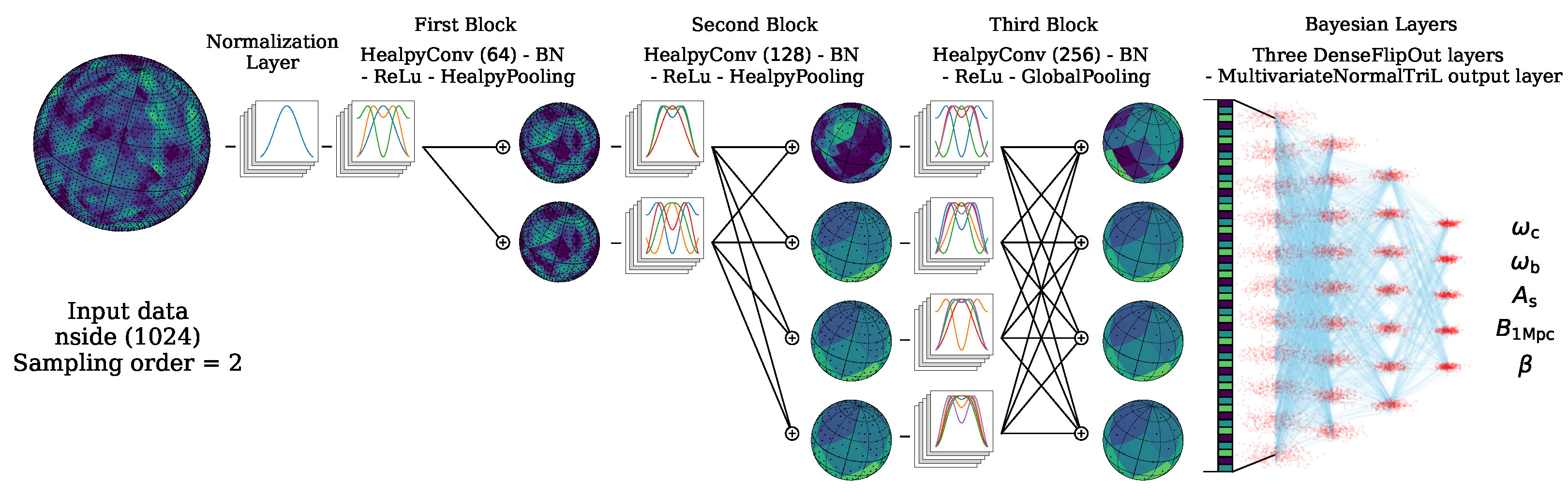
Bayesian Inference of Primordial Magnetic Field Parameters from CMB with Spherical Graph Neural Networks

 , , and
Abstract
1. Introduction
2. Neural Networks
2.1. Graph Neural Networks and DeepSphere
2.2. Bayesian Neural Networks
3. Methods
3.1. Simulation of CMB Maps with PMF
3.2. Dataset and Validation
3.3. Architecture
3.4. Training
3.5. Uncertainty Calibration
4. Results
5. Discussion
6. Conclusions
- (i)
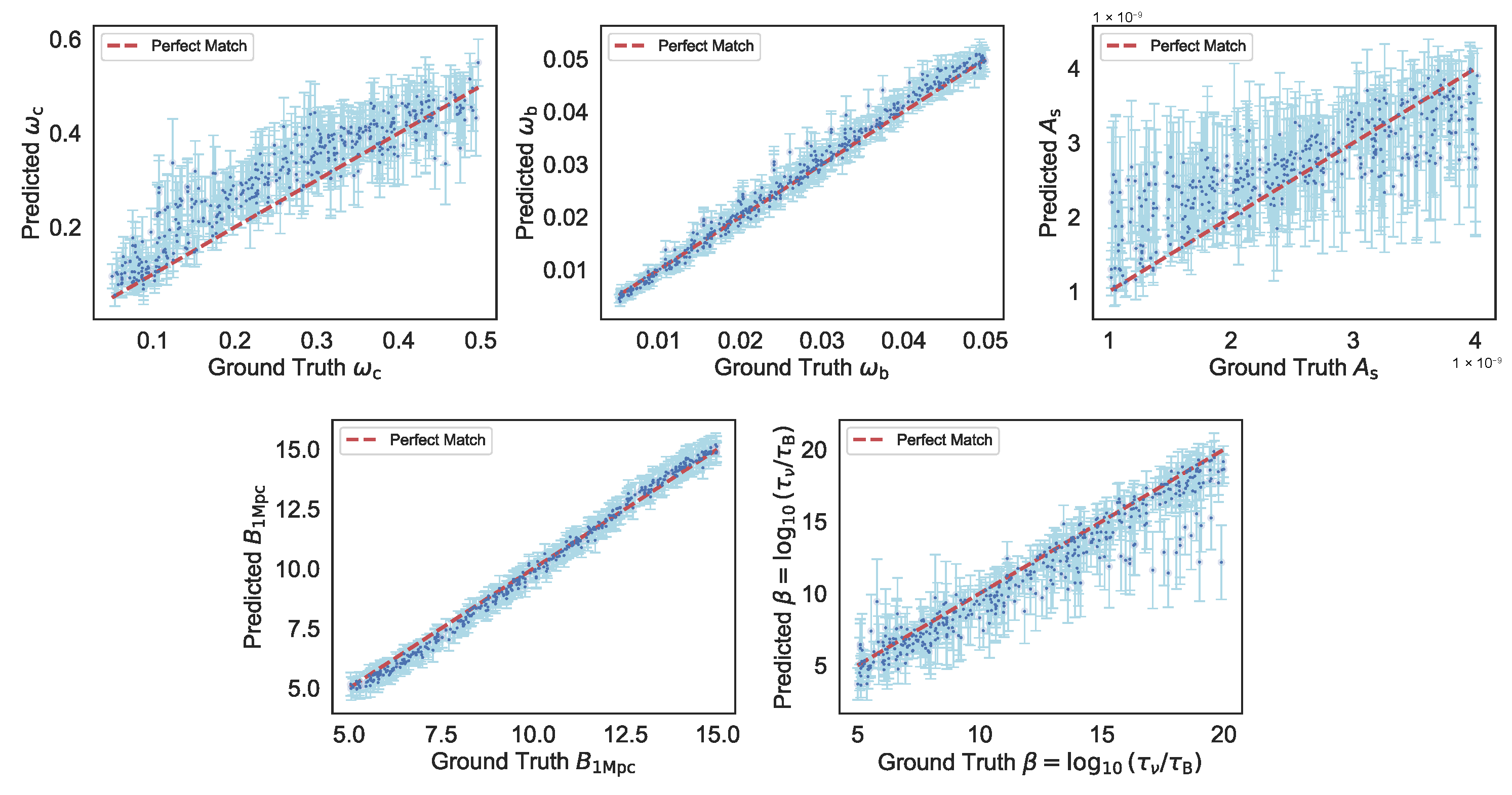
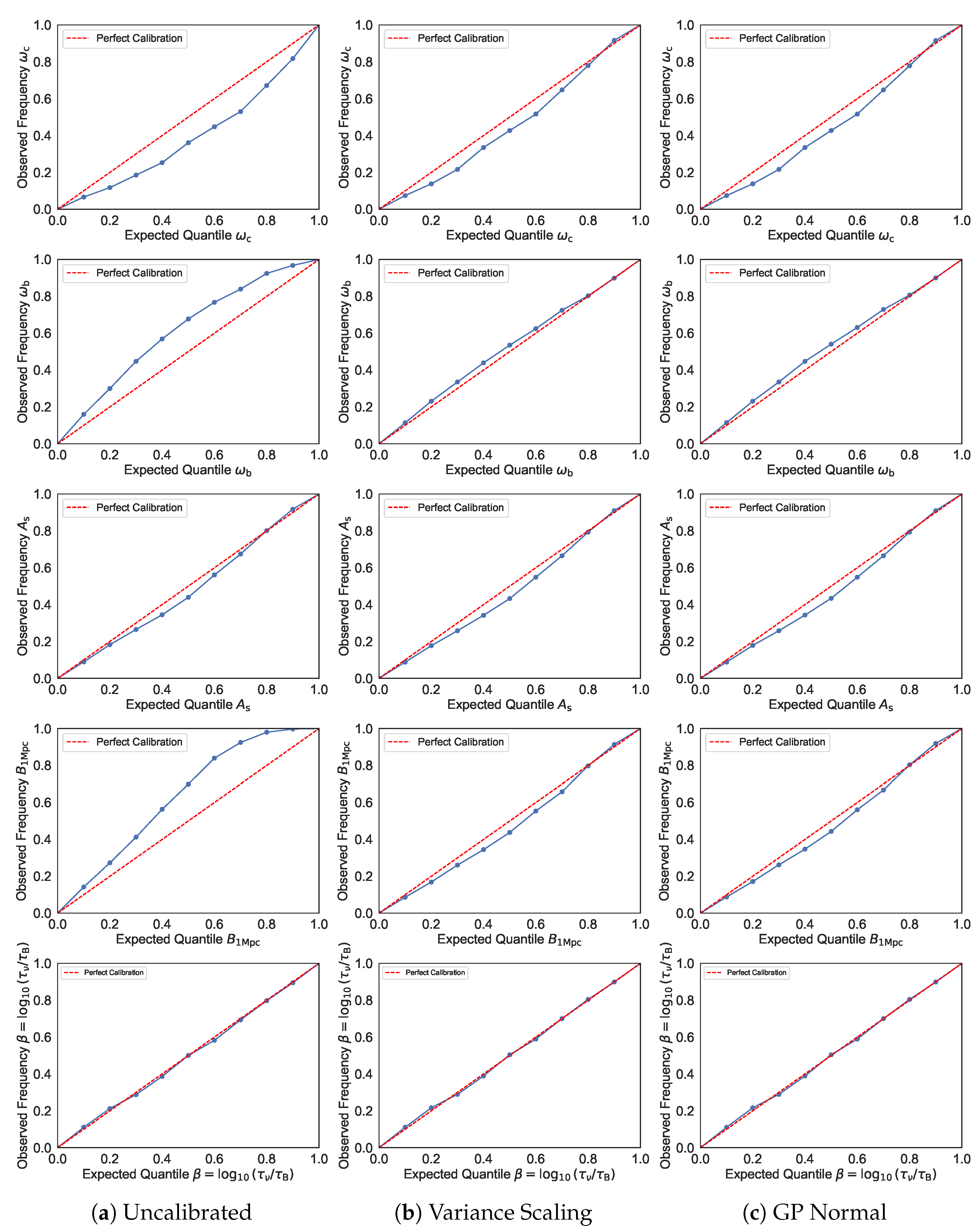
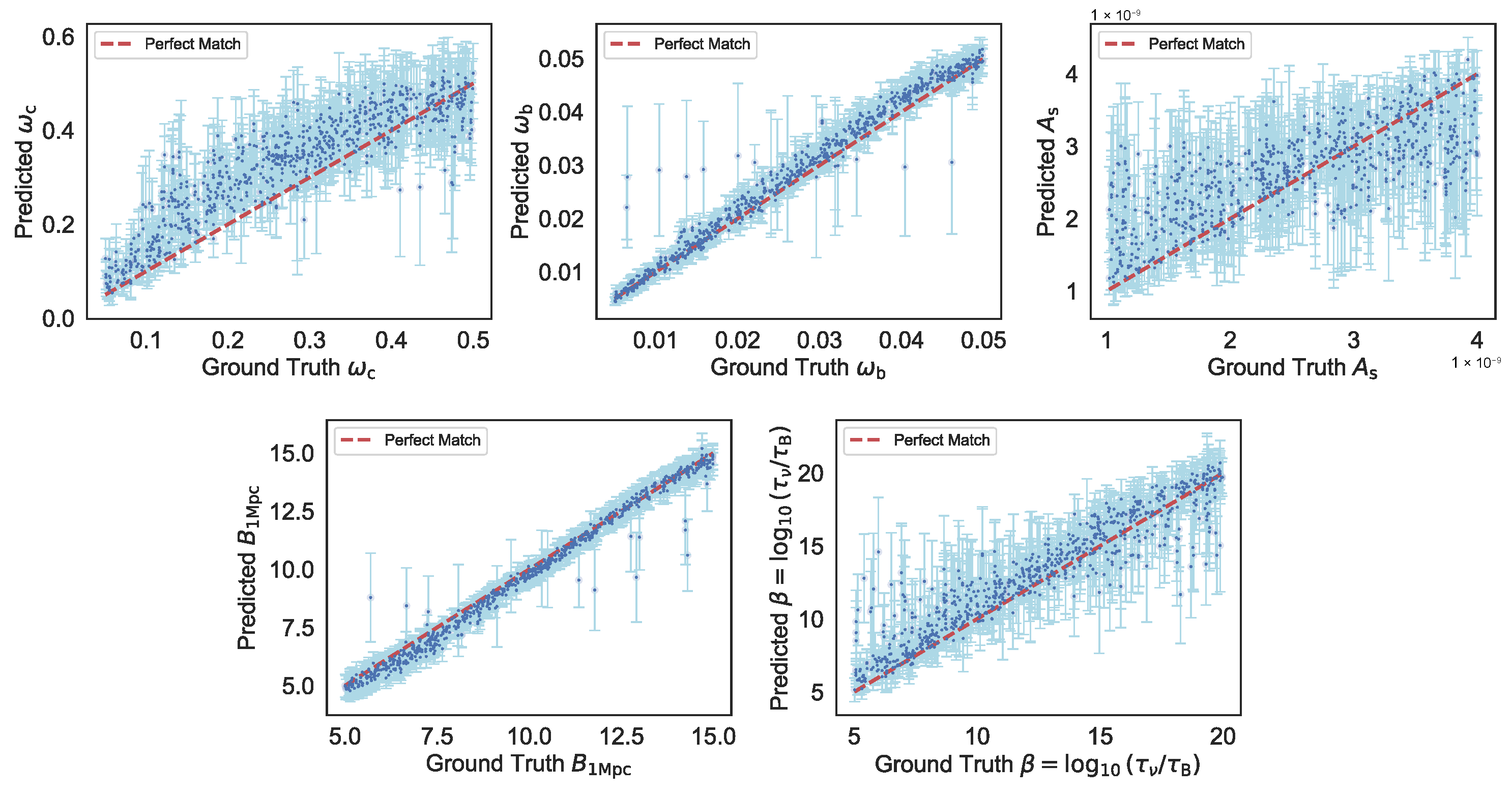
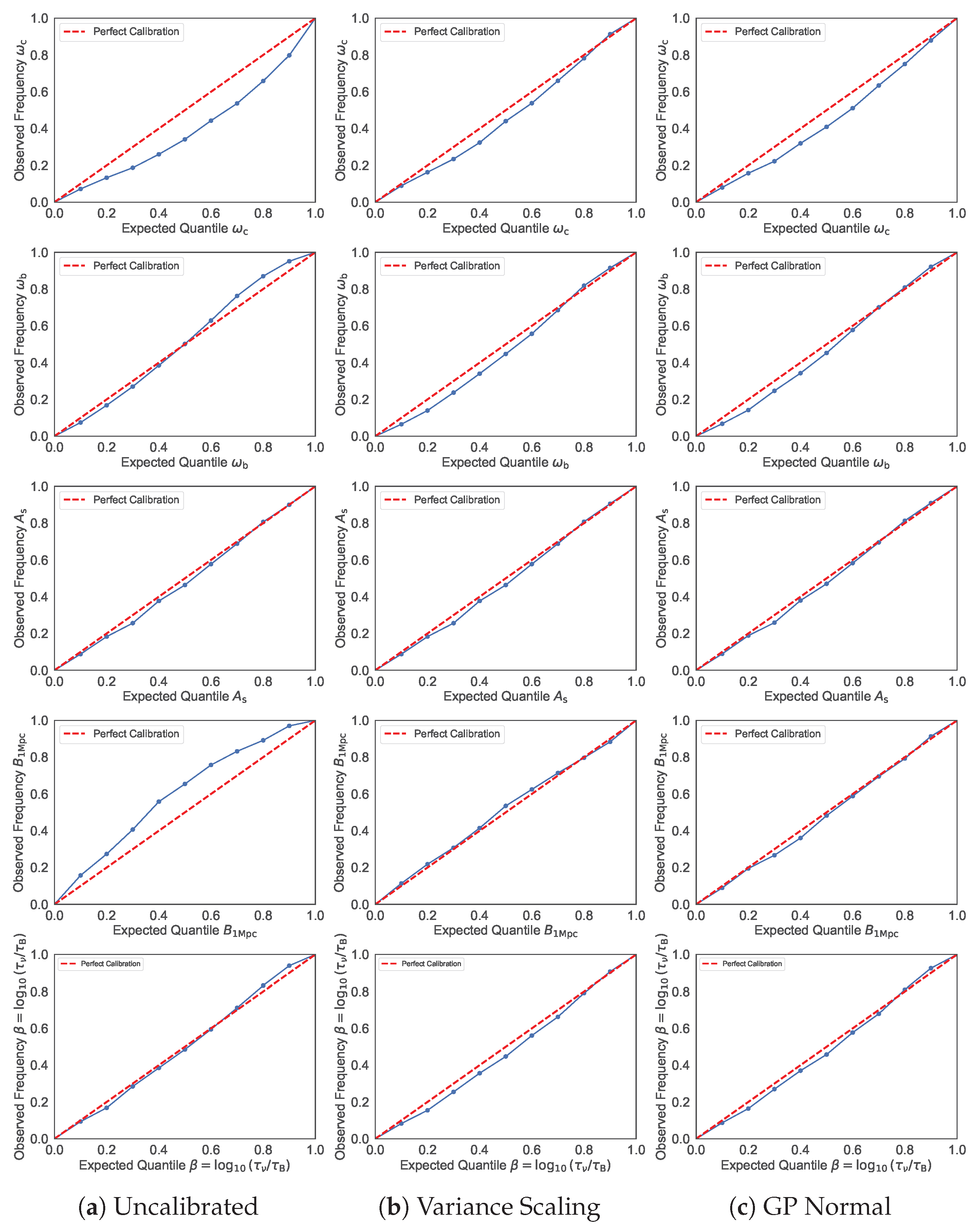
- High predictive accuracy through integration of physical characteristics. The proposed B-GNN model achieved scores close to for most of the five cosmological parameters considered: , , , , and . Moreover, we reported a mean absolute error (MAE) of and a mean squared error (MSE) of on an independent test set, confirming its strong generalization. Furthermore, the uncertainty estimates provided by the BNN were excellently calibrated, as shown in Figure 3. We found that the inclusion of PMF-induced passive and vector modes was crucial for improving the model’s representational power. This is clearly reflected in the superior performance of the full dataset compared to prim-vp, demonstrating that embedding relevant physical information in the input enhances the accuracy and stability of the predictions.
- (ii)
- Reliable and calibrated uncertainty quantification. A central contribution of this work is the incorporation of predictive uncertainty estimates. Although the raw uncertainty outputs of the probabilistic model exhibited over-confidence, applying post hoc calibration methods such as VarianceScaling and GPNormal effectively corrected this behavior. The resulting calibrated confidence intervals accurately matched the empirical error distribution, thereby increasing the interpretability and reliability of the model’s predictions. This is particularly important in cosmology, where well-calibrated uncertainties are essential for meaningful parameter inference.
- (iii)
- Strong generalization and architectural robustness. The model showed stable performance across independent validation datasets, confirming its ability to generalize beyond the training distribution. This robustness is the result of a carefully designed training strategy, including regularization, optimal learning rate scheduling, and dropout. Importantly, unlike the deterministic baseline, the Bayesian model maintained stability without requiring additional early stopping or learning-rate reduction techniques, further supporting its suitability for real data applications.
- (iv)
- Advancement of cosmological parameter inference with Bayesian deep learning. Compared to traditional parameter estimation techniques, this framework integrates a spherical CNN architecture with Bayesian inference principles, enabling both accurate point predictions and principled uncertainty estimation within a single model. Once trained, the network provides near-instantaneous parameter estimates, bypassing the computational cost of traditional MCMC methods.
- (v)
- The approach presented in this paper is best viewed as complementary to traditional methods. In fact, hybrid schemes using Bayesian Neural Networks to accelerate MCMC sampling preserve Bayesian rigor while dramatically improving efficiency [23]. However, recent proposals might be advantageous. For example, some neural-network-based methods enable near-optimal map-level inference while naturally incorporating masking, inhomogeneous noise, and non-Gaussianities. Examples include neural implementations of Wiener filtering that match conjugate-gradient accuracy at a fraction of the cost and improve upon pseudo-correlators estimators for complex sky masks [60], as well as spherical CNNs that constrain primordial non-Gaussianity directly from maps, avoiding bispectrum-based information loss [61]. Simulation-based inference further bypasses explicit likelihood assumptions, allowing systematics and nonlinearities to be propagated consistently into posterior constraints, yielding tighter bounds than power-spectrum-only analyses in weak lensing [62] and 21 cm cosmology [63]. The benefits are especially pronounced for non-Gaussian, high-dimensional signals such as 21 cm tomography, where map-level neural inference exploits information beyond two-point statistics [64,65]. Bayesian Neural Networks and normalizing flows further enable calibrated uncertainties and fast likelihood-free inference at a fraction of the computational cost of conventional pipelines [66].
- (vi)
- Outlook and implications for future applications. Our results indicate that a well-calibrated Bayesian Neural Network can robustly infer cosmological parameters from complex, high-dimensional CMB data that include subtle physical effects such as primordial magnetism. This framework offers a flexible and powerful alternative to conventional inference pipelines, providing not only point estimates but also interpretable uncertainty information. These characteristics make it a promising tool for future analyses for the next generation of CMB experiments, such as the PICO [67], LiteBIRD [59], and CORE [58]. These missions will deliver ultra-deep, high-resolution polarization maps where the PMF’s B-mode signal will be a critical and computationally challenging component to isolate. Our work establishes a foundation for using advanced machine learning to harness this data, offering a powerful and complementary tool to traditional methods for probing fundamental physics in the early Universe.
Author Contributions
Funding
Data Availability Statement
Conflicts of Interest
Appendix A
Appendix A.1. Selection of Best Results

| Datasets | |||||
|---|---|---|---|---|---|
| full | 0.894 | 0.911 | 0.758 | 0.993 | 0.913 |
| prim-vp | 0.880 | 0.891 | 0.842 | 0.923 | 0.863 |
| svp | 0.860 | 0.876 | 0.660 | 0.992 | 0.912 |
| vp | 0.800 | 0.959 | 0.258 | 0.996 | 0.985 |
| prim-sv | 0.783 | 0.920 | 0.956 | 0.977 | 0.281 |
| prim-v | 0.775 | 0.951 | 0.980 | 0.990 | 0.179 |
| sv | 0.541 | 0.955 | 0.069 | 0.992 | 0.148 |
| prim-s | 0.229 | 0.351 | 0.888 | −0.119 | −0.206 |
| sp | 0.209 | −0.040 | −0.102 | 0.725 | 0.251 |
| prim-sp | 0.054 | −0.011 | 0.043 | 0.181 | 0.005 |
Appendix A.2. Data Cleaning

Appendix A.3. Contribution of Relevant Magnetic Modes

Appendix A.4. Supplementary PRIM-VP Results


References
- Hu, W. Lecture Notes on CMB Theory: From Nucleosynthesis to Recombination. arXiv 2008, arXiv:0802.3688. [Google Scholar] [CrossRef] [Scilit]
- Dodelson, S.; Schmidt, F. Modern Cosmology; Academic Press: Cambridge, MA, USA, 2020. [Google Scholar] [CrossRef] [Scilit]
- Simpson, G.; Bolejko, K.; Walters, S. Beyond ΛCDM: How the Hubble tension challenges early Universe physics. Class. Quantum Gravity 2025, 42, 143001. [Google Scholar] [CrossRef] [Scilit]
- Jia, X.D.; Hu, J.P.; Gao, D.H.; Yi, S.X.; Wang, F.Y. The Hubble Tension resolved by the DESI Baryon Acoustic Oscillations Measurements. arXiv 2025, arXiv:2509.17454. [Google Scholar] [CrossRef] [Scilit]
- Hu, J.P.; Wang, F.Y. Hubble Tension: The Evidence of New Physics. Universe 2023, 9, 94. [Google Scholar] [CrossRef] [Scilit]
- Shiraishi, M. Polarization bispectrum for measuring primordial magnetic fields. J. Cosmol. Astropart. Phys. 2013, 2013, 006. [Google Scholar] [CrossRef] [Scilit]
- Shiraishi, M. Parity violation of primordial magnetic fields in the CMB bispectrum. J. Cosmol. Astropart. Phys. 2012, 2012, 015. [Google Scholar] [CrossRef] [Scilit]
- Rashkovetskyi, M.; Muñoz, J.B.; Eisenstein, D.J.; Dvorkin, C. Small-scale clumping at recombination and the Hubble tension. Phys. Rev. D 2021, 104, 103517. [Google Scholar] [CrossRef] [Scilit]
- Jedamzik, K.; Abel, T.; Ali-Haïmoud, Y. Cosmic recombination in the presence of primordial magnetic fields. J. Cosmol. Astropart. Phys. 2025, 2025, 012. [Google Scholar] [CrossRef] [Scilit]
- Schiff, J.; Venumadhav, T. Primordial magnetic fields and modified recombination histories. arXiv 2025, arXiv:2506.16517. [Google Scholar] [CrossRef] [Scilit]
- Widrow, L.M. Origin of galactic and extragalactic magnetic fields. Rev. Mod. Phys. 2002, 74, 775–823. [Google Scholar] [CrossRef] [Scilit]
- Neronov, A.; Vovk, I. Evidence for Strong Extragalactic Magnetic Fields from Fermi Observations of TeV Blazars. Science 2010, 328, 73. [Google Scholar] [CrossRef] [Scilit]
- Widrow, L.M.; Ryu, D.; Schleicher, D.R.G.; Subramanian, K.; Tsagas, C.G.; Treumann, R.A. The First Magnetic Fields. Space Sci. Rev. 2012, 166, 37–70. [Google Scholar] [CrossRef] [Scilit]
- Durrer, R.; Neronov, A. Cosmological magnetic fields: Their generation, evolution and observation. Astron. Astrophys. Rev. 2013, 21, 62. [Google Scholar] [CrossRef] [Scilit]
- Hortúa, H.J. Cosmological Features of Primordial Magnetic Fields. arXiv 2019, arXiv:1903.04419. [Google Scholar] [CrossRef] [Scilit]
- Kandus, A.; Kunze, K.E.; Tsagas, C.G. Primordial magnetogenesis. Phys. Rep. 2011, 505, 1–58. [Google Scholar] [CrossRef] [Scilit]
- Tsagas, C.G. Causality, initial conditions, and inflationary magnetogenesis. Phys. Rev. D 2016, 93, 103529. [Google Scholar] [CrossRef] [Scilit]
- Pogosian, L.; Vachaspati, T.; Yadav, A. Primordial magnetism in CMB B modes. Can. J. Phys. 2013, 91, 451–454. [Google Scholar] [CrossRef] [Scilit]
- Hortúa, H.J.; Castañeda, L. Reduced bispectrum seeded by helical primordial magnetic fields. J. Cosmol. Astropart. Phys. 2017, 2017, 020. [Google Scholar] [CrossRef] [Scilit]
- Pogosian, L.; Yadav, A.P.S.; Ng, Y.F.; Vachaspati, T. Primordial magnetism in the CMB: Exact treatment of Faraday rotation and WMAP7 bounds. Phys. Rev. D 2011, 84, 043530. [Google Scholar] [CrossRef] [Scilit]
- Sutton, D.R.; Feng, C.; Reichardt, C.L. Current and Future Constraints on Primordial Magnetic Fields. Astrophys. J. 2017, 846, 164. [Google Scholar] [CrossRef] [Scilit]
- Zucca, A.; Li, Y.; Pogosian, L. Constraints on primordial magnetic fields from Planck data combined with the South Pole Telescope CMB B-mode polarization measurements. Phys. Rev. D 2017, 95, 063506. [Google Scholar] [CrossRef] [Scilit]
- Hortua, H.J.; Volpi, R.; Marinelli, D.; Malago, L. Accelerating MCMC algorithms through Bayesian Deep Networks. arXiv 2020, arXiv:2011.14276. [Google Scholar] [CrossRef] [Scilit]
- Perraudin, N.; Defferrard, M.; Kacprzak, T.; Sgier, R. DeepSphere: Efficient spherical convolutional neural network with HEALPix sampling for cosmological applications. Astron. Comput. 2019, 27, 130. [Google Scholar] [CrossRef] [Scilit]
- Defferrard, M.; Milani, M.; Gusset, F.; Perraudin, N. DeepSphere: A graph-based spherical CNN. arXiv 2020, arXiv:2012.15000. [Google Scholar]
- Defferrard, M.; Perraudin, N.; Kacprzak, T.; Sgier, R. DeepSphere: Towards an Equivariant Graph-Based Spherical CNN. In Proceedings of the ICLR 2019 Workshop on Representation Learning on Graphs and Manifolds, New Orleans, LA, USA, 6 May 2019; Available online: https://rlgm.github.io/papers/71.pdf (accessed on 20 October 2025).
- Górski, K.M.; Hivon, E.; Banday, A.J.; Wandelt, B.D.; Hansen, F.K.; Reinecke, M.; Bartelmann, M. HEALPix: A Framework for High-Resolution Discretization and Fast Analysis of Data Distributed on the Sphere. Astrophys. J. 2005, 622, 759–771. [Google Scholar] [CrossRef] [Scilit]
- Krachmalnicoff, N.; Tomasi, M. Convolutional neural networks on the HEALPix sphere: A pixel-based algorithm and its application to CMB data analysis. Astron. Astrophys. 2019, 628, A129. [Google Scholar] [CrossRef] [Scilit]
- Gal, Y.; Ghahramani, Z. Dropout as a Bayesian Approximation: Representing Model Uncertainty in Deep Learning. In Proceedings of the 33rd International Conference on Machine Learning, New York, NY, USA, 20–22 June 2016; Volume 48, pp. 1050–1059. [Google Scholar]
- Dvorkin, C.; Mishra-Sharma, S.; Nord, B.; Villar, V.A.; Avestruz, C.; Bechtol, K.; Ćiprijanović, A.; Connolly, A.J.; Garrison, L.H.; Narayan, G.; et al. Machine Learning and Cosmology. arXiv 2022, arXiv:2203.08056. [Google Scholar] [CrossRef] [Scilit]
- Hortúa, H.J.; Volpi, R.; Marinelli, D.; Malagò, L. Parameter estimation for the cosmic microwave background with Bayesian neural networks. Phys. Rev. D 2020, 102, 103509. [Google Scholar] [CrossRef] [Scilit]
- García-Farieta, J.E.; Hortúa, H.J.; Kitaura, F.S. Bayesian deep learning for cosmic volumes with modified gravity. Astron. Astrophys. 2024, 684, A100. [Google Scholar] [CrossRef] [Scilit]
- Blundell, C.; Cornebise, J.; Kavukcuoglu, K.; Wierstra, D. Weight Uncertainty in Neural Network. In Proceedings of the 32nd International Conference on Machine Learning, Lille, France, 7–9 July 2015; Volume 37, pp. 1613–1622. [Google Scholar]
- Farsian, F.; Marulli, F.; Moscardini, L.; Giocoli, C. New Applications of Graph Neural Networks in Cosmology. In Machine Learning for Astrophysics; Springer: Cham, Switzerland, 2023; Volume 60, pp. 35–38. [Google Scholar] [CrossRef] [Scilit]
- Corso, G.; Stark, H.; Jegelka, S.; Jaakkola, T.; Barzilay, R. Graph neural networks. Nat. Rev. Methods Prim. 2024, 4, 17. [Google Scholar] [CrossRef] [Scilit]
- Bessadok, A.; Mahjoub, M.A.; Rekik, I. Graph Neural Networks in Network Neuroscience. IEEE Trans. Pattern Anal. Mach. Intell. 2023, 45, 5833–5848. [Google Scholar] [CrossRef] [Scilit]
- Zhang, S.; Tong, H.; Xu, J.; Maciejewski, R. Graph convolutional networks: A comprehensive review. Comput. Soc. Netw. 2019, 6, 11. [Google Scholar] [CrossRef] [Scilit]
- Xu, X.; Zhao, X.; Wei, M.; Li, Z. A comprehensive review of graph convolutional networks: Approaches and applications. Electron. Res. Arch. 2023, 31, 4185–4215. [Google Scholar] [CrossRef] [Scilit]
- Bronstein, M.M.; Bruna, J.; Cohen, T.; Veličković, P. Geometric Deep Learning: Grids, Groups, Graphs, Geodesics, and Gauges. arXiv 2021, arXiv:2104.13478. [Google Scholar] [CrossRef] [Scilit]
- Valentin Jospin, L.; Buntine, W.; Boussaid, F.; Laga, H.; Bennamoun, M. Hands-on Bayesian Neural Networks—A Tutorial for Deep Learning Users. arXiv 2020, arXiv:2007.06823. [Google Scholar] [CrossRef] [Scilit]
- Magris, M.; Iosifidis, A. Bayesian learning for neural networks: An algorithmic survey. Artif. Intell. Rev. 2023, 56, 11773–11823. [Google Scholar] [CrossRef] [Scilit]
- Lewis, A.; Challinor, A.; Lasenby, A. Efficient Computation of Cosmic Microwave Background Anisotropies in Closed Friedmann-Robertson-Walker Models. Astrophys. J. 2000, 538, 473–476. [Google Scholar] [CrossRef] [Scilit]
- Shaw, J.R.; Lewis, A. Massive neutrinos and magnetic fields in the early universe. Phys. Rev. D 2010, 81, 043517. [Google Scholar] [CrossRef] [Scilit]
- Mandal, S.; Sehgal, N.; Namikawa, T. Finding evidence for inflation and the origin of galactic magnetic fields with CMB surveys. Phys. Rev. D 2022, 105, 063537. [Google Scholar] [CrossRef] [Scilit]
- Aghanim, N.; Akrami, Y.; Ashdown, M.; Aumont, J.; Baccigalupi, C.; Ballardini, M.; Banday, A.J.; Barreiro, R.B.; Bartolo, N.; et al.; Planck Collaboration Planck 2018 results. VI. Cosmological parameters. Astron. Astrophys. 2020, 641, A6. [Google Scholar] [CrossRef] [Scilit]
- Planck Collaboration. Planck 2015 results: XIX. Constraints on primordial magnetic fields. Astron. Astrophys. 2016, 594, A19. [Google Scholar] [CrossRef] [Scilit]
- Caldeira, J.; Wu, W.L.K.; Nord, B.; Avestruz, C.; Trivedi, S.; Story, K.T. DeepCMB: Lensing reconstruction of the cosmic microwave background with deep neural networks. Astron. Comput. 2019, 28, 100307. [Google Scholar] [CrossRef] [Scilit]
- Küppers, F.; Schneider, J.; Haselhoff, A. Parametric and Multivariate Uncertainty Calibration for Regression and Object Detection. arXiv 2022, arXiv:2207.01242. [Google Scholar] [CrossRef] [Scilit]
- Krizhevsky, A.; Sutskever, I.; Hinton, G.E. ImageNet classification with deep convolutional neural networks. Commun. ACM 2017, 60, 84–90. [Google Scholar] [CrossRef] [Scilit]
- He, K.; Zhang, X.; Ren, S.; Sun, J. Deep Residual Learning for Image Recognition. In 2016 IEEE Conference on Computer Vision and Pattern Recognition (CVPR); IEEE: Piscataway, NJ, USA, 2016; pp. 770–778. [Google Scholar] [CrossRef] [Scilit]
- Wen, Y.; Vicol, P.; Ba, J.; Tran, D.; Grosse, R. Flipout: Efficient Pseudo-Independent Weight Perturbations on Mini-Batches. arXiv 2018, arXiv:1803.04386. [Google Scholar] [CrossRef] [Scilit]
- Tran, D.; Dusenberry, M.; van der Wilk, M.; Hafner, D. Bayesian Layers: A Module for Neural Network Uncertainty. In Proceedings of the 33rd International Conference on Neural Information Processing Systems; Wallach, H., Larochelle, H., Beygelzimer, A., d’Alché-Buc, F., Fox, E., Garnett, R., Eds.; Curran Associates, Inc.: Red Hook, NY, USA, 2019; Volume 32. [Google Scholar]
- Zhang, D. A Coefficient of Determination for Generalized Linear Models. Am. Stat. 2017, 71, 310–316. [Google Scholar] [CrossRef] [Scilit]
- Goodfellow, I.; Bengio, Y.; Courville, A. Deep Learning; MIT Press: Cambridge, MA, USA, 2016; Available online: http://www.deeplearningbook.org (accessed on 20 October 2025).
- Guo, C.; Pleiss, G.; Sun, Y.; Weinberger, K.Q. On Calibration of Modern Neural Networks. arXiv 2017, arXiv:1706.04599. [Google Scholar] [CrossRef] [Scilit]
- Kuleshov, V.; Fenner, N.; Ermon, S. Accurate Uncertainties for Deep Learning Using Calibrated Regression. In Proceedings of the 35th International Conference on Machine Learning; Dy, J., Krause, A., Eds.; PMLR: Cambridge, MA, USA, 2018; Volume 80, pp. 2796–2804. [Google Scholar]
- Dheur, V.; Ben Taieb, S. Probabilistic Calibration by Design for Neural Network Regression. In Proceedings of the 27th International Conference on Artificial Intelligence and Statistics; Dasgupta, S., Mandt, S., Li, Y., Eds.; PMLR: Cambridge, MA, USA, 2024; Volume 238, pp. 3133–3141. [Google Scholar]
- Delabrouille, J.; de Bernardis, P.; Bouchet, F.R.; Achúcarro, A.; Ade, P.A.R.; Allison, R.; Arroja, F.; Artal, E.; Ashdown, M.; Baccigalupi, C.; et al. Exploring cosmic origins with CORE: Survey requirements and mission design. J. Cosmol. Astropart. Phys. 2018, 2018, 014. [Google Scholar] [CrossRef] [Scilit]
- Hazumi, M.; Ade, P.A.; Adler, A.; Allys, E.; Arnold, K.; Auguste, D.; Aumont, J.; Aurlien, R.; Austermann, J.; Baccigalupi, C.; et al. LiteBIRD satellite: JAXA’s new strategic L-class mission for all-sky surveys of cosmic microwave background polarization. In Proceedings of the Space Telescopes and Instrumentation 2020: Optical, Infrared, and Millimeter Wave; Lystrup, M., Batalha, N., Tong, E.C., Siegler, N., Perrin, M.D., Eds.; SPIE: Bellingham, WA, USA, 2020. [Google Scholar] [CrossRef] [Scilit]
- Costanza, B.; Scóccola, C.G.; Zaldarriaga, M. DeepWiener: Neural Networks for CMB polarization maps and power spectrum computation. arXiv 2025, arXiv:2412.10580. [Google Scholar] [CrossRef] [Scilit]
- Melsen, J.; Flöss, T.; Meerburg, P.D. Towards detecting primordial non-Gaussianity in the CMB using spherical convolutional neural networks. Mon. Not. R. Astron. Soc. 2025, 541, 3269–3279. [Google Scholar] [CrossRef] [Scilit]
- Jeffrey, N.; Whiteway, L.; Gatti, M.; Williamson, J.; Alsing, J.; Porredon, A.; Prat, J.; Doux, C.; Jain, B.; Chang, C.; et al. Dark Energy Survey Year 3 results: Likelihood-free, simulation-based wCDM inference with neural compression of weak-lensing map statistics. arXiv 2024, arXiv:2403.02314. [Google Scholar]
- Greig, B.; Prelogović, D.; Qin, Y.; Ting, Y.-S.; Mesinger, A. Inferring astrophysical parameters using the 2D cylindrical power spectrum from reionisation. arXiv 2024, arXiv:2403.14060. [Google Scholar] [CrossRef] [Scilit]
- Neutsch, S.; Heneka, C.; Brüggen, M. Inferring astrophysics and dark matter properties from 21 cm tomography using deep learning. Mon. Not. R. Astron. Soc. 2022, 511, 3446–3462. [Google Scholar] [CrossRef] [Scilit]
- Gillet, N.; Mesinger, A.; Greig, B.; Liu, A.; Ucci, G. Deep learning from 21-cm tomography of the Cosmic Dawn and Reionization. Mon. Not. R. Astron. Soc. 2019, 484, 282–293. [Google Scholar] [CrossRef] [Scilit]
- Hortúa, H.J.; Malagò, L.; Volpi, R. Constraining the Reionization History using Bayesian Normalizing Flows. Mach. Learn. Sci. Technol. 2020, 1, 035014. [Google Scholar] [CrossRef] [Scilit]
- Hanany, S.; Alvarez, M.; Artis, E.; Ashton, P.; Aumont, J.; Aurlien, R.; Banerji, R.; Barreiro, R.B.; Bartlett, J.G.; Basak, S.; et al. PICO: Probe of Inflation and Cosmic Origins. arXiv 2019, arXiv:1902.10541. [Google Scholar]


| Parameter | Range | Planck Ref. |
|---|---|---|
| [0.05, 0.50] | ||
| [0.005, 0.05] | ||
| [1.015, 4.015] | ||
| [5, 15] | <5.8 at 95% CL [46] | |
| [5, 20] | - |
| Set | FULL | PRIM-VP | ||||
|---|---|---|---|---|---|---|
| Loss | MSE | MAE | Loss | MSE | MAE | |
| Validation | 5250.468 | 0.055 | 0.154 | 5254.806 | 0.066 | 0.174 |
| Test | 5250.208 | 0.050 | 0.147 | 5254.857 | 0.068 | 0.176 |
| External | 5250.396 | 0.052 | 0.151 | 5255.045 | 0.068 | 0.176 |
| Parameter | FULL | prim-vp |
|---|---|---|
| 77.3% | 67.1% | |
| 98.5% | 97.3% | |
| 62.6% | 56.2% | |
| 99.2% | 98.2% | |
| 89.5% | 85.6% |
Disclaimer/Publisher’s Note: The statements, opinions and data contained in all publications are solely those of the individual author(s) and contributor(s) and not of MDPI and/or the editor(s). MDPI and/or the editor(s) disclaim responsibility for any injury to people or property resulting from any ideas, methods, instructions or products referred to in the content. |
© 2026 by the authors. Licensee MDPI, Basel, Switzerland. This article is an open access article distributed under the terms and conditions of the Creative Commons Attribution (CC BY) license.
Share and Cite
Pinto Castro, J.A.; Hortúa, H.J.; García-Farieta, J.E.; Hurtado, R.A. Bayesian Inference of Primordial Magnetic Field Parameters from CMB with Spherical Graph Neural Networks. Universe 2026, 12, 34. https://doi.org/10.3390/universe12020034
Pinto Castro JA, Hortúa HJ, García-Farieta JE, Hurtado RA. Bayesian Inference of Primordial Magnetic Field Parameters from CMB with Spherical Graph Neural Networks. Universe. 2026; 12(2):34. https://doi.org/10.3390/universe12020034
Chicago/Turabian StylePinto Castro, Juan Alejandro, Héctor J. Hortúa, Jorge Enrique García-Farieta, and Roger Anderson Hurtado. 2026. "Bayesian Inference of Primordial Magnetic Field Parameters from CMB with Spherical Graph Neural Networks" Universe 12, no. 2: 34. https://doi.org/10.3390/universe12020034
APA StylePinto Castro, J. A., Hortúa, H. J., García-Farieta, J. E., & Hurtado, R. A. (2026). Bayesian Inference of Primordial Magnetic Field Parameters from CMB with Spherical Graph Neural Networks. Universe, 12(2), 34. https://doi.org/10.3390/universe12020034