
Review

Dark Sector Searches at e+e Colliders

by
Vindhyawasini Prasad
College of Physics, Jilin University, Changchun 130012, China
Universe 2026, 12(1), 20; https://doi.org/10.3390/universe12010020
Submission received: 4 December 2025 / Revised: 6 January 2026 / Accepted: 7 January 2026 / Published: 12 January 2026
(This article belongs to the Special Issue Modified Gravity and Dark Energy Theories)

Abstract

The Standard Model (SM) of particle physics is one of the most successful frameworks in modern physics, yet it leaves several fundamental questions unanswered, including the nature of dark matter (DM). Precise knowledge of DM is crucial for testing astrophysical and cosmological observations and for determining the matter density of our Universe. Many hidden dark sector models beyond the SM open the possibility of coupling between DM and SM particles via various portals. The corresponding new physics particles include light Higgs bosons, dark photons, axion-like particle, and spin-1/2 fermions. Furthermore, the introduction of a dark baryon could simultaneously explain the origin of DM and the observed matter–antimatter asymmetry in the Universe. If these hypothetical particles have masses of a few GeV, they can be explored at high-intensity e + e colliders, such as in the BaBar, Belle/Belle II, and BESIII experiments. This report reviews the current status of DM searches at e + e colliders, with a focus on portal-based scenarios.

1. Introduction

The Standard Model (SM) [1,2,3,4] of particle physics has been remarkably successful in describing the fundamental particles and their interactions, including the mechanism by which they acquire mass [5,6,7,8,9,10,11]. It has been well tested by several collider experiments. Despite its success, the SM is widely recognized as an incomplete theory because there are still some phenomena that can not be explained by the SM. For instance, it does not explain the origin of tiny neutrino masses [12] or the nature of dark matter (DM) [13]. The former has been established by the discovery of neutrino oscillation [14,15], which implies that neutrinos have masses below the eV scale. The latter has been indicated by a variety of evidence, such as the galactic rotation curve [16], galaxy cluster, and the large-scale structure of the Universe [17,18,19,20]. These issues strongly suggest the need for physics beyond the SM (BSM). Extensions of the SM are therefore required to solve these outstanding issues, including the missing description of DM [13] and neutrino oscillation [12,14,15].
DM accounts for about 26.8 % of the total matter density of the Universe [21,22]. It does not interact via the strong or electromagnetic interaction, and its presence so far can be inferred only through gravitational effect. Therefore, the nature of DM remains unknown. Experimental information on DM is needed to explain recent astrophysical observations, including the velocity profiles of the galactic rotation curve [16] and the fundamental characteristics of our Universe [17,18,19,20]. A dynamical mechanism, baryogenesis, has been recently proposed for GeV-scale DM carrying a baryon number, offering an attractive framework for simultaneously addressing the sources of DM and the matter–antimatter asymmetry of the Universe [23,24]. Additionally, the presence of DM particles may enhance the branching fraction of flavor-changing neutral-current (FCNC) processes [25], which are highly suppressed by the Glashow–Iliopoulos–Maiani mechanism [4], making them accessible to the current generation of collider experiments.
An extension of the SM is needed to accommodate DM. One of the most popular scenarios is a dark sector (or “hidden sector”) that arises from several well-motivated theories, including string-inspired models [26], supersymmetry (SUSY) [27], and extensions featuring extra U ( 1 ) symmetries [28]. In these scenarios, dark sector fields interact only feebly with SM particles, often through renormalizable operators or high-dimension Wilson coefficient operators [29]. According to this hidden sector, DM may couple to the SM particles via the following portals: vector, axion, Higgs, and neutrino portals [30]. The corresponding portals predict new physics particles that are categorized as dark photons, axion-like particles, light Higgs bosons, and sterile neutrinos. Only restricted regions of the parameter space of particle dark matter models can reproduce this observed relic abundance, typically under the assumption of thermal freeze-out in the early Universe. If the masses of these particles lie in the MeV–GeV range, they can be probed in high-intensity e + e collider experiments, such as BaBar [31], Belle/Belle II [32], and BESIII [33]. Complementary efforts are ongoing and planned at future colliders, including the Circular Electron–Positron Collider (CEPC) [34], Future Circular Collider (FCC) [35], and the Super Tau–Charm Factory (STCF) [36] in China, which promise to substantially extend the current sensitivity to rare and invisible decays.
This report reviews recent progress in searches for new physics in e + e collider experiments, with an emphasis on portal-based scenarios. It outlines the theoretical motivations for these models, summarizes the experimental results from both existing and planned experiments, and discusses future prospects. These studies represent a cornerstone of the ongoing effort to uncover the nature of dark matter and other phenomena beyond the SM.

2. Vector Portal

The vector portal introduces a new abelian U ( 1 ) gauge boson, commonly referred to as a dark photon ( A or γ ) [37], which shares similarities with the ordinary photon but may possess mass and interact with dark matter particles [30]. In this framework, dark matter particles can annihilate into a pair of dark photons, which subsequently decay into SM particles, satisfying the constraints of recent astrophysical observations [17,18,19,20]. Dark photons are broadly categorized into two distinct types: massive dark photons, which arise when the additional U ( 1 ) gauge symmetry is spontaneously broken, and massless dark photons, where the symmetry remains unbroken [38,39]. Each category exhibits unique phenomenological signatures and is probed through different experimental approaches.

2.1. Massive Dark Photons

Dark photons can acquire mass through a hidden mechanism, such as the Stückelberg mechanism [40] or a dark Higgs mechanism [41], where the spontaneous symmetry breaking of the U ( 1 ) gauge group introduces a dark Higgs boson h . The corresponding Lagrangian for the minimal dark sector is given by the following [42]:
L = 1 4 F μ ν F μ ν 1 4 F μ ν F μ ν ϵ 2 F μ ν F μ ν + 1 2 m A 2 A μ A μ + A μ J dark μ + L mass ,
where F μ ν and F μ ν represent the field strength tensors for the SM photon and dark photon, respectively. The parameter ϵ quantifies the kinetic mixing between the SM and dark sector photons, while m A denotes the dark photon mass. The dark current J dark μ describes interactions with dark sector fermions or scalars, A μ is the dark photon field, and L mass includes terms related to mass generation and possible spontaneous symmetry breaking effects.

2.1.1. Abelian Dark Photons

The spontaneous breaking of an abelian U ( 1 ) gauge group generates mass for the dark photon A [37]. The effective coupling strength between the massive dark photon and SM photon is given by α D ϵ 2 α , where α and α D represent the fine structure constants of the SM and dark sectors, respectively [43,44]. Astrophysical constraints typically restrict the massive dark photon mass to the sub-GeV to few GeV range [44,45]. Constraints on ϵ have been placed on visible A decays by beam dump [46], fixed-target [47,48,49], e + e collider [50,51,52,53,54], rare meson decay [55], and LHCb [56] experiments. The most stringent limits on ϵ , especially below O ( 10 3 ) , mainly come from the NA48 experiment in the m A range of [ 10 , 120 ] MeV, KLOE-2 experiment [54] in the ρ ω mass region, BaBar experiment [50] in 0.12 < m A < 8 GeV , and LHCb experiment [56] in the high-mass region, as seen in Figure 1 (left). BESIII has extended these searches to lower-mass regions ( 1.5 < m A < 3.4 GeV ) [51,52,53]. For invisibly decaying dark photons, constraints on ϵ appear from kaon decays [13], missing energy events in electron–nucleus scattering [57] and e + e collider experiments [58,59]. BaBar’s result [58] is more stringent in the higher-mass region, as seen in Figure 1 (middle).
Another important topic is the thermal relic abundance of dark matter in the early Universe. Cosmological constraints from the cosmic microwave background (CMB) and Big Bang Nucleosynthesis (BBN) on the dimensionless parameter y = ϵ 2 α D m χ m A 4 impose a lower bound on the parameter space compatible with the observed relic density [60,61], as illustrated in Figure 1 (right) [32], where m χ is the mass of the dark matter χ particle. Current experimental limits on y remain several orders of magnitude above this thermal relic target. Future results from Belle II [32] and STCF [36], using their full data sets, may help in further probing this region of parameter space.

2.1.2. Non-Abelian Dark Sector

An extended theory featuring a non-abelian S U ( 2 ) × U ( 1 ) gauge group introduces four gauge bosons: γ ( A ), W D , W D , and W D [44]. The mass hierarchy among these particles is unconstrained, allowing for light gauge bosons and potentially a light dark Higgs boson. This scenario enables the probing of such light dark matter particles at low-energy e + e colliders and in fixed-target experiments through signatures including e + e W W l + l l + l (mediated by a virtual A ) and e + e γ A ( W W ) γ l + l l + l . BaBar conducted searches for a narrow di-lepton resonance in four-lepton final states using 536 fb 1 of data. No significant signal events were observed, yielding 90 % CL upper limits on production cross-sections: σ ( e + e W W e + e e + e ) < ( 15 70 ) ab, σ ( e + e W W e + e μ + μ ) < (15–40) ab, and σ ( e + e W W μ + μ μ + μ ) < (11–17) ab for W masses between 0.24 and 5.3 GeV/ c 2 [62]. Under the assumption of equal W coupling to electrons and muons, a combined upper limit of σ ( e + e W W l + l l + l ) < (25–60) ab was established.

2.2. Massless Dark Photons

A massless dark photon ( γ ) can couple to SM fermions through a higher-dimensional operator. Reference [38] introduces a dimension-six operator enabling an effective coupling between the dark photon field strength and SM fermions, leading to FCNC processes. Unlike the massive case, this coupling arises from a term proportional to 1 / Λ NP 2 , where Λ NP represents the new physics scale, rather than through kinetic mixing.
BESIII has recently conducted searches for massless dark photons in the following decay channels:
  • Σ + p + invisible via J / ψ Σ + Σ ¯ using 10 billion J / ψ events [63].
  • Λ c + p γ through e + e Λ c + Λ ¯ c using 4.5 fb 1 of data at s = 4.6–4.6999 GeV [64].
  • D 0 ω γ and D 0 γ γ using 7.9 fb 1 of ψ ( 3770 ) D 0 D ¯ 0 data [65].
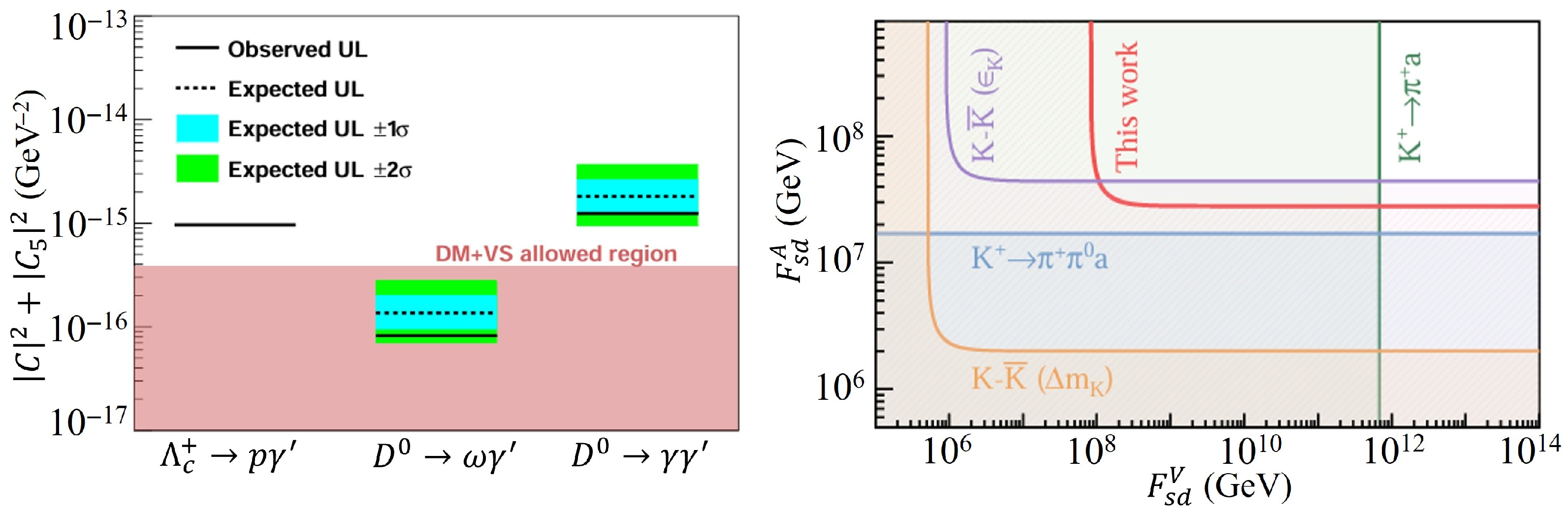
These analyses employed a double tag technique [66], where one baryon or meson is reconstructed in its dominant hadronic decay modes while the partner decays to the signal channel of interest. No significant signal events are observed, establishing 90% CL upper limits of B ( Σ + p + invisible ) < 3.2 × 10 5 [63], B ( Λ c + p γ ) < 8 × 10 5 [64], B ( D 0 ω γ ) < 1.1 × 10 5 , and B ( D 0 γ γ ) < 2.0 × 10 6 [65]. These results improve constraints on the effective coupling parameters to | C | 2 + | C 5 | 2 < 8.2 × 10 17 GeV 2 [65], reaching regions allowed for by DM and vacuum stability considerations and surpassing previous Λ c + p γ limits by an order of magnitude (Figure 2, left). Here C = Λ NP 2 ( C 12 U + C 12 U * ) ν / 8 , and C 5 = Λ NP 2 ( C 12 U C 12 U * ) ν / 8 , with the Higgs vacuum expectation value ν = 246.2 GeV, the new physics energy scale Λ NP , and the up-type dimensionless coefficient C 12 U . The Σ + p + invisible limit improves constraints on the axial–vector coupling F s d A beyond bounds from kaon mixing and CP violation measurements [63] (Figure 2, right). The quantity F s d A is the axial–vector flavor-changing coupling between strange (s) and down (d) quarks mediated by an invisible light gauge boson, such as a QCD axion, an ALP, or a dark sector pseudoscalar with axial couplings [63].

3. Higgs Portal

In the last decade, both the ATLAS and CMS experiments confirmed the Higgs mechanism [5,6,7,8,9], which provides masses to SM particles via the spontaneous breaking of electroweak symmetry [10,11]. Both experiments were also able to map out its properties in detail and find consistency with the assumption that the Higgs boson couples to SM particles proportionally to their mass. Nevertheless, the origin of the majority of mass in the Universe remains a mystery, because it is not in the form of known particles but in a completely new form called DM [13]. If DM is composed of elementary particles, we can hope to detect these particles in the laboratory or infer their properties from astrophysical observations [17,18,19,20]. A similar Higgs mechanism [41] may give mass to a dark matter candidate and to the gauge boson mediating its interactions, such as a dark photon. An extended sector beyond the SM may also be required to solve the little hierarchy problem of the SM [67]. In low-energy e + e collider experiments, the following scenarios related to BSM Higgs or spin-0 scalar searches are well motivated and explored.

3.1. Light Higgs Boson

A light Higgs boson is predicted by many models beyond the SM, such as the Next-to-Minimal Supersymmetric Standard Model (NMSSM) [68], which extends the Higgs sector of the SM to include additional Higgs fields. The Higgs sector of the NMSSM contains three C P -even, two C P -odd, and two charged Higgs bosons. The mass of the lightest C P -odd Higgs boson, A 0 , could be smaller than twice the mass of the bottom or charm quark, thus making it accessible via radiative decays of Υ ( n S ) ( n = 1 , 2 , 3 ) or J / ψ [69]. The couplings of the Higgs field to up- and down-type quark pairs are proportional to cot β and tan β , respectively, where tan β represents the ratio of the vacuum expectation values of the up- and down-type Higgs doublets. The branching fractions of Υ ( 1 S ) γ A 0 and J / ψ γ A 0 are predicted to be in the ranges of 10 7 10 3 and 10 9 10 7 , respectively, depending on m A 0 , tan β , and other NMSSM parameters [70].
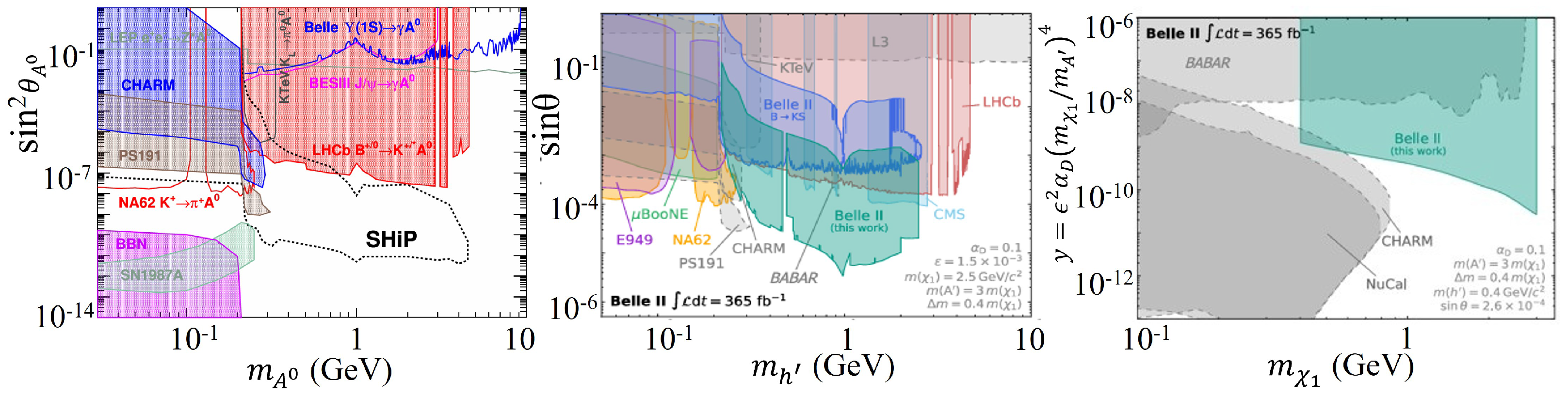
The branching fractions of V γ A 0 are related to the Yukawa coupling of A 0 to down- or up-type quarks g q 2 , as described by the formula in Equation (1) of Ref. [71]. Searches for a light Higgs boson decaying to various fermion-pair final states in radiative Υ ( n S ) have been performed by various B-factory-related experiments, such as the BaBar [72] and Belle [73] experiments. Though these experiments have reported null results, their results have placed strong exclusion limits on the effective Yukawa coupling of the Higgs field to bottom-type quark pairs ( g b ). According to Ref. [74], BaBar’s results for A 0 μ + μ are much more sensitive than those for hadronic, di-tau, and invisible decays of A 0 . The exclusion limits on g c , on the other hand, have been set by the BESIII experiment, which has performed searches for A 0 decaying to invisible final states and muon pairs. The BESIII measurement [71,75,76,77] is comparable to those from BaBar [72] and Belle [73] in the low-mass region, as seen in Figure 3 (left), of exclusion limits on the mixing angle ( sin 2 θ A 0 ) as a function of A 0 mass. Here, θ denotes the mixing angle between A 0 and the SM Higgs boson [73].

3.2. Dark Higgs Boson

Searches for the dark Higgs boson have been performed by the BaBar [79], Belle [80], Belle II [81], and KLOE-2 [82] experiments via the Higgs-strahlung process e + e A h . Three main kinematic regimes are considered: (a) m h < m A , where the dark Higgs boson is long-lived and escapes detection, while the dark photon decays into a pair of leptons or hadrons, resulting in a final state with two charged tracks and missing energy; (b) m A < m h < 2 m A , where the decay h A A is kinematically forbidden, and the dark Higgs boson decays via an off-shell dark photon, leading to a final state with four charged tracks accompanied by missing energy; and (c) m h > 2 m A , where the decay h A A is dominant, with both dark photons decaying into lepton or hadron pairs, giving rise to a final state with six charged tracks. Here, m h and m A denote the masses of the dark Higgs boson and dark photon, respectively. No evidence for dark Higgs production has been observed, and 90 % CL upper limits on α D ϵ 2 have been set as functions of m A for various values of m h . These upper limits range from 10 9 to 10 5 , depending on m A and m h [79,80,81,82].
Inelastic dark matter models that feature two dark matter particles and a massive dark photon can reproduce the observed relic dark matter density without violating cosmological limits [17,18,19,20]. The mass splitting between the two dark matter particles is induced by a dark Higgs field and its corresponding dark Higgs boson h . Belle II has recently performed a search for the dark Higgs boson produced in association with inelastic dark matter using a 365 fb 1 data sample [78]. Belle II uses events with up to two displaced vertices and missing energy, produced in e + e collisions via e + e h ( x + x ) A ( χ 1 χ 2 ( χ 1 e + e ) ) , where x + x indicates μ + μ , π + π , or K + K . The search for a signal is performed by looking for a narrow enhancement in the m x + x distribution. The 95 % CL upper limits on the mixing angle between the SM Higgs boson and h , as shown in Figure 3 (middle), as well as on the dimensionless variable y = ϵ 2 α D ( m χ 1 / m A ) 4 as a function of DM mass m χ 1 shown in Figure 3 (right), are set as functions of m h and m χ 1 , respectively [78]. The parameter y provides a direct link between the collider sensitivity and the annihilation cross-section required to reproduce the observed relic dark matter abundance [60].

3.3. Muon-Philic Scalar or Vector Bosons

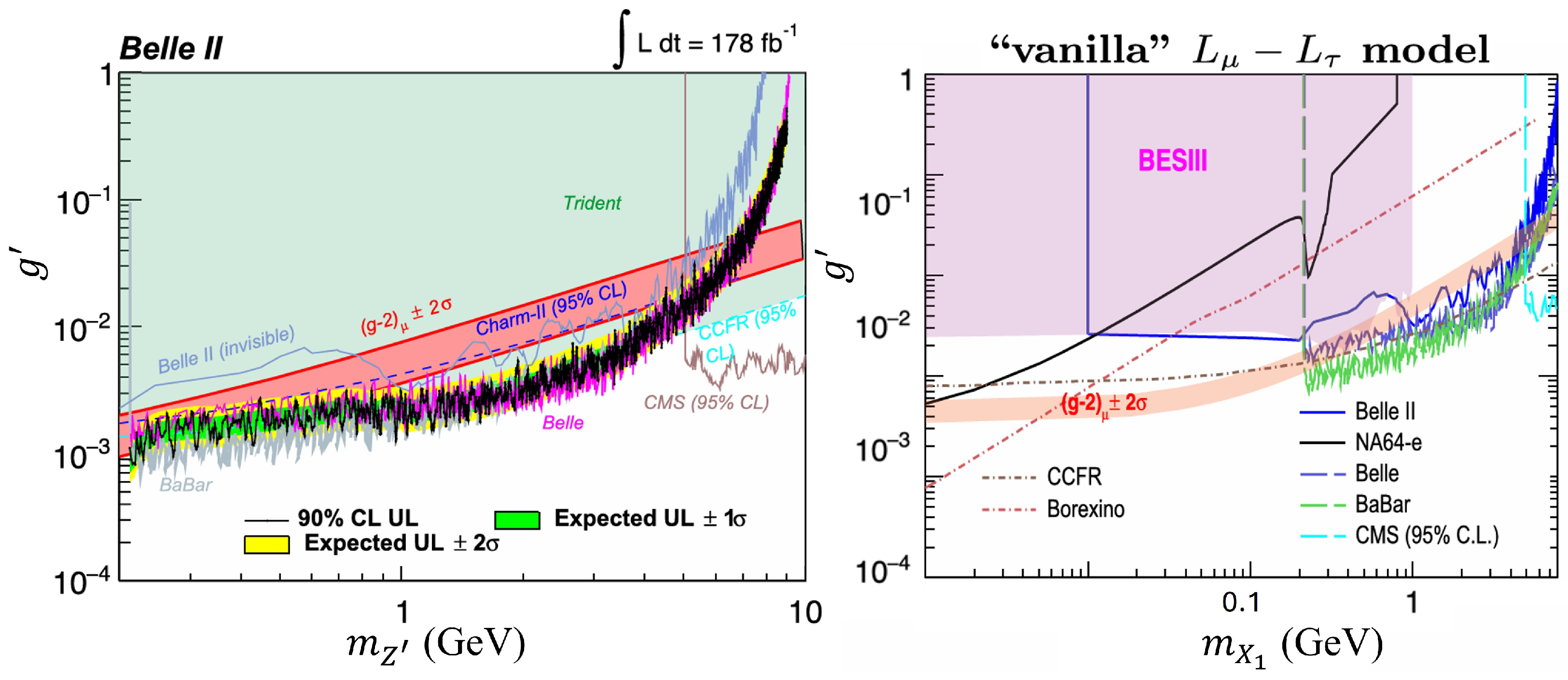
A new type of L μ L τ extension of the SM is desirable to resolve the long-standing muon anomalous magnetic moment [83] and the tensions in flavor observables reported by B-factory experiments [84] and to explain dark matter phenomena and the relic abundance of dark matter [85]. This model gauges the difference between the muon and the τ -lepton number through the introduction of new massive vector ( X 1 ) or leptophilic scalar ( X 0 ) or pseudoscalar bosons [86,87]. X 0 , 1 could also mediate the interactions between the SM and the dark sector. They couple exclusively to second- and third-generation leptons ( μ , ν μ , τ , ν τ ) with coupling strengths g . Experimentally, searches for X 0 , 1 decaying to a pair of muons have been reported by the BaBar [88], CMS [89], Belle [90], and Belle II [91] experiments. The BaBar [88] measurement is more stringent in the low-mass region, as seen in Figure 4 (left). Searches for a light muon-philic scalar X 0 or vector X 1 have been performed via J / ψ μ + μ X 0 , 1 with X 0 , 1 decaying to invisible final states using 10 billion J / ψ events, and null results have been reported [92]. The obtained limits are more stringent than the Belle II measurement in the mass range of 200–860 MeV/ c 2 [92], as seen in Figure 4 (right).
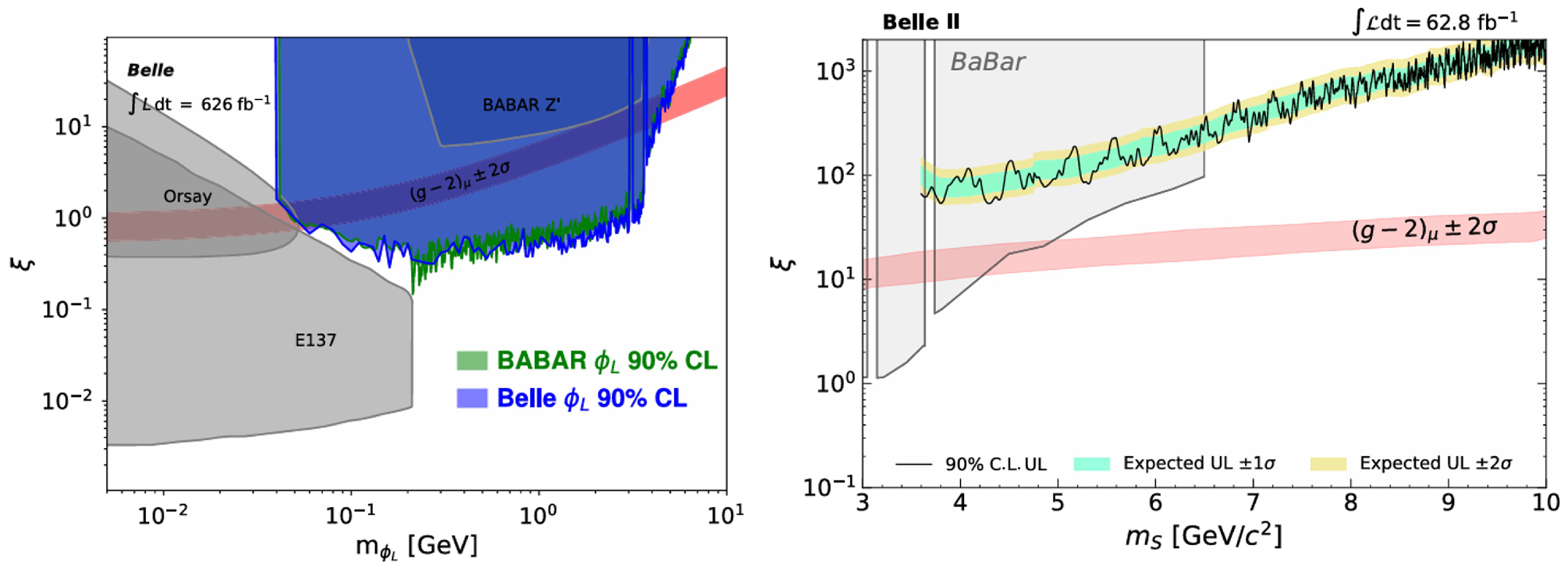
The leptophilic scalar decaying into electrons and muons is constrained by Belle [93] and BaBar [94] up to masses of approximately 6.5 GeV / c 2 , while the leptophilic scalar decaying into a τ -lepton pair is constrained by BaBar/Belle II in e + e μ + μ τ + τ events [95], as shown in Figure 5. These constraints can be used to derive stronger constraints on ( g 2 ) measurements for electrons and muons, as discussed in Ref. [96].

3.4. Search for Dark Baryons

The baryon asymmetry of the Universe (BAU) implies the need for baryogenesis [23,24]. Baryogenesis requires the Sakharov conditions [97]: baryon number violation, violation of charge conjugation C and charge parity C P , and a departure from thermal equilibrium. These conditions are, in principle, compatible with the SM, but current measurements show that the SM does not provide sufficient baryogenesis to explain the observed BAU. The similarity between the dark matter and baryonic energy densities, ρ DM 5.4 ρ baryon , suggests a possible connection between their origins, motivating scenarios in which dark matter carries a non-zero baryon number [98,99]. A baryonic dark sector is further motivated by the long-standing discrepancy between neutron lifetime measurements in beam and bottle experiments, which could be resolved if the neutron decays into dark matter states carrying a baryon number with a branching fraction of order 1 % [100].
The B-mesogenesis mechanism can simultaneously explain both the visible baryon asymmetry and the origin of dark matter [101]. Dark sector antibaryons have been searched for in B meson decays in the BaBar experiment [102,103,104] and, more recently, in invisible decays of the Λ baryon [105] as well as Λ Λ ¯ oscillation [106] in BESIII. Complementary to these searches, hyperon decays offer an additional opportunity to probe baryonic dark matter through final states containing dark baryons, which would manifest as missing energy in the detector.
More recently, a search for baryogenesis and dark matter in B + Λ c + + invisible was performed using 398 fb 1 of data collected at the Υ ( 4 S ) resonance by the BaBar experiment [102,103,104]. The signal was inferred from the distributions of the beam-constrained mass and the invariant mass of the p K π system. No evidence for dark baryon production ψ D was found, and upper limits on B ( B + Λ c + + ψ D ) were set at the 90 % confidence level as a function of the ψ D mass in the range 0 m ψ D 3 GeV .
A search for a dark baryon χ in the two-body decay Ξ π + invisible has recently been performed using approximately 10 7 events from J / ψ Ξ Ξ ¯ + decays, based on the 10 10 J / ψ events collected by the BESIII detector [107]. In this process, Ξ is studied by tagging the recoil Ξ ¯ + , reconstructed via Ξ ¯ + π + Λ ¯ ( p ¯ π + ) . The dark baryon χ is treated as an invisible particle, and the search is performed for assumed masses of 1.07, 1.10, m Λ , 1.13, and 1.16 GeV/ c 2 , where m Λ is the Λ -baryon mass. No significant signal is observed, and 90 % ( 95 % ) CL upper limits on B ( Ξ π + invisible ) are set. The corresponding 95 % CL limits on the left- and right-handed effective operators, parameterized by the Wilson coefficients C u s , s L and C u s , s R , are found to be C u s , s L < 5.5 × 10 2 TeV 2 and C u s , s R < 4.9 × 10 2 TeV 2 , which are more stringent than previous constraints from LHC searches for colored mediators.

4. Axion Portal

An axion is a pseudoscalar Goldstone boson originally introduced through the spontaneous breaking of the Peccei–Quinn symmetry to solve the strong CP problem in QCD [108,109]. Many models beyond the SM also predict axion-like particles (ALPs) [110,111]. The spin parity of these ALPs is the same as that of the QCD axion, but they have arbitrary masses and couplings to SM particles. ALPs are also considered candidates for cold DM and can act as mediators between the SM and DM candidates. Their interactions with SM gauge bosons are typically described using an effective field theory (EFT), where the leading coupling at dimension-5 involves the ALP field a and the gauge field strengths.

4.1. Coupling to Photon Pairs

The interaction of an ALP with two photons is given by the following effective Lagrangian term:
L a γ γ = 1 4 g a γ γ a F μ ν F ˜ μ ν
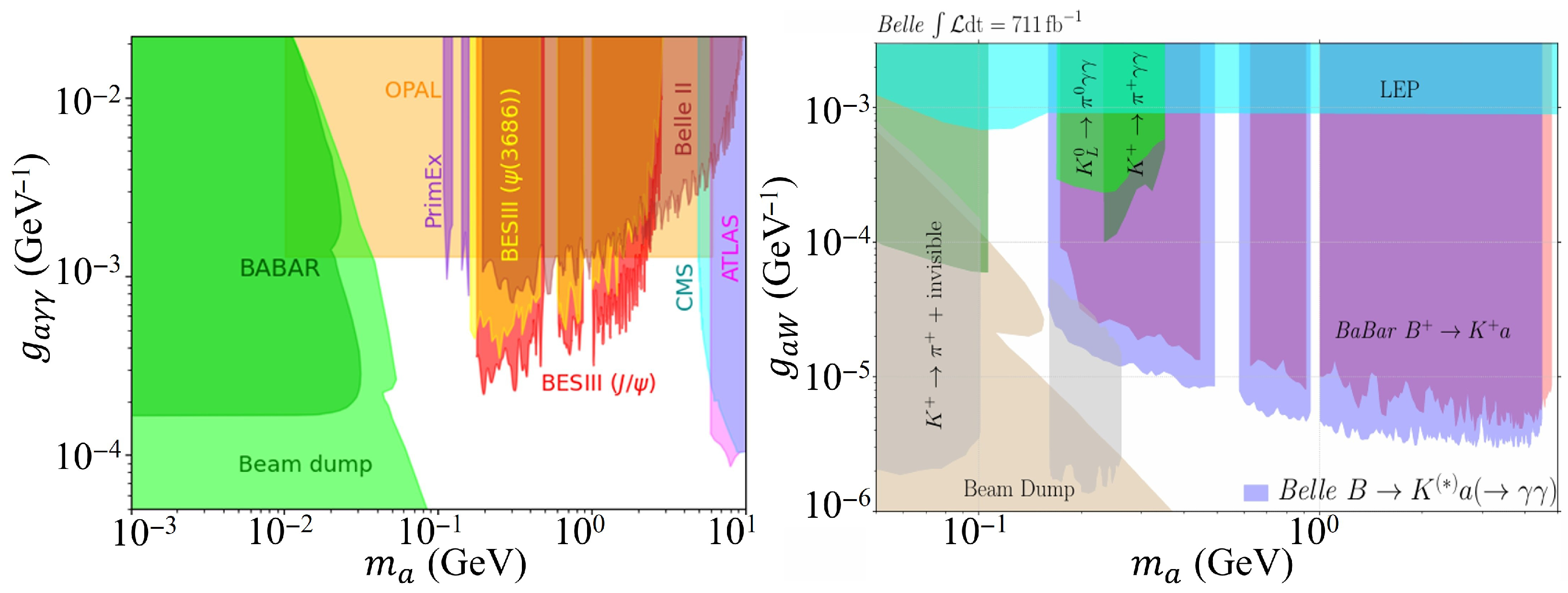
where F μ ν is the electromagnetic field strength tensor, and F ˜ μ ν = 1 2 ϵ μ ν ρ σ F ρ σ is its dual. The coupling g a γ γ can be measured in e + e collider experiments via either the ALP-strahlung process or radiative V meson decays ( V = J / ψ , Υ ( n S ) ) with ( n = 1 , 2 , 3 ). The coupling g a γ γ in the sub-GeV mass range, especially for ALP masses between 0.1 and 5 GeV, is less constrained compared to other regions. In this mass region, the Belle II and OPAL experiments have performed searches for ALPs via the ALP-strahlung process e + e γ a , while BESIII has performed a search via radiative J / ψ γ a decays using 10 billion J / ψ events and 2.7 billion ψ ( 2 S ) events [112,113]. The J / ψ data sample contains about a 4.4 % contribution from the ALP-strahlung process e + e γ a and a 95.6 % contribution from radiative J / ψ decay, along with the dominant SM background from J / ψ γ P ( P = π 0 , η , η ) decays. The search for signal events from the ALP a was conducted by performing a series of fits to the combined di-photon spectrum after removing the backgrounds from J / ψ γ P . No significant signal was found, and BESIII has set one of the most stringent upper limits on g a γ γ in the mass range of [ 0.18 , 2.85 ] GeV [112,113], as seen in Figure 6 (left).

4.2. Coupling to W Bosons

ALPs can also couple to electroweak gauge bosons through the S U ( 2 ) L field strength tensor:
L a W W = 1 4 g a W W a W μ ν i W i μ ν
where W μ ν i is the S U ( 2 ) L field strength tensor, i labels the weak isospin components, and g a W W is the ALP–W boson coupling. After electroweak symmetry breaking, this operator induces interactions of the ALP with the physical W ± bosons. This coupling leads to the production of ALPs at one loop in the process B ± K ± a , where the ALP is emitted from an internal W ± boson. Electroweak symmetry breaking and the resulting gauge–boson mixing also generate an effective ALP coupling to a pair of photons. In specific models, the branching fraction of a γ γ can be nearly 100 % for m a < 2 m e (to avoid other decays) or under specific assumptions, but it is model-dependent. The BaBar and Belle experiments have searched for ALPs in the reactions B ± K ± a and B K * a , respectively, using their data samples collected at the Υ ( 4 S ) resonance, and they reported null results. The Belle limits on the coupling to the W ± boson, g a W W , which range from 3 × 10 6 GeV 1 to 3 × 10 5 GeV 1 , are more stringent than the BaBar limits [114], as seen in Figure 6 (right).

4.3. ALP Signature with Invisible Final State

An ALP may also be involved in charged lepton flavor-violating (CLFV) decays, such as τ l α ( l = e , μ ) [115], where α corresponds to an ALP. CLFV processes can occur in extended SM frameworks that include right-handed neutrinos. Their predicted branching fractions are expected to be at the level of 10 54 . The contribution of ALPs in such CLFV decays may enhance their decay rates up to the level of current experimental sensitivity. The search for an invisible signature of α in τ l α has recently been performed by Belle II using 61.8 fb 1 of data at the Υ ( 4 S ) resonance, resulting in a null observation [116]. The reported 95 % CL upper limits on the branching fractions B ( τ l α ) as a function of the α mass are the most stringent to date, as detailed in Ref. [116]. A signature for an ALP with an invisible final state in the decay J / ψ ϕ + invisible has also been explored by the BESIII experiment, with null results [117].

5. Neutrino Portal

The neutrino portal refers to interactions mediated by gauge-singlet fermions, commonly known as sterile neutrinos, right-handed neutrinos, or heavy neutral leptons (HNLs). The portal interaction is represented by
L portal = y ν L ¯ H N R + h . c . ,
where L is the lepton doublet, H is the Higgs doublet, N R is a right-handed (sterile) neutrino, and y ν is Yukawa coupling.

5.1. Search for Heavy Neutral Leptons

HNLs are additional neutrino states that are massive but neutral under all SM gauge interactions. In the νMSM, introducing three sterile, right-handed Majorana HNLs to the SM can simultaneously explain neutrino oscillations and the origin of the baryon asymmetry of the Universe and provide a dark matter candidate. Two of these HNLs typically have masses in the MeV to GeV range, while the third—acting as a dark matter candidate—has a mass at the keV scale. The HNLs in the MeV–GeV mass range can be produced in semi-leptonic B decays, lepton number-violating (LNV) D decays, hadronic τ decays, and quarkonium decays, leading to possible deviations from SM expectations. Mixing between an HNL mass eigenstate and active neutrinos can be parameterized by an extended Pontecorvo–Maki–Nakagawa–Sakata (PMNS) matrix, with an additional element U 4 , where denotes the SM flavor state e, μ , or τ .
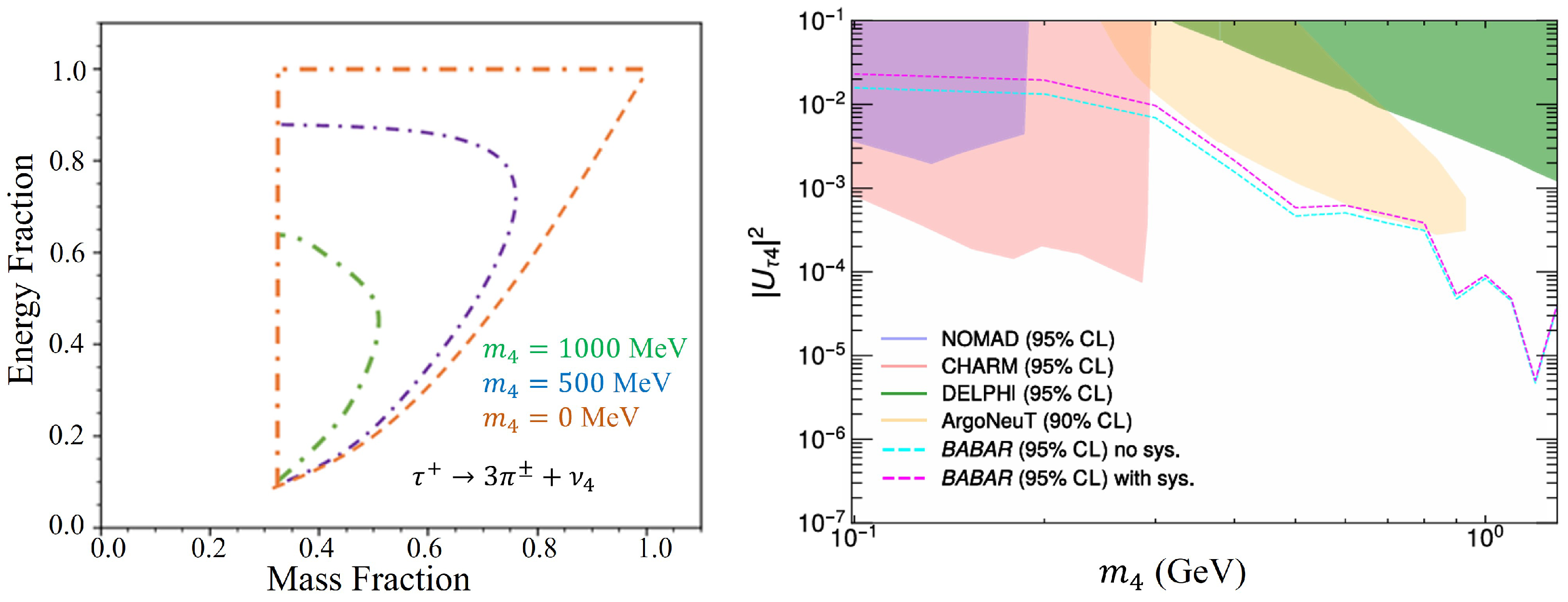
Experimental constraints on the mixing strength between the lepton sector and HNLs in the electron and muon sectors primarily come from LHC experiments in the higher-HNL-mass region. In the low-mass region, the exclusion limits on | U l 4 | 2 mainly come from LNV decays D K π e + e + [118], semi-leptonic B decays [119], and hadronic τ decays [120]. More recently, the BaBar experiment performed a search for an HNL that mixes with the SM τ neutrino, characterized by the mixing parameter | U τ 4 | 2 (the absolute square of the corresponding extended PMNS matrix element), using a data sample of 424 fb 1 . BaBar conducted this study via the process e + e τ + τ , where one τ lepton is tagged through τ + e + ν ν ¯ , and the other decays via τ π π π + ν [121]. This channel allows for sensitivity to HNL masses in the range 100 < m 4 < 1360 MeV / c 2 . In the decay τ π π π + ν , the HNL ν 4 can mix with the SM neutrino. The mass of the missing neutrino m 4 determines the two-dimensional distribution of the hadronic energy E h versus the invariant mass of the hadronic system, as described in Figure 7 (left).
The observed kinematic phase-space distributions of the hadronic system can be interpreted as a superposition of two components: one corresponding to decays mediated by the HNL (weighted by | U τ 4 | 2 ) and one corresponding to SM neutrino decays (weighted by 1 | U τ 4 | 2 ). For a hypothetical mixing with the τ lepton, the total differential decay rate becomes
d Γ ( τ ν h ) d m h d E h Total = | U τ 4 | 2 d Γ ( τ ν h ) d m h d E h HNL + 1 | U τ 4 | 2 d Γ ( τ ν h ) d m h d E h SM .
No significant signal is observed, and upper limits on | U τ 4 | 2 at the 95% confidence level are set, depending on the HNL mass hypothesis shown in Figure 7 (right). These limits range from 2.31 × 10 2 to 5.04 × 10 6 within the mass range 100 < m 4 < 1300 MeV / c 2 , representing the most stringent constraints to date [121].

5.2. Invisible Decays

In the SM, neutrinos are invisible to particle detectors because they interact only via the weak force with extremely small cross-sections. Their presence can be inferred only through the missing four-momentum in a decay. A quarkonium state, composed of a quark (q) and its corresponding antiquark ( q ¯ ), may annihilate into a neutrino pair via a virtual Z 0 boson, but such processes are highly suppressed. The branching fractions of these rare decays could be enhanced in the presence of light dark matter (LDM) particles. Estimates of invisible quarkonium decays often assume a connection between the cross-sections of the time-reversed processes, σ ( q q ¯ χ χ ) σ ( χ χ q q ¯ ) , where χ denotes a generic dark matter particle. Exclusion limits on invisible decays of Υ ( 1 S ) [122], J / ψ [123], B 0 / B S 0 [124,125], η ( ) [126,127], π 0 [46], D 0 [128], ω / ϕ [129] mesons, and the Λ [105] baryon have been reported by several collider experiments. A feasibility study of invisible decays of light vector mesons ( V = ω , ϕ ) in the STCF experiment has revealed that the 90 % CL upper limits on the branching fractions of these decays could reach a level of 10 7 . Sensitivity could further reach a level of 10 8 using a deep-learning-based optimization technique, allowing for tighter constraints on the parameter space of LDM scenarios [130].
More recently, BESIII has reported a search for the FCNC decay K S 0 ν ν ¯ , which can proceed via the s d ν ν ¯ transition. This decay is extremely suppressed due to angular momentum constraints and remains so even if neutrinos have mass, because the required helicity configuration is unfavorable. The SM prediction for B ( K S 0 ν ν ¯ ) is below 10 16 [131]. Therefore, this decay provides a highly sensitive test of the SM. Several new physics scenarios predict enhancements: for example, models such as the Two-Higgs-Doublet Model (2HDM) may raise the branching fraction to the 10 4 level [131], while mirror-matter theories—which postulate a parallel mirror sector—predict invisible branching fractions at the order of 10 6 [132,133]. Invisible K S 0 decays also offer valuable input for tests of charge, parity, and time reversal (CPT) symmetry, since the Bell–Steinberger relation connects possible CPT violations to the amplitudes of all kaon decay channels, assuming no invisible decay mode exists [134].
The first direct search for invisible decays of the K S 0 meson has been performed by the BESIII Collaboration using 10 10 J / ψ events [134]. K S 0 candidates are reconstructed from the decay J / ψ ϕ K S 0 K S 0 , which benefits from low background contamination because the decay J / ψ ϕ K S 0 K L 0 is forbidden by C-parity conservation. No significant signal is observed, and an upper limit on the branching fraction, B ( K S 0 invisible ) < 8.4 × 10 4 , is set at the 90% confidence level for the first time.

6. Discussion

This paper reviews the current experimental status of dark matter searches in various e + e collider experiments. In the sub-GeV mass range, hidden dark sector models allow for the possibility that SM particles couple to dark matter through different portals. The corresponding new physics particles include dark photons, ALPs, light Higgs bosons, and sterile neutrinos. These particles have been searched for by multiple collider experiments, but so far only null results have been observed. The resulting exclusion limits have constrained large portions of the parameter spaces of physics models beyond the SM.
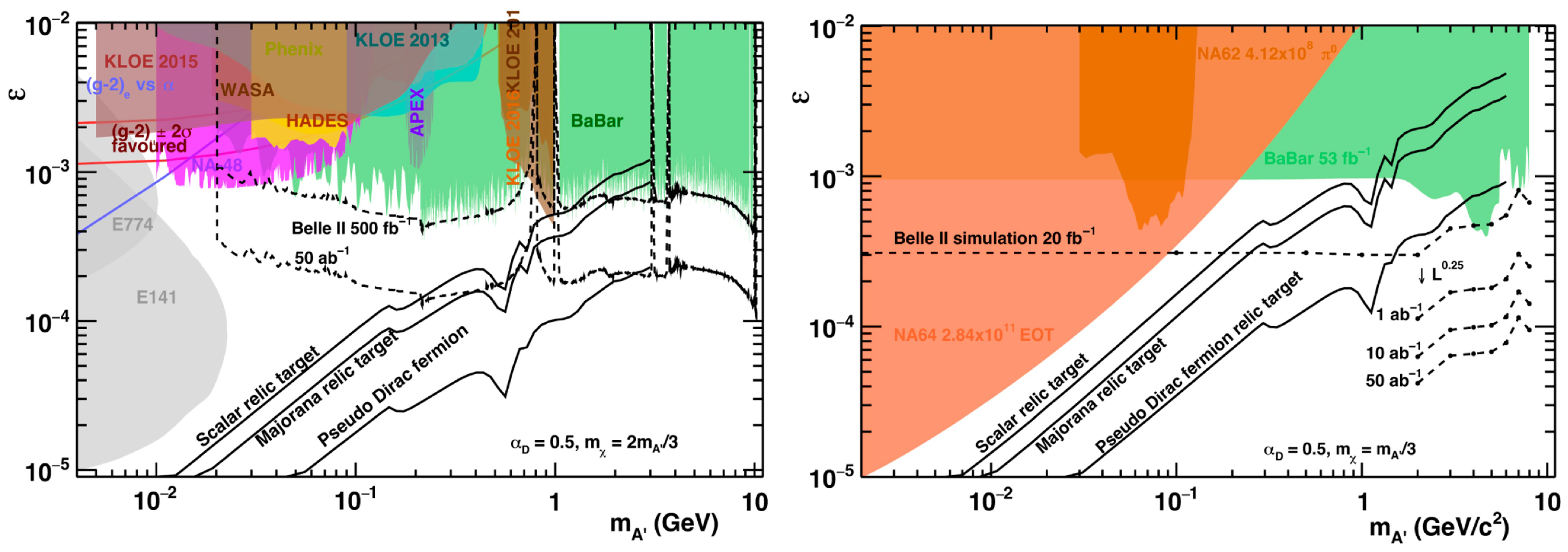
Although Belle II has so far collected only about 1 % of its target integrated luminosity, many of its early results related to the dark sector are already more stringent than those from the preceding B-factory experiments, such as BaBar and Belle. Figure 8 summarizes the projected sensitivity in ϵ for both the visible and invisible dark photon decay modes, together with the dark matter relic density targets, in Belle II [135]. The revised constraints on the ALP–photon coupling g a γ γ in Belle II are discussed in Ref. [136]. The projected sensitivities for various other dark matter searches are discussed in Refs. [137,138]. Therefore, Belle II is expected to play a major role in either discovering or ruling out new physics scenarios associated with dark matter portals.
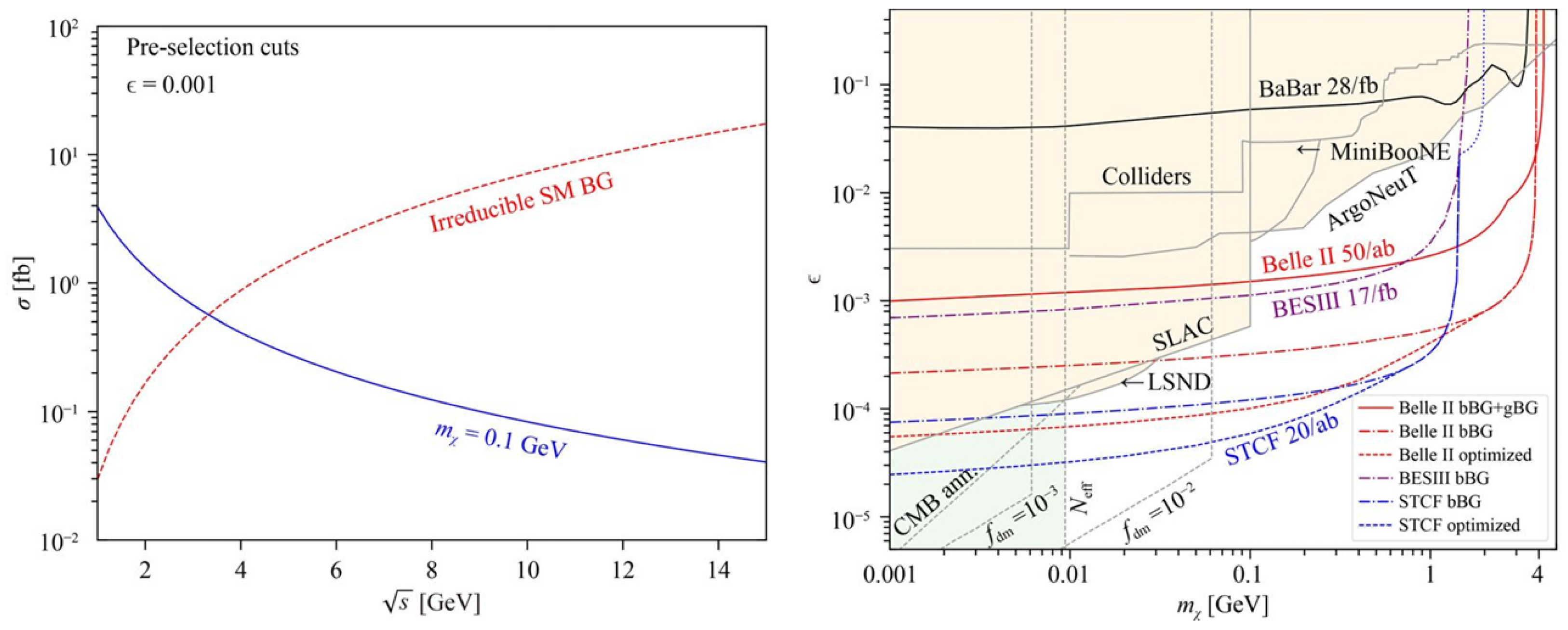
The BESIII experiment has also played a major role in exploring dark sector searches, and its results, particularly for light Higgs bosons and ALPs, remain among the most stringent to date. BESIII has additionally explored invisible decays of light mesons and baryons and reported strong exclusion limits in these channels. Its successor, the STCF, will be capable of either discovering or excluding light dark matter scenarios through searches for invisible decays of light mesons. In addition to exploring various flavors of dark matter particles, the STCF aims to search for millicharged particles, which can arise in hidden sector models via kinetic mixing [36]. The expected mono-photon cross-sections and the corresponding 95% CL upper limits on millicharged particles from the STCF are summarized in Figure 9. Overall, while no signals of dark matter have yet been observed, the e + e collider program continues to play a central role in shaping theoretical expectations and guiding future experimental developments.

7. Conclusions

The hidden dark sector model introduces various types of sub-GeV dark matter particles that can mediate interactions between the SM and the dark sector. One of the main efforts of the current generation of collider experiments is to search for these new physics particles. To date, no statistically significant signals have been observed. The resulting exclusion limits already rule out a large fraction of the parameter space of many new physics models beyond the SM. In the future, the data collected by Belle II and STCF will be able to be used to either discover or exclude these dark matter scenarios. Overall, searches at e + e colliders provide a complementary and robust probe of dark sector models motivated by thermal relic dark matter, independent of astrophysical uncertainties and assumptions.

Funding

This research is funded by the Seed Funding of Jilin University.

Institutional Review Board Statement

Not applicable.

Informed Consent Statement

Not applicable.

Data Availability Statement

This study is a review article. No new data were created or analyzed, and data sharing is not applicable.

Acknowledgments

The author acknowledges that the content of this manuscript is based on published theoretical and experimental results related to dark sector searches.

Conflicts of Interest

The author declares no conflicts of interest.

References

  1. Weinberg, S. A model of leptons. Phys. Rev. Lett. 1967, 19, 1264. [Google Scholar] [CrossRef]
  2. Salam, A. Weak and electromagnetic interactions. In Elementary Particle Theory; Svartholm, N., Ed.; Almquist and Wiksells: Stockholm, Sweden, 1969; p. 367. [Google Scholar]
  3. Glashow, S.L. Partial symmetries of weak interactions. Nucl. Phys. 1961, 22, 579. [Google Scholar] [CrossRef]
  4. Glashow, S.L.; Iliopoulos, J.; Maiani, L. Weak interactions with lepton–hadron symmetry. Phys. Rev. D 1970, 2, 1285. [Google Scholar] [CrossRef]
  5. Higgs, P.W. Broken symmetries, masses particles and gauge fields. Phys. Lett. 1964, 12, 132. [Google Scholar] [CrossRef]
  6. Higgs, P.W. Broken symmetries and the masses of gauge bosons. Phys. Rev. Lett. 1964, 13, 508. [Google Scholar] [CrossRef]
  7. Higgs, P.W. Spontaneous symmetry breakdown without massless bosons. Phys. Rev. 1966, 145, 1156. [Google Scholar] [CrossRef]
  8. Englert, F.; Brout, R. Broken symmetry and the mass of gauge vector mesons. Phys. Rev. Lett. 1964, 13, 321. [Google Scholar] [CrossRef]
  9. Guralnik, G.S.; Hagen, C.R.; Kibble, T.W.B. Global conservation laws and the massless particles. Phys. Rev. Lett. 1964, 13, 585. [Google Scholar] [CrossRef]
  10. Aad, G. et al. [ATLAS Collaboration] Observation of a new particle in the search for the Standard Model Higgs boson with the ATLAS detector at the LHC. Phys. Lett. B 2012, 716, 1. [Google Scholar] [CrossRef]
  11. Chatrchyan, S. et al. [CMS Collaboration] Observation of a new boson at a mass of 125 GeV with the CMS experiment at the LHC. Phys. Lett. B 2012, 716, 30. [Google Scholar] [CrossRef]
  12. Weinberg, S. Baryon- and lepton-nonconserving processes. Phys. Rev. Lett. 1979, 43, 1566. [Google Scholar] [CrossRef]
  13. Pospelov, M. Secluded U(1) below the weak scale. Phys. Rev. D 2009, 80, 095002. [Google Scholar] [CrossRef]
  14. McDonald, A.B. Nobel Lecture: The Sudbury Neutrino Observatory: Observation of flavor change for solar neutrinos. Rev. Mod. Phys. 2016, 88, 030502. [Google Scholar] [CrossRef]
  15. Kajita, T. Nobel Lecture: Discovery of atmospheric neutrino oscillations. Rev. Mod. Phys. 2016, 88, 030501. [Google Scholar] [CrossRef]
  16. Sofue, Y.; Rubin, V. Rotation curves of spiral galaxies. Annu. Rev. Astron. Astrophys. 2001, 39, 137. [Google Scholar] [CrossRef]
  17. Adriani, O.; Barbarino, G.C.; Bazilevskaya, G.A.; Bellotti, R.; Boezio, M.; Bogomolov, E.A.; Bonechi, L.; Bongi, M.; Bonvicini, V.; Bottai, S.; et al. An anomalous positron abundance in cosmic rays with energies 1.5–100 GeV. Nature 2009, 458, 607. [Google Scholar] [CrossRef] [PubMed]
  18. Aguilar, M. et al. [AMS Collaboration] First result from the Alpha Magnetic Spectrometer on the International Space Station: Precision measurement of the positron fraction in primary cosmic rays of 0.5–350 GeV. Phys. Rev. Lett. 2013, 110, 141102. [Google Scholar] [CrossRef]
  19. Chang, J.; Adams, J.H.; Ahn, H.S.; Bashindzhagyan, G.L.; Christl, M.; Ganel, O.; Guzik, T.G.; Isbert, J.; Kim, K.C.; Kuznetsov, E.N.; et al. An excess of cosmic ray electrons at energies of 300–800 GeV. Nature 2008, 456, 362. [Google Scholar] [CrossRef]
  20. Ackermann, M. et al. [Fermi LAT Collaboration] Measurement of separate cosmic-ray electron and positron spectra with the Fermi Large Area Telescope. Phys. Rev. Lett. 2012, 108, 011103. [Google Scholar] [CrossRef]
  21. Aghanim, N. et al. [Planck Collaboration] Planck 2018 results. VI Cosmological paramaters. Astron. Atstrophys. 2020, 641, A6. [Google Scholar] [CrossRef]
  22. Navas, S. et al. [Particle Data Group] The review of particle physics (2025), 2025 update. Phys. Rev. D 2024, 110, 030001. [Google Scholar]
  23. Elor, G.; Escudero, M.; Nelson, A. Baryogenesis and dark matter from B mesons. Phys. Rev. D 2019, 99, 035031. [Google Scholar] [CrossRef]
  24. Alonso-Álvarez, G.; Elor, G.; Escudero, M. Collider signals of baryogenesis and dark matter from B mesons: A roadmap to discovery. Phys. Rev. D 2021, 104, 035028. [Google Scholar] [CrossRef]
  25. Su, J.Y.; Tandean, J. Low-energy probes of light pseudoscalars coupled to gluons. Phys. Rev. D 2020, 101, 035044. [Google Scholar] [CrossRef]
  26. Cicoli, M.; Conlon, J.P.; Quevedo, F. Dark radiation in LARGE volume models. Phys. Rev. D 2013, 87, 043520. [Google Scholar] [CrossRef]
  27. Cacciapaglia, G.; Deandrea, A.; Isnard, W. Hidden supersymmetric dark sectors. Phys. Rev. D 2024, 109, 015024. [Google Scholar] [CrossRef]
  28. Holdom, B. Two U(1)’s and epsilon charge shifts. Phys. Lett. B 1986, 166, 196. [Google Scholar] [CrossRef]
  29. Battaglieri, M.; Belloni, A.; Chou, A.; Cushman, P.; Echenard, B.; Essig, R.; Estrada, J.; Feng, J.L.; Flaugher, B.; Fox, P.J.; et al. US Cosmic Visions: New ideas in dark matter 2017: Community report. arXiv 2017, arXiv:1707.04591. [Google Scholar] [CrossRef]
  30. Essig, R.; Jaros, J.A.; Wester, W.; Adrian, P.H.; Andreas, S.; Averett, T.; Baker, O.; Batell, B.; Battaglieri, M.; Beacham, J.; et al. Dark sectors and new, light, weakly-coupled particles. arXiv 2013, arXiv:1311.0029. [Google Scholar] [CrossRef]
  31. Aubert, B. et al. [BaBar Collaboration] The BaBar detector. Nucl. Instrum. Meth. A 2002, 479, 1. [Google Scholar] [CrossRef]
  32. Kou, E. et al. [Belle II Collaboration] The Belle II physics book. Prog. Theor. Exp. Phys. 2019, 2019, 123C01. [Google Scholar] [CrossRef]
  33. Ablikim, M. et al. [BESIII Collaboration] Future physics programme of BESIII. Chin. Phys. C 2020, 44, 040001. [Google Scholar] [CrossRef]
  34. Costa, J.G.D.; The CEPC Study Group. CEPC conceptual design report: Volume 2—Physics and detector. arxiv 2018, arXiv:1811.10545. [Google Scholar]
  35. Benedikt, M.; Zimmermann, F.; Auchmann, B.; Bartmann, W.; Burnet, J.P.; Carli, C.; Chancé, A.; Craievich, P.; Giovannozzi, M.; Grojean, C.; et al. Future Circular Collider Feasibility Study Report. Eur. Phys. J. C 2025, 85, 1468. [Google Scholar] [CrossRef]
  36. Achasov, M.; Ai, X.C.; An, L.P.; Aliberti, R.; An, Q.; Bai, X.Z.; Bai, Y.; Bakina, O.; Barnyakov, A.; Blinov, V.; et al. STCF conceptual design report: Volume 1—Physics and detector. Front. Phys. 2024, 19, 14701. [Google Scholar] [CrossRef]
  37. Arkani-Hamed, N.; Finkbeiner, D.P.; Slatyer, T.R.; Weiner, N. A theory of dark matter. Phys. Rev. D 2009, 79, 015014. [Google Scholar] [CrossRef]
  38. Dobrescu, B.A. Massless gauge bosons other than the photon. Phys. Rev. Lett. 2005, 94, 151802. [Google Scholar] [CrossRef]
  39. Pan, J.X.; He, M.; He, X.G.; Li, G. Scrutinizing a massless dark photon: Basis independence. Nucl. Phys. B 2020, 953, 114968. [Google Scholar] [CrossRef]
  40. Ruegg, H.; Ruiz-Altaba, M. The Stueckelberg field. Int. J. Mod. Phys. A 2004, 19, 3265. [Google Scholar] [CrossRef]
  41. Li, S.; Yang, J.M.; Zhang, M.; Zhang, Y.; Zhu, R. Unraveling dark Higgs mechanism via dark photon production at an e+e collider. arXiv 2025, arXiv:2506.20208. [Google Scholar] [CrossRef]
  42. Lanfranchi, G.; Pospelov, M.; Schuster, P. The search for feebly interacting particles. Ann. Rev. Nucl. Part. Sci. 2021, 71, 279. [Google Scholar] [CrossRef]
  43. Batell, B.; Pospelov, M.; Ritz, A. Probing a secluded U(1) at B factories. Phys. Rev. D 2009, 79, 115008. [Google Scholar] [CrossRef]
  44. Essig, R.; Schuster, P.; Toro, N. Probing dark forces and light hidden sectors at low-energy e+e colliders. Phys. Rev. D 2009, 80, 015003. [Google Scholar] [CrossRef]
  45. Liu, J.; Weiner, N.; Xue, W. Signals of a light dark force in the galactic center. J. High Energy Phys. 2015, 08, 050. [Google Scholar] [CrossRef]
  46. Cortina Gil, E. et al. [NA62 Collaboration] Search for π0 decays to invisible particles. J. High Energy Phys. 2021, 02, 201. [Google Scholar]
  47. Abrahamyan, S. et al. [APEX Collaboration] Search for a New Gauge Boson in Electron-Nucleus Fixed-Target Scattering by the APEX Experiment. Phys. Rev. Lett. 2011, 107, 191804. [Google Scholar] [CrossRef]
  48. Merkel, H. et al. [A1 Collaboration] Search at the Mainz Microtron for Light Massive Gauge Bosons Relevant for the Muon g-2 Anomaly. Phys. Rev. Lett. 2014, 112, 221802. [Google Scholar] [CrossRef]
  49. Merkel, H. et al. [A1 Collaboration] Search for Light Gauge Bosons of the Dark Sector at the Mainz Microtron. Phys. Rev. Lett. 2011, 106, 251802. [Google Scholar] [CrossRef]
  50. Lees, J.P. et al. [BaBar Collaboration] Search for a dark photon in e+e collisions at BaBar. Phys. Rev. Lett. 2014, 113, 201801. [Google Scholar] [CrossRef]
  51. Ablikim, M. et al. [BESIII Collaboration] Measurement of B(J/ψηe+e) and search for a dark photon. Phys. Rev. D 2019, 99, 012013. [Google Scholar] [CrossRef]
  52. Ablikim, M. et al. [BESIII Collaboration] Study of the Dalitz decay J/ψe+eη. Phys. Rev. D 2019, 99, 012006, Erratum in Phys. Rev. D 2021, 104, 099901. [Google Scholar] [CrossRef]
  53. Ablikim, M. et al. [BESIII Collaboration] Dark photon search in the mass range between 1.5 and 3.4 GeV/c2. Phys. Lett. B 2017, 774, 252. [Google Scholar] [CrossRef]
  54. Anastasi, A. et al. [KLOE-2 Collaboration] Limit on the production of a new vector boson in e+e, Uπ+π with the KLOE experiment. Phys. Lett. B 2016, 757, 356. [Google Scholar] [CrossRef]
  55. Batley, J.R. et al. [NA48 Collaboration] Search for the dark photon in π0 decays. Phys. Lett. B 2015, 746, 178. [Google Scholar] [CrossRef]
  56. Aaij, R. et al. [LHCb Collaboration] Search for A′ → μ+μ decays. Phys. Rev. Lett. 2020, 124, 041801. [Google Scholar] [CrossRef]
  57. Andreev, Y.M. et al. [NA64 Collaboration] Search for Light Dark Matter with NA64 at CERN. Phys. Rev. Lett. 2023, 131, 161801. [Google Scholar] [CrossRef]
  58. Lees, J.P. et al. [BaBar Collaboration] Search for invisible decays of a dark photon produced in e+e collisions at BaBar. Phys. Rev. Lett. 2017, 119, 131804. [Google Scholar] [CrossRef]
  59. Ablikim, M. et al. [BESIII Collaboration] Search for invisible decays of a dark photon using e+e annihilation data at BESIII. Phys. Lett. B 2023, 839, 137785. [Google Scholar] [CrossRef]
  60. Izaguirre, E.; Krnjaic, G.; Shuve, B. Discovering inelastic thermal-relic dark matter at colliders. Phys. Rev. D 2016, 93, 063523. [Google Scholar] [CrossRef]
  61. Izaguirre, E.; Krnjaic, G.; Schustera, P.; Toro, N. Analyzing the Discovery Potential for Light Dark Matter. Phys. Rev. Lett. 2015, 115, 251301. [Google Scholar] [CrossRef]
  62. Aubert, B. et al. [BaBar Collaboration] Search for a Narrow Resonance in e+e- to Four Lepton Final States. arXiv 2009, arXiv:0908.2821. [Google Scholar] [CrossRef]
  63. Ablikim, M. et al. [BESIII Collaboration] Search for a massless particle beyond the Standard Model in the Σ0p + invisible decays. Phys. Lett. B 2024, 852, 138614. [Google Scholar] [CrossRef]
  64. Ablikim, M. et al. [BESIII Collaboration] Search for massless dark photons in Λ c + ′ decay. Phys. Rev. D 2022, 106, 072008. [Google Scholar] [CrossRef]
  65. Ablikim, M. et al. [BESIII Collaboration] Search for a massless dark photon in c decays. Phys. Rev. D 2025, 111, L011103. [Google Scholar] [CrossRef]
  66. Baltrusaitis, R.M. et al. [MARK-III Collaboration] Direct measurement of charmed-D-meson hadronic branching fractions. Phys. Rev. Lett. 1986, 56, 2140. [Google Scholar] [CrossRef]
  67. Delgado, A.; Kolda, C.; Puente, A.D. Solving the little hierarchy problem with a light singlet and supersymmetric mass terms. Phys. Lett. B 2012, 710, 460. [Google Scholar] [CrossRef][Green Version]
  68. Maniatis, M. The next-to-minimal supersymmetric extension of the Standard Model. Int. J. Mod. Phys. A 2010, 25, 3505. [Google Scholar] [CrossRef]
  69. Wilczek, F. Decays of Heavy Vector Mesons into Higgs Particles. Phys. Rev. Lett. 1977, 39, 1304. [Google Scholar] [CrossRef]
  70. Dermisek, R.; Gunion, J.F.; McElrath, B. Probing next-to-minimal-supersymmetric models with minimal fine tuning by searching for decays of the Υ to a light CP-odd Higgs boson. Phys. Rev. D 2007, 76, 051105. [Google Scholar] [CrossRef]
  71. Ablikim, M. et al. [BESIII Collaboration] Search for a CP-odd light Higgs boson in J/ψγA0. Phys. Rev. D 2022, 105, 012008. [Google Scholar] [CrossRef]
  72. Lees, J.P. et al. [BaBar Collaboration] Search for di-muon decays of a low-mass Higgs boson in radiative decays of the Υ(1S). Phys. Rev. D 2013, 87, 031102(R). [Google Scholar] [CrossRef]
  73. Jia, S. et al. [Belle Collaboration] Search for a Light Higgs Boson in Single-Photon Decays of Υ(1S) Using Υ(2S) → π+πΥ(1S) Tagging Method. Phys. Rev. Lett. 2021, 128, 081804. [Google Scholar]
  74. Kolomensky, Y. Searches for Light Higgs Bosons at BaBar. ICHEP 2012 Proceedings. Available online: https://indico.cern.ch/event/181298/contributions/309553/attachments/243619/340902/ichep12$_$kolomensky.pdf (accessed on 6 July 2012).
  75. Ablikim, M. et al. [BESIII Collaboration] Search for a light exotic particle in J/ψ radiative decays. Phys. Rev. D 2012, 85, 092012. [Google Scholar] [CrossRef]
  76. Ablikim, M. et al. [BESIII Collaboration] Search for a light CP-odd Higgs boson in radiative decays of J/ψ. Phys. Rev. D 2016, 93, 052005. [Google Scholar] [CrossRef]
  77. Ablikim, M. et al. [BESIII Collaboration] Search for the decays J/ψγ + invisible. Phys. Rev. D 2020, 101, 112005. [Google Scholar] [CrossRef]
  78. Adachi, I. et al. [Belle II Collaboration] Search for a dark Higgs boson in produced in association with inelastic dark matter at the Belle II experiment. Phys. Rev. Lett. 2025, 135, 131801. [Google Scholar] [CrossRef]
  79. Lees, J.P. et al. [BaBar Collaboration] Search for Low-Mass Dark-Sector Higgs Bosons. Phys. Rev. Lett. 2012, 108, 211801. [Google Scholar] [CrossRef]
  80. Jaegle, I. et al. [Belle Collaboration] Search for the Dark Photon and the Dark Higgs Boson at Belle. Phys. Rev. Lett. 2015, 114, 211801. [Google Scholar] [CrossRef]
  81. Abudinen, F. et al. [Belle II Collaboration] Search for a dark photon and an invisible dark Higgs boson in μ+μ and missing energy final states with the Belle II experiment. Phys. Rev. Lett. 2023, 130, 071804. [Google Scholar] [CrossRef]
  82. Anastasi, A. et al. [KLOE-2 Collaboration] Search for dark Higgsstrahlung in e+eμ+μ and missing energy events with the KLOE experiment. Phys. Lett. B 2015, 747, 365. [Google Scholar] [CrossRef]
  83. Aliberti, R.; Aoyama, T.; Balzani, E.; Bashir, A.; Benton, G.; Bijnens, J.; Biloshytskyi, V.; Blum, T.; Boito, D.; Bruno, M.; et al. The anomalous magnetic moment of the muon in the Standard Model: An update. Phys. Rep. 2025, 1143, 1. [Google Scholar] [CrossRef]
  84. Albrecht, J.; Dyk, D.V.; Langenbruch, C. Flavour anomalies in heavy quark decays. Prog. Part. Nucl. Phys. 2021, 120, 103885. [Google Scholar] [CrossRef]
  85. Foldenauer, P. Light dark matter in a gauged U(1)Lμ−Lτ model. Phys. Rev. D 2019, 99, 035007. [Google Scholar] [CrossRef]
  86. He, X.G.; Joshi, G.C.; Lew, H.; Volkas, R.R. New Z′ phenomenology. Phys. Rev. D 1991, 43, R22(R). [Google Scholar] [CrossRef]
  87. He, X.G.; Joshi, G.C.; Lew, H.; Volkas, R.R. Simplest Z′ model. Phys. Rev. D 1991, 44, 2118. [Google Scholar] [CrossRef]
  88. Lees, J.P. et al. [BaBar Collaboration] Search for a muonic dark force at BaBar. Phys. Rev. D 2016, 94, 011102. [Google Scholar] [CrossRef]
  89. Sirunyan, A.M. et al. [CMS Collaboration] Search for an Lμ − Lτ gauge boson using Z → 4μ events in proton-proton collisions at s = 13 TeV. Phys. Lett. B 2019, 792, 345. [Google Scholar] [CrossRef]
  90. Czank, T. et al. [Belle Collaboration] Search for Z′ → μ+μ in the Lμ − Lτ gauge-symmetric model at Belle. Phys. Rev. D 2022, 106, 012003. [Google Scholar] [CrossRef]
  91. Adachi, I. et al. [Belle II Collaboration] Search for a μ+μ resonance in four-muon final states at Belle II. Phys. Rev. D 2024, 109, 112015. [Google Scholar] [CrossRef]
  92. Ablikim, M. et al. [BESIII Collaboration] Search for a muon-philic X0 or vector X1 via J/ψμ+μ + invisible decays at BESIII. Phys. Rev. D 2024, 109, L031102. [Google Scholar] [CrossRef]
  93. Biswas, D. et al. [Belle Collaboration] Search for a dark leptophilic scalar produced in association with τ+τ pair in e+e annihilation at center-of-mass energies near 10.58 GeV. Phys. Rev. D 2024, 109, 032002. [Google Scholar] [CrossRef]
  94. Lees, J.P. et al. [BaBaR Collaboration] Search for a dark leptophilic scalar in e+e collisions. Phys. Rev. Lett. 2020, 125, 181801. [Google Scholar] [CrossRef]
  95. Adachi, I. et al. [Belle II Collaboration] Search for a τ+τ resonance in e+eμ+μτ+τ events with the Belle II experiment. Phys. Rev. Lett. 2023, 131, 121802. [Google Scholar] [CrossRef] [PubMed]
  96. Cogollo, D.; Torres, Y.M.O.; Queiroz, F.S.; Villamizar, Y.; Saa, Z. Search for sub-GeV scalars in e+e collisions. Eur. Phys. J. C 2025, 85, 1404. [Google Scholar] [CrossRef]
  97. Sakharov, A.D. Violation of CP invariance, C asymmetry, and baryon asymmetry of the universe. JETP Lett. 1967, 6, 24. [Google Scholar]
  98. Petraki, K.; Volkas, R.R. Review of asymmetric dark matter. Int. J. Mod. Phys. A 2013, 28, 1330028. [Google Scholar] [CrossRef]
  99. Zurek, K.M. Asymmetric dark matter: Theories, signatures, and constraints. Phys. Rep. 2014, 537, 91. [Google Scholar] [CrossRef]
  100. Fornal, B.; Grinstein, B. Dark matter interpretation of the neutron decay anomaly. Phys. Rev. Lett. 2018, 120, 191801, Erratum in Phys. Rev. Lett. 2020, 124, 219901. [Google Scholar] [CrossRef]
  101. Nelson, A.E.; Xiao, H. Baryogenesis from B meson oscillations. Phys. Rev. D 2019, 100, 075002. [Google Scholar] [CrossRef]
  102. Lees, J.P. et al. [BaBar Collaboration] Search for B mesogenesis at BaBar. Phys. Rev. D 2023, 107, 092001. [Google Scholar] [CrossRef]
  103. Lees, J.P. et al. [BaBar Collaboration] Search for Evidence of Baryogenesis and Dark Matter in B+ψD + p decays at BaBar. Phys. Rev. Lett. 2023, 131, 201801. [Google Scholar] [CrossRef]
  104. Lees, J.P. et al. [BaBar Collaboration] Search for baryogenesis and dark matter in B+ Λ c + + invisible decays. Phys. Rev. D 2025, 111, L031101. [Google Scholar]
  105. Ablikim, M. et al. [BESIII Collaboration] Search for invisible decays of the Λ baryon. Phys. Rev. D 2022, 105, L071101. [Google Scholar] [CrossRef]
  106. Ablikim, M. et al. [BESIII Collaboration] Search for Λ– Λ ¯ oscillation in J/ψ → Λ Λ ¯ decay. Phys. Rev. D 2025, 111, 052014. [Google Scholar] [CrossRef]
  107. Ablikim, M. et al. [BESIII Collaboration] Search for a dark baryon in the Ξπ + invisible decay. arXiv 2024, arXiv:2505.22140. [Google Scholar]
  108. Weinberg, S. A new light boson? Phys. Rev. Lett. 1978, 40, 223. [Google Scholar] [CrossRef]
  109. Wilczek, F. Problem of strong P and T invariance in the presence of instantons. Phys. Rev. Lett. 1978, 40, 279. [Google Scholar] [CrossRef]
  110. Branco, G.C.; Ferreira, P.M.; Lavoura, L.; Rebelo, M.N.; Sher, M.; Silva, J.P. Theory and phenomenology of two-Higgs-doublet models. Phys. Rep. 2012, 516, 1. [Google Scholar] [CrossRef]
  111. Ringwald, A. Searching for axions and ALPs from string theory. J. Phys. Conf. Ser. 2014, 485, 012013. [Google Scholar] [CrossRef]
  112. Ablikim, M. et al. [BESIII Collaboration] Search for axion-like particles in radiative J/ψ decays. Phys. Lett. B 2023, 838, 137698. [Google Scholar] [CrossRef]
  113. Search for diphoton decays of an axionlike particle in radiative J/ψ decays. Phys. Rev. D 2023, 110, L031101.
  114. Adachi, I. et al. [Belle II Collaboration] Search for an axion-like particle in BK(*)a( → γγ) decays at Belle. arXiv 2025, arXiv:2507.01249. [Google Scholar]
  115. Calibbi, L.; Redigolo, D.; Ziegler, R.; Zupan, J. Looking forward to lepton-flavor-violating ALPs. J. High Energy Phys. 2021, 09, 173. [Google Scholar] [CrossRef]
  116. Adachi, I. et al. [Belle II Collaboration] Search for Lepton-Flavor-Violating τ Decays to a Lepton and an Invisible Boson at Belle II. Phys. Rev. Lett. 2023, 130, 181803. [Google Scholar] [CrossRef] [PubMed]
  117. Ablikim, M. et al. [BESIII Collaboration] Search for Sub-GeV Invisible Particles in Inclusive Decays of J/ψ to ϕ. Phys. Rev. Lett. 2025, 135, 151804. [Google Scholar] [CrossRef]
  118. Ablikim, M. et al. [BESIII Collaboration] Search for heavy Majorana neutrino in lepton number violating decays of DKπe+e+. Phys. Rev. D 2019, 99, 112002. [Google Scholar] [CrossRef]
  119. Liventsev, D. et al. [Belle Collaboration] Search for heavy neutrinos at Belle. Phys. Rev. D 2013, 87, 071102. [Google Scholar] [CrossRef]
  120. Liventsev, D. et al. [Belle Collaboration] Search for heavy neutrino in τ decays at Belle. Phys. Rev. Lett. 2023, 131, 211802. [Google Scholar] [CrossRef] [PubMed]
  121. Lees, J.P. et al. [BaBar Collaboration] Search for heavy neutral leptons using tau lepton decays at BaBar. Phys. Rev. D 2023, 107, 052009. [Google Scholar] [CrossRef]
  122. Aubert, B. et al. [BaBar Collaboration] Search for invisible decays of the Υ(1S). Phys. Rev. Lett. 2009, 103, 251801. [Google Scholar] [CrossRef] [PubMed]
  123. Ablikim, M. et al. [BES Collaboration] Search for the invisible decay of J/ψ in ψ(2S) → π+πJ/ψ. Phys. Rev. Lett. 2008, 100, 192001. [Google Scholar] [CrossRef]
  124. Hsu, C.L. et al. [Belle Collaboration] Search for B0 decays to invisible final states at Belle. Phys. Rev. D 2012, 86, 032002. [Google Scholar] [CrossRef]
  125. Alonso-Álvarez, G.; Abenza, M.E. The first limit on invisible decays of Bs mesons comes from LEP. Eur. Phys. J. C 2024, 84, 553. [Google Scholar] [CrossRef] [PubMed]
  126. Ablikim, M. et al. [BESIII Collaboration] Search for η and η′ invisible decays in J/ψϕη and ϕη′. Phys. Rev. D 2013, 87, 012009. [Google Scholar] [CrossRef]
  127. Ablikim, M. et al. [BES Collaboration] Search for invisible decays of η and η′ in J/ψϕη and ϕη′. Phys. Rev. Lett. 2006, 97, 202002. [Google Scholar] [CrossRef]
  128. Lai, Y.T. et al. [Belle Collaboration] Search for D0 decays to invisible final states at Belle. Phys. Rev. D 2018, 95, 011102. [Google Scholar]
  129. Ablikim, M. et al. [BESIII Collaboration] Search for invisible decays of the ω and ϕ mesons with J/ψ data at BESIII. Phys. Rev. D 2018, 98, 032001. [Google Scholar] [CrossRef]
  130. Available online: https://indico.pnp.ustc.edu.cn/event/4580/contributions/32042/attachments/11770/18351/Invisible_decays_of%20light_mesons.pdf (accessed on 26 November 2025).
  131. Gninenko, S.N. Search for invisible decays of π0, η, η′, KS, and KL: A probe of new physics and tests using the Bell-Steinberger relation. Phys. Rev. D 2015, 91, 015004. [Google Scholar] [CrossRef]
  132. Tan, W. Invisible decays of neutral hadrons. arXiv 2020, arXiv:2006.10746. [Google Scholar] [CrossRef]
  133. Mohapatra, R.N. Dark matter and mirror world. Entropy 2024, 26, 282. [Google Scholar] [CrossRef]
  134. Ablikim, M. et al. [BESIII Collaboration] Search for K S 0 invisible decays. J. High Energy Phys. 2025, 05, 092. [Google Scholar]
  135. Hearty, C.; Pachal, K.; Aitken, B.; Curtin, D.; Diamond, M.; Grewal, J.S.; Hallman, Z.; Miller, C.; Owh, G.; Ren, R.; et al. Accelerator-based dark matter searches. Can. J. Phys. 2025, 103, 8. [Google Scholar] [CrossRef]
  136. Dolan, M.J.; Ferber, T.; Hearty, C.; Kahlhoefer, F.; Hoberg, K.S. Revised constraints and Belle II sensitivity for visible and invisible axion-like particles. J. High Energy Phys. 2017, 12, 094. [Google Scholar] [CrossRef]
  137. Graham, M.; Hearty, C.; Williams, M. Searches for dark photons at Accelerators. Annu. Rev. Nucl. Part Sci. 2021, 71, 37. [Google Scholar] [CrossRef]
  138. Duerr, M.; Ferber, T.; Hearty, C.; Kahlhoefer, F.; Hoberg, K.S.; Tunney, P. Invisible and displaced dark matter signatures at Belle II. J. High Energy Phys. 2020, 02, 039. [Google Scholar] [CrossRef]
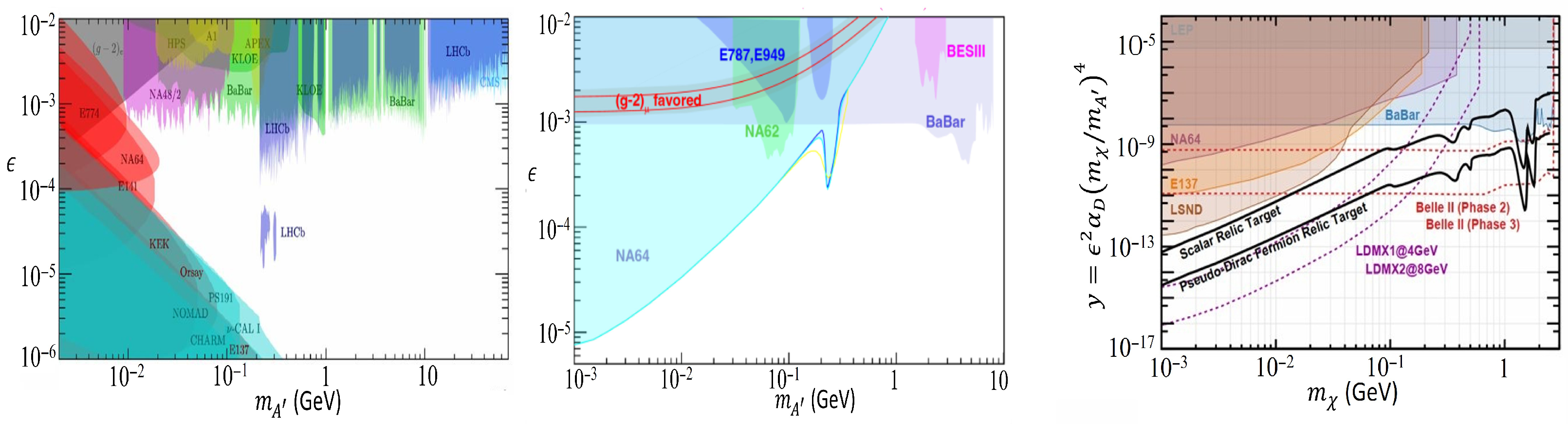
Figure 1. Current exclusion limits on ϵ at the 90% confidence level (CL) as a function of the dark photon mass from various collider experiments for massive dark photons decaying into visible final states (left) and invisible final states (middle). (Right) Exclusion limits on the dimensionless variable y as a function of the dark matter mass m χ , compared with the results from BaBar [58] and other collider experiments, as well as projections from Belle II [32] and other experiments.
Universe 12 00020 g001
Figure 2. (Left) This figure shows 90% CL upper limits on effective coupling operators | C | 2 + | C 5 | 2 from massless dark photon searches via Λ c + p γ , D 0 ω γ , and D 0 γ γ . (Right) This figure also shows 90% CL exclusion limits on the s d axion–fermion effective coupling from Σ + p + invisible (hatched region excluded), compared with existing constraints from K + π + a , K + π + π 0 a , K K ¯ mixing ( Δ m K ), and the CP-violating parameter ϵ K .
Universe 12 00020 g002
Figure 3. (Left) Surviving parameter space in the plane of sin 2 θ A 0 versus m A 0 obtained from various collider experiments. (Middle) Exclusion limits at the 95 % CL in the plane of the sine of the mixing angle θ versus the dark Higgs mass m h , obtained by Belle II [78] and other collider experiments. (Right) Exclusion limits on the dimensionless variable y = ϵ 2 α D ( m χ 1 / m A ) 4 as a function of the dark matter mass m χ 1 , compared with the results from Belle II [78] and other collider experiments.
Universe 12 00020 g003
Figure 4. Current exclusion limits on g at the 90% CL from various collider experiments for a massive dark photon decaying into visible final-state particles (left) and on g for massive X 0 , 1 decaying into invisible final states (right), shown as a function of the leptophilic scalar or vector particle mass in the vanilla L μ L τ model, where the branching fraction B ( X 0 , 1 ν ν ¯ ) varies in the range (33–100)%.
Universe 12 00020 g004
Figure 5. The 90 % CL upper limits on the leptophilic scalar coupling in the e + e τ + τ ϕ L , ϕ L l + l ( l = e , μ ) process (left) and e + e μ + μ S , S τ + τ (right).
Universe 12 00020 g005
Figure 6. The 95 % CL upper limits on the axion–photon coupling g a γ γ (left) and 90 % CL upper limits on the axion–W boson coupling g a W (right) as a function of ALP mass for various collider experiments. In the MeV-GeV ALP mass range, the most stringent upper limits on g a γ γ are mainly set by the BESIII, Belle II, and OPAL experiments. On the other hand, the most stringent upper limits on g a W mainly come from the Belle experiment.
Universe 12 00020 g006
Figure 7. (Left) The hadronic energy versus invariant mass of the hadronic system under different m 4 hypotheses. (Right) The 95 % CL upper limits on | U τ 4 | 2 as a function of m 4 for various collider experiments, including the BaBar measurement [121].
Universe 12 00020 g007
Figure 8. Projected Belle II sensitivity in the kinetic mixing parameter ϵ as a function of the dark photon mass for (left) visible dark photon decays and (right) invisible dark photon decays, together with the dark matter relic density targets.
Universe 12 00020 g008
Figure 9. (Left) Mono-photon cross-sections for millicharged particles (solid) and the SM irreducible background (dashed) as a function of the collision energy. (Right) The expected 95% CL upper limits on millicharged particles from the STCF and other collider experiments.
Universe 12 00020 g009
Disclaimer/Publisher’s Note: The statements, opinions and data contained in all publications are solely those of the individual author(s) and contributor(s) and not of MDPI and/or the editor(s). MDPI and/or the editor(s) disclaim responsibility for any injury to people or property resulting from any ideas, methods, instructions or products referred to in the content.