
Metabolomics-Based Selection of Biostimulant and Biocontrol Microbial Consortia


Abstract
1. Introduction
2. Materials and Methods
2.1. Consortia Preparation
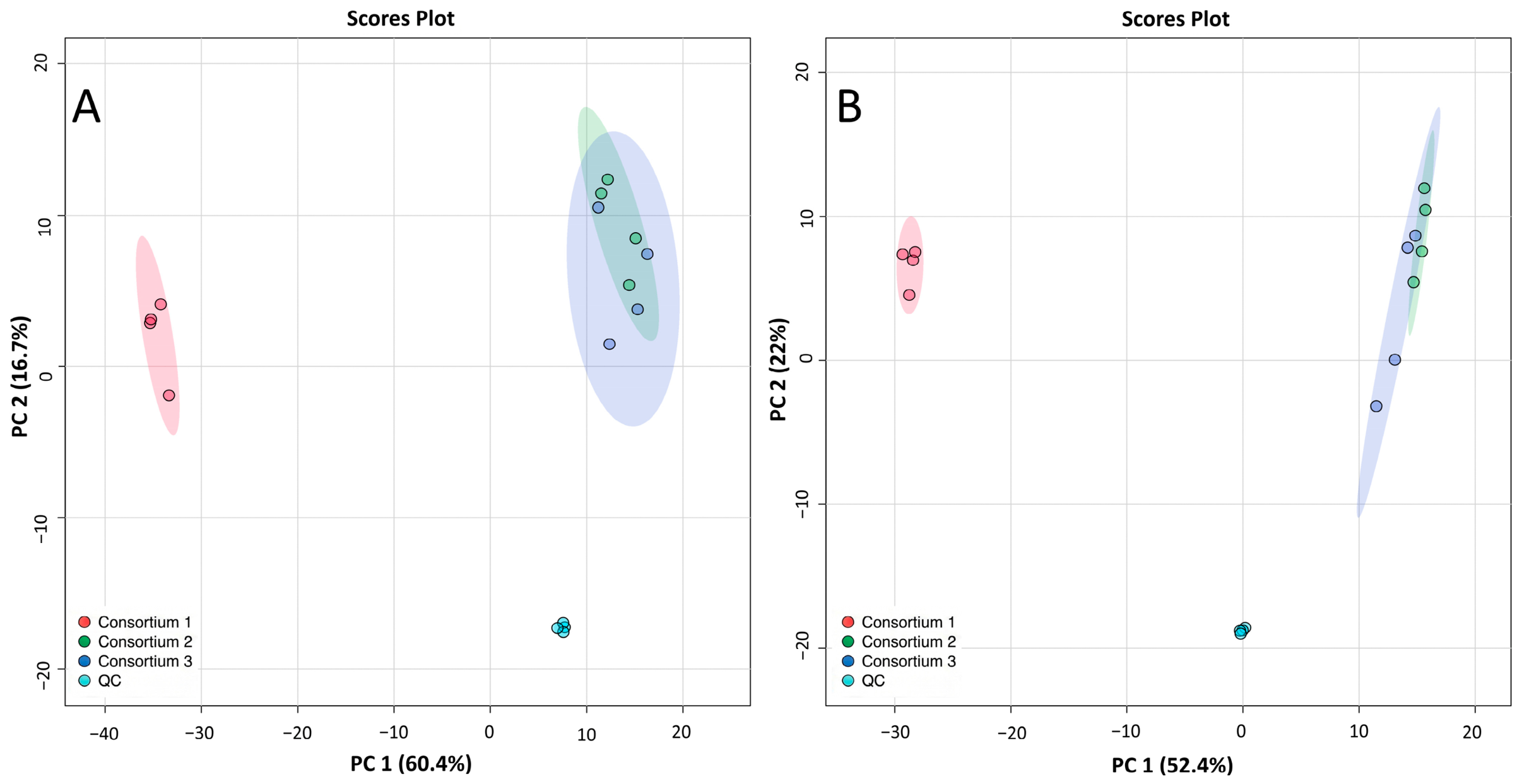
- Consortium 1 (C1)—six bacterial species, Bacillus subtilis TLC, B. velezensis TLC, B. licheniformis TLC, Rhodopseudomonas palustris TLC, ammonia-oxidising bacteria Nitrosomonas europaea TLC, and nitrite-oxidising bacteria Nitrobacter winogradskyi Nb-255. According to various field reports and internal case studies, C1 has increased biofertilization capacity and stimulates growth as a soil-drench application.
- Consortium 2 (C2)—contained only B. subtilis TLC, B. velezensis TLC, and B. licheniformis TLC. According to various field reports and internal case studies, C2 is suitable for foliar applications to promote stress resilience.
- Consortium 3 (C3)—contained only B. subtilis TLC, B. velezensis TLC, and B. licheniformis TLC. Growth medium contained an inducer—a chitin-related polymeric compound. According to various field reports and internal case studies, C3 is suitable for foliar application to ensure plant protection.
2.2. Metabolomic Analysis
2.3. Data Analysis
3. Results
4. Discussion
4.1. Functional Differences of Soil-Drench Consortium C1 and Foliar Consortium C2
4.2. The Addition of an Inducer Shifts the Metabolic Profile of the Bacillus-Only Consortium Further to Biocontrol
5. Conclusions
Supplementary Materials
Author Contributions
Funding
Institutional Review Board Statement
Informed Consent Statement
Data Availability Statement
Conflicts of Interest
Abbreviations
| VOCs | Volatile Organic Compounds |
| PGPB | Plant Growth-Promoting Bacteria |
| FA | Fatty Acid |
| LPC | Lysophosphatidylcholine |
| LPE | Lysophosphatidylethanolamine |
| NAE | N-Hexadecatrienoylethanolamine |
| FC | Fold Change |
References
- Khoulati, A.; Ouahhoud, S.; Taibi, M.; Ezrari, S.; Mamri, S.; Merah, O.; Hakkou, A.; Addi, M.; Maleb, A.; Saalaoui, E. Harnessing biostimulants for sustainable agriculture: Innovations, challenges, and future prospects. Discov. Agric. 2025, 3, 56. [Google Scholar] [CrossRef] [Scilit]
- Mannino, G. Plant-biostimulants interaction: Scientific trends, markets dynamics, and real-world implication. J. Plant Interact. 2025, 20, 2572668. [Google Scholar] [CrossRef] [Scilit]
- Schütz, L.; Gattinger, A.; Meier, M.; Müller, A.; Boller, T.; Mäder, P.; Mathimaran, N. Improving crop yield and nutrient use efficiency via biofertilization—A global meta-analysis. Front. Plant Sci. 2018, 8, 2204. [Google Scholar] [CrossRef] [Scilit] [PubMed]
- Nunes, P.S.O.; Lacerda-Junior, G.V.; Mascarin, G.M.; Guimarães, R.A.; Medeiros, F.H.V.; Arthurs, S.; Bettiol, W. Microbial consortia of biological products: Do they have a future? Biol. Control 2024, 188, 105439. [Google Scholar] [CrossRef] [Scilit]
- Köhl, J. Use of beneficial microorganisms in crop production: Do current regulatory frameworks in the EU fit for purpose? BioControl 2025, 70, 433–450. [Google Scholar] [CrossRef] [Scilit]
- De Diego, N.; Spíchal, L. Presence and future of plant phenotyping approaches in biostimulant research and development. J. Exp. Bot. 2022, 73, 5199–5212. [Google Scholar] [CrossRef] [Scilit] [PubMed]
- Mashabela, M.D.; Terefe, T.; Kerchev, P.; Sitole, L.; Mhlongo, M.I. Next-generation biostimulants: Molecular insights, digital integration, and regulatory frameworks for sustainable agriculture. Front. Plant Sci. 2025, 16, 1710899. [Google Scholar] [CrossRef] [Scilit] [PubMed]
- Ficca, A.G.; Luziatelli, F.; Abou Jaoudé, R.; Ruzzi, M. Integrative genomics and metabolomics analyses provide new insights into the molecular basis of plant growth promotion by Pantoea agglomerans. Microorganisms 2025, 13, 2138. [Google Scholar] [CrossRef] [Scilit] [PubMed]
- García, C.J.; Alacid, V.; Tomás-Barberán, F.A.; García, C.; Palazón, P. Untargeted metabolomics to explore the bacteria exo-metabolome related to plant biostimulants. Agronomy 2022, 12, 1926. [Google Scholar] [CrossRef] [Scilit]
- Nephali, L.; Steenkamp, P.; Burgess, K.; Huyser, J.; Brand, M.; van der Hooft, J.J.J.; Tugizimana, F. Mass spectral molecular networking to profile the metabolome of biostimulant Bacillus strains. Front. Plant Sci. 2022, 13, 920963. [Google Scholar] [CrossRef] [Scilit] [PubMed]
- Mmotla, K.; Allie, F.; Mafuna, T.; Mashabela, M.D.; Mhlongo, M.I. Metabolic reprogramming in PGPR reveals cross-feeding-driven physiological shifts and metabolic adaptations. Front. Microbiol. 2025, 16, 1668025. [Google Scholar] [CrossRef] [Scilit] [PubMed]
- Mmotla, K.; Allie, F.; Mafuna, T.; Mashabela, M.D.; Mhlongo, M.I. Metabolomic profiling of VOC-driven interactions between Priestia megaterium and Bacillus licheniformis in a simulated rhizosphere using split petri dishes. Arch. Microbiol. 2025, 207, 224. [Google Scholar] [CrossRef] [Scilit] [PubMed]
- Grossi Vanacore, M.F.; Sartori, M.; Giordanino, F.; Barros, G.; García, D. Dual role of Bacillus velezensis EM-A8 in maize: Biocontrol of Exserohilum turcicum and enhancement of plant growth. Plants 2025, 14, 3464. [Google Scholar] [CrossRef] [Scilit] [PubMed]
- Figueiredo, J.E.F.; Diniz, G.F.D.; Marins, M.S.; Silva, F.C.; Ribeiro, V.P.; Lanza, F.E.; Oliveira-Paiva, C.A.; Cruz-Magalhães, V. Bacillus velezensis CNPMS-22 as biocontrol agent of pathogenic fungi and plant growth promoter. Front. Microbiol. 2025, 16, 1522136. [Google Scholar] [CrossRef] [Scilit] [PubMed]
- Spantidos, T.-N.; Douka, D.; Katinakis, P.; Venieraki, A. Genomic insights into plant growth promotion and biocontrol of Bacillus velezensis Amfr20, an olive tree endophyte. Horticulturae 2025, 11, 384. [Google Scholar] [CrossRef] [Scilit]
- Pang, Z.; Lu, Y.; Zhou, G.; Hui, F.; Xu, L.; Viau, C.; Spigelman, A.F.; MacDonald, P.E.; Wishart, D.S.; Li, S.; et al. MetaboAnalyst 6.0: Towards a unified platform for metabolomics data processing, analysis and interpretation. Nucleic Acids Res. 2024, 52, W398–W406. [Google Scholar] [CrossRef] [Scilit] [PubMed]
- Khan, M.Y.; Nadeem, S.M.; Sohaib, M.; Waqas, M.R.; Alotaibi, F.; Ali, L.; Zahir, Z.A.; Al-Barakah, F.N.I. Potential of plant growth promoting bacterial consortium for improving the growth and yield of wheat under saline conditions. Front. Microbiol. 2022, 13, 958522. [Google Scholar] [CrossRef] [Scilit] [PubMed]
- Habibi, S.; Yokoyama, T.; Haidari, M.D.; Torii, A.; Yasuda, M.; Ohkama-Ohtsu, N. Analyzing single and combined cultures of plant growth-promoting rhizobacteria isolates from Afghanistan as a potential biofertilizer for rice growth and development. Agriculture 2023, 13, 2252. [Google Scholar] [CrossRef] [Scilit]
- Saleem, M.; Nawaz, F.; Hussain, M.B.; Ikram, R.M. Comparative effects of individual and consortia plant growth promoting bacteria on physiological and enzymatic mechanisms to confer drought tolerance in maize (Zea mays L.). J. Soil Sci. Plant Nutr. 2021, 21, 3461–3476. [Google Scholar] [CrossRef] [Scilit]
- Olanrewaju, O.S.; Babalola, O.O. Bacterial consortium for improved maize (Zea mays L.) production. Microorganisms 2019, 7, 519. [Google Scholar] [CrossRef] [Scilit] [PubMed]
- Wang, H.; Wang, Z.; Xu, W.; Wang, K. Comprehensive transcriptomic and proteomic analyses identify intracellular targets for myriocin to induce Fusarium oxysporum f. sp. niveum cell death. Microb. Cell Fact. 2021, 20, 69. [Google Scholar] [CrossRef] [Scilit] [PubMed]
- Bradáčová, K.; Florea, A.S.; Bar-Tal, A.; Minz, D.; Yermiyahu, U.; Shawahna, R.; Kraut-Cohen, J.; Zolti, A.; Erel, R.; Dietel, K.; et al. Microbial consortia versus single-strain inoculants: An advantage in PGPM-assisted tomato production? Agronomy 2019, 9, 105. [Google Scholar] [CrossRef] [Scilit]
- Leporino, M.; Rouphael, Y.; Bonini, P.; Colla, G.; Cardarelli, M. Protein hydrolysates enhance recovery from drought stress in tomato plants: Phenomic and metabolomic insights. Front. Plant Sci. 2024, 15, 1357316. [Google Scholar] [CrossRef] [Scilit] [PubMed]
- Agarwal, P.; Fischer, H.D.; Camalle, M.D.; Skirycz, A. Not to be overlooked: Dipeptides and their role in plant stress resilience. J. Exp. Bot. 2025, 76, 5738–5747. [Google Scholar] [CrossRef] [Scilit] [PubMed]
- Minen, R.I.; Thirumalaikumar, V.P.; Skirycz, A. Proteinogenic dipeptides, an emerging class of small-molecule regulators. Curr. Opin. Plant Biol. 2023, 75, 102395. [Google Scholar] [CrossRef] [Scilit] [PubMed]
- Pan, X.; Elsayed, S.S.; van Wezel, G.P.; Raaijmakers, J.M.; Carrión, V.J. Disentangling the molecular mechanisms of disease suppression by endophytic Flavobacterium sp. 98. Microbiol. Res. 2026, 304, 128415. [Google Scholar] [CrossRef] [Scilit] [PubMed]
- Begum, M.A.; Shi, X.-X.; Tan, Y.; Zhou, W.-W.; Hannun, Y.A.; Obeid, L.M.; Mao, C.; Zhu, Z.-R. Molecular characterization of rice OsLCB2a1 gene and functional analysis of its role in insect resistance. Front. Plant Sci. 2016, 7, 1789. [Google Scholar] [CrossRef] [Scilit] [PubMed]
- Nozawa, K.; Yamada, M.; Tsuda, Y.; Kawai, K.; Nakajima, S. Antifungal activity of oosponol, oospolactone, phyllodulcin, hydrangenol, and some other related compounds. Chem. Pharm. Bull. 1981, 29, 2689–2691. [Google Scholar] [CrossRef] [Scilit] [PubMed]
- Zhou, H.; Zhang, J.; Bai, L.; Liu, J.; Li, H.; Hua, J.; Luo, S. Chemical structure diversity and extensive biological functions of specialized metabolites in rice. Int. J. Mol. Sci. 2023, 24, 17053. [Google Scholar] [CrossRef] [Scilit] [PubMed]
- Noh, S.W.; Seo, R.; Park, J.-K.; Manir, M.M.; Park, K.; Sang, M.K.; Moon, S.-S.; Jung, H.W. Cyclic dipeptides from Bacillus vallismortis BS07 require key components of plant immunity to induce disease resistance in Arabidopsis against Pseudomonas infection. Plant Pathol. J. 2017, 33, 402–409. [Google Scholar] [CrossRef] [Scilit] [PubMed]
- Solís-Ortiz, C.S.; Peña-Uribe, C.A.; Maya-Gómez, M.; González-López, O.; Calderón-Vázquez, C.L.; García-Pineda, E.; Campos-García, J.; Reyes de la Cruz, H. Bacterial cyclodipeptides elicit Arabidopsis thaliana immune responses reducing the pathogenic effects of Pseudomonas aeruginosa PAO1 strains on plant development. J. Plant Physiol. 2022, 275, 153742. [Google Scholar] [CrossRef] [Scilit] [PubMed]
- Song, G.C.; Choi, H.K.; Kim, Y.S.; Choi, J.S.; Ryu, C.-M. Seed defense biopriming with bacterial cyclodipeptides triggers immunity in cucumber and pepper. Sci. Rep. 2017, 7, 14209. [Google Scholar] [CrossRef] [Scilit] [PubMed]
- Kim, J.; Kim, J.-C.; Sang, M.K. Identification of isomeric cyclo(leu-pro) produced by Pseudomonas sesami BC42 and its differential antifungal activities against Colletotrichum orbiculare. Front. Microbiol. 2023, 14, 1230345. [Google Scholar] [CrossRef] [Scilit] [PubMed]
- Zhai, Y.; Shao, Z.; Cai, M.; Zheng, L.; Li, G.; Yu, Z.; Zhang, J. Cyclo(l-Pro–l-Leu) of Pseudomonas putida MCCC 1A00316 isolated from Antarctic soil: Identification and characterization of activity against Meloidogyne incognita. Molecules 2019, 24, 768. [Google Scholar] [CrossRef] [Scilit] [PubMed]
- Yan, P.-S.; Song, Y.; Sakuno, E.; Nakajima, H.; Nakagawa, H.; Yabe, K. Cyclo(l-leucyl-l-prolyl) produced by Achromobacter xylosoxidans inhibits aflatoxin production by Aspergillus parasiticus. Appl. Environ. Microbiol. 2004, 70, 7466–7473. [Google Scholar] [CrossRef] [Scilit] [PubMed]
- Ali, U.; Lu, S.; Fadlalla, T.; Iqbal, S.; Yue, H.; Yang, B.; Hong, Y.; Wang, X.; Guo, L. The functions of phospholipases and their hydrolysis products in plant growth, development and stress responses. Prog. Lipid Res. 2022, 86, 101158. [Google Scholar] [CrossRef] [Scilit] [PubMed]
- Amaro, A.L.; Almeida, D.P.F. Lysophosphatidylethanolamine effects on horticultural commodities: A review. Postharvest Biol. Technol. 2013, 78, 92–102. [Google Scholar] [CrossRef] [Scilit]
- Gross, I.; Durner, J. In search of enzymes with a role in 3′,5′-cyclic guanosine monophosphate metabolism in plants. Front. Plant Sci. 2016, 7, 576. [Google Scholar] [CrossRef] [Scilit] [PubMed]
- Nan, W.; Wang, X.; Yang, L.; Hu, Y.; Wei, Y.; Liang, X.; Mao, L.; Bi, Y. Cyclic GMP is involved in auxin signalling during Arabidopsis root growth and development. J. Exp. Bot. 2014, 65, 1571–1583. [Google Scholar] [CrossRef] [Scilit] [PubMed]
- Bibi, G.; Shafique, I.; Ali, S.; Ahmad, R.; Shah, M.M.; Naqvi, T.A.; Zeb, I.; Maathuis, F.J.M.; Hussain, J. Cyclic guanosine monophosphate improves salt tolerance in Solanum lycopersicum. J. Plant Res. 2024, 137, 111–124. [Google Scholar] [CrossRef] [Scilit] [PubMed]
- Bhavanam, S.; Stout, M. Seed treatment with jasmonic acid and methyl jasmonate induces resistance to insects but reduces plant growth and yield in rice, Oryza sativa. Front. Plant Sci. 2021, 12, 691768. [Google Scholar] [CrossRef] [Scilit] [PubMed]
- Gao, M.; Hao, Z.; Ning, Y.; He, Z. Revisiting growth–defence trade-offs and breeding strategies in crops. Plant Biotechnol. J. 2024, 22, 1198–1205. [Google Scholar] [CrossRef] [Scilit] [PubMed]
- Ku, Y.S.; Liao, Y.J.; Chiou, S.P.; Lam, H.M.; Chan, C. From trade-off to synergy: Microbial insights into enhancing plant growth and immunity. Plant Biotechnol. J. 2024, 22, 2461–2471. [Google Scholar] [CrossRef] [Scilit] [PubMed]
- Forde, B.G. Glutamate signalling in roots. J. Exp. Bot. 2014, 65, 779–787. [Google Scholar] [CrossRef] [Scilit] [PubMed]
- Asgher, M.; Sehar, Z.; Rehaman, A.; Rashid, S.; Ahmed, S.; Per, T.S.; Alyemeni, M.N.; Khan, N.A. Exogenously-applied L-glutamic acid protects photosynthetic functions and enhances arsenic tolerance through increased nitrogen assimilation and antioxidant capacity in rice (Oryza sativa L.). Environ. Pollut. 2022, 301, 119008. [Google Scholar] [CrossRef] [Scilit] [PubMed]
- Sun, C.; Jin, L.; Cai, Y.; Huang, Y.; Zheng, X.; Yu, T. L-Glutamate treatment enhances disease resistance of tomato fruit by inducing the expression of glutamate receptors and the accumulation of amino acids. Food Chem. 2019, 293, 263–270. [Google Scholar] [CrossRef] [Scilit] [PubMed]
- Kadotani, N.; Akagi, A.; Takatsuji, H.; Miwa, T.; Igarashi, D. Exogenous proteinogenic amino acids induce systemic resistance in rice. BMC Plant Biol. 2016, 16, 60. [Google Scholar] [CrossRef] [Scilit] [PubMed]
- Takeuchi, K.; Ogiso, M.; Morohoshi, T.; Seo, S. Glutamate positively regulates chitinase activity and the biocontrol efficacy of Pseudomonas protegens. Mol. Plant-Microbe Interact. 2023, 36, 323–333. [Google Scholar] [CrossRef] [Scilit] [PubMed]
- Alexandersson, E.; Mulugeta, T.; Lankinen, Å.; Liljeroth, E.; Andreasson, E. Plant resistance inducers against pathogens in Solanaceae species—From molecular mechanisms to field application. Int. J. Mol. Sci. 2016, 17, 1673. [Google Scholar] [CrossRef] [Scilit] [PubMed]
- Finiti, I.; de la O Leyva, M.; Vicedo, B.; Gómez-Pastor, R.; López-Cruz, J.; García-Agustín, P.; Real, M.D.; González-Bosch, C. Hexanoic acid protects tomato plants against Botrytis cinerea by priming defence responses and reducing oxidative stress. Mol. Plant Pathol. 2014, 15, 550–562. [Google Scholar] [CrossRef] [Scilit] [PubMed]
- Scalschi, L.; Vicedo, B.; Camañes, G.; Fernández-Crespo, E.; Lapeña, L.; González-Bosch, C.; García-Agustín, P. Hexanoic acid is a resistance inducer that protects tomato plants against Pseudomonas syringae by priming the jasmonic acid and salicylic acid pathways. Mol. Plant Pathol. 2013, 14, 342–355. [Google Scholar] [CrossRef] [Scilit] [PubMed]
- Llorens, E.; Fernández-Crespo, E.; Vicedo, B.; Lapeña, L.; García-Agustín, P. Enhancement of the citrus immune system provides effective resistance against Alternaria brown spot disease. J. Plant Physiol. 2013, 170, 146–154. [Google Scholar] [CrossRef] [Scilit] [PubMed]
- Llorens, E.; Scalschi, L.; Fernández-Crespo, E.; Lapeña, L.; García-Agustín, P. Hexanoic acid provides long-lasting protection in ‘Fortune’ mandarin against Alternaria alternata. Physiol. Mol. Plant Pathol. 2015, 91, 38–45. [Google Scholar] [CrossRef] [Scilit]
- Fernández-Crespo, E.; Navarro, J.A.; Serra-Soriano, M.; Finiti, I.; García-Agustín, P.; Pallás, V.; González-Bosch, C. Hexanoic acid treatment prevents systemic MNSV movement in Cucumis melo plants by priming callose deposition correlating SA and OPDA accumulation. Front. Plant Sci. 2017, 8, 1793. [Google Scholar] [CrossRef] [Scilit] [PubMed]
- Axel, C.; Brosnan, B.; Zannini, E.; Peyer, L.C.; Furey, A.; Coffey, A.; Arendt, E.K. Antifungal activities of three different Lactobacillus species and their production of antifungal carboxylic acids in wheat sourdough. Appl. Microbiol. Biotechnol. 2016, 100, 1701–1711. [Google Scholar] [CrossRef] [Scilit] [PubMed]
- Byrne, M.B.; Thapa, G.; Doohan, F.M.; Burke, J.I. Lactic acid bacteria as potential biocontrol agents for Fusarium head blight disease of spring barley. Front. Microbiol. 2022, 13, 912632. [Google Scholar] [CrossRef] [Scilit] [PubMed]
- Vasundaradevi, R.; Sarvajith, M.; Somashekaraiah, R.; Gunduraj, A.; Sreenivasa, M.Y. Antagonistic properties of Lactiplantibacillus plantarum MYSVB1 against Alternaria alternata: A putative probiotic strain isolated from the banyan tree fruit. Front. Microbiol. 2024, 15, 1322758. [Google Scholar] [CrossRef] [Scilit] [PubMed]
- Wu, H.-S.; Liu, Y.-D.; Zhao, G.-M.; Chen, X.-Q.; Yang, X.-N.; Zhou, X.-D. Succinic acid inhibited growth and pathogenicity of in vitro soil-borne fungus Fusarium oxysporum f. sp. niveum. Acta Agric. Scand. Sect. B—Soil Plant Sci. 2011, 61, 404–409. [Google Scholar] [CrossRef] [Scilit]
- Wang, N.; Ping, L.; Mei, X.; Zhang, Y.; Zhang, Y.; Yang, X.; Guo, Y.; Gao, Y.; Xu, Y.; Shen, Q.; et al. Succinic acid reduces tomato bacterial wilt disease by recruiting Sphingomonas sp. Environ. Microbiome 2025, 20, 85. [Google Scholar] [CrossRef] [Scilit] [PubMed]
- Yan, F.; Ma, J.; Peng, M.; Xi, C.; Chang, S.; Yang, Y.; Tian, S.; Zhou, B.; Liu, T. Lactic acid induced defense responses in tobacco against Phytophthora nicotianae. Sci. Rep. 2024, 14, 9338. [Google Scholar] [CrossRef] [Scilit] [PubMed]
- Lee, S.-M.; Kim, S.-K.; Heo, H.; Choi, S.H.; Kwon, C.; Park, J.; Lee, G.; Lee, T.K.; Ryu, C.-M. D-Lactic acid secreted by Chlorella fusca primes pattern-triggered immunity against Pseudomonas syringae in Arabidopsis. Plant J. 2020, 102, 761–778. [Google Scholar] [CrossRef] [Scilit] [PubMed]
- Zhou, M.; Li, P.; Wu, S.; Zhao, P.; Gao, H. Bacillus subtilis CF-3 volatile organic compounds inhibit Monilinia fructicola growth in peach fruit. Front. Microbiol. 2019, 10, 1804. [Google Scholar] [CrossRef] [Scilit] [PubMed]
- Song, G.; Du, S.; Sun, H.; Liang, Q.; Wang, H.; Yan, M.; Zhang, J. Antifungal mechanism of (E)-2-hexenal against Botrytis cinerea growth revealed by transcriptome analysis. Front. Microbiol. 2022, 13, 951751. [Google Scholar] [CrossRef] [Scilit] [PubMed]
- Yuan, X.; Meng, K.; Shi, S.; Wu, Y.; Chen, X.; OuYang, Q.; Tao, N. Trans-2-hexenal inhibits the growth of imazalil-resistant Penicillium digitatum Pdw03 and delays green mold in postharvest citrus. Postharvest Biol. Technol. 2023, 199, 112304. [Google Scholar] [CrossRef] [Scilit]
- Shao, J.; Pei, Z.; Jing, H.; Wang, L.; Jiang, C.; Du, X.; Jiang, C.; Lou, Z.; Wang, H. Antifungal activity of myriocin against Fusarium graminearum and its inhibitory effect on deoxynivalenol production in wheat grains. Physiol. Mol. Plant Pathol. 2021, 114, 101635. [Google Scholar] [CrossRef] [Scilit]
- Fei, B.; Liu, J.; Mao, B.; Wang, R.; Meng, Y.; Huang, H.; Lu, X.; Zhao, F.; Duan, Y. Effects of exogenous spermidine on germination and seedling growth of rice under salt stress: Physiological and transcriptomic insights. Curr. Issues Mol. Biol. 2025, 47, 946. [Google Scholar] [CrossRef] [Scilit] [PubMed]
- Gholizadeh, F.; Janda, T.; Gondor, O.K.; Pál, M.; Szalai, G.; Sadeghi, A.; Turkoglu, A. Improvement of drought tolerance by exogenous spermidine in germinating wheat (Triticum aestivum L.) plants is accompanied with changes in metabolite composition. Int. J. Mol. Sci. 2022, 23, 9047. [Google Scholar] [CrossRef] [Scilit] [PubMed]
- Augustyniak, B.; Wojtasik, W.; Sawuła, A.; Burgberger, M.; Kulma, A. Spermidine treatment limits the development of the fungus in flax shoots by suppressing polyamine metabolism and balanced defence reactions, thus increasing flax resistance to fusariosis. Front. Plant Sci. 2025, 16, 1561203. [Google Scholar] [CrossRef] [Scilit] [PubMed]
- Dong, X.; Ma, X.; Zhao, Z.; Ma, M. Exogenous betaine enhances salt tolerance of Glycyrrhiza uralensis through multiple pathways. BMC Plant Biol. 2024, 24, 165. [Google Scholar] [CrossRef] [Scilit] [PubMed]
- Lavanya, N.S.; Amruthesh, N.K. Glycine betaine mediated disease resistance against Sclerospora graminicola in pearl millet. J. Appl. Biol. Biotechnol. 2017, 5, 45–51. [Google Scholar] [CrossRef] [Scilit]
- Xuan, T.D.; Khang, D.T. Effects of exogenous application of protocatechuic acid and vanillic acid to chlorophylls, phenolics and antioxidant enzymes of rice (Oryza sativa L.) in submergence. Molecules 2018, 23, 620. [Google Scholar] [CrossRef] [Scilit] [PubMed]
- Klein, A.; Keyster, M.; Ludidi, N. Response of soybean nodules to exogenously applied caffeic acid during NaCl-induced salinity. South Afr. J. Bot. 2015, 96, 13–18. [Google Scholar] [CrossRef] [Scilit]
- Wan, Y.-Y.; Zhang, Y.; Zhang, L.; Zhou, Z.-Q.; Li, X.; Shi, Q.; Wang, X.-J.; Bai, J.-G. Caffeic acid protects cucumber against chilling stress by regulating antioxidant enzyme activity and proline and soluble sugar contents. Acta Physiol. Plant. 2015, 37, 1706. [Google Scholar] [CrossRef] [Scilit]



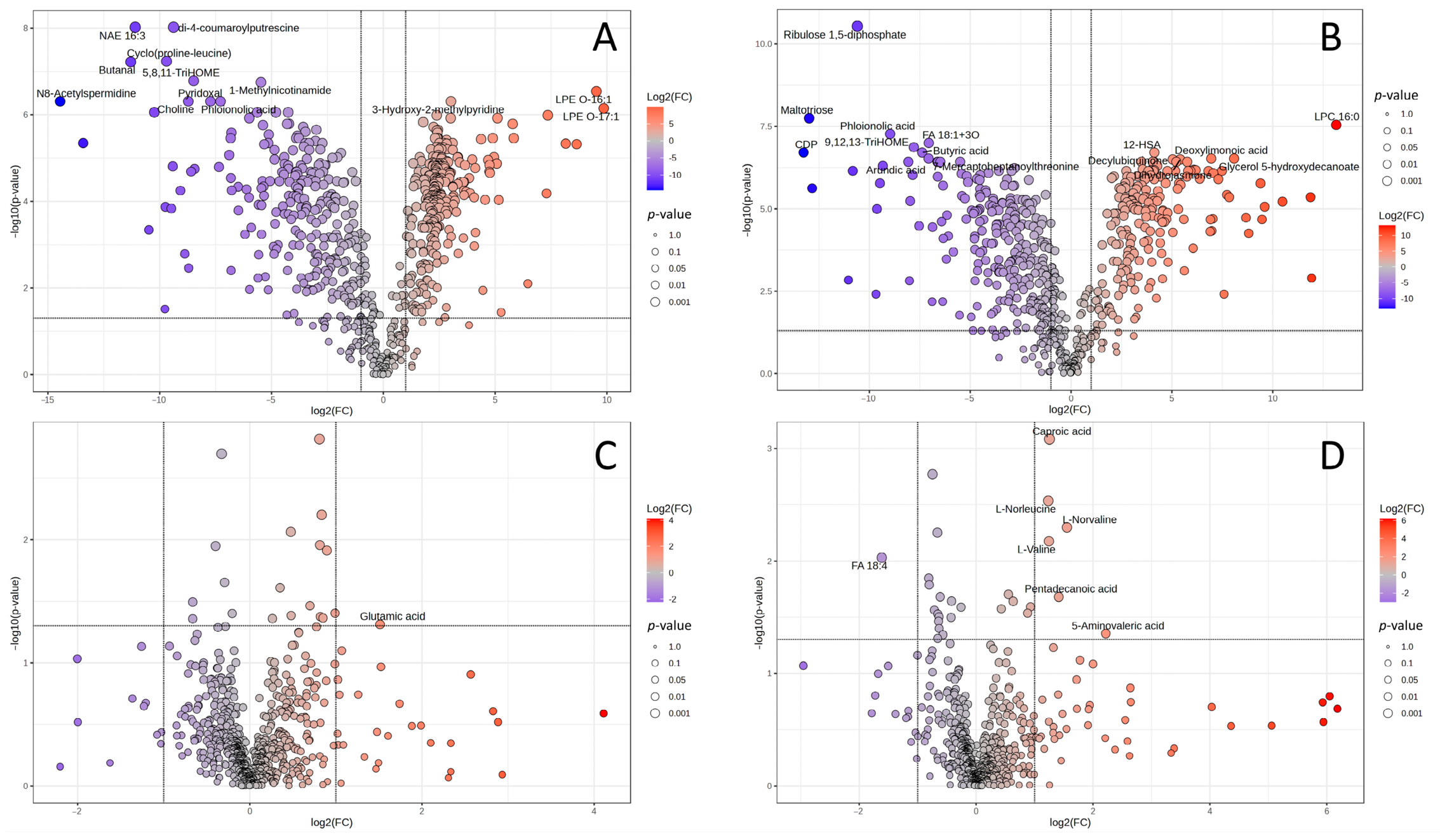
| Metabolite | ESI+/− | C1 | C2 | Probable Agricultural Role |
|---|---|---|---|---|
| 5-Phosphorylribose 1-pyrophosphate | − | no | yes | Cell disruption/lysis marker |
| LPE 15:0-d5 | − | no | yes | |
| MGMG 18:3 | − | no | yes | |
| 2′-Deoxy-AMP | − | no | yes | Cell disruption/lysis marker |
| Deoxycytidine-5′-diphosphate | − | no | yes | Cell disruption/lysis marker |
| Cytidine-5′-monophosphate | − | no | yes | Cell disruption/lysis marker |
| NADH | − | no | yes | Cell disruption/lysis marker |
| GDP | − | no | yes | Cell disruption/lysis marker |
| Ribulose 1,5-diphosphate | − | no | yes | Cell disruption/lysis marker |
| Cytidine-5′-diphosphate | − | no | yes | Cell disruption/lysis marker |
| Maltotriose | − | no | yes | |
| Leucylphenylalanine | + | no | yes | Dipeptide. Stress resilience. |
| 1,3-Cyclohexanedione | + | no | yes | |
| Thymine | + | no | yes | Cell disruption/lysis marker |
| Fusaric acid | + | no | yes | |
| Dimethylbenzimidazole | + | no | yes | Biocontrol |
| Putative Harman | + | no | yes | Growth inhibitor, Biocontrol |
| Putative C17-Sphinganine | + | no | yes | Biocontrol |
| Eleutheroside E | + | no | yes | |
| Dihydroisocoumarin | + | no | yes | Biocontrol |
| Di-4-coumaroylputrescine | + | no | yes | Stress resilience/Biocontrol |
| Cyclo(proline-leucine) | + | no | yes | Biocontrol |
| Putative NAE 16:3 | + | no | yes | Stress resilience |
| Putative BUTANAL | + | no | yes | Growth inhibitor |
| N8-Acetylspermidine | + | no | yes | Growth inhibitor |
| LPC O-18:1 | + | yes | no | Stress resilience |
| Guanosine-3′,5′-cyclic monophosphate | + | yes | no | Stress resilience |
| Putative NAE 22:5 | + | yes | no | |
| LPE O-16:1 | + | yes | no | Biocontrol |
| LPE O-17:1 | + | yes | no | Biocontrol |
| LPE 16:0 | − | yes | no | Biocontrol |
Disclaimer/Publisher’s Note: The statements, opinions and data contained in all publications are solely those of the individual author(s) and contributor(s) and not of MDPI and/or the editor(s). MDPI and/or the editor(s) disclaim responsibility for any injury to people or property resulting from any ideas, methods, instructions or products referred to in the content. |
© 2026 by the authors. Licensee MDPI, Basel, Switzerland. This article is an open access article distributed under the terms and conditions of the Creative Commons Attribution (CC BY) license.
Share and Cite
Volkova, P.; Wong, J.M.; Wong, J. Metabolomics-Based Selection of Biostimulant and Biocontrol Microbial Consortia. Metabolites 2026, 16, 582. https://doi.org/10.3390/metabo16080582
Volkova P, Wong JM, Wong J. Metabolomics-Based Selection of Biostimulant and Biocontrol Microbial Consortia. Metabolites. 2026; 16(8):582. https://doi.org/10.3390/metabo16080582
Chicago/Turabian StyleVolkova, Polina, John M. Wong, and Jacqueline Wong. 2026. "Metabolomics-Based Selection of Biostimulant and Biocontrol Microbial Consortia" Metabolites 16, no. 8: 582. https://doi.org/10.3390/metabo16080582
APA StyleVolkova, P., Wong, J. M., & Wong, J. (2026). Metabolomics-Based Selection of Biostimulant and Biocontrol Microbial Consortia. Metabolites, 16(8), 582. https://doi.org/10.3390/metabo16080582