
Discriminative Ability of TyG, TyG-WC, BAI, FGIR, and QUICKI Indexes in Identifying Metabolic Syndrome in a Pediatric Population with Obesity



Abstract
1. Introduction
2. Materials and Methods
2.1. Study Population
2.2. Anthropometry and Puberal Stage
2.3. Laboratory and Clinical Parameters
2.4. Indexes
2.5. Statistical Analysis
3. Results
4. Discussion
5. Conclusions
Supplementary Materials
Author Contributions
Funding
Institutional Review Board Statement
Informed Consent Statement
Data Availability Statement
Acknowledgments
Conflicts of Interest
References
- WHO Regional Office for Europe. WHO European Childhood Obesity Surveillance Initiative (COSI): Report on the Sixth Round of Data Collection, 2022–2024; WHO Regional Office for Europe: Copenhagen, Denmark, 2025. [Google Scholar]
- Spinelli, A.; Buoncristiano, M.; Kovacs, V.A.; Yngve, A.; Spiroski, I.; Obreja, G.; Starc, G.; Pérez, N.; Rito, A.I.; Kunešová, M.; et al. Prevalence of Severe Obesity among Primary School Children in 21 European Countries. Obes. Facts 2019, 12, 244–258. [Google Scholar] [CrossRef]
- Zhao, Y.; Zhu, Z.; Hu, W.; Li, J. Early Detection and Risk Stratification of Insulin Resistance in Children and Adolescents with Excess Weight: A sdLDL/oxLDL–Based Model. Clin. Exp. Med. 2026, 26, 163. [Google Scholar] [CrossRef]
- US Preventive Services Task Force; Nicholson, W.K.; Silverstein, M.; Wong, J.B.; Chelmow, D.; Coker, T.R.; Davis, E.M.; Donahue, K.E.; Jaén, C.R.; Krousel-Wood, M.; et al. Interventions for High Body Mass Index in Children and Adolescents: US Preventive Services Task Force Recommendation Statement. JAMA 2024, 332, 226–232. [Google Scholar] [CrossRef]
- Büyükinan, M.; Sert, S.; Yılmaz, A.F. The Role of Pediatric Simple Metabolic Syndrome Score and Metabolic Syndrome Severity Z-Scores in Identifying Metabolic Syndrome among Obese Adolescents. Nutr. Hosp. 2025, 42, 652–660. [Google Scholar] [CrossRef]
- US Preventive Services Task Force; Grossman, D.C.; Bibbins-Domingo, K.; Curry, S.J.; Barry, M.J.; Davidson, K.W.; Doubeni, C.A.; Epling, J.W.; Kemper, A.R.; Krist, A.H.; et al. Screening for Obesity in Children and Adolescents: US Preventive Services Task Force Recommendation Statement. JAMA 2017, 317, 2417–2426. [Google Scholar] [CrossRef] [PubMed]
- Mousavi, E.; Mozafarian, N.; Heidari-Beni, M.; Sehhati, M.; Kelishadi, R. Uncovering Age-Specific Subtypes of Pediatric Obesity and Metabolic Syndrome Using Machine Learning Algorithms. Sci. Rep. 2025, 15, 40722. [Google Scholar] [CrossRef]
- Agudelo, G.M.; Bedoya, G.; Estrada, A.; Patiño, F.A.; Muñoz, A.M.; Velásquez, C.M. Variations in the Prevalence of Metabolic Syndrome in Adolescents According to Different Criteria Used for Diagnosis: Which Definition Should Be Chosen for This Age Group? Metab. Syndr. Relat. Disord. 2014, 12, 202–209. [Google Scholar] [CrossRef] [PubMed]
- Kahn, R.; Buse, J.; Ferrannini, E.; Stern, M.; American Diabetes Association; European Association for the Study of Diabetes. The Metabolic Syndrome: Time for a Critical Appraisal: Joint Statement from the American Diabetes Association and the European Association for the Study of Diabetes. Diabetes Care 2005, 28, 2289–2304. [Google Scholar] [CrossRef]
- Gustafson, J.K.; Yanoff, L.B.; Easter, B.D.; Brady, S.M.; Keil, M.F.; Roberts, M.D.; Sebring, N.G.; Han, J.C.; Yanovski, S.Z.; Hubbard, V.S.; et al. The Stability of Metabolic Syndrome in Children and Adolescents. J. Clin. Endocrinol. Metab. 2009, 94, 4828–4834. [Google Scholar] [CrossRef] [PubMed]
- Pasquali, R.; Casanueva, F.; Haluzik, M.; van Hulsteijn, L.; Ledoux, S.; Monteiro, M.P.; Salvador, J.; Santini, F.; Toplak, H.; Dekkers, O.M. European Society of Endocrinology Clinical Practice Guideline: Endocrine Work-up in Obesity. Eur. J. Endocrinol. 2020, 182, G1–G32. [Google Scholar] [CrossRef] [PubMed]
- Frankenfield, D.C.; Rowe, W.A.; Cooney, R.N.; Smith, J.S.; Becker, D. Limits of Body Mass Index to Detect Obesity and Predict Body Composition. Nutrition 2001, 17, 26–30. [Google Scholar] [CrossRef]
- Gurunathan, U.; Myles, P.S. Limitations of Body Mass Index as an Obesity Measure of Perioperative Risk. Br. J. Anaesth. 2016, 116, 319–321. [Google Scholar] [CrossRef]
- Kok, P.; Seidell, J.C.; Meinders, A.E. The value and limitations of the body mass index (BMI) in the assessment of the health risks of overweight and obesity. Ned. Tijdschr. Geneeskd. 2004, 148, 2379–2382. [Google Scholar] [PubMed]
- Radetti, G.; Fanolla, A.; Grugni, G.; Lupi, F.; Tamini, S.; Cicolini, S.; Sartorio, A. The Role of Different Indexes of Adiposity and Body Composition for the Identification of Metabolic Syndrome in Women with Obesity. J. Clin. Med. 2021, 10, 1975. [Google Scholar] [CrossRef]
- Simental-Mendía, L.E.; Rodríguez-Morán, M.; Guerrero-Romero, F. The Product of Fasting Glucose and Triglycerides As Surrogate for Identifying Insulin Resistance in Apparently Healthy Subjects. Metab. Syndr. Relat. Disord. 2008, 6, 299–304. [Google Scholar] [CrossRef] [PubMed]
- Ramdas Nayak, V.K.; Satheesh, P.; Shenoy, M.T.; Kalra, S. Triglyceride Glucose (TyG) Index: A Surrogate Biomarker of Insulin Resistance. J. Pak. Med. Assoc. 2022, 72, 986–988. [Google Scholar] [CrossRef]
- Wan, H.; Cao, H.; Ning, P. Superiority of the Triglyceride Glucose Index over the Homeostasis Model in Predicting Metabolic Syndrome Based on NHANES Data Analysis. Sci. Rep. 2024, 14, 15499. [Google Scholar] [CrossRef]
- Tamini, S.; Bondesan, A.; Caroli, D.; Marazzi, N.; Sartorio, A. The Ability of the Triglyceride-Glucose (TyG) Index and Modified TyG Indexes to Predict the Presence of Metabolic-Associated Fatty Liver Disease and Metabolic Syndrome in a Pediatric Population with Obesity. J. Clin. Med. 2025, 14, 2341. [Google Scholar] [CrossRef] [PubMed]
- Zheng, S.; Shi, S.; Ren, X.; Han, T.; Li, Y.; Chen, Y.; Liu, W.; Hou, P.C.; Hu, Y. Triglyceride Glucose-Waist Circumference, a Novel and Effective Predictor of Diabetes in First-Degree Relatives of Type 2 Diabetes Patients: Cross-Sectional and Prospective Cohort Study. J. Transl. Med. 2016, 14, 260. [Google Scholar] [CrossRef]
- Calcaterra, V.; Labati, L.; Cordaro, E.; Schneider, L.; Rossi, V.; Colombo, A.; Turzi, M.; Fabiano, V.; Zuccotti, G. Diagnostic Accuracy of the Triglyceride-Glucose Derived Indices in Detecting Metabolic Syndrome in Pediatric Patients. J. Obes. Metab. Syndr. 2026, 35, 86–98. [Google Scholar] [CrossRef]
- Bergman, R.N.; Stefanovski, D.; Buchanan, T.A.; Sumner, A.E.; Reynolds, J.C.; Sebring, N.G.; Xiang, A.H.; Watanabe, R.M. A Better Index of Body Adiposity. Obesity 2011, 19, 1083–1089. [Google Scholar] [CrossRef]
- Ramírez-Manent, J.I.; López-González, Á.A.; Tomás-Gil, P.; Riutord-Sbert, P.; Garrido-Sepulveda, L.; Vicente-Herrero, M.T. Relationship between Abdominal Volume Index and Body Adiposity Index and Scales of Insulin Resistance and Metabolic Syndrome. Diagnostics 2023, 13, 3356. [Google Scholar] [CrossRef] [PubMed]
- Ibarra-Reynoso, L.d.R.; Rodriguez-Hernandez, N.; Lazo-de-la-Vega-Monroy, M.-L.; Garcia-Ramirez, J.R.; Ruiz-Noa, Y.; Jordan-Perez, B.; Garnelo-Cabañas, S.; Muñoz-Cornejo, V.; Preciado-Puga, M.d.C. Adiposity and Metabolic Indices in the Diagnosis and Histological Stage Association of Metabolic Dysfunction-Associated Steatotic Liver Disease. J. Clin. Med. 2025, 14, 8365. [Google Scholar] [CrossRef]
- Kheirouri, S.; Alizadeh, M. Contribution of Body Adiposity Index and Conicity Index in Prediction of Metabolic Syndrome Risk and Components. Hum. Nutr. Metab. 2024, 38, 200290. [Google Scholar] [CrossRef]
- Tamini, S.; Bondesan, A.; Caroli, D.; Sartorio, A. The Lipid Accumulation Product Index (LAP) and the Cardiometabolic Index (CMI) Are Useful for Predicting the Presence and Severity of Metabolic Syndrome in Adult Patients with Obesity. J. Clin. Med. 2024, 13, 2843. [Google Scholar] [CrossRef] [PubMed]
- De Santis Filgueiras, M.; Cecon, R.S.; de Faria, E.R.; de Faria, F.R.; Pereira, P.F.; Ribeiro, A.Q.; Priore, S.E.; de Novaes, J.F. Agreement of Body Adiposity Index (BAI) and Paediatric Body Adiposity Index (BAIp) in Determining Body Fat in Brazilian Children and Adolescents. Public Health Nutr. 2019, 22, 132–139. [Google Scholar] [CrossRef]
- Wickel, E.E. Evaluating the Utility of the Body Adiposity Index in Adolescent Boys and Girls. J. Sci. Med. Sport 2014, 17, 434–438. [Google Scholar] [CrossRef]
- Burgert, T.S.; Vuguin, P.M.; DiMartino-Nardi, J.; Attie, K.M.; Saenger, P. Assessing Insulin Resistance: Application of a Fasting Glucose to Insulin Ratio in Growth Hormone-Treated Children. Horm. Res. 2002, 57, 37–42. [Google Scholar] [CrossRef]
- Hosseinkhani, S.; Forouzanfar, K.; Hadizadeh, N.; Razi, F.; Darzi, S.; Bandarian, F. Insight into the Predictive Power of Surrogate Diagnostic Indices for Identifying Individuals with Metabolic Syndrome. Endocr. Metab. Immune Disord. Drug Targets 2024, 24, 1291–1302. [Google Scholar] [CrossRef]
- Conwell, L.S.; Trost, S.G.; Brown, W.J.; Batch, J.A. Indexes of Insulin Resistance and Secretion in Obese Children and Adolescents: A Validation Study. Diabetes Care 2004, 27, 314–319. [Google Scholar] [CrossRef] [PubMed]
- Katz, A.; Nambi, S.S.; Mather, K.; Baron, A.D.; Follmann, D.A.; Sullivan, G.; Quon, M.J. Quantitative Insulin Sensitivity Check Index: A Simple, Accurate Method for Assessing Insulin Sensitivity in Humans. J. Clin. Endocrinol. Metab. 2000, 85, 2402–2410. [Google Scholar] [CrossRef] [PubMed]
- Motamed, N.; Miresmail, S.J.H.; Rabiee, B.; Keyvani, H.; Farahani, B.; Maadi, M.; Zamani, F. Optimal Cutoff Points for HOMA-IR and QUICKI in the Diagnosis of Metabolic Syndrome and Non-Alcoholic Fatty Liver Disease: A Population Based Study. J. Diabetes Complicat. 2016, 30, 269–274. [Google Scholar] [CrossRef] [PubMed]
- Shand, B.I.; Scott, R.S.; Lewis, J.G.; Elder, P.A.; Frampton, C.M. Comparison of Indices of Insulin Resistance with Metabolic Syndrome Classifications to Predict the Development of Impaired Fasting Glucose in Overweight and Obese Subjects: A 3-Year Prospective Study. Int. J. Obes. 2009, 33, 1274–1279. [Google Scholar] [CrossRef]
- Donma, M.; Donma, O.; Topçu, B.; Aydın, M.; Tülübaş, F.; Nalbantoğlu, B.; Demirkol, M.; Gürel, A. A new insulin sensitivity index derived from fat mass index and quantitative insulin sensitivity check index. Int. J. Basic Clin. Med. 2016, 3, 26–36. [Google Scholar]
- Manios, Y.; Moschonis, G.; Kourlaba, G.; Bouloubasi, Z.; Grammatikaki, E.; Spyridaki, A.; Hatzis, C.; Kafatos, A.; Fragiadakis, G.A. Prevalence and Independent Predictors of Insulin Resistance in Children from Crete, Greece: The Children Study. Diabet. Med. 2008, 25, 65–72. [Google Scholar] [CrossRef]
- Cacciari, E.; Milani, S.; Balsamo, A.; Spada, E.; Bona, G.; Cavallo, L.; Cerutti, F.; Gargantini, L.; Greggio, N.; Tonini, G.; et al. Italian Cross-Sectional Growth Charts for Height, Weight and BMI (2 to 20 Yr). J. Endocrinol. Investig. 2006, 29, 581–593. [Google Scholar] [CrossRef] [PubMed]
- Lohman, T.G.; Roche, A.F.; Martorell, R. Anthropometric Standardization Reference Manual: Abridged Edition; Human Kinetics Books: Champaign, IL, USA, 1991. [Google Scholar]
- Marshall, W.A.; Tanner, J.M. Variations in the Pattern of Pubertal Changes in Boys. Arch. Dis. Child. 1970, 45, 13–23. [Google Scholar] [CrossRef]
- Marshall, W.A.; Tanner, J.M. Variations in Pattern of Pubertal Changes in Girls. Arch. Dis. Child. 1969, 44, 291–303. [Google Scholar] [CrossRef]
- Zimmet, P.; Alberti, K.G.M.; Kaufman, F.; Tajima, N.; Silink, M.; Arslanian, S.; Wong, G.; Bennett, P.; Shaw, J.; Caprio, S.; et al. The Metabolic Syndrome in Children and Adolescents—An IDF Consensus Report. Pediatr. Diabetes 2007, 8, 299–306. [Google Scholar] [CrossRef]
- Guerrero-Romero, F.; Simental-Mendía, L.E.; González-Ortiz, M.; Martínez-Abundis, E.; Ramos-Zavala, M.G.; Hernández-González, S.O.; Jacques-Camarena, O.; Rodríguez-Morán, M. The Product of Triglycerides and Glucose, a Simple Measure of Insulin Sensitivity. Comparison with the Euglycemic-Hyperinsulinemic Clamp. J. Clin. Endocrinol. Metab. 2010, 95, 3347–3351. [Google Scholar] [CrossRef]
- Er, L.-K.; Wu, S.; Chou, H.-H.; Hsu, L.-A.; Teng, M.-S.; Sun, Y.-C.; Ko, Y.-L. Triglyceride Glucose-Body Mass Index Is a Simple and Clinically Useful Surrogate Marker for Insulin Resistance in Nondiabetic Individuals. PLoS ONE 2016, 11, e0149731. [Google Scholar] [CrossRef]
- Legro, R.S.; Finegood, D.; Dunaif, A. A Fasting Glucose to Insulin Ratio Is a Useful Measure of Insulin Sensitivity in Women with Polycystic Ovary Syndrome. J. Clin. Endocrinol. Metab. 1998, 83, 2694–2698. [Google Scholar] [CrossRef]
- Youden, W.J. Index for Rating Diagnostic Tests. Cancer 1950, 3, 32–35. [Google Scholar] [CrossRef] [PubMed]
- Schober, P.; Boer, C.; Schwarte, L.A. Correlation Coefficients: Appropriate Use and Interpretation. Anesth. Analg. 2018, 126, 1763–1768. [Google Scholar] [CrossRef]
- Zhang, B.; Shi, H.; Cai, W.; Yang, B.; Xiu, W. Metabolic Syndrome in Children and Adolescents: Definitions, Epidemiology, Pathophysiology, Interventions, and Challenges. Front. Endocrinol. 2025, 16, 1512642. [Google Scholar] [CrossRef] [PubMed]
- Klancic, T.; Woodward, L.; Hofmann, S.M.; Fisher, E.A. High Density Lipoprotein and Metabolic Disease: Potential Benefits of Restoring Its Functional Properties. Mol. Metab. 2016, 5, 321–327. [Google Scholar] [CrossRef] [PubMed]
- Di Bonito, P.; Di Sessa, A.; Licenziati, M.R.; Corica, D.; Wasniewska, M.; Miraglia del Giudice, E.; Morandi, A.; Maffeis, C.; Faienza, M.F.; Mozzillo, E.; et al. Sex-Related Differences in Cardiovascular Risk in Adolescents with Overweight or Obesity. Rev. Cardiovasc. Med. 2024, 25, 141. [Google Scholar] [CrossRef]
- Al-Beltagi, M.; Bediwy, A.S.; Saeed, N.K. Insulin-Resistance in Paediatric Age: Its Magnitude and Implications. World J. Diabetes 2022, 13, 282–307. [Google Scholar] [CrossRef]
- Accacha, S.; Barillas-Cerritos, J.; Gabriel, L.; Srivastava, A.; Gulkarov, S.; Apsan, J.A.; Leon, J.D.; Reiss, A.B. The Natural History of Prediabetes and Cardiovascular Disease in the Pediatric Population. Biomedicines 2026, 14, 198. [Google Scholar] [CrossRef]
- Kim, I.; Lee, K.-N.; Sung, J.; Ahn, Y.J.; Im, M.; Han, K.; Cho, S.Y. Age-Related Insulin Resistance Changes in Children and Adolescents and Its Impact on the Accuracy of Diagnosis of Metabolic Syndrome. Ann. Pediatr. Endocrinol. Metab. 2025, 30, 213–222. [Google Scholar] [CrossRef]
- Kelly, L.A.; Lane, C.J.; Weigensberg, M.J.; Toledo-Corral, C.M.; Goran, M.I. Pubertal Changes of Insulin Sensitivity, Acute Insulin Response and β-Cell Function in Overweight Latino Youth. J. Pediatr. 2011, 158, 442–446. [Google Scholar] [CrossRef]
- Ortega-Avila, J.G.; Ordoñez, A.S.; Muñoz, H.G.; Suarez Ortegon, M.F.; Salazar Contreras, B.C. A Systematic Review and Meta-Analysis of Sex Differences in Subcutaneous and Visceral Abdominal Fat in Children. Nutr. Rev. 2025, 84, nuaf143. [Google Scholar] [CrossRef]
- Baran, R.; Baran, J.; Leszczak, J.; Bartosiewicz, A.; Wyszyńska, J. Lipid Profile, Obesity Indicators and Cardiometabolic Risk Factors in School-Aged Children and Adolescents: Sex-Specific Associations. J. Clin. Med. 2025, 14, 6677. [Google Scholar] [CrossRef]
- Widén, E.; Silventoinen, K.; Sovio, U.; Ripatti, S.; Cousminer, D.L.; Hartikainen, A.-L.; Laitinen, J.; Pouta, A.; Kaprio, J.; Järvelin, M.-R.; et al. Pubertal Timing and Growth Influences Cardiometabolic Risk Factors in Adult Males and Females. Diabetes Care 2012, 35, 850–856. [Google Scholar] [CrossRef]
- de Lamas, C.; Kalén, A.; Anguita-Ruiz, A.; Pérez-Ferreirós, A.; Picáns-Leis, R.; Flores, K.; Moreno, L.A.; Bueno, G.; Gil, Á.; Gil-Campos, M.; et al. Progression of Metabolic Syndrome and Associated Cardiometabolic Risk Factors from Prepuberty to Puberty in Children: The PUBMEP Study. Front. Endocrinol. 2022, 13, 1082684. [Google Scholar] [CrossRef]


| Whole Study Population | MetS+ | MetS− | p Value | |
|---|---|---|---|---|
| n. | 758 | 211 | 547 | - |
| Sex (F/M) | 454 (59.9%)/304 (40.1%) | 105 (49.8%)/106 (50.2%) | 349 (63.8%)/198 (36.2%) | <0.0001 |
| Age (yrs) | 14.8 ± 2.1 | 15.4 ± 2.0 | 14.5 ± 2.1 | <0.0001 |
| Tanner stage | 3.8 ± 1.4 | 4.1 ± 1.2 | 3.7 ± 1.4 | <0.0001 |
| WC (cm) | 115.2 ± 14.7 | 122.7 ± 14.3 | 112.4 ± 13.8 | <0.0001 |
| HC (cm) | 121.6 ± 12.2 | 125.2 ± 12.6 | 120.3 ± 11.8 | <0.0001 |
| BW (kg) | 101.6 ± 22.7 | 112.4 ± 23.5 | 97.4 ± 21.0 | <0.0001 |
| Height (cm) | 163.0 ± 9.8 | 166.7 ± 9.6 | 161.6 ± 9.4 | <0.0001 |
| BMI (kg/m2) | 37.9 ± 6.2 | 40.2 ± 6.4 | 37.0 ± 5.9 | <0.0001 |
| SBP (mmHg) | 125.5 ± 12.6 | 134.5 ± 11.2 | 122.0 ± 11.3 | <0.0001 |
| DBP (mmHg) | 78.5 ± 7.9 | 82.4 ± 8.2 | 77.0 ± 7.3 | <0.0001 |
| Glucose (mg/dL) | 81.4 ± 6.2 | 81.6 ± 6.8 | 81.3 ± 6.0 | ns |
| Insulin (mU/L) | 14.9 ± 8.7 | 17.2 ± 8.3 | 14.0 ± 8.7 | <0.0001 |
| T-C (mg/dL) | 163.8 ± 31.7 | 165.0 ± 32.3 | 163.3 ± 31.3 | ns |
| HDL-C (mg/dL) | 42.8 ± 10.5 | 34.7 ± 5.9 | 45.9 ± 10.3 | <0.0001 |
| TG (mg/dL) | 96.6 ± 40.8 | 125.7 ± 51.3 | 85.4 ± 29.1 | <0.0001 |
| TyG | 4.4 ± 0.2 | 4.6 ± 0.2 | 4.4 ± 0.2 | <0.0001 |
| TyG-WC | 512.7 ± 74.3 | 561.6 ± 70.9 | 493.7 ± 66.3 | <0.0001 |
| BAI | 40.6 ± 5.8 | 40.3 ± 5.9 | 40.7 ± 5.7 | ns |
| FGIR | 8.0 ± 6.7 | 6.4 ± 5.2 | 8.6 ± 7.1 | <0.0001 |
| QUICKI | 0.34 ± 0.03 | 0.33 ± 0.03 | 0.34 ± 0.03 | <0.0001 |
| Females | Males | p Value | |
|---|---|---|---|
| n. | 454 | 304 | |
| Age (yrs) | 14.8 ± 2.1 | 14.6 ± 2.2 | ns |
| Tanner stage | 4.0 ± 1.3 | 3.5 ± 1.4 | <0.0001 |
| WC (cm) | 112.0 ± 13.5 | 120.1 ± 15.1 | <0.0001 |
| HC (cm) | 122.3 ± 29.3 | 120.7 ± 13.2 | ns |
| BW (kg) | 97.2 ± 18.7 | 108.1 ± 26.4 | <0.0001 |
| Height (cm) | 160.3 ± 7.4 | 167.0 ± 11.4 | <0.0001 |
| BMI (kg/m2) | 37.7 ± 6.0 | 38.3 ± 6.4 | ns |
| SBP (mmHg) | 123.5 ± 12.1 | 128.4 ± 12.7 | <0.0001 |
| DBP (mmHg) | 77.8 ± 7.6 | 79.7 ± 8.3 | <0.01 |
| Glucose (mg/dL) | 81.0 ± 6.3 | 81.9 ± 5.9 | ns |
| Insulin (mU/L) | 14.5 ± 8.5 | 15.4 ± 9.1 | ns |
| T-C (mg/dL) | 162.8 ± 31.0 | 165.3 ± 32.4 | ns |
| HDL-C (mg/dL) | 44.3 ± 10.4 | 40.5 ± 10.3 | <0.0001 |
| TG (mg/dL) | 93.1 ± 40.1 | 101.8 ± 41.5 | <0.01 |
| MetS (+/−) | 105 (23.1%)/349 (76.9%) | 106 (34.9%)/198 (65.1%) | <0.0001 |
| TyG | 4.4 ± 0.2 | 4.5 ± 0.2 | <0.001 |
| TyG-WC | 495.9 ± 68.6 | 537.8 ± 75.5 | <0.0001 |
| BAI | 42.3 ± 5.4 | 38.0 ± 5.4 | <0.0001 |
| FGIR | 8.1 ± 6.7 | 7.9 ± 6.8 | ns |
| QUICKI | 0.34 ± 0.03 | 0.33 ± 0.03 | ns |
| ROC Area | Cut-Off | Sensitivity | Specificity | PPV | NPV | PLR | NLR | |
|---|---|---|---|---|---|---|---|---|
| Whole study population | ||||||||
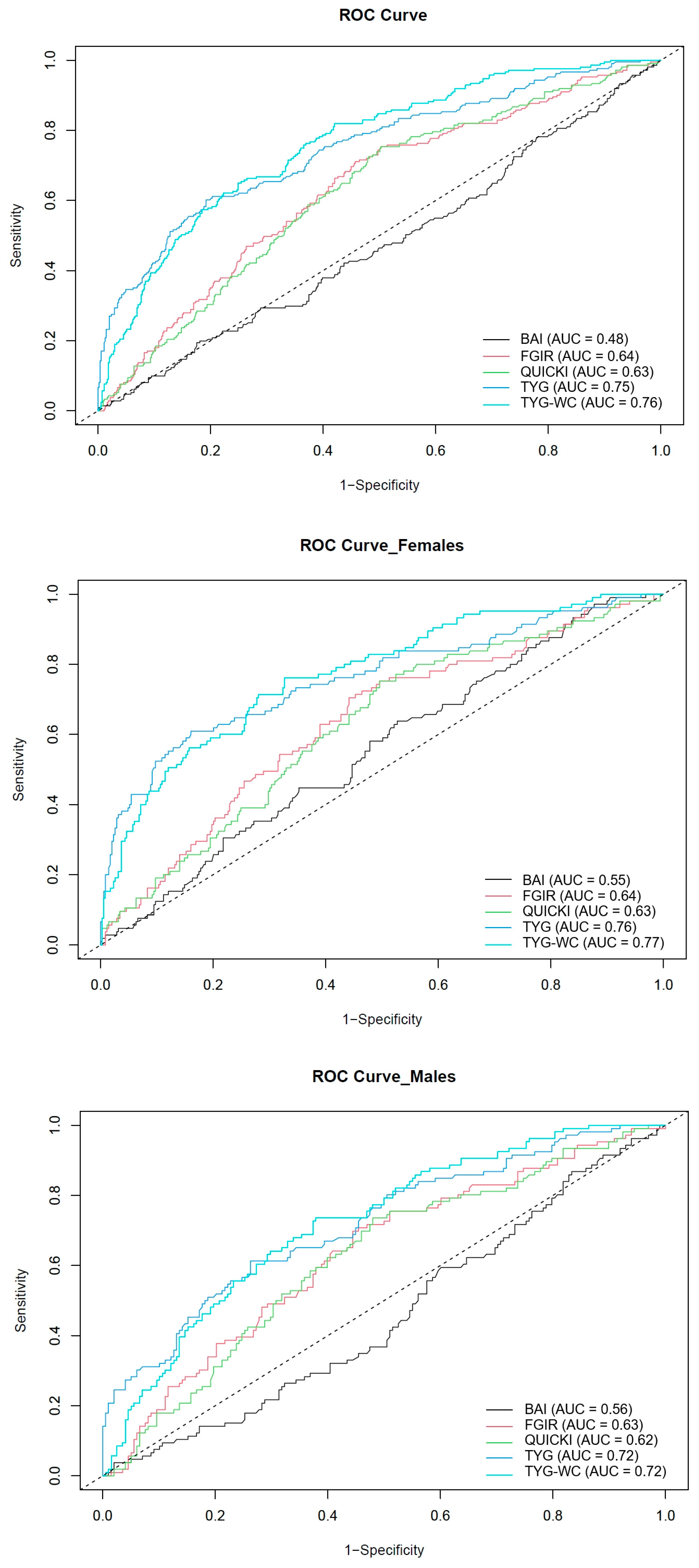
| TyG | 0.75 (0.71–0.79) | 4.54 | 60.2% (53.2–66.8%) | 80.2% (77.2–84.0%) | 54.7% (49.4–61.7%) | 84.0% (79.9–86.8%) | 3.14 (2.56–3.85) | 0.50 (0.42–0.58) |
| TyG-WC | 0.76 (0.73–0.80) | 530.07 | 64.9% (58.1–71.4%) | 75.1% (71.3–78.7%) | 50.2% (45.3–57.5%) | 84.7% (80.6–87.2%) | 2.61 (2.19–3.12) | 0.47 (0.39–0.56) |
| BAI | 0.48 (0.43–0.53) | 45.39 | 19.4% (14.3–25.4%) | 82.4% (79.0–85.5%) | 29.9% (25.5–37.6%) | 72.6% (64.8–77.0%) | 1.11 (0.80–1.54) | 0.98 (0.91–1.01) |
| FGIR | 0.64 (0.59–0.68) | 6.2 | 71.1% (64.5–77.1%) | 54.3% (50.0–58.5%) | 37.5% (33.6–45.1%) | 83.0% (78.2–85.3%) | 1.55 (1.37–1.76) | 0.53 (0.43–0.67) |
| QUICKI | 0.63 (0.58–0.67) | 0.34 | 75.4% (69.0–81.0%) | 49.7% (45.5–54.0%) | 36.6% (32.8–44.7%) | 84.0% (79.2–86.1%) | 1.50 (1.34–1.68) | 0.50 (0.39–0.64) |
| Females | ||||||||
| TyG | 0.76 (0.70–0.82) | 4.54 | 61.0% (50.9–70.3%) | 84.0% (79.7–87.6%) | 53.3% (46.1–63.4%) | 87.7% (82.6–90.6%) | 3.80 (2.86–5.05) | 0.47 (0.37–0.59) |
| TyG-WC | 0.77 (0.72–0.82) | 500.40 | 76.2% (66.9–84.0%) | 67.3% (62.1–72.2%) | 41.2% (35.8–53.4%) | 90.4% (85.6–92.2%) | 2.33 (1.94–2.81) | 0.35 (0.25–0.50) |
| BAI | 0.55 (0.50–0.62) | 40.78 | 63.8% (53.9–73.0%) | 47.3% (41.9–52.7%) | 26.7% (22.7–35.8%) | 81.3% (74.2–84.3%) | 1.21 (1.02–1.44) | 0.77 (0.58–1.01) |
| FGIR | 0.64 (0.58–0.70) | 6.27 | 70.5% (60.8–79.0%) | 55.9% (50.5–61.2%) | 32.5% (27.9–43.1%) | 86.3% (80.3–88.7%) | 1.60 (1.35–1.90) | 0.53 (0.39–0.72) |
| QUICKI | 0.63 (0.57–0.69) | 0.34 | 75.2% (65.9–83.1%) | 50.4% (45.1–55.8%) | 31.3% (26.9–42.6%) | 87.1% (81.1–89.4%) | 1.52 (1.30–1.77) | 0.49 (0.35–0.70) |
| Males | ||||||||
| TyG | 0.72 (0.66–0.78) | 4.54 | 61.3% (51.4–70.6%) | 73.7% (67.0–79.7%) | 55.6% (47.5–65.5%) | 78.1% (70.3–83.3%) | 2.34 (1.77–3.08) | 0.53 (0.41–0.68) |
| TyG-WC | 0.72 (0.66–0.78) | 529.39 | 73.6% (64.1–81.7%) | 62.1% (55.0–68.9%) | 51.0% (43.6–62.5%) | 81.5% (73.8–85.6%) | 1.94 (1.57–2.40) | 0.43 (0.30–0.60) |
| BAI | 0.56 (0.50–0.62) | 32.96 | 86.8% (78.8–92.6%) | 16.7% (11.8–22.6%) | 35.8% (27.1–51.5%) | 70.2% (57.2–77.5%) | 1.04 (0.95–1.15) | 0.79 (0.44–1.41) |
| FGIR | 0.63 (0.57–0.70) | 5.95 | 69.8% (60.1–78.3%) | 55.6% (48.3–62.6%) | 45.7% (38.6–56.8%) | 77.5% (69.2–82.2%) | 1.57 (1.29–1.92) | 0.54 (0.40–0.75) |
| QUICKI | 0.62 (0.56–0.69) | 0.33 | 73.6% (64.1–81.7%) | 52.0% (44.8–59.2%) | 45.1% (38.1–56.8%) | 78.6% (70.2–83.1%) | 1.53 (1.28–1.84) | 0.51 (0.30–0.72) |
Disclaimer/Publisher’s Note: The statements, opinions and data contained in all publications are solely those of the individual author(s) and contributor(s) and not of MDPI and/or the editor(s). MDPI and/or the editor(s) disclaim responsibility for any injury to people or property resulting from any ideas, methods, instructions or products referred to in the content. |
© 2026 by the authors. Licensee MDPI, Basel, Switzerland. This article is an open access article distributed under the terms and conditions of the Creative Commons Attribution (CC BY) license.
Share and Cite
Tamini, S.; Bondesan, A.; Caroli, D.; Frigerio, F.; Sartorio, A. Discriminative Ability of TyG, TyG-WC, BAI, FGIR, and QUICKI Indexes in Identifying Metabolic Syndrome in a Pediatric Population with Obesity. Metabolites 2026, 16, 415. https://doi.org/10.3390/metabo16060415
Tamini S, Bondesan A, Caroli D, Frigerio F, Sartorio A. Discriminative Ability of TyG, TyG-WC, BAI, FGIR, and QUICKI Indexes in Identifying Metabolic Syndrome in a Pediatric Population with Obesity. Metabolites. 2026; 16(6):415. https://doi.org/10.3390/metabo16060415
Chicago/Turabian StyleTamini, Sofia, Adele Bondesan, Diana Caroli, Francesca Frigerio, and Alessandro Sartorio. 2026. "Discriminative Ability of TyG, TyG-WC, BAI, FGIR, and QUICKI Indexes in Identifying Metabolic Syndrome in a Pediatric Population with Obesity" Metabolites 16, no. 6: 415. https://doi.org/10.3390/metabo16060415
APA StyleTamini, S., Bondesan, A., Caroli, D., Frigerio, F., & Sartorio, A. (2026). Discriminative Ability of TyG, TyG-WC, BAI, FGIR, and QUICKI Indexes in Identifying Metabolic Syndrome in a Pediatric Population with Obesity. Metabolites, 16(6), 415. https://doi.org/10.3390/metabo16060415