Article

Age- and Sex-Specific Patterns of Arterial Stiffness Assessed by Cardio–Ankle Vascular Index in Apparently Healthy Chinese Adults: A Cross-Sectional Study


1
Department of Orthopedic Surgery, Affiliated Drum Tower Hospital, Medical School of Nanjing University, 321 Zhongshan Road, Nanjing 210008, China
2
Department of Sport, Physical Education and Health, Hong Kong Baptist University, Kowloon Tong, Hong Kong SAR 999077, China
3
School of Sport Sciences, Nanjing Normal University, Nanjing 210023, China
*
Author to whom correspondence should be addressed.
These authors contributed equally to this work.
Metabolites 2026, 16(5), 300; https://doi.org/10.3390/metabo16050300
Submission received: 18 March 2026 / Revised: 23 April 2026 / Accepted: 25 April 2026 / Published: 29 April 2026

Abstract

Objective: This study examined age- and sex-specific correlates of arterial stiffness, assessed by the cardio–ankle vascular index (CAVI), in apparently healthy Chinese adults using an anthropometric–metabolic–inflammatory framework, and descriptively compared subgroup association patterns across these domains. Methods: In this cross-sectional study, 525 apparently healthy Chinese adults aged 20–78 years were included. Regression models with age-by-indicator interaction terms were used to test whether the age–CAVI association varied across anthropometric, metabolic, and inflammatory indicators. Sex-adjusted analyses were applied to the overall sample, sex-stratified analyses were used to characterize sex-specific patterns, and the Benjamini–Hochberg false discovery rate correction was applied for multiple interaction tests. Results: CAVI increased progressively with age, with a steeper age–CAVI association after 50 years (p < 0.05). Notably, females showed a transient midlife elevation. Association patterns appeared to differ by sex. In the sex-stratified interaction analyses, anthropometric signals were more prominent in men, particularly for height (p < 0.01), whereas metabolic-related interaction signals were more evident in women, with triglycerides providing the clearest corresponding signal and low-density lipoprotein cholesterol (LDL-C) showing a weaker accompanying pattern; the C-reactive protein (CRP)-related contrast was not retained after additional adjustment for blood pressure and smoking. Conclusions: CAVI increased with age, with a steeper rise after midlife and a transient midlife elevation in women. The association patterns across anthropometric, metabolic, and inflammatory indicators appeared to differ by sex, with signals from the anthropometric domain appearing more evident in men and metabolic-related signals appearing more evident in women. These findings suggest that age- and sex-specific interpretation of CAVI may be informative in preventive health check-up settings.

1. Introduction

Arterial stiffness is a core manifestation of vascular aging and an important predictor of cardiovascular events [1,2,3]. With advancing age, elastin degradation, collagen accumulation, and endothelial dysfunction reduce arterial compliance, increase vascular tone, and impair the buffering capacity of large arteries, thereby elevating systolic pressure and potentially contributing to microvascular damage [4,5,6,7]. The cardio–ankle vascular index (CAVI), a measure of arterial stiffness that is relatively independent of current blood pressure, has become an important tool for assessing vascular aging and subclinical vascular damage [8,9,10]. Because CAVI is derived from pulse transmission along the heart-to-ankle arterial pathway, it is generally interpreted as reflecting stiffness of large conduit arteries, including the aorta and major lower-extremity arteries, rather than resistance (small) arterial stiffness [6,9,11]. The concept of Early Vascular Aging (EVA) highlights that arterial stiffness can be higher than expected for metrical age, even in young and middle-aged adults, often in association with metabolic abnormalities, chronic low-grade inflammation, obesity, and unhealthy lifestyles [12,13,14,15,16,17]. Within this framework, the key question is whether arterial stiffness deviates upward from age-expected levels. Accordingly, CAVI can be used as a quantitative metric of arterial stiffness to characterize age-stratified trajectories across adulthood, providing a reference for interpreting age-referenced variability in vascular aging among apparently healthy adults [18].
Beyond age, multiple biological processes have been linked to arterial stiffening. Dyslipidemia, such as elevated triglycerides (TG) and low-density lipoprotein cholesterol (LDL-C) together with reduced high-density lipoprotein cholesterol (HDL-C), has been associated with structural arterial changes, potentially through oxidative stress, endothelial dysfunction, and smooth muscle remodeling [5,19,20]. Chronic low-grade inflammation, often indexed by C-reactive protein (CRP), has been linked to extracellular matrix remodeling and is also associated with stiffening [19,21,22,23,24,25]. Mechanistically, correlates of arterial stiffness can be conceptualized as reflecting (1) body size–related structural loading and arterial geometry [20,26], (2) metabolic dysregulation linked to endothelial function and vascular remodeling [19,27], and (3) inflammatory processes associated with arterial wall and extracellular matrix remodeling [5,19]. Together, these domains represent three major and partially distinct biological pathways implicated in arterial stiffening, providing a parsimonious and interpretable structure to compare association patterns with CAVI across processes in apparently healthy adults. Based on these mechanistic considerations and prior literature, the present study grouped potential correlates of CAVI into three biological domains: an anthropometric domain (height, weight, body mass index (BMI), waist circumference, hip circumference, and pulse rate, reflecting body size and basic hemodynamic features) [26,28]; a metabolic domain (lipid and glycemic profiles, including TG, LDL-C, HDL-C, total cholesterol (TC), triglyceride-rich lipoprotein cholesterol (TRL-C), glycated hemoglobin (HbA1c), and fasting glucose (GLU)) [19,27,29,30,31]; and an inflammatory domain (CRP, reflecting chronic low-grade inflammation) [19,24,25]. This three-domain framework enables comparison of the relative strength of associations across distinct biological processes with CAVI within a unified structure.
Although age is widely recognized as the strongest correlate of CAVI, most existing studies have focused on older adults or patients with established cardiovascular disease [8], and evidence from healthy adults across different life stages remains limited. Moreover, men and women differ in metabolic profiles, hormonal status, and inflammatory responses, yet it is unclear whether these sex-specific characteristics are associated with key correlates of CAVI or whether the strength of associations across domains varies by age over the adult lifespan [32,33]. Previous studies in Japanese and, to a lesser extent, Chinese populations have reported age- and sex-related differences in CAVI, but most data come from specific regions or disease-based cohorts, and age- and sex-specific patterns in CAVI and their primary correlates among broadly defined, apparently healthy Chinese adults are still underexplored [10,11,25,30]. Therefore, the primary aim of this cross-sectional study was to characterize age- and sex-specific patterns of CAVI in apparently healthy Chinese adults. The secondary aim was to examine whether the age–CAVI association differed across subgroups defined by anthropometric, metabolic, and inflammatory indicators in the overall sample and in sex-stratified analyses. Together, these analyses provide descriptive evidence to support a more context-specific interpretation of CAVI in preventive health assessment.

2. Materials and Methods

2.1. Participants

Between December 2022 and June 2023, the research team screened 1328 self-reported healthy adults aged 20 to 78 years who underwent routine health examinations at Changzhou Sports Hospital, China. The selection criteria for the older adult population were based on the Chinese Health Standards for the Elderly (2022 edition) issued by the National Health Commission.
Through a comprehensive assessment that included physical examination, routine blood and urine analyses, biochemical tests (fasting glucose, lipid profile, liver and kidney function, and uric acid), electrocardiography, chest radiography, pulmonary function testing, echocardiography, and carotid ultrasonography, 525 individuals met the eligibility criteria and were included as apparently healthy participants. All participants provided written informed consent.
Based on the age distribution of the population in 2023, participants were categorized into five age groups: <30 years, 30–39 years, 40–49 years, 50–59 years, and ≥60 years, defined as Groups 1 through 5, respectively.
In the present study, “apparently healthy” was defined operationally as the absence of known major chronic disease, no major abnormalities on routine health examination, and no current use of medications likely to affect arterial stiffness or the measured cardiometabolic/inflammatory biomarkers. This definition does not imply that every biomarker was identical or strictly within a single optimal range in all participants; rather, inter-individual variation within the screened sample remained and was used for within-sample subgroup analyses.

2.2. Inclusion and Exclusion Criteria

(1) Inclusion criteria were as follows: no history of cardiovascular disease, cerebrovascular disease, renal disease, pulmonary disease, liver disease, rheumatic disease, chronic infection, or tumors; no history of psychological or consciousness disorders; no clinically diagnosed diabetes or hypertension; no obvious abnormalities in the head, neck, chest, abdomen, limbs, or nervous system; no major abnormalities in routine blood and urine tests, liver function, kidney function, fasting blood glucose, or blood lipid profiles; and no obvious abnormalities on chest radiography, echocardiography, and cervical vascular ultrasonography.
(2) Exclusion criteria: Patients with severe primary diseases such as liver, kidney, cardiovascular, cerebrovascular, and hematopoietic system diseases; individuals with mental disorders; severe intellectual disabilities; those reporting current use of medications that may affect arterial stiffness or cardiometabolic, inflammatory biomarkers (e.g., antihypertensive, lipid-lowering, glucose-lowering agents, systemic anti-inflammatory drugs/corticosteroids, or sex hormone therapy) and those with missing physical examination information.
After applying these criteria, a total of 525 participants were included in the final analysis.

2.3. Ethical Considerations

Ethical approval for this study was obtained from the Biomedical Research Ethics Committee of Nanjing Normal University (Approval No. NNU202310007). All participant data were coded to ensure confidentiality, and no monetary or material compensation was provided to any participant.

2.4. Arterial Stiffness Instruments and Methods

Arterial stiffness was assessed using the cardio–ankle vascular index (CAVI) with a fully automated vascular screening device (VP-1000, Colin Co., Ltd., Komaki, Japan). Participants rested in a supine position for at least 10 min in a quiet, temperature-controlled room before measurement. Cuffs were placed on both upper arms and ankles, a phonocardiographic sensor was positioned at the fourth intercostal space on the left sternal border, and electrocardiographic electrodes were attached to the wrists according to the manufacturer’s protocol. The device automatically recorded the required pulse wave and pressure signals and calculated CAVI. CAVI was calculated as CAVI = a × {(2ρ/ΔP) × ln(Ps/Pd) × pulse wave velocity (PWV)2} + b, where Ps = systolic pressure (mmHg), Pd = diastolic pressure (mmHg), ΔP = Ps − Pd, ρ = blood density (g/cm3), and a and b are calibration constants provided by the manufacturer. The mean of the left and right CAVI values was used for subsequent analyses.

2.5. Biochemical Measurements

Fasting venous blood samples were collected in the morning after an overnight fast at the Physical Examination Center of Changzhou Sports Hospital, Affiliated Sports Hospital of Nanjing Normal University (Changzhou, China) by trained staff. Blood for the lipid panel and CRP was collected into serum separator tubes, allowed to clot at room temperature, and centrifuged to obtain serum according to the center’s routine clinical standard operating procedure (SOP). Whenever possible, assays were performed on the day of collection as part of routine testing. If immediate analysis was not feasible, separated serum was kept at 4 °C for short-term storage and, when longer-term retention was required (e.g., re-testing/archival), aliquoted and stored at −80 °C until analysis, according to the laboratory SOP. HbA1c was measured from EDTA-anticoagulated whole blood using an automated enzymatic HbA1c assay, whereas serum TC and TG were measured using routine enzymatic assays, HDL-C and LDL-C were determined using direct homogeneous assays, GLU was measured in serum or plasma using a hexokinase-based method, and CRP was measured using immunoturbidimetry. These biochemical assays were performed on a BS-2000M automated chemistry analyzer (Mindray, Shenzhen, China). TRL-C was derived from the lipid panel as TC−LDL-C−HDL-C. Internal quality control and instrument calibration were conducted according to routine laboratory practice, and external quality assessment was performed when applicable.

2.6. Observation Indicators

(1) Anthropometric Indicators: Anthropometric and related hemodynamic indicators included height, weight, BMI, waist circumference, hip measurement, and pulse rate. These indicators were used to characterize body size, body-shape-related dimensions, and basic physiological features within the analytic framework of the present study.
(2) Metabolic Indicators: Metabolic status was assessed using lipid and glucose profiles, including TC, TG, LDL-C, HDL-C, TRL-C, GLU, and HbA1c.
(3) Inflammatory Indicator: Chronic low-grade inflammation was assessed using CRP.

2.7. Statistical Analysis

SPSS Statistics, version 26.0 (IBM Corp., Armonk, NY, USA) was used for statistical analysis, and analyses were performed using the available data for each variable. Continuous variables are presented as the mean ± standard deviation (SD). The distributions of continuous variables used in age-group comparisons were assessed using the Shapiro–Wilk test. Differences in CAVI and other continuous variables across age groups were analyzed using one-way analysis of variance (ANOVA). When the overall ANOVA was significant, post hoc pairwise comparisons were performed using Tukey’s honestly significant difference (HSD) test. Linear regression models were used to examine the association between age and CAVI, and age-by-indicator interaction terms were used to assess whether the age–CAVI association varied across physiological indicators in sequential models (Model 1, unadjusted; Model 2, adjusted for sex; Model 3, further adjusted for systolic and diastolic blood pressure (SBP and DBP); and Model 4, further adjusted for smoking status). For subgroup interaction analyses, anthropometric indicators were categorized into low and high subgroups using sample-based cut-off values, whereas biochemical indicators were categorized using indicator-specific cut-off values. In sex-stratified subgroup analyses, sex-specific subgroup ranges were applied separately within men and women. These subgroup definitions were used for descriptive subgroup interaction analyses and visualization only and were not intended to represent clinical diagnostic thresholds. Detailed subgroup definitions are summarized in Supplementary Table S4. Sex differences in the age–CAVI association were also examined. All statistical tests were two-sided, and statistical significance was set at p < 0.05.
To address multiplicity arising from multiple subgroups, we controlled the false discovery rate (FDR) using the Benjamini–Hochberg (BH) procedure across an overall family defined as all age-by-indicator interaction tests reported in the Results. Tests in other tables primarily reflect descriptive age-trend comparisons or baseline characteristic differences and do not belong to the age-indicator interaction-testing framework; therefore, they were not pooled into the interaction-test family for Benjamini–Hochberg false discovery rate (BH-FDR) adjustment. Raw interaction p-values and BH-adjusted p-values are provided in Supplementary Table S1, and results were considered significant after FDR if BH-adjusted p < 0.05. We pre-specified age-height, age-LDL-C, age-TG, and age-CRP as primary interaction hypotheses; all other interaction findings were interpreted as exploratory.

3. Results

3.1. Demographic Characteristics of Participants

Among the 525 participants included in the analysis, ages ranged from 20 to 78 years. There were 265 males (50.4%) with a mean age of 43.4 ± 10.8 years and 260 females (49.6%) with a mean age of 42.1 ± 10.5 years. The mean height and weight of males were 173.4 ± 6.8 cm and 83.9 ± 15.5 kg, respectively, whereas females had a mean height of 161.0 ± 5.6 cm and a mean weight of 66.2 ± 13.3 kg.

3.2. Age-Related Trajectories of CAVI and Sex Differences

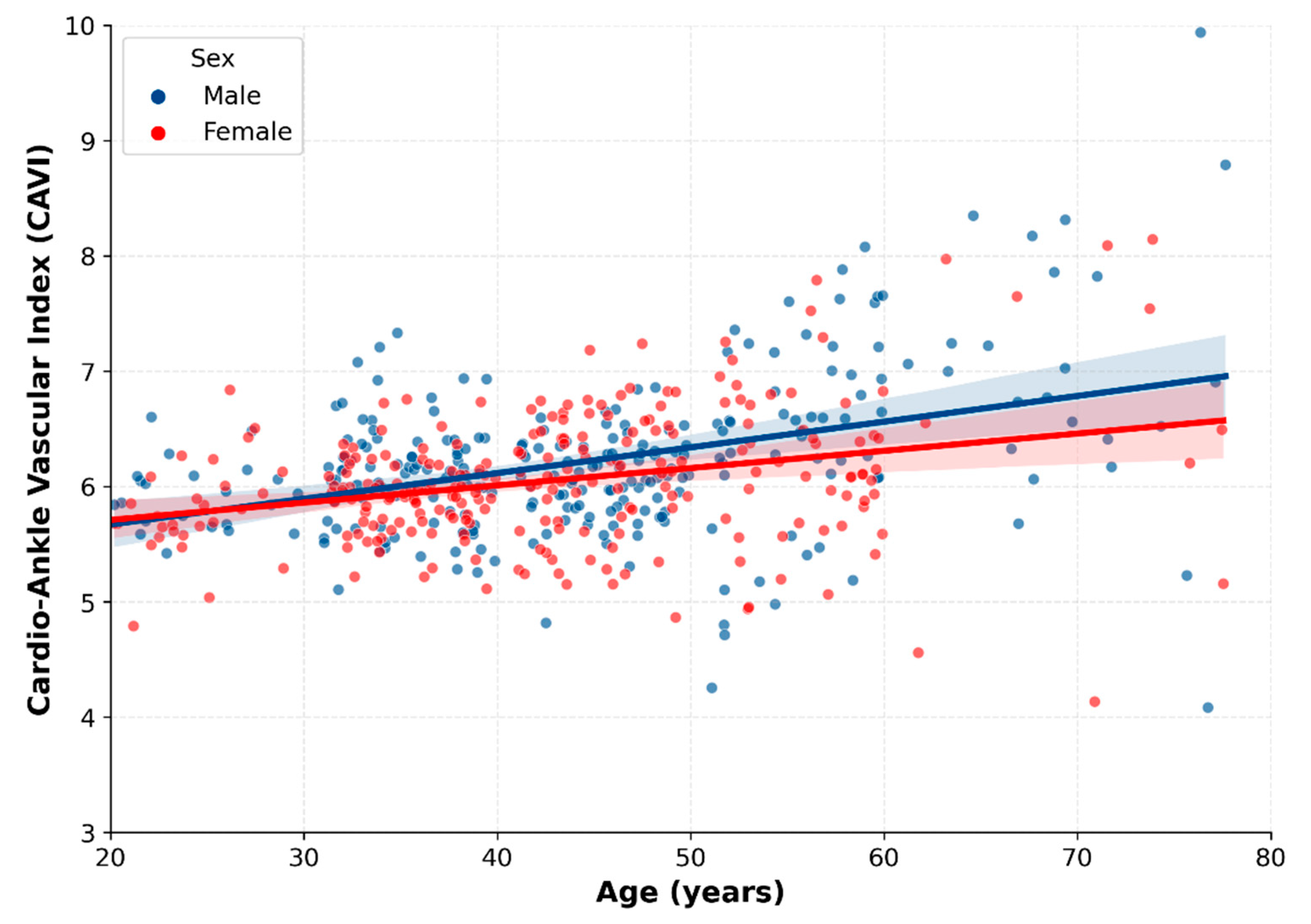
Consistent with the age-related patterns of vascular aging, CAVI values showed a clear positive association with age across the entire cohort (Figure 1). As illustrated in Figure 1 and Table 1, this increasing trend was not strictly linear but appeared to become steeper after midlife: participants aged 50–59 years and those ≥60 years demonstrated significantly higher CAVI values compared to younger cohorts (p < 0.05), suggesting a potential change point in arterial stiffening. Regression analyses (Table 2) showed age to be the strongest correlate of arterial stiffness (β = 0.023, p < 0.0001).
Sex-stratified analyses revealed different age–CAVI association patterns. Males displayed a generally steeper overall age-related association (β = 0.026, 95% CI: 0.019–0.033) compared to females (β = 0.019, 95% CI: 0.012–0.026) (Table 3). However, visual inspection of the trajectories suggests a nonlinear pattern: while males maintained higher baseline stiffness values throughout early adulthood, female CAVI values showed a transient but notable midlife elevation, which appeared compatible with midlife physiological changes. Because menopausal status was not available in the current dataset, this midlife female pattern should be interpreted cautiously. Overall, the results indicate that the age–CAVI association appeared to differ by sex.

3.3. Associations of Anthropometric Factors with CAVI

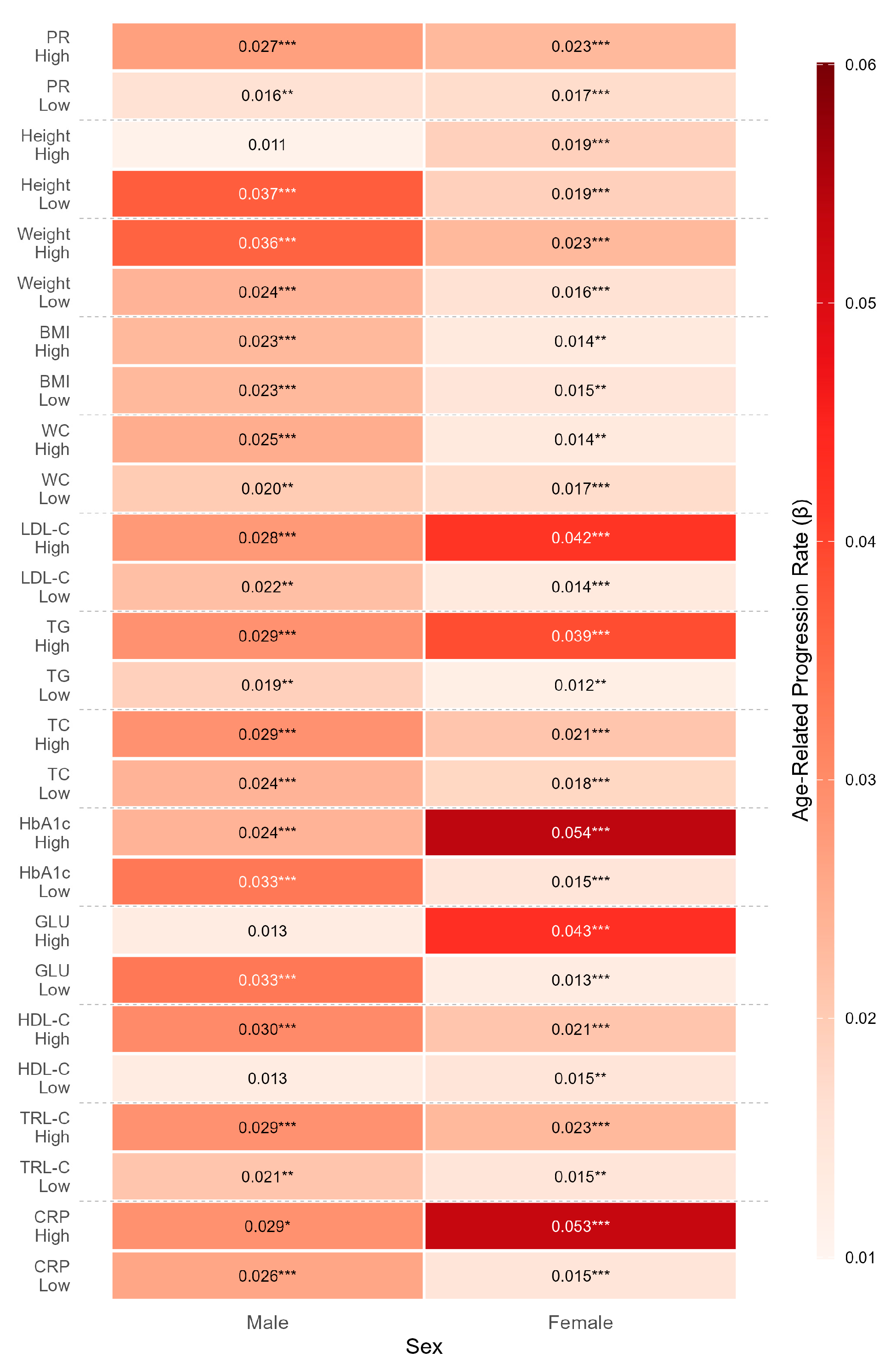
To investigate whether anthropometric characteristics are associated with differences in the age–CAVI association, stratified regression analyses were performed with age as the independent variable and CAVI as the dependent variable. As shown in Table 4, height showed a significant interaction with age in relation to CAVI (p < 0.05 for interaction). Specifically, participants in the low-height group exhibited a steeper age–CAVI association in the sex-adjusted model (β = 0.029, 95% CI: 0.022–0.036) compared to those in the high-height group (β = 0.016, 95% CI: 0.008–0.024). This suggests that shorter stature is associated with a steeper age–CAVI association. In contrast, other anthropometric indicators, including weight, BMI, waist circumference, hip circumference, and pulse rate, did not show statistically significant interactions with age in relation to CAVI (p > 0.05). Additionally, a comparison of anthropometric characteristics across age groups (Table 5) showed expected age-related patterns, with height, weight, BMI, and pulse rate tending to be lower in older age groups, whereas the age-related pattern for waist circumference was less consistent. The sex-specific heatmap (Figure 2) further illustrates the relative prominence of the height-related pattern, particularly in men, in the descriptive subgroup analyses. The age-height interaction remained statistically significant after BH-FDR correction, whereas the remaining anthropometric interactions did not survive FDR correction (Supplementary Table S1).

3.4. Associations of Metabolic Factors with CAVI

Stratified analyses revealed that lipid profiles showed heterogeneous age interactions with the age-related trajectory of CAVI. After adjusting for sex (Model 2), TG, LDL-C, and HDL-C all showed significant interactions with age (Table 6); however, after additional adjustment for blood pressure and smoking, TG remained the clearest signal, whereas LDL-C was attenuated and HDL-C was no longer retained as a robust finding. Specifically, relatively higher lipid levels within the analytic sample were associated with a steeper age–CAVI association. As detailed in Table 6, the age-related regression coefficient was markedly higher in the high-TG group (β = 0.031) compared to the low-TG group (β = 0.014, p < 0.001). Similarly, the high-LDL-C group showed a steeper increase in CAVI in the sex-adjusted model (β = 0.030) than the low-LDL-C group (β = 0.016). These results suggest that, within this screened sample, relatively higher TG levels were consistently associated with a steeper age–CAVI association, whereas the corresponding pattern for LDL-C was weaker after additional adjustment. In contrast, although HDL-C showed a nominal age interaction in the sex-adjusted model, this interaction was further attenuated after additional adjustment and did not remain significant after BH-FDR correction and was therefore interpreted as exploratory (Supplementary Table S1). Regarding the age-related distribution of these metabolic markers (Table 7), LDL-C and TC showed a gradual increase with advancing age (p < 0.05), whereas age-related trends for TG and HDL-C were less consistent across the lifespan. The sex-specific patterns in these age interactions are further illustrated and summarized in Figure 2, as descriptive subgroup contrasts.

3.5. Associations of Inflammatory and Glycemic Factors with CAVI

Within the inflammatory domain, CRP showed an age-related interaction signal in Model 1 (with no adjustments). After adjusting for sex (Model 2), the interaction between CRP and age was highly significant (Table 8), but this pattern was not retained after additional adjustment for blood pressure and smoking. Notably, participants with elevated CRP levels showed the steepest age-related increase in CAVI in the sex-adjusted model (β = 0.042, 95% CI: 0.027–0.057), which was approximately twice the slope observed in the low-CRP group (β = 0.021, 95% CI: 0.016–0.026). This suggests that higher CRP was associated with a steeper age–CAVI association in this population in the earlier models. Importantly, the CRP–age interaction remained statistically significant after BH-FDR correction in the earlier model set, but was not retained in the updated models after additional adjustment (Supplementary Table S1).
In contrast, glycemic indicators, including HbA1c and GLU, showed weaker associations. As shown in Table 8, the interactions of HbA1c and GLU with age did not reach statistical significance (p > 0.05) in the overall cohort, which may relate to the study’s exclusion of individuals with clinically diagnosed diabetes. Regarding age-related trends (Table 9), both HbA1c and GLU levels showed a progressive increase across age groups (p < 0.05), consistent with age-related changes in glucose tolerance. Although the interactions appeared weak in the overall cohort, the sex-stratified analyses suggested that subgroup association patterns for these inflammatory and glycemic indicators differed between men and women, as illustrated in Figure 2.

3.6. Sex-Specific Association Patterns Across Domains

The sex-stratified coefficients underlying Figure 2 are presented numerically in Table 10. These results suggested that subgroup association patterns related to the age–CAVI relationship may differ between men and women.
As shown in the left column of Figure 2 and Table 10, relatively larger age–CAVI coefficients in men were more often observed in the anthropometric domain, particularly for height. The low-height subgroup showed the steepest age–CAVI association in men (β = 0.037), whereas the high-weight subgroup also showed a relatively large coefficient in the heatmap (β = 0.036), although the age-weight interaction was not statistically significant. However, in men, neither BMI (p = 0.9533) nor waist circumference (p = 0.4629) showed a statistically significant interaction with age in relation to CAVI. These findings suggest that anthropometric interaction signals appeared more prominent than several metabolic or inflammatory signals in men in the present subgroup analyses, with height providing the clearest representative pattern. In contrast, several metabolic indicators in men showed comparatively smaller coefficients, such as the high-glucose subgroup (β = 0.013) and the high-LDL-C subgroup (β = 0.028). Consistent with the interaction tests, the age-height interaction remained significant in males after BH-FDR correction, indicating a steeper age-related increase in CAVI among shorter men (Supplementary Table S1).
In women, the subgroup pattern differed, with relatively larger age–CAVI coefficients observed in several metabolic-related indicators and in some inflammatory or glycemic subgroups. Anthropometric subgroup coefficients in women were generally modest, whereas several metabolic and inflammatory subgroups showed relatively steeper age–CAVI associations. Neither BMI (interaction p = 0.8759) nor waist circumference (interaction p = 0.7384) emerged as a major age-interaction signal in relation to CAVI. Notably, steeper age–CAVI associations were observed in women with high HbA1c (β = 0.054; n = 11) and high CRP (β = 0.053), as indicated by the deep red blocks; the coefficient for the female high-HbA1c subgroup should be interpreted with caution given the small sample size, and the CRP-related contrast should also be interpreted cautiously because the corresponding overall interaction was not retained after additional adjustment. Larger coefficients were also observed in several lipid-related subgroups, including the high-LDL-C subgroup, although the corresponding LDL-C interaction should be interpreted cautiously in light of the updated overall analyses.

4. Discussion

This study investigated the age- and sex-specific correlates of arterial stiffness, as assessed by the cardio–ankle vascular index (CAVI), in a rigorously screened cohort of healthy Chinese adults. Several descriptive findings may be noted. First, CAVI showed a clear age-related increase in both sexes, with a steeper age–CAVI association after midlife [17,26,34]. Second, the associations between CAVI and factors from the anthropometric, metabolic, and inflammatory domains showed heterogeneous patterns, with the clearest overall interaction signals concentrated in a limited number of indicators. Third, sex-stratified analyses revealed distinct domain-specific association patterns, suggesting that subgroup association patterns related to vascular stiffness may differ between men and women [33,35,36,37]. Taken together, these results provide additional descriptive evidence on age- and sex-related association patterns of CAVI in apparently healthy adults and may support a more cautious age- and sex-sensitive interpretation of CAVI in preventive health settings, particularly with respect to height- and TG-related heterogeneity in the overall analyses [9,10,11,18].

4.1. Age-Related Patterns of CAVI and Implications for Early Vascular Aging

Our results are consistent with prior evidence that age is a major correlate of arterial stiffness even among healthy adults [8,17,26,38]. CAVI values increased progressively across age groups, with a steeper age–CAVI association beginning in participants over 50 years [10,18,34]. This pattern supports the concept of Early Vascular Aging (EVA), which suggests that vascular changes may begin earlier than expected based on metrical age alone [12]. In our cohort, some individuals in their 40s already exhibited CAVI levels approaching those observed in later decades, indicating that early vascular deviations may occur even in the absence of overt metabolic disease or hypertension. Establishing these age-specific patterns in a healthy East Asian population helps address an important reference gap, as descriptive data for CAVI have been largely derived from Western cohorts [15,26]. Clinically, these age-related patterns may help clinicians to distinguish between physiological age-related changes and potentially pathological elevations that may warrant further cardiometabolic evaluation.

4.2. Sex Differences in Arterial Stiffness and Possible Biological Correlates

Beyond age, our findings suggest sex-related differences in the age–CAVI association and in the subgroup patterns observed across physiological indicators. Men exhibited higher CAVI values overall and showed a steeper age-associated increase than women in the present sample; however, this descriptive pattern should not be interpreted as direct evidence of a faster progression of structural vascular aging [34,35,36]. Women demonstrated a distinct pattern: while their overall CAVI levels were lower, a noticeable midlife rise was observed, a pattern that may be compatible with midlife physiological changes. This pattern may be compatible with prior evidence linking midlife hormonal changes to vascular and metabolic alterations [33,35,39]. Our sex-stratified subgroup analyses suggest that the association patterns linked to vascular stiffness may differ by sex [33,36].
In men, relatively larger coefficients were more often observed within the anthropometric domain, particularly for height, which may be compatible with a more evident anthropometric-related descriptive pattern [31,40]. Higher body mass and related body-size characteristics can be accompanied by increased arterial wall stress and pulsatile load, although in the present analysis, the clearest anthropometric interaction signal was observed for height rather than for BMI or waist circumference [19]. In addition, shorter stature has been associated with arterial stiffness and steeper age–CAVI associations, providing a plausible context for the stronger height-related signal observed in men [31,40]. The concurrent signal for glycemic indicators in men was less consistent in the overall analyses and should therefore be interpreted cautiously despite its appearance in some subgroup displays [41]. In women, several metabolic-related strata, including TG and to a lesser extent LDL-C, showed comparatively larger subgroup coefficients, whereas the CRP-related contrast was not retained in the updated overall analyses [24,25,29,30,31]. One of the steepest age–CAVI associations in women was observed in the high-HbA1c stratum; however, this subgroup was small (n = 11; Table 10), and the estimate should be interpreted cautiously. These findings suggest that vascular aging is not uniform across sexes but may reflect sex-specific physiological contexts that may vary over the lifespan [35,36,37].

4.3. Relative Association Patterns Across the Three Biological Domains

A key objective of this study was to examine whether factors from the three biological domains defined in the present analytic framework, anthropometric, metabolic, and inflammatory, showed different subgroup association patterns with arterial stiffness. Our findings show domain-specific contribution patterns, while recognizing that the overall interaction evidence was concentrated in only a limited number of indicators.
Anthropometric domain: Height displayed a consistent inverse association with CAVI [26,28,41]. Physiologically, this may be related to the length of the arterial tree; taller individuals have longer arterial paths, which may delay the return of reflected pressure waves, which could theoretically be associated with lower arterial stiffness readings [15,26,28]. This signal was particularly evident in men in the present subgroup analyses, although the clearest anthropometric interaction signal was observed for height, while BMI and waist circumference did not emerge as major interaction signals.
Metabolic domain: Lipid-related factors exhibited heterogeneous associations with CAVI, with triglycerides showing the clearest pattern, whereas LDL-C showed a weaker pattern after additional adjustment [5,19,20,29,30,31]. Elevated TG was consistently associated with a steeper age–CAVI association, whereas the corresponding LDL-C pattern was limited [5,19,20,29,30,31]. These findings are consistent with the relevance of lipid-related indicators to age-related variation in CAVI, in line with the prior literature involving oxidative stress, endothelial dysfunction, and smooth muscle remodeling [19,27,42]. Notably, some of these signals appeared more evident in women in the present subgroup analyses; however, these descriptive sex-specific patterns should be interpreted cautiously and not as definitive evidence of a stronger metabolic influence on female vascular aging, with TG providing the clearest corresponding signal and LDL-C representing a secondary pattern [25,35,36].
Inflammatory domain: CRP showed an initial interaction signal in the earlier models, but this signal was attenuated after adjustment for blood pressure and was not retained in the overall analyses [24,25]. Additionally, CRP-related subgroup differences appeared more evident in women; however, this pattern should be interpreted cautiously [20,21,29].
Taken together, these patterns suggest that the association patterns related to arterial stiffness are heterogeneous [3,5,37,40]. Although the cross-sectional design precludes causal inference, the observed subgroup patterns suggest that signals from the anthropometric domain may be more evident in some male subgroups, whereas signals from the metabolic domains may be more evident in some female subgroups, with inflammatory contrasts remaining descriptive and less stable in the overall analyses [24,25,29,30,31,35,36,37].

4.4. Clinical Implications

This study has several potential implications for clinical practice. First, the age- and sex-specific CAVI patterns observed in this rigorously screened cohort may offer descriptive reference information for interpreting CAVI values in apparently healthy East Asian adults [13,18,32,39]. Importantly, the present findings should be interpreted as pertaining primarily to large-vessel stiffness assessed by CAVI and should not be directly extrapolated to resistance (small) arterial stiffness or microvascular dysfunction. Deviations from these descriptive trajectories may help flag individuals at risk of EVA despite otherwise unremarkable cardiometabolic profiles [33]. Second, our domain-based findings may inform hypothesis generation regarding sex-specific risk interpretation in preventive health assessment, with the clearest overall signals observed for height and TG. If confirmed in future studies, anthropometric indicators, particularly height, may warrant particular attention when interpreting subgroup differences in men. For women, metabolic indicators, particularly TG, may warrant particular attention in some female subgroups [24,25,29,30,31,35,36]. Finally, recognizing that arterial stiffness is shaped by the interplay of multiple biological domains supports the use of CAVI as part of a comprehensive cardiovascular risk stratification approach rather than a standalone indicator [8,37,38].

4.5. Limitations

This study has several limitations. First, its cross-sectional design precludes causal inference. Second, although the overall analytic sample included 525 participants, sample sizes in several subgroups became limited after sex stratification and biomarker-based subgrouping; therefore, some subgroup-specific estimates should be interpreted cautiously. Third, the present study focused on CAVI and did not include the heart–thigh beta index (htβ), so comparison with a more central arterial stiffness measure was not possible. Fourth, the menopausal status was not available in the present dataset; therefore, the transient midlife elevation observed among women should be interpreted cautiously rather than as direct evidence of a menopausal mechanism. Future studies with larger samples, longitudinal follow-up, more comprehensive covariate adjustment, and, where possible, joint assessment of CAVI and htβ are warranted.

5. Conclusions

In conclusion, in this cohort of apparently healthy Chinese adults, we found that arterial stiffness assessed by CAVI rose steadily with age and seemed to climb more steeply after the fifth decade onward. Men had higher CAVI values and a slightly faster age-related increase than women, whereas women showed a transient midlife elevation in CAVI. In subgroup interaction analyses, anthropometric signals appeared more prominent in men, with height providing the clearest representative pattern, whereas metabolic signals appeared more prominent in women, with TG providing the clearest corresponding signal.

Supplementary Materials

The following supporting information can be downloaded at: https://www.mdpi.com/article/10.3390/metabo16050300/s1, Table S1: Interaction tests with BH-FDR adjustment; Table S2: CRP Sensitivity Analysis: Exclude Participants with CRP > 10 mg/L; Table S3: CRP Sensitivity Analysis: CRP distribution before and after exclusion; Table S4: Cut-off values used for subgroup definitions.

Author Contributions

The study was conceived and designed by F.-H.L. The literature retrieval, information collection, analysis, and writing of the first draft of this study were done by K.-W.H. and B.-L.C. The manuscript was reviewed and revised by P.-S.N. and Z.-Z.W. All authors have read and agreed to the published version of the manuscript.

Funding

This work was supported by the National Natural Science Foundation of China (grant nos. 32371180 and 31971099), the training targets of young and middle-aged academic leaders in the Jiangsu Province Blue Project (no specific grant number assigned), the Major Sports Research Project of the Jiangsu Provincial Sports Bureau in 2023 (ST231208), and the Major Science and Technology Demonstration Project for Social Development in Jiangsu Province (BE2018752), the National Social Science Foundation of China (23CTY018), and the Jiangsu Province Social Science Foundation Program (21TYD004).

Institutional Review Board Statement

The study was conducted in accordance with the Declaration of Helsinki and approved by the Biomedical Research Ethics Committee of Nanjing Normal University (Approval No. NNU202310007) on 7 October 2023. All methods were carried out in accordance with the ethical principles of the Declaration of Helsinki. All participants were informed about the purpose of the study, assured of confidentiality, and provided written informed consent prior to participation. Participation was voluntary, and participants could withdraw at any time without consequence.

Informed Consent Statement

Written informed consent was obtained from all participants involved in the study.

Data Availability Statement

The data that support the findings of this study are available from the corresponding author upon reasonable request.

Conflicts of Interest

The authors declare no competing interests.

Abbreviations

EVA: early vascular aging; CAVI: cardio–ankle vascular index; BMI: body mass index; CRP: C-reactive protein; HbA1c: glycated hemoglobin; GLU: fasting glucose; HDL-C: high-density lipoprotein cholesterol; LDL-C: low-density lipoprotein cholesterol; TC: total cholesterol; PWV: pulse wave velocity; TG: triglyceride; TRL-C: triglyceride-rich lipoprotein cholesterol; SBP: systolic blood pressure; DBP: diastolic blood pressure; FDR: false discovery rate; BH: Benjamini–Hochberg; HSD: honestly significant difference; SOP: standard operating procedure.

References

  1. Vlachopoulos, C.; Aznaouridis, K.; Stefanadis, C. Prediction of cardiovascular events and all-cause mortality with arterial stiffness: A systematic review and meta-analysis. J. Am. Coll. Cardiol. 2010, 55, 1318–1327. [Google Scholar] [CrossRef] [PubMed]
  2. Boutouyrie, P.; Chowienczyk, P.; Humphrey, J.D.; Mitchell, G.F. Arterial stiffness and cardiovascular risk in hypertension. Circ. Res. 2021, 128, 864–886. [Google Scholar] [CrossRef]
  3. Regnault, V.; Lacolley, P.; Laurent, S. Arterial stiffness: From basic primers to integrative physiology. Annu. Rev. Physiol. 2024, 86, 99–121. [Google Scholar] [CrossRef] [PubMed]
  4. Lakatta, E.G.; Levy, D. Arterial and cardiac aging: Major shareholders in cardiovascular disease enterprises: Part I: Aging arteries: A ‘set up’ for vascular disease. Circulation 2003, 107, 139–146. [Google Scholar] [CrossRef]
  5. Zieman, S.J.; Melenovsky, V.; Kass, D.A. Mechanisms, pathophysiology, and therapy of arterial stiffness. Arterioscler. Thromb. Vasc. Biol. 2005, 25, 932–943. [Google Scholar] [CrossRef]
  6. Laurent, S.; Boutouyrie, P. The structural factor of hypertension: Large and small artery alterations. Circ. Res. 2015, 116, 1007–1021. [Google Scholar] [CrossRef]
  7. Chen, W.; Li, S.; Fernandez, C.; Sun, D.; Lai, C.-C.; Zhang, T.; Bazzano, L.; Urbina, E.M.; Deng, H.-W. Temporal relationship between elevated blood pressure and arterial stiffening among middle-aged Black and White adults: The Bogalusa Heart Study. Am. J. Epidemiol. 2016, 183, 599–608. [Google Scholar] [CrossRef] [PubMed]
  8. Cecelja, M.; Chowienczyk, P. Role of arterial stiffness in cardiovascular disease. JRSM Cardiovasc. Dis. 2012, 1, cvd.2012.012016. [Google Scholar] [CrossRef]
  9. Yambe, T.; Yoshizawa, M.; Saijo, Y.; Yamaguchi, T.; Shibata, M.; Konno, S.; Nitta, S.; Kuwayama, T. Brachio-ankle pulse wave velocity and cardio-ankle vascular index (CAVI). Biomed. Pharmacother. 2004, 58, S95–S98. [Google Scholar] [CrossRef]
  10. Namekata, T.; Suzuki, K.; Ishizuka, N.; Shirai, K. Establishing baseline criteria of cardio-ankle vascular index as a new indicator of arteriosclerosis: A cross-sectional study. BMC Cardiovasc. Disord. 2011, 11, 51. [Google Scholar] [CrossRef]
  11. Shirai, K.; Hiruta, N.; Song, M.; Kurosu, T.; Suzuki, J.; Tomaru, T.; Miyashita, Y.; Saiki, A.; Takahashi, M.; Suzuki, K.; et al. Cardio-ankle vascular index (CAVI) as a novel indicator of arterial stiffness: Theory, evidence and perspectives. J. Atheroscler. Thromb. 2011, 18, 924–938. [Google Scholar] [CrossRef]
  12. Nilsson, P.M.; Boutouyrie, P.; Cunha, P.; Kotsis, V.; Narkiewicz, K.; Parati, G.; Rietzschel, E.; Scuteri, A.; Laurent, S. Early vascular ageing in translation: From laboratory investigations to clinical applications in cardiovascular prevention. J. Hypertens. 2013, 31, 1517–1526. [Google Scholar] [CrossRef] [PubMed]
  13. Li, S.; Chen, W.; Srinivasan, S.R.; Berenson, G.S. Influence of metabolic syndrome on arterial stiffness and its age-related change in young adults: The Bogalusa Heart Study. Atherosclerosis 2005, 180, 349–354. [Google Scholar] [CrossRef]
  14. Aatola, H.; Hutri-Kähönen, N.; Juonala, M.; Viikari, J.S.A.; Hulkkonen, J.; Laitinen, T.; Taittonen, L.; Lehtimäki, T.; Raitakari, O.T.; Kähönen, M. Lifetime risk factors and arterial pulse wave velocity in adulthood: The Cardiovascular Risk in Young Finns Study. Hypertension 2010, 55, 806–811. [Google Scholar] [CrossRef]
  15. Hickson, S.S.; Butlin, M.; Graves, M.; Taviani, V.; Avolio, A.P.; McEniery, C.M.; Wilkinson, I.B. The relationship of age with regional aortic stiffness and diameter. JACC Cardiovasc. Imaging 2010, 3, 1247–1255. [Google Scholar] [CrossRef] [PubMed]
  16. Laurent, S.; Boutouyrie, P. Arterial stiffness: A new surrogate end point for cardiovascular disease? J. Nephrol. 2007, 20, S45–S50. [Google Scholar] [CrossRef]
  17. Sun, Z. Aging, arterial stiffness, and hypertension. Hypertension 2015, 65, 252–256. [Google Scholar] [CrossRef]
  18. Kubozono, T.; Miyata, M.; Ueyama, K.; Nagaki, A.; Otsuji, Y.; Kusano, K.; Kubozono, O.; Tei, C. Clinical significance and reproducibility of new arterial distensibility index. Circ. J. 2007, 71, 89–94. [Google Scholar] [CrossRef] [PubMed]
  19. Mäki-Petäjä, K.M.; Wilkinson, I.B. Inflammation and large arteries: Potential mechanisms for inflammation-induced arterial stiffness. Artery Res. 2012, 6, 59–64. [Google Scholar] [CrossRef]
  20. deGoma, E.M.; deGoma, R.L.; Rader, D.J. Beyond high-density lipoprotein cholesterol levels: Evaluating high-density lipoprotein function as influenced by novel therapeutic approaches. J. Am. Coll. Cardiol. 2008, 51, 2199–2211. [Google Scholar] [CrossRef]
  21. Jia, G.; Aroor, A.R.; Hill, M.A.; Sowers, J.R. Role of renin-angiotensin-aldosterone system activation in promoting cardiovascular fibrosis and stiffness. Hypertension 2018, 72, 537–548. [Google Scholar] [CrossRef] [PubMed]
  22. Wu, M.Y.; Li, C.J.; Hou, M.F.; Chu, P.Y. New insights into the role of inflammation in the pathogenesis of atherosclerosis. Int. J. Mol. Sci. 2017, 18, 2034. [Google Scholar] [CrossRef] [PubMed]
  23. Libby, P.; Ridker, P.M.; Hansson, G.K. Progress and challenges in translating the biology of atherosclerosis. Nature 2011, 473, 317–325. [Google Scholar] [CrossRef]
  24. Yasmin; McEniery, C.M.; Wallace, S.; Mackenzie, I.S.; Cockcroft, J.R.; Wilkinson, I.B. C-reactive protein is associated with arterial stiffness in apparently healthy individuals. Arterioscler. Thromb. Vasc. Biol. 2004, 24, 969–974. [Google Scholar] [CrossRef]
  25. Gómez-Marcos, M.A.; Recio-Rodríguez, J.I.; Patiño-Alonso, M.C.; Agudo-Conde, C.; Gómez-Sanchez, L.; Rodríguez-Sanchez, E.; Gómez-Sanchez, M.; Martínez-Vizcaíno, V.; García-Ortiz, L. Relationships between high-sensitive C-reactive protein and markers of arterial stiffness in hypertensive patients: Differences by sex. BMC Cardiovasc. Disord. 2012, 12, 37. [Google Scholar] [CrossRef]
  26. The Reference Values for Arterial Stiffness’ Collaboration. Determinants of pulse wave velocity in healthy people and in the presence of cardiovascular risk factors: ‘Establishing normal and reference values’. Eur. Heart J. 2010, 31, 2338–2350. [CrossRef]
  27. Gimbrone, M.A., Jr.; García-Cardeña, G. Endothelial cell dysfunction and the pathobiology of atherosclerosis. Circ. Res. 2016, 118, 620–636. [Google Scholar] [CrossRef] [PubMed]
  28. Koivistoinen, T.; Kööbi, T.; Jula, A.; Hutri-Kähönen, N.; Raitakari, O.T.; Majahalme, S.; Kukkonen-Harjula, K.; Lehtimäki, T.; Reunanen, A.; Viikari, J.; et al. Pulse wave velocity reference values in healthy adults aged 26–75 years. Clin. Physiol. Funct. Imaging 2007, 27, 191–196. [Google Scholar] [CrossRef]
  29. Si, X.B.; Liu, W. Relationship between blood lipid and arterial stiffness in hypertension. Clin. Investig. Med. 2019, 42, E47–E55. [Google Scholar] [CrossRef]
  30. Nagayama, D.; Watanabe, Y.; Saiki, A.; Shirai, K.; Tatsuno, I. Lipid parameters are independently associated with cardio-ankle vascular index (CAVI) in healthy Japanese subjects. J. Atheroscler. Thromb. 2018, 25, 621–633. [Google Scholar] [CrossRef]
  31. Wang, L.; Zhi, F.; Gao, B.; Ni, J.; Liu, Y.; Mo, X.; Huang, J. Association between lipid profiles and arterial stiffness: A secondary analysis based on a cross-sectional study. J. Int. Med. Res. 2020, 48, 300060520938188. [Google Scholar] [CrossRef]
  32. Mitchell, G.F.; Vita, J.A.; Larson, M.G.; Parise, H.; Keyes, M.J.; Warner, E.; Vasan, R.S.; Levy, D.; Benjamin, E.J. Cross-sectional relations of peripheral microvascular function, cardiovascular disease risk factors, and aortic stiffness: The Framingham Heart Study. Circulation 2005, 112, 3722–3728. [Google Scholar] [CrossRef]
  33. Stanhewicz, A.E.; Wenner, M.M.; Stachenfeld, N.S. Sex differences in endothelial function important to vascular health and overall cardiovascular disease risk across the lifespan. Am. J. Physiol. Heart Circ. Physiol. 2018, 315, H1569–H1588. [Google Scholar] [CrossRef]
  34. Tomiyama, H.; Yamashina, A.; Arai, T.; Hirose, K.; Koji, Y.; Chikamori, T.; Hori, S.; Yamamoto, Y.; Doba, N.; Hinohara, S. Influences of age and gender on results of noninvasive brachial-ankle pulse wave velocity measurement: A survey of 12,517 subjects. Atherosclerosis 2003, 166, 303–309. [Google Scholar] [CrossRef] [PubMed]
  35. Moreau, K.L.; Hildreth, K.L. Vascular aging across the menopause transition in healthy women. Adv. Vasc. Med. 2014, 2014, 204390. [Google Scholar] [CrossRef]
  36. Robert, J. Sex differences in vascular endothelial cells. Atherosclerosis 2023, 384, 117278. [Google Scholar] [CrossRef]
  37. Herzog, M.J.; Müller, P.; Lechner, K.; Stiebler, M.; Arndt, P.; Kunz, M.; Ahrens, D.; Schmeißer, A.; Schreiber, S.; Braun-Dullaeus, R.C. Arterial stiffness and vascular aging: Mechanisms, prevention, and therapy. Signal Transduct. Target. Ther. 2025, 10, 282. [Google Scholar] [CrossRef]
  38. Ben-Shlomo, Y.; Spears, M.; Boustred, C.; May, M.; Anderson, S.G.; Benjamin, E.J.; Boutouyrie, P.; Cameron, J.; Chen, C.H.; Cruickshank, J.K.; et al. Aortic pulse wave velocity improves cardiovascular event prediction: An individual participant meta-analysis of prospective observational data from 17,635 subjects. J. Am. Coll. Cardiol. 2014, 63, 636–646. [Google Scholar] [CrossRef] [PubMed]
  39. Miller, V.M.; Duckles, S.P. Vascular actions of estrogens: Functional implications. Pharmacol. Rev. 2008, 60, 210–241. [Google Scholar] [CrossRef] [PubMed]
  40. Laurent, S.; Cockcroft, J.; Van Bortel, L.; Boutouyrie, P.; Giannattasio, C.; Hayoz, D.; Pannier, B.; Vlachopoulos, C.; Wilkinson, I.; Struijker-Boudier, H. Expert consensus document on arterial stiffness: Methodological issues and clinical applications. Eur. Heart J. 2006, 27, 2588–2605. [Google Scholar] [CrossRef]
  41. Sugawara, J.; Hayashi, K.; Yokoi, T.; Tanaka, H. Age-associated elongation of the ascending aorta in adults. JACC Cardiovasc. Imaging 2008, 1, 739–748. [Google Scholar] [CrossRef] [PubMed]
  42. Harvey, A.; Montezano, A.C.; Lopes, R.A.; Rios, F.; Touyz, R.M. Vascular fibrosis in aging and hypertension: Molecular mechanisms and clinical implications. Can. J. Cardiol. 2016, 32, 659–668. [Google Scholar] [CrossRef] [PubMed]
Figure 1. Age-related trajectories of arterial stiffness in healthy adults stratified by sex. Note: Scatter plot showing individual data points for males (blue circles) and females (red circles). Solid lines represent the linear regression trends for each sex, and shaded areas indicate the 95% confidence intervals. Cardio-ankle vascular index (CAVI) values demonstrate a progressive increase with age in both groups, with distinct trajectories observed between sexes.
Metabolites 16 00300 g001
Figure 2. Sex-specific heatmap of subgroup-specific age–CAVI regression coefficients. Note: PR, pulse rate, BMI, body mass index, WC, Waist circumference, LDL-C, low-density lipoprotein cholesterol, TG, triglycerides, TC, total cholesterol, HbA1c, glycated hemoglobin, GLU, fasting glucose, HDL-C, high-density lipoprotein cholesterol, TRL-C, triglyceride-rich lipoprotein cholesterol, CRP, C-reactive protein. The heatmap displays the regression coefficients (β), representing the annual change in CAVI within each subgroup. Darker red indicates a larger age–CAVI coefficient. Asterisks denote the statistical significance of the regression coefficient within each subgroup (* p < 0.05, ** p < 0.01, *** p < 0.001) and do not indicate the significance of the interaction between high and low subgroups. In men, relatively larger coefficients were more often observed in anthropometric subgroups, particularly the low-height subgroup. In women, relatively larger coefficients were more often observed in several metabolic subgroups. BMI and waist circumference were included among the anthropometric indicators, but they did not emerge as major interaction signals in either sex.
Metabolites 16 00300 g002
Table 1. Mean ± standard deviation of Cardio–Ankle Vascular Index (CAVI) by age group.
Age GroupTotalMaleFemale
nMean ± SDnMean ± SDnMean ± SD
1505.85 ± 0.38225.92 ± 0.31285.80 ± 0.42
21746.00 ± 0.41846.08 ± 0.48905.92 ± 0.31
31626.09 ± 0.45826.07 ± 0.38806.11 ± 0.52
41046.34 ± 0.80 abc536.46 ± 0.85 abc516.21 ± 0.73 ab
5356.88 ± 1.32 abcd247.01 ± 1.35 abcd116.59 ± 1.27 ab
Note: a: p < 0.05 compared to 1; b: p < 0.05 compared to 2; c: p < 0.05 compared to 3; d: p < 0.05 compared to 4.
Table 2. Regression analysis of the effect of age on Arterial Stiffness (CAVI).
VariantModel 1
β (95%CI)
p
Model 2
β (95%CI)
p
(CAVI)0.023 (0.018, 0.028)
<0.00001
0.023 (0.018, 0.027)
<0.00001
Note: Dependent variable: cardio–ankle vascular index (CAVI), independent variable: age. Model 1: unadjusted variable, Model 2: adjusted variable adjusted for sex.
Table 3. Sex-stratified association between age and arterial stiffness (CAVI).
VariantMale
β (95%CI)
p
Female
β (95%CI)
p
(CAVI)0.026 (0.019, 0.033)
<0.0001
0.019 (0.012, 0.026)
<0.0001
Note: Dependent variable: cardio–ankle vascular index (CAVI); independent variable: age; effect modifier: sex.
Table 4. Stratified regression and interaction test of the influencing factors (anthropometric indicators).
Indicator StratificationnModel 1
β (95%CI)
p
pModel 2
β (95%CI)
p
pModel 3
β (95%CI)
p
pModel 4
β (95%CI)
p
p
Height525
high2700.015 (0.007, 0.023)
<0.0001
0.00510.016 (0.008, 0.024)
<0.0001
0.01540.016 (0.009, 0.024)
<0.0001
0.01570.017 (0.009, 0.024)
<0.00001
0.0104
low2550.030 (0.023, 0.037)
<0.0001
0.029 (0.022, 0.036)
<0.0001
0.028 (0.021, 0.035)
<0.0001
0.029 (0.021, 0.036)
<0.00001
Weight525
high2570.028 (0.021, 0.036)
<0.0001
0.16480.029 (0.021, 0.037)
<0.0001
0.06800.024 (0.017, 0.031)
<0.0001
0.21700.024 (0.017, 0.031)
<0.00001
0.2316
low2680.021 (0.015, 0.028)
<0.0001
0.020 (0.013, 0.026)
<0.0001
0.018 (0.011, 0.026)
<0.0001
0.018 (0.011, 0.026)
<0.00001
BMI525
high2290.028 (0.021, 0.036)
<0.0001
0.09520.028 (0.020, 0.036)
<0.0001
0.08300.026 (0.018, 0.033)
<0.0001
0.14690.026 (0.018, 0.033)
<0.00001
0.1335
low2960.020 (0.013, 0.026)
<0.0001
0.019 (0.012, 0.025)
<0.0001
0.017 (0.011, 0.024)
<0.0001
0.017 (0.010, 0.024)
<0.00001
Waist circumference492
high2530.022 (0.015, 0.030)
<0.0001
0.72460.022 (0.015, 0.030)
<0.0001
0.77440.022 (0.015, 0.029)
<0.0001
0.85660.022 (0.015, 0.029)
<0.00001
0.8535
low2390.024 (0.017, 0.032)
<0.0001
0.022 (0.014, 0.030)
<0.0001
0.019 (0.011, 0.027)
<0.0001
0.019 (0.011, 0.027)
<0.00001
Hip measurement492
high2430.027 (0.019, 0.035)
<0.0001
0.42790.027 (0.019, 0.035)
<0.0001
0.34000.024 (0.016, 0.031)
<0.0001
0.56190.024 (0.016, 0.032)
<0.00001
0.4538
low2490.023 (0.015, 0.030)
<0.0001
0.022 (0.014, 0.029)
<0.0001
0.021 (0.013, 0.029)
<0.0001
0.020 (0.012, 0.028)
<0.00001
Pulse rate525
high2680.021 (0.014, 0.028)
<0.0001
0.32940.020 (0.013, 0.027)
<0.0001
0.23340.018 (0.012, 0.024)
<0.0001
0.12300.019 (0.013, 0.025)
<0.00001
0.4624
low2570.026 (0.019, 0.033)
<0.0001
0.026 (0.019, 0.033)
<0.0001
0.025 (0.017, 0.034)
<0.0001
0.024 (0.016, 0.032)
<0.00001
Note: Dependent variable: Cardio-ankle vascular index (CAVI); independent variable: age, and the data in the table are expressed as β (95% CI) p. Model 1: no adjustment variable, Model 2: sex as adjustment variable, Model 3: sex, Systolic blood pressure (SBP) and Diastolic blood pressure (DBP) as adjustment variable, Model 4: additionally adjusted for smoking status.
Table 5. Mean ± standard deviation of anthropometric indicators by age group.
HeightWeightBMIWaist CircumferenceHip MeasurementPulse Rate
1169.9 ± 9.7483.7 ± 21.029.02 ± 5.1794.9 ± 14.7108.1 ± 10.983.9 ± 9.39
2168.7 ± 9.8378.1 ± 19.527.40 ± 5.1292.4 ± 14.4102.8 ± 9.72 a78.6 ± 9.83 a
3167.0 ± 8.0873.6 ± 14.6 a26.30 ± 4.81 a90.9 ± 12.7100.0 ± 7.35 ab78.9 ± 10.0 a
4164.9 ± 7.70 ab70.3 ± 12.7 ab25.79 ± 4.90 a88.9 ± 13.1 a98.7 ± 7.18 ab75.1 ± 10.3 abc
5164.3 ± 6.07 ab69.4 ± 10.4 ab25.45 ± 5.28 a90.9 ± 13.198.4 ± 7.38 ab74.2 ± 10.3 a
Note: BMI, body mass index. a: p < 0.05 compared to 1; b: p < 0.05 compared to 2; c: p < 0.05 compared to 3.
Table 6. Stratified regression and interaction tests for the influences (lipid indicators).
Indicator StratificationnModel 1
β (95%CI)
p
pModel 2
β (95%CI)
p
pModel 3
β (95%CI)
p
pModel 4
β (95%CI)
p
p
LDL-C514
high2040.030 (0.023, 0.038)
<0.0001
0.00760.030 (0.023, 0.038)
<0.0001
0.00560.029 (0.020, 0.037)
<0.0001
0.01670.029 (0.020, 0.037)
<0.00001
0.0157
low3100.017 (0.010, 0.023)
<0.0001
0.016 (0.010, 0.023)
<0.0001
0.015 (0.009, 0.022)
<0.0001
0.015 (0.009, 0.021)
<0.00001
TG514
high2570.031 (0.024, 0.038)
<0.0001
0.00100.031 (0.024, 0.038)
<0.0001
0.00080.030 (0.022, 0.038)
<0.0001
<0.00010.030 (0.022, 0.038)
<0.00001
<0.0001
low2570.015 (0.008, 0.021)
<0.0001
0.014 (0.007, 0.021)
<0.0001
0.013 (0.007, 0.018)
<0.0001
0.012 (0.007, 0.018)
<0.0001
TC514
high1820.025 (0.017, 0.033)
<0.0001
0.61220.026 (0.017, 0.034)
<0.0001
0.40300.027 (0.018, 0.036)
<0.0001
0.20230.027 (0.018, 0.036)
<0.00001
0.2140
low3320.022 (0.016, 0.029)
<0.0001
0.021 (0.015, 0.028)
<0.0001
0.018 (0.012, 0.024)
<0.0001
0.018 (0.012, 0.024)
<0.00001
HDL-C514
high3210.027 (0.021, 0.033)
<0.0001
0.01640.027 (0.021, 0.033)
<0.0001
0.02160.024 (0.017, 0.031)
<0.0001
0.05830.024 (0.017, 0.031)
<0.00001
0.0594
low1930.014 (0.005, 0.023)
0.0018
0.014 (0.005, 0.023)
0.0018
0.015 (0.009, 0.020)
<0.0001
0.014 (0.009, 0.020)
<0.00001
Note: CAVI, cardio-ankle vascular index; LDL-C, low-density lipoprotein cholesterol; TG, triglyceride; TC, total cholesterol; HDL-C, high-density lipoprotein cholesterol; SBP, systolic blood pressure; DBP, diastolic blood pressure. CAVI is the dependent variable, and age is the independent variable; data in the table are expressed as β (95% CI) and p value. Model 1: no adjustment variable, Model 2: sex as adjustment variable, Model 3: sex, SBP and DBP as adjustment variables, Model 4: additionally adjusted for smoking status.
Table 7. Mean ± standard deviation of lipid indices by age group.
LDL-CTGTCHDL-C
11.27 ± 0.591.27 ± 0.714.62 ± 0.911.25 ± 0.27
21.34 ± 0.691.77 ± 2.044.87 ± 0.881.26 ± 0.32
31.51 ± 0.661.86 ± 1.384.93 ± 0.941.29 ± 0.38
41.57 ± 0.841.75 ± 1.115.04 ± 0.93 a1.38 ± 0.34 b
51.67 ± 0.77 a1.75 ± 1.225.23 ± 0.97 a1.32 ± 0.28
Note: a: p < 0.05 compared to 1; b: p < 0.05 compared to 2.
Table 8. Stratified regression and interaction tests for glycemic and inflammatory indicators.
Indicator StratificationnModel 1
β (95%CI)
p
pModel 2
β (95%CI)
p
pModel 3
β (95%CI)
p
pModel 4
β (95%CI)
p
p
HbA1c514
high1840.027 (0.019, 0.034)
<0.0001
0.19910.027 (0.019, 0.034)
<0.0001
0.19690.024 (0.015, 0.033)
<0.0001
0.25740.024 (0.015, 0.033)
<0.00001
0.2831
low3300.020 (0.013, 0.026)
<0.0001
0.020 (0.013, 0.026)
<0.0001
0.019 (0.013, 0.025)
<0.0001
0.019 (0.013, 0.025)
<0.00001
GLU514
high1100.021 (0.011, 0.031)
<0.0001
0.76630.021 (0.011, 0.031)
<0.0001
0.78340.021 (0.009, 0.032)
0.0006
0.96370.021 (0.009, 0.033)
0.0006
0.9996
low4040.023 (0.017, 0.029)
<0.0001
0.023 (0.017, 0.028)
<0.0001
0.021 (0.015, 0.027)
<0.0001
0.020 (0.015, 0.026)
<0.00001
CRP514
high520.043 (0.028, 0.058)
<0.0001
0.00910.042 (0.027, 0.057)
<0.0001
0.00810.033 (0.018, 0.048)
<0.0001
0.11560.033 (0.018, 0.049)
<0.0001
0.1210
low4620.022 (0.016, 0.027)
<0.0001
0.021 (0.016, 0.026) <0.00010.020 (0.015, 0.026)
<0.0001
0.020 (0.015, 0.025)
<0.00001
Note: CAVI, cardio-ankle vascular index; HbA1c, glycated hemoglobin; GLU, fasting glucose; CRP, C-reactive protein; SBP, systolic blood pressure; DBP, diastolic blood pressure. CAVI is the dependent variable, age is the independent variable, and the data in the table are expressed as β (95% CI) and p value. Model 1: no adjustment variable, Model 2: sex as adjustment variable, Model 3: sex, SBP and DBP as adjustment variables, Model 4: additionally adjusted for smoking status.
Table 9. Mean ± standard deviation of glycemic and inflammatory indicators by age group.
HbA1cGLUCRP
15.06 ± 0.375.14 ± 0.703.29 ± 2.51
25.08 ± 0.555.50 ± 1.112.88 ± 2.59
35.28 ± 0.64 b5.68 ± 1.192.32 ± 2.10 a
45.40 ± 0.84 ab5.99 ± 1.87 ab2.34 ± 1.77
55.67 ± 0.68 abc6.51 ± 1.56 abc2.69 ± 2.58
Note: a: p < 0.05 compared to 1; b: p < 0.05 compared to 2; c: p < 0.05 compared to 3.
Table 10. Stratified regression of influences on interaction tests (male and female).
MaleFemale
Indicator StratificationSex-Specific Subgroup RangenModel 1
β (95%CI)
p
pSex-Specific Subgroup RangenModel 1
β (95%CI)
p
p
Pulse rate 262 260
high79–1031180.027 (0.016, 0.038)
<0.0001
0.153780–991320.023 (0.013, 0.033)
<0.0001
0.3691
low50–781440.016 (0.006, 0.026)
0.0015
52–791280.017 (0.008, 0.026)
0.0002
height 265 260
high173.5–1951360.011 (−0.002, 0.024)
0.0977
0.0028161–179.51340.019 (0.010, 0.028)
<0.0001
0.9820
low157–1731290.037 (0.026, 0.047)
<0.0001
144.5–160.51260.019 (0.010, 0.028)
<0.0001
weight 265 260
high82.1–137.11300.036 (0.024, 0.048)
<0.0001
0.134264–136.51270.023 (0.014, 0.033)
<0.0001
0.2356
low55.1–81.91350.024 (0.013, 0.034)
<0.0001
43.6–63.91330.016 (0.007, 0.024)
0.0006
BMI 265 0.9533 260 0.8759
high28.12–45.831320.023 (0.014, 0.031)
<0.0001
25.47–39.071300.014 (0.005, 0.023)
0.0025
low15.31–28.071330.023 (0.011, 0.035)
0.0003
14.80–25.431300.015 (0.006, 0.025)
0.0021
Waist circumference 265 0.4629 260 0.7384
high90.2–140.01320.025 (0.017, 0.034)
<0.0001
90.5–134.61300.014 (0.005, 0.024)
0.0034
low59.9–90.11330.020 (0.008, 0.032)
0.0018
60.0–90.31300.017 (0.007, 0.026)
0.0004
LDL-C 263 251
high1.79–3.781710.028 (0.019, 0.037)
<0.0001
0.45382.08–3.56330.042 (0.026, 0.057)
<0.0001
0.0014
low0.32–1.74920.022 (0.009, 0.035)
0.0010
0.04–2.052180.014 (0.007, 0.021)
0.0002
TG 263 251
high1.16–21.72010.029 (0.020, 0.038)
<0.0001
0.22781.56–8.31560.039 (0.026, 0.053)
<0.0001
0.0006
low0.39–1.15620.019 (0.005, 0.033)
0.0069
0.06–1.541960.012 (0.005, 0.019)
0.0015
TC 263 251
high5.19–8.511030.029 (0.017, 0.040)
<0.0001
0.5394
5.09–8.19790.021 (0.009, 0.033)
0.0005
0.6765
low2.21–5.181600.024 (0.015, 0.034)
<0.0001
2.31–5.081720.018 (0.010, 0.027)
<0.0001
HbA1c 263 251
high5.1–10.01730.024 (0.016, 0.033)
<0.0001
0.28625.7–8.1110.054 (0.026, 0.082)
0.0002
0.0089
low4.3–5900.033 (0.019, 0.047)
<0.0001
4–5.62400.015 (0.009, 0.022)
<0.0001
GLU 263 251
high6.11–18.24710.013 (−0.000, 0.025)
0.0539
0.01006.12–15.43390.043 (0.026, 0.059)
<0.0001
0.0012
low3.94–6.11920.033 (0.024, 0.042)
<0.0001
3.82–6.12120.013 (0.006, 0.020)
0.0006
HDL-C 263 251
high1.3–2.141710.030 (0.021, 0.039)
<0.0001
0.04121.3–2.941500.021 (0.013, 0.030)
<0.0001
0.3764
low0.52–1.29920.013 (−0.000, 0.027)
0.0583
0.68–1.291010.015 (0.004, 0.026)
0.0082
TRL-C 263 251
high0.57–4.881850.029 (0.020, 0.038)
<0.0001
0.30900.57–51050.023 (0.013, 0.033)
<0.0001
0.2144
low0.02–0.56780.021 (0.009, 0.033)
0.0011
0.17–0.561460.015 (0.006, 0.024)
0.0013
CRP
high5.04–16.57260.029 (0.004, 0.055)
0.0250
0.80455.04–16.57260.053 (0.036, 0.070)
<0.0001
<0.0001
low0.25–4.962370.026 (0.018, 0.034)
<0.0001
0.25–4.962250.015 (0.008, 0.021)
<0.0001
Note: CAVI, cardio-ankle vascular index; BMI, body mass index; LDL-C, low-density lipoprotein cholesterol; TG, triglyceride; TC, total cholesterol; HbA1c, glycated hemoglobin; GLU, fasting glucose; HDL-C, high-density lipoprotein cholesterol; TRL-C, triglyceride-rich lipoprotein cholesterol; CRP, C-reactive protein. Dependent variable: CAVI; independent variable: age. Data are expressed as β (95% CI) and p value from sex-stratified linear regression analyses. The separate p column indicates the interaction p value for the difference in age–CAVI slopes between high and low subgroups within each sex. Model 1 was unadjusted. Sex-specific subgroup ranges were applied separately in men and women.
Disclaimer/Publisher’s Note: The statements, opinions and data contained in all publications are solely those of the individual author(s) and contributor(s) and not of MDPI and/or the editor(s). MDPI and/or the editor(s) disclaim responsibility for any injury to people or property resulting from any ideas, methods, instructions or products referred to in the content.