
Citrus Peels in Health Foods: A Case Study of Pulp-Free Japanese-Grown Bushukan (Citrus medica var. sarcodactylis)


Highlights
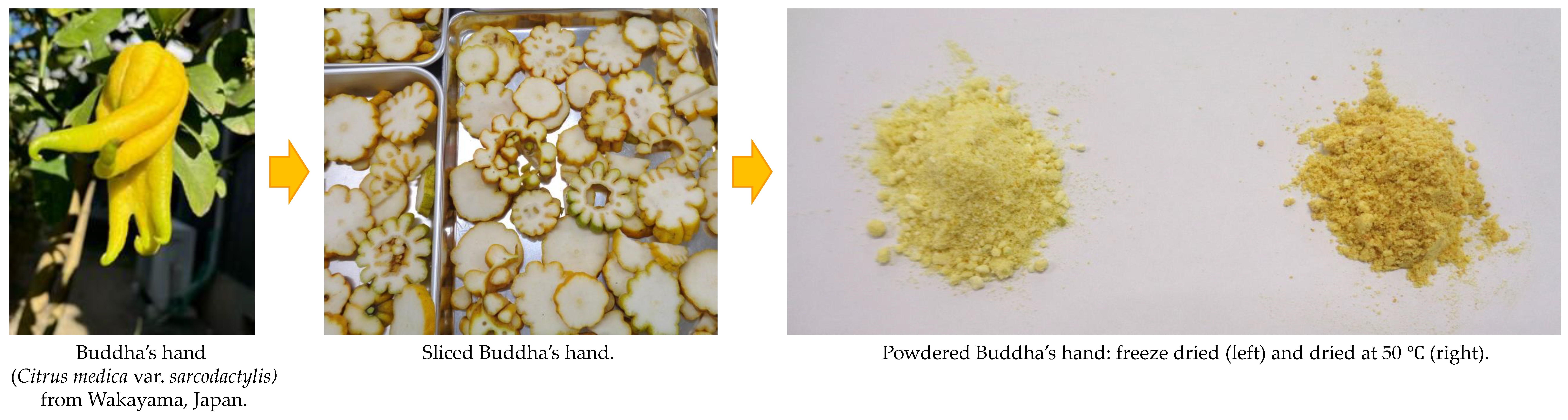
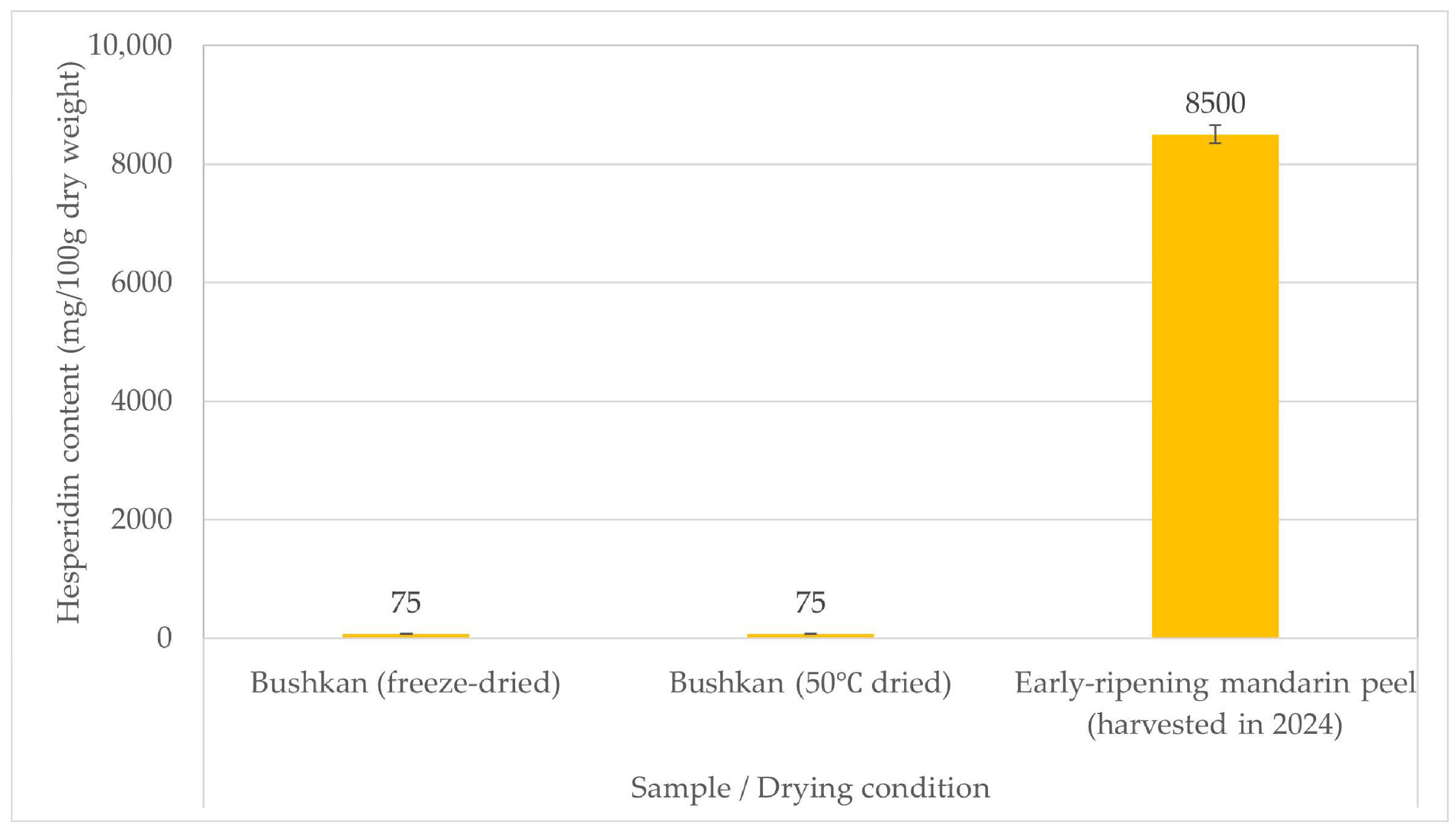
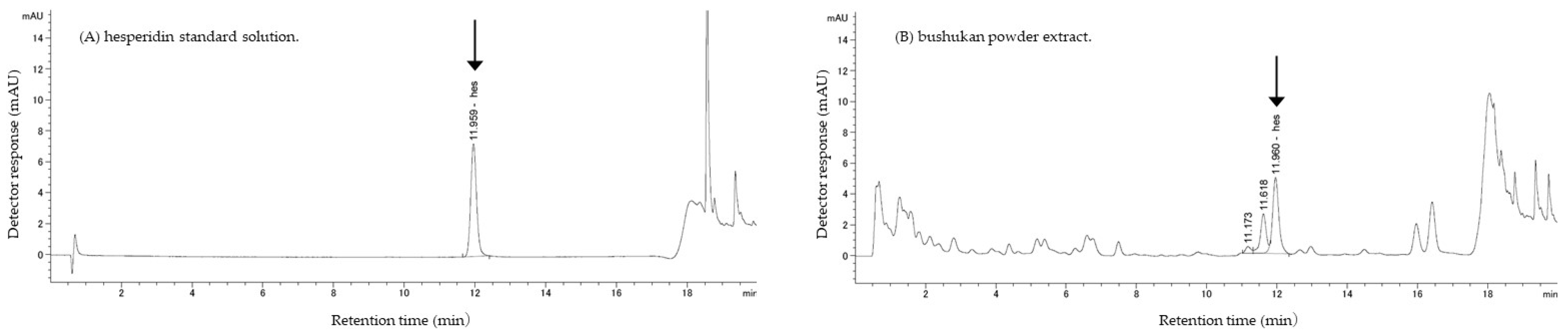
- Japanese-grown bushukan (Citrus medica var. sarcodactylis) contains exceptionally low or undetectable levels of hesperidin and nobiletin.
- The hesperidin concentration in both freeze-dried and hot-air-dried samples was approximately one hundredth of that typically found in early-season satsuma mandarin peel.
- Functional value should not be presumed based solely on botanical classification, as secondary metabolite profiles can differ markedly even within the same genus.
- The study underscores the necessity of species- and origin-specific compositional verification prior to utilizing citrus peels as raw materials for health foods.
Abstract
1. Introduction
2. Materials and Methods
3. Results
4. Discussion
5. Conclusions
Author Contributions
Funding
Institutional Review Board Statement
Informed Consent Statement
Data Availability Statement
Conflicts of Interest
Abbreviations
| HPLC | High-Performance Liquid Chromatography |
| LOD | Limit of Detection |
| LOQ | Limit of Quantification |
| RSD | Relative Standard Deviation |
References
- Chen, J.; Wu, G.; Zhu, C.; Wu, Y.; Wei, R.; Ma, Q. Structurally Diverse Flavonoids from Citrus medica L. var. sarcodactylis Swingle and Their Multiple Bioactivities: A review. J. Food Nutr. Res. 2022, 10, 81–87. [Google Scholar] [CrossRef] [Scilit]
- Lim, T.K. (Ed.) Citrus medica var. sarcodactylis. In Edible Medicinal and Non-Medicinal Plants; Springer: Dordrecht, The Netherlands, 2012; Volume 4, pp. 690–694. [Google Scholar] [CrossRef] [Scilit]
- Nakahigashi, J.; Kurikami, M.; Iwai, S.; Iwamoto, S.; Kobayashi, S.; Kobayashi, E. Exploring the pharmacokinetics and gut microbiota modulation of hesperidin and nobiletin from mandarin orange peel in experimental dogs: A pilot study. Metabolites 2024, 15, 3. [Google Scholar] [CrossRef] [Scilit] [PubMed]
- Yonezawa, T.; Marasigan, C.N.B.B.; Komori, M.; Fujiwara, N.; Nakahigashi, J.; Kobayashi, E. Preliminary Safety Assessment for Mandarin Orange Peel Administration to Dogs Based on Physical Conditions and Blood Examination Parameters. Metabolites 2026, 16, 213. [Google Scholar] [CrossRef] [Scilit] [PubMed]
- Ma, Q.-G.; Chen, J.; Chen, L.-H.; Wu, G.; Zhu, M.-N.; He, N.-X.; Wang, Q.-Y.; Sang, Z.-P.; Zhu, C.-Q.; Wu, Y.-Z.; et al. Citrus medica var. sarcodactylus (Siebold ex Hoola van Nooten) Swingle: An insight into its botany, traditional uses, phytochemistry, and pharmacological properties. Phytochem. Rev. 2023, 22, 1247–1279. [Google Scholar] [CrossRef] [Scilit]
- National Institute of Biomedical Innovation, Health and Nutrition (NIBIOHN). Chenpi Assay Method: Hesperidin Quantification Using Methanol Reflux. Medicinal Plant Database of Japan. Available online: http://mpdb.nibiohn.go.jp/mpdb-bin/view_jp_assay_data.cgi?id=42 (accessed on 15 March 2026).
- Mai, D.-S.; Chen, C.-X.; Cao, J.-M.; Chen, Y.-C.; Liang, T.-T.; Zhao, Z.-X.; Yang, W.-Q. A new limonoid from the Fruits of Citrus medica var. sarcodactylus (Siebold ex Hoola van Nooten) Swingle. Nat. Prod. Res. 2025, 1–9. [Google Scholar] [CrossRef] [Scilit] [PubMed]
- Seminara, S.; Bennici, S.; Di Guardo, M.; Caruso, M.; Gentile, A.; La Malfa, S.; Distefano, G. Sweet orange: Evolution, characterization, varieties, and breeding perspectives. Agriculture 2023, 13, 264. [Google Scholar] [CrossRef] [Scilit]
- Panzella, L.; Moccia, F.; Nasti, R.; Marzorati, S.; Verotta, L.; Napolitano, A. Bioactive phenolic compounds from agri-food wastes: An update on green and sustainable extraction methodologies. Front. Nutr. 2020, 7, 60. [Google Scholar] [CrossRef] [Scilit] [PubMed]
- Prechsl, U.E.; Bonadio, M.B.; Wegher, L.W.; Oberhuber, M.O. Long-term monitoring of pesticide residues on public sites: A regional approach to survey and reduce spray drift. Front. Environ. Sci. 2022, 10, 1062333. [Google Scholar] [CrossRef] [Scilit]
- Graham, K.K.; Sanchez, A.B.; McArt, S.; Isaacs, R. Pesticide drift into field margins threatens bee pollinators and other beneficial insects. Environ. Entomol. 2025, 54, 835–841. [Google Scholar] [CrossRef] [Scilit] [PubMed]


Disclaimer/Publisher’s Note: The statements, opinions and data contained in all publications are solely those of the individual author(s) and contributor(s) and not of MDPI and/or the editor(s). MDPI and/or the editor(s) disclaim responsibility for any injury to people or property resulting from any ideas, methods, instructions or products referred to in the content. |
© 2026 by the authors. Licensee MDPI, Basel, Switzerland. This article is an open access article distributed under the terms and conditions of the Creative Commons Attribution (CC BY) license.
Share and Cite
Nakahigashi, J.; Kobayashi, E. Citrus Peels in Health Foods: A Case Study of Pulp-Free Japanese-Grown Bushukan (Citrus medica var. sarcodactylis). Metabolites 2026, 16, 254. https://doi.org/10.3390/metabo16040254
Nakahigashi J, Kobayashi E. Citrus Peels in Health Foods: A Case Study of Pulp-Free Japanese-Grown Bushukan (Citrus medica var. sarcodactylis). Metabolites. 2026; 16(4):254. https://doi.org/10.3390/metabo16040254
Chicago/Turabian StyleNakahigashi, Jun, and Eiji Kobayashi. 2026. "Citrus Peels in Health Foods: A Case Study of Pulp-Free Japanese-Grown Bushukan (Citrus medica var. sarcodactylis)" Metabolites 16, no. 4: 254. https://doi.org/10.3390/metabo16040254
APA StyleNakahigashi, J., & Kobayashi, E. (2026). Citrus Peels in Health Foods: A Case Study of Pulp-Free Japanese-Grown Bushukan (Citrus medica var. sarcodactylis). Metabolites, 16(4), 254. https://doi.org/10.3390/metabo16040254