
Systematic Review

Effects of High-Intensity Interval Training on Body Composition, Metabolic Health, and Cardiorespiratory Fitness in Overweight or Obese Children and Adolescents: A Systematic Review and Meta-Analysis

1
China Basketball College, Beijing Sport University, Beijing 100084, China
2
Sports Coaching College, Beijing Sport University, Beijing 100084, China
3
School of Sports Training, Wuhan Sports University, Wuhan 430079, China
4
School of Sport Science, Beijing Sport University, Beijing 100084, China
*
Authors to whom correspondence should be addressed.
Metabolites 2026, 16(4), 232; https://doi.org/10.3390/metabo16040232
Submission received: 24 February 2026 / Revised: 21 March 2026 / Accepted: 23 March 2026 / Published: 31 March 2026

Abstract

Background: Childhood and adolescent overweight and obesity are major global public health concerns. High-intensity interval training (HIIT) has been increasingly investigated as a time-efficient intervention; however, evidence regarding its effects on multiple health-related outcomes and the influence of intervention characteristics remains inconsistent. Objective: The objective of this study was to evaluate the effects of HIIT on body composition, metabolic health, and cardiorespiratory fitness in children and adolescents with overweight or obesity. Methods: Systematic literature searches were conducted in PubMed, Web of Science, EBSCO, CNKI, Wanfang Data, and VIP databases. Randomized controlled trials were included. Risk of bias was assessed using the Cochrane Risk of Bias tool. Meta-analyses were conducted using random-effects models, and standardized mean differences (SMDs) with 95% confidence intervals (CIs) were calculated. Heterogeneity, sensitivity analyses, publication bias, and certainty of evidence (GRADE) were also evaluated. Results: A total of 21 randomized controlled trials involving 652 participants (325 in the intervention groups and 327 in the control groups) were included. Compared with control conditions, HIIT significantly improved multiple outcomes related to body composition, metabolic health, and cardiorespiratory fitness, including BMI (SMD = −1.05), body fat percentage (SMD = −0.69), total cholesterol (SMD = −0.42), HOMA-IR (SMD = −1.00), and VO2peak (SMD = 0.91), while no significant effect was observed on lean body mass. Subgroup analyses suggested that HIIT protocols with a load duration of less than 1 min were associated with greater improvements in several outcomes, particularly body fat percentage, total cholesterol, HOMA-IR, and VO2peak. Conclusions: HIIT may improve body composition, metabolic health, and cardiorespiratory fitness in children and adolescents with overweight or obesity. However, the certainty of evidence varied across outcomes and was limited for some findings by heterogeneity, small sample sizes, and potential risk of bias. Further high-quality, large-scale randomized controlled trials with standardized HIIT protocols are needed to confirm these findings and clarify the influence of different training characteristics (e.g., exercise mode and interval structure).

1. Introduction

Overweight and obesity in childhood and adolescence have become major public health challenges worldwide. According to the World Health Organization, more than 390 million children and adolescents aged 5–19 years were overweight or obese in 2022, and the global prevalence in this age group increased from 8% in 1990 to 20% in 2022 [1]. A recent global analysis further showed that, in many countries, obesity in school-aged children and adolescents has now surpassed thinness, underscoring the worldwide shift in malnutrition patterns [2]. For example, obesity affects 19.7% of children and adolescents aged 2–19 years in the United States [3], while data from the WHO European Childhood Obesity Surveillance Initiative (COSI) show that 28.7% of boys and 26.5% of girls aged 6–9 years across 36 countries were overweight or obese [4]. Importantly, this burden is not confined to a single country or to high-income settings. Consistent with these global trends, China has also experienced a marked increase in overweight and obesity among children and adolescents over recent decades [5]. The Report on the Status of Nutrition and Chronic Diseases Among Chinese Residents (2020) issued by the National Health Commission indicates that the prevalence of overweight and obesity among children and adolescents aged 6–17 years has reached 19% and continues to show an upward trend [6]. Childhood and adolescent obesity not only impairs physical development and mental well-being but also markedly increases the risk of insulin resistance, dyslipidemia, hypertension, and early cardiovascular and metabolic complications, posing a serious threat to long-term health [7].
Exercise-based interventions are among the most effective and safest non-pharmacological strategies for managing pediatric overweight and obesity. In recent years, high-intensity interval training (HIIT), which alternates brief bouts of vigorous exercise with low-intensity recovery, has attracted increasing attention as a time-efficient modality that may improve body composition and cardiometabolic health while also promoting adherence and enjoyment [8,9,10].
Previous systematic reviews and meta-analyses have suggested that HIIT may improve selected health-related outcomes in children and adolescents with overweight or obesity, particularly cardiorespiratory fitness and some cardiometabolic risk markers [11,12,13]. However, the current evidence base remains incomplete. Some earlier meta-analyses primarily focused on comparisons between HIIT and moderate-intensity continuous training and emphasized cardiometabolic risk factors rather than the overall effects of HIIT across multiple outcome domains [11,12]. In contrast, other more recent reviews have focused on a single outcome, such as cardiorespiratory fitness, rather than simultaneously evaluating body composition, metabolic health, and cardiorespiratory fitness within one integrated synthesis [13]. In addition, findings from individual randomized controlled trials have not been fully consistent, with the magnitude of improvement varying across studies and outcomes [11,12]. These discrepancies may be related to heterogeneity in participant characteristics, intervention duration, exercise modality, work-to-rest structure, and outcome selection [11,12,13]. Therefore, an updated and more comprehensive synthesis is warranted to clarify the overall effects of HIIT and to explore whether key intervention characteristics may influence its effectiveness.
Accordingly, we conducted a systematic review and meta-analysis to synthesize the current evidence on the effects of HIIT on body composition, metabolic health, and cardiorespiratory fitness in children and adolescents with overweight or obesity. We further explored whether selected intervention characteristics, such as load duration and training modality, might be associated with differences in intervention effects, thereby informing exercise-based interventions and public health strategies for pediatric overweight and obesity.

2. Methods

This study followed the Preferred Reporting Items for Systematic Reviews and Meta-Analyses (PRISMA) guidelines [14] and was registered on the PROSPERO database, the registration No. is CRD420251155266.

2.1. PICOS and Literature Search Strategy

The search strategy was developed based on the Population, Intervention, Comparison, Outcome, and Study design (PICOS) framework (Table 1). Eligible participants were children and adolescents with overweight or obesity, without restrictions on sex, nationality, or region.
A comprehensive literature search was conducted across several databases, including Web of Science, PubMed, EBSCO, CNKI, Wanfang Data, and VIP from their inception to 9 September 2025. The search strategy was developed using a combination of Medical Subject Headings (MeSH) and free-text terms to ensure comprehensive retrieval of relevant studies. The English search terms included but were not limited to “high-intensity interval training”, “high-intensity interval exercise”, “high-intensity intermittent exercise”, “adolescent”, “children”, “childhood”, “overweight”, and “obese”. Boolean operators (“AND” and “OR”) were used to combine related terms. The complete search strategies, including the Boolean search strings used for each database, are provided in Supplementary Material S1.

2.2. Inclusion and Exclusion Criteria

Inclusion Criteria

The inclusion criteria determined whether the included studies were relevant to the scope of this study and ultimately affected the validity of the findings. Therefore, we predefined the inclusion criteria based on the PICOS framework. Moreover, to include as many potentially eligible studies as possible, we imposed no time limitations on the literature search. Specific inclusion criteria were as follows: (1) Participants were children and adolescents aged between 5 and 19 years, according to the WHO Growth Reference [15], and were classified as overweight or obese based on the criteria established by the World Health Organization or relevant national standards, without other contraindications to exercise or health problems. (2) The intervention group received HIIT, while the control group maintained usual activities without additional structured exercise intervention. (3) Outcomes included at least one measure related to body composition, metabolic health, or cardiorespiratory fitness. (4) The study design was a randomized controlled trial (RCT). (5) The study was published in Chinese or English.

2.3. Exclusion Criteria

Conversely, the exclusion criteria were as follows:
(1)
Studies enrolling normal-weight participants in control groups;
(2)
Ineligible study types (e.g., literature reviews, conference abstracts, animal studies, acute trials, or single-arm studies);
(3)
Studies without accessible full texts or extractable data;
(4)
Non-peer-reviewed publications (e.g., dissertations, theses, preprints).

2.4. Study Selection

The literature search records were managed and screened using Zotero software (Version 7.0.17; Corporation for Digital Scholarship, Falls Church, VA, USA, 2025). Two independent reviewers (Y.Y. and C.P.) first removed duplicate records. Titles and abstracts were then screened according to the predefined inclusion and exclusion criteria to identify potentially eligible studies. The full texts of the remaining articles were subsequently reviewed to determine final eligibility. Any disagreements arising during this process were resolved by discussion, and if consensus could not be achieved, a third reviewer (H.J.Z.) was consulted for adjudication.

2.5. Data Extraction

Data were independently extracted by the same two reviewers. The extracted information included: (1) the first author and year of publication; (2) participant characteristics; (3) sample size; (4) intervention details including intervention duration, frequency, session length, exercise modality, and intervention protocol; and (5) outcome measures.
For continuous outcomes, effect sizes were calculated using post-intervention values rather than change scores. Because baseline values were generally comparable between the intervention and control groups in the randomized trials, post-intervention data were considered appropriate for estimating between-group effects.
For the calculation of effect sizes, the mean values and standard deviations (SDs) were extracted for both intervention and control groups. When these data were not directly reported, other statistics (e.g., medians with ranges or standard errors) were used to calculate the corresponding values using appropriate formulas.
For studies with multiple intervention arms, only the HIIT arms were included in the quantitative synthesis. When multiple time points were reported, only the assessment conducted immediately after completion of the intervention was extracted for the primary meta-analysis; follow-up assessments were not included.

2.6. Quality Assessment

To assess the methodological quality of the RCTs included in this study, the Cochrane Risk of Bias (RoB) tool, implemented in Review Manager (Version 5.4; The Cochrane Collaboration, 2020), was used by two of our researchers (Y.Y. and H.J.Z.) independently. This tool evaluates potential risk of bias in these studies across six domains: selection, performance, detection, attrition, reporting, and other sources of bias. Specifically, seven items were assessed: random sequence generation, allocation concealment, blinding of participants and personnel, blinding of outcome assessment, incomplete outcome data, selective reporting, and other bias. Each item was rated as having a “low risk,” “high risk,” or “unclear risk” of bias.

2.7. Statistical Analysis

Statistical analyses were performed using Stata/MP version 18.0 (StataCorp LLC, College Station, TX, USA). For continuous outcomes, pooled effect sizes were calculated as standardized mean differences (SMDs) with 95% confidence intervals (CIs), because the included studies used different measurement scales. Given the relatively small sample sizes of the included studies, Hedges’ g was applied to correct for small-sample bias; for interpretability, effect sizes were classified as small (0.20–0.49), medium (0.50–0.79), or large (≥0.80) [16].
Statistical heterogeneity was assessed using Cochran’s Q test and quantified using the I2 statistic. I2 values of 25%, 50%, and 75% were interpreted as indicating low, moderate, and high heterogeneity, respectively [17].
Regarding model choice, a fixed-effect model assumes a single common true effect across studies. When heterogeneity is present, this assumption may be violated because the model does not account for between-study variance (τ2), which can lead to underestimated uncertainty and overly narrow confidence intervals; moreover, inference pertains only to the specific set of included studies [18,19]. Given the anticipated clinical and methodological heterogeneity in participant characteristics and HIIT prescriptions across trials, pooled effect sizes were therefore synthesized using a random-effects model. This model incorporates between-study variance (τ2) and estimates the mean of a distribution of true effects, thereby providing a more appropriate summary of the available evidence under heterogeneous conditions [18,19].
Sensitivity analyses were conducted using a leave-one-out approach, in which each study was sequentially omitted and the pooled estimate was recalculated to assess the robustness of the results. For outcomes included in publication bias assessment, potential small-study effects were examined using visual inspection of funnel plots and Egger’s regression test [20,21]. If Egger’s test indicated possible bias (p < 0.05), the trim-and-fill method was applied to adjust for missing studies, and the corrected pooled estimates were recalculated to verify the robustness of these outcomes. Given the limited number of studies for some outcomes and the incomplete reporting of potential effect modifiers, only prespecified subgroup analyses were conducted, whereas more extensive subgroup analyses or meta-regression were not performed to avoid underpowered and unstable estimates.

2.8. Certainty Assessment

To assess how much confidence can be placed in the pooled effects for each outcome, we used the GRADE approach to rate the certainty of evidence. This approach evaluates five domains for each outcome: risk of bias, inconsistency, indirectness, imprecision, and publication bias. As all included studies were randomized controlled trials, the starting level was “high”, and if any important concerns were identified in these domains, the rating was downgraded to moderate, low, or very low. The GRADE assessment was performed by one reviewer (Y.Y.), with independent verification by a second reviewer (C.P.).

3. Results

3.1. Literature Search Results

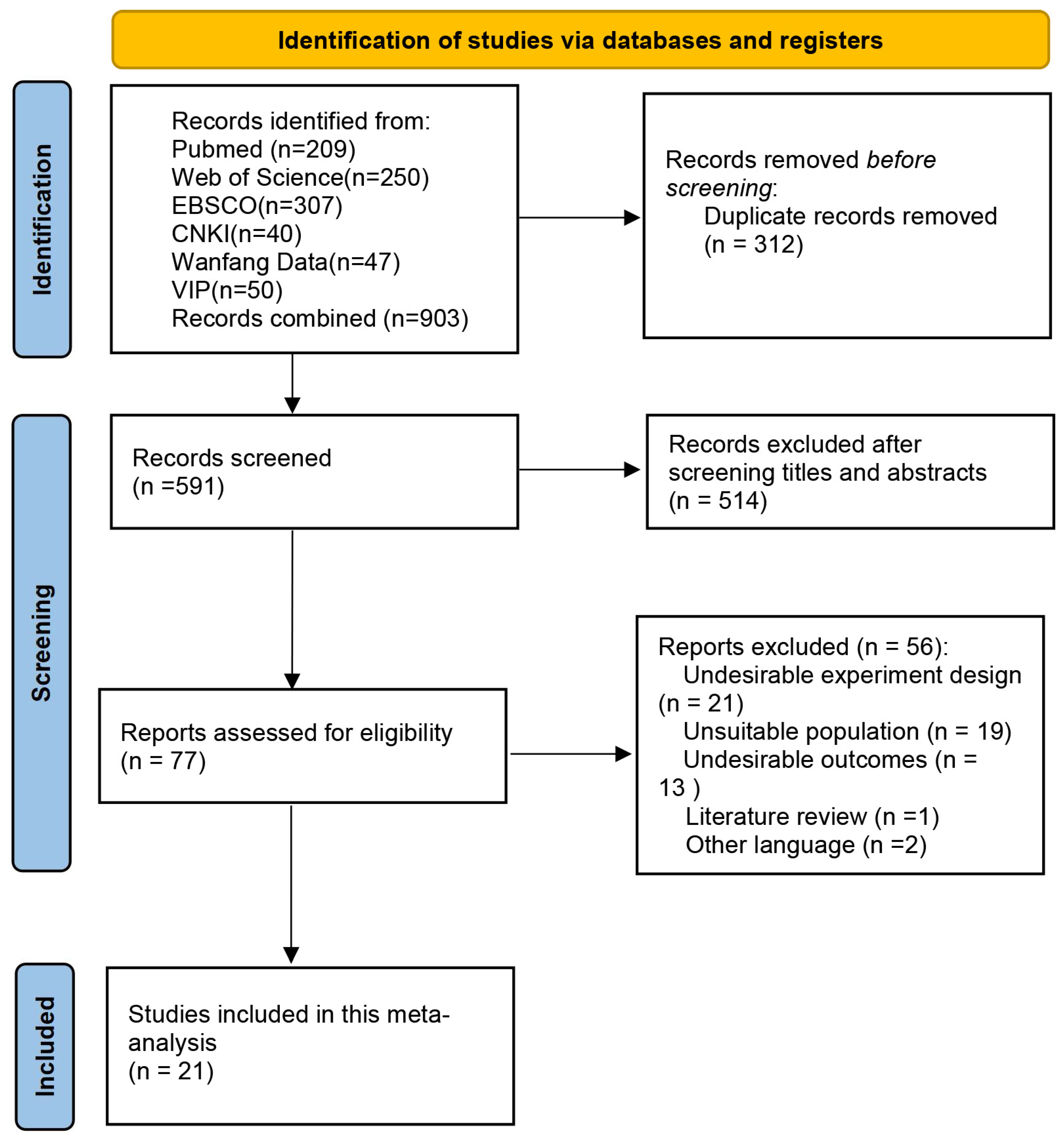
Following the search strategy described above, a total of 903 records were retrieved from the selected databases. After removing duplicates using Zotero, 591 unique records remained. Subsequently, titles and abstracts were screened according to the predefined inclusion and exclusion criteria, and clearly irrelevant studies were removed, resulting in 77 articles for full-text review. After full-text assessment, 21 studies met the eligibility criteria and were included in the final analysis [22,23,24,25,26,27,28,29,30,31,32,33,34,35,36,37,38,39,40,41,42]. The study selection process is summarized in Figure 1.

3.2. Study Characteristics

A total of 903 publications were initially identified through the database search. After removing 312 duplicate records, 591 articles remained for title and abstract screening, of which 514 were excluded. Subsequently, the full texts of 77 articles were assessed for eligibility. Ultimately, 21 studies were included in this meta-analysis, with a total of 652 participants (325 in the intervention groups and 327 in the control groups). Table 2 presents the main characteristics of the included studies.

3.3. Study Quality Assessment

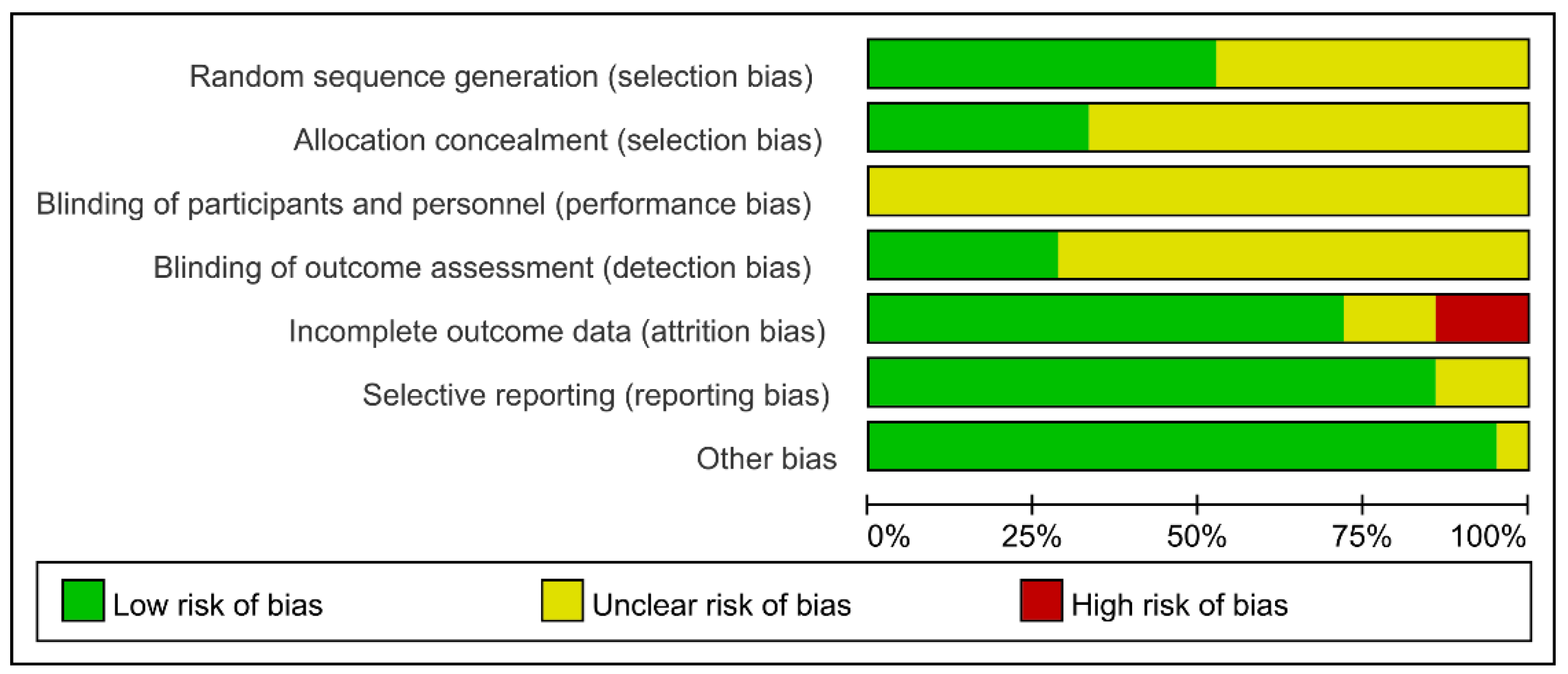
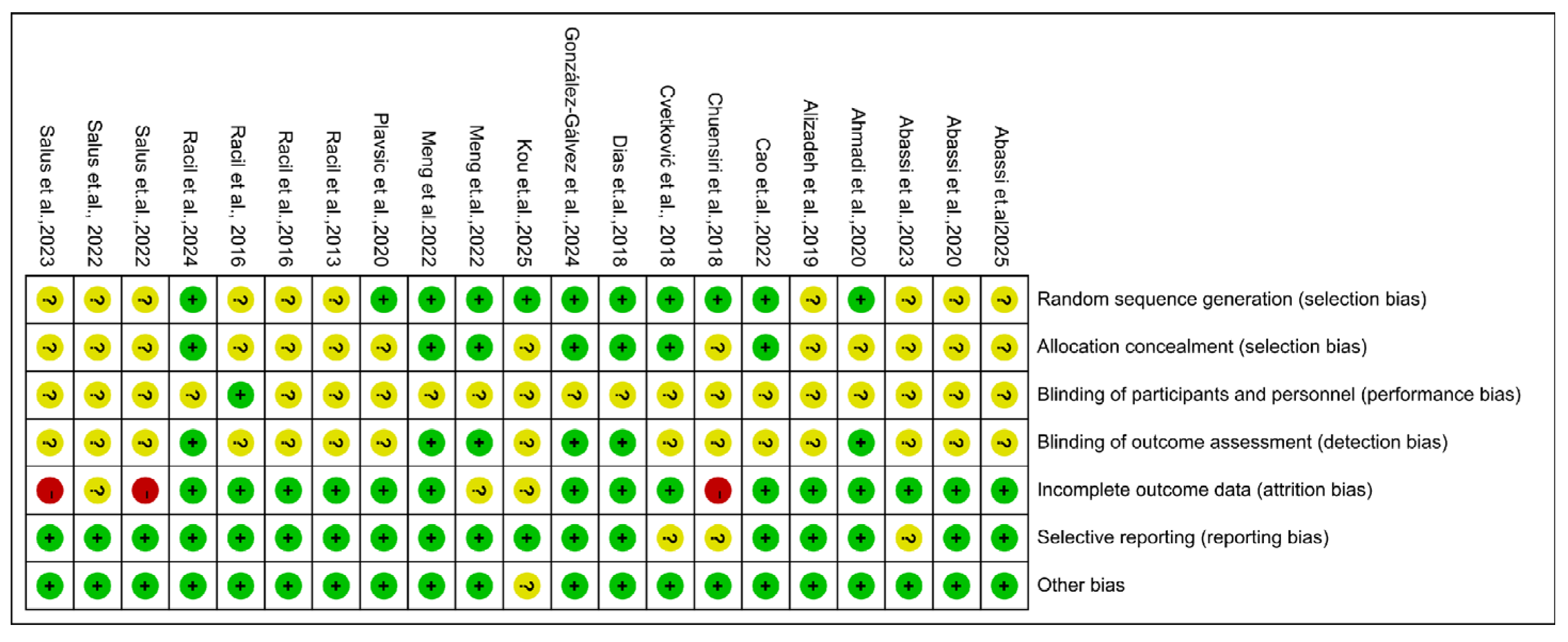
We utilized the RoB tool implemented in Review Manager (Version 5.4; The Cochrane Collaboration, 2020) to evaluate the methodological quality of the 21 included studies. Although all included studies were randomized controlled trials, 10 studies did not explicitly describe how the randomization sequence was generated; therefore, the risk of bias for random sequence generation in these studies was rated as “unclear”. Six studies explicitly described their allocation concealment procedures; for the remaining trials, concealment methods were not reported, and this domain was rated as “unclear” risk of bias. None of the included studies reported a specific method for blinding participants and study personnel, and given the nature of exercise interventions, performance bias in this domain could not be excluded. The risk of bias related to blinding of outcome assessment also varied across studies. In addition, the risk of bias arising from incomplete outcome data and selective reporting was not consistent among the included trials; depending on attrition, exclusions after randomization, and the availability of trial registration or protocol information, some studies were judged as having low risk, whereas others were rated as having high or unclear risk. The overall results of the quality assessment are presented in Figure 2 and Figure 3.

3.4. Results of Meta-Analysis

3.4.1. Outcomes of Body Composition

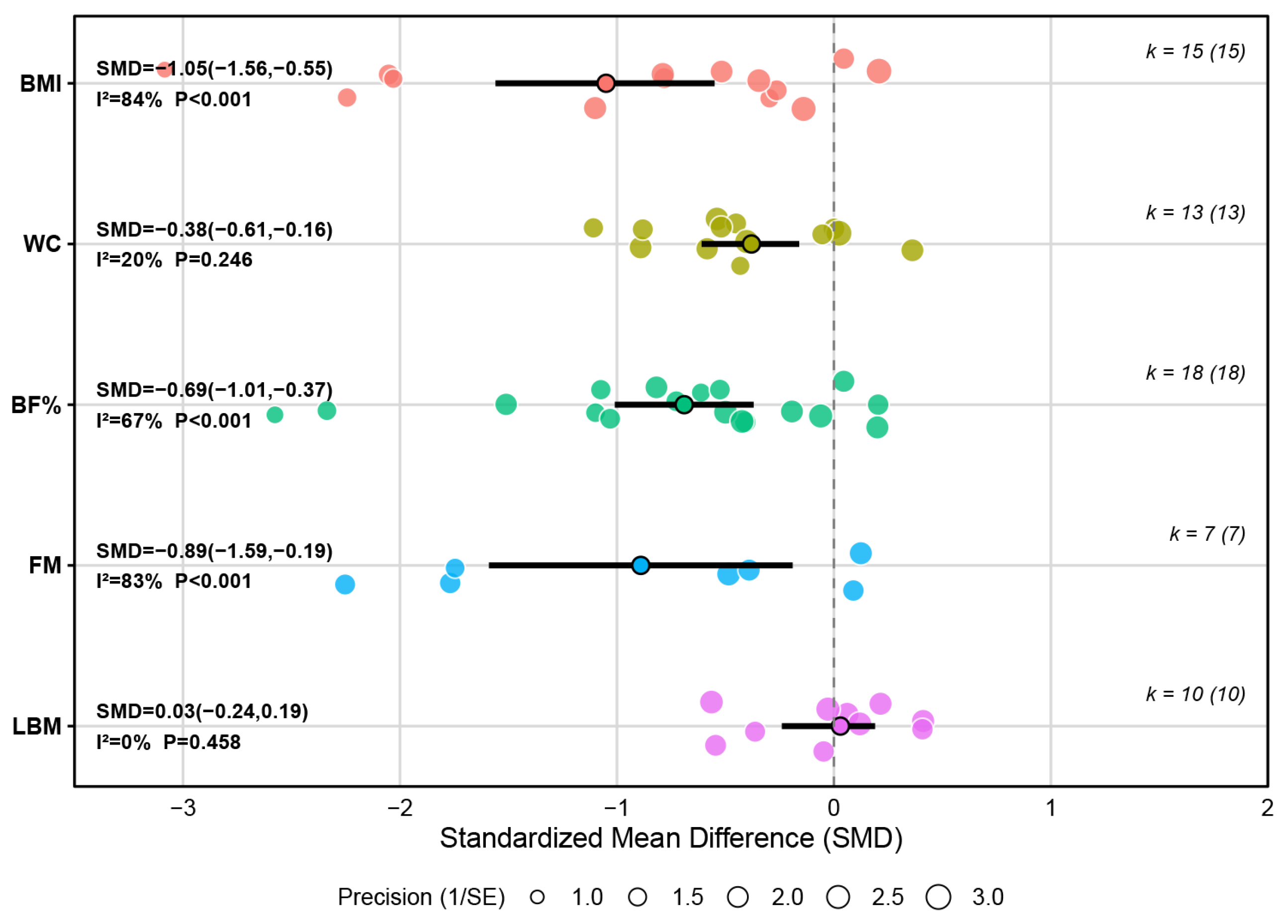
A meta-analysis of 15 studies indicated that, compared with the control conditions, HIIT had a significant overall effect on reducing BMI in children and adolescents with overweight or obesity (SMD = −1.05, 95% CI [−1.56, −0.55], p < 0.001). According to our pre-specified benchmarks for Hedges’ g, the magnitude of this pooled effect qualifies as large. Although between-study heterogeneity was substantial (I2 = 84%), sensitivity analysis showed that exclusion of any single study did not materially change the pooled estimate, and all leave-one-out re-estimates remained negative with 95% CIs below zero, indicating a robust overall effect despite between-study variability.
A meta-analysis of 13 studies revealed that HIIT had a significant overall effect on reducing waist circumference (WC) in children and adolescents with overweight or obesity (SMD = −0.38, 95% CI [−0.61, −0.16], p = 0.01), and the magnitude of this pooled effect was small. Heterogeneity across studies was low (I2 = 20%), suggesting high consistency of outcomes among individual studies. Sensitivity analysis also indicated that the pooled effect was robust.
A meta-analysis of 18 studies showed that, compared with the control conditions, HIIT significantly reduced body fat percentage (BF%) in children and adolescents with overweight or obesity, and the effect size was medium (SMD = −0.69, 95% CI [−1.01, −0.37], p < 0.001). Heterogeneity across studies was moderate (I2 = 67%), suggesting a moderate level of variability between studies. The robustness of the overall effect was confirmed by a leave-one-out sensitivity analysis.
A meta-analysis of seven studies found that, compared with the control conditions, HIIT was associated with a reduction in fat mass (FM) (SMD = −0.89, 95% CI [−1.59, −0.19], p = 0.012), which represents a large effect. Substantial heterogeneity was observed among studies (I2 = 83%). The leave-one-out sensitivity analysis supported the robustness of the pooled effect, as removing any single study did not materially alter its magnitude or direction.
However, a meta-analysis of 10 studies found that, compared with the control conditions, HIIT had no statistically significant effect on lean body mass (LBM) in children and adolescents with overweight or obesity (SMD = −0.03, 95% CI [−0.24, 0.19], p = 0.813). More details can be found in Figure 4 and Figure S1 in Supplementary Material S2.

3.4.2. Outcomes of Metabolic Health

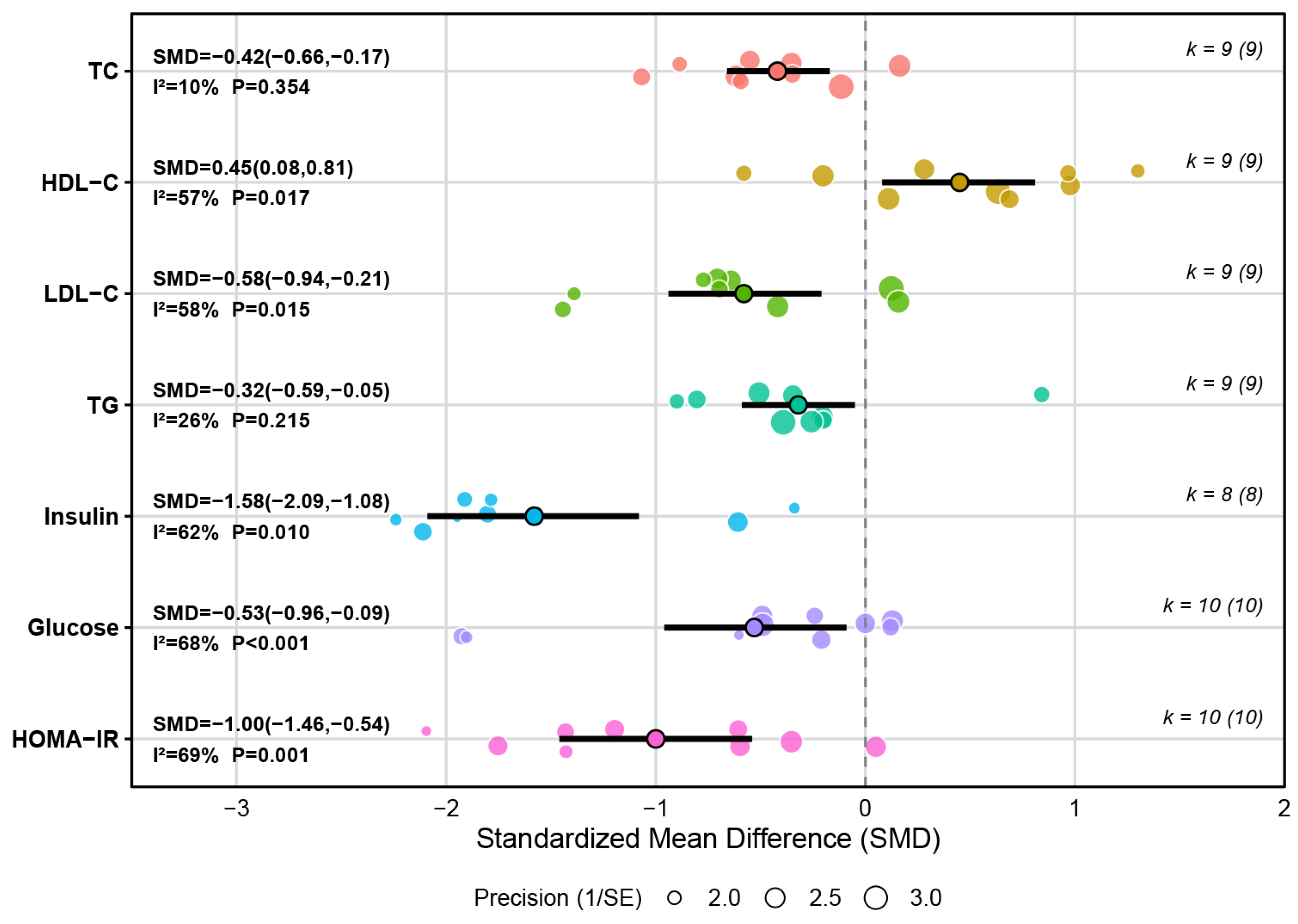
A meta-analysis of 9 studies showed that, compared with the control conditions, HIIT had a significant overall effect on reducing total cholesterol (TC) in children and adolescents with overweight or obesity (SMD = −0.42, 95% CI [−0.66, −0.17], p = 0.001), representing a small effect size. Heterogeneity was low (I2 = 10%), suggesting a high consistency of outcomes among included studies. Sensitivity analysis indicated that excluding any single study did not materially change the pooled estimate, indicating a robust overall effect.
A meta-analysis of nine studies showed that, compared with control conditions, HIIT had a significant overall effect on increasing high-density lipoprotein cholesterol (HDL-C) in children and adolescents with overweight or obesity (SMD = 0.45, 95% CI [0.08, 0.81], p = 0.016), representing a small-to-medium effect size. The between-study heterogeneity was moderate (I2 = 57%), and sensitivity analysis showed that exclusion of any single study did not materially change the pooled estimate, indicating a robust overall effect despite potential between-study variability.
A meta-analysis of nine studies showed that, compared with control conditions, HIIT had a significant overall effect on decreasing low-density lipoprotein cholesterol (LDL-C) in children and adolescents with overweight or obesity (SMD = −0.58, 95% CI [−0.94, −0.21], p = 0.002), representing a medium effect size. The heterogeneity between-study was moderate (I2 = 58%), and sensitivity analysis revealed the robustness of the overall effect.
A meta-analysis of nine studies indicated that, compared with control conditions, HIIT had a significant overall effect on decreasing triglyceride (TG) levels in children and adolescents with overweight or obesity (SMD = −0.32, 95% CI [−0.59, −0.05], p = 0.02), representing a small effect size. Outcomes between studies were relatively consistent as heterogeneity was low (I2 = 26%). Sensitivity analysis found that excluding any single study did not materially alter the pooled estimate, indicating a robust overall effect despite between-study variability.
A meta-analysis of eight studies suggested that, compared with control conditions, HIIT had a significant overall effect on reducing insulin levels in children and adolescents with overweight or obesity (SMD = −1.58, 95% CI [−2.09, −1.08], p < 0.001), representing a large effect size. The heterogeneity between-study was moderate (I2 = 62%), and sensitivity analysis showed that exclusion of any single study did not materially change the pooled estimate, indicating a robust overall effect.
A meta-analysis of 10 studies suggested that, compared with control conditions, HIIT had a significant overall effect on decreasing glucose levels in children and adolescents with overweight or obesity (SMD = −0.53, 95% CI [−0.96, −0.09], p = 0.017), representing a medium effect size. Although between-study heterogeneity indicated variability across studies (I2 = 68%), sensitivity analysis indicated a robust pooled effect, with exclusion of any single study causing no material change in the estimate.
A meta-analysis of 10 studies suggested that, compared with control conditions, HIIT had a significant overall effect on reducing HOMA-IR in children and adolescents with overweight or obesity (SMD = −1.00, 95% CI [−1.46, −0.54], p < 0.001), indicating a large effect size. While the heterogeneity between-studies was moderate (I2 = 69%), sensitivity analysis revealed that exclusion of any single study did not materially change the pooled estimate, indicating a robust overall effect despite between-study variability. More details could be found in Figure 5 and Figure S2 in Supplementary Material S2.

3.4.3. Outcomes of Cardiorespiratory Fitness

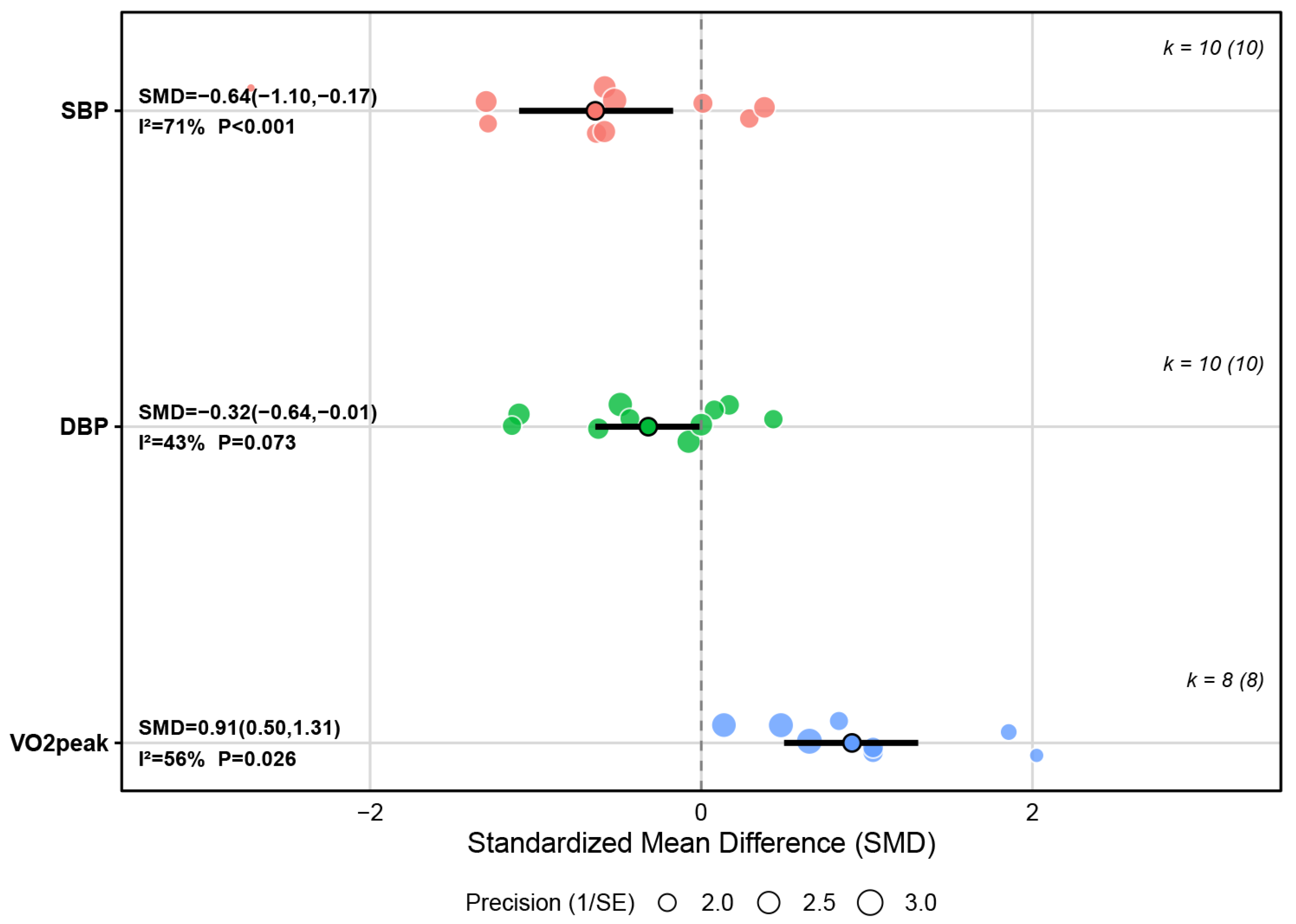
A total of 10 studies examined the effects of HIIT on systolic blood pressure (SBP), including 284 participants. The results showed that HIIT had a significant effect on reducing SBP in children and adolescents with overweight and obesity compared with the control conditions (SMD = −0.64, 95% CI [−1.10, −0.17], p = 0.007), indicating a medium effect size. Although the between-study heterogeneity was substantial (I2 = 71%), sensitivity analysis revealed that exclusion of any single study did not materially change the pooled estimate, indicating a robust overall effect despite between-study variability.
Ten studies investigated the effects of HIIT on diastolic blood pressure (DBP), including 284 participants. The results showed that HIIT had a significant effect on decreasing DBP in children and adolescents with overweight or obesity (SMD = −0.32, 95% CI [−0.64, −0.01], p = 0.045), indicating a small effect size. Between-study heterogeneity was moderate (I2 = 43%), and sensitivity analysis revealed that exclusion of any single study did not materially change the pooled estimate, indicating a robust overall effect despite between-study variability.
Eight studies examined the effects of HIIT on peak oxygen uptake (VO2peak) in children and adolescents with overweight or obesity, including 255 participants. The results showed that HIIT had a significant effect on improving VO2peak in children and adolescents with overweight or obesity compared with the control conditions (SMD = 0.91, 95% CI [0.50, 1.31], p < 0.001), indicating a large effect size. The between-study heterogeneity was moderate (I2 = 56%), and sensitivity analysis revealed that exclusion of any single study did not materially change the pooled estimate, indicating a robust overall effect despite between-study variability. More details could be found in Figure 6 and Figure S3 in Supplementary Material S2.

3.4.4. Results of Subgroup Analysis

To examine whether different individual factors and training characteristics may influence intervention outcomes, we selected four representative indicators to perform subgroup analysis: body fat percentage, total cholesterol, HOMA-IR, and peak oxygen uptake. These indicators encompass body composition, lipid metabolism, glucose metabolism, and cardiorespiratory fitness, providing comprehensive coverage and sufficient data for subgroup analyses. The subgroup moderators included sex (female or male), load duration (≤1 min or >1 min), and training mode (running or cycling). The first reflects physiological differences among participants, whereas the latter two capture variations in training intensity and loading characteristics. Based on these indicators and moderators, we conducted subgroup analyses to further investigate whether different training parameters and individual characteristics influence the effectiveness of HIIT interventions in children and adolescents with overweight or obesity. More details of subgroup analyses can be found in Table 1, Table 2, Table 3 and Table 4 and Supplementary Material S3.

3.4.5. Subgroup Analysis for BF%

In the sex subgroup, eight studies comprised samples of female-only participants; the pooled estimate for this subgroup demonstrated a significant reduction in body fat percentage with a medium effect (SMD = −0.67, 95% CI [−1.13,−0.22], p < 0.01). Seven studies included only males and revealed a similar outcome (SMD = −0.62, 95% CI [−1.09,−0.15], p = 0.01).
In the load duration subgroup analysis, 14 studies with load duration ≤ 1 min (i.e., each high-intensity bout lasted ≤ 1 min) showed a significant reduction in body fat percentage with a medium effect size (SMD = −0.69, 95% CI [−1.03, −0.35], p < 0.01). By contrast, four studies with load duration > 1 min did not demonstrate a significant effect (SMD = −0.74, 95% CI [−1.67, 0.20], p = 0.12).
In the training mode subgroup, fourteen studies using running as the primary training mode indicated a significant effect on decreasing body fat percentage in children and adolescents with overweight and obesity, with a close-to-large effect size (SMD = −0.76, 95% CI [−1.11, −0.4], p < 0.01), whereas three studies employing cycling interventions yielded non-significant results (SMD = −0.67, 95% CI [−1.61, 0.27], p > 0.05). More details of the subgroup analyses for BF% are presented in Table 3.

3.4.6. Subgroup Analysis for TC

In the sex subgroup, three studies comprised samples of female-only participants, and the pooled results showed that HIIT had no statistically significant effect on total cholesterol (SMD = −0.28, 95% CI [−0.79, 0.22], p > 0.05). Three studies with male-only participants showed a significant reduction in TC with a close-to-large effect (SMD = −0.76, 95% CI [−1.23, −0.28], p < 0.01).
In the load duration subgroup, five studies with load duration ≤ 1 min showed a significant reduction in total cholesterol with a medium effect size (SMD = −0.56, 95% CI [−0.90, −0.23], p < 0.01). However, four studies with longer load duration (>1 min) showed no significant effect on decreasing TC (SMD = −0.3, 95% CI [−0.73, 0.13], p > 0.05).
In the training mode subgroup, five studies using running as the training mode demonstrated a near-significant reduction in total cholesterol (SMD = −0.30, 95% CI [−0.61, 0.02], p = 0.06), while two studies employing cycling interventions reported a significant decrease with a large effect size (SMD = −0.99, 95% CI [−1.58, −0.39], p < 0.01). More details of the subgroup analyses for TC are presented in Table 4.

3.4.7. Subgroup Analysis for HOMA-IR

In the sex subgroup, five studies comprised female-only samples, and the pooled results showed a significant reduction in HOMA-IR with a large effect size (SMD = −1.08, 95% CI [−1.64, −0.52], p < 0.01). Two studies with male-only participants demonstrated a pooled effect that was close to significant (SMD = −1.31, 95% CI [−2.77, 0.14], p = 0.07).
In the load duration subgroup, seven studies employing load duration ≤ 1 min showed a significant decrease in HOMA-IR with a large effect size (SMD = −1.26, 95% CI [−1.66, −0.85], p < 0.01). In contrast, two studies with load duration > 1 min revealed no statistically significant change (SMD = −0.17, 95% CI [−0.63, 0.30], p = 0.48).
In the training mode subgroup, seven studies using running as the training mode indicated a significant reduction in HOMA-IR with a large effect size (SMD = −1.21, 95% CI [−1.68, −0.74], p < 0.01). However, among the studies reporting HOMA-IR, only one used cycling as its training mode; therefore, there were insufficient data to determine whether cycling is an effective training mode for improving insulin resistance. More details of the subgroup analyses for HOMA-IR are presented in Table 5.

3.4.8. Subgroup Analysis for VO2peak

In the sex subgroup, three studies comprised female-only participants, and the pooled analysis revealed a significant increase in VO2peak with a medium effect size (SMD = 0.42, 95% CI [0.03, 0.81], p = 0.03). Four studies included male-only samples, and the outcome showed a larger improvement, with a large effect size (SMD = 1.4, 95% CI [0.9, 1.9], p < 0.01).
In the load duration subgroup, five studies with load duration ≤ 1 min indicated a significant increase in VO2peak with a large effect size (SMD = 0.97, 95% CI [0.55, 1.4], p < 0.01). However, three studies with load duration > 1 min reported an outcome that was close to statistically significant (SMD = 0.84, 95% CI [−0.05, 1.73], p = 0.06).
In the training mode subgroup, four studies employing running as the primary training mode showed a significant improvement in VO2peak, with a medium effect size (SMD = 0.42, 95% CI [0.03, 0.81], p = 0.06). Three studies using cycling interventions also demonstrated a significant increase, with a large effect size that was greater than that of running (SMD = 1.27, 95% CI [0.7, 1.85], p < 0.01). More details of the subgroup analyses for VO2peak are presented in Table 6.

3.5. Sensitivity and Publication Bias Analysis

We utilized Egger’s test and funnel plots in Stata 18 to assess publication bias for the 14 outcomes that demonstrated statistically significant pooled effects (p < 0.05). The test results indicated potential publication bias for five indicators—BMI, body fat percentage, LDL-C, HOMA-IR, and VO2peak (p < 0.05)—and the funnel plots of these indicators were also asymmetrical. To address potential publication bias, the trim-and-fill method was applied and the adjusted pooled estimates were recalculated accordingly. The findings showed that the direction and level of statistical significance of these indicators remained unchanged before and after adjustment, suggesting that potential publication bias did not materially affect the overall conclusions.
In addition, sensitivity analyses were conducted for all outcome measures using the leave-one-out method. During this process, each study was sequentially removed, and the pooled effect size was recalculated and compared with the original estimate to assess the influence of individual studies. The results revealed that no single study had a substantial impact on the overall results. This finding showed that all the outcomes were robust, and none of them were altered by any single study, including those with potential risks of bias.
Taken together, these findings indicate that despite the inclusion of studies with relatively small sample sizes or potential sources of bias, the pooled estimates in this meta-analysis were both robust and reliable. For more details of sensitivity and publication bias analysis, please refer to Supplementary Material S4 and S5.

3.6. Certainty of Evidence

The GRADE evaluation indicated that the certainty of evidence varied across outcomes. Evidence was rated as high for LBM, TC, DBP, and insulin; moderate for BMI, WC, BF%, FM, TG, HDL-C, LDL-C, glucose, and VO2peak; and low for HOMA-IR and SBP. Therefore, the beneficial effects of HIIT on several outcomes are supported by moderate-to-high certainty evidence, whereas findings for HOMA-IR and SBP should be interpreted with greater caution. The details of GRADE evaluation can be found in Table 7.

4. Discussion

This meta-analysis, which aimed to evaluate the comprehensive effects of high-intensity interval training (HIIT) on health-related outcomes in children and adolescents with overweight or obesity, synthesized evidence from 21 randomized controlled trials encompassing 652 participants. The main findings demonstrated that HIIT yielded significant improvements across key measures of body composition, metabolic health, and cardiorespiratory fitness in children and adolescents with overweight or obesity. Meanwhile, substantial heterogeneity was observed for several outcomes, indicating meaningful between-study variability. This heterogeneity likely reflects both clinical and methodological differences across trials. With respect to intervention design, HIIT prescriptions were not uniform in terms of training modality, load duration, intensity prescription, work-to-rest structure, or weekly training volume, and these differences may influence energy expenditure, cardiovascular stress, exercise tolerance, and ultimately the magnitude of adaptation. Intervention duration also varied across studies, and shorter programs may be insufficient to induce measurable changes in adiposity or metabolic regulation, whereas longer interventions may allow training adaptations to accumulate more consistently. In addition, participant characteristics were not uniform, with differences in sex composition, age distribution, baseline adiposity, and metabolic status, all of which may affect responsiveness to exercise interventions. Our subgroup analyses partly support this interpretation, as protocols with brief work bouts (≤1 min) tended to yield larger pooled effects for several outcomes, with lower between-study variability in some analyses. Nevertheless, because the number of studies within some subgroups remained limited and reporting of potentially important modifiers was not always sufficiently detailed, these observations should be interpreted cautiously. Notably, our leave-one-out sensitivity analyses did not materially alter the pooled estimates, suggesting that the overall findings were not driven by any single study. Future trials with more standardized intervention reporting and more homogeneous participant profiles are warranted. Concurrently, the GRADE assessment indicated that certainty of evidence differed by outcome, with most outcomes rated moderate to high in certainty, which strengthens the persuasiveness of the main conclusions from a certainty-of-evidence perspective; nevertheless, the lower certainty for some outcomes underscores the need for additional high-quality, methodologically rigorous studies to consolidate and strengthen the evidence base.

4.1. Effects of HIIT on Body Composition in Children and Adolescents with Overweight or Obesity

Our meta-analysis found that HIIT produced significant improvements in several main indices of body composition, such as body fat percentage, body mass index, waist circumference, and fat mass. These findings align with those reported by Duncombe, Zhu, and Zheng, further supporting the beneficial role of HIIT on body composition in children and adolescents with overweight or obesity [43,44,45]. While several outcomes improved significantly, HIIT did not yield a significant increase in lean body mass, which may be due to differences in stimulus characteristics: the accrual of skeletal muscle and bone generally requires progressive, weight-bearing resistance loading [46,47], whereas typical running- or cycling-based HIIT provides insufficient mechanical tension. Accordingly, the body composition benefits in this meta-analysis were most evident as reductions in adiposity.
Several mechanisms may account for these effects. Acute exercise imposes substantial demands on glycogen and oxygen, resulting in excess post-exercise oxygen consumption (EPOC) [48]. Meanwhile, exercise stimulus enhances the central neural drive, thereby augmenting sympathetic outflow. This sympathetic activation elevates stress hormones, including catecholamines, which remain above the baseline during early recovery and continue to activate lipolytic signaling via the PKA–HSL/ATGL pathway [49,50,51,52]. The combination of rapid substrate depletion and sustained lipolytic activation shifts post-exercise fuel use from carbohydrate toward fat, thereby increasing fat oxidation [53]. Because the magnitudes of EPOC and recovery fat oxidation are related to exercise intensity, HIIT typically elicits a larger EPOC accompanied by higher post-exercise fat oxidation relative to isoenergetic continuous exercise [54,55,56].
During a long-term intervention period, repeated training stimuli may enhance the body’s capacity for fat oxidation, as reflected by a lower respiratory exchange ratio (RER) and higher fat oxidation at a given exercise intensity, and by increases in maximal fat oxidation (MFO) and its corresponding intensity (Fatmax) [57,58,59]. This enhancement likely arises because repeated high-intensity training activates pathways such as AMPK/PGC-1α, which promote mitochondrial biogenesis, providing more sites for fat oxidation [60,61]. In parallel, the activities of critical oxidative enzymes involved in lipid metabolism, such as citrate synthase and β-hydroxyacyl-CoA dehydrogenase (β-HAD), are upregulated [62,63], making mitochondrial fatty-acid catabolism more efficient and thereby increasing fat oxidation during exercise.
However, not all previous syntheses have reached the same conclusion. For example, Men et al. reported no significant effect of HIIT on body composition in a meta-analysis of 47 trials [64]. A closer inspection suggests that the inclusion of trials with normal-weight participants may have diluted the effects that are specific to overweight or obese populations. By contrast, our analysis restricted inclusion to trials enrolling children and adolescents with overweight or obesity, and the pooled effects remained robust in sensitivity analyses.
It is worth to notice that body fat assessment is a key predictor of cardiometabolic risk in youth. Numerous studies have shown that in children and adolescents, higher body fat levels are associated with insulin resistance, dyslipidemia, and other components of metabolic syndrome, and that body fat percentage is more effective than BMI for identifying these cardiometabolic risks [65,66,67]. Our subgroup analyses provide further evidence on body fat percentage across different moderators. The results showed that interventions with shorter load duration (≤1 min per high-intensity bout) produced larger reductions, plausibly because shorter bouts allow higher relative intensity, thereby provoking greater catecholamine responses, larger EPOC, and enhanced post-exercise lipid oxidation [54,68]. Despite sex-specific physiological differences during childhood and adolescence, our subgroup analyses showed significant reductions in body fat percentage in both males and females, indicating that HIIT is effective in both genders. When training mode was considered as another moderator, running-based HIIT showed a greater effect on reducing BF% than cycling. This may be because running generally recruits more lower-limb and core musculature, increasing energy expenditure during exercise and thereby producing larger reductions in body fat. However, it is important to acknowledge that empirical evidence on sex- and mode-specific mechanisms is limited, and targeted studies are needed to confirm these hypotheses.

4.2. Effects of HIIT on Metabolic Health in Children and Adolescents with Overweight or Obesity

Obesity in children and adolescents can lead to metabolic dysregulation, typically manifested as increased triglyceride (TG) and low-density lipoprotein cholesterol (LDL-C) levels, decreased high-density lipoprotein cholesterol (HDL-C) levels, impaired glucose metabolism, and insulin resistance, all of which are characteristic features of metabolic syndrome [69,70]. These metabolic disturbances are recognized as early risk factors for type 2 diabetes and various cardiovascular diseases (CVDs), such as atherosclerosis [71,72,73].
The findings of this meta-analysis revealed that HIIT effectively improved both lipid metabolism indicators (e.g., triglyceride and cholesterol levels) and glucose metabolism markers (e.g., insulin level and HOMA-IR). These results are consistent with those of Song, Solera-Martínez, and García-Hermoso, all of whom reported the efficacy of HIIT in enhancing metabolic health among children with overweight or obesity [74,75,76].
However, ref. [77] observed no apparent improvement in insulin resistance or related parameters in a two-week small-sample intervention, suggesting that the metabolic benefits of HIIT may depend on a longer intervention duration and greater cumulative training load.
Mechanistically, beyond the energy metabolism and mitochondrial adaptations discussed above, exercise training can enhance the expression of skeletal muscle glucose transporter type 4 (GLUT4), thereby increasing peripheral insulin sensitivity and improving glucose handling [78]. In addition, animal studies have also demonstrated that HIIT can enhance insulin sensitivity in the liver and adipose tissue [79]. Collectively, these findings provide further evidence supporting the role of HIIT in improving metabolic function.
Subgroup analyses indicated that HIIT significantly improved both lipid and glucose metabolism parameters in children and adolescents with overweight or obesity, regardless of sex. In the load duration subgroups, protocols with shorter high-intensity bouts (≤1 min) produced more pronounced improvements and showed lower heterogeneity across studies, suggesting that brief yet intense interval stimuli may be more effective in alleviating metabolic dysregulation among youth with obesity.
Regarding training mode, running-based HIIT elicited greater improvements in total cholesterol and HOMA-IR than cycling-based protocols. However, as the number of cycling studies was limited, further empirical evidence is warranted to confirm these findings.

4.3. Effects of HIIT on Cardiorespiratory Fitness in Children and Adolescents with Overweight or Obesity

VO2peak serves as a primary indicator of cardiorespiratory fitness (CRF), whereas SBP and DBP reflect arterial pressure and can collectively represent vascular resistance and cardiovascular regulatory capacity. Given that all three parameters are closely associated with circulatory function, this study considered VO2peak, SBP, and DBP as cardiorespiratory fitness indices to comprehensively evaluate the influence of HIIT on oxygen transport efficiency and vascular regulation.
The findings revealed that HIIT is an effective intervention for lowering both SBP and DBP in children and adolescents with overweight or obesity, with a more pronounced effect observed for SBP. This aligns with multiple previous studies that have consistently demonstrated HIIT’s efficacy in improving SBP [11,64,80,81]. In contrast, evidence regarding its effect on DBP remains inconsistent. While some studies have reported significant reductions in DBP following HIIT—results consistent with those of the present analysis [64]—others have found no notable changes [11,76,82]. Considering the moderate heterogeneity across studies included in this meta-analysis, the impact of HIIT on DBP requires further confirmation through high-quality randomized trials.
Cardiorespiratory fitness is a key determinant of long-term health in youth, as higher fitness levels during childhood and adolescence are linked to lower risks of disease and all-cause mortality later in life [83,84]. VO2peak, as a core measure of CRF, directly reflects the improvement of cardiopulmonary function. Consistent with previous evidence [75,81], our results indicate that HIIT significantly enhances VO2peak in children and adolescents with overweight or obesity. Subgroup analyses further revealed that HIIT improved VO2peak across both sexes. With respect to load duration, protocols with ≤1 min of high-intensity bouts produced greater improvements, suggesting that exercise intensity is a key factor influencing the effectiveness of HIIT on VO2peak. Regarding training mode, both running- and cycling-based HIIT protocols significantly improved VO2peak; however, the effect size was greater in cycling interventions, possibly due to their more stable power output and sustained cardiovascular stimulus. These findings suggest that short-duration, high-intensity cycling HIIT may represent a more effective strategy for enhancing cardiorespiratory fitness in children and adolescents with overweight or obesity.

4.4. General Remarks and Limitations

Taken together, HIIT simultaneously promotes favorable changes in body composition, metabolic regulation, and cardiorespiratory fitness, suggesting a systemic enhancement in multiple physiological systems in children and adolescents with overweight or obesity. These findings highlight HIIT as an integrated and time-efficient approach capable of reversing key pathophysiological features of pediatric obesity and reinforcing its value as a viable public health strategy for youth populations.
In addition, our subgroup analyses revealed that protocols employing brief work duration (≤1 min) consistently yielded larger pooled effects than those with longer bouts (>1 min) across several outcomes, with a tendency toward lower between-study variability in some cases. This result indicated that HIIT with short bout (≤1 min) might be a more effective way to improve body composition, metabolic health, and cardiorespiratory fitness in children and adolescents with overweight or obesity. Meanwhile, short load duration is able to enhance training adherence by mitigating the physiological burden and exercise monotony of prolonged sessions. Thus, we recommend short load duration as a preferred HIIT protocol.
Despite these strengths, several limitations should be acknowledged. First, most studies did not apply standardized controls for dietary intake, daily physical activity, or sleep patterns, potentially confounding the independent effects of HIIT on body composition and metabolic outcomes.
Second, substantial variability existed across HIIT protocols, including differences in training modality, load duration, intensity prescription, work-to-rest structure, and intervention duration. Such protocol heterogeneity may have contributed to between-study variability and may limit the direct comparability of pooled estimates across trials.
In addition, although the overall number of included studies was acceptable, some individual trials and several subgroup comparisons were based on relatively small sample sizes, which may reduce statistical precision and limit the generalizability of certain findings. Therefore, the present results should be interpreted with appropriate caution, and future studies with larger samples and more standardized HIIT protocols are warranted.

5. Conclusions

In conclusion, this meta-analysis provides robust evidence that HIIT yields comprehensive benefits for children and adolescents with overweight or obesity. HIIT effectively improves body composition, metabolic health, and cardiorespiratory fitness, underscoring its strong potential as a practical intervention for this population.
Specifically, HIIT was found to reduce BMI, body fat percentage and waist circumference, indicating a favorable modulation of body composition. It also improved key metabolic parameters—including insulin resistance, total cholesterol, and lipid profiles—and, to some extent, fasting glucose levels. Moreover, HIIT enhanced peak oxygen uptake (VO2peak) and reduced systolic blood pressure, suggesting improved cardiorespiratory fitness and vascular regulation.
Moving forward, future studies should further refine HIIT protocols—such as training intensity, work-to-rest ratio and intervention duration—while controlling for confounding factors like diet, habitual activity, and sleep. Incorporating metabolomics and biomarker analyses could deepen understanding of the mechanisms through which HIIT promotes multisystem health. Ultimately, these findings provide a scientific foundation for integrating HIIT into school-based physical education and broader public health initiatives aimed at improving youth fitness and preventing obesity-related diseases. In practical settings, brief and well-supervised HIIT programs may represent a feasible option for obesity management in children and adolescents, particularly when incorporated into school, community, or family-supported exercise environments.

Supplementary Materials

The following supporting information can be downloaded at https://www.mdpi.com/article/10.3390/metabo16040232/s1. Supplementary Material S1: Searching strategy; Supplementary Material S2: Forest plots of all outcomes; Supplementary Material S3: Forest plots of subgroup analyses; Supplementary Material S4: Funnel plots of all outcomes; Supplementary Material S5: Sensitivity analysis plot of all outcomes; Supplementary Material S6: PRISMA checklist.

Author Contributions

Y.Y., H.Z. and C.P.: Conceptualization, data curation, methodology, formal analysis, writing—original draft, writing—review and editing. C.L. and J.M.: Conceptualization, Data curation, supervision, writing—review and editing. B.T., S.L. (Shuning Liu) and S.L. (Shuairan Li): Methodology, resources, and editing. All authors have read and agreed to the published version of the manuscript.

Funding

The authors declare that financial support was received for the research, authorship, and/or publication of this article. This research was funded by the Fundamental Research Funds for the Central Universities (2024YDXL001). This work was supported by the Peking University Medical-Qingyan Boshi Joint Laboratory for skin nutrition and anti-aging (No. L202206) and in part by the Peking University Health Science Center for the Study on the effects of anti-aging nutritional interventions on athletes’ skin health (No. YFF24000662, No. BSU20240500, No. YFF25001838 and No. BSU20250728). This study was supported by the Youth Program of the Ministry of Education Humanities and Social Sciences Fund, under the project titled “Research on Precision Exercise and Nutritional Interventions for Obese Older Adults Based on Large Language Models” (Project No. 25YJC890020). This work was supported by the Beijing Higher Education Society’s Sub-Committee on University Student Employment and Entrepreneurship Research under the project titled “Research on the Transformation Path and Mechanism of Innovation and Entrepreneurship Competition Achievements among University Students—Based on the Practice of Sports Universities” (Project No. DXSJCFHMS2025023). This work was supported by the National Natural Science Foundation of China (82304718), the Beijing Natural Science Foundation (7232303), and CACMS Innovation Fund (CI2023E002, CI2024E003). This work was supported by the General Administration of Sport of China, Project on Artistic Performance Training Support for the National Figure Skating Team Preparing for the Milan Winter Olympic Games (No. BSU20240682).

Institutional Review Board Statement

Not applicable.

Informed Consent Statement

Not applicable.

Data Availability Statement

As this study is a systematic review, all data analyzed are available in the main manuscript and the Supplementary Materials. No new datasets were generated. Further information is available from the corresponding author upon reasonable request.

Acknowledgments

We sincerely thank all collaborators for their expertise in literature screening, data extraction and verification, which ensured this study’s integrity. Special gratitude goes to the corresponding authors Mi and Liu for their guidance from study design to manuscript revision; their rigor and insights shaped this work and my growth.

Conflicts of Interest

The authors declare that the research was conducted in the absence of any commercial or financial relationships that could be construed as a potential conflict of interest.

Abbreviations

HIIT, High-Intensity Interval Training; BMI, Body Mass Index; WC, Waist Circumference; BF%, Body Fat Percentage; FM, Fat Mass; LBM, Lean Body Mass; TC, Total Cholesterol; HDL-C, High-Density Lipoprotein Cholesterol; LDL-C, Low-Density Lipoprotein Cholesterol; TG, Triglycerides; INS, Insulin; GLU, Blood Glucose; HOMA-IR, Homeostasis Model Assessment of Insulin Resistance; SBP, Systolic Blood Pressure; DBP, Diastolic Blood Pressure; VO2peak, Peak Oxygen Uptake.

References

  1. World Health Organization. Obesity and Overweight. Available online: https://www.who.int/news-room/fact-sheets/detail/obesity-and-overweight (accessed on 18 December 2025).
  2. Ncd Risk Factor Collaboration (NCD-RisC). Worldwide Trends in Underweight and Obesity from 1990 to 2022: A Pooled Analysis of 3663 Population-Representative Studies with 222 Million Children, Adolescents, and Adults. Lancet 2024, 403, 1027–1050. [Google Scholar] [CrossRef] [PubMed]
  3. Stierman, B.; Afful, J.; Carroll, M.D.; Chen, T.-C.; Davy, O.; Fink, S.; Fryar, C.D.; Gu, Q.; Hales, C.M.; Hughes, J.P.; et al. National Health and Nutrition Examination Survey 2017-March 2020 Prepandemic Data Files-Development of Files and Prevalence Estimates for Selected Health Outcomes. Natl. Health Stat. Rep. 2021, 158, 10–15620. [Google Scholar] [CrossRef]
  4. Spinelli, A.; Buoncristiano, M.; Nardone, P.; Starc, G.; Hejgaard, T.; Júlíusson, P.B.; Fismen, A.-S.; Weghuber, D.; Musić Milanović, S.; García-Solano, M.; et al. Thinness, Overweight, and Obesity in 6- to 9-Year-Old Children from 36 Countries: The World Health Organization European Childhood Obesity Surveillance Initiative-COSI 2015–2017. Obes. Rev. 2021, 22, e13214. [Google Scholar] [CrossRef]
  5. Kerr, J.A.; Patton, G.C.; Cini, K.I.; Abate, Y.H.; Abbas, N.; Magied, A.H.A.A.A.; ElHafeez, S.A.; Abd-Elsalam, S.; Abdollahi, A.; Abdoun, M.; et al. Global, Regional, and National Prevalence of Child and Adolescent Overweight and Obesity, 1990–2021, with Forecasts to 2050: A Forecasting Study for the Global Burden of Disease Study 2021. Lancet 2025, 405, 785–812. [Google Scholar] [CrossRef]
  6. National Disease Control and Prevention Administration. Report on the Status of Nutrition and Chronic Diseases Among Chinese Residents (2020); Renmin weisheng Chubanshe; People’s Health Publishing House: Beijing, China, 2022; ISBN 978-7-117-32503-5. [Google Scholar]
  7. Reilly, J.J.; Kelly, J. Long-Term Impact of Overweight and Obesity in Childhood and Adolescence on Morbidity and Premature Mortality in Adulthood: Systematic Review. Int. J. Obes. 2011, 35, 891–898. [Google Scholar] [CrossRef]
  8. Strong, W.B.; Malina, R.M.; Blimkie, C.J.; Daniels, S.R.; Dishman, R.K.; Gutin, B.; Hergenroeder, A.C.; Must, A.; Nixon, P.A.; Pivarnik, J.M. Evidence Based Physical Activity for School-Age Youth. J. Pediatr. 2005, 146, 732–737. [Google Scholar] [CrossRef]
  9. Gibala, M.J.; Little, J.P.; MacDonald, M.J.; Hawley, J.A. Physiological Adaptations to Low-volume, High-intensity Interval Training in Health and Disease. J. Physiol. 2012, 590, 1077–1084. [Google Scholar] [CrossRef] [PubMed]
  10. Lofrano-Prado, M.C.; Tenório, T.R.S.; Barros, T.A.R.; Timme, S.; Brand, R.; Santos, T.M.; Balagopal, B.; Freitas-Dias, R.; Haddock, B.; Prado, W.L. Adherence and Affect in Exercise Interventions for Adolescents with Obesity: A Randomized Clinical-Trial: 943. Med. Sci. Sports Exerc. 2022, 54, 231. [Google Scholar] [CrossRef]
  11. Cao, M.; Tang, Y.; Li, S.; Zou, Y. Effects of High-Intensity Interval Training and Moderate-Intensity Continuous Training on Cardiometabolic Risk Factors in Overweight and Obesity Children and Adolescents: A Meta-Analysis of Randomized Controlled Trials. Int. J. Environ. Res. Public Health 2021, 18, 11905. [Google Scholar] [CrossRef]
  12. Liu, J.; Zhu, L.; Su, V. Comparative Effectiveness of High-Intensity Interval Training and Moderate-Intensity Continuous Training for Cardiometabolic Risk Factors and Cardiorespiratory Fitness in Childhood Obesity: A Meta-Analysis of Randomized Controlled Trials. Front. Physiol. 2020, 11, 214. [Google Scholar] [CrossRef]
  13. Deng, Y.; Wang, X. Effect of High-Intensity Interval Training on Cardiorespiratory in Children and Adolescents with Overweight or Obesity: A Meta-Analysis of Randomized Controlled Trials. Front. Public Health 2024, 12, 1269508. [Google Scholar] [CrossRef]
  14. Page, M.J.; McKenzie, J.E.; Bossuyt, P.M.; Boutron, I.; Hoffmann, T.C.; Mulrow, C.D.; Shamseer, L.; Tetzlaff, J.M.; Akl, E.A.; Brennan, S.E.; et al. The PRISMA 2020 Statement: An Updated Guideline for Reporting Systematic Reviews. BMJ 2021, 372, n71. [Google Scholar] [CrossRef]
  15. de Onis, M.; Onyango, A.W.; Borghi, E.; Siyam, A.; Nishida, C.; Siekmann, J. Development of a WHO Growth Reference for School-Aged Children and Adolescents. Bull. World Health Organ. 2007, 85, 660–667. [Google Scholar] [CrossRef]
  16. Hedges, L.; Tipton, E. Meta-Analysis. In Handbook of Behavioral Medicine—Methods and Applications; Springer: Berlin/Heidelberg, Germany, 2010; pp. 909–921. ISBN 978-0-387-09487-8. [Google Scholar]
  17. Higgins, J.P.T.; Thompson, S.G.; Deeks, J.J.; Altman, D.G. Measuring Inconsistency in Meta-Analyses. BMJ 2003, 327, 557–560. [Google Scholar] [CrossRef]
  18. Borenstein, M.; Hedges, L.V.; Higgins, J.P.T.; Rothstein, H.R. A Basic Introduction to Fixed-Effect and Random-Effects Models for Meta-Analysis. Res. Synth. Methods 2010, 1, 97–111. [Google Scholar] [CrossRef] [PubMed]
  19. Schmidt, F.L.; Oh, I.-S.; Hayes, T.L. Fixed- versus Random-Effects Models in Meta-Analysis: Model Properties and an Empirical Comparison of Differences in Results. Br. J. Math. Stat. Psychol. 2009, 62, 97–128. [Google Scholar] [CrossRef]
  20. Egger, M.; Smith, G.D.; Schneider, M.; Minder, C. Bias in Meta-Analysis Detected by a Simple, Graphical Test. BMJ 1997, 315, 629–634. [Google Scholar] [CrossRef] [PubMed]
  21. Peters, J.L.; Sutton, A.J.; Jones, D.R.; Abrams, K.R.; Rushton, L. Contour-Enhanced Meta-Analysis Funnel Plots Help Distinguish Publication Bias from Other Causes of Asymmetry. J. Clin. Epidemiol. 2008, 61, 991–996. [Google Scholar] [CrossRef] [PubMed]
  22. Abassi, W.; Ouerghi, N.; Feki, M.; Jebabli, N.; Andrade, M.S.; Bouassida, A.; Sousa, C.V.; Nikolaidis, P.T.; Weiss, K.; Knechtle, B. Effects of Moderate- vs. High-Intensity Interval Training on Physical Fitness, Enjoyment, and Affective Valence in Overweight/Obese Female Adolescents: A Pre-/Post-Test Study. Eur. Rev. Med. Pharmacol. Sci. 2023, 27, 3809–3822. [Google Scholar] [CrossRef]
  23. Abassi, W.; Ouerghi, N.; Ghouili, H.; Haouami, S.; Bouassida, A. Greater Effects of High- Compared with Moderate-Intensity Interval Training on Thyroid Hormones in Overweight/Obese Adolescent Girls. Horm. Mol. Biol. Clin. Investig. 2020, 41, 20200031. [Google Scholar] [CrossRef]
  24. Abassi, W.; Ouerghi, N.; Hammami, M.B.; Jebabli, N.; Feki, M.; Bouassida, A.; Weiss, K.; Knechtle, B. High-Intensity Interval Training Reduces Liver Enzyme Levels and Improves MASLD-Related Biomarkers in Overweight/Obese Girls. Nutrients 2025, 17, 164. [Google Scholar] [CrossRef]
  25. Ahmadi, A.; Moheb-Mohammadi, F.; Navabi, Z.S.; Dehghani, M.; Heydari, H.; Sajjadi, F.; Khodarahmi, S. The Effects of Aerobic Training, Resistance Training, Combined Training, and Healthy Eating Recommendations on Lipid Profile and Body Mass Index in Overweight and Obese Children and Adolescents: A Randomized Clinical Trial. ARYA Atheroscler. 2020, 16, 226–234. [Google Scholar] [CrossRef]
  26. Alizadeh, H.; Safarzade, A. High Intensity Intermittent Training Induces Anti-Inflammatory Cytokine Responses and Improves Body Composition in Overweight Adolescent Boys. Horm. Mol. Biol. Clin. Investig. 2019, 39, 20190004. [Google Scholar] [CrossRef]
  27. Cao, M.; Tang, Y.; Li, S.; Zou, Y. Effects of High-Intensity Interval Training on Body Composition,Cardiorespiratory Fitness and Blood Indicators of Children with Obesity: A Randomized Controlled Trial. Chin. J. Sports Med. 2022, 41, 109–117. [Google Scholar] [CrossRef]
  28. Chuensiri, N.; Suksom, D.; Tanaka, H. Effects of High-Intensity Intermittent Training on Vascular Function in Obese Preadolescent Boys. Child Obes. 2018, 14, 41–49. [Google Scholar] [CrossRef] [PubMed]
  29. Cvetković, N.; Stojanović, E.; Stojiljković, N.; Nikolić, D.; Scanlan, A.T.; Milanović, Z. Exercise Training in Overweight and Obese Children: Recreational Football and High-Intensity Interval Training Provide Similar Benefits to Physical Fitness. Scand. J. Med. Sci. Sports 2018, 28, 18–32. [Google Scholar] [CrossRef] [PubMed]
  30. Dias, K.A.; Ingul, C.B.; Tjønna, A.E.; Keating, S.E.; Gomersall, S.R.; Follestad, T.; Hosseini, M.S.; Hollekim-Strand, S.M.; Ro, T.B.; Haram, M.; et al. Effect of High-Intensity Interval Training on Fitness, Fat Mass and Cardiometabolic Biomarkers in Children with Obesity: A Randomised Controlled Trial. Sports Med. 2018, 48, 733–746. [Google Scholar] [CrossRef]
  31. González-Gálvez, N.; Soler-Marín, A.; Abelleira-Lamela, T.; Abenza-Cano, L.; Mateo-Orcajada, A.; Vaquero-Cristóbal, R. Eight Weeks of High-Intensity Interval vs. Sprint Interval Training Effects on Overweight and Obese Adolescents Carried out during the Cool-down Period of Physical Education Classes: Randomized Controlled Trial. Front. Public Health 2024, 12, 1394328. [Google Scholar] [CrossRef]
  32. Kou, M.; Zhang, Y.; Songyan, L.; Wang, J. Effects of Different Exercise Modes on Body Composition and Bone Health in Male Adolescents with Simple Obesity. J. Jilin Sport. Univ. 2025, 41, 92–99. [Google Scholar] [CrossRef]
  33. Meng, C.; Yucheng, T.; Shu, L.; Yu, Z. Effects of School-Based High-Intensity Interval Training on Body Composition, Cardiorespiratory Fitness and Cardiometabolic Markers in Adolescent Boys with Obesity: A Randomized Controlled Trial. BMC Pediatr. 2022, 22, 112. [Google Scholar] [CrossRef]
  34. Meng, C.; Yucheng, T.; Yu, Z. Integrating High-Intensity Interval Training into a School Setting Improve Body Composition, Cardiorespiratory Fitness and Physical Activity in Children with Obesity: A Randomized Controlled Trial. J. Clin. Med. 2022, 11, 5436. [Google Scholar] [CrossRef]
  35. Plavsic, L.; Knezevic, O.M.; Sovtic, A.; Minic, P.; Vukovic, R.; Mazibrada, I.; Stanojlovic, O.; Hrncic, D.; Rasic-Markovic, A.; Macut, D. Effects of High-Intensity Interval Training and Nutrition Advice on Cardiometabolic Markers and Aerobic Fitness in Adolescent Girls with Obesity. Appl. Physiol. Nutr. Metab. 2020, 45, 294–300. [Google Scholar] [CrossRef]
  36. Racil, G.; Ben Ounis, O.; Hammouda, O.; Kallel, A.; Zouhal, H.; Chamari, K.; Amri, M. Effects of High vs. Moderate Exercise Intensity during Interval Training on Lipids and Adiponectin Levels in Obese Young Females. Eur. J. Appl. Physiol. 2013, 113, 2531–2540. [Google Scholar] [CrossRef]
  37. Racil, G.; Coquart, J.B.; Elmontassar, W.; Haddad, M.; Goebel, R.; Chaouachi, A.; Amri, M.; Chamari, K. Greater Effects of High- Compared with Moderate-Intensity Interval Training on Cardio-Metabolic Variables, Blood Leptin Concentration and Ratings of Perceived Exertion in Obese Adolescent Females. Biol. Sport 2016, 33, 145–152. [Google Scholar] [CrossRef]
  38. Racil, G.; Aouichaoui, C.; Hawani, A.; Signorelli, P.; Chamari, K.; Migliaccio, G.M.; Trabelsi, Y.; Padulo, J. The Impact of Interval Training on Adiponectin to Leptin Ratios and on Blood Pressures in Severely Obese Adolescent Girls: A Randomized Controlled Trial. J. Sports Sci. 2024, 42, 884–892. [Google Scholar] [CrossRef]
  39. Racil, G.; Zouhal, H.; Elmontassar, W.; Abderrahmane, A.B.; De Sousa, M.V.; Chamari, K.; Amri, M.; Coquart, J.B. Plyometric Exercise Combined with High-Intensity Interval Training Improves Metabolic Abnormalities in Young Obese Females More so than Interval Training Alone. Appl. Physiol. Nutr. Metab. 2016, 41, 103–109. [Google Scholar] [CrossRef]
  40. Salus, M.; Tillmann, V.; Remmel, L.; Unt, E.; Mäestu, E.; Parm, Ü.; Mägi, A.; Tali, M.; Jürimäe, J. Effect of Supervised Sprint Interval Training on Cardiorespiratory Fitness and Body Composition in Adolescent Boys with Obesity. J. Sports Sci. 2022, 40, 2010–2017. [Google Scholar] [CrossRef]
  41. Salus, M.; Tillmann, V.; Remmel, L.; Unt, E.; Mäestu, E.; Parm, Ü.; Mägi, A.; Tali, M.; Jürimäe, J. Effect of Sprint Interval Training on Cardiometabolic Biomarkers and Adipokine Levels in Adolescent Boys with Obesity. Int. J. Env. Res. Public Health 2022, 19, 12672. [Google Scholar] [CrossRef]
  42. Salus, M.; Tillmann, V.; Remmel, L.; Unt, E.; Mäestu, E.; Parm, Ü.; Mägi, A.; Tali, M.; Jürimäe, J. Serum Osteocalcin, Sclerostin and Lipocalin-2 Levels in Adolescent Boys with Obesity over a 12-Week Sprint Interval Training. Children 2023, 10, 850. [Google Scholar] [CrossRef]
  43. Duncombe, S.L.; Barker, A.R.; Bond, B.; Earle, R.; Varley-Campbell, J.; Vlachopoulos, D.; Walker, J.L.; Weston, K.L.; Stylianou, M. School-Based High-Intensity Interval Training Programs in Children and Adolescents: A Systematic Review and Meta-Analysis. PLoS ONE 2022, 17, e0266427. [Google Scholar] [CrossRef]
  44. Zhu, Y.; Nan, N.; Wei, L.; Li, T.; Gao, X.; Lu, D. The Effect and Safety of High-Intensity Interval Training in the Treatment of Adolescent Obesity: A Meta-Analysis. Ann. Palliat. Med. 2021, 10, 8596–8606. [Google Scholar] [CrossRef]
  45. Zheng, W.; Yin, M.; Guo, Y.; Liu, H.; Sun, J.; Zhu, A.; Zhong, Y.; Xu, K.; Li, H.; Piao, S. Effects and Moderator of High-Intensity Interval Training and Moderate-Intensity Continuous Training among Children and Adolescents with Overweight or Obese: A Systematic Review and Meta-Analysis. Front. Physiol. 2025, 16, 1625516. [Google Scholar] [CrossRef]
  46. Hind, K.; Burrows, M. Weight-Bearing Exercise and Bone Mineral Accrual in Children and Adolescents: A Review of Controlled Trials. Bone 2007, 40, 14–27. [Google Scholar] [CrossRef]
  47. van der Heijden, G.-J.; Wang, Z.J.; Chu, Z.; Toffolo, G.; Manesso, E.; Sauer, P.J.J.; Sunehag, A.L. Strength Exercise Improves Muscle Mass and Hepatic Insulin Sensitivity in Obese Youth. Med. Sci. Sports Exerc. 2010, 42, 1973–1980. [Google Scholar] [CrossRef]
  48. LaForgia, J.; Withers, R.T.; Gore, C.J. Effects of Exercise Intensity and Duration on the Excess Post-Exercise Oxygen Consumption. J. Sports Sci. 2006, 24, 1247–1264. [Google Scholar] [CrossRef]
  49. Athanasiou, N.; Bogdanis, G.C.; Mastorakos, G. Endocrine Responses of the Stress System to Different Types of Exercise. Rev. Endocr. Metab. Disord. 2023, 24, 251–266. [Google Scholar] [CrossRef]
  50. Dimsdale, J.E.; Hartley, L.H.; Guiney, T.; Ruskin, J.N.; Greenblatt, D. Postexercise Peril. Plasma Catecholamines and Exercise. JAMA 1984, 251, 630–632. [Google Scholar] [CrossRef]
  51. Grabner, G.F.; Xie, H.; Schweiger, M.; Zechner, R. Lipolysis: Cellular Mechanisms for Lipid Mobilization from Fat Stores. Nat. Metab. 2021, 3, 1445–1465. [Google Scholar] [CrossRef]
  52. Tomohiro, Y.; Naoto, O.; Emi, M.; Hiromi, N.; Kanki, U.; Tamotsu, T.; Kiyoshi, S.; Fumiko, H.; Takashi, O. CGI-58 Facilitates Lipolysis on Lipid Droplets but Is Not Involved in the Vesiculation of Lipid Droplets Caused by Hormonal Stimulation. J. Lipid Res. 2007, 48, 1078–1089. [Google Scholar] [CrossRef]
  53. Pritzlaff, C.J.; Wideman, L.; Blumer, J.; Jensen, M.; Abbott, R.D.; Gaesser, G.A.; Veldhuis, J.D.; Weltman, A. Catecholamine Release, Growth Hormone Secretion, and Energy Expenditure during Exercise vs. Recovery in Men. J. Appl. Physiol. 2000, 89, 937–946. [Google Scholar] [CrossRef]
  54. Jiang, L.; Zhang, Y.; Wang, Z.; Wang, Y. Acute Interval Running Induces Greater Excess Post-Exercise Oxygen Consumption and Lipid Oxidation than Isocaloric Continuous Running in Men with Obesity. Sci. Rep. 2024, 14, 9178. [Google Scholar] [CrossRef]
  55. Jung, W.-S.; Hwang, H.; Kim, J.; Park, H.-Y.; Lim, K. Effect of Interval Exercise versus Continuous Exercise on Excess Post-Exercise Oxygen Consumption during Energy-Homogenized Exercise on a Cycle Ergometer. J. Exerc. Nutr. Biochem. 2019, 23, 45–50. [Google Scholar] [CrossRef] [PubMed]
  56. Peake, J.M.; Tan, S.J.; Markworth, J.F.; Broadbent, J.A.; Skinner, T.L.; Cameron-Smith, D. Metabolic and Hormonal Responses to Isoenergetic High-Intensity Interval Exercise and Continuous Moderate-Intensity Exercise. Am. J. Physiol. Endocrinol. Metab. 2014, 307. [Google Scholar] [CrossRef] [PubMed]
  57. Gaitán, J.M.; Eichner, N.Z.; Gilbertson, N.M.; Heiston, E.M.; Weltman, A.; Malin, S.K. Two Weeks of Interval Training Enhances Fat Oxidation during Exercise in Obese Adults with Prediabetes. J. Sports Sci. Med. 2019, 18, 636. [Google Scholar]
  58. Maunder, E.; Plews, D.J.; Kilding, A.E. Contextualising Maximal Fat Oxidation during Exercise: Determinants and Normative Values. Front. Physiol. 2018, 9, 599. [Google Scholar] [CrossRef]
  59. Ramos-Jiménez, A.; Hernández-Torres, R.P.; Torres-Durán, P.V.; Romero-Gonzalez, J.; Mascher, D.; Posadas-Romero, C.; Juárez-Oropeza, M.A. The Respiratory Exchange Ratio Is Associated with Fitness Indicators Both in Trained and Untrained Men: A Possible Application for People with Reduced Exercise Tolerance. Clin. Med. Circ. Respir. Pulm. Med. 2008, 2, CCRPM-S449. [Google Scholar] [CrossRef]
  60. Lira, V.A.; Benton, C.R.; Yan, Z.; Bonen, A. PGC-1α Regulation by Exercise Training and Its Influences on Muscle Function and Insulin Sensitivity. Am. J. Physiol. Endocrinol. Metab. 2010. [Google Scholar] [CrossRef]
  61. Little, J.P.; Safdar, A.; Bishop, D.; Tarnopolsky, M.A.; Gibala, M.J. An Acute Bout of High-Intensity Interval Training Increases the Nuclear Abundance of PGC-1α and Activates Mitochondrial Biogenesis in Human Skeletal Muscle. Am. J. Physiol. Regul. Integr. Comp. Physiol. 2011, 300, R1303–R1310. [Google Scholar] [CrossRef]
  62. Burgomaster, K.A.; Hughes, S.C.; Heigenhauser, G.J.F.; Bradwell, S.N.; Gibala, M.J. Six Sessions of Sprint Interval Training Increases Muscle Oxidative Potential and Cycle Endurance Capacity in Humans. J. Appl. Physiol. 2005, 98, 1985–1990. [Google Scholar] [CrossRef]
  63. Spina, R.J.; Chi, M.M.; Hopkins, M.G.; Nemeth, P.M.; Lowry, O.H.; Holloszy, J.O. Mitochondrial Enzymes Increase in Muscle in Response to 7–10 Days of Cycle Exercise. J. Appl. Physiol. 1996, 80, 2250–2254. [Google Scholar] [CrossRef]
  64. Men, J.; Zou, S.; Ma, J.; Xiang, C.; Li, S.; Wang, J. Effects of High-Intensity Interval Training on Physical Morphology, Cardiorespiratory Fitness and Metabolic Risk Factors of Cardiovascular Disease in Children and Adolescents: A Systematic Review and Meta-Analysis. PLoS ONE 2023, 18, e0271845. [Google Scholar] [CrossRef]
  65. de Morais, N.d.S.; Azevedo, F.M.; de Freitas Rocha, A.R.; Morais, D.d.C.; Ribeiro, S.A.V.; Gonçalves, V.S.S.; do Carmo Castro Franceschini, S.; Priore, S.E. Body Fat Is Superior to Body Mass Index in Predicting Cardiometabolic Risk Factors in Adolescents. Int. J. Env. Res. Public. Health 2023, 20, 2074. [Google Scholar] [CrossRef]
  66. Fairchild, T.J.; Klakk, H.; Heidemann, M.; Grøntved, A.; Wedderkopp, N. Insulin Sensitivity Is Reduced in Children with High Body-Fat Regardless of BMI. Int. J. Obes. 2018, 42, 985–994. [Google Scholar] [CrossRef]
  67. He, X.; Zhu, Z.; Zang, J.; Wang, Z.; Liao, P.; Wang, W.; Shi, Y.; Fu, C. Percent Body Fat, but Not Body Mass Index, Is Associated with Cardiometabolic Risk Factors in Children and Adolescents. Chronic Dis. Transl. Med. 2023, 9, 143–153. [Google Scholar] [CrossRef]
  68. Tucker, W.J.; Angadi, S.S.; Gaesser, G.A. Excess Postexercise Oxygen Consumption after High-Intensity and Sprint Interval Exercise, and Continuous Steady-State Exercise. J. Strength. Cond. Res. 2016, 30, 3090–3097. [Google Scholar] [CrossRef] [PubMed]
  69. Al-Hamad, D.; Raman, V. Metabolic Syndrome in Children and Adolescents. Transl. Pediatr. 2017, 6, 397. [Google Scholar] [CrossRef] [PubMed]
  70. Jung, M.K.; Yoo, E.-G. Hypertriglyceridemia in Obese Children and Adolescents. J. Obes. Metab. Syndr. 2018, 27, 143–149. [Google Scholar] [CrossRef]
  71. Morrison, J.A.; Friedman, L.A.; Wang, P.; Glueck, C.J. Metabolic Syndrome in Childhood Predicts Adult Metabolic Syndrome and Type 2 Diabetes Mellitus 25 to 30 Years Later. J. Pediatr. 2008, 152, 201–206. [Google Scholar] [CrossRef] [PubMed]
  72. Morrison, J.A.; Friedman, L.A.; Gray-McGuire, C. Metabolic Syndrome in Childhood Predicts Adult Cardiovascular Disease 25 Years Later: The Princeton Lipid Research Clinics Follow-up Study. Pediatrics 2007, 120, 340–345. [Google Scholar] [CrossRef]
  73. Wu, F.; Juonala, M.; Jacobs, D.R.; Daniels, S.R.; Kähönen, M.; Woo, J.G.; Sinaiko, A.R.; Viikari, J.S.A.; Bazzano, L.A.; Burns, T.L.; et al. Childhood Non-HDL Cholesterol and LDL Cholesterol and Adult Atherosclerotic Cardiovascular Events. Circulation 2024, 149, 217–226. [Google Scholar] [CrossRef]
  74. García-Hermoso, A.; López-Gil, J.F.; Izquierdo, M.; Ramírez-Vélez, R.; Ezzatvar, Y. Exercise and Insulin Resistance Markers in Children and Adolescents with Excess Weight: A Systematic Review and Network Meta-Analysis. JAMA Pediatr. 2023, 177, 1276–1284. [Google Scholar] [CrossRef]
  75. Solera-Martínez, M.; Herraiz-Adillo, Á.; Manzanares-Domínguez, I.; De La Cruz, L.L.; Martínez-Vizcaíno, V.; Pozuelo-Carrascosa, D.P. High-Intensity Interval Training and Cardiometabolic Risk Factors in Children: A Meta-Analysis. Pediatrics 2021, 148, e2021050810. [Google Scholar] [CrossRef]
  76. Song, Y.; Lan, H. The Effects of High-Intensity Interval Training on Cardiometabolic Health in Children and Adolescents: A Systematic Review and Meta-Analysis. J. Sports Sci. Med. 2024, 23, 690–706. [Google Scholar] [CrossRef] [PubMed]
  77. Cockcroft, E.J.; Bond, B.; Williams, C.A.; Harris, S.; Jackman, S.R.; Armstrong, N.; Barker, A.R. The Effects of Two Weeks High-Intensity Interval Training on Fasting Glucose, Glucose Tolerance and Insulin Resistance in Adolescent Boys: A Pilot Study. BMC Sports Sci. Med. Rehabil. 2019, 11, 29. [Google Scholar] [CrossRef] [PubMed]
  78. Richter, E.A.; Hargreaves, M. Exercise, GLUT4, and Skeletal Muscle Glucose Uptake. Physiol. Rev. 2013, 93, 993–1017. [Google Scholar] [CrossRef] [PubMed]
  79. Marcinko, K.; Sikkema, S.R.; Samaan, M.C.; Kemp, B.E.; Fullerton, M.D.; Steinberg, G.R. Muder Constantine Samaan High Intensity Interval Training Improves Liver and Adipose Tissue Insulin Sensitivity. Mol. Metab. 2015, 4, 903–915. [Google Scholar] [CrossRef]
  80. Wang, Y.; Wang, S.; Meng, X.; Zhou, H. Effect of High-Intensity Interval Training and Moderate-Intensity Continuous Training on Cardiovascular Risk Factors in Adolescents: Systematic Review and Meta-Analysis of Randomized Controlled Trials. Physiol. Behav. 2024, 275, 114459. [Google Scholar] [CrossRef]
  81. Xu, G.; Li, Q.; Yang, Q.; Yu, H. The Effect of High-Intensity Interval Training on Health-Related Outcomes in Obese Adolescents: A Systematic Review and Meta-Analysis. Front. Physiol. 2025, 16, 1609818. [Google Scholar] [CrossRef]
  82. García-Hermoso, A.; Cerrillo-Urbina, A.J.; Herrera-Valenzuela, T.; Cristi-Montero, C.; Saavedra, J.M.; Martínez-Vizcaíno, V. Is High-Intensity Interval Training More Effective on Improving Cardiometabolic Risk and Aerobic Capacity than Other Forms of Exercise in Overweight and Obese Youth? A Meta-Analysis. Obes. Rev. Off. J. Int. Assoc. Study Obes. 2016, 17, 531–540. [Google Scholar] [CrossRef]
  83. García-Hermoso, A.; Ramírez-Vélez, R.; García-Alonso, Y.; Alonso-Martínez, A.M.; Izquierdo, M. Association of Cardiorespiratory Fitness Levels during Youth with Health Risk Later in Life. JAMA Pediatr. 2020, 174, 952–960. [Google Scholar] [CrossRef]
  84. Mandsager, K.; Harb, S.; Cremer, P.; Phelan, D.; Nissen, S.E.; Jaber, W. Association of Cardiorespiratory Fitness with Long-Term Mortality among Adults Undergoing Exercise Treadmill Testing. JAMA Netw. Open 2018, 1, e183605. [Google Scholar] [CrossRef] [PubMed]
Figure 1. Flow diagram of included and excluded studies.
Metabolites 16 00232 g001
Figure 2. Risk of bias graph.
Metabolites 16 00232 g002
Figure 3. Risk of bias summary of the included studies [22,23,24,25,26,27,28,29,30,31,32,33,34,35,36,37,38,39,40,41,42].
Metabolites 16 00232 g003
Figure 4. Summary of the impact of HIIT on body composition.
Metabolites 16 00232 g004
Figure 5. Summary of the impact of HIIT on metabolic health.
Metabolites 16 00232 g005
Figure 6. Summary of the impact of HIIT on cardiorespiratory fitness.
Metabolites 16 00232 g006
Table 1. PICOS framework.
PopulationChildren and adolescents aged 5–19 years with overweight or obesity, defined according to WHO criteria or corresponding national standards; no restrictions on sex, nationality, or region.
InterventionHigh-intensity interval training (HIIT) delivered as a structured exercise intervention, regardless of training modality (e.g., running or cycling), provided that HIIT was the primary intervention component.
ComparisonControl conditions including usual daily activity, no additional exercise intervention, or conventional activity/exercise not meeting the HIIT definition.
OutcomeAt least one outcome related to body composition (e.g., BMI, waist circumference, body fat percentage, fat mass, lean body mass), metabolic health (e.g., total cholesterol, triglycerides, HDL-C, LDL-C, glucose, insulin, HOMA-IR), or cardiorespiratory fitness/cardiovascular indicators (e.g., VO2peak, systolic blood pressure, diastolic blood pressure).
Study designRandomized controlled trials published in English or Chinese with extractable quantitative data.
Table 2. Basic characteristics of the included studies.
Included StudiesSample Ratio
(T/C)
SexAgeDuration
(Weeks)
Frequency
(Days/Week)
ProtocolOutcome Measures
Abassi et al., 2023
[22]
13/12Female15–181232 sets of 6 to 8 repetitions of 30 s 100–110% MAS running + 30 s recovery at 50% MAS running; rest between sets: 4 minBMI, WC, BF%
Abassi et al., 2020
[23]
8/8Female16.5 ± 1.361232 sets of 6 repetitions of 30 s 100–110% MAS running + 30 s recovery at 50% MAS running; rest between sets: 4 minBMI; WC; BF%; INS; GLU
Abassi et al., 2025
[24]
17/16Female17 ± 1.15932 sets of 6 to 8 repetitions of 30 s 100–105% MAS running + 30 s recovery at 50% MAS running; rest between sets: 4 minBMI, WC, BF%, TC, HDL-C, LDL-C, TG, INS, GLU, HOMA-IR, SBP, DBP
Ahmadi et al., 2020 [25]28/27Mixed10–16839 sets of 3 min aerobic training + 20 s recoveryBMI, WC, TC, HDL-C, LDL-C, TG
Alizadeh and Safarzade, 2019
[26]
10/10Male18 ± 1.5634–6 sets of 30 s maximum shuttle run + 30 s recoveryBMI, BF%
Cao et al., 2022
[27]
17/18Mixed11 ± 0.81233 bouts of 8 repetitions of 15 s 100–120% MAS running + 15 s recovery at 50% MAS; rest between sets: 3 minBMI, WC, BF%, FM, LBM, TC, HDL-C, LDL-C, TG, INS, GLU, HOMA-IR, SBP, DBP
Chuensiri et al., 2018 [28]11/11Male8–121238 sets of 2 min 90% peak power output cycling + 1 min recoveryBMI, WC, BF%, TC, HDL-C, LDL-C, TG, SBP, DBP, VO2peak
Cvetković et al., 2018 [29]11/14Male11–131233 sets of 5 repetitions of 10–20 s 100% MAS running with 1:1 passive recovery; rest between sets: 3 minBMI, BF%, FM, LBM, SBP, DBP
Dias et al., 2018
[30]
17/21Mixed7–161234 sets of 4 min 85–95% HRmax training + 3 min recovery of 50–70% HRmax trainingBMI, BF%, FM, LBM, TC, HDL-C, LDL-C, TG, GLU, HOMA-IR, VO2peak
González-Gálvez et al., 2024 [31]11/12Mixed12.51 ± 0.75823 sets of 120 s 80–85% RHR running with 120 s active recovery at 50–55% RHR runningBMI, BF%, LBM, SBP, DBP
Kou et al., 2025
[32]
19/20MaleHIIT: 14.7 ± 1.3 Control: 14.2 ± 1.216315 sets of 30 s 90% VO2max cycling + 30 s 40% VO2max cyclingBMI, BF%, FM, LBM
Meng et al., 2022 [33]12/13Male11–131232 times of 8 repetitions of 15 s 90–100% MAS running + 15 s recovery at 50% MAS; rest between sets: 5 minsBMI, WC, BF%, FM, LBM, TC, HDL-C, LDL-C, TG, INS, GLU, HOMA-IR, SBP, DBP, VO2peak
Meng et al., 2022 [34]20/20Male11 ± 0.61233 sets of 8 repetitions of 15 s 100% MAS running + 15 s recovery at 50% MAS; rest between sets: 3 minsBMI, BF%, FM, LBM
Plavsic et al., 2020 [35]22/22Female15.8 ± 1.61224 sets of 4 min 85–90% HRmax running with 3 min recovery at 70% HRmaxBMI, WC, BF%, LBM, HDL-C, LDL-C, TG, TC, HOMA-IR, SBP, DBP, VO2peak
Racil et al., 2013
[36]
11/12Female15.9 ± 0.31232 sets of 6 repetitions of 30 s 100–110%MAS running + 30 s recovery of 50% MAS; rest between sets: 4 minWC, BF%, TC, HDL-C, LDL-C, TG, INS, GLU, HOMA-IR, VO2peak
Racil et al., 2016 [37]17/14Female14.2 ± 1.21233 sets of 8–16 repetitions of 15 s 100% MAS running + 15 s 50% MAS recovery; rest between sets: 3 minWC, BF%, INS, GLU, HOMA-IR, SBP, DBP
Racil et al., 2016 [39]23/19Female16.6 ± 1.31232 sets of 6–8 repetitions of 30 s running at 100% velocity at VO2peak + 30 s recovery at 50% velocity at VO2peak; rest between sets: 4 minWC, BF%, LBM, INS, GLU, HOMA-IR, VO2peak
Racil et al., 2024
[38]
12/11Female14.4 ± 1.4834 sets of 6 repetitions of 15 s running at (90–105)% MAS + 15 s recovery at 50% MAS; rest between sets: 3 minWC, BF%, GLU, SBP, DBP
Salus et al., 2022 [40]14/14Male12–161234–6 sets of 30 s all-out cycling (Wingate tests) + 4 min active recovery (cycling at 30 W) between each setWC, BF%, FM, LBM, SBP, DBP, VO2peak
Salus et al., 2022 [41]14/14Mixed12–161234–6 repetitions of 30 s all-out cycling bouts interspersed with 4 min active rest after each aboutTC, HDL-C, LDL-C, TG, INS, GLU, HOMA-IR, VO2peak
Salus et al., 2023
[42]
18/19Male13.4 ± 0.31234–6 sets of 30 s cycling with 4 mins recovery between each setBMI
T: Experimental Group; C: Control Group; MAS: Maximum Aerobic Speed; HRmax: Maximum Heart Rate; VO2max: Maximal Oxygen Uptake; BMI: Body Mass Index; WC: Waist Circumference; BF%: Body Fat Percentage; FM: Fat Mass; LBM: Lean Body Mass; TC: Total Cholesterol; HDL-C: High-Density Lipoprotein Cholesterol; LDL-C: Low-Density Lipoprotein Cholesterol; TG: Triglycerides; INS: Insulin; GLU: Blood Glucose; HOMA-IR: Homeostatic Model Assessment of Insulin Resistance; SBP: Systolic Blood Pressure; DBP: Diastolic Blood Pressure; VO2peak: Peak Oxygen Uptake.
Table 3. Subgroup analysis results for BF%.
OutcomesSubgroupsNo. of
Studies
Heterogeneity
Test Results
Effects
Models
Meta-Analysis
Results
pI295% CIp
BF%Sex
Female8<0.0163%Random−0.67 [−1.13, −0.22]<0.01
Male70.0261%Random−0.62 [−1.09, −0.15]0.01
Load duration
≤1 min14<0.0162%Random−0.69 [−1.03, −0.35]<0.01
>1 min4<0.0182%Random−0.74 [−1.67, 0.2]0.12
Training mode
Running14<0.0165%Random−0.76 [−1.11, −0.4]<0.01
Cycling30.0178%Random−0.67 [−1.61, 0.27]0.16
Table 4. Subgroup analysis results for TC.
OutcomesSubgroupNo. of
Studies
Heterogeneity
Test Results
Effects
Models
Meta-Analysis Results
pI295% CIp
TCSex
Female30.2234%Random−0.28 [−0.79, 0.22]>0.05
Male30.430%Random−0.76 [−1.23, −0.28]<0.01
Load duration
≤1 min50.70%Random−0.56 [−0.9, −0.23]<0.01
>1 min40.1641%Random−0.3 [−0.73, 0.13]0.17
Training mode
Running50.770%Random−0.3 [−0.61, 0.02]0.06
Cycling20.317%Random−0.99 [−1.58, −0.39]<0.01
Table 5. Subgroup analysis results for HOMA-IR.
OutcomesSubgroupNo. of
Studies
Heterogeneity
Test Results
Effects
Models
Meta-Analysis Results
pI295% CIp
HOMA-IRSex
Female50.0265%Random−1.08 [−1.64, −0.52]< 0.01
Male20.281%Random−1.31 [−2.77, 0.14]0.07
Load duration
≤1 min70.0945%Random−1.26 [−1.66, −0.85]<0.01
>1 min20.390Random−0.17 [−0.63, 0.30]0.48
Training mode
Running70.0161%Random−1.21 [−1.68, −0.74]<0.01
Cycling1N/AN/ARandom−0.61 [−1.37, 0.15]0.1
Table 6. Subgroup analysis results for VO2peak.
OutcomesSubgroupNo. of
Studies
Heterogeneity
Test Results
Effects
Models
Meta-Analysis Results
pI295% CIp
VO2peakSex
Female30.0162%Random0.42 [0.03, 0.81]0.03
Male40.2920%Random1.4 [0.9, 1.9]<0.01
Load duration
≤1 min50.2131%Random0.97 [0.55, 1.40]<0.01
>1 min30.0178%Random0.84 [−0.05, 1.73]0.06
Training mode
Running40.0367%Random0.75 [0.1, 1.4]0.02
Cycling30.2823%Random1.27 [0.7, 1.85]<0.01
Table 7. GRADE criteria for certainty of evidence on body composition, metabolic health, and cardiorespiratory fitness.
OutcomesCertainty AssessmentNo. of
Patients
Effect Size
(Hedges’ g, 95% CI)
Certainty
No. of StudiesStudy DesignRisk of BiasInconsistencyIndirectnessImprecisionOther ConsiderationsHIITControl
Body Composition
BMI15Randomized trialNot seriousNot seriousNot seriousNot seriousPublication bias strongly suspected217241−1.05 (−1.56 to −0.55)⨁ ⨁ ⨁ ◯ Moderate
WC13Randomized trialNot seriousSeriousNot seriousNot seriousNone202195−0.38 (−0.61 to −0.16)⨁ ⨁ ⨁ ◯ Moderate
BF%18Randomized trialNot seriousNot seriousNot seriousNot seriousPublication bias strongly suspected263260−0.69 (−1.01 to −0.37)⨁ ⨁ ⨁ ◯ Moderate
FM7Randomized trialNot seriousSeriousNot seriousSeriousStrong association111114−0.89 (−1.59 to −0.19)⨁ ⨁ ⨁ ◯ Moderate
LBM10Randomized trialNot seriousNot seriousNot seriousNot seriousNone164166−0.03 (−0.24 to 0.19)⨁ ⨁ ⨁ ⨁ High
Metabolic health
TC9Randomized trialNot seriousNot seriousNot seriousNot seriousNone148150−0.42 (−0.66 to −0.17)⨁ ⨁ ⨁ ⨁ High
TG9Randomized trialNot seriousNot seriousNot seriousSeriousNone148150−0.32 (−0.59 to −0.05)⨁ ⨁ ⨁ ◯ Moderate
HDL-C9Randomized trialNot seriousNot seriousNot seriousSeriousNone1481500.45 (0.08 to 0.81)⨁ ⨁ ⨁ ◯ Moderate
LDL-C9Randomized trialNot seriousNot seriousNot seriousNot seriousPublication bias strongly suspected148150−0.58 (−0.94 to −0.21)⨁ ⨁ ⨁ ◯ Moderate
Insulin8Randomized trialNot seriousNot seriousNot seriousSeriousStrong association119114−1.58 (−2.09 to −1.08)⨁ ⨁ ⨁ ⨁ High
Glucose10Randomized trialNot seriousNot seriousNot seriousSeriousNone156147−0.53 (−0.96 to −0.09)⨁ ⨁ ⨁ ◯ Moderate
HOMA-IR10Randomized trialNot seriousSeriousNot seriousSeriousPublication bias strongly suspected; strong association149141−1 (−1.46 to −0.54)⨁ ⨁ ◯◯ Low
Cardiorespiratory fitness
SBP10Randomized trialNot seriousSeriousNot seriousSeriousNone119117−0.64 (−1.1 to −0.17)⨁ ⨁ ◯◯ Low
DBP10Randomized trialNot seriousNot seriousNot seriousNot seriousNone119117−0.32 (−0.64 to −0.01)⨁ ⨁ ⨁ ⨁ High
VO2peak8Randomized trialNot seriousNot seriousNot seriousSeriousPublication bias strongly suspected; strong association1431470.91 (0.5 to 1.31)⨁ ⨁ ⨁ ◯ Moderate
Notes: CI: confidence interval; SMD: standardized mean difference; ⨁: a filled level of certainty; ◯: an unfilled level of certainty.
Disclaimer/Publisher’s Note: The statements, opinions and data contained in all publications are solely those of the individual author(s) and contributor(s) and not of MDPI and/or the editor(s). MDPI and/or the editor(s) disclaim responsibility for any injury to people or property resulting from any ideas, methods, instructions or products referred to in the content.