

Glycated High-Density Lipoproteins Reduce Endothelial Phenotypic Expression of Monocyte-Derived Multipotential Cells in Early Type 2 Diabetes
 , ,
, ,  ,
,
Abstract
1. Introduction
2. Materials and Method
2.1. Study Design and Population
2.2. Biochemical Analyses
2.3. HDL Characterization
2.4. MOMCs Isolation
2.5. MOMCs Endothelial Marker Expression
2.6. Statistical Analysis
3. Results
4. Discussion
Strengths and Limitations
5. Conclusions
Supplementary Materials
Author Contributions
Funding
Institutional Review Board Statement
Informed Consent Statement
Data Availability Statement
Acknowledgments
Conflicts of Interest
Abbreviations
| AGEs | advanced glycation end products |
| APC | allophycocyanin |
| EBM2 | endothelial cell growth basal medium-2 |
| EPC | endothelial progenitor cells |
| HDL | High-density lipoproteins |
| MOMCs | Monocyte-derived multipotential cells |
| PE | phycoerythrin |
| PerCP | Peridinin-chlorophyll-protein |
| LDL | low-density lipoprotein cholesterol |
| T2D | Type 2 diabetes |
| VEGFR2/KDR | vascular endothelial grown factor receptor 2/kinase domain receptor |
| SRB-I | scavenger receptor class B type I |
References
- DeFronzo, R.A. Insulin Resistance, Lipotoxicity, Type 2 Diabetes and Atherosclerosis: The Missing Links. The Claude Bernard Lecture 2009. Diabetologia 2010, 53, 1270–1287. [Google Scholar] [CrossRef]
- Henning, R.J. Type-2 Diabetes Mellitus and Cardiovascular Disease. Future Cardiol. 2018, 14, 491–509. [Google Scholar] [CrossRef] [PubMed]
- Twarda-Clapa, A.; Olczak, A.; Białkowska, A.M.; Koziołkiewicz, M. Advanced Glycation End-Products (AGEs): Formation, Chemistry, Classification, Receptors, and Diseases Related to AGEs. Cells 2022, 11, 1312. [Google Scholar] [CrossRef] [PubMed]
- Medina, R.J.; Barber, C.L.; Sabatier, F.; Dignat-George, F.; Melero-Martin, J.M.; Khosrotehrani, K.; Ohneda, O.; Randi, A.M.; Chan, J.K.Y.; Yamaguchi, T.; et al. Endothelial Progenitors: A Consensus Statement on Nomenclature. Stem Cells Transl. Med. 2017, 6, 1316–1320. [Google Scholar] [CrossRef]
- Medina, R.J.; O’Neill, C.L.; O’Doherty, T.M.; Knott, H.; Guduric-Fuchs, J.; Gardiner, T.A.; Stitt, A.W. Myeloid Angiogenic Cells Act as Alternative M2 Macrophages and Modulate Angiogenesis through Interleukin-8. Mol. Med. 2011, 17, 1045–1055. [Google Scholar] [CrossRef]
- Nasiri, B.; Yi, T.; Wu, Y.; Smith, R.J.; Podder, A.K.; Breuer, C.K.; Andreadis, S.T. Monocyte Recruitment for Vascular Tissue Regeneration. Adv. Healthc. Mater. 2022, 11, e2200890. [Google Scholar] [CrossRef]
- Smith, R.J.; Nasiri, B.; Kann, J.; Yergeau, D.; Bard, J.E.; Swartz, D.D.; Andreadis, S.T. Endothelialization of Arterial Vascular Grafts by Circulating Monocytes. Nat. Commun. 2020, 11, 1622. [Google Scholar] [CrossRef]
- Seta, N.; Kuwana, M. Derivation of Multipotent Progenitors from Human Circulating CD14+ Monocytes. Exp. Hematol. 2010, 38, 557–563. [Google Scholar] [CrossRef]
- Kuwana, M.; Okazaki, Y.; Kodama, H.; Izumi, K.; Yasuoka, H.; Ogawa, Y.; Kawakami, Y.; Ikeda, Y. Human Circulating CD14+ Monocytes as a Source of Progenitors That Exhibit Mesenchymal Cell Differentiation. J. Leukoc. Biol. 2003, 74, 833–845. [Google Scholar] [CrossRef]
- Möbius-Winkler, S.; Höllriegel, R.; Schuler, G.; Adams, V. Endothelial Progenitor Cells: Implications for Cardiovascular Disease. Cytom. Part A 2009, 75, 25–37. [Google Scholar] [CrossRef] [PubMed]
- Kuwana, M.; Okazaki, Y.; Kodama, H.; Satoh, T.; Kawakami, Y.; Ikeda, Y. Endothelial Differentiation Potential of Human Monocyte-Derived Multipotential Cells. Stem Cells 2006, 24, 2733–2743. [Google Scholar] [CrossRef] [PubMed]
- Lucchesi, D.; Popa, S.G.; Sancho, V.; Giusti, L.; Garofolo, M.; Daniele, G.; Pucci, L.; Miccoli, R.; Penno, G.; Del Prato, S. Influence of High Density Lipoprotein Cholesterol Levels on Circulating Monocytic Angiogenic Cells Functions in Individuals with Type 2 Diabetes Mellitus. Cardiovasc. Diabetol. 2018, 17, 78. [Google Scholar] [CrossRef]
- Jin, F.; Hagemann, N.; Sun, L.; Wu, J.; Doeppner, T.R.; Dai, Y.; Hermann, D.M. High-Density Lipoprotein (HDL) Promotes Angiogenesis via S1P3-Dependent VEGFR2 Activation. Angiogenesis 2018, 21, 381–394. [Google Scholar] [CrossRef] [PubMed]
- Primer, K.R.; Psaltis, P.J.; Tan, J.T.M.; Bursill, C.A. The Role of High-Density Lipoproteins in Endothelial Cell Metabolism and Diabetes-Impaired Angiogenesis. Int. J. Mol. Sci. 2020, 21, 3633. [Google Scholar] [CrossRef]
- Rye, K.-A.; Barter, P.J. Regulation of High-Density Lipoprotein Metabolism. Circ. Res. 2014, 114, 143–156. [Google Scholar] [CrossRef]
- Kashyap, S.R.; Osme, A.; Ilchenko, S.; Golizeh, M.; Lee, K.; Wang, S.; Bena, J.; Previs, S.F.; Smith, J.D.; Kasumov, T. Glycation Reduces the Stability of ApoAI and Increases HDL Dysfunction in Diet-Controlled Type 2 Diabetes. J. Clin. Endocrinol. Metab. 2018, 103, 388–396. [Google Scholar] [CrossRef]
- Ravi, R.; Ragavachetty Nagaraj, N.; Subramaniam Rajesh, B. Effect of Advanced Glycation End Product on Paraoxonase 2 Expression: Its Impact on Endoplasmic Reticulum Stress and Inflammation in HUVECs. Life Sci. 2020, 246, 117397. [Google Scholar] [CrossRef]
- Bansal, S.; Burman, A.; Tripathi, A.K. Advanced Glycation End Products: Key Mediator and Therapeutic Target of Cardiovascular Complications in Diabetes. World J. Diabetes 2023, 14, 1146–1162. [Google Scholar] [CrossRef] [PubMed]
- Clyne, A.M. Endothelial Response to Glucose: Dysfunction, Metabolism, and Transport. Biochem. Soc. Trans. 2021, 49, 313–325. [Google Scholar] [CrossRef] [PubMed]
- Su, Y.; Liu, X.-M.; Sun, Y.-M.; Jin, H.-B.; Fu, R.; Wang, Y.-Y.; Wu, Y.; Luan, Y. The Relationship between Endothelial Dysfunction and Oxidative Stress in Diabetes and Prediabetes. Int. J. Clin. Pract. 2008, 62, 877–882. [Google Scholar] [CrossRef]
- Kang, H.; Ma, X.; Liu, J.; Fan, Y.; Deng, X. High Glucose-Induced Endothelial Progenitor Cell Dysfunction. Diabetes Vasc. Dis. Res. 2017, 14, 381–394. [Google Scholar] [CrossRef] [PubMed]
- Sorrentino, S.A.; Besler, C.; Rohrer, L.; Meyer, M.; Heinrich, K.; Bahlmann, F.H.; Mueller, M.; Horváth, T.; Doerries, C.; Heinemann, M.; et al. Endothelial-Vasoprotective Effects of High-Density Lipoprotein Are Impaired in Patients with Type 2 Diabetes Mellitus but Are Improved after Extended-Release Niacin Therapy. Circulation 2010, 121, 110–122. [Google Scholar] [CrossRef]
- Li, H.-M.; Mo, Z.-W.; Peng, Y.-M.; Li, Y.; Dai, W.-P.; Yuan, H.-Y.; Chang, F.-J.; Wang, T.-T.; Wang, M.; Hu, K.-H.; et al. Angiogenic and Antiangiogenic Mechanisms of High Density Lipoprotein from Healthy Subjects and Coronary Artery Diseases Patients. Redox Biol. 2020, 36, 101642. [Google Scholar] [CrossRef] [PubMed]
- Gomes Kjerulf, D.; Wang, S.; Omer, M.; Pathak, A.; Subramanian, S.; Han, C.Y.; Tang, C.; den Hartigh, L.J.; Shao, B.; Chait, A. Glycation of HDL Blunts Its Anti-Inflammatory and Cholesterol Efflux Capacities in Vitro, but Has No Effect in Poorly Controlled Type 1 Diabetes Subjects. J. Diabetes Complicat. 2020, 34, 107693. [Google Scholar] [CrossRef]
- Jorge-Galarza, E.; Medina-Urrutia, A.; Posadas-Sánchez, R.; Posadas-Romero, C.; Cardoso-Saldaña, G.; Vargas-Alarcón, G.; Caracas-Portilla, N.; González-Salazar, C.; Torres-Tamayo, M.; Juárez-Rojas, J.G. Adipose Tissue Dysfunction Increases Fatty Liver Association with Pre Diabetes and Newly Diagnosed Type 2 Diabetes Mellitus. Diabetol. Metab. Syndr. 2016, 8, 73. [Google Scholar] [CrossRef]
- American Diabetes Association. 2. Classification and Diagnosis of Diabetes: Standards of Medical Care in Diabetes-2018. Diabetes Care 2018, 41, S13–S27. [Google Scholar] [CrossRef]
- DeLong, D.M.; DeLong, E.R.; Wood, P.D.; Lippel, K.; Rifkind, B.M. A Comparison of Methods for the Estimation of Plasma Low- and Very Low-Density Lipoprotein Cholesterol. The Lipid Research Clinics Prevalence Study. JAMA 1986, 256, 2372–2377. [Google Scholar] [CrossRef]
- Medina-Urrutia, A.; Juarez-Rojas, J.G.; Martínez-Alvarado, R.; Jorge-Galarza, E.; Posadas-Sánchez, R.; Cardoso-Saldaña, G.; Caracas-Portilla, N.; Mendoza-Perez, E.; Posadas-Romero, C. High-Density Lipoprotein Subclasses Distribution and Composition in Mexican Adolescents with Low HDL Cholesterol and/or High Triglyceride Concentrations, and Its Association with Insulin and C-Reactive Protein. Atherosclerosis 2008, 201, 392–397. [Google Scholar] [CrossRef] [PubMed]
- Blanche, P.J.; Gong, E.L.; Forte, T.M.; Nichols, A.V. Characterization of Human High-Density Lipoproteins by Gradient Gel Electrophoresis. Biochim. Biophys. Acta 1981, 665, 408–419. [Google Scholar] [CrossRef] [PubMed]
- Oliver, C.N.; Ahn, B.W.; Moerman, E.J.; Goldstein, S.; Stadtman, E.R. Age-Related Changes in Oxidized Proteins. J. Biol. Chem. 1987, 262, 5488–5491. [Google Scholar] [CrossRef]
- Juárez-Rojas, J.; Medina-Urrutia, A.; Posadas-Sánchez, R.; Jorge-Galarza, E.; Mendoza-Pérez, E.; Caracas-Portilla, N.; Cardoso-Saldaña, G.; Muñoz-Gallegos, G.; Posadas-Romero, C. High-Density Lipoproteins Are Abnormal in Young Women with Uncomplicated Systemic Lupus Erythematosus. Lupus 2008, 17, 981–987. [Google Scholar] [CrossRef] [PubMed]
- Skeggs, J.W.; Morton, R.E. LDL and HDL Enriched in Triglyceride Promote Abnormal Cholesterol Transport. J. Lipid Res. 2002, 43, 1264–1274. [Google Scholar] [CrossRef]
- Hur, J.; Yoon, C.-H.; Kim, H.-S.; Choi, J.-H.; Kang, H.-J.; Hwang, K.-K.; Oh, B.-H.; Lee, M.-M.; Park, Y.-B. Characterization of Two Types of Endothelial Progenitor Cells and Their Different Contributions to Neovasculogenesis. Arterioscler. Thromb. Vasc. Biol. 2004, 24, 288–293. [Google Scholar] [CrossRef] [PubMed]
- Chopra, H.; Hung, M.K.; Kwong, D.L.; Zhang, C.F.; Pow, E.H.N. Insights into Endothelial Progenitor Cells: Origin, Classification, Potentials, and Prospects. Stem Cells Int. 2018, 2018, 9847015. [Google Scholar] [CrossRef]
- Ohgami, N.; Nagai, R.; Miyazaki, A.; Ikemoto, M.; Arai, H.; Horiuchi, S.; Nakayama, H. Scavenger Receptor Class B Type I-Mediated Reverse Cholesterol Transport Is Inhibited by Advanced Glycation End Products. J. Biol. Chem. 2001, 276, 13348–13355. [Google Scholar] [CrossRef]
- Miyazaki, A.; Nakayama, H.; Horiuchi, S. Scavenger Receptors That Recognize Advanced Glycation End Products. Trends Cardiovasc. Med. 2002, 12, 258–262. [Google Scholar] [CrossRef] [PubMed]
- Kratzer, A.; Giral, H.; Landmesser, U. High-Density Lipoproteins as Modulators of Endothelial Cell Functions: Alterations in Patients with Coronary Artery Disease. Cardiovasc. Res. 2014, 103, 350–361. [Google Scholar] [CrossRef]
- Daffu, G.; Shen, X.; Senatus, L.; Thiagarajan, D.; Abedini, A.; Hurtado Del Pozo, C.; Rosario, R.; Song, F.; Friedman, R.A.; Ramasamy, R.; et al. RAGE Suppresses ABCG1-Mediated Macrophage Cholesterol Efflux in Diabetes. Diabetes 2015, 64, 4046–4060. [Google Scholar] [CrossRef] [PubMed]
- Nagata, H.; Lyu, J.; Imachi, H.; Fukunaga, K.; Sato, S.; Kobayashi, T.; Saheki, T.; Seo, K.; Salimah, J.B.; Iwama, H.; et al. AGEs Inhibit Scavenger Receptor Class B Type I Gene Expression via Smad1 in HUVECs. J. Mol. Endocrinol. 2021, 66, 223–231. [Google Scholar] [CrossRef]
- Navab, M.; Ananthramaiah, G.M.; Reddy, S.T.; Van Lenten, B.J.; Ansell, B.J.; Fonarow, G.C.; Vahabzadeh, K.; Hama, S.; Hough, G.; Kamranpour, N.; et al. The Oxidation Hypothesis of Atherogenesis: The Role of Oxidized Phospholipids and HDL. J. Lipid Res. 2004, 45, 993–1007. [Google Scholar] [CrossRef]
- Denimal, D.; Monier, S.; Brindisi, M.-C.; Petit, J.-M.; Bouillet, B.; Nguyen, A.; Demizieux, L.; Simoneau, I.; Pais de Barros, J.-P.; Vergès, B.; et al. Impairment of the Ability of HDL from Patients with Metabolic Syndrome but without Diabetes Mellitus to Activate eNOS: Correction by S1P Enrichment. Arterioscler. Thromb. Vasc. Biol. 2017, 37, 804–811. [Google Scholar] [CrossRef]
- Al Saudi, R.M.; Kasabri, V.; Naffa, R.; Bulatova, N.; Bustanji, Y. Glycated LDL-C and Glycated HDL-C in Association with Adiposity, Blood and Atherogenicity Indices in Metabolic Syndrome Patients with and without Prediabetes. Ther. Adv. Endocrinol. Metab. 2018, 9, 311–323. [Google Scholar] [CrossRef]



| Normoglycemic n = 20 | Prediabetes n = 20 | Type 2 Diabetes n = 20 | p Trend a | |
|---|---|---|---|---|
| Age (years) | 49 ± 6.5 | 52 ± 5.9 | 51 ± 5.3 | 0.187 |
| Gender (male/female) | 7/13 | 7/13 | 10/10 | 0.535 |
| BMI (kg/m2) | 25.3 ± 3.3 | 28.1 ± 4.1 * | 27.9 ± 3.9 | 0.039 |
| Smoking, n (%) | 3 (15) | 6 (30) | 2 (10) | 0.320 |
| Hemoglobin A1C (%) | 5.5 (5.3–5.6) | 5.9 (5.8–6.1) * | 6.6 (6.5–7.4) *† | <0.001 |
| Fasting glucose (mg/dL) | 89 (83–95) | 100 (96–105) * | 126 (112–148) *† | <0.001 |
| Total cholesterol (mg/dL) | 194 (167–220) | 203 (178–217) | 171 (157–208) | 0.260 |
| LDL cholesterol (mg/dL) | 122 (95–142) | 127 (115–149) | 108 (91–137) | 0.250 |
| HDL cholesterol (mg/dL) | 51.5 (39–60) | 44.4 (41–59) | 38.2 (31–48) *† | 0.019 |
| Triglycerides (mg/dL) | 108 (82–150) | 115 (102–171) | 148 (123–181) | 0.158 |
| ApoA1 (mg/dL) | 151 ± 29 | 141 ± 19 | 139 ± 27 | 0.376 |
| ApoB-100 (mg/dL) | 109 ± 27 | 115 ± 29 | 115 ± 26 | 0.608 |
| AST (IU/L) | 20 (18–24) | 18.4 (16–23) | 22 (17–25) | 0.457 |
| ALT (IU/L) | 22 (14–37) | 19 (14–29) | 25 (19–36) | 0.235 |
| eGFR (mL*min/1.73 m2) | 94 (85–104) | 97 (87–103) | 103 (84–109) | 0.614 |
| hsCRP (mg/L) | 1.4 (0.8–2.2) | 1.1 (0.61–2.8) | 1.9 (0.9–5.1) | 0.320 |
| Normoglycemic n = 20 | Prediabetes n = 20 | Type 2 Diabetes n = 20 | p Trend | |
|---|---|---|---|---|
| HDL2b (%) | 8.8 ± 3.9 | 7.83 ± 2.2 | 6.28 ± 2.6 *† | 0.018 |
| HDL2a (%) | 17.5 ± 3.7 | 15.4 ± 3.8 | 13.4 ± 4.9 *† | 0.001 |
| HDL3a (%) | 23.2 ± 2.7 | 23.4 ± 2.6 | 21.5 ± 4.2 | 0.105 |
| HDL3b (%) | 25.4 ± 2.7 | 26.4 ± 2.6 | 25.9 ± 2.6 | 0.430 |
| HDL3c (%) | 24 ± 6.6 | 27.0 ± 5.7 | 32.6 ± 10 *† | 0.010 |
| HDL mean diameter (nm) | 8.51 ± 0.2 | 8.44 ± 0.2 | 8.32 ± 0.22 *† | 0.002 |
| HDL macromolecular composition | ||||
| Free cholesterol (%) | 1.96 (1.72–2.22) | 1.74 (1.22–2.32) | 1.79 (1.23–2.21) | 0.598 |
| Esterified cholesterol (%) | 20.1 (18–22) | 20.7 (19–21) | 20.6 (19–21) | 0.964 |
| Phospholipids (%) | 3.8 (3.1–4.4) | 3.4 (2.9–4.5) | 4.1 (2.9–5.9) | 0.502 |
| Triglycerides (%) | 21.7 (20–22) | 21.6 (20–22) | 21.5 (20–22) | 0.866 |
| Protein (%) | 51.8 (50–53) | 52.7 (50–54) | 51.3 (48–55) | 0.778 |
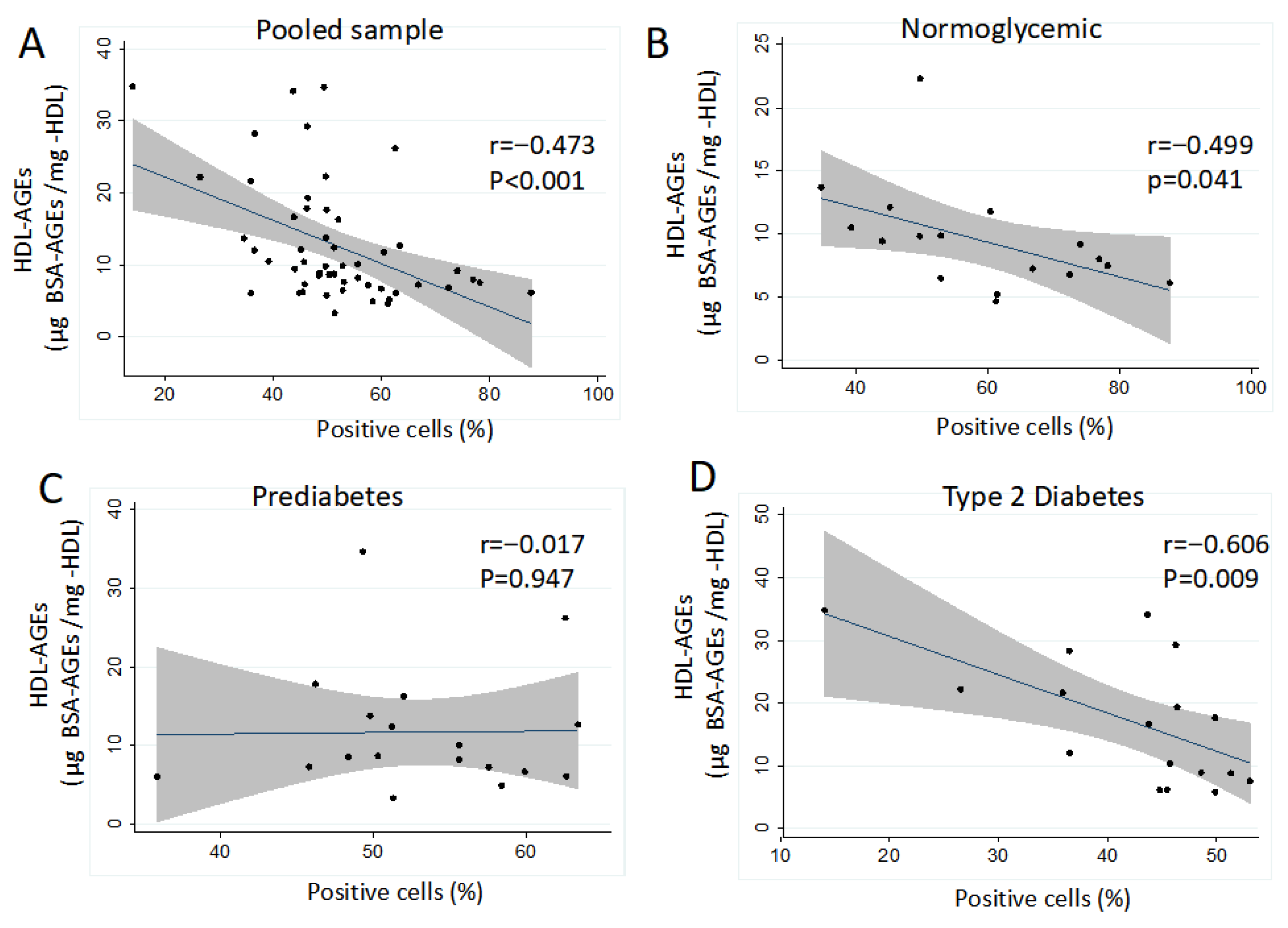
| Univariate (Beta Coefficient) | p Value | Adjusted for Age, Sex and BMI (Beta Coefficient) | p Value | Multivariate (Beta Coefficient) | p Value | |
|---|---|---|---|---|---|---|
| HDL-Fructusamine (µmol/mg of protein) | −0.289 | 0.038 | −0.277 | 0.052 | −0.265 | 0.096 |
| HDL-Carbonyls (mmol DNPH/mg protein) | −0.118 | 0.405 | −0.147 | 0.324 | −0.070 | 0.612 |
| HDL-AGEs (µg-BSA-AGEs/mg protein) | −0.473 | <0.001 | −0.454 | 0.002 | −0.418 | 0.002 |
Disclaimer/Publisher’s Note: The statements, opinions and data contained in all publications are solely those of the individual author(s) and contributor(s) and not of MDPI and/or the editor(s). MDPI and/or the editor(s) disclaim responsibility for any injury to people or property resulting from any ideas, methods, instructions or products referred to in the content. |
© 2026 by the authors. Licensee MDPI, Basel, Switzerland. This article is an open access article distributed under the terms and conditions of the Creative Commons Attribution (CC BY) license.
Share and Cite
Massó-Rojas, F.; Montaño-Estrada, L.F.; Páez-Arenas, A.; Juárez-Rojas, J.G.; Medina-Urrutia, A.; Nambo-Venegas, R.; Rodríguez-Maldonado, E.; Jorge-Galarza, E. Glycated High-Density Lipoproteins Reduce Endothelial Phenotypic Expression of Monocyte-Derived Multipotential Cells in Early Type 2 Diabetes. Metabolites 2026, 16, 194. https://doi.org/10.3390/metabo16030194
Massó-Rojas F, Montaño-Estrada LF, Páez-Arenas A, Juárez-Rojas JG, Medina-Urrutia A, Nambo-Venegas R, Rodríguez-Maldonado E, Jorge-Galarza E. Glycated High-Density Lipoproteins Reduce Endothelial Phenotypic Expression of Monocyte-Derived Multipotential Cells in Early Type 2 Diabetes. Metabolites. 2026; 16(3):194. https://doi.org/10.3390/metabo16030194
Chicago/Turabian StyleMassó-Rojas, Felipe, Luis Felipe Montaño-Estrada, Araceli Páez-Arenas, Juan Gabriel Juárez-Rojas, Aida Medina-Urrutia, Rafael Nambo-Venegas, Emma Rodríguez-Maldonado, and Esteban Jorge-Galarza. 2026. "Glycated High-Density Lipoproteins Reduce Endothelial Phenotypic Expression of Monocyte-Derived Multipotential Cells in Early Type 2 Diabetes" Metabolites 16, no. 3: 194. https://doi.org/10.3390/metabo16030194
APA StyleMassó-Rojas, F., Montaño-Estrada, L. F., Páez-Arenas, A., Juárez-Rojas, J. G., Medina-Urrutia, A., Nambo-Venegas, R., Rodríguez-Maldonado, E., & Jorge-Galarza, E. (2026). Glycated High-Density Lipoproteins Reduce Endothelial Phenotypic Expression of Monocyte-Derived Multipotential Cells in Early Type 2 Diabetes. Metabolites, 16(3), 194. https://doi.org/10.3390/metabo16030194