
This is an early access version, the complete PDF, HTML, and XML versions will be available soon.
Article

Depletion of Short-Chain Fatty Acid-Producing Commensals in Gastric Cancer Is Not Detectably Modified by Type 2 Diabetes or Tumor Characteristics

1
Department of Food and Nutrition, Changwon National University, Changwon 51140, Republic of Korea
2
Interdisciplinary Program in Senior Human Ecology, Changwon National University, Changwon 51140, Republic of Korea
3
Department of Surgery, Gyeongsang National University School of Medicine andGyeongsang National University Changwon Hospital, Changwon 51472, Republic of Korea
4
Department of Nutritional Services, Gyeongsang National University Changwon Hospital, Changwon 51472, Republic of Korea
*
Author to whom correspondence should be addressed.
Metabolites 2026, 16(10), 738; https://doi.org/10.3390/metabo16100738

Submission received: 21 August 2026 / Revised: 28 September 2026 / Accepted: 29 September 2026 / Published: 30 September 2026
(This article belongs to the Section Endocrinology and Clinical Metabolic Research)

Abstract

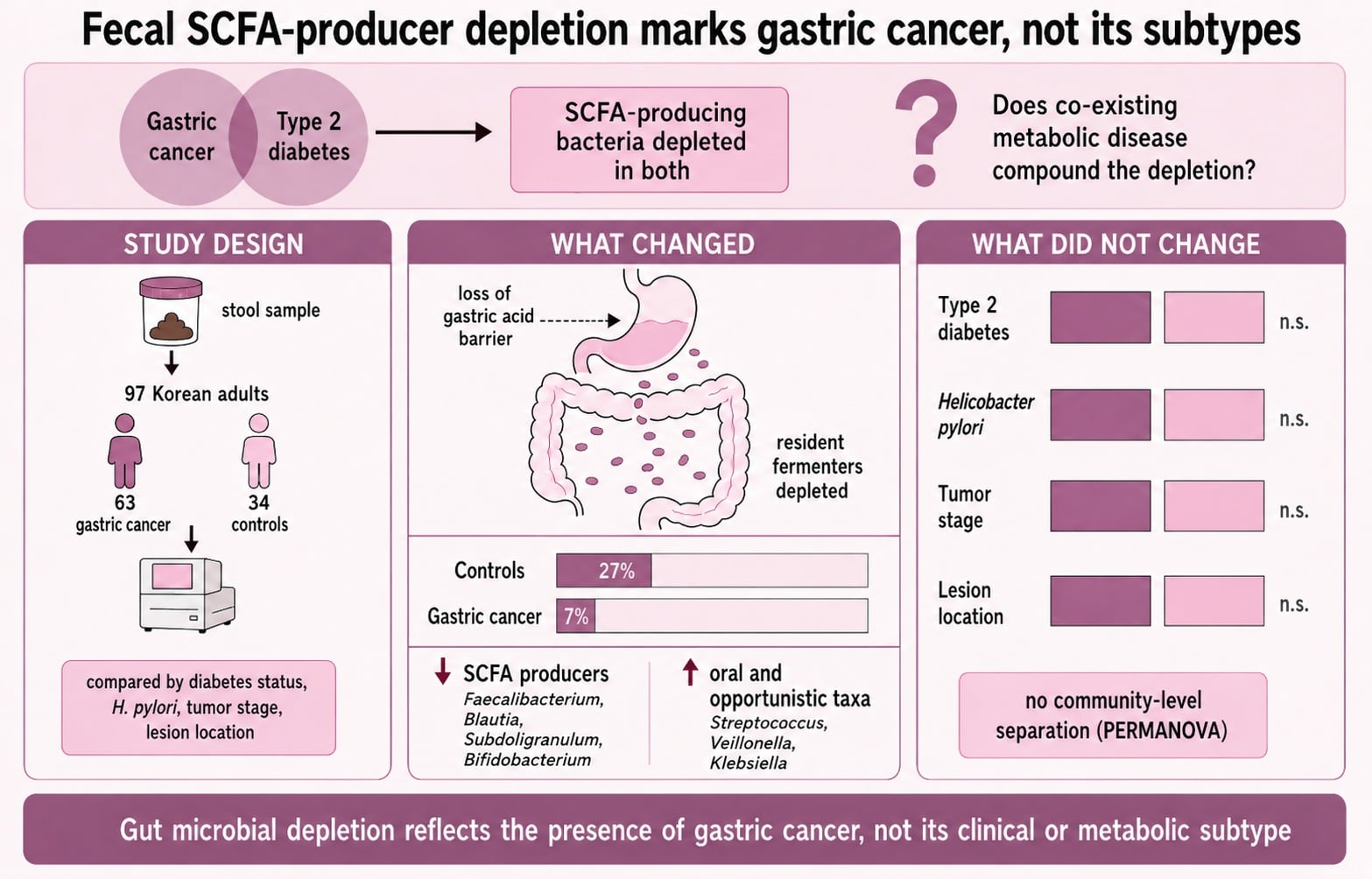
Background/Objectives: Gastric cancer (GC) is associated with depletion of short-chain fatty acid (SCFA)-producing gut commensals, and the same taxa are consistently reduced in type 2 diabetes (T2D). Co-existing metabolic disease might therefore be expected to compound GC-associated dysbiosis, but this has not been examined within a single cohort alongside tumor characteristics. Methods: Fecal microbiota of 97 Korean adults (63 with GC, 34 controls) were profiled by 16S rRNA gene sequencing. Composition, α-diversity, and β-diversity were compared between groups, and within the GC cohort by T2D status, H. pylori status, tumor stage, and lesion location. The summed relative abundance of significantly depleted SCFA-producing genera was analyzed as an aggregate measure of SCFA-producer abundance. Comparisons used Mann–Whitney U tests with Benjamini–Hochberg correction; community-level differences were tested by PERMANOVA. Results: SCFA-producer abundance fell from 26.7 ± 16.9% of the fecal community in controls to 6.6 ± 8.3% in patients with GC (p < 0.001; Cliff’s δ = +0.76, 95% CI +0.61 to +0.89). Enriched genera were predominantly oral and opportunistic, accompanied by expansion of Proteobacteria. Community-level separation was confirmed by PERMANOVA (R2 = 0.088, p = 0.001) with homogeneous dispersions. Within the GC cohort, SCFA-producer abundance did not differ by T2D status, H. pylori status, tumor stage, or lesion location (p = 0.125–0.332), though confidence intervals were wide. Conclusions: Depletion of SCFA-producing commensals in gastric cancer extends across the guild rather than individual genera and was not detectably modified by co-existing T2D or tumor characteristics. Within the limits of this cohort, the signature therefore appears to reflect the presence of disease rather than its clinical or metabolic heterogeneity.
Keywords: gastric cancer; type 2 diabetes; gut microbiota; fecal dysbiosis; short-chain fatty acids; butyrate-producing bacteria gastric cancer; type 2 diabetes; gut microbiota; fecal dysbiosis; short-chain fatty acids; butyrate-producing bacteria
Graphical Abstract