Article

Metabolite Predictors of Breast and Colorectal Cancer Risk in the Women’s Health Initiative

by
Sandi L. Navarro
1,*,†,
Brian D. Williamson
2,3,4,†,
Ying Huang
3,4,5,
G. A. Nagana Gowda
6,
Daniel Raftery
6,
Lesley F. Tinker
1,
Cheng Zheng
7,
Shirley A. A. Beresford
1,8,
Hayley Purcell
6,
Danijel Djukovic
6,
Haiwei Gu
9,
Howard D. Strickler
10,
Fred K. Tabung
11,
Ross L. Prentice
1,4,
Marian L. Neuhouser
1,8,‡ and
Johanna W. Lampe
1,8,‡
1
Cancer Prevention Program, Division of Public Health Sciences, Fred Hutchinson Cancer Center, Seattle, WA 98109, USA
2
Biostatistics Division, Kaiser Permanente Washington Health Research Institute, Seattle, WA 98101, USA
3
Vaccine and Infectious Disease Division, Fred Hutchinson Cancer Center, Seattle, WA 98109, USA
4
Department of Biostatistics, University of Washington, Seattle, WA 98195, USA
5
Biostatistics Program, Division of Public Health Sciences, Fred Hutchinson Cancer Center, Seattle, WA 98109, USA
6
Department of Anesthesiology and Pain Medicine, University of Washington, Seattle, WA 98195, USA
7
Department of Biostatistics, University of Nebraska Medical Center, Omaha, NE 68198, USA
8
Department of Epidemiology, University of Washington, Seattle, WA 98195, USA
9
Center for Metabolic and Vascular Biology, College of Health Solutions, Arizona State University, Phoenix, AZ 85004, USA
10
Department of Epidemiology and Population Health, Albert Einstein College of Medicine, Bronx, NY 10461, USA
11
Department of Internal Medicine, Division of Medical Oncology, College of Medicine and Comprehensive Cancer Center, The Ohio State University, Columbus, OH 43210, USA
*
Author to whom correspondence should be addressed.
These authors contributed equally to this work.
Metabolites 2024, 14(8), 463; https://doi.org/10.3390/metabo14080463

Submission received: 26 July 2024 / Revised: 16 August 2024 / Accepted: 19 August 2024 / Published: 20 August 2024
(This article belongs to the Special Issue Metabolomics-Based Biomarkers for Nutrition and Health)

Abstract

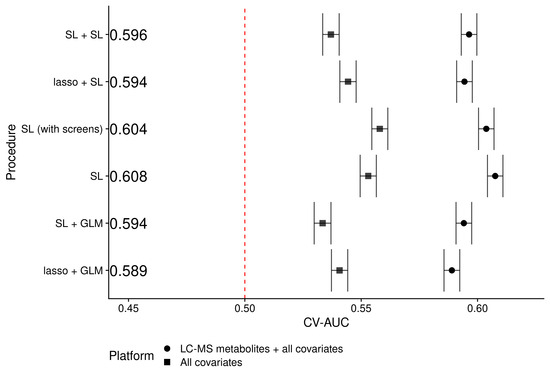
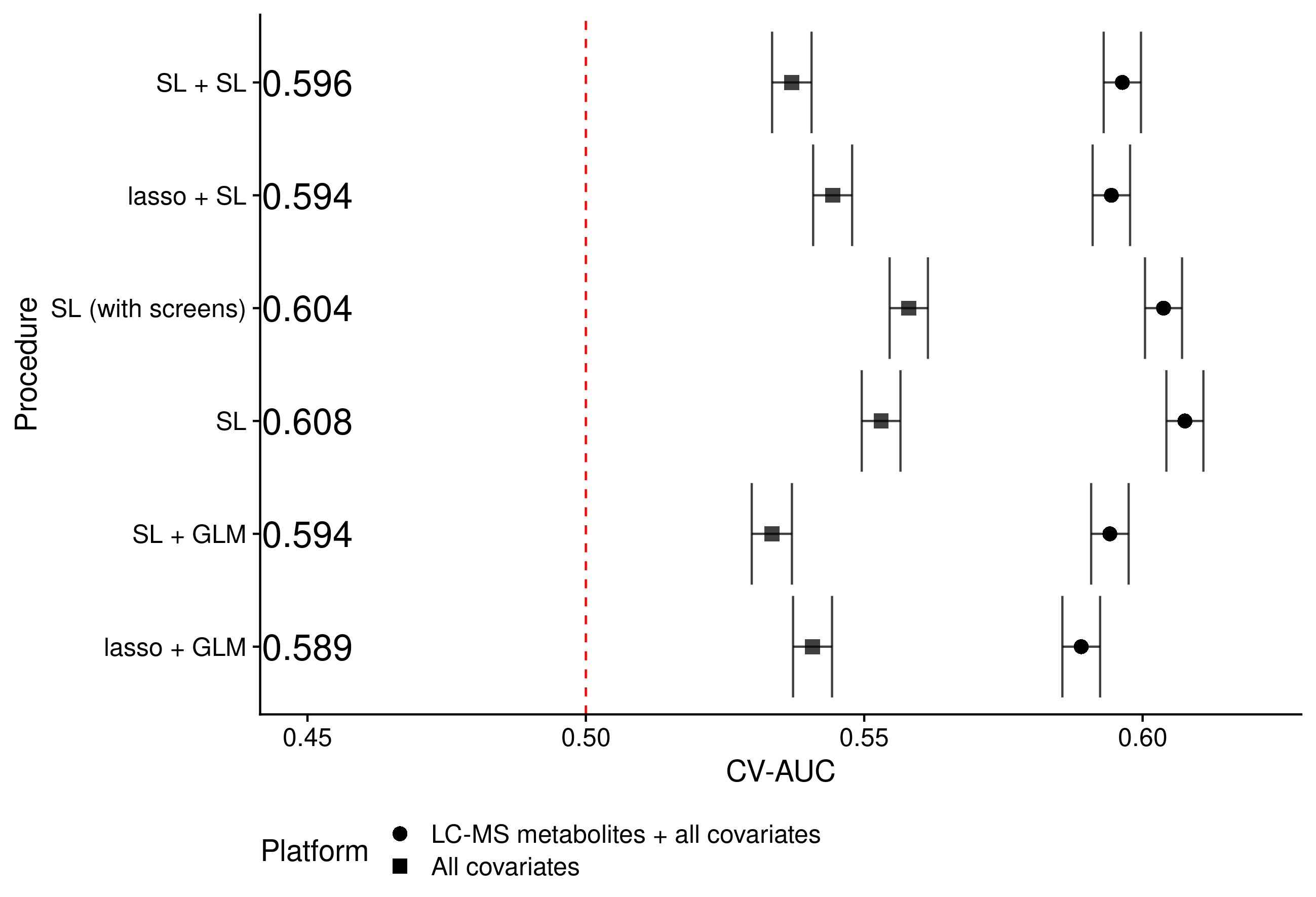
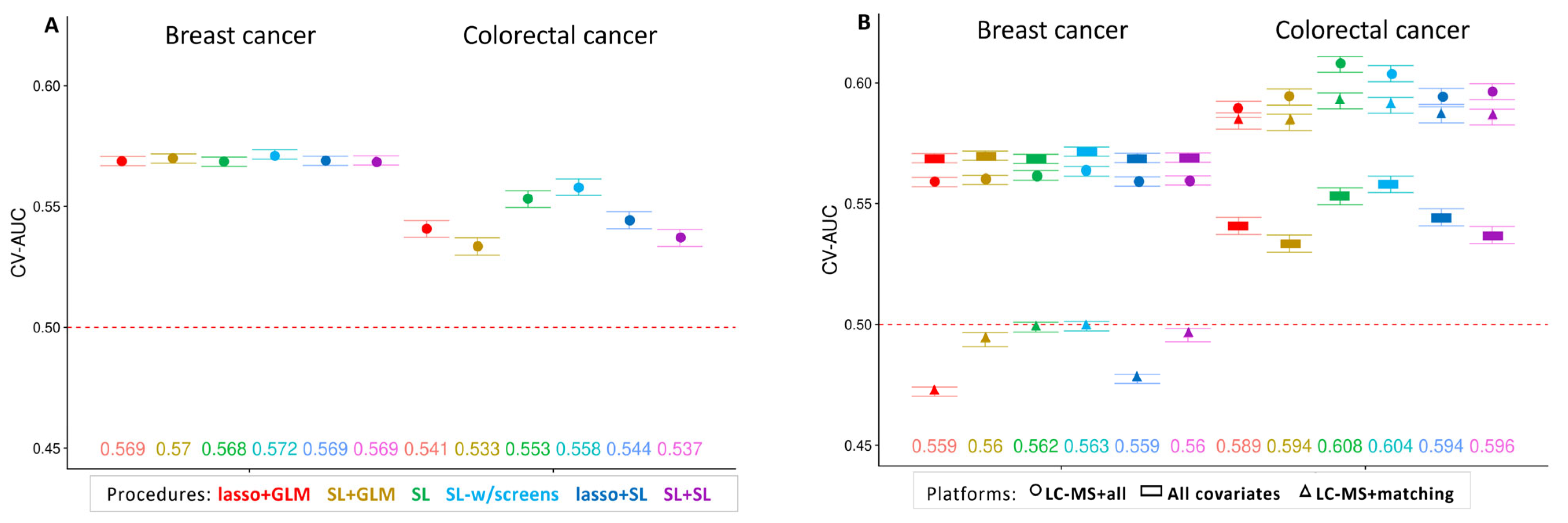
Metabolomics has been used extensively to capture the exposome. We investigated whether prospectively measured metabolites provided predictive power beyond well-established risk factors among 758 women with adjudicated cancers [n = 577 breast (BC) and n = 181 colorectal (CRC)] and n = 758 controls with available specimens (collected mean 7.2 years prior to diagnosis) in the Women’s Health Initiative Bone Mineral Density subcohort. Fasting samples were analyzed by LC-MS/MS and lipidomics in serum, plus GC-MS and NMR in 24 h urine. For feature selection, we applied LASSO regression and Super Learner algorithms. Prediction models were subsequently derived using logistic regression and Super Learner procedures, with performance assessed using cross-validation (CV). For BC, metabolites did not increase predictive performance over established risk factors (CV-AUCs~0.57). For CRC, prediction increased with the addition of metabolites (median CV-AUC across platforms increased from ~0.54 to ~0.60). Metabolites related to energy metabolism: adenosine, 2-hydroxyglutarate, N-acetyl-glycine, taurine, threonine, LPC (FA20:3), acetate, and glycerate; protein metabolism: histidine, leucic acid, isoleucine, N-acetyl-glutamate, allantoin, N-acetyl-neuraminate, hydroxyproline, and uracil; and dietary/microbial metabolites: myo-inositol, trimethylamine-N-oxide, and 7-methylguanine, consistently contributed to CRC prediction. Energy metabolism may play a key role in the development of CRC and may be evident prior to disease development.
Keywords: breast cancer; colorectal cancer; metabolite predictors; dietary biomarkers; metabolomics breast cancer; colorectal cancer; metabolite predictors; dietary biomarkers; metabolomics
Graphical Abstract