1. Introduction
Cancer remains one of the leading causes of global morbidity and mortality, representing a significant challenge for public health and modern medicine [
1]. Despite advances in conventional treatments, including surgery, radiotherapy, and chemotherapy, their effectiveness is often limited by severe adverse effects, systemic toxicity, and the development of multidrug resistance (MDR) in tumor cells [
2,
3].
In this context, the search for alternative or complementary therapeutic agents that are both effective and exhibit a favorable safety profile has increasingly directed scientific attention toward bioactive compounds derived from natural sources [
3,
4]. These alternatives offer the potential to improve clinical outcomes while reducing the side effects associated with conventional therapies [
5].
Flavonoids, a large class of polyphenolic secondary metabolites widely distributed in the plant kingdom abundant in fruits, vegetables, grains, bark, roots, stems, flowers, tea, and wine have emerged as promising candidates for cancer chemoprevention and therapy [
6,
7,
8]. Structurally, flavonoids are characterized by a diphenylpropane (C6–C3–C6) backbone, consisting of two benzene rings (A and B) connected by a three-carbon bridge that typically forms an oxygen-containing heterocyclic ring (ring C) [
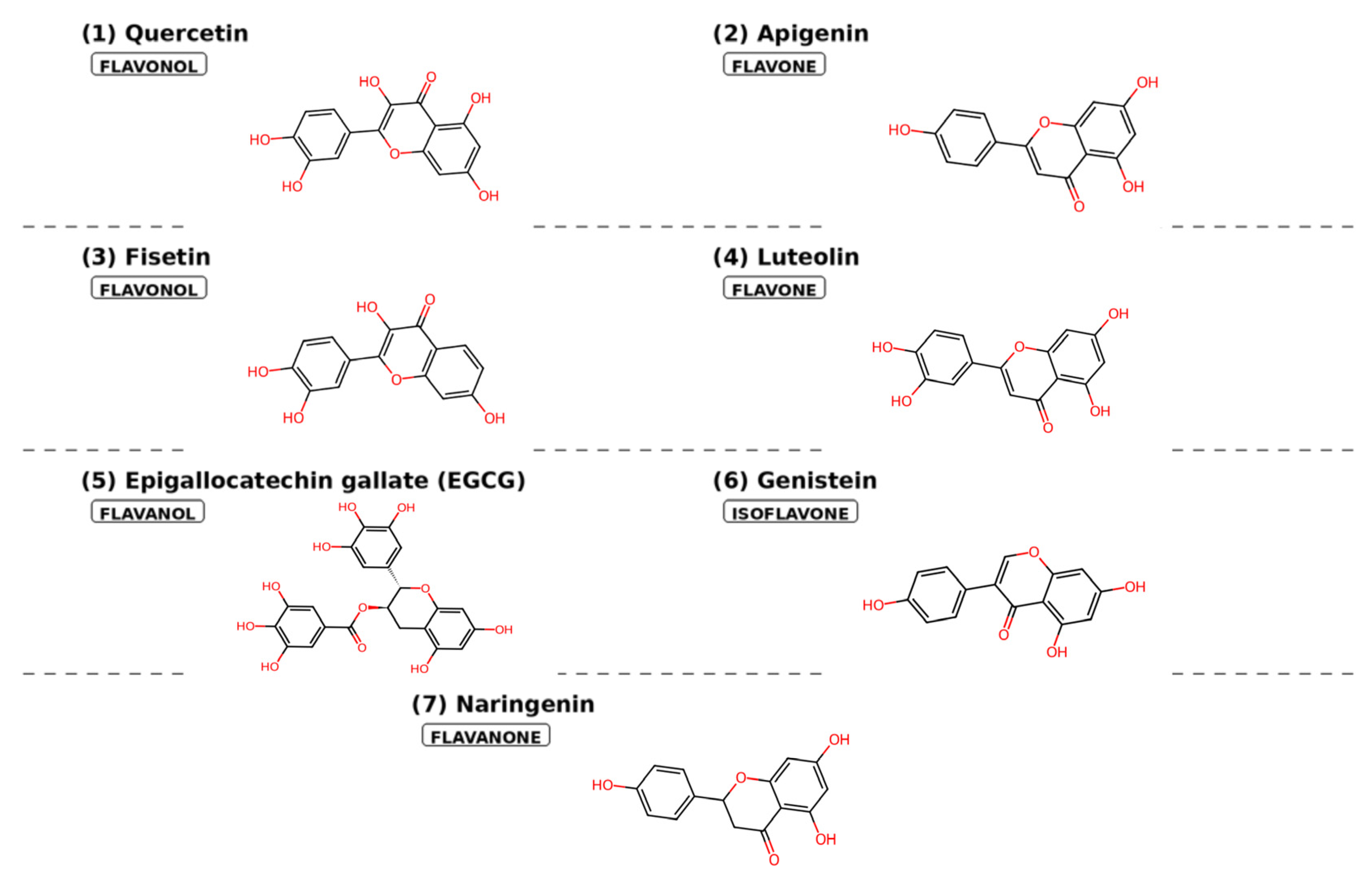
7]. Based on the degree of oxidation and substitution pattern of the C ring, flavonoids are classified into several major subclasses, including flavonols (e.g., quercetin, fisetin), flavones (e.g., apigenin, luteolin), flavanones (e.g., naringenin), isoflavones (e.g., genistein), anthocyanidins, and flavanols (e.g., epigallocatechin gallate—EGCG) [
7,
9,
10].
Preclinical research accumulated over recent decades has elucidated the pleiotropic mechanisms by which flavonoids exert their antineoplastic effects [
11,
12]. These compounds not only act as potent antioxidants, scavenging reactive oxygen species (ROS) that cause DNA damage, but also actively modulate critical cellular signaling pathways [
5,
11]. Flavonoids have demonstrated the ability to inhibit cell proliferation, induce apoptosis through both intrinsic and extrinsic pathways, promote cell cycle arrest, and suppress tumor angiogenesis and metastasis [
3,
4]. For example, quercetin has been reported to induce mitochondria- and caspase-dependent apoptosis in breast cancer cells [
8], whereas apigenin has been shown to inhibit pancreatic cancer cell proliferation through G2/M phase cell cycle arrest [
12,
13].
Despite the therapeutic potential demonstrated in in vitro studies, the clinical translation of flavonoids has been severely limited by unfavorable pharmacokinetic properties [
7,
14]. Most flavonoids exhibit poor aqueous solubility, which restricts their absorption in the gastrointestinal tract.
Furthermore, they undergo extensive first-pass metabolism in the intestine and liver, primarily through phase II conjugation reactions, including glucuronidation, sulfation, and methylation, leading to rapid systemic elimination and consequently very low oral bioavailability [
15,
16]. As a result, plasma and tissue concentrations of free flavonoids (aglycones) rarely reach the therapeutic levels required to exert significant antitumor effects in vivo [
17,
18].
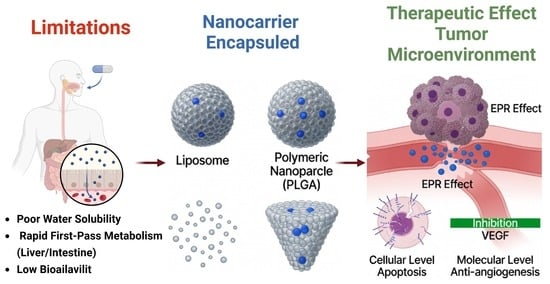
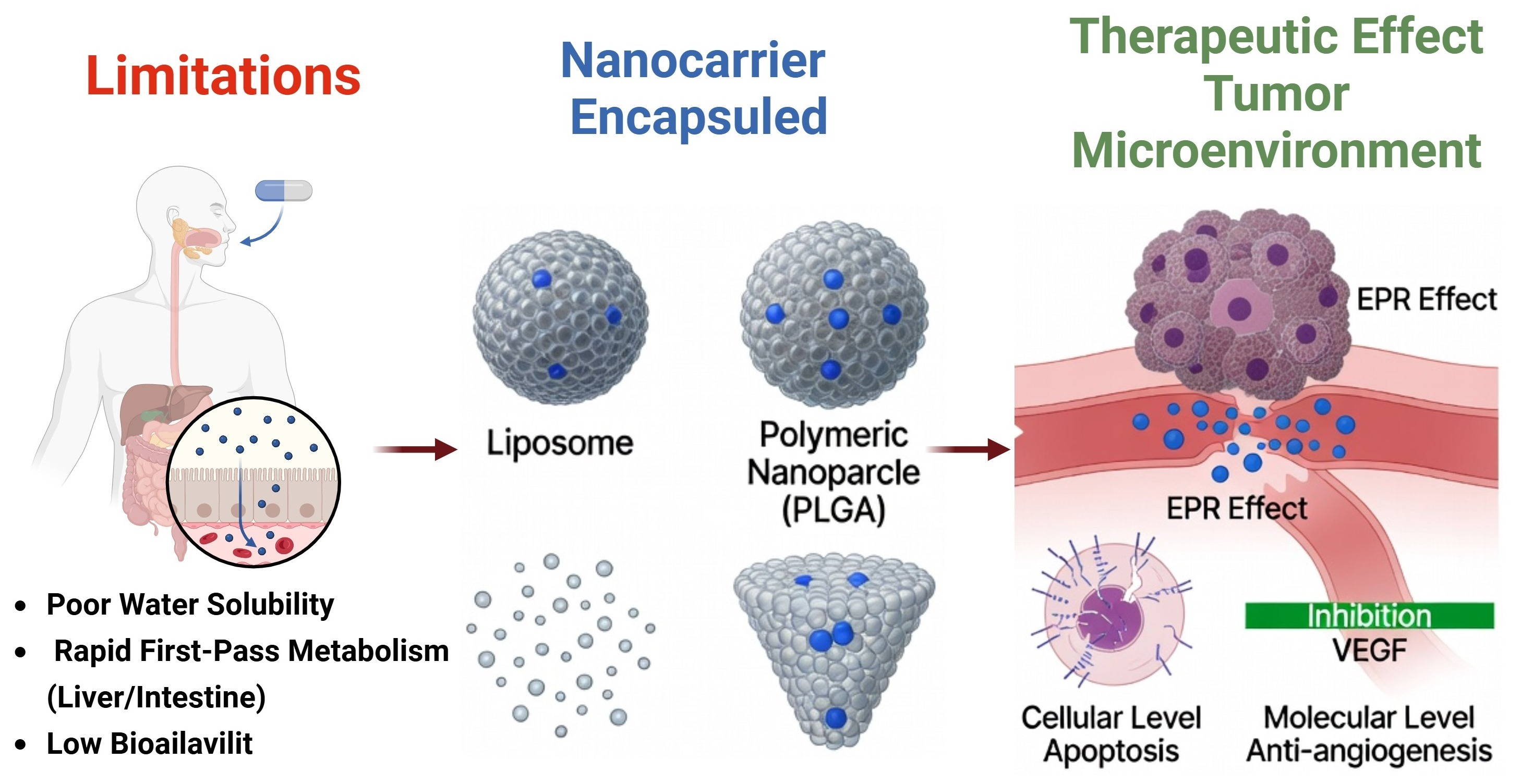
To overcome these formidable barriers, nanotechnology has been actively explored as an innovative and effective strategy. The development of nanoscale drug delivery systems (nanocarriers) provides a versatile platform for encapsulating hydrophobic compounds, protecting them from premature degradation, improving their aqueous solubility, and prolonging their systemic circulation time [
19,
20]. More importantly, nanocarriers can be engineered to exploit the unique pathophysiological characteristics of the tumor microenvironment. Through the enhanced permeability and retention (EPR) effect, nanoparticles can passively accumulate in tumor tissues due to leaky vasculature and impaired lymphatic drainage [
19,
21]. Additionally, surface functionalization with specific ligands enables active targeting of receptors overexpressed on cancer cells, thereby enhancing therapeutic efficacy while minimizing off-target toxicity and improving treatment precision [
22,
23]. In addition to nanoformulation strategies, recent advances in medicinal chemistry have explored the development of hybrid molecules containing flavonoid scaffolds combined with other bioactive pharmacophores in order to improve anticancer activity and pharmacokinetic performance.
These multifunctional approaches aim to enhance molecular selectivity, multitarget activity, and intracellular signaling modulation, particularly involving pathways such as PI3K/Akt/mTOR. In this context, flavonoid-based hybrid systems containing heterocyclic moieties, including thiazole derivatives, have attracted increasing attention as promising anticancer candidates capable of partially overcoming limitations associated with poor solubility, low bioavailability, and rapid metabolic degradation [
3,
4,
6,
24].
This review aims to provide a comprehensive and critical analysis of the role of nanocarrier-based systems in overcoming the bioavailability challenges of flavonoids for cancer therapy. The anticancer mechanisms of flavonoids, their pharmacokinetic limitations, and recent advances in the development of various nanotechnological platforms, including polymeric nanoparticles, lipid-based systems, micelles, and cyclodextrin complexes, will be discussed.
Furthermore, findings from recent in vitro and in vivo studies demonstrating the superior efficacy of flavonoid nanoformulations will be examined, along with future perspectives and translational challenges for their clinical implementation. The principal flavonoid subclasses discussed throughout this review exhibit distinct structural features, including differences in hydroxylation pattern, oxidation state, and stereochemistry, which directly influence their physicochemical properties, biological activity, bioavailability, and interaction with nanocarrier-based delivery systems. Representative chemical structures of these flavonoid subclasses are presented in
Figure 1.
2. Search Strategy and Data Sources
To develop this critical narrative review, a comprehensive literature search was conducted focusing on the intersection between flavonoids, cancer therapy, pharmacokinetic limitations, and nanotechnology-based delivery systems.
The primary electronic databases consulted included PubMed/MEDLINE, Scopus, Web of Science, and ScienceDirect.
The search strategy employed combinations of keywords and Medical Subject Headings (MeSH) terms using Boolean operators (AND, OR), including “flavonoids”, “cancer therapy”, “bioavailability”, “nanotechnology”, “nanocarriers”, “polymeric nanoparticles”, “liposomes”, “solid lipid nanoparticles”, “nanoemulsions”, “micelles”, “cyclodextrin complexes”, “targeted drug delivery”, and “pharmacokinetics of polyphenols”.
The literature search primarily covered studies published between 2004 and 2026, with emphasis on recent evidence from the last decade (2016–2026) to ensure updated translational and nanotechnological perspectives. Classical and highly cited earlier studies were also included when considered foundational for understanding flavonoid pharmacokinetics, molecular mechanisms, or nanocarrier development.
The inclusion criteria comprised original experimental studies (in vitro and in vivo), preclinical nanomedicine investigations, review articles, and meta-analyses published in peer-reviewed journals and written in English.
Priority was given to studies investigating flavonoid nanoformulations, anticancer activity, pharmacokinetic improvement, tumor targeting strategies, and mechanistic pathways relevant to translational oncology.
Exclusion criteria included studies focused exclusively on crude plant extracts without adequate phytochemical characterization, publications lacking verifiable bibliographic information, duplicated studies, conference abstracts without full data availability, and articles not directly related to flavonoid-based nanocarrier systems or cancer therapy applications.
The study selection process was based on the relevance of titles, abstracts, and full-text evaluation. Due to the broad and multidisciplinary nature of the topic, a narrative review approach was adopted instead of a strictly systematic methodology, allowing the integration of pharmacological, nanotechnological, mechanistic, and translational perspectives from heterogeneous study designs.
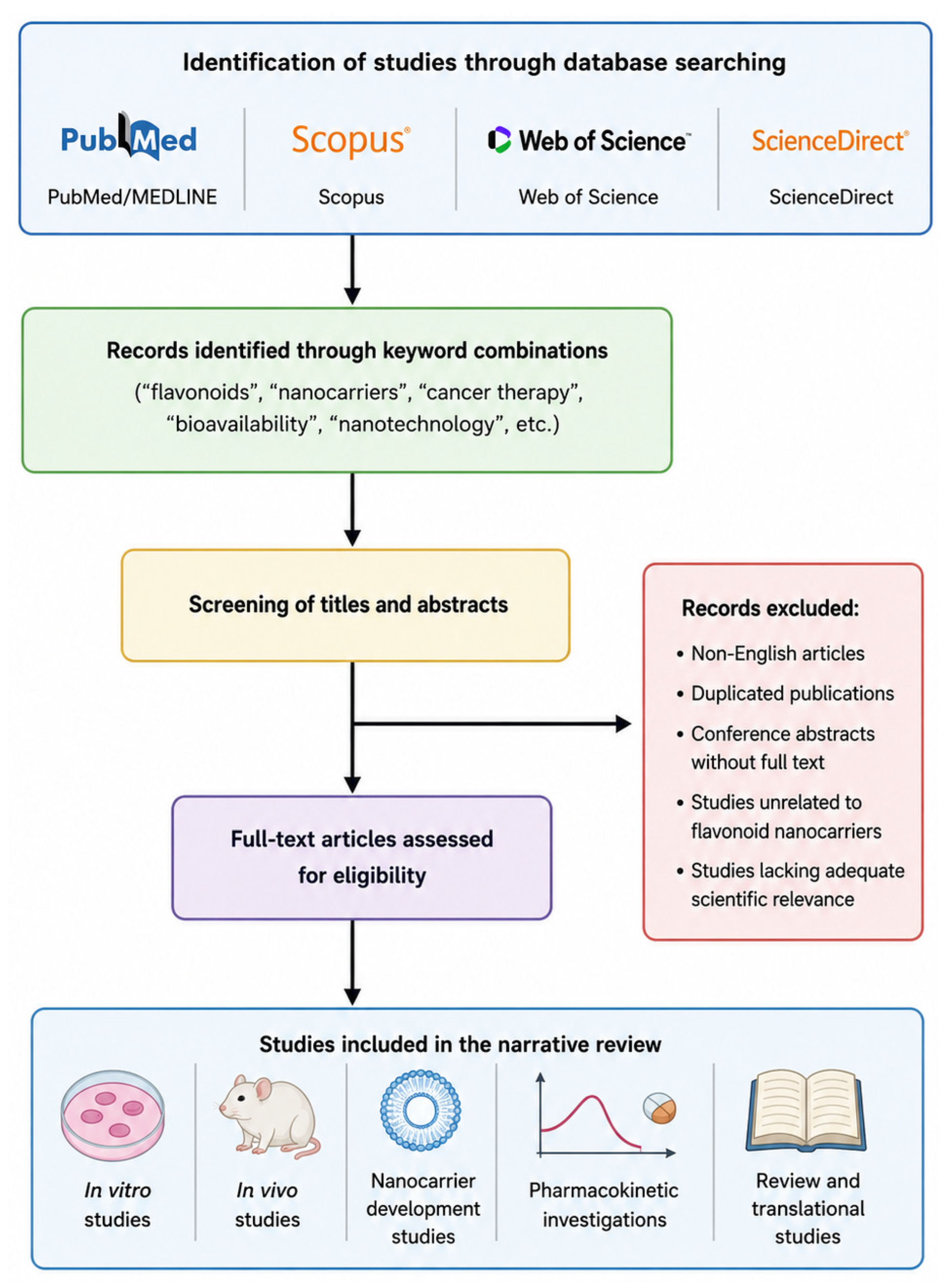
The objective was to provide a critical and integrative synthesis of the most scientifically robust and clinically relevant evidence currently available. The overall literature screening and study selection strategy adopted in this narrative review is summarized in
Figure 2.
The workflow illustrates the sequential process of database searching, screening of titles and abstracts, eligibility assessment, and inclusion of studies focusing on flavonoid-based nanocarrier systems for cancer therapy. This approach was designed to integrate pharmacological, nanotechnological, mechanistic, and translational evidence from heterogeneous but scientifically relevant study designs.
3. Anticancer Mechanisms of Flavonoids
The antineoplastic activity of flavonoids is multifaceted and stems from their ability to modulate a broad network of cellular signaling pathways that are frequently dysregulated in cancer. Rather than acting through a single dominant target, many flavonoids exhibit pleiotropic pharmacology, simultaneously impacting proliferation (e.g., PI3K/Akt/mTOR and MAPK cascades), apoptosis and survival checkpoints (e.g., Bcl-2 family proteins and caspase activation), inflammatory signaling (e.g., NF-κB), redox homeostasis (e.g., Nrf2/Keap1 axis), angiogenesis (e.g., VEGF/VEGFR), and invasion/metastasis programs (e.g., EMT-related transcription factors and MMP activity).
This multitarget profile is particularly relevant in oncology, where pathway redundancy and adaptive rewiring often undermine monotherapy approaches and contribute to therapeutic resistance.
Accordingly, flavonoids have been widely investigated as chemopreventive agents and as adjuvants capable of sensitizing tumor cells to conventional treatments, attenuating pro-survival signaling, and modulating the tumor microenvironment. Collectively, these properties support the rationale for further translational exploration of flavonoids as multi-node modulators of cancer hallmarks [
24,
25].
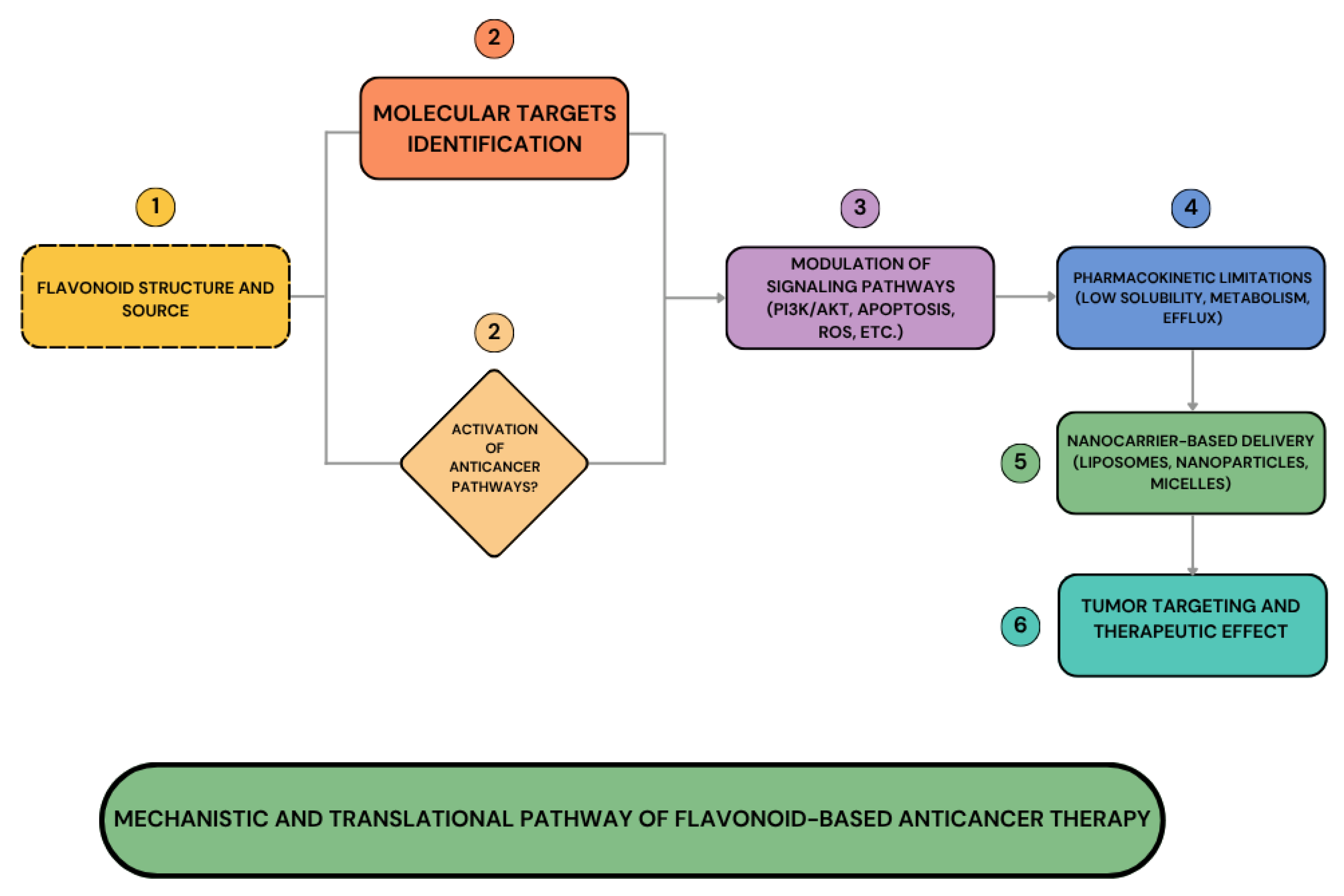
To facilitate a consolidated view of these interconnected mechanisms—and to bridge molecular effects with downstream phenotypic outcomes relevant to translation (e.g., growth inhibition, sensitization to therapy, and suppression of metastatic competence)—a schematic representation of the main mechanistic and translational pathways of flavonoid-based anticancer activity is presented in
Figure 3.
Table 1 summarizes the main flavonoids investigated in oncology, their subclasses, dietary sources, and the reported anticancer mechanisms.
3.1. Induction of Apoptosis and Cell Cycle Arrest
Apoptosis, or programmed cell death, is a crucial defense mechanism against tumorigenesis. Cancer cells often develop resistance to apoptosis through the overexpression of anti-apoptotic proteins (e.g., Bcl-2, Bcl-xL) and the downregulation of pro-apoptotic proteins (e.g., Bax, Bak) [
26,
27,
28]. Flavonoids have been shown to counteract this imbalance. Duo et al. (2012) demonstrated that quercetin inhibits the proliferation of human breast cancer cells and induces apoptosis by upregulating Bax and downregulating Bcl-2, accompanied by activation of caspase-3 [
8]. Similarly, Ujiki et al. (2006) reported that apigenin inhibits pancreatic cancer cell proliferation by inducing G2/M phase cell cycle arrest and activating the apoptotic cascade, associated with decreased cyclin B1 expression and increased p21 levels [
13].
3.2. Modulation of the PI3K/Akt/mTOR Pathway
The PI3K/Akt/mTOR signaling pathway is frequently hyperactivated in various types of cancer, promoting cell survival, proliferation, and metabolic reprogramming. Flavonoids have emerged as natural inhibitors of this pathway [
29,
30,
31,
32]. Zughaibi et al. (2021) conducted a comprehensive review demonstrating that several flavonoids, including quercetin, fisetin, apigenin, and kaempferol, suppress Akt and mTOR phosphorylation, leading to inhibition of tumor growth and induction of autophagy in multiple cancer cell lines [
6]. This ability to target the PI3K/Akt/mTOR axis underscores the potential of flavonoids as targeted therapeutic agents acting on specific molecular pathways [
33,
34].
3.3. Inhibition of Angiogenesis and Metastasis
Tumor angiogenesis is a fundamental process in cancer progression, enabling tumor growth beyond 1–2 mm
3 and facilitating metastatic dissemination. In this context, vascular endothelial growth factor (VEGF) plays a central role in regulating tumor neovascularization by promoting endothelial cell proliferation, migration, and survival, as well as increasing vascular permeability, thereby supporting the formation of a functional vascular network within the tumor microenvironment [
35,
36].
Experimental evidence indicates that several flavonoids exhibit significant anti-angiogenic activity, primarily through the inhibition of VEGF expression and suppression of vascular endothelial growth factor receptor 2 (VEGFR-2) activation in endothelial cells, resulting in reduced cell proliferation, migration, and neovessel formation [
4,
34,
35].
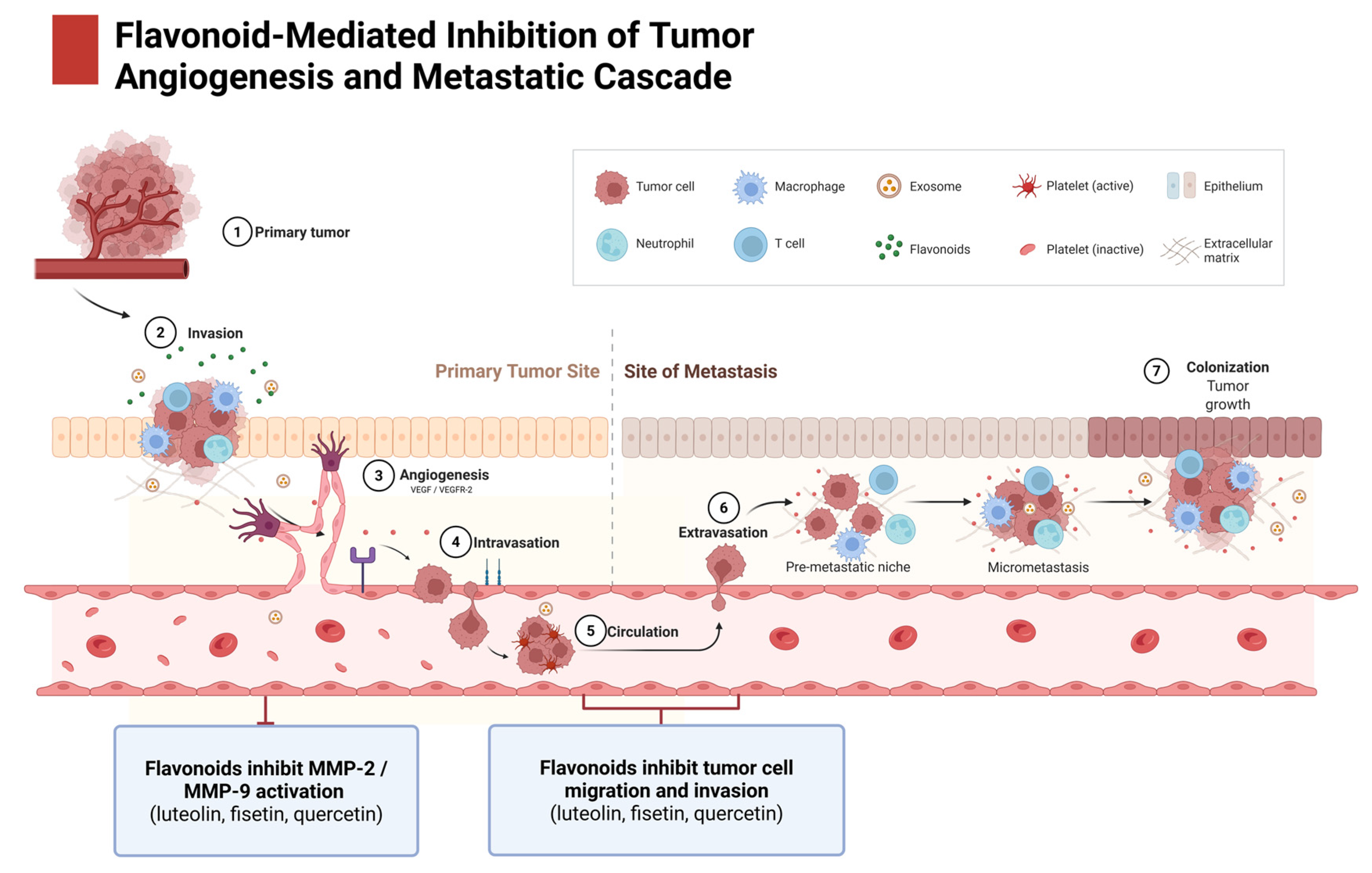
Furthermore, flavonoids can suppress metastasis by inhibiting the activity of matrix metalloproteinases (MMPs), enzymes responsible for extracellular matrix degradation and tumor cell invasion. Ferreira et al. (2022) highlighted that luteolin and fisetin inhibit cancer cell migration and invasion through suppression of MMP-2 and MMP-9 signaling pathways [
4].
To illustrate the key processes involved in tumor angiogenesis and metastatic dissemination, as well as the inhibitory effects of flavonoids on these events, a schematic representation is presented in
Figure 4.
3.4. Induction of Ferroptosis by Flavonoids
Ferroptosis has emerged as a distinct form of regulated cell death driven by iron-dependent lipid peroxidation, representing a promising strategy for targeting apoptosis-resistant tumors. Flavonoids have been shown to induce ferroptosis through multiple mechanisms, including disruption of iron homeostasis, inhibition of glutathione peroxidase 4 (GPX4) and the cystine/glutamate antiporter (System Xc
−), and enhancement of lipid peroxidation via enzymes such as acyl-CoA synthetase long-chain family member 4 (ACSL4) and lipoxygenases. These combined effects promote the accumulation of reactive oxygen species and lipid peroxides, ultimately leading to tumor cell death. Importantly, flavonoid-induced ferroptosis has demonstrated potential synergy with conventional therapies; however, its clinical application remains limited by pharmacokinetic challenges, highlighting the need for optimized delivery strategies [
37].
4. Pharmacokinetic Challenges: The Bioavailability Paradox
Despite robust preclinical evidence supporting the anticancer efficacy of flavonoids in in vitro models, their translation into clinical success in vivo remains limited. This phenomenon, commonly referred to as the “bioavailability paradox”, is attributed to multiple pharmacokinetic and physicochemical barriers that significantly restrict the systemic concentration of flavonoids in their biologically active form [
15,
16].
4.1. Poor Aqueous Solubility and Limited Absorption
Most flavonoids in their aglycone (non-glycosylated) form exhibit a highly lipophilic and planar structure, resulting in extremely low aqueous solubility. Cai et al. (2013) reported that the solubility of quercetin in water at 25 °C is below 1 mg/mL, which leads to a slow dissolution rate in the gastrointestinal tract (GIT) and limits passive absorption across the intestinal epithelium [
18]. Manach et al. (2005), in a review of 97 bioavailability studies, demonstrated that the oral bioavailability of most polyphenols is generally below 10%, with quercetin reaching a maximum of approximately 17% under optimal conditions [
15]. Consequently, a substantial fraction of the orally administered dose is excreted in the feces without being absorbed.
More recent studies corroborate these pharmacokinetic limitations, highlighting that poor solubility, limited permeability, and extensive first-pass metabolism collectively contribute to the reduced systemic exposure of flavonoids [
38,
39,
40]. These findings reinforce the need for advanced formulation strategies to improve the bioavailability and therapeutic performance of these compounds.
4.2. Extensive First-Pass Metabolism
Flavonoids that are absorbed by enterocytes undergo extensive phase II metabolism (conjugation), mediated by intestinal and hepatic enzymes, including uridine-5′-diphospho-glucuronosyltransferases (UGTs), sulfotransferases (SULTs), and catechol-O-methyltransferases (COMTs) [
17,
27].
Walle (2004) demonstrated that this first-pass metabolism rapidly converts active aglycones into glucuronide, sulfate, and methylated conjugates, which are generally more polar, less biologically active, and rapidly excreted via urine and bile [
17]. As a result, plasma concentrations of unconjugated flavonoids are often undetectable or present only at low nanomolar levels, far below the micromolar concentrations typically required to achieve efficacy in vitro.
Additionally, a fraction of these conjugated metabolites may undergo enterohepatic recirculation. Following conjugation, glucuronides and sulfates are frequently secreted into bile or transported back into the intestinal lumen by efflux transporters (e.g., MRP2 and BCRP), where they can be further metabolized by the gut microbiota and subsequently reabsorbed [
41,
42]. Although this process may prolong the overall systemic presence of flavonoid-derived metabolites, it also reinforces the central limitation that circulating forms are predominantly conjugated, with generally reduced biological activity and membrane permeability compared to aglycones.
Conversely, local deconjugation by β-glucuronidases enzymes present in the gut microbiota and described in inflammatory and tumor microenvironments, suggests that the “effective” bioavailability of flavonoids may vary across tissues, contributing to discrepancies between in vitro and in vivo responses [
43]. Collectively, these aspects highlight the need for formulation strategies, such as nanocarrier-based systems, capable of protecting flavonoids, modulating their release, and enhancing delivery of bioactive forms to tumor sites.
4.3. Intestinal Efflux and Microbiota-Mediated Degradation
In addition to metabolism, flavonoids are substrates for apical efflux transporters in the intestine, such as P-glycoprotein (P-gp) and breast cancer resistance protein (BCRP). These transporters actively pump absorbed flavonoids and their conjugates back into the intestinal lumen, further reducing net bioavailability [
16].
Chen et al. (2022) extensively reviewed flavonoid metabolism, demonstrating that non-absorbed flavonoids reaching the colon are subjected to degradation by the intestinal microbiota, resulting in cleavage of the C ring and formation of smaller phenolic acids with distinct bioactivity profiles compared to the parent compounds [
16].
More broadly, intestinal efflux mediated by ATP-binding cassette (ABC) transporters—including P-gp (ABCB1), BCRP (ABCG2), and multidrug resistance-associated proteins (MRPs)—represents a critical pharmacokinetic barrier to oral administration. These transporters reduce the absorbed fraction by recycling xenobiotics back into the lumen and often act synergistically with phase II metabolism in enterocytes, thereby decreasing systemic exposure to bioactive aglycones and promoting the elimination of conjugated metabolites [
44].
In this context, formulation strategies have been proposed to mitigate the impact of efflux, including the use of functional excipients or transporter inhibitors, as well as nanotechnology-based systems capable of enhancing local solubilization, promoting endocytic uptake, and reducing direct interaction with efflux pumps. These approaches may improve effective permeability and, consequently, oral bioavailability [
44,
45].
Zverev and Rykunova (2022) further support this concept by demonstrating that, with rare exceptions, native flavonoid aglycones are not detectable in plasma following oral administration, highlighting the limitations in directly correlating in vitro findings with in vivo outcomes [
20].
5. Nanocarrier-Based Systems for Flavonoid Delivery
To overcome the inherent pharmacokinetic limitations of flavonoids, nanotechnology offers a transformative approach. The encapsulation of flavonoids into nanocarriers (typically ranging from 10 to 200 nm) can significantly improve their aqueous solubility, protect them from metabolic degradation, prolong systemic circulation time, and enable targeted delivery to tumor tissues [
19,
20,
46,
47,
48,
49]. The following table compares the main nanotechnological platforms used for flavonoid delivery in oncology (
Table 2).
5.1. Polymeric Nanoparticles
Polymeric nanoparticles (PNPs) are formulated using biocompatible and biodegradable polymers, either synthetic (e.g., PLGA) or natural (e.g., chitosan, alginate). These systems provide high structural stability and enable controlled drug release through polymer degradation or diffusion mechanisms [
21].
PLGA is one of the most widely used polymers due to its FDA approval and well-established safety profile. A quercetin-loaded PLGA nanoformulation and demonstrated its ability to inhibit cancer progression via mitochondria-dependent activation of caspases 3 and 7, along with suppression of the PI3K/Akt pathway in breast and colon cancer cells. The PLGA formulation significantly enhanced cellular uptake and cytotoxicity compared to free quercetin, reducing IC
50 values by up to threefold [
21].
Similarly, polymeric nanoparticles loaded with quercetin exhibited superior anticancer efficacy in both in vitro and in vivo hepatocellular carcinoma models, with enhanced tumor accumulation and a 60% reduction in tumor volume compared to the free drug group [
53].
Chitosan, a naturally derived cationic polysaccharide obtained from chitin, is frequently used due to its mucoadhesive properties, which can prolong gastrointestinal residence time and enhance oral absorption. Mujtaba et al. [
47] developed PEGylated chitosan nanoparticles loaded with apigenin for oral administration, achieving a 4.8-fold increase in relative bioavailability compared to free apigenin, while maintaining cytotoxic activity in HCT-116 colon cancer cells.
Beyond chemical composition and polymer selection, physicochemical properties such as mean particle size, polydispersity index (PDI), and zeta potential are also important determinants of nanocarrier performance. In flavonoid-loaded nanosystems, particle sizes ranging from approximately 80 to 250 nm are generally considered favorable for tumor accumulation through the enhanced permeability and retention (EPR) effect while simultaneously reducing splenic clearance. Likewise, PDI values below 0.3 usually indicate a more homogeneous particle distribution and improved colloidal stability. Surface charge also plays a relevant role, since highly positive or negative zeta potential values tend to reduce aggregation phenomena and contribute to formulation stability. Previous studies involving quercetin- and apigenin-loaded nanosystems suggest that these parameters may directly influence cellular uptake and, consequently, antitumor activity [
21,
47,
48,
49].
5.2. Lipid-Based Delivery Systems
Lipid-based nanocarriers constitute a highly versatile platform for flavonoid delivery, largely due to their favorable biocompatibility profile, biomimetic organization, and capacity to efficiently solubilize and encapsulate poorly water-soluble (lipophilic) phytochemicals within hydrophobic domains (e.g., bilayers or lipid matrices). By shielding flavonoids from chemical and enzymatic degradation in biological fluids and partially mitigating presystemic metabolism, these systems can improve apparent solubility, enhance intestinal permeability, and increase systemic exposure. In addition, their structural similarity to cellular membranes facilitates interaction with the plasma membrane and promotes internalization through endocytic pathways, thereby increasing intracellular delivery at the tumor site. Importantly, lipid nanocarriers can be rationally engineered via lipid composition, surface charge, and stealth/targeting modifications to modulate drug release kinetics, prolong circulation time, and favor tumor accumulation through passive (EPR-mediated) and, when functionalized with ligands, active targeting mechanisms, ultimately contributing to improved therapeutic indices compared with free flavonoids [
17].
5.2.1. Liposomes
Liposomes are spherical vesicles composed of one or more phospholipid bilayers surrounding an aqueous core. They can encapsulate hydrophilic flavonoids within the aqueous core and lipophilic compounds within the lipid bilayer.
Seguin et al. [
26] developed a liposomal formulation of fisetin and demonstrated remarkable results: in vivo, liposomal fisetin achieved a 47-fold increase in relative bioavailability compared to free fisetin. Furthermore, treatment with liposomal fisetin at a low dose (21 mg/kg) resulted in a greater delay in Lewis lung carcinoma (LLC) tumor growth in mice (3.3 days) compared to free fisetin at the same dose (1.6 days), indicating enhanced antitumor efficacy at lower doses.
Banerjee et al. [
54] showed that apigenin-loaded liposomes exhibited enhanced chemotherapeutic efficacy in colorectal cancer cells (HCT116 and HT29), with significantly lower IC
50 values than free apigenin. This effect was attributed to improved interaction with cellular membranes, facilitating intracellular drug delivery.
Goniotaki et al. [
55] encapsulated several flavonoids (quercetin, kaempferol, naringenin) into liposomes and demonstrated consistent enhancement of biological activity across multiple human cancer cell lines, with 2–5-fold reductions in IC
50 values.
5.2.2. Solid Lipid Nanoparticles (SLNs) and Nanostructured Lipid Carriers (NLCs)
Solid lipid nanoparticles (SLNs) are composed of lipids that remain solid at room and body temperature, offering superior protection against chemical degradation and controlled drug release compared to liquid emulsions.
Hatami et al. [
48] demonstrated that quercetin-loaded SLNs exhibited enhanced antitumor activity and more effectively suppressed proliferation of MDA-MB-231 triple-negative breast cancer cells compared to free quercetin, reducing cell viability by 40% versus 25% at the same concentration. Nanostructured lipid carriers (NLCs), considered second-generation lipid nanoparticles, incorporate a mixture of solid and liquid lipids, creating structural imperfections that increase drug loading capacity and prevent drug expulsion during storage, representing a significant technological advancement over SLNs [
54].
Recent studies further reinforce the potential of lipid nanoparticles. Curcumin-loaded SLNs have shown significantly enhanced cellular uptake and cytotoxicity in breast cancer cell lines such as MCF-7, resulting in greater reduction in cell viability and increased apoptosis compared to free curcumin. These effects are attributed to improved solubility, stability, sustained release, and enhanced interaction with tumor cell membranes [
49].
5.2.3. Nanoemulsions
Nanoemulsions are kinetically stable colloidal dispersions consisting of immiscible oil and aqueous phases stabilized by surfactants and/or co-surfactants, typically exhibiting droplet diameters in the range of ~20–200 nm. Owing to their high interfacial area and ability to solubilize lipophilic payloads within the internal oil phase, nanoemulsions can markedly enhance the apparent solubility of poorly water-soluble flavonoids, improve dissolution rate, and promote intestinal absorption. Moreover, depending on lipid composition, these systems may facilitate lymphatic transport and partially reduce presystemic metabolism, while also protecting labile compounds from hydrolytic and oxidative degradation in the gastrointestinal milieu.
Consistent with these advantages, Ragelle et al. [
27] formulated a fisetin-loaded nanoemulsion and reported a pronounced increase in relative bioavailability, which translated into improved antitumor efficacy in mice bearing Lewis lung carcinoma. Importantly, the nanoemulsion enabled therapeutic activity at doses as low as 36.6 mg/kg, whereas free fisetin required 223 mg/kg to achieve comparable effects, corresponding to an approximate sixfold dose reduction and suggesting more efficient systemic exposure and tumor delivery of the encapsulated flavonoid.
5.3. Polymeric Micelles and Cyclodextrin Complexes
Polymeric micelles are core–shell structures formed by the self-assembly of amphiphilic copolymers in aqueous environments. The hydrophobic core serves as a reservoir for poorly soluble flavonoids, while the hydrophilic shell (often PEG) provides steric stabilization and prolongs circulation time.
Khonkarn et al. [
51] demonstrated that flavonoid-loaded polymeric micelles enhanced chemotherapeutic efficacy in cancer cells overexpressing P-gp, suggesting that micelles can effectively overcome multidrug resistance (MDR) efflux mechanisms, representing a significant therapeutic advantage.
Cyclodextrins are cyclic oligosaccharides with a hydrophobic internal cavity and hydrophilic outer surface, capable of forming inclusion complexes with flavonoids, thereby significantly enhancing their apparent aqueous solubility.
Rajamohan et al. [
52] developed a quercetin–β-cyclodextrin nano-inclusion complex that increased aqueous solubility by more than 100-fold and exhibited improved cytotoxic activity against cancer cells, with lower IC
50 values compared to free quercetin.
Over the past few years, increasing attention has been directed toward the use of lipidic and polymeric nanocapsules for flavonoid delivery in cancer therapy. In general, these systems have demonstrated improved solubility, enhanced stability under physiological conditions, and greater cellular uptake when compared with non-encapsulated flavonoids. Khan et al. [
56] for example, reported tha nanocarriers containing flavonoids were able to increase selective cytotoxicity in breast cancer cell lines while also promoting higher intracellular accumulation of the active compound.
Other studies have further suggested that reservoir-type nanosystems may provide more sustained release profiles, contributing to prolonged maintenance of therapeutic concentrations and potentially reducing dosing frequency. More recently, lipid–polymeric hybrid systems have also shown promising results regarding encapsulation efficiency and controlled release behavior. Taken together, these findings highlight the growing translational potential of flavonoid-based nanoformulations, although additional studies are still necessary to improve standardization and support future clinical validation.
5.4. Active Targeting and the EPR Effect
The success of nanomedicine in oncology largely depends on the ability to selectively deliver therapeutic agents to tumor tissues. Passive targeting exploits the enhanced permeability and retention (EPR) effect, whereby nanoparticles (typically 20–200 nm) accumulate in tumor tissues due to leaky vasculature and impaired lymphatic drainage [
49].
Sanna et al. [
19] highlighted that PEGylation (surface modification with polyethylene glycol) is one of the most effective strategies for prolonging circulation time and enhancing tumor accumulation via the EPR effect, achieving 5–10-fold increases in tumor concentration compared to non-PEGylated formulations.
To further enhance selectivity and cellular uptake, active targeting strategies involve the conjugation of specific ligands to nanoparticle surfaces. Zwicke et al. [
57] emphasized the use of folate receptors for active targeting, as they are overexpressed in several epithelial tumors (ovarian, breast, lung, and kidney cancers), often at levels 100–300 times higher than in normal tissues.
Hu et al. [
58] demonstrated an innovative approach in which quercetin was used to remodel the tumor microenvironment, enhancing nanoparticle permeability, retention, and antitumor effects. Specifically, quercetin suppressed type I collagen expression in the tumor stroma, reducing interstitial pressure and increasing nanoparticle penetration by 2.3-fold, illustrating the synergistic potential of flavonoids in nanomedicine.
Although nanotechnology-based delivery systems have shown substantial progress in recent years, several limitations still restrict their broader clinical application. In many formulations, physicochemical instability during storage remains a challenge, particularly because of particle aggregation or premature leakage of the encapsulated compound. In addition, large-scale manufacturing continues to face obstacles related to production costs and batch-to-batch reproducibility. Potential toxicity associated with residual solvents, surfactants, or degradation products of certain polymers must also be carefully considered. From a biological perspective, rapid recognition by the mononuclear phagocyte system and the heterogeneous nature of the EPR effect among tumor types may compromise therapeutic efficiency. Collectively, these limitations reinforce the importance of optimization strategies and standardized quality-by-design approaches for the development of clinically viable nanocarriers [
59].
6. Future Perspectives: Smart Nanocarriers, AI/ML, and Clinical Translation
The integration of nanotechnology with phytochemistry represents a paradigm shift in translational oncology. As demonstrated throughout this review, flavonoids possess a robust arsenal of anticancer mechanisms, enabling intervention at multiple stages of carcinogenesis, from initiation and promotion to progression and metastasis [
4,
6,
8,
11].
However, the clinical utility of these natural compounds has historically been limited by the “bioavailability paradox”, characterized by poor aqueous solubility, extensive first-pass metabolism, and rapid cellular efflux [
15,
16,
17].
The development of nanocarrier-based systems has emerged as the most promising strategy to overcome these pharmacokinetic barriers. Encapsulation of flavonoids within polymeric, lipid-based matrices or cyclodextrin complexes not only protects the active molecules from premature degradation in the gastrointestinal tract and systemic circulation but also significantly enhances their apparent solubility [
20,
52]. Consequently, nanoformulations have consistently demonstrated improved pharmacokinetic profiles, including increased area under the curve (AUC) and prolonged elimination half-life (t
1/2) compared to free flavonoids, as exemplified by the 47-fold increase in the bioavailability of liposomal fisetin reported by Seguin et al. (2013) [
26].
More importantly, nanotechnology enables the exploitation of the unique tumor microenvironment. Passive targeting via the enhanced permeability and retention (EPR) effect facilitates preferential accumulation of nanocarriers within tumor tissues, while surface functionalization with specific ligands (active targeting) promotes receptor-mediated cellular uptake, thereby increasing intracellular flavonoid concentration at the desired site of action [
19,
52]. In vivo studies support this concept, demonstrating that nanoencapsulated flavonoids exhibit superior antitumor efficacy at significantly lower doses compared to their free counterparts, while simultaneously reducing systemic toxicity [
26,
27,
48].
A comparative analysis of different nanocarrier systems reveals that each platform presents specific advantages and limitations. Liposomes offer excellent biocompatibility and encapsulation versatility but may suffer from physical instability during storage and high production costs. PLGA-based polymeric nanoparticles provide controlled release and biodegradability but may present residual monomer toxicity. Nanoemulsions are relatively simple to prepare and offer high solubilization capacity but may exhibit long-term thermodynamic instability. Polymeric micelles, due to their small size (10–100 nm), are particularly advantageous for overcoming P-gp-mediated multidrug resistance (MDR), representing a promising strategy for resistant tumors [
26,
49,
58].
Despite these advances, the clinical translation of flavonoid nanoformulations faces significant technological, regulatory, and biological challenges. From a manufacturing perspective, large-scale production (scale-up) and batch-to-batch reproducibility require strict control of critical quality attributes (e.g., particle size distribution, polydispersity index (PDI), zeta potential, morphology, drug loading/encapsulation efficiency, and release profile), as minor variations may affect colloidal stability, bioavailability, and the risk–benefit ratio.
From a biological standpoint, upon interaction with physiological fluids, nanocarriers acquire a dynamic biomolecular identity through the adsorption of proteins and other biomolecules at the nano–bio interface, forming so-called “protein coronas” (hard and soft). These coronas can significantly alter surface properties, opsonization, recognition by the mononuclear phagocyte system, and consequently pharmacokinetics, biodistribution, and cellular uptake. Moreover, corona composition may vary depending on the carrier material, biological environment, and host-specific factors (e.g., inflammatory status or disease condition), introducing interindividual variability and reinforcing the need for standardized characterization and quality-by-design approaches to minimize translational uncertainties [
60,
61,
62,
63,
64,
65]. Despite the advances achieved in preclinical investigations, the clinical translation of flavonoid-based nanocarriers remains limited. Most evidence currently available derives from in vitro experiments and animal models, whereas robust clinical trials evaluating long-term efficacy, safety, pharmacokinetics, and therapeutic superiority in humans are still scarce. In addition, regulatory approval by agencies such as the U.S. Food and Drug Administration (FDA) and the European Medicines Agency (EMA) requires rigorous standardization regarding manufacturing reproducibility, physicochemical characterization, stability, scalability, and toxicological assessment of nanomedicines. The intrinsic complexity of multifunctional nanosystems, combined with variability in biological responses and nano–bio interactions, continues to represent a major challenge for the successful clinical implementation of flavonoid-based nanotherapeutic platforms.
Among the multiple factors contributing to these limitations, protein corona formation has emerged as a critical determinant of nanocarrier behavior following exposure to physiological environments. The adsorption of proteins and other biomolecules onto the nanoparticle surface may alter important characteristics such as colloidal stability, cellular recognition, and biodistribution. In some situations, adsorbed proteins can partially mask surface ligands designed for active targeting, thereby reducing interaction with tumor-specific receptors and compromising targeting efficiency. In addition, growing evidence indicates that the composition of the protein corona may vary according to patient-specific conditions, including inflammatory status, metabolic alterations, and disease progression. Such variability may directly affect therapeutic performance, systemic clearance, and immune recognition of flavonoid-loaded nanosystems [
66,
67,
68].
Future perspectives should prioritize the development of “smart” nanocarriers responsive to endogenous tumor microenvironment (TME) stimuli—such as acidic pH, redox gradients (e.g., elevated glutathione levels), hypoxia, enzyme overexpression (e.g., MMPs, hyaluronidases), and increased levels of reactive oxygen species (ROS)—to enable spatiotemporally controlled drug release, enhance intratumoral retention, and minimize off-target effects in healthy tissues [
64,
65].
In parallel, the co-encapsulation of flavonoids with conventional chemotherapeutic agents in co-delivery systems represents a rational strategy to maintain fixed therapeutic ratios, synchronize pharmacokinetic profiles of compounds with distinct properties, and enhance synergistic effects—such as chemosensitization, modulation of survival pathways, and inhibition of efflux pumps. These approaches may contribute to overcoming MDR and reducing the need for high doses of cytotoxic agents [
68,
69,
70,
71].
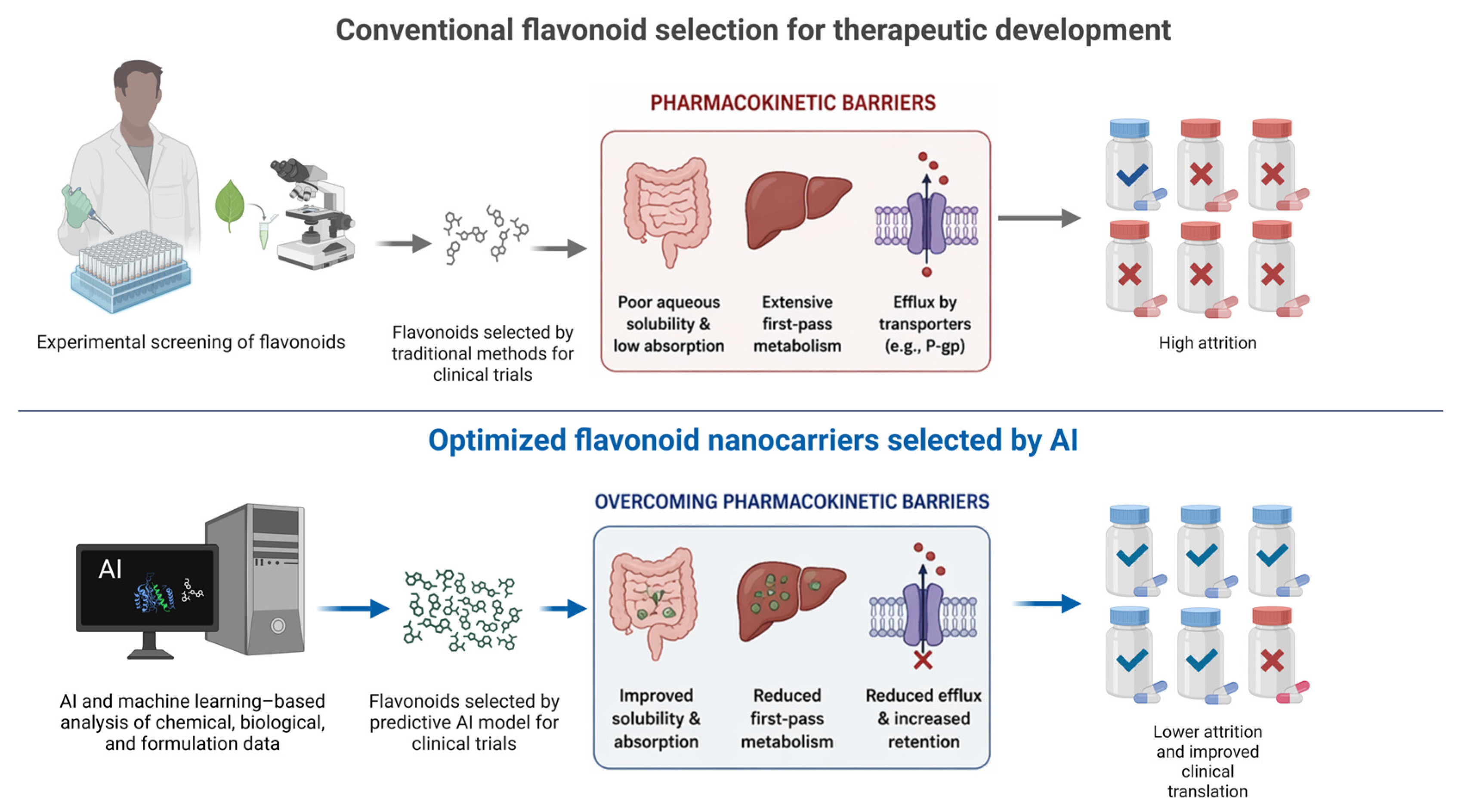
Emerging approaches integrating artificial intelligence (AI) and machine learning (ML) into nanocarrier development may further accelerate and rationalize the optimization of flavonoid delivery systems. In practice, data-driven models can learn structure–process–property relationships from formulation variables (e.g., lipid/polymer composition, surfactant ratio, manufacturing parameters) and critical quality attributes (e.g., particle size distribution, PDI, zeta potential, drug loading, and release kinetics) to support design-of-experiments, reduce trial-and-error iterations, and prioritize experimentally tractable candidates. In addition, ML has been increasingly explored to predict nano–bio interactions that critically determine in vivo performance—most notably protein corona composition and downstream cellular recognition thereby enabling earlier assessment of biodistribution and clearance liabilities. To illustrate these concepts, a comparative schematic is presented in
Figure 5.
Finally, AI-enabled modeling frameworks can be coupled with pharmacokinetic/pharmacodynamic (PK/PD) or model-informed drug development strategies to forecast exposure–response relationships, refine dosing regimens, and ultimately advance precision nanomedicine by aligning nanocarrier design with patient- and disease-specific variability [
70,
71,
72,
73].
7. Conclusions
Flavonoids exhibit robust multitarget anticancer activity across key oncogenic pathways; however, their clinical translation remains constrained by unfavorable pharmacokinetic properties, including poor solubility, extensive first-pass metabolism, and low systemic bioavailability. Nanocarrier-based delivery systems represent a transformative strategy to overcome these barriers, significantly enhancing stability, tumor targeting, and therapeutic efficacy while reducing systemic toxicity.
Nevertheless, important limitations remain, including challenges related to large-scale production, batch reproducibility, regulatory approval, and biological variability associated with nano–bio interactions. Furthermore, the majority of current evidence is still derived from preclinical models, highlighting the need for well-designed clinical studies. Future progress will depend on the development of stimuli-responsive nanocarriers, standardized quality-by-design approaches, and robust translational frameworks to bridge the gap between experimental promise and clinical applicability.
Ultimately, the successful clinical integration of flavonoid-based nanomedicine will depend not only on technological innovation, but on the ability to translate mechanistic insights into safe, scalable, and clinically effective therapeutic strategies capable of addressing the complex and dynamic nature of cancer.
Author Contributions
Conceptualization, M.J.M.d.P. and M.T.; methodology, M.J.M.d.P., J.F.P. and I.A.d.M.D.; validation, M.J.M.d.P., T.T.d.S. and W.B.D.; formal analysis, M.J.M.d.P. and J.F.P.; investigation, M.J.M.d.P., I.A.d.M.D., T.T.d.S. and M.S.S.; resources, W.B.D., T.T.d.S. and S.D.S.C.H.; data curation, M.J.M.d.P. and M.S.S.; writing—original draft preparation, M.J.M.d.P.; writing—review and editing, M.J.M.d.P., I.A.d.M.D., T.T.d.S., J.F.P., M.T., W.B.D. and S.D.S.C.H.; visualization, M.J.M.d.P. and M.S.S.; supervision, W.B.D. and M.T.; project administration, M.J.M.d.P. All authors have read and agreed to the published version of the manuscript.
Funding
This research received no external funding.
Institutional Review Board Statement
Not applicable.
Informed Consent Statement
Not applicable.
Data Availability Statement
No new data were created or analyzed in this study. Data sharing is not applicable to this article.
Acknowledgments
The authors would like to thank all colleagues and institutions whose work contributed indirectly to the development of this review. During the preparation of this manuscript, the authors used artificial intelligence-assisted tools to support language refinement, structural organization, and figure conceptualization. The authors reviewed, edited, and validated all content and take full responsibility for the accuracy and integrity of the information presented.
Conflicts of Interest
The authors declare no conflicts of interest.
References
- Global Burden of Disease Cancer Collaboration. Global, regional, and national burden of cancer, 1990–2023. Lancet 2025, 406, 1565–1586. [Google Scholar] [CrossRef] [PubMed]
- Tian, Y.; Lei, Y.; Wang, Y.; Lai, J.; Wang, J.; Xia, F. Mechanism of multidrug resistance to chemotherapy mediated by P-glycoprotein (Review). Int. J. Oncol. 2023, 63, 119. [Google Scholar] [CrossRef] [PubMed]
- Kopustinskiene, D.M.; Jakstas, V.; Savickas, A.; Bernatoniene, J. Flavonoids as Anticancer Agents. Nutrients 2020, 12, 457. [Google Scholar] [CrossRef] [PubMed]
- Ferreira, M.; Costa, D.; Sousa, Â. Flavonoids-Based Delivery Systems towards Cancer Therapies. Bioengineering 2022, 9, 197. [Google Scholar] [CrossRef] [PubMed]
- Pishro, P.; Nasiri, J.A.; Nasiri Sarvi, Z.; Saeidi, S.; Rassouli, F.B. Predictive Modeling of Flavonoid Efficacy against Esophageal Carcinoma: A Comprehensive Approach. Sci. Rep. 2025, 15, 39570. [Google Scholar] [CrossRef] [PubMed]
- Zughaibi, T.A.; Suhail, M.; Tarique, M.; Tabrez, S. Targeting PI3K/Akt/mTOR Pathway by Different Flavonoids: A Cancer Chemopreventive Approach. Int. J. Mol. Sci. 2021, 22, 12455. [Google Scholar] [CrossRef] [PubMed]
- Panche, A.N.; Diwan, A.D.; Chandra, S.R. Flavonoids: An overview. J. Nutr. Sci. 2016, 5, e47. [Google Scholar] [CrossRef] [PubMed]
- Duo, J.; Ying, G.G.; Wang, G.W.; Zhang, L. Quercetin inhibits human breast cancer cell proliferation and induces apoptosis via Bcl-2 and Bax regulation. Mol. Med. Rep. 2012, 5, 1453–1456. [Google Scholar] [CrossRef] [PubMed]
- Shen, N.; Wang, T.; Gan, Q.; Liu, S.; Wang, L.; Jin, B. Plant flavonoids: Classification, distribution, biosynthesis, and antioxidant activity. Food Chem. 2022, 383, 132531. [Google Scholar] [CrossRef] [PubMed]
- Liga, S.; Paul, C.; Péter, F. Flavonoids: Overview of biosynthesis, biological activity, and current extraction techniques. Plants 2023, 12, 2732. [Google Scholar] [CrossRef] [PubMed]
- Kumar, S.; Pandey, A.K. Chemistry and Biological Activities of Flavonoids: An Overview. Sci. World J. 2013, 2013, 162750. [Google Scholar] [CrossRef] [PubMed]
- Wang, B.; Zhang, M.; Guo, J.; Liu, Z.; Zhou, R.; Guo, F.; Li, K.; Mu, Y. The Effects of Flavonoid Apigenin on Male Reproductive Health: Inhibition of Spermatogonial Proliferation through Downregulation of Prmt7/Akt3 Pathway. Int. J. Mol. Sci. 2021, 22, 12209. [Google Scholar] [CrossRef] [PubMed]
- Ujiki, M.B.; Ding, X.Z.; Salabat, M.R.; Bentrem, D.J.; Golkar, L.; Milam, B.; Talamonti, M.S.; Bell, R.H.; Iwamura, T.; Adrian, T.E. Apigenin inhibits pancreatic cancer cell proliferation through G2/M cell cycle arrest. Mol. Cancer 2006, 5, 76. [Google Scholar] [CrossRef] [PubMed]
- Abotaleb, M.; Samuel, S.M.; Varghese, E.; Varghese, S.; Kubatka, P.; Liskova, A.; Büsselberg, D. Flavonoids in Cancer and Apoptosis. Cancers 2019, 11, 28. [Google Scholar] [CrossRef]
- Manach, C.; Williamson, G.; Morand, C.; Scalbert, A.; Rémésy, C. Bioavailability and bioefficacy of polyphenols in humans. I. Review of 97 bioavailability studies. Am. J. Clin. Nutr. 2005, 81, 230S–242S. [Google Scholar] [CrossRef] [PubMed]
- Chen, L.; Cao, H.; Huang, Q.; Xiao, J.; Teng, H. Absorption, metabolism and bioavailability of flavonoids: A review. Crit. Rev. Food Sci. Nutr. 2022, 62, 7730–7742. [Google Scholar] [CrossRef] [PubMed]
- Walle, T. Absorption and metabolism of flavonoids. Free Radic. Biol. Med. 2004, 36, 829–837. [Google Scholar] [CrossRef] [PubMed]
- Cai, X.; Fang, Z.; Dou, J.; Yu, A.; Zhai, G. Bioavailability of quercetin: Problems and promises. Curr. Med. Chem. 2013, 20, 2572–2582. [Google Scholar] [CrossRef] [PubMed]
- Sanna, V.; Pala, N.; Sechi, M. Targeted therapy using nanotechnology: Focus on cancer. Int. J. Nanomed. 2014, 9, 467–483. [Google Scholar] [CrossRef] [PubMed]
- Zverev, Y.F.; Rykunova, A.Y. Modern Nanocarriers as a Factor in Increasing the Bioavailability and Pharmacological Activity of Flavonoids. Appl. Biochem. Microbiol. 2022, 58, 1002–1020. [Google Scholar] [CrossRef] [PubMed]
- Yadav, N.; Tripathi, A.K.; Parveen, A.; Parveen, S.; Banerjee, M. PLGA-Quercetin Nano-Formulation Inhibits Cancer Progression via Mitochondrial Dependent Caspase-3,7 and Independent FoxO1 Activation with Concomitant PI3K/AKT Suppression. Pharmaceutics 2022, 14, 1326, Correction in Pharmaceutics 2024, 16, 124. https://doi.org/10.3390/pharmaceutics16010124.. [Google Scholar] [CrossRef] [PubMed]
- Ejigah, V.; Owoseni, O.; Bataille-Backer, P.; Ogundipe, O.D.; Fisusi, F.A.; Adesina, S.K. Approaches to Improve Macromolecule and Nanoparticle Accumulation in the Tumor Microenvironment by the Enhanced Permeability and Retention Effect. Polymers 2022, 14, 2601. [Google Scholar] [CrossRef] [PubMed]
- Sun, R.; Xiang, J.; Zhou, Q.; Piao, Y.; Tang, J.; Shao, S.; Zhou, Z.; Bae, Y.H.; Shen, Y. The Tumor EPR Effect for Cancer Drug Delivery: Current Status, Limitations, and Alternatives. Adv. Drug Deliv. Rev. 2022, 191, 114614. [Google Scholar] [CrossRef] [PubMed]
- Namdeo, A.G.; Boddu, S.H.; Amawi, H.; Ashby, C.R.; Tukaramrao, D.B.; Trivedi, P.; Babu, R.J.; Tiwari, A.K. Flavonoids as Multi-Target Compounds: A Special Emphasis on their Potential as Chemo-adjuvants in Cancer Therapy. Curr. Pharm. Des. 2020, 26, 1712–1728. [Google Scholar] [CrossRef] [PubMed]
- Wan, Q.; Ren, Q.; Qiao, S.; Lyu, A.; He, X.; Li, F. Therapeutic potential of flavonoids from traditional Chinese medicine in pancreatic cancer treatment. Front. Nutr. 2024, 11, 1477140. [Google Scholar] [CrossRef] [PubMed]
- Seguin, J.; Brullé, L.; Boyer, R.; Lu, Y.M.; Romano, M.R.; Touil, Y.S.; Scherman, D.; Bessodes, M.; Mignet, N.; Chabot, G.G. Liposomal encapsulation of the natural flavonoid fisetin improves bioavailability and antitumor efficacy. Int. J. Pharm. 2013, 444, 146–154. [Google Scholar] [CrossRef] [PubMed]
- Ragelle, H.; Crauste-Manciet, S.; Seguin, J.; Brossard, D.; Scherman, D.; Arnaud, P.; Chabot, G.G. Nanoemulsion formulation of fisetin improves bioavailability and antitumour activity in mice. Int. J. Pharm. 2012, 427, 452–459. [Google Scholar] [CrossRef] [PubMed]
- Carneiro, B.A.; El-Deiry, W.S. Targeting apoptosis in cancer therapy. Nat. Rev. Clin. Oncol. 2020, 17, 395–417. [Google Scholar] [CrossRef] [PubMed]
- ul Islam, B.; Suhail, M.; Khan, M.S.; Ahmad, A.; Zughaibi, T.A.; Husain, F.M.; Rehman, M.T.; Tabrez, S. Flavonoids and PI3K/Akt/mTOR signaling cascade: A potential crosstalk in anticancer treatment. Curr. Med. Chem. 2021, 28, 8083–8097. [Google Scholar] [CrossRef]
- Suhail, M.; AlZahrani, W.M.; Shakil, S.; Tarique, M.; Tabrez, S.; Zughaibi, T.A.; Rehan, M. Analysis of some flavonoids for inhibitory mechanism against cancer target phosphatidylinositol 3-kinase (PI3K) using computational tool. Front. Pharmacol. 2023, 14, 1236173. [Google Scholar] [CrossRef] [PubMed]
- Li, X.; Zhou, N.; Wang, J.; Liu, Z.; Wang, X.; Zhang, Q.; Liu, Q.; Gao, L.; Wang, R. Quercetin suppresses breast cancer stem cells (CD44+/CD24−) by inhibiting the PI3K/Akt/mTOR-signaling pathway. Life Sci. 2018, 196, 56–62. [Google Scholar] [CrossRef] [PubMed]
- Pu, Y.; Zhang, T.; Wang, J.; Mao, Z.; Duan, B.; Long, Y.; Xue, F.; Liu, D.; Liu, S.; Gao, Z. Luteolin exerts an anticancer effect on gastric cancer cells through multiple signaling pathways and regulating miRNAs. J. Cancer 2018, 9, 3669–3675. [Google Scholar] [CrossRef] [PubMed]
- Jamshidi, S.; Eghbalian, A.; Shojaei, S.; Taherkhani, A.; Feizi-Dehnayebi, M. Flavonoids as promising Akt1 inhibitors in cancer medicine: Insights from molecular docking, dynamics, DFT calculations, and in vitro validation. Cancer Rep. 2025, 8, e70315. [Google Scholar] [CrossRef] [PubMed]
- Hu, J.; Guo, Y.; Ren, L.; Zhang, H.; Qin, X.; Yin, F.; Liu, X. Natural products targeting the PI3K/Akt/mTOR-mediated autophagy pathway in cancer therapy: Recent advances and clinical perspectives. J. Nat. Prod. 2026, 89, 379–397. [Google Scholar] [CrossRef] [PubMed]
- Viallard, C.; Larrivée, B. Tumor angiogenesis and vascular normalization: Alternative therapeutic targets. Angiogenesis 2017, 20, 409–426. [Google Scholar] [CrossRef] [PubMed]
- Gong, G.; Zhang, Z.; Zheng, Y. Targeting ferroptosis with flavonoids for cancer therapy: Mechanisms and opportunities. Biochim. Biophys. Acta Rev. Cancer 2026, 1881, 189528. [Google Scholar] [CrossRef] [PubMed]
- Al Amin, M.; Zehravi, M.; Sweilam, S.H.; Jahnavi, P.; Gupta, J.K.; Rajashakar, V.; Vodeti, R.; Billah, A.A.M.; Dharmamoorthy, G.; Arjun, U.V.N.V.; et al. Natural agents modulating ferroptosis in cancer: Molecular pathways and therapeutic perspectives. J. Cell. Mol. Med. 2025, 29, e70834. [Google Scholar] [CrossRef] [PubMed]
- Jomova, K.; Alomar, S.Y.; Valko, R.; Fresser, L.; Nepovimova, E.; Kuca, K.; Valko, M. Interplay of oxidative stress and antioxidant mechanisms in cancer development and progression. Arch. Toxicol. 2026, 100, 27–73. [Google Scholar] [CrossRef] [PubMed]
- Dobrzynska, M.; Napierala, M.; Florek, E. Flavonoid nanoparticles: A promising approach for cancer therapy. Biomolecules 2020, 10, 1268. [Google Scholar] [CrossRef] [PubMed]
- Serri, C. Editorial on Special Issue: “Advances in nanotechnology-based drug delivery systems”. Pharmaceutics 2025, 17, 1038. [Google Scholar] [CrossRef] [PubMed]
- Jiang, W.; Hu, M. Mutual interactions between flavonoids and enzymatic and transporter elements responsible for flavonoid disposition via phase II metabolic pathways. RSC Adv. 2012, 2, 7948–7963. [Google Scholar] [CrossRef] [PubMed]
- Alvarez, A.I.; Real, R.; Pérez, M.; Mendoza, G.; Prieto, J.G.; Merino, G. Modulation of the activity of ABC transporters (P-glycoprotein, MRP2, BCRP) by flavonoids and drug response. J. Pharm. Sci. 2010, 99, 598–617. [Google Scholar] [CrossRef] [PubMed]
- Hillege, L.E.; Stevens, M.A.M.; Kristen, P.A.J.; de Vos-Geelen, J.; Penders, J.; Redinbo, M.R.; Smidt, M.L. The role of gut microbial β-glucuronidases in carcinogenesis and cancer treatment: A scoping review. J. Cancer Res. Clin. Oncol. 2024, 150, 495. [Google Scholar] [CrossRef] [PubMed]
- Lu, R.; Zhou, Y.; Ma, J.; Wang, Y.; Miao, X. Strategies and Mechanism in Reversing Intestinal Drug Efflux in Oral Drug Delivery. Pharmaceutics 2022, 14, 1131. [Google Scholar] [CrossRef] [PubMed]
- Murota, K.; Nakamura, Y.; Uehara, M. Flavonoid metabolism: The interaction of metabolites and gut microbiota. Biosci. Biotechnol. Biochem. 2018, 82, 600–610. [Google Scholar] [CrossRef] [PubMed]
- Aiello, P.; Consalvi, S.; Poce, G.; Raguzzini, A.; Toti, E.; Palmery, M.; Biava, M.; Bernardi, M.; Kamal, M.A.; Perry, G.; et al. Dietary flavonoids: Nano delivery and nanoparticles for cancer therapy. Semin. Cancer Biol. 2021, 69, 150–165. [Google Scholar] [CrossRef] [PubMed]
- Mujtaba, A.; Alotaibi, N.M.; Alshehri, S.M.; Yusuf, M.; Anwer, K.; Rahman, M.A.; Parveen, A. Novel therapeutic approach in PEGylated chitosan nanoparticles of apigenin for the treatment of cancer via oral nanomedicine. Polymers 2022, 14, 4344. [Google Scholar] [CrossRef] [PubMed]
- Ayala-Fuentes, J.C.; Soleimani, M.; Magaña, J.J.; Gonzalez-Meljem, J.M.; Chavez-Santoscoy, R.A. Novel Hybrid Inulin–Soy Protein Nanoparticles Simultaneously Loaded with (-)-Epicatechin and Quercetin and Their In Vitro Evaluation. Nanomaterials 2023, 13, 1615. [Google Scholar] [CrossRef] [PubMed]
- Tefas, L.R.; Tomuță, I.; Achim, M.; Vlase, L. Development and optimization of quercetin-loaded PLGA nanoparticles by experimental design. Clujul Med. 2015, 88, 214–223. [Google Scholar] [CrossRef] [PubMed]
- Hatami, M.; Kouchak, M.; Kheirollah, A.; Khorsandi, L.; Rashidi, M. Quercetin-loaded solid lipid nanoparticles exhibit antitumor activity and suppress the proliferation of triple-negative MDA-MB 231 breast cancer cells: Implications for invasive breast cancer treatment. Mol. Biol. Rep. 2023, 50, 9417–9430. [Google Scholar] [CrossRef] [PubMed]
- Khonkarn, R.; Daowtak, K.; Okonogi, S. Chemotherapeutic efficacy enhancement in P-gp-Overexpressing cancer cells by flavonoid-loaded polymeric micelles. AAPS PharmSciTech 2020, 21, 210. [Google Scholar] [CrossRef] [PubMed]
- Rajamohan, R.; Ashokkumar, S.; Murugavel, K.; Lee, Y.R. Preparation and characterization of a nano-inclusion complex of quercetin with β-cyclodextrin and its potential activity on cancer cells. Micromachines 2023, 14, 1352. [Google Scholar] [CrossRef] [PubMed]
- Baksi, R.; Singh, D.P.; Borse, S.P.; Rana, R.; Sharma, V.; Nivsarkar, M. In Vitro and In Vivo Anticancer Efficacy Potential of Quercetin Loaded Polymeric Nanoparticles. Biomed. Pharmacother. 2018, 106, 1513–1526. [Google Scholar] [CrossRef] [PubMed]
- Banerjee, K.; Banerjee, S.; Mandal, M. Enhanced chemotherapeutic efficacy of apigenin liposomes in colorectal cancer based on flavone-membrane interactions. J. Colloid Interface Sci. 2017, 491, 98–110. [Google Scholar] [CrossRef] [PubMed]
- Goniotaki, M.; Hatziantoniou, S.; Dimas, K.; Wagner, M.; Demetzos, C. Encapsulation of naturally occurring flavonoids into liposomes: Physicochemical properties and biological activity against human cancer cell lines. J. Pharm. Pharmacol. 2004, 56, 1217–1224. [Google Scholar] [CrossRef] [PubMed]
- Khan, M.R.; Khan, M.A.; Ahmad, I.; Ahmed, J.; Ahmed, H.; Mubeen, I.; Awan, B.; Ullah, F. Synthesis of Quercetin Derivatives as Cytotoxic against Breast Cancer MCF-7 Cell Line: In Vitro and In Silico Studies. Future Med. Chem. 2024, 16, 1749–1759. [Google Scholar] [CrossRef] [PubMed]
- Zwicke, G.L.; Mansoori, G.A.; Jeffery, C.J. Utilizing the folate receptor for active targeting of cancer nanotherapeutics. Nano Rev. 2012, 3, 18496. [Google Scholar] [CrossRef] [PubMed]
- Hu, K.; Miao, L.; Goodwin, T.J.; Li, J.; Liu, Q.; Huang, L. Quercetin Remodels the Tumor Microenvironment to Improve the Permeation, Retention, and Antitumor Effects of Nanoparticles. ACS Nano 2017, 11, 4916–4925. [Google Scholar] [CrossRef] [PubMed]
- Ranjbar, S.; Emamjomeh, A.; Sharifi, F.; Zarepour, A.; Aghaabbasi, K.; Dehshahri, A.; Sepahvand, A.M.; Zarrabi, A.; Beyzaei, H.; Zahedi, M.M.; et al. Lipid-Based Delivery Systems for Flavonoids and Flavonolignans: Liposomes, Nanoemulsions, and Solid Lipid Nanoparticles. Pharmaceutics 2023, 15, 1944. [Google Scholar] [CrossRef] [PubMed]
- Fernández, M.; Javaid, F.; Chudasama, V. Advances in targeting the folate receptor in the treatment/imaging of cancers. Chem. Sci. 2018, 9, 790–810. [Google Scholar] [CrossRef] [PubMed]
- Syahputra, R.A.; Dalimunthe, A.; Utari, Z.D.; Halim, P.; Sukarno, M.A.; Zainalabidin, S.; Salim, E.; Gunawan, M.; Nurkolis, F.; Park, M.N.; et al. Nanotechnology and Flavonoids: Current Research and Future Perspectives on Cardiovascular Health. J. Funct. Foods 2024, 120, 106355. [Google Scholar] [CrossRef]
- Zhou, W.; Jia, Y.; Liu, Y.; Chen, Y.; Zhao, P. Tumor Microenvironment-Based Stimuli-Responsive Nanoparticles for Controlled Release of Drugs in Cancer Therapy. Pharmaceutics 2022, 14, 2346. [Google Scholar] [CrossRef] [PubMed]
- Chauhan, A.; Kamal, R.; Bhatia, R.; Singh, T.G.; Awasthi, A. From Bench to Bedside: ROS-Responsive Nanocarriers in Cancer Therapy. AAPS PharmSciTech 2025, 26, 10, Correction in AAPS PharmSciTech 2025, 26, 32. https://doi.org/10.1208/s12249-024-03036-w.. [Google Scholar] [CrossRef] [PubMed]
- Benderski, K.; Lammers, T.; Sofias, A.M. Analysis of multi-drug cancer nanomedicine. Nat. Nanotechnol. 2025, 20, 1163–1172. [Google Scholar] [CrossRef] [PubMed]
- Bhattacharjee, S. Craft of Co-encapsulation in Nanomedicine: A Struggle To Achieve Synergy through Reciprocity. ACS Pharmacol. Transl. Sci. 2022, 5, 278–298. [Google Scholar] [CrossRef] [PubMed]
- Mahmoudi, M.; Landry, M.P.; Moore, A.; Coreas, R. The protein corona from nanomedicine to environmental science. Nat. Rev. Mater. 2023, 8, 422–438. [Google Scholar] [CrossRef] [PubMed]
- Hajipour, M.J.; Safavi-Sohi, R.; Sharifi, S.; Mahmoud, N.; Ashkarran, A.A.; Voke, E.; Serpooshan, V.; Ramezankhani, M.; Milani, A.S.; Landry, M.P.; et al. An Overview of Nanoparticle Protein Corona Literature. Small 2023, 19, e2301838. [Google Scholar] [CrossRef] [PubMed]
- Cisneros, E.P.; Morse, B.A.; Savk, A.; Malik, K.; Peppas, N.A.; Lanier, O.L. The role of patient-specific variables in protein corona formation and therapeutic efficacy in nanomedicine. J. Nanobiotechnol. 2024, 22, 714. [Google Scholar] [CrossRef] [PubMed]
- Birla, D.; Khandale, N.; Bashir, B.; Alam, M.S.; Vishwas, S.; Gupta, G.; Dureja, H.; Kumbhar, P.S.; Disouza, J.; Patravale, V.; et al. Application of quality by design in optimization of nanoformulations: Principle, perspectives and practices. Drug Deliv. Transl. Res. 2024, 15, 798–830. [Google Scholar] [CrossRef] [PubMed]
- Tao, H.; Wu, T.; Aldeghi, M.; Wu, T.C.; Aspuru-Guzik, A.; Kumacheva, E. Nanoparticle synthesis assisted by machine learning. Nat. Rev. Mater. 2021, 6, 701–716. [Google Scholar] [CrossRef]
- Villa Nova, M.; Lin, T.P.; Shanehsazzadeh, S.S.; Jain, K.; Ng, S.S.C.Y.; Wacker, R.; Chichakly, K.; Wacker, M.G. Nanomedicine Ex Machina: Between Model-Informed Development and Artificial Intelligence. Front. Digit. Health 2022, 4, 799341. [Google Scholar] [CrossRef] [PubMed]
- Chen, C.; Yaari, Z.; Apfelbaum, E.; Grodzinski, P.; Shamay, Y.; Heller, D.A. Merging data curation and machine learning to improve nanomedicines. Adv. Drug Deliv. Rev. 2022, 183, 114172. [Google Scholar] [CrossRef] [PubMed]
- Ban, Z.; Yuan, P.; Yu, F.; Peng, T.; Zhou, Q.; Hu, X. Machine learning predicts the functional composition of the protein corona and the cellular recognition of nanoparticles. Proc. Natl. Acad. Sci. USA 2020, 117, 10492–10499. [Google Scholar] [CrossRef] [PubMed]
| Disclaimer/Publisher’s Note: The statements, opinions and data contained in all publications are solely those of the individual author(s) and contributor(s) and not of MDPI and/or the editor(s). MDPI and/or the editor(s) disclaim responsibility for any injury to people or property resulting from any ideas, methods, instructions or products referred to in the content. |
© 2026 by the authors. Published by MDPI on behalf of the Österreichische Pharmazeutische Gesellschaft. Licensee MDPI, Basel, Switzerland. This article is an open access article distributed under the terms and conditions of the Creative Commons Attribution (CC BY) license.




 ,
,