Article

Discovery of Potential Antihypertensive Agents from the Marine Microalga Phaeodactylum tricornutum Through Metabolite Profiling and In Silico Analysis


by
Miguel Ernesto Guzmán-Rodríguez
1,
Marco Antonio Valdez-Flores
2,
Cinthia Ayón-Fernandez
3,
José Juan Ordaz-Ortiz
4,
Alma Marlene Guadrón-Llanos
2,
Javier Magaña-Gómez
5,
Alberto Kousuke de la Herrán-Arita
2,
Josué Camberos-Barraza
2,
Verónica Judith Picos-Cárdenas
2,
Juan Fidel Osuna-Ramos
2,
Claudia Desireé Norzagaray-Valenzuela
1,6,* and
Loranda Calderón-Zamora
1,6,*
1
Programa en Ciencias Biológicas, Facultad de Biología, Universidad Autónoma de Sinaloa, Ciudad Universitaria, Boulevard Universitarios S/N, Culiacán C.P. 80013, Mexico
2
Facultad de Medicina, Universidad Autónoma de Sinaloa, Culiacán C.P. 80019, Mexico
3
Programa de Doctorado en Biomedicina Molecular, Facultad de Medicina, Universidad Autónoma de Sinaloa, Culiacán C.P. 80019, Mexico
4
Centro de Investigación y de Estudios Avanzados del Instituto Politécnico Nacional, Unidad de Genómica Avanzada, Irapuato C.P. 36824, Mexico
5
Laboratorio de Nutrición Humana, Facultad de Ciencias de la Nutrición y Gastronomía, Universidad Autónoma de Sinaloa, Culiacán C.P. 80019, Mexico
6
Facultad de Biología, Universidad Autónoma de Sinaloa, Culiacán C.P. 80013, Mexico
*
Authors to whom correspondence should be addressed.
Sci. Pharm. 2026, 94(2), 43; https://doi.org/10.3390/scipharm94020043

Submission received: 17 March 2026 / Revised: 13 May 2026 / Accepted: 19 May 2026 / Published: 21 May 2026

Abstract

Hypertension remains a leading cause of global morbidity and mortality, and angiotensin-converting enzyme (ACE) represents a central therapeutic target within the renin–angiotensin–aldosterone system. Marine microalgae, particularly Phaeodactylum tricornutum, provide an underexplored reservoir of structurally diverse metabolites with potential cardiovascular relevance. In this in silico study, we characterized metabolites putatively annotated by UPLC-ESI-HRMS and evaluated their predicted ACE inhibitory potential. We performed molecular docking with AutoDock 4 and assessed pharmacokinetic and toxicological properties using the SwissADME, PASS, and ProTox platforms. Several metabolites showed favorable binding orientations within the ACE catalytic pocket, including interactions with key residues and proximity to the zinc-binding motif. Lehualide G, Val–Asn–Pro, tanariflavanone B, hydroxyterbinafine, and anhydro-vitamin A exhibited the most favorable docking profiles. PASS predictions indicated vascular-related bioactivity signals for selected compounds, whereas ADMET modeling revealed heterogeneous but classifiable pharmacokinetic and safety characteristics. The convergence of predicted binding compatibility, bioactivity signals, and stratified safety margins supports P. tricornutum as a promising source of candidate molecules for further experimental validation in antihypertensive research.

1. Introduction

Hypertension, also known as high blood pressure, represents a disruption in blood pressure regulation and remains one of the leading causes of mortality worldwide. It is estimated that approximately 1.4 billion adults aged 30–79 years live with hypertension [1]. Most individuals with high blood pressure may remain asymptomatic, even when readings reach dangerously elevated levels. The World Health Organization estimates that 46% of adults with hypertension are unaware of their condition. When symptoms do occur, they may include chest pain, dizziness, edema, seizures, severe headache, and visual disturbances [2].
Based on its origin, hypertension can be classified as primary, when associated with genetic and multifactorial etiologies, or secondary, when it results from underlying pathological conditions [3]. Blood pressure regulation involves multiple interconnected systems, including natriuretic peptides, endothelial function, the sympathetic nervous system, immune mechanisms, and particularly the renin–angiotensin–aldosterone system (RAAS) [4]. Prevention and initial treatment typically focus on lifestyle modifications, such as dietary changes, increased physical activity, reduced alcohol intake, improved sleep, and pharmacological interventions targeting angiotensin-converting enzyme, angiotensin receptors, and calcium channels [5,6,7].
Currently, most antihypertensive drugs are derived from plant compounds. However, microalgae have emerged as a promising alternative source of bioactive molecules with potential health applications, including the development of nutraceuticals and functional foods [8]. Algae are primarily photosynthetic organisms that exist in both micro- and macroscopic forms and include both prokaryotic and eukaryotic members [9]. Microalgae produce a wide range of secondary metabolites with documented biological activities. Despite the identification of thousands of such metabolites, comprehensive characterization and pharmacological evaluation remain limited [10].
Over the past decades, multiple pharmacological strategies have been developed to manage high blood pressure [11]. In the 1970s, captopril was introduced as the first orally active angiotensin-converting enzyme inhibitor (ACEI) [12]. Subsequent structural modifications led to the development of enalapril and lisinopril [13], followed by additional derivatives such as benazepril, perindopril, quinapril, and ramipril, which remain in clinical use [14].
Although these agents are effective, they are associated with adverse effects, including dry cough, angioedema, electrolyte imbalance, dizziness, headache, and, in some cases, a decline in renal function [12,15]. Variability in therapeutic response and reports of reduced efficacy have also been described [16,17]. These limitations highlight the need to explore novel bioactive scaffolds with improved safety and pharmacological profiles. In this context, angiotensin-converting enzyme (EC 3.4.15.1; ACE) remains a strategic molecular target due to its central role in the RAAS. ACE catalyzes the conversion of angiotensin I, an inactive peptide, into angiotensin II, a potent vasoconstrictor that elevates blood pressure [18,19,20]. RAAS remains a principal therapeutic axis in antihypertensive drug development, given its role in blood pressure control and fluid and electrolyte balance [21]. Renin, initially synthesized as prorenin and secreted by afferent renal arterioles, initiates the cascade by cleaving angiotensinogen to produce angiotensin I [22,23].
Angiotensin I is subsequently converted into angiotensin II through ACE-mediated hydrolysis [24]. ACE is a Zn2+-dependent metalloprotease located on the membrane of parenchymal cells, where it hydrolyzes angiotensin I by cleaving the histidyl–leucine bond [25].
In the present work, an integrative in silico approach was implemented, using Food and Drug Administration (FDA)-approved ACE inhibitors as reference compounds to systematically evaluate metabolites extracted from Phaeodactylum tricornutum.
The objective was to identify candidate molecules with structural compatibility with ACE, favorable binding characteristics, and acceptable pharmacokinetic and toxicity profiles, thereby supporting their prioritization as potential antihypertensive agents for further experimental validation.

2. Materials and Methods

2.1. Biologic Materials of Phaeodactylum tricornutum

The diatom Phaeodactylum tricornutum is part of the strain collection of the Molecular Physiology Laboratory at the Center for Applied Research in Public Health (CIASAP), Faculty of Medicine, Autonomous University of Sinaloa, Culiacán, Mexico. This strain was provided by the culture collection of the Center for Scientific Research and Higher Education of Ensenada (CICESE) in Ensenada, Baja California, Mexico.

2.2. Microalgae Culture Condition and Biomass Processing

The diatom was cultivated following the methodology previously used by Norzagaray-Valenzuela et al., 2016 [26], Saline water (34 g NaCl L−1) and F/2 medium proposed by Guillard and Ryther [27]. The following chemicals were used for growth medium preparation: NaNO3, NaH2PO4 · H2O, FeCl3 · 6H2O, Na2 EDTA · 6H2O, MnCl2 · 4H2O, ZnSO4 · 7H2O, CoCl2 · 6H2O, CuSO4 · 5H2O, Na2MoO4 · 2H2O, thiamine, biotin and cyanocobalamin were used; the medium was adjusted to a pH of 7.6. The inoculum was prepared by gradually increasing the culture volume through weekly subculturing, starting from 10 mL and progressing to 20 L of growth medium. Inoculum concentration was 10% (v/v) of the culture volume. The diatom was grown in a polycarbonate carboy with 1% CO2, allowing gas exchange and the suspension of microorganisms in the liquid medium, under warm white light lamps (continuous irradiance of 120–130 μmol photons m−2 s−1) and at 22 °C. Batch cultures were grown until the cells reached the stationary phase. Biomass recovery was carried out using a flocculation process with chitosan (C56H103N9O39), sodium hydroxide (NaOH), and acetic acid (CH3COOH) [28]. Vitamins, chitosan, and other chemical reagents were obtained from Sigma-Aldrich (St. Louis, MO, USA). The culture was harvested in the late log phase of growth. The wet biomass was then placed in an oven at 40 °C for 24 h to remove water, resulting in dry biomass.

2.3. Preparation of the Biomass Methanolic Extract

The methanolic extract was prepared following the methodology as reported by Pereira and coworkers, with minor modifications [29]. Thirty grams of dried biomass was macerated in a 250 mL methanol/water solution (4:1 v/v). The biomass was extracted by maintaining the mixture under continuous agitation for 24 h in the absence of light at 35 °C. The mixture was then separated by centrifugation at 10,000× g/10 min, and the supernatant was recovered. This was then filtered in two stages: first, using Whatman No. 2 filter paper, followed by a second filtration using a 0.22 μm Captiva Econo Filter acrodisc, Agilent® (Andover, MA, USA). The solvents were removed from the extract using a rotary evaporator at 45 °C, and the extract was finally lyophilized. The lyophilized extract was stored at −80 °C for later use.

2.4. Procedure of Non-Targeted Metabolomic Analysis

Extracts were subjected to non-targeted metabolomic analyses, following the methodology described by Hernández-Peña et al. and Rodríguez-Castillo et al., with minor adjustments [30,31].
Non-targeted metabolomic analyses were performed using an Ultra-Performance Liquid Chromatograph (AcquityTM UPLCTM I-Class system, Waters Corporation; Milford, MA, USA) coupled with a high-resolution Q-TOFMS High-Resolution Mass Spectrometer (HRMS) using an electrospray ionization source in positive and negative modes (SynaptTM HDMS Waters Corporation, Milford, MA, USA).
A reversed-phase AcquityTM BEHTM column C18 (Waters Corporation, Milford, MA, USA) (2.1 × 150 mm, 1.7 µm) was used for the chromatographic separation. The mobile phases consisted of water containing 0.1% formic acid (A) and acetonitrile containing 0.1% formic acid (B), both LC–MS grade (JT Baker®, Phillipsburg, NJ, USA). The gradient program was as follows: 0–0.5 min, 95% A; 0.5–25.5 min, linear gradient to 100% B; 25.5–27.5 min, column wash with 100% B; 27.51 min return to initial conditions (95% A); followed by 3 min for column re-equilibration. The flow rate was set to 0.2 mL/min, the column temperature to 40 °C, and the injection volume to 5 µL.
All samples (including blank extraction) were resuspended in 1 mL of acetonitrile/ultra-pure water (70:30 v/v) and filtered through a 0.2 µm PTFE membrane (Agilent Technologies, Santa Clara, CA, USA). Solvent blanks and extraction blanks were analyzed under the same conditions to monitor background signals. The sample was analyzed by PDA, and ions were generated using an electrospray ionization (ESI) source in negative and positive modes. Both ionization modes were injected separately. Under negative electrospray ionization (ESI-) conditions, the capillary voltage was adjusted to 2 kV and the cone voltage to 40 V.
The source temperature was maintained at 150 °C, with a cone gas flow of 20 L/h. The desolvation temperature was set at 350 °C, and the desolvation gas flow was 600 L/h. For positive electrospray ionization (ESI+), the capillary voltage was increased to 3 kV while the cone voltage was maintained at 40 V. The source temperature was set at 130 °C. The desolvation temperature remained at 350 °C, with a desolvation gas flow of 700 L/h. Data were acquired in continuum mode with an MS scan time of 1.5 s. In both ionization modes, spectra were obtained using MSE acquisition, employing argon as the collision gas. Collision energy in the trap region was fixed at 6 eV for low-energy scans (Function 1) and ramped from 20 to 40 eV for high-energy scans (Function 2). During acquisition, Leucine-Enkephalin was used as a mass reference at m/z 554.2615 for ESI- and 556.2771 for ESI+, and was infused directly at a flow of 5 µL/min at a concentration of 2 ng/mL, enabling internal mass calibration. Positive and negative adducts were considered.
The metabolomic raw data were analyzed using Progenesis® QI for metabolites (Nonlinear Dynamics version 2.3, Waters Corporation), calibrated with lock mass, and normalized. Putative annotation of compounds was performed using the ChemSpider Database (Version: 1.0.6905.308112) and Progenesis MetaScope (Version: 1.0.6907.37313), with an isotope-similarity filter of 90%. Subsequently, a handpicked database was conducted for each metabolite, and its putative candidates were confidence-filtered using score punctuation ≥ 40 and isotope similarity ≥ 90 as criteria. The metabolites that passed the criteria of score and isotope similarity were chosen for this first stage. According to the Metabolomics Standards Initiative (MSI), these assignments were classified as MSI level 2 annotations, corresponding to putatively annotated compounds, because they were supported by accurate mass, isotopic similarity, and database matching without confirmation using authentic analytical standards under identical experimental conditions.

2.5. Molecular Docking Analysis of ACE

The angiotensin-converting enzyme (ACE) is a zinc-dependent metalloprotease composed of two catalytic domains (N- and C-domains). Molecular docking was performed against the C-domain because it is primarily associated with angiotensin I hydrolysis and is the main target of clinically used ACE inhibitors [32]. The crystal structure of human ACE C-domain (PDB ID: 1UZF) was obtained from the protein data bank (PDB) [33]. The protein chain used for docking (chain A) was selected, and the co-crystallized ligand (D-captopril) was removed prior to docking. Protein preparation was carried out using AutoDockTools (MGLTools 1.5.7).
All crystallographic water molecules were removed. Hydrogen atoms were added, and protonation states of titratable residues were assigned at physiological pH (7.4).
The catalytic Zn2+ ion was retained during receptor preparation to preserve the active site’s integrity. Kollman united-atom charges were assigned to the protein, and atomic coordinates were saved in PDBQT format. Canonical SMILES for metabolites putatively annotated from P. tricornutum extracts were obtained from the PubChem database (https://pubchem.ncbi.nlm.nih.gov, accessed on 3 October 2025) and ChemSpider database (https://www.chemspider.com, accessed on 3 October 2025). Ligand 3D structures were generated and optimized using Open Babel 3.1.0 [34]. Geometry minimization was performed using the MMFF94 force field (~5000 steps). Ligands were protonated at pH 7.4, and Gasteiger partial charges were assigned [35,36,37]. Ligands were saved in PDBQT format. The docking grid was configured to allow ligand accommodation within the catalytic pocket, ensuring proper coverage of the zinc-coordination region [36]. Subsequently, the docking grid was centered on the catalytic site at coordinates X = 36.98, Y = 27.05, and Z = 50.65, while the grid box size was set to 40 × 40 × 40 points with a grid spacing of 0.564 Å, following the methodology proposed by Zarei et al., and Qiu et al., [38,39]. Molecular docking for metalloproteins with zinc was performed using AutoDock 4.2 with the Lamarckian Genetic Algorithm [40]. Multiple independent runs were performed for each ligand, and poses were clustered by RMSD. The lowest-energy conformation from the most populated cluster was selected for analysis. Captopril, lisinopril, and enalaprilat were included as positive controls. Ligands were prioritized based on clustering reproducibility, binding mode within the catalytic site, proximity to Zn2+, and relative docking scores relative to controls. A threshold of ≤−7.0 kcal·mol−1 was used as an initial filter, recognizing the approximate nature of docking scores [41].

2.6. Redocking Validation Using RMSD Analysis

Docking validation was performed by redocking ligand D-captopril into the ACE C-domain structure (PDB ID: 1UZF) using the same grid box configuration and docking parameters described above. The resulting docked pose was compared with the experimental crystallographic conformation of D-captopril from the original PDB complex. Root mean square deviation (RMSD) values were calculated in PyMOL (v3.1.6.1) [42]. After structural alignment of the receptor, the protein was kept fixed and only heavy atoms were considered (hydrogen atoms were excluded). An RMSD value ≤ 2.0 Å was considered indicative of successful pose reproduction and adequate docking accuracy (Figure S1) [36,43,44,45].

2.7. Prediction of Biological Activity

Biological activity prediction was performed using the PASS online server (Prediction of Activity Spectra for Substances) (https://way2drug.com/PassOnline/predict.php, accessed on 18 November 2025). PASS estimates the probability of activity (Pa) and inactivity (Pi) for each compound based on structure–activity relationships derived from curated experimental datasets using Bayesian statistical modeling [46]. Compounds were considered to have potential biological activity when Pa exceeded Pi, with higher Pa values indicating a greater likelihood of activity. The analysis was conducted according to previously reported procedures with minor modifications [47].

2.8. In Silico Physicochemical and ADME Profiling, and Toxicity Prediction

The physicochemical and ADME properties of the prioritized ligands were predicted using SwissADME (default settings), including molecular weight, lipophilicity (logP), topological polar surface area (TPSA), hydrogen bond donors and acceptors, gastrointestinal absorption, blood–brain barrier permeability, and Lipinski’s rule-of-five compliance.
Toxicity was independently evaluated using ProTox 3.0, which provides predicted oral LD50 values and toxicity class estimations based on machine learning models (https://tox.charite.de/protox3/, accessed on 25 November 2025) [48,49]. Compounds were prioritized according to predefined drug-likeness and toxicity criteria (TC ≥ 4).

3. Results

3.1. Non-Targeted Metabolomic Analysis

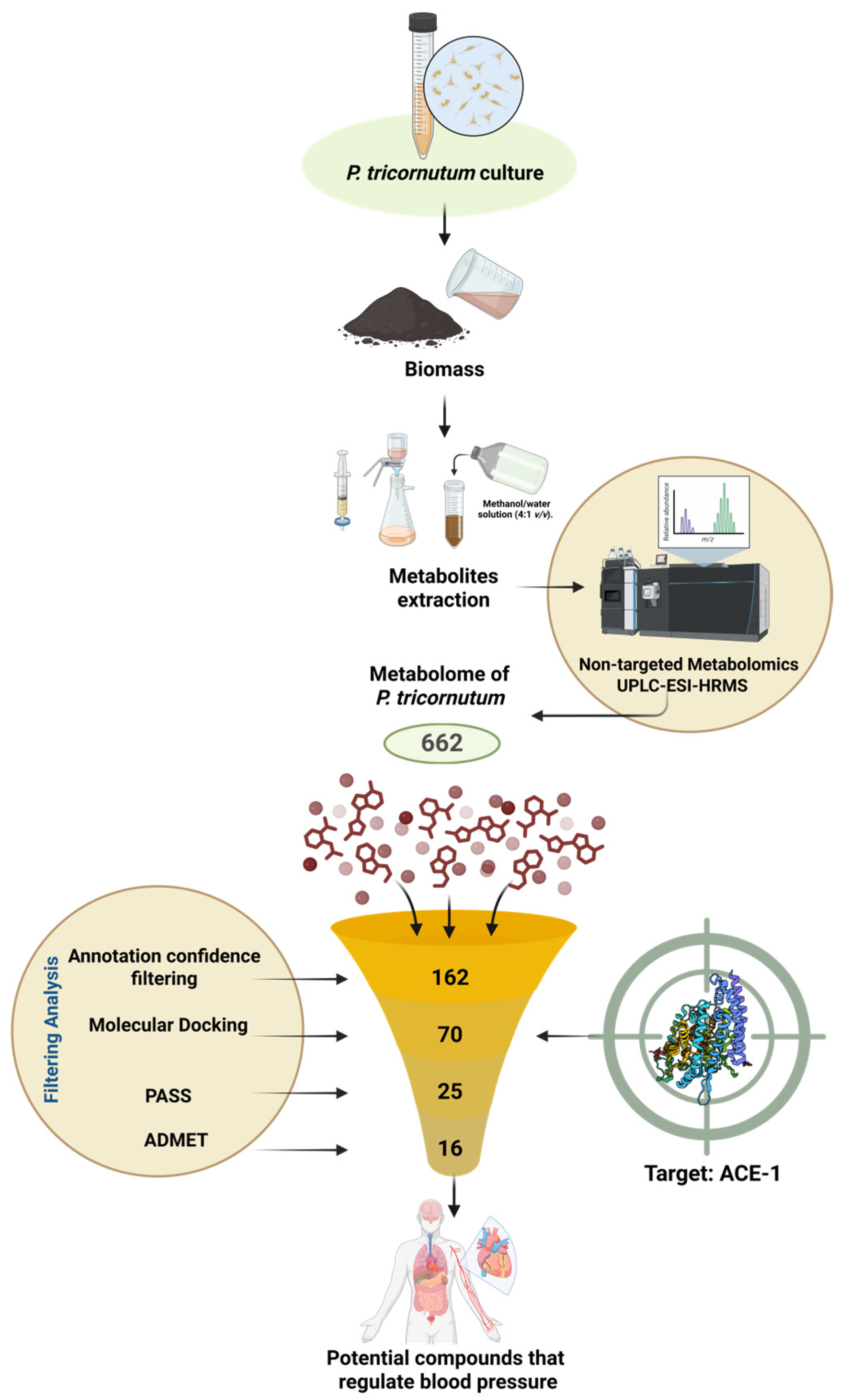
UPLC-ESI-HRMS profiling of the methanolic extract of P. tricornutum resulted in the detection of 662 mass spectral features. After applying annotation confidence criteria and removing redundant signals, 162 putatively annotated compounds were retained for subsequent molecular computational analyses (Table S1). The overall experimental and computational workflow of the study is summarized in Figure 1.

3.2. Molecular Docking Screening

A total of 162 annotated metabolites were subjected to molecular docking analyses targeting the ACE C-domain. Utilizing a predetermined docking threshold of ≤−7.0 kcal·mol−1, 18 compounds emerged with favorable predicted binding energies, warranting further interaction analysis (Table 1). The reference inhibitors exhibited binding energies of −9.438 kcal·mol−1 for enalapril, −8.449 kcal·mol−1 for lisinopril, and −7.060 kcal·mol−1 for captopril.
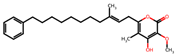
Notably, among the natural metabolites, the most promising docking scores were recorded for lehualide G (−8.429 kcal·mol−1), Val-Asn-Pro (−8.178 kcal·mol−1), tanariflavanone B (−8.105 kcal·mol−1), hydroxyterbinafine (−7.900 kcal·mol−1), and anhydrovitamin A (−7.792 kcal·mol−1).

3.3. Interaction of the Ligands with the Amino Acid Residues of ACE

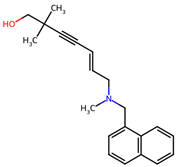
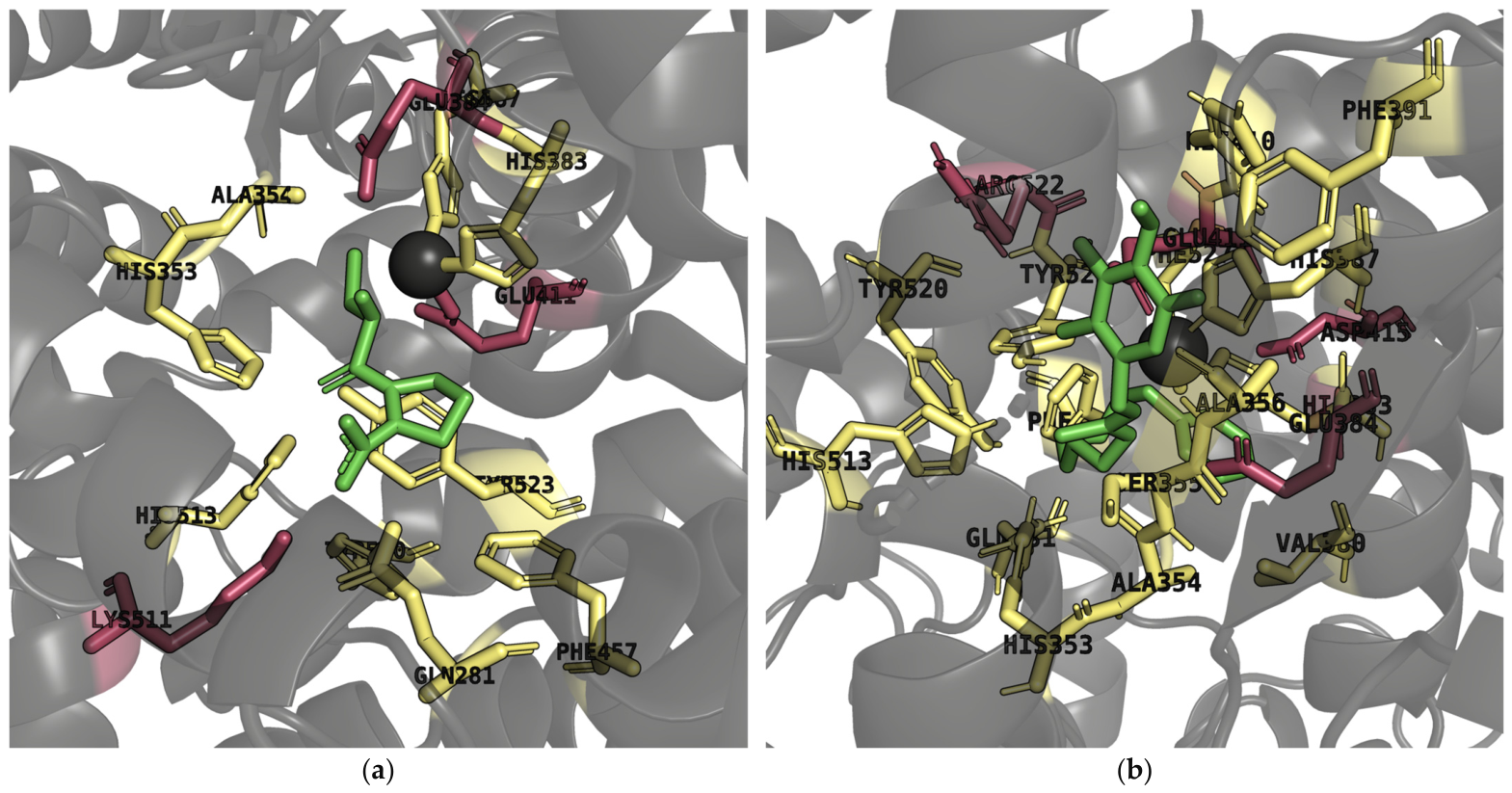
Detailed interaction analysis of the selected ligands showed that several compounds occupied both the S1 and S2′ pockets and extended toward the HEXXH–Zn2+ catalytic motif, indicating structural compatibility with the ACE active site (Figure 2, Table S2). Compounds such as hydroxyterbinafine, 3-hydroxylinoleoylcarnitine, 4-hydroxy-6-(15-hydroxypentadecyl)-pyran-2-one, and (5E,10E)-5,10-pentadecadien-1-ol established interactions within S1 and S2′ while positioning functional groups in proximity to the catalytic zinc ion. Hydrogen bonds within the 2.2–3.2 Å range were observed with residues including Ala354, Glu384, Tyr523, Gln281, and Lys511. Our results also showed interactions with His383, His387, and Glu411, which form the canonical HEXXH motif. In addition, hydrophobic contacts were identified with Val380, Phe457, Phe527, and Tyr523 (3.3–5.0 Å), contributing to stabilization within the catalytic channel.
Reference inhibitors, captopril and lisinopril, displayed the expected binding orientations in S1 and S2′, and proximity to the Zn2+ catalytic site, consistent with their known crystallographic binding modes. Several natural metabolites showed comparable spatial occupation of the catalytic cavity, although differences in interaction density and zinc proximity were observed among compounds. Based on the extent and distribution of predicted contacts, hydroxyterbinafine and 3-hydroxylinoleoylcarnitine exhibited the highest number of simultaneous interactions across S1, S2′, and the catalytic region. Other compounds demonstrated more localized binding profiles, which were primarily restricted to S1 and hydrophobic contacts. These variations suggest differential binding orientations among the selected metabolites within the ACE active site.

3.4. PASS Biological Prediction of Vasoactive and Antihypertensive Potential

The PASS-based prediction of biological activity revealed different probabilities for vasodilatory and antihypertensive mechanisms among the evaluated metabolites and the reference ACE inhibitors (Table 2). Activity probabilities (Pa) were interpreted relative to their corresponding inactivity probabilities (Pi), with Pa > Pi indicating a putative biological association under the similarity-based model.
PASS analysis identified 3-hydroxylinoleoylcarnitine as the most consistently predicted vasoactive compound, exhibiting the highest probabilities for peripheral vasodilation (Pa = 0.975), general vasodilatory activity (Pa = 0.905), and a moderate antihypertensive signal (Pa = 0.454), all with Pa values markedly exceeding Pi. This profile distinguishes it as the strongest endpoint candidate within the natural metabolite panel.
Among additional metabolites, gingerdione, 6β-hydroxyferruginol, and both pyran-2-one derivatives demonstrated coherent peripheral and/or general vasodilatory probabilities (Pa > Pi), suggesting structural similarity to compounds involved in vascular modulation. Lehualide G showed notable coronary vasodilator activity (Pa = 0.462), while Val–Asn–Pro presented moderate but consistent signals across peripheral and antihypertensive endpoints.
In contrast, the reference ACE inhibitors displayed a distinct pattern dominated by coronary vasodilator activity, with enalapril (Pa = 0.740), captopril (Pa = 0.661), and lisinopril (Pa = 0.534) showing strong and selective VC predictions. These compounds did not demonstrate high peripheral vasodilator activity in the PASS model, suggesting a pharmacological profile that differs from that of several natural metabolites that display stronger structural similarity to known vasoactive pharmacophores.

3.5. In Silico ADME and Drug-Likeness Evaluation

The in silico ADME evaluation revealed heterogeneous physicochemical and pharmacokinetic profiles among the prioritized metabolites and reference ACE inhibitors (Table 3; Figure 3 and Figure 4). Most compounds complied with Lipinski’s rule of five, with molecular weights below 500 g/mol and acceptable hydrogen-bond donor (HBD) and acceptor (HBA) counts. Only one compound (3-hydroxylinoleoylcarnitine) exhibited two Lipinski violations, while two additional compounds showed a single violation. Several metabolites demonstrated moderate lipophilicity (iLOGP 2–4), whereas a subset, including tanariflavanone B, lehualide G, and anhydrovitamin A, displayed elevated iLOGP values (>4), suggesting increased hydrophobic character. Rotatable bond counts varied considerably, ranging from 1 to 20, with long-chain derivatives such as 3-hydroxylinoleoylcarnitine and substituted pyran derivatives showing the highest conformational flexibility. Most compounds were free of PAINS alerts, with only 7C-aglycone presenting a PAINS flag. SwissADME analysis identified BRENK structural alerts in several metabolites, associated with potential reactivity or medicinal chemistry liabilities.
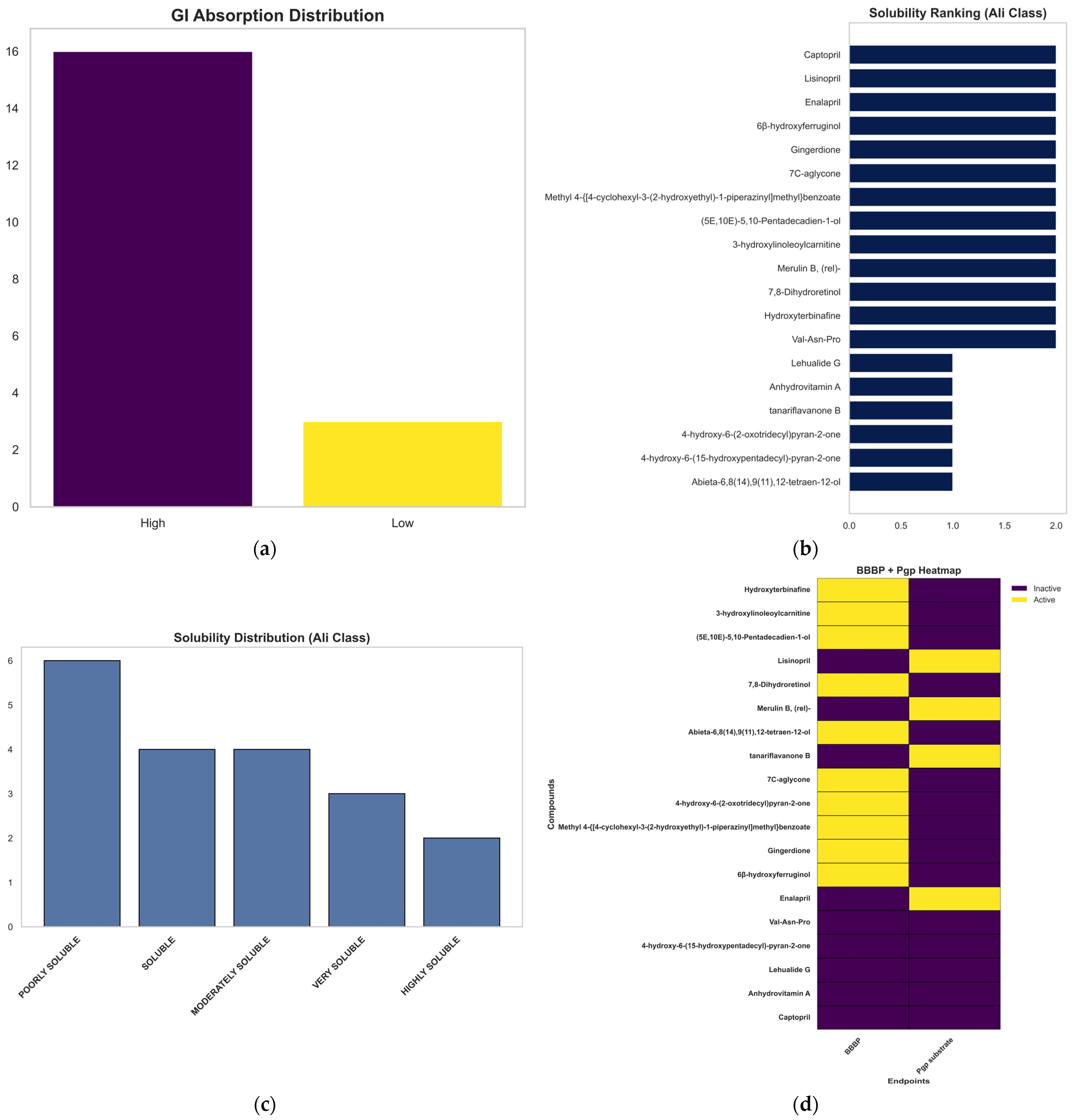
Predicted gastrointestinal absorption indicated that 18 of the evaluated compounds were classified as having high oral absorption, whereas only three metabolites were predicted to exhibit low absorption (Figure 5a). Compounds displaying reduced predicted absorption were generally characterized by increased conformational flexibility and extended aliphatic chains, as observed for 3-hydroxylinoleoylcarnitine and certain long-chain pyran derivatives.
Solubility predictions according to the Ali classification demonstrated a heterogeneous distribution across categories. Six compounds were classified as poorly soluble, five as soluble, five as moderately soluble, three as very soluble, and two as highly soluble (Figure 5b,c).
Long-chain pyran derivatives and lehualide G were predominantly associated with poor solubility profiles, consistent with their elevated lipophilicity and rotatable bond counts. In contrast Val-Asn-Pro exhibited more favorable solubility rankings, aligning with their moderate iLOGP values and lower structural complexity (Table 3).
Blood–brain barrier permeability predictions revealed that several lipophilic metabolites, including hydroxyterbinafine, (5E,10E)-5,10-pentadecadien-1-ol, 3-hydroxylinoleoylcarnitine, 7,8-dihydroretinol, 7C-aglycone and 6β-hydroxyferruginol, were predicted to cross the BBB (Figure 5d). Conversely, lehualide G, anhydrovitamin A, merulin B, (rel)-, and the reference ACE inhibitors captopril, enalapril, and lisinopril were predicted as non-permeant. These findings suggest that structural lipophilicity and reduced polarity were major determinants of predicted central distribution.
Efflux transport predictions indicated that only a limited subset of compounds was identified as P-glycoprotein substrates, specifically merulin B (rel), lisinopril, and enalapril, whereas many natural metabolites were classified as non-substrates. This distribution implies that efflux-mediated disposition is more likely to influence certain reference drugs than most of the evaluated metabolites.
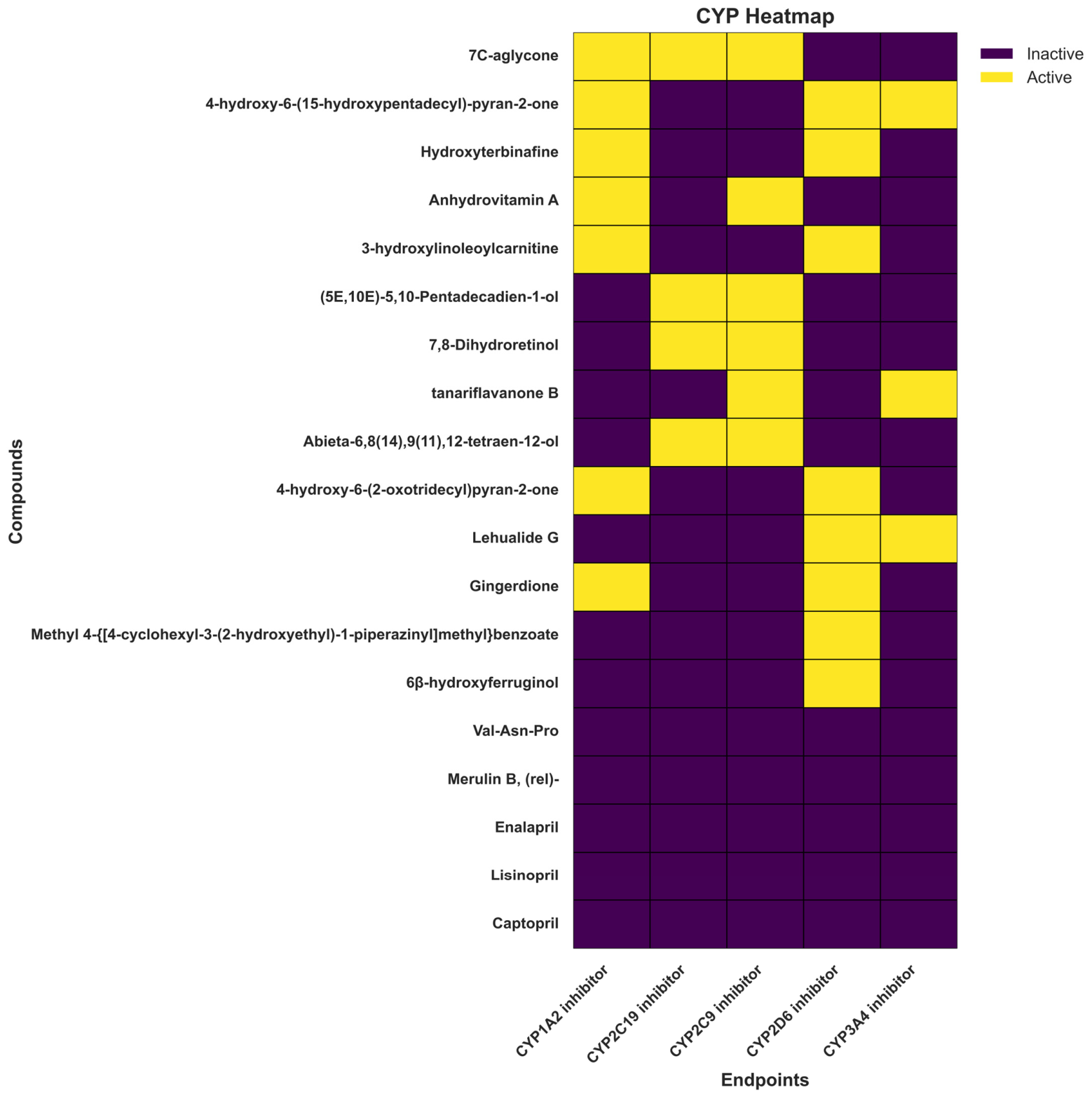
Metabolic assessment based on cytochrome P450 inhibition predictions revealed distinct compound-specific interaction patterns (Figure 6). Several natural metabolites, including 7C-aglycone, 4-hydroxy-6-(15-hydroxypentadecyl)-pyran-2-one, 3-hydroxylinoleoylcarnitine, gingerdione, and anhydrovitamin A, were predicted to inhibit one or more CYP isoforms, with CYP2D6 and CYP1A2 being the most frequently affected enzymes. Tanariflavanone B and lehualide G were predicted to inhibit CYP3A4, suggesting potential interactions with the principal drug-metabolizing pathway.
In contrast, Val-Asn-Pro and merulin B (rel) showed no predicted inhibition across all evaluated CYP isoforms. Notably, the reference ACE inhibitors captopril, enalapril, and lisinopril were predicted to be inactive across all CYP endpoints.
Furthermore, these findings indicate that while most metabolites demonstrate favorable predicted oral absorption and variable solubility, the potential for metabolic interactions differs substantially across compounds. These predictions provide a structured pharmacokinetic framework for prioritizing compounds with balanced absorption and limited metabolic liability for further investigation. Therefore, these results indicate variability in predicted drug-likeness properties among the putatively annotated metabolites, with some compounds occupying classical small-molecule drug space and others exhibiting structural complexity that may influence their predicted pharmacokinetic behavior.

3.6. Prediction Toxicological Profile and Acute Oral Toxicity Assessment

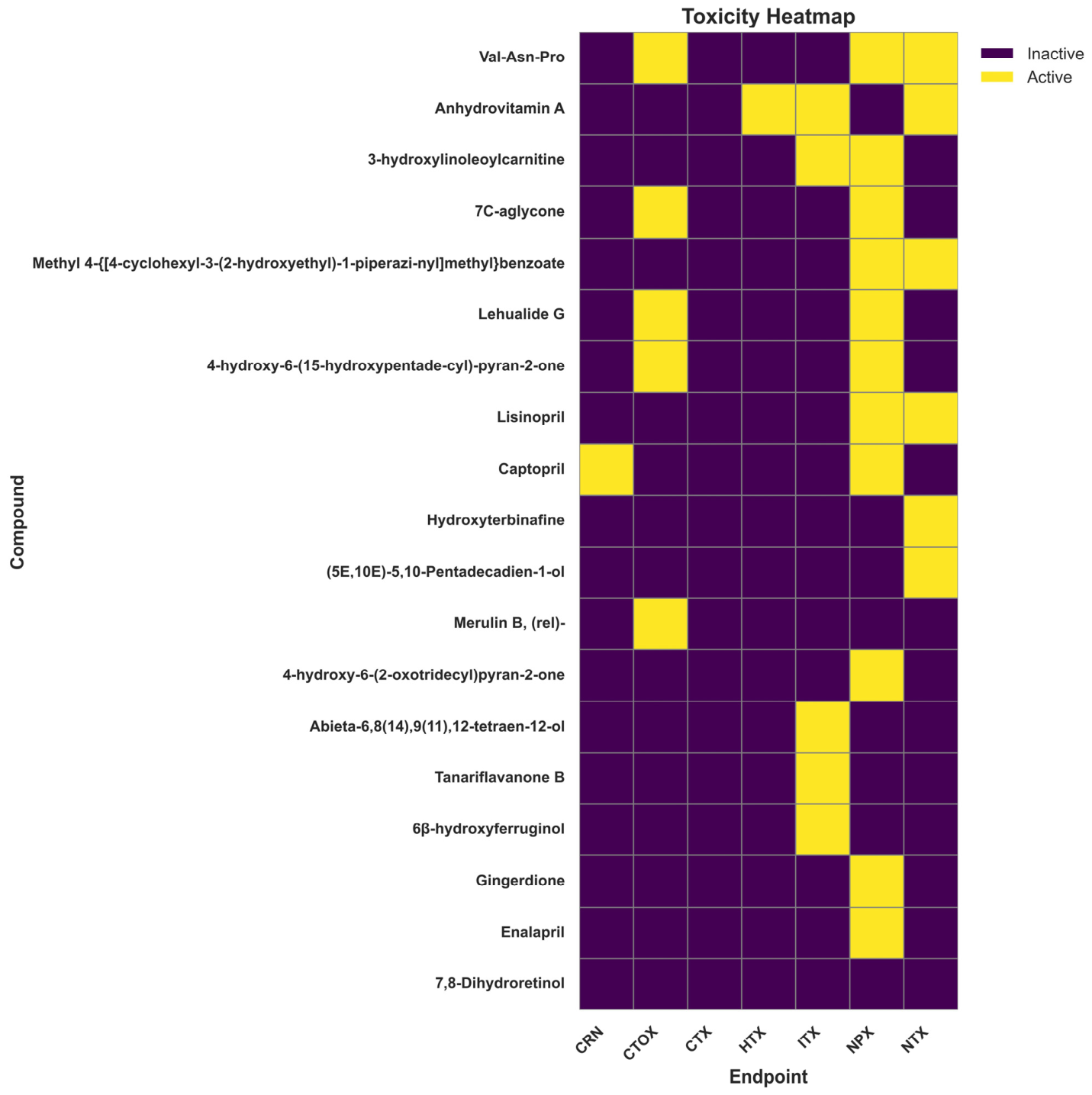
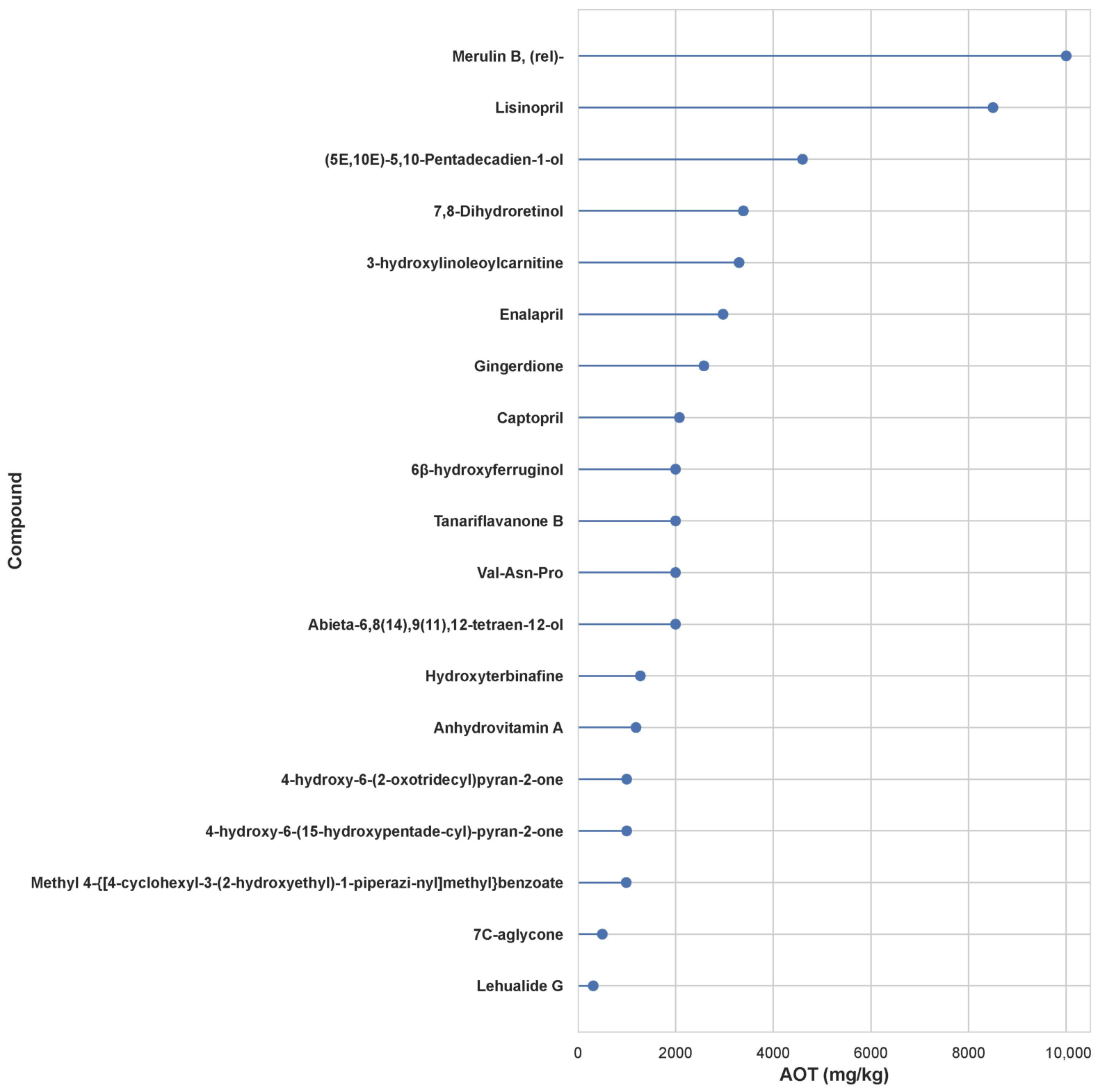
The computational toxicity profiling revealed a diverse but classifiable safety landscape among the evaluated metabolites and reference ACE inhibitors (Figure 3 and Figure 4). When integrating endpoint toxicity flags with predicted acute oral toxicity (LD50), compounds could be categorized into three safety tiers.
Compounds in this category exhibited the widest predicted acute safety margins. Merulin B, (rel)- (10,000 mg/kg) and lisinopril (8500 mg/kg) showed the highest LD50 values, indicating lower predicted acute toxicity. (5E,10E)-5,10-pentadecadien-1-ol (4600 mg/kg) and 7,8-dihydroretinol (3389 mg/kg) also demonstrated more favorable predicted toxicity profiles. Notably, 7,8-dihydroretinol showed a completely inactive toxicity endpoint pattern in the heatmap, representing the lowest number of predicted toxicity endpoint alerts among all evaluated compounds. Although (5E,10E)-5,10-pentadecadien-1-ol exhibited isolated neurotoxicity, its high LD50 value suggests a relatively low acute risk.
This group included 3-hydroxylinoleoylcarnitine (3300 mg/kg), enalapril (2973 mg/kg), and gingerdione (2580 mg/kg), along with several metabolites clustered around ~2000 mg/kg.
These compounds displayed limited but specific endpoint activity, most frequently nephrotoxicity and/or immunotoxicity. The presence of focused toxicity signals without widespread multi-organ involvement suggests moderate predicted risk requiring prioritization refinement rather than immediate exclusion.
Compounds with the lowest LD50 estimates included lehualide G (315 mg/kg) and 7C-aglycone (500 mg/kg). These metabolites also displayed endpoint activity in some cases. Within the computational framework, these compounds represent the highest acute toxicity risk among the evaluated panel.
Across all tiers, nephrotoxicity emerged as the most recurrent predicted endpoint, affecting both natural metabolites and the three ACE inhibitors, whereas hepatotoxicity and general cytotoxicity were not broadly distributed. Importantly, the reference ACE inhibitors did not uniformly outperform natural metabolites in safety ranking; certain metabolites, particularly 7,8-dihydroretinol and merulin B, (rel)-, showed computational toxicity estimates comparable to those of the reference ACE inhibitors.

4. Discussion

Marine metabolites remain substantially underexplored, due to the extensive diversity of organisms inhabiting these ecosystems. Among these sources, microalgae, particularly diatoms, represent a group with significant biochemical potential that has yet to be fully investigated [50]. In this context, the marine diatom Phaeodactylum tricornutum has received considerable attention, mainly for its lipid profile and its exploitation for the production of high-value fatty acids and as a nutraceutical [51,52,53].
In the present study, non-targeted metabolomic profiling expanded the chemical repertoire associated with P. tricornutum, revealing a complex distribution of structurally diverse metabolites. Amphipathic and lipophilic compounds are known to exhibit enhanced affinity for membrane-associated proteins and metalloproteins due to favorable hydrophobic and metal-coordination interactions, as seen with angiotensin-converting enzyme [54]. This chemical diversity provided the foundation for subsequent structure-based prioritization and functional prediction analyses.
Molecular docking simulations provide a structure-based framework for estimating the binding orientation and relative affinity of small molecules toward biological targets by scoring functions that approximate Gibbs free energy changes (ΔG) [55,56,57,58,59]. In this context, more negative ΔG values indicate a stronger predicted binding affinity within the scoring function approximation.
In the present study, ligand prioritization was performed according to the binding energy hierarchy, identifying Lehualide G, Val–Asn–Pro, tanariflavanone B, hydroxyterbinafine, and anhydrovitamin A as the top-ranked metabolites. All selected compounds exhibited binding energies ≤ −7.0 kcal·mol−1, a threshold frequently considered indicative of relevant interaction strength for ACE inhibitors in computational screening studies [60,61,62].
Previous reports support this cutoff as biologically meaningful. For instance, Wang et al. identified ACE-interacting peptides with binding energies around −7.4 kcal·mol−1 [63], while Xu et al. reported efficient soy-derived peptides exhibiting docking scores approaching −9.8 kcal·mol−1 [64]. Similarly, Wei et al. described cheese-derived ACE inhibitory peptides with binding energies near −9.5 kcal·mol−1, highlighting the association between increasingly negative ΔG values and stronger predicted inhibitory potential [65]. Within this comparative framework, Lehualide G (−8.429 kcal·mol−1) and Val–Asn–Pro (−8.178 kcal·mol−1) displayed binding affinities that approach those reported for experimentally validated ACE-inhibitory peptides, positioning these metabolites as structurally competitive candidates. Although docking energies represent approximations rather than absolute thermodynamic measurements, the relative ranking observed here supports the hypothesis that selected P. tricornutum metabolites may achieve stable accommodation within the ACE catalytic cavity.
Detailed interaction analysis was performed, focusing on the canonical ACE catalytic architecture, including the S1, S1′, and S2′ subsites and the conserved HEXXH zinc-binding motif, as well as structural elements essential for enzymatic activity and inhibitor recognition [33,66,67,68]. In zinc-dependent metalloproteases such as ACE, ligand engagement with catalytic residues and/or the Zn2+ center is frequently associated with inhibitory potential [69]. Among the top-ranked ligands, Lehualide G exhibited extensive engagement within the catalytic region.
The compound established stabilizing contacts with Tyr523 in the S1 pocket and His513 in S2′, while simultaneously interacting with residues of the HEXXH motif (His383, His387, Glu411) and the catalytic Zn2+ ion. Notably, the hydrogen bond with Glu411 (1.94 Å) falls within a geometrically favorable range for strong stabilization, suggesting potential interference with the catalytic environment.
Although the Zn2+ interaction (4.04 Å) exceeds typical coordination distances, it remains consistent with electrostatic stabilization observed in non-chelating zinc-binding ligands [70]. Collectively, this binding pattern supports stable accommodation within the catalytic cavity rather than definitive enzymatic inhibition.
The tripeptide Val–Asn–Pro displayed a binding mode consistent with that of previously reported peptide-derived ACE inhibitors [71,72]. The ligand formed multiple hydrogen bonds within S1 (Ala354, Tyr523) and S2′ (Gln281, Lys511, Tyr520, His353), including a short hydrogen bond with Glu411 (2.13 Å). This interaction network reflects a polar anchoring mechanism characteristic of peptide inhibitors that rely predominantly on hydrogen bonding and electrostatic complementarity rather than hydrophobic stabilization [73,74].
Tanariflavanone B, a polyhydroxylated flavonoid, demonstrated a multimodal interaction profile. The compound formed strong hydrogen bonds with Tyr523, Glu384, His513, and Asp415 (1.8–2.9 Å) and electrostatic contacts with Zn2+ and Glu411. Such short-range polar interactions are consistent with the metal-chelating behavior reported for flavonoids acting on zinc-dependent enzymes [75,76,77,78], supporting a potential competitive binding mode within the catalytic site.
In contrast, hydroxyterbinafine and anhydrovitamin A exhibited predominantly hydrophobic interaction patterns. Hydroxyterbinafine combined polar contacts in S1 and S2′ with an extended hydrophobic network surrounding the zinc-binding region but lacked direct Zn2+ coordination, suggesting a steric or substrate-access interference mechanism consistent with non-chelating ACE inhibitors. Anhydrovitamin A interacted mainly through van der Waals contacts (3.4–4.9 Å) involving residues near the catalytic motif, indicating a lipophilic stabilization strategy rather than direct catalytic disruption.
Recent computational studies have similarly reported that ligands with predicted ACE-inhibitory activity frequently engage catalytic residues, such as Tyr523, Glu384, His387, Glu411, and Zn2+ within the conserved HEXXH motif. Comparable interaction profiles involving hydrogen bonding, electrostatic contacts, and occupation of S1/S2′ subsites have been described in other docking-based investigations of ACE inhibitors [79,80,81], supporting the structural plausibility of the binding modes observed here.
Previous studies have demonstrated that marine algae and microalgae are relevant sources of both ACE-inhibitory peptides and non-peptidic metabolites [82]. For instance, peptides isolated from Ulva intestinalis, including FGMPLDR and MELVLR, showed ACE-inhibitory activity and molecular interactions involving hydrogen bonds and Zn2+-related contacts within the ACE active site [83]. Similarly, peptides from Gracilariopsis lemaneiformis, such as FQIN[M(O)]CILR and TGAPCR, exhibited low IC50 values, docking interactions with ACE active pockets, gastrointestinal stability, and antihypertensive effects in spontaneously hypertensive rats [84]. Marine microalgae have also been reported as sources of ACE-inhibitory peptides, including Val–Glu–Gly–Tyr from Chlorella ellipsoidea and peptide-rich fractions from Nannochloropsis oculata [85,86]. In addition to peptides, non-peptidic marine metabolites have shown ACE-inhibitory potential; Phlorotannins from Ecklonia stolonifera, particularly phlorofucofuroeckol A, dieckol, and eckol, displayed marked ACE inhibition, whereas meroterpenoids from Sargassum macrocarpum inhibited ACE through interactions involving Zn2+ and hydrogen bonds [85,87]. In this context, the predicted ACE-binding compatibility observed for the putatively annotated metabolites from P. tricornutum, including the peptide-like candidate Val–Asn–Pro and structurally diverse lipophilic metabolites such as Lehualide G, is consistent with the broader evidence supporting marine-derived molecules as a chemically diverse reservoir of potential ACE-interacting candidates.
The PASS-based activity trends suggest that 3-hydroxylinoleoylcarnitine may represent the most structurally consistent vasoactive candidate within the natural metabolite panel. Its high predicted probabilities for peripheral and general vasodilation, together with a moderate antihypertensive signal, indicate alignment with molecular features commonly associated with modulation of vascular smooth muscle. Long-chain acyl derivatives that are structurally related to carnitine esters have previously been implicated in endothelial signaling and membrane-associated enzymatic regulation, supporting the pharmacological relevance of a vascular-associated activity profile [88,89].
Similarly, gingerdione, 6β-hydroxyferruginol, and the substituted pyran-2-one derivatives displayed coherent Pa > Pi distributions across vascular-related endpoints. Such convergence may reflect shared physicochemical characteristics, particularly an amphipathic balance and moderate lipophilicity, that facilitate interactions with membrane-associated or enzymatic targets involved in vascular tone regulation. Comparable structural motifs have been described in natural multi-target vasoactive compounds capable of modulating nitric oxide pathways, calcium signaling, or endothelial reactivity [90,91].
In contrast, the reference ACE inhibitors exhibited a more restricted PASS pattern dominated by coronary vasodilator predictions. This selectivity aligns with their well-characterized mechanism of action in the renin–angiotensin system, in which inhibition of angiotensin-converting enzyme reduces angiotensin II formation and indirectly promotes vasodilation [92].
The comparatively broader peripheral vasodilator signals observed for several natural metabolites may therefore indicate structural compatibility with multi-target vascular modulation rather than exclusive ACE-directed inhibition.
Although PASS predictions do not provide functional validation, they rely on structure–activity relationship modeling derived from curated experimental datasets. Previous evaluations have demonstrated that Pa > Pi trends frequently correlate with experimentally confirmed bioactivity when supported by complementary in silico or biochemical assays [93,94,95]. Accordingly, the observed probability patterns support the hypothesis that selected P. tricornutum metabolites contain structural determinants compatible with vascular and antihypertensive activity. However, experimental validation will be required to clarify whether these compounds act through direct ACE inhibition, endothelial modulation, ion-channel interaction, or alternative vasoactive mechanisms.
Oral bioavailability depends primarily on intestinal permeability, metabolic stability, and physicochemical balance [96]. Because most approved drugs are administered orally [97,98], early prediction of gastrointestinal absorption remains a critical parameter in compound prioritization.
In this study, most selected metabolites showed high predicted gastrointestinal absorption, whereas only three compounds exhibited low absorption. Solubility predictions under the Ali classification revealed a heterogeneous distribution, ranging from poorly soluble to highly soluble compounds [99]. Long-chain derivatives, including 3-hydroxylinoleoylcarnitine and selected substituted pyran derivatives, consistently showed reduced predicted absorption and lower solubility. This pattern aligns with the well-established inverse relationship between lipophilicity and aqueous solubility, as well as with the influence of molecular flexibility on membrane permeability and absorption efficiency [100,101]. Most compounds met established drug-likeness criteria, including Lipinski’s rule-of-five, PAINS, and BRENK filters [98]. Molecular weights generally remained below 500 g/mol, and hydrogen bond donor (HBD) and acceptor (HBA) counts stayed within accepted limits. Lipophilicity values spanned from low to moderately high. Tanariflavanone B, lehualide G, and anhydrovitamin A exhibited elevated iLOGP values (>4), reflecting increased hydrophobicity. Rotatable bond counts ranged from 1 to 20, with long-chain metabolites displaying greater structural flexibility. Previous analyses have demonstrated that molecular weight, hydrogen-bonding capacity, and rotatable bond count collectively influence oral bioavailability and permeability [102].
Val–Asn–Pro showed a relatively high topological polar surface area. TPSA values exceeding 140 Å2 correlate with reduced passive intestinal diffusion [100]. However, its limited hydrogen bond donor and acceptor counts may partially offset this constraint, as hydrogen-bonding capacity and conformational adaptability also modulate permeability [103]. Distribution profiles also differed among compounds. Blood–brain barrier permeability depends on molecular size, lipophilicity, polarity, and transporter interactions [104,105,106].
Although BBB penetration is essential for central nervous system-targeted therapies, peripherally acting antihypertensive agents such as ACE inhibitors do not require central access [107,108]. While most evaluated metabolites had molecular weights below 500 Da, molecular size alone does not determine BBB permeability. Lipophilicity and polar surface area frequently exert a stronger influence on CNS penetration than molecular mass per se [109,110]. Consistently, several lipophilic metabolites, including hydroxyterbinafine, 7,8-dihydroretinol and 6β-hydroxyferruginol, showed predicted BBB permeability, whereas lehualide G, anhydrovitamin A, merulin B (rel)-, and the reference ACE inhibitors showed non-permeant profiles.
Transporter-mediated processes further refined the distribution profile. P-glycoprotein (ABCB1) functions as an ATP-dependent efflux transporter that restricts intestinal absorption, promotes biliary and renal elimination, and limits central nervous system penetration at the BBB [111,112,113,114]. In this dataset, only tanariflavanone B and merulin B (rel) showed predicted P-gp substrate behavior. Previous studies describe flavonoids and structurally related polyphenols as P-gp interactors whose activity depends on hydroxylation patterns and polarity [115,116], supporting the plausibility of these predictions.
Finally, cytochrome P450 inhibition predictions characterized metabolic liability. CYP3A4 and CYP2D6 play central roles in drug metabolism and frequently mediate clinically relevant drug–drug interactions [117,118,119]. CYP3A4 alone metabolizes approximately half of marketed drugs, underscoring its relevance in pharmacokinetic risk assessment. Several natural metabolites, including 7C-aglycone, 3-hydroxylinoleoylcarnitine, gingerdione, and 4-hydroxy-6-(15-hydroxypentadecyl)-pyran-2-one, showed inhibition across one or more isoforms. In contrast, Val–Asn–Pro and merulin B (rel)- showed no predicted inhibition across evaluated isoforms, and captopril, enalapril, and lisinopril similarly showed no CYP inhibition signals.
The in silico toxicity assessment performed in this study aligns with contemporary computational drug discovery pipelines that integrate machine learning-based toxicity prediction tools during early-stage candidate prioritization. ProTox-II and its updated version, ProTox 3.0, have been widely adopted for estimating oral LD50 values, assigning compounds to Globally Harmonized System (GHS) toxicity classes (I–VI), and predicting organ-specific toxicity endpoints, including hepatotoxicity, immunotoxicity, carcinogenicity, mutagenicity, cytotoxicity, and neurotoxicity [49,120]. These platforms are trained on large, curated toxicological datasets and provide probabilistic predictions that support rational filtering prior to experimental validation.
Several recent virtual screening studies targeting cardiovascular, anticancer, and antimicrobial pathways have employed ProTox-based toxicity profiling as a standard ADMET filtering step, combining predicted LD50 values with endpoint activity mapping to stratify compounds into safety tiers [121,122,123,124,125]. In these frameworks, compounds exhibiting predicted LD50 values above ~2000 mg/kg (typically corresponding to toxicity classes IV–VI in the GHS system) are generally considered to possess acceptable acute toxicity margins and are retained for further investigation. The present findings are consistent with this benchmark, as Merulin B, (rel)-, 7,8-dihydroretinol, and (5E,10E)-5,10-pentadecadien-1-ol demonstrated high predicted LD50 values alongside limited or absent multi-endpoint activation, supporting their prioritization within a low-risk tier [123,125].
Importantly, comparative ADMET analyses reported in the literature indicate that clinically approved drugs do not invariably demonstrate superior predicted toxicity profiles when evaluated using standardized in silico and machine learning-based platforms [48,49]. Computational toxicity models are trained on structurally diverse chemical spaces, including approved drugs and natural compounds, which may lead to comparable safety rankings across different molecular classes [126]. The present study supports this observation, as certain diatom-derived metabolites, particularly 7,8-dihydroretinol and Merulin B (rel)-, displayed predicted safety margins comparable to or exceeding those of reference ACE inhibitors.
Despite the robustness of ProTox 3.0 models and their validated performance in acute oral toxicity classification [49,120]. Toxicity predictions remain probabilistic and dependent on training-set representation, chemical similarity domains, and algorithmic generalization limits [126]. In addition, regulatory acute toxicity classifications, such as those defined by the Globally Harmonized System (GHS), are based on experimentally determined LD50 thresholds [127], highlighting that computational estimates should be interpreted as supportive rather than definitive evidence. Therefore, while the integration of LD50 estimation and endpoint profiling provides a rational and literature-supported prioritization strategy, experimental validation through in vitro and in vivo assays remains essential to confirm acute and organ-specific toxicity risk.

Study Limitations

The main limitation of this study is that the proposed antihypertensive candidates were prioritized from putatively annotated metabolites and computational predictions rather than from experimentally confirmed bioactivity. Because authentic standards were not analyzed under identical experimental conditions, the metabolite assignments correspond to MSI level 2 annotations and should be interpreted as putative rather than definitive chemical identifications [128].
This limitation also extends to the pharmacological interpretation of the prioritized candidates. Molecular docking, PASS, SwissADME, and ProTox provided a coherent framework to compare ACE-binding compatibility, predicted vasoactive signals, pharmacokinetic behavior, and toxicity risk.
However, these approaches do not demonstrate enzymatic inhibition, antihypertensive efficacy, or toxicological safety. Thus, the present findings should be considered a prioritization framework for selecting candidates for further validation. Future work should confirm the chemical identity of the selected metabolites using authentic standards and evaluate the methanolic extract and top-ranked compounds through in vitro ACE inhibition assays and subsequently in cell culture to in vivo models of antihypertensive activity.

5. Conclusions

In conclusion, the present study suggests that Phaeodactylum tricornutum is a relevant source of structurally diverse, putatively annotated metabolites with potential antihypertensive properties. In silico analyses prioritized multiple putatively annotated compounds that engage the angiotensin-converting enzyme catalytic site, exhibiting binding orientations compatible with potential interaction within the zinc-dependent catalytic environment and predicted affinities comparable to those of reference inhibitors. Rather than a single dominant candidate, the results reveal a differentiated profile across metabolites. Lehualide G and tanariflavanone B showed strong docking compatibility with the catalytic pocket, 3-hydroxylinoleoylcarnitine exhibited the most consistent predicted vasoactive signal, and 7,8-dihydroretinol and Merulin B (rel)- demonstrated the widest predicted acute safety margins. Val–Asn–Pro displayed a balanced profile combining ACE-binding compatibility with acceptable pharmacokinetic predictions, although its elevated polarity may influence permeability. Cytochrome P450 inhibition patterns and toxicity modeling further highlighted variability in metabolic liability across compounds, underscoring the importance of multi-parameter prioritization. Overall, the convergence of docking compatibility, probabilistic vascular activity, balanced ADME characteristics, and stratified safety predictions supports advancing selected metabolites toward targeted experimental validation to confirm antihypertensive efficacy and safety.

Supplementary Materials

The following supporting information can be downloaded at: https://www.mdpi.com/article/10.3390/scipharm94020043/s1, Figure S1: Superposition of co-crystallized and docked D-captopril showing docking pose accuracy. Table S1: List of putatively annotated metabolites in the Phaeodactylum tricornutum extract by UPLC-ESI-HRMS after application of inclusion and exclusion criteria. Table S2: Molecular interactions between the top docking with residues of the ACE catalytic site.

Author Contributions

Conceptualization, L.C.-Z. and C.D.N.-V.; methodology, M.E.G.-R., C.A.-F. and J.J.O.-O.; software, M.E.G.-R.; validation, L.C.-Z., J.M.-G. and A.K.d.l.H.-A.; formal analysis, M.E.G.-R., J.C.-B., A.M.G.-L. and J.J.O.-O.; investigation, M.E.G.-R., C.A.-F. and J.J.O.-O.; resources, V.J.P.-C. and J.F.O.-R.; data curation, M.E.G.-R., J.C.-B. and A.M.G.-L.; writing—original draft preparation, M.E.G.-R.; writing—review and editing, L.C.-Z., C.D.N.-V., A.K.d.l.H.-A. and J.M.-G.; visualization, M.E.G.-R.; supervision, L.C.-Z. and C.D.N.-V.; project administration, L.C.-Z.; funding acquisition, M.A.V.-F., L.C.-Z. and C.D.N.-V. All authors have read and agreed to the published version of the manuscript.

Funding

This research received no external funding.

Institutional Review Board Statement

Not applicable.

Informed Consent Statement

Not applicable.

Data Availability Statement

The datasets generated and analyzed during the study are available from the corresponding authors upon reasonable request.

Acknowledgments

During the preparation of this manuscript, the authors used AI-assisted tools to improve coherence and clarity. Grammarly (https://www.grammarly.com/, accessed date 19 May 2026) and related AI-based proofreading services were used exclusively for language refinement, achieving a final grammar quality score of ≥95%. All scientific interpretation, data analysis, and intellectual content remain entirely the responsibility of the authors. M.E.G.-R. and C.A.-F. gratefully acknowledge a scholarship from Secretaría de Ciencia, Humanidades, Tecnología e Innovación (SECIHT) for a doctoral scholarship. The authors thank Luis Fernando Pérez-Vega for their technical assistance during the metabolomic analysis. The Article Processing Charges will be covered through support requested from the PAIPC program (Programa de Apoyo e Incentivos a Publicaciones Científicas) of CONFÍE (Coordinación General para el Fomento a la Investigación Científica e Innovación del Estado de Sinaloa).

Conflicts of Interest

The authors declare no conflicts of interest.

Abbreviations

The following abbreviations are used in this manuscript:
ACE Angiotensin-Converting Enzyme
UPLC Ultra-Performance Liquid Chromatography
ESI Electrospray Ionization
HRMS High-Resolution Mass Spectrometry
ADMET Absorption, Distribution, Metabolism, Excretion and toxicity
ACEI Angiotensin-Converting Enzyme Inhibitor
RAAS Renin–Angiotensin–Aldosterone System
CIASAP Centro de Investigación Aplicada a la Salud Pública
FDA Food and Drug Administration
CICESE Centro de Investigación Científica y de Educación Superior de Ensenada
PDB Protein Data Bank
RMSD Root-Mean-Square Deviation
SMILES Simplified Molecular Input Line Entry System
PASS Prediction of Activity Spectra for Substances
ACEIPs Angiotensin-Converting Enzyme Inhibitory Peptides
PAINS Pan-Assay Interference compounds
BRENK Brenk structural alerts (Brenk filters)
TPSA Topological Polar Surface Area
Da Dalton
BBB Blood–Brain Barrier
BBBP Blood–Brain Barrier Permeability
CNS Central Nervous System
MDR Multidrug Resistance
AOT Acute Oral Toxicity
CYP Cytochrome P450

References

  1. World Health Organization. Global Report on Hypertension: The Race Against a Silent Killer; World Health Organization: Geneva, Switzerland, 2023. [Google Scholar]
  2. World Health Organization. Guideline for the Pharmacological Treatment of Hypertension in Adults; World Health Organization: Geneva, Switzerland, 2021. [Google Scholar]
  3. Sudano, I.; Suter, P.; Beuschlein, F. Secondary hypertension as a cause of treatment resistance. Blood Press. 2023, 32, 2224898. [Google Scholar] [CrossRef]
  4. Oparil, S.; Acelajado, M.C.; Bakris, G.L.; Berlowitz, D.R.; Cífková, R.; Dominiczak, A.F.; Grassi, G.; Jordan, J.; Poulter, N.R.; Rodger, A.; et al. Hypertension. Nat. Rev. Dis. Primers 2019, 22, 18014. [Google Scholar] [CrossRef]
  5. Charchar, F.J.; Prestes, P.R.; Mills, C.; Ching, S.M.; Neupane, D.; Marques, F.Z.; Sharman, J.E.; Vogt, L.; Burrell, L.M.; Korostovtseva, L.; et al. Lifestyle management of hypertension: Interna-tional Society of Hypertension position paper endorsed by the World Hypertension League and European Society of Hy-pertension. J. Hypertens. 2024, 42, 23–49. [Google Scholar] [CrossRef]
  6. Marin-Couture, E.; Moulin, J.A.; Thibault, A.S.; Poirier, P.; Després, J.P.; Gallant, A.; Lamarre, V.; Alméras, N.; Lemieux, I.; Chabot, C.; et al. Impact of lifestyle medicine interventions on the management of systemic hypertension in primary care: A Canadian randomized controlled trial. Am. J. Lifestyle Med. 2024, 18, 703–720. [Google Scholar] [CrossRef]
  7. Wang, M.Y.; Dandoy, C.E.; Smith, D.F.; Hogenesch, J.B. Go to bed!: Sleep as a risk factor for adolescent hypertension. Prog. Pediatr. Cardiol. 2023, 68, 101613. [Google Scholar] [CrossRef]
  8. Beetul, K.; Gopeechund, A.; Kaullysing, D.; Mattan-Moorgawa, S.; Puchooa, D.; Bhagooli, R. Challenges and opportunities in the present era of marine algal applications. In Algae—Organisms for Imminent Biotechnology; IntechOpen: London, UK, 2016; Volume 40. [Google Scholar] [CrossRef]
  9. Leu, S.; Boussiba, S. Advances in the production of high-value products by microalgae. Ind. Biotechnol. 2014, 10, 169–183. [Google Scholar] [CrossRef]
  10. Barkia, I.; Saari, N.; Manning, S.R. Microalgae for high-value products towards human health and nutrition. Mar. Drugs 2019, 17, 304. [Google Scholar] [CrossRef]
  11. Brown, M.J.; Cruickshank, J.K.; Dominiczak, A.F.; MacGregor, G.A.; Poulter, N.R.; Russell, G.I.; Thom, S.; Williams, B. Better blood pressure control: How to combine drugs. J. Hum. Hypertens. 2003, 17, 81–86. [Google Scholar] [CrossRef] [PubMed]
  12. Ondetti, M.A.; Rubin, B.; Cushman, D.W. Design of specific inhibitors of angiotensin-converting enzyme: New class of orally active antihypertensive agents. Science 1977, 196, 441–444. [Google Scholar] [CrossRef] [PubMed]
  13. Ulm, E.H.; Hichens, M.; Gómez, H.J.; Till, A.E.; Hand, E.; Vassil, T.C.; Biollaz, J.; Brunner, H.R.; Schelling, J.L. Enalapril maleate and a lysine analogue (MK-521): Disposition in man. Br. J. Clin. Pharmacol. 1982, 14, 357–362. [Google Scholar] [CrossRef]
  14. Song, J.C.; White, C.M. Clinical pharmacokinetics and selective pharmacodynamics of new angiotensin converting enzyme inhibitors: An update. Clin. Pharm. 2002, 41, 207–224. [Google Scholar] [CrossRef]
  15. Ahmad, H.; Khan, H.; Haque, S.; Ahmad, S.; Srivastava, N.; Khan, A. Angiotensin-converting enzyme and hypertension: A systemic analysis of various ACE inhibitors, their side effects, and bioactive peptides as a putative therapy for hypertension. J. Renin-Angiotensin-Aldosterone Syst. 2023, 2023, 7890188. [Google Scholar] [CrossRef]
  16. Rossi, G.P.; Seccia, T.M.; Maniero, C.; Pessina, A.C. Drug-related hypertension and resistance to antihypertensive treatment: A call for action. J. Hypertens. 2011, 29, 2295–2309. [Google Scholar] [CrossRef]
  17. Kyoung, J.; Atluri, R.R.; Yang, T. Resistance to antihypertensive drugs: Is gut microbiota the missing link? Hypertension 2022, 79, 2138–2147. [Google Scholar] [CrossRef]
  18. Yi, X.; Yang, S.; Yang, J.; Chen, X.; Zhang, A.; Zeng, Q.; Luo, W.; Li, Q.; Hu, J. Renin-angiotensin-aldosterone system modulators in adults with hypertension: A network meta-analysis of randomized controlled trials. Drugs 2024, 84, 1445–1462. [Google Scholar] [CrossRef] [PubMed]
  19. Miura, S.I.; Matsuo, Y.; Seumatsu, Y. Renin-angiotensin-aldosterone system and its relation to hypertension. Hypertens. Res. 2025, 48, 2209–2217. [Google Scholar] [CrossRef] [PubMed]
  20. Adhikari, A.; Sharma, C.; Sherpa, M.L.; Karaunakran, G.; Dhakal, M.; Sharma, A. Impact of Renin–Angiotensin–Aldosterone System (RAAS) gene polymorphism in essential hypertension and antihypertensive drug therapy: A review. Int. J. Hypertens. 2025, 2025, 5530265. [Google Scholar] [CrossRef] [PubMed]
  21. Lu, H.; Cassis, L.A.; Vander-Kooi, C.W.; Daugherty, A. Structure and functions of angiotensinogen. Hypertens. Res. 2016, 39, 492–500. [Google Scholar] [CrossRef]
  22. Ichihara, A.; Yatabe, M.S. The (pro) renin receptor in health and disease. Nat. Rev. Nephrol. 2019, 15, 693–712. [Google Scholar] [CrossRef]
  23. Fountain, J.H.; Kaur, J.; Lappin, S.L. Physiology, Renin Angiotensin System [Updated 2023-Mar-12]; StatPearls Publishin: Treasure Island, FL, USA, 2023. [Google Scholar]
  24. Ciau-Solís, N.; Betancur-Ancona, D. Sistema renina-angiotensina (SRA) en las patologías cardiovasculares: Papel sobre la hipertensión arterial. J. Negat. No Posit. Results 2021, 6, 163–176. [Google Scholar] [CrossRef]
  25. Lew, R.A. The zinc metallopeptidase family: New faces, new functions. Protein Pept. Lett. 2004, 11, 407–414. [Google Scholar] [CrossRef]
  26. Norzagaray-Valenzuela, C.D.; Valdez-Ortiz, Á.; Shelton, L.M.; Jiménez-Edeza, M.; Rivera-López, J.; Valdez-Flores, M.A.; Germán-Báez, L.J. Residual biomasses and protein hydrolysates of three green microalgae species exhibit antioxidant and anti-aging activity. J. Appl. Phycol. 2016, 29, 189–198. [Google Scholar] [CrossRef]
  27. Guillard, R.R.; Ryther, J.H. Studies of marine planktonic diatoms: I. Cyclotella nana Hustedt, and Detonula confervacea (Cleve) Gran. Can. J. Microbiol. 1962, 8, 229–239. [Google Scholar] [CrossRef]
  28. Sirin, S.; Trobajo, R.; Ibanez, C.; Salvadó, J. Harvesting the microalgae Phaeodactylum tricornutum with polyaluminum chloride, aluminium sulphate, chitosan and alkalinity-induced flocculation. J. Appl. Phycol. 2012, 24, 1067–1080. [Google Scholar] [CrossRef]
  29. Pereira, H.; Custódio, L.; Rodrigues, M.J.; De Sousa, C.B.; Oliveira, M.; Barreira, L.; Neng, N.D.R.; Nogueira, J.M.F.; Alrokayan, S.A.; Mouffouk, F.; et al. Biological activities and chemical composition of methanolic extracts of selected autochthonous microalgae strains from the Red Sea. Mar. Drugs 2015, 13, 3531–3549. [Google Scholar] [CrossRef]
  30. Hernández-Peña, R.; Lorenzo-Manzanarez, J.L.; Cruz-Ramírez, L.A.; Reyes-López, D.; Hernández-Domínguez, C.; Pascual-Ramírez, F.; Ordaz-Ortiz, J.J. Unravelling Vanillin Biosynthesis: Integrative Transcriptomic and Metabolomic Insights into Vanilla planifolia Pod Development. J. Agric. Food Chem. 2025, 73, 19094–19106. [Google Scholar] [CrossRef] [PubMed]
  31. Rodríguez-Castillo, A.J.; González-Chávez, S.A.; Portillo-Pantoja, I.; Cruz-Hermosillo, E.; Pacheco-Tena, C.; Chávez-Flores, D.; Delgado-Gardea, M.C.E.; Infante-Ramírez, R.; Ordaz-Ortiz, J.J.; Sánchez-Ramírez, B. Aqueous extracts of Rhus trilobata inhibit the lipopolysaccharide-induced inflammatory response in vitro and in vivo. Plants 2024, 13, 2840. [Google Scholar] [CrossRef] [PubMed]
  32. Polakovičová, M.; Jampílek, J. Advances in structural biology of ACE and development of domain selective ACE-inhibitors. J. Med. Chem. 2019, 15, 574–587. [Google Scholar] [CrossRef] [PubMed]
  33. Natesh, R.; Schwager, S.L.; Evans, H.R.; Sturrock, E.D.; Acharya, K.R. Structural details on the binding of antihypertensive drugs captopril and enalaprilat to human testicular angiotensin I-converting enzyme. Biochem 2004, 43, 8718–8724. [Google Scholar] [CrossRef]
  34. O’Boyle, N.M.; Banck, M.; James, C.A.; Morley, C.; Vandermeersch, T.; Hutchison, G.R. Open Babel: An open chemical toolbox. J. Cheminform. 2011, 3, 33. [Google Scholar] [CrossRef]
  35. Alves, M.J.; Froufe, H.J.C.; Costa, A.F.T.; Santos, A.F.; Oliveira, L.G.; Osório, S.R.M.; Abreu, R.M.V.; Pintado, M.; Ferreira, I.C.F.R. Docking studies in target proteins involved in antibacterial action mechanisms: Extending the knowledge on standard antibiotics to antimicrobial mushroom compounds. Molecules 2014, 19, 1672–1684. [Google Scholar] [CrossRef]
  36. Obikeze, K.; Sasi, A.A.; Raji, I. In-silico and in-vivo evaluation of the cardiovascular effects of five Leonotis leonurus diterpenes. Sci. Afr. 2023, 19, e01510. [Google Scholar] [CrossRef]
  37. Sanner, M.F. Python: A programming language for software integration and development. J. Mol. Graph. Model 1999, 17, 57–61. [Google Scholar]
  38. Qiu, J.; Xu, M.; Ren, R.; Zhao, Y.; Liu, L.; Li, X.; Zhu, X.; Ji, H.; Geng, Y.; Huang, X.; et al. Identification, inhibition modes, and molecular docking of ACE inhibitory peptides derived from Cheddar cheese. LWT 2024, 203, 116326. [Google Scholar] [CrossRef]
  39. Zarei, M.; Ghanbari, R.; Zainal, N.; Ovissipour, R.; Saari, N. Inhibition kinetics, molecular docking, and stability studies of papa-in-generated peptides from palm kernel cake proteins on angiotensin-converting enzyme (ACE). Food. Chem. Mol. Sci. 2022, 5, 100147. [Google Scholar] [CrossRef]
  40. Santos-Martins, D.; Forli, S.; Ramos, M.J.; Olson, A.J. AutoDock4Zn: An improved AutoDock force field for small-molecule docking to zinc metalloproteins. J. Chem. Inf. Model. 2014, 54, 2371–2379. [Google Scholar] [CrossRef] [PubMed]
  41. Dankwa, B.; Broni, E.; Enninful, K.S.; Kwofie, S.K.; Wilson, D. Consensus docking and MM-PBSA computations identify putative furin protease inhibitors for developing potential therapeutics against COVID-19. Struct. Chem. 2022, 33, 2221–2241. [Google Scholar] [CrossRef] [PubMed]
  42. Schrödinger, LLC. The PyMOL Molecular Graphics System, Version 3.1.6.1; Schrödinger, LLC: New York, NY, USA, 2023. Available online: https://www.pymol.org/ (accessed on 18 November 2025).
  43. Ramírez, D.; Caballero, J. Is it reliable to take the molecular docking top scoring position as the best solution without con-sidering available structural data? Molecules 2018, 23, 1038. [Google Scholar] [CrossRef]
  44. Dalton, J.A.; Jackson, R.M. Hmology-modelling protein–ligand interactions: Allowing for ligand-induced conformational change. J. Mol. Biol. 2010, 399, 645–661. [Google Scholar] [CrossRef] [PubMed]
  45. Jaundoo, R.; Bohmann, J.; Gutierrez, G.E.; Klimas, N.; Broderick, G.; Craddock, T.J.A. Using a consensus docking approach to predict adverse drug reactions in combination drug therapies for Gulf War Illness. Int. J. Mol. Sci. 2018, 19, 3355. [Google Scholar] [CrossRef]
  46. Filimonov, D.A.; Lagunin, A.A.; Gloriozova, T.A.; Rudik, A.V.; Druzhilovskii, D.S.; Pogodin, P.V.; Poroikov, V.V. Prediction of the biological activity spectra of organic compounds using the PASS Online web resource. Chem. Heterocycl. Compd. 2014, 50, 444–457. [Google Scholar] [CrossRef]
  47. Uc-Chuc, M.A.; Cigarroa-Toledo, N.; Acosta-Viana, K.Y.; Chan-Pérez, J.I.; Pineda-Cortes, J.C.; Villanueva-Alonzo, H.J. Identification of potential Trypanosoma cruzi trans-sialidase inhibitors by computational drug repositioning approaches. Sci. Pharm. 2024, 92, 40. [Google Scholar] [CrossRef]
  48. Daina, A.; Michielin, O.; Zoete, V. SwissADME: A free web tool to evaluate pharmacokinetics, drug-likeness and medicinal chemistry friendliness of small molecules. Sci. Rep. 2017, 7, 42717. [Google Scholar] [CrossRef] [PubMed]
  49. Banerjee, P.; Kemmler, E.; Dunkel, M.; Preissner, R. ProTox 3.0: A webserver for the prediction of toxicity of chemicals. Nucleic Acids Res. 2024, 5, 513–520. [Google Scholar] [CrossRef]
  50. Nieri, P.; Carpi, S.; Esposito, R.; Costantini, M.; Zupo, V. Bioactive molecules from marine diatoms and their value for the nutraceutical industry. Nutrients 2023, 15, 464. [Google Scholar] [CrossRef] [PubMed]
  51. Tonon, T.; Harvey, D.; Larson, T.R.; Graham, I.A. Long chain polyunsaturated fatty acid biosynthesis in microalgae: Cloning, functional characterization and cellular localization of an eicosapentaenoic acid elongase (PhELO1) from the marine microalga Phaeodactylum tricornutum. Phytochemistry 2002, 61, 15–24. [Google Scholar] [CrossRef] [PubMed]
  52. Stiefvatter, L.; Lehnert, K.; Frick, K.; Montoya-Arroyo, A.; Frank, J.; Vetter, W.; Schmid-Staiger, U.; Bischoff, S.C. Oral Bioa-vailability of Omega-3 Fatty Acids and Carotenoids from the Microalgae Phaeodactylum tricornutum in Healthy Young Adults. Mar. Drugs 2021, 19, 700. [Google Scholar] [CrossRef]
  53. Dickerson, B.; Maury, J.; Jenkins, V.; Nottingham, K.; Xing, D.; Gonzalez, D.E.; Leonard, M.; Kendra, J.; Ko, J.; Yoo, C.; et al. Effects of Supplementation with Microalgae Extract from Phaeodactylum tricornutum (Mi136) to Support Benefits from a Weight Management Intervention in Overweight Women. Nutrients 2024, 16, 990. [Google Scholar] [CrossRef]
  54. Maret, W. The Extracellular Metallometabolome: Metallophores, Metal Ionophores, and Other Chelating Agents as Natural Products. Nat. Prod. Commun. 2024, 19, 1934578X241271701. [Google Scholar] [CrossRef]
  55. Dar, A.M.; Mir, S. Molecular Docking: Approaches, Types, Applications and Basic Challenges. J. Anal. Bioanal. Tech. 2017, 8, 1–3. [Google Scholar] [CrossRef]
  56. Raval, K.; Ganatra, T. Basics, types and applications of molecular docking: A review. IP Int. J. Compr. Adv. Pharmacol. 2022, 7, 12–16. [Google Scholar] [CrossRef]
  57. Kuntz, I.D.; Blaney, J.M.; Oatley, S.J.; Langridge, R.; Ferrin, T.E. A geometric approach to macromolecule-ligand interactions. J. Mol. Biol. 1982, 161, 269–288. [Google Scholar] [CrossRef]
  58. Nivatya, H.K.; Singh, A.; Kumar, N.; Sonam; Sharma, L.; Singh, V.; Mishra, R.; Gaur, N.; Mishra, A.K. Assessing molecular docking tools: Understanding drug discovery and design. Future J. Pharm. Sci. 2025, 11, 111. [Google Scholar] [CrossRef]
  59. Bitencourt-Ferreira, G.; de Azevedo, W.F. Exploring the Scoring Function Space. In Docking Screens for Drug Discovery; de Azevedo, W.F., Jr., Ed.; Springer: New York, NY, USA, 2019; pp. 275–281. [Google Scholar]
  60. Muhammad, S.A.; Fatima, N. In silico analysis and molecular docking studies of potential angiotensin-converting enzyme inhibitor using quercetin glycosides. Pharmacogn. Mag. 2015, 11, 123–126. [Google Scholar] [CrossRef]
  61. Suo, S.K.; Zheng, S.L.; Chi, C.F.; Luo, H.Y.; Wang, B. Novel angiotensin-converting enzyme inhibitory peptides from tuna byproducts—Milts: Preparation, characterization, molecular docking study, and antioxidant function on H2O2-damaged human umbilical vein endothelial cells. Front. Nutr. 2022, 9, 957778. [Google Scholar] [CrossRef]
  62. Wang, S.; Zhang, L.; Wang, H.; Liu, J.; Hu, Y.; Tu, Z. Angiotensin converting enzyme (ACE) inhibitory peptide from the tuna (Thunnus thynnus) muscle: Screening, interaction mechanism and stability. Int. J. Biol. Macromol. 2024, 279, 135469. [Google Scholar] [CrossRef]
  63. Wang, X.; Chen, H.; Fu, X.; Li, S.; Wei, J.A. novel antioxidant and ACE inhibitory peptide from rice bran protein: Biochemical characterization and molecular docking study. LWT 2017, 75, 93–99. [Google Scholar] [CrossRef]
  64. Xu, Z.; Wu, C.; Sun-Waterhouse, D.; Zhao, T.; Waterhouse, G.I.; Zhao, M.; Su, G. Identification of post-digestion angiotensin-I converting enzyme (ACE) inhibitory peptides from soybean protein isolate: Their production conditions and in silico molecular docking with ACE. Food. Chem. 2021, 345, 128855. [Google Scholar] [CrossRef]
  65. Wei, G.; Zhao, Q.; Wang, D.; Fan, Y.; Shi, Y.; Huang, A. Novel ACE inhibitory, antioxidant and α-glucosidase inhibitory peptides identified from fermented rubing cheese through peptidomic and molecular docking. LWT 2022, 159, 113196. [Google Scholar] [CrossRef]
  66. Rohit, A.C.; Sathisha, K.; Aparna, H.S.A. Variant peptide of buffalo colostrum β-lactoglobulin inhibits angiotensin I-converting enzyme activity. Eur. J. Med. Chem. 2012, 53, 211–219. [Google Scholar] [CrossRef] [PubMed]
  67. Wu, Q.; Jia, J.; Yan, H.; Du, J.; Gui, Z. A novel angiotensin-I converting enzyme (ACE) inhibitory peptide from gastrointestinal protease hydrolysate of silkworm pupa (Bombyx mori) protein: Biochemical characterization and molecular docking study. Peptides 2015, 68, 17–24. [Google Scholar] [CrossRef] [PubMed]
  68. Fu, W.; Chen, C.; Zeng, H.; Lin, J.; Zhang, Y.; Hu, J.; Zheng, B. Novel angiotensin-converting enzyme inhibitory peptides derived from Trichiurus lepturus myosin: Molecular docking and surface plasmon resonance study. LWT 2019, 110, 54–63. [Google Scholar] [CrossRef]
  69. Ye, S.; Chen, Q.; Li, D.; Zhou, H.; Chen, Y.; Meng, C.; Hong, J. Isolation and identification of novel angiotensin I-converting enzyme (ACE) inhibitory peptides from pony seed and evaluation of the inhibitory mechanisms. J. Funct. Foods 2022, 95, 105151. [Google Scholar] [CrossRef]
  70. Pietruś, W.; Kafel, R.; Bojarski, A.J.; Kurczab, R. Hydrogen Bonds with Fluorine in Ligand-Protein Complexes- the PDB Analysis and Energy Calculations. Molecules 2022, 27, 1005. [Google Scholar] [CrossRef]
  71. Israelachvili, J.N. Intermolecular and surface forces. In Intermolecular and Surface Forces, 3rd ed.; Academic Press: London, UK, 2011; Volume 3, pp. 635–660. [Google Scholar]
  72. Qi, C.; Zhang, R.; Liu, F.; Zheng, T.; Wu, W. Molecular mechanism of interactions between inhibitory tripeptide GEF and angiotensin-converting enzyme in aqueous solutions by molecular dynamic simulations. J. Mol. Liq. 2018, 249, 389–396. [Google Scholar] [CrossRef]
  73. Vermeirssen, V.; Van Camp, J.; Verstraete, W. Bioavailability of angiotensin I converting enzyme inhibitory peptides. Br. J. Nutr. 2004, 92, 357–366. [Google Scholar] [CrossRef]
  74. Ondetti, M.A.; Cushman, D.W. Enzymes of the renin-angiotensin system and their inhibitors. Annu. Rev. Biochem. 1982, 51, 283–308. [Google Scholar] [CrossRef]
  75. Parellada, J.; Suárez, G.; Guinea, M. Inhibition of zinc metallopeptidases by flavonoids and related phenolic compounds: Structure-activity relationships. J. Enzym. Inhib. 1998, 13, 347–359. [Google Scholar] [CrossRef]
  76. Hrubša, M.; Tvrdý, V.; Kutý, M.; Valentová, K.; Křen, V.; Mladěnka, P. Interaction of Flavonoids with Zinc and Zinc-Containing Enzymes. J. Agric. Food. Chem. 2022, 27, 6134–6144. [Google Scholar] [CrossRef] [PubMed]
  77. Guerrero, L.; Castillo, J.; Quiñones, M.; Garcia-Vallvé, S.; Arola, L.; Pujadas, G.; Muguerza, B. Inhibition of angiotensin-converting enzyme activity by flavonoids: Structure-activity relationship studies. PLoS ONE 2012, 7, e49493. [Google Scholar] [CrossRef]
  78. Preciado, L.M.; Comer, J.; Núñez, V.; Rey-Súarez, P.; Pereañez, J.A. Inhibition of a Snake Venom Metalloproteinase by the Flavonoid Myricetin. Molecules 2018, 23, 2662. [Google Scholar] [CrossRef]
  79. Chen, H.; Chen, Y.; Zheng, H.; Xiang, X.; Xu, L. A novel angiotensin-I-converting enzyme inhibitory peptide from oyster: Simulated gastro-intestinal digestion, molecular docking, inhibition kinetics and antihypertensive effects in rats. Front. Nutr. 2022, 9, 981163. [Google Scholar] [CrossRef]
  80. Nong, N.T.P.; Sutopo, C.C.Y.; Hung, W.-T.; Wu, P.-H.; Hsu, J.-L. The Molecular Docking and Inhibition Kinetics of Angiotensin I-Converting Enzyme Inhibitory Peptides Derived from Soft-Shelled Turtle Yolk. Appl. Sci. 2022, 12, 12340. [Google Scholar] [CrossRef]
  81. Ramlal, A.; Bhat, I.; Nautiyal, A.; Baweja, P.; Mehta, S.; Kumar, V.; Mallikarjuna, B.P. In Silico Analysis of Angiotensin Converting Enzyme Inhibitory Compounds Obtained from Soybean [Glycine max (L.) Merr.]. Front. Physiol. 2023, 14, 1172684. [Google Scholar] [CrossRef] [PubMed]
  82. Jo, D.-M.; Khan, F.; Park, S.-K.; Ko, S.-C.; Kim, K.W.; Yang, D.; Kim, J.-Y.; Oh, G.-W.; Choi, G.; Lee, D.-S.; et al. From Sea to Lab: Angiotensin I-Converting Enzyme Inhibition by Marine Peptides—Mechanisms and Applications. Mar. Drugs 2024, 22, 449. [Google Scholar] [CrossRef]
  83. Sun, S.; Xu, X.; Sun, X.; Zhang, X.; Chen, X.; Xu, N. Preparation and Identification of ACE Inhibitory Peptides from the Marine Macroalga Ulva intestinalis. Mar. Drugs 2019, 17, 179. [Google Scholar] [CrossRef] [PubMed]
  84. Deng, Z.; Liu, Y.; Wang, J.; Wu, S.; Geng, L.; Sui, Z.; Zhang, Q. Antihypertensive Effects of Two Novel Angiotensin I-Converting Enzyme (ACE) Inhibitory Peptides from Gracilariopsis lemaneiformis (Rhodophyta) in Spontaneously Hypertensive Rats (SHRs). Mar. Drugs 2018, 16, 299. [Google Scholar] [CrossRef]
  85. Ko, S.-C.; Kang, N.; Kim, E.-A.; Kang, M.C.; Lee, S.-H.; Kang, S.-M.; Lee, J.-B.; Jeon, B.-T.; Kim, S.-K.; Park, S.-J.; et al. A novel angiotensin I-converting enzyme (ACE) inhibitory peptide from a marine Chlorella ellipsoidea and its antihypertensive effect in spontaneously hypertensive rats. Process Biochem. 2012, 47, 2005–2011. [Google Scholar] [CrossRef]
  86. Hayes, M.; Mora, L.; Lucakova, S. Identification of Bioactive Peptides from Nannochloropsis oculata Using a Combination of Enzymatic Treatment, in Silico Analysis and Chemical Synthesis. Biomolecules 2022, 12, 1806. [Google Scholar] [CrossRef]
  87. Jung, H.A.; Hyun, S.K.; Kim, H.R.; Choi, J.S. Angiotensin-converting enzyme I inhibitory activity of phlorotannins from Ecklonia stolonifera. Fish. Sci. 2006, 72, 1292–1299. [Google Scholar] [CrossRef]
  88. Mohammadi, M.; Hajhossein-Talasaz, A.; Alidoosti, M. Preventive effect of l-carnitine and its derivatives on endothelial dysfunction and platelet aggregation. Clin. Nutr. ESPEN 2016, 15, 1–10. [Google Scholar] [CrossRef] [PubMed]
  89. Alvarez de Sotomayor, M.; Bueno, R.; Pérez-Guerrero, C.; Herrera, M.D. Effect of L-Carnitine and Propionyl-L-Carnitine on Endothelial Function of Small Mesenteric Arteries from SHR. J. Vasc. Res. 2007, 44, 354–364. [Google Scholar] [CrossRef] [PubMed]
  90. Bisi, A.; Gobbi, S.; Belluti, F.; Rampa, A. Design of multifunctional compounds for cardiovascular disease: From natural scaffolds to “classical” multitarget approach. J. Curr. Med. Chem. 2013, 2013, 1759–1782. [Google Scholar] [CrossRef]
  91. Luna-Vázquez, F.J.; Ibarra-Alvarado, C.; Rojas-Molina, A.; Rojas-Molina, I.; Zavala-Sánchez, M.Á. Vasodilator Compounds Derived from Plants and Their Mechanisms of Action. Molecules 2013, 18, 5814–5857. [Google Scholar] [CrossRef]
  92. Nádasy, G.L.; Balla, A.; Dörnyei, G.; Hunyady, L.; Szekeres, M. Direct Vascular Effects of Angiotensin II (A Systematic Short Review). Int. J. Mol. Sci. 2025, 26, 113. [Google Scholar] [CrossRef]
  93. Matin, M.M.; Uzzaman, M.; Chowdhury, S.A.; Bhuiyan, M.H. In vitro antimicrobial, physicochemical, pharmacokinetics and molecular docking studies of benzoyl uridine esters against SARS-CoV-2 main protease. J. Biomol. Struct. Dyn. 2022, 40, 3668–3680. [Google Scholar] [CrossRef] [PubMed]
  94. Islam, S.; Hosen, M.A.; Ahmad, S.; ul Qamar, M.T.; Dey, S.; Hasan, I.; Fujii, Y.; Ozeki, Y.; Kawsar, S.M.A. Synthesis, antimicrobial, anticancer activities, PASS prediction, molecular docking, molecular dynamics and pharmacokinetic studies of designed methyl α-D-glucopyranoside esters. J. Mol. Struct. 2022, 1260, 132761. [Google Scholar] [CrossRef]
  95. Alam, S.; Rashid, M.A.; Sarker, M.M.R.; Emon, N.U.; Arman, M.; Mohamed, I.N.; Haque, M.R. Antidiarrheal, antimicrobial and antioxidant potentials of methanol extract of Colocasia gigantea Hook. f. leaves: Evidenced from in vivo and in vitro studies along with computer-aided approaches. BMC Complement. Med. Ther. 2021, 21, 119. [Google Scholar] [CrossRef]
  96. Stielow, M.; Witczyńska, A.; Kubryń, N.; Fijałkowski, Ł.; Nowaczyk, J.; Nowaczyk, A. The Bioavailability of Drugs—The Current State of Knowledge. Molecules 2023, 28, 8038. [Google Scholar] [CrossRef]
  97. Prasad, V.; De Jesús, K.; Mailankody, S. The High Price of Anticancer Drugs: Origins, Implications, Barriers, Solutions. Nat. Rev. Clin. Oncol. 2017, 14, 381–390. [Google Scholar] [CrossRef]
  98. Alqahtani, M.S.; Kazi, M.; Alsenaidy, M.A.; Ahmad, M.Z. Advances in Oral Drug Delivery. Front. Pharmacol. 2021, 12, 618411. [Google Scholar] [CrossRef] [PubMed]
  99. Ali, J.; Camilleri, P.; Brown, M.B.; Hutt, A.J.; Kirton, S.B. Revisiting the general solubility equation: In silico prediction of aqueous solubility incorporating the effect of topographical polar surface area. J. Chem. Inf. Model. 2012, 52, 420–428. [Google Scholar] [CrossRef]
  100. Lipinski, C.A.; Lombardo, F.; Dominy, B.W.; Feeney, P.J. Experimental and computational approaches to estimate solubility and permeability in drug discovery and development settings. Adv. Drug Deliv. Rev. 2001, 46, 3–26. [Google Scholar] [CrossRef]
  101. Di, L.; Artursson, P.; Avdeef, A.; Benet, L.Z.; Houston, J.B.; Kansy, M.; Kerns, E.H.; Lennernäs, H.; Smith, D.A.; Sugano, K. The Critical Role of Passive Permeability in Designing Successful Drugs. Chem. Med. Chem. 2020, 15, 1862–1874. [Google Scholar] [CrossRef]
  102. O’Donovan, D.H.; De Fusco, C.; Kuhnke, L.; Reichel, A. Trends in Molecular Properties, Bioavailability, and Permeability across the Bayer Compound Collection. J. Med. Chem. 2023, 66, 2347–2360. [Google Scholar] [CrossRef]
  103. Feng, Q.; De Chavez, D.; Kihlberg, J.; Poongavanam, V. A Membrane Permeability Database for Nonpeptidic Macrocycles. Sci. Data 2025, 12, 10. [Google Scholar] [CrossRef]
  104. Kumar, R.; Sharma, A.; Alexiou, A.; Bilgrami, A.L.; Kamal, M.A.; Ashraf, G.M. DeePred-BBB: A Blood–Brain Barrier Permea-bility Prediction Model with Improved Accuracy. Front. Neurosci. 2022, 16, 858126. [Google Scholar] [CrossRef]
  105. Lochhead, J.J.; Yang, J.; Ronaldson, P.T.; Davis, T.P. Structure, Function, and Regulation of the Blood–Brain Barrier Tight Junction in Central Nervous System Disorders. Front. Physiol. 2020, 11, 914. [Google Scholar] [CrossRef]
  106. Faramarzi, S.; Kim, M.T.; Volpe, D.A.; Cross, K.P.; Chakravarti, S.; Stavitskaya, L. Development of QSAR Models to Predict Blood–Brain Barrier Permeability. Front. Pharmacol. 2022, 13, 1040838. [Google Scholar] [CrossRef] [PubMed]
  107. Cosarderelioglu, C.; Nidadavolu, L.S.; George, C.J.; Oh, E.S.; Bennett, D.A.; Walston, J.D.; Abadir, P.M. Brain Renin–Angiotensin System at the Intersect of Physical and Cognitive Frailty. Front. Neurosci. 2020, 14, 586314. [Google Scholar] [CrossRef] [PubMed]
  108. Jo, Y.; Kim, S.; Ye, B.S.; Lee, E.; Yu, Y.M. Protective Effect of Renin–Angiotensin System Inhibitors on Parkinson’s Disease: A Nationwide Cohort Study. Front. Pharmacol. 2022, 13, 837890. [Google Scholar] [CrossRef]
  109. Cox, B.; Nicolaï, J.; Williamson, B. The role of the efflux transporter, P-glycoprotein, at the blood-brain barrier in drug discovery. Bio. Drug Dispos. 2023, 44, 113–126. [Google Scholar] [CrossRef]
  110. Wu, D.; Chen, Q.; Chen, X.; Han, F.; Chen, Z.; Wang, Y. The blood-brain barrier: Structure, regulation, and drug delivery. Signal Transduct. Target. Ther. 2023, 8, 217. [Google Scholar] [CrossRef] [PubMed]
  111. Cascorbi, I. P-glycoprotein: Tissue Distribution, Substrates, and Functional Consequences of Genetic Variations. In Drug Transporters; Fromm, M.F., Kim, R.B., Eds.; Springer: Berlin/Heidelberg, Germany, 2011; pp. 261–283. [Google Scholar]
  112. Ahmed-Juvale, I.I.; Abdul-Hamid, A.A.; Abd-Halim, K.B.; Che-Has, A.T. P-glycoprotein: New insights into structure, physiological function, regulation and alterations in disease. Heliyon 2022, 8, e09777. [Google Scholar] [CrossRef]
  113. Blaze, C.; Shu, Y. Beyond ADME: The Endogenous Functions of Drug Transporters and Its Impact on Human Disease. Pharmaceutics 2025, 17, 685. [Google Scholar] [CrossRef] [PubMed]
  114. Kreisl, W.C.; Liow, J.S.; Kimura, N.; Seneca, N.; Zoghbi, S.S.; Morse, C.L.; Pike, V.W.; Innis, R.B. P-glycoprotein Function at the Blood–Brain Barrier in Humans: Chemical Inhibition and Genotype Influence. J. Cereb. Blood Flow Metab. 2010, 30, 559–566. [Google Scholar] [CrossRef]
  115. Ferreira, A.; Pousinho, S.; Fortuna, A.; Falcão, A. Flavonoid Compounds as Reversal Agents of the P-glycoprotein-Mediated Multidrug Resistance: Biology, Chemistry and Pharmacology. Phytochem. Rev. 2015, 14, 735–764. [Google Scholar] [CrossRef]
  116. Bai, J.; Zhao, S.; Fan, X.; Chen, Y.; Zou, X.; Hu, M.; Wang, B.; Jin, J.; Wang, X.; Hu, J.; et al. Inhibitory effects of flavonoids on P-glycoprotein in vitro and in vivo: Food/herb-drug interactions and structure-activity relationships. Toxicol. Appl. Pharmacol. 2019, 369, 49–59. [Google Scholar] [CrossRef]
  117. Cho, H.-J.; Yoon, I.-S. Pharmacokinetic Interactions of Herbs with Cytochrome P450 and P-Glycoprotein. Evid.-Based Complement. Altern. Med. 2015, 1, 736431. [Google Scholar] [CrossRef]
  118. Zhao, M.; Ma, J.; Li, M.; Zhang, Y.; Jiang, B.; Zhao, X.; Huai, C.; Shen, L.; Zhang, N.; He, L.; et al. Cytochrome P450 Enzymes and Drug Metabolism in Humans. Int. J. Mol. Sci. 2021, 22, 12808. [Google Scholar] [CrossRef]
  119. Jaladanki, C.K.; Gahlawat, A.; Rathod, G.; Sandhu, H.; Jahan, K.; Bharatam, P.V. Mechanistic studies on the drug metabolism and toxicity originating from cytochromes P450. Drug Metab. Rev. 2020, 52, 366–394. [Google Scholar] [CrossRef]
  120. Banerjee, P.; Eckert, A.O.; Schrey, A.K.; Preissner, R. ProTox-II: A webserver for the prediction of toxicity of chemicals. Nucleic Acids Res. 2018, 46, W257–W263. [Google Scholar] [CrossRef] [PubMed]
  121. Panickar, A.; Manoharan, A.; Ramaiah, S. Machine learning-based virtual screening and density functional theory characterisation of natural inhibitors targeting mutant PBP2x in Streptococcus pneumoniae. Sci. Rep. 2025, 15, 39164. [Google Scholar] [CrossRef]
  122. Supandi, Y.; Merdekawati, F. In Silico Study of Pyrazolylaminoquinazoline Toxicity by Lazar, Protox, and Admet Predictor. J. Appl. Pharm. Sci. 2018, 8, 119–129. [Google Scholar] [CrossRef]
  123. Shi, Z.; Liu, N.; Zhao, F.; Kang, D.; De Jonghe, S.; Neyts, J.; Gao, N.; Liu, X. Discovery of Small Molecules Targeting Norovirus 3CL Protease by Multi-Stage Virtual Screening. Int. J. Mol. Sci. 2025, 26, 5625. [Google Scholar] [CrossRef]
  124. Alderawy, M.Q.; Al-Hakiem, M.M.; Al-Anssari, R.A.; Elias, R.S. Comprehensive molecular docking, cytotoxicity, and ADMET analysis of documented curcuminoid derivatives on the A549 cell line. Pharmacia 2025, 72, 1–10. [Google Scholar] [CrossRef]
  125. Sharma, V.; Rengasamy, G.; Sekaran, S.; Sankaran, K.; Veeraraghavan, V.P.; Eswaramoorthy, R. Molecular docking analysis of the tumor protein beta arrestin-1 with oxadiazole compounds. Bioinformation 2023, 19, 111–116. [Google Scholar] [CrossRef]
  126. Tonoyan, L.; Siraki, A.G. Machine learning in toxicological sciences: Opportunities for assessing drug toxicity. Front. Drug Discov. 2024, 4, 1336025. [Google Scholar] [CrossRef]
  127. OECD. Test No. 425: Acute Oral Toxicity—Up-and-Down Procedure; OECD Publishing: Paris, France, 2008. [Google Scholar]
  128. Sumner, L.W.; Amberg, A.; Barrett, D.; Beale, M.H.; Beger, R.; Daykin, C.A.; Fan, T.W.M.; Fiehn, O.; Goodacre, R.; Griffin, J.L.; et al. Proposed minimum reporting standards for chemical analysis. Metabolomics 2007, 3, 211–221. [Google Scholar] [CrossRef] [PubMed]
Figure 1. Integrated workflow of non-targeted metabolomic profiling and in silico prioritization of ACE inhibitory candidates from Phaeodactylum tricornutum. Arrows indicate the sequential progression of the experimental and computational workflow, from biomass processing and metabolite extraction to UPLC-ESI-HRMS analysis, annotation-confidence filtering, molecular docking, PASS prediction, and ADMET evaluation. The numbers shown in the funnel represent the number of compounds retained after each filtering step.
Scipharm 94 00043 g001
Figure 2. Molecular docking poses of captopril and one of the P. tricornutum metabolites within the catalytic site of the angiotensin-converting enzyme. (a) Binding orientation of captopril within the S1 and S2′ pockets and the HEXXH catalytic motif of the C-terminal domain. (b) Binding orientation of Lehualide G occupying the S1 and S2′ pockets and extending toward the HEXXH–Zn2+ motif. The receptor is shown in light grey, ligands in green, residues within 4.0 Å in pale yellow, and salt-bridge interactions in raspberry. The catalytic Zn2+ ion is represented in dark grey.
Scipharm 94 00043 g002
Figure 3. Multi-endpoint toxicity profile of P. tricornutum metabolites. Binary heatmap showing predicted toxicity endpoints for the evaluated compounds. Yellow indicates predicted active toxicity, whereas purple indicates inactive profiles. Abbreviations: HTX: Hepatotoxicity; NTX: Neurotoxicity; NPX: Nephrotoxicity; CTOX: Cardiotoxicity; CRN: Carcinogenicity; ITX: Immunotoxicity; CTX: Cytotoxicity.
Scipharm 94 00043 g003
Figure 4. Prediction of the acute oral toxicity profile of P. tricornutum metabolites. Horizontal scatter plot displaying predicted median lethal dose (AOT; LD50, mg/kg) values obtained from in silico toxicity modeling. Compounds are ranked in increasing order of acute toxicity risk. Higher LD50 values indicate lower predicted acute toxicity and a wider theoretical safety margin.
Scipharm 94 00043 g004
Figure 5. ADME-related physicochemical and pharmacokinetic profile of the selected compounds. (a) Distribution of predicted gastrointestinal (GI) absorption, showing the predominance of compounds with high oral absorption. (b) Solubility ranking according to the Ali Class scale, displaying individual compound classification. (c) Frequency distribution of solubility categories (poorly soluble to highly soluble). (d) Binary heatmap of blood–brain barrier permeability (BBBP) and P-glycoprotein (P-gp) substrate prediction, where yellow indicates active prediction, and purple indicates inactive status.
Scipharm 94 00043 g005
Figure 6. Cytochrome P450 (CYP) inhibition profile of the evaluated compounds. Binary heatmap showing predicted inhibition of major CYP isoforms (CYP1A2, CYP2C9, CYP2C19, CYP2D6, and CYP3A4). Yellow indicates predicted inhibitor activity, while purple represents inactive prediction. This analysis provides an overview of the potential for metabolic interactions and the risk of drug–drug interactions among the selected compounds.
Scipharm 94 00043 g006
Table 1. Molecular docking-derived binding free energies of Phaeodactylum tricornutum metabolites against the human ACE C-domain.
PUBCHEM
CID
Molecular FormulaCompoundBinding Affinity ΔG (kcal.mol−1)Two-Dimensional Structure
71728359 C14H24N4O5 Val-Asn-Pro −8.178 Scipharm 94 00043 i001
21917706 C21H25NO Hydroxyterbinafine −7.900 Scipharm 94 00043 i002
71464556 C25H45NO53-hydroxylinoleoylcarnitine −7.380 Scipharm 94 00043 i003
24771804 C16H24O (5E,10E)-5,10-Pentadecadien-1-ol −7.064 Scipharm 94 00043 i004
13730286 C20H32O 7,8-Dihydroretinol −7.741 Scipharm 94 00043 i005
70698171 C15H24O5Merulin B, (rel)- −7.374 Scipharm 94 00043 i006
14165048 C22H30O2Abieta-6,8(14),9(11),12-tetraen-12-ol −7.642 Scipharm 94 00043 i007
91825614 C20H34O44-hydroxy-6-(15-hydroxypentadecyl)-pyran-2-one −7.780 Scipharm 94 00043 i008
11113726 C30H34O6Tanariflavanone B −8.105 Scipharm 94 00043 i009
20348793 C18H18O47C-aglycone −7.425 Scipharm 94 00043 i010
85908104 C18H28O44-hydroxy-6-(2-oxotridecyl)pyran-2-one −7.781 Scipharm 94 00043 i011
16190788 C21H32N2O3Methyl 4-([4-cyclohexyl-3-(2-hydroxyethyl)-1-piperazinyl]methyl)benzoate −7.382 Scipharm 94 00043 i012
0698273 C20H30O26β-hydroxyferruginol −7.759 Scipharm 94 00043 i013
162952 C17H24O4Gingerdione −7.283 Scipharm 94 00043 i014
54733285 C25H34O4Lehualide G −8.429 Scipharm 94 00043 i015
5287678 C20H28Anhydrovitamin A −7.792 Scipharm 94 00043 i016
5388962 C20H28N2O5Enalapril −9.438 Scipharm 94 00043 i017
5362119 C21H31N3O5Lisinopril −8.449 Scipharm 94 00043 i018
447055 C9H15NO3S Captopril −7.651 Scipharm 94 00043 i019
ΔG values correspond to the lowest-energy binding pose obtained from the most populated docking cluster using AutoDock 4.2. More negative values indicate stronger predicted binding affinity. Reference inhibitors (enalapril, lisinopril, and captopril) were included as positive controls. Note: Atom colors in the 2D structures follow conventional chemical notation: C, black/gray; O, red; N, blue; H, omitted or explicitly shown when applicable.
Table 2. PASS biological prediction of vasoactive and antihypertensive activity of P. tricornutum metabolites.
VPVCVAHT
Molecular FormulaCompoundPaPiPaPiPaPiPaPi
C14H24N4O5 Val-Asn-Pro 0.234 0.222 0.372 0.071 - - 0.268 0.095
C21H25NO Hydroxyterbinafine 0.255 0.198 0.371 0.071 - - - -
C25H45NO5 3-hydroxylinoleoylcarnitine 0.975 0.002 0.231 0.204 0.905 0.004 0.454 0.028
C16H24O (5E,10E)-5,10-Pentadecadien-1-ol 0.270 0.180 - - - - - -
C20H32O 7,8-Dihydroretinol 0.296 0.150 0.269 0.153 - - - -
C15H24O5 Merulin B, (rel)- 0.244 0.211 - - - - - -
C20H28O Abieta-6,8(14),9(11),12-tetraen-12-ol 0.388 0.088 - - - - - -
C20H34O4 4-hydroxy-6-(15-hydroxypentadecyl)-pyran-2-one 0.504 0.025 - - 0.409 0.036 - -
C30H34O6 Tanariflavanone B - - - - 0.193 0.155
C18H18O4 7C-aglycone 0.314 0.135 0.296 0.123 0.366 0.048 - -
C18H28O4 4-hydroxy-6-(2-oxotridecyl)pyran-2-one 0.255 0.197 0.383 0.065 0.497 0.022 - -
C21H32N2O3 Methyl 4-{[4-cyclohexyl-3-(2-hydroxyethyl)-1-piperazinyl]methyl}benzoate 0.317 0.132 0.267 0.156 0.197 0.151 0.208 0.144
C20H30O2 6β-hydroxyferruginol 0.516 0.041 - - - - - -
C17H24O4 Gingerdione 0.642 0.016 0.339 0.090 0.427 0.032 - -
C25H34O4 Lehualide G - - 0.462 0.033 0.414 0.035 - -
C20H28 Anhydrovitamin A 0.456 0.055 - - - - - -
C9H15NO3S Captopril - - 0.661 0.010 0.297 0.073 - -
C21H31N3O5 Lisinopril - - 0.534 0.021 - - - -
C20H28N2O5 Enalapril - - 0.740 0.006 - - - -
Abbreviations: Pa—probability of activity; Pi—probability of inactivity; VP—peripheral vasodilator; VC—coronary vasodilator; V—vasodilator; AHT—antihypertensive activity. Activity values were obtained using the PASS prediction platform for each compound. (-) denotes no predicted activity.
Table 3. In silico prediction of drug-likeness and pharmacokinetic parameters of P. tricornutum metabolites and standard drugs.
Molecular FormulaCompoundMWHBAHBDRBiLOGPLPPAINSBRENK
C14H24N4O5 Val-Asn-Pro 328.36 6 4 9 0.87 0 0 0
C21H25NO Hydroxyterbinafine 307.43 2 1 5 3.88 0 0 1
C25H45NO5 3-hydroxylinoleoylcarnitine 439.63 5 1 20 3.17 2 0 1
C16H24O (5E,10E)-5,10-Pentadecadien-1-ol 232.36 1 0 2 3.07 0 0 1
C20H32O 7,8-Dihydroretinol 288.47 1 1 6 3.07 0 0 1
C15H24O5 Merulin B, (rel)- 284.35 5 2 1 1.98 0 0 1
C20H28O Abieta-6,8(14),9(11),12-tetraen-12-ol 284.44 1 1 1 3.58 1 0 0
C20H34O4 4-hydroxy-6-(15-hydroxypentadecyl)-pyran-2-one 338.48 4 2 15 4.09 0 0 0
C30H34O6 tanariflavanone B 490.59 6 3 6 4.98 0 0 1
C18H18O4 7C-aglycone 298.33 4 1 5 2.33 0 1 1
C18H28O4 4-hydroxy-6-(2-oxotridecyl)pyran-2-one 308.41 4 1 12 3.17 0 0 0
C21H32N2O3 Methyl 4-{[4-cyclohexyl-3-(2-hydroxyethyl)-1-piperazinyl]methyl]benzoate 360.49 5 1 7 3.97 0 0 0
C20H30O2 6β-hydroxyferruginol 302.45 2 2 1 3.31 0 0 0
C17H24O4 Gingerdione 292.37 4 1 10 3.14 0 0 0
C25H34O4 Lehualide G 398.54 4 1 12 4.83 0 0 1
C20H28 Anhydrovitamin A 268.44 0 0 4 4.26 1 0 1
Abbreviations: MW—molecular weight; HBA—hydrogen bond acceptors; HBD—hydrogen bond donors; RB—rotatable bonds; iLOGP—predicted lipophilicity (logP); LP—Lipinski rule violations; PAINS—pan-assay interference structural alerts; BRENK—structural alerts associated with reactivity or medicinal chemistry liabilities.
Disclaimer/Publisher’s Note: The statements, opinions and data contained in all publications are solely those of the individual author(s) and contributor(s) and not of MDPI and/or the editor(s). MDPI and/or the editor(s) disclaim responsibility for any injury to people or property resulting from any ideas, methods, instructions or products referred to in the content.