
Pineapple-Derived Sodium Carboxymethylcellulose: Physicochemical Basis for Hydrogel Formulation



Abstract
1. Introduction
2. Materials and Methods
2.1. Materials
2.2. Methodology
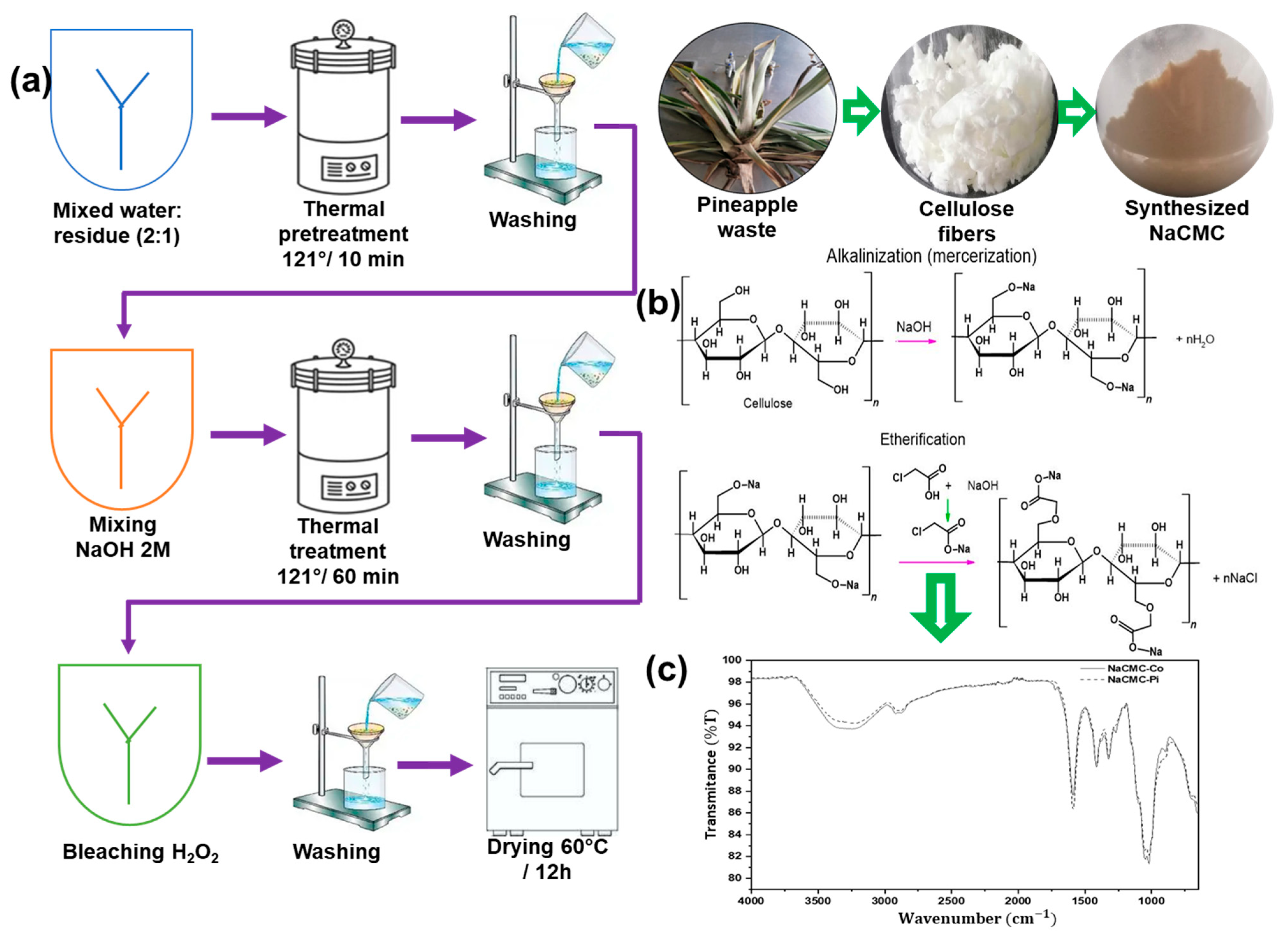
2.2.1. Cellulose Obtained
2.2.2. Synthesis of Sodium Carboxymethylcellulose (NaCMC)
2.2.3. Average Molecular Weight of Sodium Carboxymethylcellulose
2.2.4. Fourier Transform Infrared (FTIR) Spectroscopy
2.2.5. Physicochemical Characterization of Sodium Carboxymethylcellulose
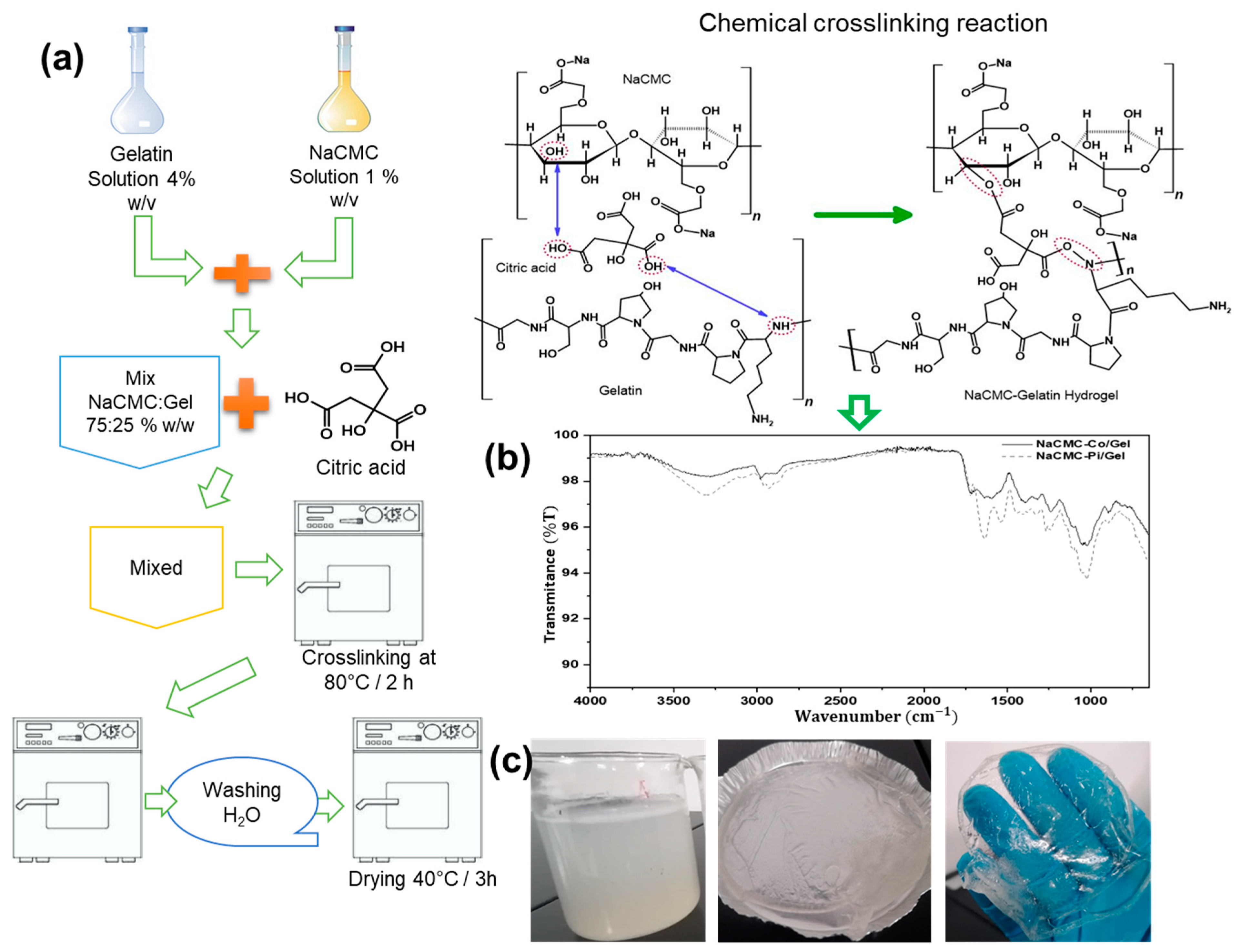
2.2.6. Hydrogel Synthesis
2.2.7. Scanning Electron Microscopy (SEM) Studies
2.2.8. Thermal Analysis (DSC and TGA) Studies
2.2.9. Swelling Degree and Gel Fraction Tests
2.2.10. Environmental Metrics and Process Sustainability Assessment
3. Results and Discussion
3.1. Synthesis of Sodium Carboxymethylcellulose
3.1.1. Molecular Weight Determination
3.1.2. FTIR Analysis of NaCMC Samples
3.1.3. Physicochemical Characterization
3.2. Synthesis Process of the Sodium Carboxymethylcellulose Hydrogel
3.2.1. Infrared Spectroscopy Characterization of the Hydrogels
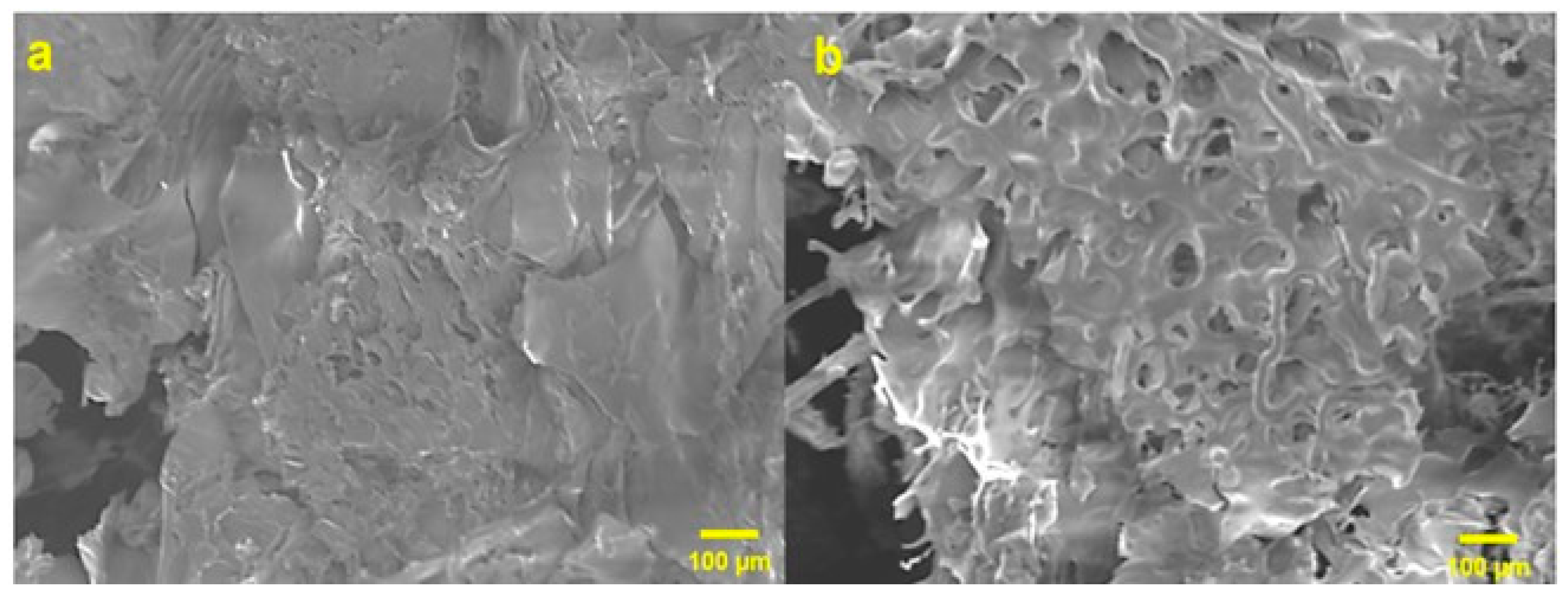
3.2.2. Scanning Electron Microscopy (SEM)
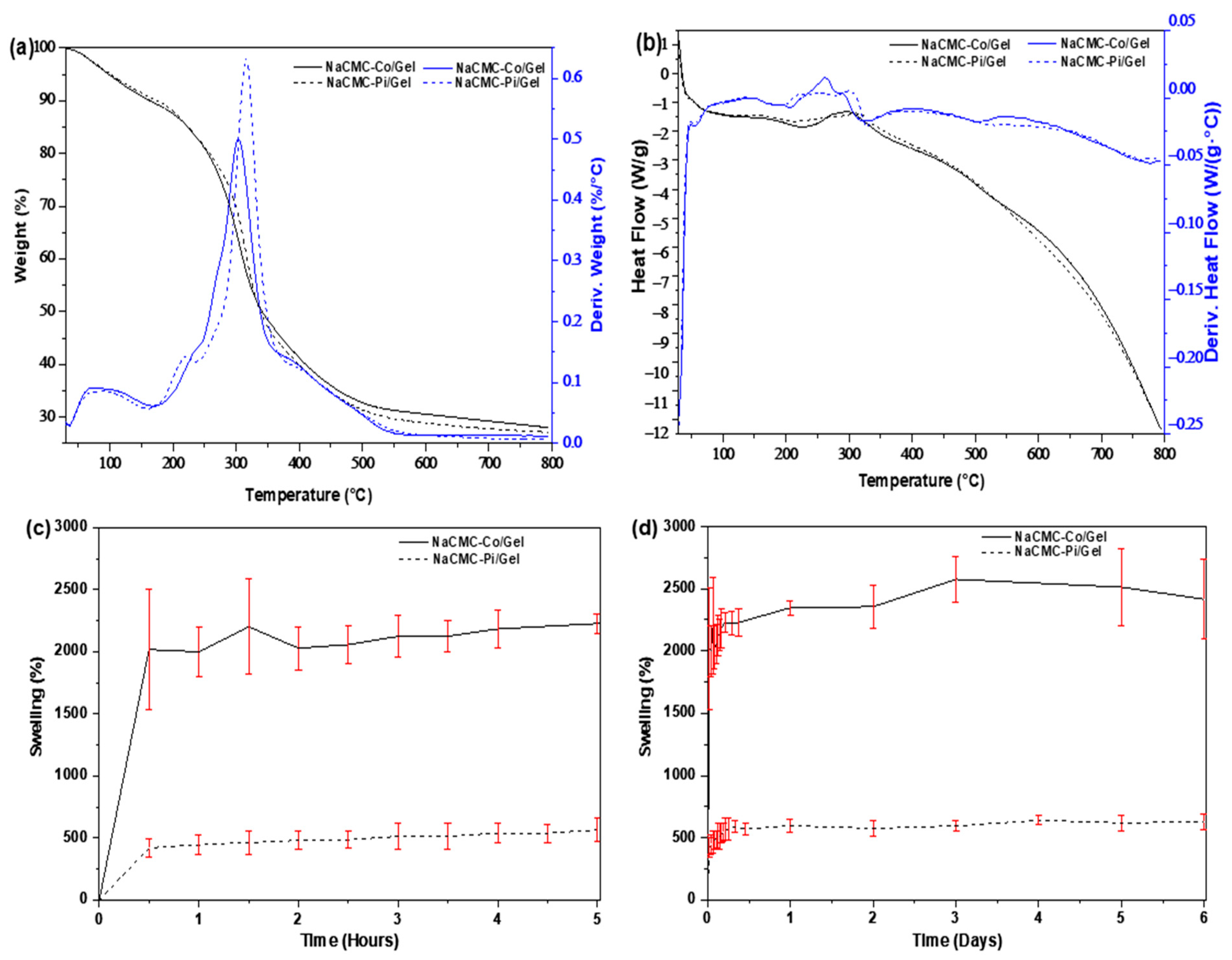
3.2.3. Differential Scanning Calorimetry and Thermogravimetric Analysis
3.2.4. Swelling Degree and Gel Fraction Analysis
3.3. Energy and Environmental Efficiency of the Process
4. Conclusions
Author Contributions
Funding
Institutional Review Board Statement
Informed Consent Statement
Data Availability Statement
Acknowledgments
Conflicts of Interest
Abbreviations
| NaCMC | Sodium carboxymethylcellulose |
| NaCMC-Pi | Pineapple derived sodium carboxymethylcellulose |
| NaCMC-Co | Commercial sodium carboxymethylcellulose |
References
- Nath, P.C.; Debnath, S.; Sharma, M.; Sridhar, K.; Nayak, P.K.; Inbaraj, B.S. Recent Advances in Cellulose-Based Hydrogels: Food Applications. Foods 2023, 12, 350. [Google Scholar] [CrossRef]
- Khairnar, R.G.; Darade, A.R.; Tasgaonkar, R.R. A Review on Tablet Binders as a Pharmaceutical Excipient. World J. Biol. Pharm. Health Sci. 2024, 17, 295–302. [Google Scholar] [CrossRef]
- Rahman, M.S.; Hasan, M.S.; Nitai, A.S.; Nam, S.; Karmakar, A.K.; Ahsan, M.S.; Shiddiky, M.J.A.; Ahmed, M.B. Recent Developments of Carboxymethyl Cellulose. Polymers 2021, 13, 1345. [Google Scholar] [CrossRef]
- Ramakrishnan, R.; Kim, J.T.; Roy, S.; Jayakumar, A. Recent Advances in Carboxymethyl Cellulose-Based Active and Intelligent Packaging Materials: A Comprehensive Review. Int. J. Biol. Macromol. 2024, 259, 129194. [Google Scholar] [CrossRef]
- Yu, P.; Wei, L.; Yang, Z.; Liu, X.; Ma, H.; Zhao, J.; Liu, L.; Wang, L.; Chen, R.; Cheng, Y. Hydrogel Wound Dressings Accelerating Healing Process of Wounds in Movable Parts. Int. J. Mol. Sci. 2024, 25, 6610. [Google Scholar] [CrossRef]
- Shen, Z.; Zhang, C.; Wang, T.; Xu, J. Advances in Functional Hydrogel Wound Dressings: A Review. Polymers 2023, 15, 2000. [Google Scholar] [CrossRef]
- Kurhade, R.R.; Shaikh, M.S.; Nagulwar, V.; Kale, M.A. Advancements in Carboxymethyl Cellulose (CMC) Modifications and Their Diverse Biomedical Applications: A Comprehensive Review. Int. J. Polym. Mater. Polym. Biomater. 2025, 74, 1043–1067. [Google Scholar] [CrossRef]
- Panchan, N.; Wattanapan, P.; Sungsinchai, S.; Roddecha, S.; Dittanet, P.; Seubsai, A.; Niamnuy, C.; Devahastin, S. Optimization of Synthesis Conditions for Carboxymethyl Cellulose from Pineapple Leaf Waste Using Microwave-Assisted Heating and Its Application as a Food Thickener. BioResources 2021, 16, 7684–7701. [Google Scholar] [CrossRef]
- Fouad, H.; Jawaid, M.; Karim, Z.; Meraj, A.; Abu-Jdayil, B.; Nasef, M.M.; Sarmin, S.N. Preparation and Characterization of Carboxymethyl Microcrystalline Cellulose from Pineapple Leaf Fibre. Sci. Rep. 2024, 14, 23286. [Google Scholar] [CrossRef]
- Zhang, W.; Liu, L.; Cheng, H.; Zhu, J.; Li, X.; Ye, S.; Li, X. Hydrogel-Based Dressings Designed to Facilitate Wound Healing. Mater. Adv. 2023, 5, 1364–1394. [Google Scholar] [CrossRef]
- Jia, X.; Dou, Z.; Zhang, Y.; Li, F.; Xing, B.; Hu, Z.; Li, X.; Liu, Z.; Yang, W.; Liu, Z. Smart Responsive and Controlled-Release Hydrogels for Chronic Wound Treatment. Pharmaceutics 2023, 15, 2735. [Google Scholar] [CrossRef]
- Paz-Arteaga, S.L.; Cadena-Chamorro, E.; Goméz-García, R.; Serna-Cock, L.; Aguilar, C.N.; Torres-León, C. Unraveling the Valorization Potential of Pineapple Waste to Obtain Value-Added Products towards a Sustainable Circular Bioeconomy. Sustainability 2024, 16, 7236. [Google Scholar] [CrossRef]
- Secretaría de Agricultura y Desarrollo Rural. Se Afianza México Dentro de los 10 Productores Mundiales de Piña. Available online: https://www.gob.mx/agricultura/prensa/se-afianza-mexico-dentro-de-los-10-productores-mundiales-de-pina (accessed on 17 July 2025).
- Food and Agriculture Organization (FAO) of the United Nations. Major Tropical Fruits: Market Review 2023; FAO: Rome, Italy, 2024. [Google Scholar]
- Yin, B.; Gosecka, M.; Bodaghi, M.; Crespy, D.; Youssef, G.; Dodda, J.M.; Wong, S.H.D.; Imran, A.B.; Gosecki, M.; Job-deedamrong, A.; et al. Engineering Multifunctional Dynamic Hydrogel for Biomedical and Tissue Regenerative Appli-cations. Chem. Eng. J. 2024, 487, 150403. [Google Scholar] [CrossRef]
- Pérez Ruiz, M.; Flores Merino, M.V.; Gonzalez Ruiz, A. Development of Polymeric Materials as Hydrogels with Curcumin for Skin Tissue Regeneration. Rev. Mex. Ing. Bioméd. 2024, 45, 99–111. [Google Scholar] [CrossRef]
- American Chemical Society. 12 Principles of Green Chemistry. Available online: https://www.acs.org/green-chemistry-sustainability/principles/12-principles-of-green-chemistry.html (accessed on 24 October 2025).
- Stefanache, A.; Marcinschi, A.; Marin, G.-A.; Mitran, A.-M.; Lungu, I.I.; Miftode, A.M.; Crivoi, F.; Lacatusu, D.; Baican, M.; Cioanca, O.; et al. Green Chemistry Approaches in Pharmaceutical Synthesis: Sustainable Methods for Drug Development. AppliedChem 2025, 5, 13. [Google Scholar] [CrossRef]
- Anastas, P.T.; Warner, J.C. What Is Green Chemistry? In Green Chemistry; Oxford University Press: Oxford, UK, 2000; pp. 11–20. [Google Scholar] [CrossRef]
- Onagun, Q.; Gbenga, A.A. Green Chemistry in Medicinal Chemistry: A Review on Sustainable Approaches to the Synthesis of Biologically Active Compounds. World J. Adv. Res. Rev. 2024, 24, 1371–1382. [Google Scholar] [CrossRef]
- Sheldon, R.A. The E Factor at 30: A Passion for Pollution Prevention. Green Chem. 2023, 25, 1704–1728. [Google Scholar] [CrossRef]
- Kassim, N.A.; Mohamed, A.Z.; Zainudin, E.S.; Zakaria, S.; Khaulah, S.; Azman, Z.; Abdullah, H.H. Isolation and Characterization of Macerated Cellulose from Pineapple Leaf. BioResources 2019, 14, 1198–1209. [Google Scholar] [CrossRef]
- Sagar, B.M.; Islam, M.M.; Habib, M.L.; Ahmed, S.; Sahadat Hossain, M. Utilization of Natural and Waste Sources for Synthesis of Cellulose, Chitin, and Chitosan for a Suitable Environment. RSC Adv. 2025, 15, 26276–26301. [Google Scholar] [CrossRef] [PubMed]
- Nargotra, P.; Sharma, V.; Tsai, M.L.; Hsieh, S.L.; Dong, C.-D.; Wang, H.M.D.; Kuo, C.H. Recent Advancements in the Valorization of Agro-Industrial Food Waste for the Production of Nanocellulose. Appl. Sci. 2023, 13, 6159. [Google Scholar] [CrossRef]
- Çelikçi, N.; Ayhan Ziba, C.; Dolaz, M. Synthesis and Characterization of Carboxymethyl Cellulose (CMC) from Different Waste Sources Containing Cellulose and Investigation of Its Use in the Construction Industry. Cellul. Chem. Technol. 2022, 56, 55–68. [Google Scholar] [CrossRef]
- Klunklin, W.; Jantanasakulwong, K.; Phimolsiripol, Y.; Leksawasdi, N.; Seesuriyachan, P.; Chaiyaso, T.; Insomphun, C.; Phongthai, S.; Jantrawut, P.; Sommano, S.R.; et al. Synthesis, Characterization, and Application of Carboxymethyl Cellulose from Asparagus Stalk End. Polymers 2021, 13, 81. [Google Scholar] [CrossRef]
- Yan, Q.; Wei, P.; Peng, R.; Tian, S.; Li, D.; Tong, Y.; Ni, J.; Liu, L.; Xiong, B. Controllable Synthesis of Carboxymethyl Cellulose and Its Application in Tobacco Sheets. Wuhan Univ. J. Nat. Sci. 2023, 28, 341–350. [Google Scholar] [CrossRef]
- Raja, A.; Wilfert, P.K.; Picken, S.J. Charge Mediated Changes to the Intrinsic Viscosity of Biopolymer Systems. Polymers 2024, 16, 2894. [Google Scholar] [CrossRef]
- Eremeeva, T.E.; Bykova, T.O. SEC of Mono-Carboxymethyl Cellulose (CMC) in a Wide Range of PH; Mark–Houwink Constants. Carbohydr. Polym. 1998, 36, 319–326. [Google Scholar] [CrossRef]
- Puente Córdova, J.G.; Hernández Ramírez, C.L.; Reyes Melo, M.E.; Rentería Baltiérrez, F.Y.; Miranda Valdez, I.Y. Estudio Reológico de Soluciones Poliméricas de Carboximetil Celulosa. Ing. Investig. Tecnol. 2022, 23, 1–10. [Google Scholar] [CrossRef]
- Arinaitwe, E.; Pawlik, M. Dilute Solution Properties of Carboxymethyl Celluloses of Various Molecular Weights and Degrees of Substitution. Carbohydr. Polym. 2014, 99, 423–431. [Google Scholar] [CrossRef]
- Yoshida, M.; Nakagawa, D.; Hozumi, H.; Horikawa, Y.; Makino, S.; Nakamura, H.; Shikata, T. A New Concept for Interpretation of the Viscoelastic Behavior of Aqueous Sodium Carboxymethyl Cellulose Systems. Biomacromolecules 2024, 25, 3420–3431. [Google Scholar] [CrossRef]
- Dardeer, H.M.; Gad, A.N.; Mahgoub, M.Y. Promising Superabsorbent Hydrogel Based on Carboxymethyl Cellulose and Polyacrylic Acid: Synthesis, Characterization, and Applications in Fertilizer Engineering. BMC Chem. 2024, 18, 144. [Google Scholar] [CrossRef] [PubMed]
- Mexico Secretaría de Salud. Farmacopea de Los Estados Unidos Mexicanos 13.0; Secretaría de Salud/Comisión Permanente de la Farmacopea de los Estados Unidos Mexicanos: Mexico City, Mexico, 2021. [Google Scholar]
- Capanema, N.S.V.; Mansur, A.A.P.; Carvalho, I.C.; Carvalho, S.M.; Mansur, H.S. Bioengineered Water-Responsive Carboxymethyl Cellulose/Poly(Vinyl Alcohol) Hydrogel Hybrids for Wound Dressing and Skin Tissue Engineering Applications. Gels 2023, 9, 166. [Google Scholar] [CrossRef]
- Pratinthong, K.; Punyodom, W.; Jantrawut, P.; Jantanasakulwong, K.; Tongdeesoontorn, W.; Sriyai, M.; Panyathip, R.; Thanakkasaranee, S.; Worajittiphon, P.; Tanadchangsaeng, N.; et al. Modification of a Carboxymethyl Cellulose/Poly(Vinyl Alcohol) Hydrogel Film with Citric Acid and Glutaraldehyde Crosslink Agents to Enhance the Anti-Inflammatory Effectiveness of Triamcinolone Acetonide in Wound Healing. Polymers 2024, 16, 1798. [Google Scholar] [CrossRef]
- Laddawan, P.; Auecharoenrat, S.; Tongsook, C. Environmentally Friendly Carboxymethyl Cellulose Hydrogels Derived from Waste Paper and Sawdust as a Urea Release Agent. ACS Omega 2025, 10, 17296–17309. [Google Scholar] [CrossRef] [PubMed]
- Magalhães, S.; Fernandes, C.; Pedrosa, J.F.S.; Alves, L.; Medronho, B.; Ferreira, P.J.T.; Rasteiro, M.d.G. Eco-Friendly Methods for Extraction and Modification of Cellulose: An Overview. Polymers 2023, 15, 3138. [Google Scholar] [CrossRef]
- McNeice, P.; ten Brink, G.H.; Gran, U.; Karlson, L.; Edvinsson, R.; Feringa, B.L. Cellulose Modification for Sustainable Polymers: Overcoming Problems of Solubility and Processing. RSC Sustain. 2024, 2, 369–376. [Google Scholar] [CrossRef]
- Kurul, F.; Doruk, B.; Topkaya, S.N. Principles of Green Chemistry: Building a Sustainable Future. Discov. Chem. 2025, 2, 68. [Google Scholar] [CrossRef]
- Djafari Petroudy, S.R.; Chabot, B.; Loranger, E.; Naebe, M.; Shojaeiarani, J.; Gharehkhani, S.; Ahvazi, B.; Hu, J.; Thomas, S. Recent Advances in Cellulose Nanofibers Preparation through Energy-Efficient Approaches: A Review. Energies 2021, 14, 6792. [Google Scholar] [CrossRef]
- Liu, Y.; Wei, H.; Liu, Z.; Liu, X.; Fang, Y.; Jiang, M.; Li, M.; Zhou, L.; Zhang, J. Ultrafast and Energy-Saving Extraction of Cellulose Nanocrystals. Green Chem. 2022, 24, 6823–6829. [Google Scholar] [CrossRef]
- Malucelli, L.C.; Matos, M.; Jordão, C.; Lomonaco, D.; Lacerda, L.G.; Carvalho Filho, M.A.S.; Magalhães, W.L.E. Influence of Cellulose Chemical Pretreatment on Energy Consumption and Viscosity of Produced Cellulose Nanofibers (CNF) and Mechanical Properties of Nanopaper. Cellulose 2019, 26, 1667–1681. [Google Scholar] [CrossRef]
- Carolin, C.F.; Kamalesh, T.; Kumar, P.S.; Hemavathy, R.V.; Rangasamy, G. A Critical Review on Sustainable Cellulose Materials and Its Multifaceted Applications. Ind. Crops Prod. 2023, 203, 117221. [Google Scholar] [CrossRef]
- Signori-Iamin, G.; Aguado, R.J.; Putaux, J.-L.; Santos, A.F.; Thielemans, W.; Delgado-Aguilar, M. Energy and Property Trade-Offs in Nanocellulose Production: High-Pressure Homogenization at Different Processing Consistencies. Chem. Eng. J. 2025, 509, 161257. [Google Scholar] [CrossRef]
- Aboagye, E.A.; Chea, J.D.; Yenkie, K.M. Systems Level Roadmap for Solvent Recovery and Reuse in Industries. iScience 2021, 24, 103114. [Google Scholar] [CrossRef] [PubMed]
- Duelge, K.J.; Young, J.A. Estimating Recovery in the Evaporation Chemical Space. Biomed. Mater. Devices 2024, 2, 1205–1214. [Google Scholar] [CrossRef]
- Ardhaoui, W.; Cherif, E.; Herth, E. Effect on the Viscometric Properties of Sodium Carboxymethylcellulose in a Dimethylacetamide and Acetone Mixture. J. Macromol. Sci. Part B Phys. 2023, 62, 557–571. [Google Scholar] [CrossRef]
- Aswathy, S.H.; NarendraKumar, U.; Manjubala, I. The Influence of Molecular Weight of Cellulose on the Properties of Carboxylic Acid Crosslinked Cellulose Hydrogels for Biomedical and Environmental Applications. Int. J. Biol. Macromol. 2023, 239, 124282. [Google Scholar] [CrossRef]
- Richbourg, N.R.; Wancura, M.; Gilchrist, A.E.; Toubbeh, S.; Harley, B.A.C.; Cosgriff-Hernandez, E.; Peppas, N.A. Precise Control of Synthetic Hydrogel Network Structure via Linear, Independent Synthesis-Swelling Relationships. Sci. Adv. 2021, 7, eabe3245. [Google Scholar] [CrossRef] [PubMed]
- Sayko, R.; Jacobs, M.; Dobrynin, A.V. Quantifying Properties of Polysaccharide Solutions. ACS Polym. Au 2021, 1, 196–205. [Google Scholar] [CrossRef]
- Gupta, S.K.; Deshpande, A.P.; Kumar, R. Rheological and Dielectric Behavior of Sodium Carboxymethyl Cellulose (NaCMC)/Ca2+ and Esterified NaCMC/Ca2+ Hydrogels: Correlating Microstructure and Dynamics with Properties. Carbohydr. Polym. 2024, 335, 122049. [Google Scholar] [CrossRef]
- Asrorov, U.A.; Inagamov, S.Y.; Khujanov, E.B.; Turotov, F.K.; Bozorov, H.N. Local Sodium Carboxymethyl Cellulose: Physicochemical Characteristics and Their Significance. In Proceedings of the 4th International Scientific and Practical Symposium on Materials Science and Physics, Dushanbe, Tajikistan, 23–25 December 2024; Gibadullin, A., Devi, G., Sadullozoda, S., Eds.; Springer Nature: Cham, Switzerland, 2025; pp. 111–123. [Google Scholar]
- Wallace, W.E. Sodium Carboxymethyl Cellulose, Infrared Spectra. In NIST Chemistry WebBook, NIST Standard Reference Database Number 69; Linstrom, P.J., Mallard, W.G., Eds.; National Institute of Standards and Testing (NIST): Gaithersburg, MD, USA, 2024; p. 20899. [Google Scholar] [CrossRef]
- Rahmi, A.; Olvia, B.V.; Saufani, I.A. Synthesis and Characterization of Sodium Carboxymethylcellulose from Sansevieria Trifasciata as an Alternative Raw Material for Capsule Shell. Turk. J. Pharm. Sci. 2025, 22, 77–82. [Google Scholar] [CrossRef]
- Uranga, J.; Nguyen, B.T.; Si, T.T.; Guerrero, P.; De la Caba, K. The Effect of Cross-Linking with Citric Acid on the Properties of Agar/Fish Gelatin Films. Polymers 2020, 12, 291. [Google Scholar] [CrossRef]
- Mali, K.K.; Dhawale, S.C.; Dias, R.J.; Dhane, N.S.; Ghorpade, V.S. Citric Acid Crosslinked Carboxymethyl Cellulose-Based Composite Hydrogel Films for Drug Delivery. Indian J. Pharm. Sci. 2018, 80, 657–667. [Google Scholar] [CrossRef]
- Akalin, G.O.; Pulat, M. Preparation and Characterization of Nanoporous Sodium Carboxymethyl Cellulose Hydrogel Beads. J. Nanomater. 2018, 2018, 9676949. [Google Scholar] [CrossRef]
- Kukrety, A.; Singh, R.K.; Singh, P.; Ray, S.S. Comprehension on the Synthesis of Carboxymethylcellulose (CMC) Utilizing Various Cellulose Rich Waste Biomass Resources. Waste Biomass Valorization 2018, 9, 1587–1595. [Google Scholar] [CrossRef]
- Ardiyanita, P.Z.; Sutriyo, S.; Suryadi, H. Preparation and Characterization of Sodium Carboxymethyl Cellulose from Kapok (Ceiba Pentandra) Alpha-Cellulose. Int. J. Appl. Pharm. 2020, 12, 9–14. [Google Scholar] [CrossRef]
- Trastulli Colangeli, S.; Campana, F.; Ferlin, F.; Vaccaro, L. A Waste-Minimized Protocol for Electrochemical Reductive Amination and Its Environmental Assessment. Green Chem. 2024, 27, 633–641. [Google Scholar] [CrossRef]



| Test | Specification | Result |
|---|---|---|
| Description | White or grayish white powder. | Complies |
| Solubility | Solubility Sparingly soluble in water Almost insoluble in alcohol, diethyl ether and other organic solvents. | Complies |
| Identity tests | A. Sample absorbs methylene blue and sediments as a blue fibrous mass. | Compies |
| B. A purplish red color forms at the interface. | Complies | |
| pH | Between 5.0 and 7.0 | 6.5 |
| Degree of substitution | Between 0.60 and 0.85 | 0.77 |
| Loss on drying | Not more than 10.0% of its weight | 8.1% |
| Residue on ignition | Between 14.0% and 28.0%, calculated on dry basis | 16.3% |
Disclaimer/Publisher’s Note: The statements, opinions and data contained in all publications are solely those of the individual author(s) and contributor(s) and not of MDPI and/or the editor(s). MDPI and/or the editor(s) disclaim responsibility for any injury to people or property resulting from any ideas, methods, instructions or products referred to in the content. |
© 2026 by the authors. Published by MDPI on behalf of the Österreichische Pharmazeutische Gesellschaft. Licensee MDPI, Basel, Switzerland. This article is an open access article distributed under the terms and conditions of the Creative Commons Attribution (CC BY) license.
Share and Cite
Pérez-R, M.; Orozco, G.; González-Ruiz, A.; Flores-Merino, M.V. Pineapple-Derived Sodium Carboxymethylcellulose: Physicochemical Basis for Hydrogel Formulation. Sci. Pharm. 2026, 94, 7. https://doi.org/10.3390/scipharm94010007
Pérez-R M, Orozco G, González-Ruiz A, Flores-Merino MV. Pineapple-Derived Sodium Carboxymethylcellulose: Physicochemical Basis for Hydrogel Formulation. Scientia Pharmaceutica. 2026; 94(1):7. https://doi.org/10.3390/scipharm94010007
Chicago/Turabian StylePérez-R, Mateo, G. Orozco, A. González-Ruiz, and Miriam V. Flores-Merino. 2026. "Pineapple-Derived Sodium Carboxymethylcellulose: Physicochemical Basis for Hydrogel Formulation" Scientia Pharmaceutica 94, no. 1: 7. https://doi.org/10.3390/scipharm94010007
APA StylePérez-R, M., Orozco, G., González-Ruiz, A., & Flores-Merino, M. V. (2026). Pineapple-Derived Sodium Carboxymethylcellulose: Physicochemical Basis for Hydrogel Formulation. Scientia Pharmaceutica, 94(1), 7. https://doi.org/10.3390/scipharm94010007