Article

MD + QC Methodology for Studying the Interaction of Bioactive Molecules with Amino Acids: The Case of Arbidol Interaction with Aromatic Amino Acids and Its Spectral-Luminescent Validation


by
Sophia S. Borisevich
1,
Edward M. Khamitov
1,*,
Gulshat A. Masyagutova
1,
Olga I. Yarovaya
2 and
Sergey L. Khursan
1
1
Ufa Federal Research Center of RAS, Ufa Institute of Chemistry, 450054 Ufa, Russia
2
Department of Medicinal Chemistry, N.N. Vorozhtsov Novosibirsk Institute of Organic Chemistry of Siberian Branch of RAS, 630090 Novosibirsk, Russia
*
Author to whom correspondence should be addressed.
Sci. Pharm. 2026, 94(1), 20; https://doi.org/10.3390/scipharm94010020
Submission received: 20 January 2026 / Revised: 19 February 2026 / Accepted: 27 February 2026 / Published: 4 March 2026
(This article belongs to the Special Issue Computer-Aided Drug Design and Molecular Synthesis)

Abstract

A comprehensive MD + QC methodology was developed and applied to evaluate various aspects of Arbidol interactions with functional amino acids of surface proteins of influenza virus and SARS-CoV-2. The spatial structure, solvation features, conformational behavior of Arb AA (AA–Trp, Tyr, Phe, and Val) complexes were established, and the statistics of intermolecular interactions in the complex were described. It was found that Arb can participate in strong and long-lived π-π stacking interactions with aromatic amino acids. The binding energy (BE) of Arbidol and amino acids in aqueous solution was estimated using an explicit solvation model, QTAIM analysis and correlation of BE vs. total electron density at the bond critical points of the complex. Theoretical calculations were validated by experimental studies of fluorescence (FL) quenching of aromatic AA by Arbidol. Spectral-fluorescent properties of Arbidol hydrochloride in aqueous solutions were studied, and the luminescence quantum yield for the electronically excited state of Arb was determined.

Graphical Abstract

1. Introduction

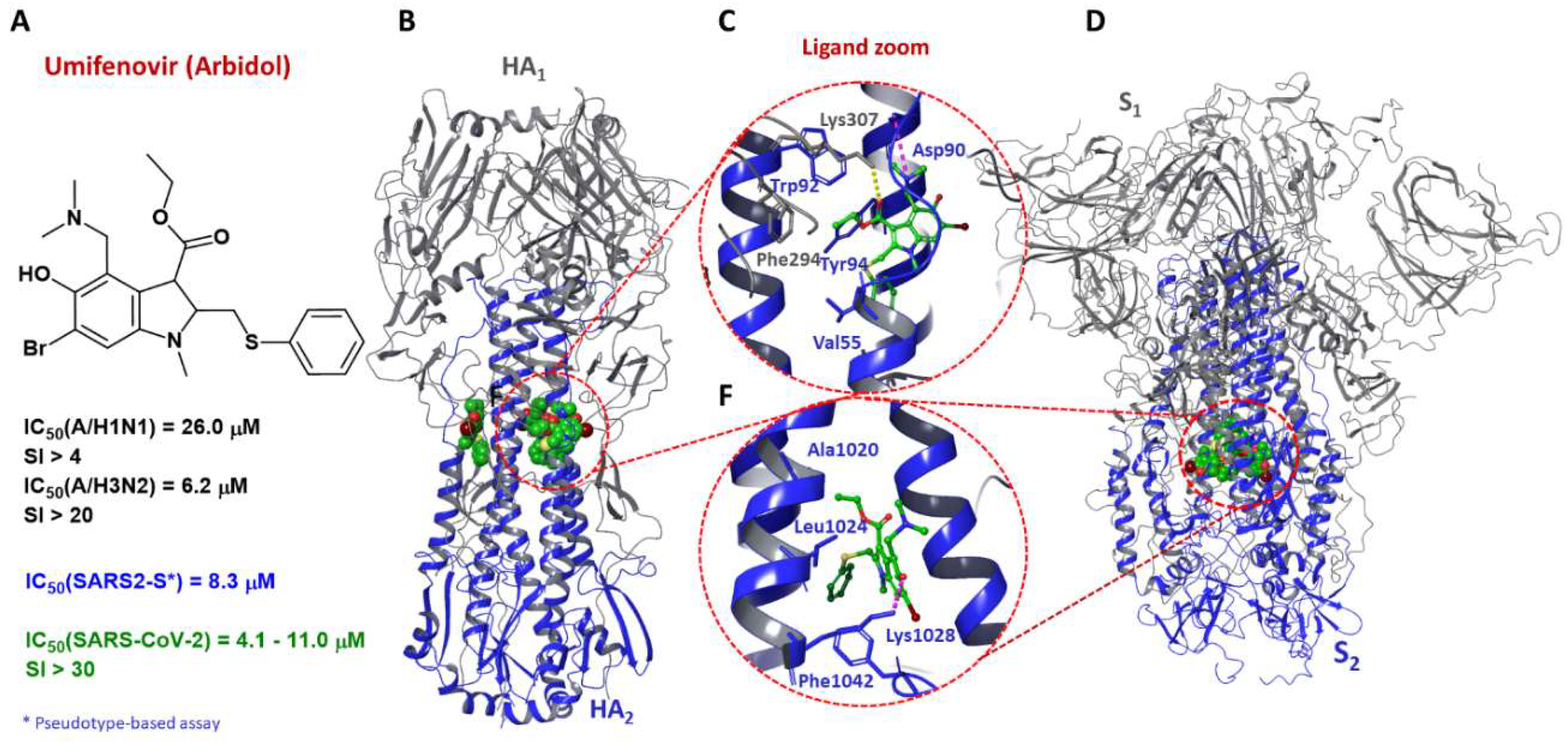
Umifenovir or Arbidol (Arb), an antiviral drug approved for clinical use in Russia and China [1,2], is active against various strains of the influenza virus (Figure 1A). The mechanism of Arb antiviral activity is believed to be associated with the inhibition of the viral surface protein hemagglutinin (HA) [3]. The main function of HA is to ensure penetration of the viral genome into the cytoplasm of the host cell. Virus penetration begins with the binding of the HA1 globular domain to the sialic acid (SA) receptor on the cell surface [4], followed by endocytosis. The acidic environment of the endosome triggers conformational changes in the stem portion of the HA2 domain, which lead to fusion of the viral and cellular membranes [5,6,7,8,9,10]. As a result, the so-called fusion peptide is exposed to the outside, which binds to the cellular membrane and mediates fusion of the viral and endosomal membranes. According to the spatial structure of the HA complex with Arbidol determined by X-ray structural analysis [3], the ligand binds in the stem part of HA between two functional short and long α-helices (Figure 1B) in the region of heptad repeats (HRs). It should be noted that HA is a trimer consisting of three identical protomers, and each of them can bind an Arb molecule. The ligand is surrounded by functional amino acids (AAs), including aromatic Trp92, Tyr94 and Phe294, hydrophobic Val55, Leu99, as well as Lys307 and Asp90 (Figure 1C). The binding of the protein cavity ligands stabilizes the protein conformation and inhibits important conformational rearrangements of the membrane fusion at low pH values in the endosome [3,11,12].
The influenza hemagglutinin and the S spike protein of SARS-CoV-2 are type I surface proteins with a similar fusion mechanism [10]. The presence of HR in these proteins suggests the presence of similar hydrophobic cavities in the space between the α helices of the stem part of the protein. For this reason, Arbidol was one of the first drugs to be considered as a candidate for potential inhibitors of SARS-CoV-2 entry [13]. Indeed, Arb has been found to be moderately active against the SARS-CoV-2 virus in in vitro tests at concentrations between 4.1 and 11.0 μM (Figure 1A) [14,15] and inhibits the S protein in pseudovirus system tests [16]. Molecular modeling [16,17,18] showed that three Arb molecules can bind to the HR region of the S protein (Figure 1D). The binding site is filled by hydrophobic amino acids, including aromatic Phe1042 (Figure 1D). It has been suggested [16,17,18] that the ligand interaction with key amino acids of the S protein leads to the inhibition of protein rearrangement from pre-fusion to the post-fusion conformation.
Figure 1. The inhibitor of influenza and SARS-CoV-2 virus entry: (A) Structural formula and antiviral activity of Arb [1,14,15,16]. (B) Secondary structure of the influenza virus hemagglutinin (HA): the globular head of the first subunit of the protein (HA1) is shown in gray, and the stalk domain (HA2) is shown in blue; the structure is visualized using the PDB [19] code 5T6N [3]. (C) The location of Ab between two α helices of HR: hydrogen and salt bridges are shown as yellow and purple dashed lines, respectively. (D) Secondary structure of the onion head of the SARS-CoV-2 S protein: the first subunit (S1) is shown in gray, and the second subunit (S2) is shown in blue; the structure is visualized using the PDB code 7BNM [20]. F—location of the Arb molecule in the HR region: the salt bridge is shown as a purple dashed line.
Scipharm 94 00020 g001
Thus, the probable Arb-binding sites of the surface protein of the influenza and SARS-CoV-2 viruses have a similar pharmacophore profile: on the one hand, there are hydrophobic AAs which cause hydrophobic interactions with the Arb, and on the other hand, there are aromatic amino acids that are capable to π-π stacking interactions with the indole fragment of Arb. This may suggest that Arbidol can disrupt conformational rearrangements of proteins due to the formation of stable π-π stacking complexes [21] and hydrophobic contacts with aliphatic amino acids of a type similar to “leucine zippers” [22]. To elucidate these possibilities, molecular modeling methods (docking and classical dynamics) may be used to estimate the affinity and behavior of a molecule at the binding site, as well as to assume the presence of various intermolecular interactions, such as hydrogen bonds and π-π stacking, while the energy of these interactions can be estimated reliably by quantum chemistry methods only. However, the size of ligand–protein complexes such as HA 3Arb or S 3Arb, where three ligand molecules are bound with the surface protein, is too large to carry out full-fledged quantum chemical estimates. In this regard, it seems reasonable to create a model of an acceptable size that considers the interaction of Arb with specific or key amino acid residues. In the described case of Arb binding in the cavity of the surface protein of the influenza and SARS-CoV-2 viruses, this model should include the aromatic amino acids (AAs) tyrosine (Tyr), tryptophan (Trp), and phenylalanine (Phe), as well as aliphatic AAs—valine (Val), leucine (Leu) and isoleucine (Ile). Thus, the aim of the present work is to develop a methodology for studying the mechanism and energetics of the interaction of Arbidol with a number of functional amino acids within the framework of a combined approach, including docking and classical dynamics in combination with quantum chemical calculations using density functional theory.

2. Materials and Methods

2.1. Molecular Dynamics

The interacting model system is a virtual cube containing 2000 water molecules, one Arb molecule protonated at the aliphatic nitrogen atom, a chloride anion as a counter-ion, and amino acids: Tyr, Trp, Phe, or Val. Five amino acid molecules were added to the system in a random order. The visualization of the starting systems is presented in the Supporting Information (Figure S1). The cubic form of periodic boundary conditions (PBC) [23] and the TIP3P water model [24,25] were used. The protocol for preparing the system for simulation included preliminary energy minimization and equilibration of the system components. The period of the registered simulation in the NPT ensemble was 20 nanoseconds at a temperature of 300 K with an integration step of 1 fs. The OPLS4 force field was used [26]. The analysis of the MD trajectory and the construction of three-dimensional maps of space population by AA molecules were carried out using the VMD molecular visualization program [27]. Quantitative assessment of the population volumes was performed using the ChimeraX program ver. 1.13.1 [28].

VolMap Analysis

Spatial distribution and residence preferences of amino acid molecules around Arbidol were quantified using the VolMap plugin in VMD (version 1.9.4).
For each system (Arbidol + 5 identical amino acid molecules), volumetric maps were generated with the following parameters:
  • Selection: entire amino acid molecule (resname TRP/PHE/TYR/HIS, depending on the system);
  • Map type: density;
  • Weights: occupancy (each atom contributes 1 if present in the grid voxel, 0 otherwise);
  • Frame processing: compute for all frames (-allframes);
  • Frame combination: average (-combine avg);
  • Other parameters: default values (Gaussian smoothing with atomic radii as standard deviations, grid resolution 1.0 Å, and periodic boundary handling enabled).
This setup produces an average occupancy density map, where the value at each grid point represents the mean fraction of frames (occupancy probability, ranging from 0 to 1) in which at least one atom of the selected amino acid resides within the corresponding Gaussian-smeared volume element. The resulting map effectively captures the cumulative residence probability of the amino acid in space relative to Arbidol over the entire trajectory.
To compare interaction preferences quantitatively, isosurfaces were generated at a fixed threshold value of 0.40 (or an equivalent density cutoff chosen consistently across all systems). The volume of each high-occupancy region was calculated by integrating the number of voxels exceeding this threshold within a spherical cutoff of 8–10 Å from the center of mass of Arbidol (to exclude distant, non-specific density). Volume integration was performed using the built-in VMD tools (volutil measure volume Tcl command or manual voxel counting in isosurface representation) and expressed in Å3.
All maps were visualized and isosurfaces rendered using the isosurface representation in VMD, with a consistent isovalue for direct comparison.

2.2. Quantum Chemical Calculations

The TeraChem program version 1.96H-beta-231003) [29] was applied to perform quantum chemical calculations using the B3LYP density functional [30,31] with GD3 Grimme dispersion correction [32] and the def2-SVP double-splitting basis set [33,34]. The initial geometric parameters of the Arb AA complexes and water clusters were obtained from the MD trajectory analysis. The Arb environment was chosen to correspond to the statistically significant positions of an amino acid relative to the Arb molecule. The geometric parameters of the Arb AA complexes in the case of the explicit solvent model were optimized considering water molecules within a radius of 12 Å from the center of mass of the complex. The wave function obtained during the QM calculation was analyzed in the MultiWFN program (version 3.8(dev)) [35]. QTAIM analysis was performed to find and describe the nature of critical points in the region of contact of Arb with amino acid. The electron density ρi at the critical point of (3; −1) type [36] between atoms of interacting molecules was used as a characteristic of the strength of binding, regardless of the nature of interatomic contact (π-π stacking or hydrogen bond or other). The sum value of the electron densities ∑ρi was used to estimate the binding energy BE (kJ/mol) in the Arb AA complex according to Equation (1):
B E = 956 ± 85 × ρ i ( 9.6 ± 3.2 ) ,
where the correlation coefficients of the dependence (1) are discussed below.

2.3. Spectral Measurements

The absorption spectra were recorded on a Shimadzu UV 1800 spectrophotometer (Shimadzu, Kyoto, Japan), the corrected FL spectra were recorded on a CM-2203 spectrofluorometer (SOLAR; Minsk, Republic of Belarus). The FL spectra were obtained by photoexcitation of Arb or AA water solutions at angles of 90° and 35° in quartz cuvettes. The fluorescence quantum yield (φ) of Arb was determined [37] using the external standard of Trp according to the Equation (2):
φ = φ T r p × S × A T r p S T r p × A ,
where φ is the FL quantum yield of the substrate (Arbidol); φTrp is the FL quantum yield of tryptophan (φTrp = 0.14 [38]); S and A are the light sum under the FL band and the absorption of Arb at the wavelength of excitation light (λex), respectively; and STrp and ATrp are the same for tryptophan. The absorption of the studied solutions did not exceed 0.05, which ensured, first, the applicability of Equation (2), and second, the practical absence of the “inner filter” effect [37] (absorption of emitted light by the solution). In order to minimize the reabsorption of excitation light and fluorescence by the quencher, FL Trp was recorded by photoexcitation at the angle of 35°. The solutions were prepared in double-distilled water. Amino acids (Sigma-Aldrich, Darmstadt, Germany) were used without additional purification.

3. Results

3.1. Interaction of Arb with AA

Molecular dynamics methods in combination with quantum chemical calculations at the DFT level of theory were used to describe the mechanism of interaction of the Arb molecule with four AAs. Aromatic amino acids Trp, Tyr, and Phe, as well as one hydrophobic AA, Val, were selected for the analysis. The first step of analyzing the results of molecular dynamics simulations is to estimate the scale of fluctuations in atom position as the root-mean-square deviation (RMSD), which characterizes the intensity of the movement of the system components (Figure S2). The RMSD of Arb atoms is in the range of 1.5 to 3.0 Å. Clustering of RMSD values allows us to estimate the frequency of amino acid contacts with Arb (Table 1).
The lowest RMSD value along the entire trajectory of AA movement relative to Arb is observed for Trp, while it is the highest for Val. This result can be interpreted as an indicator of the frequency of interactions of Arb with an amino acid; i.e., during the entire simulation time, the longest contacts of Arbidol are observed for tryptophan, with tyrosine and phenylalanine being somewhat shorter. The frequency of Arb interactions with hydrophobic valine is the lowest. However, the obtained results say nothing about the nature of intermolecular binding of Arb to amino acids. So, the second step of our investigation was the analysis of trajectories of amino acid movements relative to Arb. An indole scaffold was chosen as a reference fragment of Arb, relative to which the geometric parameters of AA molecules corresponding to each frame of the simulation were determined (Figure 2). This statistical approach made it possible to obtain 3D maps that illustrate the spatial features of the Arb–AA interaction. For aromatic acids, these maps have a “sandwich” shape with the indole fragment of Arb in the center. The shape and arrangement of the population clouds suggest π-π stacking interaction between the indole fragment of Arb and the aromatic ring of AA.
The spatial distribution of each amino acid around Arbidol was quantified using the VolMap plugin of VMD (density map with occupancy weighting, averaged over all frames). The resulting maps represent the average occupancy (residence probability) of the amino acid atoms in space. The volume of the high-occupancy region (isosurface at a fixed threshold of 0.40) therefore serves as a direct proxy for the cumulative time the amino acid molecules spend in close contact with Arb. A larger volume indicates a greater overall interaction preference, as the molecules approach Arb more frequently and/or remain in its vicinity for longer periods across the trajectory.

3.2. Conformational Behavior of Arb in the Presence of AA

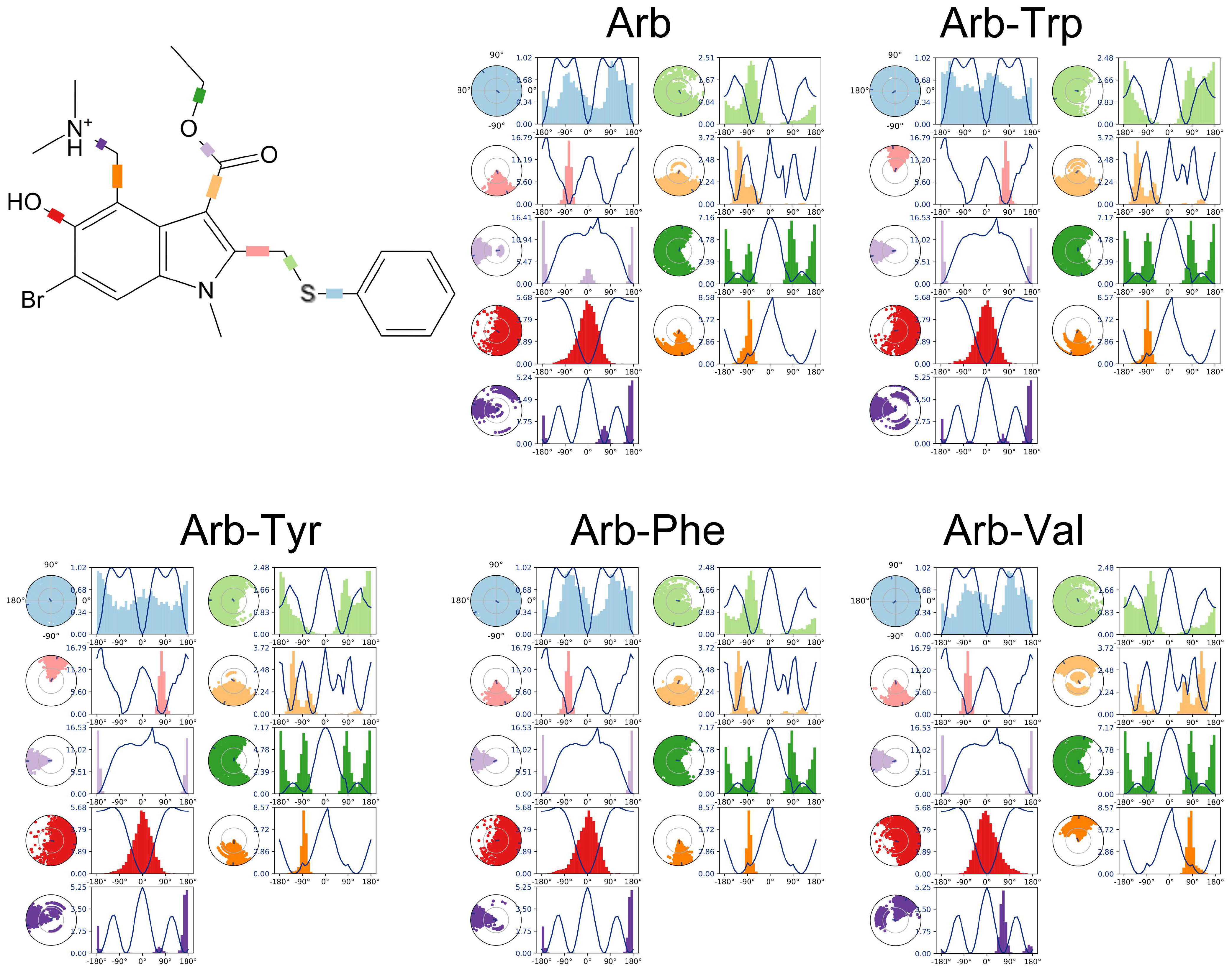
The features of the interaction of Arb with amino acids can be revealed using conformational analysis, since the solvate environment of Arb affects the conformational mobility of the latter. For this purpose, a comparative conformational analysis of the Arb molecule in aqueous solution was carried out both in the presence and absence of amino acids. Figure 3 shows histograms of the population of the conformational states of Arb by the torsion angle value and energy profiles of the states.
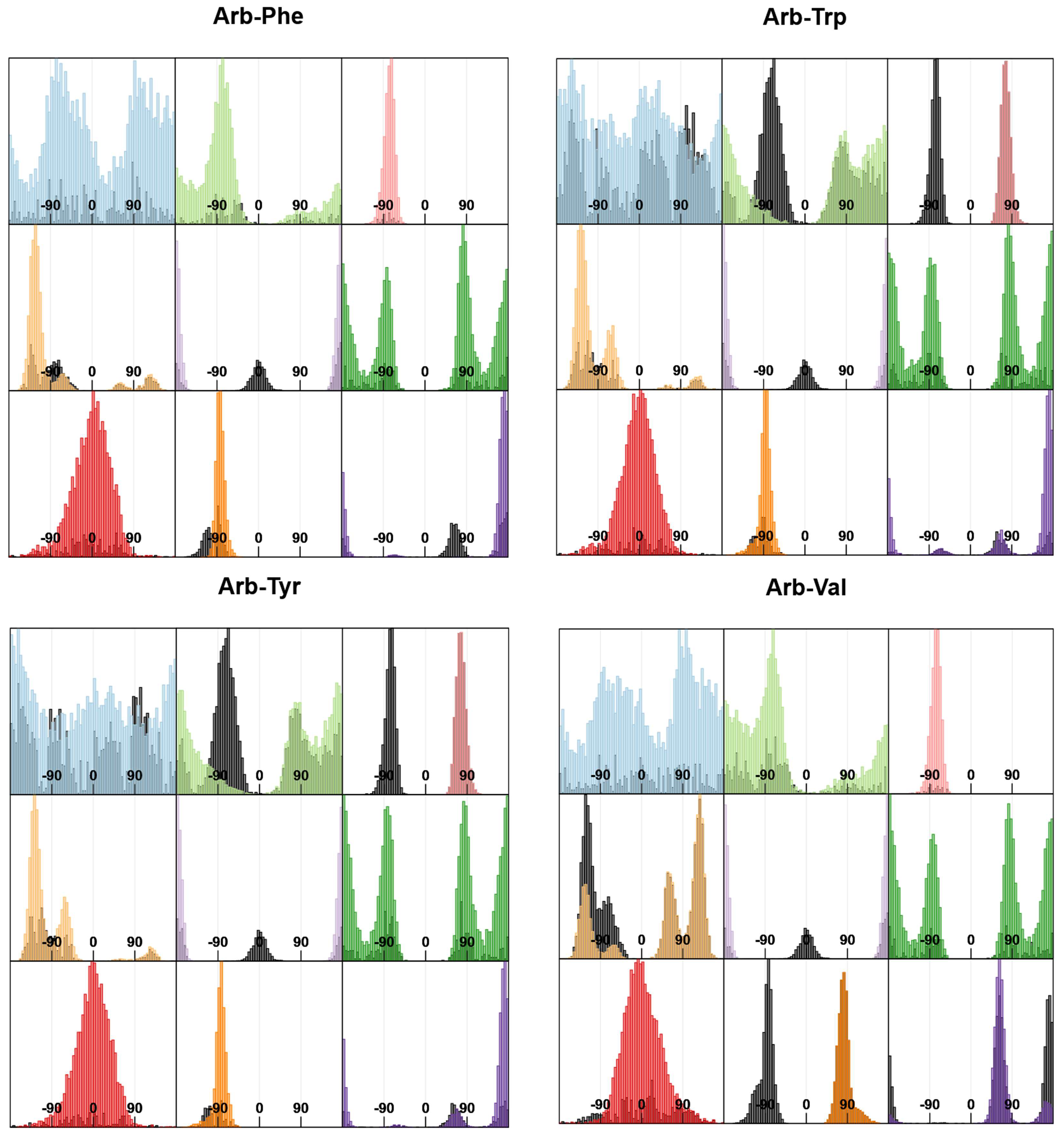
The difference in population of the Arb conformational states is shown in Figure 4. The color scheme is the same as in Figure 3, except for the black color, which displays the modulus of the difference between the population values |Arb − Arb-AA| depending on the corresponding torsion angle in the Arb molecule. The statistical and graphic analysis of the histograms presented in Figure 4 leads to simple and obvious conclusions about the nature of Arbidol’s interaction with amino acids.
The most significant change in the conformational potential of Arb in its complex with aromatic amino acids is observed for the rotation of phenyl, thiophenyl, and thioanisole fragments of Arbidol in the Arb–Trp and Arb–Tyr pairs (the first three histograms in Figure 4). Indeed, the π-π stacking interaction of molecules takes place in the most frequently realized contact of Arb with Tyr, with the polar zwitterionic group of the amino acid oriented along the thioanisole fragment of Arb, thus causing the observed change in the conformational potential. During the interaction of Arb with Trp, the stacking contact is accompanied by the formation of an intermolecular hydrogen bond N-H···S between the indole fragment of amino acid and a sulfur atom of the thiophenyl substituent, which also changes the nature of free rotation along the C-S bonds in Arbidol. It is noteworthy that the absence of noticeable changes in the conformational potential of the Arb–Phe pair, in which a stacking contact also takes place, is due to a different structure of π-complex where the orientation of the Phe zwitterion towards the polar head of Arb is observed. In this case, the conformational changes of Arbidol are generally insignificant (Figure 4).
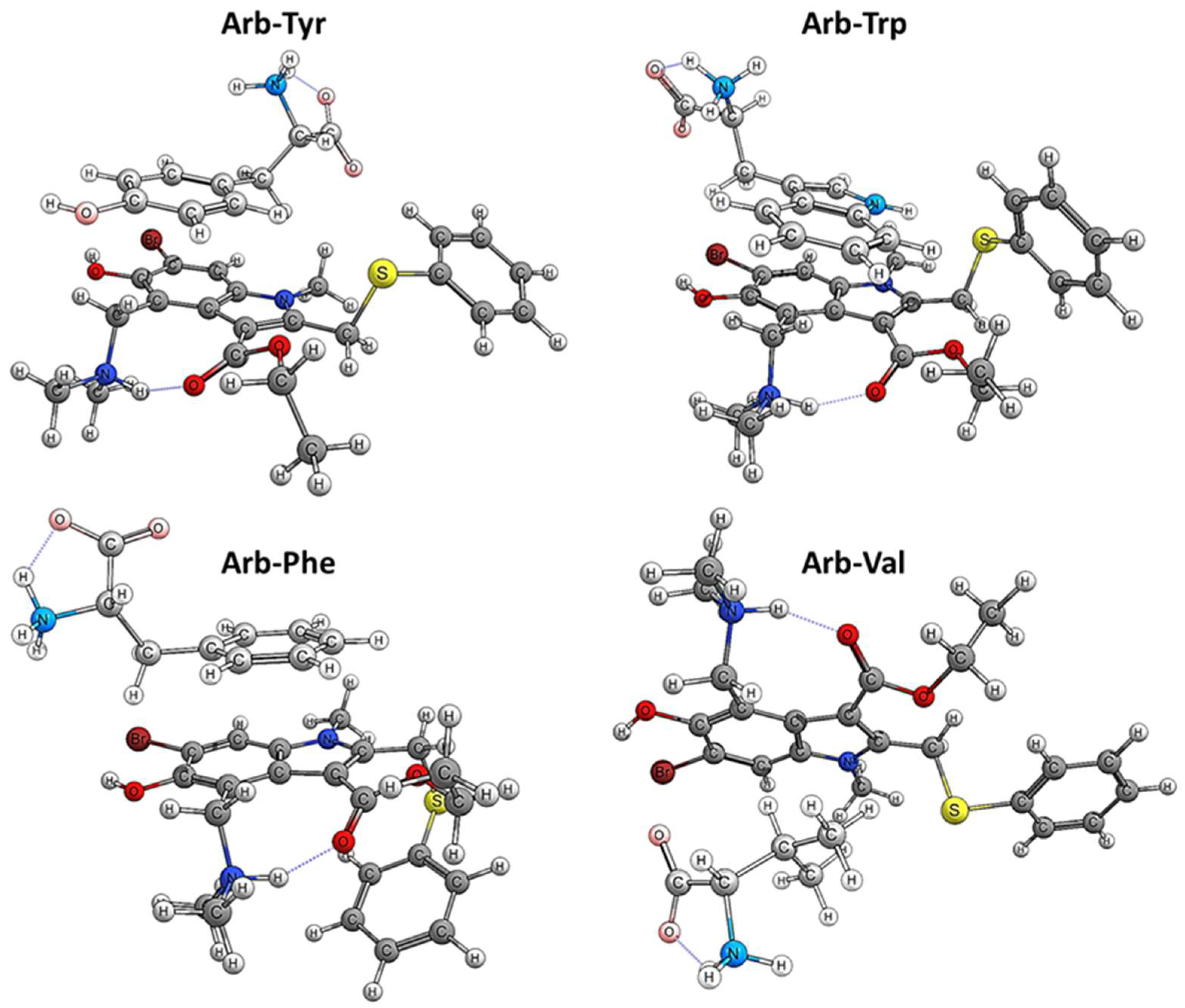
Finally, in the Arb–Val pair, the most significant changes are observed in the fourth (rotation of ester fragment), eighth (rotation of protonated trimethylaminyl fragment), and ninth (rotation of protonated dimethylaminyl fragment) histograms; see Figure 3 and Figure 4. However, these changes are not associated with any specific interaction of Arb–Val and are due to inversion of the area of intramolecular binding between the protonated center and ester group relative to the plane of the Arb indole fragment. Statistical analysis of the most frequent and, therefore, energetically favorable contacts is consistent with the above conformational changes. The structures of the most probable complexes found by MD simulations were re-optimized within the framework of density functional theory and implicit PCM solvent model and are shown in Figure 5. The structures of the DFT-optimized complexes correspond well to those obtained by MD simulations.

3.3. Estimation of the Arb–AA Interaction Energy

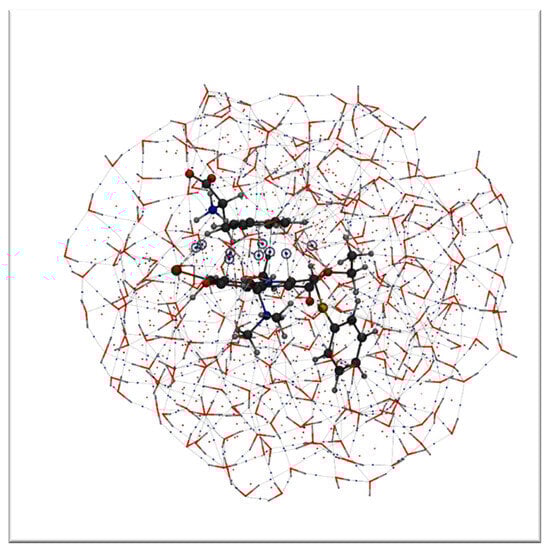
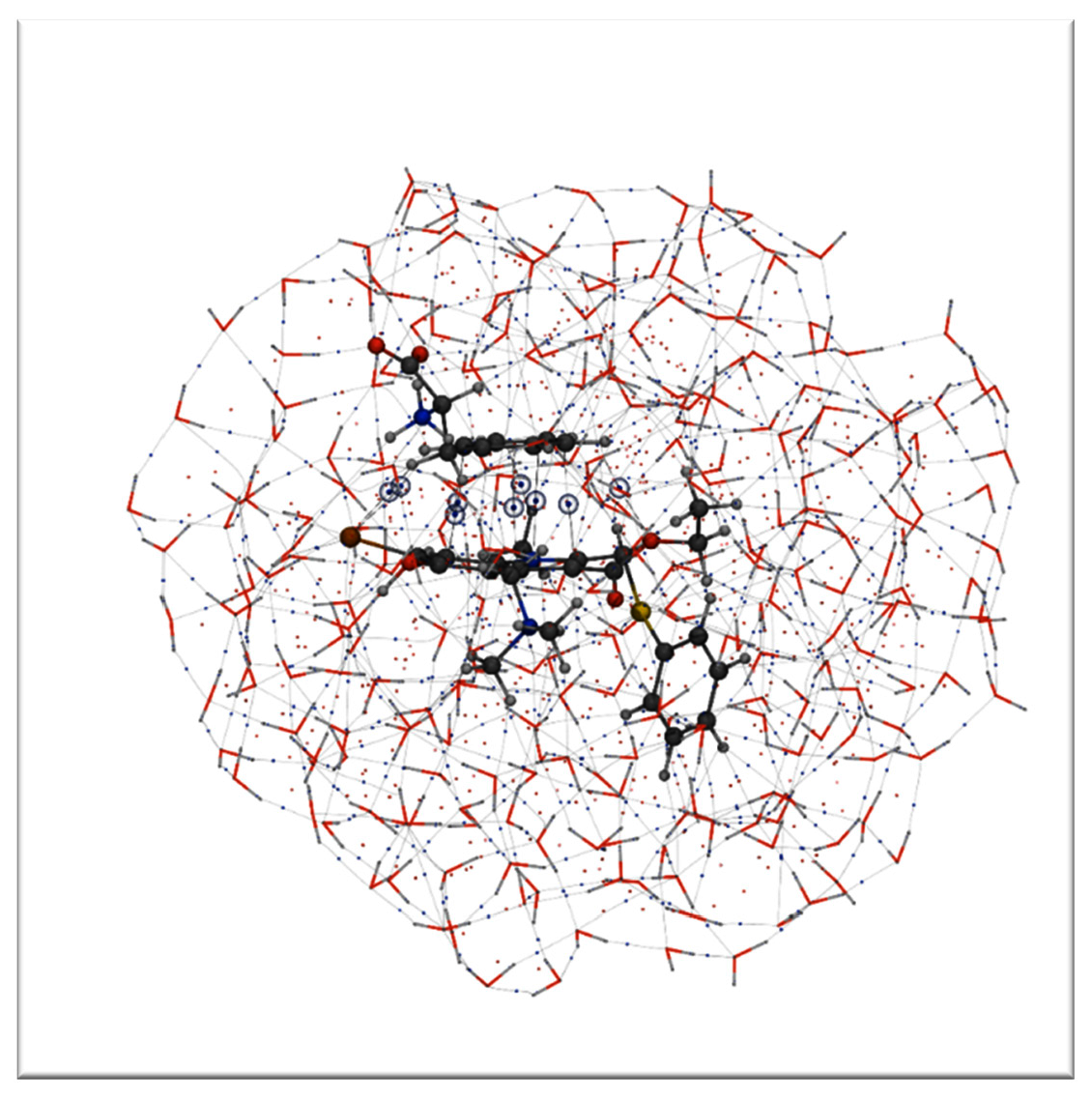
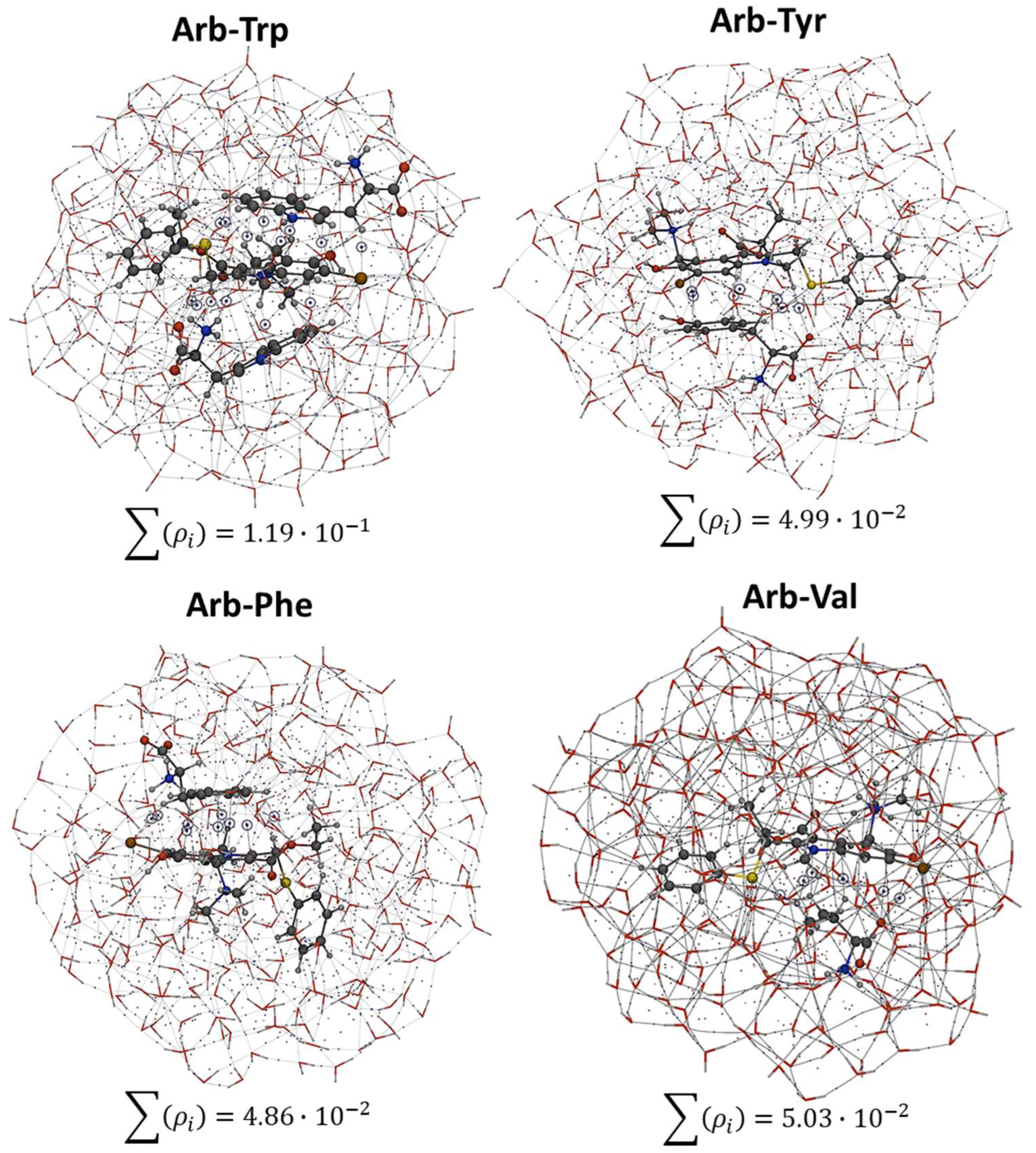
The Arb–AA binding energy for the case of the explicit aqueous model was estimated using density functional theory and the results of MD simulation of Arb–AA complex solvation as an initial approximation. Analysis of the pair radial distribution function g(r) (Figure S3), where the pair is the center of mass of Arbidol and the water molecule, allowed us to determine the radius of the solvation shell to within 10 Å. Accordingly, we took into account the explicit presence of water molecules within a radius of 12 Å (2 Å more for reliability) during optimization geometric parameters of Arb–AA complexes. Then, using QTAIM analysis [39], a complete set of bond critical points of the solvate cluster was localized, of which only BCPs of the (3; −1) type corresponding to the interaction of Arbidol molecules with an amino acid were considered (Figure 6, points in blue circles). It was found that the main types of Arb–AA interaction are stacking of aromatic fragments and hydrogen bonding. The total value of electron density at BCPs, ∑ρi (Figure 6) was used as a measure of interaction energy of Arbidol with amino acids in the optimized complexes. More detailed information is presented in Figures S4–S7. It is worth pointing out that the solvated Arb–AA complexes shown in Figure 6 are not the only possible structures but were chosen as the most frequently formed ones based on the results of MD simulation indicating the probability of Arb contacts with AA decreasing in the order of Trp > Tyr > Phe > Val (Figure 2, Table 2).
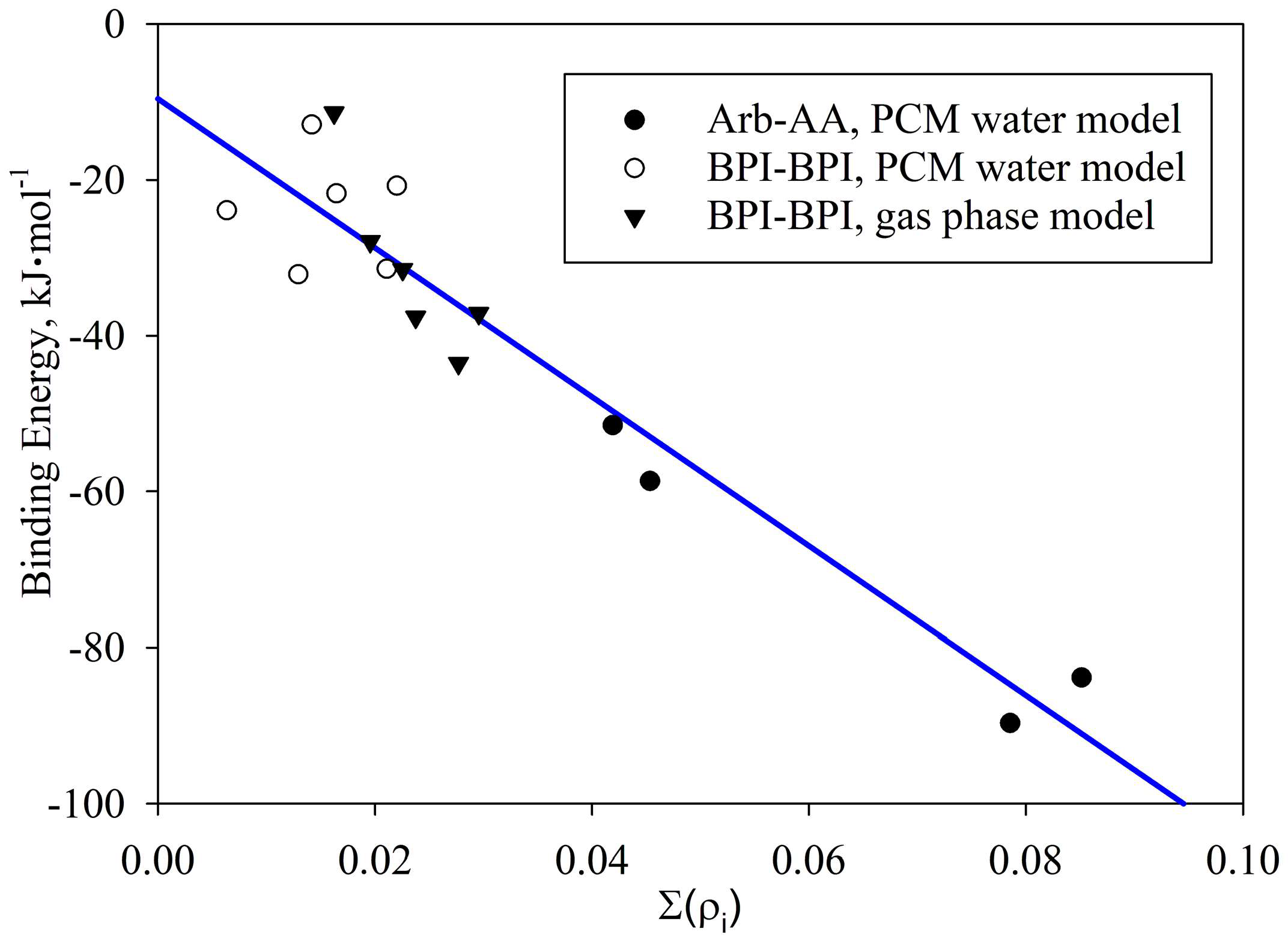
The total interaction energy of Arbidol with AA in a model system with explicit effect of the solvent, determined by a set of intermolecular contacts, is difficult to estimate using traditional quantum chemistry techniques. A possible solution to this problem was proposed in Ref. [36]. The authors established a linear correlation between total electron density at the bond critical points ∑ρi and energy of hydrogen bonding of the components of the interacting system. We applied a similar approach, considering the fact that the dominant interaction motif is π-π stacking in our case. To determine the coefficients of the BE vs. ∑ρi linear correlation, a test set of interacting pairs of reagents was used, for which direct determination of BE for stacking contact is possible through the difference in total energies of the π-π complex and reagents (Tables S1 and S2). Since the aromatic fragments of the studied AAs are benzene (B), phenol (P) and indole (I), all six combinations of π-π complexes (BPI) in both gas and liquid phases (PCM water model) were included in the test set. It also includes Arb complexes with AA, calculated within the implicit solvent model (Figure 5). The QTAIM analysis of the wave function was performed for all pairs, and bond critical points corresponding to the π-π stacking interaction were localized (Figures S8–S13). For Arb–AA pairs, the BCPs of hydrogen bonding were also considered (Figures S14–S17). A satisfactory correlation was observed between BE and ∑ρi (Figure 7), which allowed us to derive the coefficients of the linear regression; see Equation (1). Using this equation, the Arb–AA binding energies (kJ/mol) for the case of the explicit model of a water cluster solvating Arb and AA were estimated from the ∑ρi values (Figure 6). The results of this estimation are presented in Table 2.
The most stable π-π complex is formed by the Arb–Trp pair. It should also be noted that the BE estimate for the Arb–Val interaction may be inaccurate, since the applicability of Equation (1), based on the correlation of energy of stacking contacts and electron density in BCPs, is not obvious for this pair. Therefore, the binding energy of Arb–Val was also estimated using the equation
B E   ( k J / m o l ) = 933 × ρ i + 3.1 ,
proposed by authors of Ref. [36] for hydrogen-bonded systems. It was found that BE = −43.8 ± 6.4 kJ/mol, which is 14 kJ/mol less than the estimated value of BE given in Table 2.
Thus, it can be concluded that in an aqueous environment, which is the most natural for biological objects, Arb forms significantly stronger complexes with tryptophan. Apparently, this is due to both a larger π-electron system of Trp and donor properties of the nitrogen atom in the indole fragment. When projecting these results onto real active sites of biological systems, the statistical factor of interaction should also be considered. π-π stacking requires coplanarity of interacting species, which may be associated with energy-consuming conformational rearrangement of the amino acid chain of a polypeptide and, thus, a decrease in the efficiency of the stacking interaction. In the aqueous model we studied, low-molecular-weight reagents have a significant degree of freedom to choose a favorable orientation during interaction. Thus, the proportion of “favorable” Arb–AA contacts changes from 18.4% (Trp) to 0.5% (Val); see Table 2. Obviously, in the latter case this is due to the competing effective hydration of the amino acid, which prevents the formation of a complex with Arbidol.

3.4. Quenching of AA Fluorescence by Arb

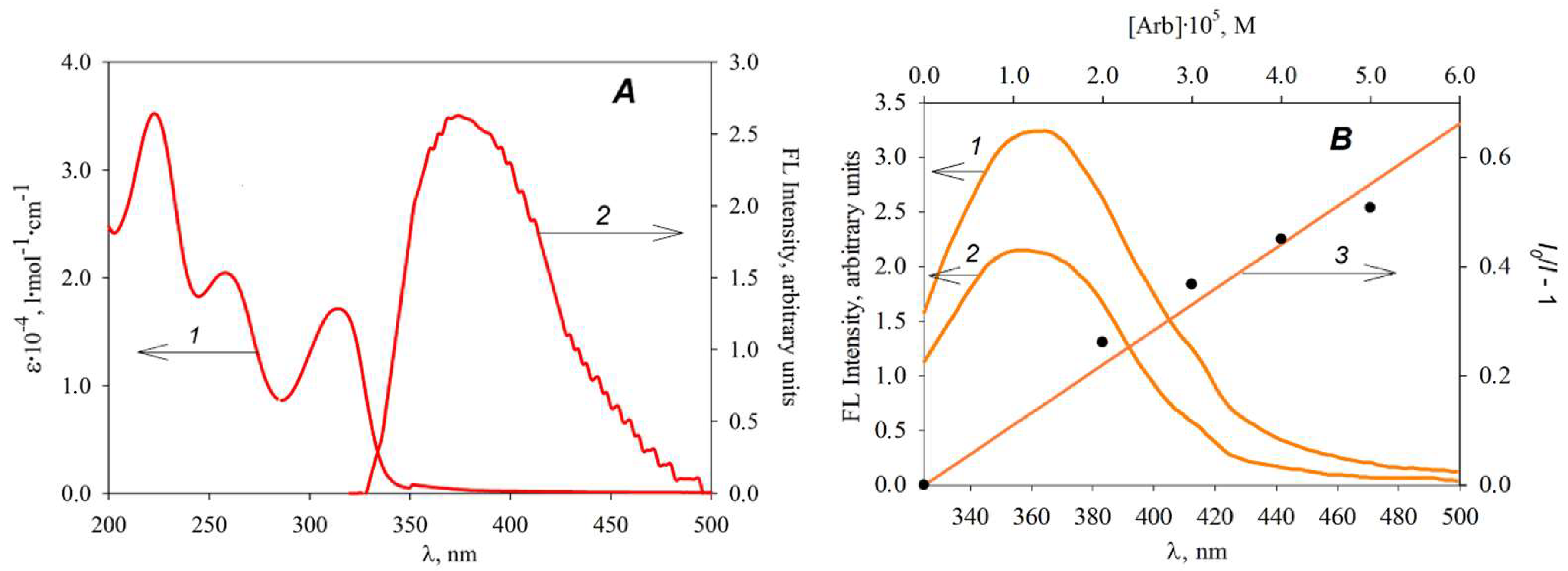
The MD + QC investigation indicates that π-π-type stacking contacts dominate during the interaction of Arb with aromatic amino acids. Independent experimental confirmation of this fact can be obtained using luminescence studies, given the fact that aromatic amino acids have fairly intense fluorescence. The emitter of FL is the aromatic system of AA, which receives an additional opportunity for nonradiative deactivation in the π-π complex, i.e., it may be assumed a priori that Arb, forming complexes with aromatic AAs, will effectively quench their FL. However, the Arbidol molecule also contains an indole fragment capable of luminescence. For this reason, spectral studies were carried out to find the optimal conditions of FL registering using interaction of Arb with tryptophan as a probe test. Thus, the absorption spectrum of Arb (Figure 8A) in H2O has three maxima at 222 (ε = 3.5 × 10⁴), 257 (2.0 × 10⁴) and 315 nm (1.7 × 10⁴ M−1 × cm−1), as well as two minima at 245 (1.83 × 10⁴) and 286 nm (0.86 × 10⁴ M−1 × cm−1). The FL spectrum of Arb hydrochloride in aqueous solution has a maximum at λem = 374 nm. The FL quantum yield calculated using Equation (2) is small, φArb = 3.0 × 10⁻⁵.
The FL spectra of Trp (Figure 8B, λmax = 353 nm) and Arb are located in the same spectral region. However, the FL quantum yield of Trp (φTrp = 0.14 [40]) is significantly higher than that of Arbidol; therefore, their interaction may be studied by the quenching of FL of Trp by Arb. The absorption spectra of Arb and Trp, caused by the indole chromophore, also overlap, which does not allow selective photoexcitation of the latter. Optimal photoexcitation was found to be possible at λex = 286 nm in the long-wavelength minimum of Arb absorption (Figure 8A), which successfully corresponds to the maximum of the long-wavelength absorption band of Trp at 280–290 nm [40].
It was found that Arb effectively quenches FL of Trp (Figure 8B, spectra 1, 2). Quenching is satisfactorily described by the Stern–Volmer equation (Figure 8B, plot 3) [40,41]:
I 0 I 1 = K × Q = k q × τ 0 × Q ,
where K is the Stern–Volmer quenching constant; [Q] is the concentration of the quencher; I0 and I are the FL intensities of Trp in the absence and presence of the quencher, respectively; kq is the effective quenching rate constant; and τ0 is the lifetime of the excited singlet of Trp, equal to 3.1 ns [40].
The anomalously high value of the effective bimolecular rate constant of FL quenching by Arbidol kq = 4.5 × 10¹² M−1 × s−1, which is three orders of magnitude higher than the rate constant of reagent diffusion in aqueous medium [37], allows us to state that FL quenching is followed by a static mechanism [40] and, presumably, by photoinduced electron transfer, PET [41]. PET leads to the formation of ion–radical pairs, the reverse recombination of which is accompanied by FL quenching of chromophore due to its transition to ground state without emission of light. The standard redox potential and excitation energy of 0−0 transitions of tryptophan E°(Trp•+/Trp) = 1.015 eV [42] and ΔE0−0(Trp*) = 3.9 eV [43] cause the high electron-donor ability of Trp in the electron-excited state, which determines the diversity of its photochemical reactions, including the PET process to an acceptor, the Arbidol molecule in our case. Thus, the most probable mechanism of quenching of tryptophan FL by Arbidol can be assumed to be intra-complex reversible electron phototransfer, which is preceded by π-π stacking interaction between the aromatic components Arb and Trp:
Trp   +   Arb     Trp - Arb   h ν [ Trp + Arb ]
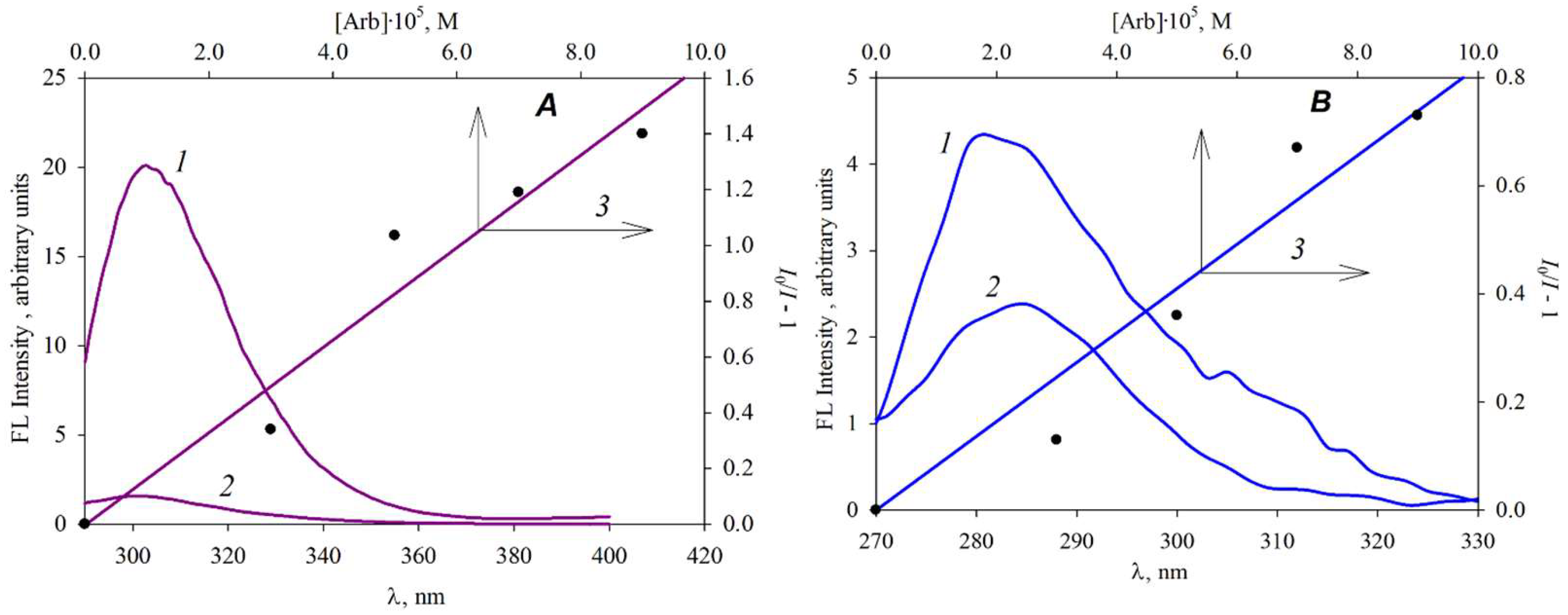
The similar photophysical and photochemical properties of aromatic AAs were judged to use the same procedure to select the conditions for photoexcitation of Tyr and Phe and quenching of their FL by Arb. Figure 9 shows the luminescence spectra of Tyr and Phe and their Stern–Volmer plots in the presence of Arbidol.
Similar to the tryptophan case, the effective bimolecular rate constants for quenching the fluorescence of tyrosine and phenylalanine by Arbidol (Table 3) are orders of magnitude higher than the rate constants for reagent diffusion in water [37]. This allows us to conclude that FL quenching of all studied aromatic amino acids by Arbidol occurs by a static mechanism [40].
From the comparison of the data in Table 3, it follows that the efficiency of quenching of aromatic AA fluorescence by Arbidol is approximately the same and decreases somewhat in the order of Tyr > Trp > Phe. It should also be noted that quenching of Arbidol’s own fluorescence by aliphatic amino acids Leu, Ile and Val was not observed in our experiments. This indicates the absence of prolonged interactions of the Arb molecule with aliphatic AAs in an aqueous solution. Thus, the luminescence measurements confirm the conclusions made during our MD + QC study on the dominant nature of interaction of Arb with aromatic amino acids.

4. Discussion

Combined data from molecular dynamics and quantum chemical calculations shows that Arbidol in an aqueous solution forms the longest and strongest intense contacts with aromatic amino acids. Based on the structural features of the studied systems, it can be concluded that Arb forms complexes with Trp, Tyr and Phe through π-π stacking interactions. This is also evidenced by the observed effects of quenching of aromatic amino acid fluorescence by Arbidol. Analysis of the MD population maps of the Arb–Tyr complex shows that the probability of complex formation or, in other words, the duration of the π-π stacking interactions takes place during 15.4% of the total simulation time (Table 2). In the Arb–Trp complex, tryptophan can be located twice as frequently as the indole scaffold of Arb. In both cases, the duration of the interaction is realized within 8.6 or 9.8% of the total simulation time. The Arb–Phe complex is formed in 6.2% of the simulation. The hydrophobic amino acid Val, as well as probably two other aliphatic amino acids, Ile and Leu, can interact with Arb for a short period. This is evidenced by the RMSD (Table 1) and 3D values of the population maps (Figure 2, Table 2). In fact, the Arb–Val complex is detected only in 0.5% of the MD simulation frames. Apparently, such a short contact cannot lead to a noticeable effect of quenching of the intrinsic fluorescence of Arbidol by valine, which is confirmed by the FL experiment. The binding energies of Arb with Tyr and Phe are close and amount to 56–57 kJ/mol; more efficient binding occurs with Trp, which is apparently due to a more developed π-electron system and a donor nitrogen atom in the indole scaffold of Trp.
Arbidol can bind to surface proteins due to the formation of non-covalent interactions with functional AAs. Molecular modeling methods (docking and classical dynamics) allow us to describe the location of the molecule at the binding site and determine probable intermolecular interactions with surrounding AAs. In this case, rather crude atomistic approaches are used. The advantage of these approaches is the short calculation time and the ability to represent the full-sized protein structure. However, if the binding site of the biologically active molecules and the key amino acids are known reliably, it is possible to use more accurate computation methods to study the interactions of the ligand that can affect the function of the protein as a whole. We presented a theoretical approach using molecular dynamics and quantum chemistry methods to estimate the duration and intensity of interactions between Arb and functional amino acids that are directly contacted by the ligand when binding to the surface proteins of the influenza and SARS-CoV-2 viruses. According to calculations, Arb is able to form strong and long-term π-π stacking interactions with aromatic amino acids. Thus, if the studied amino acids play a key role in the binding site of some other protein, then Arbidol can influence the conformation of the side chains due to the formation of π-π intermolecular interactions. Of course, the size of the binding site must be suitable for Arb binding to occur. For example, it is known [46] that the binding site of F protein inhibitors of respiratory syncytial virus is saturated with phenylalanines, the arrangement of which relative to each other affects the configuration of the protein as a whole. The results of our study allow us to assume that Arbidol can bind to the site of F protein inhibitors and influence the Phe-containing side chains through π-π stacking interactions. The mechanism of Arbidol’s influence on the functioning of the RSV F protein has not been studied in depth, but there is evidence that Arbidol is effective against RSV [47]. In addition, the authors of [48] consider the possibility of binding of Arb to the inhibitor-binding site of the F protein. Thus, the presented theoretical approach can be used to assess the intensity and duration of interaction between a biologically active molecule and functional amino acids, as well as to justify the choice of potential biological targets.

5. Conclusions

One of the stages in studying the mechanism of the biological action of small molecules is evaluating the affinity for binding to the target protein’s binding site and describing the nature of interaction with key amino acid residues. Traditionally, methods such as molecular docking and dynamics have been used for this purpose, and they have proven to be effective. However, using these computational methods requires knowledge of geometric parameters for the ligand–protein complex or the target protein encoded by experimental methods; otherwise, there is a high risk of error. Alternatively, more precise methods such as quantum chemical methods or the QM/MM approach could be used. However, these methods have limitations due to the size of atomic–molecular systems. Our methodology enables us to assess the effect of small molecules on specific amino acids that are crucial for a particular target protein. Intermolecular interactions that occur between the atoms of residues and ligands can affect the secondary structure of proteins, and consequently the biological function of these proteins. For example, the inhibition of fusogenic activity of hemagglutinin is associated with a direct effect of Arbidol on the second subunit of a protein. As we have shown above, Arbidol forms a number of strong interactions with aromatic amino acid residues lining the cavity of a binding site. Our calculations agree with experimental data.
Thus, if information is available about the key amino acid residues of the target protein, the above algorithm can be used to evaluate the energy and nature of the interaction with a potential ligand. This approach is obviously more accurate than molecular docking and faster than QM/MM calculations.

Supplementary Materials

The following supporting information can be downloaded at: https://www.mdpi.com/article/10.3390/scipharm94010020/s1, Figure S1: Model Arb-AA systems; Figure S2: RMSD of the components of aqueous solutions during MD simulation; Figure S3: Radial distribution function of pair interactions of solvent molecules (water) with Arbidol–amino acid complexes; Figure S4: Explicit model of the Arb–Val complex; Figure S5: Explicit model of the Arb–Tyr complex; Figure S6: Explicit model of the Arb–Phe complex; Figure S7: Explicit model of the Arb–Trp complex; Figure S8: PCM model of the benzene–benzene complex; Figure S9: PCM model of the benzene–phenol complex; Figure S10: PCM model of the benzene–indole complex; Figure S11: PCM model of the phenol–phenol complex; Figure S12: PCM model of the indole–indole complex; Figure S13: PCM model of the phenol–indole complex; Figure S14: PCM model of the Arb–Tyr complex; Figure S15: PCM model of the Arb–Trp complex; Figure S16: PCM model of the Arb–Phe complex; Figure S17: PCM model of the Arb–Val complex; Table S1: B3LYP-D3/def2-svp PCM (water) energies of aromatic molecules and their complexes; Table S2: B3LYP-D3/def2-svp PCM (water) energies of Arb and AAs and their complexes.

Author Contributions

Conceptualization, S.S.B. and S.L.K.; methodology, G.A.M. and E.M.K.; software, E.M.K.; validation, S.S.B., G.A.M. and S.L.K.; formal analysis, E.M.K.; investigation, G.A.M. and E.M.K.; resources, O.I.Y.; data curation, S.S.B.; writing—original draft preparation, S.S.B. and O.I.Y.; writing—review and editing, S.S.B. and S.L.K.; visualization, E.M.K.; supervision, S.L.K.; project administration, S.L.K. All authors have read and agreed to the published version of the manuscript.

Funding

This work has been made in accordance with the research plan of Ufa Institute of Chemistry of the Ufa Federal Research Center of the Russian Academy of Sciences No. 125020601626-9.

Data Availability Statement

Upon request from the corresponding author.

Acknowledgments

All spectral experiments have been performed with equipment of Research Equipment Sharing Centers “Chemistry” of Ufa Institute of Chemistry UFRC RAS. The authors are grateful to the theoretical group ‘Quanta and Dynamics’ (https://monrel.ru accessed on 10 February 2025).

Conflicts of Interest

The authors declare that there are no conflicts of interest.

Abbreviations

The following abbreviations are used in this manuscript:
AAsAmino acids
a.u.Atomic units
ArbArbidol (Umifenovir)
BCPBond critical point
BEBinding energy
FLFluorescence
HAHemagglutinin of influenza virus
HRHeptad repeat
MDMolecular dynamics
PCMPolarized continuum model
PETPhotoinduced electron transfer
RMSDRoot-mean-square deviation
QCQuantum chemistry
QMQuantum mechanics
QTAIMQuantum theory “Atoms In Molecules”

References

  1. Boriskin, Y.S.; Leneva, I.A.; Pecheur, E.I.; Polyak, S.J. Arbidol: A Broad-Spectrum Antiviral Compound that Blocks Viral Fusion. Curr. Med. Chem. 2008, 15, 997–1005. [Google Scholar] [CrossRef]
  2. Leneva, I.; Kartashova, N.; Poromov, A.; Gracheva, A.; Korchevaya, E.; Glubokova, E.; Borisova, O.; Shtro, A.; Loginova, S.; Shchukina, V.; et al. Antiviral Activity of Umifenovir In Vitro against a Broad Spectrum of Coronaviruses, Including the Novel SARS-CoV-2 Virus. Viruses 2021, 13, 1665. [Google Scholar] [CrossRef] [PubMed]
  3. Kadam, R.U.; Wilson, I.A. Structural basis of influenza virus fusion inhibition by the antiviral drug Arbidol. Proc. Natl. Acad. Sci. USA 2017, 114, 206–214. [Google Scholar] [CrossRef] [PubMed]
  4. Matrosovich, M.; Herrler, G.; Klenk, H.D. Sialic Acid Receptors of Viruses. In SialoGlyco Chemistry and Biology II: Tools and Techniques to Identify and Capture Sialoglycans; Gerardy-Schahn, R., Delannoy, P., von Itzstein, M., Eds.; Springer International Publishing: Cham, Switzerland, 2015; pp. 1–28. [Google Scholar]
  5. Xu, R.; Wilson, I.A. Structural Characterization of an Early Fusion Intermediate of Influenza Virus Hemagglutinin. J. Virol. 2011, 85, 5172–5182. [Google Scholar] [CrossRef] [PubMed]
  6. Hamilton, B.S.; Whittaker, G.R.; Daniel, S. Influenza Virus-Mediated Membrane Fusion: Determinants of Hemagglutinin Fusogenic Activity and Experimental Approaches for Assessing Virus Fusion. Viruses 2012, 4, 1144–1168. [Google Scholar] [CrossRef]
  7. Benton, D.J.; Gamblin, S.J.; Rosenthal, P.B.; Skehel, J.J. Structural transitions in influenza haemagglutinin at membrane fusion pH. Nature 2020, 583, 150–153. [Google Scholar] [CrossRef]
  8. Barrett, C.T.; Dutch, R.E. Viral Membrane Fusion and the Transmembrane Domain. Viruses 2020, 12, 693. [Google Scholar] [CrossRef]
  9. Russell, R.J.; Kerry, P.S.; Stevens, D.J.; Steinhauer, D.A.; Martin, S.R.; Gamblin, S.J.; Skehel, J.J. Structure of influenza hemagglutinin in complex with an inhibitor of membrane fusion. Proc. Natl. Acad. Sci. USA 2008, 105, 17736–17741. [Google Scholar]
  10. Harrison, S.C. Viral membrane fusion. Virology 2015, 479–480, 498–507. [Google Scholar] [CrossRef]
  11. Borisevich, S.S.; Zarubaev, V.V.; Shcherbakov, D.N.; Yarovaya, O.I.; Salakhutdinov, N.F. Molecular Modeling of Viral Type I Fusion Proteins: Inhibitors of Influenza Virus Hemagglutinin and the Spike Protein of Coronavirus. Viruses 2023, 15, 902. [Google Scholar] [CrossRef]
  12. Leneva, I.A.; Russell, R.J.; Boriskin, Y.S.; Hay, A.J. Characteristics of arbidol-resistant mutants of influenza virus: Implications for the mechanism of anti-influenza action of arbidol. Antivir. Res. 2009, 81, 132–140. [Google Scholar] [CrossRef] [PubMed]
  13. Wright, Z.V.F.; Wu, N.C.; Kadam, R.U.; Wilson, I.A.; Wolan, D.W. Structure-based optimization and synthesis of antiviral drug Arbidol analogues with significantly improved affinity to influenza hemagglutinin. Bioorg. Med. Chem. Lett. 2017, 27, 3744–3748. [Google Scholar] [CrossRef] [PubMed]
  14. Wang, X.; Cao, R.; Zhang, H.; Liu, J.; Xu, M.; Hu, H.; Li, Y.; Zhao, L.; Li, W.; Sun, X.; et al. The anti-influenza virus drug, arbidol is an efficient inhibitor of SARS-CoV-2 in vitro. Cell Discov. 2020, 6, 28. [Google Scholar] [CrossRef] [PubMed]
  15. Cai, L.; Guo, X.; Cao, Y.; Ying, P.; Hong, L.; Zhang, Y.; Yi, G.; Fu, M. Determining available strategies for prevention and therapy: Exploring COVID-19 from the perspective of ACE2 (Review). Int. J. Mol. Med. 2021, 47, 43. [Google Scholar] [CrossRef]
  16. Borisevich, S.S.; Khamitov, E.M.; Gureev, M.A.; Yarovaya, O.I.; Rudometova, N.B.; Zybkina, A.V.; Mordvinova, E.D.; Shcherbakov, D.N.; Maksyutov, R.A.; Salakhutdinov, N.F. Simulation of Molecular Dynamics of SARS-CoV-2 S-Protein in the Presence of Multiple Arbidol Molecules: Interactions and Binding Mode Insights. Viruses 2022, 14, 119. [Google Scholar] [CrossRef]
  17. Vankadari, N. Arbidol: A potential antiviral drug for the treatment of SARS-CoV-2 by blocking trimerization of the spike glycoprotein. Int. J. Antimicrob. Agents 2020, 56, 105998. [Google Scholar] [CrossRef]
  18. Freidel, M.R.; Armen, R.S. Modeling the Structure–Activity Relationship of Arbidol Derivatives and Other SARS-CoV-2 Fusion Inhibitors Targeting the S2 Segment of the Spike Protein. J. Chem. Inf. Model. 2021, 61, 5906–5922. [Google Scholar] [CrossRef]
  19. Berman, H.M.; Westbrook, J.; Feng, Z.; Gilliland, G.; Bhat, T.N.; Weissig, H.; Shindyalov, I.N.; Bourne, P.E. The Protein Data Bank. Nucleic Acids Res. 2000, 28, 235–242. [Google Scholar] [CrossRef]
  20. Benton, D.J.; Wrobel, A.G.; Roustan, C.; Borg, A.; Xu, P.; Martin, S.R.; Rosenthal, P.B.; Skehel, J.J.; Gamblin, S.J. The effect of the D614G substitution on the structure of the spike glycoprotein of SARS-CoV-2. Proc. Natl. Acad. Sci. USA 2021, 118, e2022586118. [Google Scholar] [CrossRef]
  21. Blaising, J.; Polyak, S.J.; Pécheur, E.-I. Arbidol as a broad-spectrum antiviral: An update. Antivir. Res. 2014, 107, 84–94. [Google Scholar] [CrossRef]
  22. Vinson, C.R.; Sigler, P.B.; McKnight, S.L. Scissors-Grip Model for DNA Recognition by a Family of Leucine Zipper Proteins. Science 1989, 246, 911–916. [Google Scholar] [CrossRef]
  23. Alder, B.J.; Wainwright, T.E. Studies in Molecular Dynamics. I. General Method. J. Chem. Phys. 1959, 31, 459–466. [Google Scholar] [CrossRef]
  24. Jorgensen, W.L. Quantum and statistical mechanical studies of liquids. 10. Transferable intermolecular potential functions for water, alcohols, and ethers. Application to liquid water. J. Am. Chem. Soc. 1981, 103, 335–340. [Google Scholar] [CrossRef]
  25. Jorgensen, W.L.; Chandrasekhar, J.; Madura, J.D.; Impey, R.W.; Klein, M.L. Comparison of simple potential functions for simulating liquid water. J. Chem. Phys. 1983, 79, 926–935. [Google Scholar] [CrossRef]
  26. Lu, C.; Wu, C.; Ghoreishi, D.; Chen, W.; Wang, L.; Damm, W.; Ross, G.A.; Dahlgren, M.K.; Russell, E.; Von Bargen, C.D.; et al. OPLS4: Improving Force Field Accuracy on Challenging Regimes of Chemical Space. J. Chem. Theory Comput. 2021, 17, 4291–4300. [Google Scholar] [CrossRef]
  27. Humphrey, W.; Dalke, A.; Schulten, K. VMD: Visual molecular dynamics. J. Mol. Graph. 1996, 14, 33–38. [Google Scholar] [CrossRef] [PubMed]
  28. Pettersen, E.F.; Goddard, T.D.; Huang, C.C.; Meng, E.C.; Couch, G.S.; Croll, T.I.; Morris, J.H.; Ferrin, T.E. UCSF ChimeraX: Structure visualization for researchers, educators, and developers. Protein Sci. 2021, 30, 70–82. [Google Scholar] [CrossRef]
  29. Ufimtsev, I.S.; Martínez, T.J. Graphical Processing Units for Quantum Chemistry. Comput. Sci. Eng. 2008, 10, 26–34. [Google Scholar] [CrossRef]
  30. Becke, A.D. Density-functional thermochemistry. III. The role of exact exchange. J. Chem. Phys. 1993, 98, 5648–5652. [Google Scholar] [CrossRef]
  31. Lee, C.; Yang, W.; Parr, R.G. Development of the Colle-Salvetti correlation-energy formula into a functional of the electron density. Phys. Rev. B 1988, 37, 785–789. [Google Scholar] [CrossRef]
  32. Grimme, S.; Antony, J.; Ehrlich, S.; Krieg, H. A consistent and accurate ab initio parametrization of density functional dispersion correction (DFT-D) for the 94 elements H-Pu. J. Chem. Phys. 2010, 132, 154104. [Google Scholar] [CrossRef] [PubMed]
  33. Weigend, F.; Ahlrichs, R. Balanced basis sets of split valence, triple zeta valence and quadruple zeta valence quality for H to Rn: Design and assessment of accuracy. Phys. Chem. Chem. Phys. 2005, 7, 3297–3305. [Google Scholar] [CrossRef] [PubMed]
  34. Weigend, F. Accurate Coulomb-fitting basis sets for H to Rn. Phys. Chem. Chem. Phys. 2006, 8, 1057–1065. [Google Scholar] [CrossRef]
  35. Lu, T.; Chen, F. Multiwfn: A multifunctional wavefunction analyzer. J. Comput. Chem. 2012, 33, 580–592. [Google Scholar] [CrossRef] [PubMed]
  36. Emamian, S.; Lu, T.; Kruse, H.; Emamian, H. Exploring Nature and Predicting Strength of Hydrogen Bonds: A Correlation Analysis Between Atoms-in-Molecules Descriptors, Binding Energies, and Energy Components of Symmetry-Adapted Perturbation Theory. J. Comput. Chem. 2019, 40, 2868–2881. [Google Scholar] [CrossRef]
  37. Parker, C.A. Photoluminescence of Solutions: With Applications to Photochemistry and Analytical Chemistry; Elsevier Publishing: Amsterdam, The Netherlands, 1968. [Google Scholar]
  38. Tatischeff, I.; Klein, R. Influence of the Environment on the Excitation Wavelength Dependence of the Fluorescence Quantum Yield of Indole. Photochem. Photobiol. 1975, 22, 221–229. [Google Scholar] [CrossRef]
  39. Bader, R.F.W. A quantum theory of molecular structure and its applications. Chem. Rev. 1991, 91, 893–928. [Google Scholar] [CrossRef]
  40. Lakowicz, J.R. Principles of Fluorescence Spectroscopy; Springer: New York, NY, USA, 2006; p. 954. [Google Scholar]
  41. Barltrop, J.A.; Coyle, J.D. Excited States in Organic Chemistry; John Wiley & Sons: New York, NY, USA, 1975. [Google Scholar]
  42. Harriman, A. Further comments on the redox potentials of tryptophan and tyrosine. J. Phys. Chem. 1987, 91, 6102–6104. [Google Scholar] [CrossRef]
  43. Horrocks, W.D.; Bolender, J.P.; Smith, W.D.; Supkowski, R.M. Photosensitized Near Infrared Luminescence of Ytterbium(III) in Proteins and Complexes Occurs via an Internal Redox Process. J. Am. Chem. Soc. 1997, 119, 5972–5973. [Google Scholar] [CrossRef]
  44. Bent, D.V.; Hayon, E. Excited state chemistry of aromatic amino acids and related peptides. I. Tyrosine. J. Am. Chem. Soc. 1975, 97, 2599–2606. [Google Scholar] [CrossRef]
  45. Leroy, E.; Lami, H.; Laustriat, G. Fluorescence Lifetime and Quantum Yield of Phenylalanine Aqueous Solutions. Temp. Conc. Eff. Photochem. Photobiol. 1971, 13, 411–421. [Google Scholar] [CrossRef]
  46. Rossey, I.; Hsieh, C.-L.; Sedeyn, K.; Ballegeer, M.; Schepens, B.; McLellan, J.S.; Saelens, X. A Vulnerable, Membrane-Proximal Site in Human Respiratory Syncytial Virus F Revealed by a Prefusion-Specific Single-Domain Antibody. J. Virol. 2021, 95. [Google Scholar] [CrossRef]
  47. Shi, L.; Xiong, H.; He, J.; Deng, H.; Li, Q.; Zhong, Q.; Hou, W.; Cheng, L.; Xiao, H.; Yang, Z. Antiviral activity of arbidol against influenza A virus, respiratory syncytial virus, rhinovirus, coxsackie virus and adenovirus in vitro and in vivo. Arch. Virol. 2007, 152, 1447–1455. [Google Scholar] [CrossRef]
  48. Battles, M.B.; Langedijk, J.P.; Furmanova-Hollenstein, P.; Chaiwatpongsakorn, S.; Costello, H.M.; Kwanten, L.; Vranckx, L.; Vink, P.; Jaensch, S.; Jonckers, T.H.; et al. Molecular mechanism of respiratory syncytial virus fusion inhibitors. Nat. Chem. Biol. 2016, 12, 87–93. [Google Scholar] [CrossRef]
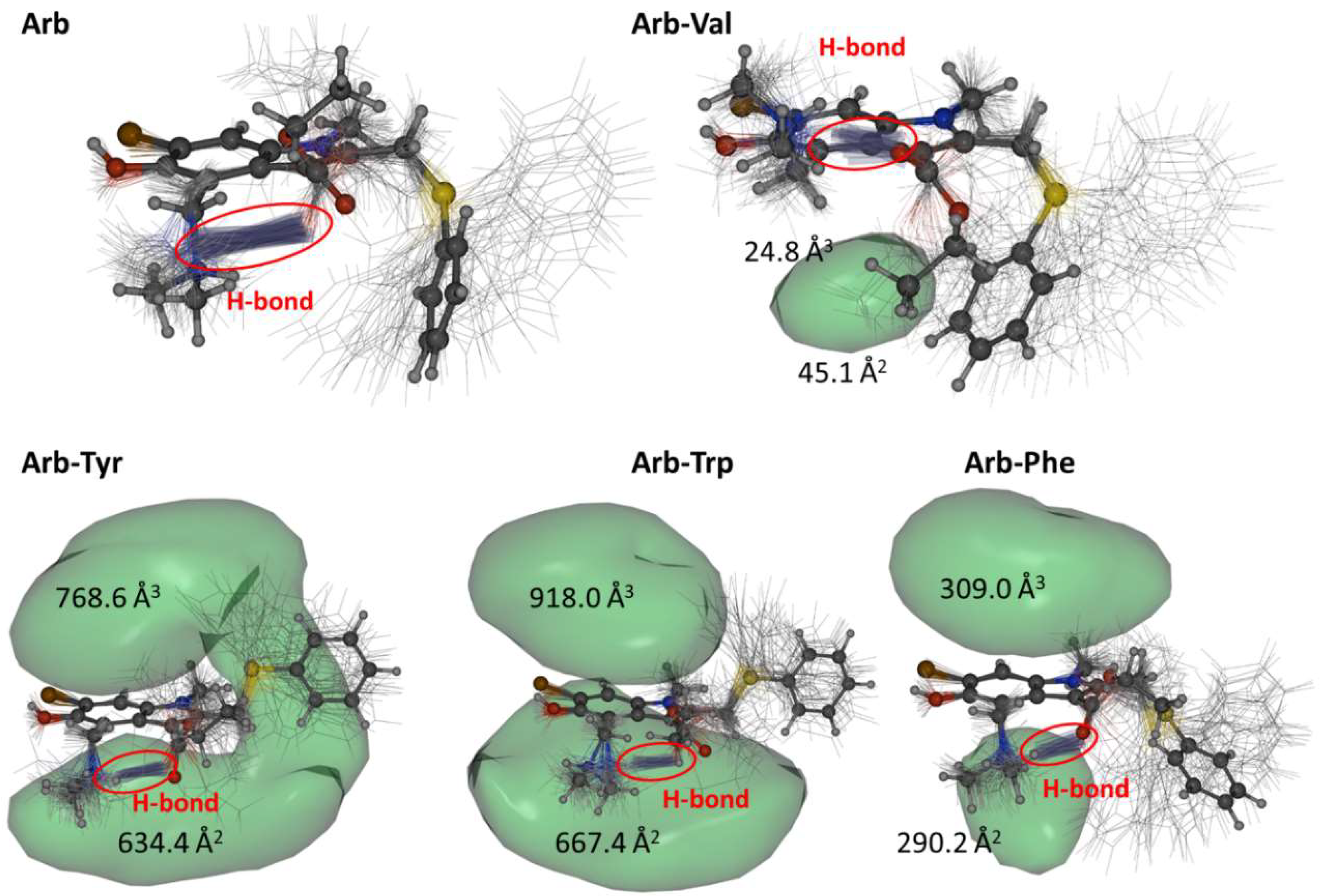
Figure 2. Visualization of MD results: Clustering of Arb geometric parameters by frames; the AA population maps relative to Arb are shown as green clouds. Intramolecular hydrogen bonds are shown in purple. Quantitative characteristics of the AA population are presented as volume (Å3) and surface area (Å2) values.
Scipharm 94 00020 g002
Figure 3. The MD conformational potential of Arb molecule relative to possible rotation axes (highlighted in color) and the population of conformational states of Arb in the presence of amino acids (aqueous solution). Radial plots depict the time evolution of rotatable bonds (simulation start at center; time increases radially outward). Angular position reflects the dihedral angle (0–360°), with trajectory density indicating conformational residence time. Histograms show the torsion angle distribution, with overlaid force field torsional potentials (kcal/mol) highlighting barriers and bound-state strain.
Scipharm 94 00020 g003
Figure 4. Histograms of population states based on the torsion angle values in the Arb molecule in the presence of amino acid residues. The color scheme is the same as in Figure 3 except for black, which represents the absolute difference between the torsion angles of the Arb without amino acids and with one amino acid.
Scipharm 94 00020 g004
Figure 5. Optimized structures of Arbidol complexes with amino acids in the frame of the implicit solvent model. Calculation in the B3LYP GD3/def2 SVP approximation.
Scipharm 94 00020 g005
Figure 6. The B3LYP GD3/def2-SVP optimized structures of Arb–AA complexes in an aqueous environment and results of QTAIM analysis of wave function critical points. The bond critical points for Arb–AA interaction are shown as transparent blue spheres; total electron density at these points (in a.u.) is given.
Scipharm 94 00020 g006
Figure 7. Correlation dependence of binding energy and total electron density at bond critical points of π-π stacking complexes.
Scipharm 94 00020 g007
Figure 8. (A) UV (1) and FL (2) spectra of Arbidol; (B) fluorescence spectra: 1—[Trp] = 5 × 10⁻⁶ M; 2—[Trp] = 5 × 10⁻⁶ M + [Arb] = 5 × 10⁻⁵ M; 3—the Stern–Volmer plot of Trp FL quenching by Arbidol. Conditions of FL measurements: λex = 285 nm, H2O, pH 7.0, 293 K.
Scipharm 94 00020 g008
Figure 9. Fluorescence spectra: (A) Tyrosine: 1—[Tyr] = 1 × 10⁻⁵ M; 2—[Tyr] = 1 × 10⁻⁵ M + [Arb] = 9 × 10⁻⁵ M; 3—the Stern–Volmer plot for Tyr (λex = 275 nm, H2O, 293 K); (B) phenylalanine: 1—[Phe] = 5 × 10⁻⁵ M; 2—[Phe] = 5 × 10⁻⁵ M + [Arb] = 9 × 10⁻⁵ M; 3—the Stern–Volmer plot for Phe (λex = 205 nm, H2O, 293 K).
Scipharm 94 00020 g009
Table 1. The RMSD values of the components of the Arb AA systems averaged over the entire simulation time.
AARMSD Average Value, Å
OverallArbAA
Trp28.22.211.3
Tyr28.11.613.8
Phe28.21.714.3
Val28.21.915.3
Table 2. Binding of Arb with amino acids in aqueous solutions.
PairOcc. Volume% *ρi × 100, a.u.-BE, kJ/mol
Arb–Trp918.018.47.0677.1 ± 6.8
Arb–Tyr768.615.44.9957.3 ± 5.3
Arb–Phe309.06.24.8656.1 ± 5.2
Arb–Val24.80.55.0357.7 ± 5.3
* Statistics per frame: % = (occupancy volume/5000 MD frames) × 100.
Table 3. Spectral-luminescent parameters of Arb, Tyr, Trp, Phe, and quenching constants of amino acid FL by Arbidol (H2O, 293 K).
Compoundλem., nmφτ, nskq, M−1 × s−1K, M−1
Arb3743.0 × 10−5
Tyr3030.21 [44]3.5 [44] 4.7 × 10121.7 × 104
Trp3530.14 [40]3.1 [40] 3.2 × 10121.1 × 104
Phe2820.025 [45]6.8 [45] 1.3 × 10120.8 × 104
Disclaimer/Publisher’s Note: The statements, opinions and data contained in all publications are solely those of the individual author(s) and contributor(s) and not of MDPI and/or the editor(s). MDPI and/or the editor(s) disclaim responsibility for any injury to people or property resulting from any ideas, methods, instructions or products referred to in the content.