
Spectral Characterization of Prospidium Chloride Using Complementary Analytical Techniques


 , , ,
, , ,
Abstract
1. Introduction
1.1. Mechanism of Chemotherapeutic Action
1.2. Prospidium Chloride as a Chemotherapeutic Alkylating Agent
2. Materials and Methods
2.1. Object of Research
2.2. Method of Research
2.2.1. Fourier Transform Infrared (FT-IR) Spectroscopy
2.2.2. Electronic Absorbtion Spectroscopy
2.2.3. 1H NMR Spectroscopy*
2.3. Loss on Drying (LOD)
Statistical Analysis
3. Results and Discussion
3.1. Spectral Methods
3.1.1. FT-IR Spectroscopy Analysis
3.1.2. Electronic Absorption Spectrophotometry
3.2. 1H NMR Spectroscopy
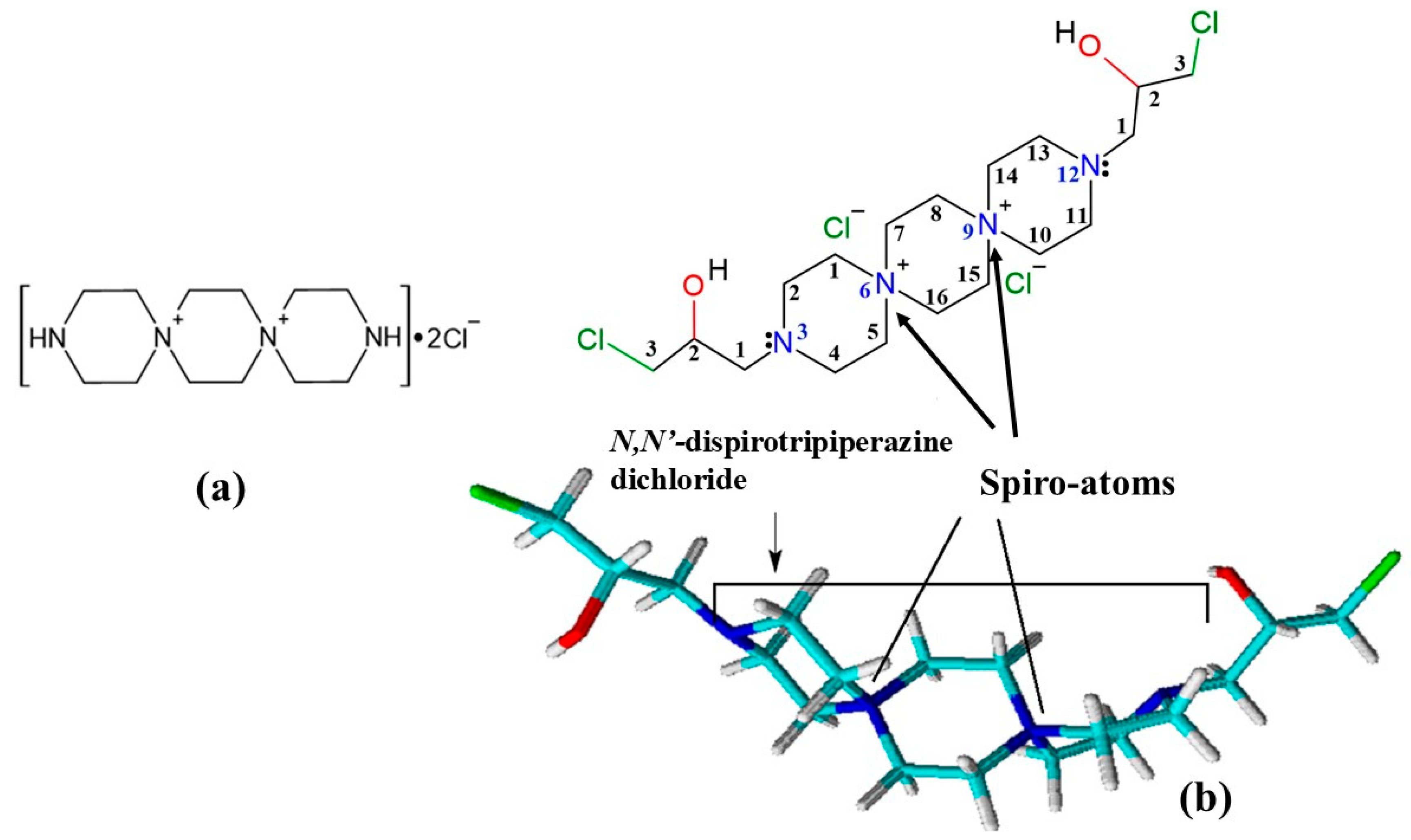
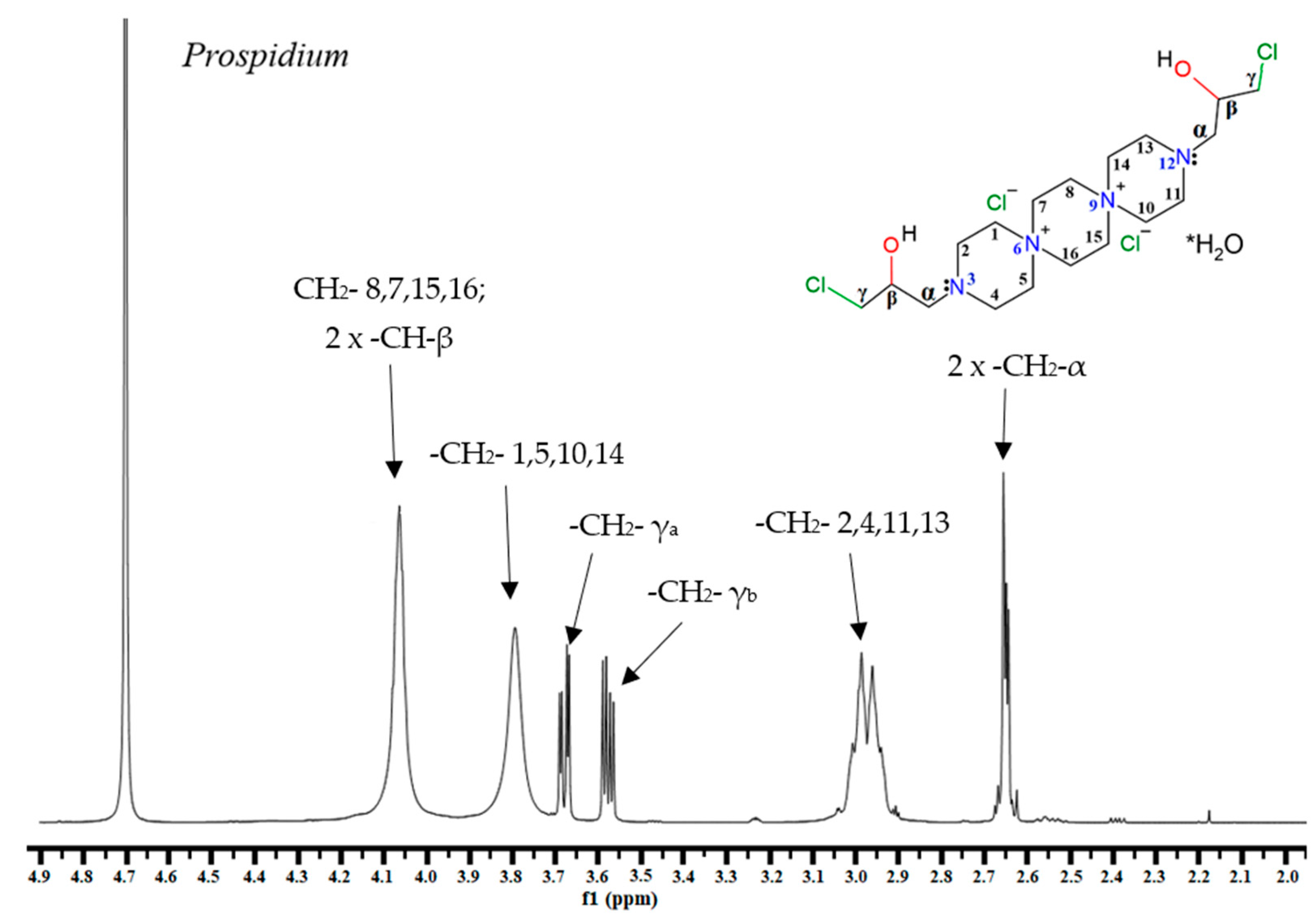
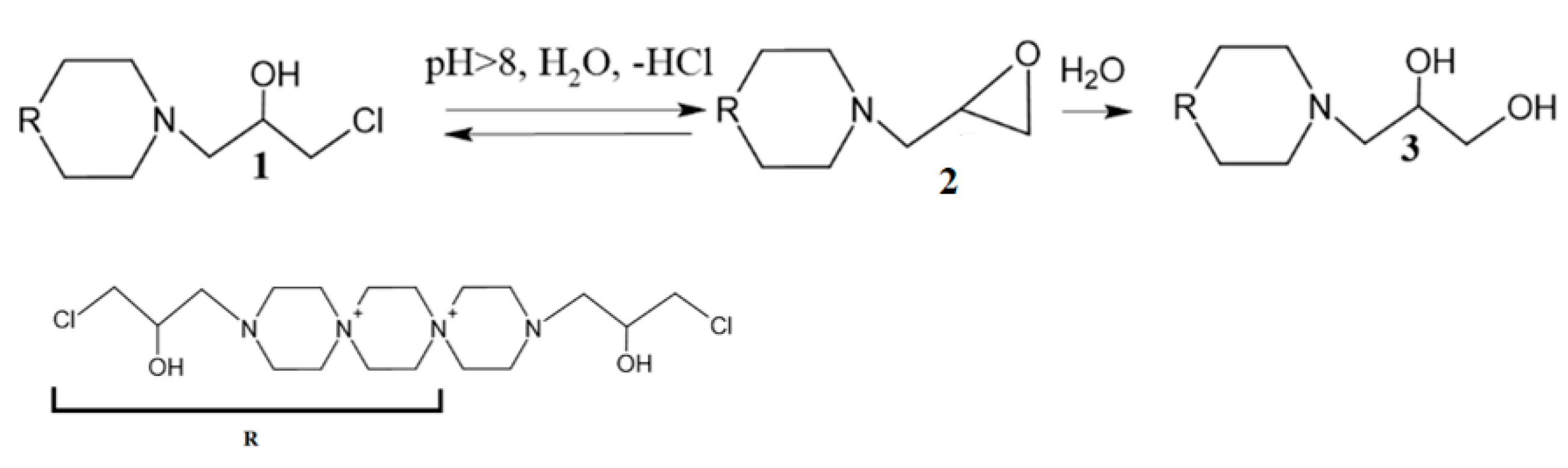
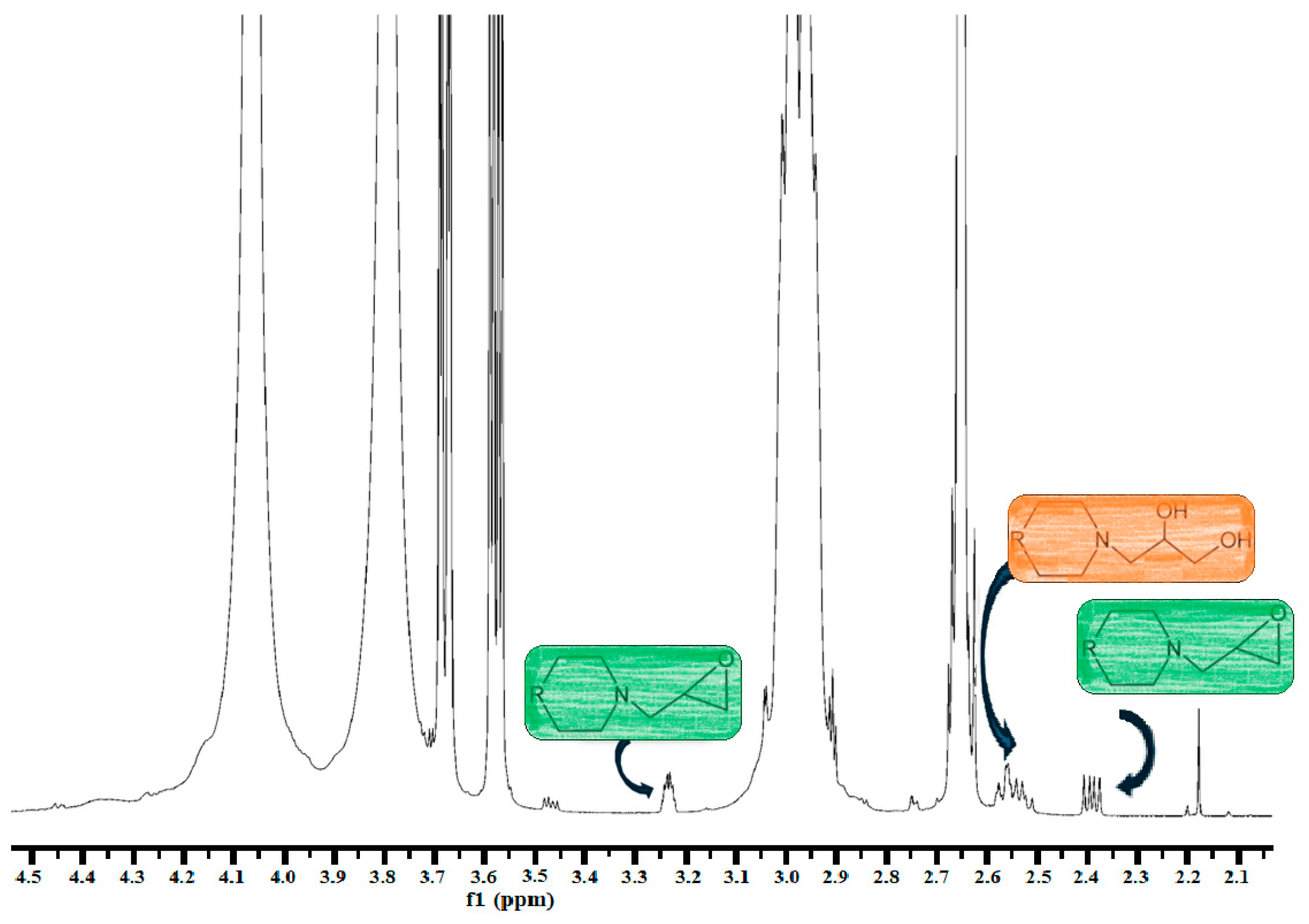
- δ 4.28–3.92 (br. s, 10H, -CH2- 8,7,15,16, 2 x -CH-β)—the most deshielded protons, located next to the quaternary ammonium nitrogen N+ of the central ring and the CH(OH) groups (inductive effect of OH). The broad singlet is due to free rotation and conformational lability.
- δ 3.91–3.72 (br. s, 8H, -CH2- 1,5,10,14)—a broad singlet arising from methylene protons adjacent to the ammonium nitrogen N+, deshielded by the +I effect of N+ (δ~3.8 ppm, which is typical for [R4N]+CH2-).
- δ 3.68 (dd, J = 11.7, 3.8 Hz, 2H, -CH2-γa)—γ-methylene protons of the CH2Cl groups showing geminal coupling 2J = 11.7 Hz (protons on the same carbon atom) and vicinal coupling 3J = 3.8 Hz (protons on adjacent carbon atoms). The small spin−spin coupling constants 3J (J-coupling) is consistent with a gauche conformation (groups separated by a torsion angle of approximately 60°).
- δ 3.58 (dd, J = 11.7, 5.6 Hz, 2H, -CH2-γb)—signal of the diastereotopic γ-methylene protons of the CH2Cl group with 3J = 5.6 Hz, also indicative of a gauche conformation.
- δ 3.11–2.85 (m, 8H, -CH2- 2,4,11,13)—methylene protons of the spiro fragments (–CH2–N–CH2–), multiplet.
- δ 2.70–2.61 (m, 4H, 2 x -CH2-α)—the least deshielded methylene protons in α-position to N+ (CH2–N+), shielded by the methylene groups of the spiro ring.
1H NMR for the Detection of PrsCl2 Impurities
4. Conclusions
5. Patents
Supplementary Materials
Author Contributions
Funding
Data Availability Statement
Acknowledgments
Conflicts of Interest
Abbreviations
| AD | Anno Domini |
| CChtIs | Cytostatic chemotherapeutic ingredients |
| SlfM | Sulfur mustards |
| UNDRR | United Nations Office for Disaster Risk Reduction |
| NtrM | Nitrogen mustard |
| CWA | chemical warfare agents |
| AlkCyts | Alkylating cytostatics |
| MC | Molecular complexity |
| BPS | British Pharmacological Society |
| SIADH | Syndrome of inappropriate antidiuretic hormone secretion |
| NDI | Nephrogenic diabetes insipidus |
| AKI (ATN) | Acute kidney injury (acute tubular necrosis) |
| CKD | Chronic kidney disease |
| DSpTPpCl2 | N, N’- Dispirotripiperazine dichloride |
| PrsCl2 | Prospidium dichloride |
| FT-IR | Fourier transform infrared spectroscopy |
| ATR | Attenuated total reflectance |
| ARRIP | All-Russian Scientific Research Institute of a Phytopathology |
| BLB | Bouguer–Lambert–Beer |
| NMR Spectroscopy | Nuclear magnetic resonance spectroscopy |
| SD | Standard deviation |
| MO | Molecular orbitals |
| ET | Electronic transition |
| MAC | Molar absorption coefficient |
| RSs | Related substances |
| QSAR | Quantitative structure–activity relationship |
| TSP-d4 | Sodium 3-(trimethylsilyl)propionate-d4 |
| qNMR | Quantitative NMR spectroscopy |
| u.i. | unidentified impurity |
| QSAR | Quantitative Structure–Activity Relationship, |
| J-coupling | spin−spin coupling constants |
| br. s | a broad singlet refers to an NMR signal |
| dd | a doublet of doublets refers to an NMR signal |
| m | a multiplet refers to an NMR signal |
References
- Nedelcu, A.M. The evolution of multicellularity and cancer: Views and paradigms. Biochem. Soc. Trans. 2020, 48, 1505–1518. [Google Scholar] [CrossRef]
- Breasted, J.H. The Edwin Smith Surgical Papyrus; University of Chicago Press: Chicago, IL, USA, 1930. [Google Scholar]
- van Middendorp, J.J.; Sanchez, G.M.; Burridge, A.L. The Edwin Smith papyrus: A clinical reappraisal of the oldest known document on spinal injuries. Eur. Spine J. 2010, 19, 1815–1823. [Google Scholar] [CrossRef]
- Panegyres, K. The story of how cancer got its name. Cancer 2024, 130, 3401–3403. [Google Scholar] [CrossRef]
- Stephanus. Commentary on Hippocrates’ Aphorisms 6.38. In Stephanus of Athens. Commentary on Hippocrates’ Aphorisms, Sections V–VI; Westerink, L.G., Translator; Academie Verlag: Berlin, Germany, 1995; Volume III. [Google Scholar]
- Gallucci, B.B. Selected concepts of cancer as a disease: From the Greeks to 1900. Oncol. Nurs. Forum 1985, 12, 67–71. [Google Scholar]
- Schmidt, A.; Weber, O.F. In memoriam of Rudolf Virchow: A historical retrospective including aspects of inflammation, infection and neoplasia. Contrib. Microbiol. 2006, 13, 1–15. [Google Scholar] [CrossRef] [PubMed]
- Becquerel, A.H.; Curie, P. Action physiologique des rayons de radium. C. R. Acad. Sci. 1901, 132, 1289–1291. [Google Scholar]
- Gianfaldoni, S.; Gianfaldoni, R.; Wollina, U.; Lotti, J.; Tchernev, G.; Lotti, T. An overview on radiotherapy: From its history to its current applications in dermatology. Open Access Maced. J. Med. Sci. 2017, 5, 521–525. [Google Scholar] [CrossRef]
- DeVita, V.T., Jr.; Chu, E. A history of cancer chemotherapy. Cancer Res. 2008, 68, 8643–8653. [Google Scholar] [CrossRef] [PubMed]
- Institute of Medicine (US). Veterans at Risk: The Health Effects of Mustard Gas and Lewisite; National Academies Press: Washington, DC, USA, 1993. Available online: https://www.ncbi.nlm.nih.gov/books/NBK236059/ (accessed on 21 August 2025).
- International Chemical Safety Cards (ICSCs). Available online: https://chemicalsafety.ilo.org/dyn/icsc/showcard.listcards3?p_lang=en (accessed on 21 August 2025).
- Amin, S.B.M.; Islam, T.; Price, N.E.; Wallace, A.; Guo, X.; Gomina, A.; Heidari, M.; Johnson, K.M.; Lewis, C.D.; Yang, Z.; et al. Effects of local sequence, reaction conditions, and additives on the formation and stability of interstrand cross-links derived from abasic sites. ACS Omega 2022, 7, 36888–36901. [Google Scholar] [CrossRef]
- Ruiz-Losada, M.; González, R.; Peropadre, A.; Gil-Gálvez, A.; Tena, J.J.; Baonza, A.; Estella, C. Coordination between cell proliferation and apoptosis after DNA damage in Drosophila. Cell Death Differ. 2022, 29, 832–845. [Google Scholar] [CrossRef]
- Krumbhaar, E.B.; Krumbhaar, H.D. The blood and bone marrow in yellow cross gas (mustard gas) poisoning. J. Med. Res. 1919, 40, 497–508. [Google Scholar]
- Chen, H.; Cui, Z.; Hejazi, L.; Yao, L.; Walmsley, S.J.; Rizzo, C.J.; Turesky, R.J. Kinetics of DNA adducts and abasic site formation in mice treated with nitrogen mustard. Chem. Res. Toxicol. 2020, 33, 988–998. [Google Scholar] [CrossRef] [PubMed]
- LiverTox: Clinical and Research Information on Drug-Induced Liver Injury. Alkylating Agents. Available online: https://www.ncbi.nlm.nih.gov/books/NBK547849/ (accessed on 10 January 2026).
- Chiorcea-Paquim, A.M.; Oliveira-Brett, A.M. Electrochemistry of chemotherapeutic alkylating agents and their interaction with DNA. J. Pharm. Biomed. Anal. 2023, 222, 115036. [Google Scholar] [CrossRef]
- van den Boogaard, W.M.C.; Komninos, D.S.J.; Vermeij, W.P. Chemotherapy side-effects: Not all DNA damage is equal. Cancers 2022, 14, 627. [Google Scholar] [CrossRef] [PubMed]
- International Agency for Research on Cancer (IARC). Available online: https://www.iarc.who.int/ (accessed on 26 June 2025).
- Scheulen, M.E.; Hilger, R.A.; Oberhoff, C.; Casper, J.; Freund, M.; Josten, K.M.; Bornhäuser, M.; Ehninger, G.; Berdel, W.E.; Baumgart, J.; et al. Clinical phase I dose escalation and pharmacokinetic study of high-dose chemotherapy with treosulfan and autologous peripheral blood stem cell transplantation in patients with advanced malignancies. Clin. Cancer Res. 2000, 6, 4209–4216. [Google Scholar]
- Cayman Chemical Company. Available online: https://www.caymanchem.com/about (accessed on 26 June 2025).
- Lewis, R.J., Sr. (Ed.) Sax’s Dangerous Properties of Industrial Materials, 11th ed.; Wiley-Interscience: Hoboken, NJ, USA, 2004; p. 820. [Google Scholar]
- New Zealand Ministry of Health; MEDSAFE. Data Sheet for Muphoran (Fotemustine, 209 mg Powder for Injection). Available online: https://www.medsafe.govt.nz/Profs/Datasheet/m/Muphoraninj.htm (accessed on 10 January 2026).
- Thermo Fisher Scientific. Available online: https://www.thermofisher.com/ru/ru/home/chemicals.html (accessed on 27 December 2025).
- Papadia, P.; Barozzi, F.; Hoeschele, J.D.; Piro, G.; Margiotta, N.; Di Sansebastiano, G.P. Cisplatin, oxaliplatin, and kiteplatin subcellular effects compared in a plant model. Int. J. Mol. Sci. 2017, 18, 306. [Google Scholar] [CrossRef] [PubMed]
- DrugBank Online. Prospidium Chloride (DB00526). Available online: https://go.drugbank.com/drugs/DB00526 (accessed on 10 September 2025).
- PubChem. Compound CID 2907. Available online: https://pubchem.ncbi.nlm.nih.gov/compound/2907 (accessed on 10 September 2025).
- Naveja, J.J.; Rico-Hidalgo, M.P.; Medina-Franco, J.L. Analysis of a large food chemical database: Chemical space, diversity, and complexity. F1000Research 2018, 7, 993. [Google Scholar] [CrossRef]
- Oprea, T.I.; Bologa, C. Molecular complexity: You know it when you see it. J. Med. Chem. 2023, 66, 12710–12714. [Google Scholar] [CrossRef]
- International Union of Basic and Clinical Pharmacology (IUPHAR); British Pharmacological Society (BPS). Guide to PHARMACOLOGY. Available online: https://www.guidetopharmacology.org (accessed on 10 September 2025).
- Smith, R.A.; Mettlin, C.J.; Eyre, H. Cancer screening and early detection. In Holland-Frei Cancer Medicine, 6th ed.; Kufe, D.W., Pollock, R.E., Weichselbaum, R.R., Bast, R.C., Gansler, T.S., Holland, J.F., Frei, E., III, Eds.; BC Decker: Hamilton, ON, Canada, 2003; Chapter 31. Available online: https://www.ncbi.nlm.nih.gov/books/NBK12499/ (accessed on 10 September 2025).
- Faccenda, E.; Maxwell, S.; Szarek, J.L. The IUPHAR pharmacology education project. Clin. Pharmacol. Ther. 2019, 105, 45–48. [Google Scholar] [CrossRef]
- Nussbaumer, S.; Bonnabry, P.; Veuthey, J.-L.; Fleury-Souverain, S. Analysis of anticancer drugs: A review. Talanta 2011, 85, 2265–2289. [Google Scholar] [CrossRef]
- Andrés, C.M.C.; Pérez de la Lastra, J.M.; Munguira, E.B.; Andrés Juan, C.; Pérez-Lebeña, E. Dual-action therapeutics: DNA alkylation and antimicrobial peptides for cancer therapy. Cancers 2024, 16, 3123. [Google Scholar] [CrossRef]
- Markowska, A.; Antoszczak, M.; Markowska, J.; Huczyński, A. Gynotoxic effects of chemotherapy and potential protective mechanisms. Cancers 2024, 16, 2288. [Google Scholar] [CrossRef]
- Bychkouski, P.M.; Yurkshtovich, T.L.; Kladiev, A.A.; Revtovich, M.Y. Antitumor activity of gel-forming preparation prospidin on the model of Zaidela ascitic hepatoma. Cell Tissue Biol. 2012, 6, 233–239. [Google Scholar] [CrossRef]
- Chupakhin, E.; Babich, O.; Prosekov, A.; Asyakina, L.; Krasavin, M. Spirocyclic motifs in natural products. Molecules 2019, 24, 4165. [Google Scholar] [CrossRef]
- Filatova, N.A.; Ivanov, V.A.; Kladiev, A.A.; Bychkovskiy, P.M.; Knyazev, N.A. Antitumor activity of prospidin in a mouse MG22A hepatoma model. Vopr. Onkol. 2014, 60, 755–760. (In Russia) [Google Scholar]
- National Cancer Institute. NCI Thesaurus Concept C29333. Available online: https://evsexplore.semantics.cancer.gov/evsexplore/concept/ncit/C29333 (accessed on 10 September 2025).
- Bonacorsi, A.; Trespidi, G.; Scoffone, V.C.; Irudal, S.; Barbieri, G.; Riabova, O.; Monakhova, N.; Makarov, V.; Buroni, S. Characterization of the dispirotripiperazine derivative PDSTP as antibiotic adjuvant and antivirulence compound against Pseudomonas aeruginosa. Front. Microbiol. 2024, 15, 1357708. [Google Scholar] [CrossRef]
- Egorova, A.; Bogner, E.; Novoselova, E.; Zorn, K.M.; Ekins, S.; Makarov, V. Dispirotripiperazine-core compounds, their biological activity with a focus on broad antiviral property, and perspectives in drug design (mini-review). Eur. J. Med. Chem. 2021, 211, 113014. [Google Scholar] [CrossRef]
- National Center for Biotechnology Information. PubChem Compound Summary for CID 31937, Prospidium Chloride. Available online: https://pubchem.ncbi.nlm.nih.gov/compound/Prospidium-Chloride (accessed on 13 January 2026).
- Lestido-Cardama, A.; Rodríguez Bernaldo de Quirós, A.; Sendón, R. Migration of dihydroxy alkylamines and their possible impurities from packaging into foods and food simulants: Analysis and safety evaluation. Polymers 2023, 15, 2656. [Google Scholar] [CrossRef]
- PubChem Compounds—NIH. Prospidium Chloride (CID 31937). Available online: https://pubchem.ncbi.nlm.nih.gov/compound/31937 (accessed on 10 September 2025).
- PubChem. PubChem Compound Summary for CID 31938, Prospidium. National Center for Biotechnology Information. Available online: https://pubchem.ncbi.nlm.nih.gov/compound/Prospidium (accessed on 9 January 2026).
- European Pharmacopoeia (Ph. Eur.) 10.0; Council of Europe, European Directorate for the Quality of Medicines & HealthCare (EDQM): Strasbourg, France, 2019; Chapter 2.2.32, pp. 57–58.
- Benenson, E.V.; Nemtsov, B.F.; Ualieva, T.M. A new basic drug prospidin in the treatment of rheumatoid arthritis. III. Comparative analysis of prospidin and cyclophosphamide. Ter Arkh. 1987, 59, 76–79. (In Russia) [Google Scholar] [PubMed]
- European Directorate for the Quality of Medicines & HealthCare (EDQM), Council of Europe. Available online: https://faq.edqm.eu/pages/viewpage.action?pageId=1376881 (accessed on 10 January 2025).
- Lorenz-Fonfria, V.A. Infrared difference spectroscopy of proteins: From bands to bonds. Chem. Rev. 2020, 120, 3466–3576. [Google Scholar] [CrossRef] [PubMed]
- Sigma-Aldrich. IR Spectrum Table & Chart. Available online: https://www.sigmaaldrich.com/RU/en/applications/analytical-chemistry/photometry-and-reflectometry (accessed on 8 January 2026).
- Kraśnicki, A.; Kisiel, Z.; Guillemin, J.-C. From molecular to cluster properties: Rotational spectroscopy of 2-aminopyridine and of its biomimetic cluster with water. Molecules 2021, 26, 6870. [Google Scholar] [CrossRef] [PubMed]
- Kachkovskii, A.D. The nature of electronic transitions in linear conjugated systems. Russ. Chem. Rev. 1997, 66, 647–664. [Google Scholar] [CrossRef]
- Westermayr, J.; Marquetand, P. Machine learning for electronically excited states of molecules. Chem. Rev. 2021, 121, 9873–9926. [Google Scholar] [CrossRef]
- Albrecht, A.C. “Forbidden” character in allowed electronic transitions. J. Chem. Phys. 1960, 33, 156–169. [Google Scholar] [CrossRef]
- IUPAC Compendium of Chemical Terminology (the Gold Book). n → σ* Transition, 5th ed.; International Union of Pure and Applied Chemistry: Research Triangle Park, NC, USA, 2025. [Google Scholar] [CrossRef]
- Laporte, O.; Meggers, W.F. Some rules of spectral structure. J. Opt. Soc. Am. 1925, 11, 459–463. [Google Scholar] [CrossRef]
- Horn, D. W-spin selection rules. Phys. Rev. 1966, 150, 1218. [Google Scholar] [CrossRef]
- Halstead, J.A. Teaching the spin selection rule: An inductive approach. J. Chem. Educ. 2013, 90, 70–75. [Google Scholar] [CrossRef]
- European Medicines Agency. ICH Topic Q2 (R1): Validation of Analytical Procedures: Text and Methodology; EMA: London, UK, 2006. Available online: http://www.emea.eu.int (accessed on 10 January 2025).
- Kladiev, A.A.; Kladiev, A.A.; Uspenskaya, E.V. Development and validation of methods for the spectrophotometric determination of prospidium chloride using the “authenticity” and “quantitative determination” parameters. Probl. Biol. Med. Pharm. Chem. 2024, 27, 12–19. [Google Scholar] [CrossRef]
- National Institute of Standards and Technology (NIST). Engineering Statistics Handbook. Available online: https://www.itl.nist.gov/div898/handbook/eda/section3/eda3672.htm (accessed on 10 January 2025).
- Maggio, R.M.; Calvo, N.L.; Vignaduzzo, S.E.; Kaufman, T.S. Pharmaceutical impurities and degradation products: Uses and applications of NMR techniques. J. Pharm. Biomed. Anal. 2014, 101, 102–122. [Google Scholar] [CrossRef]
- Vasil’ev, V.; Sheremeta, A.; Ivlev, V.; Goriainov, S.; Hajjar, F.; Esparza, C.; Platonov, E.; Khromov, A.; Kolesnov, A.; Romashchenko, V.; et al. Quantitative ^1H NMR spectroscopy method for determination of anthraquinone derivatives in extracts from Rubia tinctorum L. roots and rhizomes. Sci. Pharm. 2024, 92, 24. [Google Scholar] [CrossRef]
- Pol’shakov, V.I.; Dvoryantseva, G.G.; Sheinker, Y.N. Conversions of the antineoplastic preparation prospidin in aqueous media. Pharm. Chem. J. 1984, 18, 521–527. [Google Scholar] [CrossRef]
- Safonova, T.S.; Shatukhina, E.A.; Sedov, A.L. Synthesis, chemical, spectral, and biological properties of 3,12-diaza-6,9-diazoniadispiro [5,2,5,3]-heptadecane derivatives. Pharm. Chem. J. 2002, 36, 360–365. [Google Scholar] [CrossRef]
- Kleinman, M.H.; Elder, D.; Teasdale, A.; Mowery, M.D.; McKeown, A.P.; Baertschi, S.W. Strategies To Address Mutagenic Impurities Derived from Degradation in Drug Substances and Drug Products. Org. Process Res. Dev. 2015, 19, 1447–1457. [Google Scholar] [CrossRef]
- Babij, N.R.; McCusker, E.O.; Whiteker, G.T.; Canturk, B.; Choy, N. NMR chemical shifts of trace impurities: Industrially preferred solvents used in process and green chemistry. Org. Process Res. Dev. 2016, 20, 661–667. [Google Scholar] [CrossRef]
- Mikhalev, V.A.; Chernov, V.A.; Dorokhova, M.I.; Smolina, N.E.; Tikhonova, O.Y. Haloalkylamines and their transformation products. III. Spirazidine, prospidin, and some other N’,N’’-dispirotripiperazinium derivatives. Pharm. Chem. J. 1972, 6, 355–358. [Google Scholar] [CrossRef]
- Ueda, K.; Sokell, E.; Schippers, S.; Aumayr, F.; Sadeghpour, H.; Burgdörfer, J.; Lemell, C.; Tong, X.M.; Pfeifer, T.; Calegari, F.; et al. Roadmap on photonic, electronic and atomic collision physics: I. Light-matter interaction. J. Phys. B At. Mol. Opt. Phys. 2019, 52, 171001. [Google Scholar] [CrossRef]
- F ICH Expert Working Group. ICH Q3C (R6) Impurities: Guideline for Residual Solvents. Step 4. International Council for Harmonisation of Technical Requirements for Pharmaceuticals for Human Use. 2019. Available online: https://database.ich.org/sites/default/files/Q3C-R6_Guideline_ErrorCorrection_2019_0410_0.pdf (accessed on 10 January 2026).
- Stangret, J.; Kamieńska-Piotrowicz, E.; Szymańska-Cybulska, J. Analysis of spectral data by complementary methods: Inspection of the molecular complex in N,N-dimethylformamide–methanol mixtures. Spectrochim Acta A Mol. Biomol. Spectrosc. 2005, 61, 3043–3050. [Google Scholar] [CrossRef] [PubMed]



| Structure, IUPAC Name, Molecular Weight (g.mol−1) | Molecular Complexity (MC) * | LogP | Toxicity Data and Details [19] | Carcinogen Classification [20] |
|---|---|---|---|---|
Mechlorethamine 2-chloro-N-(2-chloroethyl)-N-methylethanamine 156.05 | 43.7 | 0.91 | LD50 = 10 mg/kg (oral, for a rat). | Group 2A: probably carcinogenic to humans |
Cyclophosphamide N,N-bis(2-chloroethyl)-2-oxo-1,3,2λ5-oxazaphosphinan-2-amine 261.08 | 212 | 0.8 | LD50 = 420 mg/kg (intraperitoneal, for a mouse); Hemorrhagic cystitis, NDI/syndrome of inappropriate antidiuretic hormone secretion (SIADH). | Group 1: carcinogenic to humans |
Ifosfamide N,3-bis(2-chloroethyl)-2-oxo-1,3,2λ5-oxazaphosphinan-2-amine 261.08 | 218 | 0.86 | LD50 = 415 mg/kg (intraperitoneal, for a mouse); LD50 = 2600 mg/kg (oral, for a mouse); Salt wasting, hyponatremia-SIADH, hemorrhagic cystitis, AKI (ATN), CKD, renal tubular acidosis, glomerular disease, tubulointerstitial disease. | Group 3: not classifiable regarding its carcinogenicity to humans |
Melphalan (2S)-2-amino-3-[4-[bis(2-chloroethyl)amino]phenyl]propanoic acid 305.20 | 265 | 0.4 | LD50 = 30 mg/kg (intraperitoneal, for a rat); Hyponatremia-SIADH, glomerular dysfunction. | Group 1: carcinogenic to humans |
Chlorambucil 4-[4-[bis(2-chloroethyl)amino]phenyl]butanoic acid 304.2 | 250 | 1.7 | LD50 = 14 mg/kg (intraperitoneal, for a rat); LD50 = 76 mg/kg (oral, for a rat); Acute encephalopathy, seizures. | Group 1: carcinogenic to humans |
| t, min | m1, g | m2, g | m3, g | Loss on Drying (LOD), % |
|---|---|---|---|---|
| 180 | 39.9535 | 40.1948 | 40.18425 | 4.37 |
| Wavenumber, cm−1 | Group | Compound Class | Appearance |
|---|---|---|---|
| 3550–3200 | O-H stretching | alcohol intermolecular bonded | strong, broad |
| 3350–3310 * | N-H stretching | secondary amine | medium |
| near 3000 * | N-R stretching | amine salt | strong, broad |
| near 2850 | C-H stretching | alkane | medium |
| 1650 * | N-H bending | amine | medium |
| near 1500 * | C-H bending | alkane methylene group | medium |
| 1385–1465 * | C-H bending | methylene group (other, acyclic) | medium |
| 1250–1020 * | C-N stretching | amine | medium |
| near 900 * | C-Cl stretching | halo compound | strong |
| 1124–1087 | C-O | secondary alcohol | strong |
| 900–700 | C-H bending | 1,2-disubstituted 1,2,3-trisubstituted | strong |
| Linear Dependence Parameters y = ax + b | ||||
|---|---|---|---|---|
| Constant (Free) Term, b SD | Slope, a SD | Coefficient of Determination, (R-Square) | Adjusted R 2 | Pearson’s Coefficient, r |
| 2.77 ± 0.02 | 0.092 ± 0.007 | 0.975 | 0.000039 | 0.9998 |
| y = 2.77x + 0.092 | ||||
| Number of Levels, N | Total Sample Size, n | , L·mol−1 cm−1 | SD | RSD | L·mol−1 cm−1 | , % |
|---|---|---|---|---|---|---|
| 1–3 | n = 35 t =2.03 * пpи f = 34, p = 0.975) | 3.89 | 0.24 | 0.06 | 3.89 ± 0.08 | 2.1 |
| The Research Subject | δ (ppm) | Assignment | Content | |
|---|---|---|---|---|
| , mg | ||||
| PrsCl2 | 3.58 | -CH2Cl | 46.27 ± 0.89 | 88.43 |
| diol | 2.60–2.52 | -CH2-α | 1.54 ± 0,03 | 2.94 |
| epoxy | 2.37 | -CH-αb | 1.38 ± 0.03 | 2.64 |
Disclaimer/Publisher’s Note: The statements, opinions and data contained in all publications are solely those of the individual author(s) and contributor(s) and not of MDPI and/or the editor(s). MDPI and/or the editor(s) disclaim responsibility for any injury to people or property resulting from any ideas, methods, instructions or products referred to in the content. |
© 2026 by the authors. Published by MDPI on behalf of the Österreichische Pharmazeutische Gesellschaft. Licensee MDPI, Basel, Switzerland. This article is an open access article distributed under the terms and conditions of the Creative Commons Attribution (CC BY) license.
Share and Cite
Kladiev, A.A.; Uspenskaya, E.V.; Baryshev, M.G.; Ivlev, V.A.; Vasil’ev, V.G.; Barsegyan, S.S.; Safdari, A. Spectral Characterization of Prospidium Chloride Using Complementary Analytical Techniques. Sci. Pharm. 2026, 94, 15. https://doi.org/10.3390/scipharm94010015
Kladiev AA, Uspenskaya EV, Baryshev MG, Ivlev VA, Vasil’ev VG, Barsegyan SS, Safdari A. Spectral Characterization of Prospidium Chloride Using Complementary Analytical Techniques. Scientia Pharmaceutica. 2026; 94(1):15. https://doi.org/10.3390/scipharm94010015
Chicago/Turabian StyleKladiev, Antoniy A., Elena V. Uspenskaya, Mikhail G. Baryshev, Vasilii A. Ivlev, Vasilii G. Vasil’ev, Samvel S. Barsegyan, and Ainaz Safdari. 2026. "Spectral Characterization of Prospidium Chloride Using Complementary Analytical Techniques" Scientia Pharmaceutica 94, no. 1: 15. https://doi.org/10.3390/scipharm94010015
APA StyleKladiev, A. A., Uspenskaya, E. V., Baryshev, M. G., Ivlev, V. A., Vasil’ev, V. G., Barsegyan, S. S., & Safdari, A. (2026). Spectral Characterization of Prospidium Chloride Using Complementary Analytical Techniques. Scientia Pharmaceutica, 94(1), 15. https://doi.org/10.3390/scipharm94010015