
Artificial Intelligence, Wearable Technologies, and Virtual Reality in Precision Nutrition and Obesity Management: A Critical Narrative Review

Abstract
1. Introduction
2. Review Approach
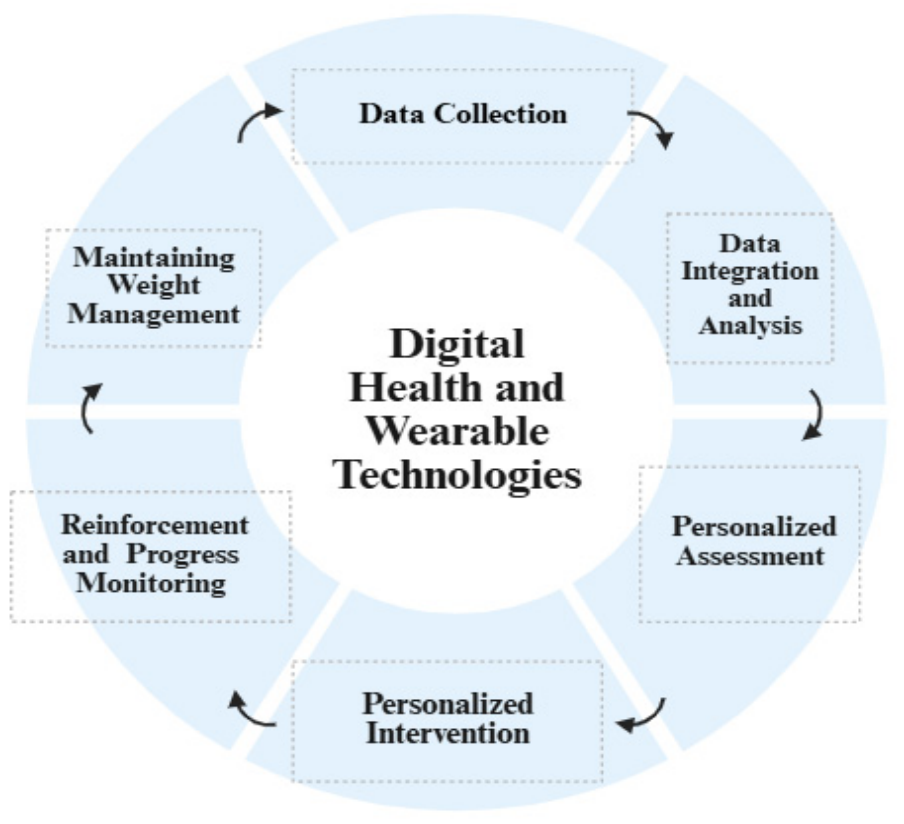
3. Digital Health and Wearable Technologies in Obesity Management
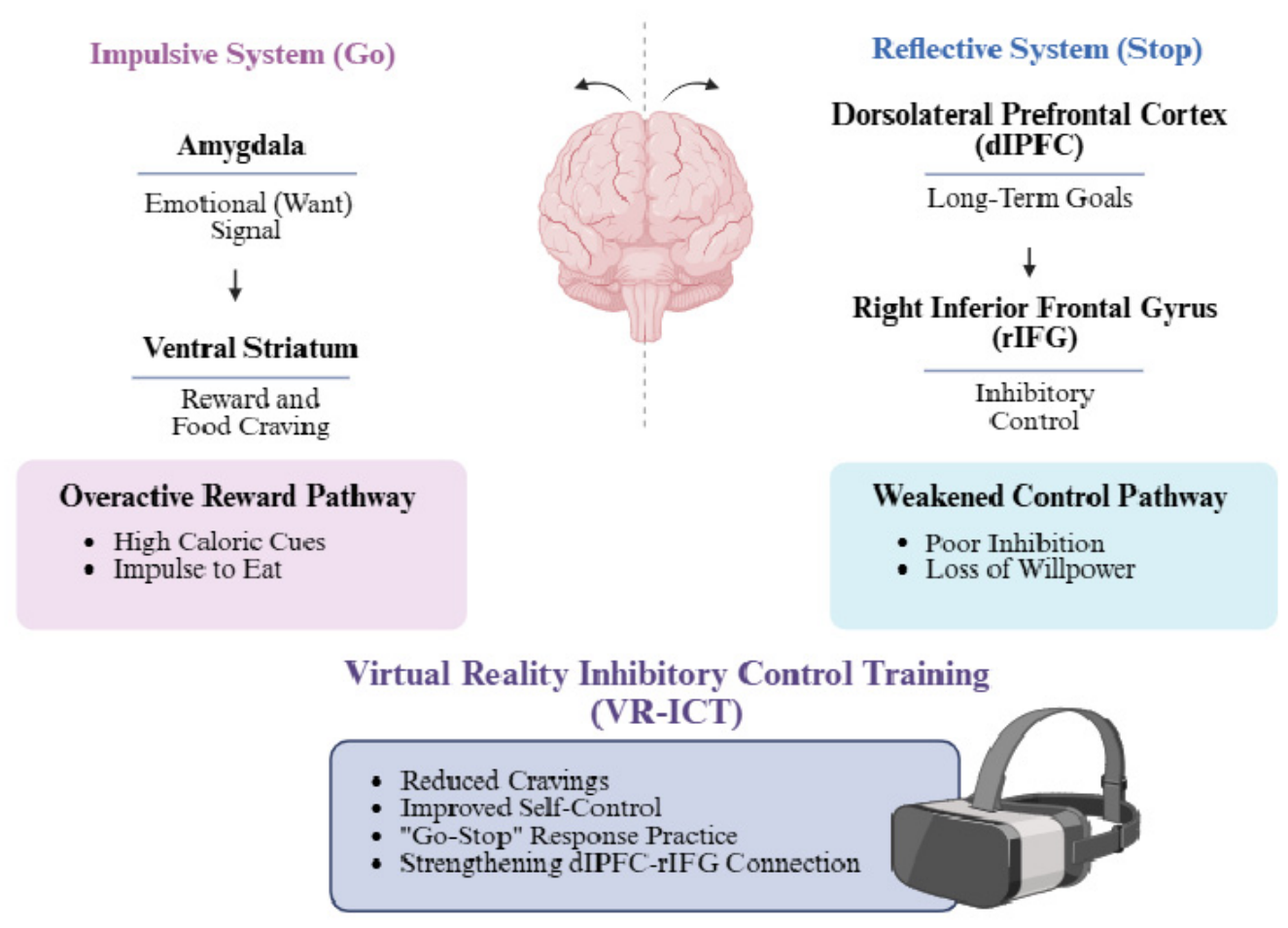
4. Virtual Reality (VR) as a Tool for Behavioral Change
5. Artificial Intelligence Applications in Weight Management and Glycemic Control
6. Integrated Digital Technologies for Weight Loss and Metabolic Control
7. Conclusions
Author Contributions
Funding
Institutional Review Board Statement
Informed Consent Statement
Data Availability Statement
Acknowledgments
Conflicts of Interest
References
- Parretti, H.M.; Erskine, S.E.; Coulman, K.D.; Mears, R.; Clare, K.; Williamson, K.; Watkins, R.; Hughes, C.A. A Review of the Management of Obesity in Primary Care. Clin. Obes. 2026, 16, e70040. [Google Scholar] [CrossRef] [Scilit] [PubMed]
- Baldelli, S.; Aiello, G.; Mansilla, E.; Martino, D.; Campaci, D.; Muthanna, F.M.S. The Role of Adipose Tissue and Nutrition in the Regulation of Adiponectin. Nutrients 2024, 16, 2436. [Google Scholar] [CrossRef] [Scilit] [PubMed]
- Petrovics, P.; Sandor, B.; Palfi, A.; Szekeres, Z.; Atlasz, T.; Toth, K.; Szabados, E. Association between obesity and overweight and cardiorespiratory and muscle performance in adolescents. Int. J. Environ. Res. Public Health 2021, 18, 134. [Google Scholar] [CrossRef] [Scilit] [PubMed]
- Grocic, M.; Nguyen, M.; Sanyal, A.J. Current Trends in the Epidemiology of Obesity and the Association Between Obesity and Metabolic Liver Disease (MASLD/MASH). Diabetes Obes. Metab. 2026, 28, 3–18. [Google Scholar] [CrossRef] [Scilit] [PubMed]
- Protano, C.; De Giorgi, A.; Valeriani, F.; Mazzeo, E.; Zanni, S.; Cofone, L.; D’ancona, G.; Hasnaoui, A.; Pindinello, I.; Sabato, M.; et al. Can Digital Technologies Be Useful for Weight Loss in Individuals with Overweight or Obesity? A Systematic Review. Healthcare 2024, 12, 670. [Google Scholar] [CrossRef] [Scilit] [PubMed]
- Veluvali, A.; Dehghani Zahedani, A.; Hosseinian, A.; Aghaeepour, N.; McLaughlin, T.; Woodward, M.; DiTullio, A.; Hashemi, N.; Snyder, M.P. Impact of digital health interventions on glycemic control and weight management. npj Digit. Med. 2025, 8, 20. [Google Scholar] [CrossRef] [Scilit] [PubMed]
- Ambrosi, E.; Mezzalira, E.; Canzan, F.; Leardini, C.; Vita, G.; Marini, G.; Longhini, J. Effectiveness of digital health interventions for chronic conditions management in European primary care settings: Systematic review and meta-analysis. Int. J. Med. Inform. 2025, 196, 105820. [Google Scholar] [CrossRef] [Scilit] [PubMed]
- Rubino, F.; Cummings, D.E.; Eckel, R.H.; Cohen, R.V.; Wilding, J.P.H.; Brown, W.A.; Stanford, F.C.; Batterham, R.L.; Farooqi, I.S.; Farpour-Lambert, N.J.; et al. Definition and diagnostic criteria of clinical obesity. Lancet Diabetes Endocrinol. 2026, 13, 221–262. [Google Scholar] [CrossRef] [Scilit] [PubMed]
- Das Virgens Silva, J.; Coutinho-Lima, C.R.O.; Brandao, N.A.; Dos Santos, L.A.; Dias, V.C.; Correa, A.B.; de Almeida, D.O.; Conceicao, G.; Florence, T.C.M.; de Almeida, A.G.; et al. Analysis of the association between anxiety, depression and obesity in individuals with metabolic syndrome. Endocr. Regul. 2023, 57, 92–98. [Google Scholar] [CrossRef] [Scilit] [PubMed]
- Guerrini Usubini, A.; Varallo, G.; Giusti, E.M.; Cattivelli, R.; Granese, V.; Consoli, S.; Bastoni, I.; Volpi, C.; Castelnuovo, G. The Mediating Role of Psychological Inflexibility in the Relationship Between Anxiety, Depression, and Emotional Eating in Adult Individuals With Obesity. Front. Psychol. 2022, 13, 861341. [Google Scholar] [CrossRef] [Scilit] [PubMed]
- Kucher, S.V.; Mudra, U.O.; Tkachuk, V.V.; Ruda, M.M.; Chernets, T.Y.; Nikitina, I.M.; Dzhyvak, V.H. Impact of lifestyle modification interventions on metabolic syndrome and obesity in adults. Wiad. Lek. 2025, 78, 1857–1865. [Google Scholar] [CrossRef] [Scilit] [PubMed]
- Lemp, J.M.; Nuthanapati, M.P.; Bärnighausen, T.W.; Vollmer, S.; Geldsetzer, P.; Jani, A. Use of lifestyle interventions in primary care for individuals with newly diagnosed hypertension, hyperlipidaemia or obesity: A retrospective cohort study. J. R. Soc. Med. 2022, 115, 289–299. [Google Scholar] [CrossRef] [Scilit] [PubMed]
- Calcaterra, V.; Verduci, E.; Vandoni, M.; Rossi, V.; Fiore, G.; Massini, G.; Berardo, C.; Gatti, A.; Baldassarre, P.; Bianchi, A.; et al. The Effect of Healthy Lifestyle Strategies on the Management of Insulin Resistance in Children and Adolescents with Obesity: A Narrative Review. Nutrients 2022, 14, 4692. [Google Scholar] [CrossRef] [Scilit] [PubMed]
- Tang, H.B.; Jalil, N.I.B.A.; Tan, C.S.; He, L.; Zhang, S.J. Why more successful? An analysis of participants’ self-monitoring data in an online weight loss intervention. BMC Public Health 2024, 24, 322. [Google Scholar] [CrossRef] [Scilit] [PubMed]
- Chew, H.S.J.; Gao, Y.; Shabbir, A.; Lim, S.L.; Geetha, K.; Kim, G.; Chong, C.S.; Lomanto, D.; So, B.Y.J. Personal motivation, self-regulation barriers and strategies for weight loss in people with overweight and obesity: A thematic framework analysis. Public Health Nutr. 2022, 25, 2426–2435. [Google Scholar] [CrossRef] [Scilit] [PubMed]
- Park, S.W.; Kim, G.; Hwang, Y.C.; Lee, W.J.; Park, H.; Kim, J.H. Validation of the effectiveness of a digital integrated healthcare platform utilizing an AI-based dietary management solution and a real-time continuous glucose monitoring system for diabetes management: A randomized controlled trial. BMC Med. Inform. Decis. Mak. 2020, 20, 156. [Google Scholar] [CrossRef] [Scilit] [PubMed]
- Chu, Y.T.; Huang, R.Y.; Chen, T.T.W.; Lin, W.H.; Tang, J.T.Q.; Lin, C.W.; Huang, C.-H.; Lin, C.-Y.; Chen, J.-S.; Kurtz-Rossi, S.; et al. Effect of health literacy and shared decision-making on choice of weight-loss plan among overweight or obese participants receiving a prototype artificial intelligence robot intervention facilitating weight-loss management decisions. Digit. Health 2022, 8, 20552076221136372. [Google Scholar] [CrossRef] [Scilit] [PubMed]
- Pujia, C.; Ferro, Y.; Mazza, E.; Maurotti, S.; Montalcini, T.; Pujia, A. The Role of Mobile Apps in Obesity Management: Systematic Review and Meta-Analysis. J. Med. Internet Res. 2025, 27, e66887. [Google Scholar] [CrossRef] [Scilit] [PubMed]
- Kelly, J.T.; Warner, M.M.; Conley, M.; Reidlinger, D.P.; Hoffmann, T.; Craig, J.; Tong, A.; Reeves, M.; Johnson, D.W.; Palmer, S.; et al. Feasibility and acceptability of telehealth coaching to promote healthy eating in chronic kidney disease: A mixed-methods process evaluation. BMJ Open 2019, 9, e024551. [Google Scholar] [CrossRef] [Scilit] [PubMed]
- Tsolakidis, D.; Gymnopoulos, L.P.; Dimitropoulos, K. Artificial Intelligence and Machine Learning Technologies for Personalized Nutrition: A Review. Informatics 2024, 11, 62. [Google Scholar] [CrossRef] [Scilit]
- Wu, Q.; Han, R.; Li, Z.; Huang, X.; Cheng, D.; Ni, J.; Zhang, S.; Tan, X.; Kang, P.; Yu, S.; et al. Effect of virtual reality-based exercise and physical exercise on adolescents with overweight and obesity: Study protocol for a randomised controlled trial. BMJ Open 2023, 13, e075332. [Google Scholar] [CrossRef] [Scilit] [PubMed]
- Guo, P.; Liu, G.; Xiang, X.; An, R. From AI to the Table: A Systematic Review of ChatGPT’s Potential and Performance in Meal Planning and Dietary Recommendations. Dietetics 2025, 4, 7. [Google Scholar] [CrossRef] [Scilit]
- Xu, C. The Application of Virtual Reality as a Research Tool in Consumer Behavior Research. Ph.D. Thesis, ETH Zurich, Zurich, Switzerland, 2022. [Google Scholar]
- Segawa, T.; Baudry, T.; Bourla, A.; Blanc, J.V.; Peretti, C.S.; Mouchabac, S.; Ferreri, F. Virtual Reality (VR) in Assessment and Treatment of Addictive Disorders: A Systematic Review. Front. Neurosci. 2020, 13, 1409. [Google Scholar] [CrossRef] [Scilit] [PubMed]
- Spinean, A.; Mladin, A.; Carniciu, S.; Stănescu, A.M.A.; Serafinceanu, C. Emerging Methods for Integrative Management of Chronic Diseases: Utilizing mHealth Apps for Lifestyle Interventions. Nutrients 2025, 17, 1506. [Google Scholar] [CrossRef] [Scilit] [PubMed]
- Batsis, J.A.; Petersen, C.L.; Clark, M.M.; Cook, S.B.; Lopez-Jimenez, F.; Al-Nimr, R.I.; Pidgeon, D.; Kotz, D.; A Mackenzie, T.; Bartels, S.J. A weight loss intervention augmented by a wearable device in rural older adults with obesity: A feasibility study. J. Gerontol.-Ser. A Biol. Sci. Med. Sci. 2021, 76, 95–100. [Google Scholar] [CrossRef] [Scilit] [PubMed]
- Lugones-Sanchez, C.; Sanchez-Calavera, M.A.; Repiso-Gento, I.; Adalia, E.G.; Ignacio Ramirez-Manent, J.; Agudo-Conde, C.; Rodriguez-Sanchez, E.; Gomez-Marcos, M.A.; I Recio-Rodriguez, J.; Garcia-Ortiz, L.; et al. Effectiveness of an mHealth intervention combining a smartphone app and smart band on body composition in an overweight and obese population: Randomized controlled trial (EVIDENT 3 study). JMIR MHealth UHealth 2020, 8, e21771. [Google Scholar] [CrossRef] [Scilit] [PubMed]
- Roth, L.; Ordnung, M.; Forkmann, K.; Mehl, N.; Horstmann, A. A randomized-controlled trial to evaluate the app-based multimodal weight loss program zanadio for patients with obesity. Obesity 2023, 31, 1300–1310. [Google Scholar] [CrossRef] [Scilit] [PubMed]
- Gemesi, K.; Winkler, S.; Schmidt-Tesch, S.; Schederecker, F.; Hauner, H.; Holzapfel, C. Efficacy of an app-based multimodal lifestyle intervention on body weight in persons with obesity: Results from a randomized controlled trial. Int. J. Obes. 2024, 48, 118–126. [Google Scholar] [CrossRef] [Scilit] [PubMed]
- Rogers, R.J.; Lang, W.; Barone Gibbs, B.; Davis, K.K.; Burke, L.E.; Kovacs, S.J.; Portzer, L.A.; Jakicic, J.M. Applying a technology-based system for weight loss in adults with obesity. Obes. Sci. Pract. 2016, 2, 3–12. [Google Scholar] [CrossRef] [Scilit] [PubMed]
- Riva, G.; Malighetti, C.; Serino, S. Virtual reality in the treatment of eating disorders. Clin. Psychol. Psychother. 2021, 28, 477–488. [Google Scholar] [CrossRef] [Scilit] [PubMed]
- Pla-Sanjuanelo, J.; Ferrer-García, M.; Vilalta-Abella, F.; Riva, G.; Dakanalis, A.; Ribas-Sabaté, J.; Andreu-Gracia, A.; Fernandez-Aranda, F.; Sanchez-Diaz, I.; Escandón-Nagel, N.; et al. Testing virtual reality-based cue-exposure software: Which cue-elicited responses best discriminate between patients with eating disorders and healthy controls? Eat. Weight Disord. 2019, 24, 757–765. [Google Scholar] [CrossRef] [Scilit] [PubMed]
- Tay, A. Switching minds: A theoretical model of cognitive speed gaps, emotional reactivity, and behavioural self-regulation. Complement. Ther. Med. 2025, 95, 103273. [Google Scholar] [CrossRef] [Scilit] [PubMed]
- Stover, P.J.; Field, M.S.; Andermann, M.L.; Bailey, R.L.; Batterham, R.L.; Cauffman, E.; Frühbeck, G.; Iversen, P.O.; Starke-Reed, P.; Sternson, S.M.; et al. Neurobiology of eating behavior, nutrition, and health. J. Intern. Med. 2023, 294, 582–604. [Google Scholar] [CrossRef] [Scilit] [PubMed]
- Liu, Y.; Xiao, M.; Guo, Y.; Shi, P.; Pang, Y.; Li, W.; Chen, X.; Zhao, J.; Chen, H. The effective neural connections in food inhibitory control and their relationship with daily eating behavior in individuals with overweight/obesity or normal-weight. NeuroImage 2025, 321, 121498. [Google Scholar] [CrossRef] [Scilit] [PubMed]
- Moszak, M.; Marcickiewicz, J.; Pelczyńska, M.; Bogdański, P. The Interplay Between Psychological and Neurobiological Predictors of Weight Regain: A Narrative Review. Nutrients 2025, 17, 1662. [Google Scholar] [CrossRef] [Scilit] [PubMed]
- Yang, Y.; Shields, G.S.; Guo, C.; Liu, Y. Executive function performance in obesity and overweight individuals: A meta-analysis and review. Neurosci. Biobehav. Rev. 2018, 84, 225–244. [Google Scholar] [CrossRef] [Scilit] [PubMed]
- McGreen, J.; Kemps, E.; Tiggemann, M. The relationship between inhibitory control and food consumption or choice: A systematic review and meta-analysis. Appetite 2023, 183, 106466. [Google Scholar] [CrossRef] [Scilit] [PubMed]
- Manasse, S.M.; Lampe, E.W.; Juarascio, A.S.; Zhu, J.; Forman, E.M. Using virtual reality to train inhibitory control and reduce binge eating: A proof-of-concept study. Appetite 2021, 157, 104988. [Google Scholar] [CrossRef] [Scilit] [PubMed]
- Anastasiadou, D.; Slater, M.; Spanlang, B.; Cano Porras, D.; Comas, M.; Ciudin, A.; Puig, G.P.; Sebastián, J.V.-D.; Ramos-Quiroga, J.A.; Lusilla-Palacios, P. Clinical efficacy of a virtual reality tool for the treatment of obesity: Study protocol of a randomised controlled trial. BMJ Open 2022, 12, e060822. [Google Scholar] [CrossRef] [Scilit] [PubMed]
- Yaw, Q.P.; Loh, Y.L.; Lee, R.L.T.; Ang, W.W.; Lau, Y.; Wong, S.H. Virtual reality-enhanced interventions to improve weight control and body image in overweight and obese adults: A systematic review and meta-analysis. Virtual Real. 2025, 29, 65. [Google Scholar] [CrossRef] [Scilit]
- Zahedani, A.D.; Veluvali, A.; McLaughlin, T.; Aghaeepour, N.; Hosseinian, A.; Agarwal, S.; Ruan, J.; Tripathi, S.; Woodward, M.; Hashemi, N.; et al. Digital health application integrating wearable data and behavioral patterns improves metabolic health. npj Digit. Med. 2023, 6, 216. [Google Scholar] [CrossRef] [Scilit] [PubMed]
- Campanella, S.; Paragliola, G.; Cherubini, V.; Pierleoni, P.; Palma, L. Towards personalized ai-based diabetes therapy: A review. IEEE J. Biomed. Health Inform. 2024, 28, 6944–6957. [Google Scholar] [CrossRef] [Scilit] [PubMed]
- Ryan, L.; Coleman, S.; Zimmermann, T.; Coyne, R.; Broadbent, E.; Browne, A.; O’DOnoghue, G.; Quigley, F.; Worlikar, H.; Connolly, C.; et al. A Pilot Feasibility Study Exploring the Preliminary Effectiveness of an AI-Driven Virtual Human Intervention for General Practitioner Obesity Education and Communication-Skills Training. Obes. Sci. Pract. 2025, 11, e70083. [Google Scholar] [CrossRef] [Scilit] [PubMed]
- Kim, D.W.; Park, J.S.; Sharma, K.; Velazquez, A.; Li, L.; Ostrominski, J.W.; Tran, T.; Peréz, R.H.S.; Shin, J.-H. Qualitative evaluation of artificial intelligence-generated weight management diet plans. Front. Nutr. 2024, 11, 1374834. [Google Scholar] [CrossRef] [Scilit] [PubMed]
- Silberman, J.M.; Kaur, M.; Sletteland, J.; Venkatesan, A. Outcomes in a digital weight management intervention with one-on-one health coaching. PLoS ONE 2020, 15, e0232221. [Google Scholar] [CrossRef] [Scilit] [PubMed]
- Rasmussen, K.; Vernal, D.L.; Mariegaard, L.S.; Jørgensen, G.; Zeka, F.; Smith, L.C.; Nordentoft, M.; Midtgaard, J.; Glenthøj, L.B. Patient perspectives on modified virtual reality-assisted therapy for persistent auditory verbal hallucinations: A qualitative substudy of the CHALLENGE randomized clinical trial. Digit. Health 2026, 12, 150–190. [Google Scholar] [CrossRef] [Scilit] [PubMed]
- Krishna Suryadevara, C. Revolutionizing Dietary Monitoring: A Comprehensive Analysis of the Innovative Mobile App for Tracking Dietary Composition. Int. J. Innov. Eng. Res. Technol. 2022, 10, 100–120. [Google Scholar]
- Haque, M.D.R.; Rubya, S. An Overview of Chatbot-Based Mobile Mental Health Apps: Insights From App Description and User Reviews. JMIR MHealth UHealth 2023, 11, e44838. [Google Scholar] [CrossRef] [Scilit] [PubMed]
- Chandran, V.P.; Balakrishnan, A.; Rashid, M.; Kulyadi, G.P.; Khan, S.; Devi, E.S.; Nair, S.; Thunga, G. Mobile applications in medical education: A systematic review and meta-analysis. PLoS ONE 2022, 17, e0265927. [Google Scholar] [CrossRef] [Scilit] [PubMed]
- Yang Toh, S.H.; Lee, S.C.; Sündermann, O. Mobile Behavioral Health Coaching as a Preventive Intervention for Occupational Public Health: Retrospective Longitudinal Study. JMIR Form. Res. 2023, 7, e45678. [Google Scholar] [CrossRef] [Scilit] [PubMed]
- Joshi, S.; Dwivedi, A.; Kumar, A.; Aayush, K.; Bisht, B.; Kumar, S.; Kumar, V. Revolutionizing Nutrition Care: The Role of Artificial Intelligence in Personalized Nutrition. J. Food Sci. 2026, 91, e71281. [Google Scholar] [CrossRef] [Scilit] [PubMed]
- Ying, Z.; Fan, Y.; Chen, C.; Liu, Y.; Tang, Q.; Chen, Z.; Yang, Q.; Yan, H.; Wu, L.; Lu, J.; et al. Real-Time AI-Assisted Insulin Titration System for Glucose Control in Patients with Type 2 Diabetes: A Randomized Clinical Trial. JAMA Netw. Open 2025, 8, e258910. [Google Scholar] [CrossRef] [Scilit] [PubMed]
- Ayorinde, A.; Mensah, D.O.; Walsh, J.; Ghosh, I.; Aishah, S.; Hogg, J.; Peek, N.; Griffiths, F. Health Care Professionals’ Experience of Using AI: Systematic Review with Narrative Synthesis. J. Med. Internet Res. 2023, 26, e55766. [Google Scholar] [CrossRef] [Scilit] [PubMed]
- Cornil, A.; Lakritz, C.; Iceta, S.; Flaudias, V. Craving in eating disorders: Mapping the concept through a systematic review. Neurosci. Biobehav. Rev. 2026, 181, 106515. [Google Scholar] [CrossRef] [Scilit] [PubMed]
- Tufail, R.; Shahwani, A.M.; Khan, W.; Badar, Y. Examining the Impact of AI-Generated Content on Self-Esteem and Body Image Through Social Comparison. Bull. Bus. Econ. 2024, 13, 413–421. [Google Scholar] [CrossRef] [Scilit]
- Turkkila, E.; Pekkala, T.; Merikallio, H.; Merikukka, M.; Heikkilä, L.; Hukkanen, J.; Oinas-Kukkonen, H.; Salonurmi, T.; Teeriniemi, A.-M.; Jokelainen, T.; et al. Five-year follow-up of a randomized weight loss trial on a digital health behaviour change support system: Clinical Research. Int. J. Obes. 2025, 49, 949–953. [Google Scholar] [CrossRef] [Scilit] [PubMed]


| Author Name/Years | Design | Participants | Digital Technology | Result | Duration |
|---|---|---|---|---|---|
| Veluvali et al. (2025) [6] | Observational cohort/real-world digital health study | 944 | January V2 app with CGM and heart-rate monitoring | Reported improvements in weight-related outcomes, time in range, and glycemic control | 14 days |
| Ryan et al. (2025) [44] | Pilot feasibility study | 22 | AI-driven virtual human | Improved general practitioners’ obesity-related education and communication skills | 4 months |
| Kim et al. (2024) [45] | Qualitative evaluation | 95 invited; 67 completed surveys | ChatGPT-generated weight-loss diet plans | Experts had difficulty distinguishing AI-generated from human-created plans; limitations included insufficient specificity and clinical tailoring | 11 days |
| Gemesi et al. (2024) [29] | RCT | 168 | App-based lifestyle intervention with personalized feedback | Clinically meaningful weight loss at 12 weeks, partly maintained at 24 weeks; improved lifestyle behaviors | 24 weeks |
| Zahedani et al. (2023) [42] | RCT | 2217 | Season of Me/digital app integrating wearable and behavioral data | Reported weight loss, increased physical activity, and improved glycemic-related outcomes | 28 days |
| Wu et al. (2023) [21] | RCT study protocol | 220 planned | VR-based physical exercise training | Planned outcomes include physical activity, BMI, and related health outcomes | 8 weeks |
| Roth et al. (2023) [28] | RCT | 150 | App-based multimodal weight-loss program (Zanadio) | Significant and clinically relevant body weight reduction; improved self-monitoring and physical activity | 12 months |
| Chu et al. (2022) [17] | Quantitative | 144 | AI robot developed for this study | Supported weight-management decision-making, health literacy, and shared decision-making | 3 months |
| Anastasiadou et al. (2022) [40] | RCT study protocol | 96 | VR platform integrating multiple therapeutic components | Designed to evaluate a holistic VR tool for obesity-related behavioral and psychological intervention | 12 months |
| Batsis et al. (2021) [26] | Feasibility study | 28 | Wearable-augmented weight-loss intervention/Fitbit Flex 2 | Feasible intervention; reported improvements in physical activity and functional or anthropometric outcomes | 12 weeks |
| Manasse et al. (2021) [39] | PES | 14 | VR-ICT system | Feasible and acceptable; reductions in loss-of-control eating episodes | 2 weeks |
| Silberman et al. (2020) [46] | Observational cohort | 683 | Digital weight-management program with one-on-one coaching | Reported weight loss outcomes in a digital coaching program | 12 months |
| Park et al. (2020) [16] | RCT | 294 | AI-based dietary management with real-time CGM | Investigated AI-supported dietary management and glucose monitoring for diabetes care | 48 weeks |
| Lugones-Sánchez et al. (2020) [27] | Multicenter RCT | 440 | Smartphone app and smart band | Improved body composition and physical activity; moderate effect on BMI | 3 months |
Disclaimer/Publisher’s Note: The statements, opinions and data contained in all publications are solely those of the individual author(s) and contributor(s) and not of MDPI and/or the editor(s). MDPI and/or the editor(s) disclaim responsibility for any injury to people or property resulting from any ideas, methods, instructions or products referred to in the content. |
© 2026 by the authors. Licensee MDPI, Basel, Switzerland. This article is an open access article distributed under the terms and conditions of the Creative Commons Attribution (CC BY) license.
Share and Cite
Bashir, Y.Y.; AL-Huneiti, R.; AL-Dalaeen, A.; Azzeh, F.S. Artificial Intelligence, Wearable Technologies, and Virtual Reality in Precision Nutrition and Obesity Management: A Critical Narrative Review. Diseases 2026, 14, 295. https://doi.org/10.3390/diseases14080295
Bashir YY, AL-Huneiti R, AL-Dalaeen A, Azzeh FS. Artificial Intelligence, Wearable Technologies, and Virtual Reality in Precision Nutrition and Obesity Management: A Critical Narrative Review. Diseases. 2026; 14(8):295. https://doi.org/10.3390/diseases14080295
Chicago/Turabian StyleBashir, Yin Yin, Rahaf AL-Huneiti, Anfal AL-Dalaeen, and Firas S. Azzeh. 2026. "Artificial Intelligence, Wearable Technologies, and Virtual Reality in Precision Nutrition and Obesity Management: A Critical Narrative Review" Diseases 14, no. 8: 295. https://doi.org/10.3390/diseases14080295
APA StyleBashir, Y. Y., AL-Huneiti, R., AL-Dalaeen, A., & Azzeh, F. S. (2026). Artificial Intelligence, Wearable Technologies, and Virtual Reality in Precision Nutrition and Obesity Management: A Critical Narrative Review. Diseases, 14(8), 295. https://doi.org/10.3390/diseases14080295