

Alternative Therapeutic Approaches in the Management of Gastroparesis: A Systematic Review




Abstract
1. Introduction
2. Materials and Methods
2.1. Protocol
2.2. Eligibility Criteria
2.3. Search Strategy
2.3.1. Ovid and Embase Shared Search Strategy
2.3.2. PubMed Search Strategy
2.3.3. ScienceDirect Search Strategy
2.3.4. Web of Science Search Strategy
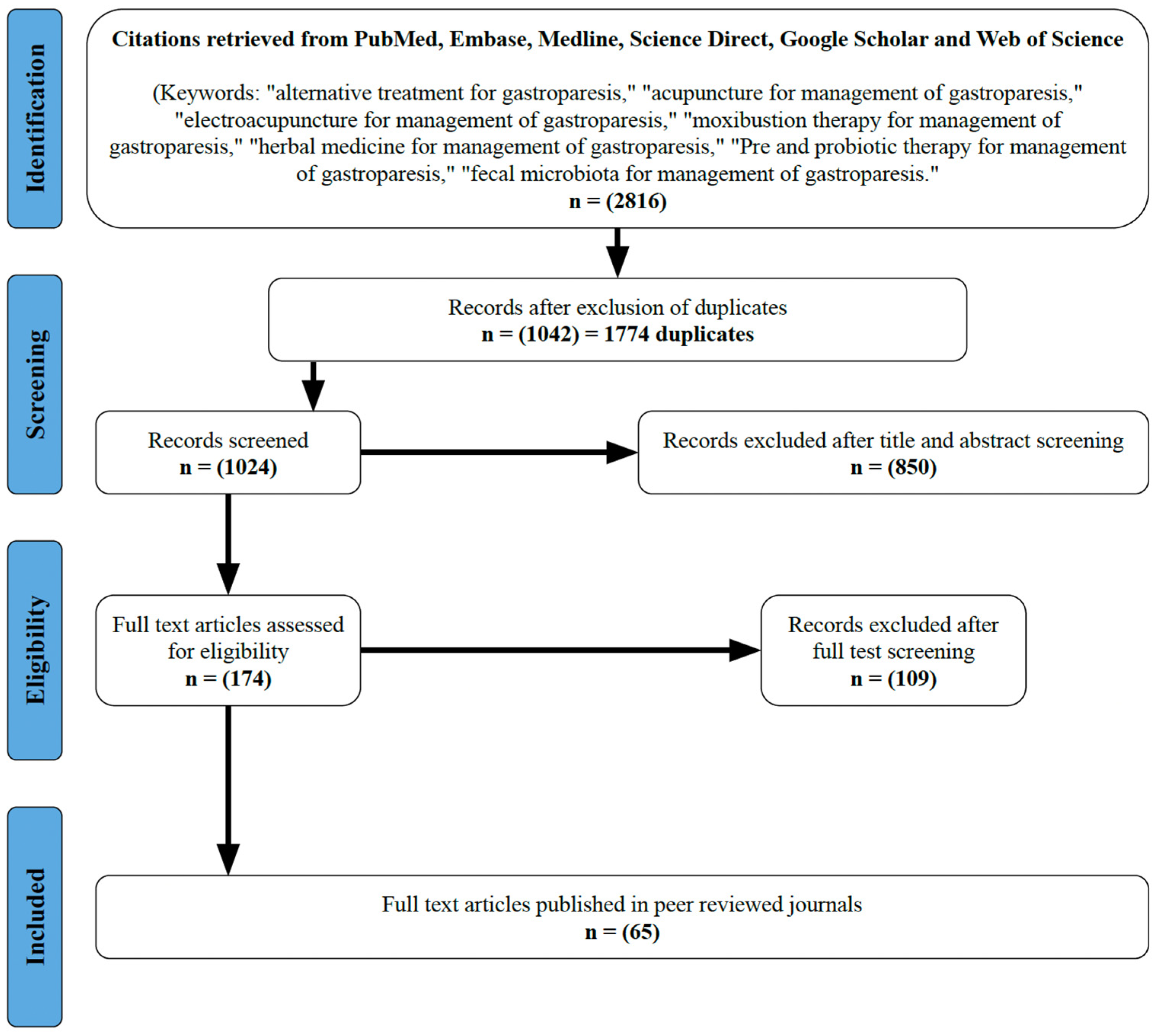
2.4. Study Selection
2.5. Data Extraction and Quality Assessment
3. Results
3.1. Therapeutic Response
3.2. Symptomatic Response
4. Discussion
Limitations
5. Conclusions
Author Contributions
Funding
Institutional Review Board Statement
Informed Consent Statement
Data Availability Statement
Acknowledgments
Conflicts of Interest
Abbreviations
| GP | Gastroparesis |
| AC | Acupuncture |
| EA | Electroacupuncture |
| MX | Moxibustion |
| HM | Herbal medicine |
References
- Dimino, J.; Kuo, B. Current concepts in gastroparesis and gastric neuromuscular disorders—Pathophysiology, diagnosis, and management. Diagnostics 2025, 15, 935. [Google Scholar] [CrossRef] [Scilit] [PubMed]
- Simon-Weidner, R. Die postoperative Magenatonie nach Magenresektionen [Postoperative stomach atony after stomach resections]. Zentralbl. Chir. 1953, 78, 353–362. [Google Scholar]
- Kassander, P. Asymptomatic gastric retention in diabetics (gastroparesis diabeticorum). Ann. Intern. Med. 1958, 48, 797–812. [Google Scholar] [CrossRef] [Scilit]
- Camilleri, M.; Chedid, V.; Ford, A.C.; Haruma, K.; Horowitz, M.; Jones, K.L.; Low, P.A.; Park, S.; Parkman, H.P.; Stanghellini, V. Gastroparesis (Primer). Nat. Rev. Dis. Primers 2018, 4, 41. [Google Scholar] [CrossRef] [Scilit]
- Grover, M.; Farrugia, G.; Stanghellini, V. Gastroparesis: A turning point in understanding and treatment. Gut 2019, 68, 2238–2250. [Google Scholar] [CrossRef] [Scilit]
- Ladabaum, U.; Ford, J.M.; Martel, M.; Barkun, A.N. American Gastroenterological Association technical review on the diagnosis and management of Lynch syndrome. Gastroenterology 2015, 149, 783–813. [Google Scholar] [CrossRef] [Scilit]
- Wang, Y.R.; Fisher, R.S.; Parkman, H.P. Gastroparesis-related hospitalizations in the United States: Trends, characteristics, and outcomes, 1995–2004. Off. J. Am. Coll. Gastroenterol.|ACG 2008, 103, 313–322. [Google Scholar] [CrossRef] [Scilit] [PubMed]
- Jung, H.K. The incidence, prevalence, and survival of gastroparesis in olmsted county, Minnesota, 1996–2006 (gastroenterology 2009; 136: 1225–1233). J. Neurogastroenterol. Motil. 2010, 16, 99–100. [Google Scholar] [CrossRef] [Scilit]
- Waseem, S.; Moshiree, B.; Draganov, P.V. Gastroparesis: Current diagnostic challenges and management considerations. World J. Gastroenterol. WJG 2009, 15, 25. [Google Scholar] [CrossRef] [Scilit]
- Grover, M.; Farrugia, G.; Lurken, M.S.; Bernard, C.E.; Faussone–Pellegrini, M.S.; Smyrk, T.C.; Parkman, H.P.; Abell, T.L.; Snape, W.J.; Unalp-Arida, A.; et al. Cellular changes in diabetic and idiopathic gastroparesis. Gastroenterology 2011, 140, 1575–1585. [Google Scholar] [CrossRef] [Scilit] [PubMed]
- Kashyap, P.; Farrugia, G. Diabetic gastroparesis: What we have learned and had to unlearn in the past 5 years. Gut 2010, 59, 1716–1726. [Google Scholar] [CrossRef] [Scilit]
- Tang, D.M.; Friedenberg, F.K. Gastroparesis: Approach, diagnostic evaluation, and management. Disease-a-Month 2011, 57, 74–101. [Google Scholar] [CrossRef] [Scilit]
- Staller, K.; Parkman, H.P.; Greer, K.B.; Leiman, D.A.; Zhou, M.J.; Singh, S.; Camilleri, M.; Altayar, O. AGA clinical practice guideline on management of gastroparesis. Gastroenterology 2025, 169, 828–861. [Google Scholar] [CrossRef] [Scilit] [PubMed]
- Yin, J.; Chen, J.; Chen, J.D. Ameliorating effects and mechanisms of electroacupuncture on gastric dysrhythmia, delayed emptying, and impaired accommodation in diabetic rats. Am. J. Physiol.-Gastrointest. Liver Physiol. 2010, 298, G563–G570. [Google Scholar] [CrossRef] [Scilit] [PubMed]
- Wang, S.J.; Yang, H.Y.; Xu, G.S. Acupuncture alleviates colorectal hypersensitivity and correlates with the regulatory mechanism of TrpV1 and p-ERK. Evid.-Based Complement. Altern. Med. 2012, 2012, 483123. [Google Scholar] [CrossRef] [Scilit]
- Abraham, T.S.; Chen, M.L.; Ma, S.X. TRPV1 expression in acupuncture points: Response to electroacupuncture stimulation. J. Chem. Neuroanat. 2011, 41, 129–136. [Google Scholar] [CrossRef] [Scilit]
- Sun, H.; Wang, D.H. Clinical observation on different acupuncture and moxibustion therapies for treatment of postsurgical gastroparesis syndrome. Zhongguo Zhen Jiu Chin. Acupunct. Moxibustion 2007, 27, 173–175. [Google Scholar]
- Zhou, Y.; Ma, H.Q.; Yang, Z.J.; Shao, H.T.; Yue, G.L.; Du, G.Z. Comparative study on effect of electroacupuncture at lower he-sea point of stomach and he-sea matching front-mu points for gastroparesis. Zhongguo Zhen Jiu Chin. Acupunct. Moxibustion 2020, 40, 925–927. [Google Scholar] [CrossRef] [Scilit]
- Wang, C.P.; Kao, C.H.; Chen, W.K.; Lo, W.Y.; Hsieh, C.L. A single-blinded, randomized pilot study evaluating effects of electroacupuncture in diabetic patients with symptoms suggestive of gastroparesis. J. Altern. Complement. Med. 2008, 14, 833–839. [Google Scholar] [CrossRef] [Scilit]
- Danielli Miller, N.; Schiff, E.; Ben-Arye, E.; Singer, J.; Tsadok Perets, T.; Flaut, S.; Sahar, N.; Niv, Y.; Dickman, R. Benefits of acupuncture for diabetic gastroparesis: A comparative preliminary study. Acupunct. Med. 2014, 32, 139–145. [Google Scholar] [CrossRef] [Scilit]
- Li, G.; Huang, C.; Zhang, X.; Xie, H.; Cheng, H.; Tang, Y.; Li, Z. The short-term effects of acupuncture on patients with diabetic gastroparesis: A randomised crossover study. Acupunct. Med. 2015, 33, 204–209. [Google Scholar] [CrossRef] [Scilit]
- Sun, B.M.; Luo, M.; Wu, S.B.; Chen, X.X.; Wu, M.C. Acupuncture versus metoclopramide in treatment of postoperative gastroparesis syndrome in abdominal surgical patients: A randomized controlled trial. Zhong Xi Yi Jie He Xue Bao J. Chin. Integr. Med. 2010, 8, 641–644. [Google Scholar] [CrossRef] [Scilit]
- Chang, C.S.; Ko, C.W.; Wu, C.Y.; Chen, G.H. Effect of electrical stimulation on acupuncture points in diabetic patients with gastric dysrhythmia: A pilot study. Digestion 2001, 64, 184–190. [Google Scholar] [CrossRef] [Scilit] [PubMed]
- Song, G.; Sun, Y.; Bashashati, M.; Quezada, A.; Sigaroodi, S.; Sarosiek, I.; Chen, J.D.Z.; McCallum, R.W. Efficacy of needleless transcutaneous electroacupuncture in synchronization with breathing for symptomatic idiopathic gastroparesis: A blinded and controlled acute treatment trial. Neurogastroenterol. Motil. 2018, 30, e13361. [Google Scholar] [CrossRef] [Scilit]
- Meng, N.; Shi, Z.M. Effect of herb-partitioned moxibustion at fanwei point on plasma motilin and serum gastrin in patients of diabetic gastroparesis. Zhongguo Zhen Jiu Chin. Acupunct. Moxibustion 2020, 40, 361–364. [Google Scholar] [CrossRef]
- Guo, J.; Dou, J.; Li, R. Evaluation on therapeutic effect of needle warming moxibustion combined with Banxia-Xiexin decoction in diabetic gastroparesis. Int. J. Tradit. Chin. Med. 2019, 41, 451–453. [Google Scholar]
- Hou, X.B.; Su, Y.U. Thirty-six cases of postsurgical gastroparesis of abdominal cancer treated by comprehensive therapy of acupuncture-moxibustion. World J. Acupunct.-Moxibustion 2013, 23, 53–55. [Google Scholar] [CrossRef] [Scilit]
- Hu, Z.; Wang, Y.; Huang, J.; Xu, J.; Jiang, Z.; Wang, S. Research for optimizing the acupuncture-moxibustion treatment protocol for diabetic gastroparesis. Shanghai J. Acupunct. Moxibustion 2014, 1094–1096. [Google Scholar]
- Song, Y.J.; Wang, X.; Li, X.J.; Zhang, Z.L. Effect of Tiaoli Piwei needling technique on diabetic gastroparesis and transmembrane protein 16A. Zhongguo Zhen Jiu Chin. Acupunct. Moxibustion 2020, 40, 811–815. [Google Scholar] [CrossRef] [Scilit]
- Chen, L.; Zhang, X.F.; Ku, B.Q.; Wang, X.C.; Ma, C.; Liang, J.Y.; Liu, J. Effects of acupoint injection of autologous blood on symptoms and plasma motilin and gastrin levels of diabetic gastroparesis patients. Zhen Ci Yan Jiu Acupunct. Res. 2012, 37, 229–232. [Google Scholar]
- Zeng, H.W.; Nie, B.; Ge, Y.; Wang, H.; Song, X.J. Effects of different acupuncture intensities on the therapeutic effect and the gastric electric activity in the patient of diabetic gastroparesis. Zhongguo Zhen Jiu Chin. Acupunct. Moxibustion 2006, 26, 644–646. [Google Scholar]
- Zeng, H.W.; Chai, T.J. Observation on therapeutic effect of turtle probing the cave needling method on diabetic gastroparesis. Zhongguo Zhen Jiu Chin. Acupunct. Moxibustion 2008, 28, 576–578. [Google Scholar]
- Zhang, C.Y. Observation on therapeutic effect of routine acupoints plus mental activity-adjusting acupoints in the treatment of post-surgical gastroparesis syndrome. Zhen Ci Yan Jiu Acupunct. Res. 2010, 35, 458–461. [Google Scholar] [CrossRef]
- Zhang, C.N.; Huang, X.K.; Luo, Y.; Jiang, J.; Wan, L.; Wang, L. Observation on therapeutic effects of acupoint injection of metoclopramide for postsurgical gastroparesis syndrome. Zhen Ci Yan Jiu Acupunct. Res. 2014, 39, 406–409. [Google Scholar] [CrossRef]
- Zhang, P.; Liu, Z.F.; Wang, C.M.; Yao, S.Z.; Zhang, Z.L. Observation on the therapeutic effect of needling method for harmonizing spleen-stomach on diabetic gastroparesis. Zhongguo Zhen Jiu Chin. Acupunct. Moxibustion 2007, 27, 258–260. [Google Scholar]
- Wu, X.; Li, P.; Liu, L.; Chen, X.; Yue, Z. A Clinical Randomized Controlled Trial of Acupuncture Treatment of Gastroparesis Using Different Acupoints. Pain Res. Manag. 2020, 2020, 8751958. [Google Scholar] [CrossRef] [Scilit]
- Cai, D. Xiangshaliujunzi Decoction Treating Diabetic Gastroparesis. Master’s Thesis, Hubei University of Chinese Medicine, Wuhan, China, 2011. [Google Scholar]
- Feng, M.L. Moderated Xiangshaliujunzi decoction treating 64 Diabetic patients. Zhongguo Zhongyiyoa Xinxi Zazhi 2001, 2. [Google Scholar]
- Guo, Q.H.; Zhai, L.L. Moderated Xiangshaliujunzi decoction treating 32 Diabetic gastroparesis patients. Yunnan Zhongyi Zhongyao Zazhi 2009, 30, 31. [Google Scholar] [CrossRef]
- Lu, Y.W. Moderated Xiangshaliujunzi decoction treating Diabetic gastroparesis. Liaoning Zhongyiyao Daxue Xuebao 2009, 11, 136–137. [Google Scholar] [CrossRef]
- Lu, Y.C.; Yu, X.L. Xiangshaliujunzi decoction combined with Xuanfudaizhe decoction treating 72 Diabetic gastroparesis patients. Jiangsu Zhongyiyao 2011, 43, 42–43. [Google Scholar]
- Meng, Y.F. Moderated Xiangshaliujunzi decoction treating 32 Diabetic gastroparesis patients. Zhongwai Jiankang Wenzhai 2012, 9, 414. [Google Scholar]
- Wen, Z.Q. Moderated Xiangshaliujunzi decoction treating 44 Diabetic gastroparesis patients. Zhongguo Linchuang Yanjiu 2012, 25, 608–609. [Google Scholar]
- Dai, B.H. Moderated Xiangshaliujunzi decoction treating 36 Diabetic gastroparesis patients. Hebei Zhongyi 2003, 25, 809–810. [Google Scholar]
- Ji, M.L. Moderated Xiangshaliujunzi decoction treating Diabetic gastroparesis. Shanxi Yiyao Zazhi 2009, 38, 622. [Google Scholar]
- Hou, J.Z.; Zhang, Q.; Yan, G.H. Moderated Xiangshaliujunzi decoction treating 56 Diabetic gastroparesis patients. Xinzhongyi 2010, 42, 17–19. [Google Scholar]
- Yan, H.; Zhi-jin, L.; Xiao-fang, L. Effect of hot application with the packed Chinese medicine in the treatment of patients with diabetic gastroparesis. J. Qilu Nurs. 2013, 13. [Google Scholar]
- Liang, C.; Xie, R.; Xu, W. Clinical Observation of Hot Herbal Medicine Package Treatment for Diabetic Gastroparesis. J. New Chin. Med. 2015, 7. [Google Scholar]
- X, Y.; Fu. Clinical observation of Modifed Banxiaxiexin decoction treating 83 Diabetic Gastroparesis patients. Mod. Med. J. China 2006, 8, 20. [Google Scholar]
- Gao, Y.F. Clinical observation of Modifed Banxiaxiexin decoction combined with Sinisan treating 35 Diabetic Gastroparesis patients. Gansu J. Tradit. Chin. Med. 2011, 24, 46–47. [Google Scholar]
- Li, J. Clinical observation of Modifed Banxiaxiexin decoction treating 45 Diabetic Gastroparesis patients. Jiangsu J. Tradit. Chin. Med. 2004, 25, 25. [Google Scholar]
- Liu, R.Y.; Xu, L.; Zhao, P.T. Clinical observation of Banxiaxiexin decoction treating 38 Diabetic Gastroparesis patients. Guangming J. Chin. Med. 2008, 23, 969. [Google Scholar]
- Liu, Z.P. Clinical observation of Banxiaxiexin decoction combined with Domperidone treating 60 Diabetic Gastroparesis patients in T2DM. Yunnan J. Tradit. Chin. Med. Mater. Medica 2012, 33, 36. [Google Scholar]
- Luo, Y.H.; Luo, Y.J.; Liu, Z.Y. Clinical observation of Integrative Medicine treating 46 diabetic gastroparesis patients. China Med. Her. 2008, 5, 62–63. [Google Scholar]
- Qiu, Y.M.; Shan, J.W.; Hu, T.C. Clinical observation of Modifed Banxiaxiexin decoction treating 35 Diabetic Gastroparesis patients. Fujian J. Tradit. Chin. Med. 2004, 35, 25. [Google Scholar]
- Sun, X.Q. The Efcacy of Banxiaxiexin decoction treating diabetic gastroparesis. Guangming J. Chin. Med. 2009, 24, 1447. [Google Scholar]
- Wang, R.L. Effects of Chaihu Shugan San combine with Banxiaxiexin decoction for treating diabetic gastroparesis. Massage Rehabil. Med. 2011, 51, 200. [Google Scholar]
- Wang, L.N. Clinical observation of Modifed Banxiaxiexin decoction treating 30 Diabetic Gastroparesis. Henan Tradit. Chin. Med. 2011, 31, 586–587. [Google Scholar]
- Wang, Y.S. Clinical observation of Integrative Medicine treating diabetic gastroparesis. Hebei Med. J. 2010, 32, 2277. [Google Scholar]
- Yin, D. Clinical observation of Integrative Medicine treating 57 diabetic gastroparesis patients. Mod. J. Integr. Tradit. Chin. West. Med. 2012, 21, 3580–3581. [Google Scholar]
- Zhou, X.S. Observation of Modifed Banxiaxiexin decoction treating 48 Diabetic Gastroparesis patients. Henan Tradit. Chin. Med. 2003, 23, 10. [Google Scholar]
- Shuiping, Z. Observation of Modifed Banxiaxiexin decoction treating 43 Diabetic Gastroparesis patients. J. Emerg. Tradit. Chin. Med. 2005, 14, 898. [Google Scholar]
- Zhu, Z.Y.; Ji, X.R. Observation of Banxiaxiexin decoction treating 26 Diabetic Gastroparesis patients. Shandong J. Tradit. Chin. Med. 2009, 28, 848–849. [Google Scholar]
- Zou, J.P. Banxiaxiexin decoction treating diabetic gastroparesis patients. Nei Mong. J. Tradit. Chin. Med. 2009, 28, 6. [Google Scholar]
- Revicki, D.A.; Rentz, A.M.; Dubois, D.; Kahrilas, P.; Stanghellini, V.; Talley, N.J.; Tack, J. Development and validation of a patient-assessed gastroparesis symptom severity measure: The Gastroparesis Cardinal Symptom Index. Aliment. Pharmacol. Ther. 2003, 18, 141–150. [Google Scholar] [CrossRef] [Scilit]
- Cao, J.; Zhou, X.; Yan, H.; Li, L. Application of acupuncture in diabetic gastroparesis: A case series. Asian J. Surg. 2024, 47, 1401–1402. [Google Scholar] [CrossRef] [Scilit]
- Chen, J.; Liang, F.X.; Wu, S.; Chen, Z.Q.; Chen, B.; Zhou, T.; Gu, X.L.; Li, C.L.; Shi, Y.P.; Yan, P.; et al. Clinical research of acupuncture therapy combined with domperidone in treatment of diabetic gastroparesis of liver stagnation and spleen deficiency. Chen Tzu Yen Chiu Acupunct. Res. 2023, 48, 88–94. [Google Scholar] [CrossRef] [Scilit]
- Cheng, H.; Sun, J.; Yin, W.; Zhang, L. Clinical effect of acupuncture combined with acupoint application to treat gastroparesis syndrome after gastric cancer operation. Asia-Pac. J. Clin. Oncol. 2022, 18, 24. [Google Scholar]
- Liang, H.Y. Clinical observation of Xiangsha Liujunzi decoction in the treatment of type 2 diabetic gastroparesis with spleen and stomach weakness. Zhongguo Minjian Liaofa 2022, 75–77. [Google Scholar]
- Kostitska, I.; Mankovsky, B.; Grunevuch, R.; Shapoval, O. The Use of Laser Acupuncture in the Treatment of Diabetic Gastroparesis; Editura Niculescu: Bucharest, Romania, 2017; pp. 212–219. [Google Scholar]
- Li, S.; Wang, G. External application of traditional Chinese medicine to treat diabetic gastroparesis. Asian J. Surg. 2024, 47, 4427–4428. [Google Scholar] [CrossRef] [Scilit]
- Li, T.; Zhang, Y.; Mi, Q.; Li, Z.; Bao, F.; Wang, W. Comparison of Clinical Efficacy of Different Acupuncture Therapies for Grade C Delayed Gastric Emptying after Pancreaticoduodenectomy: A Retrospective Cohort Study Based on Propensity Score Matching. Med. J. Peking Union Med. Coll. Hosp. 2023, 14, 1031–1037. (In Chinese) [Google Scholar] [CrossRef]
- Lin, W.J.; Zheng, S.; Yang, X.Q.; Lu, L.H.; Liu, W.W.; Chen, C.Y. Clinical efficacy observation of electroacupuncture based on the “ascending lucidity and descending turbidity” theory: A study of gut microbiota in patients with diabetic gastrointestinal dysfunction. Chen Tzu Yen Chiu Acupunct. Res. 2024, 49, 1084–1091. [Google Scholar] [CrossRef] [Scilit]
- Liu, R.; He, M.; Zhao, X.; Sun, M.; Cao, J.; Wang, X.; Wang, X.; Zhao, S.; Wang, F.; Li, T. Effects of stimulating single acupoint and combination acupoints on diabetic gastroparesis: A randomised controlled trial study. J. Tradit. Complement. Med. 2024, 14, 446–455. [Google Scholar] [CrossRef] [Scilit]
- Pan, W.P.; Wang, Z.K.; Tian, F.L.; Yan, M.X.; Lu, Y. Electroacupuncture combined with mosapride alleviates symptoms in diabetic patients with gastroparesis. Exp. Ther. Med. 2017, 13, 1637–1643. [Google Scholar] [CrossRef] [Scilit] [PubMed]
- Liu, Q.M. Clinical observation of modified Chaiqin Wendan decoction in the treatment of diabetic gastroparesis. Shiyong Zhongyi Zazhi 2021, 911–913. [Google Scholar]
- Sarosiek, I.; McCallum, R.W.; Sun, Y.; Vasquez, D.; Chen, J.F.; Abell, T.L.; Yin, J.Y.; Chen, J.D. Self-Administered Needleless Acupuncture Therapy to Control Dyspepsia and GERD Symptoms in Patients Diagnosed With Diabetic Gastroparesis. Gastroenterology 2013, 144, 135. [Google Scholar] [CrossRef] [Scilit]
- Singh, A.; Kant, R.; Raina, R.; Dhingra, V.; Nema, R.; Bairwa, M.C.; Kanwar, V.; Mirza, A.A.; Agarwal, M. Efficacy of Pistacia lentiscus plant (rumi mastagi) in comparison to levosulpiride in patients with diabetic gastroparesis: A double-blind non-inferior randomised control trial study. Indian J. Endocrinol. Metab. 2024, 28, 35–42. [Google Scholar] [CrossRef] [Scilit]
- Yan, Y.; Zeng, J. Observation on the effects of gastroparesis recipe ironing therapy combined with umbilical moxibustion on the recovery of gastroparesis after gastric tumor surgery. Anti-Tumor Pharm. 2023, 13, 106–110. (In Chinese) [Google Scholar]
- Yue, G.; Zhang, L.; Li, T.; Ge, X.; Zhou, Q.; Gong, C.; Du, G. Effects of Electroacupuncture at He-Mu Acupoints on Gastroparesis Syndrome. Int. J. Clin. Acupunct. 2023, 32, 42. [Google Scholar]
- Zhu, C.H.; Mei, C. To analyze the efficacy of Banxia Xiexin decoction in the treatment of diabetic gastroparesis and its influence on the quality of life of patients. Shu Li Yi Yao Xue Za Zhi 2022, 1057–1059. [Google Scholar]
- Wang, L. Clinical observation on acupuncture treatment in 35 cases of diabetic gastroparesis. J. Tradit. Chin. Med. 2004, 163–165. [Google Scholar]
- Zhang, Q. Clinical observation on acupuncture treatment of insomnia in 35 cases. J. Chin. Med. 2003, 57–58. [Google Scholar]
- Kim, K.H.; Lee, M.S.; Choi, T.Y.; Kim, T.H. Acupuncture for symptomatic gastroparesis. Cochrane Database Syst. Rev. 2018, 2018, CD009676. [Google Scholar] [CrossRef] [Scilit]
- Noguchi, E. Acupuncture regulates gut motility and secretion via nerve reflexes. Auton. Neurosci. 2010, 156, 15–18. [Google Scholar] [CrossRef] [Scilit] [PubMed]
- Chen, J.; Song, G.Q.; Yin, J.; Koothan, T.; Chen, J.D. Electroacupuncture improves impaired gastric motility and slow waves induced by rectal distension in dogs. Am. J. Physiol.-Gastrointest. Liver Physiol. 2008, 295, G614–G620. [Google Scholar] [CrossRef] [Scilit]
- Chen, Y.; Xu, J.J.; Liu, S.; Hou, X.H. Electroacupuncture at ST36 ameliorates gastric emptying and rescues networks of interstitial cells of Cajal in the stomach of diabetic rats. PLoS ONE 2013, 8, e83904. [Google Scholar] [CrossRef] [Scilit]
- Fu, Z.-T.; Liu, C.-Z.; Kim, M.-R.; Liu, Y.-D.; Wang, Y.; Fu, Y.-M.; Yang, J.-W.; Yang, N.-N. Acupuncture improves the symptoms, serum ghrelin, and autonomic nervous system of patients with postprandial distress syndrome: A randomized controlled trial. Chin. Med. 2024, 19, 162. [Google Scholar] [CrossRef] [Scilit]
- Guo, Y.; Wei, W.; Chen, J.D.Z. Effects and mechanisms of acupuncture and electroacupuncture for functional dyspepsia: A systematic review. World J. Gastroenterol. 2020, 26, 2440–2457. [Google Scholar] [CrossRef] [Scilit]
- Deng, H.; Shen, X. The mechanism of moxibustion: Ancient theory and modern research. Evid.-Based Complement. Altern. Med. 2013, 2013, 379291. [Google Scholar] [CrossRef] [Scilit]
- Chen, J.D.Z.; Yin, J.; Wei, W. Electroceuticals and neuromodulation for gastrointestinal motility disorders. Expert Rev. Gastroenterol. Hepatol. 2018, 24, 489–502. [Google Scholar] [CrossRef] [Scilit]
- Chen, C.; Yu, Z.; Li, Y.; Fichna, J.; Storr, M. Effects of berberine in the gastrointestinal tract—A review of actions and therapeutic implications. Am. J. Chin. Med. 2014, 42, 1053–1070. [Google Scholar] [CrossRef] [Scilit]
- Liu, J.; Li, F.; Tang, X.D.; Ma, J.; Ma, X.; Ge, D.Y.; Li, G.M.; Wang, Y. Xiangshaliujunzi decoction alleviates the symptoms of functional dyspepsia by regulating brain–gut axis and production of neuropeptides. BMC Complement. Altern. Med. 2015, 15, 387. [Google Scholar] [CrossRef] [Scilit] [PubMed]
- Bielefeldt, K.; Raza, N.; Zickmund, S.L. Different faces of gastroparesis. World J. Gastroenterol. WJG 2009, 15, 6052. [Google Scholar] [CrossRef] [Scilit] [PubMed]
- De La Loge, C.; Trudeau, E.; Marquis, P.; Revicki, D.A.; Rentz, A.M.; Stanghellini, V.; Talley, N.J.; Kahrilas, P.; Tack, J.; Dubois, D. Responsiveness and interpretation of a quality of life questionnaire specific to upper gastrointestinal disorders. Clin. Gastroenterol. Hepatol. 2004, 2, 778–786. [Google Scholar] [CrossRef] [Scilit]
- Bian, J.L.; Zhang, C.H. Conception and core of academician Shi Xuemin’s acupuncture manipulation quantitative arts. Chin. Acupunct. Moxibustion 2003, 5. [Google Scholar]


| Reference | Study | Patients (T/G) | Mode of Operation | Duration | Outcome | Comments |
|---|---|---|---|---|---|---|
| [18] | Zhou et al., 2020 | 63/2 | ST 36, CV 12 | Once a day, 5 times a week, 3 weeks | GCSI, T1/2, GRR, | NA |
| [19] | Wang et al., 2008 | 19/2 | ST 36, LI 4 | Four sessions over 2 weeks | GCSI, T1/2, SG, PM, PBGL, PP | Sham EA was taken as a control |
| [24] | Song et al., 2018 | 18 | Transcutaneous electroacupuncture PC 6, ST 36 | 30 min for baseline, and 60 min for STEA | PP, NS | Real STEA vs. Sham STEA. STEA was effective in gastric dysrhythmia |
| [73] | Lin et al., 2024 | 48/2 | CV12, ST25, LU1, LR13, SP3, LU9, ST36, ST37 | Once daily, 30 min, 5 times a week for 2 weeks | GCSI, GSRS | Sham EA was provided to control. EA was effective in gastroparesis management |
| [75] | Pan et al., 2017 | 56/2 | NA | Once daily, 30 min, 5 times a week for 2 weeks | GCSI, GER, GIS | No control, groups divided by mild and severe gastroparesis |
| [77] | Sarosiek et al., 2013 | 12 | Transcutaneous electroacupuncture PC6, ST36 | 2 h, three times per day, over 4 weeks | GIS | All patients had both treatment and sham at different time points. EA was shown to be effective |
| [80] | Yue et al., 2023 | 51/2 | CV12, ST36 | Once daily, 30 min, 5 times a week for 3 weeks | T1/2, GRR | No control group, two groups based on multiple or single acupoints. Multiple considered more effective |
| Reference | Study | Patients (T/G) | Intervention Combinations | Mode of Operation | Duration | Outcome | Comments |
|---|---|---|---|---|---|---|---|
| [17] | Sun and Wang, 2007 | 41/3 | Acupuncture, moxibustion | NA | NA | GDV | Moxibustion considered the best method |
| [25] | Meng and Shi, 2020 | 134/2 | Herb-partitioned moxibustion | Fanwei point | Once a day, 5 times a week, for 6 weeks | GCSI, SG, PM, TCM | Itopride hydrochloride medication for control |
| [26] | Guo et al., 2019 | 86/2 | Moxibustion with Banxia-Xiexin decoction | NA | Four weeks | PM, SS, LP | Control group was treated with moxibustion |
| [27] | Hou and Yu et al., 2013 | 36/3 | Moxibustion, Acupuncture and Cupping | BL 21, CV 13, CV 12, CV 10, ST 25, CV 8, ST 36 | Once a day, 5 times during a course, with total 2 courses | GCSI | Moxibustion combined with cupping was efficient |
| [28] | Zhihai et al., 2014 | 100/4 | Moxibustion, acupuncture, electroacupuncture, hydro acupuncture, | NA | 3 courses | VCS | Acupuncture combined with moxibustion was effective among treatments |
| [71] | Li and Wang, 2024 | 48/2 | Moxibustion, acupoint injection of methylcobalamin | ST36 | Once daily, 4-week duration | GCSI | Control group was treated with metoclopramide and gastroparesis diet |
| [79] | Yan and Zeng, 2023 | 102/2 | Moxibustion, ironing therapy | On umbilicus | Once daily, 4-week duration | GCSI, GER | Moxibustion and ironing therapy was shown to be effective |
| Reference | Study | Patients (T/G) | Mode of Operation | Duration | Outcome | Comments |
|---|---|---|---|---|---|---|
| [20] | Miller et al., 2014 | 8/2 | PC 6, ST 36, LR 14, CV 12 | 12 weeks medication and 8 weeks for acupuncture with 2–3-week gap | GCSI, GER, GGH | First patients received domperidone for 12 weeks, then acupuncture for 8 weeks |
| [21] | Li et al., 2015 | 21/2 | NA | 7 days for both with one month gap | GCSI, FBG, GGH | The two groups received real or sham acupuncture |
| [22] | Sun et al., 2010 | 63/2 | RN 12, ST 36, PC 6, SP 6, | Once a day | GDV | Metoclopramide was given to control three times a day |
| [23] | Chang et al., 2001 | 15 | NA | For one minute, with 30 min interval | PP, SG, PM | Acupuncture followed by electrical stimulation with 30 min interval |
| [29] | Song et al., 2020 | 128/2 | CV 12, ST 36, SP 9, SP 10, SP 6, SP 8 | Once a day, 6 times a week, 4 weeks | GCSI, STMP 16A (ANO1) | Mosapride citrate was given to control group |
| [30] | Chen et al., 2012 | 42/2 | ST 36, OV 12, BL 21 | Once a day a week, 4 weeks | PM, PG | Domperidone was given to control group |
| [31] | Zeng et al., 2006 | 80/4 | NA | Once a day a week, 2 weeks | SEG | Grouping in terms of acupuncture intensity and hypoglycemic drug as control |
| [32] | Zeng and Chai, 2008 | 60/2 | CV 12, ST 36, PC 6, SP 6 | Once a day, for 2 weeks | NA | Domperidone was given to control |
| [33] | Zhang 2010 | 20/2 | BL 20, BL 21, BL 22, PC 6, CV 12, CV 6, ST 25, MA-IC, MA-AH 7, MA-IC 3, MA-IC 4, MA-AT 1, GV 20, EX-HN 3 | Once a day, 5 times a week, for 4 weeks | HAMD, HAMA, GDV | Significant in terms of HAMD and HAMA |
| [34] | Zhang et al., 2014 | 46/2 | ST 36, BL 21 | Once a day, for 2 weeks | VCS | Metoclopramide for both groups |
| [35] | Zhang et al., 2007 | 72/2 | LI 11, LI 4, CV 12, ST 36, ST 40, SP 9, SP 6, SP 10, SP 8 | Twice each day, 10 days with interval of 2 days | NA | Domperidone was given to control group |
| [36] | Xuefen et al., 2020 | 99/3 | CV 12, ST 36, PC 6, | Once a day, for 5 days, with 2 days gap b/w three courses | GCSI, GER | No control group, three groups based on acupoints |
| [66] | Cao et al., 2024 | 53/2 | NA | Once a day for 5 days over 4 weeks | GCSI, FBG, 2hPBG | Control group was treated with mosapride |
| [67] | Chen et al., 2023 | 84/2 | GV20, GV24, CV12, ST36, LI4, LR3 | Once a day 3 times a week for 4 weeks | GCSI, TCM, FBG, 2hPBG, GH | Acupuncture treatment is effective with domperidone |
| [68] | Cheng et al., 2022 | 80/2 | NA | Once a day for 2 weeks | GCSI, GIS, RAD | Control group was treated with itopride |
| [70] | Kotstitska et al., 2017 | 34/2 | NA | 5 sessions of 40 min, over 1 week | GCSI, GER | Control group was treated with itopride daily |
| [72] | Li et al., 2023 | 65/2 | NA | Once a day for 30 min, 3 days | GCSI, GER, GDV | No control group, two groups based on acupoints (body/ear). Auricular considered more effective |
| [74] | Liu et al., 2024 | 99/3 | CV12, ST36 | 30 min per day, 5 days a week for 3 weeks | GCSI, FPG, 2hPBG | Groups determined by multiple, single or sham acupoints. Combinations more effective |
| [82] | Wang 2004 | 80/3 | CV 12, ST 36, PC 6, SP 4, BL 20, BL 21, LI 11, GB 34, CV 6, CV 4, SP 6 | Once a day, for 10 days, with 5 days interval b/w two courses | VCS, GP | Two control groups, one given domperidone while other nothing |
| Reference | Study | Patients (T/G) | Type of Herbal Medicine | Duration | Outcome | Comments |
|---|---|---|---|---|---|---|
| [37] | Cai, 2011 | 54/2 | Modified xiangshaliujunzi decoction | 4 weeks | CER, GER, GIS | Control group was treated with metoclopramide |
| [38] | Feng 2001 | 128/2 | Modified xiangshaliujunzi decoction | 4 weeks | CER, GIS | Cisapride and metoclopramide as control group |
| [39] | Gou et al., 2009 | 62/2 | Modified xiangshaliujunzi decoction | 8 weeks | CER, GIS | Control group was treated with domperidone |
| [40] | Lu 2009 | 94/2 | Modified xiangshaliujunzi decoction | 4 weeks | CER, GIS | Domperidone as a control group |
| [41] | Lu et al., 2011 | 142/2 | Modified xiangshaliujunzi decoction | 4 weeks | CER, GER, GIS | Mosapride as a control group |
| [42] | Meng 2012 | 62/2 | Modified xiangshaliujunzi decoction | 4 weeks | CER, GIS | Cisapride and metoclopramide as a control group |
| [43] | Wen 2012 | 87/2 | Modified xiangshaliujunzi decoction | 4 weeks | CER, GER, GIS | Control group was treated with cisapride |
| [44] | Dai 2003 | 70/2 | Modified xiangshaliujunzi decoction | 3 weeks | CER, GER, GIS | Control group was treated with domperidone |
| [45] | Ji 2009 | 56/2 | Modified xiangshaliujunzi decoction | 2 weeks | CER, GIS | Domperidone as a control group |
| [46] | Hou et al., 2010 | 112/2 | Modified xiangshaliujunzi decoction | 8 weeks | CER, GIS, GER | Domperidone as a control group |
| [47] | Yan et al., 2013 | 50/2 | Hot application with packed Chinese medicine | 4 weeks | CER, GER, QL | Cisapride as a control group |
| [48] | Liang et al., 2015 | 66/2 | Hot application with packed Chinese medicine | 4 weeks | GER, FPG, CER, GH | NA |
| [49] | X et al., 2006 | 83/2 | Modified Banxia-Xiexin decoction | 9 weeks | CER, GER | Domperidone as a control group |
| [50] | Gao 2011 | 67/2 | Modified Banxia-Xiexin decoction | 8 weeks | CER, GER | Domperidone as a control group |
| [51] | Li 2004 | 85/2 | Modified Banxia-Xiexin decoction | 4 weeks | CER, GIS | Domperidone as a control group |
| [52] | Liu et al., 2008 | 76/2 | Concentrated Banxia-Xiexin decoction | 4 weeks | CER, GER | Domperidone as a control group |
| [53] | Liu 2012 | 120/2 | Concentrated Banxia-Xiexin decoction | 4 weeks | CER, GER | Domperidone as a control group |
| [54] | Luo et al., 2008 | 92/2 | Modified Banxia-Xiexin decoction | 4 weeks | CER, GER, GIS, | Mosapride as a control group |
| [55] | Qiu et al., 2004 | 65/2 | Modified Banxia-Xiexin decoction | 4 weeks | CER, GER | Cisapride as a control group |
| [56] | Sun 2009 | 96/2 | Concentrated Banxia-Xiexin decoction | 2 weeks | CER, GER, GIS | Domperidone as a control group |
| [57] | Wang 2011 | 100/2 | Modified Banxia-Xiexin decoction | 2 weeks | CER, GER, GIS | Domperidone as a control group |
| [58] | Wang 2011 | 56/2 | Modified Banxia-Xiexin decoction | 4 weeks | CER, GER, GIS | Domperidone as a control group |
| [59] | Wang 2010 | 96/2 | Modified Banxia-Xiexin decoction | 4 weeks | CER, GER | Domperidone and roxithromycin as a control group |
| [60] | Yin 2012 | 110/2 | Concentrated Banxia-Xiexin decoction | 4 weeks | CER, GER | Domperidone as a control group |
| [61] | Zhou 2003 | 72/2 | Modified Banxia-Xiexin decoction | 4 weeks | CER, GER | Domperidone as a control group |
| [62] | Zhou 2005 | 86/2 | Modified Banxia-Xiexin decoction | 4 weeks | CER, GER, FBG | Cisapride as a control group |
| [63] | Zhu and Ji 2009 | 50/2 | Modified Banxia-Xiexin decoction | 4 weeks | CER, GER | Domperidone as a control group |
| [64] | Zou 2009 | 48/2 | Modified Banxia-Xiexin decoction | 4 weeks | CER, GER, FBG | Domperidone as a control group |
| [69] | Liang, 2022 | 60/2 | Xiangshaliujunzi decoction | 3 weeks | CER, GIS | Control group was treated with cisapride |
| [76] | Liu, 2021 | 98/2 | Chaishaoliujun decoction | 2 weeks | CER, GIS, GER | NA |
| [78] | Singh et al., 2024 | 38/2 | Rumi Mastagi | Twice daily for 8 weeks | GCSI, GH, T1/2 | Control group was treated with levosulpiride |
| [81] | Zhu and Mei, 2022 | 122/2 | Banxia-Xiexin decoction | 4 weeks | CER, GER, GIS | Decoction proven to be effective over control (domperidone) |
Disclaimer/Publisher’s Note: The statements, opinions and data contained in all publications are solely those of the individual author(s) and contributor(s) and not of MDPI and/or the editor(s). MDPI and/or the editor(s) disclaim responsibility for any injury to people or property resulting from any ideas, methods, instructions or products referred to in the content. |
© 2026 by the authors. Licensee MDPI, Basel, Switzerland. This article is an open access article distributed under the terms and conditions of the Creative Commons Attribution (CC BY) license.
Share and Cite
Tan, D.; Singh, S.; Krishnan, U.; Ho, V. Alternative Therapeutic Approaches in the Management of Gastroparesis: A Systematic Review. Diseases 2026, 14, 179. https://doi.org/10.3390/diseases14050179
Tan D, Singh S, Krishnan U, Ho V. Alternative Therapeutic Approaches in the Management of Gastroparesis: A Systematic Review. Diseases. 2026; 14(5):179. https://doi.org/10.3390/diseases14050179
Chicago/Turabian StyleTan, Desaree, Serena Singh, Usha Krishnan, and Vincent Ho. 2026. "Alternative Therapeutic Approaches in the Management of Gastroparesis: A Systematic Review" Diseases 14, no. 5: 179. https://doi.org/10.3390/diseases14050179
APA StyleTan, D., Singh, S., Krishnan, U., & Ho, V. (2026). Alternative Therapeutic Approaches in the Management of Gastroparesis: A Systematic Review. Diseases, 14(5), 179. https://doi.org/10.3390/diseases14050179