
Harmful Effects of Microplastics and Nanoplastics in Human Body Systems: A Systematic Review



Abstract
1. Introduction
2. Materials and Methods
2.1. Protocol
2.2. Eligibility Criteria
2.3. Search Strategy and Information Sources
2.4. Screening Guidelines
2.5. Quality Assessment of Clinical Studies
2.5.1. Quality Appraisal
2.5.2. Risk of Bias Assessment
2.6. Data Extraction
3. Results
3.1. Impact of MNPs of Human Body Systems: Findings from Clinical Studies
3.1.1. Cardiovascular System
3.1.2. Gastrointestinal System
3.1.3. Musculoskeletal System
3.1.4. Respiratory System
3.1.5. Reproductive System
3.2. Impact of MNPs of Human Body Systems: Findings from In Vitro Studies
3.2.1. Cardiovascular System
3.2.2. Gastrointestinal System
3.2.3. Immune and Lymphatic Systems
3.2.4. Reproductive System
3.2.5. Respiratory System
3.2.6. Vascular System
3.2.7. Certified Reference Materials (CRMs)
4. Discussion
4.1. Principal Findings and Integration with the Existing Literature
4.2. Potential Mechanisms Linking MNPs to Human Health Outcomes
4.3. Public Health and Clinical Implications
4.4. Methodological Considerations and Future Research Directions
4.5. Strengths and Limitations
5. Conclusions
Author Contributions
Funding
Institutional Review Board Statement
Informed Consent Statement
Data Availability Statement
Conflicts of Interest
Appendix A
| NEWCASTLE—OTTAWA QUALITY ASSESSMENT SCALE |
| CASE CONTROL STUDIES |
| Note: A study can be awarded a maximum of one star for each numbered item within the Selection and Exposure categories. A maximum of two stars can be given for Comparability. |
| Selection |
| (1) Is the case definition adequate? (a) yes, with independent validation (b) yes, e.g., record linkage or based on self reports (c) no description |
| (2) Representativeness of the cases (a) consecutive or obviously representative series of cases (b) potential for selection biases or not stated |
| (3) Selection of Controls (a) community controls (b) hospital controls (c) no description |
| (4) Definition of Controls (a) no history of disease (endpoint) (b) no description of source |
| Comparability |
| (1) Comparability of cases and controls on the basis of the design or analysis (a) study controls for _______________ (Select the most important factor.) (b) study controls for any additional factor (These criteria could be modified to indicate specific control for a second important factor.) |
| Exposure |
| (1) Ascertainment of exposure (a) secure record (e.g., surgical records) (b) structured interview where blind to case/control status (c) interview not blinded to case/control status (d) written self report or medical record only (e) no description |
| (2) Same method of ascertainment for cases and controls (a) yes (b) no |
| (3) Non-Response rate (a) same rate for both groups (b) non respondents described (c) rate different and no designation |
| NEWCASTLE—OTTAWA QUALITY ASSESSMENT SCALE |
| COHORT STUDIES |
| Note: A study can be awarded a maximum of one star for each numbered item within the Selection and Outcome categories. A maximum of two stars can be given for Comparability. |
| Selection |
| (1) Representativeness of the exposed cohort (a) truly representative of the average _______________ (describe) in the community (b) somewhat representative of the average ______________ in the community (c) selected group of users, e.g., nurses, volunteers (d) no description of the derivation of the cohort |
| (2) Selection of the non-exposed cohort (a) drawn from the same community as the exposed cohort (b) drawn from a different source (c) no description of the derivation of the non-exposed cohort |
| (3) Ascertainment of exposure (a) secure record (e.g., surgical records) (b) structured interview (c) written self report (d) no description |
| (4) Demonstration that outcome of interest was not present at start of study (a) yes (b) no |
| Comparability |
| (1) Comparability of cohorts on the basis of the design or analysis (a) study controls for _____________ (select the most important factor) (b) study controls for any additional factor (These criteria could be modified to indicate specific control for a second important factor.) |
| Outcome |
| (1) Assessment of outcome (a) independent blind assessment (b) record linkage (c) self-report (d) no description |
| (2) Was follow-up long enough for outcomes to occur (a) yes (select an adequate follow up period for outcome of interest) (b) no |
| (3) Adequacy of follow up of cohorts (a) complete follow up—all subjects accounted for (b) subjects lost to follow up unlikely to introduce bias—small number lost—> ____ % (select an adequate %) follow up, or description provided of those lost) (c) follow up rate < ____% (select an adequate %) and no description of those lost (d) no statement |
Appendix B

| Domain | Item | Answer (Only 1 per Item Possible) | Rating | Awarded Star(s) |
|---|---|---|---|---|
| STUDY SAMPLE SELECTION (max. 2 stars) | 1. Representativeness of the study sample | (a) Truly representative of the target population (all subjects or random sampling). | ✵ | ____/1 star |
| (b) Somewhat representative of the target population (non-random sampling). | ✵ | |||
| (c) No representative of the target population (selected group of users). | - | |||
| (d) No description of the sampling strategy. | - | |||
| 2. Sample size | (a) Justified and satisfactory. | ✵ | ____/1 star | |
| (b) Not justified or unsatisfactory. | - | |||
| ASSESSMENT of EXPOSURE and OUTCOME (max. 4 stars) | 3. Assessment of the exposure(s) | (a) Gold-standard assessment tool. | ✵✵ | ____/2 stars |
| (b) Acceptable assessment tool. | ✵ | |||
| (c) Non-acceptable assessment methods. | - | |||
| (d) No description of the assessment tool. | - | |||
| 4. Assessment of the outcome(s) | (a) Gold-standard assessment tool. | ✵✵ | ____/2 stars | |
| (b) Acceptable assessment tool. | ✵ | |||
| (c) Non-acceptable assessment methods. | - | |||
| (d) No description of the measurement tool. | - | |||
| CONFOUNDING FACTORS (max. 3 stars) | 5. Adjustment for confounde(s) | (a) The study estimates are adjusted for all the most important confounding factors, and not adjusted for potential mediator(s). | ✵✵ | ____/2 stars |
| (b) The study estimates are adjusted for all the most important confounding factors, but also for potential mediator(s). | ✵ | |||
| (c) The study estimates are adjusted for some but not all the most important confounding factors. | ✵ | |||
| (d) The study estimates are not adjusted for any of the most important confounding factors or no description is provided. | - | |||
| 6. Assessment of confounder(s) | (a) Most of the confounding factors controlled for were measured through gold standard assessment methods. | ✵ | ____/1 star | |
| (b) Most of the confounding factors controlled for were measured through acceptable assessment methods. | ✵ | |||
| (c) Most of the confounding factors controlled for were not measured through at least acceptable assessment methods. | - | |||
| (d) No confounding factors controlled for. | - | |||
| Total score | ____/9 stars | |||
References
- Hossain, M.; Engelhardt, I. Global plastic footprint: Unveiling property trends, environmental fate, and emerging threats of microplastic and nanoplastics pollution across ecosystems. Energy Ecol. Environ. 2025, 10, 637–674. [Google Scholar] [CrossRef]
- United States Environmental Protection Agency. Microplastics Research. 2025. Available online: https://www.epa.gov/water-research/microplastics-research (accessed on 2 October 2025).
- Dube, E.; Okuthe, G.E. Plastics and micro/nano-plastics (MNPs) in the environment: Occurrence, impact, and toxicity. Int. J. Environ. Res. Public Health 2023, 20, 6667. [Google Scholar] [CrossRef]
- Yang, Z.; DeLoid, G.M.; Zarbl, H.; Baw, J.; Demokritou, P. Micro- and nanoplastics (MNPs) and their potential toxicological outcomes: State of science, knowledge gaps and research needs. NanoImpact 2023, 32, 100481. [Google Scholar] [CrossRef]
- Bhattacharyya, S.; Greer, M.L.; Salehi, M. Impact of micro- and nanoplastics exposure on human health: Focus on neurological effects from ingestion. Front. Public Health 2025, 13, 1681776. [Google Scholar] [CrossRef]
- Prata, J.C.; da Costa, J.P.; Lopes, I.; Duarte, A.C.; Rocha-Santos, T. Environmental exposure to microplastics: An overview on possible human health effects. Sci. Total Environ. 2020, 702, 134455. [Google Scholar] [CrossRef]
- Jahedi, F.; Jaafarzadeh Haghighi Fard, N. Micro- and nanoplastic toxicity in humans: Exposure pathways, cellular effects, and mitigation strategies. Toxicol. Rep. 2025, 14, 102043. [Google Scholar] [CrossRef]
- Dennis, J.; Arulraj, D.; Mistri, T.K. Unseen toxins: Exploring the human health consequences of micro and nanoplastics. Toxicol. Rep. 2025, 14, 101955. [Google Scholar] [CrossRef]
- Guo, Y.; Rong, M.; Fan, Y.; Teng, X.; Jin, L.; Zhao, Y. The presence of microplastics in human semen and their associations with semen quality. Toxics 2025, 13, 566. [Google Scholar] [CrossRef] [PubMed]
- Saraluck, A.; Techarang, T.; Bunyapipat, P.; Boonchuwong, K.; Pullaput, Y.; Mordmuang, A. Detection of microplastics in human breast milk and its association with changes in human milk bacterial microbiota. J. Clin. Med. 2024, 13, 4029. [Google Scholar] [CrossRef] [PubMed]
- Schwabl, P.; Köppel, S.; Königshofer, P.; Bucsics, T.; Trauner, M.; Reiberger, T.; Liebmann, B. Detection of various microplastics in human stool: A prospective case series. Ann. Intern. Med. 2019, 171, 453–457. [Google Scholar] [CrossRef]
- Leslie, H.A.; van Velzen, M.J.M.; Brandsma, S.H.; Vethaak, A.D.; Garcia-Vallejo, J.J.; Lamoree, M.H. Discovery and quantification of plastic particle pollution in human blood. Environ. Int. 2022, 163, 107199. [Google Scholar] [CrossRef] [PubMed]
- Darbre, P.D. Chemical components of plastics as endocrine disruptors: Overview and commentary. Birth Defects Res. 2020, 112, 1300–1307. [Google Scholar] [CrossRef]
- Meeker, J.D.; Sathyanarayana, S.; Swan, S.H. Phthalates and other additives in plastics: Human exposure and associated health outcomes. Philos. Trans. R. Soc. Lond. 2009, 364, 2097–2113. [Google Scholar] [CrossRef]
- Campanale, C.; Massarelli, C.; Savino, I.; Locaputo, V.; Uricchio, V.F. A detailed review study on potential effects of microplastics and additives of concern on human health. Int. J. Environ. Res. Public Health 2020, 17, 1212. [Google Scholar] [CrossRef]
- Cox, K.D.; Covernton, G.A.; Davies, H.L.; Dower, J.F.; Juanes, F.; Dudas, S.E. Human consumption of microplastics. Environ. Sci. Technol. 2019, 53, 7068–7074. [Google Scholar] [CrossRef]
- Vianello, A.; Jensen, R.L.; Liu, L.; Vollertsen, J. Simulating human exposure to indoor airborne microplastics using a Breathing Thermal Manikin. Sci. Rep. 2019, 9, 8670. [Google Scholar] [CrossRef] [PubMed]
- Prata, J.C. Airborne microplastics: Consequences to human health? Environ. Pollut. 2018, 234, 115–126. [Google Scholar] [CrossRef]
- Murashov, V.; Geraci, C.L.; Schulte, P.A.; Howard, J. Nano- and microplastics in the workplace. J. Occup. Environ. Hyg. 2021, 18, 489–494. [Google Scholar] [CrossRef]
- Ragusa, A.; Svelato, A.; Santacroce, C.; Catalano, P.; Notarstefano, V.; Carnevali, O.; Papa, F.; Rongioletti, M.C.A.; Baiocco, F.; Draghi, S.; et al. Plasticenta: First evidence of microplastics in human placenta. Environ. Int. 2021, 146, 106274. [Google Scholar] [CrossRef]
- Moher, D.; Liberati, A.; Tetzlaff, J.; Altman, D.G.; PRISMA Group. Preferred Reporting Items for Systematic Reviews and Meta-Analyses: The PRISMA statement. PLoS Med. 2009, 6, e1000097. [Google Scholar] [CrossRef]
- Jones, E.A.K.; Mitra, A.K.; Bhuiyan, A.R. Impact of COVID-19 on mental health in adolescents: A systematic review. Int. J. Environ. Res. Public Health 2021, 18, 2470. [Google Scholar] [CrossRef] [PubMed]
- Ottawa Hospital Research Institute. The Newcastle-Ottawa Scale (NOS) for Assessing the Quality of Nonrandomised Studies in Meta-Analyses. 2025. Available online: https://ohri.ca/en/who-we-are/core-facilities-and-platforms/ottawa-methods-centre/newcastle-ottawa-scale (accessed on 12 January 2026).
- Carra, M.C.; Romandini, P.; Romandini, M. Risk of bias evaluation of cross-sectional studies: Adaptation of the Newcastle-Ottawa Scale. J. Periodontal Res. 2025, 1–10. [Google Scholar] [CrossRef]
- De Cassai, A.; Boscolo, A.; Zarantonello, F.; Pettenuzzo, T.; Sella, N.; Geraldini, F.; Munari, M.; Navalesi, P. Enhancing study quality assessment: An in-depth review of risk of bias tools for meta-analysis-a comprehensive guide for anesthesiologists. J. Anesth. Analg. Crit. Care 2023, 3, 44. [Google Scholar] [CrossRef] [PubMed]
- Thomas, J.; Harden, A. Methods for the thematic synthesis of qualitative research in systematic reviews. BMC Med. Res. Methodol. 2008, 8, 45. [Google Scholar] [CrossRef]
- Okoye, E.C.; Mitra, A.K.; Lomax, T.; Nunaley, C. Dengue fever epidemics and the prospect of vaccines: A systematic review and meta-analysis using clinical trials in children. Diseases 2024, 12, 32. [Google Scholar] [CrossRef] [PubMed]
- Wang, T.; Yi, Z.; Liu, X.; Cai, Y.; Huang, X.; Fang, J.; Shen, R.; Lu, W.; Xiao, Y.; Zhuang, W.; et al. Multimodal detection and analysis of microplastics in human thrombi from multiple anatomically distinct sites. EBioMedicine 2024, 103, 105118. [Google Scholar] [CrossRef]
- Yang, Y.; Zhang, F.; Jiang, Z.; Du, Z.; Liu, S.; Zhang, M.; Jin, Y.; Qin, Y.; Yang, X.; Wang, C.; et al. Microplastics are associated with elevated atherosclerotic risk and increased vascular complexity in acute coronary syndrome patients. Part. Fibre Toxicol. 2024, 21, 34. [Google Scholar] [CrossRef]
- Yu, H.; Li, H.; Cui, C.; Han, Y.; Xiao, Y.; Zhang, B.; Li, G. Association between blood microplastic levels and severity of extracranial artery stenosis. J. Hazard. Mater. 2024, 480, 136211. [Google Scholar] [CrossRef]
- Yan, Z.; Liu, Y.; Zhang, T.; Zhang, F.; Ren, H.; Zhang, Y. Analysis of microplastics in human feces reveals a correlation between fecal microplastics and inflammatory bowel disease status. Environ. Sci. Technol. 2022, 56, 414–421. [Google Scholar] [CrossRef]
- Cetin, M.; Demirkaya Miloglu, F.; Kilic Baygutalp, N.; Ceylan, O.; Yildirim, S.; Eser, G.; Gul, H.İ. Higher number of microplastics in tumoral colon tissues from patients with colorectal adenocarcinoma. Environ. Chem. Lett. 2023, 21, 639–646. [Google Scholar] [CrossRef]
- Wu, F.; Wu, F.; Liu, X.; Xie, W.; Liang, Y.; Ye, Y.; Xiao, X.; Sun, K.; Bai, L.; Lui, S.; et al. Microplastic accumulation in fibrotic intestinal tissue and mesenteric adipose tissue in Crohn’s disease patients. Environ. Res. 2025, 271, 121077. [Google Scholar] [CrossRef] [PubMed]
- Li, Y.; Piao, G.; Hu, F.; Chen, W.; Wang, Q.; Zhang, X.; Ling, H.; Liang, J. The silent invasion of microplastics polyvinyl chloride and polyethylene terephthalate: Potential impact on osteoporosis. J. Hazard. Mater. 2025, 492, 138074. [Google Scholar] [CrossRef] [PubMed]
- Liu, S.; Zheng, J.; Lan, W.; Yang, Z.; Li, M.; Li, J.; Yu, J.; Yang, S.; Du, J.; Dong, R.; et al. Microplastics exposed by respiratory tract and exacerbation of community-acquired pneumonia: The potential influences of respiratory microbiota and inflammatory factors. Environ. Int. 2025, 199, 109485. [Google Scholar] [CrossRef]
- Zhang, C.; Zhang, G.; Sun, K.; Ren, J.; Zhou, J.; Liu, X.; Lin, F.; Yang, H.; Cao, J.; Nie, L.; et al. Association of mixed exposure to microplastics with sperm dysfunction: A multi-site study in China. EBioMedicine 2024, 108, 105369. [Google Scholar] [CrossRef]
- Kim, N.; Lee, J.H.; Lee, I.; Park, J.H.; Jung, G.S.; Lee, M.J.; Im, W.; Cho, S.; Choi, Y.S. Investigation of potential toxic effects of nano- and microplastics on human endometrial stromal cells. Reprod. Toxicol. 2025, 132, 108848. [Google Scholar] [CrossRef]
- Xu, H.; Dong, C.; Xiang, T.; Shentu, X.; Yu, Z.; Xu, J.; Yu, J.; Ma, D.; Xie, Y. Microplastic changes during the development of cervical cancer and its effects on the metabolomic profiles of cancer tissues. J. Hazard. Mater. 2025, 483, 136656. [Google Scholar] [CrossRef]
- Xu, H.; Dong, C.; Zhang, B.; Jin, Y.; Cheng, J.; Yu, Z.; Ozaki, Y.; Yu, J.; Ma, D.; Xie, Y. The role of microplastics in elevated risk and tissues metabolic alterations in uterine fibroid of female patients. Environ. Pollut. 2025, 374, 126251. [Google Scholar] [CrossRef]
- Zhang, M.; Zhang, Y.; Liu, T.; An, C.; Sun, Y. Microplastic exposure in daily life and the risk of pregnancy-induced hypertension: A study on the association between environmental pollutants and maternal-fetal health outcomes. J. Hazard. Mater. 2025, 494, 138654. [Google Scholar] [CrossRef]
- Ma, J.; Ladd, D.M.; Kaval, N.; Wang, H.S. Toxicity of long term exposure to low dose polystyrene microplastics and nanoplastics in human iPSC-derived cardiomyocytes. Food Chem. Toxicol. 2025, 202, 115489. [Google Scholar] [CrossRef]
- Persiani, E.; Cecchettini, A.; Amato, S.; Ceccherini, E.; Gisone, I.; Sgalippa, A.; Ippolito, C.; Castelvetro, V.; Lomonaco, T.; Vozzi, F. Virgin and photo-degraded microplastics induce the activation of human vascular smooth muscle cells. Sci. Rep. 2025, 15, 4263. [Google Scholar] [CrossRef]
- Xue, D.; Huang, J.; Sun, X.; Zhang, W.; Ma, H.; Yin, D.; Wang, Y.; Wang, J.; Yang, C.; Geng, Q. Dissection of the potential mechanism of polystyrene microplastic exposure on cardiomyocytes. Sci. Total Environ. 2025, 973, 179048. [Google Scholar] [CrossRef]
- Chen, Z.; Li, Y.; Xia, H.; Wang, Y.; Pang, S.; Ma, C.; Bi, L.; Wang, F.; Song, M.; Jiang, G. Chronic exposure to polystyrene microplastics increased the chemosensitivity of normal human liver cells via ABC transporter inhibition. Sci. Total Environ. 2024, 912, 169050. [Google Scholar] [CrossRef]
- Lu, G.; Wei, S. Polystyrene nanoplastics exposure causes inflammation and death of esophageal cell. Ecotoxicol. Environ. Saf. 2024, 269, 115819. [Google Scholar]
- Nissen, L.; Spisni, E.; Spigarelli, R.; Casciano, F.; Valerii, M.C.; Fabbri, E.; Fabbri, D.; Zulfiqar, H.; Coralli, I.; Gianotti, A. Single exposure of food-derived polyethylene and polystyrene microplastics profoundly affects gut microbiome in an in-vitro colon model. Environ. Int. 2024, 190, 108884. [Google Scholar] [CrossRef]
- Najahi, H.; Alessio, N.; Venditti, M.; Oliveri Conti, G.; Ferrante, M.; Di Bernardo, G.; Galderisi, U.; Minucci, S.; Banni, M. Impact of environmental microplastic exposure on Caco-2 cells: Unraveling proliferation, apoptosis, and autophagy activation. Int. J. Environ. Res. Public Health 2025, 22, 922. [Google Scholar] [CrossRef] [PubMed]
- Çobanoğlu, H.; Belivermiş, M.; Sıkdokur, E.; Kılıç, Ö.; Çayır, A. Genotoxic and cytotoxic effects of polyethylene microplastics on human peripheral blood lymphocytes. Chemosphere 2021, 272, 129805. [Google Scholar] [CrossRef]
- Weber, A.; Schwiebs, A.; Solhaug, H.; Stenvik, J.; Nilsen, A.M.; Wagner, M.; Relja, B.; Radeke, H.H. Nanoplastics affect the inflammatory cytokine release by primary human monocytes and dendritic cells. Environ. Int. 2022, 163, 107173. [Google Scholar] [CrossRef]
- Koner, S.; Florance, I.; Mukherjee, A.; Chandrasekaran, N. Cellular response of THP-1 macrophages to polystyrene microplastics exposure. Toxicology 2023, 483, 153385. [Google Scholar] [CrossRef]
- Zhang, Y.; Hales, B.F.; Robaire, B. Exposure to polystyrene nanoplastics induces lysosomal enlargement and lipid droplet accumulation in KGN human ovarian granulosa cells. Arch. Toxicol. 2025, 99, 1445–1454. [Google Scholar] [CrossRef]
- Dong, C.D.; Chen, C.W.; Chen, Y.C.; Chen, H.H.; Lee, J.S.; Lin, C.H. Polystyrene microplastic particles: In-vitro pulmonary toxicity assessment. J. Hazard. Mater. 2020, 385, 121575. [Google Scholar] [CrossRef]
- Halimu, G.; Zhang, Q.; Liu, L.; Zhang, Z.; Wang, X.; Gu, W.; Zhang, B.; Dai, Y.; Zhang, H.; Zhang, C.; et al. Toxic effects of nanoplastics with different sizes and surface charges on epithelial-to-mesenchymal transition in A549 cells and the potential toxicological mechanism. J. Hazard. Mater. 2022, 430, 128485. [Google Scholar] [CrossRef]
- Annangi, B.; Villacorta, A.; Vela, L.; Tavakolpournegari, A.; Marcos, R.; Hernández, A. Effects of true-to-life PET nanoplastics using primary human nasal epithelial cells. Environ. Toxicol. Pharmacol. 2023, 100, 104140. [Google Scholar] [CrossRef]
- Han, M.; Liang, J.; Wang, K.; Si, Q.; Zhu, C.; Zhao, Y.; Khan, N.A.K.; Abdullah, A.L.B.; Shau-Hwai, A.T.; Li, Y.M.; et al. Integrin A5B1-mediated endocytosis of polystyrene nanoplastics: Implications for human lung disease and therapeutic targets. Sci. Total Environ. 2024, 953, 176017. [Google Scholar] [CrossRef]
- Winiarska, E.; Chaszczewska-Markowska, M.; Ghete, D.; Jutel, M.; Zemelka-Wiacek, M. Nanoplastics penetrate human bronchial smooth muscle and small airway epithelial cells and affect mitochondrial metabolism. Int. J. Mol. Sci. 2024, 25, 4724. [Google Scholar] [CrossRef]
- Chen, Y.C.; Chen, K.F.; Andrew Lin, K.Y.; Su, H.P.; Wu, D.N.; Lin, C.H. Evaluation of toxicity of polystyrene microplastics under realistic exposure levels in human vascular endothelial EA.hy926 cells. Chemosphere 2023, 313, 137582. [Google Scholar] [CrossRef] [PubMed]
- Brook, R.D.; Rajagopalan, S.; Pope, C.A.; Brook, J.R.; Bhatnagar, A.; Diez-Roux, A.V.; Holguin, F.; Hong, Y.; Luepker, R.V.; Mittleman, M.A.; et al. Particulate matter air pollution and cardiovascular disease: An update to the scientific statement from the American Heart Association. Circulation 2010, 121, 2331–2378. [Google Scholar] [CrossRef]
- Oberdörster, G.; Oberdörster, E.; Oberdörster, J. Nanotoxicology: An emerging discipline evolving from studies of ultrafine particles. Environ. Health Perspect. 2005, 113, 823–839. [Google Scholar] [CrossRef]
- Dalamaga, M.; Kounatidis, D.; Tsilingiris, D.; Vallianou, N.G.; Karampela, I.; Psallida, S.; Papavassiliou, A.G. The role of endocrine disruptors bisphenols and phthalates in obesity: Current evidence, perspectives and controversies. Int. J. Mol. Sci. 2024, 25, 675. [Google Scholar] [CrossRef] [PubMed]
- Lee, S.E.; Kim, D.Y.; Jeong, T.S.; Park, Y.S. Micro-and nano-plastic-induced adverse health effects on lungs and kidneys linked to oxidative stress and inflammation. Life 2025, 15, 392. [Google Scholar] [CrossRef]
- Nawab, A.; Ahmad, M.; Khan, M.T.; Nafees, M.; Khan, I.; Ihsanullah, I. Human exposure to microplastics: A review on exposure routes and public health impacts. J. Hazard. Mater. Adv. 2024, 16, 100487. [Google Scholar] [CrossRef]
- European Parliament. Plastic Waste and Recycling in the EU: Facts and Figures. 2025. Available online: https://www.europarl.europa.eu/topics/en/article/20181212STO21610/plastic-waste-and-recycling-in-the-eu-facts-and-figures (accessed on 12 February 2026).
- Statistics Canada. Physical Flow Account for Plastic Material, 2021. 2025. Available online: https://www150.statcan.gc.ca/n1/daily-quotidien/250312/dq250312d-eng.htm (accessed on 12 February 2026).
- Moyen Massa, G.; Archodoulaki, V.M. An imported environmental crisis: Plastic mismanagement in Africa. Sustainability 2024, 16, 672. [Google Scholar] [CrossRef]
- Liang, Y.; Tan, Q.; Song, Q.; Li, J. An analysis of the plastic waste trade and management in Asia. Waste Manag. 2021, 119, 242–253. [Google Scholar] [CrossRef] [PubMed]
- Zhang, Z.; Chen, Z.; Zhang, J.; Liu, Y.; Chen, L.; Yang, M.; Osman, A.I.; Farghali, M.; Liu, E.; Hassan, D.; et al. Municipal solid waste management challenges in developing regions: A comprehensive review and future perspectives for Asia and Africa. Sci. Total Environ. 2024, 930, 172794. [Google Scholar] [CrossRef]
- Zhao, X.; You, F. Microplastic human dietary uptake from 1990 to 2018 grew across 109 major developing and industrialized countries but can be halved by plastic debris removal. Environ. Sci. Technol. 2024, 58, 8709–8723. [Google Scholar] [CrossRef]
- Brits, M.; Van Velzen, M.J.; Sefiloglu, F.Ö.; Scibetta, L.; Groenewoud, Q.; Garcia-Vallejo, J.J.; Vethaak, A.D.; Brandsma, S.H.; Lamoree, M.H. Quantitation of micro and nanoplastics in human blood by pyrolysis-gas chromatography–mass spectrometry. Microplastics Nanoplastics 2024, 4, 12. [Google Scholar] [CrossRef]
- Jinesh, S.; Aditi, P. Health implications of microplastic exposure in pregnancy and early childhood: A systematic review. Int. J. Women’s Health 2025, 17, 2805–2818. [Google Scholar] [CrossRef] [PubMed]
- Zhang, H.; Ding, X.; Zheng, H.; Ma, Q.; Zhang, T. Health Risks of Prenatal and Early-Life Microplastics Exposure: A Comprehensive Review. Environ. Health 2025. [Google Scholar] [CrossRef]
- Amereh, F.; Amjadi, N.; Mohseni-Bandpei, A.; Isazadeh, S.; Mehrabi, Y.; Eslami, A.; Naeiji, Z.; Rafiee, M. Placental plastics in young women from general population correlate with reduced foetal growth in IUGR pregnancies. Environ. Pollut. 2022, 314, 120174. [Google Scholar] [CrossRef]
- University of California Riverside. Microplastics May Fuel Heart Disease, with Sex-Specific Effects. ScienceDaily. 2025. Available online: https://www.sciencedaily.com/releases/2025/11/251118220047.htm (accessed on 12 February 2026).
- American Heart Association. Living Near an Ocean Polluted by Microplastics May Increase Cardiometabolic Disease Risk. AHA Newsroom. 2025. Available online: https://newsroom.heart.org/news/living-near-an-ocean-polluted-by-microplastics-may-increase-cardiometabolic-disease-risk (accessed on 12 February 2026).
- Afonso, J.; Ramirez-Campillo, R.; Clemente, F.M.; Büttner, F.C.; Andrade, R. The perils of misinterpreting and misusing “publication bias” in meta-analyses: An education review on funnel plot-based methods. Sports Med. 2023, 54, 257–269. [Google Scholar] [CrossRef] [PubMed]


| Inclusion Criteria | Exclusion Criteria |
|---|---|
| 1. Study participants aged 18 years or older 2. Male and female gender 3. Articles published in the last five years (2020–2025) 4. Articles published in English 5. Both original and review articles 6. Research associated with the impact of MNPs contamination in at least one human organ system 7. Research describing the mechanism of MNPs in at least one human organ system 8. Research describing prevalence of MNPs contamination in humans | 1. Studies published before year 2020 2. Reports, letters, commentaries, pre-prints, abstracts only 3. Articles not published in English |
| Search Strategies | Number of Studies Available |
|---|---|
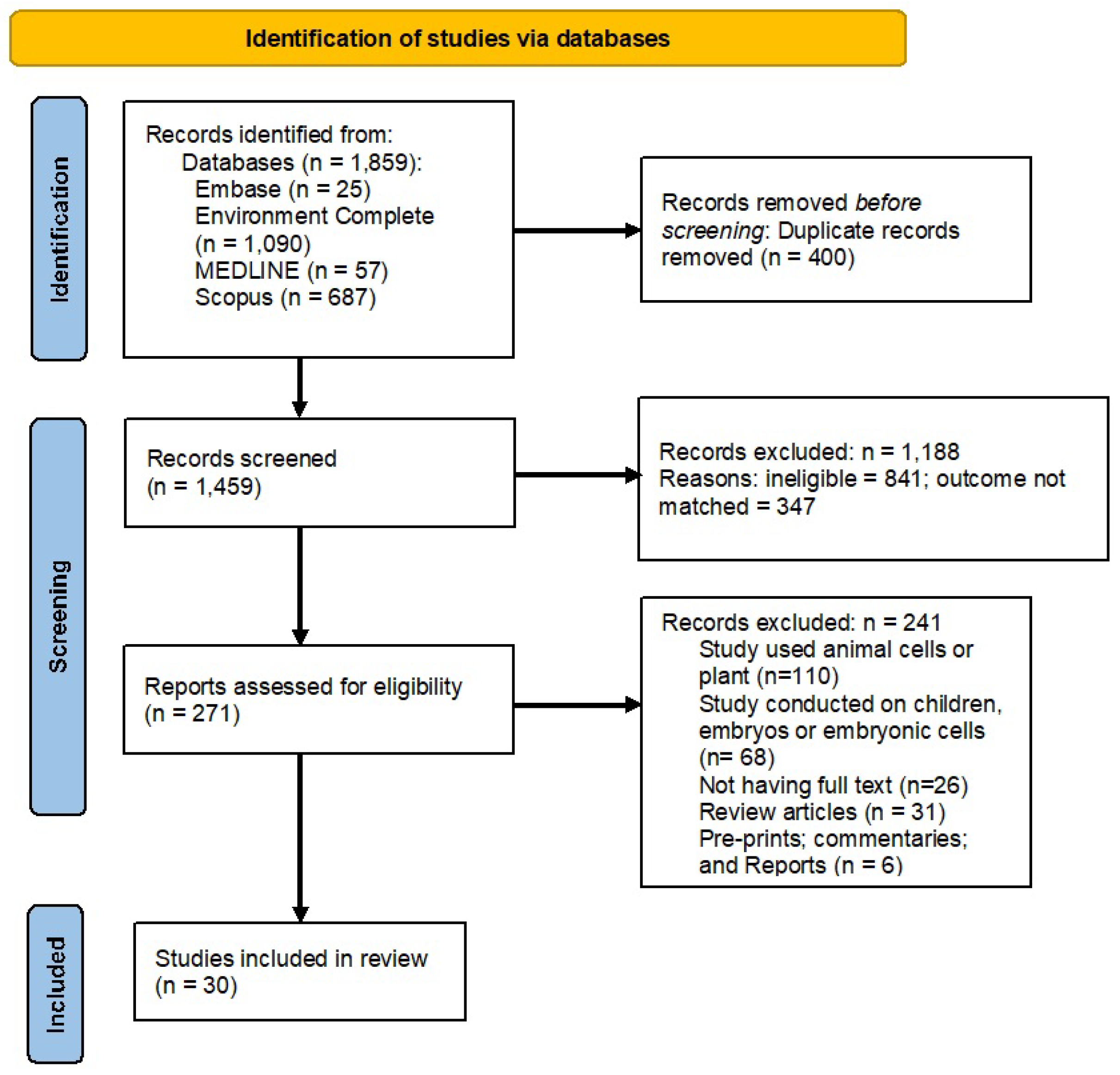
| (nanoplastics OR microplastics) AND (organ OR health OR system OR genetic) AND (mechanism OR complication OR contamination OR toxic) | Total results: 1859 Embase (n = 25), Environment Complete (n = 1090), MEDLINE (n = 57), Scopus (n = 687) |
| Total number of duplicates removed | 400 |
| Total number of studies excluded based on eligibility criteria after initial screening | 1188 |
| Total number of studies excluded based on eligibility criteria after full text screening | 241 |
| Total number of studies used for the review | 30 |
| Author (Ref.) | Type of Study | Human Body System Impacted | Major Findings | Quality Appraisal (out of 15) | Risk of Bias Assessment (out of 9) | Country of Study |
|---|---|---|---|---|---|---|
| Wang et al., 2024 [28] | Cross-sectional | Cardiovascular | n = 30; higher MP concentrations were significantly associated with greater severity of ischemic stroke, myocardial infarction, and deep venous thrombosis, and elevated D-dimer levels, indicating increased thrombotic activity. | 8 | 7 | China |
| Yang et al., 2024 [29] | Case–Control | Cardiovascular | n = 101; patients with acute coronary syndrome showed increased microplastic levels, particularly those with acute myocardial infarction and those at intermediate to high risk of coronary artery disease. Higher microplastic levels were also significantly associated with elevated inflammatory cytokines (IL-6 and IL-12p70) and increased B lymphocyte and natural killer cell counts. | 12 | 5 | China |
| Yu et al., 2024 [30] | Case–Control | Cardiovascular | n = 30; significantly higher MP concentrations were observed in patients with extracranial artery stenosis (ECAS) compared with those without ECAS, with higher levels associated with greater stenosis severity. The ECAS group also exhibited elevated D-dimer levels and prolonged thrombin time relative to the normal group. | 9 | 6 | China |
| Yan et al., 2022 [31] | Case–Control | Gastrointestinal | n = 102; individuals with inflammatory bowel disease had significantly higher fecal MP concentrations (41.8 items/g dry mass) compared with healthy individuals (28.0 items/g dry mass). | 12 | 6 | China |
| Cetin et al., 2023 [32] | Case–Control | Gastrointestinal | n = 31; tumoral colon tissues contain higher levels of MP than non-tumoral colon tissues, suggesting a possible association between colorectal cancer and MP exposure. MP particle sizes in tumoral colon tissues range from 1 to 1299 µm and include polyethylene, poly(methyl methacrylate), and nylon (polyamide). | 9 | 4 | Switzerland |
| Wu et al. 2025 [33] | Cohort | Gastrointestinal | n = 10; high-risk practices, such as frequent invasive gastrointestinal examinations, increased microplastic accumulation in fibrotic intestines. MP concentrations were significantly higher at lesion sites compared with surrounding tissues. In more fibrotic regions of Crohn’s fibrosis and involved ileum, PU and AUR concentrations were elevated, while CPE and Fluororubber levels decreased. | 10 | 3 | China |
| Li et al., 2025 [34] | Case–Control | Musculoskeletal | n = 55; polyvinyl chloride and polyethylene terephthalate were the most prevalent MP polymers identified among participants, with notable exposure risks from sources such as bottled water and take-out containers. Microplastics also exhibited a significant toxic effect on osteoblasts, suggesting a potential correlation with the progression of osteoporosis. | 11 | 4 | China |
| Liu et al., 2025 [35] | Cross-sectional | Respiratory | n = 50; increased single-type and overall MP exposure was significantly associated with a higher risk of severe community-acquired pneumonia. MP concentrations in bronchoalveolar lavage fluid were also significantly correlated with changes in respiratory microbiota, including reduced α-diversity, and with multiple inflammatory factors. | 10 | 7 | China |
| Zhang et al., 2024 [36] | Cross-Sectional | Reproductive | n = 113; exposure to polytetrafluoroethylene (PTFE) was significantly associated with poorer semen quality, including reductions in total sperm count, sperm concentration, and progressive motility. | 11 | 7 | China |
| Kim et al., 2025 [37] | Cross-sectional | Reproductive | n = 13; in endometrial stromal cells, smaller plastic particles exhibited greater cellular uptake than larger particles, with significant morphological change and cell death occurring at concentrations above 100 µg/mL after 24 h. MPs and NPs accumulated in the cytoplasm and nuclei, with uptake rates dependent on particle size | 6 | 4 | South Korea |
| Xu et al., 2025 [38] | Case–Control | Reproductive | n = 45; MP burden was observed to rise with increasing severity of cervical cancer. Metabolomic profiling identified D-mannose and cis,cis-muconic acid as the metabolites demonstrating greatest differences. Pathway enrichment analysis highlighted amino sugar and nucleotide sugar metabolism as key pathways potentially linking MP exposure to cervical cancer progression. | 10 | 4 | China |
| Xu et al., 2025 [39] | Case–Control | Reproductive | n = 80; exposure levels of MP are significantly higher in tissues with uterine fibroids compared with normal tissues from healthy individuals. Exposure to PE-MP is also associated with an increased risk of uterine fibroids compared with healthy individuals. A positive correlation observed between MP exposure levels and uterine fibroid size. | 11 | 4 | China |
| Zhang et al., 2025 [40] | Case–Control | Reproductive | n = 45; individuals with pregnancy-induced hypertension (PIH) exhibited significantly elevated levels of PE and polycarbonate in umbilical cord samples compared to controls. Overall MP concentrations were approximately 1.46-fold greater among PIH cases. Although the use of plastic tableware, seafood consumption, and intake of beverages packaged in plastic were identified as possible contributing factors, these variables were not significant after multivariable adjustment. MP presence was positively associated with the use of plastic food containers and consumption of takeout meals and was further correlated with poorer neonatal outcomes, including reduced Apgar scores and higher neonatal mortality rates. | 10 | 4 | China |
| Author (Ref.) | Human Body System Impacted | Major Findings | Country of Study |
|---|---|---|---|
| Ma et al., 2025 [41] | Cardiovascular | At 0.1 µg/L, both 0.05 µm and 1 µm MNP particles suppressed myocyte contractility, decreased Ca2+ transient amplitude, and disrupted contraction and calcium (Ca2+) transient dynamics. In hypertrophic iPSC cardiomyocytes, 0.05 µm particles further exacerbated hypertrophy, evidenced by increased cell size and proBNP expression. Cardiotoxic effects were associated with mitochondrial dysfunction, including reduced mitochondrial membrane potential and increased mitochondrial and intracellular reactive oxygen species (ROS). | United States |
| Persiani et al., 2025 [42] | Cardiovascular | MPs, particularly PE and PS, impaired vascular smooth muscle cell viability, induced apoptosis, and triggered pathological alterations, including disrupted migration and proliferation, thereby increasing the risk of cardiovascular diseases such as atherosclerosis and vascular calcification. | Italy |
| Xue et al., 2025 [43] | Cardiovascular | In human cardiomyocytes AC16 cells, differentially expressed genes induced by PS-MP were predominantly enriched in pathways related to endoplasmic reticulum (ER) stress and autophagy, indicating activation of ER stress responses. | China |
| Chen et al., 2024 [44] | Gastrointestinal | After 48 h of exposure, PS-MPs entered into normal human liver (THLE-2) cells without inducing evident acute cytotoxicity at concentrations <20 µg/mL. Long-term exposure (90 days) to an environmentally relevant dose (0.2 µg/mL) significantly disrupted cellular metabolic profiles, with more pronounced effects observed for nanosized particles. | China |
| Guanglin & Shuqin, 2024 [45] | Gastrointestinal | Exposure to PS-NPs was found to disrupt iron homeostasis in esophageal cells and impair mitochondrial autophagy. These alterations contributed to increased mitochondrial ROS production, heightened inflammatory signaling, and increased cellular injury and death. | China |
| Nissen et al., 2024 [46] | Gastrointestinal | MP exposure caused an overgrowth of opportunistic bacterial groups, including Enterobacteriaceae, Desulfovibrio spp., Clostridium group I, and the Atopobium–Collinsella group, while concurrently reducing the abundance of beneficial taxa, except Lactobacillales. | Italy |
| Najahi et al., 2025 [47] | Gastrointestinal | Exposure to MPs of different sizes (1 µm and 2.6 µm) for 72 h caused significant decrease in cell viability, apoptosis, increased ROS production, and autophagy in Caco-2 cells. | Tunisia |
| Çobanoğlu et al., 2021 [48] | Lymphatic | Exposure significantly increased micronucleation, nucleoplasmic bridge formation, and nuclear bud formation in human peripheral blood lymphocytes. | Turkey |
| Weber et al., 2022 [49] | Immune | Exposure to NP caused primary human monocytes and monocyte-derived dendritic cells to secrete cytokines as key initiators of inflammation. | Germany |
| Koner et al., 2023 [50] | Immune | Exposure to PS-NPs (50–500 µg/mL) significantly reduced the viability of human macrophages. At 500 µg/mL, PS-NPs induced oxidative stress and decreased cell proliferation. PS-NP exposure also reduced mitochondrial membrane potential and caused DNA damage in macrophages. | India |
| Zhang et al., 2025 [51] | Reproductive | Exposure to PS-NPs for 48 h did not cause significant changes in cytotoxicity, Calcein intensity, or active mitochondrial levels in KGN human ovarian granulosa cells. However, PS-NP exposure resulted in a dose-dependent increase in cytoplasmic vacuolization, increased total lysosomal area, and a higher number of lipid droplets in KGN cells. | China |
| Dong et al., 2020 [52] | Respiratory | PS-MPs cause cytotoxic and inflammatory responses in BEAS-2B cells through reactive oxygen species (ROS) formation, resulting in reduced transepithelial electrical resistance and increasing the risk of chronic obstructive pulmonary disease. | Taiwan |
| Halimu et al., 2022 [53] | Respiratory | Exposure of Human alveoli epithelial A549 cells to PS-NP increased cell migration and epithelial–mesenchymal transition marker expression, alongside upregulation of ROS and NADPH oxidase 4. PS-NPs also induced mitochondrial dysfunction and endoplasmic reticulum stress. | China |
| Annangi et al., 2023 [54] | Respiratory | Human primary nasal epithelial cells exposure to polyethylene terephthalate NP caused an increase in intracellular ROS, LC3-II protein expression levels, expression of p62, and loss of mitochondrial membrane potential. | Spain |
| Han et al., 2024 [55] | Respiratory | Cellular uptake of PS-NPs in lung epithelial cells occurs primarily through an integrin α5β1-dependent endocytic pathway. Increased expression of integrin α5β1 amplified PS-NP internalization and intensified mitochondrial Ca2+ imbalance and depolarization. These mitochondrial disturbances promoted excessive ROS generation, inflammatory signaling, genomic damage, and necrotic cell death, thereby contributing to the development of pulmonary pathology. | China |
| Winiarska et al., 2024 [56] | Respiratory | NPs measuring 25 and 50 nm penetrated bronchial smooth muscle and small airway epithelial cells, impairing bioenergetics and inducing mitochondrial dysfunction compared to cells not treated with NPs. | Poland |
| Chen et al., 2023 [57] | Vascular | Exposure to PS-MP caused oxidative stress in human vascular endothelial EA. hy926 cells by reducing the expression of antioxidants, leading to apoptotic cytotoxicity. PS-MPs also induced vascular barrier dysfunction via the depletion of zonula occludens-1 protein. | Taiwan |
| Method | Detection Limit | Polymer Specificity | Main Strengths | Biases and Limitations |
|---|---|---|---|---|
| Optical Microscopy (light/stereo) | ~100 µm | None-visual size/shape only | Simple, low cost | Misses <100 µm, cannot identify polymer type |
| Fluorescence Microscopy (Nile Red) | ~1–50 µm | Greater visibility of hydrophobic particles | Rapid screening | Stains non-plastic organics, false positives |
| Fourier Transform Infrared (FTIR) Spectroscopy | ~10–20 µm | High infrared (IR) spectral libraries | Polymer identification and size | Time-consuming and sensitive sample prep, limited to <10 µm |
| Raman Spectroscopy (µ-Raman) | ~1 µm | High | Polymer identification and size | Fluorescence interference, time-consuming |
| Pyrolysis-GC/MS | Qualitative/ quantitative by mass | High | Identification and quantification by chem signature | Destroys morphology, time consuming |
| Thermal Desorption GC/MS (TD-GC/MS) | ~ng mass | High | Minimal preparation | Cannot identify size or count particles |
| Scan/Trans Electron Microscopy (SEM/TEM) + En Dispers X-ray (EDX) | <100 nm imaging | Low–moderate (via EDX) | Morphology at nanoscale | Unreliable for low atomic number polymers (plastics), complex prep |
| Atomic Force Microscopy (AFM)-IR/nano-FTIR | ~10–100 nm | Occasionally high | Nano-chemical mapping | Emerging technique, costly |
| Dynamic Light Scattering (DLS) | ~1 nm | None | Rapid size distribution in suspension | Unreliable for large, mixed-sized samples |
| Nanoparticle Tracking Analysis (NTA) | ~10–50 nm | None | Counts + size distribution | Cannot make chemical identification, RI-sensitive |
| Mass Spectrometry (ToF-SIMS) | <100 nm surface analysis | High (surface chem) | Detailed surface chemistry | Costly, generating complex data |
| Flow Cytometry (with fluorescent staining) | ~200 nm–microns | Low | Counts in liquid suspension | Stain biasness, unreliable detection of polymer types |
Disclaimer/Publisher’s Note: The statements, opinions and data contained in all publications are solely those of the individual author(s) and contributor(s) and not of MDPI and/or the editor(s). MDPI and/or the editor(s) disclaim responsibility for any injury to people or property resulting from any ideas, methods, instructions or products referred to in the content. |
© 2026 by the authors. Licensee MDPI, Basel, Switzerland. This article is an open access article distributed under the terms and conditions of the Creative Commons Attribution (CC BY) license.
Share and Cite
Edet, P.P.; Mitra, A.K.; Dennis, M.; Zaman, M.S. Harmful Effects of Microplastics and Nanoplastics in Human Body Systems: A Systematic Review. Diseases 2026, 14, 88. https://doi.org/10.3390/diseases14030088
Edet PP, Mitra AK, Dennis M, Zaman MS. Harmful Effects of Microplastics and Nanoplastics in Human Body Systems: A Systematic Review. Diseases. 2026; 14(3):88. https://doi.org/10.3390/diseases14030088
Chicago/Turabian StyleEdet, Precious Patrick, Amal K. Mitra, Melissa Dennis, and Md S. Zaman. 2026. "Harmful Effects of Microplastics and Nanoplastics in Human Body Systems: A Systematic Review" Diseases 14, no. 3: 88. https://doi.org/10.3390/diseases14030088
APA StyleEdet, P. P., Mitra, A. K., Dennis, M., & Zaman, M. S. (2026). Harmful Effects of Microplastics and Nanoplastics in Human Body Systems: A Systematic Review. Diseases, 14(3), 88. https://doi.org/10.3390/diseases14030088