Article

Orbital Radiotherapy for Graves’ Ophthalmopathy: Single Institutional Experience of Efficacy and Safety


by
Madalina La Rocca
1,*,
Barbara Francesca Leonardi
1,
Maria Chiara Lo Greco
1,
Giorgia Marano
1,
Roberto Milazzotto
2,
Rocco Luca Emanuele Liardo
2,
Grazia Acquaviva
2,
Viviana Anna La Monaca
2,
Vincenzo Salamone
2,
Antonio Basile
3,4,
Pietro Valerio Foti
3,4,
Stefano Palmucci
3,4,
Emanuele David
4,
Silvana Parisi
1,
Antonio Pontoriero
1,
Stefano Pergolizzi
1 and
Corrado Spatola
2,3,4,*
1
Radiation Oncology Unit, Department of Biomedical, Dental and Morphological and Functional Imaging Sciences, University of Messina, 98122 Messina, Italy
2
Radiation Oncology Unit, Department of Medical Surgical Sciences and Advanced Technologies “G.F. Ingrassia”, University of Catania, 95123 Catania, Italy
3
Department of Medical Surgical Sciences and Advanced Technologies “G.F. Ingrassia”, University Hospital Policlinico “G. Rodolico-San Marco”, 95123 Catania, Italy
4
Radiology I Unit, Department of Medical Surgical Sciences and Advanced Technologies “G.F. Ingrassia”, University of Catania, 95123 Catania, Italy
*
Authors to whom correspondence should be addressed.
Diseases 2025, 13(2), 61; https://doi.org/10.3390/diseases13020061

Submission received: 23 December 2024 / Revised: 7 February 2025 / Accepted: 13 February 2025 / Published: 17 February 2025

Abstract

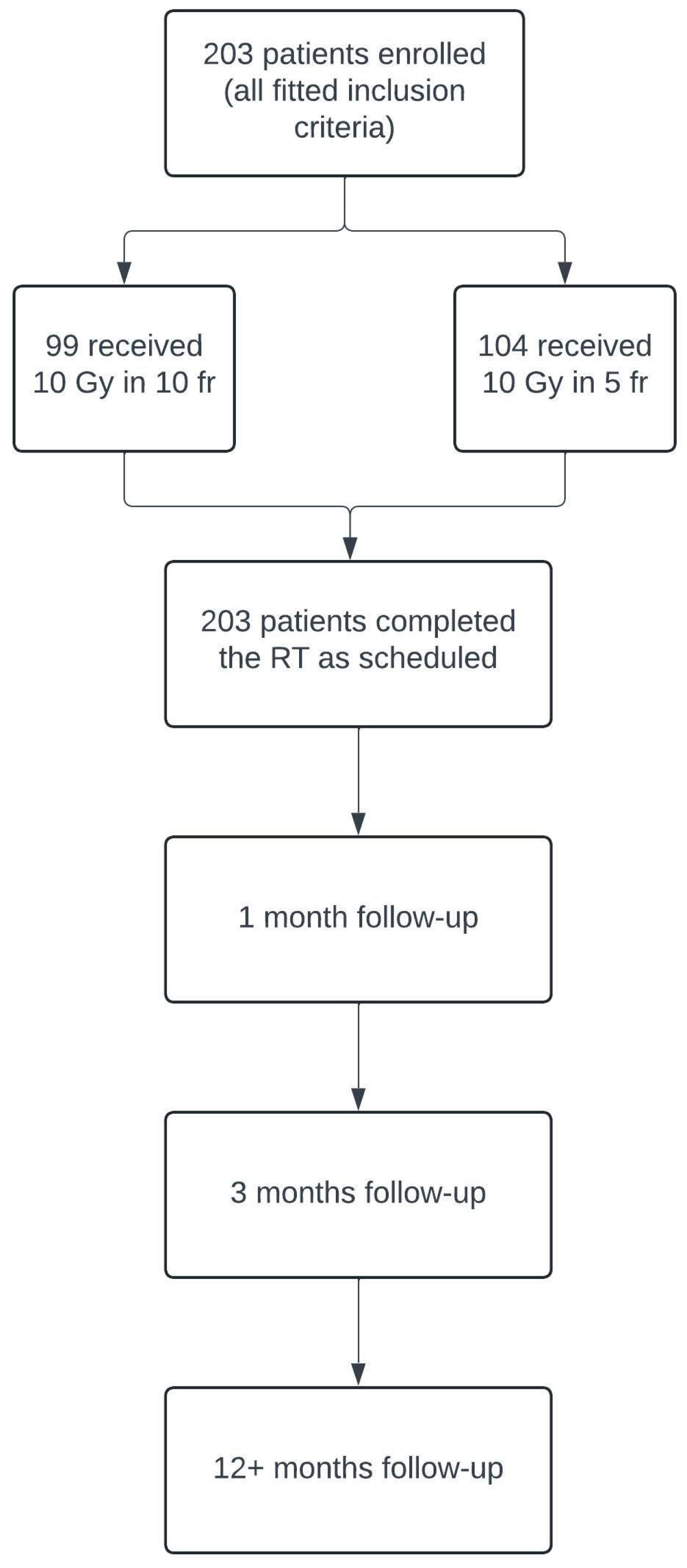
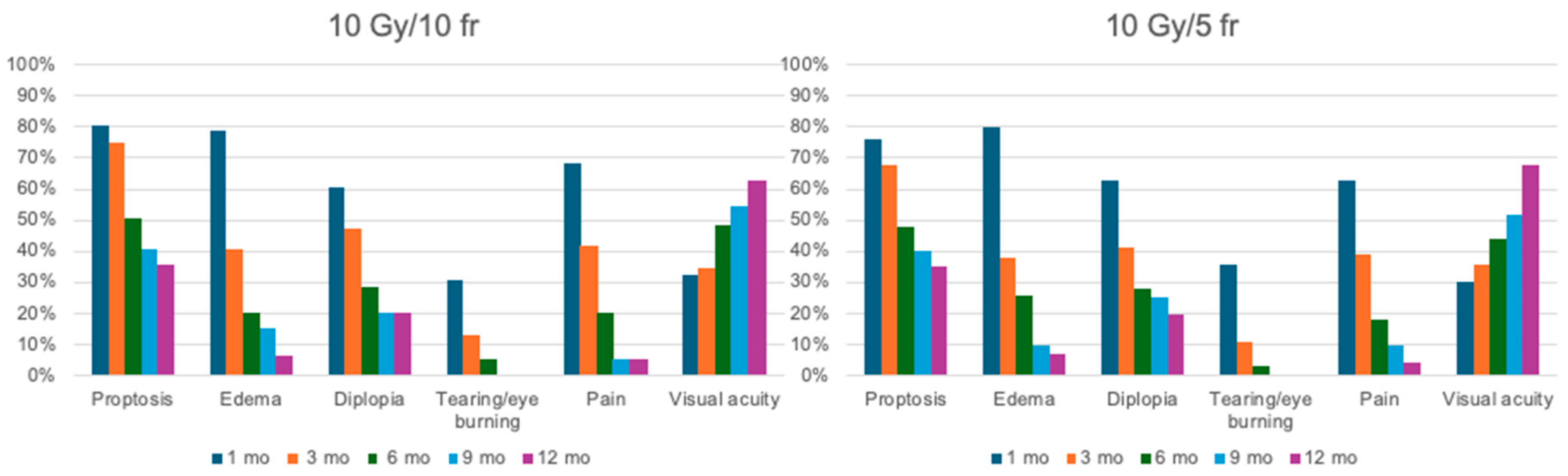
Graves’ ophthalmopathy is the most common extrathyroidal manifestation of Graves–Basedow disease. Radiotherapy is effective especially when used in synergy with the administration of glucocorticoids. The aim of our study was to analyze the effectiveness and safety of radiotherapy, using different protocols, to improve ocular symptoms and quality of life. Methods: We retrospectively analyzed the clinical data of two-hundred and three patients treated with retrobulbar radiotherapy between January 2002 and June 2023. Ninety-nine patients were treated with a schedule of 10 Gy in 10 fractions and one-hundred and four were treated with 10 Gy in 5 fractions. Radiotherapy (RT) was administrated during the 12 weeks of pulse steroid therapy. Patients were evaluated with a clinical exam, orbital CT, thyroid assessment, and Clinical Activity Score (CAS). Results: The median follow-up was 28.6 months (range 12–240). Complete response was found in ninety-four pts (46.31%), partial response or stabilization in one hundred pts (49.26%), and progression in nine pts (4.43%). In most subjects, an improvement in visual acuity and a reduction in CAS of at least 2 points and proptosis by more than 3 mm were observed. Three patients needed decompressive surgery after treatment. Only G1 and G2 acute eye disorders and no cases of xerophthalmia or cataract were assessed. Conclusions: RT is an effective and well-tolerated treatment in this setting, especially when associated with the administration of glucocorticoids. Although the most used fractionation schedule in the literature is 20 Gy in 10 fractions, in our clinical practice, we have achieved comparable results with 10 Gy in 5 or 10 fractions with a lower incidence of toxicity.
Keywords: Graves’ ophthalmopathy; thyroid eye disease; radiotherapy; exophthalmos; Graves’ orbitopathy; orbital irradiation; combined treatment Graves’ ophthalmopathy; thyroid eye disease; radiotherapy; exophthalmos; Graves’ orbitopathy; orbital irradiation; combined treatment