1. Introduction
The proliferation of bandwidth-intensive multimedia applications has created unprecedented demands on modern communication infrastructure. Streaming platforms now routinely deliver 4K and 8K video content, while emerging technologies such as cloud-based gaming platforms and immersive augmented reality (AR)/virtual reality (VR) [
1,
2] environments require not only exceptional visual fidelity but also minimal latency to ensure seamless user experiences. These applications span diverse consumer devices [
3], including mobile handsets, wearable displays, and connected television systems, each presenting unique constraints on power consumption, processing capability, and network connectivity. The challenge extends beyond transmitting large volumes of data; maintaining perceptual quality across heterogeneous wireless channels characterized by noise, interference, and time-varying signal strength remains a fundamental obstacle. Transmission impairments lead to compression artifacts, temporal discontinuities, or frame losses, directly degrading user experience and undermining high-resolution content delivery.
Beyond these challenges, modern video encoding technologies achieve high compression efficiency by exploiting spatiotemporal correlations within video sequences. Standards such as versatile video coding (VVC) [
4] leverage advanced prediction mechanisms that reference previously decoded frames within structured group-of-pictures (GOP) sequences, enabling significant bitrate reductions. However, this efficiency introduces a critical vulnerability: temporal dependencies cause channel-induced errors to propagate across successive frames, amplifying visual distortion. Classical forward error correction (FEC) [
5] schemes, including polar codes [
6], turbo codes [
7], and low-density parity-check (LDPC) [
8] codes, provide strong protection under stable conditions. Yet, in low signal-to-noise ratio (SNR) or rapidly varying channels typical of mobile environments, residual errors persist and result in noticeable degradation. This issue is particularly severe for high-motion or high-detail content, where human perception is highly sensitive to artifacts, motivating the need for more robust transmission strategies.
In response, quantum communication principles offer a potentially transformative alternative by leveraging quantum mechanical phenomena such as superposition [
9] and entanglement [
10] to encode information. These properties enable fundamentally different information representations, providing enhanced parallelism and improved spectral utilization. However, practical quantum transmission for multimedia faces notable challenges. Early Hadamard-based single-qubit encoding approaches [
11] provide implementation simplicity but suffer from limited state diversity and reduced robustness under realistic channel impairments. Although quantum error correction (QEC) [
12] can mitigate noise and decoherence, it requires significant ancillary qubits and circuit complexity, making it impractical for scalable multimedia systems. The associated overhead limits its applicability in high-throughput, resource-constrained scenarios.
To address these limitations, multi-qubit encoding strategies based on Hadamard transformations [
13] have been explored, offering improved parallelism and error tolerance compared to single-qubit schemes. However, these methods still underutilize the full representational capacity of multi-qubit systems when handling high-dimensional multimedia data. Frequency-domain approaches [
14] further improve noise resilience by operating on spectral representations, but their computational and circuit complexity hinder real-time deployment. Consequently, a clear gap exists for encoding strategies that can deliver high fidelity, robustness, and low complexity simultaneously.
Therefore, this work introduces a novel complex-valued orthogonal unitary superposition (COUS) encoding strategy for multi-qubit quantum systems in video transmission. Unlike Hadamard-based methods, COUS exploits both amplitude and phase degrees of freedom, enabling richer quantum state representations suited to high-dimensional video data. By coordinating encoding across multiple qubits, the approach leverages the expanded Hilbert space to project information onto orthogonal state directions, enhancing state diversity and discriminability. This allows each qubit to carry more information while improving resilience to noise under adverse channel conditions. Furthermore, COUS avoids the heavy resource demands of conventional QEC, achieving robust transmission through a low-complexity and scalable architecture.
The complete transmission pipeline operates as follows: the source video is first compressed using the VVC codec for efficient bitrate utilization, followed by polar code-based error protection. The encoded bitstream is then segmented according to the selected multi-qubit dimension (1 to 8 qubits) and mapped onto COUS-based quantum states for transmission over noisy channels. At the receiver, inverse COUS decoding and multi-qubit detection recover the encoded data, followed by channel and source decoding to reconstruct the video sequence. Performance is evaluated using perceptual quality metrics, including peak signal-to-noise ratio (PSNR), structural similarity index measure (SSIM), and video multimethod assessment fusion (VMAF). The experimental results demonstrate that the proposed COUS-based multi-qubit system outperforms Hadamard-based approaches and bandwidth-equivalent classical baselines in terms of fidelity and noise resilience, while maintaining computational efficiency.
This research makes the following principal contributions:
Introduces a novel COUS-based multi-qubit quantum encoding framework.
Evaluates the performance and noise robustness of the proposed system for video transmission.
Develops a scalable, low-complexity architecture for high-throughput multimedia communication.
Benchmarks the proposed approach against state-of-the-art quantum and classical techniques, demonstrating improved fidelity and robustness.
The manuscript proceeds as follows.
Section 2 reviews the existing literature on quantum multimedia transmission and multi-qubit encoding.
Section 3 presents the proposed COUS framework and system model.
Section 4 discusses the experimental results under varying channel conditions.
Section 5 concludes the paper and outlines future research directions.
2. Related Works
Quantum communication [
15] was initially developed as a paradigm for secure information transfer, with foundational technologies such as quantum key distribution (QKD) [
16,
17] and quantum teleportation [
18,
19,
20] used to establish the principles of confidentiality and integrity. Core properties of quantum mechanics [
21], including superposition [
22], entanglement, and the no-cloning theorem [
23], are exploited to achieve levels of security that cannot be attained with classical cryptography [
24,
25]. Secret keys are generated and shared over quantum channels through QKD with provable security, while quantum states are transmitted without sending the physical qubits themselves via quantum teleportation, forming the basis of highly secure communication networks.
Although these early developments primarily target classical data protection, quantum communication is increasingly applied to multimedia content, including images and video [
26,
27,
28,
29]. The same quantum mechanical properties that enable secure key exchange are leveraged to achieve high-fidelity visual data transfer. Image and video information is encoded into quantum states, combining intrinsic security with the ability to exploit high-dimensional quantum spaces for parallelism and resilience to channel noise.
High-fidelity multimedia transmission is initially pursued through single-qubit Hadamard encoding, where information of a single bit is represented by each qubit [
11]. Superposition is exploited to encode multiple states simultaneously, simplifying state preparation and minimizing circuit complexity. However, single-qubit approaches are limited in their information density and are highly susceptible to decoherence and channel noise [
30], which restrict their effectiveness for high-resolution video transmission. To improve throughput, multiple single-qubit streams are transmitted in parallel across distinct channels using single-qubit multiple-input multiple-output (MIMO) systems [
31]. Although effective data rates are increased, robustness is not substantially improved, as each qubit remains vulnerable to noise and environmental disturbances.
The inherent vulnerability of single-qubit and MIMO-based quantum transmission schemes to decoherence and channel noise is addressed through the application of QEC techniques in image and video transmission. QEC mechanisms [
32,
33,
34,
35,
36] are used to detect and correct errors occurring at the qubit level, enhancing the reliability and fidelity of transmitted multimedia content. Qubits encoding pixel values or video frame blocks are supplemented with ancilla qubits and structured circuit operations [
37], allowing for the identification and rectification of errors caused by amplitude damping, phase noise, or depolarization during transmission. Through the incorporation of QEC, substantially lower error rates are achieved, and more accurate reconstruction of high-resolution images and smoother video playback are ensured, even under imperfect channel conditions.
Despite these benefits, the practical implementation of QEC in multimedia transmission incurs considerable cost. Additional physical qubits are required for each logical qubit, significantly increasing hardware demands, particularly for high-resolution images or long video sequences [
38]. Extra gate operations and measurement cycles are introduced for error detection and correction, adding complexity to quantum circuits and increasing the potential for cumulative errors. These constraints make real-time deployment of QEC-intensive systems particularly challenging, especially for applications that demand high throughput, such as live video streaming or interactive cloud-based gaming. Consequently, while QEC methods provide a robust solution for mitigating channel-induced errors in image and video transmission, their resource-intensive nature motivates the exploration of alternative strategies capable of delivering high-fidelity multimedia with lower hardware and computational overhead.
As a further advancement, multi-qubit encoding schemes [
13] are developed to distribute information across multiple qubits simultaneously. Parallelism is increased and partial resilience to noise is offered through Hadamard-based multi-qubit encoding. However, Hadamard encoding is restricted to real-valued amplitudes in the linear polarization basis, and phase information is not utilized. This limits both the information capacity per qubit and the distinguishability between quantum states, leaving much of the multi-qubit Hilbert space underutilized, especially for high-resolution images or video sequences.
Alternative methods are explored in the frequency domain to further enhance robustness. High-dimensional visual data is efficiently represented through quantum Fourier transform (QFT) [
39,
40] based encoding [
14], while information is distributed across orthogonal frequency components using orthogonal frequency division multiplexing (OFDM) [
41] to mitigate frequency-selective fading. Although noise resilience and fidelity are improved, these methods are computationally intensive and require substantial quantum and classical resources, which limits their practical applicability for real-time or high-throughput multimedia transmission.
Key Research Gaps and Motivation
Existing quantum multimedia transmission frameworks reveal a number of fundamental trade-offs. Single-qubit encoding is straightforward to implement but highly fragile, making it unsuitable for high-fidelity image and video transmission. Single-qubit MIMO systems improve throughput by enabling parallel transmission across multiple channels, yet they do not substantially enhance robustness, as each qubit remains vulnerable to decoherence and channel noise. QEC techniques provide increased reliability and error resilience for multimedia data, but they incur significant overhead in terms of additional qubits, gate operations, and circuit complexity, limiting their practicality for real-time or high-throughput applications. The conventional Hadamard encoding-based multi-qubit system allows for higher parallelism but underutilizes the full multi-qubit Hilbert space, restricting both the information capacity and robustness. QFT and OFDM-based approaches improve noise resilience and fidelity but are computationally intensive and require substantial resources, which hinders scalability and efficiency for large-scale video transmission. Collectively, these limitations highlight a clear gap in the literature: there is a need for a quantum encoding framework that simultaneously maximizes transmission fidelity, ensures robustness against noise and channel impairments, and remains efficient in terms of hardware and computational resources.
To address these challenges, this work proposes a novel COUS encoding scheme for video transmission. Unlike conventional multi-qubit approaches, COUS can encode information across both the amplitude and phase components of multiple qubits, fully exploiting the multi-qubit Hilbert space. This seeks to enable intrinsic resilience to decoherence and channel noise, improve distinguishability of quantum states, and reduce hardware and circuit complexity. As a result, COUS has the potential to offer a scalable, efficient, and high-fidelity solution for transmitting videos over quantum channels, effectively bridging the gap between quantum communication capabilities and the demands of next-generation multimedia applications.
3. Methodology
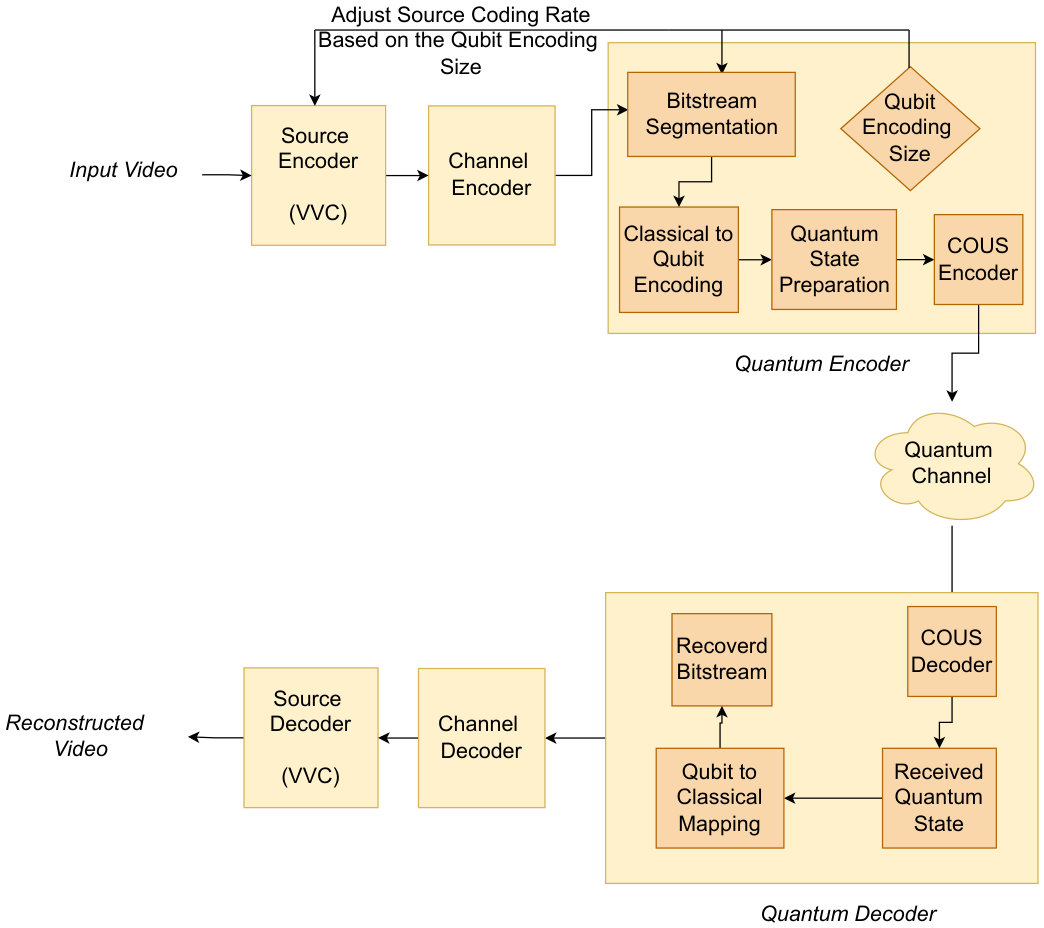
The proposed transmission framework, illustrated in
Figure 1, is designed to handle diverse video inputs and ensure robust evaluation across different spatial and temporal characteristics. Input video sequences are considered at multiple spatial resolutions, including
,
, and
pixels, and are provided at frame rates of 30, 50, and 60 frames per second (fps). To capture varying motion dynamics, sequences with low-motion [
42], medium-motion [
43], and high-motion [
44] content are included. The proposed system is input-agnostic and therefore applicable to arbitrary video sequences.
Once the videos are selected, source coding is performed using the VVC standard, implemented through the VVenC [
45] encoder. This compression pipeline efficiently removes both spatial and temporal redundancies to produce compact bitstreams suitable for transmission. GOP configurations of 8, 16, and 32 frames are employed to study the effect of inter-frame dependencies on transmission performance.
The encoder quantization parameter (QP) is adjusted to control compression strength, where lower QP values prioritize higher reconstruction quality at the cost of larger bitstreams, and higher QP values produce more compact bitstreams suitable for bandwidth-constrained channels. In addition, the QP is systematically adjusted across different qubit configurations to ensure fair bandwidth utilization. Specifically, the compressed bitstream length is scaled inversely with the number of qubits. For a reference bitstream length L corresponding to the single-qubit configuration (CS1), higher-qubit configurations use approximately reduced bitstreams following . This ensures that configurations with higher data-carrying capacity per encoded unit are assigned proportionally smaller bitstreams through increased compression. This strategy ensures that bandwidth usage remains comparable across all configurations, as the qubit rate within the channel is proportional to the bitstream length multiplied by the number of qubits. Without such scaling, higher-qubit systems would inherently transmit more information and gain an unfair advantage. By appropriately adjusting QP, the evaluation isolates the intrinsic performance of the encoding and transmission scheme, rather than differences arising from unequal data volume. This combination of video input variety, motion characteristics, spatial/temporal resolutions, and QP-based bandwidth control ensures a comprehensive and fair evaluation of the proposed transmission framework under realistic and diverse conditions.
The resulting VVC-encoded video bitstreams are then optionally protected using polar channel codes [
6,
46] with a fixed code rate of 1/2 to provide baseline error resilience prior to quantum encoding. Polar codes are selected due to their structured construction, near-capacity performance on symmetric channels, and low-complexity encoding and decoding processes, making them suitable for high-throughput video transmission scenarios. The chosen code rate offers a balanced trade-off between redundancy and efficiency, enabling effective mitigation of channel-induced errors without excessive overhead.
Conventional QEC techniques are not incorporated in this study, as most existing QEC schemes introduce substantial complexity and rely on additional ancilla qubits, which are not well aligned with scalable multi-qubit encoding architectures. By focusing on classical channel coding combined with intrinsic robustness at the quantum encoding level, the proposed system enables a clearer assessment of the benefits offered by the COUS-based multi-qubit encoding strategy for reliable video transmission over noisy quantum channels.
The channel-protected bitstreams are then partitioned according to the selected quantum encoding size (n), ranging from 1 to 8 qubits, and are initially represented as quantum states in the computational basis. These states are subsequently transformed into COUS-based superposition states, enabling information to be jointly embedded across amplitude and phase dimensions. To maintain equivalent bandwidth across all multi-qubit configurations and ensure a fair and consistent comparison, the QPs are adjusted such that the resulting quantum-encoded streams exhibit comparable transmission lengths for all encoding sizes.
The generated multi-qubit COUS states are then conveyed over the quantum communication channel. At the receiving end, the inverse processing chain is applied: the incoming quantum states are first decoded using the inverse COUS operation, followed by multi-qubit decoding, classical channel decoding, and finally source decoding to recover the original video data.
For clarity, the operational principles of main functional component within the proposed framework are detailed in the following subsections.
3.1. Quantum Encoder
The binary sequence obtained after channel protection is segmented according to the selected qubit encoding size (n), with qubit encoding size varying from 1 to 8 qubits. The upper bound of eight qubits is selected to align with the 8-bit pixel representation used in standard digital imagery, allowing an entire pixel value to be embedded within a single multi-qubit quantum state. Although the proposed framework is not fundamentally limited to this dimensionality and can be generalized to larger qubit counts, the chosen range offers a practical balance between expressive capability and system complexity for the scenarios examined in this work.
3.1.1. Classical-to-Qubit State Preparation
In the proposed system, classical binary information is converted into quantum form through preparation of qubit states in the computational basis. Each incoming bit is mapped to one of two orthogonal quantum states, where a logical 0 corresponds to the basis state
and a logical 1 corresponds to the basis state
. Together, these states define the basis of the two-dimensional qubit Hilbert space
and can be represented mathematically as shown in Equation (
1).
Through this process, the classical bitstream is transformed into a format suitable for quantum manipulation and multi-qubit state assembly. To achieve this in practical terms, the quantum register is first initialized such that all qubits occupy the ground state
. Based on the value of each classical input bit, a control operation is applied: no transformation is performed when the bit is zero, while a Pauli-
X gate [
47] is applied when the bit is one, thereby switching the qubit state from
to
. This simple preparation strategy establishes an efficient and reliable bridge between classical data processing and subsequent quantum encoding stages.
3.1.2. Multi-Qubit Quantum State Construction
Following channel encoding, the binary sequence is reorganized into fixed-length blocks determined by the selected qubit encoding size (
n). Each block contains
n binary symbols, which can be compactly represented as a binary vector, as shown in Equation (
2).
Each element of the vector is subsequently mapped to a single-qubit computational basis state, as described in Equation (
1). The resulting multi-qubit quantum state is obtained by forming the joint tensor product of the individual qubit states, as defined in Equation (
3).
As an example, when
n = 2, four orthogonal basis states are formed in a four-dimensional Hilbert space. These basis vectors are listed explicitly in Equation (
4).
This formulation naturally extends to higher encoding dimensions. In general, grouping n classical bits produces a quantum state embedded in a Hilbert space of dimension , enabling scalable representation while preserving orthogonality.
3.1.3. COUS-Based Superposition Encoding
After forming the computational-basis multi-qubit states, each qubit undergoes a unitary transformation using the proposed COUS operator. The single-qubit COUS gate is defined in Equation (
5).
The COUS operator defined in Equation (
5) can be decomposed into a sequence of standard single-qubit gates as in Equation (
6).
where
H is the Hadamard gate and
S is the phase gate. This decomposition provides important insight into how the COUS transformation jointly exploits amplitude and phase information.
To verify this equivalence, we first define the matrix representations of the Hadamard and phase gates. The Hadamard gate
H is given in Equation (
7), and the phase gate
S is defined in Equation (
8).
Using the matrices defined in Equations (
7) and (
8), we first compute the product
, as shown in Equation (
9).
Next, the phase gate is applied from the left to the result in Equation (
9), yielding the COUS unitary matrix as expressed in Equation (
10).
Finally, the result in Equation (
10) matches the COUS unitary matrix defined earlier in Equation (
5).
From an operational perspective, the first phase gate (S) introduces a phase shift to the component, enabling access to the complex domain. The subsequent Hadamard gate (H) creates an equal superposition of and , distributing amplitude across both basis states. Finally, the second phase gate further modifies the phase relationships, resulting in a structured complex-valued superposition.
This sequential transformation explains the resulting states in Equations (
11) and (
12), where both real and imaginary components are present. Unlike conventional Hadamard encoding, which produces purely real-valued coefficients, the COUS operator introduces a
phase offset, allowing the quantum state to span both amplitude and phase dimensions of the Hilbert space.
Geometrically, this corresponds to a rotation on the Bloch sphere that distributes the state across orthogonal axes, rather than confining it to a single plane. As a result, the encoded information is not restricted to a single component, but is instead distributed across multiple degrees of freedom.
This decomposition highlights a key advantage of COUS encoding: by combining amplitude superposition and phase modulation within a simple gate structure, it achieves a richer and more expressive state representation. This improves robustness under noise, as partial degradation of one component does not fully destroy the encoded information.
Importantly, the
S–
H–
S structure uses only standard qubit gates and maintains constant circuit depth under parallel execution, making it practical for implementation on current quantum hardware. Applying the COUS operator to the computational basis states produces complex-valued superpositions, as shown in Equations (
11) and (
12).
Each output state satisfies the normalization constraint given in Equation (
13).
The complex-valued superposition introduced by the COUS operator can also be interpreted in terms of polarization states in photonic quantum systems. In such systems, the computational basis is mathematically equivalent to the horizontal and vertical polarization basis .
The circular polarization states are defined as in Equation (
14).
By identifying
and
, the action of the COUS operator in Equations (
11) and (
12) can be expressed as in Equations (
15) and (
16).
Since global phase factors do not affect physical observables, the state is physically equivalent to . Therefore, the COUS transformation maps the computational basis onto the circular polarization basis up to a global phase. This interpretation highlights that the COUS operator introduces a phase relationship between basis components, enabling information to be encoded jointly in amplitude and phase. While this correspondence provides a useful physical interpretation in photonic systems, the COUS operator itself remains a general unitary transformation applicable to any two-level quantum system.
For an
n-qubit system, the multi-qubit COUS gate is constructed by taking the tensor product of the single-qubit COUS gates
n times, as expressed in Equation (
17).
The unitarity of the COUS transformation is guaranteed by the condition shown in Equation (
18).
As an example, for a two-qubit system, the expanded COUS operator is given in Equation (
19).
The transformation of the two-qubit computational basis states under the COUS operator is summarized in Equations (
20).
In a similar manner, this approach can be extended to higher-qubit encoding systems. By exploiting both amplitude and phase dimensions of the Hilbert space, the COUS encoding strategy enhances state separability and improves robustness against channel-induced distortions, which is beneficial for reliable quantum video transmission.
The COUS operator is designed to overcome the limitations of conventional Hadamard-based encoding, which utilizes only real-valued amplitudes. By introducing a phase shift, COUS enables complex-valued superposition states, allowing information to be encoded in both amplitude and phase while leveraging the inherent robustness of the system. This results in improved state diversity and enhanced resilience to noise, while maintaining a unitary structure and compatibility with standard quantum gate implementations.
3.2. Quantum Channel Modeling
The quantum channel is modeled as a composite noise process composed of several common error mechanisms, including bit-flip, phase-flip, depolarizing, amplitude damping, and phase damping channels [
30]. The relative contribution of each component is determined using normalized random weights, allowing the simulation to represent a wide range of realistic channel conditions where multiple noise processes occur simultaneously. This randomized composition implicitly includes scenarios where a single noise mechanism becomes dominant, thereby approximating fixed or worst-case noise configurations. Since all encoding schemes are evaluated under identical channel realizations, the resulting comparisons remain fair while providing a robust assessment of the system performance under diverse noise environments. Each type of noise introduces errors into the transmitted quantum states according to a probability parameter. These models are widely adopted in quantum communications because they effectively capture the stochastic and decoherence effects commonly observed in practice [
13,
14,
38]. Device-specific imperfections, such as gate errors or measurement inefficiencies, are not included here, as these noise models are sufficient to assess the system’s performance at an early stage of theoretical validation.
3.2.1. Composite Quantum Channel
To model realistic quantum transmission, all considered noise mechanisms are combined into a single composite channel, denoted
, where
is the density matrix of the transmitted qubit. The composite channel is treated as a probabilistic mixture of individual noise channels. Formally, this is expressed as in Equation (
21).
Here,
represents the total probability that a qubit is affected by any type of noise, while
correspond to the individual probabilities of bit-flip, phase-flip, depolarizing, amplitude damping, and phase damping errors, respectively. The functions
implement the corresponding noise operations, defined in Equations (
27)–(
33).
Validity of the Composite Channel: The formulation in Equation (
21) represents a convex combination of completely positive trace-preserving (CPTP) maps. Since each individual noise channel is CPTP, their weighted sum also defines a valid quantum channel, provided that the normalization condition in Equation (
22) is satisfied.
This guarantees physical realizability and ensures that the output remains a valid density operator.
Physical Interpretation: In practical quantum communication systems, noise arises from multiple concurrent mechanisms such as energy relaxation, phase decoherence, and control errors. The composite model in Equation (
21) captures this behavior by representing the channel as a stochastic mixture of these processes, rather than assuming a single dominant noise source.
The total noise probability is related to the channel SNR in dB as in Equation (
23).
This mapping ensures consistency with classical communication models, where higher SNR corresponds to lower noise levels and vice versa.
To distribute
among the five individual noise channels, independent random weights
are drawn from a uniform distribution, as described in Equation (
24).
The channel-specific error probabilities are normalized as in Equation (
25).
This normalization ensures that the constraint in Equation (
26) is satisfied.
Justification of Random and Uniform Weighting: In practical quantum systems, the relative contributions of different noise mechanisms are generally unknown, time-varying, and dependent on hardware conditions. Therefore, using fixed deterministic weights may bias the evaluation toward a specific noise profile. The use of random weights allows the model to represent a distribution of possible channel realizations rather than a single configuration. The uniform distribution in Equation (
24) is chosen due to its maximum-entropy property under bounded support, ensuring that no noise type is preferentially weighted in the absence of prior knowledge. After normalization via Equation (
25), the resulting probabilities form a random point on the simplex, effectively generating diverse combinations of noise processes. This provides a statistically robust and unbiased evaluation across a wide range of channel conditions.
Reproducibility and Controlled Channel Realizations: To ensure reproducibility and fairness in the evaluation, all stochastic components of the simulation are controlled using a fixed random seed (seed = 42). This guarantees that the pseudo-random number generator produces a deterministic and repeatable sequence of random variables.
The fixed seed governs:
the generation of uniformly distributed random variables used to determine the composite noise weights in Equation (
24).
the stochastic realization of individual quantum noise processes, including bit-flip, phase-flip, depolarizing, amplitude damping, and phase damping channels.
the sequence of Monte Carlo trials used for performance evaluation.
As a result, identical channel realizations are applied across all encoding schemes within each Monte Carlo trial. This ensures that performance differences arise solely from the encoding strategies rather than variations in the underlying channel conditions, thereby preserving a fair and controlled comparison. Furthermore, the use of a fixed seed enables exact reproducibility of all reported results. Repeated executions of the simulation yield identical outputs, while averaging over multiple trials ensures statistical robustness and minimizes the impact of residual randomness.
Relation to Realistic Quantum Channels: Real quantum hardware typically exhibits a mixture of noise processes, such as amplitude damping and dephasing in superconducting qubits, or phase noise and control errors in trapped-ion systems. However, the exact proportions vary across platforms and operating conditions. The proposed random-weighted model captures this variability by sampling multiple noise configurations, thereby approximating realistic channel uncertainty.
Furthermore, the composite noise channel used in this work is intended to represent a generalized quantum communication environment in which multiple error mechanisms may occur simultaneously. The use of normalized random weights allows the simulation framework to capture a diverse set of channel conditions without restricting the analysis to a specific hardware platform. In practice, different quantum technologies exhibit distinct dominant noise sources; for example, superconducting qubit systems are typically characterized by amplitude damping and dephasing processes, while trapped-ion systems often experience phase noise and control errors. The randomized composite channel employed in this study implicitly includes realizations that approximate such hardware-specific noise conditions.
It is important to note that the primary objective of this work is to investigate the fundamental encoding-level properties of the proposed COUS framework, particularly its robustness and state distinguishability under noisy transmission conditions. A comprehensive hardware-aware evaluation incorporating detailed modeling of gate infidelity, decoherence mechanisms, and device-specific noise profiles represents an important direction for future work.
Effect on Quantum State Evolution: The composite channel introduces simultaneous degradation in multiple domains, as follows:
Amplitude distortions due to amplitude damping and bit-flip;
Phase decoherence due to phase damping and phase-flip;
Isotropic perturbations due to depolarizing noise.
This results in a more comprehensive and realistic degradation compared to single-noise models.
Modeling Advantage: The proposed composite noise model enables:
Representation of multiple physical error mechanisms;
Unbiased evaluation across diverse channel conditions;
Improved robustness of performance assessment.
Robustness Under Adverse and Low-SNR Channel Conditions: The robustness of the proposed method is evaluated using a composite noise model that combines multiple quantum noise processes, including bit-flip, phase-flip, depolarizing, amplitude damping, and phase damping. The relative contributions of these noise components are determined using normalized random weights, resulting in a wide range of channel realizations across Monte Carlo trials. This approach ensures that diverse channel conditions are considered, including cases where individual noise processes dominate.The primary objective of this work is to evaluate encoding-level robustness under realistic and heterogeneous channel conditions, rather than focusing on highly specific or artificially constructed worst-case scenarios that may not reflect practical communication environments. Nevertheless, the adopted composite noise framework provides a generalized and statistically representative approach to robustness evaluation. In particular, worst-case behavior is inherently captured through the inclusion of low SNR regimes, where noise effects dominate and channel impairments are most severe. In this work, the system is evaluated over a wide SNR range extending down to −16 dB, representing extremely adverse channel conditions. These low-SNR scenarios effectively correspond to practical worst-case transmission conditions and are already systematically included in the evaluation framework.
3.2.2. Individual Noise Channels
Each individual channel introduces a distinct type of quantum error to the transmitted qubit.
Bit-flip noise, denoted by
, flips
with probability
. Its action is defined in Equation (
27).
where
X is the Pauli-X operator [
47].
Phase-flip noise, denoted by
, flips the phase of
relative to
with probability
, as defined in Equation (
28).
where
Z is the Pauli-Z operator.
Depolarizing noise, denoted by
, randomly applies the Pauli operators
X,
Y, or
Z with equal probability
, driving the qubit toward a maximally mixed state, as defined in Equation (
29).
where
Y is the Pauli-Y operator.
Amplitude damping, denoted by
, models energy decay from
to
with probability
, as defined in Equation (
30). The corresponding Kraus operators are given in Equation (
31).
Phase damping, denoted by
, reduces off-diagonal coherence without altering the populations with probability
, as defined in Equation (
32). The corresponding Kraus operators are given in Equation (
33).
While this work focuses on the fundamental encoding-level behavior under controlled conditions, we acknowledge that practical quantum hardware introduces non-idealities such as gate operation errors and measurement imperfections. These hardware impairments are not explicitly modeled, as they are not unique to quantum systems, and classical communication systems are also subject to implementation-related imperfections. At this initial stage, the adopted abstraction is sufficient to analyze the performance of the proposed system, which is consistent with standard practice in early-stage communication system design. Such imperfections can distort amplitude–phase relationships and introduce bit errors during measurement, leading to moderate degradation in reconstruction quality, particularly at low SNR. However, lightweight mitigation strategies, including gate calibration and measurement error correction through classical post-processing, can effectively reduce their impact without requiring complex quantum error correction. Therefore, the proposed COUS framework remains practically viable, and incorporating detailed hardware-aware modeling constitutes an important direction for future work.
3.3. Quantum Decoder
At the receiver side, the encoded multi-qubit states are processed through the inverse COUS operation to recover the original computational basis states. The inverse single-qubit COUS gate, denoted by
, is defined as the Hermitian conjugate of the forward COUS gate, as shown in Equation (
34).
For an
n-qubit multi-qubit system, the inverse COUS transformation is given by the tensor product of
n single-qubit inverse COUS gates, as shown in Equation (
35).
Due to quantum channel noise, the received state vector, denoted , may deviate from the ideal COUS-encoded states. Here, the symbol is standard mathematical notation representing a vector space of dimension over the complex numbers, corresponding to the Hilbert space of an n-qubit system. Decoding is performed using a minimum-distance criterion, with a computational complexity of . In this work, the qubit size is limited to , resulting in a maximum of 256 candidate states, which is computationally tractable. This enables efficient decoding while preserving optimal detection performance. For larger systems, reduced-complexity or approximate decoding methods can be considered.
A nearest-neighbor decoding procedure is first applied to identify the most probable transmitted quantum state. Formally, the estimated encoded state
is computed as in Equation (
36), where
denotes the set of all possible COUS-encoded basis states.
where
represents the Euclidean norm in the
-dimensional Hilbert space.
Once
is determined, the inverse multi-qubit COUS transformation reconstructs the recovered quantum state (
), as shown in Equation (
37).
Finally, projective measurements are performed on each qubit of the recovered state to extract the classical bitstream, as shown in Equation (
38).
Here, is the j-th recovered bit, is the corresponding qubit, and represents a standard computational basis measurement. The recovered classical bitstream is subsequently passed through the channel and source decoders to reconstruct the transmitted video frames.
3.4. Reference System Implementations
To evaluate the performance of the proposed COUS-based multi-qubit transmission system, two main comparative reference systems are considered: a Hadamard encoding-based multi-qubit quantum system and a bandwidth-equivalent classical communication system.
Hadamard-Based Quantum Reference System: In the Hadamard encoding-based multi-qubit system [
13], the proposed COUS unitary operations are replaced by Hadamard gates, while all other components of the transmission pipeline remain unchanged. The single-qubit Hadamard gate (
) is defined in Equation (
39).
For multi-qubit encoding, the full transformation matrix is constructed using the tensor product of
n single-qubit Hadamard gates. At the receiver, decoding is performed using the transpose of the multi-qubit Hadamard matrix, which serves as its inverse due to the unitary property of the Hadamard transformation [
13].
QFT-Based Quantum Reference System: In addition to the Hadamard-based encoding reference, the evaluation also includes a frequency-domain quantum encoding approach based on QFT principles [
14]. This method represents a more advanced encoding strategy that exploits both amplitude and phase components of the quantum state. Including this additional reference provides a stronger quantum benchmark and enables a comprehensive comparison of the proposed COUS encoding framework against both conventional and more advanced quantum encoding strategies.
Classical Bandwidth-Equivalent Reference System: In addition to the quantum benchmarks, a bandwidth-equivalent classical communication system is implemented to provide a conventional performance reference. The classical system employs polar channel coding with a code rate of , and the encoded bitstream is modulated using binary phase-shift keying (BPSK) prior to channel transmission.
BPSK is selected because it transmits one bit per symbol, which aligns naturally with the single-qubit transmission configuration where each qubit represents one binary information unit. This ensures bandwidth equivalence between the classical and quantum transmission systems, allowing for a fair comparison of communication performance without introducing additional variables related to higher-order modulation schemes.
Fairness of the Comparison Framework: To ensure a fair and meaningful evaluation, all systems are tested under identical experimental conditions. The same source video sequences, compression settings, channel models, and polar channel coding configuration are used for both classical and quantum transmission pipelines. Furthermore, the source bitstream length is adjusted according to the selected qubit encoding size so that the effective transmission bandwidth remains comparable across all configurations.
In all systems, polar channel coding is employed because it represents one of the most advanced and efficient modern error-correcting techniques. A code rate of is used as the primary configuration to ensure a strong and reliable coding scheme. In addition, code rates of and are also evaluated to illustrate the impact of channel coding strength on the overall transmission performance.
It is important to note that the selected quantum baseline schemes are intentionally limited to unitary encoding strategies, including Hadamard-based time-domain encoding and QFT-based frequency-domain encoding, to ensure a fair and consistent comparison within the same operational framework. These methods represent the most widely adopted and advanced encoding paradigms in their respective domains. More complex approaches, such as entanglement-assisted or adaptive encoding schemes, are not considered, as they rely on fundamentally different system models, introduce significant computational and hardware overhead, and are not directly comparable to the proposed framework. On the classical side, polar coding with BPSK modulation is employed as a strong and representative baseline, as polar codes are capacity-achieving and widely recognized as state-of-the-art. Therefore, the selected baselines provide a balanced, fair, and practically relevant comparison without introducing unnecessary system-level disparities.
3.5. Simulation Parameters
The simulation parameters used to evaluate the proposed COUS-based multi-qubit video transmission system, including video resolutions, frame rates, GOP sizes, SNR ranges, number of trials, and hardware configuration, are summarized in
Table 1 for reproducibility.
4. Results and Discussion
This section presents a comprehensive evaluation of the proposed COUS-based multi-qubit system for video transmission, examining its performance across a wide range of channel conditions and system configurations. The analysis focuses on transmission robustness, reconstruction quality, and scalability with respect to qubit encoding size, video content characteristics, and channel noise severity. The proposed COUS-based multi-qubit system, with qubit encoding sizes ranging from 1 to 8 (CS1–CS8), is compared against two benchmark systems: a Hadamard-encoding-based multi-qubit system with qubit encoding sizes ranging from 1 to 8 (H1–H8), and a classical communication (C) baseline, all evaluated under equivalent bandwidth constraints. This comparative analysis highlights the impact of COUS encoding on error resilience and reconstruction fidelity. To ensure statistical robustness, 1000 independent transmission trials are conducted for each video sequence. All reported results correspond to averages over repeated transmission trials as well as over all spatial resolutions and frame rates associated with each sequence. A variance analysis showed that the statistical dispersion is very small, with standard deviations typically below 0.15 dB for PSNR, 0.003 for SSIM, and 0.5 for VMAF. Since these variations are negligible compared with the observed performance gains, confidence intervals or error bars are omitted for clarity. In this section, performance gains are evaluated by computing the channel SNR gain as the difference between the SNR required by the reference baseline and that required by the corresponding quantum system to achieve the same target reconstruction quality. The following subsections discuss the observed trends and performance trade-offs in detail.
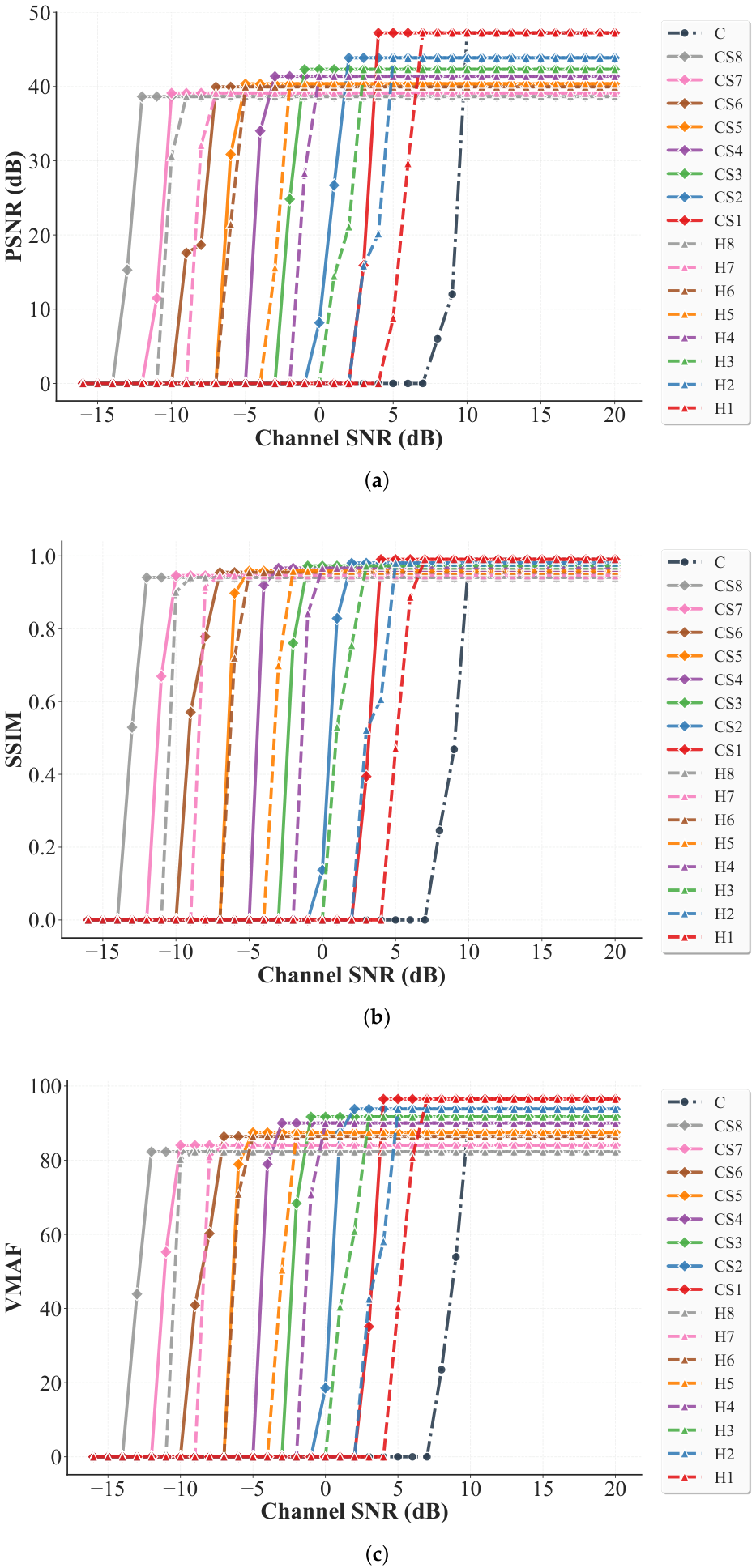
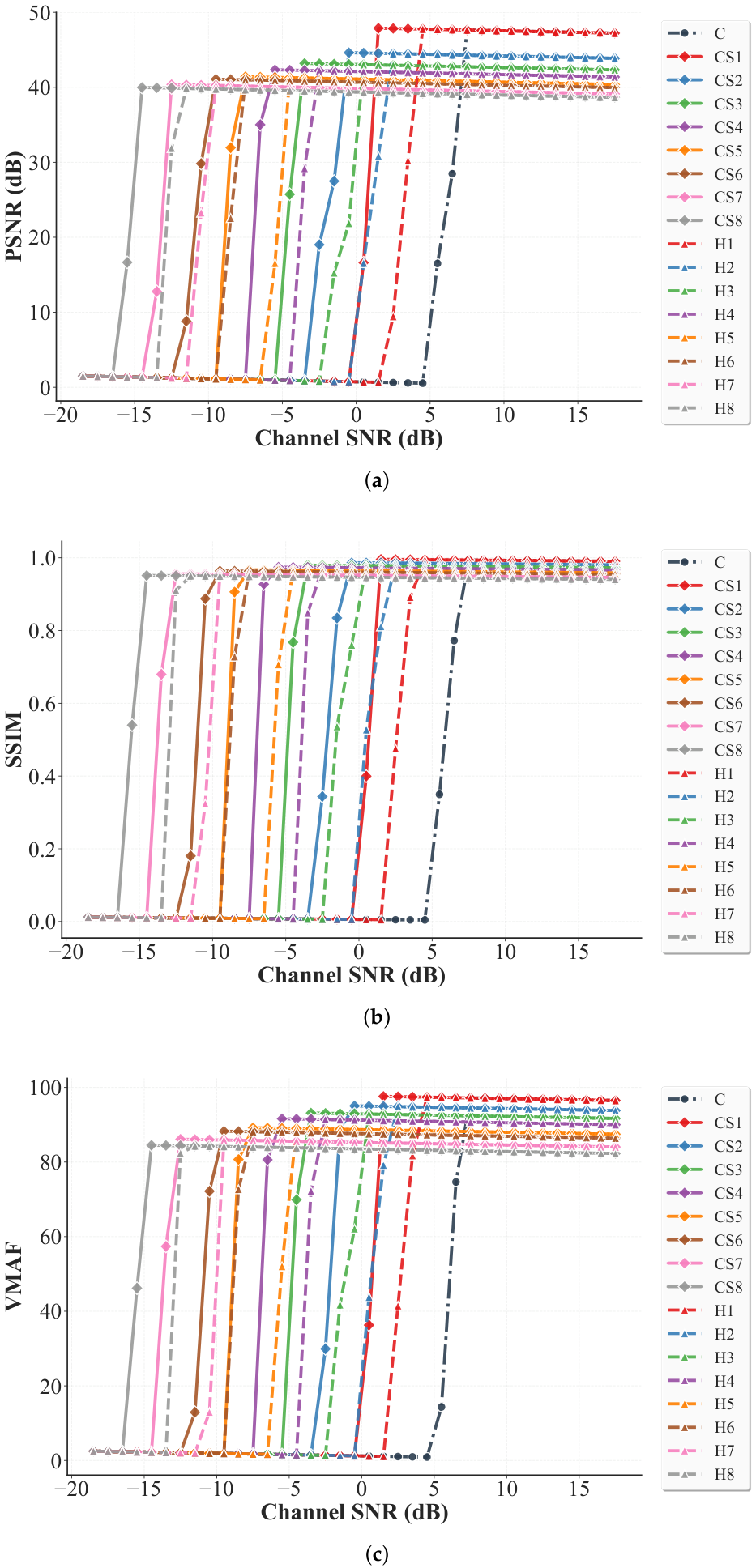
The performance of the proposed COUS-based multi-qubit system under the GOP8 configuration is evaluated using PSNR, SSIM and VMAF, as shown in
Figure 2. The results demonstrate a consistent and significant performance advantage over both the Hadamard encoding-based multi-qubit system and the classical communication baseline across the entire SNR range. Even in the single-qubit configuration, the COUS-based multi-qubit system (CS1) achieves an observable improvement, providing approximately a 4 dB channel SNR gain relative to the corresponding Hadamard encoding-based multi-qubit system (H1) while yielding higher PSNR, improved SSIM, and increased perceptual video quality as reflected by VMAF. As the number of qubits increases, further gains are observed, indicating that higher-dimensional COUS encoding enhances robustness against channel noise and improves the stability of inter-frame reconstruction in the presence of transmission errors. Although bandwidth normalization necessitates stronger source compression for higher-qubit configurations, leading to a modest reduction in peak quality under high-SNR conditions, these configurations consistently outperform lower-qubit and benchmark systems in moderate-to-low SNR regimes. In contrast, the classical communication (C) system exhibits the lowest performance across all metrics, lagging by approximately 3 dB in channel SNR compared to the single-qubit Hadamard encoding-based system (H1) and showing inferior perceptual quality under noisy conditions. Overall, the GOP8 results confirm that the proposed COUS-based multi-qubit architecture delivers superior fidelity, structural consistency, and perceptual quality, particularly in noise-limited scenarios, highlighting its effectiveness for robust quantum video transmission.
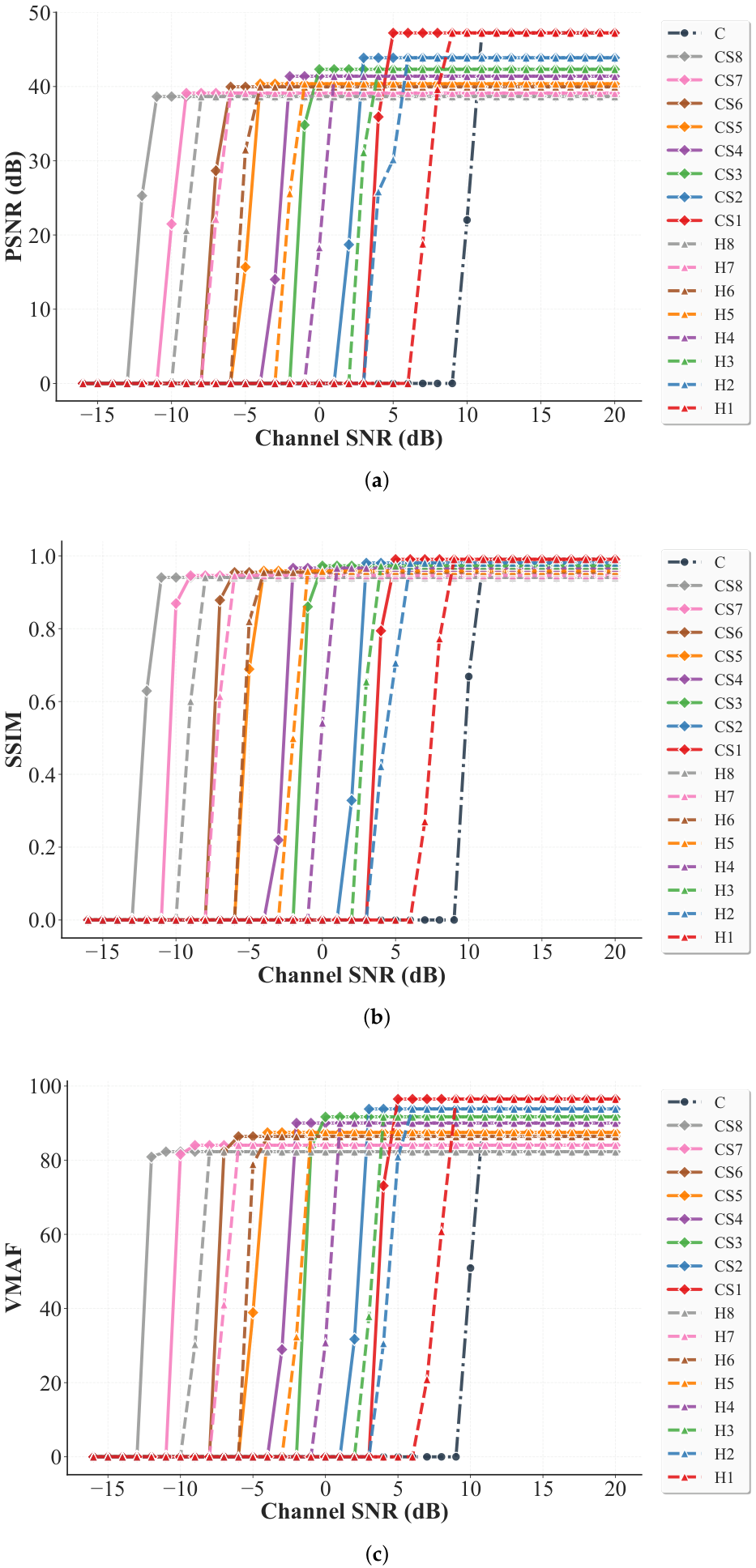
When the GOP size is increased to 16, temporal dependencies become more pronounced, leading to stricter robustness requirements for reliable transmission, as shown in
Figure 3. Nevertheless, the performance trends observed for GOP8 largely persist under this setting. The proposed COUS-based multi-qubit system (CS1–CS8) consistently outperform both the Hadamard encoding-based multi-qubit system (H1–H8) and the classical communication (C) baseline across all evaluated SNR levels. Even under GOP16, the single-qubit COUS encoding configuration (CS1) maintains a noticeable advantage over its Hadamard encoding-based counterpart (H1), exhibiting an approximate 3–4 dB channel SNR gain for equivalent PSNR, SSIM, and VMAF levels. As the number of qubits increases, COUS encoding demonstrates enhanced noise tolerance, allowing higher-qubit configurations to sustain acceptable video quality under increasingly adverse channel conditions. This improvement is particularly significant at low SNR regimes, where error propagation across inter-predicted frames severely degrades reconstruction quality for less robust schemes. In contrast, Hadamard encoding-based multi-qubit system show a steeper quality degradation as GOP size increases, indicating limited resilience to compounded temporal errors. The classical communication system continues to exhibit the weakest performance, falling several decibels behind even the lowest-qubit quantum configurations, especially under noisy channel conditions. Although bandwidth normalization necessitates stronger compression for higher-qubit settings, resulting in a slight reduction in peak quality metrics at high SNR, the improved robustness of COUS encoding ensures superior perceptual quality in moderate-to-low SNR scenarios. Overall, the GOP16 results confirm that COUS-based multi-qubit encoding effectively mitigates the adverse effects of temporal error propagation inherent in modern video compression. By maintaining higher fidelity and perceptual quality across PSNR, SSIM, and VMAF metrics, the proposed framework demonstrates strong scalability and robustness, making it well suited for quantum video transmission under realistic channel impairments.
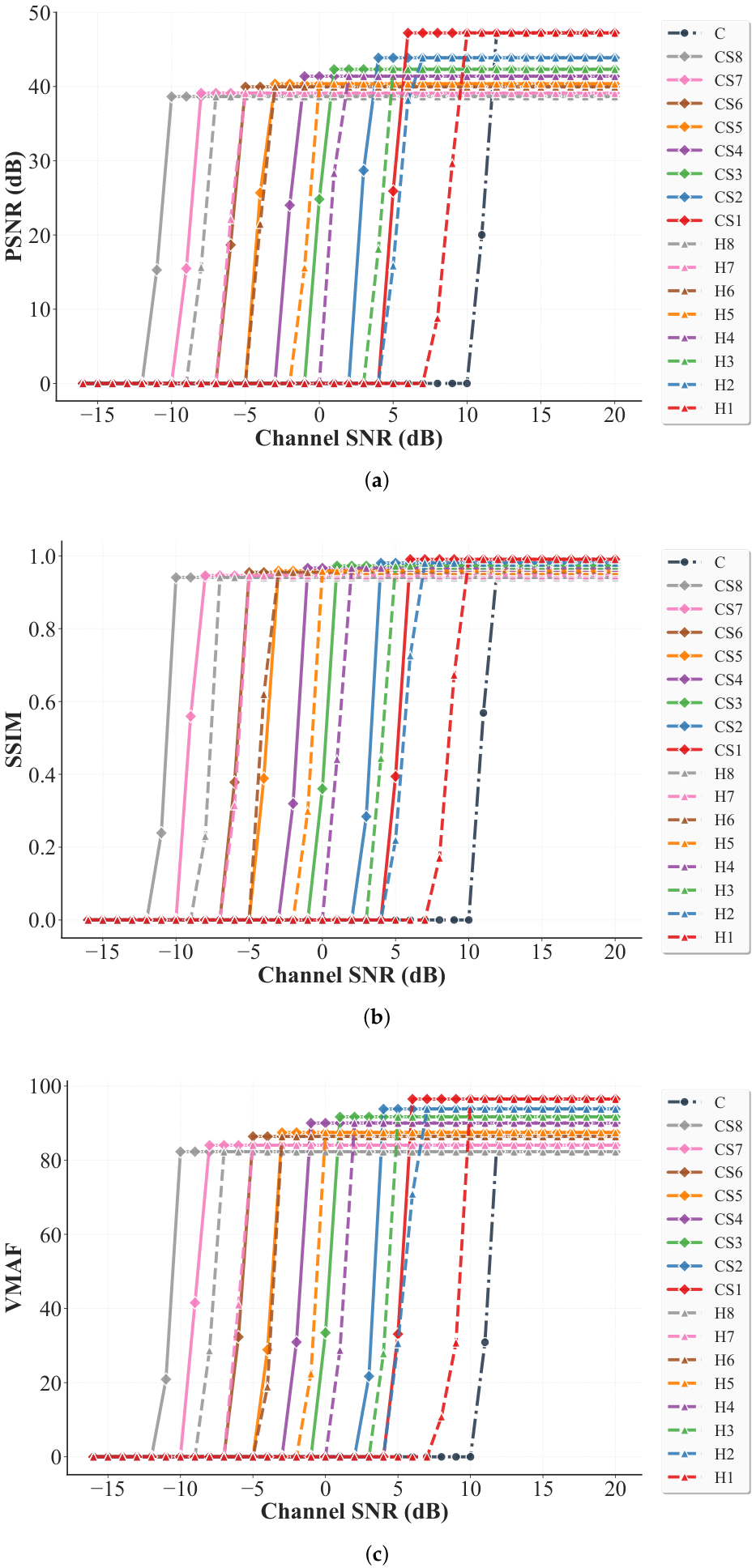
For the largest GOP size of 32, the transmission scenario represents a highly challenging regime due to strong temporal dependencies introduced by long prediction chains, as shown in
Figure 4. In this case, performance differences between encoding strategies become even more distinct. The COUS-based multi-qubit system (CS1–CS8) demonstrate superior stability across the entire SNR range, maintaining usable PSNR, SSIM, and VMAF levels even when channel conditions deteriorate. Higher-qubit COUS encoding configurations, in particular, exhibit strong resilience to noise-induced distortions, significantly reducing catastrophic quality drops commonly observed in long-GOP video transmission. While increased compression slightly constrains peak-quality performance at high SNR values, the overall perceptual quality remains consistently higher than that of Hadamard encoding-based multi-qubit systems (H1–H8) at moderate-to-low SNR levels. The classical communication baseline performs worst in this setting, suffering from severe quality loss due to unmitigated error propagation across predicted frames.
Across all GOP configurations, the proposed COUS-based multi-qubit framework demonstrates a clear and consistent advantage over both Hadamard encoding-based multi-qubit system and classical benchmark system. The ability to encode information jointly in amplitude and phase enables improved state distinguishability and enhanced noise tolerance. Importantly, even low-dimensional COUS configurations deliver meaningful gains, while higher-dimensional encodings provide further robustness in challenging channel conditions. These results confirm that the proposed approach effectively balances compression efficiency, transmission robustness, and perceptual quality, making it well suited for high-fidelity quantum video transmission under realistic noisy channel conditions.
When the GOP size increases to 16 and 32, as illustrated in
Figure 3 and
Figure 4, the influence of temporal dependencies becomes more evident. Longer GOPs introduce extended prediction chains, where P-frames rely not only on the nearest I-frame but also on previously decoded inter frames. This makes the video stream increasingly sensitive to errors introduced during transmission. Any distortion in early frames can propagate across multiple subsequent frames, leading to cumulative visual artifacts such as blurring, flickering, or block-like distortions. As a result, the overall video quality gradually declines as the GOP length grows, and higher channel SNR is required to achieve similar reconstruction fidelity. Despite this increased vulnerability, the COUS-based multi-qubit system consistently outperforms both Hadamard encoding-based multi-qubit system and classical communication benchmarks. Higher-dimensional COUS configurations provide additional resilience by encoding information across multiple qubits, which helps maintain reliable reference frames and reduces the amplification of errors across inter-coded frames. This effect is reflected in consistently higher PSNR, SSIM, and VMAF scores, even at lower SNR levels. These observations demonstrate that the proposed COUS encoding framework can effectively suppress temporal error propagation, preserve spatial details, and maintain perceptual consistency across long prediction chains, making it robust under challenging channel conditions.
The results clearly show that COUS encoding provides superior video reconstruction quality by jointly encoding information in both amplitude and phase within each qubit. Unlike Hadamard encoding, which uses only linear polarization states (horizontal and vertical ) with real-valued amplitudes, COUS leverages circular polarization states, right-handed () and left-handed (). This allows each qubit to carry more information, as the phase dimension adds extra degrees of freedom. By distributing video data across multiple orthogonal components in a complex Hilbert space, COUS naturally improves resilience to channel noise and transmission distortions.
A significant advantage of COUS encoding is its energy-preserving and unitary structure, which ensures that the overall probability amplitude remains normalized. This property helps maintain high-fidelity video reconstruction even under low-SNR conditions or adverse channel scenarios. The combination of amplitude and phase also introduces intrinsic redundancy: if some qubit components are affected by noise, the remaining components still contain usable information, mitigating the impact of partial errors and enhancing robustness. The COUS-based multi-qubit framework amplifies these benefits by spreading information across multiple qubits. Higher-dimensional COUS states increase the distinguishability between encoded quantum states, reducing decoding errors and ensuring more reliable reconstruction of reference frames. This robustness is reflected in consistently higher PSNR, SSIM, and VMAF scores, particularly under moderate to low SNR levels, where Hadamard encoding-based multi-qubit system and classical systems show noticeable quality degradation.
Additionally, COUS encoding is scalable. The dual amplitude–phase encoding enables larger video frames or higher-dimensional states to be transmitted without a proportional increase in qubit resources. Orthogonality of the circular polarization states allows for parallel processing of multiple video components, improving transmission efficiency while preserving temporal and spatial fidelity. While formal analyses like minimum distance or Bloch-sphere representations are not included, the empirical results confirm that phase diversity in COUS encoding enhances state separability and decoding accuracy compared to Hadamard encoding.
Furthermore, for the proposed system, a closed-form analytical relationship between the number of qubits, channel SNR, and perceptual quality metrics is difficult to derive due to the multi-layered and nonlinear nature of the system. Nevertheless, consistent quantitative trends are observed. Specifically, PSNR is found to increase approximately logarithmically with SNR, indicating diminishing returns at higher SNR levels. Increasing the number of qubits improves reconstruction quality due to enhanced state representation; however, the gain gradually saturates as the system approaches its representational limit. Similarly, SSIM and VMAF exhibit saturation behavior at high SNR and larger qubit configurations. These trends are consistent with established communication theory and provide a clear quantitative understanding of system performance without relying on simplified curve-fitting models.
To further validate the proposed method,
Table 2 presents the peak channel SNR gains achieved by the COUS and Hadamard-based encoding schemes relative to the classical system across multiple video resolutions for GOP8. For clarity and ease of comparison, the reported SNR gain values in
Table 2 are rounded to the nearest integer. This rounding does not affect the observed trends, as the underlying variations remain within a small range (typically
dB), as shown in
Table 3. The evaluation includes low-resolution (
), HD (
), and full HD (
) sequences. Across all tested scenarios, COUS-based multi-qubit system (CS1–CS8) consistently outperforms Hadamard encoding-based multi-qubit system (H1–H8), achieving higher SNR gains and demonstrating superior robustness against channel noise and transmission-induced distortions. Based on the results, the performance of the proposed system is largely independent of video resolution, maintaining consistent advantages across both low and high-definition sequences. This indicates that the proposed framework is input-agnostic with respect to spatial resolution.
To further examine the consistency of the observed performance gains,
Table 3 presents the per-condition SNR gains along with their corresponding standard deviations across different spatial resolutions. The results demonstrate that the variations remain within a narrow range (typically
dB) for both COUS-based and Hadamard-based multi-qubit systems, indicating strong statistical consistency.
These small variations arise from the stochastic nature of the Monte Carlo simulation, including random channel realizations and finite sample averaging, and are considered statistically insignificant in communication system evaluations. Furthermore, it is observed that the SNR gains of both COUS-based and Hadamard-based multi-qubit systems remain effectively constant across different resolutions and motion characteristics. This behavior can be attributed to the fact that the proposed encoding operates on compressed and channel-coded bitstreams rather than raw pixel data. Due to entropy coding and inter-frame prediction in VVC, the resulting bitstream exhibits statistically stabilized properties, making transmission performance largely independent of input resolution and content.
To further validate the statistical stability of perceptual quality metrics,
Table 4 presents representative PSNR, SSIM, and VMAF values along with their corresponding standard deviations for the two-qubit COUS configuration (GOP8).
As shown in
Table 4, the variations in perceptual quality metrics remain extremely small across all SNR levels, confirming strong statistical stability. Given this negligible variance, the inclusion of error bars in the figures is unnecessary, as they would be visually indistinguishable and would not affect the interpretation of the results.
To analyze the influence of video motion characteristics, the proposed COUS-based system is evaluated across low, medium, and high-motion sequences at multiple spatial resolutions, as summarized in
Table 5, which presents the peak channel SNR gains achieved for different qubit configurations.
The results show that the SNR gains remain consistent across all motion categories and resolutions. This indicates that the performance of the proposed system is largely independent of video motion characteristics. This behavior can be explained by the system architecture. The input video is first compressed using VVC, where spatiotemporal correlations (including motion) are exploited to generate a compact bitstream. High-motion videos typically produce higher-entropy bitstreams, while low-motion videos result in more compact representations. However, after compression, the transmission system operates purely on the bitstream. Subsequent stages, including polar channel coding and COUS-based multi-qubit encoding, process the data as binary sequences without explicit dependence on spatial or temporal structure. Therefore, system performance is primarily governed by channel conditions, coding strategy, and qubit dimensionality, rather than motion content. This property highlights an important advantage of the proposed framework. Unlike conventional systems where high-motion content can significantly degrade performance due to error propagation, the proposed bitstream-level processing combined with COUS encoding ensures consistent robustness across diverse video characteristics.
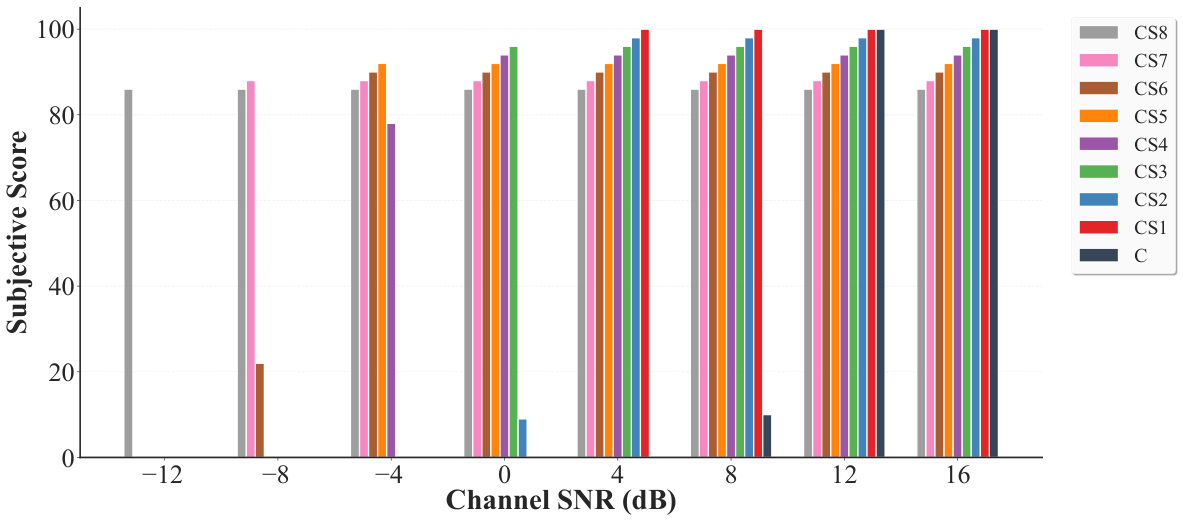
Furthermore, a subjective quality assessment of the proposed system for GOP8 is conducted and compared with the classical baseline using the double stimulus assessment method [
48], as shown in
Figure 5. In this evaluation, the original reference video sequence is first presented, followed by the processed sequences, enabling direct comparison with the reconstructed content. A total of 100 participants, spanning diverse age groups from 18 to 65 years, are recruited through university mailing lists and voluntary participation. The participant pool includes both technical and non-technical backgrounds, and all participants report normal or corrected-to-normal vision. To minimize bias, no information regarding the underlying methods or system configurations is provided. Each participant evaluates a set of carefully selected video stimuli (three representative sequences), covering combinations of channel SNR levels and encoding configurations (CS1–CS8, H1–H8, and the classical baseline). The subset of stimuli is selected to balance statistical coverage and participant reliability while avoiding excessive session duration, in accordance with ITU-R BT.500 recommendations [
48]. All videos are displayed on a calibrated monitor under consistent ambient lighting, with a viewing distance of approximately three times the screen height. Video sequences are presented at their native resolution and frame rate to ensure fair perceptual assessment. To mitigate fatigue effects, session durations are limited and short breaks are provided at regular intervals. In addition, the presentation order of all test sequences is randomized independently for each participant to avoid ordering bias and learning effects. Perceived quality is rated using a continuous quality scale, with emphasis on visual clarity, artifact visibility, and overall perceptual fidelity. Final subjective scores are obtained by averaging the ratings across all participants. Informed consent is obtained from all participants involved in the study. The study is conducted in accordance with institutional ethical guidelines and is approved by the Ethics Committee of the University of Strathclyde (protocol code 3048, approved on 9 December 2025). This controlled, randomized, and ethically compliant evaluation methodology ensures reliable, unbiased, and reproducible perceptual quality assessment, effectively complementing the objective metrics used in the study.
The subjective quality evaluation across different channel SNR conditions reveals distinct performance characteristics for COUS-based multi-qubit schemes (CS1–CS8) and the classical communication scheme (C) across the SNR range from 16 dB to −12 dB. At high SNR conditions (12–16 dB), nearly all quantum schemes (CS1–CS8) achieve excellent subjective quality, along with the classical communication scheme (C), demonstrating that under favorable channel conditions, all approaches deliver satisfactory performance. As the channel SNR decreases to 8 dB, the classical communication scheme (C) begins to show degradation. In contrast, the COUS-based multi-qubit schemes (CS1–CS8) continue to perform robustly, with CS1 through CS8 all maintaining high quality scores. At moderate SNR levels (4 dB), CS1 and the higher qubit schemes sustain near-perfect quality, while the classical approach becomes ineffective. At 0 dB SNR, CS1 fails and CS2 shows noticeable degradation. At −4 dB, only the higher qubit configurations (CS4–CS6) maintain acceptable performance, with some quality loss in CS4. In the low-SNR regime (−8 dB), CS7 and CS8 retain near-peak performance, while under the most severe conditions (−12 dB), only CS8 continues to deliver satisfactory quality. These trends are consistent with the objective quality metrics (PSNR, SSIM, and VMAF), confirming alignment between perceptual and computational assessments.
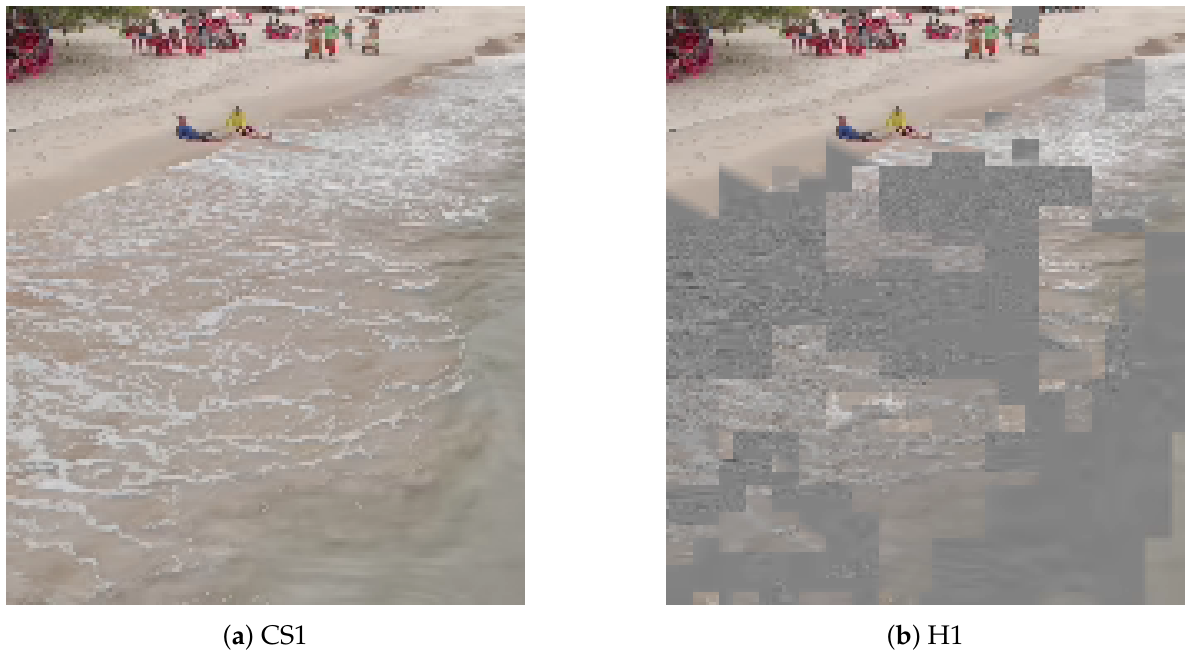
In addition, to clearly illustrate the visual differences between the COUS-based multi-qubit system and the Hadamard encoding-based multi-qubit system,
Figure 6 presents a sample decoded video frame at SNR = 6 dB for the CS1 and H1 configurations. The figure highlights the superior reconstruction fidelity of the COUS-based multi-qubit system, showing sharper details and reduced artifacts compared to the Hadamard encoding-based system at the same noise level.
To further validate the proposed approach, a comparative evaluation is conducted against representative quantum encoding schemes, including Hadamard-based time-domain encoding and frequency-domain (QFT-based) encoding, under identical system conditions, as summarized in
Table 6. The results indicate that COUS consistently outperforms Hadamard encoding across all qubit configurations (Q1–Q8), corresponding to 1–8 qubits, by approximately 3–4 dB. This improvement is attributed to the ability of COUS to encode information in both amplitude and phase, thereby increasing the degrees of freedom available for representation.
When compared to the frequency-domain approach, COUS achieves nearly identical performance in most cases, with only minor differences observed at higher qubit levels. Notably, this performance is achieved without relying on complex QFT-based transformations, highlighting the efficiency of the proposed method. In the single-qubit (Q1) configuration, COUS is observed to slightly outperform the QFT-based approach, achieving an SNR gain of approximately 3 dB. This behavior arises because the QFT framework cannot effectively exploit frequency-domain characteristics with only a single qubit, as meaningful frequency decomposition requires multiple qubits. In contrast, COUS directly utilizes both amplitude and phase even in the single-qubit case, enabling more efficient information representation and improved performance.
Although the frequency-domain approach can achieve slightly higher peak performance at larger qubit configurations, it requires significantly higher computational resources due to increased circuit complexity and depth. In particular, the QFT-based encoding exhibits a computational complexity of and circuit depth of due to controlled rotation operations between qubits. In contrast, COUS maintains linear computational complexity , with a gate count of and constant circuit depth , since encoding operations are applied independently to each qubit. As a result, COUS is more suitable for practical implementation, particularly in near-term quantum devices where circuit depth and error accumulation are critical constraints.
4.1. Positioning of the Proposed COUS Encoding
The proposed COUS encoding differs from conventional basis rotation strategies and existing phase-augmented frequency-domain encoding approaches in several important aspects. Although the COUS operator can be decomposed into a sequence of standard quantum gates (S–H–S), its novelty does not lie in the introduction of a new elementary gate but in the structured construction of a complex-valued orthogonal encoding framework specifically designed for multimedia transmission over noisy quantum channels. Unlike conventional Hadamard-based encoding, which generates purely real-valued superposition states, the COUS transformation introduces a phase shift that produces complex-valued coefficients, enabling information to be distributed across both amplitude and phase components of the quantum state. This effectively expands the representational diversity of the encoded states within the Hilbert space and improves their distinguishability under channel noise.
Compared with frequency-domain approaches such as QFT-based encoding, the proposed method achieves amplitude–phase diversity using only three single-qubit operations, resulting in a significantly shallower circuit. This provides a favorable trade-off between encoding richness and implementation complexity, which is particularly important for high-dimensional multimedia transmission scenarios. Furthermore, the proposed COUS encoding is integrated within a complete multimedia communication pipeline that combines modern video compression, channel coding, and multi-qubit quantum transmission. This system-level integration demonstrates how structured complex-valued encoding can improve the robustness of compressed multimedia bitstreams under noisy quantum channels.
4.2. Parameter Sensitivity Analysis
To evaluate the robustness of the proposed framework, a sensitivity analysis is conducted with respect to polar code rate, VVC QP, and channel noise composition. The impact of these parameters is assessed using PSNR, SSIM, and VMAF under identical system conditions.
4.2.1. Effect of Polar Code Rate
To analyze the effect of channel coding strength, we evaluate three polar code rates:
,
, and
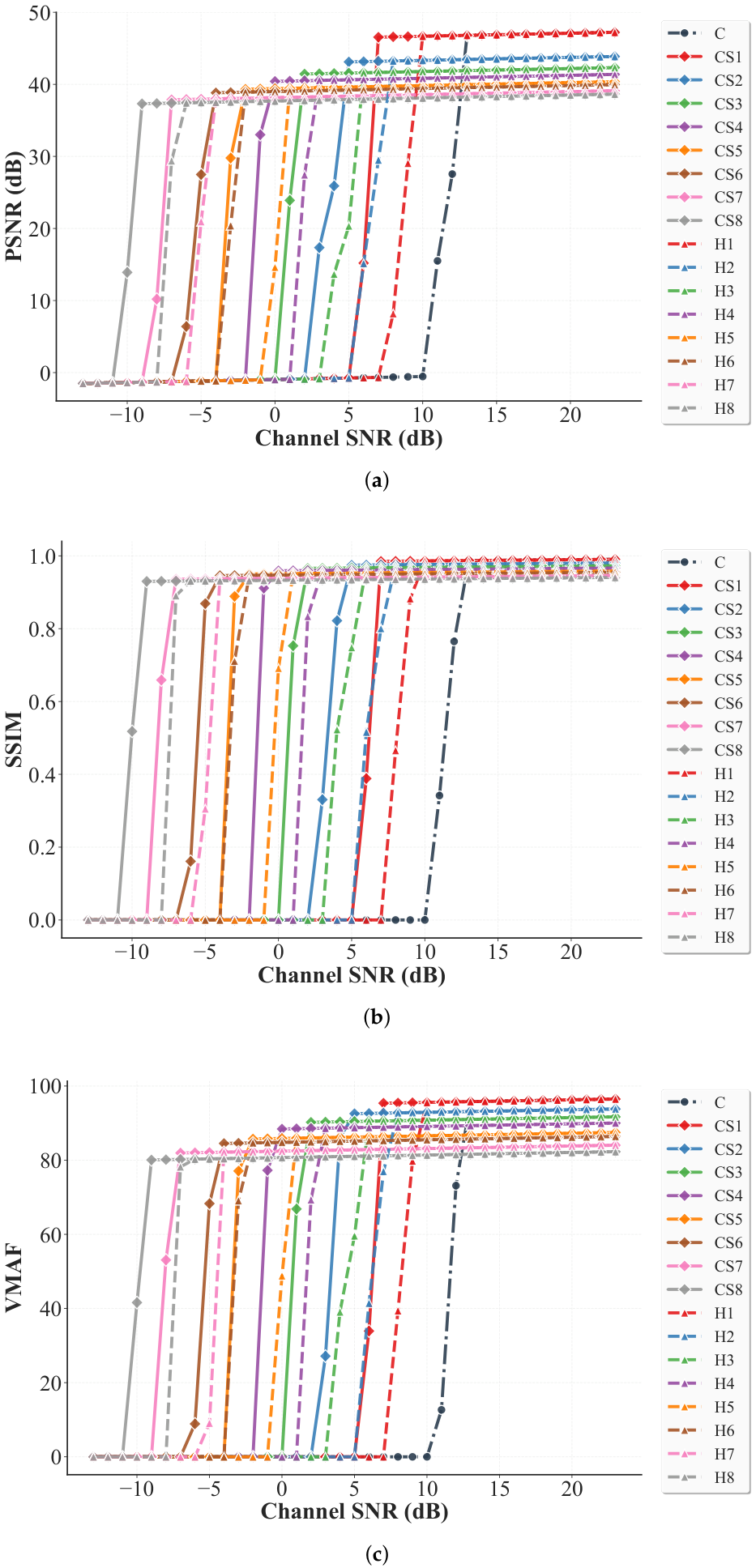
under identical transmission conditions for GOP8. The results show a clear trade-off between redundancy and efficiency. At a lower code rate (
) (
Figure 7), higher redundancy provides stronger error correction capability, leading to improved robustness under low SNR conditions. This results in higher PSNR, SSIM, and VMAF values in noisy environments. However, the increased redundancy reduces spectral efficiency and requires more bandwidth. At a higher code rate (
) (
Figure 8), the system achieves better efficiency but becomes more sensitive to channel noise, resulting in noticeable degradation in reconstruction quality, especially at moderate-to-low SNR levels. The intermediate rate
(
Figure 2) provides a balanced trade-off between robustness and efficiency. It consistently delivers stable performance across a wide range of SNR conditions without excessive redundancy. Therefore, a polar code rate of
is selected as the optimal configuration in this work.
4.2.2. Effect of Quantization Parameter (QP)
The impact of source compression is evaluated by varying the VVC QP, as shown in
Table 7, using a representative low-motion video sequence with a resolution of
and a GOP size of 8. Lower QP values produce higher-quality bitstreams with less compression, while higher QP values increase compression at the cost of source distortion.
To ensure a fair comparison between classical and quantum transmission schemes, the effective channel bit rate (bits per channel use) is maintained constant across all configurations. In the classical baseline, the compressed bitstream of length L is transmitted using BPSK modulation, where each channel use carries one bit. In the quantum system, an n-qubit encoding allows n classical bits to be represented within a single quantum symbol. Therefore, the input bitstream length is proportionally reduced to approximately so that the number of channel uses remains comparable across configurations.
For example, the reference configuration (CS1) uses a bitstream length of bits with QP = 21. When using a two-qubit configuration (CS2), each transmitted symbol carries two bits, and therefore the bitstream is reduced to bits by adjusting the compression level (QP = 26). Similarly, for the eight-qubit configuration (CS8), each symbol represents eight bits and the bitstream length becomes approximately bits using QP = 38. This normalization ensures that the effective transmission load remains consistent across all configurations.
The results indicate that lower QP values (e.g., QP = 21) yield higher PSNR, SSIM, and VMAF under high SNR conditions because the source distortion is minimal. However, these bitstreams are larger and therefore more vulnerable to channel errors due to the increased transmission load. Conversely, higher QP values (e.g., QP = 38) reduce the bitstream size, improving robustness to transmission errors. However, excessive compression introduces visible artifacts and reduces overall reconstruction quality. An intermediate QP range (e.g., QP = 26–32) provides the best compromise between compression efficiency and perceptual quality. This range ensures a manageable bitstream size while preserving sufficient visual fidelity, making it suitable for transmission over noisy quantum channels while maintaining the same effective channel bit rate across all encoding configurations.
4.2.3. Effect of Noise Composition
The proposed system models a composite quantum channel consisting of multiple noise types, including bit-flip, phase-flip, depolarizing, amplitude damping, and phase damping. To evaluate sensitivity, the proportion of each noise component is varied while maintaining a constant total noise probability. The results show that amplitude damping and depolarizing noise have the most significant impact on system performance, as they directly affect both amplitude and coherence of quantum states. Phase-flip and phase damping noise primarily affect phase information but have comparatively lower impact on reconstruction quality when COUS encoding is used. Importantly, the proposed COUS encoding demonstrates strong robustness across different noise distributions. This is because COUS jointly encodes information in both amplitude and phase, providing inherent redundancy and improving resilience against diverse noise types.
4.2.4. Optimal Configuration
Based on the analysis, the optimal configuration consists of a polar code rate of , an intermediate QP range (26–32), and a balanced composite noise model. This combination provides the best trade-off between compression efficiency, robustness, system complexity and reconstruction quality. Overall, the proposed COUS-based system demonstrates strong robustness to parameter variations, while achieving optimal performance under a balanced configuration of channel coding, source compression, and quantum encoding.
4.3. Theoretical Justification of COUS Performance Gains
The observed empirical improvements of the proposed COUS-based encoding framework are supported by analytical principles related to quantum state representation, distinguishability under noise, and geometric structure in Hilbert space.
4.3.1. Complex Hilbert Space Representation
In an n-qubit system, quantum states reside in a complex Hilbert space . The robustness of an encoding scheme depends on how effectively it utilizes this space.
Hadamard encoding produces real-valued superposition states, as shown in Equation (
40).
These states restrict information to the real axis of the Hilbert space.
In contrast, COUS encoding introduces complex-valued coefficients, as given in Equation (
41).
This allows simultaneous utilization of amplitude and phase, leading to improved state diversity and a more uniform distribution across the complex Hilbert space.
4.3.2. Minimum Distance and Effective Distinguishability
For normalized quantum states, the Euclidean distance between two pure states is defined in Equation (
42).
Both Hadamard and COUS encoding produce orthogonal states under ideal (noise-free) conditions. Therefore, the minimum Euclidean distance between encoded states is identical for both schemes.
Under noisy transmission conditions, the encoded states are transformed by the quantum channel as shown in Equation (
43).
The distinguishability between the resulting noisy states is characterized by the trace distance defined in Equation (
44).
Trace-Distance Contractivity Under Composite Channels: Let
and
denote two encoded quantum states. Consider a composite quantum channel defined in Equation (
45).
In Equation (
45),
represents completely positive trace-preserving (CPTP) channels and
are normalized weights satisfying
.
The trace distance between the output states satisfies the contractivity property shown in Equation (
46). This property follows from the contractivity of the trace distance under CPTP maps [
30].
As an example, Hadamard encoding generates real-valued superposition states defined in Equation (
40). These states lie along a single axis of the Bloch sphere, making them more sensitive to certain noise processes such as amplitude damping or phase damping.
In contrast, COUS encoding produces complex-valued superposition states defined in Equation (
41). These states distribute information across both amplitude and phase components, effectively spanning orthogonal quadratures of the Bloch sphere.
As a result, although the trace distance contracts for both encodings according to Equation (
46), the effective distinguishability after noise tends to satisfy Equation (
47).
Equation (
47) is consistent with the improved decoding reliability observed in the experimental results.
4.3.3. Amplitude–Phase Diversity Under Noise
The proposed COUS encoding introduces amplitude–phase diversity in the representation of quantum states. Different quantum noise processes affect state components in distinct ways; for instance, amplitude damping primarily alters the magnitude of the state amplitudes, while phase damping mainly degrades quantum coherence. Depolarizing noise, on the other hand, affects both amplitude and phase components simultaneously.
By distributing the encoded information across both amplitude and phase components of the quantum state, COUS encoding preserves partial information even when one component is degraded by channel noise. As a result, the distinguishability between encoded states is better maintained, improving robustness under asymmetric or composite noise conditions.
4.3.4. Bloch Sphere Interpretation
A general qubit state is expressed as in Equation (
48).
Hadamard encoding restricts to , placing states along the X-axis. In contrast, COUS encoding introduces , positioning states along an orthogonal axis (Y-axis). Under noise, quantum states undergo rotations and contractions on the Bloch sphere. States confined to a single axis are more vulnerable, whereas states distributed across orthogonal axes retain greater angular separation and hence better distinguishability.
4.3.5. Information-Theoretic Perspective
The accessible classical information is bounded by the Holevo quantity, as given in Equation (
49), where
denotes the Holevo bound.
In Equation (
49),
represents the quantum state associated with the
i-th classical message, and
denotes its corresponding probability. The average quantum state is defined as
, and
denotes the von Neumann entropy, given by
, where
represents the trace operation. By improving state distinguishability, COUS encoding preserves a higher effective
, thereby enabling more reliable information extraction and improved transmission fidelity.
4.3.6. Multi-Qubit Scaling
For n qubits, the state space grows as . COUS encoding extends via tensor products, enabling joint amplitude–phase representation across multiple qubits. This results in increased dimensional diversity, improved separability, and enhanced robustness, particularly as the system dimension increases.
4.3.7. Unified Interpretation
The performance gains of COUS encoding arise from:
Full utilization of the complex Hilbert space;
Preservation of effective distance under noise;
Amplitude–phase diversity;
Improved geometric robustness;
Enhanced information capacity.
These analytical insights explain the observed improvements in PSNR, SSIM, and VMAF across all evaluated scenarios.
4.4. Hardware Feasibility and Complexity Analysis
Evaluating the hardware requirements and computational complexity of the proposed COUS-based multi-qubit encoding is essential for assessing its practicality in quantum video transmission systems. The COUS gate is implemented using a sequence of standard single-qubit operations, specifically a phase–Hadamard–phase (S–H–S) structure. All of these gates are natively supported by current quantum hardware platforms, including superconducting qubits, trapped ions, and photonic systems, ensuring strong hardware compatibility.
In a multi-qubit system, the COUS operation is applied independently to each qubit. As a result, the total number of gates scales linearly with the number of qubits, requiring single-qubit gates for an n-qubit system. Since these operations act on different qubits, they can be executed in parallel, ensuring that the circuit depth remains constant, . This shallow circuit depth is particularly advantageous in practical quantum systems, as it reduces the impact of decoherence and accumulated gate errors.
For comparison, Hadamard encoding requires only a single gate per qubit, resulting in n gates with the same constant circuit depth under parallel execution. While Hadamard encoding is computationally simpler, it utilizes only real-valued amplitudes and does not exploit phase information. In contrast, COUS encoding introduces phase modulation with only a constant-factor increase in gate count, providing improved robustness without affecting asymptotic complexity.
The computational complexity of different stages of the system is summarized in
Table 8.
The decoding stage employs exhaustive nearest-neighbor (NN) detection in the -dimensional Hilbert space in order to evaluate the intrinsic performance of the encoding scheme under optimal detection conditions. For an n-qubit system, the number of candidate states grows as . In the present study, the system configuration is restricted to , corresponding to a maximum of candidate states. At this scale, decoding remains computationally lightweight, requiring at most 256 distance evaluations per received symbol, which can be efficiently executed on standard classical processors. In addition, decoding is performed independently for each symbol block, enabling straightforward parallel processing and reducing latency. The choice of also aligns naturally with typical multimedia representations where pixel intensities are encoded using 8-bit precision.
For significantly larger qubit dimensions, exhaustive NN decoding may become computationally expensive due to the exponential growth of the candidate state space. In such cases, reduced-complexity decoding strategies such as sphere decoding, hierarchical or tree-based search, and approximate nearest-neighbor (ANN) detection could be employed to significantly reduce the computational burden while maintaining reliable detection performance. However, incorporating such techniques would introduce additional algorithmic design choices and optimization parameters that are largely independent of the encoding framework itself. Consequently, including these methods would shift the focus of the work from encoding analysis toward decoder design and algorithmic optimization. Therefore, these techniques are not incorporated in the present study. Investigating such scalable decoding approaches represents an important direction for future work.
It is also worth noting that the current implementation is performed on classical computing platforms as part of the simulation framework used to evaluate the communication system. As quantum hardware continues to evolve, quantum processors are expected to provide native support for high-dimensional state manipulation and inherently parallel quantum operations. This parallelism can significantly accelerate state comparison and decoding tasks. Consequently, while the decoding procedure is implemented classically in this work for analysis purposes, it remains computationally lightweight for the considered system sizes and is expected to scale efficiently for larger qubit configurations when implemented on quantum hardware.
4.5. System Scalability and Practical Implications of COUS Encoding
The COUS encoding strategy exhibits high scalability and hardware compatibility, making it suitable for multi-qubit quantum communication tasks. The design of COUS ensures that the gate count grows linearly with the number of qubits while the circuit depth remains constant through parallel application of single-qubit operations, enabling efficient utilization of quantum resources and allowing high-dimensional quantum states to be processed without increased execution time. As such, the system can be naturally extended beyond eight qubits, supporting the transmission of more complex video sequences while maintaining low operational overhead.
From an application perspective, COUS encoding is particularly promising for scenarios where high fidelity and robustness are critical. This includes quantum-enhanced imaging, secure video communication, remote sensing, and quantum metrology, where both amplitude and phase information must be accurately preserved. Additionally, COUS can be applied in distributed quantum computing, multi-qubit quantum sensing, quantum radar, and quantum error-resilient communication networks, where maintaining state orthogonality and minimizing error propagation are essential. Its linear scalability of gate requirements and shallow circuit depth make COUS a feasible choice for these applications, particularly in future quantum devices with limited coherence times.
4.6. Simulation-Centric Evaluation
Given current hardware limitations, including restricted qubit counts, finite coherence times, and imperfect gate fidelities, simulation-based evaluation is a widely accepted and necessary approach for validating new quantum communication techniques. In this work, the performance of COUS encoding is assessed through classical simulations that accurately model unitary gate operations, superposition states, and realistic noise channels. Such simulations allow for exploration of a wide range of conditions, including varying qubit sizes, noise levels, and channel impairments, enabling quantitative assessment of reconstruction fidelity, error resilience, and scalability.
Simulation provides a controlled and reproducible environment to test complex multi-qubit encoding strategies like COUS before attempting costly or currently infeasible hardware implementations. By modeling both ideal and noisy channels, it is possible to identify potential bottlenecks, quantify error propagation, and validate the effectiveness of amplitude–phase encoding. This approach is standard in the field, as many recent studies in quantum communication rely on simulation to benchmark performance, optimize encoding schemes, and guide experimental design, while physical experiments remain the ultimate test of real-world feasibility.