1. Introduction
Achieving resilient consensus in distributed multi-agent systems is essential for ensuring stability and coordination in cyber–physical infrastructures, power networks, and networked control systems. The W-MSR (weighted-mean subsequence reduced) algorithm and its variants provide a foundational mechanism for tolerating Byzantine agents by filtering extreme neighbor values and maintaining convex-hull safety [
1]. However, classical W-MSR relies on one-hop communication, which requires strong robustness properties (e.g.,
-robustness) that many sparse networks—such as power-system graphs—cannot satisfy. To address this, recent extensions have introduced multi-hop W-MSR (MW-MSR) frameworks, where agents gather information from nodes up to
h hops away [
2]. These works establish robustness criteria for synchronous and asynchronous settings and show that multi-hop communication can significantly relax topological requirements. Specifically, if the
h-hop graph satisfies
-robustness (or
-robustness under delays), resilient consensus becomes achievable even when one-hop communication fails. Despite these advances, a critical practical challenge remains unresolved:
How can one determine the smallest hop radius that guarantees resilient consensus while avoiding unnecessary communication overhead?
In nearly all MW-MSR literature, the hop count h is preselected, often heuristically or as a fixed parameter. This leaves practitioners without guidance, forcing them to choose between either an h that is too small, which leads to insufficient robustness and consensus failure, or an h that is too large, which leads to excess bandwidth usage, latency, and an increased attack surface.
Moreover, exact robustness verification—although theoretically ideal—is computationally difficult for large graphs and is often impractical in real deployments. As a result, there is a clear need for a systematic, scalable, and implementation-oriented procedure for selecting .
Contributions —This paper introduces a hop-selection framework designed for practical deployment in adversarial networks:
Minimal hop radius : Hybrid verification combining exact robustness (when feasible) with scalable proxies;
Proxy hierarchy: Local feasibility, normalized algebraic connectivity, and adversary-dilution constraints (see
Appendix A.1.4);
Design time and runtime procedures: Consistent with MW-MSR theory in synchronous and bounded-delay asynchronous settings;
Complexity and cost model: Highlighting why selecting the smallest feasible matters;
Evaluation on IEEE 14/30/57 with stealthy and burst adversaries: Demonstrating reliable detection of resilience thresholds.
Overall, this work aims to provide a practical, scalable, and theoretically grounded approach to choosing the communication horizon for resilient consensus. Rather than proposing a new variant of W-MSR, our goal is to bridge the gap between MW-MSR theory and real-world implementation, offering tools that enable practitioners to configure multi-hop communication in a principled manner.
2. Related Work
Achieving consensus in multi-agent networks [
3,
4] that suffer dynamic updates or changes in the form of link or node failure and delays is covered in Olfati et al.’s work [
5]. This work is governed by sound theoretical, graphical, and control theory.
Enabling agents to reach an agreement in an environment with malicious or faulty nodes is an area in which several algorithms based on the W-MSR family have been developed. The aim is to help normal agents achieve consensus (see [
1,
6,
7,
8] for more details).
The presence of stealthy Byzantine agents with sufficient knowledge about the network and maliciously working to drift the system away from its normal behavior has been presented in Ishii’s overview; see [
9] and Zhao et al.’s work to isolate attacks [
10].
The problem of resilient consensus in multi-agent leaderless systems with coordination is presented in [
11,
12].
The problem of resilient consensus in multi-agent systems in the presence of leaders has been studied extensively in the literature. The work of [
13] focuses on the W-MSR algorithm to deal with time-varying graphs, unlike many models that deal with static graphs. However, Usevitch and Dimitra’s work is limited to discrete-time dynamics with reliance on the W-MSR algorithm to achieve local filtering (see [
14]). In addition, the work commonly requires strong graph robustness (
r—robust). Moreover, the proposed model is heavy in nature, as it depends on complex leader dynamics.
Several works investigate the one-hop communication using the W-MSR algorithm to reach almost-sure consensus using martingale theory and random processes (such as [
15] and Shang’s work [
16]). Yemini et al.’s work relies on stochastic trust values [
17]. Rezaee et al. try to make multi-agent systems immune to DoS attack [
18]. Rezaee et al. investigate W-MSR consensus under the presumption of noisy channels [
19].
The notion of robustness and connectivity in complex networks is investigated in Zhang et al.’s work [
20]. Tyra et al.’s work [
21] investigates the robustness of models under adaptive and/or dependent attacks. The work [
21] considers attack scenarios that follow dependent and adaptive patterns.
Moreover, Usevitch’s and Dimitra’s work is considered the anchor for resilient leaders–followers. The work by [
22] is inspired by Usevitch’s and Dimitra’s. However, Yuan’s and Ishii’s work cover several gaps present in [
13], such as extending W-MSR by multi-hop relays (see [
2,
23] for more details on multi-hop communication).
The work by Shang [
24] provides a unified leaderless and leader–follower resilient consensus over directed random networks with
l-hop communication, Byzantine nodes, and edge failure. This is different from this work in that Shang’s work [
24] introduces an
l-hop communication as a generalization without claiming or proving “optimality”. Therefore, the distinction between this work and Shang’s [
24] is that the latter was aimed at a feasible framework, while this work is targeting (performance-driven) optimal design. Moreover, this work seeks an optimal hop radius
by merging a proven heuristic and exact search and is validated on IEEE-14/30/57 bus systems.
According to Abbas et al. [
25], the presence of trusted nodes is a game-changer and helps improve robustness and resilient consensus.
In addition, the work by Niewenhuis and Varbanescu [
26] addresses the trimming concept based on the well-established principle of strongly connected components (SCCs) (see [
27]). Niewenhuis and Varbanescu introduce a novel algorithm “Forward–Backward” (FB), to compute SCCs. The importance of trimming in the M-MSR algorithm is due to the need to eliminate adversaries.
Beyond MW-MSR, event-triggered and maximum correntropy criterion (MCC)-based consensus methods reduce bandwidth and enhance robustness to non-Gaussian noise (see [
28,
29] for more details). Active disturbance rejection control/extended state observer (ADRC/ESO)-based schemes address unknown disturbances via extended state observers [
30,
31]. Fractional order consensus considers memory effects and nonuniform delays [
32]. Robust/optimal consensus under disturbances has also advanced recently [
33]. Our work is orthogonal: it focuses on multi-hop radius selection (structural design), not on the control protocol’s triggering, disturbance estimation, or fractional dynamics.
5. Multi-Hop W-MSR Control Law
Under the MW-MSR framework, each normal agent collects multi-hop information, discards potentially malicious outliers, and applies a distributed control input computed from safely filtered neighbor data. The steps below formalize information gathering, trimming, and control.
5.1. Multi-Hop Information Gathering
Given a hop radius h and the associated adjacency , agent i receives state pairs from all . Messages may be relayed through intermediate nodes, so adversarial values can appear anywhere along the paths. This expanded neighborhood increases information redundancy but also enlarges the set of potentially adversarial inputs, hence the need for a properly sized trimming budget .
5.2. Trimming Rule (WM-MSR)
At each update, agent i processes the received state values coordinate-wise:
Let
denote the retained set of neighbors after trimming. The filtered averages are
consistent with the WM-MSR message-cover interpretation.
5.3. Distributed Control Input
The control law of agent
i is defined as
i.e., a proportional–derivative (PD)-type consensus controller that drives each agent toward filtered multi-hop references. Given the trimming feasibility and the robustness conditions on
, this preserves the convex-hull safety of the normal agents and ensures resilient convergence under the appropriate model (synchronous or bounded-delay asynchronous).
5.4. Continuous/Discrete Operation
At each iteration, agent i gathers , trims extremes, computes , and applies .
6. Optimal Hop Selection
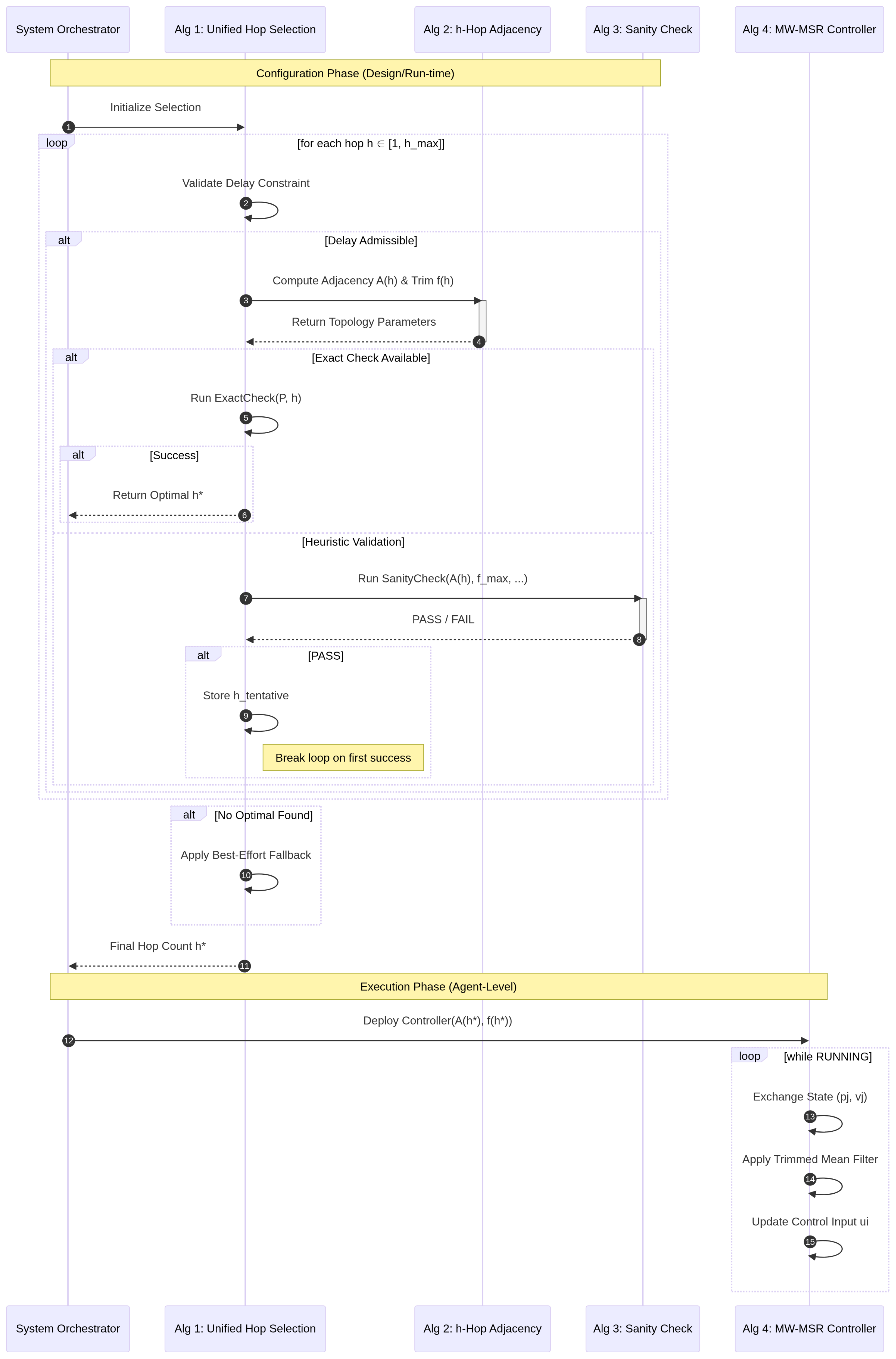
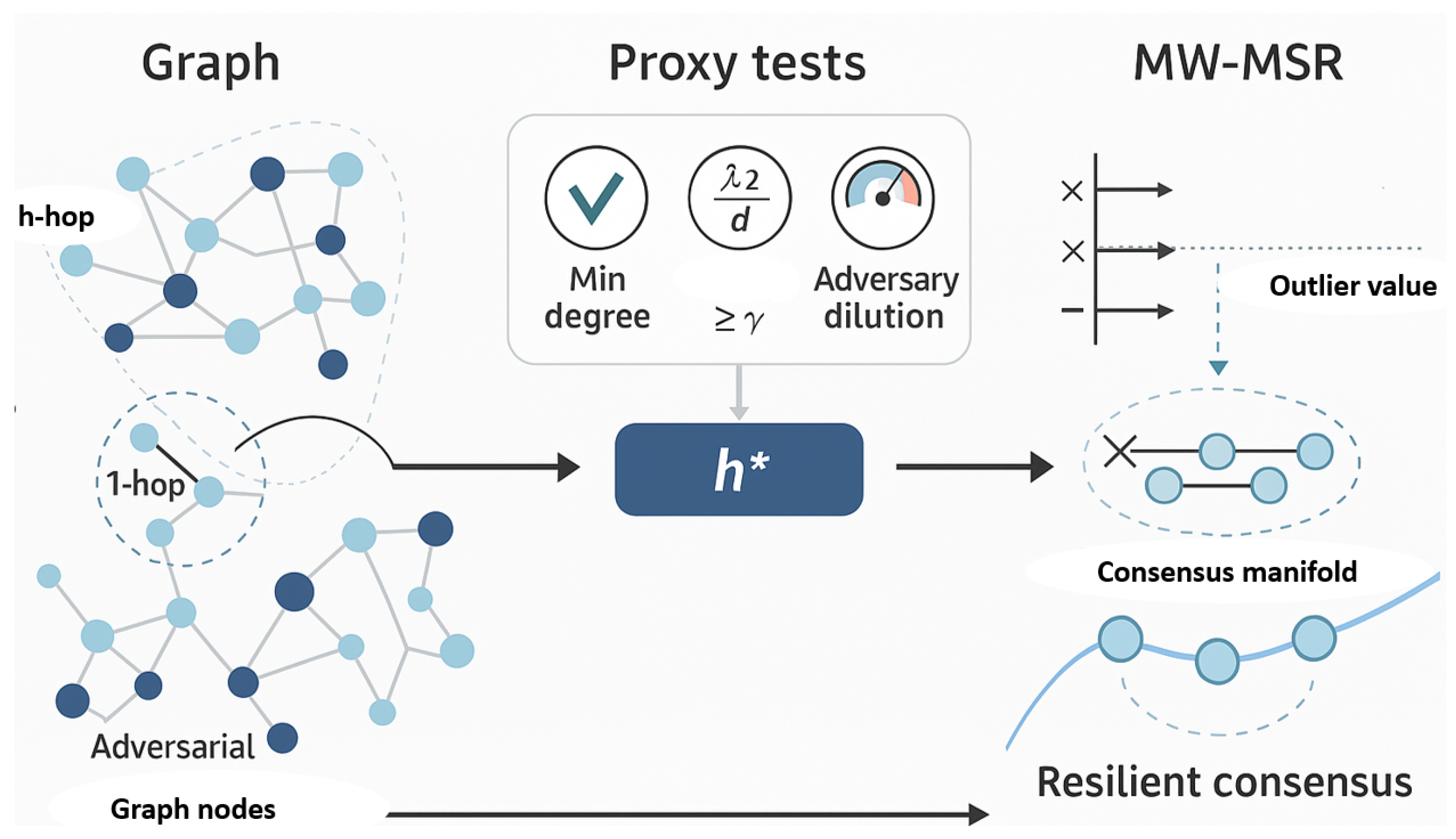
Figure 1 shows a conceptual overview of the proposed hop-selection framework.
Choosing h is central: a value that is too small means insufficient robustness, while a value that is too large means unnecessary bandwidth, latency, and attack surface. We formalize the optimal hop radius and present a hybrid selection procedure that identifies the smallest feasible using exact robustness verification (when available) combined with lightweight proxies.
6.1. Robustness Targets and
These are the smallest horizons meeting the MW-MSR robustness assumptions for synchronous and bounded-delay asynchronous models, respectively.
Relation to Adaptive/Event-Triggered Schemes
Event-triggered consensus modulates when to communicate, whereas we decide how far to communicate (multi-hop radius). These approaches are complementary and can be combined by executing event-triggered MW-MSR at the selected
, see [
28] for more details.
6.2. Existence and Monotonicity
If holds for some , then exists with , and holds for all due to the monotonicity of h—hop robustness with respect to h.
6.3. Principle of Optimality
For , robustness fails and consensus cannot be guaranteed; at , the robustness requirement holds; for , correctness does not improve, while costs strictly increase.
6.4. Hybrid Verification Strategy
Because exact -robustness checking is expensive at scale, we proceed in two tiers:
Tier-1 (exact): If an exact checker or MILP is available and certifies , set . We attempt exact certification on small graphs (e.g., ), where MILP runtimes are reasonable; for larger N, we default to proxies. The exact checker aborts on timeout, and the pipeline continues with Tier 2.
Tier-2 (proxies—a multi-criteria screening procedure): Otherwise, apply the following scalable checks:
capturing local feasibility, spectral connectivity (see
Appendix A.1.3 for more details), and adversary dilution (
denotes maximum allowed adversarial concentration). We define
, where
. The proxy
normalizes the Fiedler value by the average degree to de-emphasize scale/size and emphasize connectivity per link.
6.4.1. The Role of Each Criterion
A candidate hop radius h is accepted only if it simultaneously satisfies three independent conditions:
Local feasibility: , ensuring the trimming step remains well-posed.
Spectral connectivity: , screening out topologies that are large but poorly connected.
Adversarial dilution: ensuring that adversaries do not dominate extended neighborhoods.
6.4.2. Delay-Aware Admissibility
We restrict candidate
h to those satisfying
with
, where
denotes the estimated end-to-end delay for a path with
h hops,
denotes the average per-link delay, and
denotes the maximum allowable end-to-end delay. Hop selection is then applied on this delay-admissible set (see
Appendix A.1 and
Appendix A.1.6 for more information on complexity issues). This prevents violating the bounded delay requirement in asynchronous MW-MSR.
6.4.3. Proxy Conservatism on Small Graphs
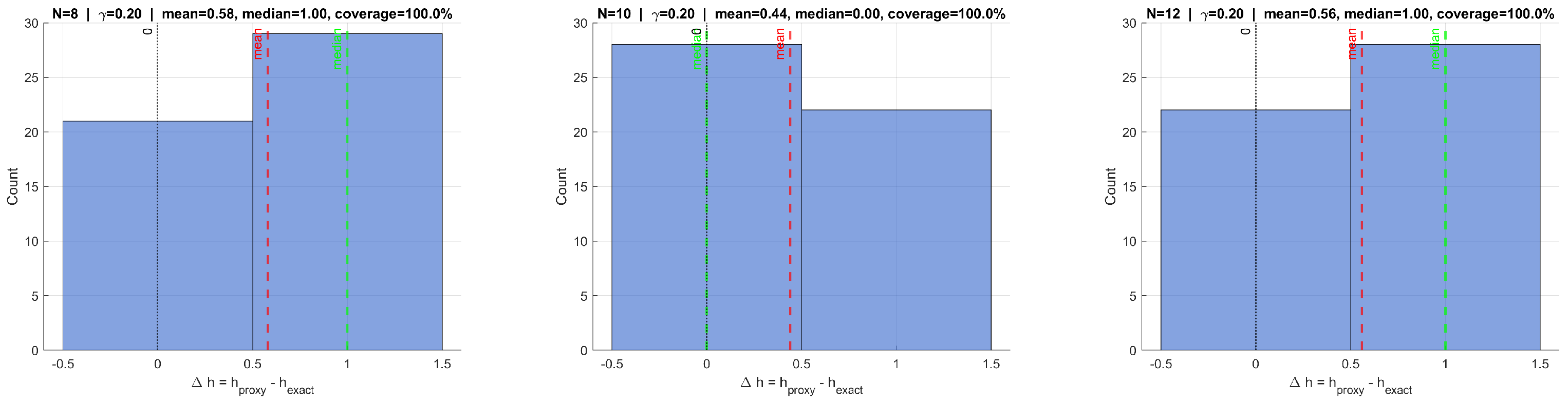
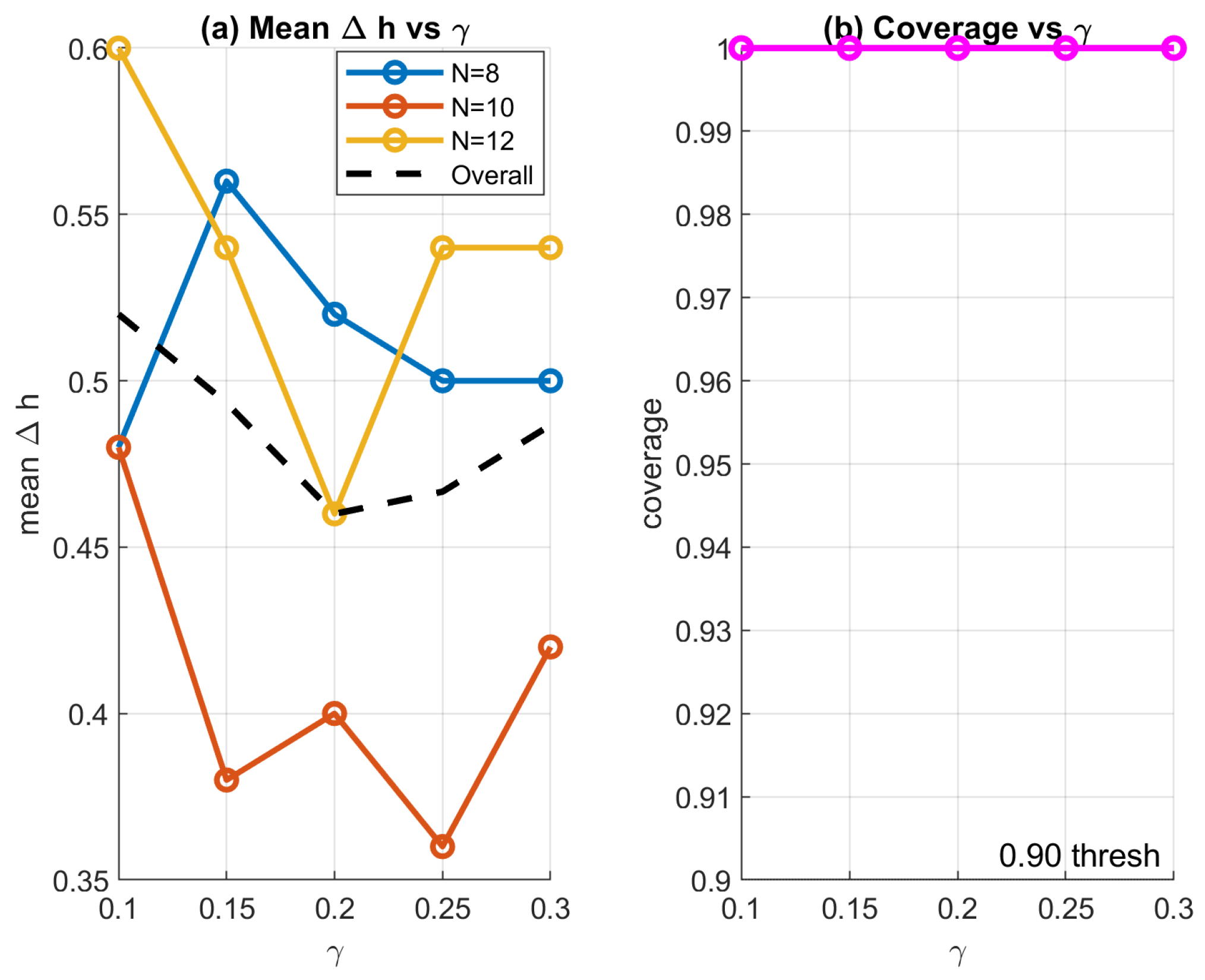
In a small-graph study (
connected graphs each), the proxy-selected radius matched the exact MILP-certified minimal radius in 52–66% of cases (median
). When it differed, the gap was one hop only (overall mean
,
). This supports using the proxy pipeline in larger networks where exact certification is intractable while acknowledging a bounded conservatism in hop count (see results in
Appendix B for more details).
6.4.4. Robustness to Topology Changes
Because and vary with reconfigurations, we recommend a safety margin on the proxy inequalities (e.g., and to tolerate sporadic link failures without re-tuning h. Under significant topology changes, hop selection should be rerun.
We employ as a screening proxy, not a necessary condition; in our datasets, higher values align with the smallest feasible .
6.4.5. Clustered Adversaries
Concentrating adversaries near low-degree cut sets may violate dilution at small h. Our proxies detect such cases; the framework can increase h (if delay is admissible) or flag infeasibility, indicating a need for structural augmentation.
6.5. Selection Procedure
Scan . If exact verification succeeds, return . Otherwise, record the smallest h that passes all proxies; if none pass, return as a best-effort choice.
6.6. Cost Model and Trade-Offs
We minimize the cost expressed in Equation (
5)
where (
) denotes weight bandwidth and scales with
, latency scales with
h, and computation scales with sorting
. We do not report measured costs; this model motivates selecting the smallest feasible
.
6.7. Practical Interpretation
: Failure(drift/partition).
: Success with optimal efficiency.
: No additional correctness benefits are attained, while bandwidth/latency grows with h.
This classification emphasizes why the smallest feasible hop radius is desirable for resilient and efficient operation.
6.8. Generalization to Directed Graphs (Digraphs)
For digraphs, we interpret (r,s)-robustness using external in-neighbors and rely on either the symmetrized Laplacian or the in-degree Laplacian as heuristic spectral proxies. Because non-symmetric Laplacians lack the same spectral guarantees, we use these proxies strictly as screening tools; exact robustness remains the authoritative certificate.
6.9. Sequence Diagram of the Proposed Framework
Figure 2 provides a sequence diagram summarizing the flow from hop selection to MW-MSR execution. The diagram follows these steps:
The HopSelector (Algorithm 1) iterates over candidate hop counts.
For each
h, it invokes the GraphBuilder (Algorithm 2) to construct the
h-hop adjacency matrix
(see
Appendix A.1.1 for complexity details), and to compute the corresponding trimming budgets
.
If the candidate hop is delay admissible, the HopSelector may optionally call an external ExactCheck component. Otherwise, it invokes the SanityChecker procedure (Algorithm 3) to evaluate feasibility, spectral connectivity, and adversarial dilution.
After first passing h (or a fallback selection), the chosen parameters are passed to the Agent instances.
Each agent then runs the MW-MSR control loop (Algorithm 4) using the chosen and .
This offers a clear visualization of how the proposed hybrid method integrates design-time and runtime components.
Figure 2.
Sequence diagram of the proposed optimal multi-hop W-MSR model.
Figure 2.
Sequence diagram of the proposed optimal multi-hop W-MSR model.
| Algorithm 1 Unified Hop Selection (design time/run-time) |
Input: A, , , target , thresholds , delay cap , link delay Output: (or Infeasible) - 1:
, - 2:
for to do - 3:
if then continue ▹ delay-admissible set - 4:
Build , (Algorithm 2) - 5:
if ExactCheckAvailable() and ExactCheck() then - 6:
return ▹ exact minimal - 7:
end if - 8:
if SanityCheck() passes then - 9:
; break ▹ first proxy-passing h - 10:
end if - 11:
end for - 12:
if then - 13:
return - 14:
end if
- 15:
- 16:
if then - 17:
return Infeasible - 18:
end if - 19:
return ▹ heuristic: strongest normalized connectivity
|
| Algorithm 2 h-Hop Adjacency and Trim-Budget Computation |
Input: Binary adjacency A (zero diagonal), hop h, Output: , ; for to h do ▹ Boolean OR of nonzeros ▹ Boolean sparse product end for Zero the diagonal of ; compute degrees for each node i do end for |
| Algorithm 3 Sanity Check at Hop h |
Input: , , ; (optional) adversary mask, Output: PASS/FAIL Compute for all i if then return FAIL end if Compute and if then return FAIL end if if adversary mask given then if then return FAIL end if end if returnPASS |
| Algorithm 4 Agent-Level MW–MSR Controller (at agent i) |
Input: , , gains while Running do Receive from all Trim top and bottom values (coordinate-wise) Compute as averages of remainder end while |
7. Algorithmic Perspective of the Optimal Multi-Hop W-MSR Framework
Algorithms 1–3 operate at design-time to select the communication horizon, whereas Algorithm 4 governs run-time MW-MSR execution.
7.1. Call Flow
The framework first executes the unified hop selection Algorithm 1. For each candidate hop h (in increasing order), it calls Algorithm 2 to construct and compute . If an exact minimal hop is known (e.g., from a pre-computed table), the algorithm returns immediately. Otherwise, it invokes Algorithm 3 to perform a sanity check on the constructed graph. The first h that passes all checks is chosen as the operating hop. If no h passes, a fallback heuristic selects the hop that maximizes the ratio among delay-admissible hops. Once the hop count is selected, the system distributes the resulting and to all agents. Each agent then runs Algorithm 4 (the MW-MSR controller) in a continuous loop using the received neighborhood and trim budget to compute its control input.
7.2. Algorithm 1—Unified Hop-Selection (Design Time/Runtime)
This algorithm determines the smallest hop count h (up to ) that yields a communication graph satisfying several constraints: delay admissibility, connectivity, and robustness against adversarial agents. It first filters hops by the delay cap ; then, for each admissible h, it constructs the h-hop graph and trims the “f-max” budgets (via Algorithm 2). If an exact minimal hop is known (e.g., from a design-time check), it returns immediately. Otherwise, it applies a sanity check (Algorithm 3) that verifies minimum degree, algebraic connectivity, and optionally an adversary ratio.
7.3. Algorithm 2—h-Hop Adjacency and Trim-Budget Computation
Given the base adjacency matrix A and a hop count h, this algorithm builds the h-hop adjacency matrix by repeated Boolean multiplication (i.e., . It then sets the diagonal to zero, computes each node’s degree , and defines the trim budget as . This budget determines how many extreme neighbors each agent will ignore during the MSR consensus step.
7.4. Algorithm 3—Sanity Check
This algorithm evaluates whether a given h-hop graph is suitable for resilient consensus. It checks that:
Every node has a degree of at least (necessary for the MSR property);
The algebraic connectivity ratio is at least a threshold (ensuring strong connectivity);
If an adversary mask is provided, the fraction of adversarial neighbors per node does not exceed .
If all conditions hold, it returns PASS.
7.5. Algorithm 4—Agent-Level MW-MSR Controller (Runtime)
Each agent runs this loop continuously. It receives positions and velocities from its
h-hop neighbors (according to the selected graph
, trims the
highest and lowest values coordinate-wise (as determined by the trim budget; see
Appendix A.1.2 from Algorithm 2), and computes the average of the remaining values. The control input
is then a proportional–derivative term that drives the agent toward the average of the trusted neighbors.
8. Experimental Results
This section evaluates the proposed hop-selection framework and multi-hop W-MSR controller on IEEE 14-, 30-, and 57-bus power-network topologies under stealthy and burst-type adversarial behavior. All experiments compare single-hop W-MSR
against multi-hop W-MSR with the selected horizon
obtained using the framework selection method proposed in
Section 6.
Table 1 shows the simulation’s parameters and assigned values.
The results highlight three main outcomes:
Selecting is essential for avoiding drift and ensuring resilient consensus.
The normalized algebraic connectivity effectively predicts the resilience threshold.
Increasing h beyond offers no additional correctness benefit and only increases communication and computational load.
All experiments use up to 10% adversarial nodes, chosen uniformly at random unless otherwise noted. However, to experimentally validate our proposition of minimal hop resilience, we conduct
h-sweep across 30 randomized adversarial configurations (see results and discussion in
Section 8.7).
8.1. Disagreement Norm Under Adversaries
Let
be the scalar state variable used for disagreement/SSE.
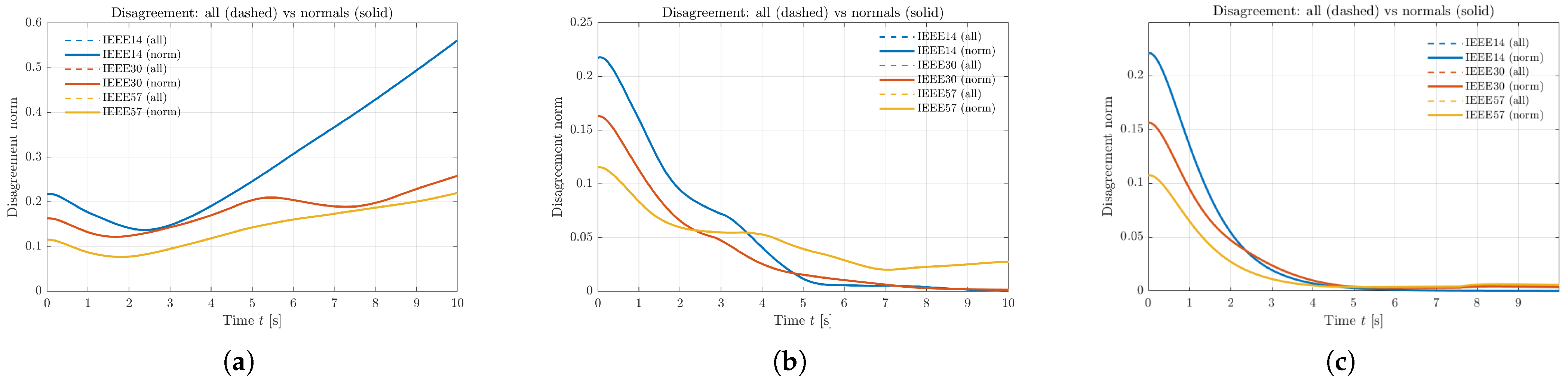
Figure 3 compares the disagreement norm
between normal nodes under two cases—single-hop W-MSR and multi-hop W-MSR—using the selected horizon
.
Key Observations
This validates that restores sufficient robustness where single-hop communication is inadequate.
Figure 3.
Disagreement norm over time for the IEEE-14, IEEE-30, and IEEE-57 networks. Single-hop and two-hop configurations exhibit persistent disagreement in sparse graphs, whereas the selected hop radius suppresses adversarial influence across all networks. In (a), single-hop W-MSR () fails to suppress adversarial drift, resulting in persistent disagreement. In (b), two-hop W-MSR () shows improved consensus compared with the single-hop case but remains insufficient in sparse topologies. In (c), multi-hop W-MSR with the selected hop radius achieves resilient consensus, with disagreement converging to zero for normal agents. In these cases, disagreement over all nodes and over normal nodes is identical, causing dashed and solid curves to overlap.
Figure 3.
Disagreement norm over time for the IEEE-14, IEEE-30, and IEEE-57 networks. Single-hop and two-hop configurations exhibit persistent disagreement in sparse graphs, whereas the selected hop radius suppresses adversarial influence across all networks. In (a), single-hop W-MSR () fails to suppress adversarial drift, resulting in persistent disagreement. In (b), two-hop W-MSR () shows improved consensus compared with the single-hop case but remains insufficient in sparse topologies. In (c), multi-hop W-MSR with the selected hop radius achieves resilient consensus, with disagreement converging to zero for normal agents. In these cases, disagreement over all nodes and over normal nodes is identical, causing dashed and solid curves to overlap.
8.2. Final-State Spread (SSE) and Effect of Connectivity
We define SSE as the steady-state variance of about the normal agents’ mean, computed over a late time window of length . Final convergence accuracy is measured using the steady-state error (SSE): error using all nodes (SSE-all) and error using only normal nodes (SSE-normal).
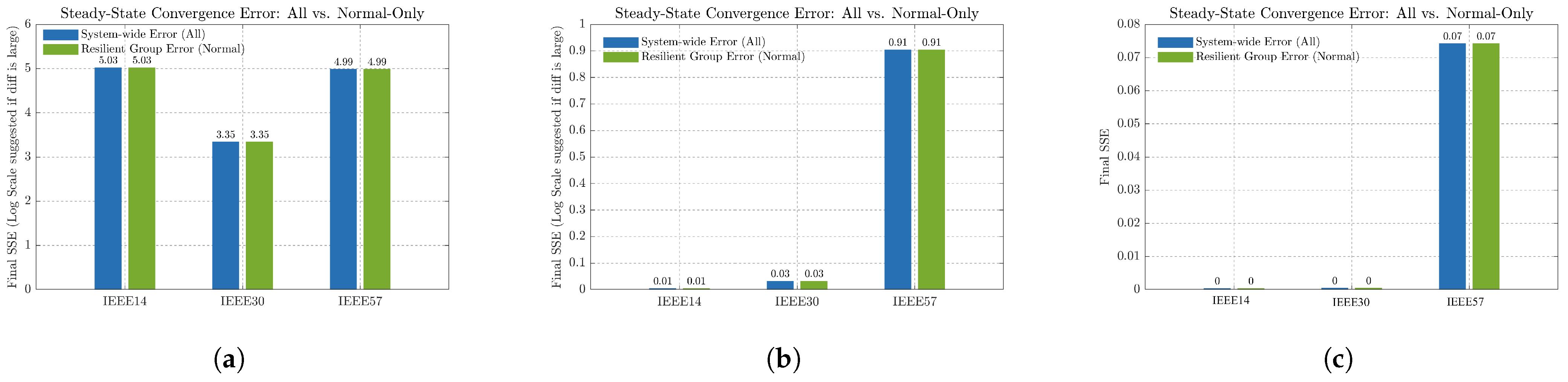
Figure 4 illustrates how the hop radius affects SSE.
Key Findings
Overall, provides the required “global visibility” that defeats influence concentration by adversaries.
In IEEE-57, moving from to suppresses SSE by over an order of magnitude, indicating that adversarial bias cannot polarize the network under MW-MSR at the selected horizon.
Figure 4.
Final steady-state error (SSE) for all agents (“SSE-all”) and normal agents only (“SSE-normal”) under different hop radii. Across all subfigures, SSE-all nearly matches SSE-normal once the robustness threshold is reached, indicating effective suppression of adversarial influence. (a) At , adversaries dominate sparsely connected neighborhoods, resulting in large SSE values (e.g., for IEEE-57). (b) At , adversaries’ effect diminishes compared with (e.g., for IEEE-30). (c) At the selected hop radius , SSE is significantly reduced (e.g., for IEEE-57).
Figure 4.
Final steady-state error (SSE) for all agents (“SSE-all”) and normal agents only (“SSE-normal”) under different hop radii. Across all subfigures, SSE-all nearly matches SSE-normal once the robustness threshold is reached, indicating effective suppression of adversarial influence. (a) At , adversaries dominate sparsely connected neighborhoods, resulting in large SSE values (e.g., for IEEE-57). (b) At , adversaries’ effect diminishes compared with (e.g., for IEEE-30). (c) At the selected hop radius , SSE is significantly reduced (e.g., for IEEE-57).
8.3. Control-Energy Profile
Control efficiency is examined using the instantaneous control energy
.
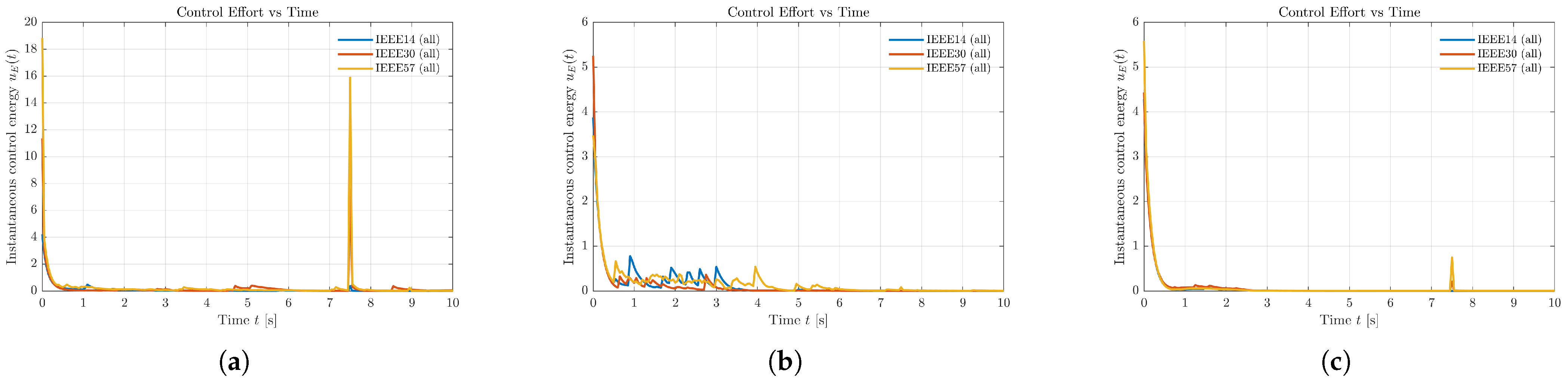
Figure 5 illustrates that at
(
Figure 5a), the system experiences drift and elevated energy but without pronounced oscillatory bursts. While at
(
Figure 5b), the control energy exhibits intermittent bursts due to incomplete adversarial suppression, particularly in the IEEE-57 case. With optimal multi-hop (
Figure 5c), control energy rapidly decays to zero once consensus is reached, indicating efficient and stable convergence.
This distinction offers a practical diagnostic: if both disagreement and control energy remain persistently nonzero, the chosen hop radius is insufficient.
Figure 5.
In single-hop runs, we observe intermittent spikes in in several trials, especially for larger graphs; at , energy decays rapidly post-consensus. (a) Under single-hop W-MSR, adversarial disturbances lead to repeated spikes in control effort, with larger networks showing more pronounced bursts. (b) Under two-hop W-MSR, the control energy exhibits better but not optimal behavior due to the inability to eliminate the adversary’s influence. (c) At the selected hop radius , control energy rapidly decays as consensus is established, demonstrating efficient and stable convergence.
Figure 5.
In single-hop runs, we observe intermittent spikes in in several trials, especially for larger graphs; at , energy decays rapidly post-consensus. (a) Under single-hop W-MSR, adversarial disturbances lead to repeated spikes in control effort, with larger networks showing more pronounced bursts. (b) Under two-hop W-MSR, the control energy exhibits better but not optimal behavior due to the inability to eliminate the adversary’s influence. (c) At the selected hop radius , control energy rapidly decays as consensus is established, demonstrating efficient and stable convergence.
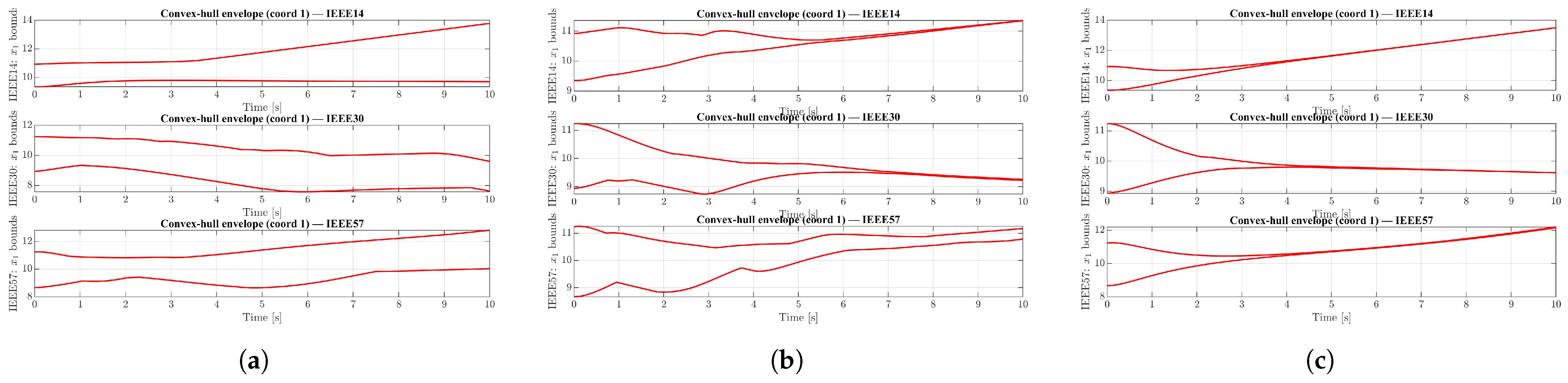
8.4. Convex-Hull Evolution
The "convex-hull envelope" is the minimal interval containing
; its growth indicates loss of containment.
Figure 6 examines the evolution of the convex hull of the normal agents’ states.
Observations
For
(
Figure 6a), the convex-hull envelope expands over time, reflecting instability and adversarial influence.
For
(
Figure 6b), the convex hull for the IEEE-57 network remains unable to marginalize the adversarial behavior.
At
(
Figure 6c), hull expansion becomes much flatter and tightly bounded, even for the IEEE-57 graph, demonstrating robust containment of adversarial drift.
This agrees with the MW-MSR safety property that normal states remain within the convex hull of initial normal values when the robustness condition is satisfied.
Figure 6.
Convex hull of (scalar state) for normal agents; upper and lower bounds of position () versus time. (a) For , the convex-hull envelope grows over time, reflecting the inability of single-hop filtering to contain adversarial drift. (b) At , the hull remains unbounded for sparse networks such as IEEE-57, a sign of inability to contain the adversarial effect. (c) At the selected hop radius , the hull remains tightly bounded across all networks, demonstrating robust containment of adversarial influence. In case where the upper and lower bounds evolve symmetrically or become nearly constant, the corresponding curves ovelap visually, indicating successful convex-hull stabilization rather than loss of information.
Figure 6.
Convex hull of (scalar state) for normal agents; upper and lower bounds of position () versus time. (a) For , the convex-hull envelope grows over time, reflecting the inability of single-hop filtering to contain adversarial drift. (b) At , the hull remains unbounded for sparse networks such as IEEE-57, a sign of inability to contain the adversarial effect. (c) At the selected hop radius , the hull remains tightly bounded across all networks, demonstrating robust containment of adversarial influence. In case where the upper and lower bounds evolve symmetrically or become nearly constant, the corresponding curves ovelap visually, indicating successful convex-hull stabilization rather than loss of information.
8.5. Scalability and Behavior Across IEEE Graphs
The proposed hop-selection method successfully adapts to the structural differences between IEEE-14, IEEE-30, and IEEE-57:
Dense subgraphs (e.g., IEEE-14) require smaller horizons.
Sparse or large-diameter networks (e.g., IEEE-57) require larger horizons to achieve adequate robustness.
Across all cases, the method identifies an that prevents failure modes at insufficient hop counts while avoiding unnecessary overhead at larger values.
For IEEE-57, the selection reorganizes the sparse graph into a sufficiently connected multi-hop structure to support consensus.
This demonstrates that the proposed framework scales naturally to larger and more challenging networks.
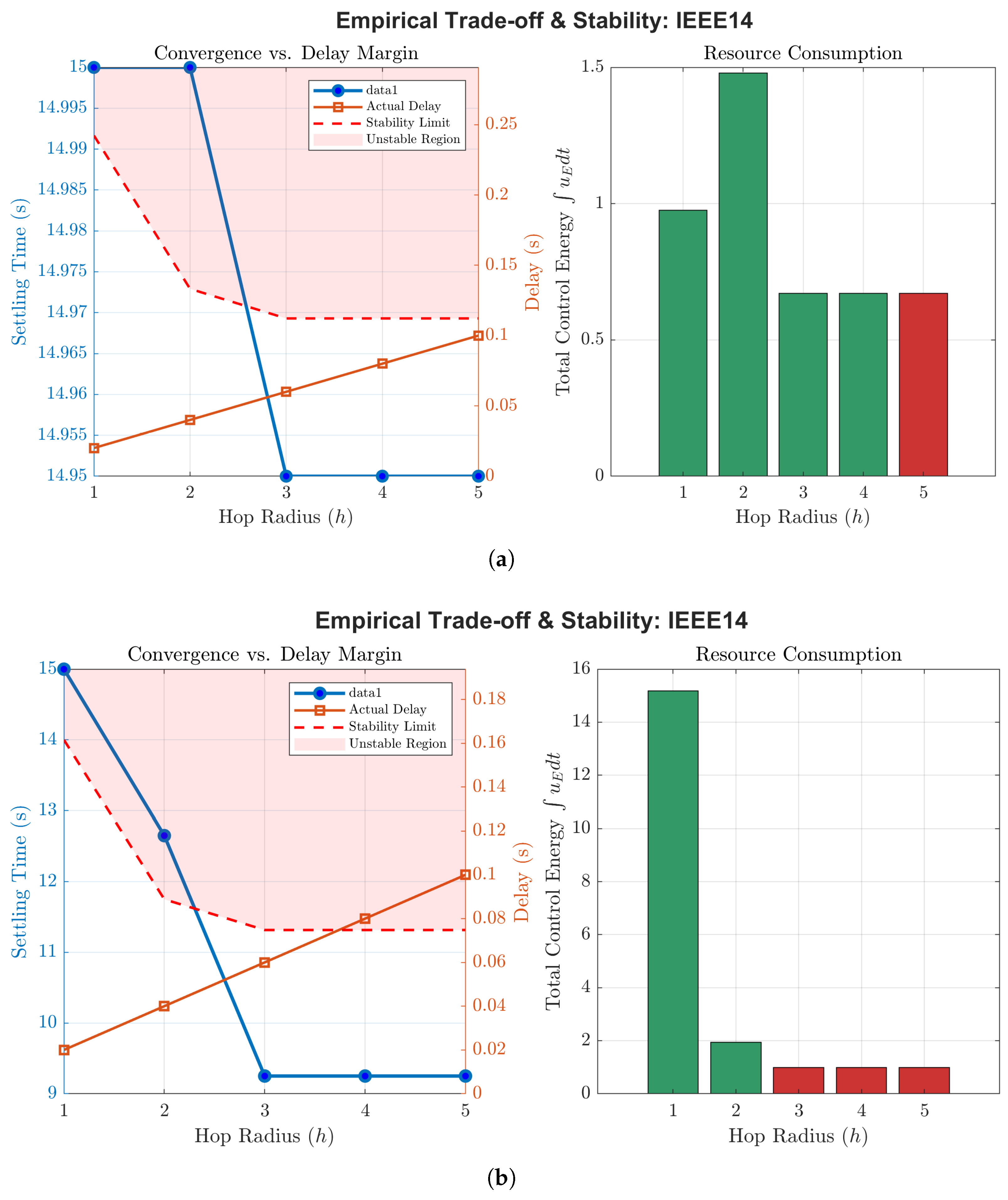
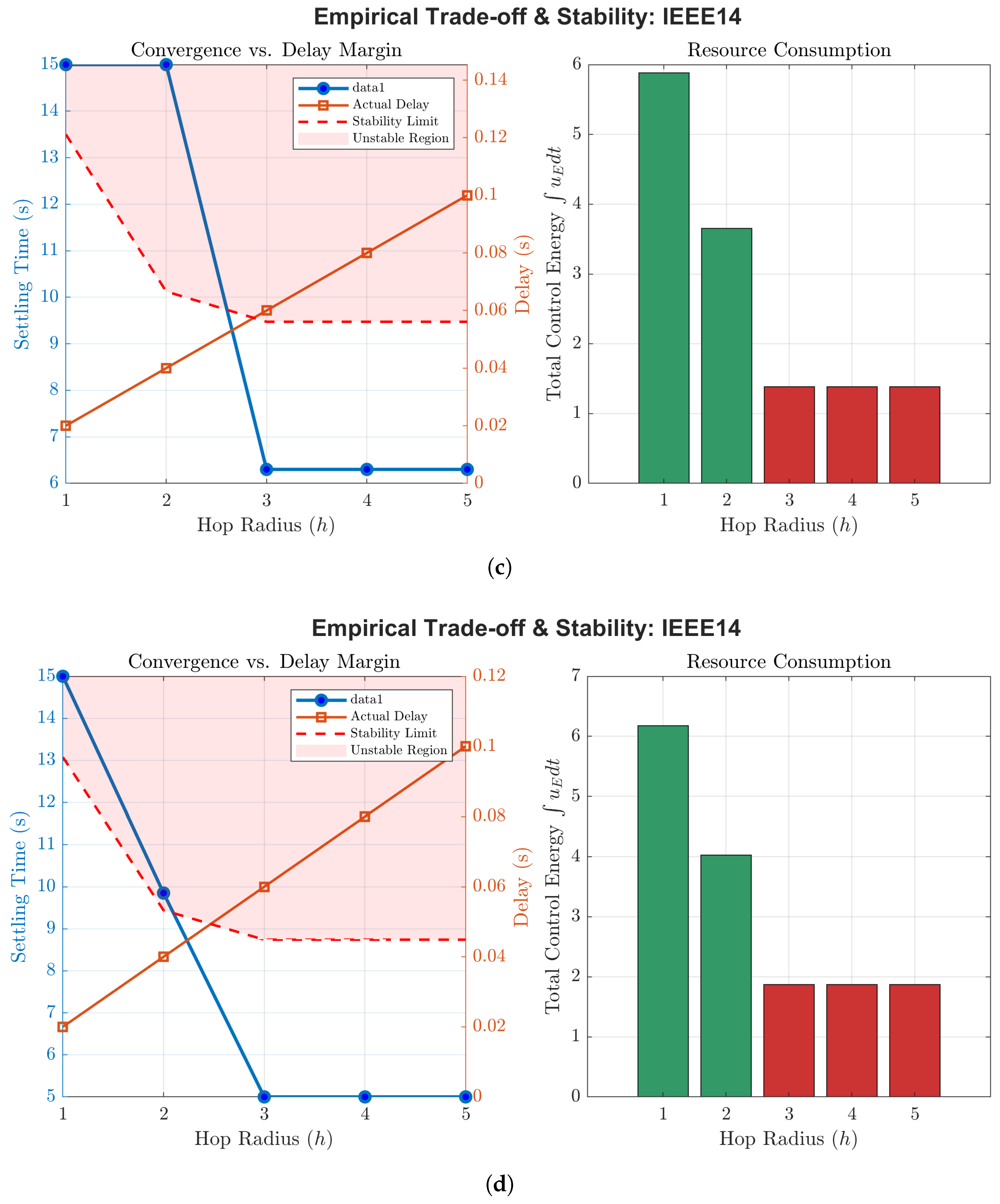
8.6. Stability Boundary and Convergence Plateau
Next, we integrate a calculation of the graph’s spectral radius for each
h. In a consensus system with feedback gain
, the maximum allowable delay
before the system becomes unstable is governed by the largest eigenvalue of the Laplacian matrix:
Therefore, for a system with a maximum eigenvalue and a total communication delay , the system remains stable only if . In addition, as we increase h, the node degrees increase, causing to grow, which in turn causes the stability margin to shrink.
Interpreting the Stability Boundary as Shown in
Figure 7a–d
The safe zone: As long as the “actual delay” (blue squares) is well below the “stability kimit” (red dashed line), the system is robust.
The crossing point: The h value where the blue line approaches or crosses the red line is the critical hop radius. Beyond this point, the effect of high connectivity is compromised by the effect of the delay.
Energy warning: In the right plot, bars will turn red if the delay at that h is within 20% of the theoretical limit. This explains why we might observe massive energy spikes. It simply means that the controller is fighting oscillations caused by the lag.
Figure 7.
Stability–performance–resilience trade-off through sweeping alongside h. (Left) Settling time and communication delay versus hop radius h, with the shaded region indicating violation of the stability limit. (Right) Total control energy versus hop radius. Green bars correspond to configurations operating within the stability margin, while the red bar indicates operation near saturation of the delay-stability constraint, where increasing h yields no further convergence benefit. (a) For , the optimal is . It is slow but ultra-robust. (b) For , the optimal shifts to . This achieves fast convergence while maintaining a stable margin. (c,d) For , the optimal is forced to . The restriction to a smaller “neighborhood” is attributed to the high gain, which makes the system too sensitive to multi-hop lag.
Figure 7.
Stability–performance–resilience trade-off through sweeping alongside h. (Left) Settling time and communication delay versus hop radius h, with the shaded region indicating violation of the stability limit. (Right) Total control energy versus hop radius. Green bars correspond to configurations operating within the stability margin, while the red bar indicates operation near saturation of the delay-stability constraint, where increasing h yields no further convergence benefit. (a) For , the optimal is . It is slow but ultra-robust. (b) For , the optimal shifts to . This achieves fast convergence while maintaining a stable margin. (c,d) For , the optimal is forced to . The restriction to a smaller “neighborhood” is attributed to the high gain, which makes the system too sensitive to multi-hop lag.
The performance of the resilient consensus protocol on the IEEE-14 bus system is evaluated across a range of hop radii () and control gains (). The results demonstrate a clear trade-off between topological connectivity, control aggression, and system stability.
- 1.
Stability Margin Migration
The empirical data confirms that the stability limit (the maximum allowable communication delay) is inversely proportional to the control gain . As increases from 1.0 to 2.5, the theoretical delay margin for the configuration drops from a safe 1.86 s to an unstable 0.74 s. This migration of the stability boundary illustrates that high-gain controllers are significantly more sensitive to the cumulative latency introduced by multi-hop broadcasting. Consequently, an “aggressive” controller restricts the network’s ability to utilize higher-order connectivity.
- 2.
The “Desirable Shift” in Optimal Topology
A key finding is the shift in the optimal hop radius (). Low Gain (): The system is ultra-stable, allowing it to safely operate at . While the local convergence is slower, the network benefits from maximum topological resilience against localized adversarial clusters. Medium Gain (): This configuration maintains a positive stability margin. For (): The stability constraint forces the network to retreat to . Any attempt to use results in the “stability cliff,” where the actual communication delay exceeds the theoretical margin, leading to the red-shaded “unstable regions” observed in the plots.
- 3.
Energy Efficiency and Transient Quality
The bar charts for resource consumption reveal that operating near the stability boundary carries a heavy energy penalty. As the actual delay approaches within 20% of the stability limit (indicated by red bars), the total control energy increases. This is attributed to high-frequency oscillations as the control signal fights the phase lag caused by multi-hop information aging.
- 4.
Convergence rate vs. h
In linear consensus, convergence relates to the spectral gap of the effective update operator. Larger
h can increase connectivity and the gap, speeding convergence, yet increased path length and delay may slow transient response. Our intermediate
h-sweep shown in
Figure 7 empirically asserts this trade-off.
- 5.
Concluding Technical Insight
The study concludes that resilience is a co-optimization problem. To effectively neutralize sophisticated adversaries in a large-scale power grid, one cannot simply increase h indefinitely. Instead, a coordinated reduction in is required to provide the necessary stability for multi-hop communication. This allows for a wider topological view—and thus better filtering of malicious data—without sacrificing the physical integrity of the feedback loop.
8.7. Randomized Adversarial Configuration and Minimal-Hop Hypothesis Verification
Increasing the hop radius h expands the h-hop graph and typically increases the normalized algebraic connectivity . However, this increase is monotonic only until the h-hop graph becomes sufficiently connected. Beyond a problem-dependent saturation point (e.g., for IEEE-14 and for IEEE-57), stops increasing because additional hops no longer add meaningful new connectivity. As a result, metrics that depend on structural robustness (such as SSE) continue to show strong correlation with , while metrics dominated by delay and graph diameter (such as settling time) exhibit weak or no correlation once the spectral quantity saturates. This explains why SSE strongly tracks the proxy across all networks, whereas settling time plateaus in sparse graphs like IEEE-57.
Importantly, the hop radius h is used here as a structural control parameter to generate families of effective communication graphs, not as an explanatory variable itself. All correlation claims with respect to are based on explicit spectral analysis, while performance trends versus h are reported for interpretability and design insight.
For relatively dense or low-diameter networks such as IEEE-14 and IEEE-30, the increase in connectivity from one-hop to two-hop neighborhoods is already sufficient to satisfy the robustness requirement of MW-MSR. Consequently, the marginal improvement from to the optimal radius is naturally small. This does not weaken the framework; it is actually an indicator that the graph saturates robustness early. In contrast, sparse or high-diameter graphs such as IEEE-57 exhibit a pronounced performance gap between , , and , which is exactly where the hop-selection framework becomes critical. Thus, the small difference between and in dense graphs is an expected structural property, not a limitation of the method.
Section 8.8 and
Section 8.9 address the Monte Carlo analysis for two different topologies that differ topologically, i.e., small and dense, and large and sparse, respectively.
8.8. Monte Carlo Analysis on IEEE-14
To evaluate the robustness of MW-MSR on dense, small networks under control gain sweeps, we conduct a Monte Carlo analysis on the IEEE-14 topology using , and a communication delay of 0.1 s.
Across all controller gains , the IEEE-14 topology consistently exhibits a robustness threshold at , beyond which all performance metrics stabilize and improve dramatically. For every value, SSE collapses by one to two orders of magnitude once , confirming that the network becomes structurally robust to adversarial influence with only modest hop expansion. As increases, settling time decreases monotonically and early-time disagreement is suppressed more quickly, while control energy stabilizes once robustness is satisfied. The nearly identical SSE, energy, and settling-time values for across all confirm that IEEE-14 is a well-connected, low-diameter network whose resilience is achieved with minimal multi-hop expansion. These results collectively demonstrate that (i) influences transient speed, (ii) h determines the onset of robustness, and (iii) once the robustness threshold is reached, the IEEE-14 system achieves fast and stable consensus irrespective of further hop increases.
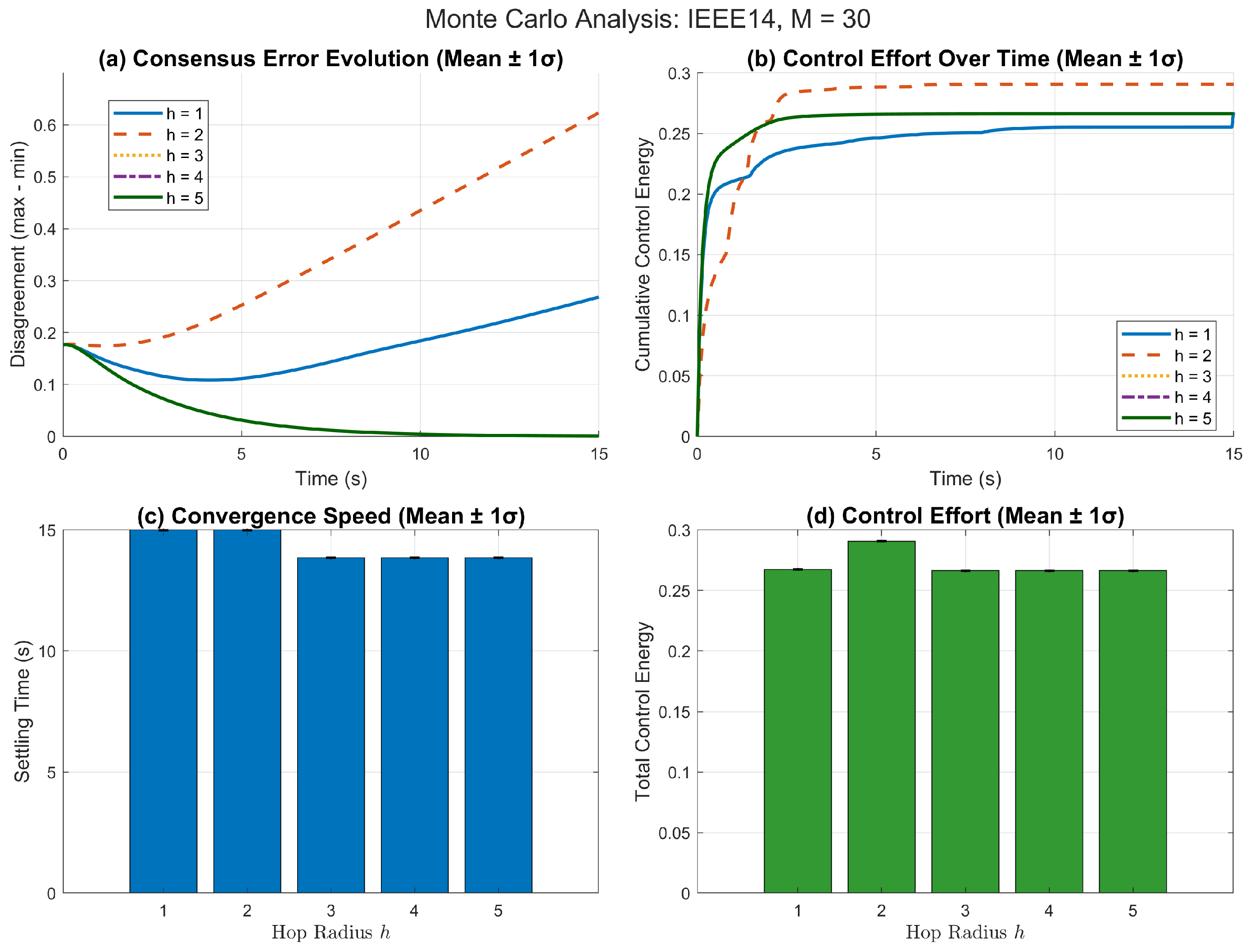
8.8.1. Monte Carlo Analysis on IEEE-14 at
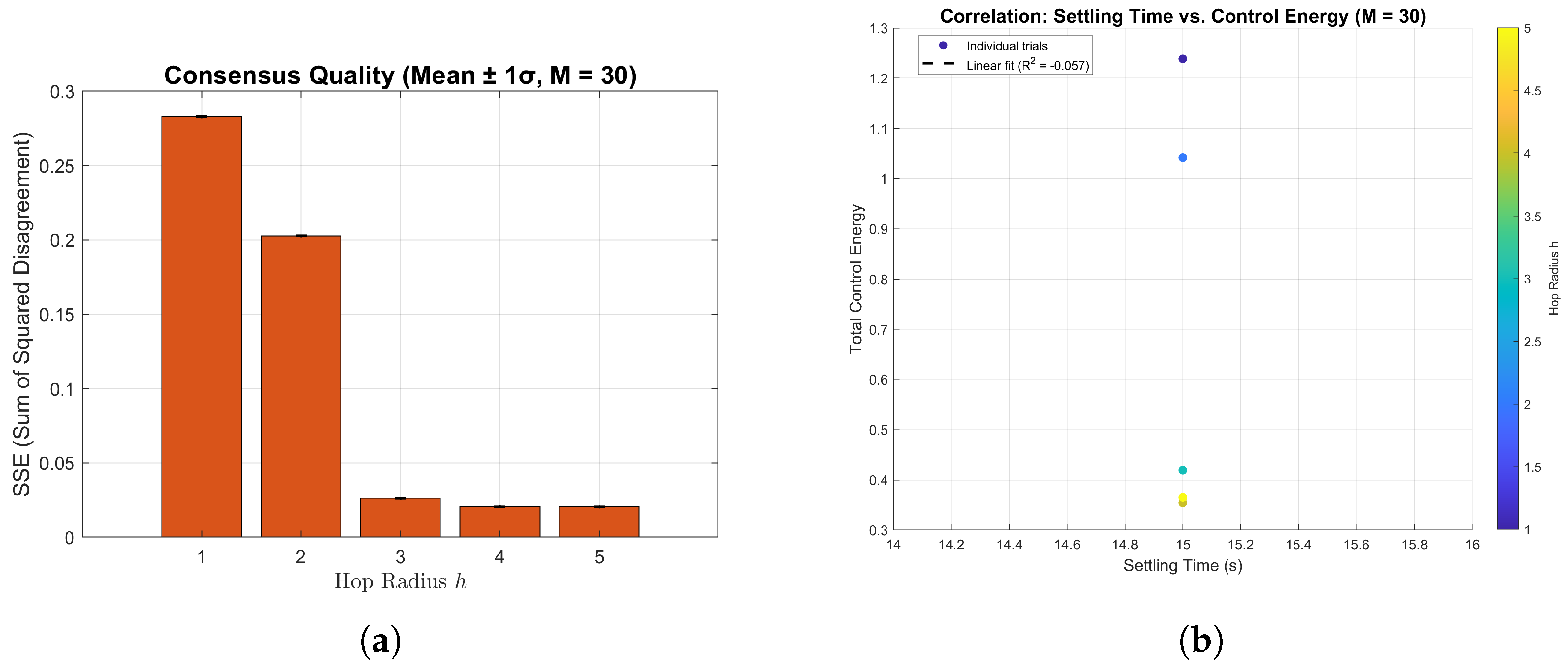
Figure 8a–d summarizes the mean trajectories and
envelopes for key performance metrics, while
Figure 9a,b reports the corresponding SSE distributions and settling time.
For , the IEEE-14 system demonstrates early robustness saturation once the hop radius reaches . Settling time remains fixed at 15 s for and , but drops to approximately 13.85 s for all , with negligible variance across Monte Carlo trials. The total control energy decreases slightly from 0.267 to about 0.266 for , indicating a mild improvement in stability and reduction of adversarial influence. The most significant change appears in the SSE metric: SSE increases from 0.4496 at to 2.21 at but then collapses by two orders of magnitude to roughly 0.0539 once . These results reflect the inherently dense structure of IEEE-14, which achieves robust multi-hop filtering at low hop radii.
Figure 8.
Monte Carlo analysis (M = 30) for IEEE-14 bus system at . Time-series plots show mean trajectories; standard deviations are computed across randomized adversarial configurations and collapse onto the mean when variance is negligible. (a) Disagreement (max–min) over time. (b) Cumulative control energy over time. (c) Settling time over hop radius. (d) Total control energy over hop radius. For this dense network, the trajectories corresponding to larger hop radii () overlap almost exactly in (a,b), reflecting early robustness saturation; consequently, these curves are visually indistinguishable.
Figure 8.
Monte Carlo analysis (M = 30) for IEEE-14 bus system at . Time-series plots show mean trajectories; standard deviations are computed across randomized adversarial configurations and collapse onto the mean when variance is negligible. (a) Disagreement (max–min) over time. (b) Cumulative control energy over time. (c) Settling time over hop radius. (d) Total control energy over hop radius. For this dense network, the trajectories corresponding to larger hop radii () overlap almost exactly in (a,b), reflecting early robustness saturation; consequently, these curves are visually indistinguishable.
Figure 9.
Consensus quality and correlation. (a) SSE vs. hop radius: , and . (b) Total control energy vs. settling time.
Figure 9.
Consensus quality and correlation. (a) SSE vs. hop radius: , and . (b) Total control energy vs. settling time.
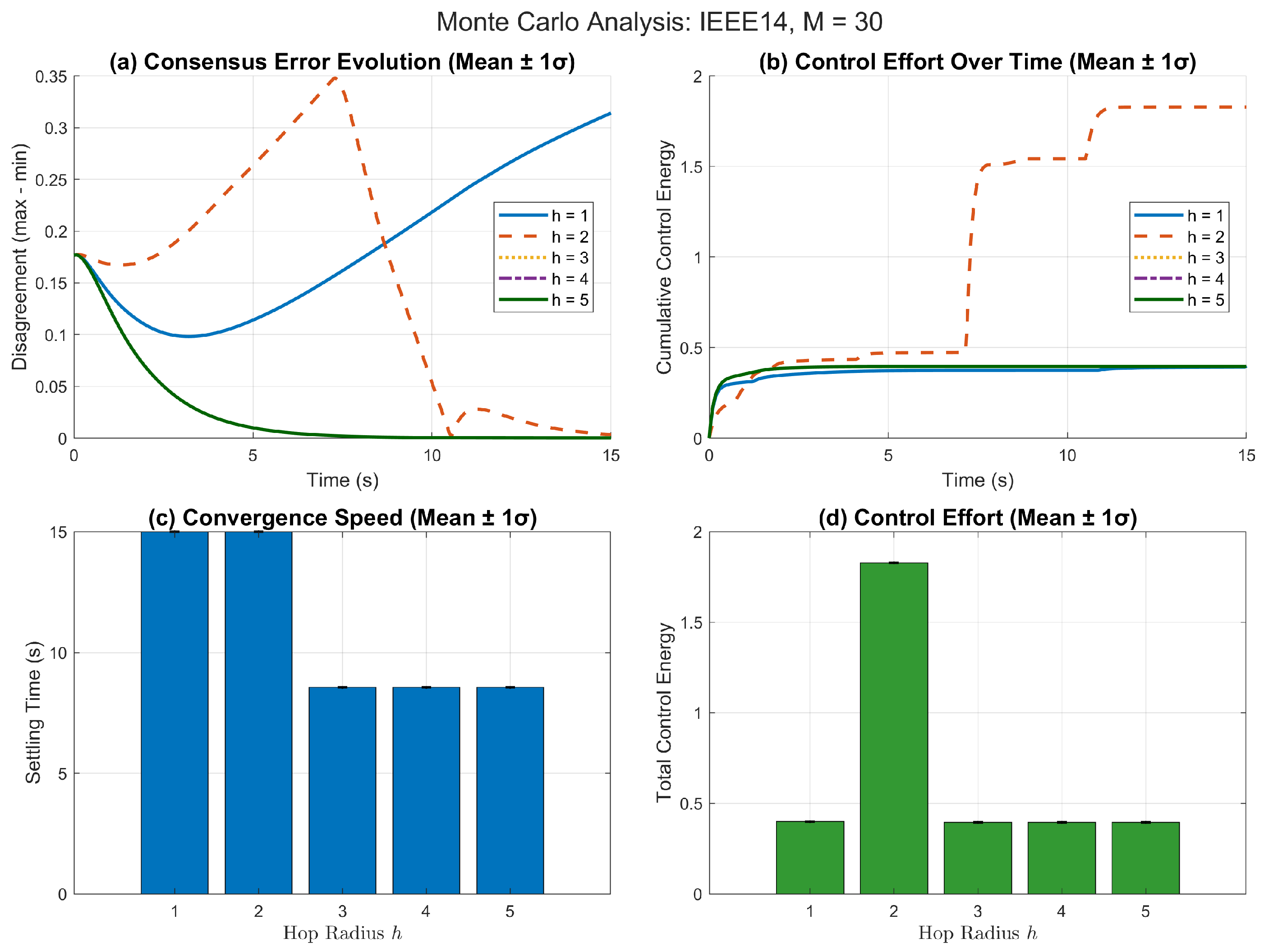
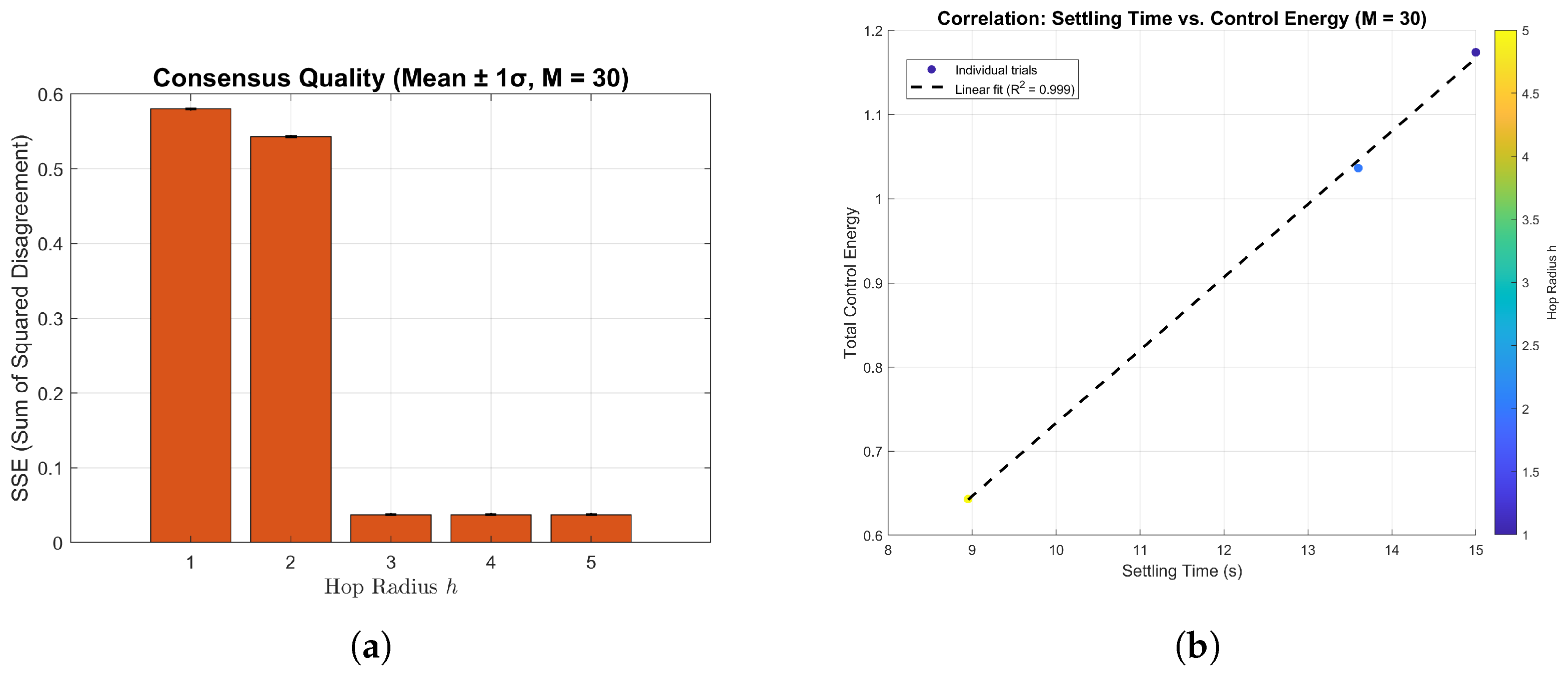
8.8.2. Monte Carlo Analysis on IEEE-14 at
Figure 10a–d summarizes the mean trajectories and
envelopes for key performance metrics, while
Figure 11a,b reports the corresponding SSE distributions and settling time.
For , the results validate the strong stabilizing role of moderate control aggression in the IEEE-14 network. Settling time again drops abruptly from 15 s at and to approximately 8.55 s for , showing improved convergence speed compared to . The control energy shows a distinct non-monotonic pattern: while energy is close to 0.399 for , it increases at due to the additional multi-hop delay but then stabilizes to approximately 0.394 for . Most notably, SSE improves dramatically: it declines from 0.580 at to 0.543 at , and then collapses to 0.0376 for . This strong SSE improvement highlights that provides sufficient aggressiveness for early-time error rejection once the hop radius reaches the robustness threshold.
Figure 10.
Monte Carlo analysis (M = 30) for IEEE-14 bus system at . Time-series plots show mean trajectories; standard deviations are computed across randomized adversarial configurations and collapse onto the mean when variance is negligible. (a) Disagreement (max–min) over time. (b) Cumulative control energy over time. (c) Settling time over hop radius. (d) Total control energy over hop radius. For this dense network, the trajectories corresponding to larger hop radii () overlap almost exactly in (a,b), reflecting early robustness saturation; consequently, these curves are visually indistinguishable.
Figure 10.
Monte Carlo analysis (M = 30) for IEEE-14 bus system at . Time-series plots show mean trajectories; standard deviations are computed across randomized adversarial configurations and collapse onto the mean when variance is negligible. (a) Disagreement (max–min) over time. (b) Cumulative control energy over time. (c) Settling time over hop radius. (d) Total control energy over hop radius. For this dense network, the trajectories corresponding to larger hop radii () overlap almost exactly in (a,b), reflecting early robustness saturation; consequently, these curves are visually indistinguishable.
Figure 11.
Consensus quality and correlation. (a) SSE vs. hop radius: , and . (b) Total control energy vs. settling time.
Figure 11.
Consensus quality and correlation. (a) SSE vs. hop radius: , and . (b) Total control energy vs. settling time.
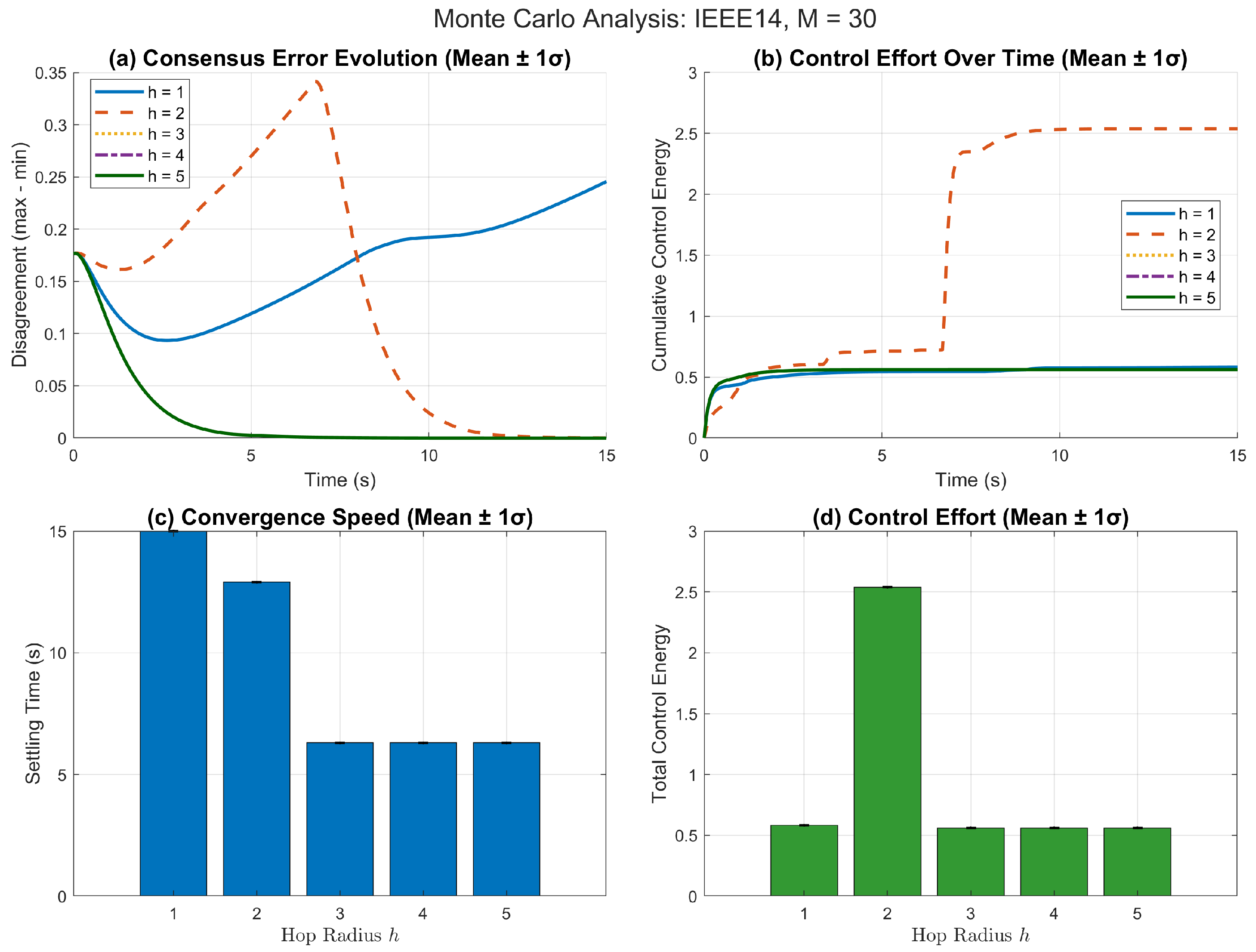
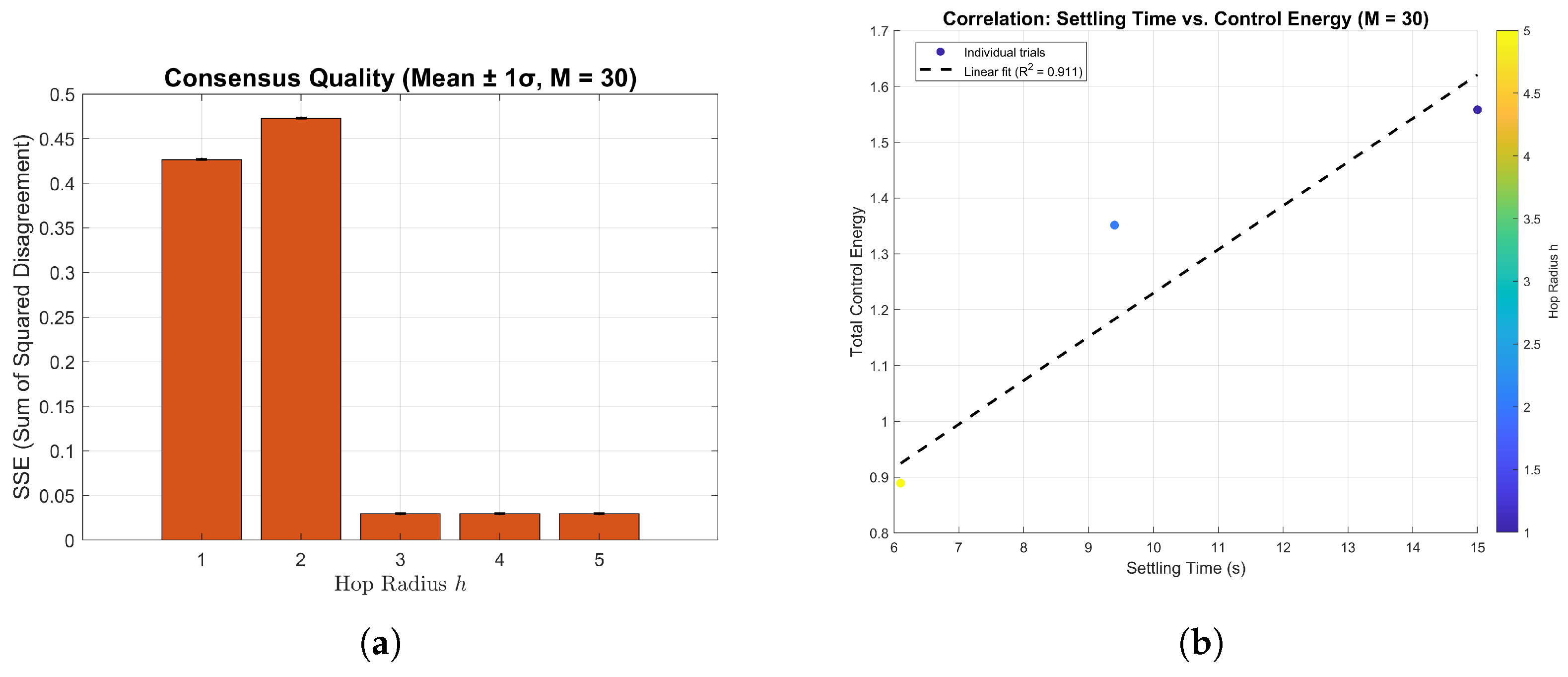
8.8.3. Monte Carlo Analysis on IEEE-14 at
Figure 12a–d summarizes the mean trajectories and
envelopes for key performance metrics, while
Figure 13a,b reports the corresponding SSE distributions and settling time.
For , the IEEE-14 system demonstrates even faster convergence and stronger adversarial suppression. Settling time decreases from 15 s for to 12.9 s for , and then falls sharply to approximately 6.3 s for . Control energy exhibits an expected increase at (0.5828) but stabilizes to roughly 0.561 for higher hop radii, demonstrating that robust multi-hop filtering allows the controller to apply smoother and more efficient corrections. The SSE metric shows excellent performance: it drops from 0.4268 at to 0.4729 at , and then stabilizes around a very low value of 0.0295 for . This indicates near-perfect resilience once robustness conditions are satisfied, with offering a faster and cleaner transient compared to = 1 and 1.5.
Figure 12.
Monte Carlo analysis (M = 30) for IEEE-14 bus system at . Time-series plots show mean trajectories; standard deviations are computed across randomized adversarial configurations and collapse onto the mean when variance is negligible. (a) Disagreement (max–min) over time. (b) Cumulative control energy over time. (c) Settling time over hop radius. (d) Total control energy over hop radius. For this dense network, the trajectories corresponding to larger hop radii () overlap almost exactly in (a,b), reflecting early robustness saturation; consequently, these curves are visually indistinguishable.
Figure 12.
Monte Carlo analysis (M = 30) for IEEE-14 bus system at . Time-series plots show mean trajectories; standard deviations are computed across randomized adversarial configurations and collapse onto the mean when variance is negligible. (a) Disagreement (max–min) over time. (b) Cumulative control energy over time. (c) Settling time over hop radius. (d) Total control energy over hop radius. For this dense network, the trajectories corresponding to larger hop radii () overlap almost exactly in (a,b), reflecting early robustness saturation; consequently, these curves are visually indistinguishable.
Figure 13.
Consensus quality and correlation. (a) SSE vs. hop radius: , and . (b) Total control energy vs. settling time.
Figure 13.
Consensus quality and correlation. (a) SSE vs. hop radius: , and . (b) Total control energy vs. settling time.
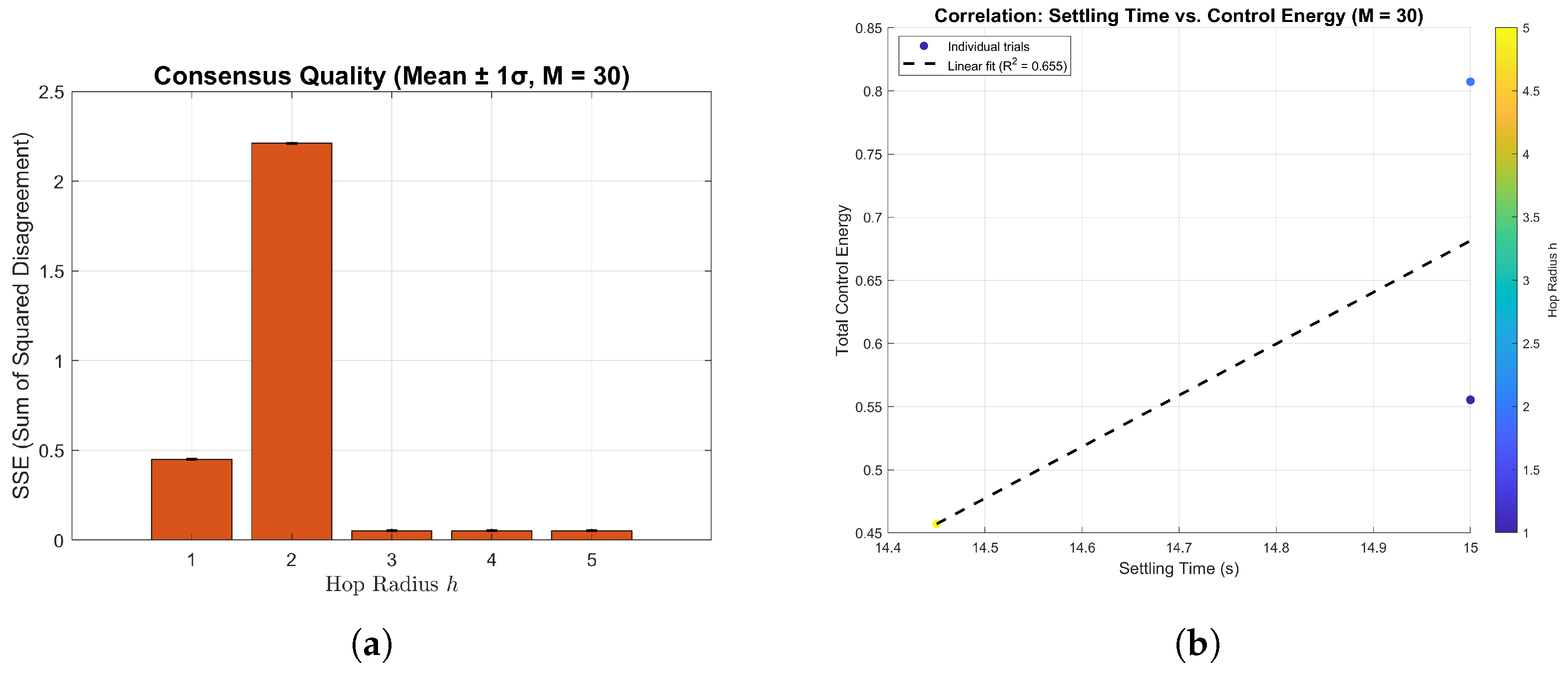
8.8.4. Monte Carlo Analysis on IEEE-14 at
Figure 14a–d summarizes the mean trajectories and
envelopes for key performance metrics, while
Figure 15a,b reports the corresponding SSE distributions and settling time.
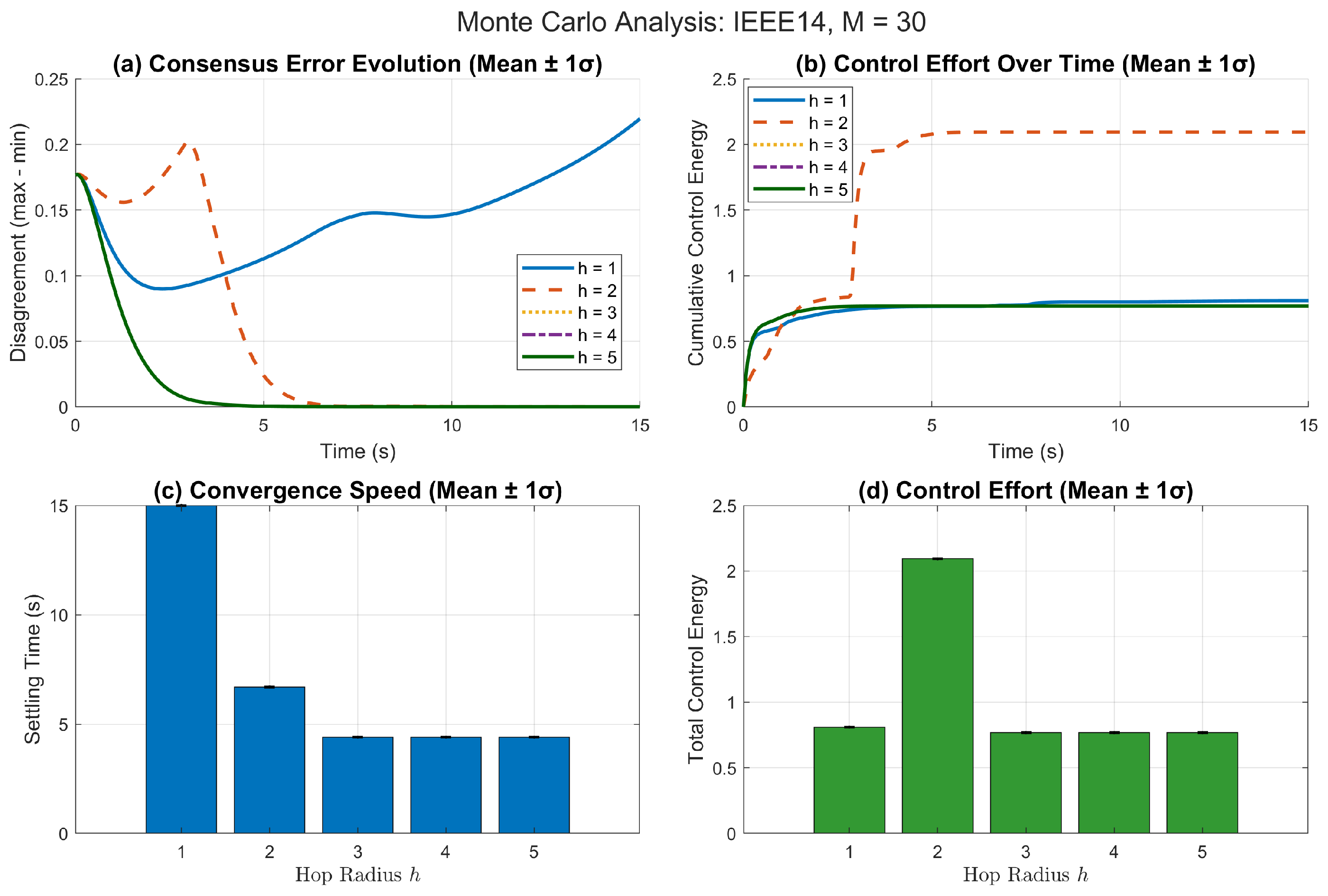
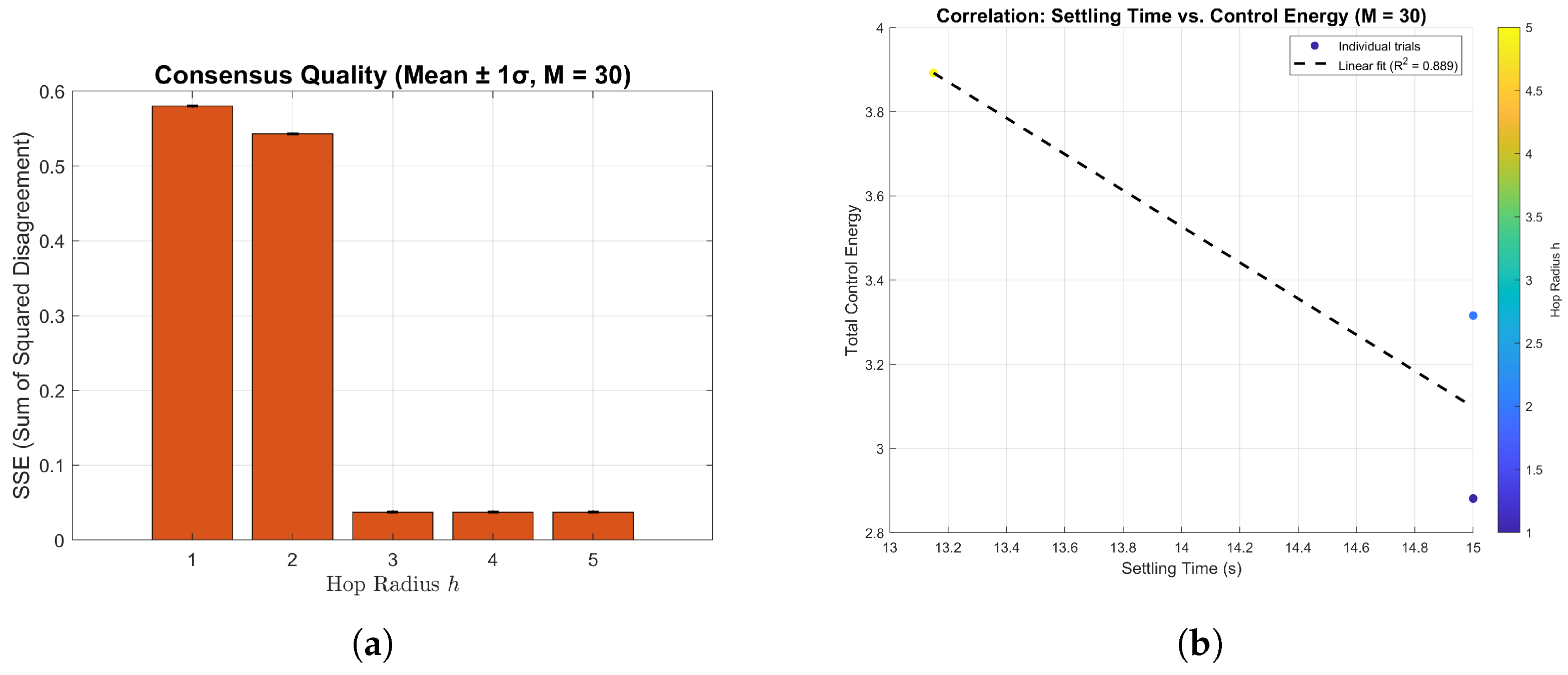
For the highly aggressive controller setting , convergence becomes extremely fast once sufficient connectivity is reached. Settling time decreases significantly from 15 s at to 6.7 s at , and then stabilizes at approximately 4.4 s for . The control energy is more variable at low hop radii (0.81 for , then 2.09 for due to oscillatory response) but quickly settles near 0.768 for all . The SSE metric again reveals the clearest robustness transition: it decreases from 0.318 for to 0.116 at , and then reaches a very low value (∼0.0247) for . These results show that although introduces more aggressive control behavior, once robustness is met, the system produces extremely fast, low-error convergence.
Figure 14.
Monte Carlo analysis (M = 30) for IEEE-14 bus system at . Time-series plots show mean trajectories; standard deviations are computed across randomized adversarial configurations and collapse onto the mean when variance is negligible. (a) Disagreement (max–min) over time. (b) Cumulative control energy over time. (c) Settling time over hop radius. (d) Total control energy over hop radius. For this dense network, the trajectories corresponding to larger hop radii () overlap almost exactly in (a,b), reflecting early robustness saturation; consequently, these curves are visually indistinguishable.
Figure 14.
Monte Carlo analysis (M = 30) for IEEE-14 bus system at . Time-series plots show mean trajectories; standard deviations are computed across randomized adversarial configurations and collapse onto the mean when variance is negligible. (a) Disagreement (max–min) over time. (b) Cumulative control energy over time. (c) Settling time over hop radius. (d) Total control energy over hop radius. For this dense network, the trajectories corresponding to larger hop radii () overlap almost exactly in (a,b), reflecting early robustness saturation; consequently, these curves are visually indistinguishable.
Figure 15.
Consensus quality and correlation. (a) SSE vs. hop radius: , and . (b) Total control energy vs. settling time.
Figure 15.
Consensus quality and correlation. (a) SSE vs. hop radius: , and . (b) Total control energy vs. settling time.
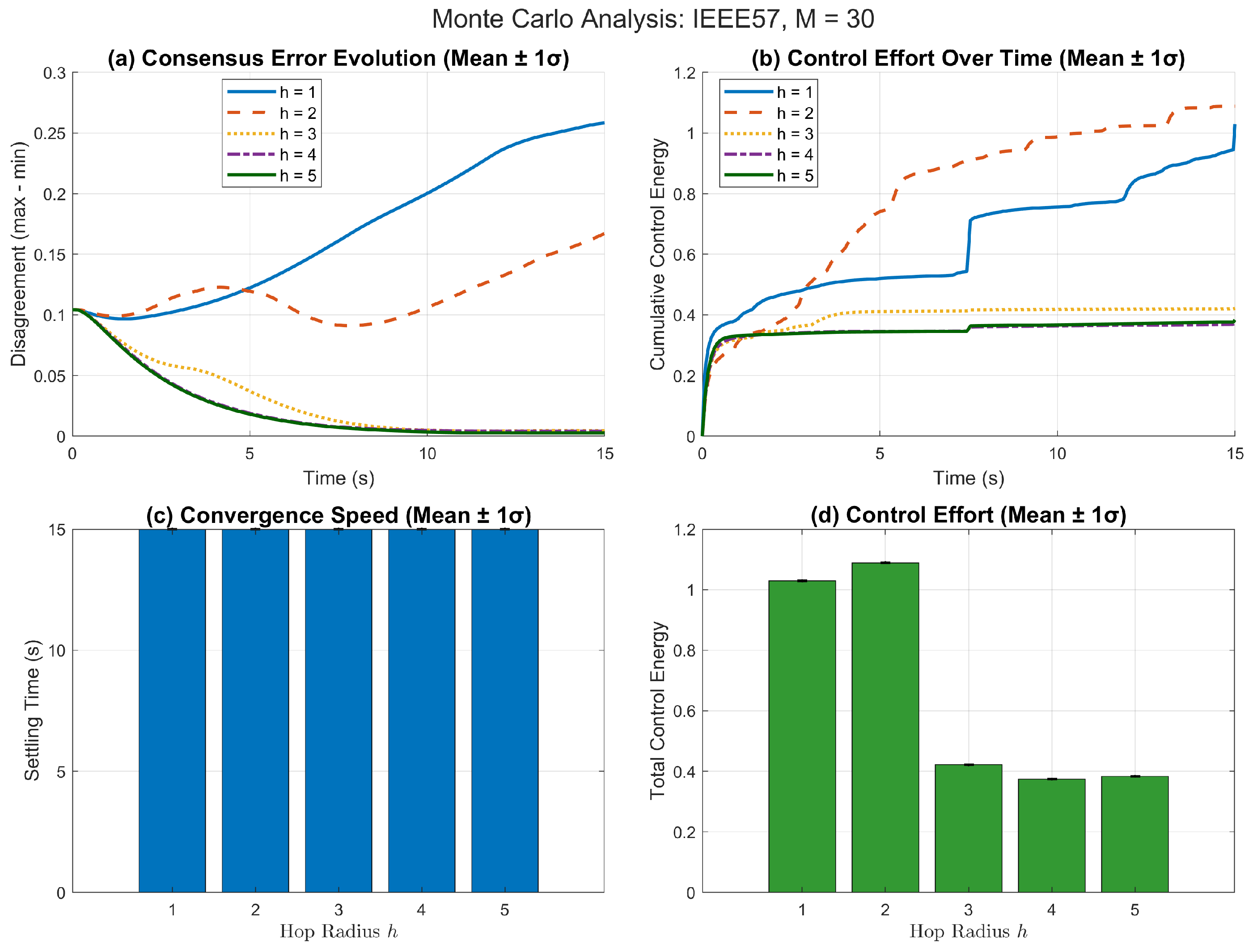
8.9. Monte Carlo Analysis on IEEE-57
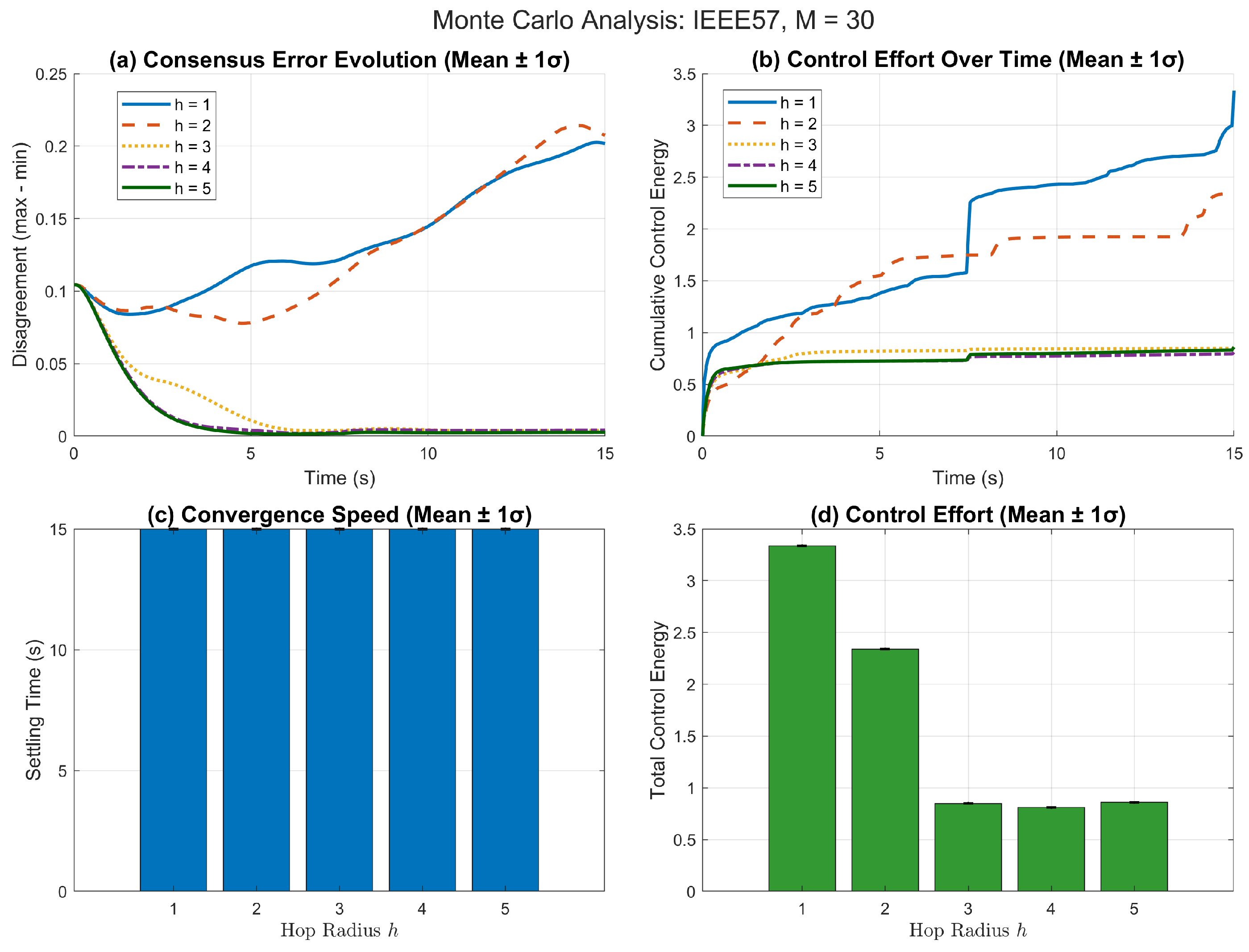
To evaluate the robustness of MW-MSR on sparse, high-diameter networks under aggressive control gains, we conduct a Monte Carlo analysis on the IEEE-57 topology using and a communication delay of 0.1 s.
A common trait among all Monte Carlo experiments conducted on IEEE-57 for all is that the settling time remains almost identical once robustness conditions are met. The limiting factors remain:
Large diameter of IEEE-57,
Cumulative multi-hop communication delay,
Slowest mode of the h-hop Laplacian.
The results across all controller gains on the IEEE-57 network reveal a consistent and physically meaningful pattern: resilient consensus is governed by a co-optimization between connectivity (hop radius h) and controller aggressiveness (gain ). Although each level exhibits distinct transient behavior, the fundamental robustness transition and its implications remain stable across all examined regimes.
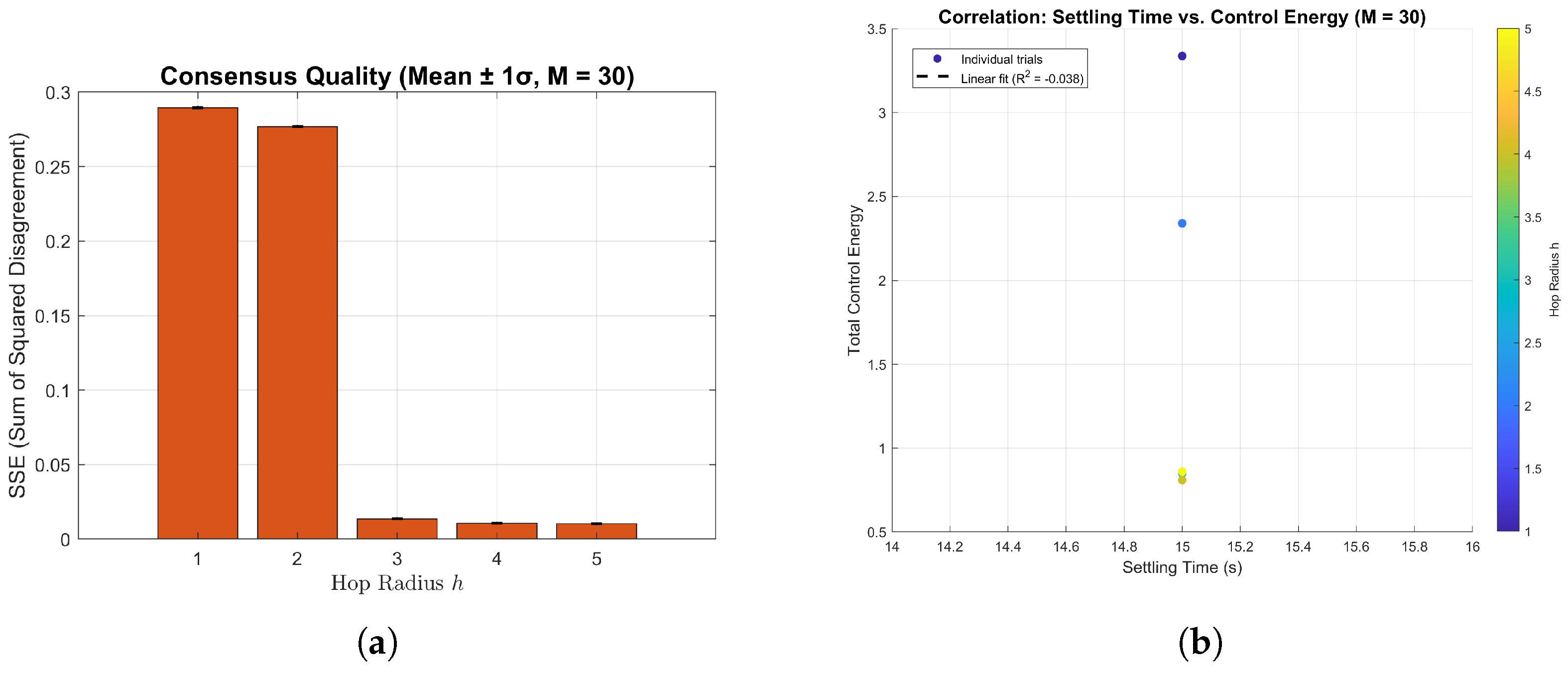
8.9.1. Monte Carlo Analysis on IEEE-57 at
Figure 16a–d summarizes the mean trajectories and
envelopes for key performance metrics, while
Figure 17a,b reports the corresponding SSE distributions and settling time.
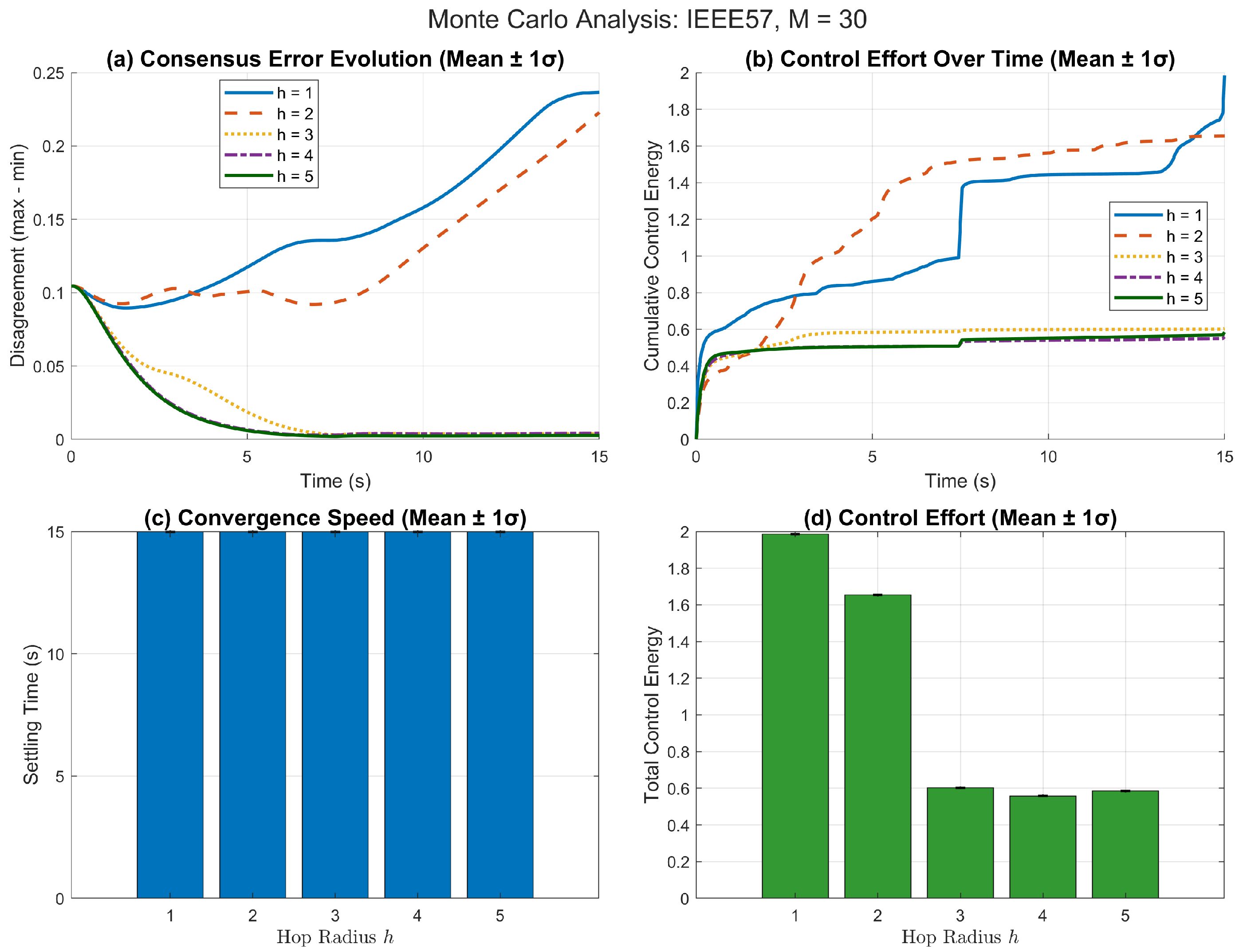
At and , disagreement decays initially but then rises again, with substantial trial-to-trial variability. The system is unable to filter adversarial values effectively because trimming is insufficient under limited connectivity.
At , disagreement converges smoothly toward zero with minimal variance. Although produces slower corrections than or , the MW-MSR mechanism still successfully eliminates adversarial influence once the h-hop neighborhoods meet robustness requirements.
In addition, the correlation between settling time and control energy remains weak (), confirming that settling time does not reveal robustness deficiencies under low or moderate gains.
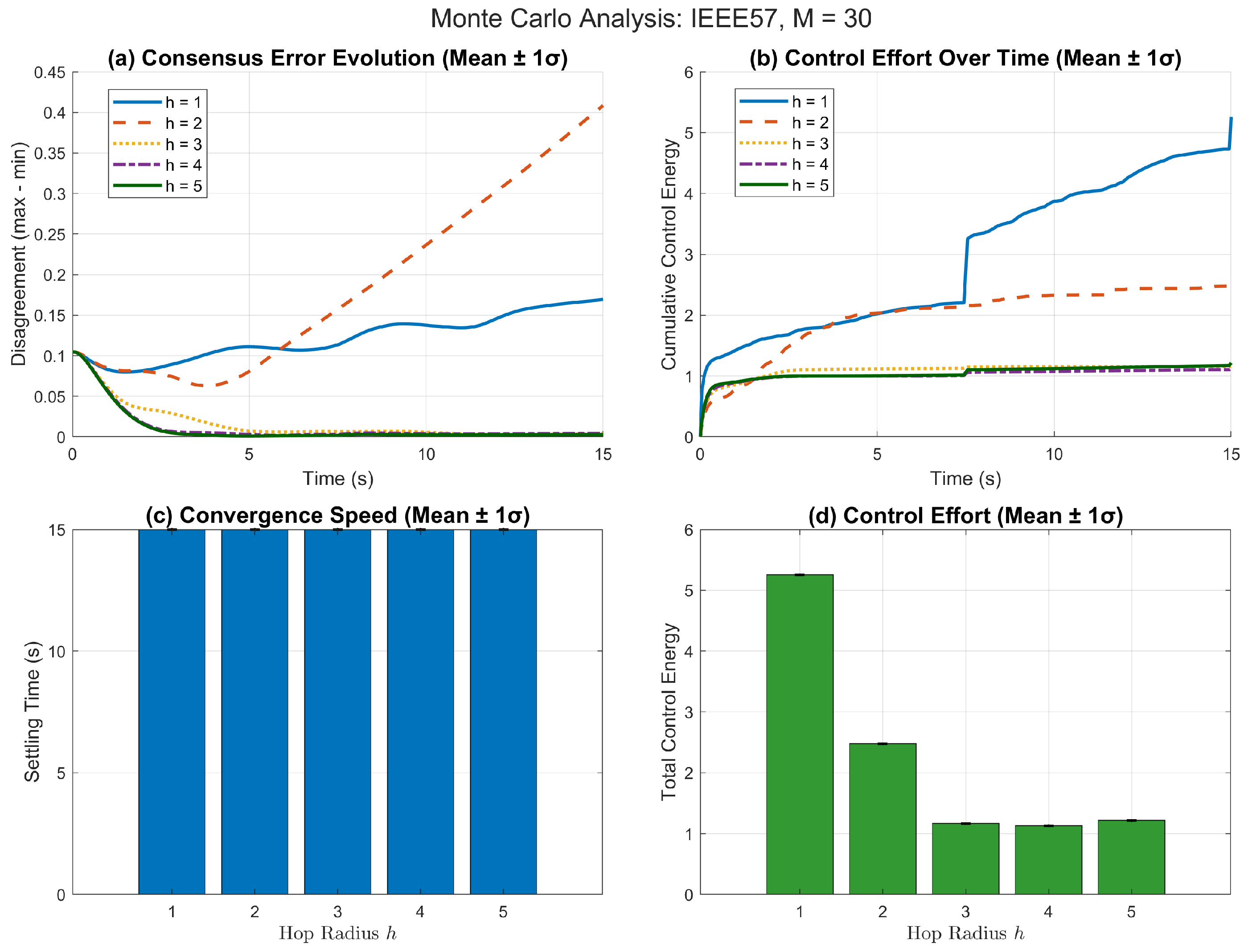
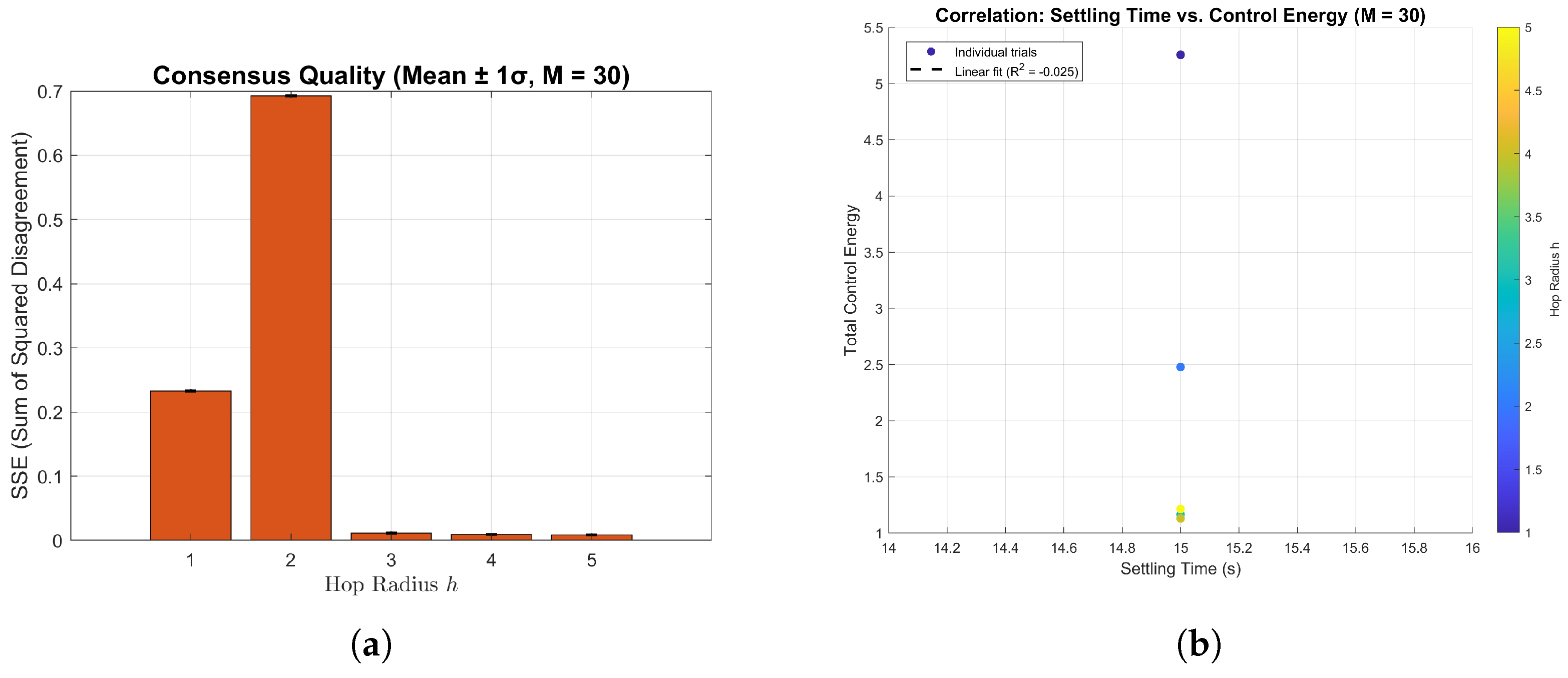
8.9.2. Monte Carlo Analysis on IEEE-57 at
Figure 18a–d summarizes the mean trajectories and
envelopes for key performance metrics, while
Figure 19a,b reports the corresponding SSE distributions and settling time.
Both and exhibit increasing disagreement, with rising variance over time. Although the divergence is less explosive than at higher gains (), the curves still reflect the inability of normal agents to consistently filter adversarial inputs when multi-hop neighborhoods are too small.
For , the model produces fast disagreement decay and extremely low variance across trials. Once the graph becomes sufficiently connected in the h-hop sense, the MW-MSR trimming mechanism reliably blocks adversarial influence despite the lower gain.
Compared to or , disagreement under decays more smoothly, and the gap between insufficient and sufficient hop radii is still clearly visible.
Figure 18.
Monte Carlo analysis for IEEE-57 bus system at . Scalar performance metrics become nearly invariant across adversarial realizations once the robustness threshold is reached, reflecting topology- and delay-dominated behavior. (a) Disagreement (max–min) over time. (b) Cumulative control energy over time. (c) Settling time over hop radius. (d) Total control energy over hop radius.
Figure 18.
Monte Carlo analysis for IEEE-57 bus system at . Scalar performance metrics become nearly invariant across adversarial realizations once the robustness threshold is reached, reflecting topology- and delay-dominated behavior. (a) Disagreement (max–min) over time. (b) Cumulative control energy over time. (c) Settling time over hop radius. (d) Total control energy over hop radius.
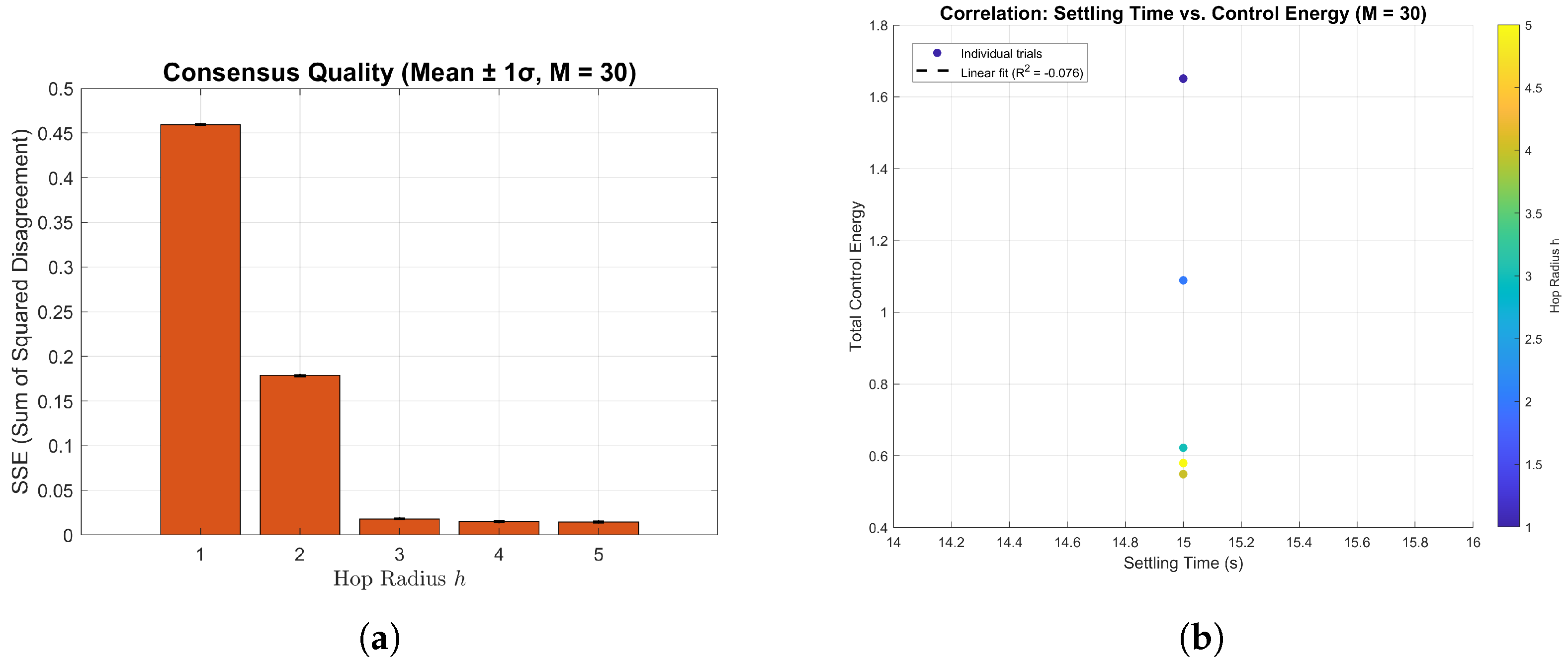
Figure 19.
Consensus quality and correlation (Monte-Carlo, ). (a) SSE versus hop radius h: at , and . (b) Mean total control energy versus mean settling time, with each marker corresponding to one hop radius h and values averaged over randomized adversarial configurations. A linear regression is computed for panel (b) for consistency with other cases; however, in these regimes settling time varies little across hop radii, and any fitted trend is weak or visually indistinguishable, reflecting topology- and delay-dominated behavior.
Figure 19.
Consensus quality and correlation (Monte-Carlo, ). (a) SSE versus hop radius h: at , and . (b) Mean total control energy versus mean settling time, with each marker corresponding to one hop radius h and values averaged over randomized adversarial configurations. A linear regression is computed for panel (b) for consistency with other cases; however, in these regimes settling time varies little across hop radii, and any fitted trend is weak or visually indistinguishable, reflecting topology- and delay-dominated behavior.
8.9.3. Monte Carlo Analysis on IEEE-57 at
Figure 20a–d summarizes the mean trajectories and
envelopes for key performance metrics, while
Figure 21a,b reports the corresponding SSE distributions and settling time.
The performance at exhibits the worst disagreement performance due to the adversarial effects. These effects vanish significantly once the hop radius reaches the robustness threshold.
Figure 20.
Monte Carlo analysis for IEEE-57 bus system at . Scalar performance metrics become nearly invariant across adversarial realizations once the robustness threshold is reached, reflecting topology- and delay-dominated behavior. (a) Disagreement (max–min) over time. (b) Cumulative control energy over time. (c) Settling time over hop radius. (d) Total control energy over hop radius.
Figure 20.
Monte Carlo analysis for IEEE-57 bus system at . Scalar performance metrics become nearly invariant across adversarial realizations once the robustness threshold is reached, reflecting topology- and delay-dominated behavior. (a) Disagreement (max–min) over time. (b) Cumulative control energy over time. (c) Settling time over hop radius. (d) Total control energy over hop radius.
Figure 21.
Consensus quality and correlation (Monte-Carlo, ). (a) SSE versus hop radius h: at , and . (b) Mean total control energy versus mean settling time, with each marker corresponding to one hop radius h and values averaged over randomized adversarial configurations. A linear regression is computed for panel (b) for consistency with other cases; however, in these regimes settling time varies little across hop radii, and any fitted trend is weak or visually indistinguishable, reflecting topology- and delay-dominated behavior.
Figure 21.
Consensus quality and correlation (Monte-Carlo, ). (a) SSE versus hop radius h: at , and . (b) Mean total control energy versus mean settling time, with each marker corresponding to one hop radius h and values averaged over randomized adversarial configurations. A linear regression is computed for panel (b) for consistency with other cases; however, in these regimes settling time varies little across hop radii, and any fitted trend is weak or visually indistinguishable, reflecting topology- and delay-dominated behavior.
8.9.4. Monte Carlo Analysis on IEEE-57 at
Figure 22a–d summarizes the mean trajectories and
envelopes for key performance metrics, while
Figure 23a,b reports the corresponding SSE distributions and settling time.
The performance at
demonstrates severe disagreement as shown in
Figure 22a. In addition,
exhibits worse disagreement than
. This is attributed to the persistent adversarial perturbations. These diminish significantly once the hop radius reaches the robustness threshold.
Figure 22.
Monte Carlo analysis for IEEE-57 bus system at . Scalar performance metrics become nearly invariant across adversarial realizations once the robustness threshold is reached, reflecting topology- and delay-dominated behavior. (a) Disagreement (max–min) over time. (b) Cumulative control energy over time. (c) Settling time over hop radius. (d) Total control energy over hop radius.
Figure 22.
Monte Carlo analysis for IEEE-57 bus system at . Scalar performance metrics become nearly invariant across adversarial realizations once the robustness threshold is reached, reflecting topology- and delay-dominated behavior. (a) Disagreement (max–min) over time. (b) Cumulative control energy over time. (c) Settling time over hop radius. (d) Total control energy over hop radius.
Figure 23.
Consensus quality and correlation (Monte-Carlo, ). (a) SSE versus hop radius h: , and . (b) Mean total control energy versus mean settling time, with each marker corresponding to one hop radius h and values averaged over randomized adversarial configurations. A linear regression is computed for panel (b) for consistency with other cases; however, in these regimes settling time varies little across hop radii, and any fitted trend is weak or visually indistinguishable, reflecting topology- and delay-dominated behavior.
Figure 23.
Consensus quality and correlation (Monte-Carlo, ). (a) SSE versus hop radius h: , and . (b) Mean total control energy versus mean settling time, with each marker corresponding to one hop radius h and values averaged over randomized adversarial configurations. A linear regression is computed for panel (b) for consistency with other cases; however, in these regimes settling time varies little across hop radii, and any fitted trend is weak or visually indistinguishable, reflecting topology- and delay-dominated behavior.
Across IEEE-14 and IEEE-30, settling time and total control energy show strong correlation with the normalized algebraic connectivity , consistent with the expectation that stronger spectral connectivity accelerates convergence. However, in IEEE-57, the settling time becomes dominated by the graph diameter and the accumulated multi-hop delay once the robustness threshold is reached (typically at ). In this topology-limited regime, further increases in no longer accelerate convergence, causing the empirical correlation between and settling time to weaken. Importantly, the correlation with SSE remains strong, indicating that the spectral proxy is highly effective as a robustness-screening tool even though settling time plateaus due to delay and structural bottlenecks.
For IEEE-57 and high controller gain (
), the settling time exhibits very small variability across 30 randomized adversarial trials. This indicates that in sparse, high-diameter networks, settling time becomes dominated by structural constraints and hop radius rather than by adversarial placement. Consequently, the correlation between settling time and total control energy becomes weak (
), as shown in
Figure 23. While total control energy varies with adversarial clustering, the settling time remains nearly constant, reflecting a saturation regime where increased gain no longer accelerates consensus. This phenomenon is consistent with the stability–delay trade-offs discussed earlier in
Section 8.6.
9. Discussion
The proposed hop-selection framework provides a structured and practical approach to determining the minimal communication horizon required for resilient consensus under the MW-MSR algorithm. The results presented in
Section 7 demonstrate that resilience depends not only on the network topology but also on the selection of an appropriate hop radius that compensates for sparsity and adversarial influence.
9.1. Adaptation to Network Topology
The experiments highlight that each IEEE network exhibits distinct structural properties that influence the required hop radius. For example, the IEEE-57 bus system is designed for efficient power distribution, not for consensus or information fusion. Its sparsity and relatively large diameter make it unsuitable for single-hop W-MSR, leading to persistent drift and disagreement. The hop-selection framework automatically identifies a sufficiently large horizon— in the experiments—to overcome these structural limitations and enable resilient consensus.
This adaptive behavior is important because it demonstrates that the method does not rely on manual tuning or overly conservative hop choices. Instead, it systematically adjusts the communication radius to meet resilience requirements dictated by the graph structure.
9.2. Effectiveness Against Stealthy and Burst Adversaries
The proposed framework is tested against adversaries capable of both stealthy drift and burst-type disturbances. These adversaries attempt to exploit local sparsity or low-degree regions to bias normal agents or cause partial divergence. The results show that:
When , adversaries can dominate local neighborhoods, leading to high SSE and unstable convex-hull behavior.
When , adversarial influence is effectively diluted, neighborhood redundancy increases, and the filtered averages remain reliable.
The alignment of SSE-normal and SSE-all at confirms that the adversaries can no longer distort the global consensus trajectory.
9.3. Role of Algebraic Connectivity
The experiments further validate the role of normalized algebraic connectivity
as a useful resilience indicator. Increases in
correlate with improved consensus performance and reduced vulnerability, particularly in sparse networks. Although
is not a substitute for exact robustness checking (see
Appendix A.1.5 for more details, it provides a computationally efficient and reliable proxy that integrates naturally into the hop-selection pipeline).
9.4. Efficiency and Resource Awareness
The results reinforce the importance of selecting the smallest feasible hop radius. Larger hop counts expand the communication graph but increase the number of relayed messages, latency, and computational workload. The proposed framework avoids these unnecessary costs by prioritizing minimality. For example, while increasing h beyond does not harm consensus correctness, it leads to superfluous overhead without further resilience benefits.
9.5. Scalability and Practical Deployment
The hop-selection framework provides a scalable strategy for determining communication horizons in large real-world networks. The combination of exact verification (when feasible) and efficient proxy tests (when exact checking is impractical) ensures that the algorithm can operate effectively across networks of varying sizes and densities. The use of multi-hop communication, combined with adaptive hop selection, enables the MW-MSR controller to operate reliably even in networks with challenging topologies.
Additionally, because the framework requires only adjacency information and standard graph computations, it can be deployed in settings where computational resources are limited, making it suitable for cyber–physical systems, power networks, distributed robotics, and IoT applications.
10. Conclusions and Future Work
This paper introduces a structured framework for selecting the minimal hop radius required for resilient consensus under the multi-hop W-MSR (MW-MSR) algorithm. The proposed approach integrates exact robustness verification—when computationally feasible—with a set of lightweight and scalable proxy tests involving local feasibility, normalized algebraic connectivity, and adversary-dilution metrics. These components together enable a principled and practical mechanism for identifying the smallest communication horizon that satisfies the robustness assumptions of MW-MSR in both synchronous and bounded-delay asynchronous settings.
Experimental results on IEEE 14-, 30-, and 57-bus systems confirm that selecting is essential for resilient operation. When , adversaries are able to exploit sparsity, induce drift, or expand the convex hull of normal states, resulting in consensus failure. In contrast, at , the multi-hop neighborhoods provide sufficient structural redundancy to suppress adversarial influence, yielding significantly improved disagreement, SSE performance, and control-energy behavior. The method scales naturally with network size and topology, and it avoids the communication and computation overhead associated with unnecessarily large hop values.
Looking ahead, several research directions can extend the usefulness of the proposed framework. First, developing more scalable exact robustness certification techniques—for example, through mixed-integer formulations or convex relaxations—would improve accuracy for large networks. Second, incorporating cost-aware hop selection based on latency, bandwidth, and energy budgets may enable deployment in resource-constrained settings. Third, extending the method to time-varying graphs using windowed or dynamic h-hop robustness measures is a natural next step. Finally, adaptive mechanisms that adjust in real time, as well as extensions to vector-valued or privacy-preserving consensus, offer promising directions for future exploration.