1. Introduction
The integration of artificial intelligence (AI), computer vision, and multimodal sensing technologies has profoundly reshaped how human physical activities are monitored and analyzed across domains such as healthcare rehabilitation, logistics, and occupational safety. In clinical scenarios, activity recognition systems support tele-rehabilitation programs by providing objective feedback on patient performance and ensuring the correct execution of prescribed therapeutic exercises [
1,
2,
3]. Wearable sensors, motion capture systems, and machine learning-based monitoring platforms further enhance remote assessment by capturing detailed kinematic patterns and offering clinicians actionable insights into movement quality and patient progress [
4,
5,
6,
7,
8]. These technologies enable continuous monitoring outside clinical settings and contribute to more personalized and scalable rehabilitation strategies.
Advances in AI have significantly expanded the potential of these systems by enabling automated extraction of motion features, anomaly detection, and unobtrusive activity monitoring, while reducing dependence on handcrafted features through end-to-end representation learning [
9,
10,
11]. Deep learning models have shown strong capabilities in capturing the complex spatiotemporal structure of human motion, particularly when analyzing multichannel time-series data. Architectures based on convolutional, recurrent, and attention mechanisms are increasingly adopted to recognize fine-grained activity patterns in diverse applications including rehabilitation, industrial processes, and smart-environment monitoring [
12,
13]. This represents a paradigm shift toward more scalable and accurate human activity recognition (HAR) systems capable of handling heterogeneous modalities, long temporal dependencies, and varying environmental conditions.
Beyond healthcare, the growing focus on ergonomics, workload monitoring, and injury prevention has accelerated the adoption of AI-based motion analysis in occupational environments. Within the frameworks of Industry 4.0 and the emerging Industry 5.0 paradigm, digital and virtual technologies are widely employed to assess worker posture, repetitive motions, manual material handling tasks, and exposure to biomechanical hazards [
14]. These systems frequently combine multiple sensing modalities—such as camera-based vision, inertial measurement units (IMUs), motion capture technologies, and digital human models—to detect suboptimal work techniques and movement patterns associated with musculoskeletal risk. Their role is particularly relevant given that work-related musculoskeletal disorders remain among the most prevalent occupational health issues worldwide.
HAR also plays a key role in industrial logistics, where manual activities such as lifting, carrying, and sorting require continuous monitoring to ensure both safety and operational efficiency. An important contribution to this research area is the LARa dataset, a large-scale multimodal corpus comprising optical marker-based motion capture (OMoCap), IMU signals, and semantic activity annotations gathered during realistic warehouse workflows [
15]. The dataset captures fine-grained process-level dynamics and includes challenging conditions such as class imbalance, operational noise, and substantial inter-subject variability, making it a valuable benchmark for the evaluation of machine learning models in industrial settings.
Despite these advancements, several challenges still hinder the reliable deployment of HAR technologies in real-world occupational environments. In particular, existing approaches often struggle to generalize across different subjects, to cope with noisy and heterogeneous sensor data, and to capture the inherently multiscale temporal dynamics of complex human movements. These issues are especially relevant in industrial contexts, where variability in movement execution, anthropometry, and working conditions can significantly affect model robustness and fairness [
16,
17].
Recent research suggests that multiscale representation learning and subject-independent validation protocols can improve the robustness and generalizability of motion recognition systems [
18]. However, systematic evaluations of such approaches in realistic industrial workflows remain limited, particularly when using high-resolution motion capture data.
In this context, the present study investigates deep learning methods for recognizing motion patterns associated with logistics activities using a multimodal motion-capture dataset collected in warehouse environments. The goal is to evaluate different neural architectures for motion-signal processing and to assess their ability to provide robust, subject-independent recognition of work-related activities. In particular, we explore the use of multiscale temporal convolutional architectures to capture motion dynamics at multiple temporal resolutions, enabling more reliable quantification of workers’ activities and supporting future applications in ergonomic monitoring and occupational risk prevention.
While the proposed multiscale temporal architecture builds upon our previous investigations into cross-subject robustness [
18], the present study addresses a substantially different and more challenging recognition problem. Unlike rehabilitation scenarios, warehouse work activities exhibit high inter-subject variability, short-duration motion segments, and subtle kinematic differences between sub-tasks. These characteristics have been shown to challenge existing activity recognition approaches, including prior benchmarks on the LARa dataset. The methodological contribution of this work lies in demonstrating that multiscale temporal feature learning—originally validated for improving fairness and robustness across subjects—can also effectively discriminate fine-grained sub-actions embedded within complex motion sequences. Specifically, the architecture combines a top branch engineered to preserve fine temporal details of motion with a lower branch that intentionally reduces temporal resolution to obtain a global view of movement dynamics. This design enables the simultaneous modeling of micro-movements and long-range context, which is essential for recognizing subtle action variations that differ only marginally in execution. Through this formulation, the study extends the applicability of multiscale temporal learning beyond subject generalization and establishes its relevance for precise sub-action recognition in logistics environments, supporting the monitoring of movement patterns associated with unsafe postures and biomechanical risk.
The remainder of this article is organized as follows.
Section 2 reviews related work on computational approaches to human motion recognition.
Section 3 describes the methodological framework adopted in this study.
Section 4 presents the quantitative results of the experiments.
Section 5 provides a comprehensive analysis of the findings and discusses future research directions. Finally,
Section 6 concludes the article.
2. Related Work
The use of artificial intelligence for monitoring human movement has gained increasing attention in both healthcare and industrial contexts. In occupational environments, motion analysis systems are employed to evaluate biomechanical load, detect unsafe postures, and assess repetitive movements associated with work-related musculoskeletal disorders. Modern ergonomic monitoring platforms integrate heterogeneous sensing technologies—including optical motion capture, inertial sensors, and computer vision—to provide quantitative measurements of workers’ physical activities [
14]. These systems support both the design of safer workstations and the continuous monitoring of workers during task execution.
Within the paradigms of Industry 4.0 and the emerging Industry 5.0, intelligent monitoring systems are increasingly deployed to enable data-driven safety assessment in complex industrial environments. However, the development of reliable HAR systems for occupational settings remains challenging. Industrial workflows often involve unstructured motion patterns, interactions with tools and materials, and substantial variability across workers. As a result, HAR models must cope with heterogeneous sensor data, environmental noise, and large inter-subject variability.
To facilitate research in realistic industrial conditions, several datasets have been introduced to benchmark motion recognition algorithms. Among these, the LARa dataset provides a comprehensive multimodal resource capturing warehouse picking and packaging workflows using optical marker-based motion capture (OMoCap), inertial measurement units (IMUs), and RGB video streams [
15]. In addition to activity labels, the dataset includes semantic attributes describing motion characteristics, enabling more detailed analyses of human movement. The dataset reflects realistic operational conditions and presents several challenges for machine learning models, including class imbalance, annotation uncertainty, and strong inter-subject variability.
Deep learning methods have significantly advanced HAR by enabling end-to-end learning of hierarchical representations from raw motion signals. Temporal convolutional neural networks (tCNNs) have proven effective in capturing local temporal dependencies in time-series data, while recurrent neural networks such as Long Short-Term Memory (LSTM) and Gated Recurrent Units (GRUs) are commonly used to model longer temporal relationships [
19,
20]. Hybrid architectures combining convolutional and recurrent components—such as CNN–LSTM and ConvLSTM networks—have further improved the modeling of spatiotemporal dynamics in motion analysis tasks [
21,
22].
More recently, transformer-based architectures have gained prominence for sequential data modeling due to their ability to capture long-range dependencies through self-attention mechanisms. These models have demonstrated strong performance in motion recognition and other sequence modeling tasks [
23]. In particular, recent studies have extended transformer frameworks for HAR by integrating convolutional feature extraction and hybrid temporal modeling strategies to better handle the complex structure of motion signals. For example, Guo et al. [
24] introduce a hybrid architecture that combines convolutional feature extraction with transformer encoders and vector-based relative position embeddings, improving the representation of local motion patterns while preserving global temporal context. Similarly, Miao et al. [
25] propose an attention-enhanced CNN-BiGRU-Transformer model that integrates recurrent and convolutional components with self-attention, enabling more effective modeling of both short-term dynamics and long-range temporal dependencies in HAR tasks. Furthermore, Lamaakal et al. [
26] present a lightweight inertial transformer framework designed for efficient deployment in resource-constrained settings, incorporating multimodal knowledge distillation and explainable AI mechanisms to maintain high recognition performance while improving interpretability. Collectively, these studies highlight a clear trend toward hybrid and efficiency-aware transformer designs, where convolutional or recurrent modules are combined with attention mechanisms to jointly capture local motion details and global temporal structure, thereby enhancing robustness in complex human motion recognition scenarios. Beyond HAR, transformer-based representation learning has also shown remarkable effectiveness in several artificial intelligence domains. For instance, multimodal transformer frameworks combining language models such as BERT with vision transformers have achieved state-of-the-art results in visual question answering applications [
27].
A key challenge in motion analysis lies in the inherently multiscale nature of human movement. Rapid joint-level adjustments coexist with slower posture changes and task-level transitions, making it difficult for single-scale models to capture the full spectrum of motion dynamics. To address this limitation, several studies have proposed multiscale temporal learning strategies based on parallel convolutional filters, dilated convolutions, or hierarchical receptive fields [
28,
29,
30]. These approaches enable models to capture motion patterns at different temporal resolutions and have demonstrated improved robustness and cross-subject generalization in activity recognition tasks. Similar benefits have been observed in attribute-based classification frameworks applied to the LARa dataset, where semantic intermediate representations help mitigate class imbalance and ambiguous activity transitions [
15].
Despite these advances, ensuring robustness and fairness across different subjects remains an open challenge in real-world HAR systems. Differences in anthropometry, movement style, and sensor placement may introduce biases in learned representations, resulting in uneven model performance across individuals [
31]. To address these issues, several methodological strategies have been proposed, including cross-subject validation protocols such as leave-one-subject-out evaluation, domain adaptation techniques, and noise-robust training procedures [
32,
33,
34].
Overall, the literature highlights the need for motion recognition architectures capable of capturing multiscale temporal dynamics while ensuring robust performance across diverse subjects and realistic operating conditions. Building on these insights, the present study evaluates several deep learning architectures for motion-signal processing in industrial environments and investigates the effectiveness of multiscale temporal convolutional models for subject-independent activity recognition.
3. Materials and Methods
3.1. Dataset
This study evaluates the performance of multiple deep learning architectures for HAR using a multichannel MoCap dataset. The methodological pipeline encompasses dataset characterization, preprocessing, segmentation, feature representation, model development, and cross-validated evaluation.
This study employed the LARa dataset and consists of full-body motion capture recordings obtained via marker-based OMoCap [
15]. Each joint marker measures three-dimensional linear accelerations and angular velocities, enabling the reconstruction of joint kinematics across the entire body. These data are particularly suitable for activity recognition, biomechanical assessment, and gait analysis applications.
The participant cohort includes 14 healthy adults (7 males, 7 females) with an average age of 37 years, a mean weight of 71 kg, and a mean height of 171 cm. Most participants were right-handed (11/14), and each subject was assigned a unique ‘subject_id’ for inter-subject comparisons.
Each timestamp in the dataset is represented as a high-dimensional feature vector describing the rotations (roll, pitch, yaw) and translations (x, y, z) of 21 anatomical joints. In total, each frame is encoded as a 126-dimensional vector, accompanied by a corresponding activity label. This results in a multichannel time-series representation suitable for sequential modeling.
The examined dataset includes seven activity classes: Standing (c1), Walking (c2), Cart Handling (c3), Handling (Upwards) (c4), Handling (Centered) (c5), Handling (Downwards) (c6), and None (c7).
The dataset comprises 12,394 segmented action windows. The class distribution is imbalanced, with “Handling (Centered)” accounting for 34.6% of the samples, while “None” accounts for only 2.2%.
The synchronization class in the original LARA dataset was excluded from this study, as it served an exclusively technical function. It was introduced by the authors of the LARA dataset to align the start of each recording and facilitate the labeling process, rather than to represent a meaningful operational activity [
15]. For instance, the initial gesture of raising both hands above the head was used solely as a temporal reference and does not contribute to action recognition. Accordingly, this class was removed from the experiments. In contrast, the “None” class (c7) was retained, as it provides an essential neutral category for segments in which no defined action is performed, or where the data is ambiguous, corrupted, or otherwise not interpretable. Its inclusion enables the model to appropriately handle uncertain or unrecognized instances, thereby preventing forced misclassifications and improving the overall robustness and reliability of the system.
The overall composition of the LARa dataset used in this study is presented in
Table 1.
3.2. Algorithms
In this study, we employ a suite of deep learning models capable of processing multi-channel time–series data derived from the LARa dataset. The dataset contains synchronized motion sequences of human activities, making it particularly suitable for data-driven models that directly operate on raw spatiotemporal patterns. Unlike traditional machine–learning approaches that require handcrafted feature extraction pipelines, our adopted neural architectures learn discriminative representations directly from the input signals within a supervised learning framework. Supervised learning was selected due to its robustness and interpretability when dealing with heterogeneous human motion data, where unsupervised clustering methods tend to suffer from instability, noise sensitivity, and ambiguous evaluation metrics. Approaches such as dynamic time warping-based clustering or latent-structure discovery require substantial preprocessing and still struggle with the natural variability of human movement, making them difficult to deploy reliably in real-world settings. For these reasons, all analyses reported here rely on supervised models trained on annotated sequences.
To perform activity recognition, we implemented several established architectures: Temporal Convolutional Neural Networks (tCNN), hybrid models that pair convolutional layers with recurrent units (CNN–LSTM and Convolutional LSTM), and Transformer-based models. These architectures have been widely adopted across the HAR literature due to their complementary strengths in modeling local temporal structure, long-range dependencies.
A multiscale temporal feature-extraction process, as evidenced in our previous work, was adopted [
18]. The multiscale temporal feature extraction process comprises two parallel pathways that capture short- and long-range temporal dependencies at different resolutions. One path uses a small convolution stride to preserve fine-grained temporal details, while the second path employs a larger stride or dilated kernels to expand the receptive field. This design allows the network to encode micromovements and coarse temporal dynamics jointly. Formally, a 1D convolution with stride
s is defined in Equation (
1), where
x is the input sequence,
h the convolutional kernel of length
k, and
y the output:
Similarly, dilated convolutions are employed to enlarge the temporal receptive field without downsampling the sequence, as defined in Equation (
2):
The upper branch of the multiscale architecture emphasizes high-frequency details of the motion, while the lower branch focuses on global temporal structure. The outputs of the two branches are concatenated before entering the classification head.
Below, we provide a detailed description of each architecture in both standard and multiscale configurations.
3.2.1. Temporal CNN Model
Temporal convolutional networks are well-suited for modeling sequential data because they extract local temporal patterns through convolutional filters while supporting large receptive fields via stacked layers or dilation. The tCNN used here receives as input the trajectories of body joints over time. In the standard configuration, a sequence of convolutional layers with batch normalization and dropout performs hierarchical feature extraction. The flattened feature map is then passed to a set of fully connected layers with ReLU activations and L2 regularization, followed by a softmax classifier.
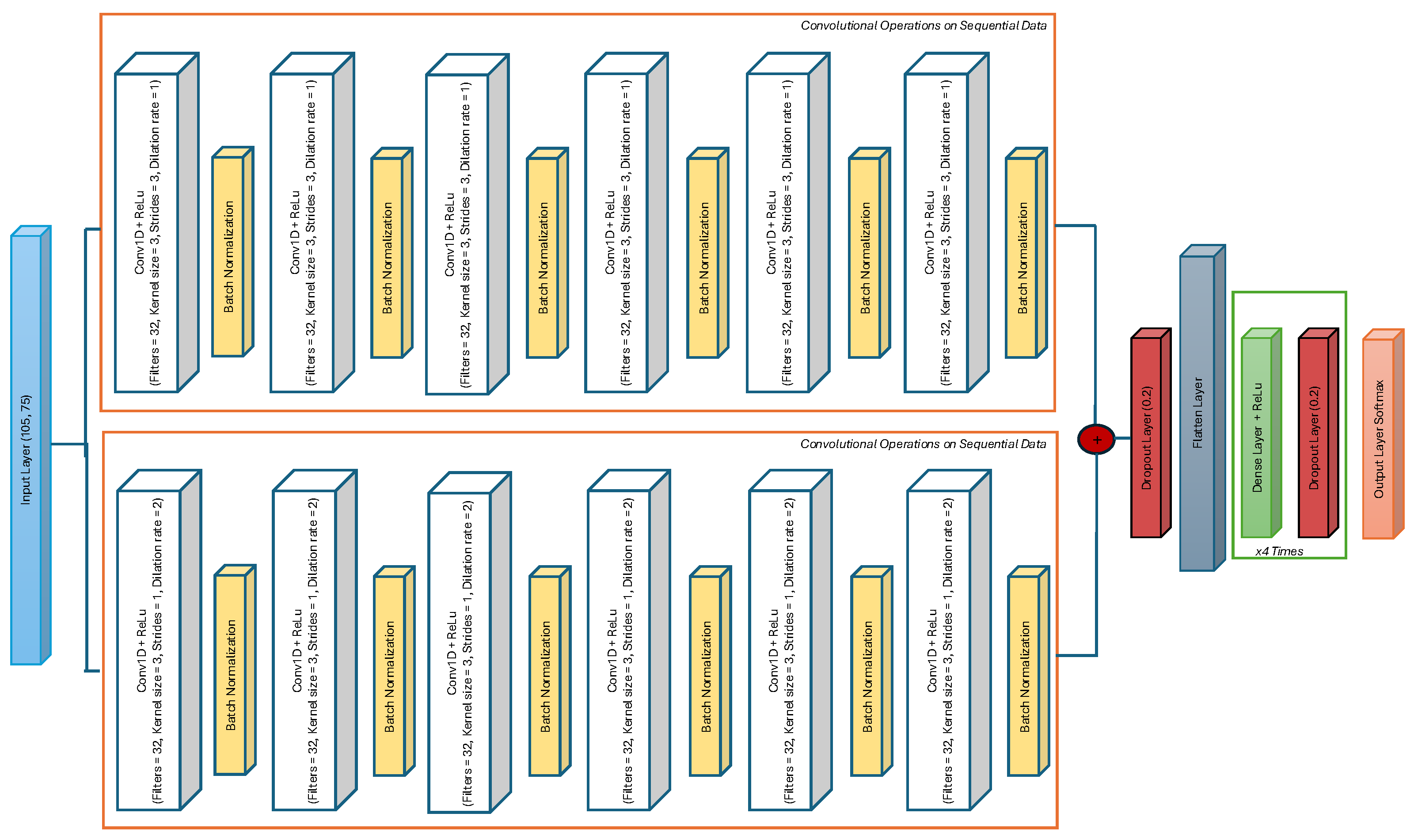
The multiscale tCNN consists of two convolutional branches: the first uses a stride of 1 to preserve temporal granularity, whereas the second applies a stride of 3 to capture long-term dynamics. Each branch ends with global average pooling, and their outputs are fused before the classification block.
The entire architecture of the multiscale tCNN model is illustrated in
Figure 1.
3.2.2. Hybrid LSTM Models
Long Short–Term Memory (LSTM) networks are specifically designed to retain long-range temporal dependencies by regulating information flow through gated memory cells. They are effective when the temporal evolution of motion plays a central role.
CNN–LSTM
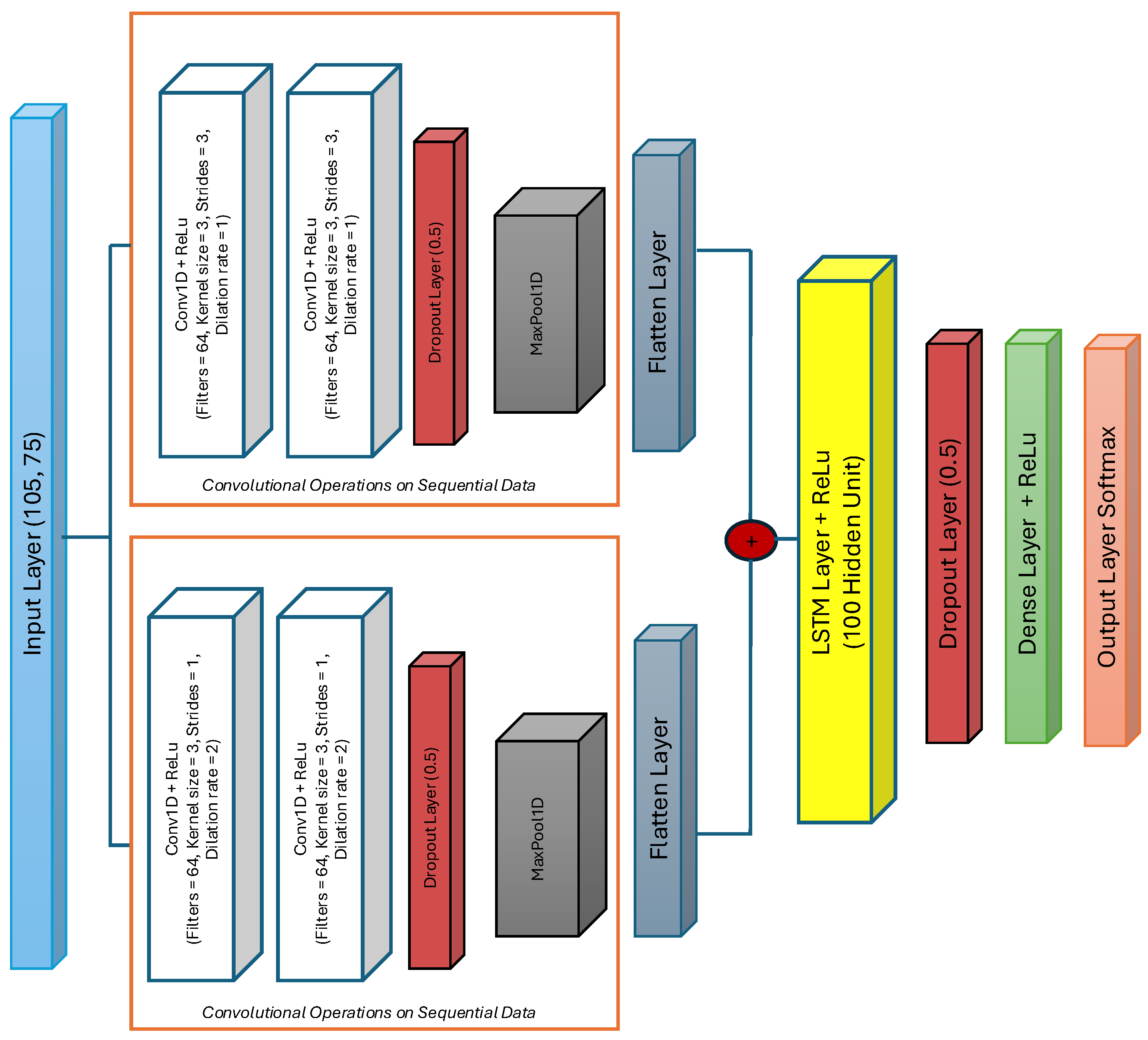
The CNN–LSTM model integrates convolutional layers for local feature extraction with an LSTM layer for sequence modeling. Convolutional layers learn spatial–temporal descriptors from the multi-joint trajectories, which an LSTM then processes with 100 units. Dense layers with ReLU activation refine the learned representation before the softmax output.
In the multiscale design, two parallel convolutional branches operate at different temporal resolutions. Their outputs are concatenated and fed into the LSTM, enabling the model to capture hierarchical motion dynamics.
The multiscale CNN–LSTM model is illustrated in
Figure 2.
Convolutional LSTM
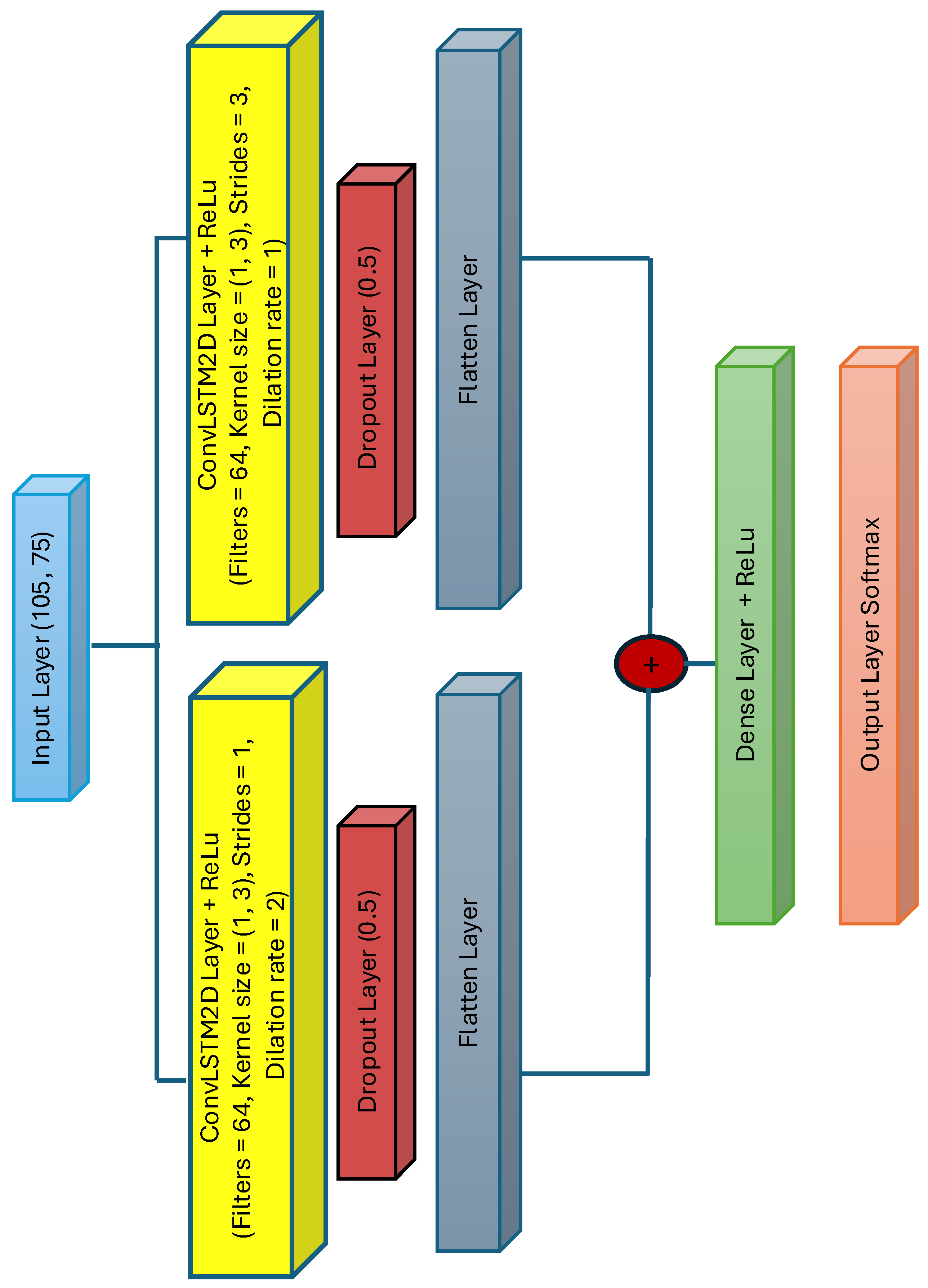
ConvLSTM incorporates convolution directly inside the LSTM gates to jointly model spatial and temporal dependencies. The model begins with a 2D ConvLSTM layer applied to the reshaped joint trajectories, followed by dropout, flattening, and dense layers for classification.
In the multiscale version, two ConvLSTM branches operate with different strides, allowing the network to capture both slow and fast motion dynamics. Their outputs are merged before the final classifier.
The multiscale ConvLSTM model is illustrated in
Figure 3.
3.2.3. Transformer Model
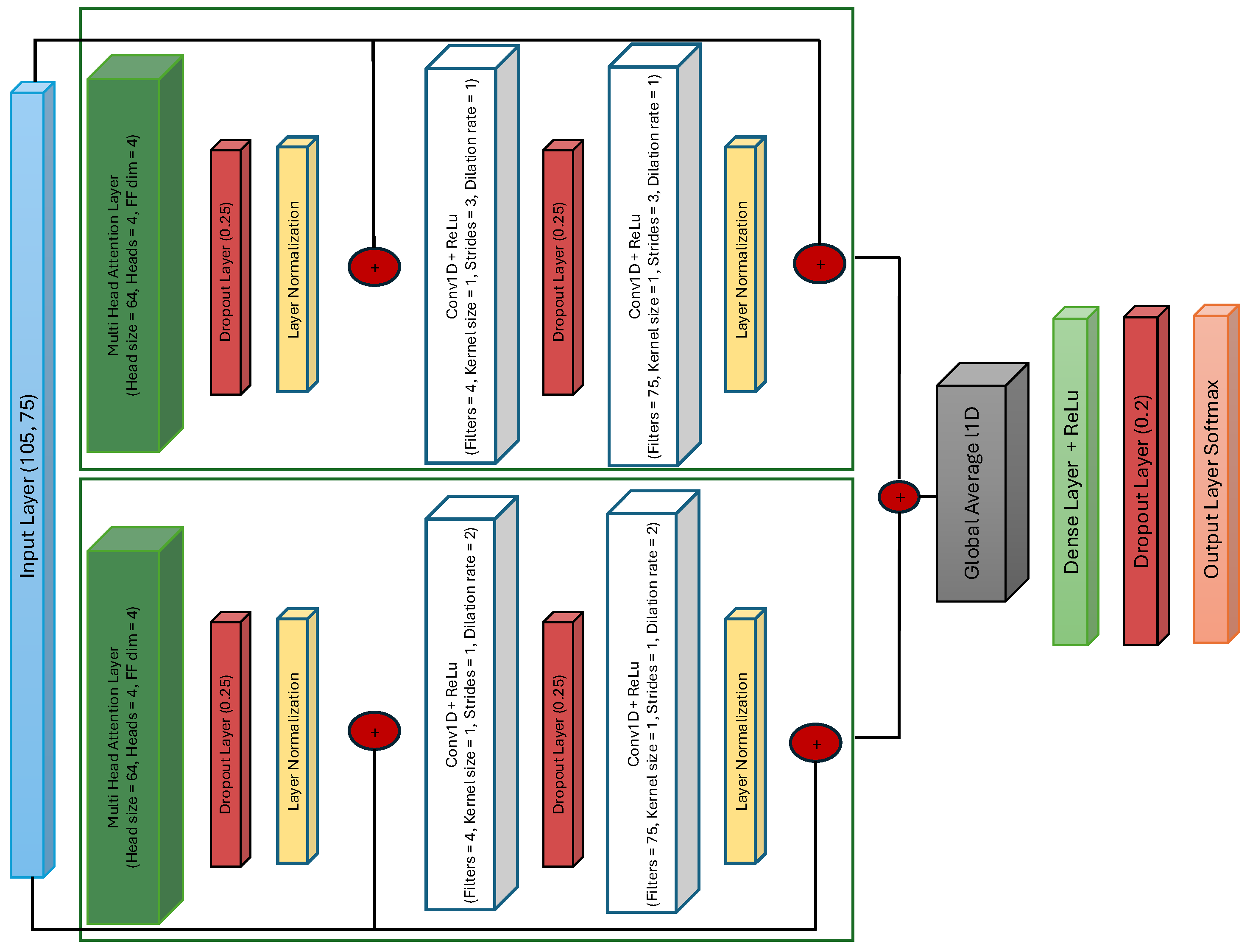
Transformers rely on self-attention mechanisms to compute interactions between all time steps in a sequence, providing a powerful mechanism for capturing long-range motion dependencies without recurrence. The adopted Transformer encoder includes multi-head attention, residual connections, layer normalization, and a position-wise feed-forward network. Positional encoding is added to the input to preserve temporal ordering.
The multiscale Transformer introduces two parallel preprocessing streams: one with a stride of 1 followed by a dilated convolution, and another with a stride of 3. After feature extraction, both streams are processed by identical encoder blocks before being merged for classification.
The multiscale Transformer model is illustrated in
Figure 4.
3.3. Experimental Setup
All experiments were conducted using the LARa dataset, which contains full-body motion sequences recorded using synchronized motion-capture hardware. Each sequence is represented as a multichannel time series comprising the 6D coordinates corresponding to the rotational (RX, RY, RZ) and translational (TX, TY, TZ) movements of various anatomical joints (e.g., head, arms, legs, root), resulting in 126 kinematic features. After preprocessing, each model receives input tensors of dimension , where N is the number of samples, T the sequence length, and F the feature dimensionality.
To ensure consistency across models, sequence lengths were normalized using zero pre-padding, which has been shown to perform robustly for time-series inputs. The time series was segmented into 1-s sliding windows, with each window comprising 200 frames.
The LARa dataset exhibits a markedly imbalanced class distribution, with certain activities (e.g., Handling (Centered)) occurring frequently, while others (Cart and None) represent rare or transitional states. To explicitly address this issue, a Naive Bayesian class-weighting strategy was adopted during training. Class priors were estimated from the training data and used to compute inverse-frequency weights, which were incorporated into the categorical cross-entropy loss function. This weighting scheme penalizes misclassification of rare classes more heavily, preventing the learning process from being dominated by majority activities. Considering the imbalance in the distribution of motion classes across the dataset, a Naïve Bayes-based approach was adopted to explicitly incorporate class distribution information into the classification process [
32]. This strategy mitigates the impact of class imbalance, leading to more stable and reliable predictions. The use of Naive Bayesian weighting is particularly appropriate in subject-independent scenarios, as it preserves the original temporal structure of motion sequences without resorting to oversampling or undersampling strategies that could distort transition dynamics. As a result, the models maintain sensitivity to rare and transitional activities while improving overall robustness and stability across subjects. The effectiveness of this strategy is reflected in the balanced per-class F1-scores reported in
Section 4, including for under-represented categories.
Training configurations for all architectures are summarized in
Table 2. Each model was trained using the Adam optimizer with a learning rate of
, categorical cross-entropy loss, and balanced class weights using a Naive Bayesian formulation. The architectural configuration and training hyperparameters were adopted from our previously validated multiscale framework, in which extensive ablation studies and sensitivity analyses were conducted [
18]. In the present study, these settings were kept fixed to ensure a controlled evaluation of the proposed methodology in a different and more complex activity recognition scenario, rather than re-optimizing configurations for each model individually. This design choice enables a fair and consistent comparison across architectures by isolating performance differences attributable to model design rather than hyperparameter tuning. Accordingly, a uniform training protocol was applied across all models, ensuring systematic and comparable evaluations under identical experimental conditions.
Given that human motion patterns vary significantly across individuals, we employed Leave-One-Subject-Out (LOSO) cross-validation. At each iteration, all data from one subject were held out for testing, while the remaining subjects formed the training set.
To evaluate the generalization capability of the proposed models across different individuals, all experiments were conducted using a LOSO cross-validation protocol. This evaluation strategy is particularly suited for human activity recognition tasks characterized by high inter-subject variability, as it prevents subject-dependent bias and simulates realistic deployment scenarios in which unseen workers are encountered.
Formally, let
denote the complete dataset, where
represents the set of all samples associated with subject
s, and
S is the total number of subjects. At each validation fold
, the test set is defined as:
while the corresponding training set is composed of data from all remaining subjects:
Under this protocol, no data from the test subject are observed during training, ensuring a strict subject-independent evaluation. Due to the inherently imbalanced distribution of activity classes in the dataset and differences in task execution across individuals, the number of test samples per activity class naturally varies across folds depending on the behavior of the held-out subject. As a result, different validation folds may exhibit different class sample counts, even for the same activity category.
Performance metrics—including accuracy, precision, recall, F1-score, and AUC—were averaged across all folds to assess model stability and generalizability. To ensure fair interpretability and comparability of results across subjects and models, performance metrics were averaged across all LOSO folds. Moreover, confusion matrices were reported using normalized values. This normalization mitigates the effect of fold-specific class imbalance and allows a consistent comparison of class-wise performance across different subjects and architectures.
All neural networks were implemented in Keras with fixed random seeds to ensure reproducibility.
5. Discussion
This study examined the feasibility of using AI-driven temporal architectures combined with optical motion-capture sensing to quantify workers’ physical activities in logistics workflows, with the broader goal of supporting occupational safety and health monitoring in smart industrial environments. Four deep learning architectures—tCNN, Transformer, CNN–LSTM, and ConvLSTM—were evaluated to assess their capability to recognize operational activities that contribute to biomechanical workload. The analysis relied on a subject-independent evaluation framework and considered both aggregated performance indicators and class-level behavior, reflecting the requirements of practical ergonomic monitoring systems.
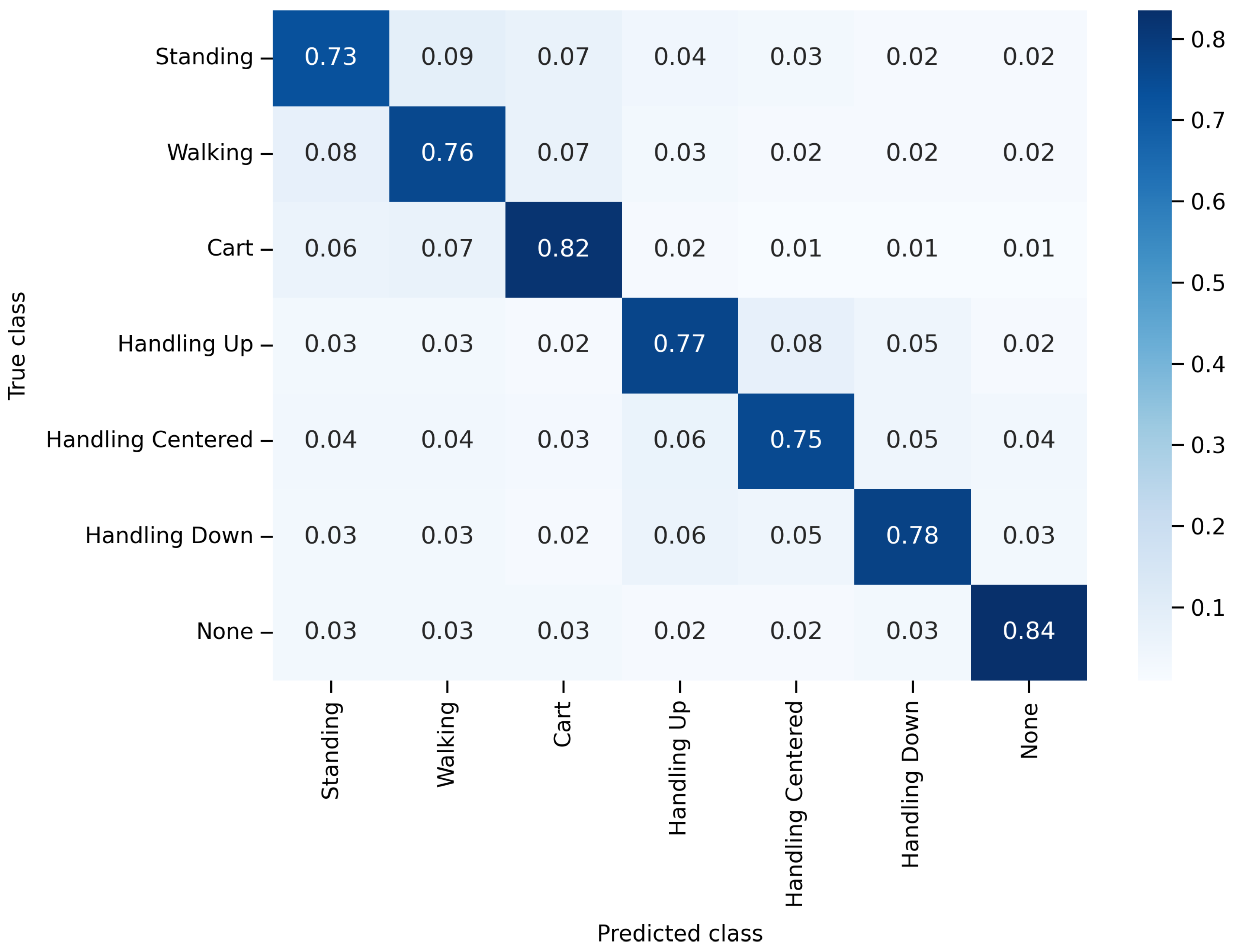
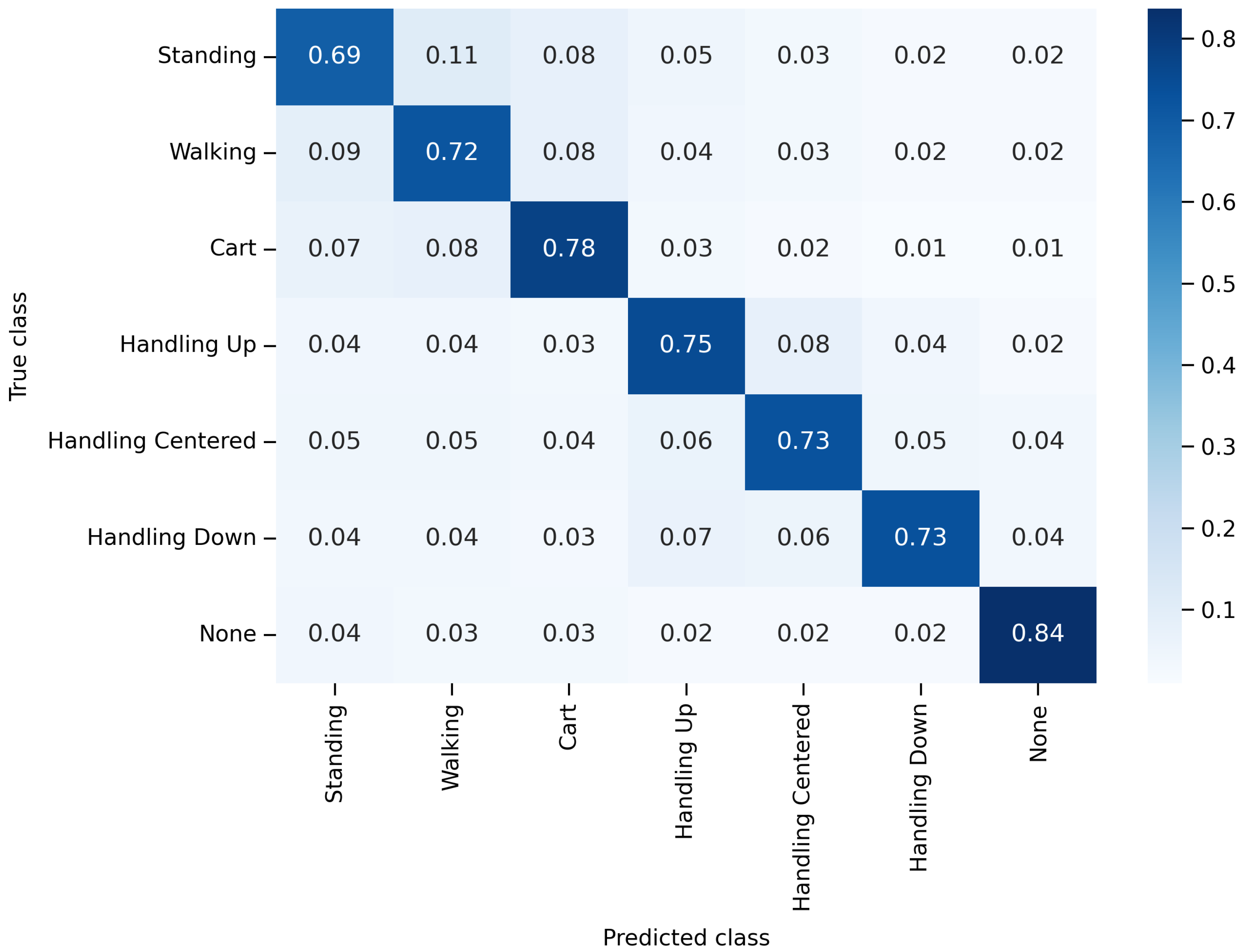
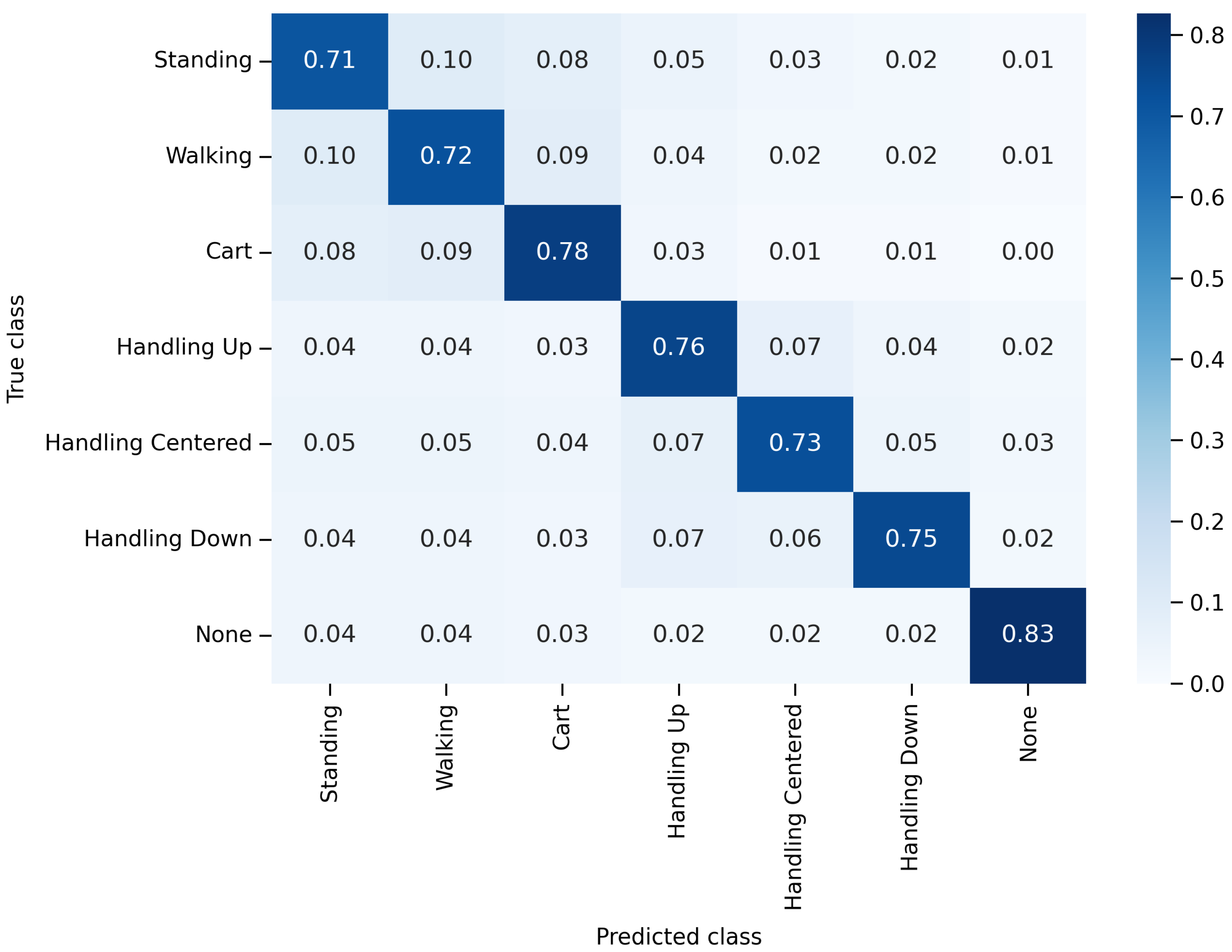
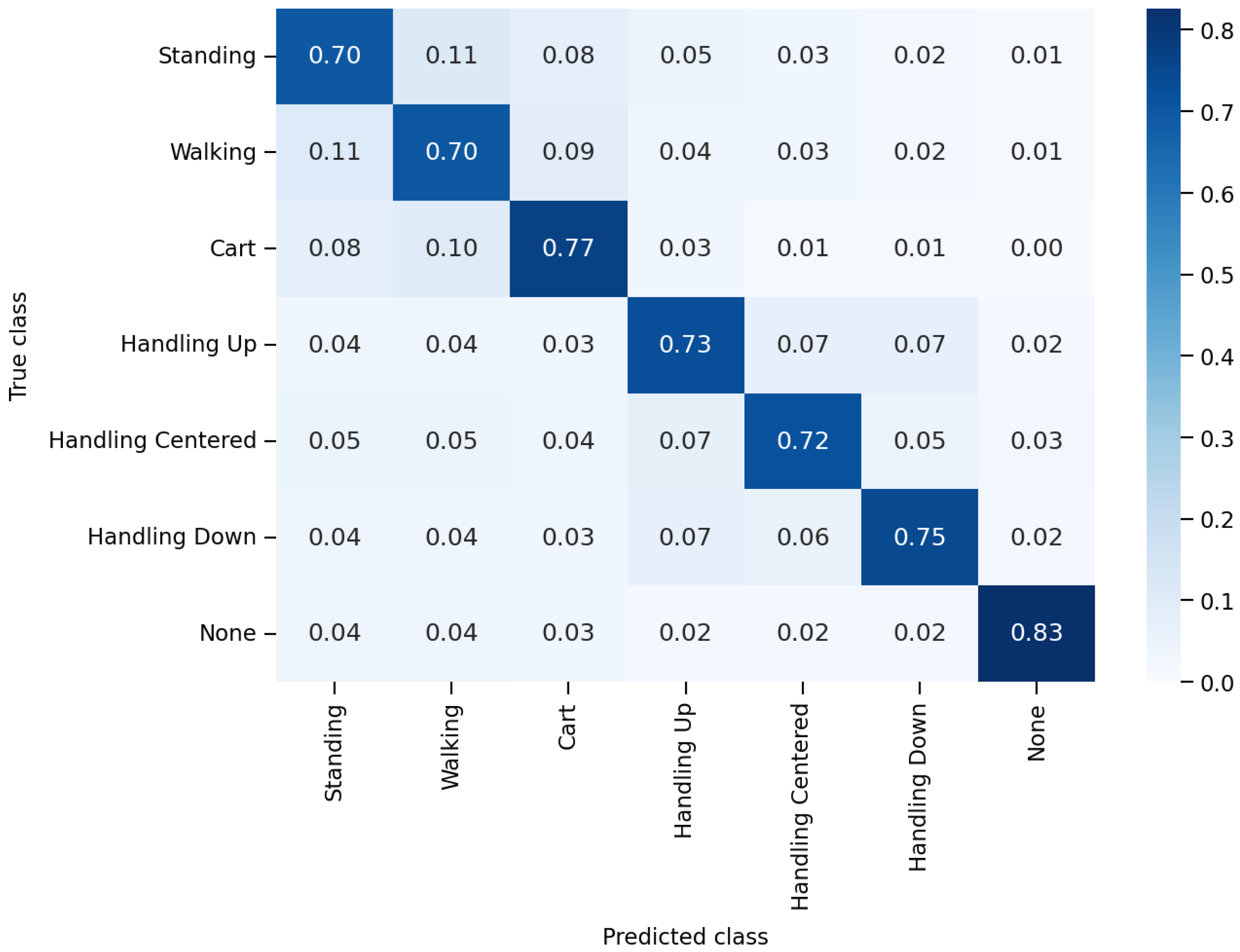
Among the evaluated models, the tCNN architecture consistently achieved the best quantitative performance, with an overall accuracy of approximately 79% and balanced macro and weighted F1-scores across the seven motion classes. ConvLSTM and Transformer models achieved intermediate performance, while the CNN–LSTM architecture displayed reduced accuracy, particularly for classes involving rapid kinematic transitions. These results indicate that temporal convolutional models are particularly effective at capturing short-range motion dynamics that characterize logistics tasks, such as object handling, posture adjustments, and rapid arm repositioning. Architectures centered on sequential memory or global attention may require additional contextual inputs to disambiguate subtle differences between visually or kinematically similar activities.
The analysis of classification errors underscores the critical role of temporal feature extraction in distinguishing activities with overlapping postural or transitional patterns. In logistics workflows, many tasks—such as handling objects at different vertical levels—exhibit similar joint configurations, which increases the risk of misclassification when the temporal dynamics of movement are not adequately captured. By employing dilated temporal convolutions, the tCNN model effectively encodes both fine-grained, rapid motions and longer-term temporal structures, thereby reducing confusion between semantically related activities and improving overall class discrimination.
These findings are consistent with prior research on HAR in industrial environments, including studies based on the LARa dataset [
15]. Earlier work reported a baseline accuracy of approximately 69% and a weighted F1-score of around 64%, with considerable variability across activity classes. In comparison, the substantially improved performance observed in the present study underscores the effectiveness of end-to-end temporal feature learning over conventional static or shallow classification approaches for multichannel motion data. Deep temporal architectures are particularly well-suited to modeling the sequential nature of physical activities, which is essential in logistics workflows characterized by structured yet variable temporal dependencies. The best-performing model in our study (tCNN) achieves an accuracy and an F1-score of 79%, representing a significant improvement over the benchmark. Gains in recall are even more pronounced, with a 78% indicating a markedly enhanced sensitivity in detecting activity instances, especially for under-represented and transition-heavy classes. Importantly, these improvements are consistent across all evaluated architectures. Even the lowest-performing ConvLSTM performs better than the benchmark (77% vs. 69% in accuracy and 76% vs. 64% in F1-score) [
15]. This consistency indicates that the observed performance gains are not attributable to a specific model, but rather arise from fundamental methodological differences, particularly in multiscale feature learning. In contrast to prior approaches based on handcrafted kinematic features and semantic attribute aggregation, the proposed models learn discriminative representations directly from raw multichannel motion signals through end-to-end temporal learning. This approach preserves fine-grained spatiotemporal information that is often lost in feature-engineered pipelines, which is crucial for capturing subtle motion patterns in logistics workflows. A key factor driving the superior performance of the proposed tCNN is its multiscale temporal architecture, explicitly designed to address the heterogeneous temporal structure of human motion. The architecture consists of two complementary convolutional branches with distinct functional roles. The first branch is designed to capture fine-grained, high-frequency motion details by employing short temporal strides and minimal dilation. This configuration preserves temporal resolution and enables the detection of subtle, rapid kinematic variations, such as arm repositioning, grasp initiation, or micro-adjustments in posture. These motion components are often critical for distinguishing between semantically similar activities, yet are typically overlooked by coarse temporal models. In contrast, the second branch is designed to capture broader temporal dependencies by employing larger strides or dilated convolutions, thereby reducing temporal resolution. Although this results in some loss of local detail, it enables the model to encode long-range temporal context, including posture evolution and task-level dynamics. This global perspective is essential for differentiating activities that share similar local motion patterns but differ in their overall structure or duration. By integrating the outputs of these two branches, the multiscale tCNN effectively captures both micro-level motion details and macro-level temporal structure, achieving a balance between temporal precision and contextual awareness. This capability is largely absent in both the benchmark method of [
15] and conventional single-scale deep architectures, providing a clear explanation for the consistent performance improvements observed across evaluation metrics and activity classes.
Class imbalance and rare states represent another important factor influencing model behavior. Some activities occur infrequently or correspond to transitional states, making them difficult to recognize reliably. In this work, the discussion focused primarily on operational activity classes, excluding background states for interpretability. However, including these rare or irregular classes in future analyses will be essential for assessing real-world performance, especially in unconstrained environments where non-operational movements frequently occur. The results also underscore the importance of evaluation protocols that replicate real deployment conditions. HAR systems often exhibit inflated performance when training and testing data share subjects. By adopting a subject-independent protocol such as leave-one-subject-out, this study emphasizes generalization across workers with different anthropometric characteristics, movement strategies, or task execution styles. Robustness to such inter-subject variability is critical for occupational health monitoring systems intended to function reliably across diverse workforces.
Despite the promising results, several limitations should be acknowledged. First, the experiments relied solely on optical motion-capture signals. Real-world industrial environments may benefit from multimodal sensing—including inertial measurements, RGB video, or contextual descriptors of the workstation—to increase robustness in the presence of occlusions or sensor noise. Second, the models were evaluated offline, and practical deployment would require addressing real-time constraints related to computational efficiency, latency, and system integration. Third, while confusion matrices reveal high-level patterns of misclassification, further interpretability studies would be valuable for understanding the motion features driving model decisions, an aspect especially relevant for ergonomic and safety-critical applications.
Although the proposed models demonstrate robust performance under a strict leave-one-subject-out protocol, the present study does not constitute a full real-world deployment or in-field validation. The experiments were conducted offline using high-quality optical motion-capture data collected under controlled yet realistic logistics workflows. Consequently, additional sources of variability commonly encountered in operational environments—such as sensor occlusions, calibration drift, environmental noise, asynchronous data streams, and real-time computational constraints—were not explicitly evaluated. As a result, the reported performance should be interpreted as evidence of methodological robustness and cross-subject generalization under favorable sensing conditions, rather than as a direct measure of deployment-ready performance. While subject-independent evaluation addresses an important aspect of generalization, further validation steps are required to assess long-term reliability and operational robustness in real industrial settings.
Future work could extend the framework in several directions. Integrating semantic or contextual information, such as object type or workstation configuration, may improve recognition of activities with similar motion signatures. Multimodal fusion strategies combining OMoCap, IMU data, and visual cues could enhance robustness in realistic industrial environments where sensing conditions are variable. Additionally, self-supervised or semi-supervised learning could help exploit large quantities of unlabeled motion data, improving generalization while reducing annotation effort.
Beyond algorithmic advances, the practical relevance of this research lies in its potential to support unobtrusive monitoring systems that prevent biomechanical overload. Continuous quantification of worker activities can inform ergonomic assessments, identify repetitive or high-risk movements, and enable proactive interventions to reduce work-related musculoskeletal disorders. Integrated within digital human modeling frameworks or smart manufacturing platforms, AI-based activity recognition may form the foundation of next-generation occupational safety solutions in Industry 4.0 and Industry 5.0 environments. In summary, this work demonstrates that deep temporal architectures applied to optical motion-capture data can effectively recognize and quantify worker activities relevant to biomechanical workload assessment.
The results confirm the potential of AI-driven motion analysis to capture complex, multiscale patterns in logistics workflows. Continued research incorporating contextual information, multimodal sensing, and real-world validation is essential to develop reliable and scalable ergonomic monitoring systems for smart industrial settings.
6. Conclusions
Recent advances in sensing technologies and artificial intelligence are reshaping the monitoring of occupational safety and worker activities in modern industrial environments. Unobtrusive sensing platforms, combined with data-driven analytics, enable continuous observation of physical work activities without interfering with operational processes. This shift supports a transition from subjective observations toward more objective and quantitative assessments of physical workload and biomechanical demands.
In this study, we investigated the capability of deep temporal architectures to analyze multichannel optical motion-capture data for recognizing and characterizing worker activities associated with biomechanical load. Experimental results demonstrate that modern deep learning models—particularly temporal convolutional networks—are able to learn discriminative multiscale temporal representations of human motion and achieve reliable activity recognition under subject-independent evaluation. These findings confirm the effectiveness of convolution-based temporal modeling for processing complex motion signals in a controlled experimental setting.
Beyond the specific models evaluated in this work, the combination of unobtrusive sensing technologies and AI-based analytics provides a useful framework for advancing research in computational ergonomics and human activity analysis. Continuous motion analysis can support the identification of repetitive or ergonomically demanding movement patterns and facilitate quantitative workload assessment, thereby contributing to a better understanding of biomechanical risk factors in industrial tasks. When combined with digital human modeling and ergonomic assessment tools, such approaches may further support the development of data-driven methods for workplace safety analysis. At the same time, the translation of AI-based monitoring systems beyond controlled experimental settings requires careful consideration of several practical aspects, including robustness under varying conditions, model interpretability, and responsible data handling. Ensuring consistent model performance across different users and environments remains an important research challenge, as does improving the transparency of model decisions. In parallel, privacy-preserving data processing and appropriate governance frameworks are important considerations for the responsible use of sensing-based human activity data.
Overall, this work highlights the potential of deep learning and unobtrusive sensing technologies for enabling more detailed and quantitative analysis of worker activities in industrial contexts. By capturing the multiscale temporal structure of human motion and demonstrating reliable subject-independent recognition in experimental evaluations, AI-driven motion analysis methods provide a basis for further research in this area. Future work may investigate the incorporation of contextual information, multimodal sensing, and efficient modeling strategies to further improve the robustness and generalizability of such approaches.