1. Introduction
Millions of individuals around the world of various ages and different languages suffer from some of the worst communication disorders, one of them being the most severe of them all: stuttering. Fluency is disrupted, and speech becomes convoluted. Stuttering is the inability to ward off misguided involuntary repetitions, long stretches of speech, and speech blocks. Current studies suggest that 5% of the world’s population stutters, and of this population, up to 2.5% are children under 5 years of age [
1]. Stuttering is complex and must be accurately diagnosed where the speech therapist must analyze and interpret the detailed speech samples provided. In doing this, stuttering ranges and fluctuations are common, and constellations are much more abundant. Therefore, clinicians often find themselves in a state of conflict. Artificial Intelligence (AI) is being developed to assist in automating stuttered speech to classify speech as fluent or disfluent [
1].
Although AI-based speech recognition systems have greatly progressed, most systems remain focused on English speakers. Although there are multilingual systems, low-resourced languages, such as Arabic, still struggle with insufficient training data and poor adaptation [
2]. Numerous approaches to stuttering detection operate under the assumption of merely complex transcription models, and so, fall short. This gap is created by the absence of Arabic speech datasets, the scarce deployment of AI systems in the domain of speech therapy [
1], and the issue of classifying speech disfluencies [
3]. Given the scarcity of major high-quality Arabic speech datasets, especially those about stuttering, the present study makes a significant contribution to the field by compiling one of the largest and most clinically relevant Arabic stuttering corpora to date. This resource meets an essential need in speech-language research, providing an excellent starting point for future work. Clinical, linguistic, and computational studies are all to be developed based on this resource.
The primary objective of this paper is to propose a specialized AI-based system for Arabic stuttering classification, capable of detecting and classifying stuttering in Arabic speech. The purpose of this system is to analyze speech inputs, transcribe them, and classify each segment as fluent or disfluent, thereby improving automated assessment and diagnosis of stuttered speech and therapy. As a first step, the present work addresses the binary fluent/disfluent task, leaving fine-grained classification of specific disfluency types to future work. This research will contribute to the field in the following ways:
Establish the first systematic, controlled comparison of the full Whisper family (Tiny–Large) against the full Wav2Vec2.0 family (Base–XLarge) for binary fluent/disfluent classification of Arabic stuttered speech, under identical preprocessing, speaker-independent splits, and evaluation metrics.
Expand and refine the dataset by incorporating 10 h of annotated Arabic stuttering speech and an additional 10 h of fluent speech. This resource serves as a foundation for future AI research and applications in speech therapy and disorder detection.
Employ the Whisper model by adapting the encoder-freezing plus lightweight classification-head paradigm specifically to Arabic, with Arabic-tuned preprocessing (single-speaker filtering, 10-s overlapping windows, Wiener-filtered denoising) and a Whisper-assisted, human- and clinician-verified annotation pipeline to address low-resource label scarcity.
The rest of the paper is organized as follows. In
Section 2, the foundational concepts and reviewed works are discussed.
Section 3 introduces the proposed method. In
Section 4, we conduct a detailed experimental analysis to evaluate the performance of the proposed method.
Section 5 discusses the findings, their clinical implications, limitations, and future work. Finally,
Section 6 concludes the paper.
2. Literature Review
Stuttering is a speech disorder characterized by interruptions in fluency such as repetitions, prolongations, and silent pauses, which can hinder communication and reduce self-confidence. Traditional assessment methods by speech-language pathologists rely heavily on manual annotation of speech samples and behavioral evaluations, which are accurate but time-intensive and prone to subjectivity. Stuttering assessment is not limited to measuring repetitions, prolongations, or pauses. A clearer understanding also depends on the speaker’s background, the context in which disfluency appears, and the possible factors behind the disorder. This broader perspective can guide researchers and developers in building more useful tools for people who stutter and in exploring areas of stuttering research that remain underdeveloped.
Modern stuttering-detection systems build on pre-trained Automatic Speech Recognition (ASR) models. Whisper is a transformer-based encoder–decoder ASR system trained on 680,000 h of weakly supervised multilingual data [
2], and it is considered as a family of models (Tiny to Large). Wav2Vec2.0, by contrast, is a self-supervised model that learns contextualized representations directly from raw audio waveforms [
4]. Both architectures have become common backbones for downstream speech tasks, including disfluency and stuttering detection, and they form the two model families compared in this study.
These backbones can be specialized to new languages and tasks through fine-tuning. Open toolkits such as the Whisper fine-tuning framework [
5] streamline adapting the pre-trained Whisper models to specific languages and datasets, supporting scalable deployment. Work targeting Arabic speech disorders, however, remains scarce. Boughariou et al. [
6] propose a machine-learning-guided framework for detecting speech disorders in spontaneous Tunisian-dialect speech, combining rule-based preprocessing with classifiers that handle code-switching between Modern Standard Arabic and French. Their study is one of the few addressing an Arabic dialect, but it does not employ ASR-based representations and is restricted to Tunisian speech.
Both backbones have been adapted for stuttering and related tasks, though with different trade-offs. Wav2Vec2.0 yields powerful self-supervised features but is comparatively demanding to fine-tune. Vaessen and van Leeuwen, for instance, adapt it to speaker recognition [
7]. Whisper is cheaper to specialize, because much of its pre-trained encoder can be kept frozen while only the upper layers and a small head are trained. This selective layer-freezing strategy preserves accuracy while cutting the number of trainable parameters [
8], and layer-wise analyses of the Whisper encoder show that its deeper layers carry the disfluency-related information that such adaptation should target [
9]. Beyond the choice of backbone, performance also depends on careful audio preprocessing, analog-to-digital conversion, fast Fourier transform and Short-Time Fourier Transform (STFT) analysis, Mel-Frequency Cepstral Coefficient (MFCC) extraction, and denoising [
10], where Wiener filtering followed by MFCC extraction is a common front-end for noisy speech [
11].
Not all stuttering-detection systems rely on ASR backbones. A parallel line of work uses dedicated acoustic architectures. FluentNet [
12] bypasses ASR entirely, operating on STFT-based spectrograms with SE-ResNet and bidirectional long short-term memory layers and attention to detect multi-label disfluencies across datasets, while a two-stage deep neural network classifier combines MFCC features with disfluent-segment localization [
1]. Closest to the present work, Whister [
13] builds on frozen Whisper encoder outputs by adding a feature-extraction block and classification heads, reporting up to 22% higher F1-scores than FluentNet and StutterNet on benchmark datasets. These results demonstrate the value of reusing robust pre-trained ASR encoders for disfluency classification, an idea we extend to Arabic, where phonetic and dialectal variation calls for dedicated treatment.
In [
14], Al-Banna et al. conducted a thorough analysis of the application of various machine learning classifiers, focusing on the automated detection of stuttering disfluencies. The analysis relied on two publicly accessible benchmark datasets: FluencyBank and SEP-28k. The classifiers were evaluated for their proficiency in detecting speech disfluency. Classifiers such as Random Forest and Support Vector Machine were assessed across a comprehensive set of metrics, including accuracy, precision, recall, F1-score, and area under the curve. In this class, a Random Forest classifier achieves 50.3% accuracy on FluencyBank and 50.35% on SEP-28k. There is moderate performance across all other metrics, suggesting a range of issues, including technological problems with traditional machine learning approaches. The authors attributed these problems and barriers primarily to factors such as speech rate, oral cavity configuration, and age variability, which impact the cohesiveness of machine learning classification. They suggested that the use of ASR is considerably augmented by Deep Learning (DL), which they described as the counter-deep-learning paradigm that merges traditional DL approaches and would significantly enhance the underlying detection precision of profoundly skewed speech datasets. This indicates that the sophisticated machine learning techniques for future speech data remain to be unveiled.
Additionally, ref. [
15] provided useful information on the use of AI and computational intelligence within the scope of automatic stuttering detection. This systematic review describes 14 publications in the journals concerning computational phonetics and stuttering, defining databases crafted in the timeframe 2019–2023. The review suggested the increasing use of AI, machine learning, and DL in feature classification of stuttering disfluency. This study highlights the challenges of manual assessment and practical limitations, as well as the possibility of human error, and for that reason, we emphasize the importance of automated systems. In addition, the review highlighted several challenges in this domain, including the scarcity of stuttering datasets, imbalance in data distribution, variation in disfluency types, and the difficulty of distinguishing stuttering-related disorders from normal speech disfluencies. Most existing studies focus on English datasets, while Arabic stuttering data remains very limited. This lack of data makes it difficult to conduct analyses and identify the most suitable methods for studying and detecting stuttering in Arabic speech.
In addition, the authors of [
16] developed a pipelined Deep Learner-Dual Classifier (PDL-DC) to evaluate speech fluency. The approach merges a DL architecture comprising convolutional auto encoders with super learner models to detect and classify disfluencies and fluency disorders like stuttering, specific language impairment, and normal speech. Using the UCLASS dataset [
17] for evaluation, the model produced satisfactory results with an average accuracy, precision, and recall of 97% and above. The researchers also addressed the difficulty in distinguishing similar fluency disorders through detailed acoustic and glottal feature analysis, showing the model’s significant improvement over traditional methods. This framework thus equips clinicians with another automated and trustworthy mechanism for swift and accurate speech impairment evaluations that can be added to existing methods to improve patient outcomes.
Use cases for speech disfluency detection are drawn from the research in [
18]. To address the lack of annotated datasets, the authors apply a set of methods such as balancing the class distributions, filtering for higher inter-annotation agreement, and using Wav2Vec2.0 embeddings extracted from a contextual representation. They designed a DL architecture called DisfluencyNet that takes advantage of these contextual embeddings for classification.
These findings proved that DisfluencyNet is able to surpass the previous baseline results for different sets of speech disfluency detection techniques with as low as 25% of the SEP-28k training dataset in terms of delta. Most of the disfluency types reached 0.7 for the F1 scoring threshold. Also, the model is robust with respect to generalization for another dataset, FluencyBank, which showed the model is still able to retain its main functionality. The research highlights the problem of low-quality data annotations and suggests that powerful classifiers can be trained on meticulously assembled datasets. With such classifiers, the technology can support users with speech disfluencies.
Alongside speech-centric stuttering detection systems, new studies have looked into how AI-integrated writing aids can help People Who Stutter (PWS) cope with stuttering-induced communication anxiety. For instance, Fluent is an intelligent script-assistance tool [
19], that helps users eliminate words that they may have challenges pronouncing. It features an active learning-based classifier that learns through user active engagement, which highlights words that may pose challenges, along with easier phonetic, yet synonymous alternative words. The aim of Fluent is to reduce the emotional and mental effort caused by word substitution. PWS often use this strategy to avoid difficult words, but it can become tiring, especially in stressful situations. In the first 20 interactions, Fluent reached a mean accuracy of 80% in identifying difficult words for simulated users. Although the system focuses on written preparation rather than real-time speech, it still shows how AI can support PWS when preparing for presentations, meetings, or other stressful communication tasks.
In various languages and contexts, multiple datasets have been constructed to facilitate research in speech processing and disfluency detection. For instance, LibriStutter provides audiobook speech recorded by fluent English speakers, which is primarily used for ASR tasks [
12]. There are also the UCLASS and FluencyBank datasets which include conversational transcription data of English-speaking adults and children who stutter. The SEP-28k dataset consists of English podcast recordings used for stuttering event detection and lacks transcription [
20]. The KSoF dataset is composed of spontaneous and reading speech samples in German recorded from speakers who stutter and is also devoid of transcriptions [
21]. There is also the AS-70 dataset [
22], which comprises adults who stutter in Mandarin and is complete with conversational and voice command tasks prescribed with detailed verbatim transcription.
There are notable gaps in the current literature. LibriStutter, UCLASS, FluencyBank, and SEP-28k target English, KSoF targets German, and AS-70 targets Mandarin, while only DisCoTAT [
23] covers Arabic, and only the Tunisian dialect. However, our work covers a 20-hour, clinically curated, multi-dialect Arabic stuttering corpus covering Modern Standard Arabic plus the Gulf, Egyptian, and Maghrebi dialect families, and including children, teens, and adults. In addition, Whister uses a frozen Whisper encoder with a classification head but is evaluated only on English, and FluentNet bypasses ASR entirely. The Random Forest/SVM study, the PDL-DC pipeline (UCLASS), and DisfluencyNet (SEP-28k) all rely on traditional or non-ASR classifiers on English data. This paper adapts the encoder-freezing plus lightweight classification-head paradigm specifically to Arabic, with Arabic-tuned preprocessing and a Whisper-assisted, human- and clinician-verified annotation pipeline to handle low-resource label scarcity. Moreover, no prior systematic comparison of the full Whisper family against the full Wav2Vec2.0 family on Arabic stuttering. Our study presents the first controlled Whisper (Tiny–Large) vs. Wav2Vec2.0 (Base–XLarge) benchmark for Arabic stuttering classification under identical preprocessing, data splits, and evaluation metrics.
3. The Proposed Method
The targeted AI-based system for classifying stuttering in Arabic speech is accomplished using the Whisper ASR model built by OpenAI (large-v2; available online:
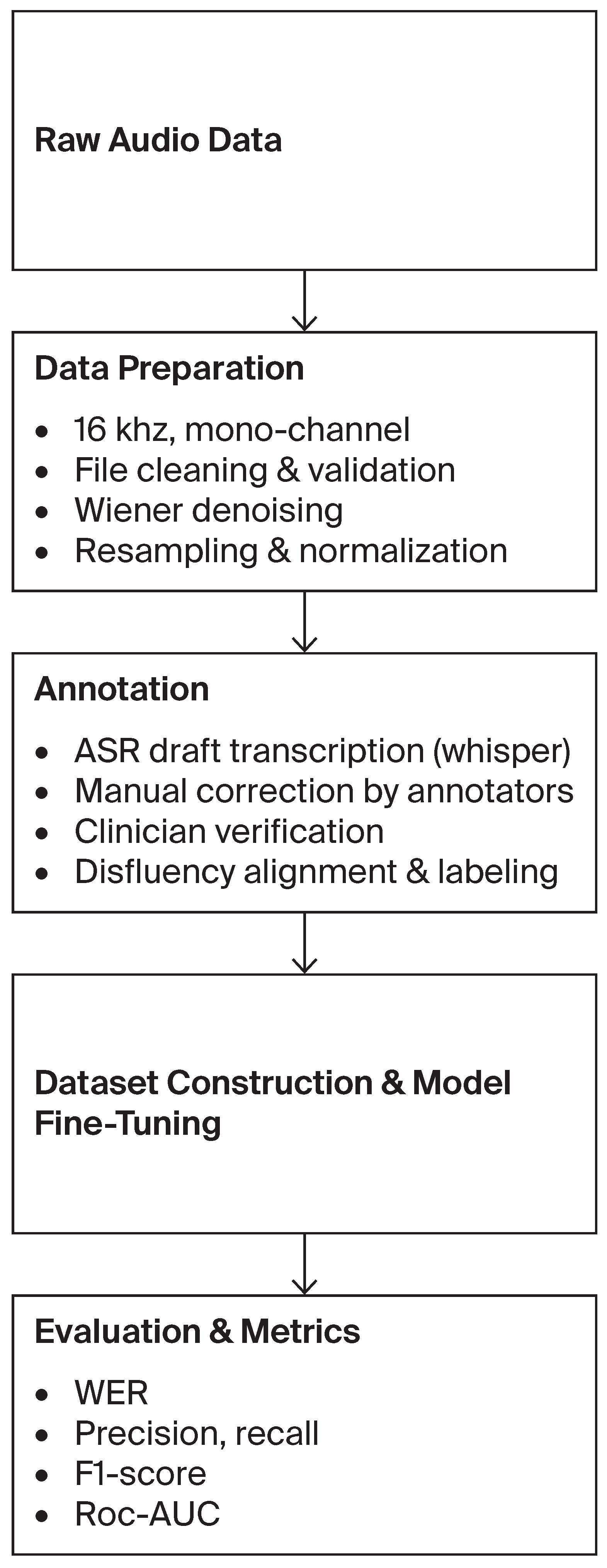
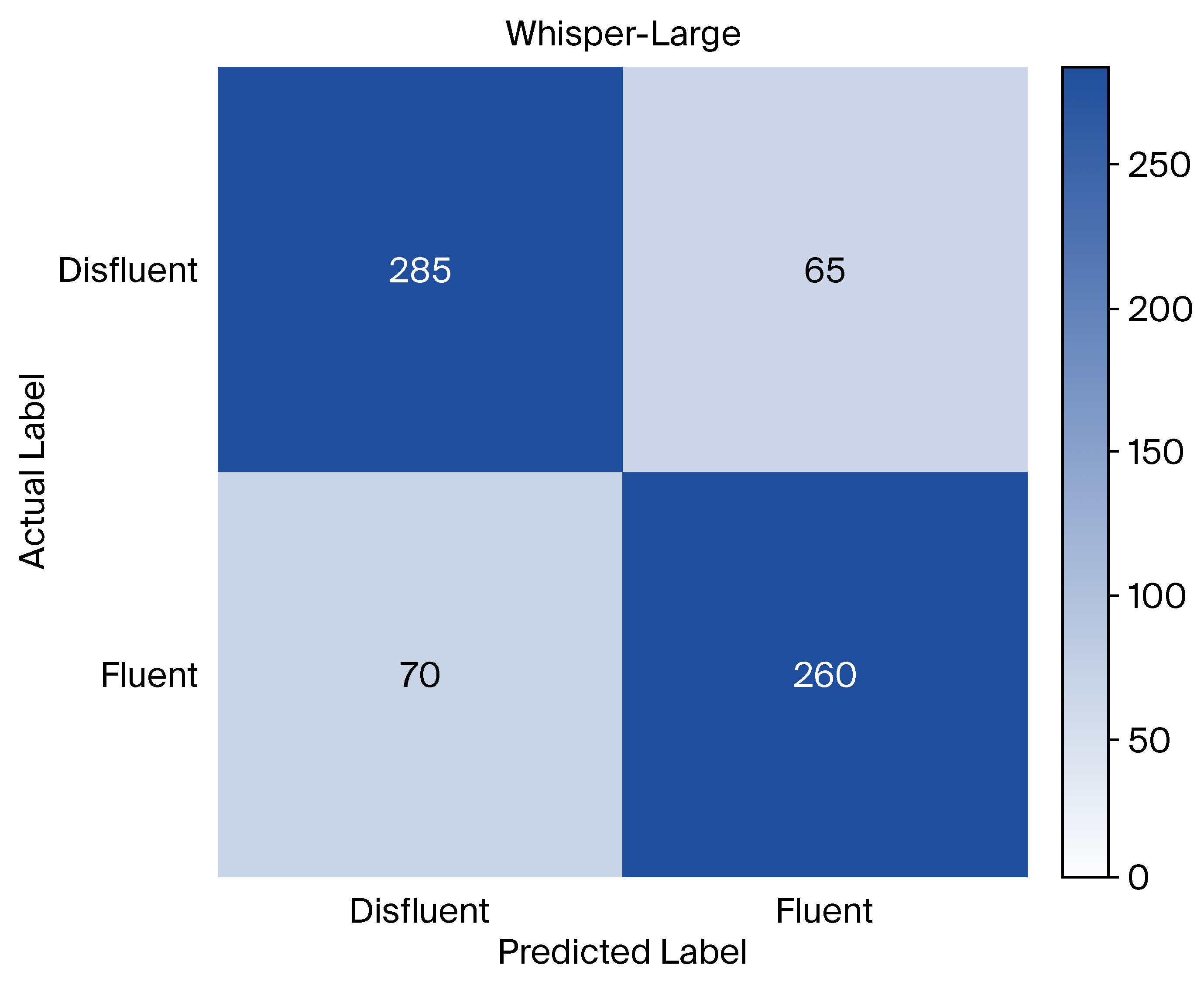
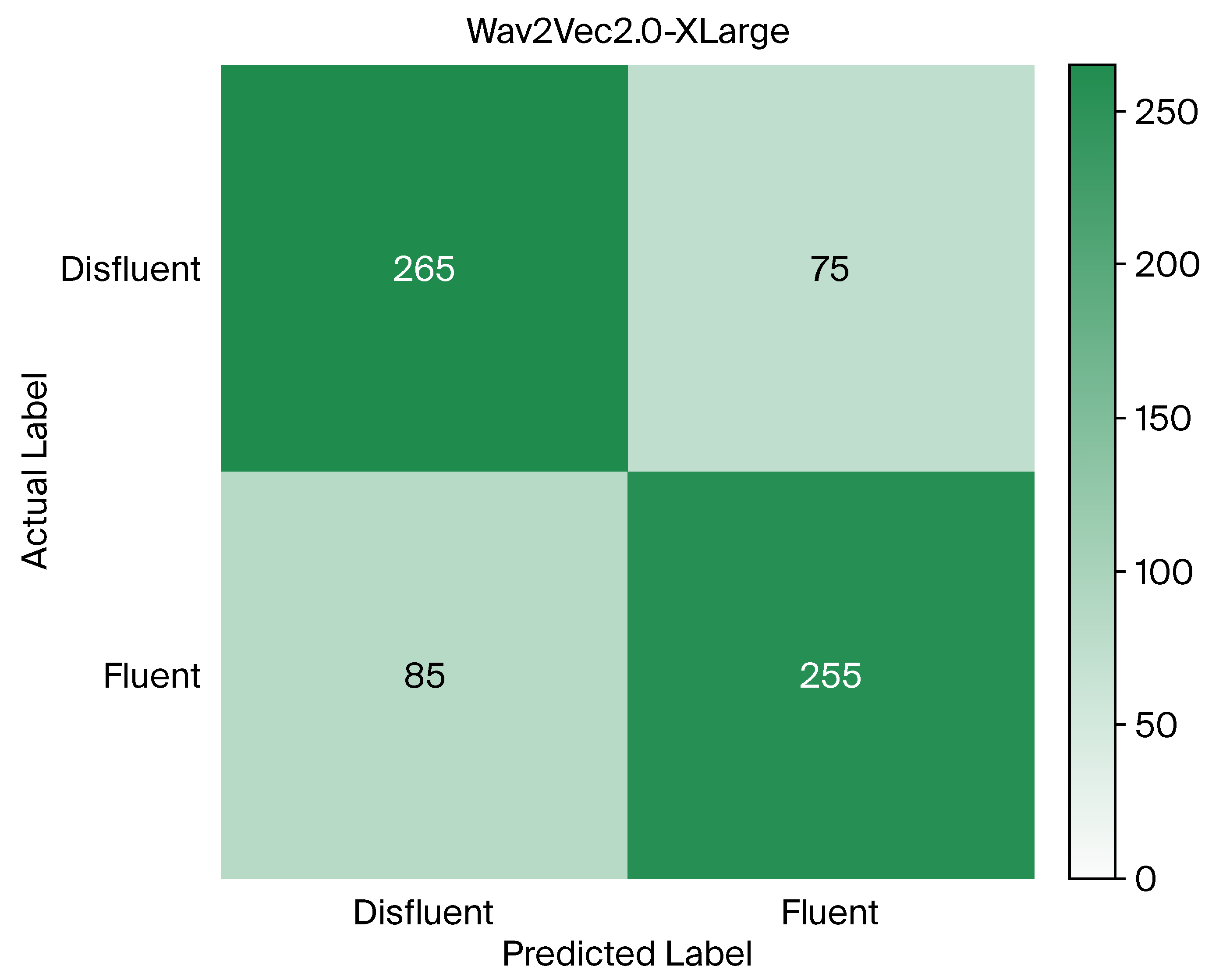
https://github.com/openai/whisper, accessed on 7 March 2025). The system classifies each Arabic speech segment as fluent or disfluent, where disfluent segments may contain stuttering intervals, filler words, or prolongations. The pipeline is illustrated as a linear process from the collection of raw audio files containing both stuttering and fluent speech to final model building. In the next phase, under data preparation, audio files containing stuttering are processed using fluent-speech components. This includes cleaning, normalizing and shaping the audio files. The next step is called processing with noise and resampling. The prepared data is employed for fine-tuning the Whisper model for stuttering detection and transcription. Finally, model performance is evaluated with performance metrics F1-score and Word Error Rate (WER), respectively, while the confusion matrix was also considered for misclassification analysis.
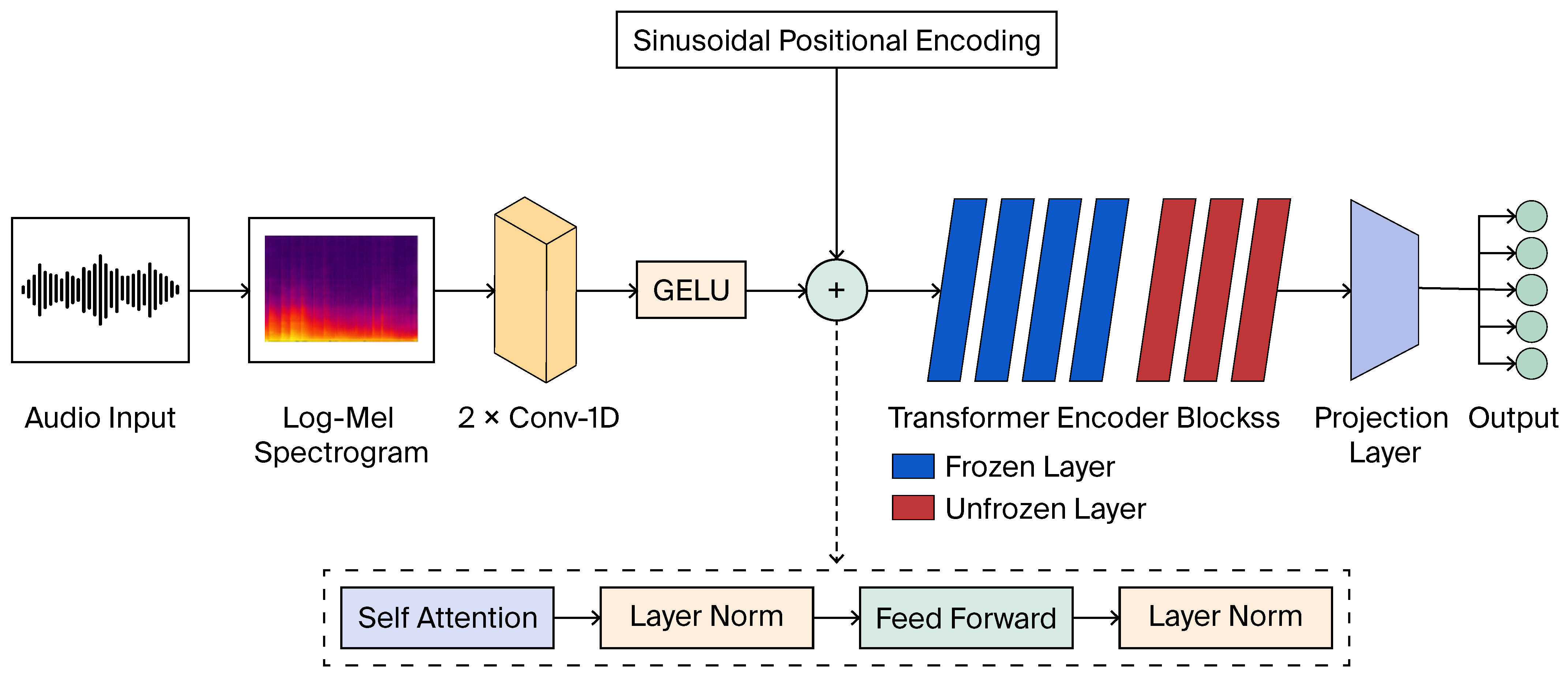
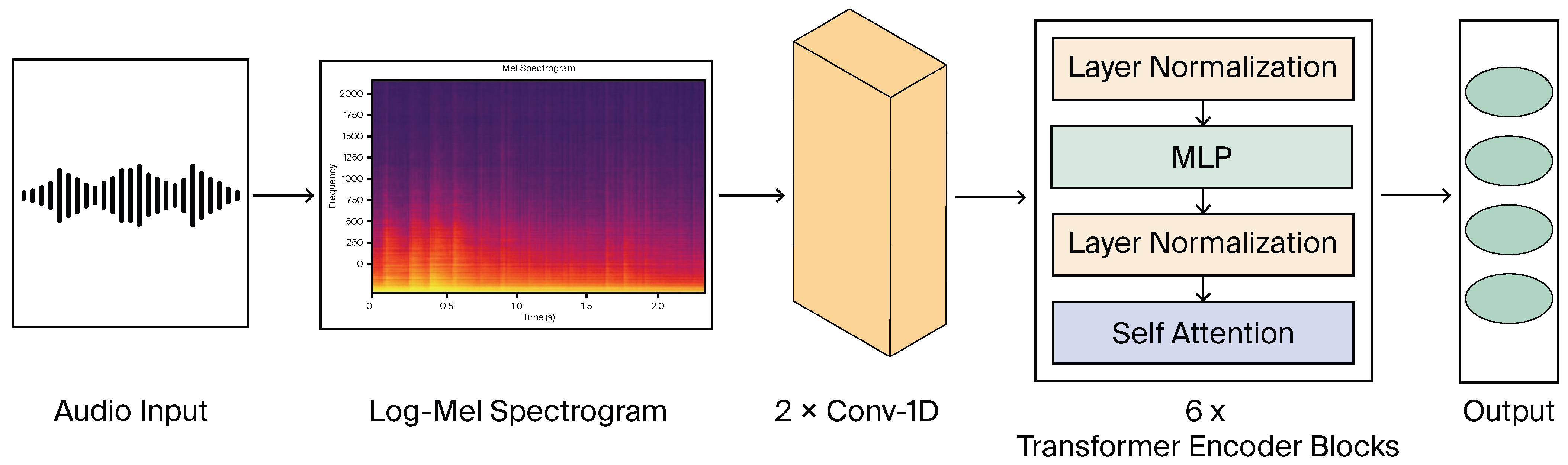
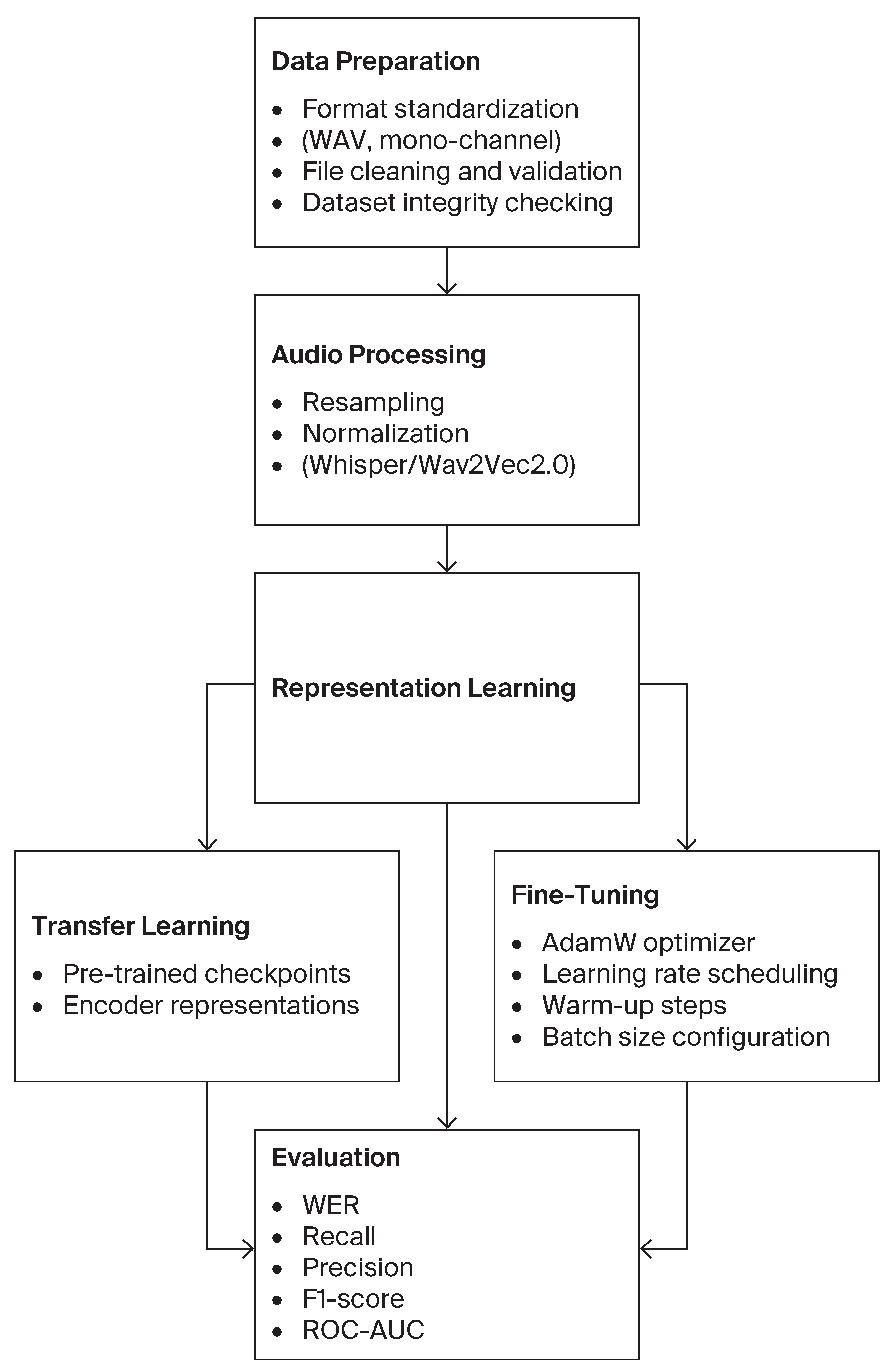
Whisper has not been explicitly trained on the nuances of stuttering speech. Thus, fine-tuning is essential to adapt it for this task. This can be done using the ‘freeze and unfreeze’ technique for layers during training, as depicted in
Figure 1. During the first pass, the essential ASR layers are frozen to maintain the model’s overall transcription functionality while the other layers are trained on Arabic stuttering speech. This way, overfitting is minimized, and the model learns to identify stuttered disfluencies without failing to recognize fluent speech [
8]. The early encoder layers, which capture general acoustic and phonetic representations, are frozen to preserve Whisper’s transcription capability, while the later layers are unfrozen and adapted to Arabic disfluency detection.
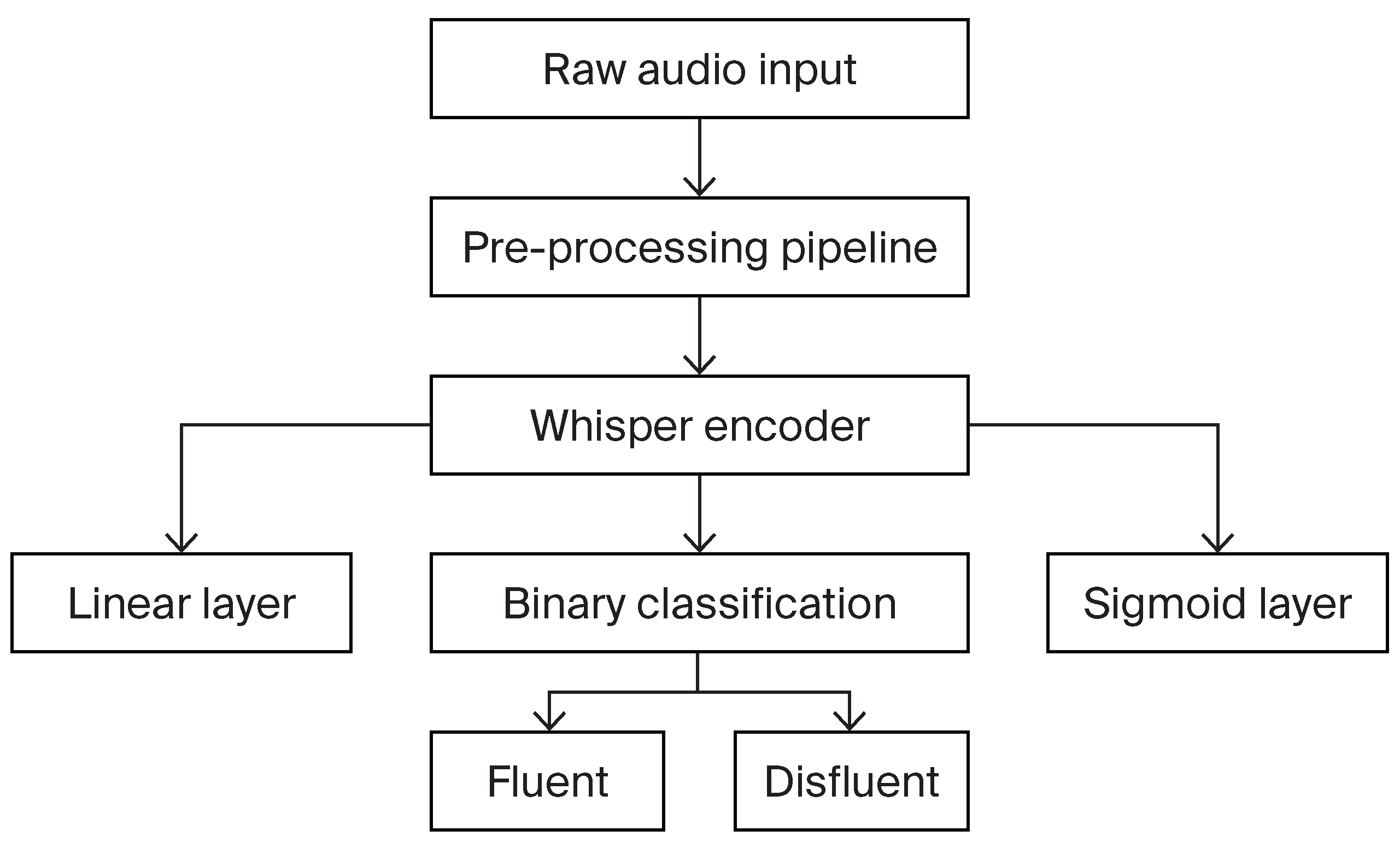
Furthermore, by changing Whisper using progressive layer freezing and unfreezing, a lightweight classification head is added on top of Whisper’s final hidden representations, as shown in
Figure 2. The head enables the system to make fluent–disfluent decisions for each audio chunk. Concretely, the encoder’s final hidden states are aggregated by temporal mean-pooling into a single utterance-level embedding, which is passed through a dropout layer (rate 0.1) and a single fully connected linear layer that projects to two output units (fluent, disfluent) followed by a softmax. The model is trained with cross-entropy loss. The head is deliberately lightweight, adding only on the order of
parameters (where
d is the encoder hidden width) on top of the pre-trained encoder, so that the fluent–disfluent decision reuses Whisper’s pre-trained representations rather than replacing them.
The layer, width, head, and parameter counts for each Whisper variant are summarized in
Table 1 [
2]. Because only the unfrozen upper layers and the classification head are updated, the number of trainable parameters is substantially smaller than each model’s nominal size reported in
Table 1. The classification head itself adds only
parameters per model (for example, 2562 parameters for Whisper-Large, whose hidden width is
), so the added capacity is negligible relative to the pre-trained backbone.
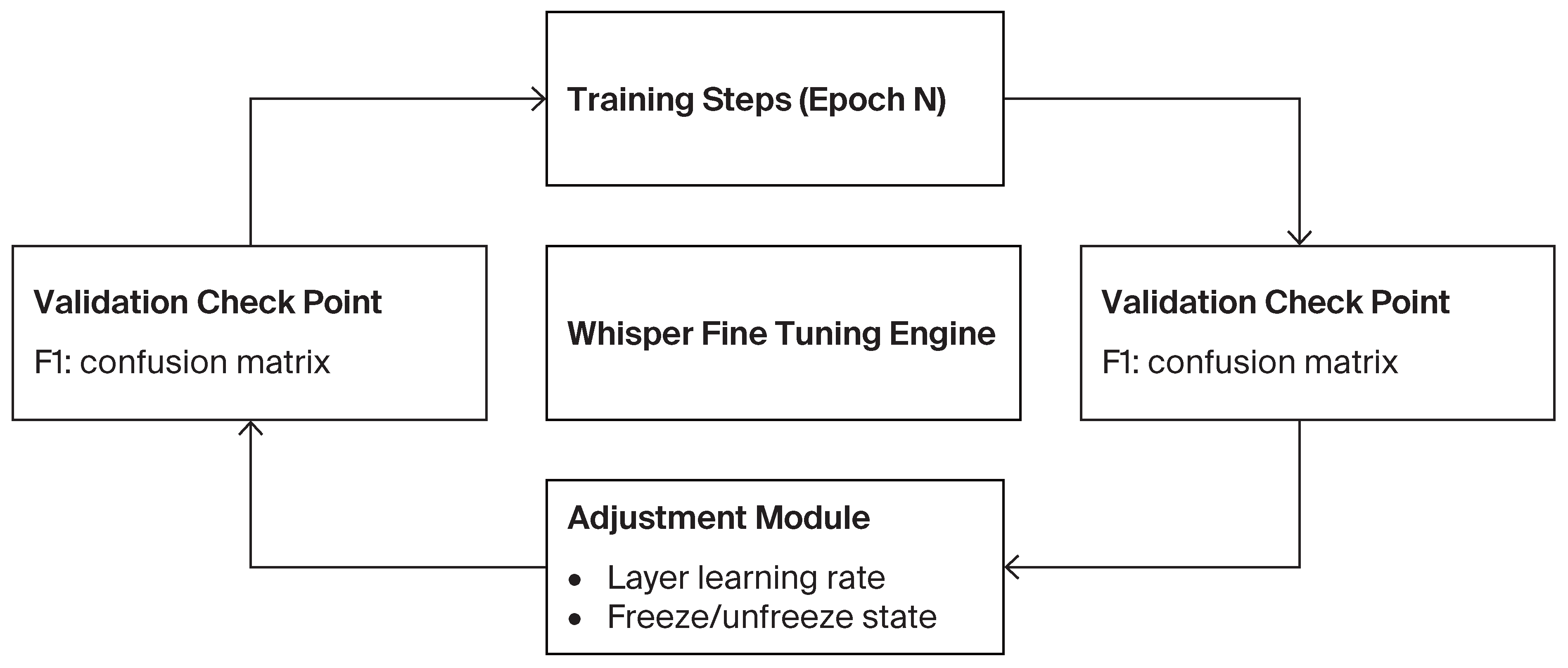
We monitored the results to see whether the model was starting to overfit. This was important because the model needed to work on recordings made under different conditions, not only on the training data. The same validation checks also gave us an indication of training stability, as shown in
Figure 3.
During training, additional layers are thawed, enabling the model to grasp better patterns related to stuttering. This incremental modification guarantees that Whisper continues to accurately recognize overlapping Arabic speech while enhancing its efficiency in disfluency categorization. However, the Whisper architecture specifics depend on the model family. Whisper’s shard architecture enables the model to be optimized for classifying Arabic stuttering by performing coarse fine-tuning. Substantial supervised training is sidestepped while precision is still enhanced.
For the stuttering detection, the current model is set in place with a single-label binary classification framework, where each audio clip is tagged as either fluent or disfluent. This embodies the first phase in the development pipeline, as presented in
Figure 2, and thus the model is able to interface with and recognize normal speech and stuttered speech at the segment level.
Since there was an inadequate subset of the dataset class imbalance (e.g., in the different types of disfluencies such as blocks), the dataset was initially categorized using single-label binary classification, fluent vs disfluent. Speech feature authenticity was maintained to ensure the evaluation was stuttering-specific. Therefore, the application of the Synthetic Minority Over-sampling Technique (SMOTE) was avoided [
24]. Moreover, we omitted cluttering from the model with full awareness of the fact that this type of disfluency is stuttering and cluttering, which intersects in behavior modification techniques like slowing down speech. Cluttering is an example that is unconditioned by the classifier techniques. This range of factors determined the approach to the initial implementation of binary classification, while keeping in mind that the model would soon be expanded to multi-class classification once the additional data gathered was more balanced.
For comparison, we also applied the same methodology to Wav2Vec2.0 and adapted it to the fluent/disfluent classification task. Wav2Vec2.0 processes the raw audio waveform through a convolutional feature encoder, which produces latent speech representations. These representations are then passed to a multi-layer transformer network to capture contextual information. During self-supervised pre-training, the model uses quantization and a contrastive learning objective to learn useful speech representations from unlabeled audio [
4]. Unlike Whisper, which takes log-Mel spectrograms as input and uses an encoder–decoder architecture, Wav2Vec2.0 works directly with raw audio waveforms and does not include an autoregressive text decoder. We used the same adaptation setup for both backbones as for Whisper, so that the two models could be compared under similar conditions. We froze the lower convolutional and transformer layers to keep the pre-trained speech features stable, and fine-tuned the upper layers for the stuttering classification task. A small classification head was then added to the output of each model, using temporal mean pooling, dropout, and a final linear softmax layer. This setup helps ensure that the comparison mainly reflects the difference between the backbones, rather than differences in the adaptation method.
5. Discussion
We tested Whisper for Arabic fluent/disfluent stuttering detection by freezing the encoder and training only a lightweight classification head. To make the comparison fair, Wav2Vec2.0 was evaluated on the same corpus, with the same preprocessing, speaker-independent split, and evaluation metrics. On the speaker-independent test set, Whisper-Large achieved an F1-score of 0.81 and a ROC-AUC of 0.90, as reported in
Table 6 and
Table 7. The results also show that the difference was not only a matter of model size. Whisper-Tiny still performed better than Wav2Vec2.0-Base, which suggests that Whisper’s pre-trained encoder was better suited to this task. At the dialect level, Gulf and Egyptian Arabic showed similar performance, whereas Maghrebi Arabic performed worse. This result is expected given the smaller number of Maghrebi samples in the training data, and it should therefore be interpreted with some caution, as shown in
Table 9.
5.1. Comparison with Prior Work
Researchers often reused a pre-trained ASR model and added a small classifier for the final fluent/disfluent decision. Whister reported strong results with this approach on English data [
13], and our Arabic results follow a similar pattern. FluentNet takes a different route and works on spectrograms without ASR [
12]. Random Forest/SVM [
14], PDL-DC [
16], and DisfluencyNet [
18] were mainly tested on English corpora. Here we fine-tune a multilingual ASR encoder for Arabic speech. Many published systems target English or German, and the main Arabic-related corpus in this line of work, DisCoTAT, is limited to Tunisian speech [
23]. We ran Whisper from Tiny to Large and Wav2Vec2.0 from Base to XLarge on the same multi-dialect Arabic data using the same pipeline. This side-by-side comparison has not been reported in this form before, and it can support follow-up work on Arabic stuttering.
5.2. Clinical Implications
Clinically, we do not see this system as a replacement for the speech-language pathologist. Its value is in screening and triage. It can flag the parts of a recording that are more likely to contain disfluency, so the clinician can review those segments first instead of listening to the full session from beginning to end. This can save time while keeping the final judgment in human hands. The ROC-AUC score of 0.90 supports this use case, indicating that fluent and disfluent clips are still separated fairly well, even when the decision threshold changes. This gives clinics some flexibility. For early screening, the threshold can be adjusted to catch more possible disfluent cases. For confirmation, it can be adjusted to reduce false positives. Whisper-Tiny is a good practical choice for clinics that do not have access to high-end GPUs such as the A100. The system was designed to support clinicians during assessment, not to make decisions on their behalf.
5.3. Limitations
This study has several limitations that should be considered when interpreting the results. First, the clips were labeled only as fluent or disfluent. We did not label repetitions, prolongations, and blocks separately. For this reason, the model can recognize that a clip is disfluent, but it cannot tell which type of disfluency occurred. Another limitation is the size of the speaker-independent test set. It included only five speakers, and only one of them was Maghrebi. For this reason, the dialect-level results, especially for Maghrebi Arabic, should be treated as indicative rather than conclusive. Another limitation concerns data access. The recordings were collected by a single institution under a data-use agreement, so the dataset cannot be made publicly available. Although the code can be shared, other researchers will not be able to train or reproduce the experiments using the same audio files. In addition, all experiments were run on a single NVIDIA A100 GPU, and we did not measure inference speed, memory use, or power consumption on phones or edge devices. The training setup was also kept fixed: we used an 80/10/10 split, 10 s clips, and early stopping with a capped number of epochs. We did not try other split ratios, clip lengths, or epoch limits, nor did we run ablation experiments to measure the effect of each choice separately. Because of this, the reported results should be viewed as the outcome of this specific setup rather than as a general estimate for all possible configurations.
5.4. Future Work
The next stage of this work should focus on four areas. First, the task needs to move beyond the current fluent/disfluent label. The model should be extended to recognize specific types of disfluency, such as repetitions, prolongations, interjections, and blocks. This can start with the subset of the data that already has partial type labels. Blocks should be given priority, since they were one of the main sources of error in the current results. Second, the annotation process should be made more systematic. The Whisper-assisted transcription and clinician review steps should be written as a fixed protocol, with clear rules for each disfluency type and regular checks for inter-annotator agreement. Active learning could also help here by pointing annotators to the clips where the model is least confident, so their time is spent on the most informative examples. Third, the dataset should be expanded. More speakers are needed, especially Maghrebi speakers, and broader age-group coverage is needed. This would make the dialect-level evaluation more reliable and help show how well the system performs across different Arabic-speaking populations. Fourth, the system should be prepared for practical deployment. Small Whisper models can be quantized for low-power devices, the classifier can be integrated into a therapy or screening application, and the full pipeline can be tested with clinicians in real use. These steps are needed before the system can move from a lab benchmark to a routine assessment of Arabic stuttering.
6. Conclusions
This paper has developed a specialized AI-based tool for Arabic stuttering classification in response to the absence of automated tools for detecting speech disfluency in Arabic. Through customization and extensive testing of the leading ASR systems, Whisper and Wav2Vec2.0, across numerous parameters and settings, we learned that Whisper, and more specifically, the large model, substantially outperformed the rest with regard to both transcription and disfluency classification. The system outperformed Wav2Vec2.0 models at all scales, including the most compressed, on F1-score and WER. With the polished and assembled 20 h dataset consisting of fluent and stuttered speech, and with the ASR system’s support, the study advanced speech therapy methods to more advanced systems. This work further confirms the applicability of the ASR approaches and, more particularly, the Whisper encoder–decoder architecture, for clinical, preliminary, and investigational workflows regarding speech disorders in Arabic. This study attempts to create what is possibly the most extensive and clinically relevant Arabic stuttering dataset, given the severe paucity of Arabic disability speech corpora and of the most appropriate of its kind. The speech-language research community has made available a crucial resource to address the multitude of problems and serve as a point of departure for future work in the area, whether in clinical, linguistic, or computational research.
A concrete, staged plan for future work, spanning multi-class disfluency recognition, annotation optimization, dataset expansion and balancing, and edge and clinical deployment, is detailed in
Section 5. We stress that the proposed system is designed to assist, not replace, speech-language pathologists, and that any clinical deployment must first be prospectively validated for accuracy, ethical compliance, and user acceptance.