Article

Semantic-Aware Resource Allocation for Massive Payload Data Backhaul in Space-Ground TT&C Networks


1
Beijing Key Laboratory of Network System Architecture and Convergence, Beijing Advanced Information Network Laboratory, Beijing University of Posts and Telecommunications, Beijing 100876, China
2
Key Laboratory of Intelligent Space TTC&O, Space Engineering University, Ministry of Education, Beijing 101416, China
*
Author to whom correspondence should be addressed.
Electronics 2026, 15(8), 1764; https://doi.org/10.3390/electronics15081764
Submission received: 14 March 2026 / Revised: 3 April 2026 / Accepted: 13 April 2026 / Published: 21 April 2026
(This article belongs to the Section Microwave and Wireless Communications)

Abstract

The rapid development of space exploration demands real-time backhaul of massive sensing payload data in space-ground integrated telemetry, tracking, and command (TT&C) networks. However, traditional narrow-band TT&C links suffer from severe congestion during massive data backhaul. Since most TT&C applications are inherently task-oriented and do not require pixel-perfect data reconstruction, we propose a task-oriented joint resource allocation framework based on semantic communications. Specifically, we introduce an adaptive semantic split computing mechanism that extracts and transmits only compact, decision-critical features instead of raw bitstreams, fundamentally mitigating the bandwidth bottleneck. The joint optimization of computation offloading, semantic splitting, and continuous on-board computing allocation is formulated as a stochastic mixed-integer nonlinear programming (MINLP) problem. We propose a decoupled algorithm based on Hierarchical Multi-Agent Proximal Policy Optimization (HMAPPO) to solve it. An outer layer employs multi-agent reinforcement learning (MARL) for distributed discrete decision-making, while an inner layer utilizes a Karush–Kuhn–Tucker (KKT)-based solver for continuous space-based computing allocation. This bi-level architecture overcomes the curse of dimensionality and mathematically guarantees zero-violation of physical capacity constraints. Simulations demonstrate that HMAPPO rapidly converges and sustains a high weighted success rate under heavy traffic congestion, significantly improving system utility compared to state-of-the-art baselines.

1. Introduction

With the rapid evolution of commercial aerospace and sixth-generation (6G) mobile communication technology, constructing space-ground integrated networks (SGIN) has become a core vision for achieving global ubiquitous connectivity [1,2]. As a fundamental segment of this vision, low Earth orbit (LEO) satellite constellations are gradually evolving from traditional transparent bent-pipe relays into intelligent space-based edge computing nodes [3]. This paradigm shift facilitates the deployment of computation-intensive and delay-sensitive services directly at the network edge, encompassing critical domains such as real-time spacecraft status monitoring and massive sensing payload data backhaul. Confronted with the exponential growth of multi-modal TT&C telemetry and sensing payload data [4], the traditional “transmit-then-compute” full data offloading mode is struggling to meet the stringent real-time response requirements of mission-critical tasks, primarily due to the inherent bandwidth bottlenecks of satellite-ground links [5]. Consequently, exploiting on-board computing resources to perform immediate edge intelligence processing has emerged as a promising research focus to alleviate communication pressure and enhance quality of experience (QoE) [6].
However, the practical deployment of space-based edge intelligence is severely hindered by the inherent resource asymmetry of the harsh space environment. On the computation side, constrained by stringent size, weight, and power (SWaP) budgets, a single satellite lacks sufficient computing capacity to independently execute high-concurrency deep neural network (DNN) inference tasks [7]. On the communication side, spectrum resources are exceedingly scarce, and limited radio frequency front-ends at ground stations cause severe channel contention when massive satellites access simultaneously [1]. This poses a significant challenge: processing tasks entirely on-board exceeds satellite computing limits, whereas direct downlink transmission of raw sensing payload data incurs excessive latency and network congestion [4]. Therefore, a novel paradigm is necessary to balance this dynamic communication-computation tradeoff.
In practical TT&C scenarios, massive payload data backhaul typically serves specific downstream tasks, such as real-time target classification. These tasks rely solely on core data semantics, making bit-level, distortion-free reconstruction highly redundant. Consequently, task-oriented semantic communication perfectly aligns with TT&C requirements. Unlike traditional “transmit-then-compute” paradigms, this approach shifts the focus from precise bit-level reproduction to efficient task execution [6,8,9]. By exploiting the hierarchical structure of DNNs, it adopts a distributed inference architecture based on model splitting [10]. Specifically, satellite edge nodes leverage their on-board computing power to deploy lightweight shallow feature extractors, compressing raw high-dimensional sensing payload data into compact semantic feature vectors for subsequent transmission and downstream inference. Although on-board computing resources are scarce, trading edge computation overhead for communication traffic compression yields substantial marginal utility when compared to the highly constrained satellite-ground spectrum resources and the associated latency bottlenecks [11,12]. By eliminating substantial redundant information at the source, this mechanism effectively mitigates the bandwidth bottleneck of SGL, thereby providing a feasible implementation path for the real-time inference of delay-sensitive intelligent tasks under harsh time-varying channel conditions. Unlike standard feature compression in Earth observation (EO) satellites, which targets data-agnostic, high-fidelity reconstruction, our adaptive semantic split is fundamentally task-oriented and resource-aware. By dynamically coupling the DNN partition point with instantaneous channel states and queue backlogs, the proposed framework autonomously optimizes the computation-communication trade-off. This ensures the transmission of only decision-critical semantics, rigorously satisfying the extreme bandwidth and latency constraints inherent to TT&C operations.
Realizing the full potential of task-oriented semantic communication in resource-constrained LEO networks fundamentally relies on the refined joint management of multi-dimensional heterogeneous resources. Mathematically, this requires the joint optimization of discrete computation offloading routing, integer-based model splitting, and continuous space-borne computing resource allocation. This intricate coupling constitutes a highly complex Stochastic mixed-integer nonlinear programming (MINLP) problem [5,13]. Facing such optimization propositions, traditional iterative numerical algorithms struggle to adapt to the rapidly changing network topology of LEO constellations due to their prohibitive computational overhead and reliance on static channel assumptions.
Conversely, while deep reinforcement learning (DRL) excels in dynamic resource management [7,14], existing purely data-driven algorithms encounter severe bottlenecks when applied to this specific MINLP problem. They inevitably suffer from the curse of dimensionality and convergence stagnation when exploring hybrid action spaces composed of discrete strategies and continuous controls. More critically, end-to-end neural networks lacking mathematical prior knowledge struggle to satisfy the hard physical constraints of on-board computing capacity. Relying solely on “soft” penalty functions for strict constraint satisfaction—a critical shortcoming inherently present in existing purely data-driven DRL methods—frequently leads to severe training oscillations and the generation of physically infeasible solutions [15]. To overcome this deficiency and fundamentally differentiate our approach from conventional end-to-end DRL works, we propose a task-oriented joint resource allocation framework for SGIN. By bridging learning-based adaptability with mathematical rigor, this bi-level decoupled architecture seamlessly integrates MARL with deterministic convex optimization. The main contributions of this work are summarized as follows:
  • To reconcile the severe conflict between limited satellite-ground bandwidth and stringent real-time service requirements, we pioneer a task-oriented semantic communication paradigm in space-ground integrated TT&C networks. We formulate a joint optimization model encompassing semantic compression, computation offloading, and resource scheduling. By designing a multi-dimensional utility function that incorporates inference accuracy, latency satisfaction, and ground access congestion penalties, we effectively quantify the dynamic trade-off of exchanging on-board computing resources for communication bandwidth and enhanced QoE.
  • To overcome the curse of dimensionality and convergence stagnation in hybrid action spaces, we propose a novel bi-level decoupled algorithmic architecture. In the outer layer, HMAPPO agents collaboratively manage discrete computation offloading and semantic splitting decisions. Concurrently, an inner-layer KKT-based solver analytically allocates continuous space-based computing resources. Unlike traditional penalty-based DRL paradigms, this deterministic solver mathematically guarantees the zero-violation of physical capacity constraints, drastically reducing the exploration dimensionality and ensuring absolute system safety during exploration.
  • Extensive simulations are conducted based on realistic LEO constellation parameters to validate the superiority of the proposed framework. Numerical results demonstrate that HMAPPO significantly outperforms state-of-the-art multi-agent deep reinforcement learning (MADRL) [15] and heuristic baselines across multiple metrics. Specifically, under severe traffic congestion (e.g., λ = 0.60 ), our scheme effectively avoids the severe constraint violation issues observed in coupled baselines, sustaining a weighted task success rate above 90 % and improving the comprehensive system utility by over 140 % . Furthermore, in-depth mechanism analysis reveals that the adaptive semantic splitting strategy intelligently navigates the communication-computation trade-off, gracefully shifting resource bottlenecks to ensure highly resilient edge intelligence in harsh space environments.
The remainder of this paper is organized as follows. Section 2 reviews the related work. Section 3 presents the system model and latency analysis. In Section 4, the multi-dimensional resource allocation problem is formulated as a decentralized partially observable Markov decision process (DEC-POMDP). Section 5 details the proposed HMAPPO algorithm, elaborating on the outer-layer multi-agent learning and the inner-layer closed-form derivation. Section 6 provides the simulation results and comprehensive performance analysis. Finally, Section 7 concludes the paper.For clarity, the key mathematical symbols used throughout this manuscript are summarized in Appendix A.

2. Related Work

This section reviews existing literature to highlight the architectural and algorithmic limitations in current approaches.

2.1. Satellite Edge Computing Architectures

With the rapid evolution of SGIN, LEO satellites are transitioning from traditional transparent bent-pipe relays into intelligent edge computing nodes [1]. This paradigm shift has prompted extensive research into space-based computing architectures. For instance, Zhang et al. [16] pioneered cooperative satellite-terrestrial offloading frameworks. Subsequent studies have further explored system-level modeling and joint resource allocation for heterogeneous tasks in LEO networks [17,18], alongside the impacts of rapid topology variations [19]. Beyond topology dynamics, refined link modeling has also been investigated, such as the analysis of Terahertz-based inter-satellite communication-ranging systems under the influence of platform vibrations [20]. However, these architectures predominantly operate under the conventional full-data offloading paradigm. Consequently, when confronted with high-dimensional sensing payload data, these architectures remain highly susceptible to satellite-ground link (SGL) bandwidth bottlenecks, creating a pressing need for more communication-efficient edge paradigms.

2.2. Semantic Communication

To break the bandwidth deadlock inherent in traditional offloading architectures, task-oriented semantic communication has emerged as a transformative paradigm by transmitting only task-relevant information [8], showing great potential for future 6G satellite networks [21]. From a system modeling perspective, researchers have actively explored integrating adaptive DNN model splitting with multi-dimensional resource allocation [10]. Furthermore, sophisticated semantic-aware metrics [22], optimized image transmission for UAV sensing [23], and multi-modal transmission frameworks [6,11,24] as well as hybrid bit-generative semantic communications [25] have been developed to significantly enhance transmission efficiency. Nevertheless, these semantic architectures are currently largely confined to terrestrial or UAV-assisted scenarios [12], which benefit from flexible trajectories or relatively unconstrained power sources. Deploying such coupled semantic computing paradigms in space-ground TT&C networks—where on-board computing capacity is strictly bounded—remains an open challenge.

2.3. Intelligent Resource Management and Optimization

Integrating semantic communication into satellite edge computing inevitably leads to highly complex, multi-dimensional resource allocation problems. Traditional numerical methods typically involve game-theoretic approaches [3], matching games with convex optimization [13], ADMM [5], and heuristic algorithms [26]. However, these methods usually entail prohibitive computational complexity and rely on static channel assumptions, making them inadequate for dynamic LEO topologies. Consequently, DRL and MARL have been widely adopted for collaborative decision-making in aerial [7,14,27] and vehicular/LEO-IoT scenarios [28,29,30]. To mitigate the “curse of dimensionality” inherent in hybrid action spaces, recent studies have explored hierarchical architectures, such as the frameworks proposed by Shi et al. [31], Cui et al. [32], Jia et al. [33] and Lai et al. [15]. While algorithms like MAPPO excel at accelerating convergence in dynamic environments [34], relying exclusively on pure end-to-end learning architectures presents a critical flaw: the reliance on “soft penalty” mechanisms. In spacecraft TT&C networks with stringent physical capacity constraints, these purely exploratory actions frequently lead to severe feasibility violations. This critical algorithmic gap motivates our proposed bi-level architecture, which uniquely embeds a deterministic KKT solver within a MARL framework.
To explicitly delineate the novelty of our proposed framework against existing state-of-the-art studies, a comprehensive comparison is summarized in Table 1.

3. System Model

This section models a space-ground collaborative edge computing system handling delay-sensitive, data-intensive tasks under constrained satellite bandwidth. To overcome the high propagation loss and spectrum scarcity of traditional bit-exact communications, we adopt a task-oriented dynamic splitting inference architecture based on deep joint source-channel coding (Deep JSCC). By extracting compact semantic symbols directly at the satellite edge, this paradigm effectively trades on-board computational overhead for communication bandwidth efficiency.
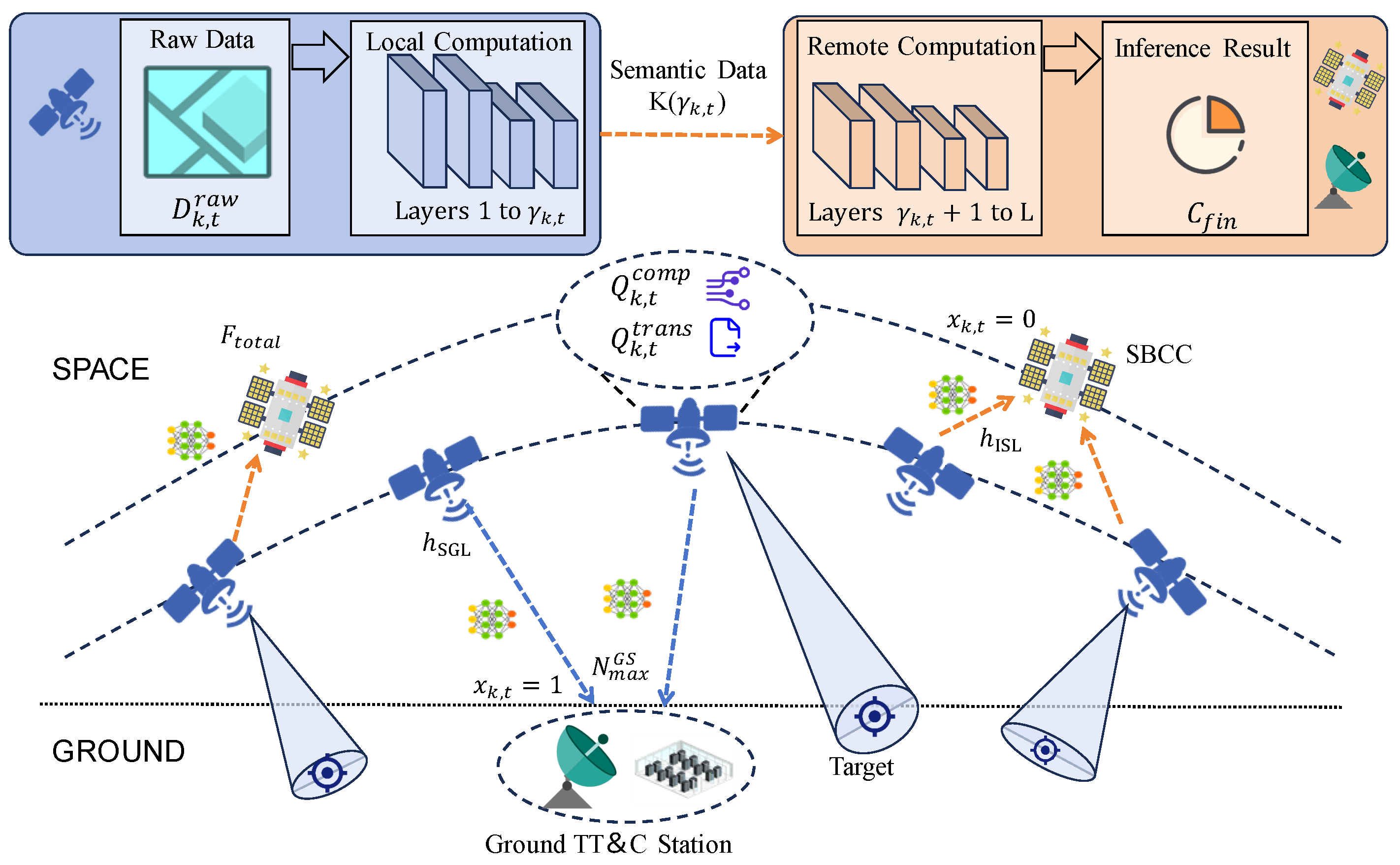
As illustrated in Figure 1, the physical network comprises LEO spacecraft nodes, a logically centralized space-based computing center (SBCC), and terrestrial ground TT&C stations. The spacecraft nodes capture multi-modal TT&C telemetry and sensing payload data and perform collaborative inference. Guided by the semantic architecture, tasks are either executed locally or offloaded to the SBCC or ground stations via inter-satellite links (ISL) and SGL, respectively. The system operates over a finite horizon of T t o t a l seconds, which is discretized into equal-length time slots indexed by t T = { 1 , 2 , , T } . The duration of each slot is denoted by τ seconds. Within each time slot, the network topology and channel gains are assumed to be quasi-static.
Let K = { 1 , 2 , , K } denote the set of spacecraft nodes. Each spacecraft node is modeled as an independent agent. These agents make offloading and model splitting decisions autonomously based on locally perceived task attributes and channel states, without requiring lateral communication with other spacecraft nodes. The SBCC possesses a total computing capacity of F t o t a l (FLOPs/s), which serves as a shared resource pool for all spacecraft nodes. The ground stations are assumed to possess sufficient computing capabilities; however, the number of concurrent users accessing the ground station within a single time slot, denoted by N max GS , is limited.

3.1. Task Model

In this scenario, spacecraft nodes perform massive TT&C payload data acquisition missions. Upon task generation, instead of backhauling heavy raw bitstreams over congested narrow-band links, the satellite extracts semantic features locally. Subsequently, only the highly compressed, task-critical features are backhauled to either the space-based or ground-based computing center. On the computing center side, the system utilizes the received semantic features to perform deep inference, thereby completing the final target recognition task.
The task arrival process for each spacecraft node k K follows a Bernoulli process. Specifically, in each time slot, a user generates a task request with a probability of ρ k . Considering that LEO constellations are typically equipped with homogeneous sensing payloads and on-board DNNs require fixed input tensor dimensions, we model the computation tasks as standardized data stream units. Let α k , t { 0 , 1 } be the task arrival indicator. When α k , t = 1 , a computation task Φ k , t is generated. Let Φ k , t denote the task request generated by spacecraft node k at time slot t, characterized by the following tuple:
Φ k , t D k , t raw , L k , t total , ϖ k , t , T k max ,
where D k , t raw denotes the input dimensions of the raw sensing payload data, L k , t total represents the total computational workload required, ϖ k , t indicates the task priority weight, and T k max denotes the maximum tolerable end-to-end latency. These attribute parameters are only visible locally to the user k.

3.2. Semantic Communication Model

To accommodate the computational constraints of satellite terminals, we employ a customized lightweight residual DNN as the backbone. The agent makes dynamic model splitting decisions for each task to optimally balance on-board computing overhead and communication bandwidth.
  • Semantic encoder: Deployed at the satellite terminal, composed of the first γ k , t layers of the network. It is responsible for mapping the raw payload data D k , t raw into compact intermediate feature representations, thereby eliminating substantial redundant information irrelevant to downstream tasks at the source.
  • Semantic decoder: Deployed at the remote edge server, containing the remaining layers of the backbone and the classifier. It completes the final classification inference based on the received impaired feature maps, demonstrating the system’s robustness against channel noise.
In the preliminary encoding phase, the spacecraft node k utilizes a parameterized semantic encoder f Φ E ( D k , t raw ; γ k , t ) to map the collected raw data D k , t raw into a semantic feature tensor S k , t :
S k , t = f Φ E ( D k , t raw ; γ k , t ) = { s 1 , s 2 , , s K ( γ k , t ) } ,
where K ( γ k , t ) represents the total number of extracted semantic symbols at the dynamic splitting point γ k , t , and s i corresponds to the i-th complex semantic feature for subsequent transmission.
Consider an L-layer DNN for task Φ k , t . Let γ k , t { 1 , , L } denote the semantic splitting decision, where the first γ k , t layers are executed locally to extract features, and the remaining L γ k , t layers are offloaded to the remote computing center. Consequently, the local computational workload W loc ( γ k , t ) is given by:
W loc ( γ k , t ) = l = 1 γ k , t w l ,
where w l represents the computational complexity of the l-th layer of the neural network. This function is monotonically increasing with respect to γ .
The quantity of transmitted semantic symbols, K ( γ k , t ) , is determined by the spatial dimensions of the feature map output by the γ -th layer. Upon receiving the noise-corrupted semantic feature S ^ k , t at the remote computing center, the remaining L γ k , t layers of the deep inference function f χ d e e p ( · ) are invoked for processing:
S r = f χ d e e p ( S ^ k , t ) .
Finally, the target classification function f Ψ f i n ( · ) outputs the final recognition result C fin . This process leverages the powerful on-board computing power of the center to compensate for the constraints of the satellite terminal’s processing capability on complex task execution.

3.3. Communication Models

The considered edge computing network encompasses two categories of communication links: SGL and ISL. Due to the high-speed mobility of LEO satellites, the channel gain, visibility, and transmission rates of these two types of links exhibit high temporal variance. Let x k , t { 0 , 1 } denote the binary offloading path decision variable. Specifically, x k , t = 1 indicates that the spacecraft node offloads the task to the ground-based computing center, whereas x k , t = 0 implies offloading to the SBCC.
When the spacecraft node chooses to offload to the ground station, data is transmitted via the SGL. This link penetrates the atmosphere and is subject to the combined effects of large-scale path loss and small-scale multipath fading. Due to Earth’s occlusion, communication occurs only when the satellite is located within the visible range of the ground station. Let ε k , t denote the elevation angle of user k with respect to ground station G at time slot t. We define a binary visibility indicator variable θ k , t { 0 , 1 } as follows:
θ k , t = 1 , ε k , t > ε min 0 , otherwise
where ε min represents the minimum elevation angle threshold for the ground station antenna. θ k , t = 0 indicates a physical link interruption, rendering the ground station invisible. During the visible period, the channel power gain of the SGL, denoted by g k , t SGL , is expressed as follows:
g k , t SGL = | h k , t | 2 · P L k , t SGL ,
where the large-scale fading component P L k , t SGL accounts for both free-space path loss and atmospheric environmental losses. Based on the Friis transmission equation, it is modeled as follows:
P L k , t SGL = λ SGL 4 π d k , t SGL 2 · G T x G R x L atm · L rain ,
where d k , t SGL represents the real-time Euclidean distance between the satellite and the ground station, λ SGL is the carrier wavelength, and G T x and G R x represent the transmitting and receiving antenna gains, respectively. L atm and L rain denote the atmospheric gas absorption loss factor and the rain attenuation factor, respectively. Considering that SGLs typically exhibit a significant line-of-sight (LoS) path, we assume the channel follows a Ricean fading distribution. The channel coefficient h k , t is modeled as follows:
h k , t = K R K R + 1 h LoS + 1 K R + 1 h NLoS ,
where K R denotes the Rician factor. We assume that the ground station employs frequency division multiple access (FDMA) technology, allocating a fixed frequency bandwidth B u n i t to each successfully accessed user. Assuming a constant transmit power P k , the signal-to-noise ratio (SNR) at the SGL receiver is given by:
S N R k , t S G L = P k · g k , t S G L N 0 B u n i t ,
where N 0 is the noise power spectral density.
Conversely, when offloading to the SBCC, data is transmitted via the ISL. The channel power gain g k , t I S L is determined by the free-space propagation model:
g k , t I S L = λ I S L 4 π d k , t I S L 2 · G k t G SBCC r .
Correspondingly, the SNR at the receiving end of the ISL is expressed as follows:
S N R k , t I S L = P k · g k , t I S L N 0 B I S L ,
where B I S L is the ISL channel bandwidth. Different from traditional digital communications, the adopted Deep JSCC paradigm maps semantic features directly to continuous channel symbols. The received semantic feature vector s ^ k , t is modeled as follows:
s ^ k , t = h k , t P k s k , t + n ,
where s k , t is the transmitted symbol vector and n is the noise vector. Consequently, the quality of the recovered features is directly determined by the instantaneous SNR. Furthermore, the transmission speed is governed by the achievable symbol rate R s . To account for practical pulse shaping filters, the symbol rate is strictly bounded by the allocated channel bandwidth, such that R s B k , t .

3.4. Computation and Queueing Delay Models

Given the established physical communication foundation, the end-to-end task processing latency is further constrained by resource contention at the computing centers and workload backlogs within the internal processing units. This subsection formulates a pipeline-based queue evolution model to characterize the dynamic latency properties.
Assuming independent computation and transmission modules, the local execution time for task Φ k , t at spacecraft node k with fixed capacity f k loc is:
t k , t exec = W loc ( γ k , t ) f k loc .
Due to the stochastic task arrival ( α k , t ) and limited processing capability, the system maintains a local computation queue. Let Q k , t comp denote the backlog of local workload at the beginning of time slot t. The state evolution equation of the computation queue is formulated as follows:
Q k , t + 1 comp = max 0 , Q k , t comp f k loc · Δ t + α k , t W loc ( γ k , t ) ,
where Δ t is the duration of a time slot. This equation captures the dynamic accumulation of unprocessed tasks and the processing progress within each slot. The total local latency T k , t loc for task Φ k , t consists of the queuing waiting time and the actual execution time:
T k , t loc = Q k , t comp + W loc ( γ k , t ) f k loc .
Upon completion of local feature extraction, the task data automatically flows into the transmission module. Leveraging a full-duplex pipeline mechanism, the transmission queue Q k , t trans evolves independently of the computation queue. Let K ( γ k , t ) denote the number of complex semantic symbols generated by the semantic encoder with splitting point γ k , t . The state evolution of the transmission queue (measured in symbols) is described by:
Q k , t + 1 trans = max 0 , Q k , t trans R s Δ t + min ( Q k , t comp , f k loc Δ t ) · K ( γ k , t ) W loc ( γ k , t )
where B k , t represents the allocated bandwidth, and the term min ( · ) represents the processed workload converted into semantic symbols. This formulation reflects that in Deep JSCC, transmission latency is deterministic given the bandwidth and symbol count, while transmission reliability relies on the instantaneous SNR. The total transmission latency T k , t trans is formulated as follows:
T k , t trans = Q k , t trans + K ( γ k , t ) R s + T prop ,
where T prop denotes the propagation delay, expressed as T prop = d k , t c , with c being the speed of light.
Given the abundant computational capacity of terrestrial cloud infrastructures, the execution and queueing delays at the ground station are negligible. Therefore, we model the ground computation latency as a constant:
T k , t rem = C gnd .
Conversely, when the satellite agent decides to offload to the SBCC, the center must handle concurrent tasks from multiple users, leading to contention for computing resources. Let f k , t sat 0 denote the computing frequency allocated to user k at time slot t. Consequently, the space-based inference latency is expressed as follows:
T k , t rem = W rem ( γ k , t ) f k , t sat .
By omitting negligible control-plane signaling overhead to focus on the dominant data-plane processing, the end-to-end completion time T k , t total for task Φ k , t is formulated as the sum of latencies across the three primary stages:
T k , t total = T k , t loc + T k , t trans + T k , t rem .

4. Problem Formulation

Efficient task processing in SGINs necessitates the deep orchestration of heterogeneous resources. Compared to terrestrial networks, space-ground TT&C edge computing presents distinct challenges: (1) highly dynamic topology causing intermittent SGL/ISL links, (2) stringent resource scarcity limiting on-board computing capacity, and (3) strict priority differentiation requiring efficient scheduling for high-value missions [35]. Building upon the end-to-end latency and link models established in Section 3, this section introduces a task-oriented utility evaluation system. Subsequently, the joint resource scheduling problem is mathematically formulated as a Stochastic MINLP problem.

4.1. Task-Oriented Utility Model

To precisely characterize the QoE of distinct TT&C tasks within the heterogeneous SGIN, we establish a multi-dimensional utility evaluation framework. This framework primarily incorporates inference accuracy and latency satisfaction.
Given the priority differentiation among tasks, we define the comprehensive utility U k , t for task k at time slot t. This metric is composed of the weighted inference accuracy gain and latency satisfaction:
U k , t = ϖ k , t · A ( γ k , t , SNR k , t ) + μ · T k max T k , t total T k max ,
where ϖ k , t represents the dynamic weight parameter, characterizing the priority level of the task. The parameter μ denotes the latency sensitivity coefficient, used to adjust the weight of latency within the total utility.
Let A ( γ k , t , SNR k , t ) denote the inference accuracy, which mathematically encapsulates the downstream task performance under the semantic communication paradigm. Diverging from the Shannon-based capacity degradation in conventional digital systems, channel impairments in this context manifest directly as semantic feature distortions. To ensure mathematical rigor and generalizability, this mapping is quantified via offline profiling. Specifically, the pre-trained semantic model (detailed in Section 6) is evaluated over a simulated AWGN channel across discrete SNR levels. The acquired empirical accuracy points are then fitted using a generalized logistic function. Consequently, A ( · ) is formulated as a continuous, differentiable, and monotonically non-decreasing function with respect to S N R k , t , effectively bridging discrete empirical observations with continuous utility optimization.
The comprehensive utility U k , t embodies the core logic of balancing service reliability and timeliness. As a unified metric, it guides agents to navigate the communication-computation trade-off by optimizing the splitting point γ k , t . This strategically trades onboard computation for transmission bandwidth to minimize latency, especially in robust high-SNR regimes. Furthermore, the latency term acts as a soft constraint, penalizing timeouts to ensure the validity of time-sensitive tasks.

4.2. Joint Optimization Problem

Building upon the preceding models, this subsection formalizes the joint resource scheduling problem. Our objective is to maximize the expected cumulative utility over the mission period T, subject to physical link availability and space-based computing constraints. This is achieved by jointly optimizing the offloading decision X = { x k , t x k , t { 0 , 1 } } , the model splitting strategy Γ = { γ k , t γ k , t { 1 , , L } } , and the space-based computing resource allocation F = { f k , t sat f k , t sat 0 } . Here, x k , t is the binary offloading indicator ( x k , t = 1 for ground offloading), γ k , t is the splitting point, and f k , t sat is the continuous computing capacity for task k.
The global joint resource optimization problem, denoted as P 0 , is mathematically formulated as follows:
P 0 : max X , Γ , F t = 1 T k = 1 K E U k , t ( γ k , t , x k , t , f k , t sat )
s . t . k = 1 K ( 1 x k , t ) f k , t sat F total , t T ,
k = 1 K x k , t N max GS , t T ,
x k , t θ k , t , k K , t T ,
x k , t { 0 , 1 } , γ k , t { 1 , , L } , f k , t sat 0 , k K , t T .
Constraints (22b) and (22c) represent the resource capacity limits, capping the aggregate spacecraft computing load at F total and the concurrent ground access requests at N max GS , respectively. Constraint (22d) guarantees physical link feasibility based on the ephemeris mask θ k , t , forcing space processing during NLoS periods, while (22e) specifies the feasible domains for the mixed decision variables.
A rigorous theoretical analysis indicates that P 0 is formulated as a highly non-convex Stochastic MINLP problem. Obtaining a global optimum centrally is computationally intractable due to the following primary challenges: (1) Non-convex coupling: The deep coupling between discrete splitting decisions γ k , t and continuous resource allocation f k , t sat in (22b) creates a non-convex feasible region; (2) Curse of dimensionality: The joint action space grows exponentially with the number of users K and model layers L; (3) High dynamics: The stochastic time-variance of channel states and task arrivals necessitates real-time inference without future network knowledge.
In response to these challenges, we restructure the problem as a multi-agent stochastic game and propose a hybrid framework that integrates DRL with convex optimization techniques [36] to achieve distributed near-optimal decision-making.

5. HMAPPO-Based Hierarchical Resource Allocation Algorithm

In this section, we propose a hierarchical resource allocation algorithm to solve the stochastic MINLP problem P 0 formulated in Section 3. To enable distributed decision-making in dynamic environments, we first restructure the problem as a multi-agent stochastic game. Subsequently, we detail the hierarchical decomposition framework, which integrates inner-layer convex optimization with outer-layer HMAPPO.

5.1. Multi-Agent Markov Game Reformulation

Given the intractable complexity of the centralized optimization problem P 0 , characterized by non-convexity and NP-hardness, we reformulate it as a DEC-POMDP. This game is defined by the tuple K , S , A , P , R , γ , where K = { 1 , , K } represents the set of agents (spacecraft nodes), and γ [ 0 , 1 ) is the discount factor. Due to limited inter-satellite communication, each agent makes independent decisions based on local observations to maximize the cumulative expected reward.

5.1.1. Local Observation Space S

The local observation o k , t S for agent k at time slot t encapsulates the environmental perception required for effective cooperation under partial observability. The observation vector consists of four key components:
  • Task attributes: Φ k , t = { D k , t raw , L k , t total , ϖ k , t , T k max } characterizes the computation demand and urgency of the current task.
  • Queue states: Q k , t = { Q k , t comp , Q k , t trans } indicates the local backlog workload, serving as a critical indicator for load balancing.
  • Channel state information: H k , t = { h k , t SGL , h k , t ISL } includes the instantaneous channel gains and the visibility mask θ k , t .
  • Global congestion indicator ( I t 1 c o n g ): To address the unobservability of real-time global states, the ground station broadcasts the aggregate load from slot t 1 via the downlink control channel. This feedback enables agents to estimate contention risks without explicit inter-satellite coordination.
Formally, the observation vector is constructed as follows:
o k , t = [ Φ k , t , Q k , t , H k , t , I t 1 cong ] .

5.1.2. Action Space A

To align with the proposed “decision-optimization” decoupled architecture, we define the action space as a strictly discrete domain. At time slot t, the action a k , t for agent k comprises only the offloading decision and the model splitting point:
a k , t = { x k , t , γ k , t } ,
where x k , t { 0 , 1 } and γ k , t { 1 , , L } .
It is imperative to note that the continuous space-based computing resource allocation variable, f k , t s a t , is explicitly decoupled from the learning agent’s action space. Instead, it is systematically embedded within the environment’s state transition dynamics: given a deterministic discrete action profile, the inner-layer analytical solver deterministically yields the optimal f k , t s a t subject to physical capacity constraints. This design significantly reduces the dimensionality of the exploration space.
Furthermore, to enforce the visibility constraint (22d), we incorporate an Action Masking mechanism. When the ground station is invisible ( θ k , t = 0 ), the probability of selecting the ground offloading action ( x k , t = 1 ) is forced to zero, thereby pruning invalid actions from the source.

5.1.3. Reward Function R

The reward aims to maximize utility while adhering to system boundaries. While (22c) imposes a strict physical limit in the formulation P 0 , enforcing such global coupling is intractable for decentralized agents. We therefore relax this hard constraint into a soft penalty term within the local objective. The reformulated immediate reward r k , t is given by:
r k , t = U k , t η · I j = 1 K x j , t > N m a x G S · x k , t ,
where I ( · ) is the indicator function and η > 0 is the penalty coefficient. This relaxation incentivizes agents to autonomously learn congestion-avoiding policies, ensuring probabilistic satisfaction of (22c) without explicit coordination. Notably, relaxing the global ground access limit (22c) into a soft penalty is a deliberate compromise dictated by decentralized execution. Unlike the local computing capacity (22b) strictly enforced by the SBCC, (22c) couples the simultaneous actions x k , t of all agents. Without instantaneous inter-satellite signaling, applying a hard action mask for (22c) is practically infeasible during distributed inference. Instead, the soft penalty, synergizing with the delayed congestion feedback I t 1 c o n g , acts as a stochastic approximation. Although transient infeasible states may occur during exploration, this mechanism explicitly drives agents toward a collision-avoiding policy, ensuring that ground station hardware limits are statistically respected in actual deployments.

5.2. Hierarchical Decomposition Framework

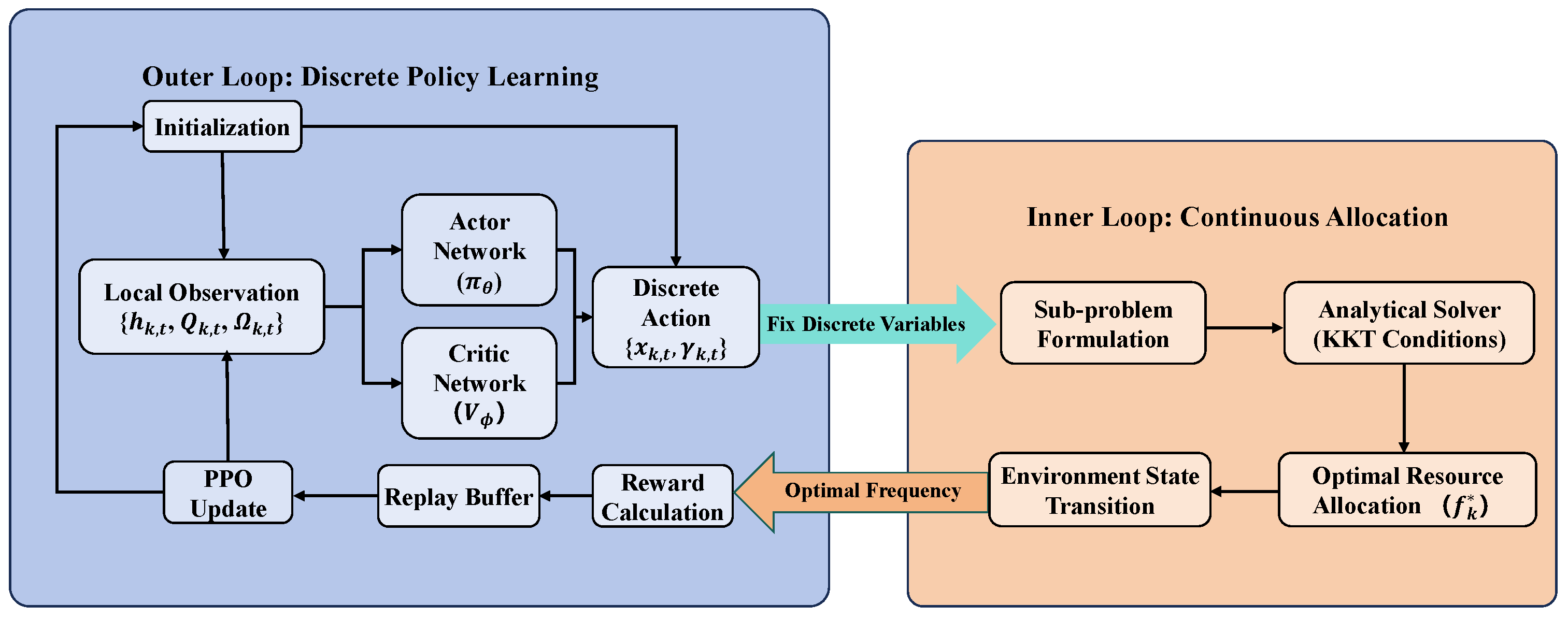
Despite the inherent global non-convexity and strong variable coupling in problem P 0 , a critical structural property can be strategically exploited: upon fixing the discrete offloading and model splitting decisions, the residual sub-problem governing the continuous space-based computing resource allocation reduces to a strictly convex optimization problem.Motivated by this structural property, we propose a model-assisted hierarchical decomposition framework to solve problem P 0 . The overall workflow of this framework is illustrated in Figure 2.
Leveraging this mathematical characteristic, we propose a model-assisted hierarchical decomposition framework. As illustrated in the system workflow, this framework decouples the original mixed-integer optimization into two nested closed-loop sub-problems:

5.2.1. Outer Layer: Distributed Decision Making

The outer layer acts as the high-level policy generator, handled by the HMAPPO agents. Addressing the combinatorial nature of the discrete variables A dis = { x k , t , γ k , t } and the environmental dynamics, the agents interact with the environment to learn a long-term cooperative policy. Based on the local observations defined in Section 5.1.1, the agents collaboratively output the offloading path and splitting point, aiming to maximize the expected cumulative return over the mission period.

5.2.2. Inner Layer: Centralized Deterministic Resource Allocation

This layer operates centrally at the SBCC. Acting as a centralized deterministic solver, the SBCC aggregates the discrete offloading requests from distributed agents and analytically computes the exact optimal frequency allocation F t utilizing the derived closed-form expression. This design effectively bridges distributed user-side decision-making with centralized server-side resource management, ensuring strict adherence to the global capacity constraint (22b). This process is executed via a closed-form solution derived from the KKT conditions, rather than through neural network inference.

5.3. Inner-Layer: Closed-Form Resource Allocation at SBCC

In the hierarchical framework, the primary objective of the inner layer is to determine the optimal computing frequency allocation F t = { f k , t sat } for the set of tasks offloaded to the satellite, given the discrete strategy a t = { X t , Γ t } fixed by the outer layer.
Let U t sat = { k K x k , t = 0 } denote the set of users selecting the space-based offloading path at time slot t. For these users, the transmission data size and remote computing workload W rem ( γ k , t ) become constants. Consequently, the original utility maximization problem P 0 can be equivalently transformed into a minimization problem focused solely on the execution latency.

5.3.1. Problem Transformation

By isolating the terms dependent on f k , t sat in the objective function Equation (22a), we define a composite urgency weight Ω k , t for each task:
Ω k , t = ϖ k , t · μ T k max .
This weight captures both the task priority and latency sensitivity. The inner-layer optimization problem, denoted as P inner , is formulated as minimizing the weighted sum of computing delays:
P inner : min f t J ( f t ) = k U t sat Ω k , t · W rem ( γ k , t ) f k , t sat
s . t . k U t sat f k , t sat F total ,
f k , t sat > 0 , k U t sat .

5.3.2. Optimal Resource Allocation via Closed-Form Solution

The optimization problem P inner minimizes a sum of strictly convex inverse functions subject to linear constraints. Consequently, the problem is strictly convex, guaranteeing a unique global optimal solution that can be derived analytically using the Karush–Kuhn–Tucker (KKT) conditions.
The Lagrangian function associated with P inner is formulated as follows:
L ( f t , λ ) = k U t sat Ω k , t W rem ( γ k , t ) f k , t sat + λ k U t sat f k , t sat F total ,
where λ 0 is the Lagrange multiplier. The KKT conditions for optimality are:
L f k , t sat = Ω k , t W rem ( γ k , t ) ( f k , t sat ) 2 + λ = 0 ,
λ k U t sat f k , t sat F total = 0 .
From Equation (29), we isolate the optimal frequency:
f k , t sat = Ω k , t W rem ( γ k , t ) λ .
Given that the objective function is monotonically decreasing, the capacity constraint (22b) is active, implying λ > 0 . Substituting Equation (31) into the equality condition f k , t sat = F total , we eliminate λ and obtain the closed-form solution:
f k , t sat = Ω k , t · W rem ( γ k , t ) j U t sat Ω j , t · W rem ( γ j , t ) · F total .
The specific procedure for deriving the continuous resource allocation is detailed in Algorithm 1.
Algorithm 1 Inner-layer deterministic resource allocation
Input: 
Joint discrete action profile: A dis = { x k , t , γ k , t } k = 1 K ; Total capacity: F total .
Output: 
Optimal frequency allocation set: F t .
  1:
Identify active users: U t sat { k K x k , t = 0 }
  2:
if  U t sat   then
  3:
    // Pass 1: Demand aggregation
  4:
    for each user k U t sat  do
  5:
        Compute intensity: ψ k , t Ω k , t · W rem ( γ k , t )
  6:
    end for
  7:
    Calculate normalization factor: Λ j U t sat ψ j , t
  8:
    // Pass 2: Fast assignment
  9:
    for each user k U t sat  do
10:
        Assign optimal frequency: f k , t sat ψ k , t Λ · F total
11:
    end for
12:
else
13:
     F t
14:
end if
15:
return  F t = { f k , t sat }
Complexity analysis: The derived closed-form solution offers a significant computational advantage. Computing Equation (32) requires only two linear passes over the user set U t sat (one for normalization, one for assignment), resulting in a linear complexity of O ( | U t sat | ) . In contrast, standard iterative convex solvers (e.g., interior point method) typically incur a complexity of O ( | U t sat | 3.5 ) . This efficiency is critical for enabling real-time resource scheduling in dynamic environments. Furthermore, unlike heuristic decoupled frameworks, our analytical inner solver strictly preserves global optimality. Mathematically, the joint MINLP is equivalent to a nested optimization: max A d i s [ max F U ( A d i s , F ) ] . Since the inner sub-problem is strictly convex, the KKT solver analytically derives the exact global optimum F ( A d i s ) for any given discrete action. Consequently, the outer-layer RL agent optimizes the exact marginalized objective max A d i s U ( A d i s , F ( A d i s ) ) . This hierarchical decomposition introduces zero structural optimality loss. The overall optimality gap is bounded solely by the MARL’s discrete exploration capability, effectively eliminating the systematic suboptimality risk typically induced by discrete-continuous separation.

5.4. Outer Layer: HMAPPO-Based Distributed Decision-Making

With the optimal space-based computing resource allocation F ( A dis ) derived analytically in the inner layer, the original MINLP problem P 0 reduces to the outer-layer sub-problem P outer , which involves only the discrete decision variables. The core task of the outer layer is to identify the optimal offloading path X and model splitting strategy Γ within the discrete action space A dis to maximize the long-term system utility.The overall training and execution process is summarized in Algorithm 2.
Algorithm 2 HMAPPO-based hierarchical resource allocation
Input: 
Maximum training episodes M; max steps per episode T; update interval N u .
Output: 
Trained policy networks π θ .
  1:
Initialization:
  2:
Initialize Actor networks π θ and centralized Critic network V ϕ with random parameters.
  3:
Initialize replay buffer D .
  4:
for episode m = 1 to M do
  5:
    Reset environment and receive initial observations o 1 = { o 1 , 1 , , o K , 1 } .
  6:
    for step t = 1 to T do
  7:
        // Phase 1: Outer-layer distributed decision
  8:
        for each agent k = 1 to K do
  9:
           Generate action mask M ( x , θ k , t ) to enforce visibility constraint (22d).
10:
           Select discrete action a k , t = { x k , t , γ k , t } via masked Actor π θ ( · | o k , t ) .
11:
           Record action log-probability log π θ ( a k , t | o k , t ) and value estimate v k , t = V ϕ ( o t ) .
12:
        end for
13:
        Construct joint discrete action set A t = { a 1 , t , , a K , t } .
14:
        // Phase 2: Inner-layer deterministic optimization
15:
        The SBCC computes optimal frequency allocation F t by calling Algorithm 1 with A t and F total .
16:
        // Phase 3: Environment interaction and feedback
17:
        Apply joint hybrid strategy ( A t , F t ) to the SGIN environment.
18:
        Receive rewards r t = { r 1 , t , , r K , t } (Equation (26)) and next observations o t + 1 .
19:
        Store transition tuple ( o t , A t , r t , o t + 1 , log π t , v t ) in buffer D .
20:
    end for
21:
    // Phase 4: Policy update (CTDE)
22:
    if episode m mod N u = = 0  then
23:
        Compute GAE for all agents.
24:
        Update Critic parameters ϕ by minimizing the MSE loss.
25:
        Update Actor parameters θ by maximizing the PPO clipped objective.
26:
        Clear replay buffer D .
27:
    end if
28:
end for
The outer-layer optimization model is formally defined as follows:
P outer : max X , Γ E t = 1 T k = 1 K U k , t ( x k , t , γ k , t , f k , t sat )
s . t . k = 1 K x k , t N max GS , t ,
x k , t θ k , t , k , t ,
x k , t { 0 , 1 } , γ k , t { 1 , , L } .
Note that the coupled congestion constraint (33b) is addressed via the penalty mechanism in the reward function (25), while the visibility constraint (33c) is strictly enforced via action masking.
Given the combinatorial complexity and the non-cooperative game nature of the problem, we employ the Heterogeneous Multi-Agent Proximal Policy Optimization (HMAPPO) algorithm based on the centralized training and decentralized execution (CTDE) paradigm.

5.4.1. Network Architecture and Action Masking

We design a dual-network architecture comprising an Actor and a Critic for policy learning. Each agent k independently maintains an Actor network π θ ( a k , t | o k , t ) , parameterized by θ . This network takes the local observation o k , t as input and outputs the probability distribution over discrete actions.
To strictly guarantee the satisfaction of the space-ground TT&C link visibility constraint (33c), we introduce an Action Masking mechanism at the output layer of the Actor. Let l x denote the raw logits output for the offloading decision. The modified probability distribution is computed as follows:
π θ ( x k , t | o k , t ) = Softmax ( l x + M ( x , θ k , t ) ) ,
where the mask term M ( x , θ k , t ) is defined as follows:
M ( x , θ k , t ) = 0 , if x θ k , t , , otherwise .
This mechanism explicitly forces the log-probability of invalid actions to negative infinity, thereby mathematically precluding the agent from exploring infeasible regions and significantly accelerating the convergence process. To ensure reproducibility and stable convergence, all linear layers in the Actor and Critic networks are initialized using orthogonal initialization. The Actor network employs a 256-256 hidden layer architecture with Tanh activations. To process the high-dimensional global state, the centralized Critic network is scaled to a 512-256 architecture. During policy updates, advantage normalization and gradient clipping are applied to prevent gradient explosion and ensure monotonic convergence.

5.4.2. Centralized Critic and Policy Update

To address the credit assignment problem in the multi-agent environment, we introduce a centralized Critic network V ϕ ( s t ) , parameterized by ϕ . This network is utilized solely during the training phase. It takes the global state s t (comprising all local observations and the global congestion state) as input to accurately evaluate the value of the joint state.
The HMAPPO algorithm implements a closed-loop optimization through the tight interaction between the inner and outer layers. In each training step, the procedure is as follows:
  • Action generation: Agents generate discrete actions { x k , t , γ k , t } based on the Actor network and action masking.
  • Virtual execution: The system calls the closed-form solution to compute the optimal f k , t sat .
  • Reward feedback: The complete action set is substituted into the system model to calculate the precise instantaneous reward r k , t .
  • Network update: The Critic calculates the TD error δ t and the generalized advantage estimation (GAE) A t . The Actor parameters θ are updated by maximizing the PPO clipped objective function:
    L ( θ ) = E min ( ρ t A t , clip ( ρ t , 1 ϵ , 1 + ϵ ) A t ) + σ H ( π θ ) ,
    where ρ t is the probability ratio, ϵ is the clipping threshold, and σ H ( π θ ) is the entropy regularization term to encourage exploration.
Through this mechanism, the outer-layer RL algorithm is responsible for extensive exploration and long-term planning in the discrete strategy space, while the inner-layer convex optimization ensures that every step of exploration is optimal and feasible at the physical resource level. This mutual support achieves an efficient solution of the complex MINLP problem.

6. Experiments and Analysis

This section presents comprehensive numerical simulations to validate the effectiveness and robustness of the proposed hierarchical resource orchestration framework.

6.1. Performance of the Semantic Communication Model

To emulate the transmission of visual payload data commonly encountered in modern TT&C missions, we evaluate the proposed semantic model using the NWPU-RESISC45 benchmark [37]. The dataset is randomly partitioned into training and testing sets with an 8:2 ratio. The model is implemented in PyTorch (version 2.5.1) and optimized via Adam (batch size 32, 200 epochs) with an initial learning rate of 1 × 10 3 dynamically adjusted by a ReduceLROnPlateau scheduler. To ensure generalized robustness against channel variations, an AWGN-based training strategy is adopted by injecting a dynamic noise layer between the encoder and decoder.
Table 2 reveals a pivotal resource asymmetry: while the computational load scales approximately linearly with layer depth (an increase of roughly 2.4 × ), the spatial dimensions of the transmission payload undergo a significant reduction by a factor of 256. This indicates that trading onboard computation for bandwidth yields extremely high marginal utility, particularly for deep splitting points. The detailed architecture of the customized lightweight network is summarized in Table 3.
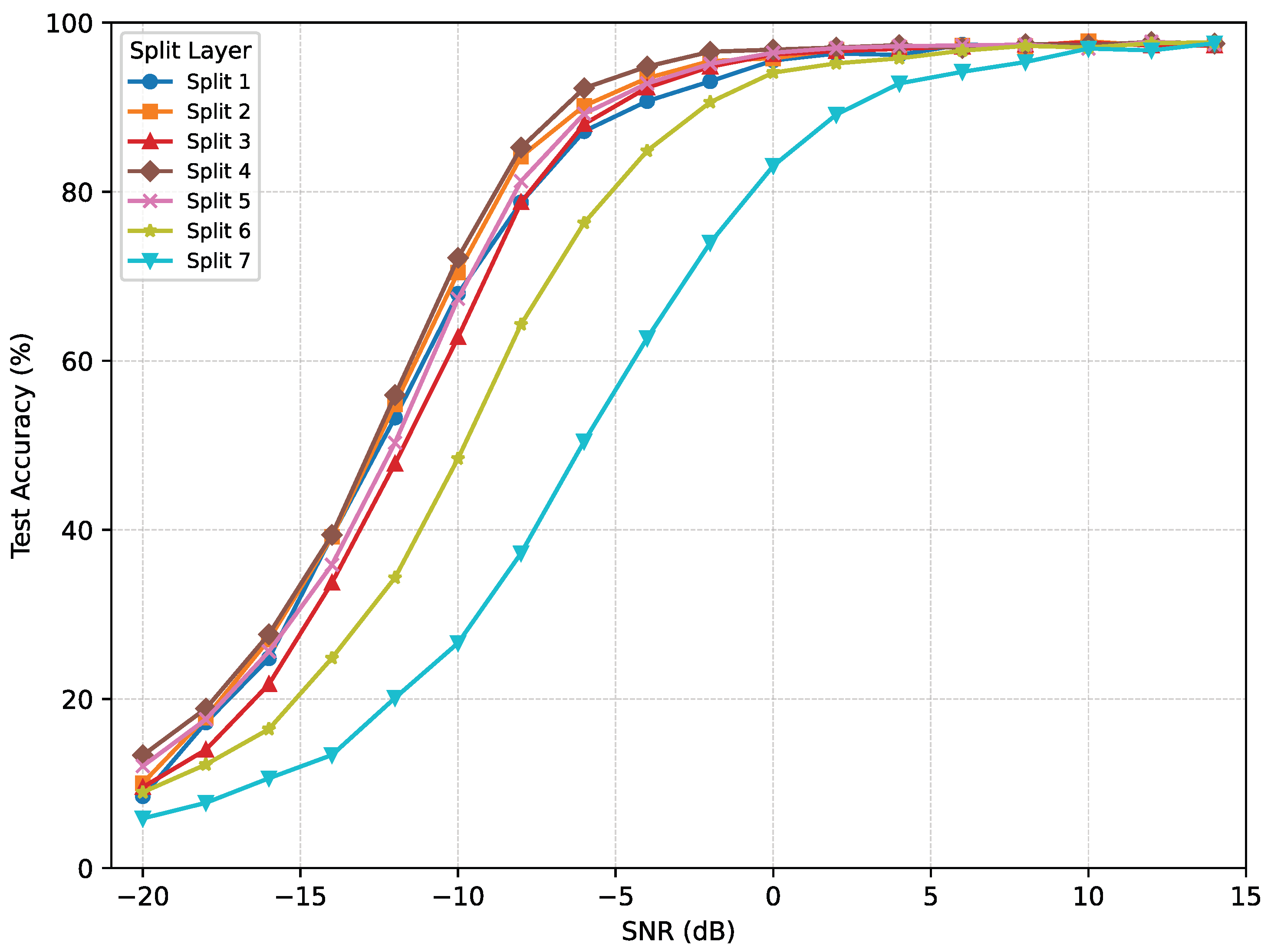
Figure 3 further elucidates the decision boundary. In high-SNR regimes (>5 dB), deep splitting (e.g., Split 7) emerges as the dominant strategy, achieving converged accuracy ( 95 % ) comparable to shallow splits but with minimal bandwidth consumption. Conversely, the interval [ 10 , 5 ] dB constitutes a Pareto-optimal trade-off zone. Here, the curves exhibit a distinct “crossing behavior,” where shallow splits are strictly required to maintain robustness against channel noise. This dynamic shift from a dominated regime to a trade-off regime provides the physical justification for our adaptive splitting algorithm. To integrate the discrete semantic accuracy evaluations into the continuous RL environment, a linear interpolation function with extrapolation capabilities is adopted. This continuously maps the instantaneous SNR to the corresponding inference accuracy based on the NWPU-RESISC45 dataset, ensuring differentiable utility feedback for the agents.

6.2. Parameter Settings and Convergence Analysis

To evaluate the proposed framework, we developed a dynamic space–ground-integrated TT&C network simulation environment. The system parameters, including channel models, computing capacities, and network topology, are configured based on the Iridium constellation standards. For strict reproducibility, all pseudo-random number generators are initialized with a fixed seed. The detailed simulation parameters and the hyperparameters for the DRL algorithms are summarized in Table 4.
Based on the Gymnasium interface, the constellation topology and channel models are guided by the 3GPP TR 38.821 NTN standards [38], but customized for practical Ka-band space-ground TT&C and massive sensing payload data transmission. To rigorously evaluate the framework under spectrum-scarce conditions, the SGL (Ka-band) and ISL (Ka-band) are purposefully restricted to narrow bandwidths of 2 MHz. To guarantee reliable link closure given the limited on-board transmit power (33 dBm for SGL; 43 dBm for ISL), we adopt an asymmetric gain architecture: satellites utilize compact phased arrays (35 dBi), while ground stations are equipped with high-gain parabolic antennas (55 dBi), effectively shifting hardware complexity to the ground segment. Regarding computation, each satellite is modeled as an edge node with 400 GFLOPs capacity, consistent with COTS embedded accelerators (e.g., NVIDIA Jetson series [39]). Furthermore, a task scale factor of κ = 16 is introduced to the Bernoulli task arrival process (with an arrival probability of ρ = 0.4 per slot) to emulate high-throughput multi-modal payload data workloads [18]. Note that the task priority weight ϖ k , t is drawn from a fixed discrete set { 1.0 , 2.0 , 4.0 } . Specifically for sensing payload image backhaul, this setting inherently reflects the practical prioritization of diverse image contents, allocating the highest priority to urgent disaster detection and lower priorities to routine terrain observation. Furthermore, employing fixed priority tiers effectively isolates variables, explicitly demonstrating the algorithm’s capability to protect high-value image classification tasks under severe network congestion.
We select the state-of-the-art HMADRL [15] as the primary baseline. While HMADRL effectively decouples the hybrid action space via a hierarchical architecture, its continuous resource allocation relies on a DDPG-based inner solver. Constrained by soft penalty mechanisms during trial-and-error exploration, it fails to strictly satisfy the hard capacity constraints of satellites. To overcome this, our HMAPPO replaces the learning-based inner layer with an exact KKT solver, successfully eliminating the curse of dimensionality and ensuring absolutely safe resource orchestration. In contrast, HMAPPO decouples the continuous sub-problem from the inner-layer convex solver, significantly reducing the exploration complexity and ensuring superior learning efficiency.
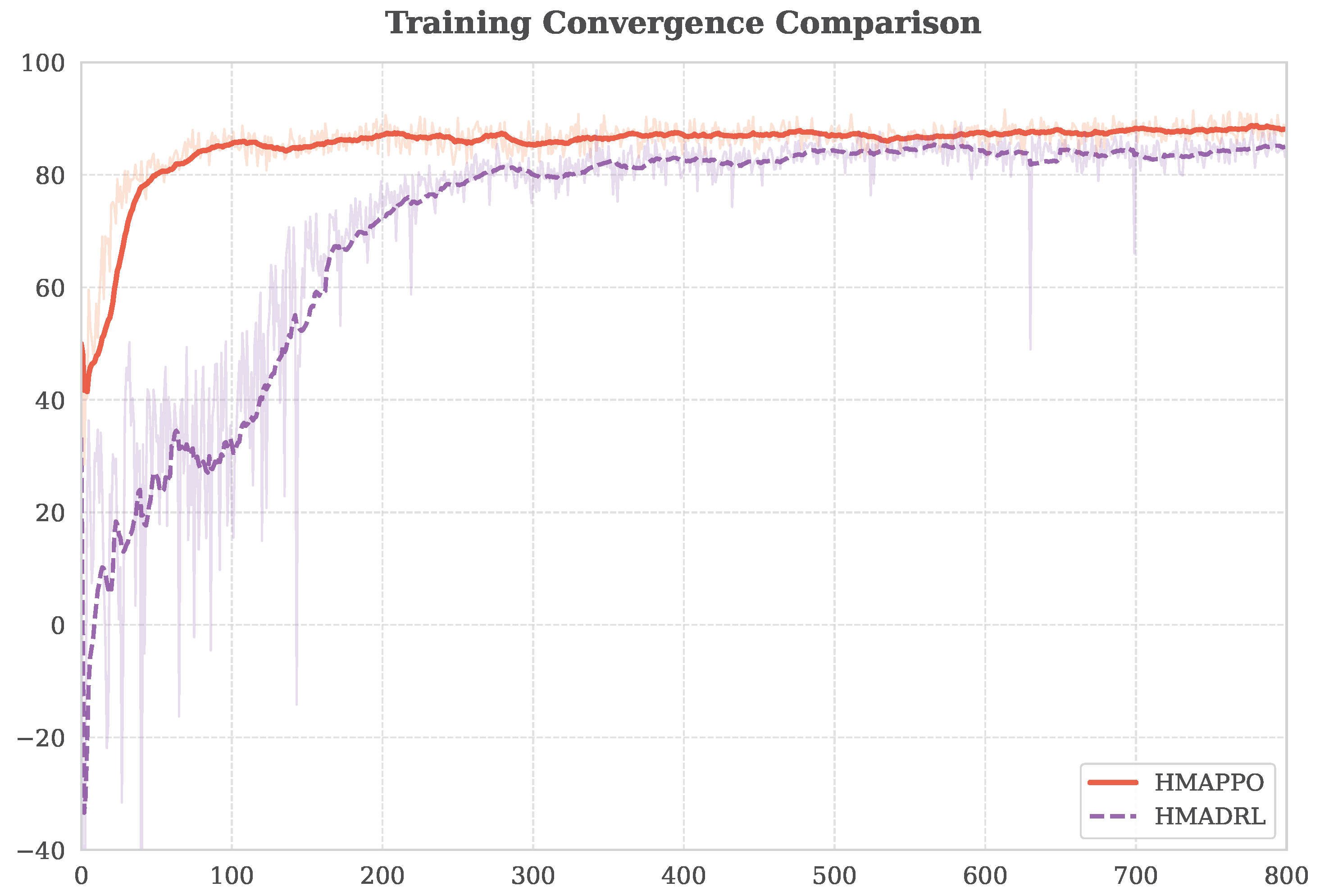
Figure 4 compares the training convergence of the proposed HMAPPO algorithm against the HMADRL benchmark. HMAPPO demonstrates superior sample efficiency, rapidly ascending to a stable high-reward plateau of approximately 90 within only 120 episodes. In contrast, HMADRL exhibits a substantially slower convergence rate, requiring over 400 episodes to attain a lower asymptotic reward of approximately 82, accompanied by pronounced algorithmic oscillations. Crucially, the significant performance gap at the initial stage—where HMAPPO starts at a reward of ≈40 compared to the negative value (≈−30) of HMADRL—validates the efficacy of our hierarchical decoupling. Specifically, the inner-layer KKT solver enforces physical constraint satisfaction even under random policy initialization, thereby mitigating the risk of the agent converging to suboptimal local minima induced by penalty functions inherent in the coupled high-dimensional exploration of HMADRL.

6.3. System Performance Analysis

Following the convergence validation, this subsection evaluates the system-level performance in terms of average latency, task completion rate, and overall QoE. To rigorously benchmark the proposed HMAPPO framework, we introduce two specific baselines with distinct decision-making logics:
  • LoadAware: Randomly selects the offloading target but dynamically optimizes the splitting point based on queue status (shallow split for high computation backlog, deep split otherwise). Resource allocation remains identical to HMAPPO.
  • Random: Selects both offloading target and splitting point completely at random. It employs the same inner-layer convex solver as HMAPPO to isolate and highlight the value of high-level intelligent discrete planning.
  • Lyapunov: Optimizes the offloading target and splitting point per slot via the drift-plus-penalty framework to balance instantaneous utility and queue stability. Though providing rigorous mathematical guarantees, it remains myopic and incurs high online computational complexity.
To justify the deployment feasibility on SWaP-constrained LEO satellites, we theoretically analyze the algorithmic overhead. Traditional optimizations (e.g., distributed ADMM or the aforementioned Lyapunov) rely on iterative solvers with prohibitive O ( 2 K ) or O ( K 3.5 ) complexity, rendering them unviable for real-time aerospace operations. Conversely, while the purely learning-based HMADRL baseline enjoys minimal O ( l n l n l 1 ) inference complexity, its soft-penalty mechanism inherently fails to guarantee strict physical constraints. By contrast, our bi-level HMAPPO achieves an optimal equilibrium: the outer layer maintains low neural network complexity, while the inner KKT solver mathematically guarantees zero constraint violations with a highly efficient O ( K log K ) analytical complexity, perfectly complying with satellite SWaP limits.
In the following experiments, we conduct a control-variable analysis to investigate the impact of traffic load (task arrival rate λ ) and network scale (number of users K) on the system performance.

6.3.1. Impact of Traffic Load

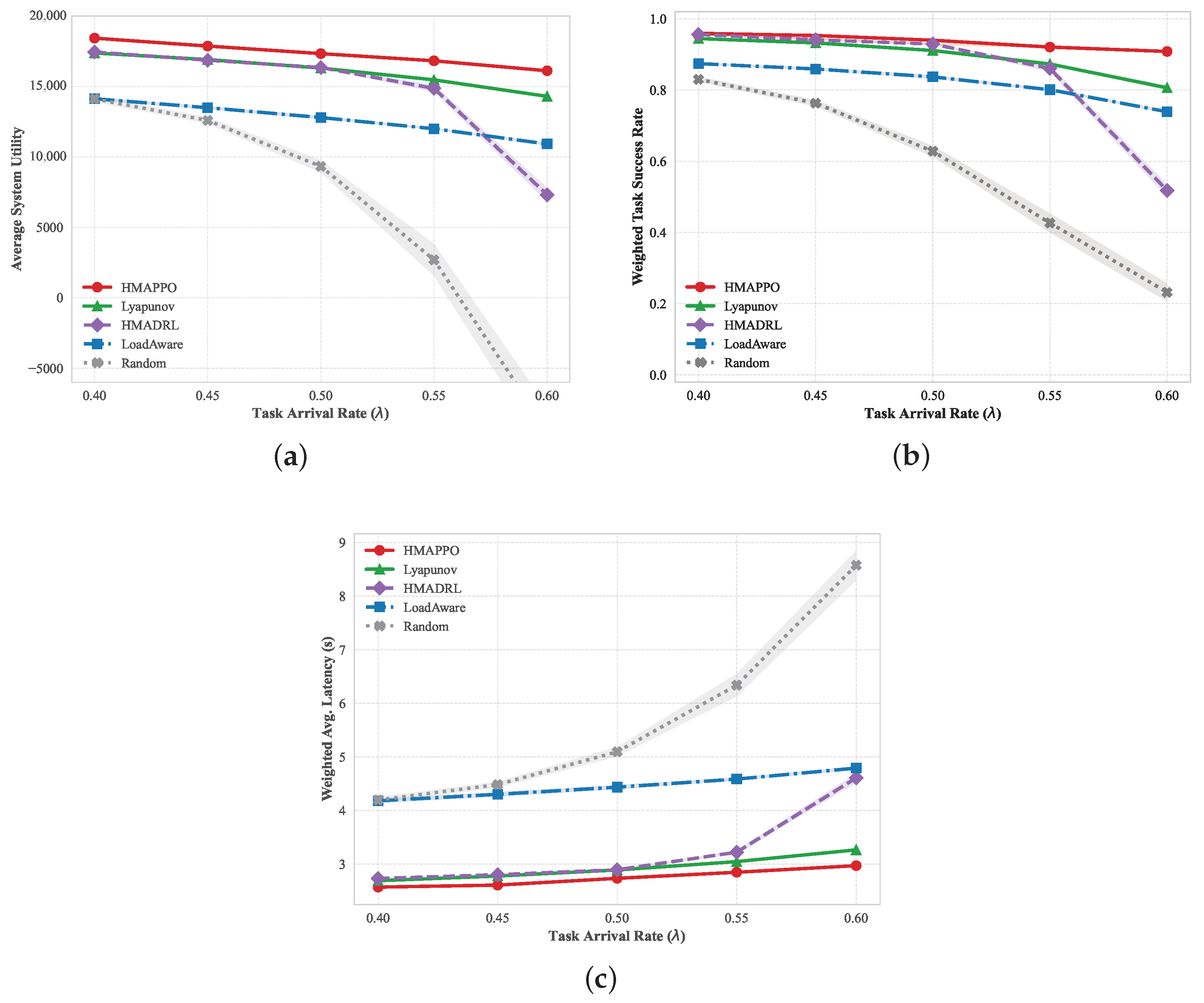
We investigate the system robustness under varying traffic intensities by scaling the task arrival rate λ from 0.4 to 0.6 . This range simulates the transition from a stable network state to a heavy congestion scenario. The comparative results in terms of total utility, success rate, and average latency are presented in Figure 5.
(1) Average system utility: Figure 5a illustrates the trajectory of the average system utility. In the light-to-medium load regime ( λ 0.50 ), HMAPPO, the mathematical Lyapunov baseline, and HMADRL achieve comparably high performance (utility exceeding 16 , 000 ). However, as the network approaches saturation ( λ 0.55 ), a critical performance divergence emerges among the primary schemes. The purely learning-based HMADRL baseline experiences a precipitous decline, dropping to ≈7300 at λ = 0.60 due to severe resource contention. Conversely, HMAPPO demonstrates exceptional resilience, sustaining a superior utility level of ≈16,000. Notably, the mathematical Lyapunov optimization exhibits robust stability (≈14,300 at λ = 0.60 ) but is ultimately surpassed by HMAPPO. This observation substantiates that while Lyapunov effectively guarantees queue stability, its intrinsically myopic nature prevents it from achieving the long-term optimal utility enabled by HMAPPO’s foresighted planning. Meanwhile, the conventional heuristic baselines (LoadAware and Random) either exhibit consistently inferior performance or collapse entirely under extreme congestion.
(2) Weighted task success rate: Figure 5b characterizes the reliability of high-value task delivery. The proposed HMAPPO maintains a highly robust weighted success rate of 90 % across the entire load spectrum. The Lyapunov baseline also demonstrates strong reliability but experiences a noticeable degradation to ≈80% at peak load ( λ = 0.60 ). In sharp contrast, the reliability of the HMADRL baseline suffers a severe deterioration beyond the saturation point ( λ = 0.55 ), declining to ≈52% at λ = 0.60 . This underscores the critical constraint violation issue inherent in coupled action spaces: HMADRL struggles to simultaneously balance discrete offloading and continuous allocation under resource scarcity, leading to widespread task timeouts. HMAPPO mitigates this vulnerability by leveraging the KKT-based inner solver to maximize the marginal utility per unit of resource, thereby ensuring critical task delivery. The remaining heuristic strategies similarly fail to maintain acceptable delivery rates under heavy traffic.
(3) Weighted average latency: The latency profiles in Figure 5c further corroborate the efficacy of our approach. HMAPPO achieves the lowest and most stable latency, increasing marginally from 2.6 s to 3.0 s even under peak loads. This stable latency profile confirms that the adaptive semantic splitting effectively counteracts congestion by aggressively compressing data volume. The Lyapunov optimization closely follows HMAPPO but induces slightly higher delays (≈3.3 s at λ = 0.60 ) due to a lack of proactive congestion avoidance mechanisms. Meanwhile, HMADRL exhibits a distinct inflection point at λ = 0.55 , after which the latency escalates sharply to 4.6 s at λ = 0.60 . In comparison, LoadAware and Random suffer from significantly higher and rapidly escalating delays, rendering them unviable for delay-sensitive satellite edge networks.

6.3.2. Impact of Network Scale

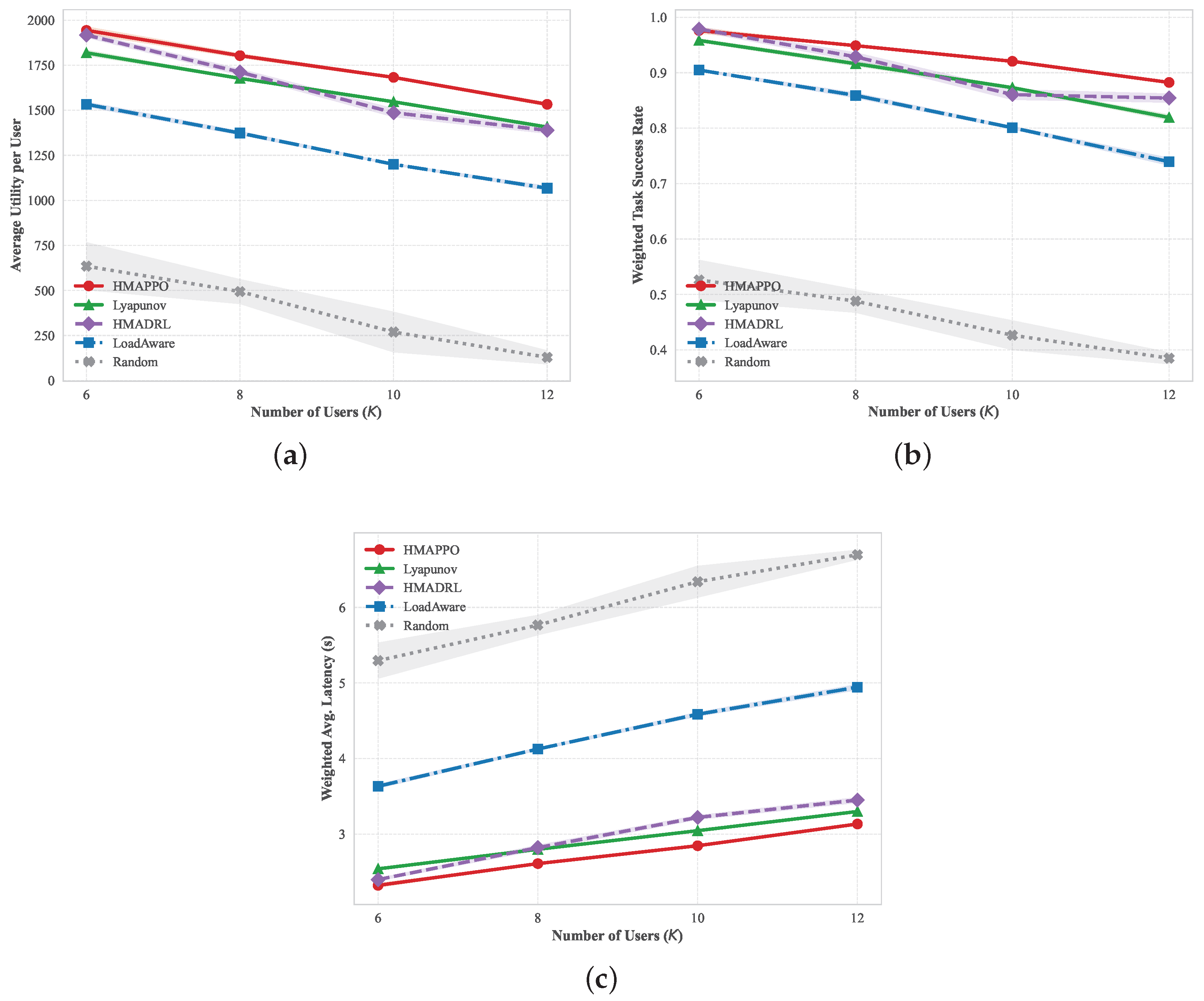
To evaluate the system scalability under massive access scenarios, we increase the number of users K from 6 to 14. This setup emulates the transition from sparse access to severe congestion, challenging the algorithm’s ability to coordinate resource competition among multiple agents. The results are presented in Figure 6.
(1) Average utility per user: Figure 6a depicts the degradation of user experience under intensifying network competition. Naturally, the utility for all schemes declines monotonically as the number of users K increases, owing to the finite on-board computing capacity and spectrum resources. However, HMAPPO exhibits the most graceful degradation slope. Even under stringent congestion ( K = 12 ), HMAPPO sustains a superior average utility of ≈1550. In contrast, the purely learning-based baseline HMADRL suffers from constrained scalability; its utility declines more sharply to ≈1380 at K = 12 . The mathematical Lyapunov optimization demonstrates robust stability but plateaus at ≈1400 under peak load. This divergence indicates that as the decision space expands exponentially with K, the coupled action space of HMADRL struggles to formulate efficient collaboration policies, whereas HMAPPO’s decoupled architecture effectively mitigates multi-user interference and surpasses the myopic bounds of Lyapunov optimization. The conventional heuristic baselines (LoadAware and Random) consistently yield substandard utility across all network scales.
(2) Weighted task success rate: Figure 6b presents the weighted task success rate, a critical metric reflecting the system’s capacity to preserve high-value missions. A significant robustness gap is observed: HMAPPO maintains a highly stable success rate of ≈88% even at K = 12 , exhibiting remarkable immunity to network congestion. Conversely, both HMADRL and Lyapunov experience more pronounced deteriorations as user density scales, declining to ≈85% and ≈82% respectively at peak load. This superiority substantiates the “value-centric” resource orchestration of our framework. Driven by the inner-layer KKT solver, HMAPPO strictly concentrates scarce resources on high-priority tasks, ensuring critical task delivery and effectively preventing the “value dilution” observed in the baselines. The remaining heuristic strategies similarly fail to maintain competitive delivery rates under dense access conditions.
(3) Weighted average latency: The latency performance in Figure 6c further corroborates the efficacy of our approach. HMAPPO consistently achieves the lowest weighted average latency, increasing linearly with a minimal slope to merely ≈3.1 s at K = 12 . The Lyapunov baseline closely tracks HMAPPO (≈3.3 s at K = 12 ) but lacks the proactive foresight to fully minimize queuing delays. In comparison, HMADRL exhibits a steeper latency escalation, reaching ≈3.4 s under peak load. The superior latency control of HMAPPO confirms that the hierarchical architecture successfully orchestrates the computation-communication trade-off, dynamically adopting deep semantic splitting to reduce transmission delays during multi-user contention peaks. Meanwhile, LoadAware and Random suffer from rapid congestion buildup, yielding prohibitive delays (≈5.0 s and ≈6.7 s, respectively) that are unviable for practical deployment.

6.4. Mechanism Analysis and Ablation Study

To provide deeper insights into the decision-making logic of the proposed framework, we analyze the evolution of the model splitting strategy and quantify the contribution of each module through ablation studies.
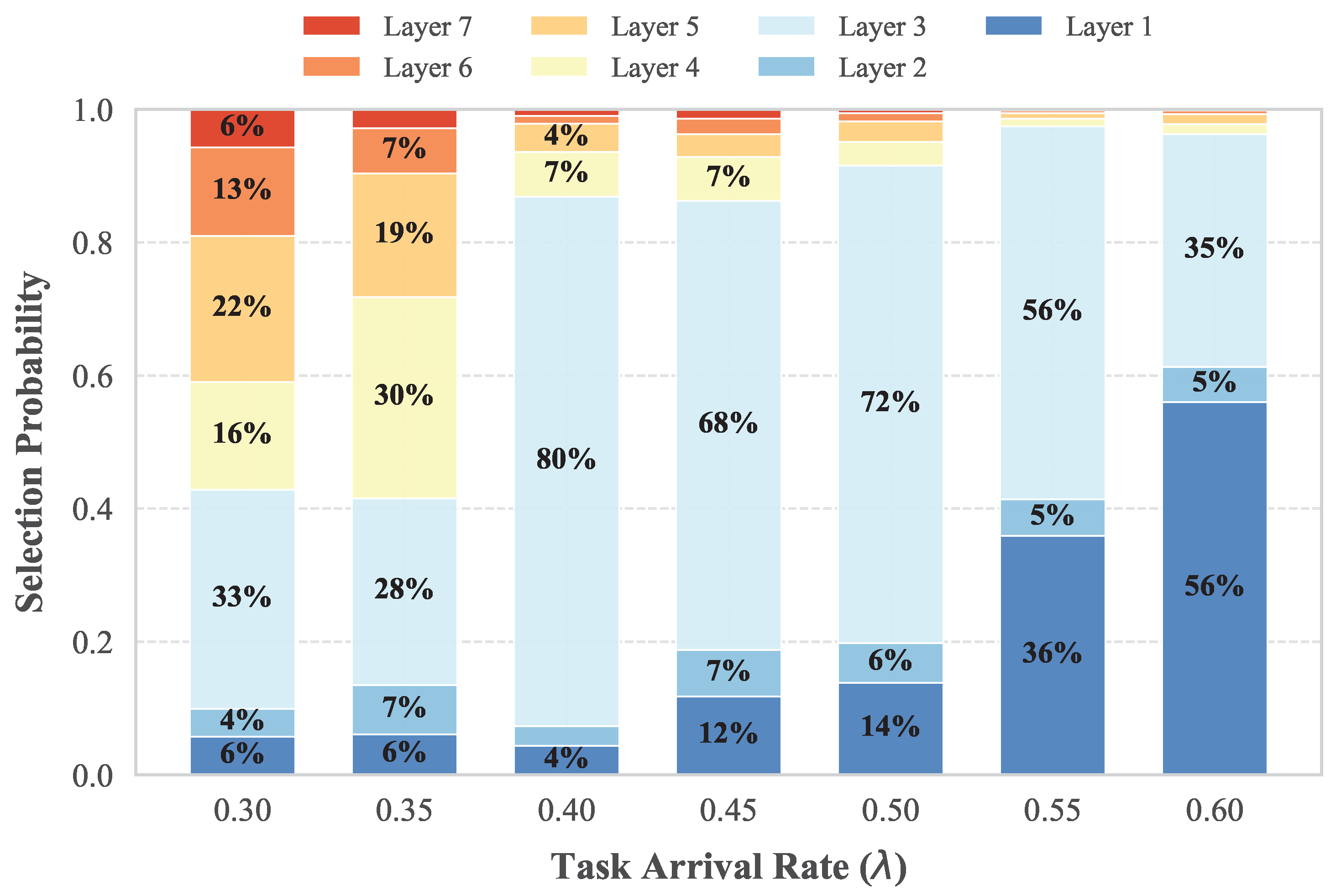
Figure 7 illustrates the DNN partitioning evolution, revealing a three-phase policy transition driven by shifting resource bottlenecks:
(1) Bandwidth-limited regime ( λ 0.35 ): Under light loads, deep and mid-level splits (Layers 3–6) dominate. With abundant on-board resources ( Q c o m p 0 ), the agent maximizes local feature extraction to exploit the high compression of deeper layers, thereby minimizing transmission latency over the spectrum-scarce SGL/ISL.
(2) Transition and optimal operating regime ( λ = 0.40 0.50 ): As traffic moderately increases, an optimal trade-off point emerges at λ = 0.40 , where Layer 3 overwhelmingly dominates ( 80 % ). This equilibrium optimally balances the growing local computation queue with data compression needs. Approaching λ = 0.50 , shallower splits (Layers 1 and 2) progressively expand to alleviate accumulating processing pressure.
(3) Computation-limited regime ( λ 0.55 ): Under heavy congestion, the policy fundamentally inverts, with shallow splits (Layers 1–2) saturating the distribution ( 91 % at λ = 0.60 ). Confronted with a localized computational bottleneck, the agent executes strategic load shedding by deliberately offloading the computational burden to the remote server, thereby significantly mitigating the risk of task timeouts.
This adaptive behavior confirms HMAPPO’s capability to autonomously identify the instantaneous limiting factor, navigating the non-convex communication–computation trade-off without explicit rule-based guidance.
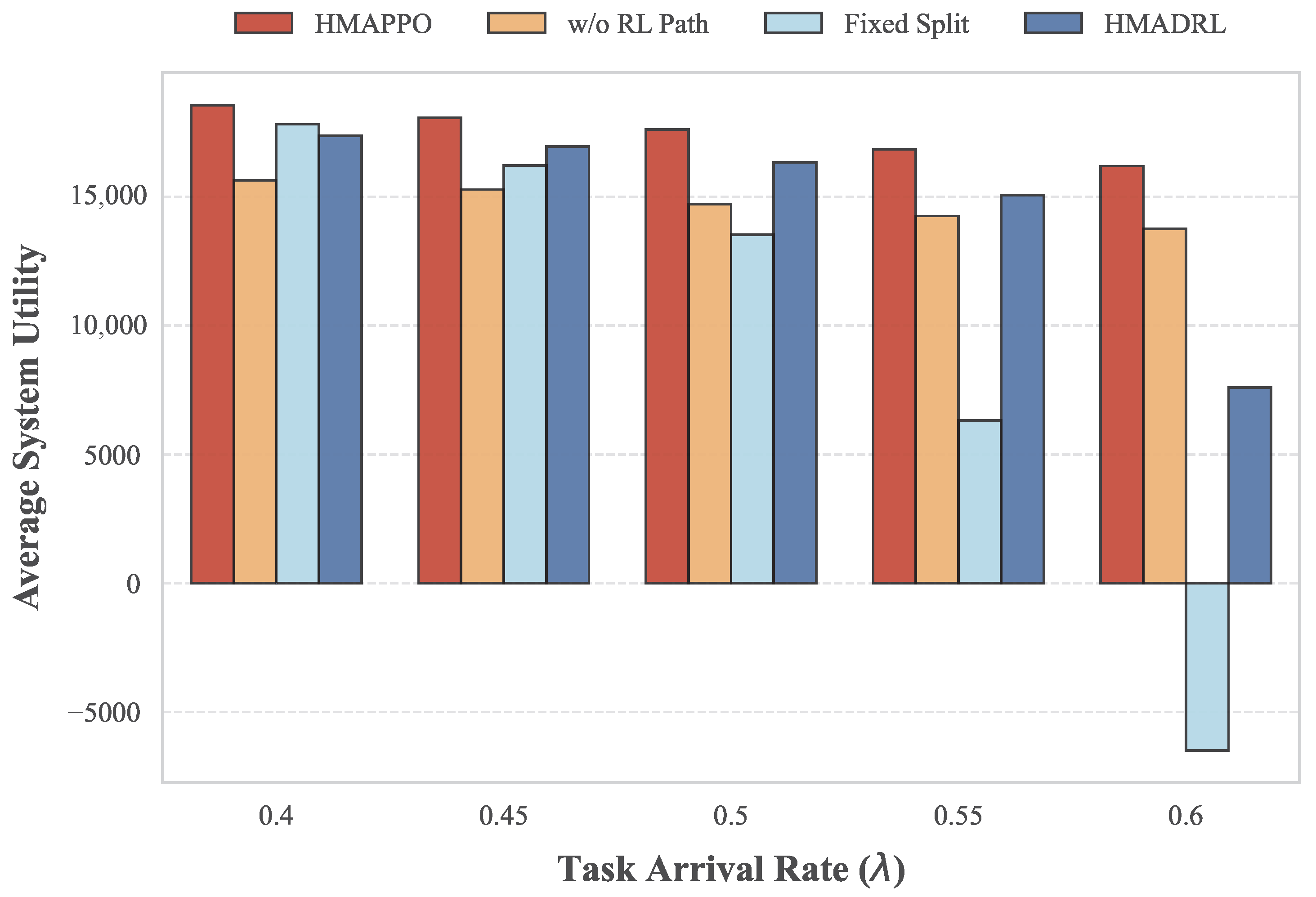
To evaluate the individual contributions of the proposed joint decision-making modules, we conduct an ablation study comparing the full HMAPPO framework against two degraded variants and the baseline: (1) w/o RL path (random routing with learned splitting), (2) fixed split (learned routing with a static split point), and (3) the HMADRL baseline. The average system utility under varying task arrival rates ( λ ) is depicted in Figure 8.
Criticality of adaptive splitting: A notable observation is the severe performance degradation of the fixed split variant under heavy traffic. While it maintains an acceptable utility at lower loads ( λ 0.45 ), its performance plummets to a significant negative value at λ = 0.6 . This sharp decline verifies that a static partition strategy lacks the flexibility to cope with dynamic network congestion, highlighting the absolute necessity of adaptive model splitting.
Necessity of joint optimization: The w/o RL path variant consistently underperforms the full HMAPPO framework across all evaluated loads. This persistent gap demonstrates that optimizing the splitting point alone is insufficient. Intelligent path selection is crucial for spatial load balancing across the satellite-ground network, proving that the joint optimization of routing and splitting yields mutually reinforcing benefits.
Architectural Robustness: The full HMAPPO architecture consistently achieves the highest system utility and exhibits the strongest robustness. Notably, at the peak load ( λ = 0.6 ), HMAPPO sustains a high utility level, whereas the HMADRL baseline experiences a severe performance drop. This directly validates the superiority of integrating the KKT solver to decouple discrete offloading decisions from continuous resource allocation, effectively preventing the agent from falling into suboptimal policies under extreme conditions.
In summary, the performance discrepancies observed across varying traffic loads and user scales stem from the fundamental limitations of HMADRL in constraint satisfaction. HMADRL relies on soft penalties to enforce the hard physical limit f k , t s a t F t o t a l , which triggers severe gradient conflicts between latency minimization and penalty avoidance as the feasible region shrinks. This conflict frequently pushes the agent into infeasible regions, leading to suboptimal convergence. Conversely, HMAPPO utilizes a KKT-based analytical solver as a deterministic mathematical projection, perfectly decoupling constraint satisfaction from RL exploration to guarantee absolute resource safety regardless of system scale or load.

7. Conclusions

This paper addressed the joint computation offloading and resource allocation challenge in resource-constrained space-ground integrated TT&C networks. To reconcile the severe conflict between narrow-band TT&C links and the immense bandwidth demands of massive payload data backhaul, we introduced a task-oriented semantic communication paradigm leveraging adaptive DNN model splitting. Furthermore, a hierarchical reinforcement learning framework, HMAPPO, was developed to solve the formulated stochastic MINLP. By decoupling the optimization into an outer-layer MARL-based discrete decision process and an inner-layer KKT-based continuous resource allocation, the proposed algorithm significantly compresses the exploration space while mathematically ensuring the strict satisfaction of physical capacity constraints. Extensive simulations demonstrated that HMAPPO achieves superior system utility, weighted task success rate, and latency control compared to existing baselines, effectively navigating the dynamic shifting of resource bottlenecks under heavy traffic loads.
Future work will extend this framework to address non-stationary channel uncertainty—specifically investigating the impacts of imperfect Channel State Information (CSI) and fast Doppler shifts induced by high-speed LEO mobility on semantic integrity—via robust optimization, and explore topology-aware decentralized coordination for scalable aerospace TT&C mega-constellations. Additionally, to prevent potential optimality degradation caused by dynamic domain shifts in sensing payload data, developing online fine-tuning mechanisms for the semantic accuracy model remains another critical direction.

Author Contributions

Conceptualization, C.S. and Z.Z.; methodology, C.S. and Z.G.; software, C.S.; validation, Z.G. and D.L.; formal analysis, D.L.; investigation, C.S. and Z.G.; resources, G.L. and Y.R.; data curation, Z.G.; writing—original draft preparation, C.S.; writing—review and editing, Z.Z., G.L. and Y.R.; supervision, Z.Z.; project administration, Z.Z.; funding acquisition, G.L. and Y.R. All authors have read and agreed to the published version of the manuscript.

Funding

This work was supported by the Key Laboratory of Intelligent Space TTC&O (Space Engineering University), Ministry of Education, under Grant NO. CYK2025-01-03.

Data Availability Statement

The original contributions presented in the study are included in the article; further inquiries can be directed to the corresponding author.

Conflicts of Interest

The authors declare no conflicts of interest.

Appendix A. List of Key Mathematical Symbols

To facilitate readability, the key mathematical symbols and variables used throughout this paper are summarized and categorized in Table A1.
Table A1. Summary of key mathematical symbols.
SymbolDefinition
K , kSet of spacecraft nodes, and the index of a node
T , tSet of time slots, and the time slot index
Φ k , t Task request generated by node k at time slot t
D k , t r a w Input dimensions of the raw sensing payload data
ϖ k , t Priority weight of the task
T k m a x Maximum tolerable end-to-end latency
K ( γ k , t ) Number of extracted semantic symbols at splitting point γ k , t
W l o c ( γ k , t ) Local computational workload
W r e m ( γ k , t ) Remote computational workload
F t o t a l Total computing capacity of the space-based computing center (SBCC)
f k l o c Local processor capacity of spacecraft node k
N m a x G S Maximum concurrent accesses supported by the ground station
θ k , t Binary visibility indicator for the satellite-ground link
h k , t Channel fading coefficient
Q k , t c o m p Local computation queue backlog
Q k , t t r a n s Local transmission queue backlog
T k , t t o t a l Total end-to-end task processing latency
Ω k , t Composite urgency weight
U k , t Comprehensive task utility
x k , t Binary offloading path indicator (0 for SBCC, 1 for Ground)
γ k , t Semantic splitting point (number of local layers)
f k , t s a t Continuous space-based computing frequency allocated to task k

References

  1. Lakew, D.S.; Tran, A.-T.; Masood, A.; Dao, N.-N.; Cho, S. A Review on Satellite-Terrestrial Integrated Wireless Networks: Challenges and Open Research Issues. In Proceedings of the 2023 International Conference on Information Networking (ICOIN), Bangkok, Thailand, 11–14 January 2023; pp. 638–641. [Google Scholar]
  2. Zhang, J. Editorial: Satellite Terrestrial Networks: Technologies, Security and Applications. Electronics 2025, 14, 3856. [Google Scholar] [CrossRef]
  3. Wang, Y.; Yang, J.; Guo, X.; Qu, Z. A Game-Theoretic Approach to Computation Offloading in Satellite Edge Computing. IEEE Access 2020, 8, 12510–12520. [Google Scholar] [CrossRef]
  4. Hong, D.; Gao, L.; Hang, R.; Zhang, B.; Chanussot, J. Deep Encoder–Decoder Networks for Classification of Hyperspectral and LiDAR Data. IEEE Geosci. Remote Sens. Lett. 2022, 19, 5500205. [Google Scholar] [CrossRef]
  5. Tang, Q.; Fei, Z.; Li, B.; Han, Z. Computation Offloading in LEO Satellite Networks With Hybrid Cloud and Edge Computing. IEEE Internet Things J. 2021, 8, 9164–9176. [Google Scholar] [CrossRef]
  6. Huang, J.; Lian, L.; Wen, D.; Zhou, Y.; Wang, F.; Wang, W.; Shi, Y. Dynamic UAV-Assisted Cooperative Edge AI Inference. IEEE Trans. Wirel. Commun. 2025, 24, 615–628. [Google Scholar] [CrossRef]
  7. Zhou, C.; Wu, W.; He, H.; Yang, P.; Lyu, F.; Cheng, N.; Shen, X. Deep Reinforcement Learning for Delay-Oriented IoT Task Scheduling in SAGIN. IEEE Trans. Wirel. Commun. 2021, 20, 911–925. [Google Scholar] [CrossRef]
  8. Xie, H.; Qin, Z.; Li, G.Y.; Juang, B.-H. Deep Learning Enabled Semantic Communication Systems. IEEE Trans. Signal Process. 2021, 69, 2663–2675. [Google Scholar] [CrossRef]
  9. Wang, Y.; Han, H.; Feng, Y.; Zheng, J.; Zhang, B. Semantic Communication Empowered 6G Networks: Techniques, Applications, and Challenges. IEEE Access 2025, 13, 28293–28314. [Google Scholar] [CrossRef]
  10. Deng, C.; Fang, X.; Wang, X. Integrated Sensing, Communication, and Computation With Adaptive DNN Splitting in Multi-UAV Networks. IEEE Trans. Wirel. Commun. 2024, 23, 17429–17445. [Google Scholar] [CrossRef]
  11. Guo, Z.; Liu, D.; Zhang, Z. Perception Enhanced Multimodal Multitask Semantic Communication and Resource Management for UAV-Assisted ISAC Systems. IEEE Trans. Veh. Technol. 2026, 1–15. [Google Scholar] [CrossRef]
  12. Guo, Z.; Tong, H.; Zhang, Z.; Liu, D. Perception-Enhanced Multitask Multimodal Semantic Communication for UAV-Assisted Integrated Sensing and Communication System. In Proceedings of the 2025 IEEE International Conference on Communications Workshops (ICC Workshops), Montreal, QC, Canada, 8–12 June 2025; pp. 602–607. [Google Scholar]
  13. Zhang, S.; Cui, G.; Long, Y.; Wang, W. Joint computing and communication resource allocation for satellite communication networks with edge computing. China Commun. 2021, 18, 236–252. [Google Scholar] [CrossRef]
  14. Waqar, N.; Hassan, S.A.; Mahmood, A.; Dev, K.; Do, D.-T.; Gidlund, M. Computation Offloading and Resource Allocation in MEC-Enabled Integrated Aerial-Terrestrial Vehicular Networks: A Reinforcement Learning Approach. IEEE Trans. Intell. Transp. Syst. 2022, 23, 21478–21491. [Google Scholar] [CrossRef]
  15. Lai, J.; Liu, H.; Xu, G.; Jiang, W.; Wang, X.; Jiang, D. Joint Computation Offloading and Resource Allocation for LEO Satellite Networks Using Hierarchical Multi-Agent Reinforcement Learning. IEEE Trans. Cogn. Commun. Netw. 2025, 11, 2554–2567. [Google Scholar] [CrossRef]
  16. Zhang, Z.; Zhang, W.; Tseng, F.-H. Satellite Mobile Edge Computing: Improving QoS of High-Speed Satellite-Terrestrial Networks Using Edge Computing Techniques. IEEE Netw. 2019, 33, 70–76. [Google Scholar] [CrossRef]
  17. Xie, B.; Cui, H.; Ho, I.W.-H.; He, Y.; Guizani, M. Computation Offloading and Resource Allocation in LEO Satellite-Terrestrial Integrated Networks With System State Delay. IEEE Trans. Mob. Comput. 2025, 24, 1372–1385. [Google Scholar] [CrossRef]
  18. Zhong, L.; Li, Y.; Ge, M.-F.; Feng, M.; Mao, S. Joint Task Offloading and Resource Allocation for LEO Satellite-Based Mobile Edge Computing Systems With Heterogeneous Task Demands. IEEE Trans. Veh. Technol. 2025, 74, 11337–11352. [Google Scholar] [CrossRef]
  19. Zhou, J.; Yang, Q.; Zhao, L.; Dai, H.; Xiao, F. Mobility-Aware Computation Offloading in Satellite Edge Computing Networks. IEEE Trans. Mob. Comput. 2024, 23, 9135–9149. [Google Scholar] [CrossRef]
  20. Zhou, K.; Li, J.; Zhou, Q.; Ye, N.; Yang, K.; An, J. Modeling and Analysis of Terahertz Inter-Satellite Communication-Ranging System Under Platform Vibrations. IEEE Trans. Commun. 2026, 74, 4772–4785. [Google Scholar] [CrossRef]
  21. Ahmed, I.; Sun, Y.; Fu, J.; Köse, A.; Musavian, L.; Xiao, M.; Özbek, B. Semantic Communications in 6G: Coexistence, Multiple Access, and Satellite Networks. IEEE Commun. Stand. Mag. 2025, 9, 58–64. [Google Scholar] [CrossRef]
  22. Yan, L.; Qin, Z.; Zhang, R.; Li, Y.; Li, G.Y. QoE-Aware Resource Allocation for Semantic Communication Networks. In Proceedings of the GLOBECOM 2022—2022 IEEE Global Communications Conference, Rio de Janeiro, Brazil, 4–8 December 2022; pp. 3272–3277. [Google Scholar]
  23. Kang, J.; Du, H.; Li, Z.; Xiong, Z.; Ma, S.; Niyato, D.; Li, Y. Personalized Saliency in Task-Oriented Semantic Communications: Image Transmission and Performance Analysis. IEEE J. Sel. Areas Commun. 2023, 41, 186–201. [Google Scholar] [CrossRef]
  24. Hu, H.; Zhu, X.; Zhou, F.; Wu, W.; Hu, R.Q.; Zhu, H. Resource Allocation for Multi-Modal Semantic Communication in UAV Collaborative Networks. IEEE Trans. Commun. 2025, 73, 7599–7616. [Google Scholar] [CrossRef]
  25. Huang, C.; Chen, X.; Chen, G.; Xiao, P.; Li, G.Y.; Huang, W. Deep Reinforcement Learning-Based Resource Allocation for Hybrid Bit and Generative Semantic Communications in Space-Air-Ground Integrated Networks. IEEE J. Sel. Areas Commun. 2025, 43, 3942–3955. [Google Scholar] [CrossRef]
  26. Kim, T.; Kwak, J.; Choi, J.P. Satellite Edge Computing Architecture and Network Slice Scheduling for IoT Support. IEEE Internet Things J. 2022, 9, 14938–14951. [Google Scholar] [CrossRef]
  27. Cheng, M.; Zhu, C.; Lin, M.; Zhu, W.-P. A MAPPO Based Scheme for Joint Resource Allocation in UAV Assisted MEC Networks. In Proceedings of the 2024 IEEE/CIC International Conference on Communications in China (ICCC), Hangzhou, China, 7–9 August 2024; pp. 42–47. [Google Scholar]
  28. Ju, Y.; Chen, Y.; Cao, Z.; Liu, L.; Pei, Q.; Xiao, M.; Ota, K.; Dong, M.; Leung, V.C.M. Joint Secure Offloading and Resource Allocation for Vehicular Edge Computing Network: A Multi-Agent Deep Reinforcement Learning Approach. IEEE Trans. Intell. Transp. Syst. 2023, 24, 5555–5569. [Google Scholar] [CrossRef]
  29. Lyu, Y.; Liu, Z.; Fan, R.; Zhan, C.; Hu, H.; An, J. Optimal Computation Offloading in Collaborative LEO-IoT Enabled MEC: A Multiagent Deep Reinforcement Learning Approach. IEEE Trans. Green Commun. Netw. 2023, 7, 996–1011. [Google Scholar] [CrossRef]
  30. Zhao, L.; Guo, L.; Ni, S.; Qian, W.; Lu, K.; Xie, Y.; Zhou, J. Adaptive Service Migration for Satellite Edge Computing via Deep Reinforcement Learning. Electronics 2025, 14, 4330. [Google Scholar] [CrossRef]
  31. Shi, W.; Li, J.; Wu, H.; Zhou, C.; Cheng, N.; Shen, X. Drone-Cell Trajectory Planning and Resource Allocation for Highly Mobile Networks: A Hierarchical DRL Approach. IEEE Internet Things J. 2021, 8, 9800–9813. [Google Scholar] [CrossRef]
  32. Cui, G.; Long, Y.; Xu, L.; Wang, W. Joint Offloading and Resource Allocation for Satellite Assisted Vehicle-to-Vehicle Communication. IEEE Syst. J. 2021, 15, 3958–3969. [Google Scholar] [CrossRef]
  33. Jia, M.; Zhang, L.; Wu, J.; Guo, Q.; Zhang, G.; Gu, X. Deep Multiagent Reinforcement Learning for Task Offloading and Resource Allocation in Satellite Edge Computing. IEEE Internet Things J. 2025, 12, 3832–3845. [Google Scholar] [CrossRef]
  34. Wara, N.; Paul, A.; Singh, K.; Kaushik, A.; Shin, W. Multi-Agent PPO-Based Resource Optimization for Full-Duplex RIS-Aided NOMA-ISAC Systems. IEEE Open J. Commun. Soc. 2025, 6, 9802–9820. [Google Scholar] [CrossRef]
  35. Ma, Y.; Zhao, Y.; Hu, Y.; He, X.; Feng, S. Multi-Agent Deep Reinforcement Learning for Joint Task Offloading and Resource Allocation in IIoT with Dynamic Priorities. Sensors 2025, 25, 6160. [Google Scholar] [CrossRef]
  36. Li, K.; Jiao, J.; Huang, J.; Xu, Z.; Sun, Q.; Xu, X.; Wang, Y.; Zhang, Q. Age-Critical Joint Communication and Computation Offloading for Satellite-Integrated Internet. IEEE Trans. Cogn. Commun. Netw. 2026, 12, 4387–4403. [Google Scholar] [CrossRef]
  37. Cheng, G.; Han, J.; Lu, X. Remote Sensing Image Scene Classification: Benchmark and State of the Art. Proc. IEEE 2017, 105, 1865–1883. [Google Scholar] [CrossRef]
  38. 3GPP. Study on New Radio (NR) to support Non-Terrestrial Networks; Technical Report 38.821 V16.1.0; 3rd Generation Partnership Project (3GPP): Sophia Antipolis, France, 2020. [Google Scholar]
  39. Denby, B.; Lucia, B. Orbital Edge Computing: Machine Inference in Space. IEEE Comput. Archit. Lett. 2019, 18, 59–62. [Google Scholar] [CrossRef]
Figure 1. The proposed SGIN system model. The dashed lines represent the wireless communication links (SGL and ISL), and the arrows indicate the direction of semantic data flow and task offloading.
Electronics 15 01764 g001
Figure 2. The workflow of the proposed model-assisted hierarchical decomposition framework. The arrows indicate the direction of data flow and the sequence of algorithmic operations.
Electronics 15 01764 g002
Figure 3. Accuracy vs. SNR under different splitting points.
Electronics 15 01764 g003
Figure 4. Convergence comparison between the proposed HMAPPO algorithm and the HMADRL benchmark. The lighter background lines represent the raw training data, while the bold lines show the smoothed trend using a moving average.
Electronics 15 01764 g004
Figure 5. Performance comparison under different task arrival rates ( λ ). (a) Average total QoE; (b) success rate; and (c) average latency.The shaded regions indicate the standard deviation across multiple independent test episodes.
Electronics 15 01764 g005
Figure 6. Performance comparison under different numbers of users (K). (a) Average total QoE; (b) success rate; and (c) average latency.The shaded regions indicate the standard deviation across multiple independent test episodes.
Electronics 15 01764 g006
Figure 7. Evolution of splitting strategy.
Electronics 15 01764 g007
Figure 8. Ablation study.
Electronics 15 01764 g008
Table 1. Feature comparison between the proposed framework and state-of-the-art literature.
Ref.Space-GroundSemantic/TaskSplittingRLConvex Opt.
[18]×××
[15]×××
[10]××
[25]××
Ours
Table 2. Computational load and feature dimensions at different splitting points.
Split LayerComp. LoadFeature Map Shape
(γ)(GFLOPs)(H × W × C)
12.64 32 × 32 × 64
23.24 32 × 32 × 64
33.85 16 × 16 × 64
44.45 16 × 16 × 64
55.05 8 × 8 × 64
65.66 4 × 4 × 64
76.26 2 × 2 × 64
Table 3. Detailed architecture of the customized lightweight network.
ModuleStructure Configuration
ResBlock (RB)Conv + BN + ReLU + Conv + BN + ReLU
DecoderBlock (DB)Upsample + Conv + BN + ReLU
Semantic encoderConv + RB + MaxPool + RB
PE-moduleGAP + FC + Softmax + FC + Softmax
Inference layers6RB
Semantic decoder2DB + Conv + Sigmoid
ClassifierGAP + FC
Note: BN: Batch Normalization; GAP: Global Average Pooling; FC: Fully Connected Layer; RB: Residual Block.
Table 4. Simulation parameters and hyperparameter settings.
ParameterValue
Satellite Network Environment
Number of satellites (K)10
Orbit height600 km
Sat computing capacity ( F total )400 GFLOPs
Local computing capacity ( F loc )80 GFLOPs
SGL bandwidth/frequency2 MHz/28 GHz
ISL bandwidth/frequency2 MHz/32 GHz
Symbol rate ( R s )1.5 Msps
Tx power (SGL/ISL)33 dBm/43 dBm
Antenna gain (SGL/ISL)55 dBi/35 dBi
Noise density−174 dBm/Hz
Time slot duration ( τ )0.5 s
Task Generation Model
Task arrival rate ( λ )0.4 tasks/slot
Task deadline ( T th )5.0 s
Task scale factor ( κ )16
Task priority weights { 1.0 , 2.0 , 4.0 }
HMAPPO Hyperparameters
Actor/Critic learning rate 1 × 10 4
Hidden layer dimension256
Discount factor ( γ RL )0.99
GAE parameter ( λ )0.95
OptimizerAdam
Training episodes2000
Rollout buffer size2000 transitions
PPO optimization epochs4
PPO clip ratio ( ϵ )0.2
Entropy coefficient ( σ )0.01
Gradient clipping norm0.5
Activation functionTanh
Disclaimer/Publisher’s Note: The statements, opinions and data contained in all publications are solely those of the individual author(s) and contributor(s) and not of MDPI and/or the editor(s). MDPI and/or the editor(s) disclaim responsibility for any injury to people or property resulting from any ideas, methods, instructions or products referred to in the content.