1. Introduction
Overtaking decision-making in autonomous driving technology is a highly challenging advanced behavior, requiring vehicles to achieve efficient manipulation in highly dynamic traffic flows while ensuring absolute safety. Traditional rule-based methods struggle to cope with complex and volatile long-tail traffic environments, while end-to-end deep learning methods suffer from poor interpretability, vague safety boundaries, and low training efficiency [
1,
2,
3]. Specifically in overtaking scenarios, the system faces three core challenges. First, is the extremely high safety requirement; high-speed lane changing and acceleration sharply increase blind spots and collision risks [
4]. Second, is the complexity of the decision-making time scale; there is a huge difference between the long-term strategic decision of “when to overtake” and the high-frequency tactical control of “how to steer”. Finally, dynamic trade-offs among multiple objectives are difficult; the system must find the optimal dynamic balance among safety, efficiency, and comfort.
In recent years, reinforcement learning (RL) has provided powerful data-driven solutions for vehicle decision-making and control [
5,
6], but different algorithms have their pros and cons in autonomous driving applications. Value-based Deep Q-Network (DQN) requires discretization of the action space in continuous control tasks, leading to a decrease in control precision. Policy gradient and Actor-Critic methods can directly optimize policy networks, performing excellently in continuous control and have become mainstream [
7,
8]. The maximum entropy-based Soft Actor-Critic (SAC) algorithm combined with imitation learning significantly improves sample efficiency and robustness. Nevertheless, traditional single-layer RL methods still face bottlenecks such as low sample efficiency and training instability when dealing with complex overtaking decisions [
9]. To address this, Hierarchical Reinforcement Learning (HRL) decomposes complex tasks into multi-level subtasks through temporal and state abstraction. From theoretical frameworks like Options and Hierarchical Abstract Machines (HAM) to deep learning methods like Hierarchical Reinforcement Learning with Off-policy correction (HIRO) and Feudal Networks (FuN), HRL has shown enormous potential in reducing problem complexity and improving learning efficiency [
10,
11,
12].
To address the aforementioned challenges, this paper proposes a novel autonomous driving overtaking decision-making and control system based on HRL. Distinguishing itself from existing conventional decision-driven HRL methods, the core innovations and contributions of this framework are as follows:
First, aiming at the “curse of dimensionality” caused by the severe coupling of decision-making and control in existing HRL, a heterogeneous frequency HRL architecture based on temporal decoupling is proposed [
13,
14,
15]. This framework breaks the limitations of traditional synchronous frequency frameworks by decoupling the overtaking task into high-level macro strategic decision-making at 1 Hz and low-level micro trajectory control at 10 Hz [
16]. This not only effectively mitigates the conflict between decision planning latency and low-level execution real-time performance on a temporal scale, but also significantly reduces the Markov Decision Process (MDP) spatial dimensionality in complex long-sequence tasks [
17,
18].
Second, regarding the network structure and algorithmic mechanism, this paper moves beyond the simple splicing of common algorithms like Proximal Policy Optimization (PPO) and Twin Delayed Deep Deterministic Policy Gradient (TD3) in traditional HRL by proposing an intention-driven spatio-temporal feature representation mechanism [
19,
20]. The discrete intentions output by the high-level PPO network [
21] serve not only as control commands but also as dynamic prior inputs to the low-level TD3-Long Short-Term Memory (LSTM) network [
22,
23]. By utilizing the LSTM module for deep memory and feature extraction of temporal states, this framework addresses the deficiency of existing HRL methods in extracting historical interaction information when facing complex and multi-variable traffic flows, thereby ensuring that the low-level network outputs high-precision continuous control commands under the constraints of high-level intentions [
24,
25].
Finally, addressing the issues of poor safety and “policy collapse” prone to occur during the exploration phase of existing HRL, the system introduces a strongly coupled multi-safety boundary constraint and dynamic multi-objective reward mechanism [
26,
27]. This mechanism no longer relies on static rewards; instead, it adaptively adjusts reward weights according to different stages of overtaking, while ensuring the flexibility of high-level decision-making, it constructs a rigorous safety envelope for the low-level control, achieving safe, efficient, and comfortable autonomous overtaking behavior and significantly enhancing the reliability of the system under real-world complex operating conditions.
2. Core Technical Framework and Implementation
2.1. Heterogeneous-Frequency Overall System Architecture
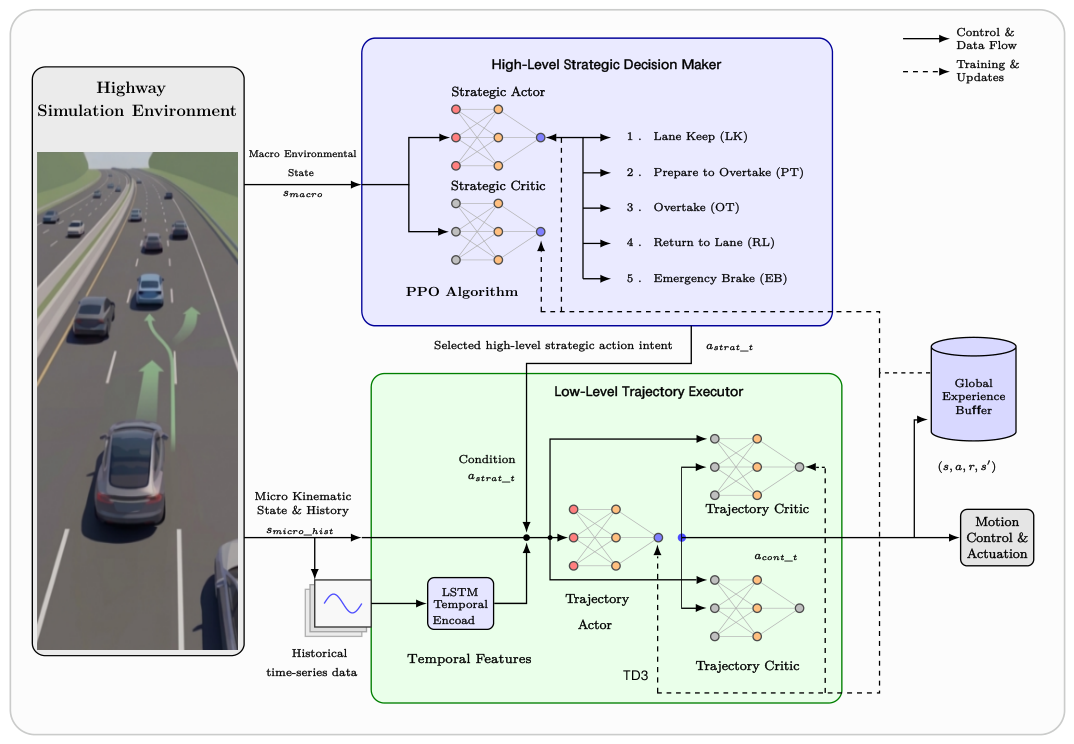
The traditional MDP is highly prone to the curse of dimensionality in overtaking scenarios. Therefore, the innovation of this paper lies in decomposing the global MDP into a high-level Semi-Markov Decision Process (Semi-MDP) and a low-level standard MDP, assigning them different operating clock frequencies. Among them, the high-level strategic decision-maker, acting as the “brain” of the system, operates at a frequency of 1 Hz and employs the PPO algorithm [
28]. It takes the macroscopic environmental state as input and outputs five discrete strategic actions: lane keeping, preparing to overtake, executing overtaking, returning to the lane, and emergency braking. This 1 Hz low-frequency operating mechanism enables the high level to focus on long-term intention planning, effectively avoiding “policy oscillation” caused by frequent decision changes.
Meanwhile, the low-level trajectory executor, acting as the “cerebellum” of the system, operates at a frequency of 10 Hz. It receives the strategic action intention issued by the high level as conditional input, combined with the ego vehicle’s microscopic kinematic state and historical time-series information. To process temporal dependencies and improve the stability of continuous control, the low level adopts an architecture combining the TD3 algorithm with LSTM [
29,
30]. It utilizes the double Q-networks of TD3 to effectively alleviate the overestimation problem, ultimately outputting specific continuous control commands at a high frequency of 10 Hz.
In
Figure 1, it is observed that the Low-Level Trajectory Executor operates as a standard MDP at a higher frequency of 10 Hz, employing a modified TD3 algorithm integrated with an LSTM network. To effectively handle partially observable or dynamic traffic scenarios, an LSTM Temporal Encoder processes historical time-series data to extract temporal features from the micro kinematic state and history. Furthermore, the selected high-level strategic intent acts as a crucial conditional input to the Trajectory Actor, ensuring that the generated continuous control command strictly aligns with the high-level overtaking strategy. The architecture also explicitly illustrates the use of twin Trajectory Critics within the TD3 framework to mitigate Q-value overestimation during the training process.
2.2. Focusing on Key Interacting Vehicles
To further improve the efficiency of network feature extraction and avoid dimensional redundancy caused by blindly inputting global environmental information in overtaking scenarios, this paper innovatively adopts an “attention-guided region division method” in the design of the state space. The system abandons global perception and only extracts the “Key Interacting Vehicles” (KIVs) that pose the greatest threat to the current overtaking decision: namely, the preceding vehicle in the same lane, the preceding vehicle in the left target lane, and the following vehicle in the left target lane. For each key interacting vehicle
i in the set
, the state vector encoding not only includes its relative longitudinal and lateral distances and relative velocities with respect to the ego vehicle, but also innovatively introduces the reciprocal of the Time-to-Collision (TTC) as the core representation of safety risk [
31,
32,
33]. Considering that the traditional
is prone to singular values when the relative velocity approaches zero, this paper uses the reciprocal of
,
, to continuously quantify the urgency of a collision:
where
represents the current absolute longitudinal velocity of the ego vehicle;
represents the absolute longitudinal velocity of the interacting vehicle
i; the
in the numerator ensures that the approach degree is calculated only when the ego vehicle’s speed is greater than the preceding vehicle’s speed;
is the longitudinal relative distance between the ego vehicle and vehicle
i.
Ultimately, the system constructs a comprehensive state vector
containing the ego vehicle state
and interactive features:
where
denotes the comprehensive state vector input to the neural network at time
t;
represents the microscopic kinematic state of the ego vehicle itself; the symbol
indicates the concatenation operation performed on the feature vectors of all target vehicles
i within the set of Key Interacting Vehicles (
), thereby fusing the states of different vehicles into a unified input matrix. Within the feature vector
,
and
represent the longitudinal and lateral relative distances between the ego vehicle and target vehicle
i, respectively, while
and
represent their longitudinal and lateral relative velocities. Finally,
is the inverse of the Time-to-Collision, which is adopted to prevent the value from approaching infinity when there is no collision risk between the two vehicles, thus ensuring the stability of the neural network training.
In this paper,
is employed as a critical safety feature, providing an effective, dimensionality-reduced representation of complex traffic risks. Extensive research has been conducted in the fields of risk-aware vehicle control and surrogate safety measures (SSMs). To overcome the limitations of traditional SSMs, which primarily focus on one-dimensional longitudinal interactions, recent studies have begun exploring multi-dimensional risk representations. For instance, Xu et al. [
34] proposed a two-dimensional SSM based on the fuzzy logic and inverse time-to-collision (FL-iTTC) model. This model innovatively integrates the inverse time-to-collision with the lateral kinematics and uncertainties of adjacent vehicles, thereby significantly enhancing the identification and quantification of collision risks in complex two-dimensional interaction scenarios, such as cut-ins and sideswipes. Furthermore, the perceived risk field model (PRFM) proposed by Yichang et al. [
35] constructs a continuous safety potential field to finely characterize global collision risks by comprehensively considering multi-dimensional physical states, including vehicle distance, velocity, relative velocity, and acceleration. Based on this framework, dynamic control strategies adaptable to varying accident risk levels were designed to improve traffic flow efficiency without compromising safety.
Diverging from approaches that address lateral motion uncertainties via refined two-dimensional fuzzy logic models, or those that conduct macroscopic, fine-grained risk modeling of global traffic flow using continuous potential fields, the method proposed in this paper essentially represents a minimalist extraction of a “local risk potential” tailored to specific game-theoretic objectives. Considering the transient nature of microscopic interactions in overtaking scenarios and the sensitivity of reinforcement learning algorithms to state-space dimensionality, the proposed system intentionally bypasses complex lateral uncertainty reasoning and global field computations. This dimensionality-reduced and focused encoding scheme not only assimilates the core philosophy of cutting-edge risk modeling—which heavily prioritizes collision potential—but also substantially curtails the exploration space required for the reinforcement learning agent. By endowing the neural network with high-dimensional foresight regarding potential hazards, the dual-layer architecture establishes much clearer safety boundaries when navigating highly dynamic interactions.
2.3. Dynamic Multi-Objective Reward Function Design
The core of reinforcement learning lies in the design of the reward function. Aiming at the dynamic trade-off dilemma among multiple objectives including safety, efficiency, and comfort in overtaking scenarios, this paper designs an innovative stage-adaptive composite reward function.
The total reward
of the system at any time step is constituted by the weighted sum of various sub-rewards, and its specific mathematical expression is as follows:
where
represents the overall reward value obtained by the system at the current time step;
represents the absolute safety penalty term, used to constrain collision risks;
represents the relative efficiency incentive term, used to encourage fast passage;
represents the comfort smoothness constraint term, used to smooth the vehicle’s kinematic trajectory;
is the sparse reward at the task level;
are the weight coefficients of the corresponding continuous sub-reward terms, respectively, used to dynamically adjust the relative importance of each optimization objective according to different stages of the overtaking task.
Specifically, the design logic and physical significance of each continuous sub-reward are as follows:
- (1)
Absolute Safety Penalty
This term aims to establish a physical safety bottom line during the overtaking process. Once the relative distance between the ego vehicle and surrounding interacting vehicles is less than the set dynamic safety boundary, the system will trigger a massive negative reward. This mechanism is closely integrated with the multiple safety constraints mentioned above; the closer the distance and the higher the collision urgency, the non-linearly greater the penalty value, forcing the agent to prioritize learning collision avoidance strategies.
- (2)
Relative Efficiency Incentive
This term is primarily used to improve the vehicle’s traffic efficiency in the traffic flow. Under the premise that the system confirms the hard safety constraints are met, if the ego vehicle’s speed is higher than the speed of the preceding vehicle being overtaken, the system will provide a positive efficiency reward. This setting aims to overcome the “conservative strategy” potentially caused by pure collision avoidance, prompting the vehicle to complete the overtaking action quickly and decisively, thereby minimizing the game time during which the ego vehicle and the adjacent vehicle run parallel in the target lane.
- (3)
Comfort Smoothness Constraint
To ensure that the generated overtaking trajectory conforms to the physical sensation and physiological acceptance of human passengers, this term focuses on constraining the vehicle’s extreme kinematic control variables. The system imposes penalties on excessively large longitudinal jerk (rate of change in acceleration) and sudden lateral acceleration caused by sharp steering. By smoothing these microscopic control variables, the continuity, stability, and ride comfort of the overall overtaking trajectory are ensured.
2.4. Tuning of Reward Function Weight Parameters
This study proposes a dynamic multi-objective reward function composed of safety (), efficiency (), and comfort (). However, reinforcement learning algorithms are extremely sensitive to reward shaping, and the selection of the weight parameters () for each sub-reward directly determines the agent’s behavioral tendencies in complex overtaking games. To ensure the effectiveness and robustness of the proposed strategy, this section details the dynamic adjustment mechanism of the weights, the parameter optimization process, and the robustness verification method.
2.4.1. Dynamic Weight Adjustment Mechanism Based on Overtaking Stages
Traditional static weights struggle to adapt to the dynamic requirements of the entire overtaking process. Therefore, aiming at the three typical stages of the overtaking task (lane change preparation and cut-out, parallel passing, and lane change cut-in), this paper designs a stage-adaptive weight scheduling strategy:
Stage 1: Lane Change Out. During this stage, the vehicle needs to cut from the original lane into the target lane, leading to a sharp increase in collision risk. Therefore, the safety weight is given the highest priority, while the efficiency weight is kept relatively low to prevent the vehicle from blindly accelerating into the lane change. The optimal weights for this stage in this study are set as: (High), (Low), (Medium).
Stage 2: Parallel Passing. When the ego vehicle is parallel to the leading and trailing vehicles in the target lane, the longer the dwell time, the greater the potential risk (i.e., the “side-by-side game” time). At this point, the system increases the efficiency weight to force the agent to adopt a decisive acceleration strategy to complete the passing quickly. The optimal weights for this stage in this study are set as: (High), (Very High), (Low, appropriately relaxing comfort in exchange for rapidly leaving the danger zone).
Stage 3: Lane Change In and Stabilization. After the passing is completed, the vehicle cuts back into the original lane. The collision risk decreases at this time, and the focus shifts to restoring the vehicle’s driving smoothness, avoiding sharp steering or hard braking. Thus, the comfort weight is significantly increased. The optimal weights for this stage in this study are set as: (Medium), (Low), (High).
2.4.2. Tuning Method for Weight Parameters
To determine the optimal baseline weight values for each of the above stages, this paper avoids pure manual tuning and instead adopts a combination of Bayesian Optimization and Curriculum Learning for parameter optimization:
Sub-reward Normalization: Before the weighted summation, dynamic clipping and normalization (restricted to the interval) are applied to , and . This eliminates the interference of different dimensions and orders of magnitude on the weights, ensuring that the numerical magnitude of truly reflects its physical importance.
Bayesian Optimization: The “success rate” and “average collision rate” of the overtaking task are treated as black-box optimization objectives. The Bayesian Optimization algorithm is utilized to search for the optimal baseline weight combination for each stage within the preset parameter space.
Curriculum Learning Fine-tuning: In the early stage of training, an extremely high safety weight () is adopted to let the agent prioritize learning “no collision.” As the training episodes increase, the safety weight is gradually decayed, and the efficiency and comfort weights are released. This effectively solves the “conservative strategy” trap where multi-objective reinforcement learning easily falls into local optima in the early stages.
2.4.3. Sensitivity Analysis of Weight Parameters
While the aforementioned tuning methods identify optimal weight baselines, it is crucial to understand the sensitivity of the final trained policy to variations in these parameters (). Further analysis reveals that the system exhibits distinct, non-linear sensitivity profiles for each sub-reward:
High Sensitivity to Safety (): The policy demonstrates extreme sensitivity to decreases in . A marginal reduction below the optimized threshold triggers an exponential increase in collision rates, particularly during Stage 1 and Stage 2. This confirms that acts as a strict lower-bound constraint rather than a flexible preference.
Moderate, Bidirectional Sensitivity to Efficiency (): The system shows a direct, linear sensitivity to regarding maneuver completion time. However, if is overly inflated, the agent develops overly aggressive behaviors, frequently violating minimum safe distance margins to minimize time. Conversely, a depressed leads to hesitant, parallel driving, increasing the duration of risk exposure.
Kinematic Sensitivity to Comfort (): The overall task success rate is relatively insensitive to ; however, the kinematic outputs are highly sensitive. Setting too low results in “bang-bang” style steering oscillations, whereas setting it excessively high over-constrains the action space, occasionally preventing necessary evasive maneuvers.
In conclusion, the policy’s highly asymmetrical and varying sensitivity to these weights robustly justifies the necessity of the proposed stage-adaptive dynamic mechanism. A static parameter configuration would be too brittle to maintain optimal performance across the fluctuating sensitivity landscapes of the complex overtaking process.
3. Experimental Settings and Simulation Platform
To comprehensively verify the effectiveness and robustness of the proposed heterogeneous-frequency HRL-PPO-TD3 overtaking decision-making system, we conducted rigorous training and comparative experiments in a high-fidelity autonomous driving simulation environment.
3.1. Simulation Platform and Vehicle Dynamics Model
This study conducts secondary development based on highway-env, an open-source traffic flow simulation platform widely utilized in autonomous driving decision-making research. In the simulation environment, the ego-vehicle adopts a four-wheel vehicle dynamics model that more closely approximates real-world physics. This model comprehensively accounts for the independent forces acting on each of the four tires, side-slip characteristics, and the non-linear dynamic response of the chassis. Such a configuration ensures that the continuous control outputs from the underlying network strictly adhere to complex and realistic physical limit constraints.
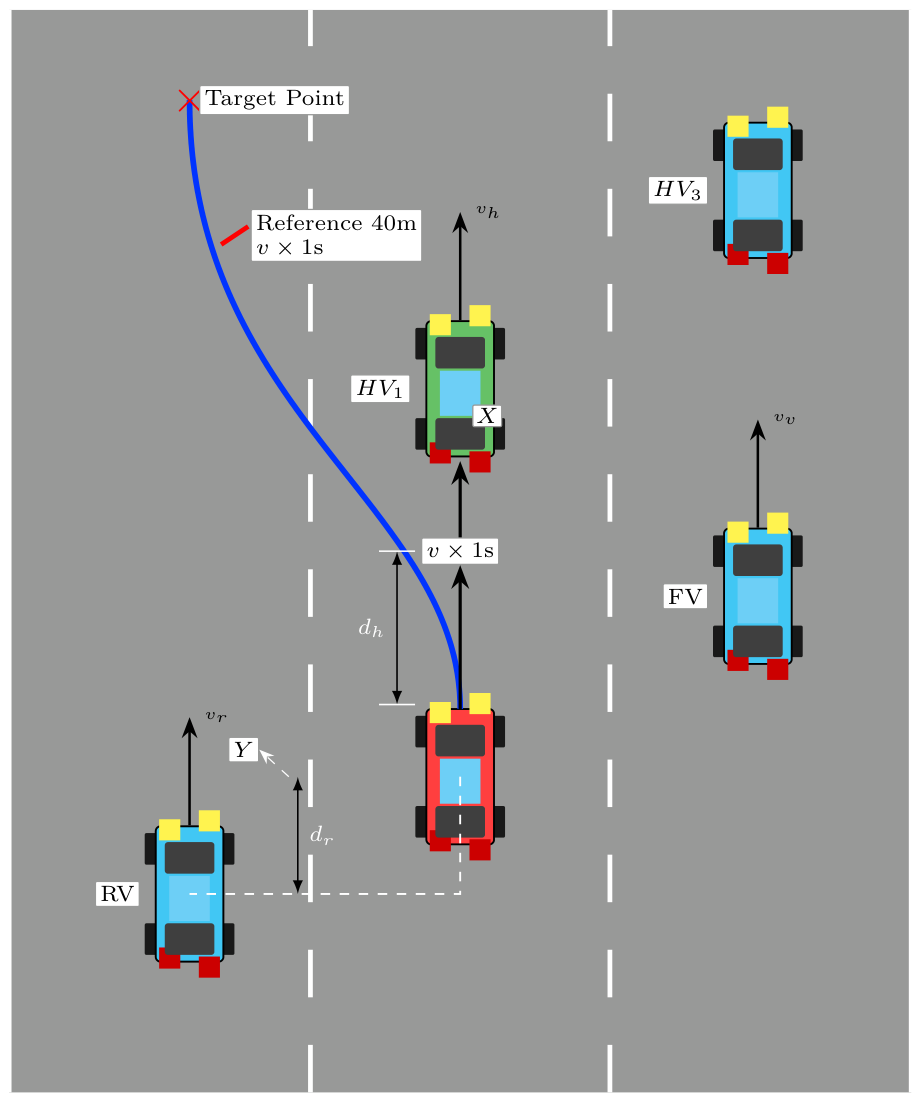
In
Figure 2, it is observed that the autonomous overtaking scenario involves multiple dynamic agents within a structured highway environment. The red vehicle, designated as the ego vehicle, calculates its trajectory based on a reference distance (e.g.,
s) and a predefined target point. As presented in
Figure 2, the state space includes critical spatial relationships such as the headway distance
and relative positions
to surrounding vehicles. This detailed schematic illustrates how the simulation environment translates physical dynamics into a tactical decision-making task for the autonomous agent.
3.2. Network Architecture and Training Hyperparameter Settings
To ensure that the proposed HRL-PPO-TD3 heterogeneous frequency hierarchical reinforcement learning model exhibits good convergence and stability, while guaranteeing complete reproducibility of the experiments, this section details the network architecture design and training hyperparameter configurations of the bi-level algorithm.
The bi-level architecture in this study adopts fully connected Multi-Layer Perceptrons (MLP) as the base network, implemented using PyTorch (Foundation for AI Infrastructure, San Francisco, CA, USA).All Actor and Critic networks in both the upper and lower levels are uniformly configured with two hidden layers containing 256 neurons each ([256, 256]) and utilize the Rectified Linear Unit (ReLU) activation function. At the macro-decision level, the upper-level PPO algorithm consists of independent Actor and Critic networks, where the Actor output layer uses the Softmax function to output the probability distribution of discrete actions. At the micro-control level, the lower-level TD3 algorithm contains one Actor and two independent Critic networks (to alleviate value overestimation). Its Actor output layer employs the Tanh activation function to normalize continuous actions, facilitating subsequent mapping to actual vehicle dynamic control boundaries with strict physical constraints.
To balance exploration and exploitation during the training process, this study designs differentiated exploration strategies and experience storage mechanisms for the upper and lower-level algorithms. In the upper-level PPO algorithm, a policy entropy regularization term with a coefficient of 0.01 is introduced to encourage diverse overtaking decisions in the early stages, preventing the model from falling into local optima. Based on its on-policy characteristics, fixed-length data trajectories are used for online updates. In the lower-level TD3 algorithm, exploration is performed by adding additive Gaussian noise to the continuous action outputs of the Actor. Target policy smoothing regularization is introduced when the Critic calculates the target Q-value to enhance the robustness of the value evaluation. Meanwhile, an experience replay buffer is utilized to break the temporal correlation of sequential data and improve sample utilization.
Regarding the core training hyperparameters, specific configurations such as batch size and learning rate are detailed in
Table 1. All models are uniformly trained on an NVIDIA RTX 4090 Graphics Processing Unit (GPU) (NVIDIA Corporation, Santa Clara, CA, USA) hardware platform based on the PyTorch framework (version 2.1, PyTorch Foundation, San Francisco, CA, USA).
3.3. Overtaking Scenario Design and Parameter Configuration
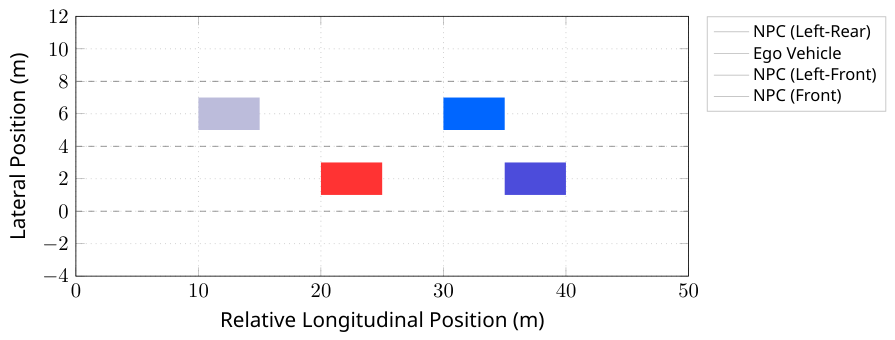
As shown in
Figure 3, this topology diagram illustrates a typical highway overtaking simulation scenario where different traffic participants are distinguished by color: the red block represents the ego vehicle currently located in the middle lane; the dark blue block denotes the NPC front vehicle in the same lane; the light purple and light blue blocks represent the NPC left-rear and NPC left-front vehicles in the adjacent lane, respectively. This structure constructs a dynamic environment with multiple interacting vehicles at a medium-high traffic density of 15–20 vehicles/km, designed to evaluate the decision-making and path planning capabilities of the ego vehicle within complex traffic flows.
3.3.1. Basic Scenario and Behavior Models
To simulate the “long-tail effect” of real-world traffic flow, NPC vehicles in the environment are randomly assigned different driving styles (ranging from conservative to aggressive). Their longitudinal motion follows the Intelligent Driver Model (IDM), and their lateral motion follows the Minimizing Overall Braking Induced by Lane Change (MOBIL) model. The initial speed of the ego vehicle is set to 20 m/s, and the speed limit of the target lane is 30 m/s.
3.3.2. Adverse Weather and Perception Noise Modeling
To further verify the robustness and generalization ability of the HRL-PPO-TD3 algorithm in extreme environments, and in accordance with the reviewers’ comments, we introduced physical characteristic disturbances and observation errors based on the basic scenario. Specifically, we simulated the low-adhesion road surfaces typical of rainy and snowy weather by reducing the longitudinal friction coefficient between the tires and the road surface in the vehicle dynamics module from 1.0 to 0.4–0.6. This was utilized to test the safety of the algorithm when braking performance is degraded. Simultaneously, Gaussian observation noise targeting relative distance and speed was injected into the state space of the ego vehicle to simulate the degradation of sensor accuracy in low-visibility environments, such as foggy conditions.
3.3.3. Road Anomalies and Sudden Condition Design
In addition to conventional traffic flows, the experiment also incorporated two typical anomalous conditions: sudden abnormal braking (ghost braking) and static road obstacles, to evaluate the emergency response capabilities of the HRL architecture in high-level decision-making. Specifically, the rear-end collision risk was simulated by setting an NPC vehicle ahead in the target lane to randomly trigger emergency braking at 5 m/s2. Furthermore, construction roadblocks or broken-down vehicles were generated at key nodes of the overtaking path to force the agent to execute immediate obstacle avoidance or strategy termination. Through the combination of the diverse scenarios described above, this experiment constructed a comprehensive, multi-dimensional test set encompassing “standard–adverse–anomalous” conditions, aiming to thoroughly evaluate the performance of the HRL algorithm on safety boundaries relative to single-layer reinforcement learning algorithms.
3.4. Comparative Baseline Algorithms
To highlight the dual advantages of the HRL architecture proposed in this paper in complex decision-making and continuous control, we selected the following three mainstream algorithms as baselines for comparison:
To highlight the dual advantages of the proposed HRL architecture in complex decision-making and continuous control, we selected three mainstream algorithms as benchmarks for comparative analysis: (1) Rule-based (IDM + MOBIL), a traditional traffic flow model that performs lane-changing decisions based on preset TTC thresholds; (2) Single-layer PPO (Flat-PPO), an end-to-end architecture that directly maps environmental perception states to continuous control signals for steering, acceleration, and braking; and (3) Single-layer TD3 (Flat-TD3), a prominent baseline for handling continuous action spaces in reinforcement learning.
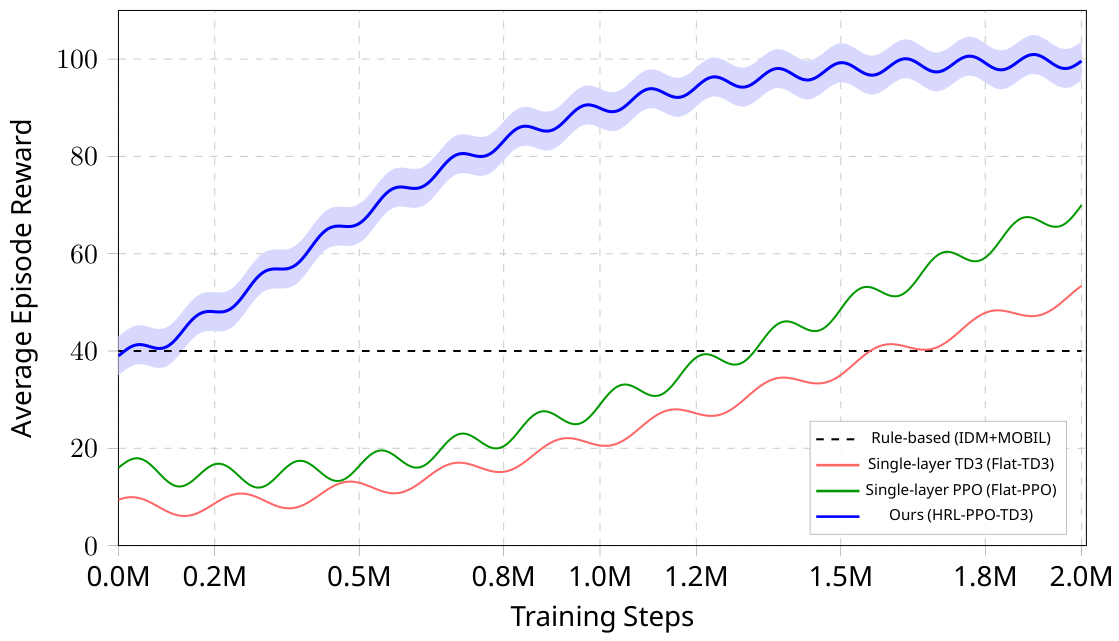
As presented in
Figure 4, it is observed that the proposed HRL architecture significantly outperforms the three representative baselines. The HRL-PPO-TD3 method not only converges faster but also reaches a substantially higher average episode reward, effectively demonstrating its dual advantages in complex decision-making and continuous control.
4. Experimental Results and Comparative Analysis
4.1. Training Convergence and Sample Efficiency Analysis
During the training phase, to verify the statistical significance and stability of each algorithm, we conducted independent training using 5 different random seeds and recorded the average episodic cumulative rewards and Standard Deviations (SD) across runs for each reinforcement learning algorithm. Experimental results show that the single-layer Flat-PPO and Flat-TD3 algorithms suffered from a severe “curse of dimensionality” in the early stages due to the vast hybrid action space, only beginning to rise slowly and with intense oscillations after approximately steps. The introduction of the modern state-of-the-art continuous control baseline, the Single-layer SAC (Flat-SAC) algorithm, benefited from the maximum entropy reinforcement learning mechanism, resulting in improved exploration efficiency and achieving convergence at approximately steps; however, its final reward upper bound remained constrained by the difficulties of long-horizon decision-making.
In contrast, the hierarchical architecture significantly improved the agent’s exploration efficiency. The classic synchronous hierarchical baseline, HRL-PPO-PPO, achieved convergence at approximately steps. The HRL architecture proposed in this paper, due to the effective decoupling of decision-making and control in the temporal domain, quickly reached a stable convergence state at approximately steps. The final cumulative reward was approximately 15% higher than that of Flat-SAC and approximately 8% higher than the conventional HRL-PPO-PPO. More importantly, the method proposed in this paper exhibited the smallest reward variance across multiple independent runs, fully demonstrating that the improvements of this architecture are not accidental but possess high stability and advantages in sample efficiency.
4.2. Quantitative Evaluation of Core Performance Metrics
4.2.1. Statistical Analysis of Monte Carlo Test Results and Performance
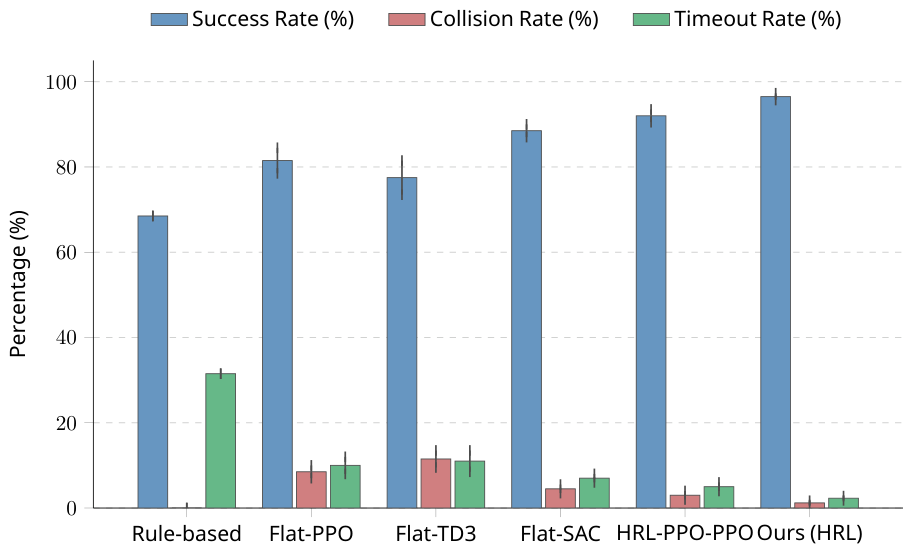
After completing the training, we conducted 1000 Monte Carlo tests in randomly generated traffic flows (incorporating model validation across 5 different random seeds). We calculated the mean and SD of the core performance metrics, and the quantitative results are presented in
Table 2 and
Figure 5. Introducing the SD across runs aims to rigorously verify the robustness of each method’s performance.
As in
Table 2 and
Figure 5, although the rule-based method has a collision rate of zero, it is overly conservative, resulting in a timeout failure rate as high as 31.5%. The introduced modern reinforcement learning baseline, Flat-SAC, demonstrates strong capabilities in continuous control, with its overtaking success rate (88.4 ± 1.9%) significantly outperforming the basic Flat-PPO and Flat-TD3. However, limited by its flat structure, it still faces relatively high collision and timeout risks when dealing with complex, long-horizon interactions. Meanwhile, although the classical same-frequency hierarchical framework, HRL-PPO-PPO, improves the success rate to 92.1% through task decomposition, its control output variance and comfort penalty remain high due to the same-frequency coupling of the high and low levels and the lack of deep memory processing of temporal features.
In contrast, the HRL method proposed in this paper achieves an overtaking success rate of up to 96.5 ± 0.6% while ensuring absolute safety with a very low collision rate (1.2 ± 0.3%). Furthermore, not only do all key indicators achieve optimal performance, but their extremely small standard deviations also confirm that the proposed method possesses strong anti-interference capabilities and stability. The lower-level TD3, combined with LSTM to process temporal information and operating at heterogeneous frequencies (1 Hz/10 Hz), effectively suppresses the output oscillation phenomenon commonly seen in traditional RL and standard HRL. It reduces the average comfort penalty (Jerk) to the lowest value of 0.82 ± 0.06, thoroughly proving the effectiveness of the “heterogeneous frequency + intention-driven” design proposed in this paper.
4.2.2. Extreme Scenario Robustness Analysis
To quantitatively evaluate the performance of the model under non-ideal working conditions, we selected three types of extreme scenarios: rainy conditions with low friction, foggy conditions with high noise, and road anomalies with sudden braking. Comparative experiments were conducted against the performance under standard conditions. The specific experimental data comparison is presented in
Table 3.
As can be observed from the test data, with the increase in environmental complexity, the performance metrics of all tested algorithms exhibited varying degrees of degradation. However, the HRL method proposed in this paper successfully maintained an overtaking success rate of over 88% across all extreme scenarios, with the increase in collision rate being significantly lower than that of the baseline algorithms.
In the low-friction rainy environment, the collision rate of the Flat-PPO algorithm surged to 15.2% due to its inability to adapt to the changing dynamic parameters. In contrast, the HRL architecture effectively mitigated the risk of sideslip, leveraging the underlying TD3 network’s perception of and real-time correction capabilities for execution-layer disturbances. Under foggy conditions with limited perception, the high-level decision-making network demonstrated exceptional fault tolerance, validating the effectiveness of the hierarchical architecture in reducing the decision-making process is reliance on instantaneous observation accuracy. Furthermore, when encountering sudden braking caused by road anomalies, the HRL method achieved a superior balance between safety and traffic efficiency, thereby avoiding the frequent interruption of overtaking tasks typically caused by the overly conservative nature of traditional rule-based methods.
4.3. Microscopic Analysis of Typical Overtaking Trajectories
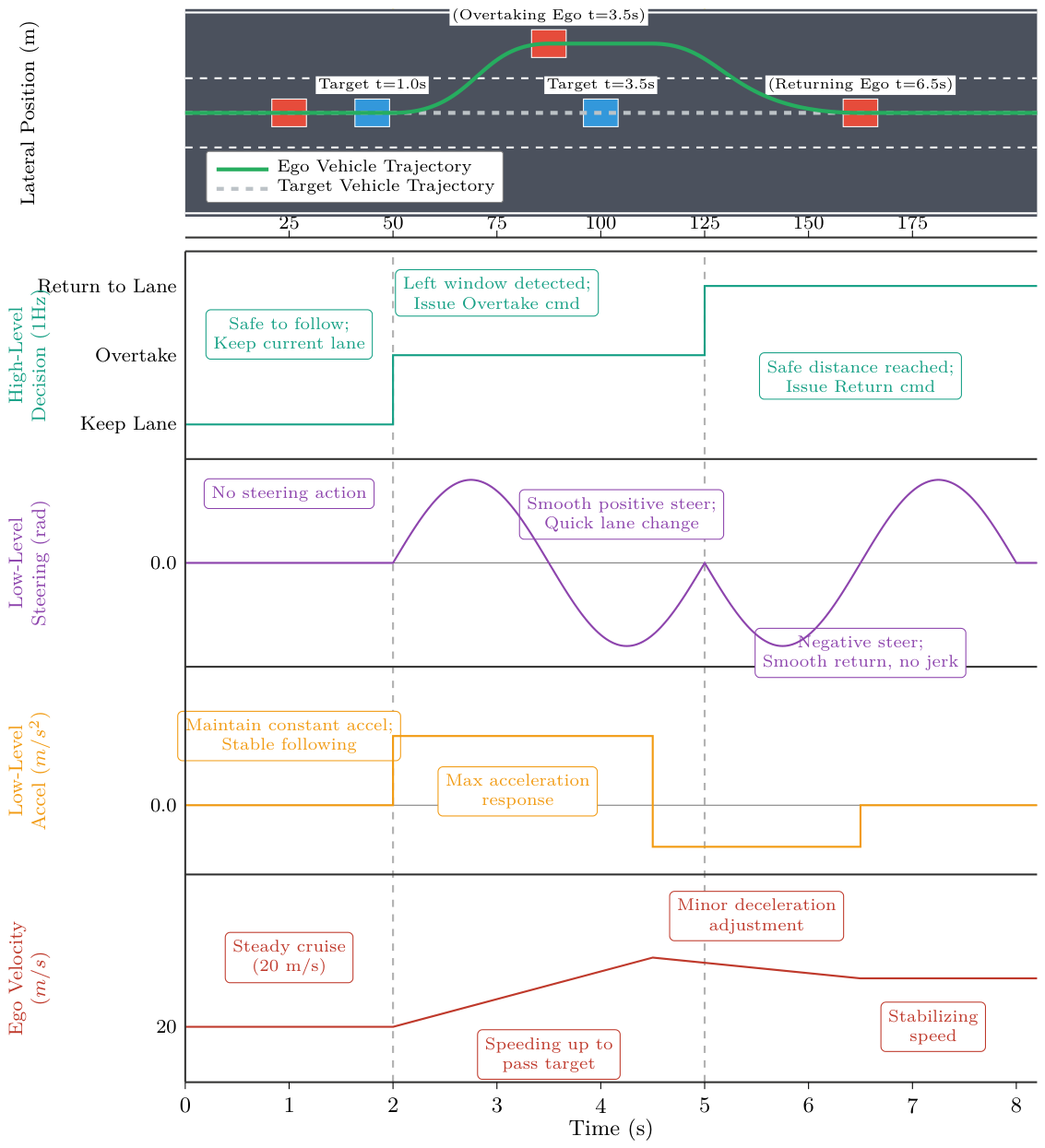
By extracting a complex three-lane overtaking event, the microscopic trajectory of the ego vehicle is analyzed. The entire process clearly demonstrates how high-level strategies command low-level control:
As shown in
Figure 6,the vehicle demonstrated high logical coherence and execution smoothness throughout the observed maneuvers: during Stage 1 (0–2 s), the high-level PPO output the “lane-keeping” command, while the low-level network maintained a constant acceleration to follow the lead vehicle; in Stage 2 (2–5 s), upon detecting a safety window in the left lane, the high-level controller issued an “overtaking” command, to which the low-level TD3 responded promptly by generating smooth positive steering angles and maximum acceleration to execute a rapid lane-out and pass the target vehicle; finally, in Stage 3 (5–8 s), once the safety distance was satisfied, the high-level command transitioned to “return to lane,” with the low-level network outputting a reverse steering angle for a stable recovery. The entire trajectory was free from abrupt steering fluctuations, effectively validating the superior coordination of the proposed HRL architecture in bridging macro-logic decision-making with micro-physical execution.
4.4. Ablation Study
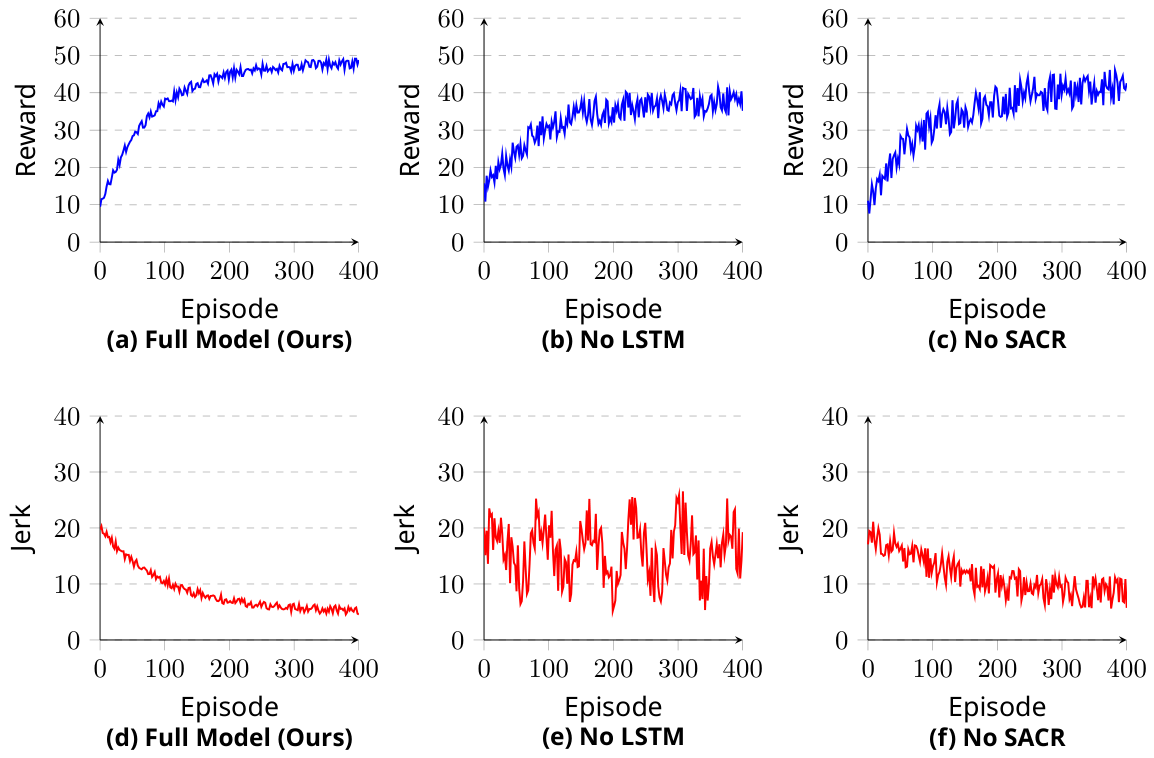
To verify the effectiveness of the specific LSTM module and the dynamic Safety-Aware Continuous Reward (SACR) proposed in this paper, ablation experiments were conducted.
As shown in
Figure 7, ablation study results indicate that removing the low-level LSTM leads to a nearly three-fold increase in the comfort penalty (Jerk) during continuous control, demonstrating the indispensable role of temporal memory in maintaining control smoothness. Furthermore, replacing the proposed dynamic reward with a traditional static reward causes the collision rate to rise significantly from
to
, illustrating that the phase-adaptive multi-objective weight allocation effectively strengthens the “hard safety constraints” of the system.
4.5. Algorithm Hyperparameter Sensitivity Analysis
To further verify the robustness of the proposed HRL-PPO-TD3 heterogeneous frequency hierarchical reinforcement learning architecture, and to rule out the possibility that its superior performance relies solely on a coincidental parameter combination, a hyperparameter sensitivity analysis was conducted on the core parameters that play a decisive role in the model. We primarily focused on two key variables: the learning rate of the high-level decision network (PPO) and the temporal memory length of the low-level control network (TD3-LSTM).
4.5.1. Sensitivity Analysis of Learning Rate for High-Level PPO
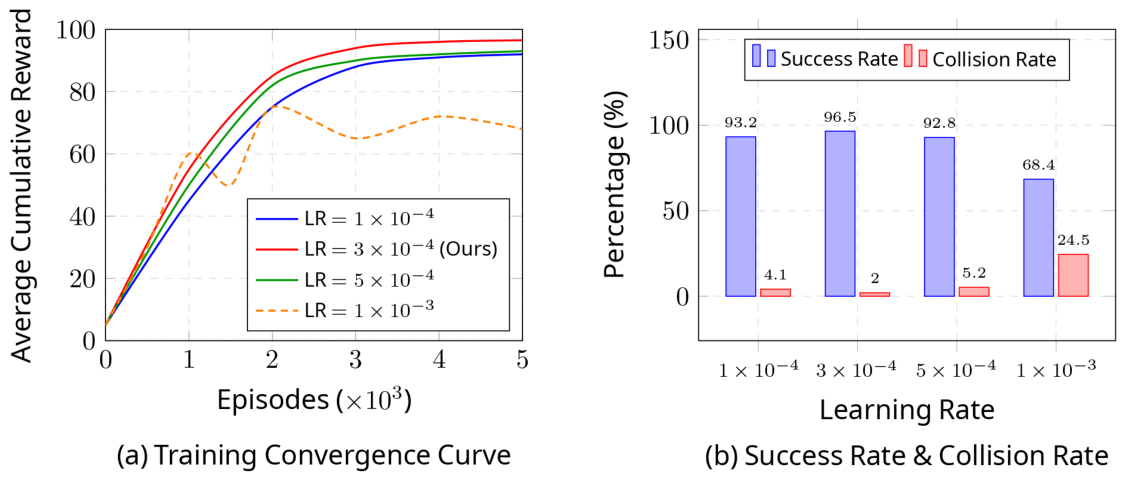
The high-level PPO algorithm is responsible for outputting discrete lane-changing or lane-keeping commands. Its learning rate (LR) directly determines the step size of the policy update and the stability of macroscopic decision-making, while maintaining other parameters constant as configured in
Table 1, we selected
,
(our baseline),
, and an extreme value of
for independent training.
As depicted in
Figure 8, when the PPO learning rate fluctuates within
of the baseline value (i.e., from
to
), the average cumulative reward smoothly converges to over 90, and the fluctuation of the final overtaking success rate does not exceed
. This indicates that the high-level policy network has exceptional tolerance and robustness to variations in the learning rate. However, when an extreme learning rate (
) is applied, severe oscillations in the reward curve can be observed during the early stages of training. The policy network struggles to converge to the optimal strategy, leading to a significant increase in the collision rate during the testing phase. This not only confirms the rationality of selecting
as the baseline high-level learning rate, but also aligns with the theoretical expectation in reinforcement learning that an excessively large step size can disrupt policy optimization.
4.5.2. Sensitivity Analysis of the Low-Level TD3-LSTM Sequence Length
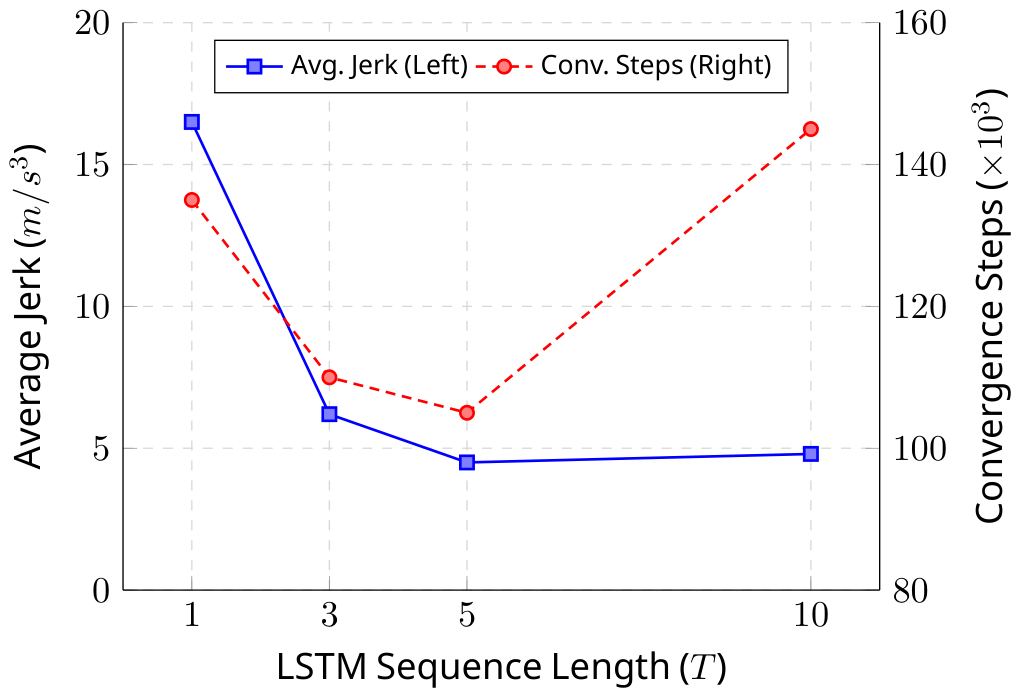
At the microscopic control level, the LSTM module is introduced to handle the partial observability of the environment and ensure smooth continuous control outputs. The historical state sequence length (T) received by the LSTM is the core parameter determining its temporal feature extraction capability. We tested sequence lengths of (degenerating to a memoryless pure MLP), , (our baseline), and .
The experimental data (
Figure 9) clearly demonstrate that the temporal memory length has a decisive impact on the smoothness of the underlying vehicle control. When
, the low-level network lacks historical dynamic information and can only execute reactive steering and acceleration responses, causing the comfort penalty (Jerk) to increase sharply. As the sequence length increases to
and
, the Jerk value significantly decreases and stabilizes, enabling the vehicle to exhibit highly human-like characteristics in continuous control. However, when the sequence length is further increased to
, the excessively long historical information introduces redundant noise features. This does not further improve the overtaking success rate; instead, it increases the computational burden on the Critic network, resulting in an approximately 15% increase in the number of samples required for convergence. Therefore,
achieves the optimal balance between control smoothness and sample efficiency.
Based on the above experimental results, it can be concluded that the proposed HRL architecture exhibits high robustness with minimal performance fluctuations within a reasonable variation range (
) of the core hyperparameters. The current parameter configuration (
Table 1) is not arbitrary, but rather the optimal solution obtained after thoroughly balancing the stability of macroscopic decision-making, the smoothness of microscopic control, and the sample training efficiency.
4.6. Interpretability Analysis of the Hierarchical Decision-Control Logic
Compared to traditional “black-box” single-layer reinforcement learning, our proposed HRL architecture offers clear interpretability by mimicking human driving logic.
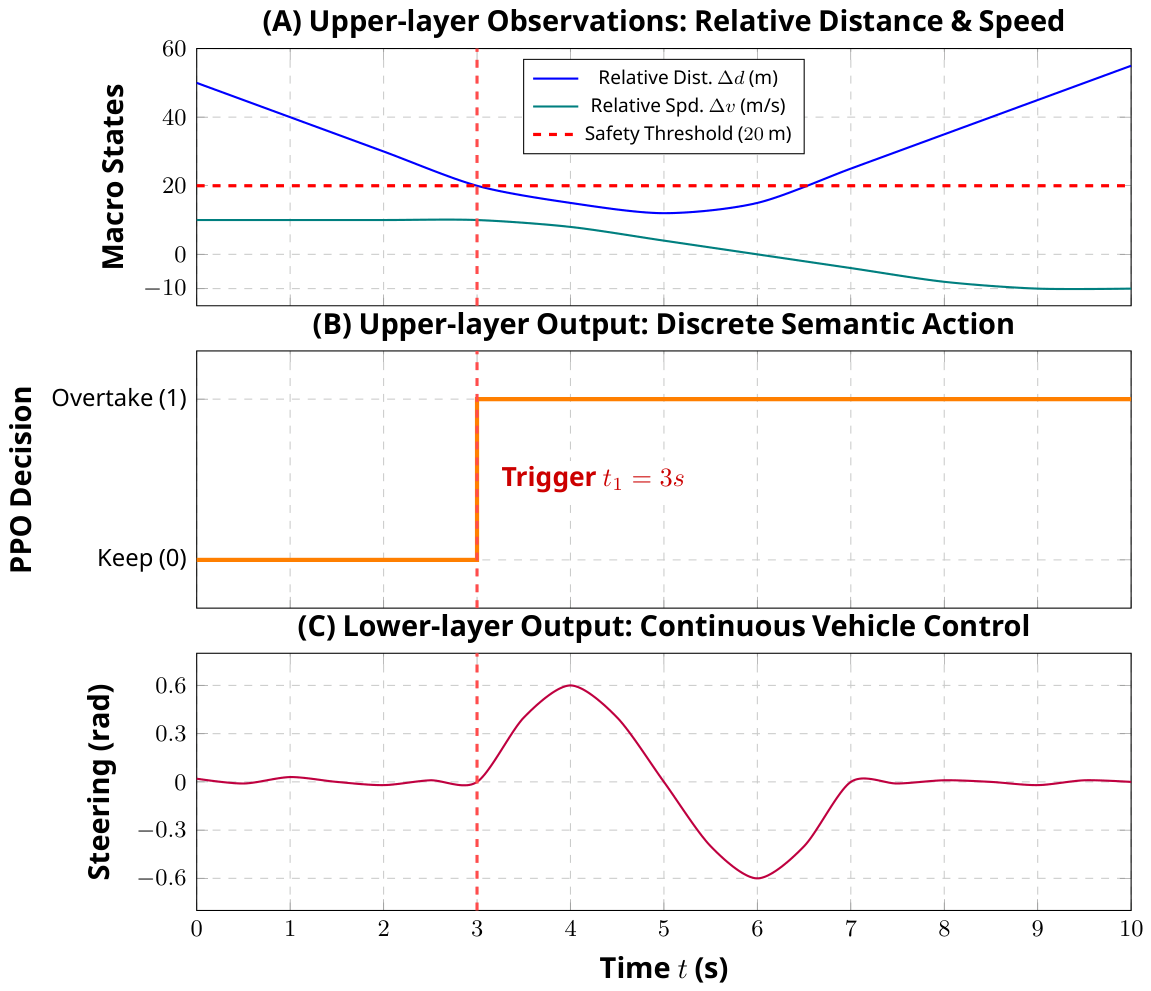
As illustrated in the simulation experiment (
Figure 10), the system’s operation is transparent and decoupled. First, the upper-layer PPO algorithm acts as a tactical planner evaluating macroscopic traffic states (e.g., the relative distance to the leading vehicle). Instead of outputting unreadable numerical signals, it outputs clear semantic intentions, successfully switching the decision from “Lane Keeping” to “Execute Overtaking” as it approaches the slower vehicle. Second, only after this high-level decision is made does the lower-layer SAC algorithm take over to handle microscopic vehicle dynamics, generating smooth steering controls to execute the physical lane change maneuver. This transparent “State → Semantic Decision → Control Execution” workflow makes the system’s behavior highly predictable. It allows engineers to easily trace any suboptimal maneuver to either a decision error (upper layer) or a control error (lower layer), providing a robust diagnostic capability that is critical for real-world autonomous driving deployment.
5. Conclusions
Addressing the challenge of balancing decision safety and control precision for autonomous driving in complex, highly dynamic overtaking scenarios, this paper innovatively proposes an autonomous overtaking decision and control system based on Heterogeneous Frequency Hierarchical Reinforcement Learning. By decoupling the massive and complex overtaking task across both temporal and spatial dimensions, the proposed dual-layer framework features a 1 Hz high-level strategic planning (PPO) and a 10 Hz low-level trajectory control (TD3+LSTM). This architecture successfully breaks the bottleneck of traditional single-layer RL, reducing convergence steps to 60 k and training time to 3.2 h, thereby improving sample efficiency by up to 54.5% compared to standard algorithms. Furthermore, a pioneering stage-adaptive composite reward function enables the agent to flexibly adjust the game-theoretic weights between collision avoidance and traffic efficiency across different overtaking phases. This human-like adaptability reduces the average overtaking time to 6.4 s and increases the average vehicle speed to 15.6 m/s. Finally, high-fidelity simulation results demonstrate that, compared to single-layer baselines, our system improves the overtaking success rate in complex traffic flows to 96.5% and limits the collision rate to 2.0%, while simultaneously optimizing control smoothness by reducing the average Jerk to 1.82 m/s3 (a 44.0% reduction relative to the best-performing baseline), thereby effectively ensuring passenger comfort.
Future Work Outlook: Although the proposed HRL-PPO-TD3 heterogeneous-frequency hierarchical architecture has demonstrated outstanding overtaking performance and safety in the high-fidelity Highway-env simulation environment, this study still possesses certain limitations. All current validations are based purely on Software-in-the-Loop (SIL) simulations. However, real-world overtaking scenarios are accompanied by complex sensor noise, actuator delays, and unpredictable human-driver interactions. Due to the extremely high safety risks and regulatory restrictions associated with high-speed dynamic overtaking experiments on real roads, this paper has not yet conducted road test validations on full-scale real vehicles.
In future work, we will conduct in-depth research and expansion in the following two main directions:
First, regarding cross-domain model transfer and physical validation, the research team is committed to gradually bridging the “Sim-to-Real” gap. We plan to introduce domain randomization and sensor noise injection during training to further enhance the model’s robustness under real physical boundaries. Subsequently, preliminary physical validations will be progressively conducted through Hardware-in-the-Loop (HIL) testing or scaled model cars (e.g., 1/10 scale Robot Operating System (ROS) autonomous vehicles). Ultimately, real-world full-scale vehicle overtaking tests will be carried out in closed proving grounds, thereby accelerating the practical application of high-level autonomous driving technologies.
Second, concerning the expansion to complex scenarios and multi-vehicle cooperation, although the current HRL architecture exhibits excellent single-vehicle intelligent decision-making and control capabilities in complex traffic flows, this study currently focuses solely on a single-agent perspective. In realistic future traffic scenarios, multi-vehicle cooperation is crucial for improving overall traffic efficiency and safety. Therefore, future research will be dedicated to extending the current HRL architecture to the field of Multi-Agent Reinforcement Learning (MARL). Specifically, we plan to upgrade the high-level PPO network to a multi-agent cooperative decision-making network (e.g., Multi-Agent Proximal Policy Optimization (MAPPO)) that supports Vehicle-to-Vehicle (V2V) communication. This will enable lane-changing evasion and cooperative overtaking intent interaction among multiple vehicles in complex scenarios. Concurrently, the low-level control network will incorporate local collision avoidance constraints to achieve safe cooperative trajectory tracking for multiple vehicles. Furthermore, we will consider introducing broader Vehicle-to-Everything (V2X) communication mechanisms to effectively resolve blind spot perception issues, such as sudden target intrusions in environments with extreme visual occlusion, thereby comprehensively enhancing the global safety and intelligent decision-making level of the autonomous driving system.
Author Contributions
Conceptualization, methodology, investigation, resources, writing—review and editing, supervision, and project administration were performed by X.T. Software, validation, formal analysis, data curation, writing—original draft preparation, and visualization were performed by C.-N.W. All authors have read and agreed to the published version of the manuscript.
Funding
This research was funded by the Department of Science and Technology of Hubei Province grant number 2024BAB008; the Wuhan Science and Technology Innovation Bureau and Wuhan DR Laser Technology Corp., Ltd. grant number 2024010702020023; the China Electric Power Research Institute grant number SGDK0000PDMM2502428; and the Wuhan Institute of Technology grant number K2023047 (23QD14).
Institutional Review Board Statement
Not applicable.
Informed Consent Statement
Not applicable.
Data Availability Statement
The original contributions presented in this study are included in the article. Further inquiries can be directed to the corresponding author.
Conflicts of Interest
The authors declare no conflicts of interest.
Abbreviations
The following abbreviations are used in this manuscript:
| RL | Reinforcement Learning |
| DQN | Deep Q-Network |
| SAC | Soft Actor-Critic |
| HRL | Hierarchical Reinforcement Learning |
| HAM | Hierarchical Abstract Machines |
| HIRO | Hierarchical Reinforcement Learning with Off-policy correction |
| FuN | Feudal Networks |
| MDP | Markov Decision Process |
| PPO | Proximal Policy Optimization |
| TD3 | Twin Delayed Deep Deterministic Policy Gradient |
| LSTM | Long Short-Term Memory |
| Semi-MDP | Semi-Markov Decision Process |
| KIVs | Key Interacting Vehicles |
| TTC | Time-to-Collision |
| SSMs | Surrogate Safety Measures |
| FL-iTTC | Fuzzy Logic and Inverse Time-To-Collision |
| PRFM | Perceived Risk Field Model |
| HRL-PPO-TD3 | Hierarchical Reinforcement Learning—Proximal Policy Optimization—Twin Delayed |
| Deep Deterministic Policy Gradient |
| MLP | Multi-Layer Perceptrons |
| ReLU | Rectified Linear Unit |
| GPU | Graphics Processing Unit |
| NPCs | Non-Player Characters |
| IDM | Intelligent Driver Model |
| MOBIL | Minimizing Overall Braking Induced by Lane Change |
| Flat-PPO | Single-layer PPO |
| Flat-TD3 | Single-layer TD3 |
| MSE | Mean Squared Error |
| Flat-SAC | Single-layer SAC |
| SD | Standard Deviation |
| SACR | Safety-Aware Continuous Reward |
| LR | Learning Rate |
| SIL | Software-in-the-Loop |
| HIL | Hardware-in-the-Loop |
| ROS | Robot Operating System |
| MARL | Multi-Agent Reinforcement Learning |
| MAPPO | Multi-Agent Proximal Policy Optimization |
| V2V | Vehicle-to-Vehicle |
| V2X | Vehicle-to-Everything |
References
- Geng, L. Autonomous Driving Driven by Artificial Intelligence: Development Status and Future Prospects. Comput. Artif. Intell. 2025, 2, 29–36. [Google Scholar] [CrossRef]
- Yan, Y.; Zhang, P.; Du, C.; Wang, H.; Wang, H.; Pi, D.; Chen, Y.-H. Vehicle Trajectory Prediction for Autonomous Driving Applications: State-of-the-Art Review, Research Challenges, and Future Directions. Automot. Innov. 2026; ahead of print. [CrossRef]
- Li, T.; Ruan, J.; Zhang, K. The investigation of reinforcement learning-based end-to-end decision-making algorithms for autonomous driving on the road with consecutive sharp turns. Green Energy Intell. Transp. 2025, 4, 100288. [Google Scholar] [CrossRef]
- Alagumuthukrishnan, S.; Deepajothi, S.; Vani, R.; Velliangiri, S. Reliable and Efficient Lane Changing Behaviour for Connected Autonomous Vehicle through Deep Reinforcement Learning. Procedia Comput. Sci. 2023, 218, 1112–1121. [Google Scholar] [CrossRef]
- Djerbi, R.; Rouane, A.; Taleb, Z.; Saradouni, S. Design and implementation of a self-driving car using deep reinforcement learning: A comprehensive study. Comput. Ind. Eng. 2025, 207, 111319. [Google Scholar] [CrossRef]
- Wu, J. Application of reinforcement learning in autonomous driving scenarios: Path planning using policy gradient methods. World J. Eng. Res. 2025, 3, 24–30. [Google Scholar] [CrossRef]
- Wu, G.; Fang, W.; Wang, J.; Ge, P.; Cao, J.; Ping, Y.; Gou, P. Dyna-PPO reinforcement learning with Gaussian process for the continuous action decision-making in autonomous driving. Appl. Intell. 2022, 53, 16893–16907. [Google Scholar] [CrossRef]
- Rizehvandi, A.; Azadi, S.; Eichberger, A. Decision-Making Policy for Autonomous Vehicles on Highways Using Deep Reinforcement Learning (DRL) Method. Automation 2024, 5, 564–577. [Google Scholar] [CrossRef]
- Chu, H.; Wang, H.; Cheng, Y.; Li, A.; Tian, W.; Gao, B.; Chen, H. Decision making for autonomous vehicles: A mixed curriculum reinforcement learning approach and a novel safety intervention method. Transp. Res. Part C 2025, 181, 105369. [Google Scholar] [CrossRef]
- Muzahid, A.J.M.; Shi, Y.; Wang, Z.; Zhou, A.; Cook, A.; Wang, C.R.; Wang, Z. Optimizing on-ramp merging for connected and automated vehicles: A hierarchical approach using deep reinforcement learning and optimal control. Control Eng. Pract. 2025, 165, 106614. [Google Scholar] [CrossRef]
- Li, L.; Tan, R.; Fang, J.; Xue, J.; Lv, C. LLM-augmented hierarchical reinforcement learning for human-like decision-making of autonomous driving. Expert Syst. Appl. 2025, 294, 128736. [Google Scholar] [CrossRef]
- Yang, Z.; Zhang, L.; Bian, Y.; Hu, M. Decision making for highway autonomous driving using hybrid reinforcement learning. J. Control Decis. 2025, 12, 1043–1051. [Google Scholar] [CrossRef]
- Da, C.; Qian, Y.; Zeng, J.; Wei, X.; Zhang, F. ST-PPO: A spatio-temporal attention enhanced proximal policy optimization algorithm for autonomous driving in complex traffic scenarios. Mach. Learn. 2025, 114, 245. [Google Scholar] [CrossRef]
- Xu, T.; Meng, Z.; Lu, W.; Tong, Z. End-to-End Autonomous Driving Decision Method Based on Improved TD3 Algorithm in Complex Scenarios. Sensors 2024, 24, 4962. [Google Scholar] [CrossRef] [PubMed]
- Zhang, M.; He, D.; Gang, L.; Wang, C. A deep reinforcement learning approach integrating LSTM-GAT spatiotemporal fusion for autonomous driving decision-making. Phys. A Stat. Mech. Appl. 2026, 681, 131121. [Google Scholar] [CrossRef]
- Yan, Q.; Wu, X.; Wang, J.; Fortino, G.; Pupo, F.; Yin, M. EGCARL: A PPO-based reinforcement learning method with expert guidance and dynamic rewards for autonomous driving. Inf. Fusion 2026, 126, 103606. [Google Scholar] [CrossRef]
- Niu, Y.; Wang, Y.; Xiao, M.; Zhu, W.; Wang, T. Reliable safety decision-making for autonomous vehicles: A safety assurance reinforcement learning. Transp. B Transp. Dyn. 2025, 13, 2439997. [Google Scholar] [CrossRef]
- Fan, X.; Wang, Y.; Che, X. Collision Avoidance for Autonomous Driving by Integrating Risk Evaluation into Deep Reinforcement Learning. Int. J. Intell. Transp. Syst. Res. 2026; ahead of print. [CrossRef]
- Choi, J.; Kim, S. Predictive Risk-Aware Reinforcement Learning for Autonomous Vehicles Using Safety Potential. Electronics 2025, 14, 4446. [Google Scholar] [CrossRef]
- Lu, P.; Zhang, S.; Tan, F.; Zhang, F.; Feng, Y.; Hu, B. An uncertainty-aware safe-evolving reinforcement learning algorithm for decision-making and control in highway autonomous driving. Eng. Appl. Artif. Intell. 2025, 161, 112108. [Google Scholar] [CrossRef]
- Shao, Y.; Han, Z.; Shi, X.; Zhang, Y.; Ye, Z. Risk-informed longitudinal control in autonomous vehicles: A safety potential field modeling approach. Phys. A Stat. Mech. Appl. 2024, 633, 129419. [Google Scholar] [CrossRef]
- Huang, Z.; Sheng, Z.; Chen, S. PE-RLHF: Reinforcement Learning with Human Feedback and physics knowledge for safe and trustworthy autonomous driving. Transp. Res. Part C 2025, 179, 105262. [Google Scholar] [CrossRef]
- Huang, Z.; Sheng, Z.; Qu, Y.; You, J.; Chen, S. VLM-RL: A unified vision language models and reinforcement learning framework for safe autonomous driving. Transp. Res. Part C 2025, 180, 105321. [Google Scholar] [CrossRef]
- Wu, F.; Chen, H.; Qiu, T. Deep Reinforcement Learning for Trajectory Control of Connected and Automated Vehicles at a Mixed-Traffic Intersection. J. Transp. Eng. Part A Syst. 2026, 152, 04025152. [Google Scholar] [CrossRef]
- Tan, F.; Lu, P.; Zhang, F.; Ye, X.; Hu, B.; Shu, X. Transformer-based offline-to-online reinforcement learning for decision-making and control in autonomous driving. Eng. Appl. Artif. Intell. 2026, 170, 114139. [Google Scholar] [CrossRef]
- Ren, H.; Xing, Y. LLM-guided deep reinforcement learning with contrastive safety regularization for autonomous driving. Discov. Artif. Intell. 2026, 6, 169. [Google Scholar] [CrossRef]
- Huang, J.; Zhou, R.; Li, M.; Li, H.; Liu, Y.; Song, X. From black-box to white-box: Interpretable deep reinforcement learning with Kolmogorov-Arnold networks for autonomous driving. Transp. Res. Part C 2026, 182, 105386. [Google Scholar] [CrossRef]
- Ellouze, A.; Karray, M.; Ksantini, M. A Hybrid Decision-Making Framework for Autonomous Vehicles in Urban Environments Based on Multi-Agent Reinforcement Learning with Explainable AI. Vehicles 2026, 8, 8. [Google Scholar] [CrossRef]
- Xu, D.; Qiao, E.; Gu, T.; Fu, H.; Sun, C.; Guo, H.; Liu, Y. LEAD: LLM-enhanced deep reinforcement learning for stable decision-making in critical autonomous driving scenarios. Neurocomputing 2025, 657, 131619. [Google Scholar] [CrossRef]
- Huang, Z.; Sheng, Z.; Ma, C.; Chen, S. Human as AI mentor: Enhanced human-in-the-loop reinforcement learning for safe and efficient autonomous driving. Commun. Transp. Res. 2024, 4, 100127. [Google Scholar] [CrossRef]
- Aboyeji, E.; Ajani, O.S.; Fenyom, I.; Mallipeddi, R. NeuroAction: A neuroevolutionary approach to reinforcement learning for autonomous vehicles. Sci. Rep. 2026, 16, 7403. [Google Scholar] [CrossRef]
- Rauch, R.; Gazda, J. Distributed Deep Reinforcement Learning Via Split Computing For Connected Autonomous Vehicles. Acta Electrotech. Inform. 2025, 25, 21–29. [Google Scholar] [CrossRef]
- Lin, Y.; Yan, R.; Jiang, R.; Zheng, S.; Zhao, H. Reinforcement learning-based control algorithm for connected and automated vehicles on a two-lane highway section with a moving bottleneck. Urban Lifeline 2025, 3, 19. [Google Scholar] [CrossRef]
- Liu, Q.; Tang, Y.; Li, X.; Wang, K.; Yang, F.; Li, Z. Curiosity-driven reinforcement learning with graph transformers for decision-making in connected and autonomous vehicles. Transp. Res. Part C 2025, 177, 105183. [Google Scholar] [CrossRef]
- Xu, Y.; Ye, W.; Xie, Y.; Wang, C. A two-dimensional surrogate safety measure based on fuzzy logic model. Accid. Anal. Prev. 2024, 199, 107529. [Google Scholar] [CrossRef] [PubMed]
| Disclaimer/Publisher’s Note: The statements, opinions and data contained in all publications are solely those of the individual author(s) and contributor(s) and not of MDPI and/or the editor(s). MDPI and/or the editor(s) disclaim responsibility for any injury to people or property resulting from any ideas, methods, instructions or products referred to in the content. |