


Optimal Penetration Level of Photovoltaic Units in Distribution Networks Considering Engineering and Economic Performance Using the Pied Kingfisher Optimizer

 , ,
, ,  and
and 
Abstract
1. Introduction
- -
- These studies mostly considered constant load demand, which is very useful to the planning process, while the dynamic load demand over a certain period of time is not considered. In practice, distribution networks experience continuous load fluctuations across hours, days, and seasons, driven by consumer behavior, industrial activity, and climatic conditions. Relying solely on constant load models fails to capture the temporal mismatch between solar generation peaks and actual load demand peaks, which is a fundamental operational challenge of PVU integration.
- -
- The uncertain characteristic of renewable energy is not fully considered by practical data and is only reliant on probabilistic models, which do not completely reflect the actual nature of these sources. Furthermore, probabilistic models tend to smooth out extreme irradiance fluctuations and fail to capture temporal correlations in solar output, leading to an incomplete representation of real-world uncertainty. The absence of practically measured irradiance and temperature data in most studies further limits the reliability and transferability of their conclusions to actual deployment environments. Adopting data-driven approaches based on real field measurements would therefore significantly enhance the realism and accuracy of uncertainty characterization in PVU integration studies.
- -
- The previous studies mostly focus on solving the problem of integrating PVU to the grid in the engineering aspect and often ignore the economic viability. Without a comprehensive economic evaluation encompassing capital costs, operational and maintenance expenditures, energy savings value, and financial indicators such as net present value and internal rate of return, the study’s conclusions remain confined to the engineering domain. This significantly limits the practical applicability of research outcomes, as real-world deployment decisions are driven not by technical merit alone but by the ability to demonstrate financial justification to stakeholders and regulators. Integrating economic viability assessment alongside engineering optimization is therefore essential for producing research that can meaningfully inform grid investment decisions and support the large-scale adoption of solar distributed generation.
- (1)
- Regarding the applied method:
- Two recently developed meta-heuristic algorithms are successfully employed to optimize the allocation of photovoltaic units (PVUs) on the given SDPN.
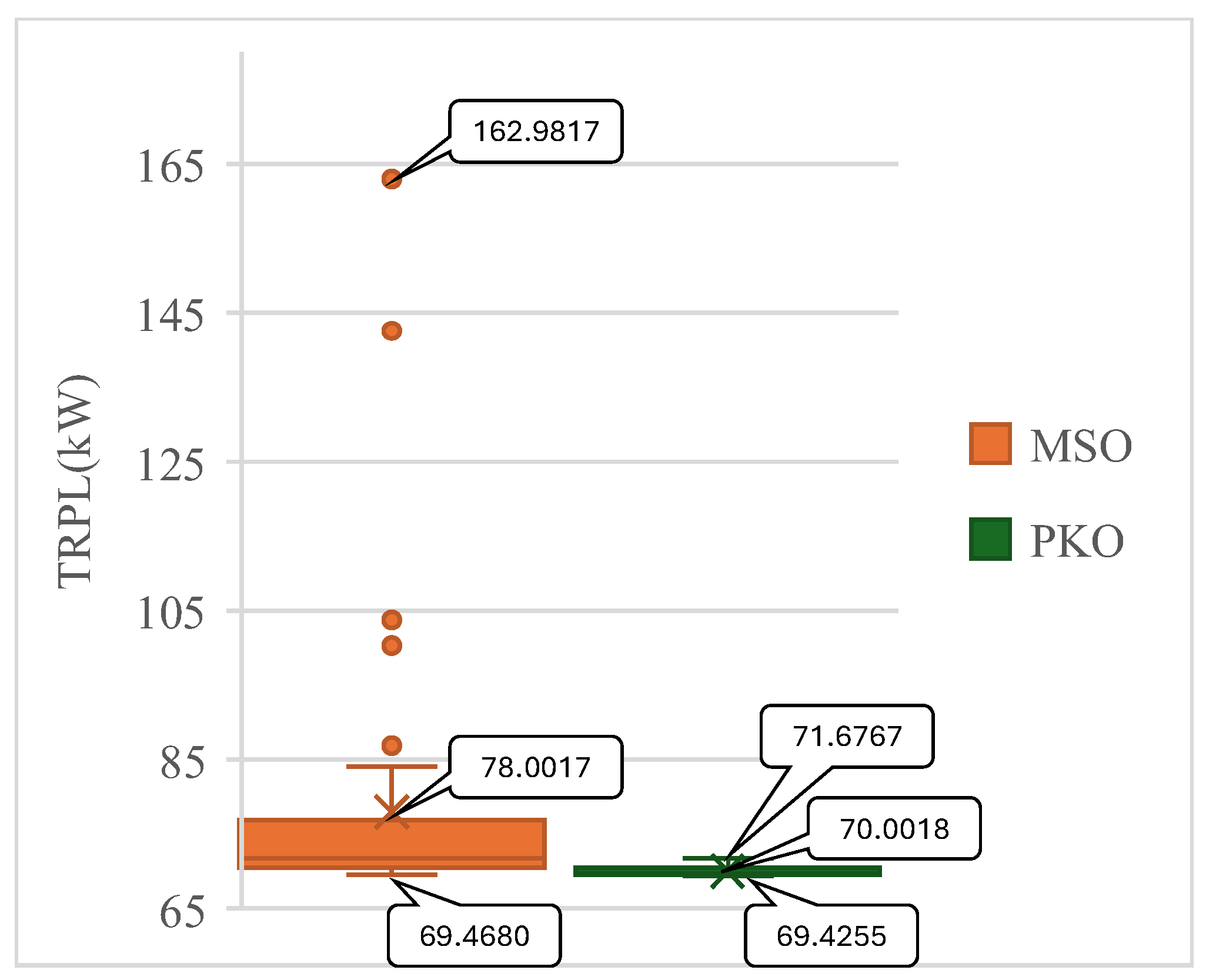
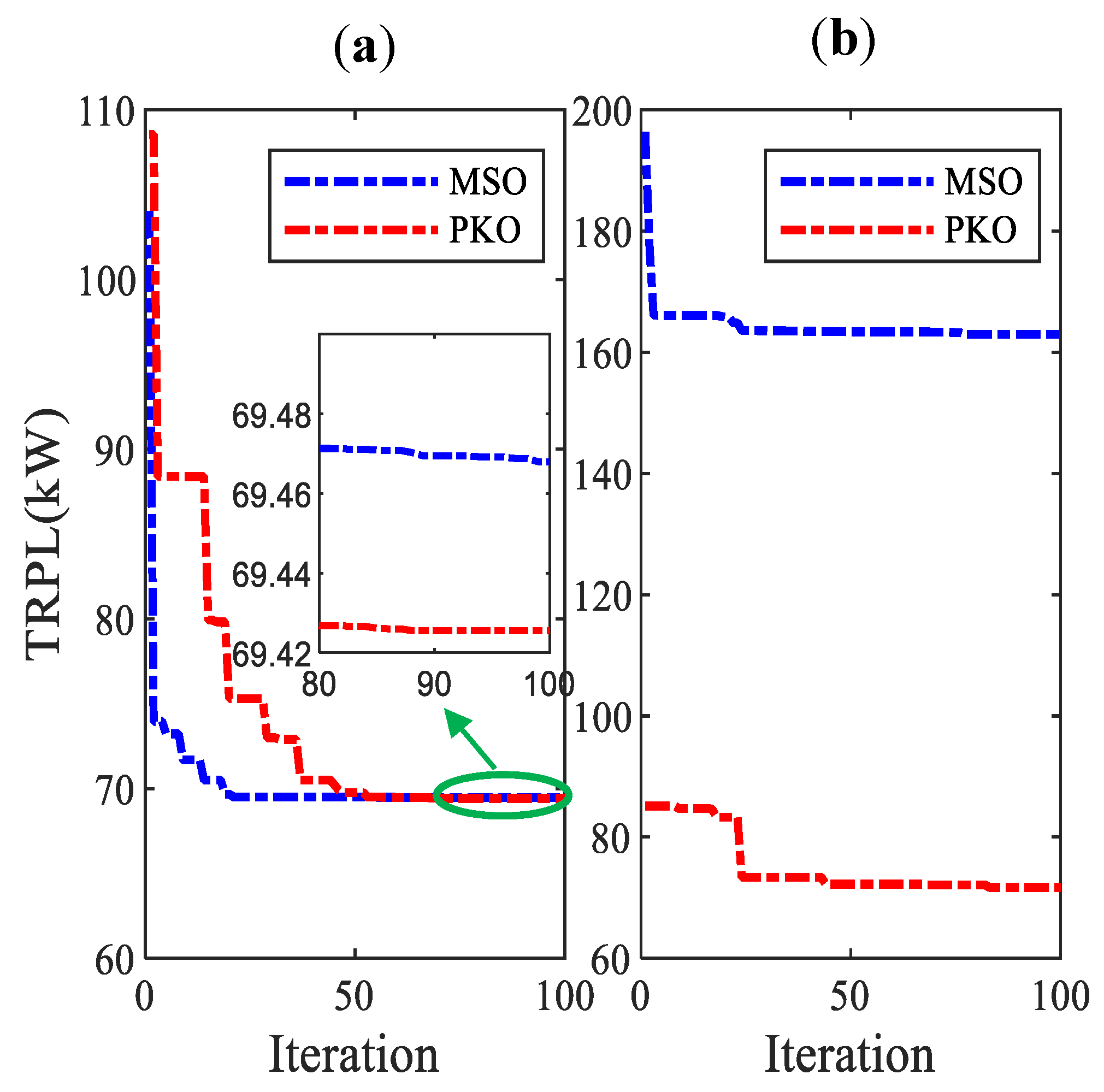
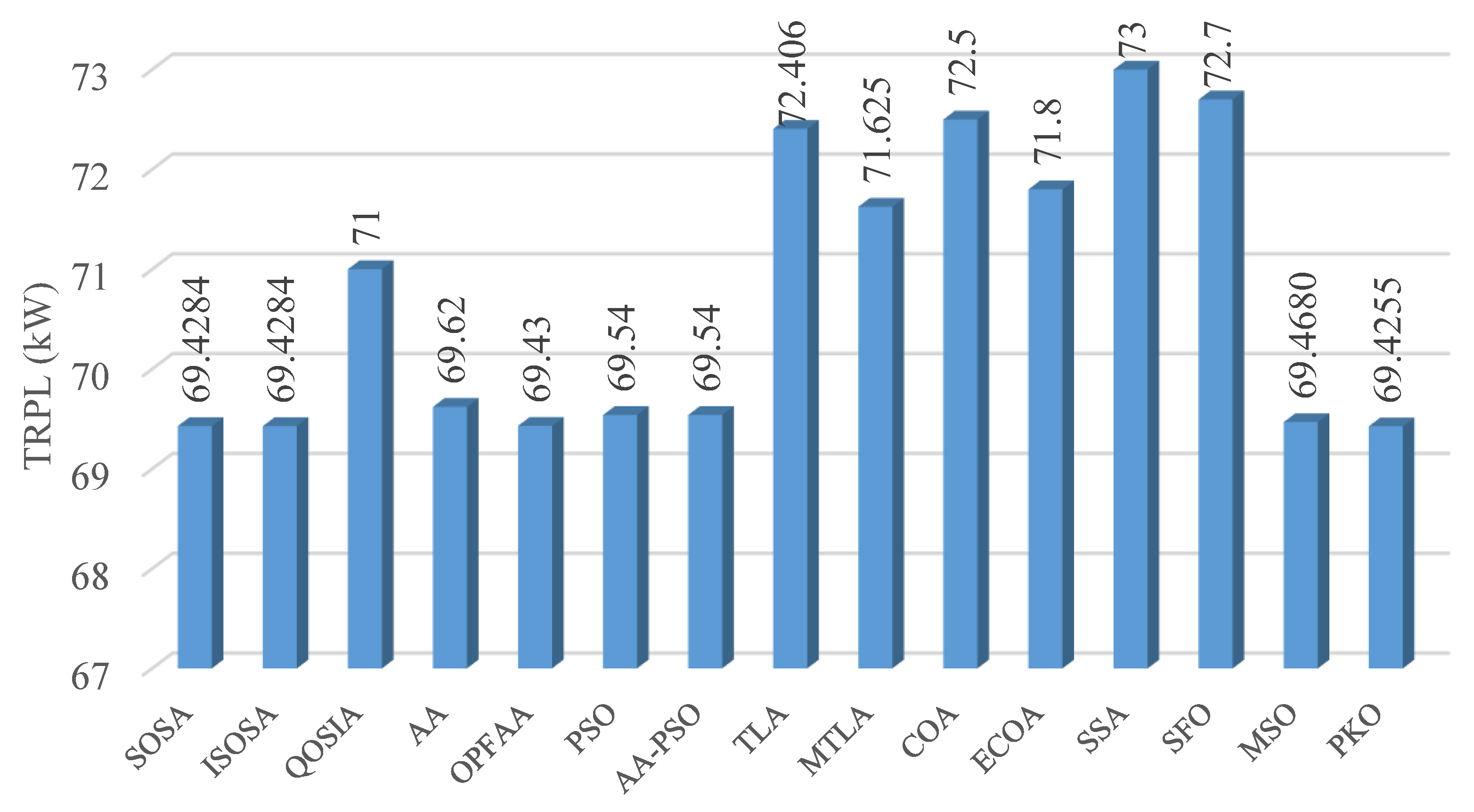
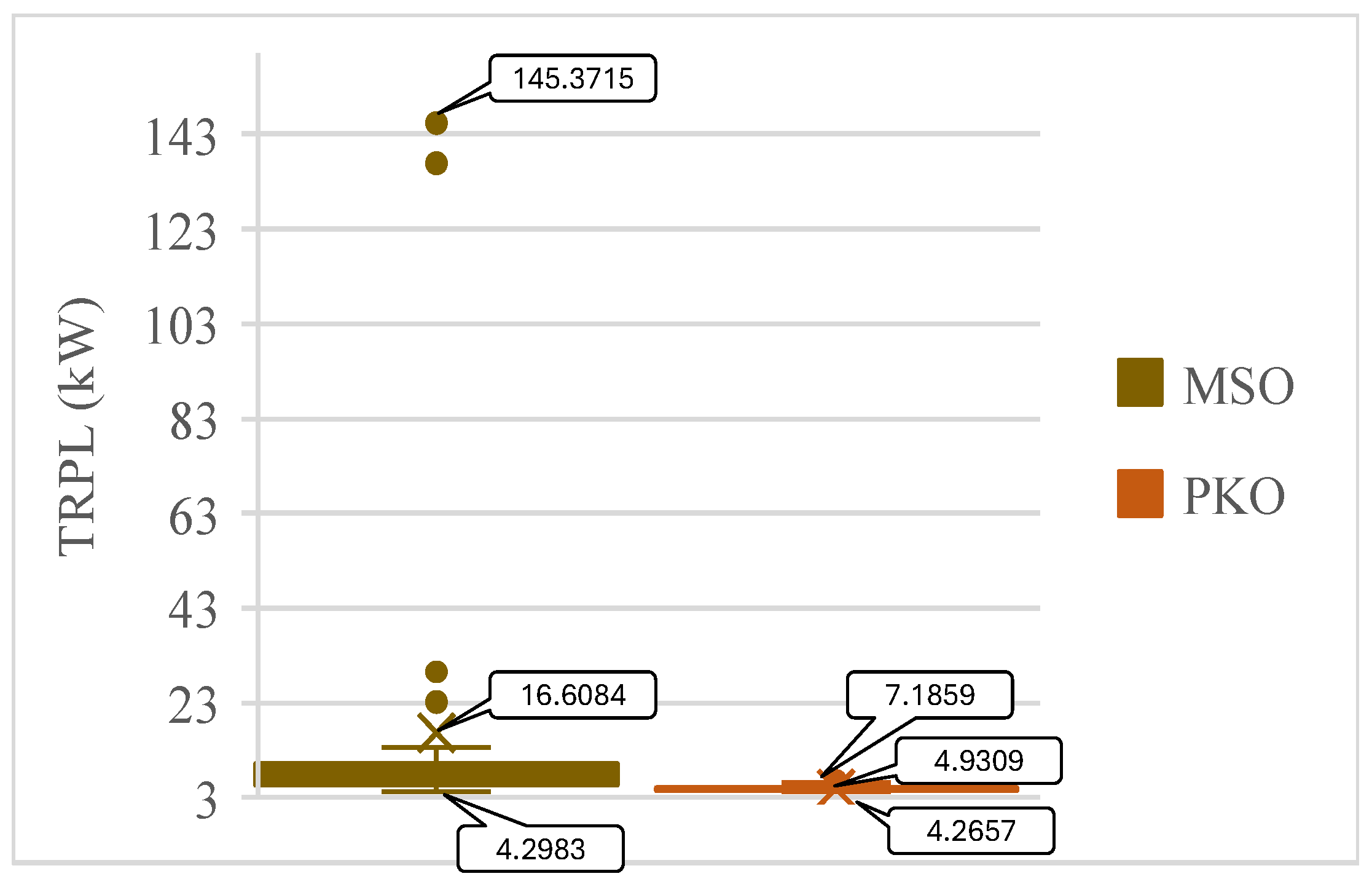
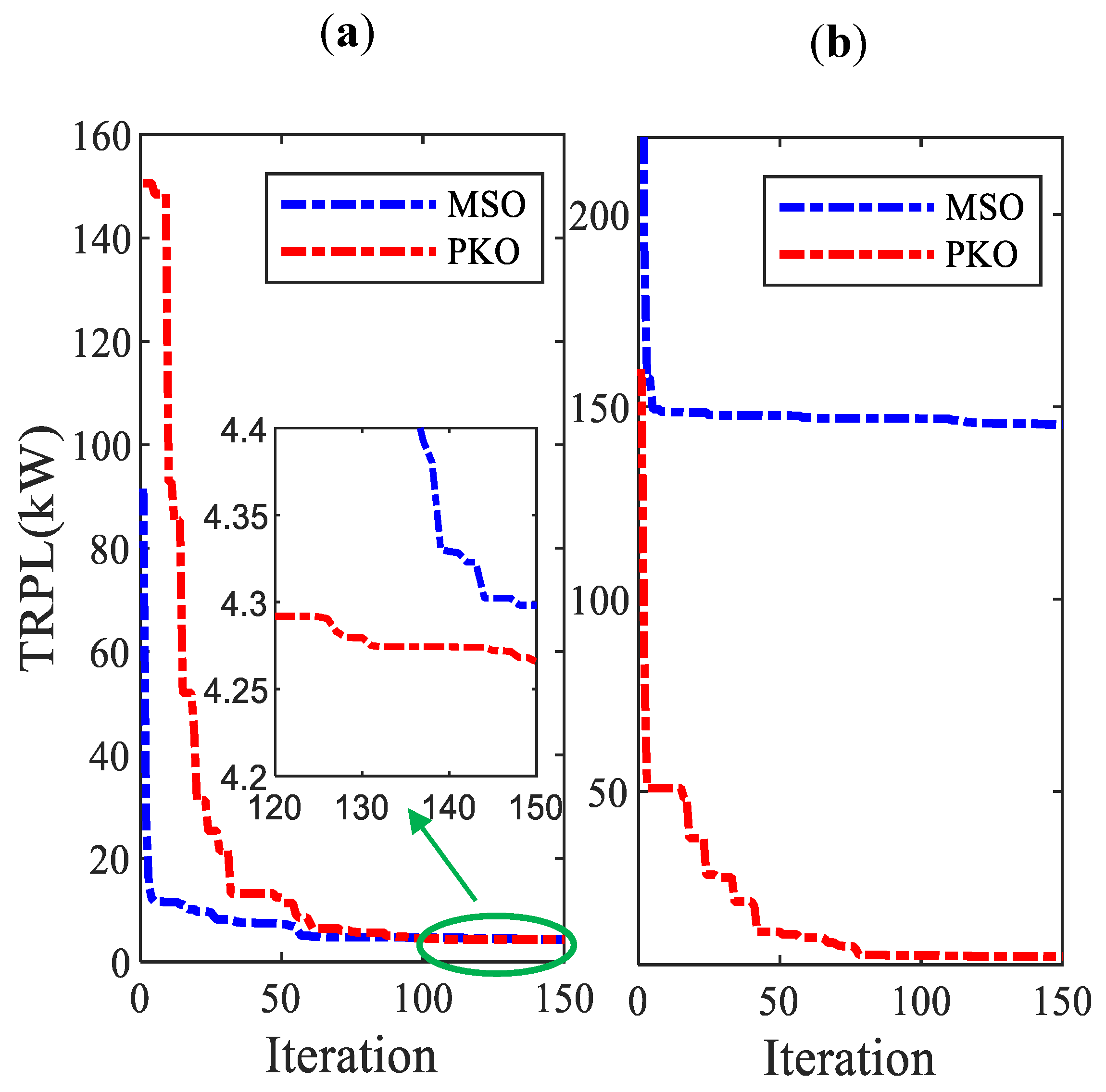
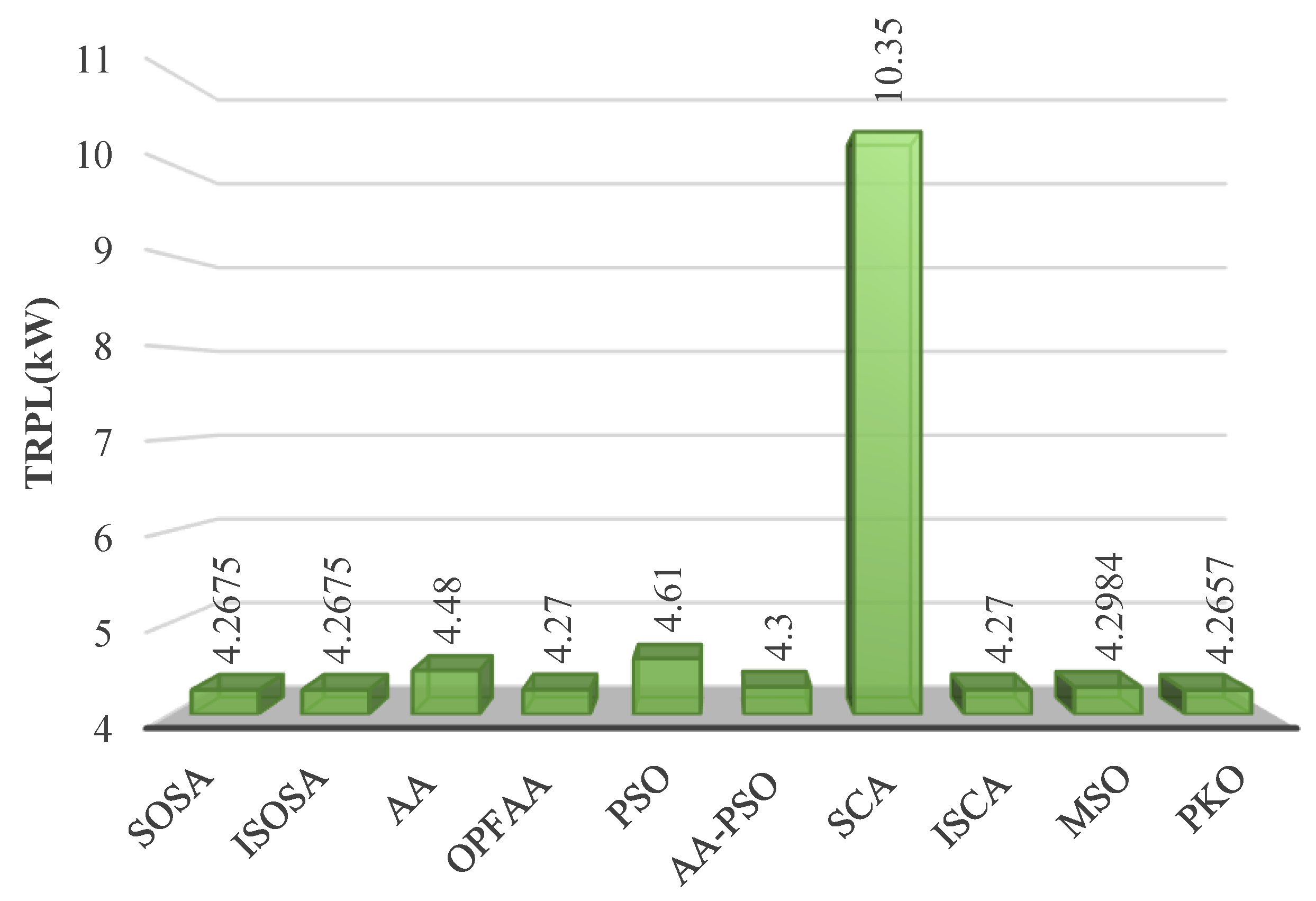
- Through various case studies and comparisons across different criteria, the Pied Kingfisher Optimizer (PKO) has proven itself to be a superior search tool, delivering the best performance in optimizing the allocation of PVUs on the grid for achieving the optimal value of the main objective function.
- (2)
- Regarding the given problem:
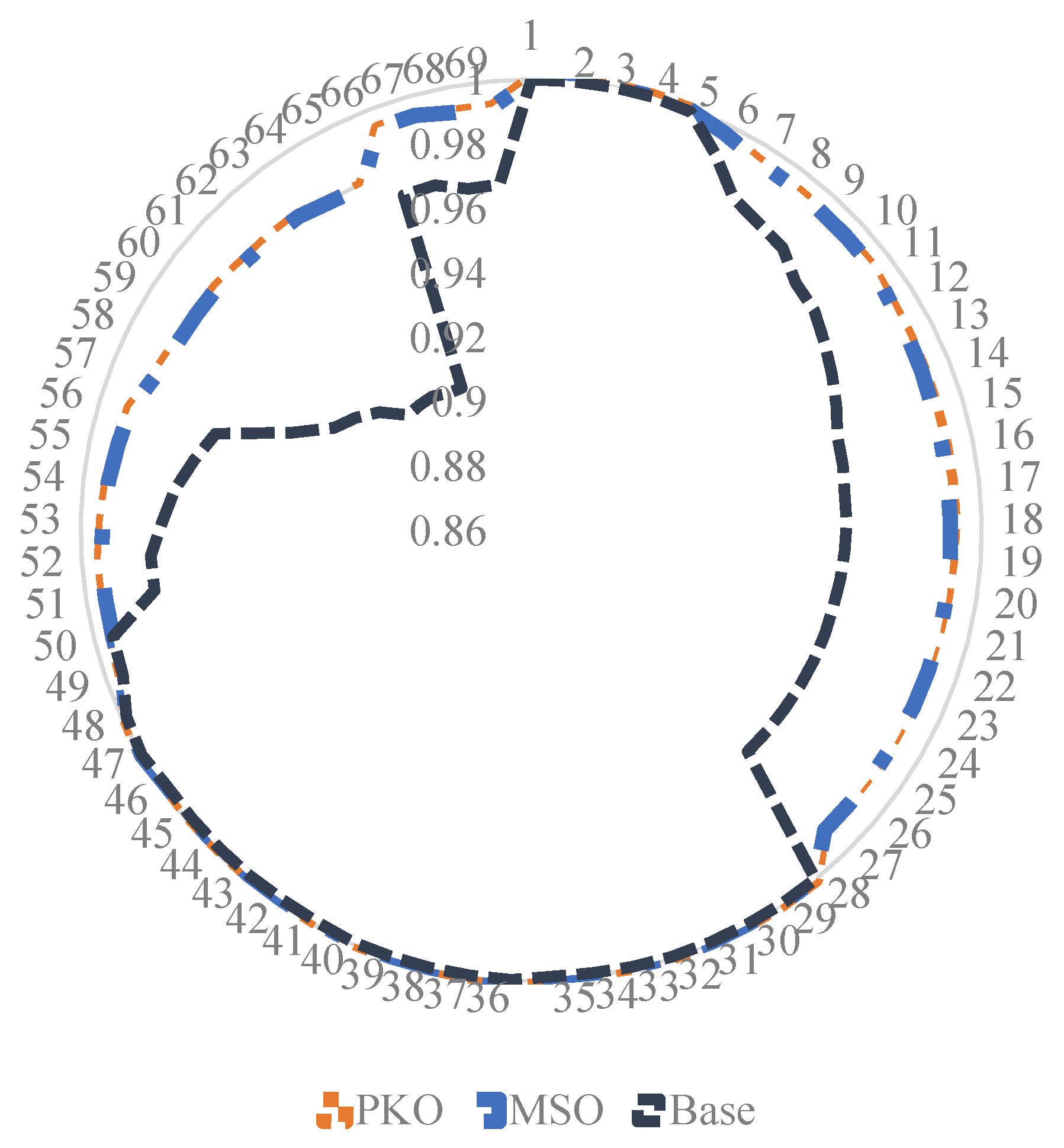
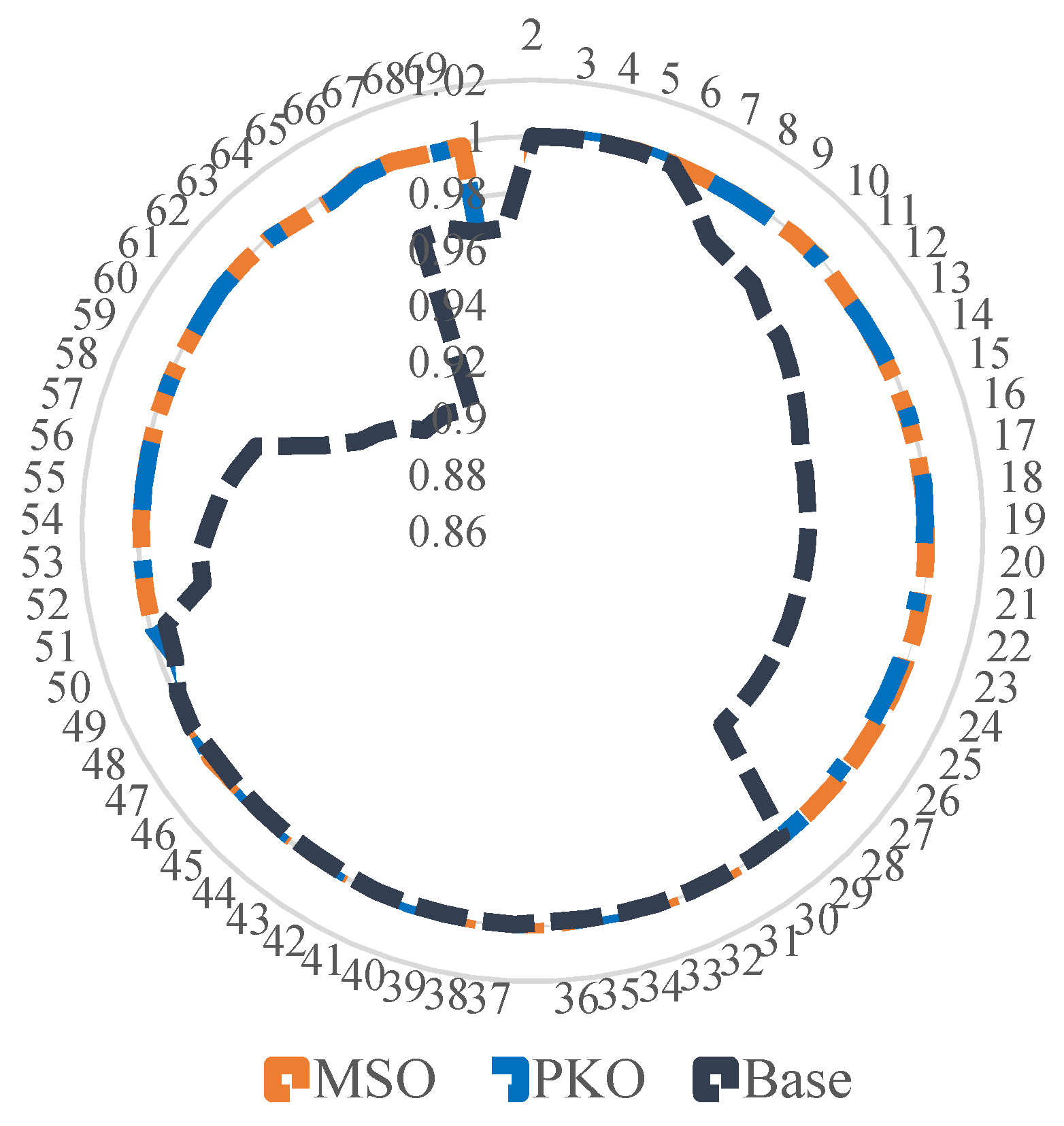
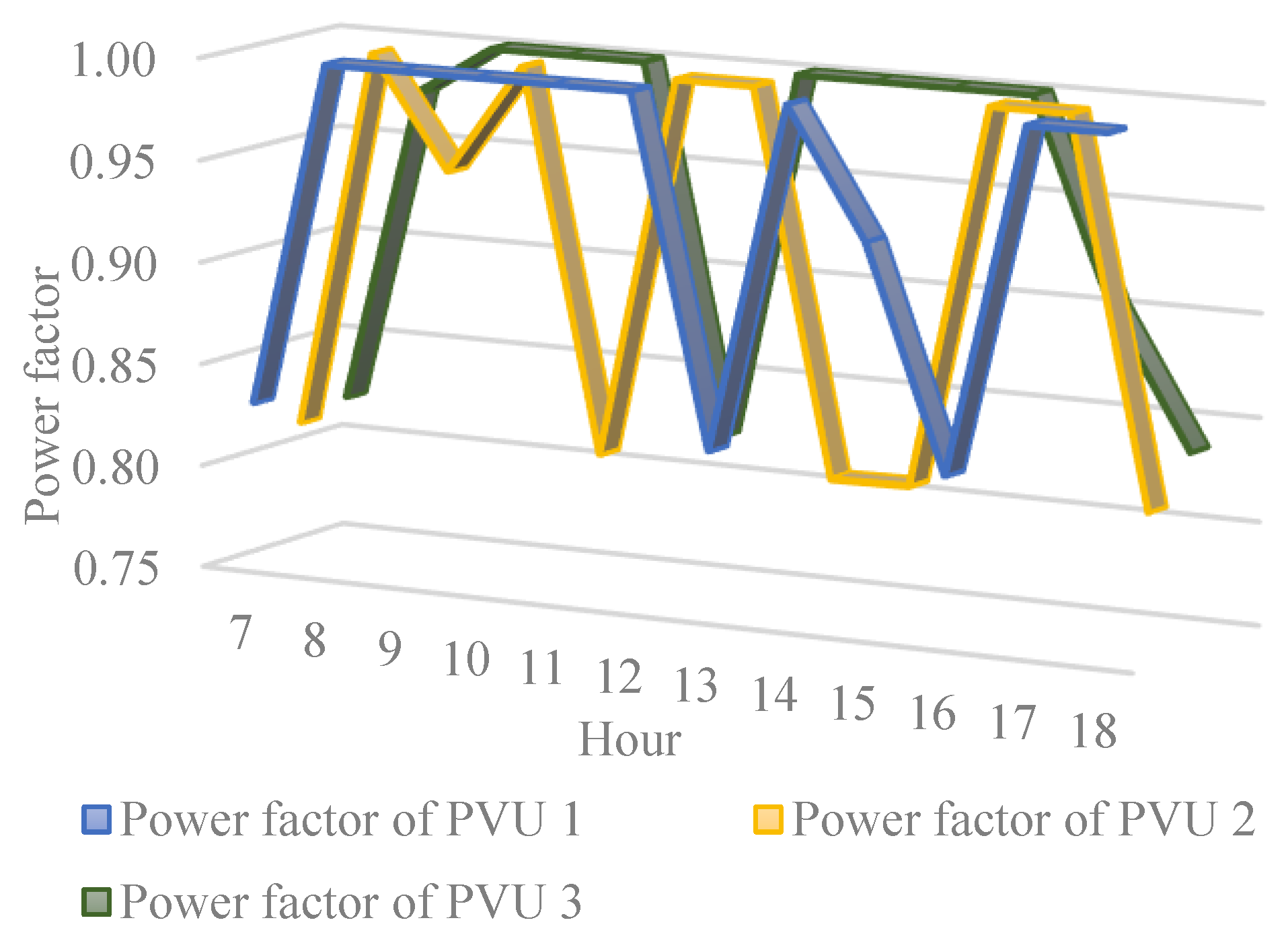
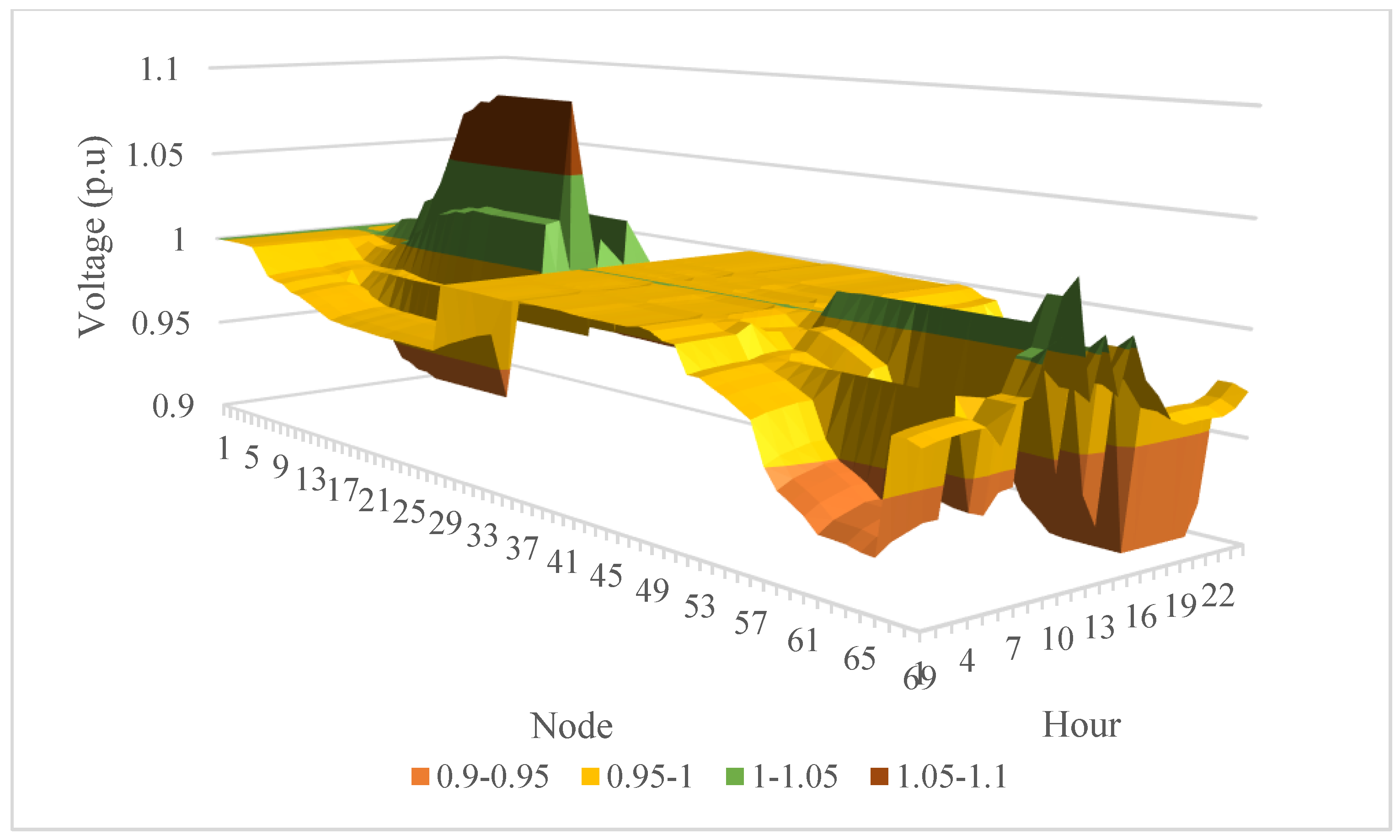
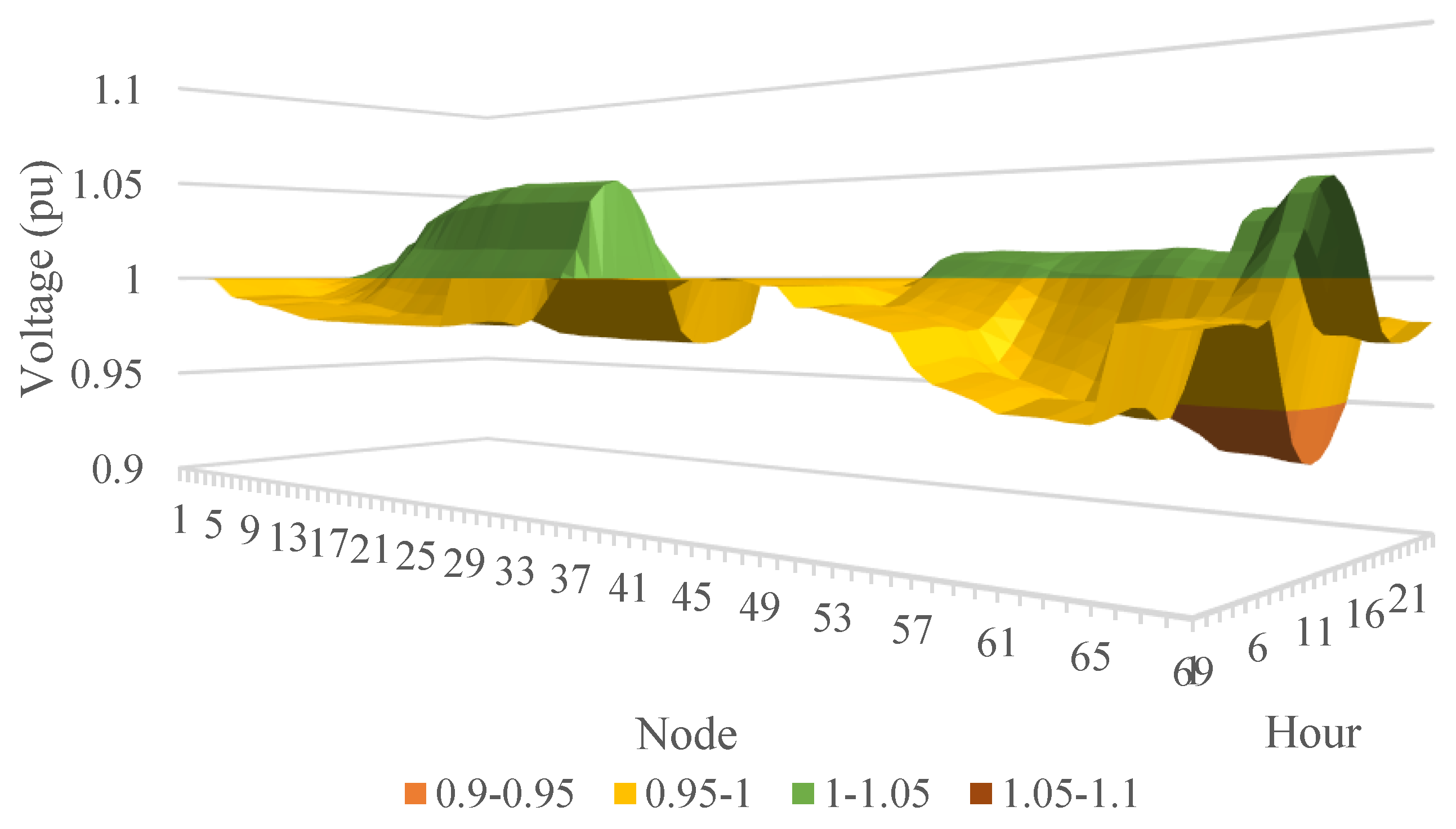
- The study quantifies total real-power losses and improves bus-voltage profiles through two cases with different PVU settings, then determines the best cases using an optimal PVU configuration.
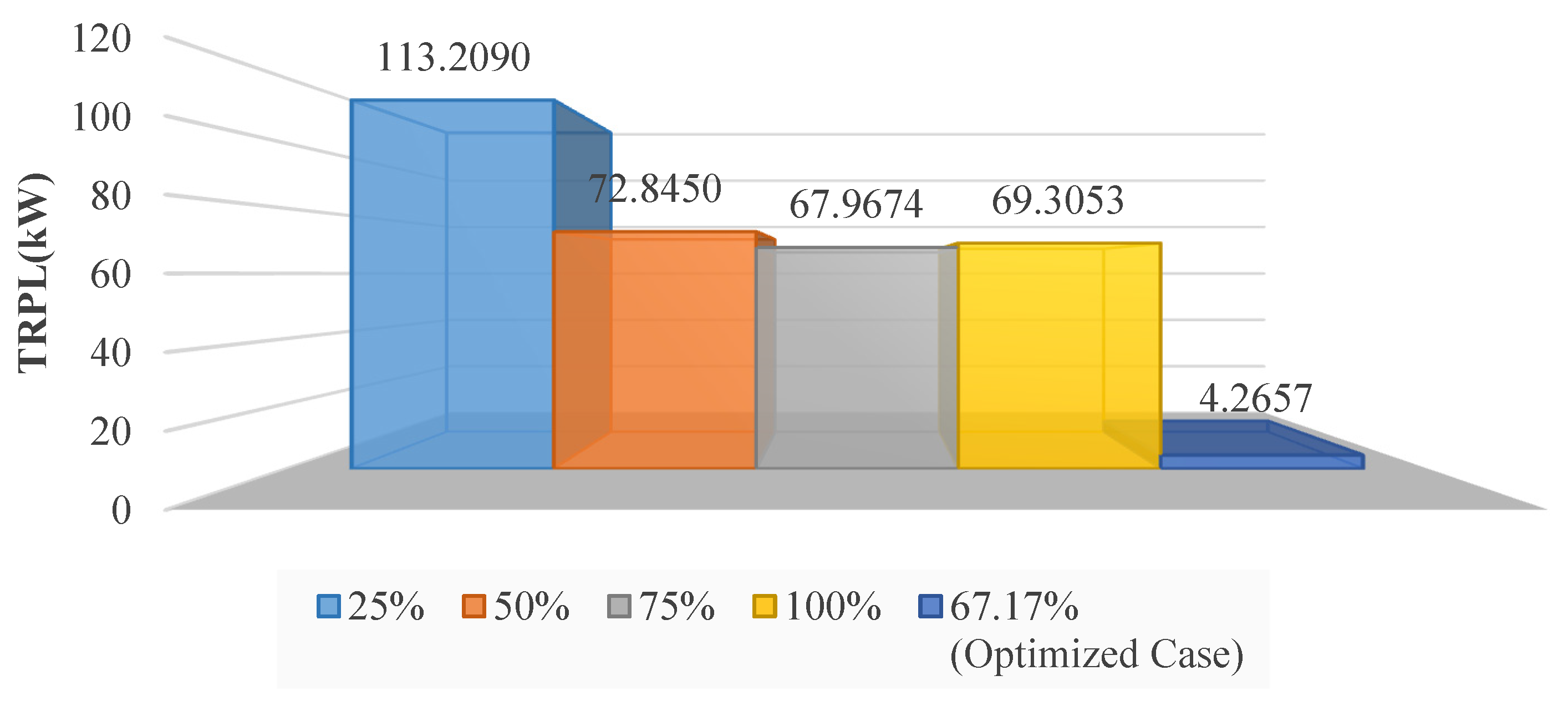
- The study identifies the most cost-effective PVU penetration level that balances economic gain and initial investment by comparing different penetration levels against the optimized configuration.
- (3)
- Regarding the economic gain:
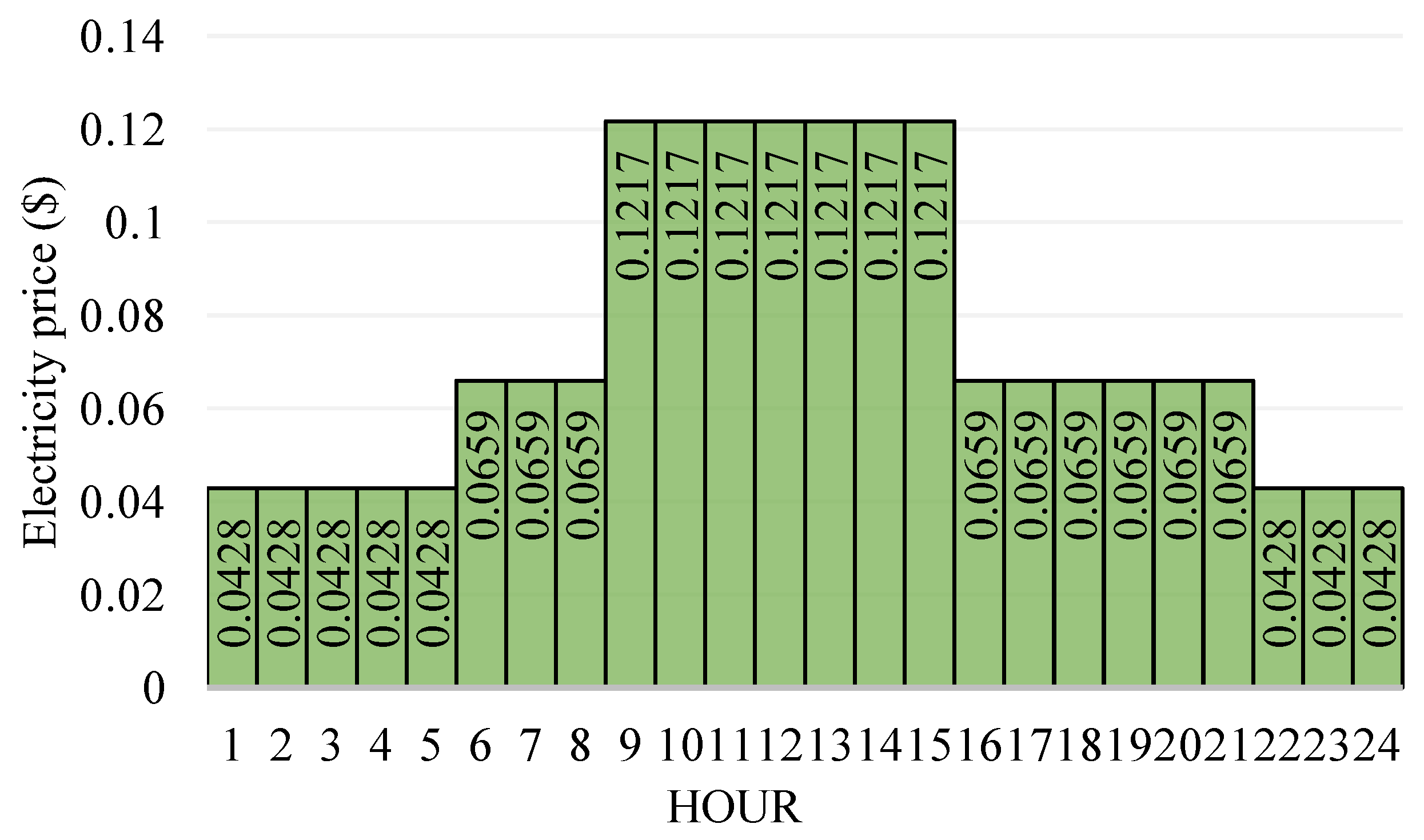
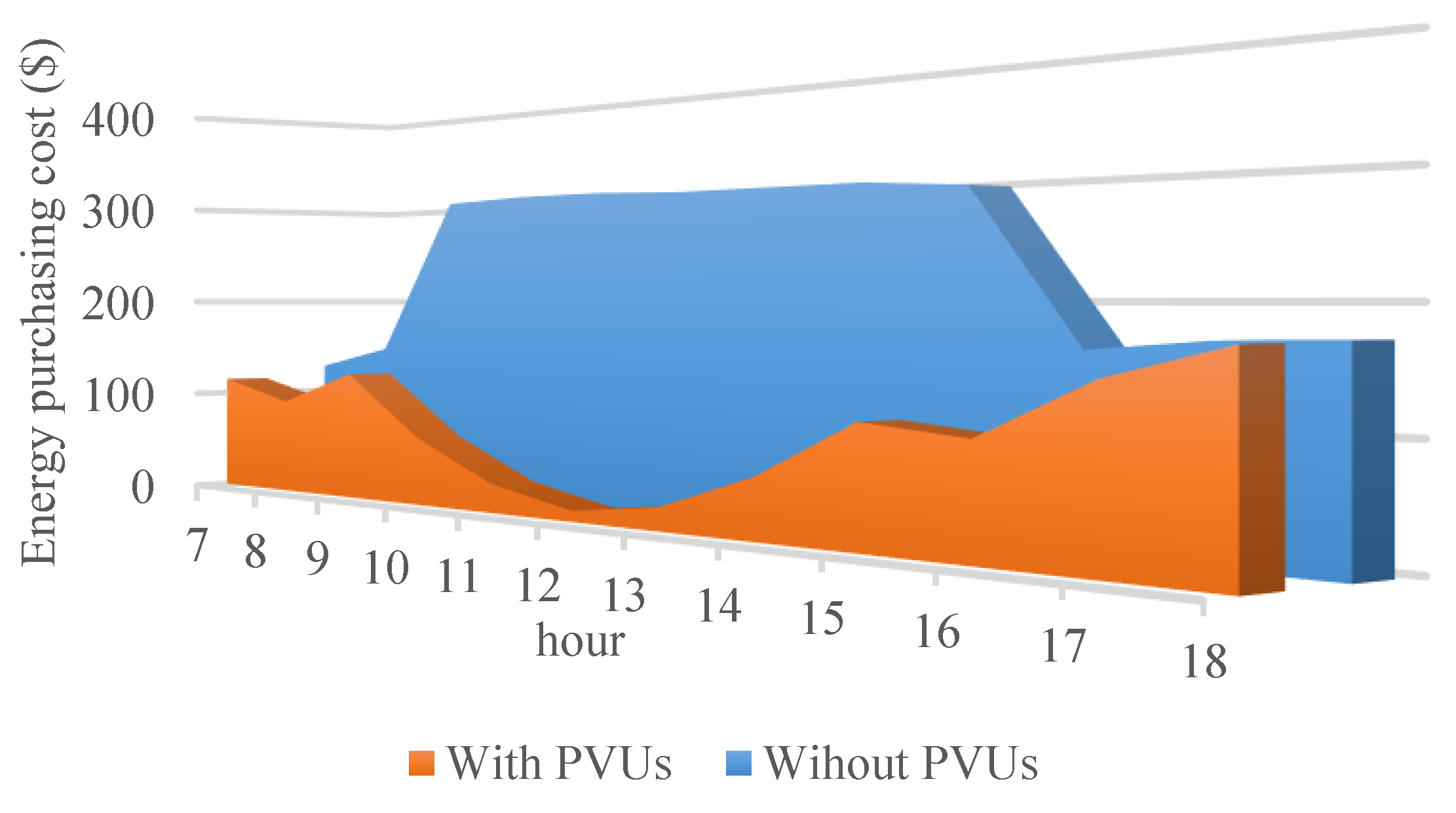
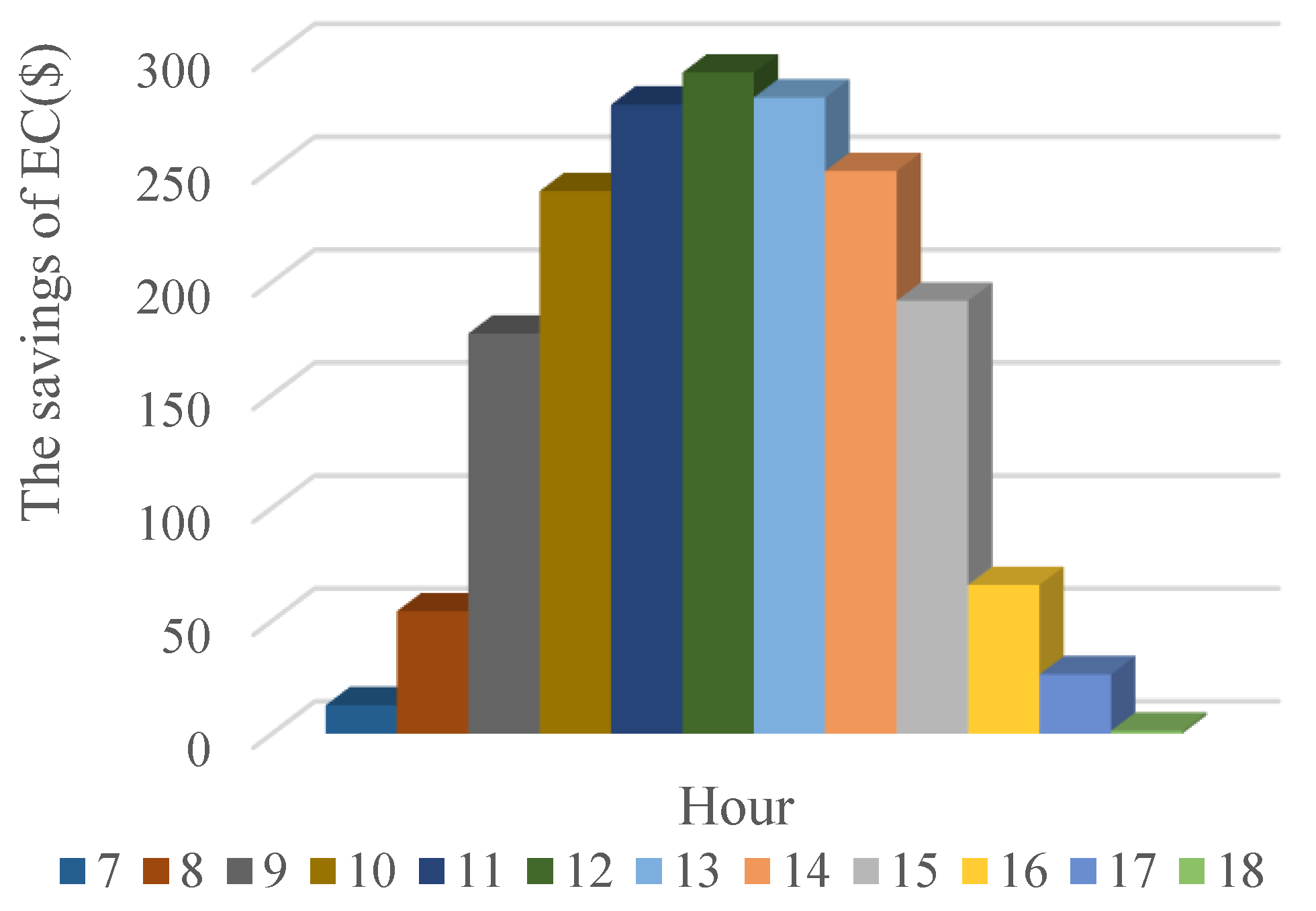
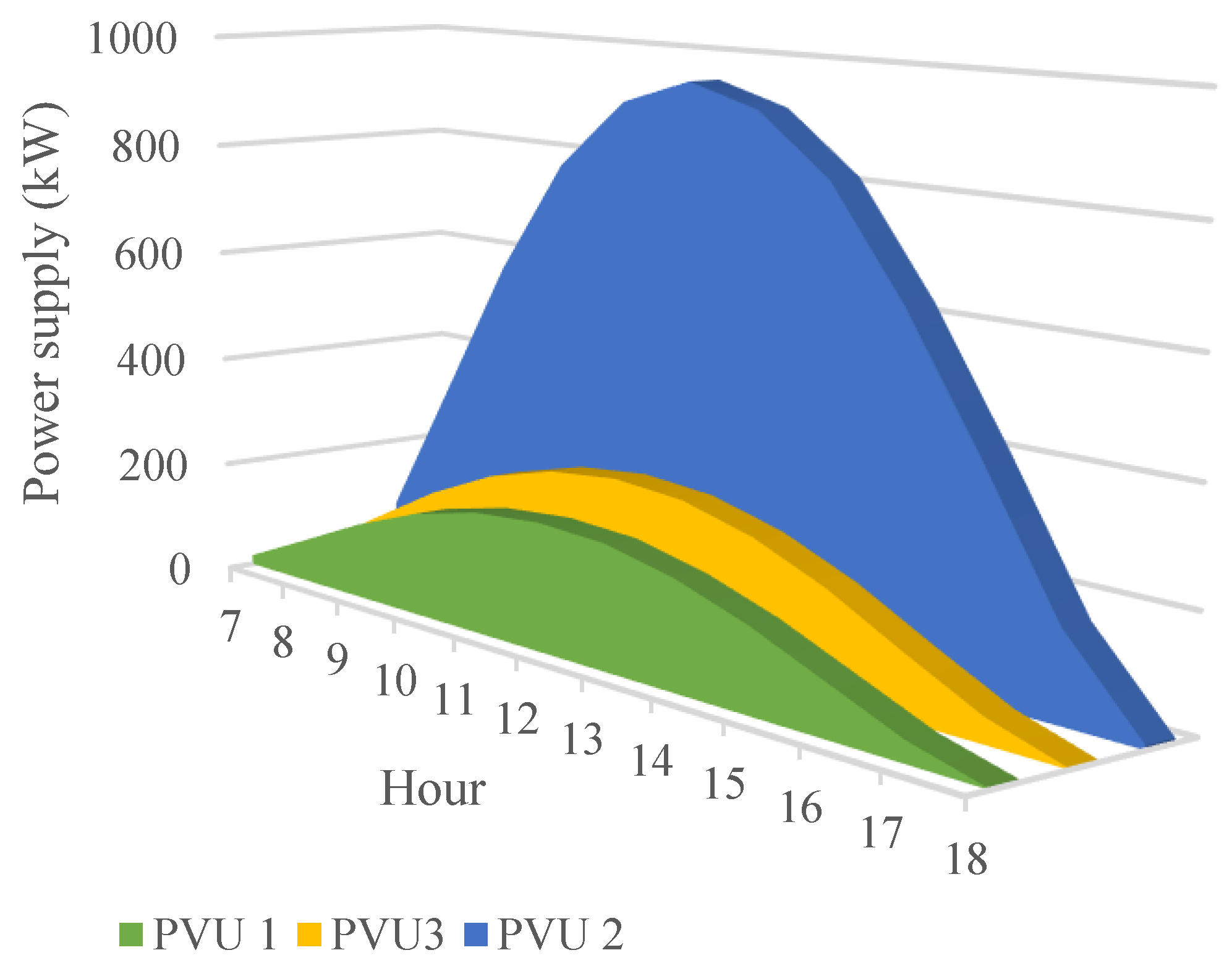
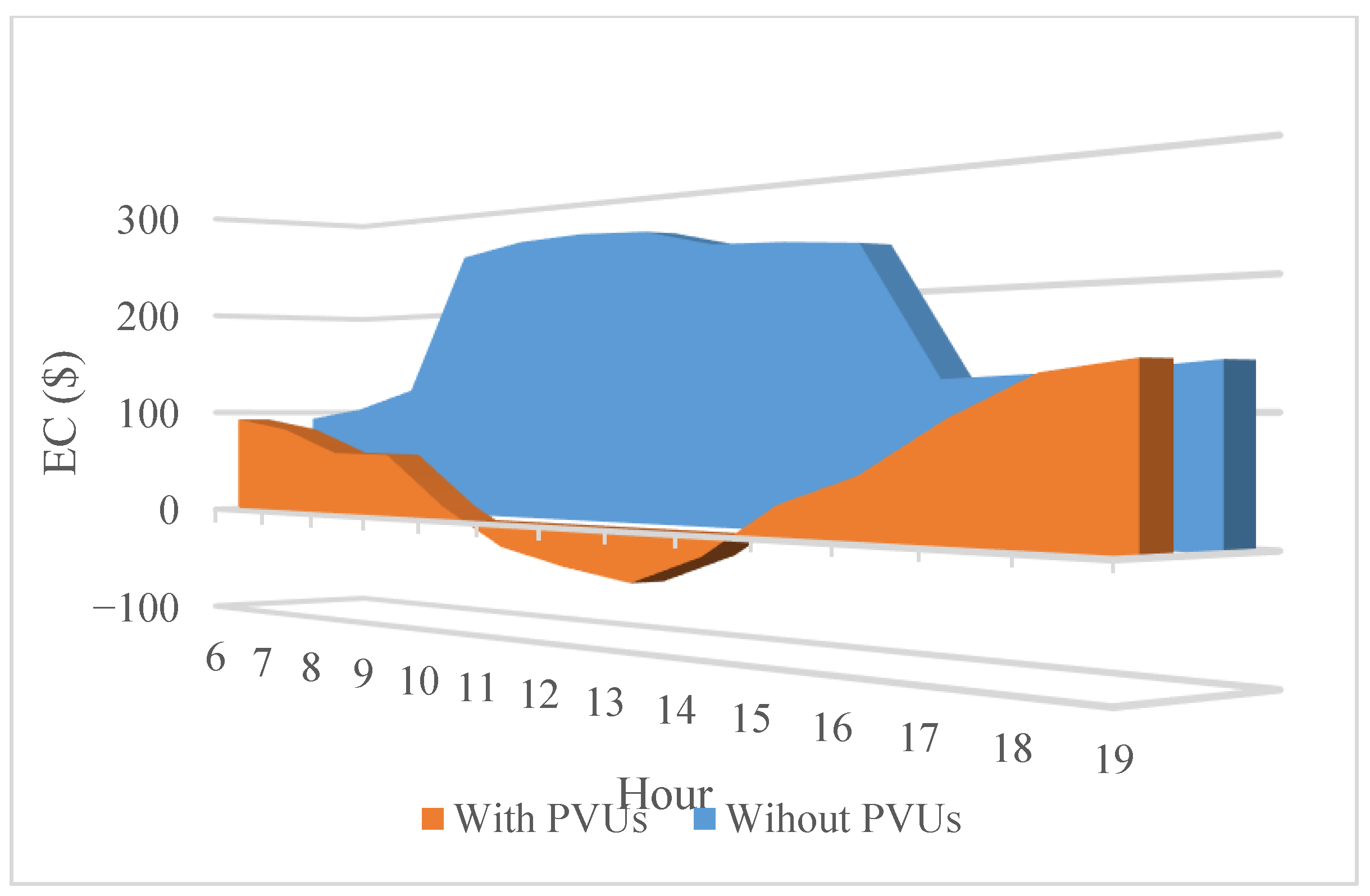
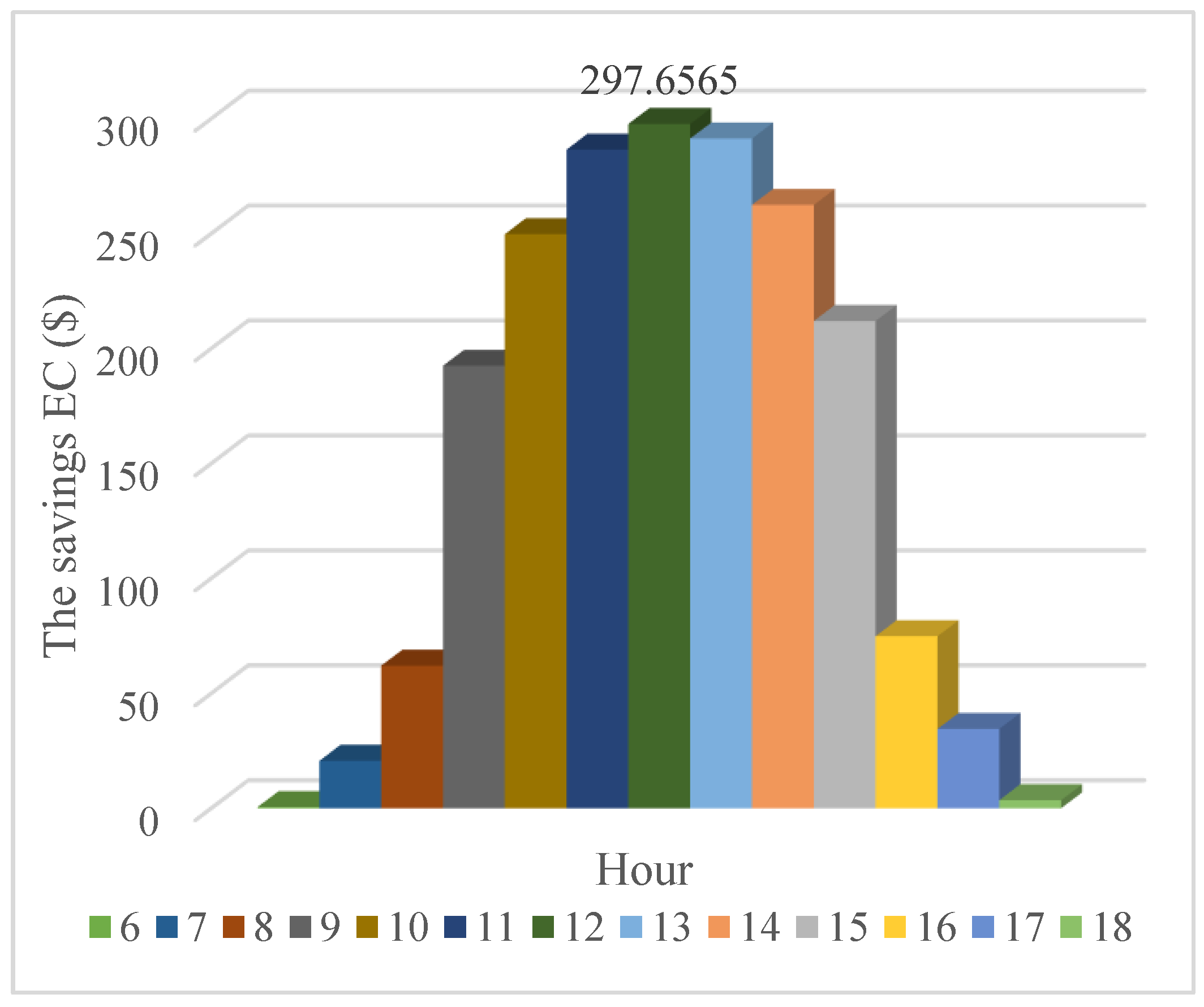
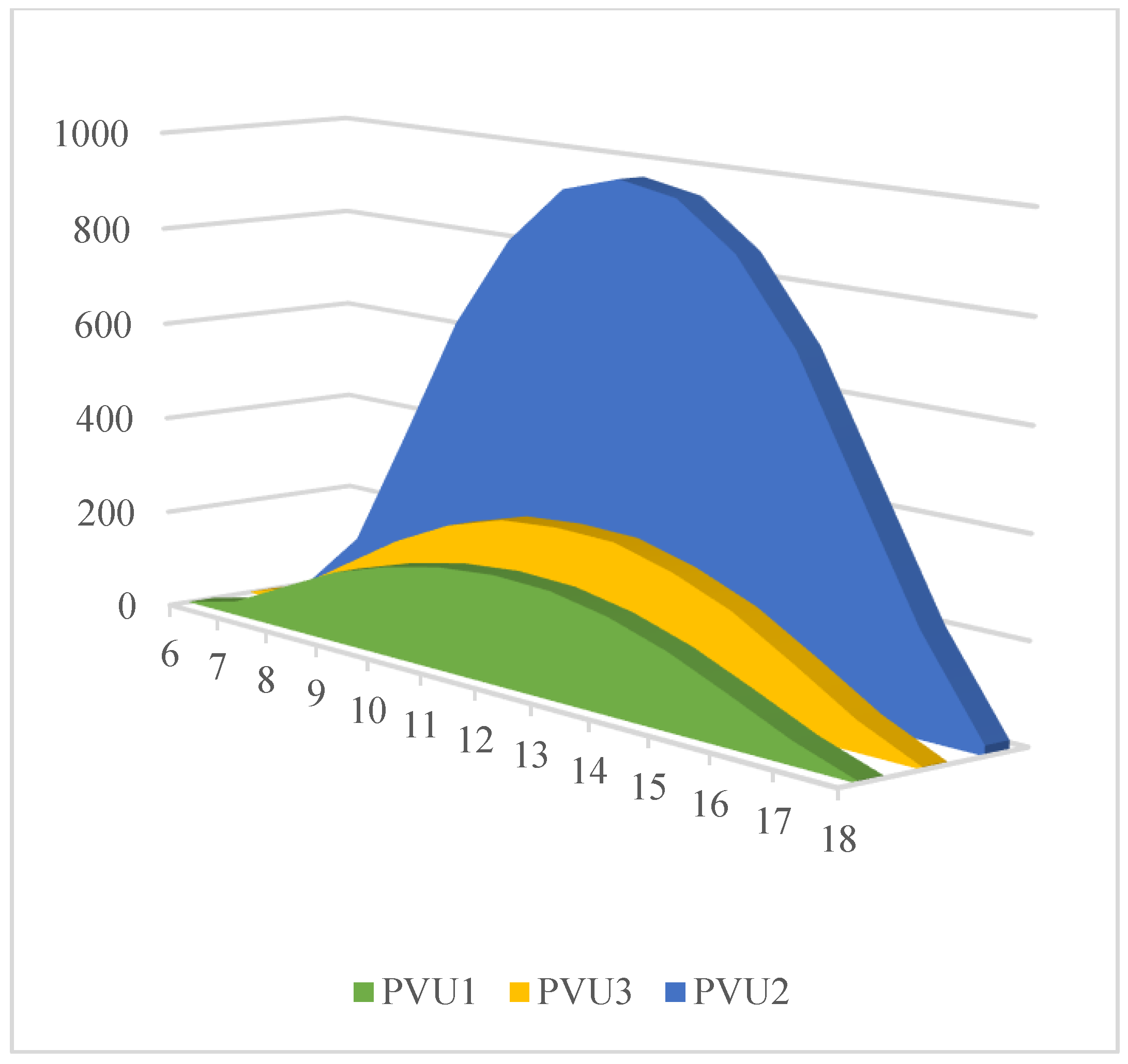
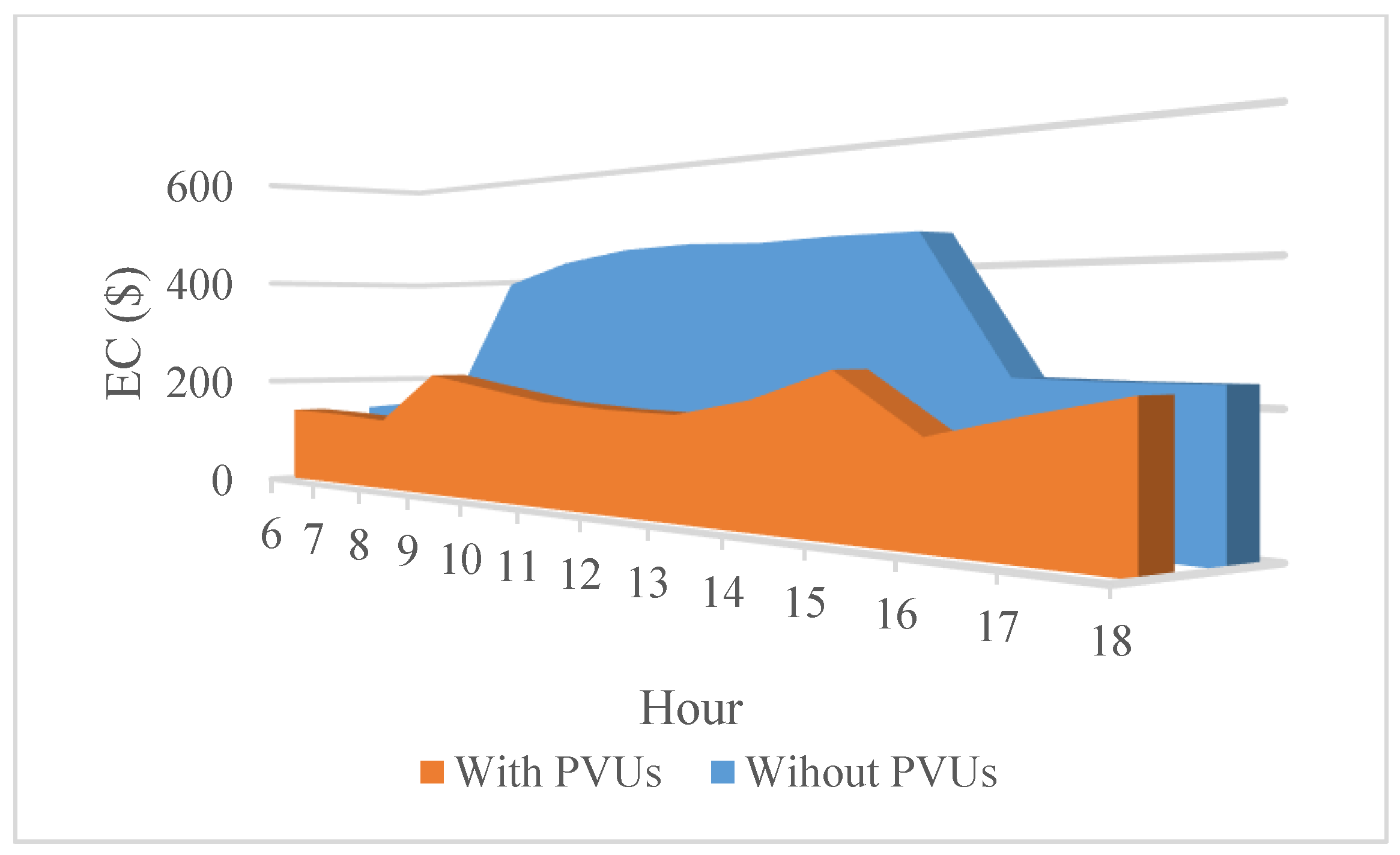
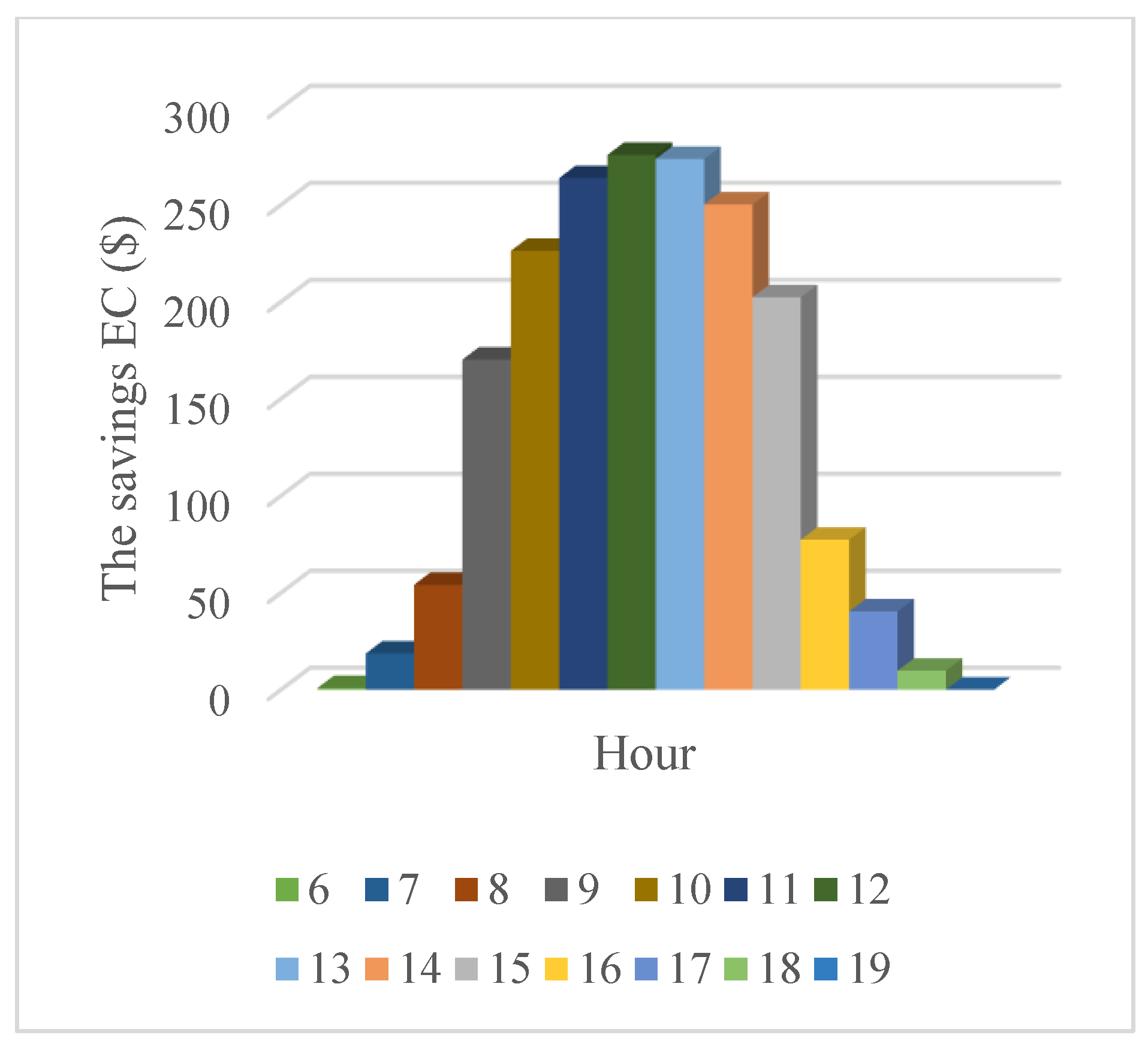
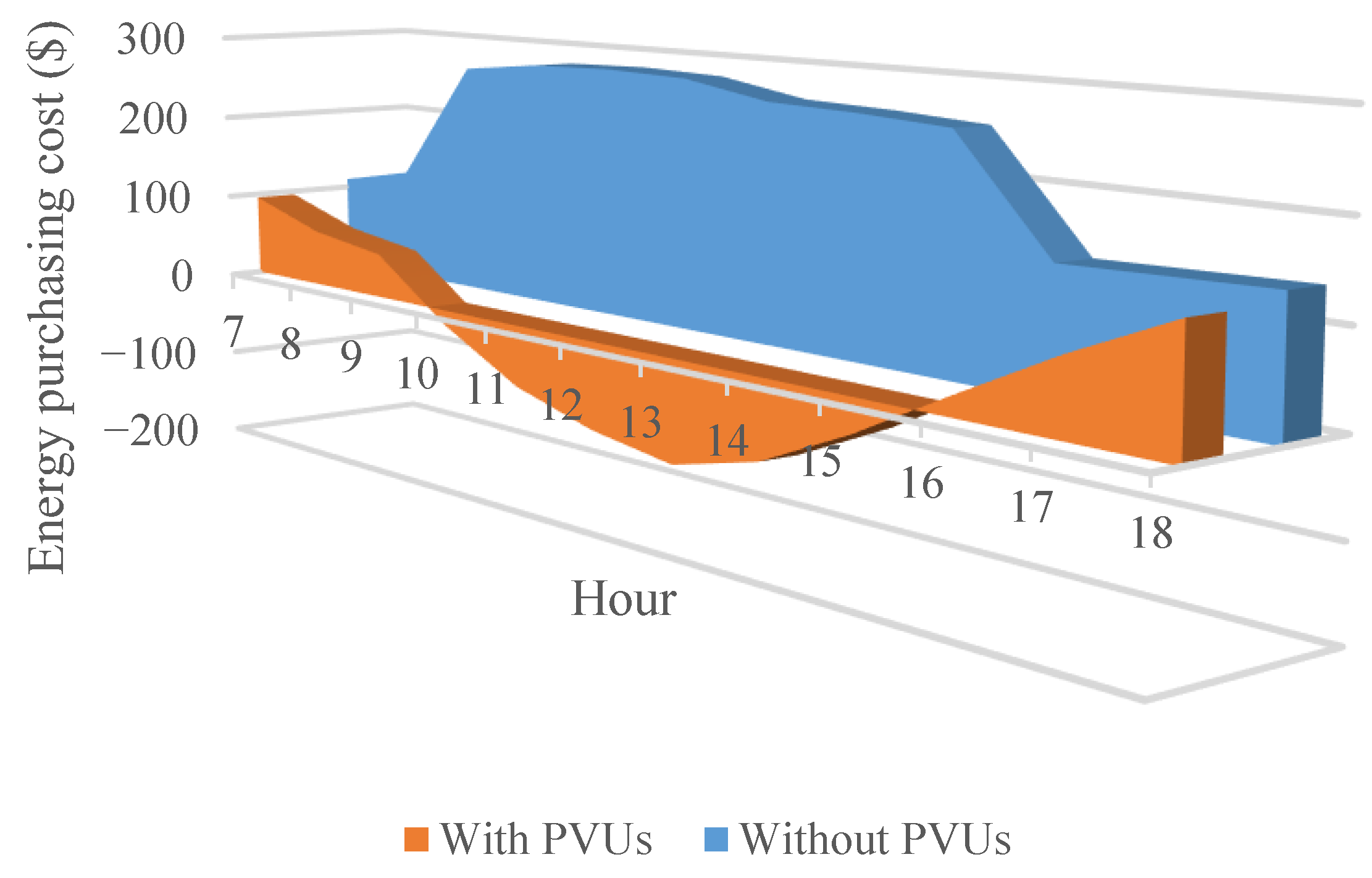
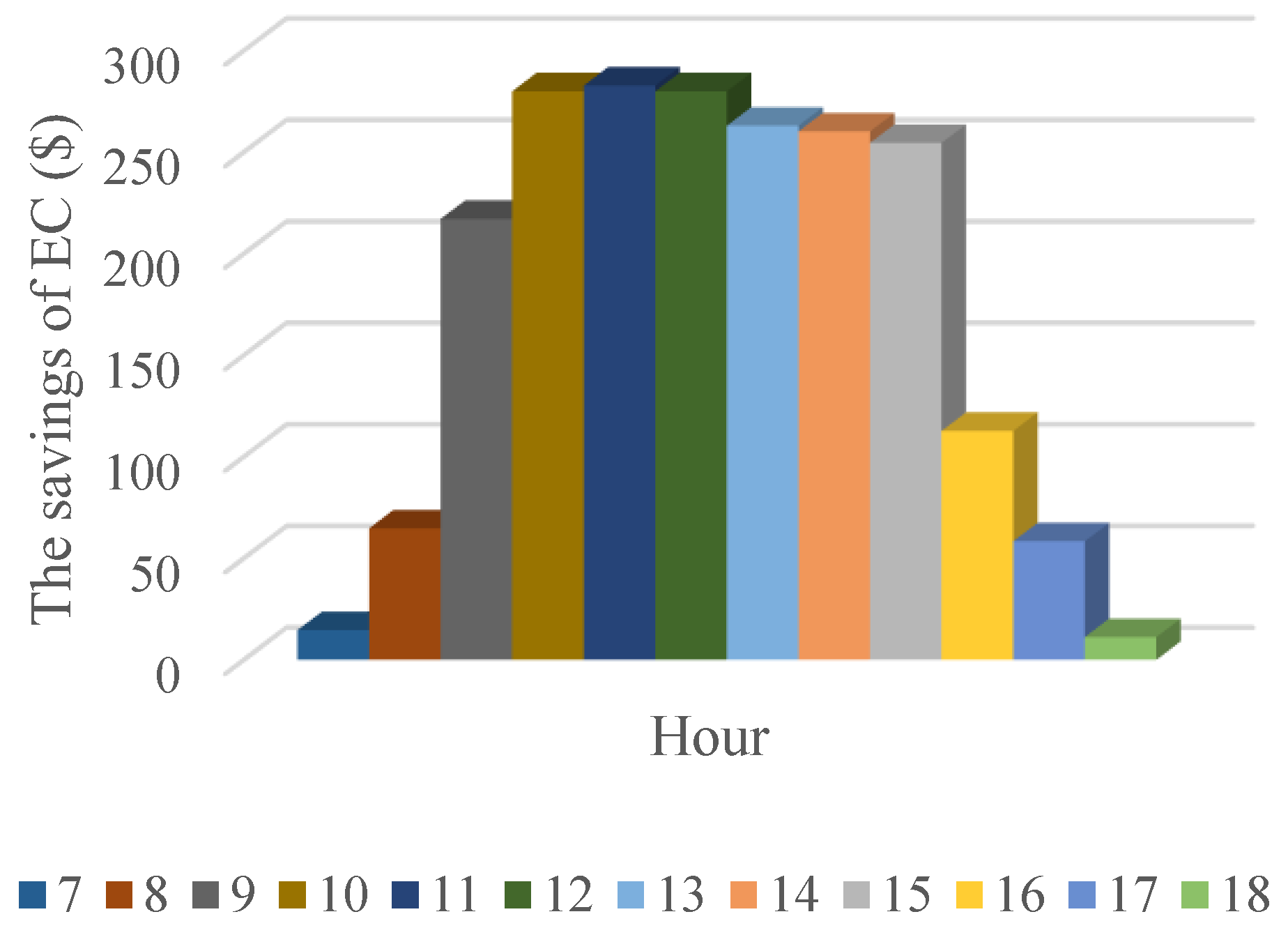
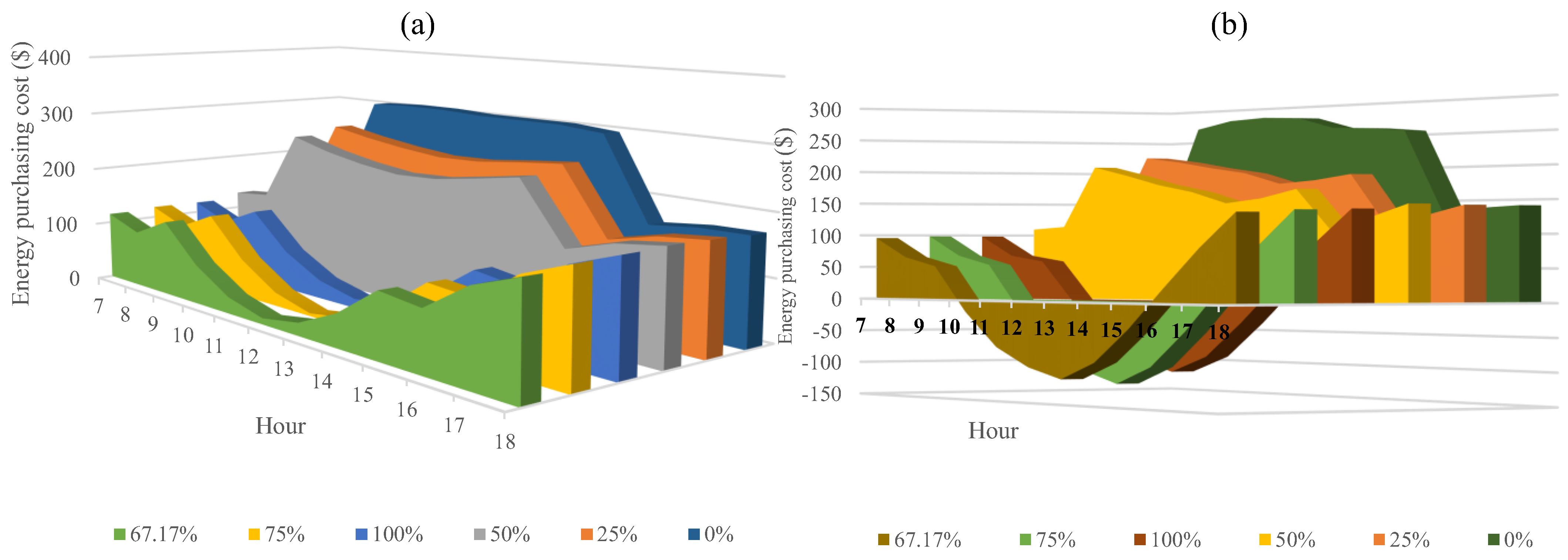
- The study also demonstrates the contribution of PVUs to reducing electricity purchasing costs compared to the case in which PVUs are absent in an operational schedule for the last 24 h of an average day of the month, accounting for load-demand fluctuations and real-time electricity prices.
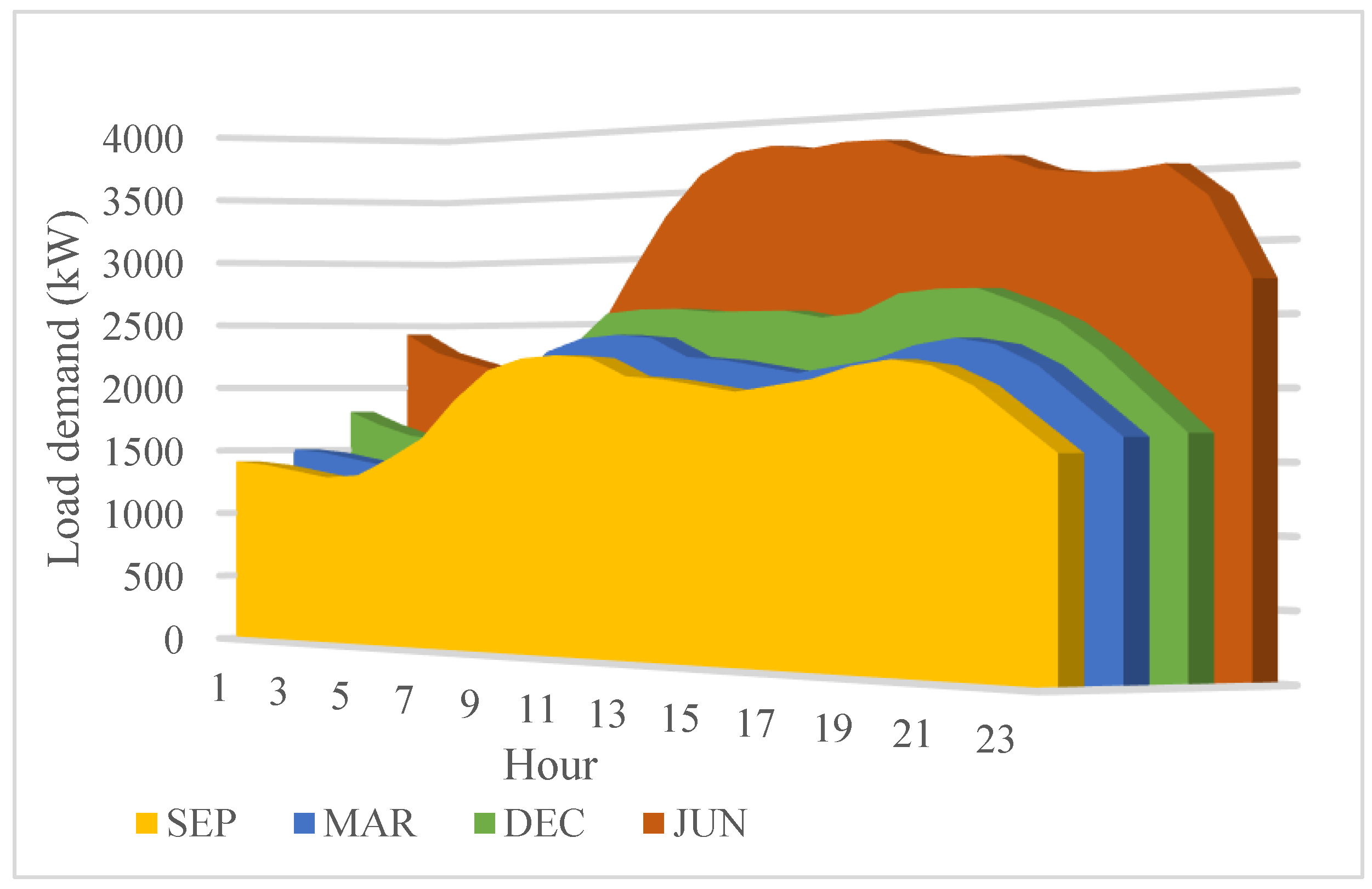
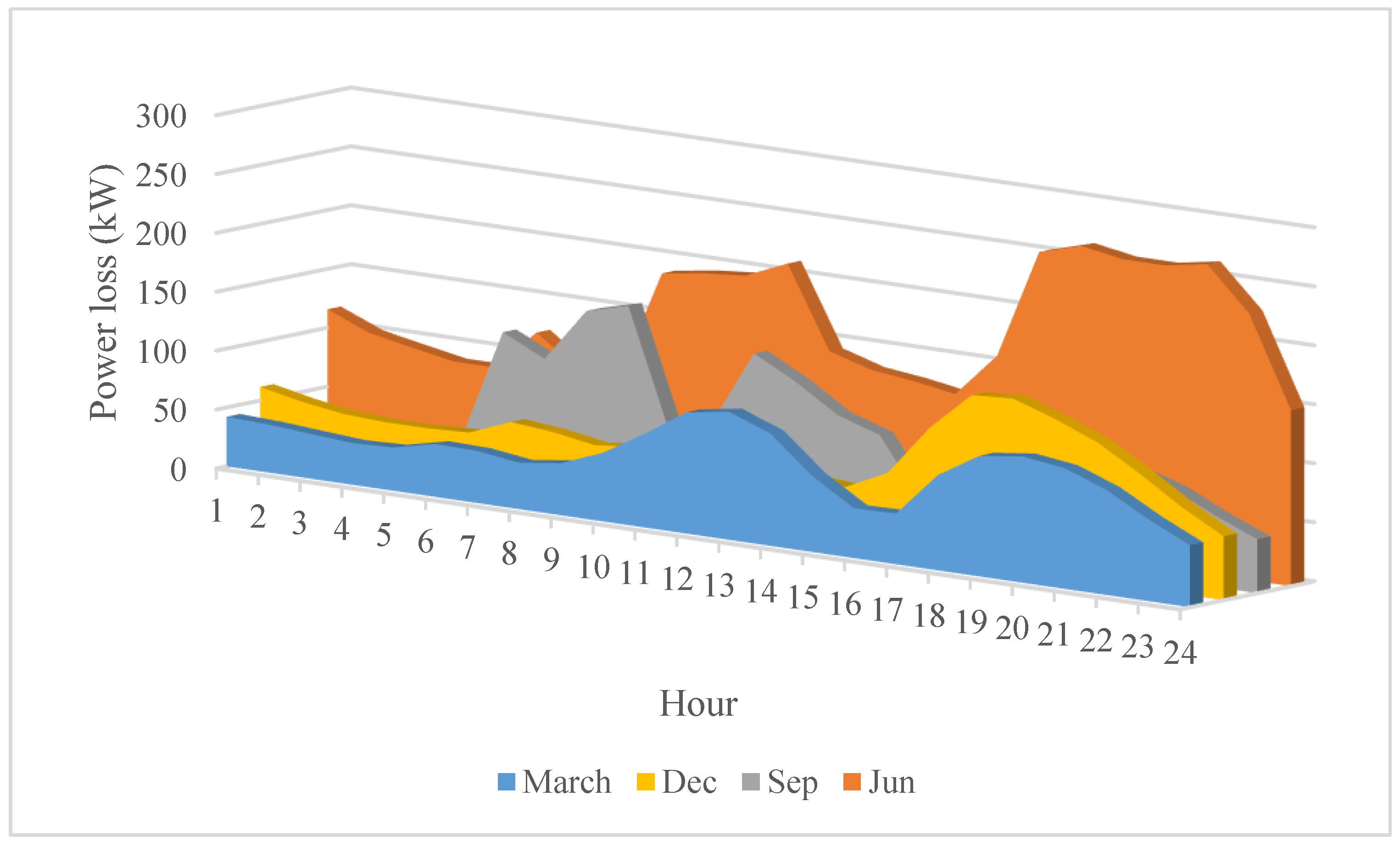
- The effects of seasonal changes in load demand over the course of a year on the cost of electricity savings are also assessed. In particular, the injected power from PVU not only contributed to lower EC but also provided the castflow back to the customer during particular periods of the year, while PVU’s injected power was larger than needed.
2. Problem Description
2.1. Power Loss and Voltage Drop
2.2. Power Loss Reduction
2.3. Electric Purchasing Cost Reduction
2.4. Constraints
3. The Applied Algorithms
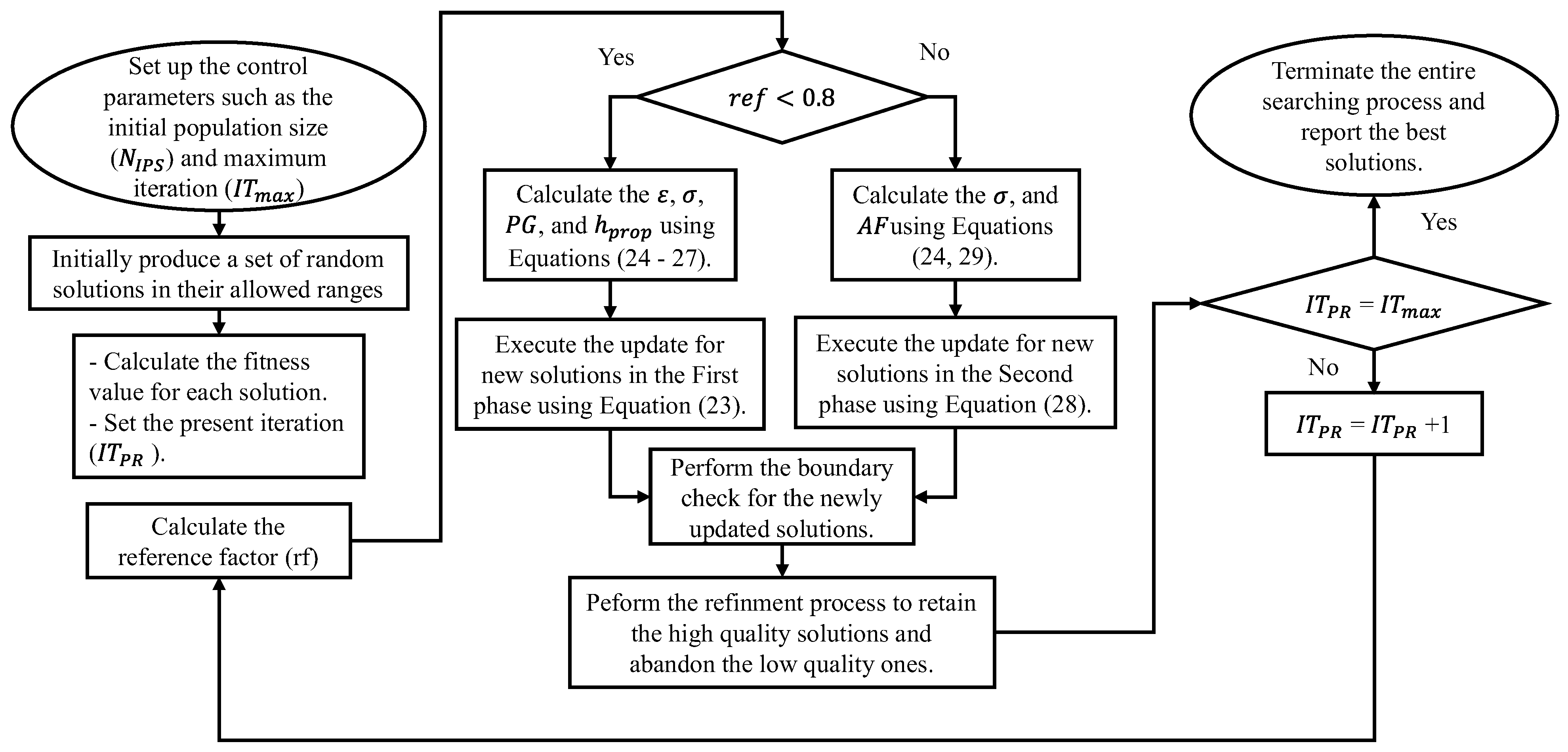
3.1. Mirage Search Optimization Algorithm
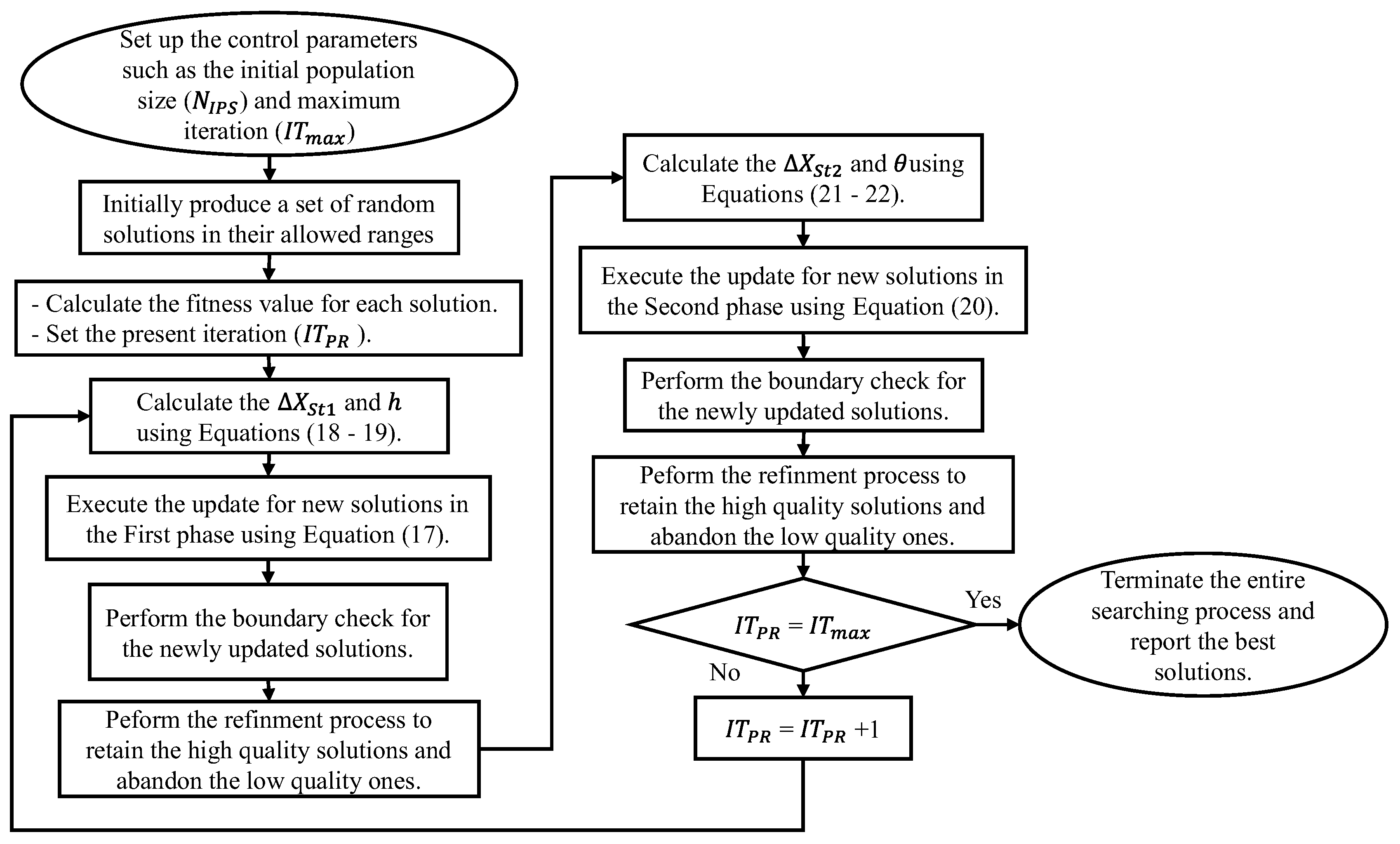
3.2. Pied Kingfisher Optimizer
4. Results and Discussion
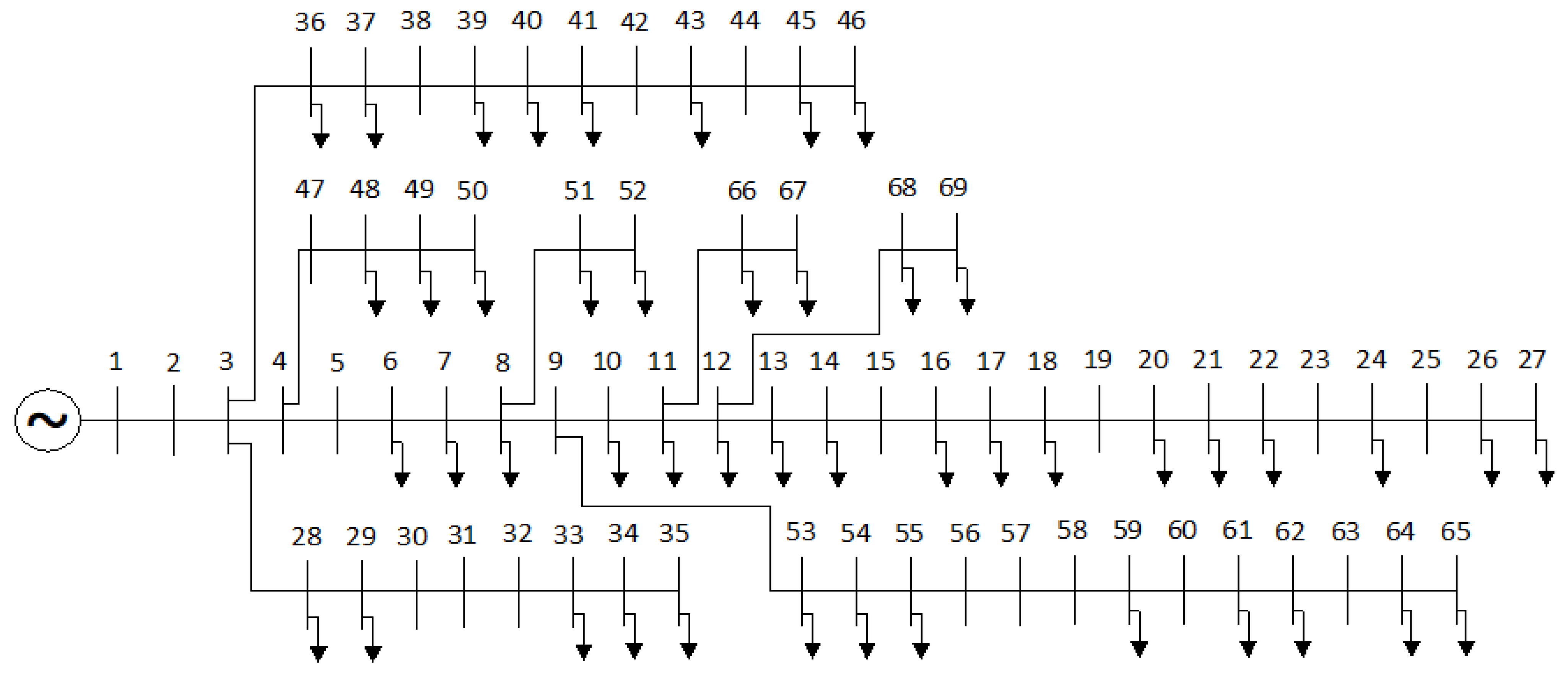
- Case 1: Optimizing the allocation of 3 PVUs on the IEEE 69-node SRDN, suppose that the PVUs can only inject active power to the grid.
- Case 2: Optimizing the allocation of 3 PVUs on the IEEE 69-node SRDN, suppose that the PVUs can inject active and reactive power to the grid.
- (1)
- Each PVU’s rated power output is assumed to be injectable into the grid with a precision of three decimal places.
- (2)
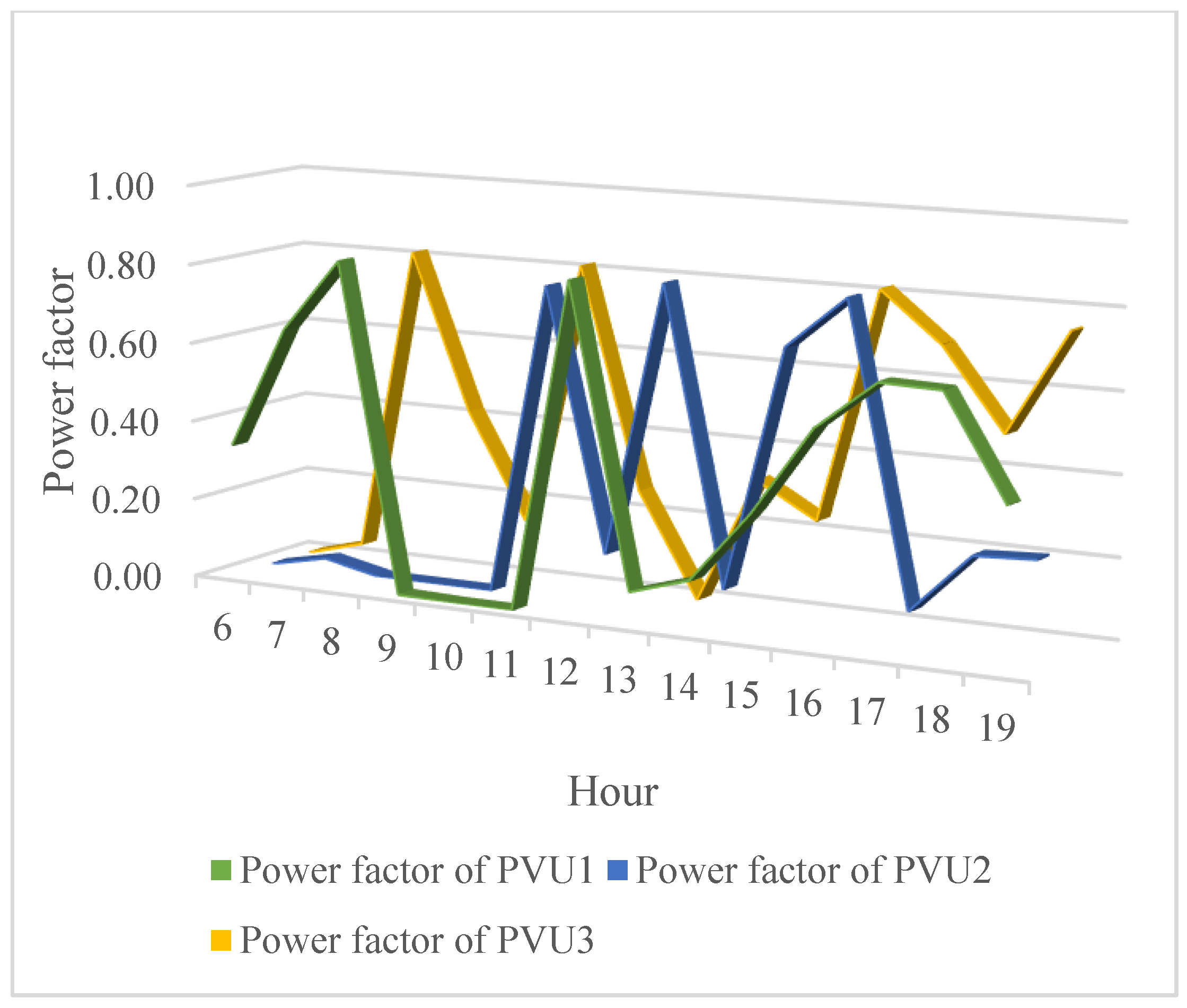
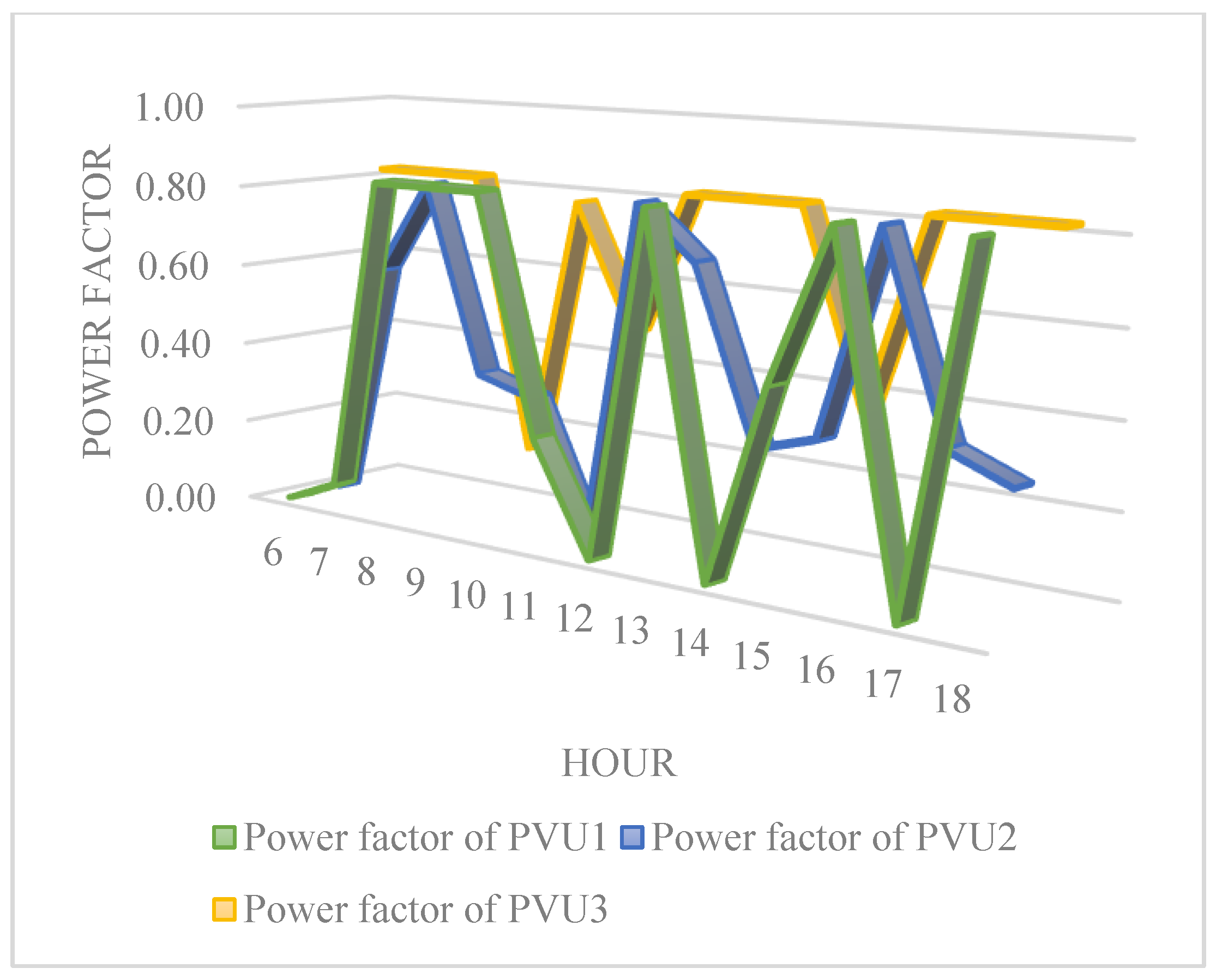
- The power converter installed on each PVU connected to the grid is assumed to operate over the full range of power levels determined by the optimization methods.
- (3)
- The DC-to-AC conversion losses of the inverters are ignored, a commonly accepted simplification in power system planning in many previous studies.
- (4)
- The grid is assumed to accommodate the total power injected by the PVUs without operational disruption, as long as all constraints presented in Section 2 are satisfied.
- (5)
- Transient fault conditions, sudden grid disturbances, and potential failures of the related equipment are excluded. The study focuses solely on maintaining the steady-state of the considered system, rather than on dynamic or protection scenarios.
4.1. The Results for Cases 1 and 2
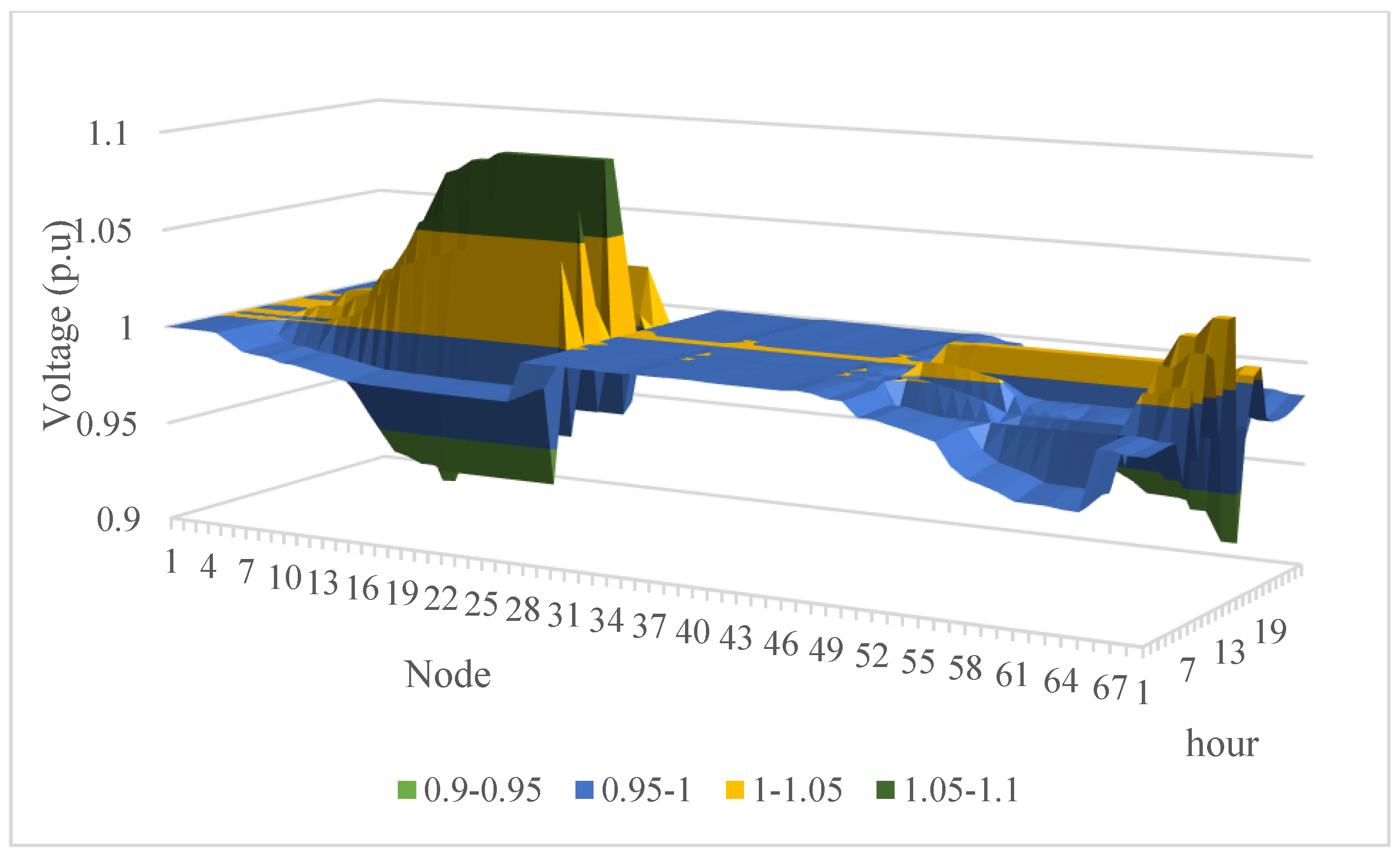
- The results of Case 1:
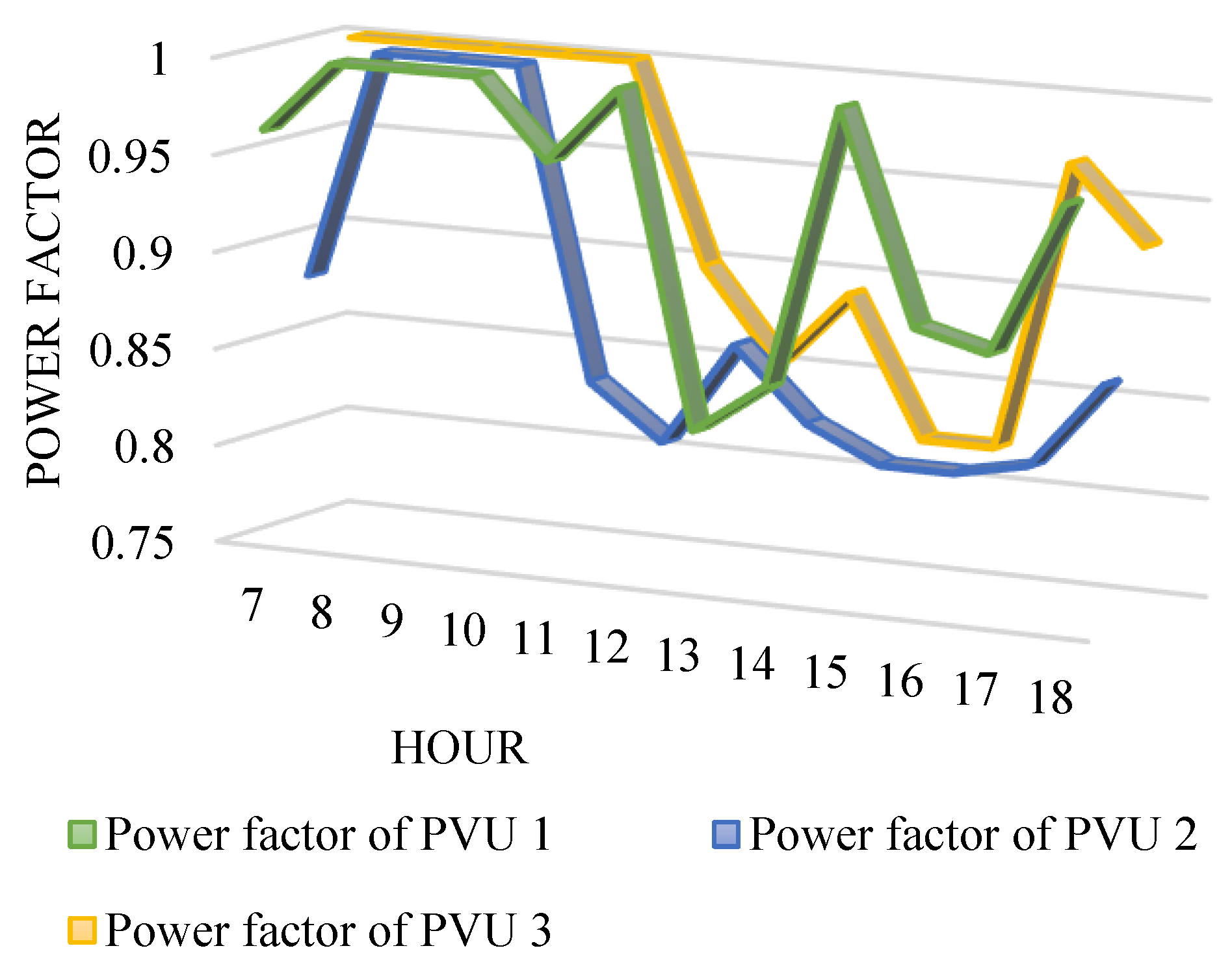
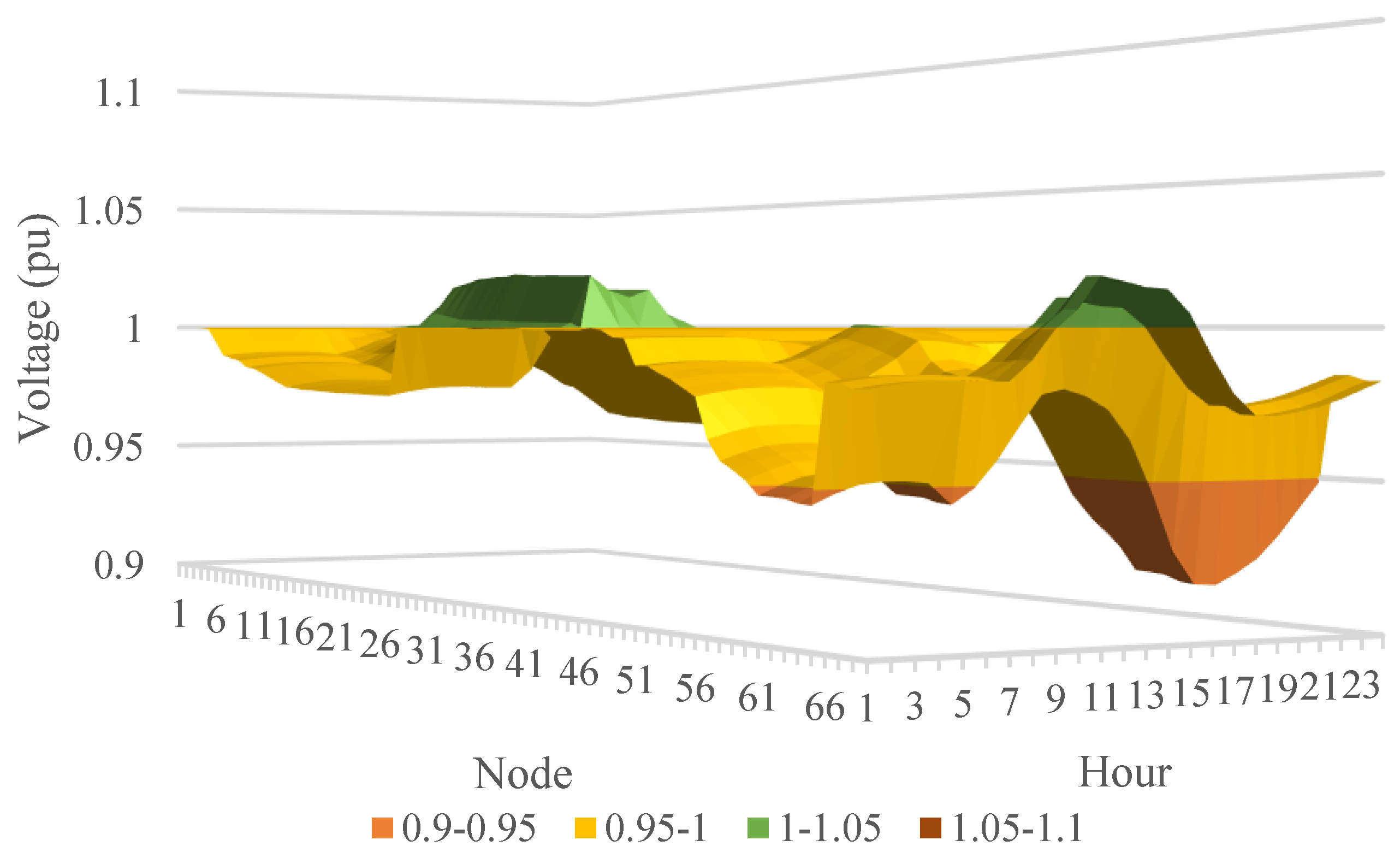
- The results of Case 2:
4.2. The Results of Energy Cost Reduction for Months
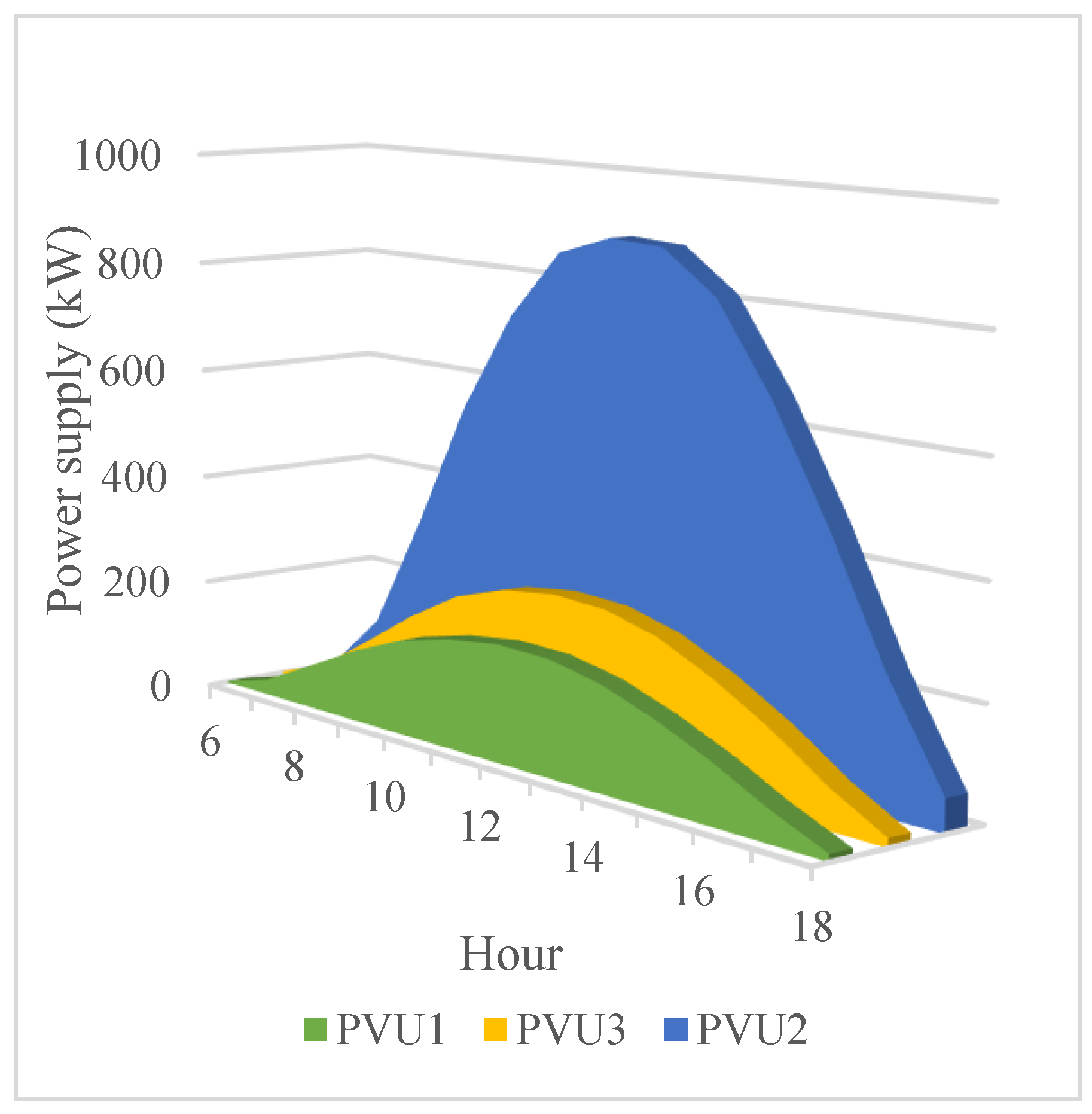
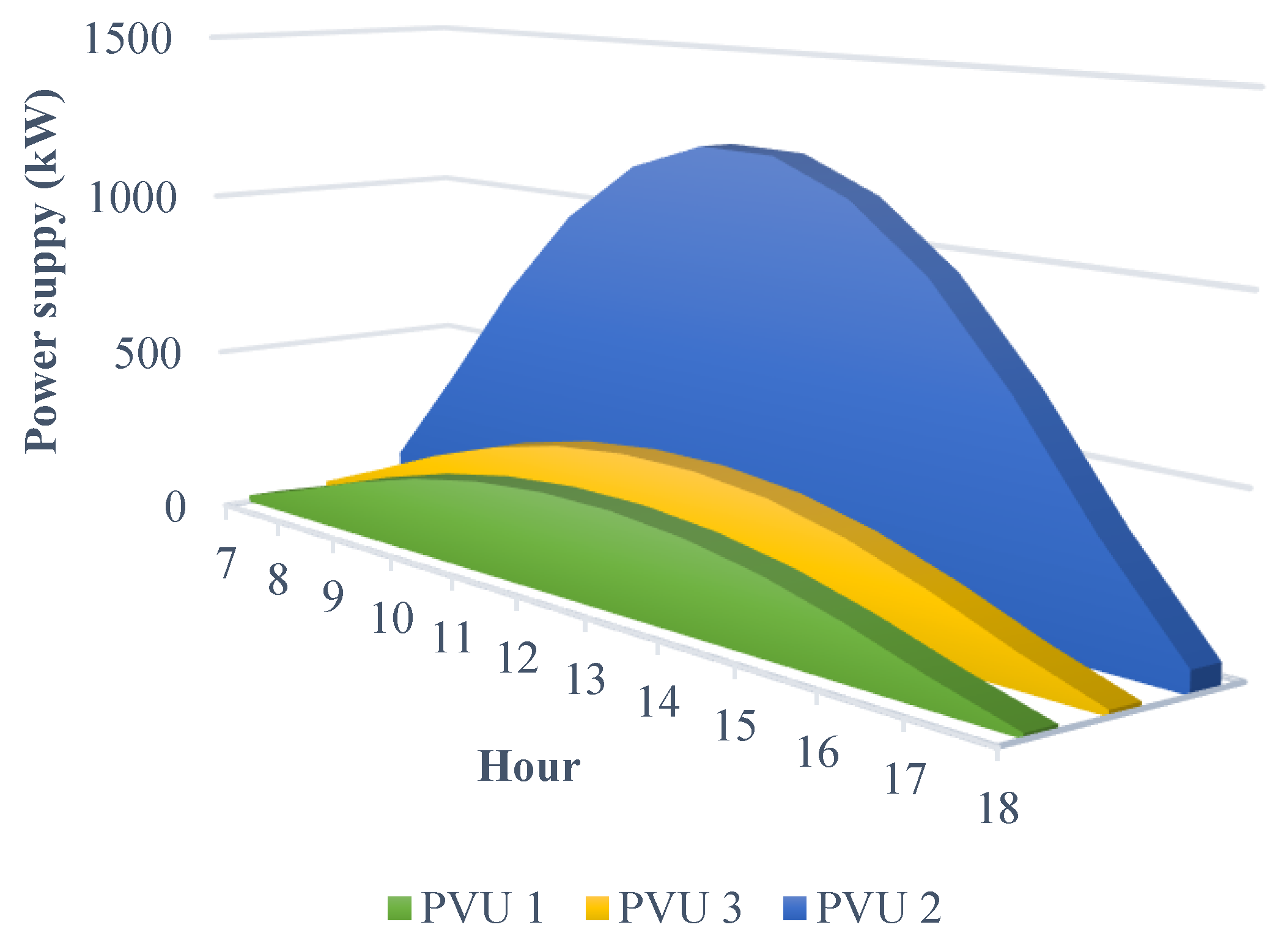
- Active radiation data during daytime: This data forms the primary basis for determining the power output of each PVU at each hour.
- Load demand variation data within 24 h.
- Electricity price for each hour.
- Integrating the energy storage system (ESS) provides the capability to save extra energy produced by the PVUs during the daytime and discharge this amount of saved energy back to the grid at nighttime, while the power supplied by PVUs is not available. However, integrating the ESS also requires an optimized charging or discharging schedule for specific periods throughout the entire schedule. Furthermore, the amount of charged/discharged energy needs to be optimized so that all ESS constraints are satisfied, as specified by the equality of the energy in the ESS at the start and end periods.
- Installing capacitor banks that offer the capability of improving the voltage node due to the injection of extra reactive power. In terms of investment and operating cost, installing the capacitor banks is an affordable solution with a high degree of flexibility. Furthermore, integrating a capacitor with PVUs partially mitigates the uncertainty caused by PVUs’ strong dependence on weather conditions. However, the installation of such capacitor banks also requires an optimal allocation on the grid to maximize their advantage.
- Installing flexible AC transmission system (FACTS) devices, such as Static Var Compensator, TCSC, UPFC, and SSSC. These devices enable changing line parameters to control power flow among distribution lines. However, installing such devices requires a significant investment in terms of cost and deployment time. Furthermore, the installation of such devices must be carefully considered using effective optimization tools to reach the expected efficiency.
4.3. The Comparison of the Optimized Penetration Level over the Four Ones of PVUs in Operation
5. Conclusions
Author Contributions
Funding
Data Availability Statement
Conflicts of Interest
References
- Ackermann, T.; Andersson, G.; Söder, L. Distributed generation: A definition. Electr. Power Syst. Res. 2001, 57, 195–204. [Google Scholar] [CrossRef]
- Mahmoud, K.; Yorino, N.; Ahmed, A. Optimal Distributed Generation Allocation in Distribution Systems for Loss Minimization. IEEE Trans. Power Syst. 2016, 31, 960–969. [Google Scholar] [CrossRef]
- Ranga, J.; Jalli, R.K.; Muthusamy, S.K.; Sundaresan, V.; Ramesh, S.; Palanisamy, R.; Arulprakasam, S. Multi-Objective Integrated Approach for Distributed Generation Placement and Sizing to Enhance Performance of Radial Power Distribution System. Adv. Electr. Electron. Eng. 2025, 23, 189. [Google Scholar] [CrossRef]
- Alhasnawi, B.N.; Almutoki, S.M.M.; Hussain, F.F.K.; Harrison, A.; Bazooyar, B.; Zanker, M.; Bureš, V. A new methodology for reducing carbon emissions using multi-renewable energy systems and artificial intelligence. Sustain. Cities Soc. 2024, 114, 105721. [Google Scholar] [CrossRef]
- Nguyen, V.P.U.; Dang, T.N. Minimizing the overall electricity production cost to the large-scale power system incorporating solar and wind energy sources using Elk Herd Optimizer. J. Adv. Eng. Comput. 2026, 10, 36–49. [Google Scholar] [CrossRef]
- Nguyen, T.T.; Nguyen, H.D.; Duong, M.Q. Optimal power flow solutions for power system considering electric market and renewable energy. Appl. Sci. 2023, 13, 3330. [Google Scholar] [CrossRef]
- Yeşil, F.N.; Serttaş, T.N. Advances in Solar Radiation Estimation Techniques: A Comprehensive Review. Adv. Electr. Electron. Eng. 2024, 22, 308. [Google Scholar] [CrossRef]
- Jamil, M.; Anees, A.S. Optimal sizing and location of SPV (solar photovoltaic) based MLDG (multiple location distributed generator) in distribution system for loss reduction, voltage profile improvement with economical benefits. Energy 2016, 103, 231–239. [Google Scholar] [CrossRef]
- Duong, M.Q.; Tran, N.T.; Sava, G.N.; Tanasiev, V. Design, performance and economic efficiency analysis of the photovoltaic rooftop system. Rev. Roum. Des Sci. Tech. 2019, 15, 229–234. [Google Scholar]
- Augugliaro, A.; Dusonchet, L.; Favuzza, S.; Ippolito, M.G.; Sanseverino, E.R. A backward sweep method for power flow solution in distribution networks. Int. J. Electr. Power Energy Syst. 2010, 32, 271–280. [Google Scholar] [CrossRef]
- Truong, K.H.; Nallagownden, P.; Elamvazuthi, I.; Vo, D.N. An improved meta-heuristic method to maximize the penetration of distributed generation in radial distribution networks. Neural Comput. Appl. 2020, 32, 10159–10181. [Google Scholar] [CrossRef]
- Sharma, S.; Bhattacharjee, S.; Bhattacharya, A. Quasi-Oppositional Swine Influenza Model Based Optimization with Quarantine for optimal allocation of DG in radial distribution network. Int. J. Electr. Power Energy Syst. 2016, 74, 348–373. [Google Scholar] [CrossRef]
- Balu, K.; Mukherjee, V. Optimal siting and sizing of distributed generation in radial distribution system using a novel student psychology-based optimization algorithm. Neural Comput. Appl. 2021, 33, 15639–15667. [Google Scholar] [CrossRef]
- Kansal, S.; Kumar, V.; Tyagi, B. Hybrid approach for optimal placement of multiple DGs of multiple types in distribution networks. Int. J. Electr. Power Energy Syst. 2016, 75, 226–235. [Google Scholar] [CrossRef]
- Sultana, S.; Roy, P.K. Multi-objective quasi-oppositional teaching learning based optimization for optimal location of distributed generator in radial distribution systems. Int. J. Electr. Power Energy Syst. 2014, 63, 534–545. [Google Scholar] [CrossRef]
- Nagaballi, S.; Kale, V.S. Pareto optimality and game theory approach for optimal deployment of DG in radial distribution system to improve techno-economic benefits. Appl. Soft Comput. 2020, 92, 106234. [Google Scholar] [CrossRef]
- Nguyen, T.T.; Nguyen, T.T. Power Loss Minimization by Optimal Placement of Distributed Generation Considering the Distribution Network Configuration Based on Artificial Ecosystem Optimization. Adv. Electr. Electron. Eng. 2023, 20, 418–431. [Google Scholar] [CrossRef]
- Pham, T.D.; Nguyen, T.T.; Dinh, B.H. Find optimal capacity and location of distributed generation units in radial distribution networks by using enhanced coyote optimization algorithm. Neural Comput. Appl. 2021, 33, 4343–4371. [Google Scholar] [CrossRef]
- Mohanty, A.K.; Perli, S.B. Fuzzy Based Optimal Network Reconfiguration of Distribution System with Electric Vehicle Charging Stations, Distributed Generation, and Shunt Capacitors. Adv. Electr. Electron. Eng. 2023, 21, 81. [Google Scholar]
- Selim, A.; Kamel, S.; Mohamed, A.A.; Elattar, E.E. Optimal Allocation of Multiple Types of Distributed Generations in Radial Distribution Systems Using a Hybrid Technique. Sustainability 2021, 13, 6644. [Google Scholar] [CrossRef]
- Talebi, H.; Nikoukar, J.; Gandomkar, M. Optimal Sizing and Techno-economic Analysis of Combined Solar Wind Power System, Fuel Cell and Tidal Turbines Using Meta-heuristic Algorithms: A Case Study of Lavan Island. Int. J. Comput. Intell. Syst. 2025, 18, 15. [Google Scholar] [CrossRef]
- Daravath, R.; Bali, S.K. Optimal Distributed Energy Resources Placement to Reduce Power Losses and Voltage Deviation in a Distribution System. Iran. J. Sci. Technol. Trans. Electr. Eng. 2025, 49, 725–744. [Google Scholar] [CrossRef]
- Wang, Q.; Zhang, M.; Li, L.; Yan, W.; Liu, B.; Xia, Z.; Tseng, M.L. Optimal capacity configuration of coupled photovoltaic and energy storage system: Multi-objective red-billed blue-magpie optimizer. J. Ind. Prod. Eng. 2025, 42, 495–515. [Google Scholar] [CrossRef]
- Rajakumar, P.; Balasubramaniam, P.M.; Parimalasundar, E.; Suresh, K.; Aravind, P. Optimized placement and sizing of solar photovoltaic distributed generation using jellyfish search algorithm for enhanced power system performance. Sci. Rep. 2025, 15, 20755. [Google Scholar] [CrossRef]
- Fokui, W.S.T.; Rene, E.A.; Mtonga, T. Integration of Photovoltaic and DSTATCOM In the Distribution Network Using Rat Swarm Optimization Technique. J. Adv. Eng. Comput. 2024, 8, 144–157. [Google Scholar] [CrossRef]
- Tran, D.T.; Duong, M.P. Zebra Optimization Algorithm for Dealing with Large-Scale Economic Load Dispatch Considering Renewable Energy Sources. In AETA 2023; Lecture Notes in Electrical Engineering; Springer: Singapore, 2025; Volume 1405. [Google Scholar]
- Singh, B.M.; Agarwal, C.; Vilas, S.S.; Raghuvanshi, H.; Sahay, P.K.; Gupta, V.K.; Babu, M.S.; Srinivas, V.L.; Kumar, A. Optimal Location and Sizing of Distributed Generation Using Horse Herd Optimization. In Proceedings of the 2025 IEEE 1st International Conference on Smart and Sustainable Developments in Electrical Engineering 2025(SSDEE), Dhanbad, India, 28 February–2 March 2025; pp. 1–6. [Google Scholar]
- Pham, L.H.; Phan, T.T.; Phan, K.D.T.; Nguyen, P.H. Optimizing the Efficiency of Photovoltaic Distributed Generation in the Distribution System. J. Adv. Eng. Comput. 2024, 8, 19–28. [Google Scholar] [CrossRef]
- Ali, E.S.; Elazim, S.M.A. Dingo Optimization Algorithm for Sizing and Allocation of Wind Energy Systems in Radial Distribution System. WSEAS Trans. Syst. 2025, 24, 84–90. [Google Scholar] [CrossRef]
- Van Tran, H.; Duong, M.P.; Kayal, P.; Nguyen, T.T.; Pham, T.D. Investigating the impact of harmonic constraints caused by nonlinear loads and renewable power sources’ converters based on economic-technical-environmental factors of distribution grid using hippopotamus optimization algorithm. Comput. Electr. Eng. 2026, 129, 110844. [Google Scholar] [CrossRef]
- Mohd Rostam Affendi, B.N.A.S.; Abdul Rahim, S.R.; Azmi, A.; Hussain, M.H.; Azmi, S.A.; Musirin, I.; Aminudin, N. Integration of Multi-Unit Distributed Generation Resources Employing a Bio-Inspired Optimizer—Artificial Hummingbird Algorithm in Distribution System. J. Phys. Conf. Ser. 2025, 2998, 012008. [Google Scholar] [CrossRef]
- Rajakumar, P.; Balasubramaniam, P.M.; Aldulaimi, M.H.; Arunkumar, M.; Ramesh, S.; Alam, M.M.; AL-Mdallal, Q.M. An integrated approach using active power loss sensitivity index and modified ant lion optimization algorithm for DG placement in radial power distribution network. Sci. Rep. 2025, 15, 10481. [Google Scholar] [CrossRef]
- Ullah, Z.; Qazi, H.S.; Alferidi, A.; Alsolami, M.; Lami, B.; Hasanien, H.M. Advanced optimization of renewables and energy storage in power networks using metaheuristic technique with voltage collapse proximity and dynamic thermal rating technology. J. Energy Storage 2025, 108, 115005. [Google Scholar] [CrossRef]
- Chen, G.; Honggang, J.; Jian, Z.; Zhiqi, Z.; Xingxing, Z. Improving power distribution networks with dwarf mongoose optimization for improved photovoltaic incorporation in rural-urban settings. Energy Inform. 2025, 8, 28. [Google Scholar] [CrossRef]
- He, J.; Zhao, S.; Ding, J.; Wang, Y. Mirage search optimization: Application to path planning and engineering design problems. Adv. Eng. Softw. 2025, 203, 103883. [Google Scholar] [CrossRef]
- Bouaouda, A.; Hashim, F.A.; Sayouti, Y.; Hussien, A.G. Pied kingfisher optimizer: A new bio-inspired algorithm for solving numerical optimization and industrial engineering problems. Neural Comput. Appl. 2024, 36, 15455–15513. [Google Scholar] [CrossRef]
- Cavus, M.; Ayan, H.; Sari, M.; Akbulut, O.; Dissanayake, D.; Bell, M. Enhancing Smart Grid Reliability Through Data-Driven Optimisation and Cyber-Resilient EV Integration. Energies 2025, 18, 4510. [Google Scholar] [CrossRef]
- Solar Radiation Data of PVU1. Available online: https://globalsolaratlas.info/map?s=10.666006,107.775192,10&pv=medium,180,11,400 (accessed on 17 June 2025).
- Solar Radiation Data of PVU2. Available online: https://globalsolaratlas.info/map?s=10.710539,107.991486,10&pv=medium,180,12,1700 (accessed on 17 June 2025).
- Solar Radiation Data of PVU3. Available online: https://globalsolaratlas.info/map?s=10.916247,108.28743,10&pv=medium,180,11,500 (accessed on 17 June 2025).
- Phan, T.M.; Duong, M.P.; Doan, A.T.; Duong, M.Q.; Nguyen, T.T. Optimal Design and Operation of Wind Turbines in Radial Distribution Power Grids for Power Loss Minimization. Appl. Sci. 2024, 14, 1462. [Google Scholar] [CrossRef]
- EVN Vietnam. Electricity Price Within 24 Hour. Available online: https://www.evn.com.vn/d/vi-VN/news/Bieu-gia-ban-le-dien-theo-QD-2941-BCT-ngay-8112023-60-3566-8503 (accessed on 10 June 2025).

| Ref. No. | Considered System | Main Objective Function | Applied Algorithm | Achievement |
|---|---|---|---|---|
| [11] | IEEE 33-bus, 69-bus, and 118-bus radial distribution networks | -Maximize DG penetration -Minimize real power loss | Quasi-Oppositional Chaotic Symbiotic Organisms Search (QOCSOS) | The application of QOCSOS have resulted in the significant reduction in real power losses across all three test systems. |
| [12] | IEEE 33-bus and 69-bus radial distribution networks | Minimizing power loss | Quasi-Oppositional Swine Influenza (QOSIA) | Power loss reduction and voltage profiles have been largely improved by the optimized placement of DGs. |
| [13] | IEEE 33-bus, 69-bus, and 136-bus (practical Brazil) radial distribution systems | -Minimize active power loss, voltage deviation, and maximize voltage stability index | Student Psychology-Based Optimization (SPBO) | The optimization of designed parameters to DG has resulted in the best values of the considered objective function with multiple load model types. |
| [14] | IEEE 33-bus and 69-bus distribution networks | Minimize power loss | Particle Swarm Optimization (PSO) | Reduced power losses and improved voltage profile with multiple DG types simultaneously placed. |
| [15] | IEEE 33-bus, 69-bus, and 118-bus radial distribution systems | -Minimize power loss and voltage deviation, -Maximize voltage stability index | Multi-objective Quasi-Oppositional Teaching Learning Based Optimization (MOQOTLBO) | Provide a better Pareto-optimal solutions for DG placement across multiple network sizes. |
| [16] | IEEE 33-bus and 69-bus radial distribution systems | Minimize power losses and maximize net cost savings | Jaya Algorithm (JA) | - Improved techno-economic benefits with the optimal placement of DGs. - Clarify the effectiveness of JA and the other optimization algorithm. |
| [17] | IEEE 33-bus radial distribution network (with reconfiguration) | -Minimize power loss | Artificial Ecosystem Optimization (AEO) | Reduced power losses through simultaneous DG placement and network reconfiguration. |
| [18] | IEEE 33-bus, 69-bus, and 85-bus radial distribution networks | -Minimize power loss, operating cost; -Maximize voltage stability | Enhanced Coyote Optimization Algorithm (ECOA) | -Provide the optimal DG placement solution for the considered objective function. - Proving the superiority of ECOA compared to its original version and many previous methods. |
| [19] | IEEE 69-bus radial distribution system (with network reconfiguration) | -Minimize active power loss -Improve substation power factor and voltage profile with | RAO-3 | Significant active power loss reduction (up to ~90%) with improved voltage profile accommodating EV charging. |
| [20] | IEEE 33-bus and 69-bus radial distribution systems | Minimize total power losses | Sine Cosine Algorithm (SCA) | Improved efficiency of the grid with significant active power loss reduction provided by the optimized placement of PVDGs. |
| [21] | Off-grid system for Lavan Island, Iran (standalone microgrid) | -Minimize Cost of Energy (COE); -Minimize power losses; maximize system reliability | Meta-heuristic algorithms (PSO, GA, etc.) | Proposed a cost-effective and reliable solution of the standalone energy system for Lavan Island using hybrid PV/wind/fuel cell/tidal. |
| [22] | Radial distribution system (IEEE 33-bus and/or practical network) | Minimize power losses and voltage deviation | Chimp Sine Cosine Algorithm (ChSCA) | Reduced power losses and minimized voltage deviation with optimal DER integration. |
| [23] | Grid-connected photovoltaic and energy storage system | Optimizing capacity configuration of PV and energy storage | Multi-objective Red-Billed Blue-Magpie Optimizer (MOBBMO) | Improved Pareto-optimal capacity planning for coupled PV and energy storage systems. |
| [24] | IEEE 33-bus and 69-bus power distribution systems | Minimize power losses | Jellyfish Search Algorithm (JSA) | Enhanced power system performance with significant active power loss reduction. |
| [25] | IEEE 33-bus distribution network | -Minimize power losses; -Improve voltage profile | Rat Swarm Optimization (RSO) | Improved voltage profile and reduced losses through joint optimal PV and DSTATCOM placement. |
| [26] | Large-scale power system with renewable energy sources (standard ELD test systems) | -Minimize total economic generation cost | Zebra Optimization Algorithm (ZOA) | Provide an efficient and competitive economic dispatch solution for large-scale systems with renewables. |
| [27] | IEEE 33-bus radial distribution system | -Minimize power losses | Horse Herd Optimization Algorithm (HOA) | Effectively improve loss reduction and voltage stability. |
| [28] | IEEE 33-bus and 69-bus distribution systems | -Maximize efficiency of photovoltaic DG; -Minimize power losses -Improve voltage profile | Backtracking Search Optimization Algorithm (BSOA | Improved efficiency of the grid with significant active power loss reduction provided by the optimized placement of PVDGs. |
| [29] | IEEE 33-bus radial distribution system | Minimize power losses | Dingo Optimization Algorithm (DOA) | Optimal wind energy allocation with improved voltage stability and reduced power losses. |
| [30] | IEEE 33-bus and 69-bus distribution grids (with nonlinear loads and renewable converters) | Economic-technical-environmental optimization subject to harmonic distortion constraints (THD limits) | Hippopotamus Optimization Algorithm (HOA) | Reduced harmonic distortion while improving economic and environmental objectives simultaneously. |
| [31] | IEEE 33-bus radial distribution system | Minimize power losses; | Artificial Hummingbird Algorithm (AHA) | Improved voltage profile and reduced losses by optimizing the rated parameters of DGs. |
| [32] | IEEE 33-bus and 69-bus radial power distribution networks | -Minimize active power losses | Modified Ant Lion Optimization Algorithm (MALO) | Reduced active power losses with optimal allocation of DGs. |
| [33] | IEEE 33-bus and 69-bus distribution networks (with dynamic thermal rating) | Minimizing voltage collapse proximity and thermal limits | Fractional Order Whale Optimization Algorithm (FWOA) | Enhanced voltage stability and renewable integration with improved system reliability. |
| [34] | IEEE 33-bus distribution network (rural-urban setting) | Dwarf Mongoose Optimization (DMO) | Enhanced PV integration with significant power loss reduction in rural-urban distribution contexts. |
| Information | MSO | PKO |
|---|---|---|
| (kW) | 380.3582 | 1713.105 |
| (kW) | 1718.607 | 335.1528 |
| (kW) | 526.5447 | 611.5048 |
| (node) | 18 | 61 |
| (node) | 61 | 21 |
| (node) | 11 | 11 |
| Total injected power (kW) | 2625.51 | 2659.763 |
| Penetration Level (%) | 69.09237 | 69.99375 |
| Information | MSO | PKO |
|---|---|---|
| (kW) | 563.758 | 375.3062 |
| (kW) | 1668.933 | 1676.46 |
| (kW) | 351.0512 | 500.7051 |
| (kVAr) | 349.8134 | 251.5938 |
| (kVAr) | 1204.159 | 1195.523 |
| (kVAr) | 229.3838 | 349.162 |
| 0.8528 | 0.8313 | |
| 0.8105 | 0.8151 | |
| 0.8374 | 0.8201 | |
| (node) | 11 | 18 |
| (node) | 61 | 61 |
| (node) | 21 | 11 |
| Total injected power (kW) | 2583.742 | 2552.471 |
| Total injected power (kVAr) | 1783.356 | 1796.279 |
| P penetration level (%) | 67.993 | 67.170 |
| Q penetration level (%) | 66.296 | 66.776 |
| Penetration | 25% | 50% | 75% | 100% |
|---|---|---|---|---|
| (kW) | 278 | 322 | 397 | 1446 |
| (kW) | 101 | 367 | 1665 | 541 |
| (kW) | 571 | 1212 | 789 | 1814 |
| (kVAr) | 246.06 | 233.09 | 351.41 | 1265.65 |
| (kVAr) | 89.06 | 264.44 | 1473.19 | 462.59 |
| (kVAr) | 505.77 | 1073.34 | 130.65 | 1533.35 |
| (node) | 65 | 21 | 18 | 49 |
| (node) | 63 | 65 | 62 | 16 |
| (node) | 62 | 62 | 9 | 62 |
| Total injected power (kW) | 950 | 1901 | 2851 | 3801 |
| Total injected power (kVAr) | 840.89 | 1570.87 | 1955.25 | 3261.59 |
| Case | 25% | 50% | 75% | 100% | 67.17% | Base Case |
|---|---|---|---|---|---|---|
| Total energy injected by the grid (kWh/day) | 55,313.14 | 55,355.32 | 55,481.03 | 55,222.82 | 55,496.06 | 56,172.7978 |
| Total energy injected by PVUs (kWh/day) | 3675.324 | 4545.426 | 10,959.33 | 6966.686 | 9966.312 | - |
| Demand (kWh/day) | 53,744.16 | 53,744.16 | 53,744.16 | 53,744.16 | 53,744.16 | 53,744.16 |
| Loss (kWh/day) | 1568.978 | 1611.162 | 1736.865 | 1478.656 | 1751.904 | 2428.6378 |
| Total Energy cost ($/day) | 3692.685 | 3564.301 | 2212.344 | 2260.849 | 2219.578 | 4090.769 |
| Total EC reduction ($/day) | 398.084 | 526.468 | 1878.425 | 1829.920 | 1871.191 | - |
| Total EC reduction (%) | 9.73 | 12.87 | 45.92 | 44.73 | 45.74 | - |
| Rank | 5 | 4 | 1 | 3 | 2 | 6 |
| Case | 25% | 50% | 75% | 100% | 67.17% | Base Case |
|---|---|---|---|---|---|---|
| Total energy injected by the grid (kWh/day) | 48,986.78 | 49,030.86 | 49,109.59 | 49,022.08 | 49,253.74 | 49,562.551 |
| Total energy injected by PVUs (kWh/day) | 4954.724 | 6084.127 | 14,816.65 | 19,759.75 | 13,642.93 | - |
| Demand (kWh/day) | 47,688.48 | 47,688.48 | 47,688.48 | 47,688.48 | 47,688.48 | 47,688.48 |
| Loss (kWh/day) | 1298.304 | 1342.38 | 1421.106 | 1333.599 | 1565.26 | 1874.071 |
| Total EC ($/day) | 3068.015 | 2880.738 | 1082.937 | 1189.339 | 1100.13 | 3625.675 |
| Total EC reduction ($/day) | 557.660 | 744.938 | 2542.738 | 2436.336 | 2525.545 | - |
| Total EC reduction (%) | 15.38 | 20.55 | 70.13 | 67.20 | 69.66 | - |
| Rank | 5 | 4 | 1 | 3 | 2 | 6 |
Disclaimer/Publisher’s Note: The statements, opinions and data contained in all publications are solely those of the individual author(s) and contributor(s) and not of MDPI and/or the editor(s). MDPI and/or the editor(s) disclaim responsibility for any injury to people or property resulting from any ideas, methods, instructions or products referred to in the content. |
© 2026 by the authors. Licensee MDPI, Basel, Switzerland. This article is an open access article distributed under the terms and conditions of the Creative Commons Attribution (CC BY) license.
Share and Cite
Le Thi Minh, C.; Pham, H.H.; Nguyen, T.T.; Duong, M.Q.; Mussetta, M. Optimal Penetration Level of Photovoltaic Units in Distribution Networks Considering Engineering and Economic Performance Using the Pied Kingfisher Optimizer. Electronics 2026, 15, 1674. https://doi.org/10.3390/electronics15081674
Le Thi Minh C, Pham HH, Nguyen TT, Duong MQ, Mussetta M. Optimal Penetration Level of Photovoltaic Units in Distribution Networks Considering Engineering and Economic Performance Using the Pied Kingfisher Optimizer. Electronics. 2026; 15(8):1674. https://doi.org/10.3390/electronics15081674
Chicago/Turabian StyleLe Thi Minh, Chau, Hong Hai Pham, Thang Trung Nguyen, Minh Quan Duong, and Marco Mussetta. 2026. "Optimal Penetration Level of Photovoltaic Units in Distribution Networks Considering Engineering and Economic Performance Using the Pied Kingfisher Optimizer" Electronics 15, no. 8: 1674. https://doi.org/10.3390/electronics15081674
APA StyleLe Thi Minh, C., Pham, H. H., Nguyen, T. T., Duong, M. Q., & Mussetta, M. (2026). Optimal Penetration Level of Photovoltaic Units in Distribution Networks Considering Engineering and Economic Performance Using the Pied Kingfisher Optimizer. Electronics, 15(8), 1674. https://doi.org/10.3390/electronics15081674

