Article

VDTA-Based Mixed-Mode Inverse Filter and Its Application to Mixed-Mode PID Controller

by
Natchanai Roongmuanpha
1,
Tattaya Pukkalanun
2,*,
Mohammad Faseehuddin
3 and
Worapong Tangsrirat
2
1
Department of IoT and Information Engineering, School of Engineering, King Mongkut’s Institute of Technology Ladkrabang (KMITL), Bangkok 10520, Thailand
2
Department of Instrumentation and Control Engineering, School of Engineering, King Mongkut’s Institute of Technology Ladkrabang (KMITL), Bangkok 10520, Thailand
3
Department of Electronics and Communication Engineering, Thapar Institute of Engineering and Technology, Patiala 147004, Punjab, India
*
Author to whom correspondence should be addressed.
Electronics 2026, 15(8), 1663; https://doi.org/10.3390/electronics15081663
Submission received: 26 March 2026 / Revised: 11 April 2026 / Accepted: 13 April 2026 / Published: 15 April 2026
(This article belongs to the Section Circuit and Signal Processing)

Abstract

This paper presents a novel voltage differencing transconductance amplifier (VDTA)-based mixed-mode inverse filter capable of operating in voltage mode, transadmittance mode, transimpedance mode, and current mode using a single topology. The proposed configuration employs only three VDTAs with two resistors and three capacitors, offering low component count, high input/output impedance flexibility, and no requirement for component matching. It simultaneously realizes first-order inverse lowpass and highpass, as well as second-order inverse bandpass responses. A comprehensive non-ideal analysis, which includes the effects of VDTA parasitic impedances, determines the practical operating frequency range. The design is validated through PSPICE simulations using 0.18 μm CMOS technology, showing close alignment between theoretical predictions and simulation results, with cutoff frequencies of approximately 1.60 MHz and low power consumption of 0.972 mW. Further analyses confirm orthogonal tuning capability, acceptable temperature stability, and robustness against component tolerances. In a practical application, the proposed inverse filter is employed to implement a mixed-mode PID controller, which significantly improves transient response characteristics by reducing rise time, settling time, and steady-state error. These findings highlight the effectiveness and versatility of the proposed design for analog signal processing and control system applications.

1. Introduction

Inverse filters play a vital role in control, instrumentation, and speech processing applications, where they are employed to compensate for signal distortions introduced by linear or nonlinear systems. By providing a frequency response that is inversely proportional to that of the target system, inverse filters enable effective restoration of degraded signals. They are also widely utilized in communication systems, for example, in signal quality monitoring and frequency modulation de-emphasis. Furthermore, in control engineering, inverse lowpass (ILP), inverse highpass (IHP), and inverse bandpass (IBP) are essential for realizing proportional–integral (PI), proportional–derivative (PD), and proportional–integral–derivative (PID) controllers. Consequently, extensive research efforts have been devoted to the design and implementation of inverse filters using various modern active building blocks [1,2,3,4,5,6,7,8,9,10,11,12,13,14,15,16,17,18,19,20,21,22].
Existing inverse filter realizations have been reported in different operation modes, including voltage-mode (VM) [1,3,4,5,6,7,8,9,10,11,12,13,14,15,16,17,18,19,20,21,22], current-mode (CM) [1,3,16,18], and transadmittance-mode configurations [2]. Among these, both first-order [9,15,17,18,21] and second-order [1,2,3,4,5,6,7,8,9,10,12,13,14,15,16,18,19,20,21,22] inverse filters have been widely investigated. Numerous inverse filter circuits have since been proposed using different active elements, although many of these configurations realize only a single filtering function [1,2,3,9,10,11,13,15,16,17]. Multifunction second-order inverse filters have also been reported [4,5,6,7,8,12,14,18,19,20,21,22]; however, they often suffer from increased circuit complexity due to the use of multiple active elements and a relatively large number of passive components, in some cases exceeding seven elements [3,6,7,10,11,15,16,22]. In [4,6,8,14,18,19,20,21,22], multifunction filtering functions can be achieved by altering external passive elements. Some of them also necessitate the use of external analog switches to produce multifunction filtering responses [5,7,12]. In VM designs, several reported circuits exhibit high output impedance [4,5,6,7,9,10,14], which limits their suitability for cascaded operation. Importantly, none of the previous configurations can support all four operation modes—voltage mode (VM), transadmittance mode (TAM), transimpedance mode (TIM), and current mode (CM)—within a single design without changing the circuit topology.
In light of the above discussion, this work is motivated by the need for a compact, low-complexity, and versatile inverse filter capable of supporting multiple operation modes within a single design. To address the limitations of existing designs, this work focuses on the utilization of a voltage differencing transconductance amplifier (VDTA) as an active building block for the realization of a mixed-mode inverse filter. The proposed filter employs three VDTAs and a minimal number of passive components to simultaneously enable VM, TAM, TIM, and CM operations. The circuit also offers several key contributions, including multifunction inverse filtering (first-order ILP and IHP as well as second-order IBP responses), high input/output impedance suitability for cascading, absence of component matching constraints, and built-in tunability of key parameters. Furthermore, comprehensive non-ideal and parasitic analyses are provided to establish practical operating conditions, and the effectiveness of the design is validated through simulation results and its application to mixed-mode PID controller implementation. Comparative evaluations with previously reported designs are presented in Table 1 to emphasize the advantages of the proposed configuration regarding operation mode, filter order, available responses, component count, technology used, bias voltage levels, and total power consumption.
The remainder of this paper is organized as follows: Section 2 introduces the VDTA and its fundamental characteristics. Section 3 presents the proposed mixed-mode inverse filter and its operational principles. Section 4 analyzes non-ideal effects. Section 5 discusses simulation results and performance evaluation. Section 6 demonstrates the application of the proposed method to PID controller design; and finally, Section 7 concludes the paper.

2. Voltage Differencing Transconductance Amplifier (VDTA)

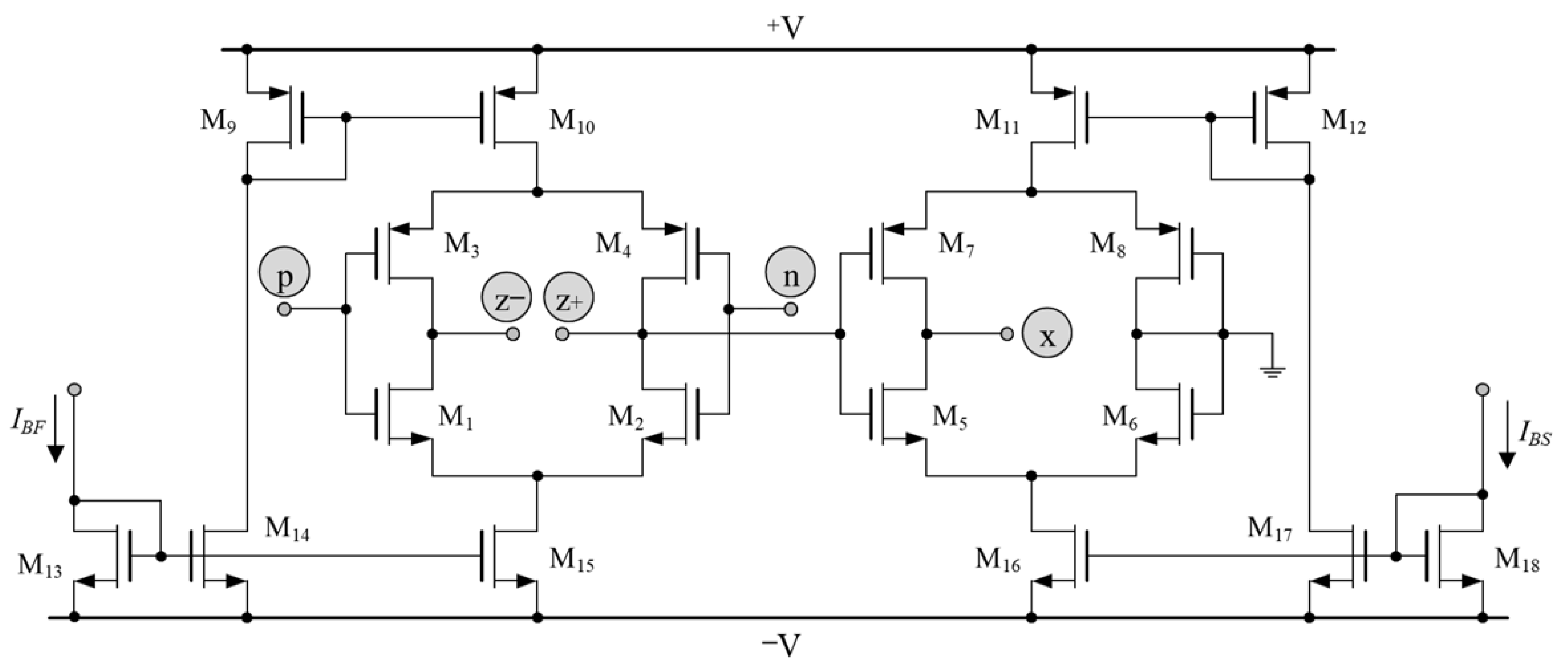
The VDTA is a versatile active building block consisting of two cascaded transconductance stages. Its symbolic representation and a CMOS implementation are shown in Figure 1 and Figure 2, respectively. The VDTA provides differential voltage processing at its input stage and transconductance-based current outputs (iz± and ix±) at its output stage. The ideal terminal characteristics of the VDTA are described by the following matrix equation [5,12]:
i z + i z i x = g m F g m F 0 g m F g m F 0 0 0 g m S v p v n v z + ,
where gmF and gmS denote the first- and second-stage transconductance gains, respectively. From (1), the VDTA operates in two successive stages. In the first stage, the differential input voltage (vpvn) is converted into output currents, iz+ and iz, with opposite polarities, through the transconductance gain gmF. In the second stage, the voltage at the terminal z+ (vz+) is transformed into the output current, ix, via the transconductance gain gmS. This structure enables flexible voltage-to-current conversion and current-mode signal processing.
For the CMOS implementation shown in Figure 2, the transconductance gains gmF and gmS can be expressed as [23]
g m F g 1 g 2 g 1 + g 2 + g 3 g 4 g 3 + g 4 ,
and
g m S g 5 g 6 g 5 + g 6 + g 7 g 8 g 7 + g 8 ,
where the parameter gi (i = 1, 2, …, 8) represents the intrinsic transconductance of the i-th MOS transistor, given by [24]
g i = I B i μ C o x W i L i .
Here, IBi is the bias current of the corresponding transistor, μ is the carrier mobility, Cox is the gate oxide capacitance per unit area, and Wi and Li are the channel width and length, respectively. These expressions indicate that the transconductance values gmF and gmS can be electronically adjusted through the bias currents. This electronic tunability makes the VDTA particularly suitable for analog signal processing applications requiring adaptive or controllable circuit parameters. Based on these advantageous properties, the VDTA is employed in this work as the sole active element to realize the proposed tunable mixed-mode inverse biquad filter circuit described in the following section.

3. Proposed VDTA-Based Mixed-Mode Inverse Filter

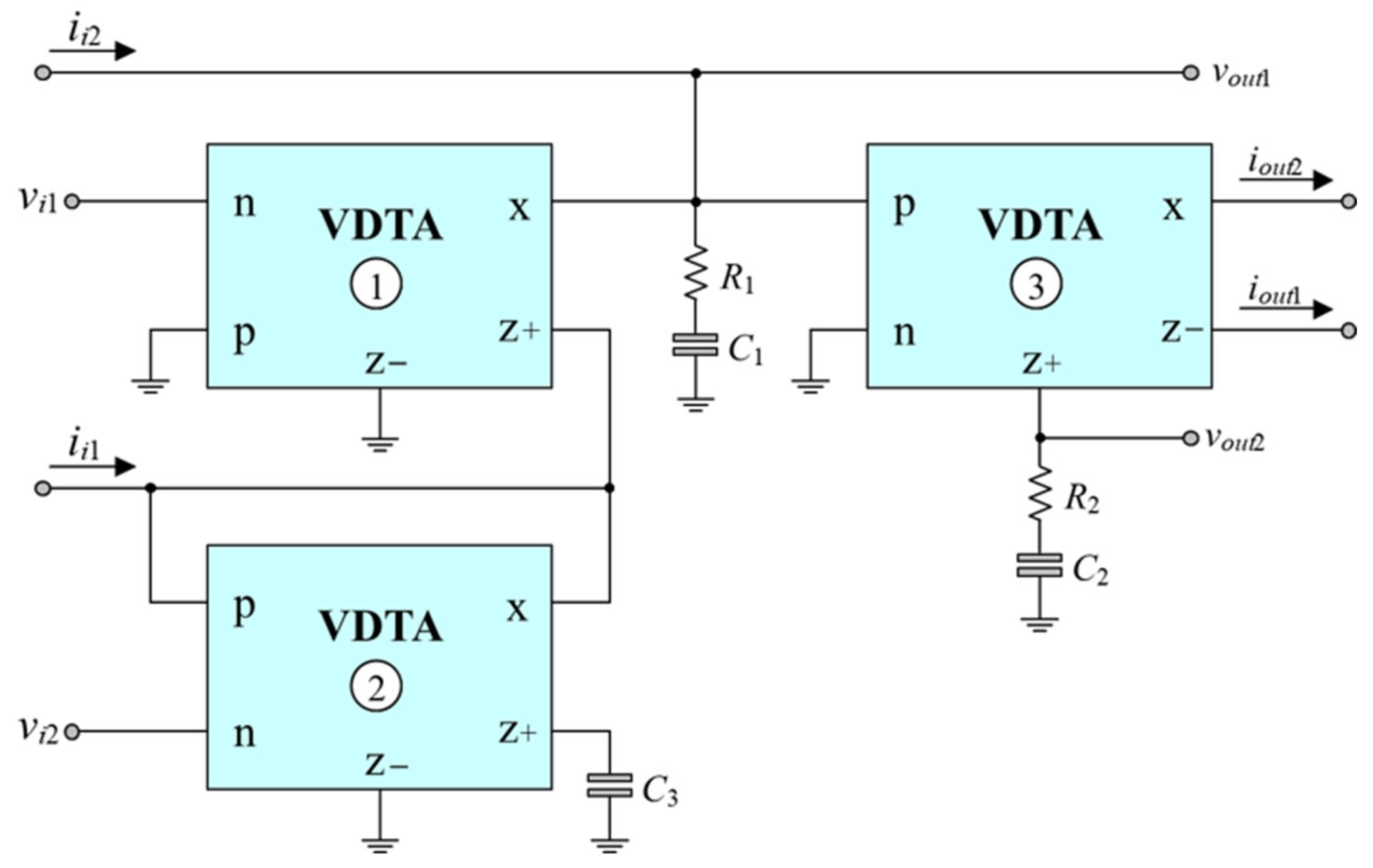
Figure 3 illustrates the proposed VDTA-based mixed-mode inverse filter employing two resistors and three capacitors. The circuit supports mixed-mode operation and enables realization of first-order inverse LP and HP and second-order inverse BP filtering responses. The proposed mixed-mode inverse filter includes several notable features: (i) it can operate in all four possible modes—VM, TAM, TIM, and CM—using a single circuit topology; (ii) it boasts high input impedance for VM and TAM, as well as high output impedance for TIM and CM operations; (iii) there is no need for matching active and passive components; and (iv) it offers built-in tunability of passband gain and pole frequency. Assuming ideal VDTA characteristics, the circuit behavior in each mode is described as follows.

3.1. Operation in VM and TAM

According to the configuration shown in Figure 3, both input currents are set to zero (ii1 = ii2 = 0), which enables the circuit to operate as a two-input four-output inverse filter. By selecting the appropriate input voltage (vin), it is possible to realize first-order LP and HP inverse filters, as well as a second-order BP inverse filter for VM and TAM operations.

3.1.1. VM Inverse Filter Realization

  • When the input voltage (vin) is set as vin = vi1 and vi2 = 0 (grounded), the first-order ILP filter is implemented with
V o u t 1 ( s ) V i n ( s ) = g m F 1 g m S 1 C 3 g m F 2 g m S 2 C 1 s R 1 C 1 + 1 .
  • When vin = vi2 and vi1 = 0, the first-order IHP filter is implemented with
V o u t 1 ( s ) V i n ( s ) = g m S 1 R 1 s R 1 C 1 + 1 s R 1 C 1 .
  • When vin = vi1 and vi2 = 0, the second-order IBP filter is implemented with
V o u t 2 ( s ) V i n ( s ) = H 0 N ( s ) s R 1 C 1 + R 2 C 2 ,
where the minimum gain (H0) and the numerical polynomial N(s) are
N ( s ) = s 2 R 1 R 2 C 1 C 2 + s R 1 C 1 + R 2 C 2 + 1 ,
and
H 0 = g m F 1 g m S 1 g m F 3 C 3 R 1 C 1 + R 2 C 2 g m F 2 g m S 2 C 1 C 2 .
Therefore, the proposed circuit effectively realizes the ILP and IHP sections as described by Equations (5) and (6), respectively, with a cutoff frequency defined as
ω c = 2 π f c = 1 R 1 C 1 .
Additionally, as evident from Equations (7) through (9) of the second-order IBP filter, the key characteristics of the filter, namely cutoff frequency (ωc) and quality factor (Q), are determined as follows:
ω c = 1 R 1 R 2 C 1 C 2 ,
and
Q = R 1 R 2 C 1 C 2 R 1 C 1 + R 2 C 2 .
Table 2 summarizes the selection of the input voltage and the corresponding performance parameters for the VM inverse filter implementation illustrated in Figure 3.

3.1.2. TAM Inverse Filter Realization

Using the same circuit topology, the first-order ILP and IHP filters, along with the second-order IBP filter in TAM operation, can be implemented by selecting the appropriate input voltage (vin), as indicated in Table 3.

3.2. Operation in TIM and CM

From the same circuit configuration with vi1 = vi2 = 0, we can derive the TIM and CM inverse filters with the following description.

3.2.1. TIM Inverse Filter Realization

In this design, when the appropriate input current signal (iin) is applied as detailed in Table 4, the proposed circuit in Figure 3 performs as a TIM filter. This configuration allows the circuit to derive first-order ILP and IHP and second-order IBP filter responses, all within the same topology.

3.2.2. CM Inverse Filter Realization

Furthermore, the circuit is capable of operating as a CM inverse filter by setting the current iin according to Table 5.

4. Non-Ideal Performance Analysis

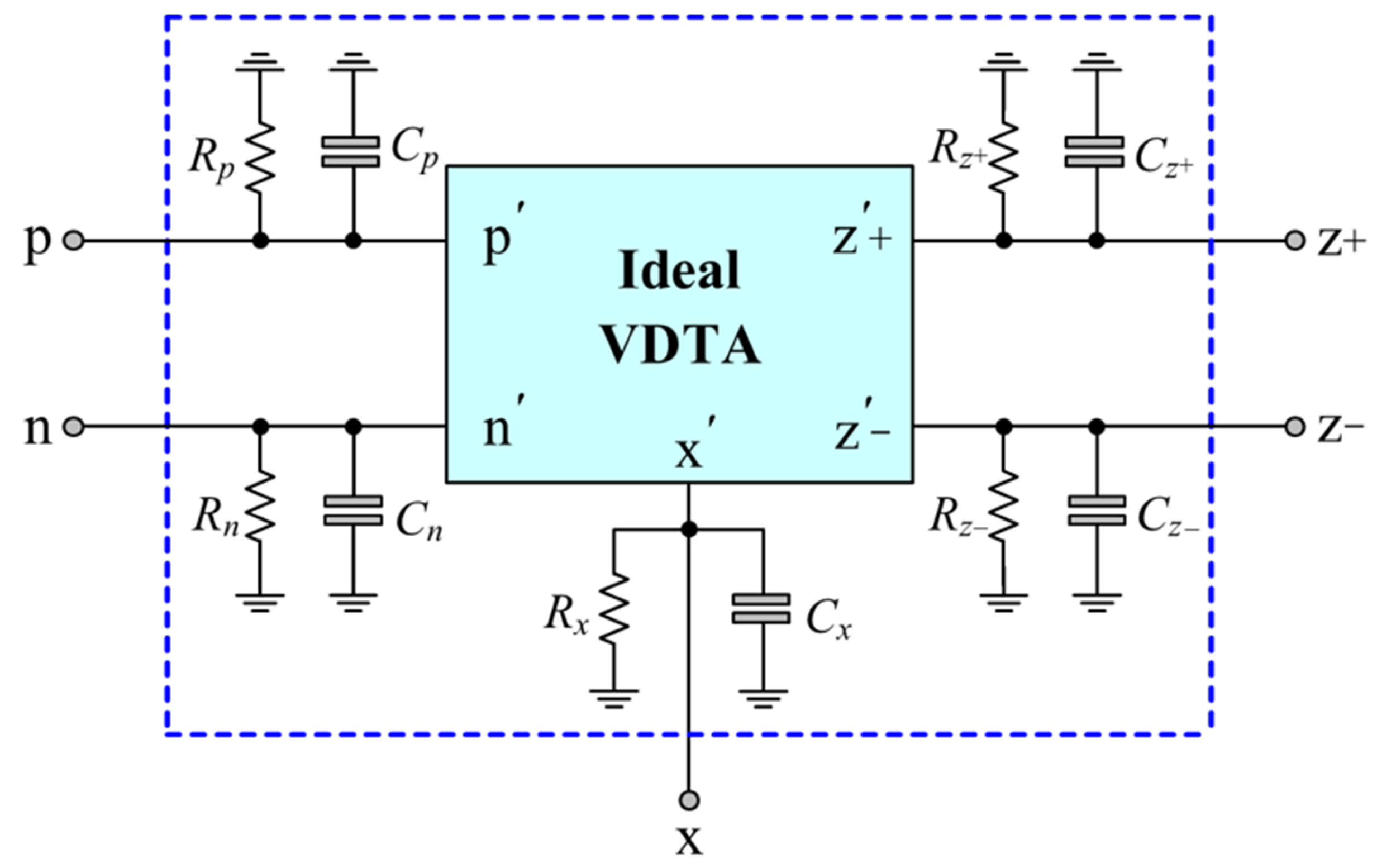
In practical implementations, the VDTA exhibits non-ideal parasitic impedances at its terminals, which may influence the performance of the proposed mixed-mode inverse filter shown in Figure 3. The complete non-ideal VDTA model including these parasitic elements is depicted in Figure 4, where Rp, Rn, Rz+, Rz-, and Rx, together with Cp, Cn, Cz+, Cz, and Cx, represent the parasitic resistances and capacitances at the respective terminals. Under ideal conditions, the parasitic impedances become negligible as Rp, Rn, Rz+, Rz-, and Rx approach infinity, while Cp, Cn, Cz+, Cz, and Cx approach zero.
In practice, these parasitic elements introduced extra dominant poles into the realized filter functions, thereby affecting the frequency responses of the proposed circuit. Considering the VDTA-based mixed-mode inverse filter in Figure 3, the effective impedances at terminals vout1 and vout2 are expressed as
Z 1 = s R 1 C 1 + 1 s 2 R 1 C 1 C A + s C 1 1 + R 1 R A + C A C 1 + 1 R A ,
and
Z 2 = s R 2 C 2 + 1 s 2 R 2 C 2 C z 3 + + s C 2 1 + R 2 R z 3 + + C z 3 + C 2 + 1 R z 3 + ,
where RA = (Rx1− // Rp3), CA = (Cx1− + Cp3). Here, Rx1−, Rp3, Rz3+, and Cx1−, Cp3, Cz3+ refer to parasitic resistances and capacitances associated with the corresponding terminal of the i-th VDTA (where i = 1, 2, 3). It is noted from the practical perspective that RA >> R1, C1 >> CA and C2 >> Cz3+. Consequently, Equations (13) and (14) can be approximated as follows:
Z 1 s R 1 C 1 + 1 s C 1 s R 1 C A + 1 + 1 R A ,
and
Z 2 = s R 2 C 2 + 1 s C 2 s R 2 C z 3 + + 1 + 1 R z 3 + .
Equation (15) indicates that two extra parasitic poles are introduced at low and high frequencies, as described below:
ω L 1 = 1 R p 3 / / R x 1 C 1   and   ω H 1 = 1 R 1 C p 3 + C x 1 .
Therefore, the useful frequency range is considerably constrained by these parasitic poles, i.e.,
ω L 1 < < ω < < ω H 1 .
Similarly, based on Equation (16), two additional poles resulting from parasitic effects are found at a specified location as
ω L 2 = 1 R z 3 + C 2   and   ω H 2 = 1 R 2 C z 3 + ,
and the frequency limitation of the circuit can also be defined, as shown in
ω L 2 < < ω < < ω H 2 .
Furthermore, considering parasitics, the equivalent impedance at terminals z+ of VDTA-1 and VDTA-2 can be computed as follows:
Z 3 = R B s R B C B + 1 ,
and
Z 4 = R z 2 + s R z 2 + C 3 + 1 .
where RB = (Rz1+ // Rp2 // Rx2−), CB = (Cz1+ + Cp2 + Cx2−). Additionally, there is also a performance limit at low frequencies due to extra unwanted poles arising from parasitic impedances of the VDTA:
ω L 3 = 1 R z 1 + / / R p 2 / / R x 2 C z 1 + + C p 2 + C x 2   and   ω L 4 = 1 R z 2 + C 3 .
Therefore, in this case, the proposed circuit can be utilized within the following frequency ranges:
ω > > ω L 3   and   ω > > ω L 4 .
Lastly, parasitics at terminals directly connected to inputs vi1 and vi2 do not have any effect.
As indicated by Equations (18), (20) and (24), it can be concluded that the overall operating frequency of the proposed mixed-mode inverse filter given in Figure 3 must be derived within the following region:
max ω L 1 , ω L 2 , ω L 3 , ω L 4 < < ω < < min ω H 1 , ω H 2

5. Functional Simulations and Performance Discussions

The theoretical analysis and practical feasibility of the proposed VDTA-based mixed-mode inverse filter in Figure 3 were verified through extensive numerical simulations. These simulations utilized a CMOS implementation of the VDTA presented in Figure 2 and aim to evaluate the expected frequency characteristics, tuning capabilities, and overall filtering performance utilizing practical device parameters. In simulations, the PSPICE program was employed using TSMC 0.18 μm CMOS process parameters. Table 6 lists the effective width (W) and length (L) of the CMOS transistors in Figure 2. The circuits operated under symmetrical supply voltages of ±0.9 V.
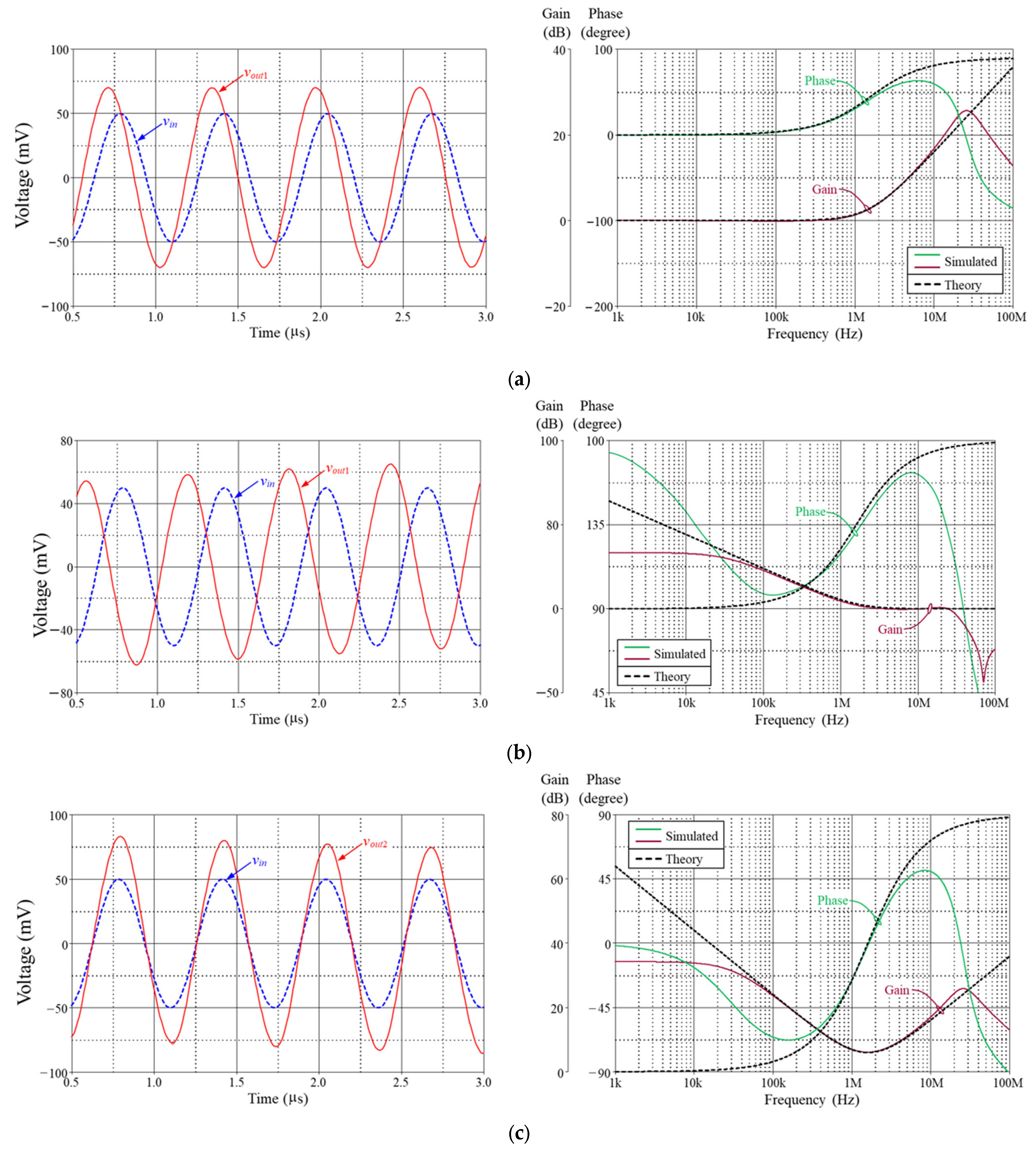
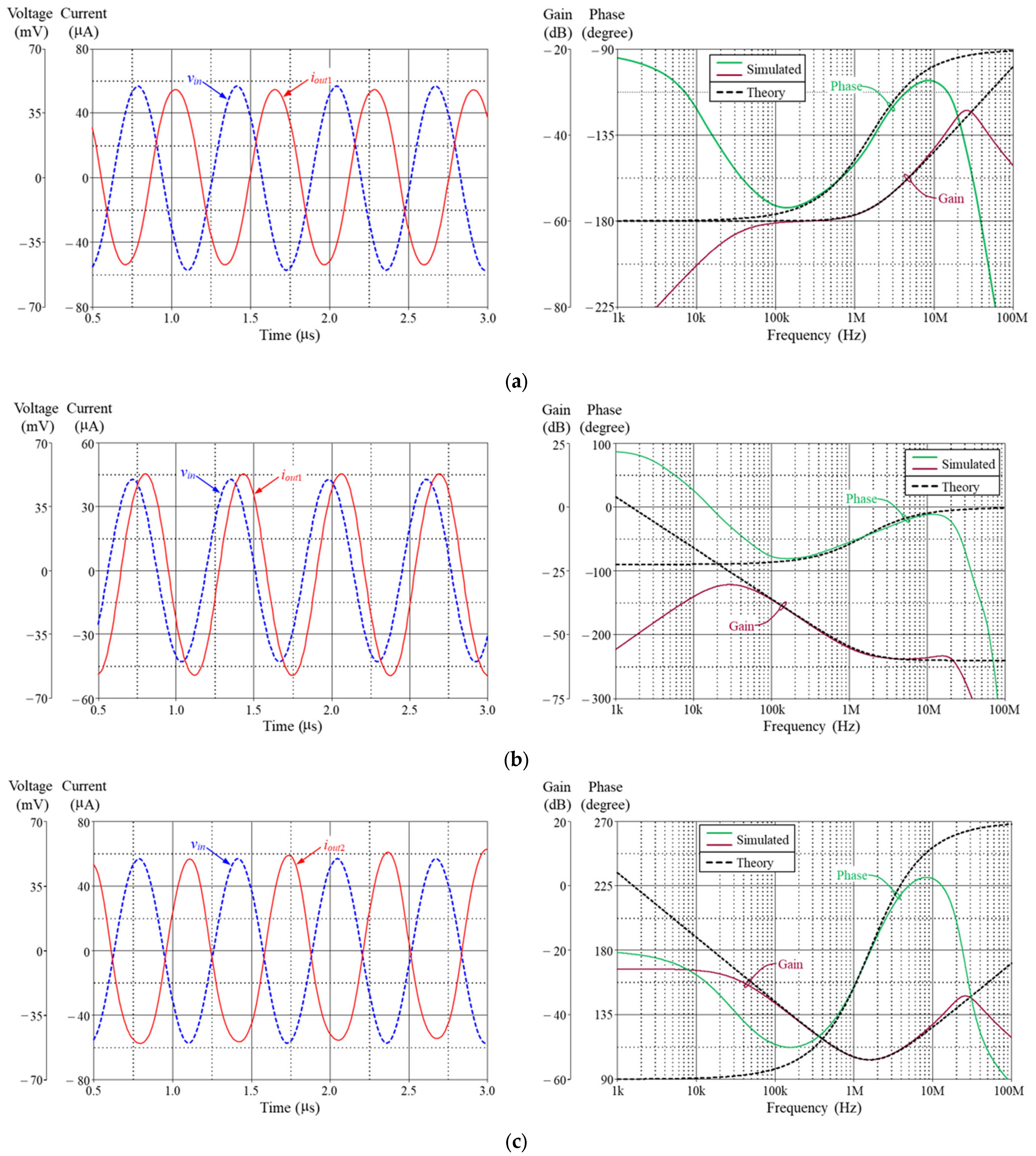
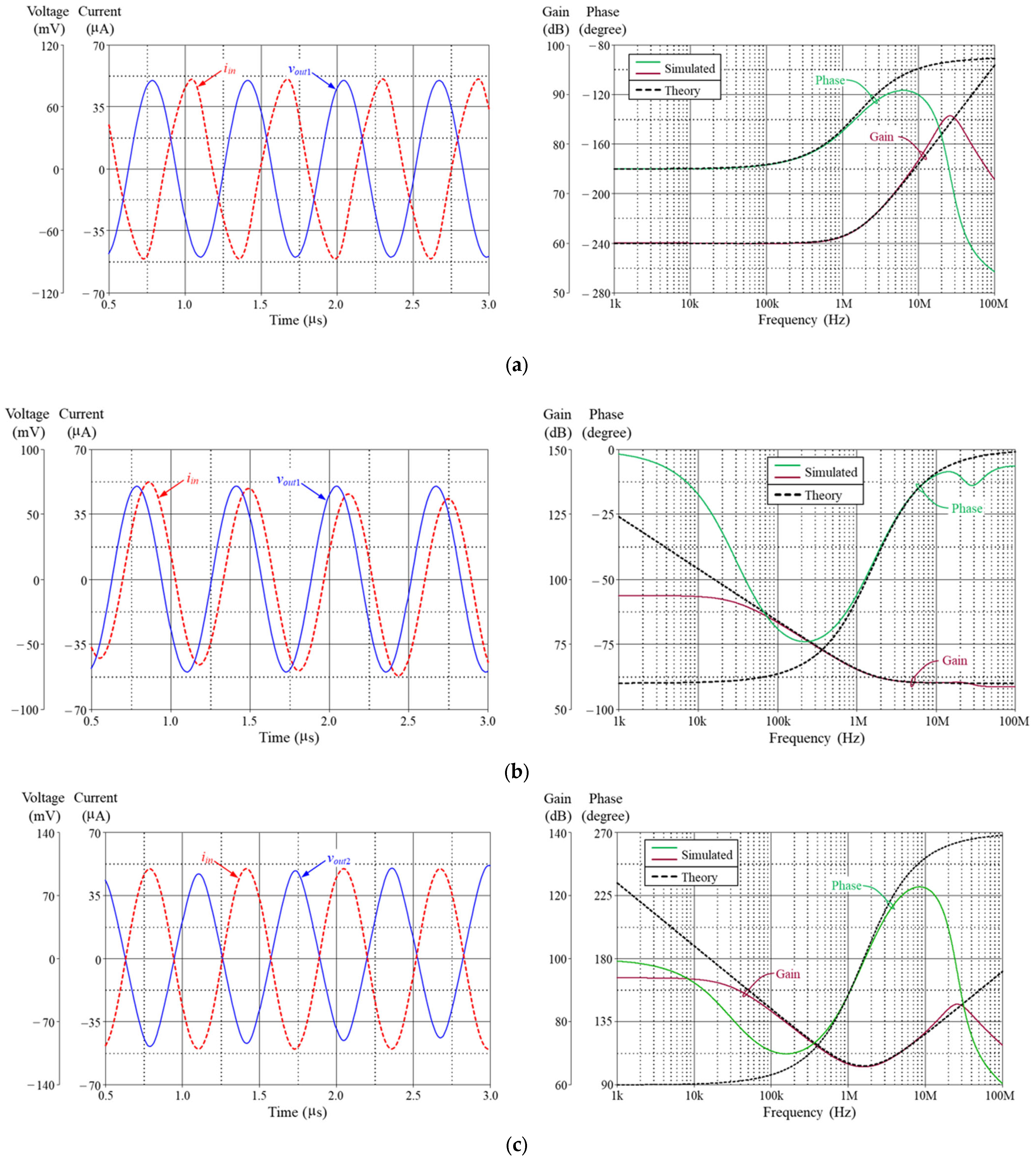
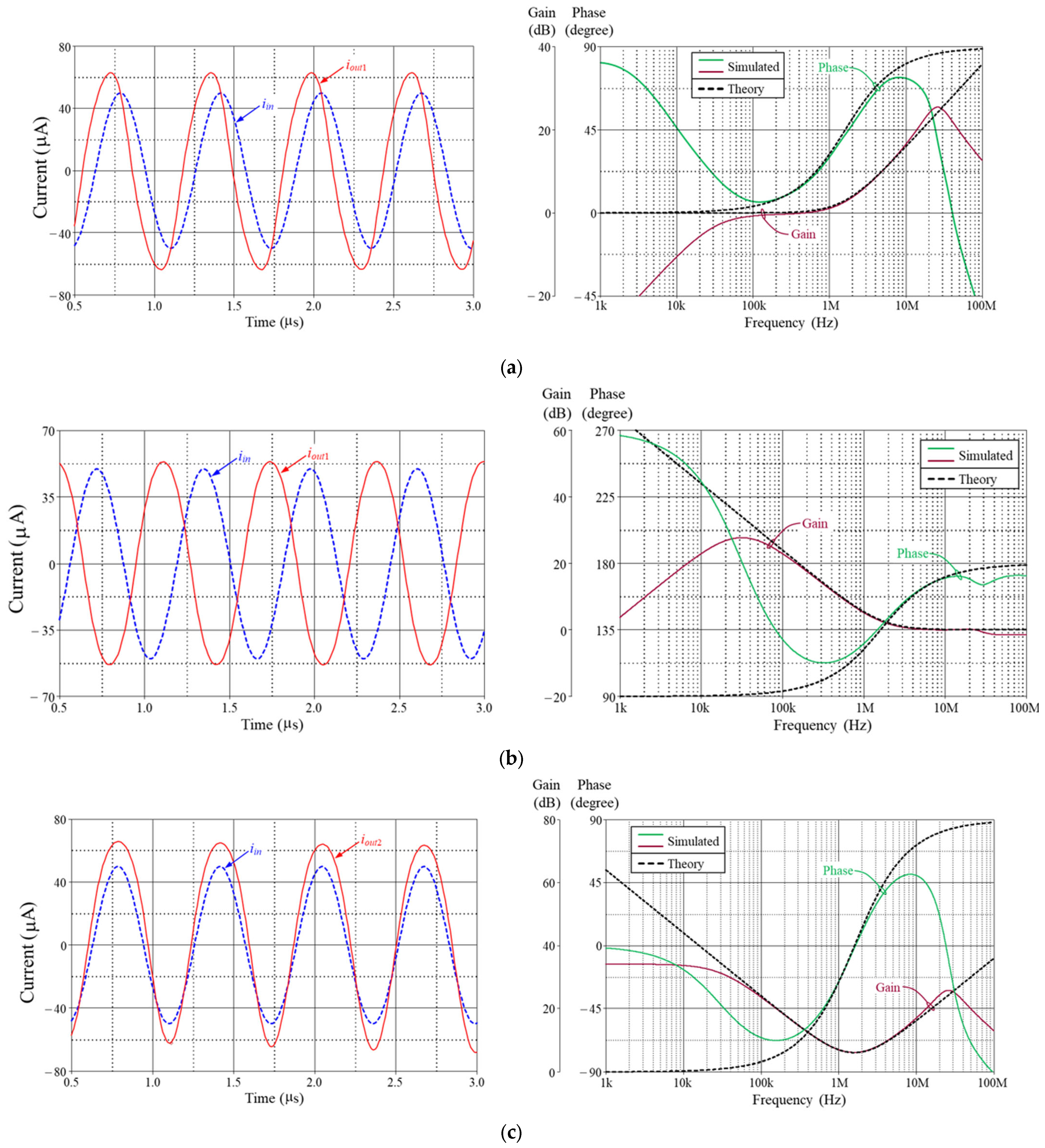
For all simulations, identical active and passive components were used: gmFj = gmSj (j = 1, 2, 3) = 1 mA/V (IBFj = IBSj = 90 μA), R1 = R2 = 1 kΩ and C1 = C2 = C3 = 100 pF. This yields the theoretical cutoff frequency of fc = ωc/2π = 1.59 MHz. The simulated transient and frequency responses of the VM, TAM, TIM, and CM inverse filters are shown in Figure 5, Figure 6, Figure 7 and Figure 8, accompanied by their corresponding theoretical characteristics. The filter was tested with input signal peak amplitudes of 50 mV for VM and TAM operations and 50 μA for TIM and CM, all at the nominal frequency of 1.59 MHz. The total power consumption was measured at 0.972 mW.
For the VM inverse filter, the first-order ILP and IHP responses, along with the second-order IBP response, exhibited the simulated fc of 1.78 MHz, 1.73 MHz, and 1.66 MHz, respectively. In comparison, the first-order ILP and IHP responses and the second-order IBP response for the TAM filter yielded an fc of 1.73 MHz, 1.64 MHz, and 1.64 MHz, respectively. Similarly, during TIM operation, the first-order ILP and IHP and second-order IBP filters produced fc values of 1.75 MHz, 1.53 MHz, and 1.58 MHz. For the CM inverse filter, the simulated fc values for ILP, IHP, and IBP were 1.71 MHz, 1.47 MHz, and 1.66 MHz. These results demonstrate a close alignment between simulated and theoretical values, thereby validating the accuracy of the proposed filter structures.
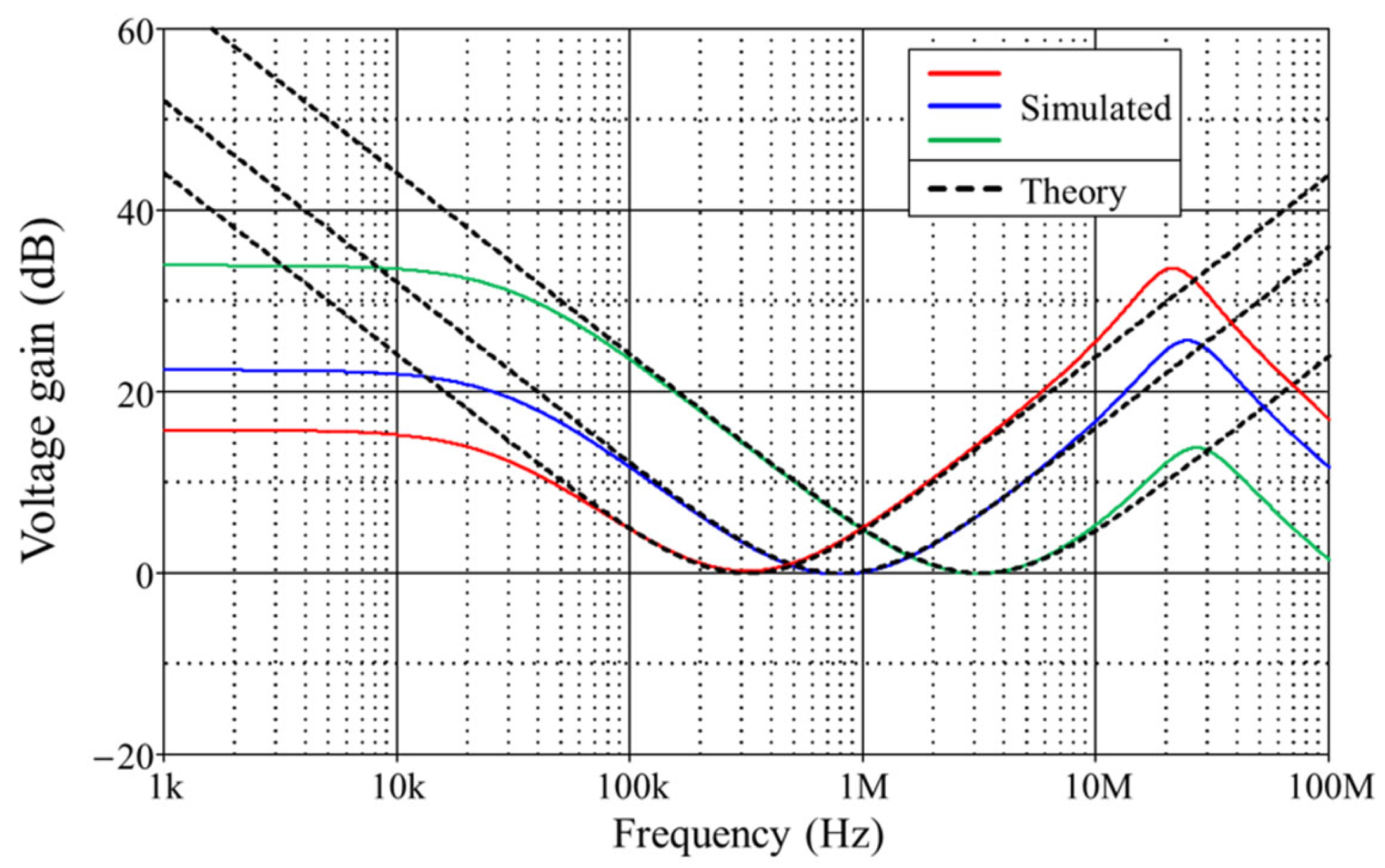
To verify the tunability of the fc value, the VM inverse BP filter was simulated while maintaining a constant quality factor (Q = 0.5). The component values were set as C1 = C2 = C3 = 100 pF, with R1 = R2 = 0.5 kΩ, 2 kΩ, and 5 kΩ. The corresponding calculated fc values were 3.18 MHz, 795.77 kHz, and 318.31 kHz, respectively. The ideal and simulated gain–frequency responses are shown in Figure 9, where the simulated fc values were recorded as 3.18 MHz, 794.33 kHz, and 316.23 kHz, respectively. It is noteworthy that the fc can be tuned independently without affecting the Q factor, demonstrating the orthogonal tuning capability of the proposed filter.
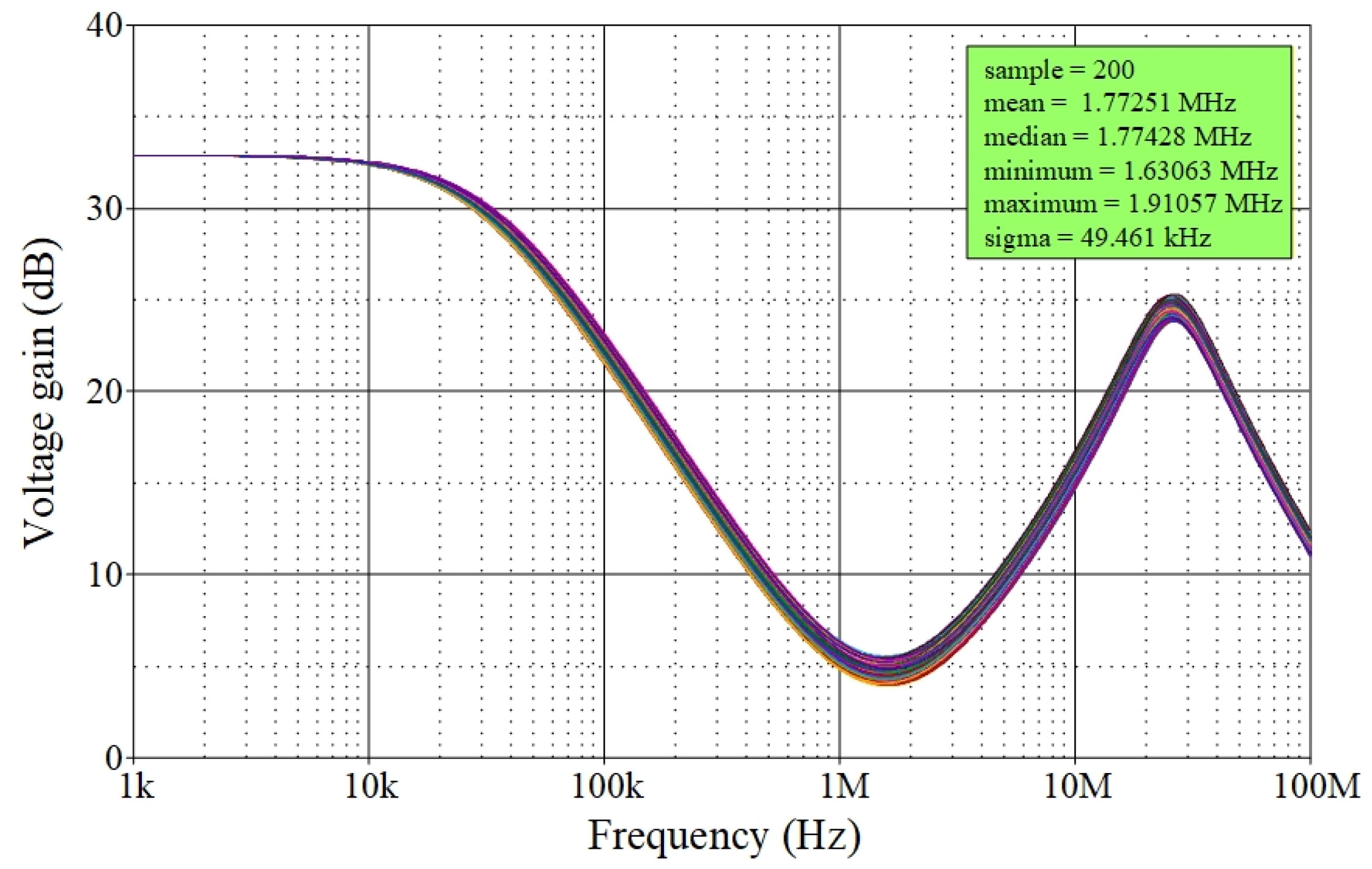
Monte Carlo (MC) statistical analysis was conducted on the VM IBP filter at the fc of 1.59 MHz by incorporating nominal 5% Gaussian deviations in the values of resistors and capacitors. Figure 10 presents the simulation results from the MC statistical analysis, which utilized a Gaussian distribution over 200 runs. The mean and standard deviation of the fc resulting from the variations in resistor and capacitor tolerances were determined to be 1.77251 MHz and 49.461 kHz, respectively, although these changes are not significant.
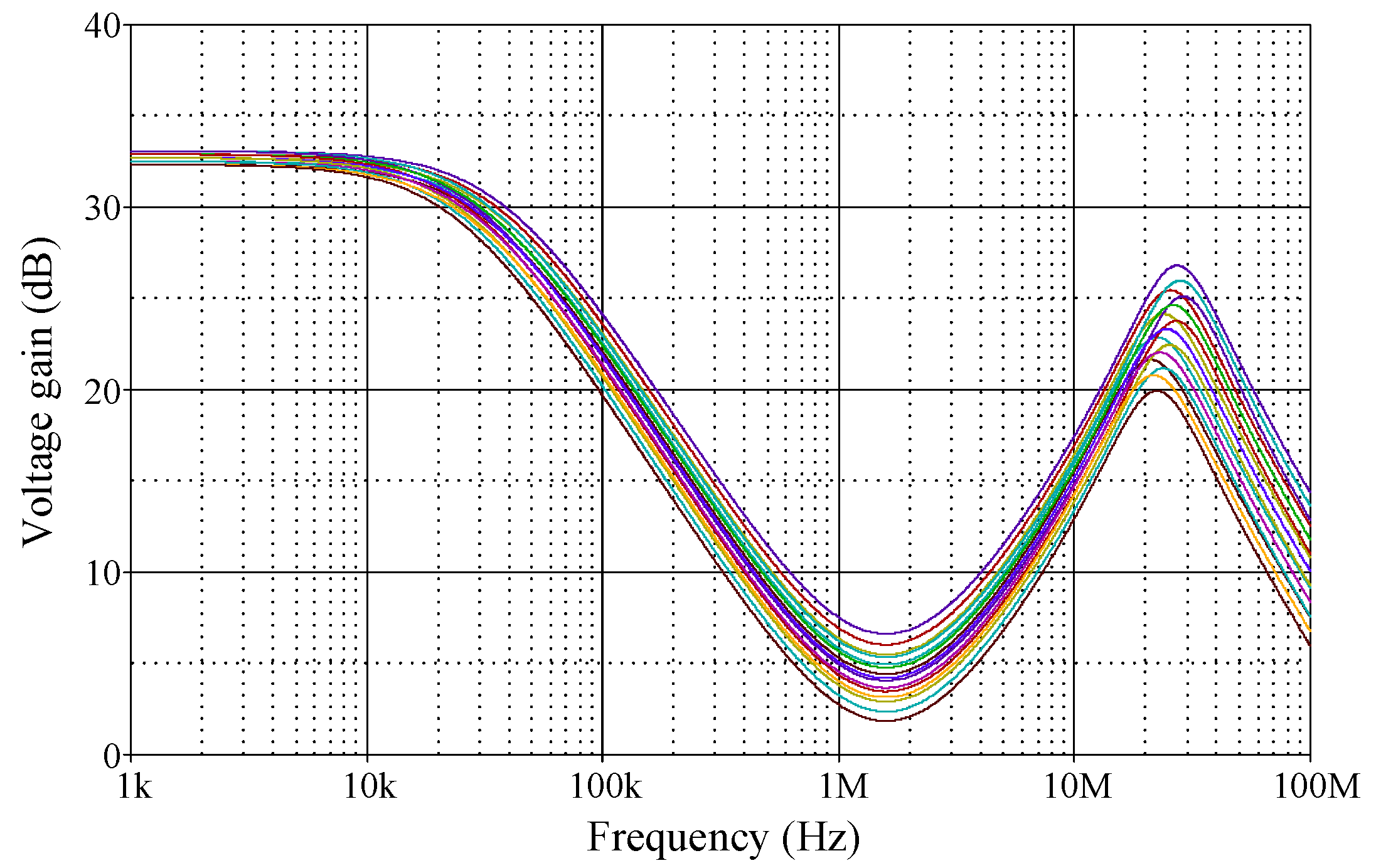
Furthermore, the proposed inverse filter topology in Figure 3 is analyzed to demonstrate its robustness under various process, voltage, and temperature (PVT) variations. The selected process corners include typical–typical, fast–fast, slow–slow, fast–slow, and slow–fast. The supply voltage corners were varied by ±10% from the nominal value. The temperature corners were set at 0 °C and 100 °C. Figure 11 shows the simulation results for the VM IBP filter response under PVT variations. The voltage gain is observed to increase with rising the supply voltage. Conversely, as the temperature increases, the operating current of the transistor decreases, resulting in a reduction in voltage gain. Consequently, power dissipation decreases up to a certain temperature threshold. In both cases, the response of the proposed circuit is influenced by variations in temperature and voltage, as it depends on the transistor current.
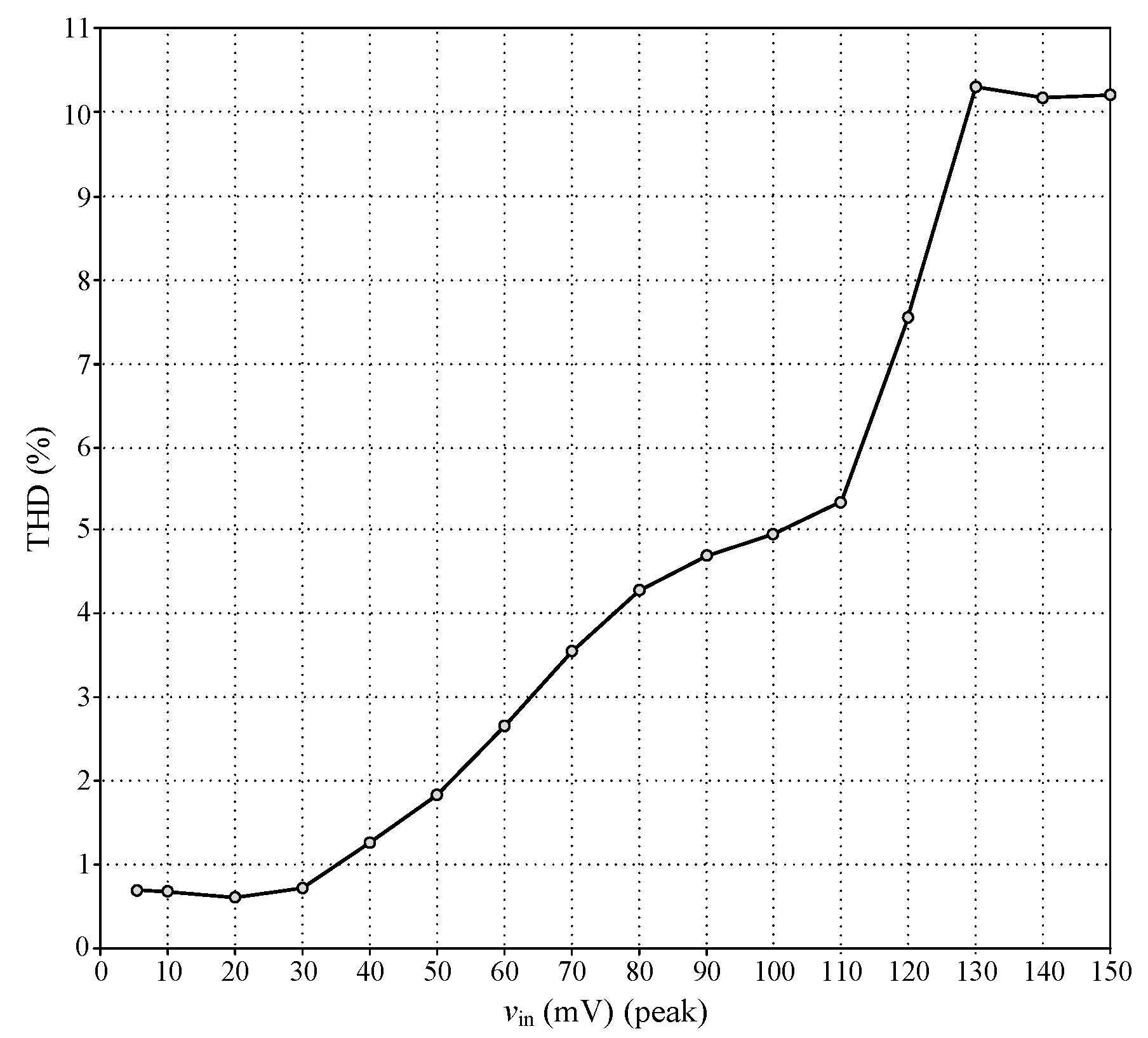
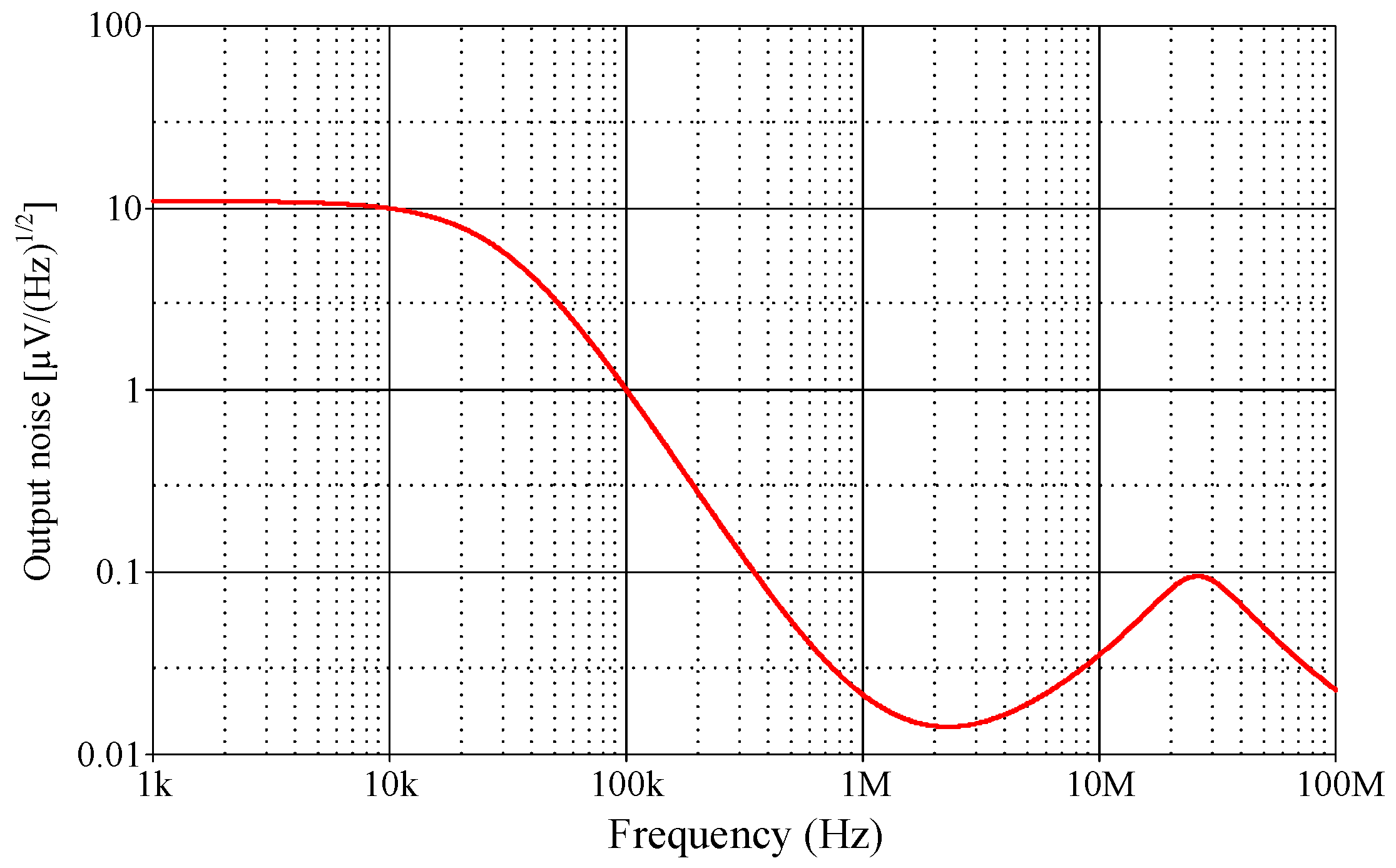
To evaluate the linearity and the input dynamic range of the proposed inverse filter, a sinusoidal signal at a frequency of 1.59 MHz with varying amplitude is applied to the input. Figure 12 depicts the total harmonic distortion (THD) of the VM IBP output signal relative to the amplitude of the input signal. The analysis shows that the THD value increases steadily with the input voltage. For input signals below 100 mV (peak), the THD values remain below 5%, indicating the practical viability of the proposed circuit. Figure 13 shows the equivalent output-referred noise analysis of the VM IBP filter, which indicates a minimal noise output of approximately 10 μV within the 1 kHz to 10 kHz frequency band.

6. Application to Mixed-Mode PID Controller Implementation

Proportional–integral–derivative (PID) controllers are widely used in various industrial process systems. It is estimated that over 90% of all control loops utilize PID controllers [25]. The proposed VDTA-based mixed-mode inverse filter shown in Figure 3 effectively implements the PID controller, which is capable of functioning in all possible four modes. Therefore, this section outlines the approach for implementing the mixed-mode PID controller employing the proposed circuit.

6.1. PID Controller Implementation for VM and TAM Operations

From Figure 3, when vi2 = 0, the voltage transfer function of a PID controller can be written as
G C V ( s ) = V o u t 2 ( s ) V i 1 ( s ) = g m F 1 g m S 1 g m F 3 C 3 R 1 C 1 + R 2 C 2 g m F 2 g m S 2 C 1 C 2 1 + 1 s R 1 C 1 + R 2 C 2 + s R 1 R 2 C 1 C 2 R 1 C 1 + R 2 C 2 = K P V + K I V s + K D V s ,
where KPV, KIV, and KDV are the proportional, integral, and derivative coefficients in VM, respectively. Then, the corresponding controller coefficients in this case are given by
K P V = g m F 1 g m S 1 g m F 3 C 3 R 1 C 1 + R 2 C 2 g m F 2 g m S 2 C 1 C 2 ,
K I V = g m F 1 g m S 1 g m F 3 C 3 g m F 2 g m S 2 C 1 C 2 ,
and
K D V = g m F 1 g m S 1 g m F 3 R 1 R 2 C 3 g m F 2 g m S 2 .
In a similar manner, the general form of the transfer function for the PID controller operating in TAM is presented as follows:
G C Y ( s ) = I o u t 2 ( s ) V i 1 ( s ) = K P Y + K I Y s + K D Y s ,
where the PID constants KPI, KII, and KDI can be determined as
K P Y = g m F 1 g m S 1 g m F 3 g m S 3 C 3 R 1 C 1 + R 2 C 2 g m F 2 g m S 2 C 1 C 2 ,
K I Y = g m F 1 g m S 1 g m F 3 g m S 3 C 3 g m F 2 g m S 2 C 1 C 2 ,
and
K D Y = g m F 1 g m S 1 g m F 3 g m S 3 R 1 R 2 C 3 g m F 2 g m S 2 .

6.2. PID Controller Implementation for TIM and CM Operations

In a TIM PID controller, connecting ii2 = 0 in the configuration of Figure 3 yields the following TIM transfer function:
G C Z ( s ) = V o u t 2 ( s ) I i 1 ( s ) = K P Z + K I Z s + K D Z s ,
In this expression, the PID controller parameters are found to be
K P Z = g m S 1 g m F 3 C 3 R 1 C 1 + R 2 C 2 g m F 2 g m S 2 C 1 C 2 ,
K I Z = g m S 1 g m F 3 C 3 g m F 2 g m S 2 C 1 C 2 ,
and
K D Z = g m S 1 g m F 3 R 1 R 2 C 3 g m F 2 g m S 2 .
Furthermore, the general form of the CM PID controller can be written as
G C I ( s ) = I o u t 2 ( s ) I i 1 ( s ) = K P I + K I I s + K D I s ,
where
K P I = g m S 1 g m F 3 g m S 3 C 3 R 1 C 1 + R 2 C 2 g m F 2 g m S 2 C 1 C 2 ,
K I I = g m S 1 g m F 3 g m S 3 C 3 g m F 2 g m S 2 C 1 C 2 ,
and
K D I = g m S 1 g m F 3 g m S 3 R 1 R 2 C 3 g m F 2 g m S 2 .
It is important to note that the second subscripts V, Y, Z, and I for the PID controller coefficients denote the VM, TAM, TIM, and CM operations, respectively.
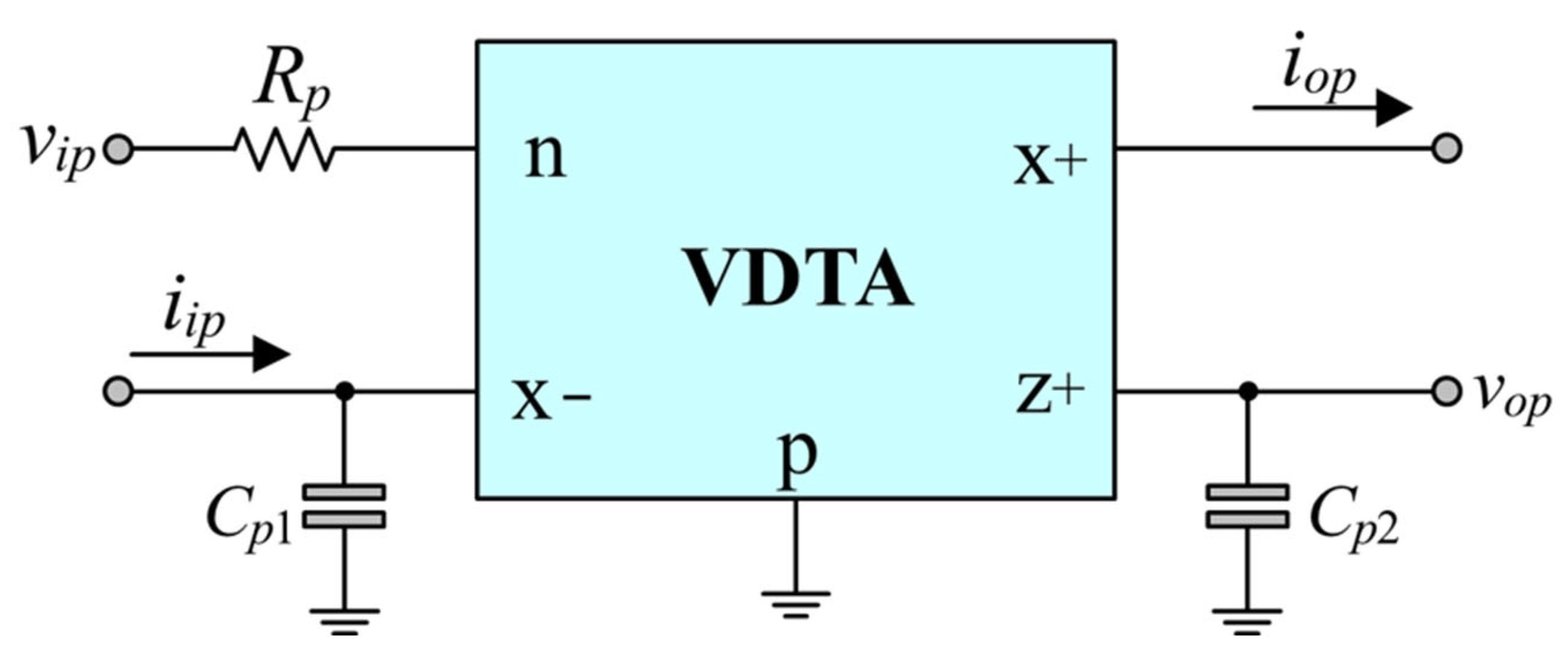
For the performance evaluation of the proposed PID controller described above, the mixed-mode second-order lowpass (LP) filter using a single VDTA shown in Figure 14 is suggested as a plant for implementing a closed-loop control system. The open-loop transfer function of a second-order plant in VM, TAM, TIM, and CM can be represented respectively as follows:
G P V ( s ) = V o p ( s ) V i p ( s ) = 1 g m S R p ω n 2 s 2 + 2 ξ ω n s + ω n 2 ,
G P Y ( s ) = I o p ( s ) V i p ( s ) = 1 R p ω n 2 s 2 + 2 ξ ω n s + ω n 2 ,
G P Z ( s ) = V o p ( s ) I i p ( s ) = 1 g m S ω n 2 s 2 + 2 ξ ω n s + ω n 2 ,
and
G P I ( s ) = I o p ( s ) I i p ( s ) = ω n 2 s 2 + 2 ξ ω n s + ω n 2 .
In these equations, the natural angular frequency (ωn) and the damping ratio (ξ) are defined as
ω n = g m F g m S C p 1 C p 2 ,
and
ξ = 1 2 R p C p 2 g m F g m S C p 1
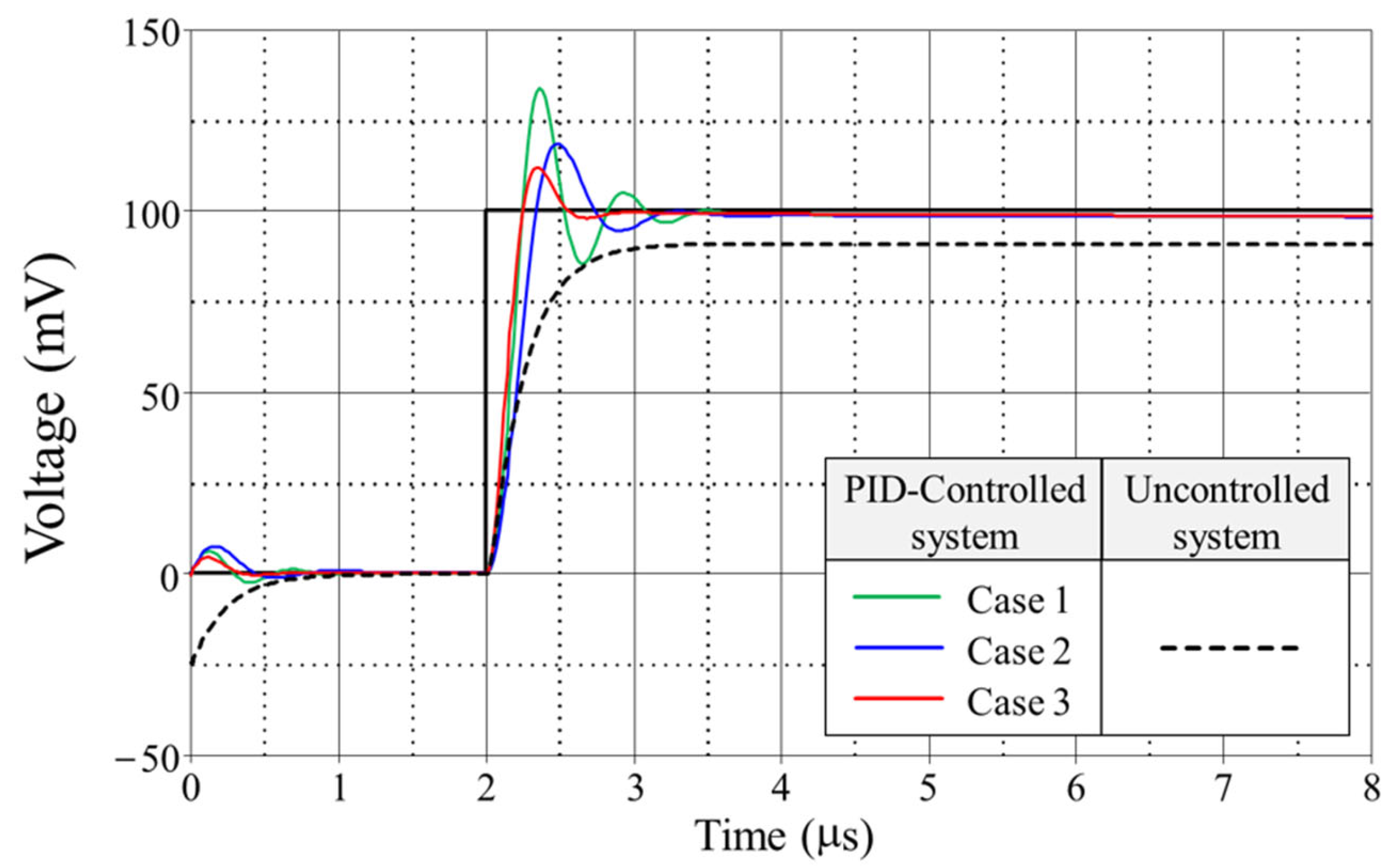
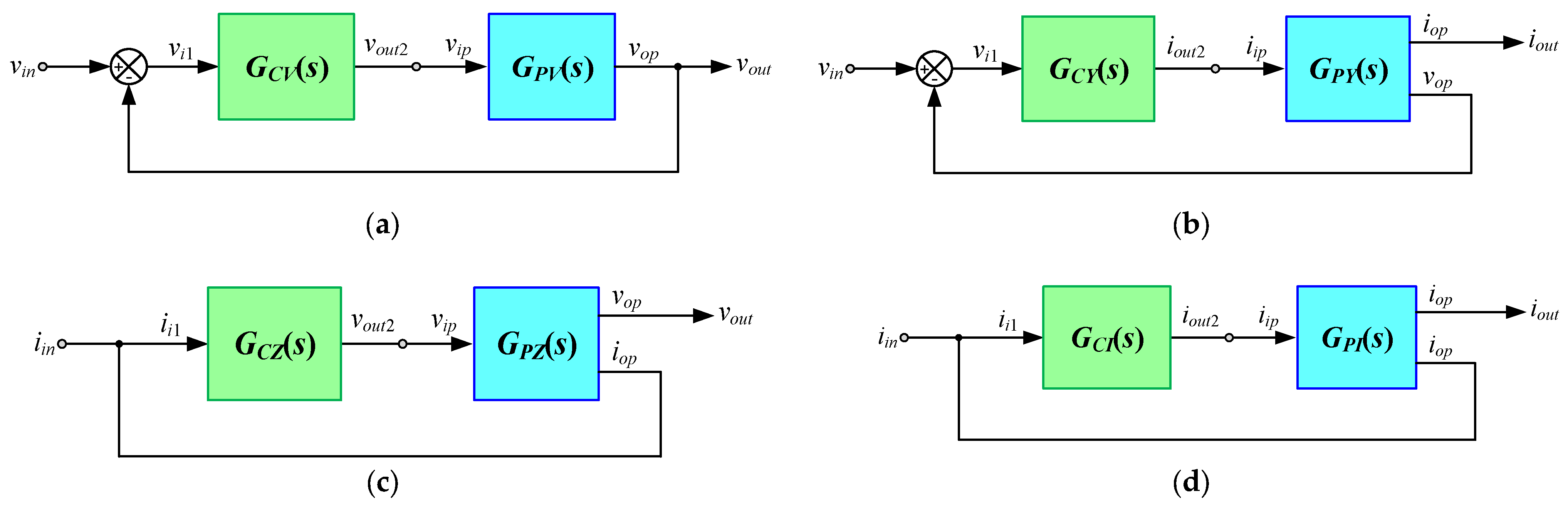
To evaluate the impact of various controllers, the performance of the closed-loop system is examined by establishing a unity-feedback system, as illustrated in Figure 15. The proposed PID controllers are utilized to improve the time-domain behavior of the second-order plant. Subsequently, the time-domain responses of both PID-controlled and uncontrolled systems are observed and compared. The component values for the second-order plant in Figure 14 are designed with gmF = gmS = 1 mA/V, Rp = 1 kΩ, and Cp1 = Cp2 = 100 pF, yielding fn = ωn/2π = 1.59 MHz and ξ = 0.5. For evaluation purposes, the PID controller parameters used to assess the step response behavior of the VM control systems are detailed in Table 7. Figure 16 displays the step responses of the PID-controlled system in Figure 15a under three different controller coefficient settings, compared to the response of the uncontrolled system. The characteristics obtained from the time responses for each case are summarized in Table 8.
It is observed from the results that the proposed PID controller improved the time response of the closed-loop control system, particularly td, tr, tp, and ts. The times tr and tp of the controlled system were approximately 30% faster than that of the uncontrolled system. It also had a steady-state error of less than 1.30 mV. Additionally, the controlled system entered the steady-state faster than the uncontrolled system and tracked the step input with a reduced steady-state error.

7. Comparison with Existing PID Controllers

To evaluate the effectiveness of the proposed PID controller shown in Figure 3, a comparative analysis with recently published PID controllers from 2024 to 2025 [26,27,28,29] is presented in Table 9. The comparison considers key performance metrics, including circuit complexity, transient response characteristics, implementation technology, and power consumption.
From Table 9, it is observed that the controller in [26] employs three CFOAs and six passive components, resulting in relatively high power consumption (348 mW) and moderate transient performance (e.g., tr = 6.88 μs, ts = 9.06 μs). In contrast, the work of [27] achieves low power consumption (6.8 mW) using only two CFOAs and four passive elements; however, its transient response is significantly slower, with very large peak and settling times (tp = 1030 μs, ts = 1130 μs), which limits its suitability for high-speed applications.
The design described in [28], based on VCII active elements, demonstrates excellent dynamic performance with very fast response (tr = 0.334 μs, ts = 2.05 μs) and minimal overshoot (0.55%). This improvement, on the other hand, comes with a high power consumption (235 mW) and is primarily limited to voltage mode. Similarly, the study in [29] reports extremely fast rise and settling times (tr = 0.0052 μs, ts = 0.18 μs) with zero overshoot, but it relies on a specialized DDCCTA device and does not report complete transient metrics (e.g., lacking peak time), which may restrict practical implementation and general applicability. In comparison, the proposed PID controller offers a well-balanced trade-off among performance, complexity, and power efficiency. It employs only three VDTAs and a small number of passive components (two resistors and three capacitors), maintaining a relatively simple structure suitable for integration. The transient response characteristics (tr = 2.244 μs, tp = 2.338 μs, and ts = 2.537 μs) indicate a significantly faster response compared to [26,27]. Additionally, its performance remains comparable to high-speed designs like [28], all while avoiding excessive power consumption.
Importantly, the proposed controller achieves very low power dissipation at 0.972 mW, which is substantially lower than all compared designs. This feature makes it highly suitable for low-power and portable applications. Although its overshoot (11.11%) is higher than that of some designs [28,29], it is still comparable to other practical implementations such as [26,27]. This comparison indicates that the proposed controller maintains acceptable stability performance in typical control scenarios.
Furthermore, unlike several prior works that are restricted to a single operation mode, the proposed controller supports multiple modes (VM, TAM, TIM, and CM). This characteristic enhances flexibility and wider applicability in mixed-mode signal processing systems.
In summary, the results in Table 9 confirm that the proposed PID controller achieves an advantageous compromise between speed, power consumption, and implementation simplicity. It outperforms many recent designs in terms of energy efficiency while also maintaining competitive transient response characteristics.

8. Conclusions

This paper has introduced a compact and versatile VDTA-based mixed-mode inverse filter that can realize multiple inverse filtering responses within a single topology. The proposed circuit utilizes only three VDTAs along with a minimal number of passive components, while supporting operations in VM, TAM, TIM, and CM. This design offers high design flexibility and integration suitability. It successfully provides first-order inverse LP and HP, as well as second-order inverse BP characteristics, with tunable pole frequency and gain. The impact of non-idealities, particularly parasitic impedances, has been analytically examined to establish realistic operating conditions. Simulation results based on a 0.18 μm CMOS process show good agreement with theoretical predictions, demonstrating accurate frequency responses, low power consumption, orthogonal tunability, and satisfactory temperature and process robustness. Furthermore, the applicability of the proposed filter has been validated through the implementation of mixed-mode PID controllers, where improved transient performance and reduced steady-state error were achieved. Owing to its simplicity, tunability, and multifunction capability, the proposed design is well suited for modern analog signal processing and control system applications.

Author Contributions

Conceptualization, N.R. and W.T.; methodology, N.R., T.P. and W.T.; validation, N.R., T.P., M.F. and W.T.; formal analysis, N.R., T.P., M.F. and W.T.; investigation, N.R., T.P. and W.T.; resources, N.R. and T.P.; data curation, N.R., T.P. and M.F.; writing—original draft preparation, N.R. and T.P.; writing—review and editing, T.P., M.F. and W.T.; visualization, N.R., T.P. and M.F.; supervision, T.P., M.F. and W.T.; project administration, M.F.; funding acquisition, T.P. All authors have read and agreed to the published version of the manuscript.

Funding

This work is supported by King Mongkut’s Institute of Technology Ladkrabang, grant number KREF046919.

Data Availability Statement

The original contributions presented in the study are included in the article; further inquiries can be directed to the corresponding author.

Acknowledgments

The authors are grateful for the support and resources provided by the School of Engineering, King Mongkut’s Institute of Technology Ladkrabang (KMITL), which contributed to the successful completion of this work.

Conflicts of Interest

The authors declare no conflicts of interest.

References

  1. Patil, V.; Sharma, R.K. Novel inverse active filters employing CFOAs. Int. J. Sci. Res. Dev. 2015, 3, 359–360. [Google Scholar]
  2. Sharma, A.; Kumar, A.; Whig, P. On the performance of CDTA based novel analog inverse low pass filter using 0.35 μm CMOS parameter. Int. J. Sci. Technol. Manag. 2015, 4, 594–601. [Google Scholar]
  3. Tsukutani, T.; Kunugasa, Y.; Yabuki, N. CCII-based inverse active filters with grounded passive components. J. Electr. Eng. 2018, 6, 212–215. [Google Scholar] [CrossRef]
  4. Singh, A.K.; Gupta, A.; Senani, R. OTRA-based multi-function inverse filter configuration. Adv. Electr. Electron. Eng. 2017, 15, 846–856. [Google Scholar] [CrossRef]
  5. Kumar, P.; Pandey, N.; Paul, S.K. Realization of resistorless and electronically tunable inverse filters using VDTA. J. Circuits Syst. Comput. 2019, 28, 1950143. [Google Scholar] [CrossRef]
  6. Pradhan, A.; Sharma, R.K. Generation of OTRA-based inverse all pass and inverse band reject filters. Proc. Natl. Acad. Sci. India Sect. A Phys. Sci. 2020, 90, 481–491. [Google Scholar] [CrossRef]
  7. Bhagat, R.; Bhaskar, D.R.; Kumar, P. Inverse band reject and all pass filter structure employing CMOS CDBAs. Int. J. Eng. Res. Technol. 2019, 8, 39–44. [Google Scholar]
  8. Bhagat, R.; Bhaskar, D.R.; Kumar, P. Multifunction filter/inverse filter configuration employing CMOS CDBAs. Int. J. Recent Technol. Eng. 2019, 8, 8844–8853. [Google Scholar] [CrossRef]
  9. Kamat, D.V. New operational amplifier based inverse filters. In Proceedings of the Third International Conference on Electronics, Communication and Aerospace Technology, Coimbatore, India, 12–14 June 2019; pp. 1177–1181. [Google Scholar]
  10. Banerjee, S.; Borah, S.S.; Ghosh, M.; Mondal, P. Three novel configurations of second order inverse band reject filter using a single operational transresistance amplifier. In Proceedings of the 2019 IEEE Region 10 Conference (TENCON 2019), Kerala, India, 17–20 October 2019; pp. 2173–2178. [Google Scholar]
  11. Borah, S.S.; Singh, A.; Ghosh, M. CMOS CDBA based 6th order inverse filter realization for low-power applications. In Proceedings of the 2020 IEEE Region 10 Conference (TENCON 2020), Osaka, Japan, 16–19 November 2020; pp. 11–16. [Google Scholar]
  12. Kumar, P.; Pandey, N.; Paul, S.K. Electronically tunable VDTA-based multi-function inverse filter. Iran. J. Sci. Technol. Trans. Electr. Eng. 2021, 45, 247–257. [Google Scholar] [CrossRef]
  13. Raj, A.; Bhagat, R.; Kumar, P.; Bhaskar, D.R. Grounded-capacitor analog inverse active filters using CMOS OTAs. In Proceedings of the 2021 8th International Conference Signal Processing Integrated Networks (SPIN), Noida, India, 26–27 August 2021; pp. 778–783. [Google Scholar]
  14. Paul, T.K.; Roy, S.; Pal, R.R. Realization of inverse active filters using single current differencing buffered amplifier. J. Sci. Res. 2021, 13, 85–99. [Google Scholar] [CrossRef]
  15. Al-Absi, M.A. Realization of inverse filters using second generation voltage conveyor (VCII). Analog. Integr. Circuits Signal Process. 2021, 109, 29–32. [Google Scholar] [CrossRef]
  16. Al-Shahrani, S.M.; Al-Absi, M.A. Efficient inverse filters based on second-generation voltage conveyor (VCII). Arab. J. Sci. Eng. 2022, 47, 2685–2690. [Google Scholar] [CrossRef]
  17. Nako, J.; Psychalinos, C.; Minaei, S. Single-input multiple-output inverse filter designs with cascade capability. Int. J. Electron. Commun. (AEÜ) 2024, 175, 155061. [Google Scholar] [CrossRef]
  18. Roongmuanpha, N.; Likhitkitwoerakul, N.; Pukkalanun, T.; Faseehuddin, M.; Tangsrirat, W. Cascadable first-order and second-order inverse filters based on second-generation voltage conveyors. Appl. Sci. 2025, 15, 1916. [Google Scholar] [CrossRef]
  19. Kaharwar, K.; Bhagat, R.; Kumar, P.; Bhaskar, D.R. Single CMOS VCII based inverse filter configuration. In Proceedings of the 2023 International Conference on Modeling, Simulation & Intelligent Computing (MoSICom), Dubai, United Arab Emirates, 7–9 December 2023; pp. 548–553. [Google Scholar]
  20. Yadav, V.; Bhaskar, D.R.; Bhagat, R. Single OTRA based inverse filter configuration. In Proceedings of the 2024 International Conference on Computer, Electronics, Electrical Engineering & their Applications (IC2E3), Uttarakhand, India, 6–7 June 2024; pp. 1–6. [Google Scholar]
  21. Minayi, E. Realization of first- and second-order voltage mode inverse active filters with cascade capability. In Proceedings of the 2025 16th International Conference on Electrical and Electronics Engineering (ELECO), Bursa, Türkiye, 27–29 November 2025; pp. 1–5. [Google Scholar]
  22. Shekhar, C.; Pandey, N.; Jain, P. Inverse active filter based on DDCC and its application as tunable inverse filter. Int. J. Electron. Commun. (AEÜ) 2026, 204, 156098. [Google Scholar] [CrossRef]
  23. Arbel, A.F.; Goldminz, L. Output stage for current-mode feedback amplifiers, theory and applications. Analog. Integr. Circuits Signal Process. 1992, 2, 243–255. [Google Scholar] [CrossRef]
  24. Srivastava, M.; Bhardwaj, K.; Prasad, D.; Singh, R.; Tangsrirat, W. New single VDCC based electronically adjustable FDNR using grounded capacitances. Indian J. Pure Appl. Phys. 2022, 60, 650–661. [Google Scholar] [CrossRef]
  25. Åström, K.J.; Hägglund, T. The future of PID control. Control Eng. Pract. 2001, 9, 1163–1175. [Google Scholar] [CrossRef]
  26. Roongmuanpha, N.; Satansup, J.; Pukkalanun, T.; Tangsrirat, W. Design of mixed-mode analog PID controller with CFOAs. Sensors 2024, 24, 3125. [Google Scholar] [CrossRef]
  27. Yurdem, B.; Sagbas, M.; Ayten, U.E. Current-mode PID controllers employing commercially available active components. Int. J. Electron. Commun. (AEÜ) 2024, 175, 155104. [Google Scholar] [CrossRef]
  28. Özer, E.; Kaçar, F. Current-mode PID controller using second-generation voltage conveyor (VCII). J. Circuits Syst. Comput. 2025, 31, 2250295. [Google Scholar] [CrossRef]
  29. Kumari, S.; Nand, D.; Kant, S. Realization of TAM-based PD, PI, PID controllers utilizing DDCCTA for closed-loop system applications. Frankl. Open 2025, 12, 100380. [Google Scholar] [CrossRef]
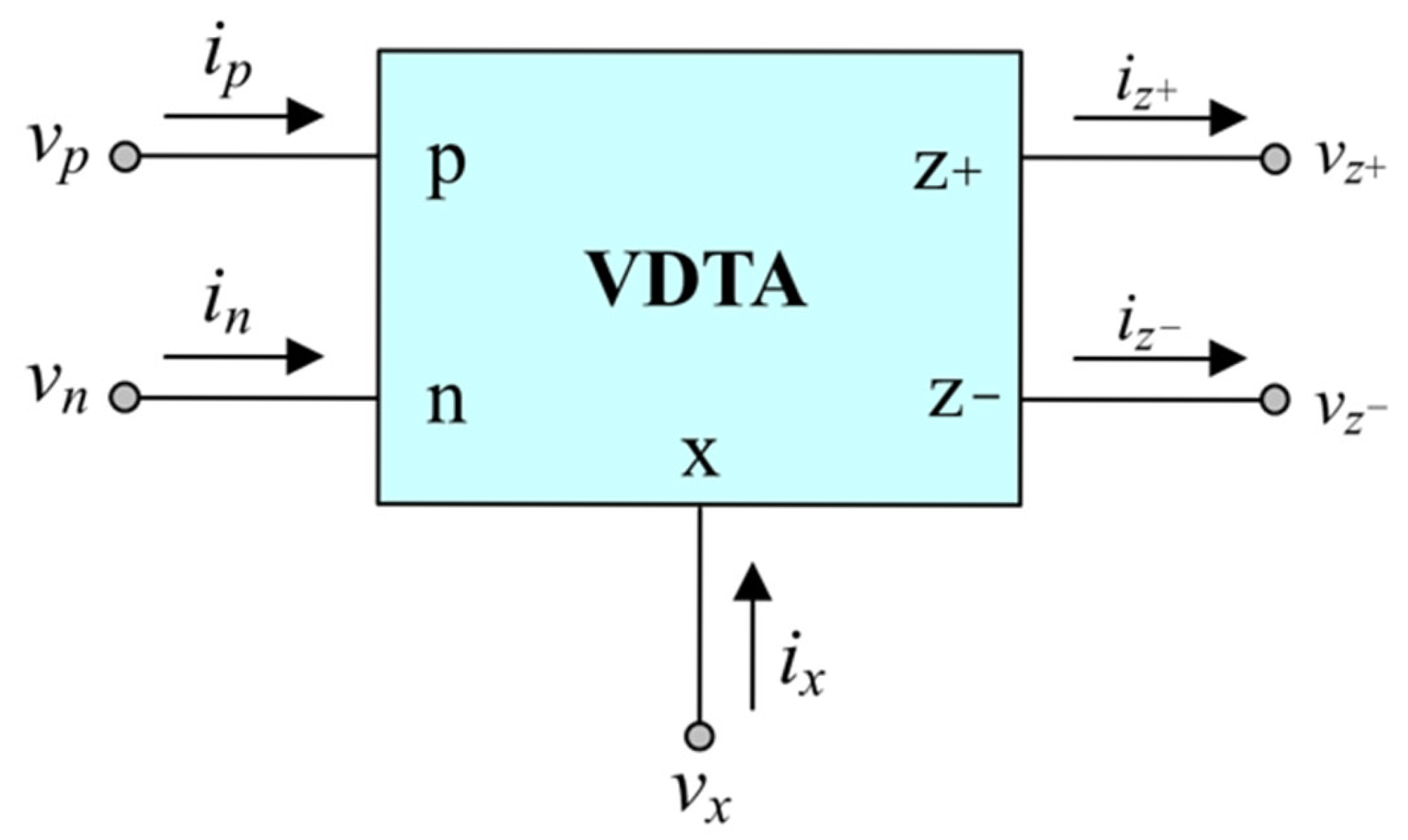
Figure 1. Symbolic representation of the voltage differencing transconductance amplifier (VDTA).
Electronics 15 01663 g001
Figure 2. CMOS implementation of the VDTA employed in this work.
Electronics 15 01663 g002
Figure 3. Proposed VDTA-based mixed-mode inverse filter topology.
Electronics 15 01663 g003
Figure 4. Non-ideal VDTA model including parasitic elements at all terminals.
Electronics 15 01663 g004
Figure 5. Transient and frequency responses of the VM inverse filter in Figure 3: (a) 1st-order ILP; (b) 1st-order IHP; (c) 2nd-order IBP.
Electronics 15 01663 g005
Figure 6. Transient and frequency responses of the TAM inverse filter in Figure 3: (a) 1st-order ILP; (b) 1st-order IHP; (c) 2nd-order IBP.
Electronics 15 01663 g006
Figure 7. Transient and frequency responses of the TIM inverse filter in Figure 3: (a) 1st-order ILP; (b) 1st-order IHP; (c) 2nd-order IBP.
Electronics 15 01663 g007
Figure 8. Transient and frequency responses of the CM inverse filter in Figure 3: (a) 1st-order ILP; (b) 1st-order IHP; (c) 2nd-order IBP.
Electronics 15 01663 g008
Figure 9. Gain–frequency responses of the VM IBP filter demonstrating fc tuning.
Electronics 15 01663 g009
Figure 10. Monte Carlo simulation results of the VM IBP filter showing statistical variation in fc.
Electronics 15 01663 g010
Figure 11. Simulation results for the PVT variation.
Electronics 15 01663 g011
Figure 12. THD analysis of the VM IBP filter as a function of input signal amplitude.
Electronics 15 01663 g012
Figure 13. Output-referred noise of the VM IBP filter.
Electronics 15 01663 g013
Figure 14. Suggested second-order LP filter used as a plant for closed-loop control implementation.
Electronics 15 01663 g014
Figure 15. Block diagrams of the closed-loop control system to show the performance of the proposed PID controllers: (a) VM; (b) TAM; (c) TIM; (d) CM.
Electronics 15 01663 g015
Figure 16. Step responses of the PID-controlled and uncontrolled systems for different controller settings.
Electronics 15 01663 g016
Table 1. Comparative evaluations of the proposed mixed-mode inverse filter with previously reported designs.
Ref.Operation
Mode
Filter
Order
Filter
Type
No. of
Active
Components
No. of
Passive
Components
TechnologySupply
Voltages
(V)
Total
Power
Consumption
(mW)
[1]VM2ndILP, IBP, IHP, IBS2 CFOAILP, IBP, IHP: 4R + 2C,
IBS: 6R + 2C
AD844N/AN/A
CM2ndILP3 CFOA3R + 2C
[2]TAM2ndIHP3 CDTA2R + 2CMOSIS
0.35 μm
±3.5N/A
[3]VM2ndILP, IBP, IHPILP, IBP: 6 CCII,
IHP: 5 CCII
ILP, IBP: 6R + 2C,
IHP: 5R + 2C
MOSIS
0.5 μm
±1.857.01–10.2
CM2ndILP, IBP, IHPILP, IBP: 5 CCII,
IHP: 4 CCII
ILP, IBP: 4R + 2C,
IHP: 3R + 2C
[4]VM2ndILP, IBP, IHP2 OTRAILP, IBP: 4R + 2C,
IHP: 3R + 3C
TSMC
0.18 μm
N/AN/A
[5]VM2ndILP, IBP, IHP, IBSILP, IBP, IBS:
3 VDTA,
IHP: 2 VDTA
2CTSMC
0.18 μm
±0.9N/A
Unified filter:
4 VDTA, 2 SW
3C
[6]VM2ndIBS, IAP2 OTRA4(6)R + 3(4)CTSMC
0.18 μm
±0.9, −0.3N/A
[7]VM2ndIBS, IAP2 CDBA, 1 SW5R + 2CTSMC
0.18 μm
±2.5N/A
[8]VM2ndILP, IBP, IHP2 CDBA4R + 2CTSMC
0.18 μm
±2.5N/A
[9]VM1stILP, IHP1 OAILP: 1(2)R + 1C,
IHP: 1(2)R + 1(2)C
VCVS
macro
model
N/AN/A
2ndIBP1 OA2R + 2C
[10]VM2ndIBS1 OTRA, 3 SW5R + 5CCMOS
0.18 μm
±1.5, −0.51.46
[11]VM6thIBP2 CDBA9R + 9CTSMC
0.18 μm
±0.60.918
[12]VM2ndILP, IBP, IHP, IBS4 VDTA, 3 SW2CTSMC
0.18 μm
±0.92.16
[13]VM2ndILP, IBP, IHP, IBSILP, IBP, IHP:
4 OTA,
IBS: 5 OTA
2CTSMC
0.18 μm
±0.9,
−0.6–−0.78
N/A
[14]VM2ndILP, IBP, IHP, IBS1 CDBAILP: 3R + 2C,
IBP, IBS: 2R + 2C,
IHP: 2R + 3C
TSMC
0.35 μm
±2.5N/A
[15]VM1stILP, IHP2 VCII4R + 1CTSMC
0.18 μm
±0.90.6
2ndIBP3 VCII6R + 2C
[16]VM2ndIBP2 VCII5R + 2CTSMC
0.18 μm
±0.9N/A
CM2ndILP, IBP, IHP, IBS2 VCII2R + 2C
[17]VM1stILP, IHP2 CFOA3R + 2CAD844N/AN/A
[18]VM1stILP, IHP1 VCIIILP: 1R + 2C,
IHP: 2R + 1C
TSMC
0.18 μm
±0.750.255
2ndILP, IBP, IHP2 VCIIILP: 2R + 4C,
IBP: 3R + 3C,
IHP: 4R + 2C
0.511
CM1stILP, IHP2 VCIIILP: 1R + 2C,
IHP: 2R + 1C
0.511
2ndILP, IBP, IHP3 VCIIILP: 4R + 2C,
IBP: 3R + 3C,
IHP: 4R + 2C
0.766
[19]VM2ndILP, IBP, IHP1 VCII3R + 2CTSMC
0.18 μm
±0.3N/A
[20]VM2ndILP, IBP, IHP, IBS1 OTRAILP: 3R + 2C
IHP: 2R + 3C
IBP: 3R + 2C
IBS: 3R + 3C
TSMC
0.18 μm
±1.5N/A
[21]VM1stILP, IHP1 DVCCILP: 1R + 2C
IHP: 2R + 1C
TSMC
0.18 μm
±1.5,
+0.75
N/A
2ndILP, IBP, IHP2 DVCCILP: 2R + 4C
IHP: 4R + 2C
IBP: 3R + 3C
[22]VM2ndILP, IBP, IHP3 DDCC3R + 3CBSIM 90 nm±1,
−0.33
2.48
4 DDCC5R + 3C
Proposed circuitVM,
TAM,
TIM,
CM
1stILP, IHP3 VDTA2R + 3CTSMC
0.18 μm
±0.90.972
2ndIBP
PID controller
function
Note: ILP = inverse lowpass, IHP = inverse highpass, IBP = inverse bandpass, IBS = inverse bandstop, IAP = inverse allpass, R = resistor, C = capacitor, N/A = not available or not measured, CFOA = Current-Feedback Operational Amplifier, CDTA = Current Differencing Transconductance Amplifier, CCII = Second-Generation Current Conveyor, OTRA = Operational Transresistance Amplifier, VDTA = Voltage Differencing Transconductance Amplifier, CDBA= Current Differencing Buffered Amplifier, OA = Operational Amplifier, OTA = Operational Transconductance Amplifier, VCII = Second-Generation Voltage Conveyor, DVCC = Differential Voltage Current Conveyor, DDCC = Differential Difference Current Conveyor.
Table 2. Input voltage selection and corresponding performance parameters for VM inverse filter realization in Figure 3.
Inverse
Filter
Response
Input Voltage VM
Transfer Function
Minimum Gain
(H0)
Cutoff
Frequency (ωc)
Quality
Factor (Q)
vi1vi2
1st-order ILPvin0 V o u t 1 ( s ) V i n ( s ) = H 0 s R 1 C 1 + 1 g m F 1 g m S 1 C 3 g m F 2 g m S 2 C 1 1 R 1 C 1 -
1st-order IHP0vin V o u t 1 ( s ) V i n ( s ) = H 0 s R 1 C 1 + 1 s R 1 C 1 g m S 1 R 1 1 R 1 C 1 -
2nd-order IBPvin0 V o u t 2 ( s ) V i n ( s ) = H 0 N ( s ) s R 1 C 1 + R 2 C 2 g m F 1 g m S 1 g m F 3 C 3 R 1 C 1 + R 2 C 2 g m F 2 g m S 2 C 1 C 2 1 R 1 R 2 C 1 C 2 R 1 R 2 C 1 C 2 R 1 C 1 + R 2 C 2
Table 3. Input voltage selection and corresponding performance parameters for TAM inverse filter realization in Figure 3.
Inverse
Filter
Response
Input Voltage TAM
Transfer Function
Minimum Gain
(H0)
Cutoff
Frequency (ωc)
Quality
Factor (Q)
vi1vi2
1st-order ILPvin0 I o u t 1 ( s ) V i n ( s ) = H 0 s R 1 C 1 + 1 g m F 1 g m S 1 g m F 3 C 3 g m F 2 g m S 2 C 1 1 R 1 C 1 -
1st-order IHP0vin I o u t 1 ( s ) V i n ( s ) = H 0 s R 1 C 1 + 1 s R 1 C 1 g m S 1 g m F 3 R 1 1 R 1 C 1 -
2nd-order IBPvin0 I o u t 2 ( s ) V i n ( s ) = H 0 N ( s ) s R 1 C 1 + R 2 C 2 g m F 1 g m S 1 g m F 3 g m S 3 C 3 R 1 C 1 + R 2 C 2 g m F 2 g m S 2 C 1 C 2 1 R 1 R 2 C 1 C 2 R 1 R 2 C 1 C 2 R 1 C 1 + R 2 C 2
Table 4. Input current selection and corresponding performance parameters for TIM inverse filter realization in Figure 3.
Inverse
Filter
Response
Input CurrentTIM
Transfer Function
Minimum Gain
(H0)
Cutoff
Frequency (ωc)
Quality
Factor (Q)
ii1ii2
1st-order ILPiin0 V o u t 1 ( s ) I i n ( s ) = H 0 s R 1 C 1 + 1 g m S 1 C 3 g m F 2 g m S 2 C 1 1 R 1 C 1 -
1st-order IHP0iin V o u t 1 ( s ) I i n ( s ) = H 0 s R 1 C 1 + 1 s R 1 C 1 R1 1 R 1 C 1 -
2nd-order IBPiin0 V o u t 2 ( s ) I i n ( s ) = H 0 N ( s ) s R 1 C 1 + R 2 C 2 g m F 3 g m S 1 C 3 R 1 C 1 + R 2 C 2 g m F 2 g m S 2 C 1 C 2 1 R 1 R 2 C 1 C 2 R 1 R 2 C 1 C 2 R 1 C 1 + R 2 C 2
Table 5. Input current selection and corresponding performance parameters for CM inverse filter realization in Figure 3.
Inverse
Filter
Response
Input CurrentCM
Transfer Function
Minimum Gain
(H0)
Cutoff
Frequency (ωc)
Quality
Factor (Q)
ii1ii2
1st-order ILPiin0 I o u t 1 ( s ) I i n ( s ) = H 0 s R 1 C 1 + 1 g m S 1 g m S 3 C 3 g m F 2 g m S 2 C 1 1 R 1 C 1 -
1st-order IHP0iin I o u t 1 ( s ) I i n ( s ) = H 0 s R 1 C 1 + 1 s R 1 C 1 g m F 3 R 1 1 R 1 C 1 -
2nd-order IBPiin0 I o u t 2 ( s ) I i n ( s ) = H 0 N ( s ) s R 1 C 1 + R 2 C 2 g m F 3 g m S 1 g m S 3 C 3 R 1 C 1 + R 2 C 2 g m F 2 g m S 2 C 1 C 2 1 R 1 R 2 C 1 C 2 R 1 R 2 C 1 C 2 R 1 C 1 + R 2 C 2
Table 6. Transistor aspect ratios (W/L) used in the CMOS implementation of the VDTA shown in Figure 2.
Transistors W/L (μm/μm)
M1, M2, M5, M624/0.18
M3, M4, M7, M830/0.18
M13–M185/0.18
M9–M126/0.18
Table 7. PID controller circuit components and their resulting coefficients.
R1 = R2
(kΩ)
C1
(pF)
C2
(pF)
C3
(pF)
gmFi = gmSi (i = 1, 2, 3)
(mA/V)
KPVKIV
(Ms−1)
KDV
(ns)
Case 10.550501001.02.04025
Case 20.5501001001.01.52025
Case 31.050501001.04.040100
Table 8. Resulting time response characteristics of the PID-controlled and uncontrolled systems in Figure 15a.
Delay Time, td
(μs)
Rise Time, tr
(μs)
Peak Time, tp
(μs)
Settling Time
at 2%, ts (μs)
Maximum
Overshoot, Mp (mV)
Steady-State
Error
(mV)
PID-
controlled
system
Case 12.1622.2422.3783.317134.1890.978
Case 22.2062.3352.4983.074118.7621.272
Case 32.1342.2442.3382.537112.1111.061
Uncontrolled
system
2.2223.2983.2982.921115.68315.683
Table 9. Comparative analysis of the performances of the proposed controller circuit against recently published PID controllers from 2024 to 2025 [26,27,28,29].
Ref.Operation
Mode
No. of
Active
Components
No. of
Passive
Components
Rise Time,
tr
(μs)
Peak
Time,
tp
(μs)
Settling
Time,
ts
(μs)
Maximum
Overshoot, Mp
(%)
TechnologySupply
Voltages
(V)
Total
Power
Consumption
(mW)
[26]VM,
TAM,
TIM,
CM
3 CFOA4R + 2C6.887.819.0611.43AD844±9348
[27]CM2 CFOA2R + 2C18.61030113011.57TSMC
0.18 μm
±26.8
[28]VM2 VCII2R + 2C0.3341.592.050.55AD844±9235
[29]TAM1 DDCCTA3R + 2C0.0052N/A0.180GPDK
0.18 μm
±0.9,
−0.62
4
Proposed
PID
controller
in Figure 3
VM,
TAM,
TIM,
CM
3 VDTA2R + 3C2.2442.3382.53711.11TSMC
0.18 μm
±0.90.972
Disclaimer/Publisher’s Note: The statements, opinions and data contained in all publications are solely those of the individual author(s) and contributor(s) and not of MDPI and/or the editor(s). MDPI and/or the editor(s) disclaim responsibility for any injury to people or property resulting from any ideas, methods, instructions or products referred to in the content.