


Abstract
This article presents a novel nonlinear control strategy for an active triple-bridge converter used in a direct current (DC) microgrid with multiple buses to interconnect its three constituent buses, which are comprised of generation systems and generalized loads. The proposed controller aims to regulate the voltage on two of the DC buses and manage the power exchanged between them in response to load and voltage changes. Unlike the existing literature, the control strategy is designed based on the generalized state-space averaged model of the converter, obtained from the delta equivalent circuit of the high-frequency transformer. The performance of the designed controller is validated through simulation results, demonstrating good performance under changes in generated power, load variations, and voltage fluctuations on both DC buses of the microgrid.
1. Introduction
In recent decades, the increasing penetration of renewable energy sources, storage systems, and power electronics-based loads has driven the development of DC microgrids as an efficient alternative to traditional alternating current (AC) distribution systems [1,2,3]. This is primarily because DC microgrids allow for more direct integration of photovoltaic generators, batteries, and supercapacitors, reducing conversion stages and improving the overall efficiency and reliability of the system [4,5,6,7].
However, a critical challenge in DC microgrids arises from the widespread deployment of power electronic loads, such as tightly regulated converters and electric vehicle (EV) battery chargers, which typically exhibit constant power load (CPL) or constant current load (CCL) characteristics [8,9]. Specifically, CPLs possess a negative incremental impedance that can affect DC bus stability and induce oscillations throughout the microgrid [10,11]. These adverse effects are further exacerbated in multi-bus DC microgrids, where strong electrical coupling exists between subsystems [12].
In this context, electronic power converters play a fundamental role, as they are responsible for interconnecting the different subsystems, providing voltage regulation and power management [13,14]. Among the different topologies available, the Triple Active Bridge (TAB) DC–DC converter has aroused increasing interest in DC microgrid applications with multiple buses, thanks to its high power density, bidirectional power transfer capability, galvanic isolation, and the possibility of interconnecting three DC buses using a single high-frequency transformer (HFT) [15,16,17].
Despite these advantages, the Triple Active Bridge (TAB) converter exhibits highly nonlinear and coupled dynamics, as the power exchanged between its ports simultaneously depends on multiple control variables, typically the phase-shift angles between the active bridges. This cross-coupling hinders the independent regulation of each DC bus and poses a significant challenge for controller design, particularly under large-signal disturbances and varying load conditions. Consequently, the development of control strategies remains a research topic of great interest [16,18]. For this reason, accurate modeling of the TAB converter is essential for the synthesis of advanced control strategies. In particular, averaged modeling techniques based on the Generalized State Space Averaging (GSSA) method allow for capturing both DC and AC dynamics, as well as the coupling effects of the TAB converter, resulting in a reliable and highly precise model [19,20].
Regarding the design of controllers for the TAB DC-DC converter, several approaches based on linear control techniques have been proposed in the specialized literature. In [21], a Proportional–Integral (PI) controller designed from its linearized GSSA model is proposed and used to regulate the voltage at two of the converter’s ports, to which only resistive loads are connected. Linear decoupling control techniques have also been proposed, such as in [22], where a controller is designed to regulate the voltage at two of the converter’s ports using its simplified model, thus reducing the controller’s complexity. However, this strategy has only been validated with purely resistive loads.
Due to the inherent limitations of linear control strategies, such as performance degradation and stability issues during large-scale load excursions or set-point changes, as they are synthesized using linearized models, the literature has explored nonlinear control designs. These approaches directly address dynamic coupling and system nonlinearities, ensuring more precise regulation and enhanced robustness against load variations. In [23], a Sliding Mode Control (SMC) is designed to regulate voltage and balance total power, achieving satisfactory performance under voltage and load variations; however, the HFT current dynamics are neglected, which may compromise system stability. A voltage controller for a TAB DC-DC converter is presented in [24], employing an effective diagonal matrix decoupling strategy based on differential flatness control. While this method offers favorable dynamic performance under disturbances, it remains highly dependent on model accuracy and is validated solely with resistive loads. Recently, advanced strategies such as model-free prediction and fixed-time control have been proposed for AC microgrids [25,26], showing significant robustness. Furthermore, although AI-based controllers for DC-DC converters have been explored to handle complex nonlinearities [27], they often require extensive training data and high computational power. Similarly, while advanced mathematical approaches for high-gain bidirectional converters exist [28], they frequently focus on specific topologies. Finally, a Model Predictive Control (MPC) is proposed in [29], providing significant improvements in dynamic response and port decoupling; nevertheless, it entails a high computational burden, exhibits sensitivity to parameter uncertainty, and is evaluated only under resistive load conditions. Unlike the aforementioned AI-based, SMC, and MPC methods, the proposed Feedback Linearization (FL) controller achieves exact decoupling with lower mathematical complexity and no training overhead. This ensures exponential error reduction and a simple control strategy to implement in standard microcontrollers, avoiding SMC chattering problems and the high computational cost of MPC or AI approaches.
This paper proposes the design of a new nonlinear control strategy for a TAB DC-DC converter used to interconnect three buses in a DC MG, each consisting of different types of loads. The main contributions of this work are listed below:
- ◆
- Unlike the approaches described in the literature, which mostly use the equivalent star model of the HFT, the proposed controller has been designed based on a delta () representation of the coupling inductances. This choice allows the formulation of the GSSA model, which captures the fundamental AC component of the currents and the DC component of the voltages, avoiding the need to calculate the neutral point voltage present in the HFT star equivalent. Thanks to this approach, the model is defined by the phase shifts of the first bridge to the other two, omitting the direct interaction between the second and third bridges. This significantly simplifies the control laws and reduces the computational load.
- ◆
- The controller is designed using a nonlinear control technique, employing feedback linearization (FL), which allows the system to be controlled using linear controllers through a coordinate transformation and nonlinear feedback. To ensure system stability and incorporate the dynamics of the HFT currents, an internal control loop is designed for the real and imaginary components of the HFT’s secondary currents, and an external control loop is designed to manage the power at the ports and thus regulate their voltages. Compared to conventional linear strategies, such as the one proposed in [21], and nonlinear control strategies, such as the SMC controller proposed in [30], this approach provides improved dynamic response and superior rejection of disturbances during load transients and setpoint variations.
- ◆
- Unlike most proposals in the literature, the strategy proposed in this work is validated with a generalized load model, which consists of components of constant impedance, constant current, and constant power (ZIP load). This ensures the robustness of the control under complex and nonlinear load dynamics.
2. System Description
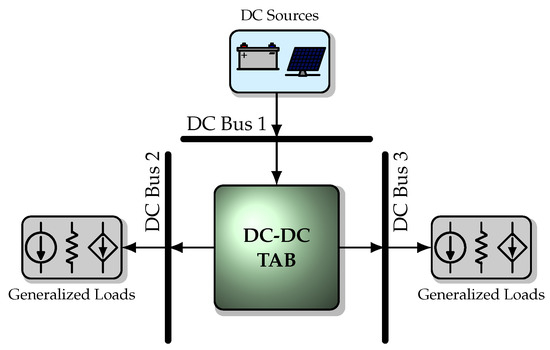
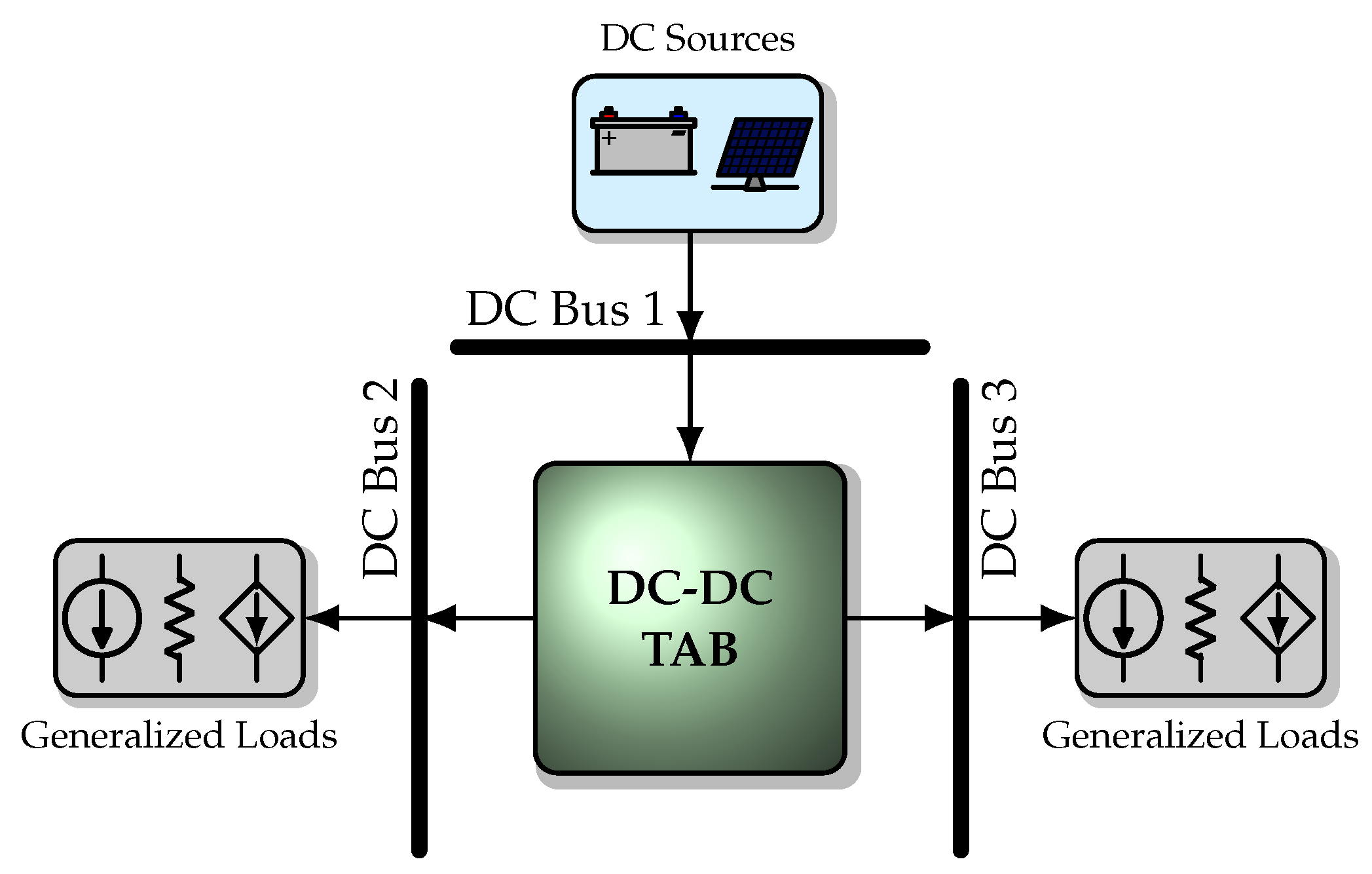
The system under study in this work is illustrated in Figure 1. It consists of a DC microgrid (MG) featuring three DC buses: one connected to DC energy sources and the remaining two connected to generalized ZIP loads. These MG buses are interconnected via a Triple Active Bridge (TAB) DC-DC converter, which provides galvanic isolation between the DC stages to ensure system safety. Furthermore, since the converter facilitates bidirectional power flow among the MG buses, the overall operational flexibility of the system is maximized.
Figure 1.
DC microgrid scheme with multiple buses interconnected by a TAB DC-DC converter.
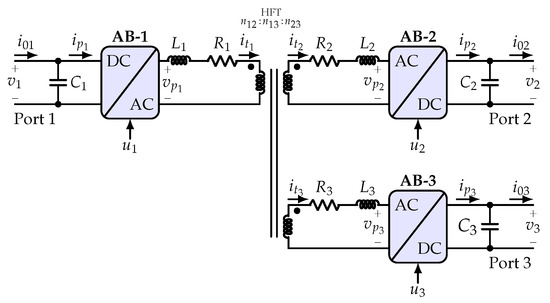
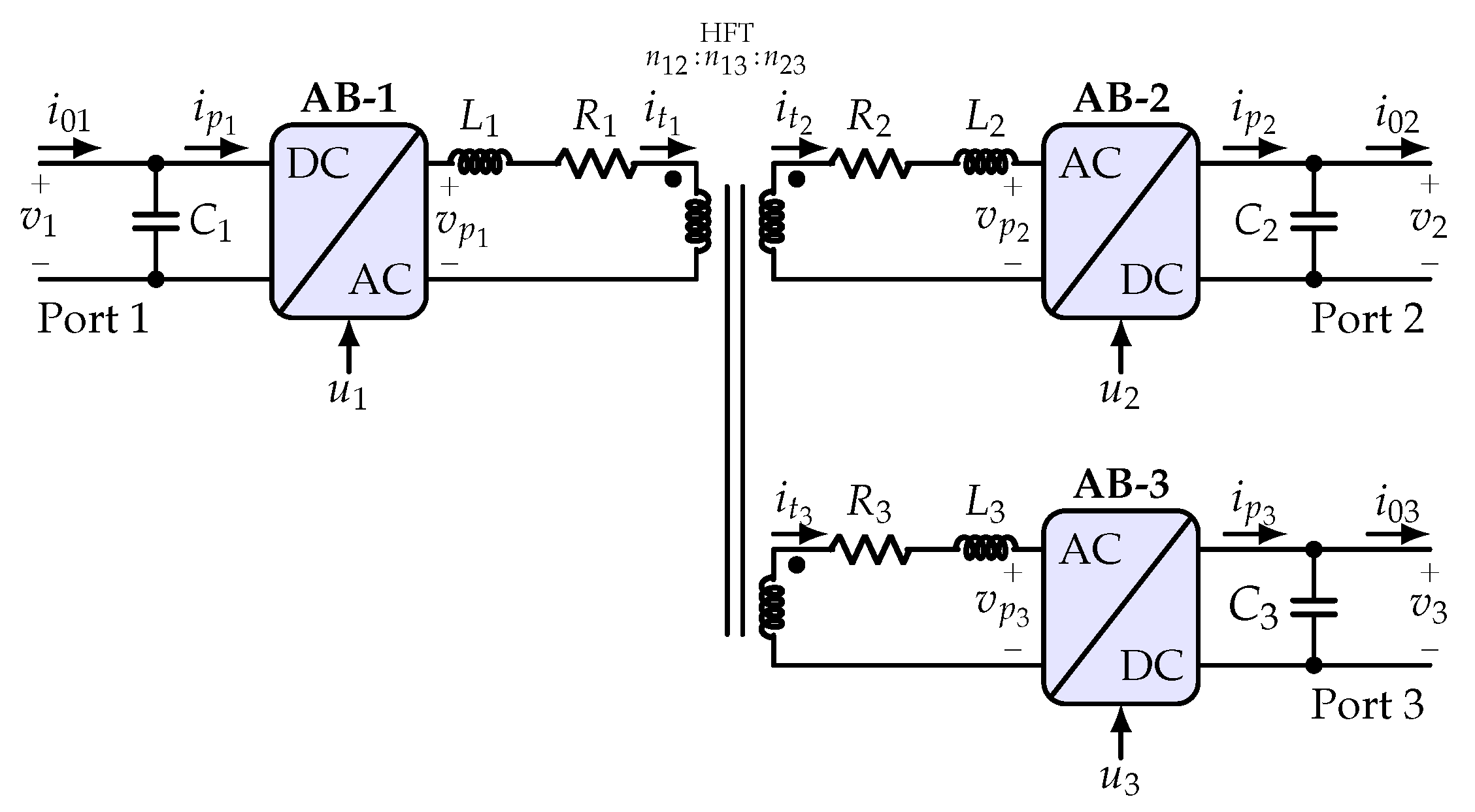
In Figure 2, a simplified diagram of the DC-DC TAB converter considered in this work is shown. It is composed of three active bridges (AB-1, AB-2, and AB-3), (all in full-bridge configuration), whose activation signals are , and . On the other hand, , and are the DC filter capacitors for buses 1, 2 and 3 respectively, , and correspond to the voltages at each bus of the DC MG, is the current of bus 1, is the current in the second bus, and corresponds to the current in the third DC bus of the MG. Finally, , and are the input currents to each of the ports (AB-1, AB-2 and AB-3, respectively).
Figure 2.
DC-DC TAB converter.
Furthermore, as observed in Figure 2, the three active bridges are interconnected through an AC link formed by an HFT, which features a primary winding with leakage inductance and internal resistance , and two secondary windings with leakage inductances and and internal resistances and , respectively. The currents , and correspond to the primary current and the currents of the two secondary windings; is the voltage on the AC side of AB-1, while and are the voltages on the AC side of AB-2 and AB-3, respectively. Finally, , and represent the HFT turns ratios between ports 1, 2, and 3.
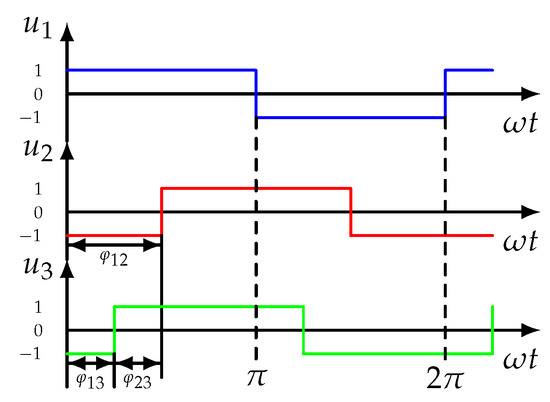
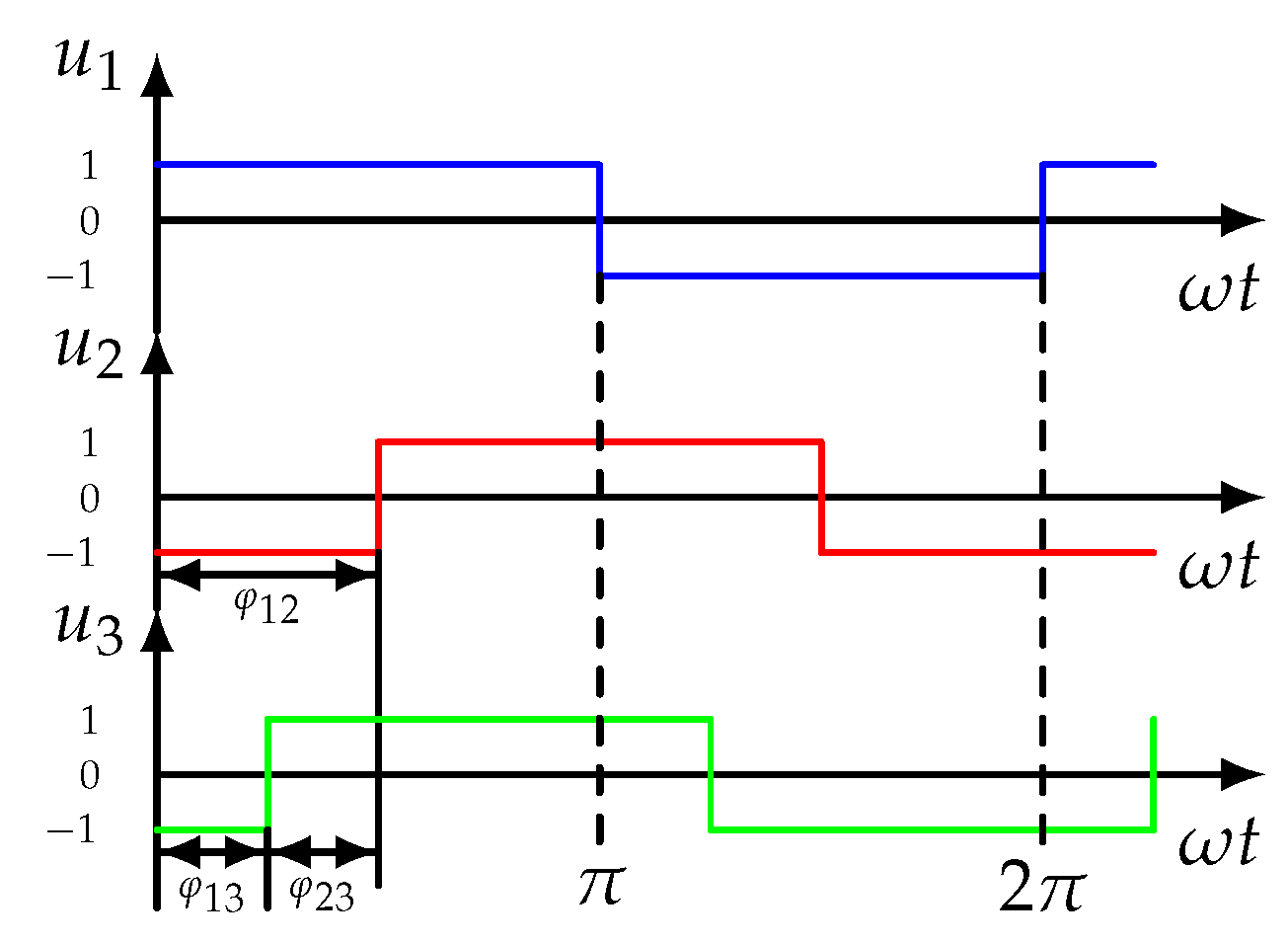
Figure 3 illustrates the switching signals , , and corresponding to the three active bridges of the TAB DC-DC converter (AB-1, AB-2, and AB-3, respectively). These signals take values in the set and are out of phase with each other. Specifically, a phase shift exists between signals and , and a phase shift is present between and , whereas the phase shift between and is defined as .
Figure 3.
Switching signals for active bridges AB-1, AB-2 and AB-3, respectively.
Therefore, by shifting the switching signals of the three active bridges, it is possible to control the power transfer between the three converter ports and, thereby, regulate the voltage on DC buses 2 and 3.
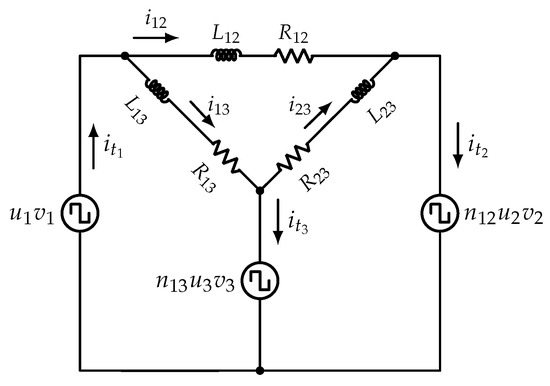
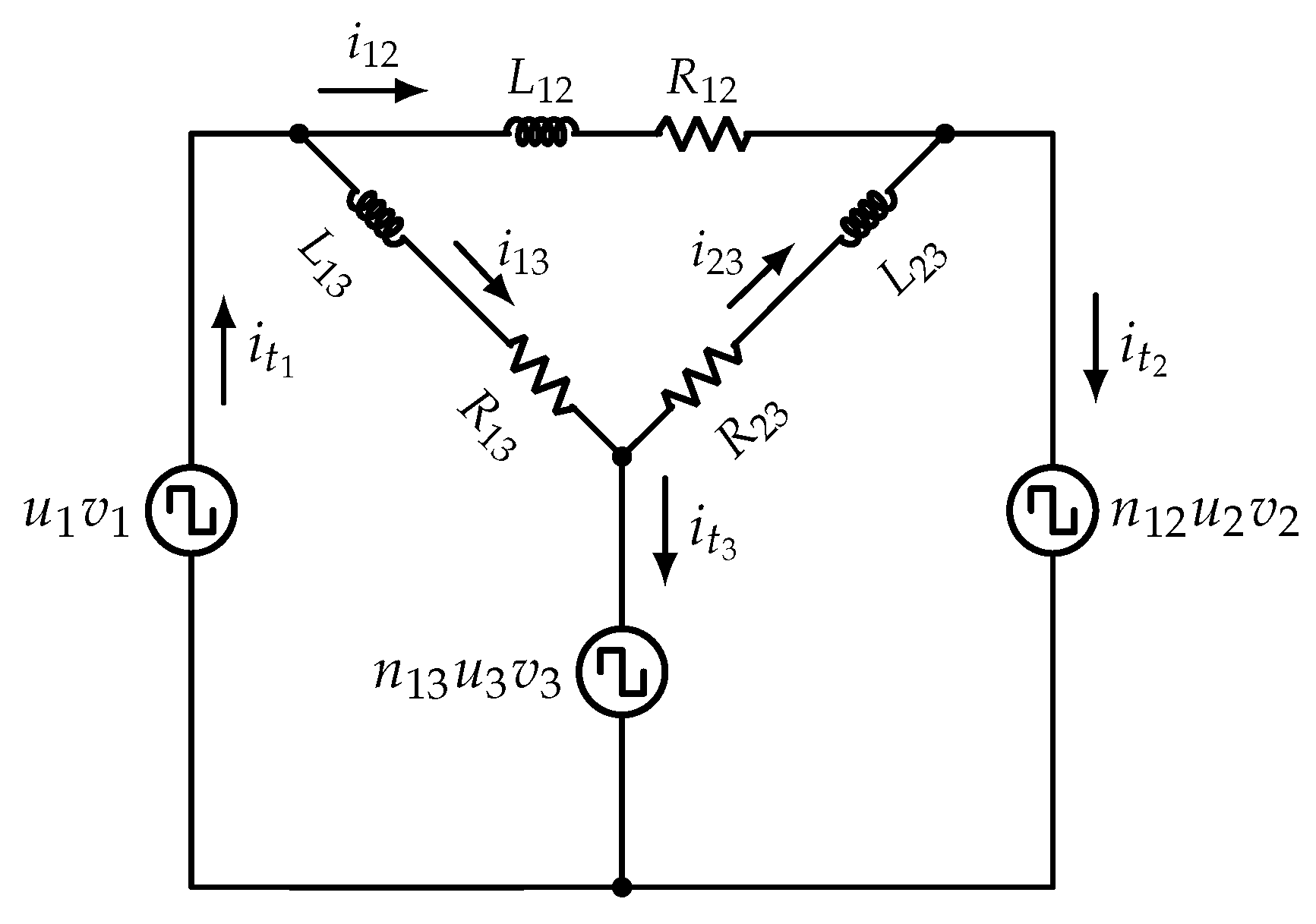
To perform the mathematical modeling of the system considering both the DC bus voltage dynamics and the AC current dynamics in the HFT, it is first necessary to obtain an equivalent circuit of the TAB DC-DC converter that represents the cross-coupling between ports produced by the HFT. To this end, this work utilizes the delta equivalent circuit of the TAB DC-DC converter shown in Figure 4, where the active bridges have been replaced by square wave voltage sources with voltages , , and . On the other hand, , and are the currents between each of the ports, while , , , , and are the equivalent HFT inductances and resistances, which are given by the following relationships:
Figure 4.
Delta equivalent circuit of DC-DC TAB converter.
On the other hand, the power delivered or absorbed by each port can be defined as:
where is the power transferred between port 1 and 2, is the power between port 2 and 3, and is the power transferred between port 1 and 3.
Next, the power transferred between ports is defined as:
where is the switching frequency, while , and correspond to the equivalent HFT leakage inductances between such ports, which are given by (1).
3. Mathematical Modeling of the DC-DC Converter TAB
To design a control strategy that regulates the voltage on buses 2 and 3 of the MG to a constant value, a mathematical model representing the converter dynamic behavior is required. Initially, the switched-mode model will be obtained, and finally, it will be derived into the GSSA model of the TAB DC-DC converter, which will be used in the design of the control strategy proposed.
3.1. Switched Model
Using the schematic diagram of the TAB DC-DC converter in Figure 2, the switching signals in Figure 3 and the delta equivalent circuit in Figure 4, and under the consideration that the power transistors of the three active bridges are ideal, the dynamics of the currents , and and the voltages and can be obtained as follows:
Expressions (6) represent the switched model of the TAB DC-DC converter for any HFT turns ratio, formulated in terms of the dynamics of the currents , and arising from the HFT delta-equivalent circuit. Therefore, to obtain the currents in the three HFT windings, the HFT equivalent circuit shown in Figure 4 can be utilized:
Finally, assuming that the HFT has a unity turns ratio (), and substituting the relationships from (7) into (6), the switched model in terms of the currents of the three HFT windings and the voltages at ports 2 and 3 results in:
where and result from considering that the HFT has a unity turns ratio.
3.2. Generalized State-Space Averaged Model
The model given by (8)–(12) obtained in the previous subsection accurately describes the switched behavior of the AC stage currents (, and ) and the DC voltages ( and ). However, the control strategy proposed in this work requires an averaged model of the converter that captures the system dynamics without explicitly relying on the switching variables.
Furthermore, because this topology includes an AC stage, classical averaging techniques are unsuitable, as they only consider the DC component of the system variables, ignoring their AC components. Therefore, the GSSA modeling strategy is adopted, which allows the AC variables of the system to be represented using a Fourier series expansion, resulting in a dynamic averaged model that preserves the AC information of the HFT currents [31].
The GSSA modeling strategy is based on the complex representation of Fourier series of state variables in the interval , as described below:
where is the angular switching frequency, while represents the Fourier coefficient associated with the k-th harmonic of the AC variables. This coefficient can be interpreted as a moving average over a switching period, making it useful for obtaining the average value of the AC variables present in the DC-DC TAB converter, and it is defined as follows:
The GSSA modeling strategy has two fundamental properties. The first establishes the derivative of the moving average given by (14), and the second defines the average of the k-th harmonic of a product between two variables [31]. These are given by
To obtain the GSSA model of the TAB DC-DC converter, in this work, only the component () is considered for the DC variables, and the component () for the AC variables.
Therefore, after applying properties (13), (14), and (15) to the commutated model given by (8)–(12), the GSSA model of the TAB DC-DC converter is obtained as follows:
where
At the same time, the subscript “0” denotes the DC component, and the subscripts ‘1R’ and “1I” represent the real and imaginary parts of the fundamental AC component.
It is necessary to clarify that, from a physical perspective, the state variables to represent the evolution of the high-frequency current components within the transformer’s leakage inductances. Meanwhile, and describe the average dynamics of the DC link voltages. The coupling terms in the model reflect the physical power flow between ports, where the phase angles and allow for regulating the power transferred between the converter’s ports through magnetic coupling.
Next, the reference values of the system variables are obtained. To do this, expressions (16)–(21) are evaluated at their equilibrium point, ignoring the effect of since, in practice, it results in a value close to zero, thus obtaining the following:
where and are the desired values of the voltages at ports 2 and 3, respectively. On the other hand, the phase shifts at the operating point can be obtained from (3) and (4), assuming a unity transformation ratio and that the converter is in steady state, resulting in:
where and are the output currents at the equilibrium point for ports 2 and 3, respectively.
It should be clarified that the reference values and will be obtained from the external control loop, which will be designed in the next section.
4. Control Strategy
The following section presents the design of the control strategy proposed in this work. The objective of the designed controller is to regulate the voltage of ports 2 and 3 to their respective reference values, to which generalized ZIP loads are connected.
4.1. System Assumptions and Practical Impact
To facilitate the controller design, the following assumptions are considered:
- Component Ideality: Losses in switches and the high-frequency transformer (HFT) are neglected in the control model. In practice, these act as small disturbances that the proposed FL controller compensates for through its active feedforward and integral action.
- Constant Parameters: Inductances and capacitances are assumed to be at their nominal values. Real-world variations (e.g., due to temperature) are handled by the integral term in the control laws, ensuring zero steady-state error.
- Ideal Sensing: Measurements of voltages and currents are assumed to be noise-free. Real implementations require low-pass filters in the Analog-to-Digital Converter (ADC) stages; the stability margins of the proposed control are robust enough to handle the minor delays introduced by these filters.
4.2. Proposed Controller Design
Because the system described by (16)–(21) is nonlinear in nature, given that it has products between state, control, and measurement variables, this paper proposes the design of a nonlinear control strategy based on FL. This choice is due to the fact that, thanks to the coordinate transformation and nonlinear feedback provided by this control technique, it is possible to control a nonlinear system with a linear controller [25,32].
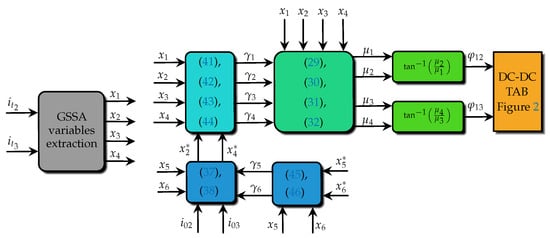
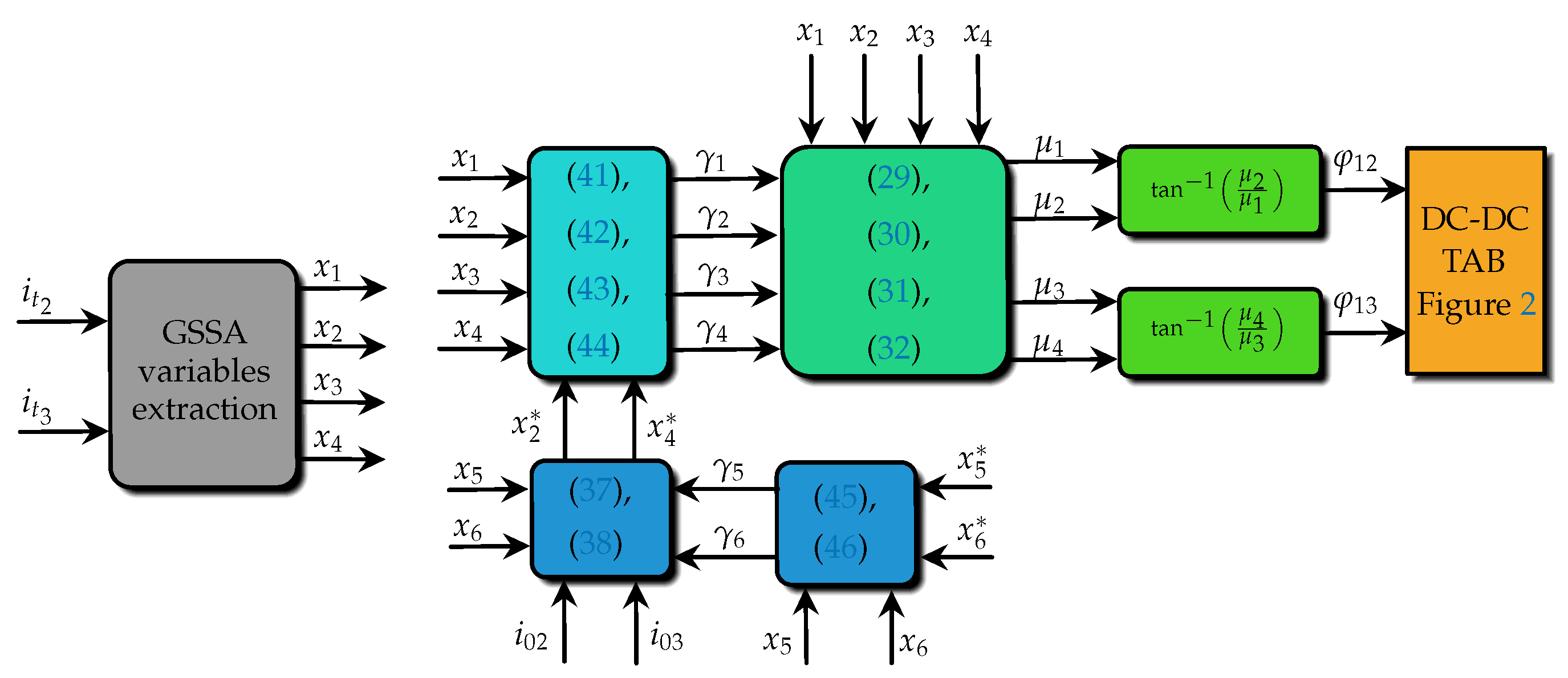
To ensure system stability and avoid unstable zero dynamics, an indirect control scheme is designed. It consists of an external control loop, which regulates the voltage at ports 2 and 3, and an internal control loop, which regulates the real and imaginary parts of the currents of both HFT secondaries, as shown in Figure 5.
Figure 5.
Control Scheme proposed.
To do this, the following output vector is defined:
By deriving the output vector (25) until the inputs appear explicitly, we obtain a system of equations described in the new coordinates,
In this way, the dynamics described in the new coordinates can be represented by a linear system in terms of the auxiliary control inputs (, , , and ), which can be designed using linear design tools. These are defined as:
Next, if the matrix in (26) is invertible, the control inputs can be obtained by
4.3. External Control Loop Design
Since the purpose of the control strategy designed is to regulate the voltages at the second and third ports of the converter, an external control loop is designed to control the voltage () and ().
Initially, it is considered to have a settling time ten times slower than the internal control loop. Therefore, it can be assumed that , , , , , , , and .
Next, for the design of the external loop, the energy at ports 2 and 3 are selected as outputs, respectively:
4.4. Design of Control Parameters
In the following subsection, the auxiliary control inputs given by (27) and (36) are designed. To do this, the errors of the transformed variables are initially defined as
and its dynamics are assigned as follows:
After replacing (27) and (36) in (40), the auxiliary control inputs are obtained as follows:
where (with ) are proportional gains that allow the desired dynamic response to be achieved. On the other hand, and are integral gains added to eliminate the steady-state error in the voltages of ports 2 and 3 that may occur due to parameter variations.
From a physical perspective, the control variables and represent linear controllers, the proportional term provides an immediate reaction to voltage deviations caused by power mismatches between ports, while the integral term accounts for the physical losses of the converter and the average power demand of the loads, ensuring zero steady-state error even under the negative incremental impedance effect of CPLs.
The proportional gains of the internal control loop (, , , and ) are obtained after solving the first four differential equations of (40) and considering a criterion of in the response, resulting in:
where is the settling time for the real and imaginary parts of the HFT secondary currents (inner loop).
On the other hand, the proportional and integral gains of the external controller ( and ) are obtained after adding control laws (45) and (46) to (36) and applying the Laplace transform, resulting in,
where is the settling time for stresses and , while is the natural frequency whose value is set at rad/s, to achieve a response in stresses with a maximum overshoot of .
Considering the parameters in Table 1, and that the internal loop settling time is ms, while that of the external loop is 2 ms, the values for the gains shown in Table 2 are obtained.
Table 1.
System parameters.
Table 2.
Controller parameters.
Finally, Figure 5 shows the control scheme of the proposed controller. Initially, the real and imaginary components of the currents of both HFT secondaries are extracted and used to obtain the auxiliary control actions (, , and ). On the other hand, from the measurement of the voltages and and their references, the auxiliary control actions and used by the external control loop to obtain the references and are obtained. Then, the control actions , , , and are calculated, from which the phase shifts and are obtained, which are applied to the switching signals of the active bridges of the TAB DC-DC converter in Figure 2.
Regarding the practical implementation of the control scheme shown in Figure 5, the GSSA variable extraction block is implemented using the filtering scheme described in [33], which allows for real-time estimation of the fundamental components with low computational overhead. The overall control law is executed at a fixed sampling frequency, where the gains were designed with a bandwidth separated from the HFT switching frequency to avoid instability. This implementation ensures that the complex GSSA mathematical framework is reduced to a set of direct arithmetic operations suitable for standard digital signal processors (DSPs).
4.5. Stability Analysis for Zero Dynamics
Since the relative vector degree of the output vector (27) is and the order of the system given by (16)–(21) is , the resulting dynamic has zeros given by (20) and (21), whose stability must be verified [32]. To do this, we consider that the system is in a stable state, so we assume that , , , , , , , and . Therefore, after replacing the references (37) and (38) in (20) and (21), we obtain
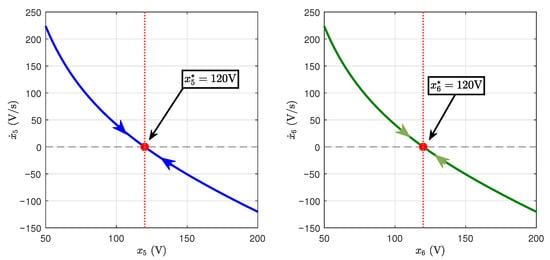
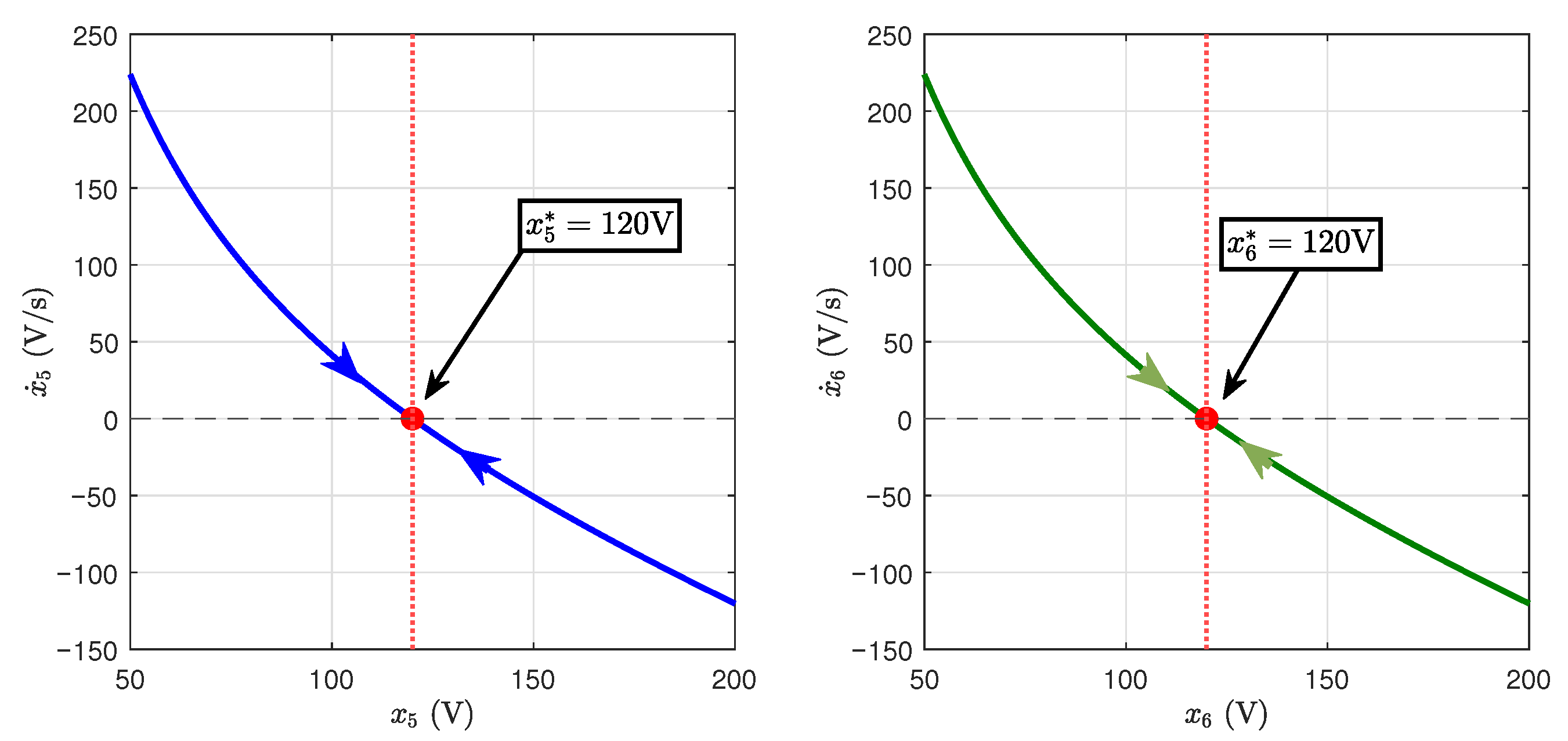
Using the controller and converter parameters given by Table 1 and Table 2, the phase portraits in Figure 6 corresponding to the dynamics of the zeros of (49) and (50) respectively are obtained.
In both cases, it can be observed that a single minimum phase equilibrium point is obtained. Therefore, the controller proposed in this work ensures that the closed-loop system is stable.
It is necessary to clarify that the proposed FL-based controller is inherently robust against the destabilizing effects of constant power loads (CPLs) since, as shown in the control laws (45) and (46), the terms and act as an active feedforward compensation. This algebraic cancellation of the load dynamics ensures that the closed-loop error remains governed by (45) and (46). Consequently, the stability of the converter is independent of the load power level, maintaining a constant and robust response even under severe CPL conditions.
5. Simulation Results
To validate the performance of the designed controller, simulation tests were performed with Matlab R2022a Simulink using the SimPowerSystems library and the Runge–Kutta simulation method with a fixed step size of T = 0.16 s. MOSFET transistors with an internal resistance m were used for the three active bridges, and a real transformer model was used for the HFT in order to achieve a realistic simulation scenario.
The simulation tests were performed on the system shown in Figure 2 using the control scheme shown in Figure 5.
To validate the performance and robustness of the proposed controller in the face of reference changes and variations in input voltage and load disturbances, four simulation tests were carried out. In the first, reference changes and variations in input voltage are made; in the second, variations in connected loads occur; and in the third, the performance of the proposed strategy is compared with a PI and SMC controller in response to reference and load changes. Finally, a fourth test was performed, where variations were made to the converter parameters, with the aim of validating the robustness of the proposed controller.
5.1. Reference Changes and Variations in Input Voltage
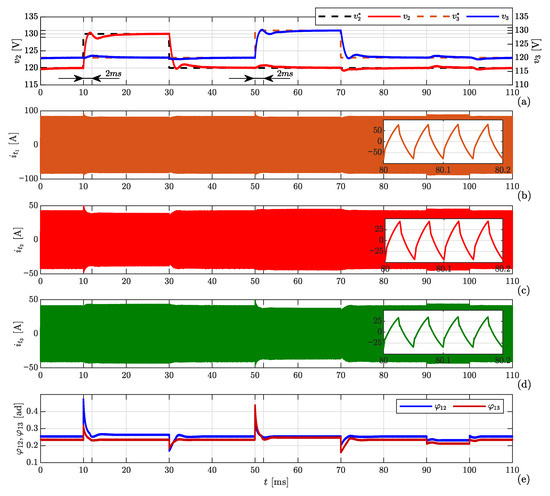
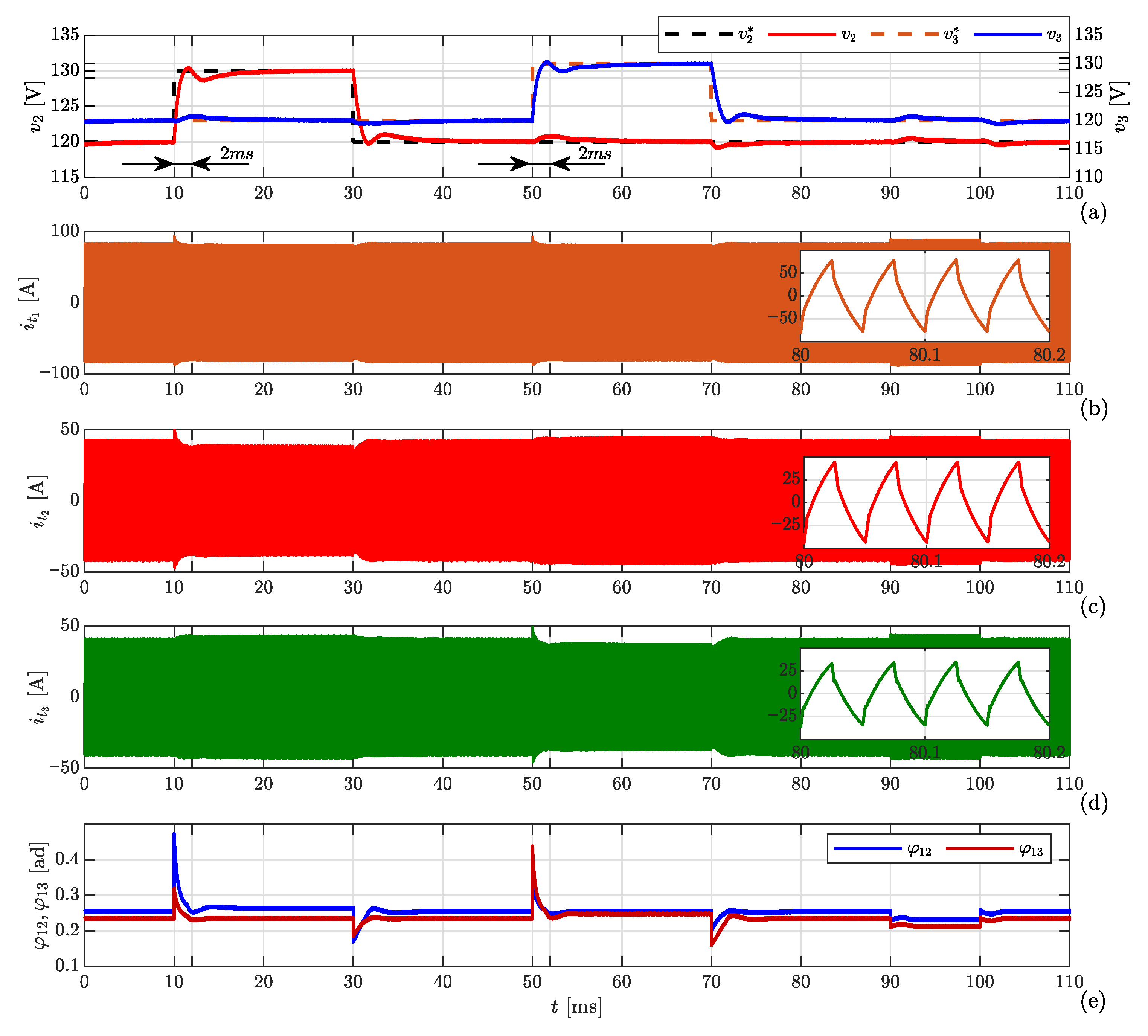
In this 110 ms test, a reference change was made from 120 V to 130 V at ms on voltage , which was returned to 120 V at ms. Then, at ms, the voltage was increased from 120 V to 130 V and returned to 120 V at ms. Finally, at ms, the input voltage () was increased from 250 V to 260 V and returned to its value of 250 V at 100 ms.
Figure 7a shows the voltages at ports 2 and 3, where good tracking of the references can be observed with a slightly underdamped response that settles within of the final value in the required settling time. Given the variations in the input voltage ( ms to 100 ms), both output voltages show small deviations ( V) from their reference values. Furthermore, it can be observed that when one of the output voltages changes, the voltage of the remaining port does not vary significantly (around V), demonstrating the decoupling between ports.
Figure 7.
Converter performance in response to reference changes and variations in port 1 voltage. (a) Voltages at ports 2 and 3. (b) Primary current of the HFT. (c) Secondary current () of the HFT. (d) Secondary current () of the HFT. (e) Control actions.
Figure 7b–d shows the three HFT currents, which do not exhibit significant overshoots or oscillations in response to the changes made and have a zero average value. The inset boxes show the characteristic trapezoidal waveform, with a switching frequency of 20 kHz.
Finally, Figure 7e shows the control actions and . In both cases, transients with small oscillations and overshoots are observed after reference changes; however, the signals remain within their operating limits at all times, without reaching saturation.
5.2. Load Variations
To evaluate the robustness and regulation capability of the proposed control strategy, a 130 ms transient simulation was performed. During the test, a reference value of 120 V was set for the voltages at ports 2 () and 3 (). The test started with a 15 resistive load and a 1 kW constant power load (CPL) at both ports. At ms, the resistive load at port 2 was disconnected, maintaining the CPL. Subsequently, at ms, the port 2 CPL was increased to kW, and at ms, a 4 A constant current source was connected. Next, at ms, the resistive load at port 3 was disconnected, maintaining the CPL, which was then increased to kW at ms. Finally, at ms, a 4 A constant current source was connected to port 3.
The system response to load variations is shown in Figure 8. It can be seen that the controller manages to maintain both voltages ( and ) at their reference values (see Figure 8a), showing decreases of no more than with respect to their reference value (120 V) in response to load increases, and when the resistive load is disconnected, in both cases an increase of around is observed with respect to their nominal value, although in all load disturbances the controller manages to reach the reference value again.
Figure 8.
Converter performance under load changes at ports 2 and 3, respectively. (a) Voltages at ports 2 and 3. (b) Primary current of the HFT. (c) Secondary current () of the HFT. (d) Secondary current () of the HFT. (e) Control actions.
The currents of the three HFT windings for this test are shown in Figure 8b–d, which exhibit transient behavior without significant oscillations or overshoot, and maintain their average value at zero, as can be verified in the details shown in each figure.
Figure 8e shows the phase angles and applied to the switching signals of ports 2 and 3, respectively. It can be observed that both phase shifts exhibit a transient response with small overshoots in response to disturbances, although at no point do these control actions reach saturation.
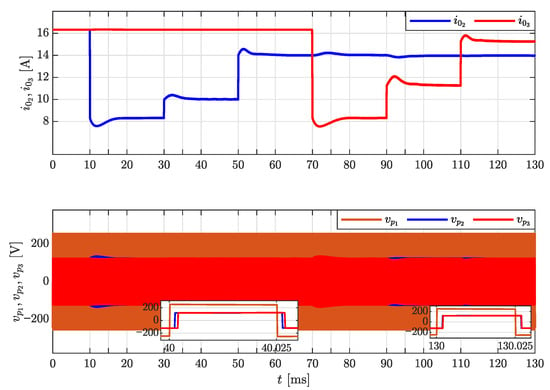
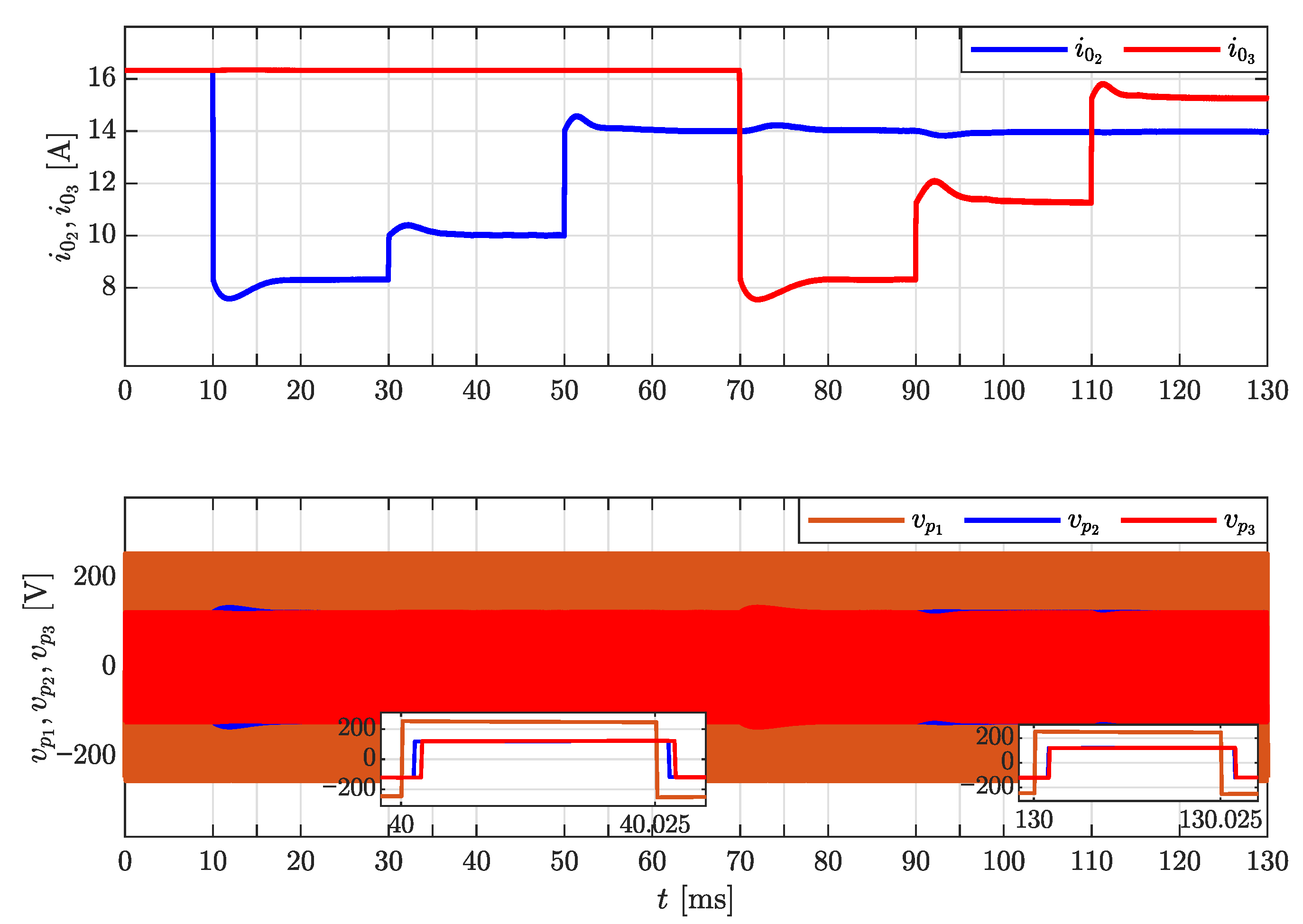
Figure 9 (above) shows the output currents and , which validate the system response to the load variations imposed at the different times when the load changes occur. Finally, Figure 9 (below) shows the voltages at the terminals of the HFT. It can be observed that all the voltages have a square waveform, with a mean value of zero. In the first detail, it can be seen that the phase shifts between the active bridges ( and ) are different from each other since the connected loads are not equal, while in the second detail, the phase shifts are similar because the power of the loads connected to both ports has a small difference between them.
Figure 9.
Converter performance under load changes at ports 2 and 3, respectively. (Top): outputs ports currents. (Bottom): voltages across the HFT terminals.
5.3. Comparison of the Proposed Control Strategy with a PI and SMC Controllers
Finally, the control strategy proposed in this work (FL) was compared with a PI controller proposed in [21] and a Sliding Mode Control (SMC) strategy proposed in [30], which were both adjusted with the same performance requirements established for the FL controller.
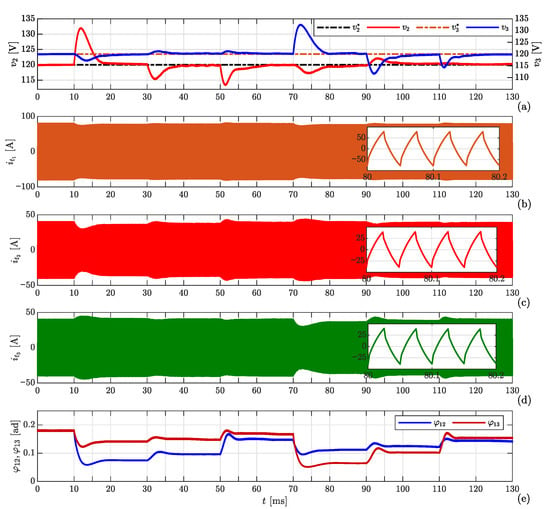
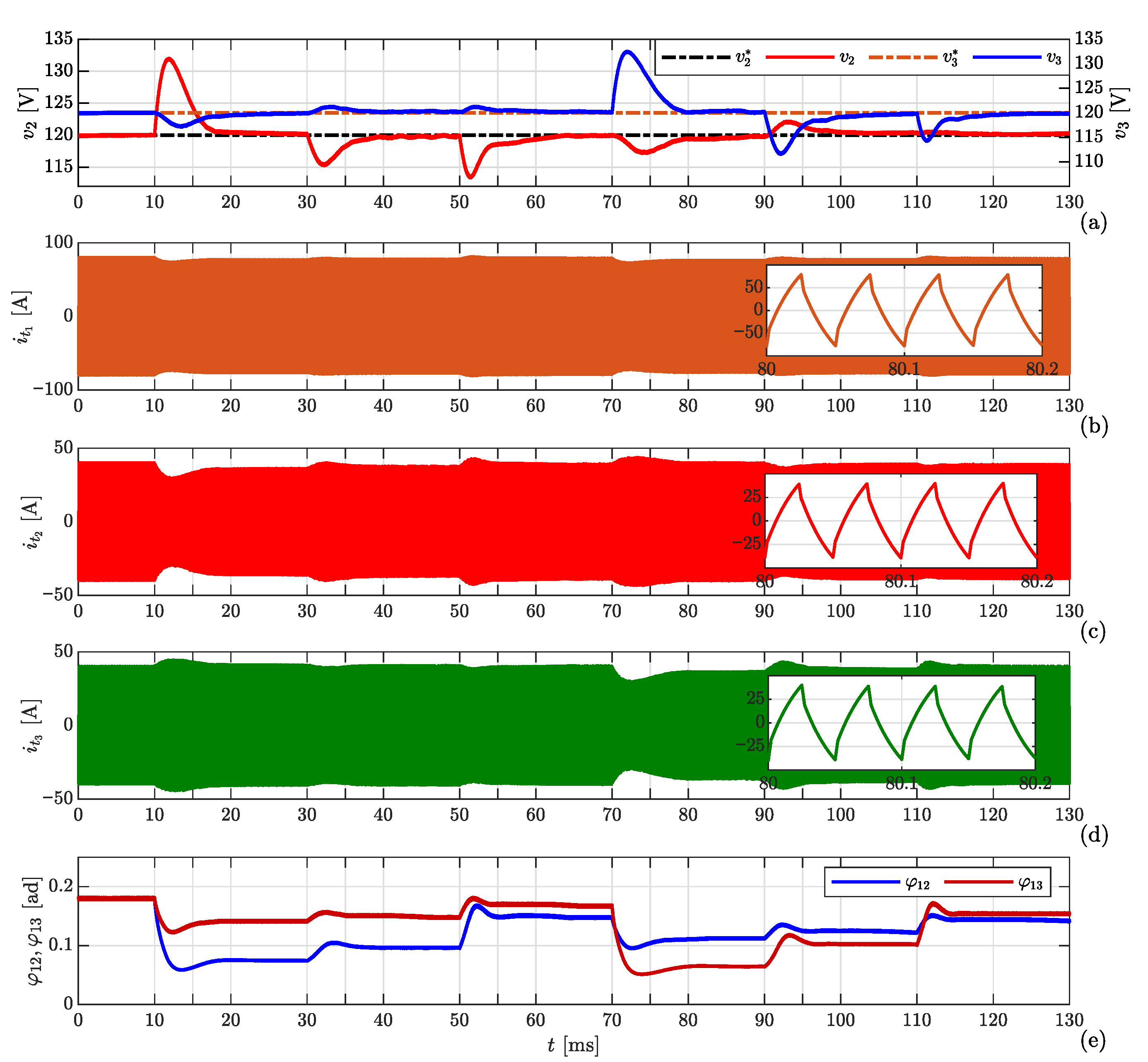
The test performed has a duration of 130 ms and begins with a resistive load of and CPL of 1 kW at each port. The voltage reference changes, from 120 V to 130 V, were applied at ms for and at ms for . Subsequently, at ms, the CPL of port 2 was increased to kW, followed by the connection of a constant current source of 4 A at ms. Next, the CPL of port 3 is increased to kW at ms, and finally at ms, a constant current source of 4 A is connected.
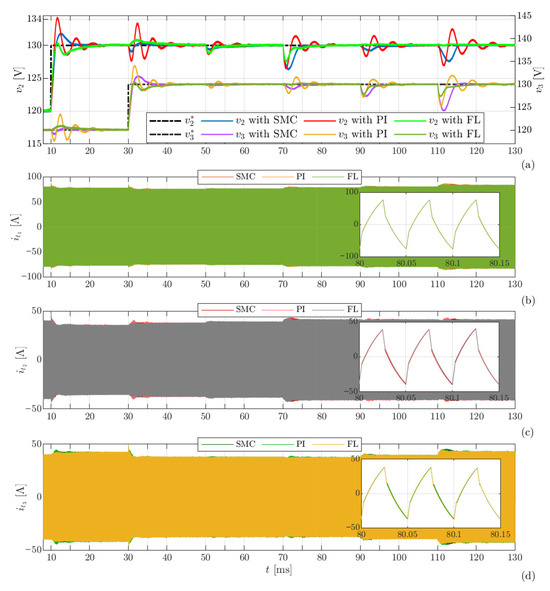
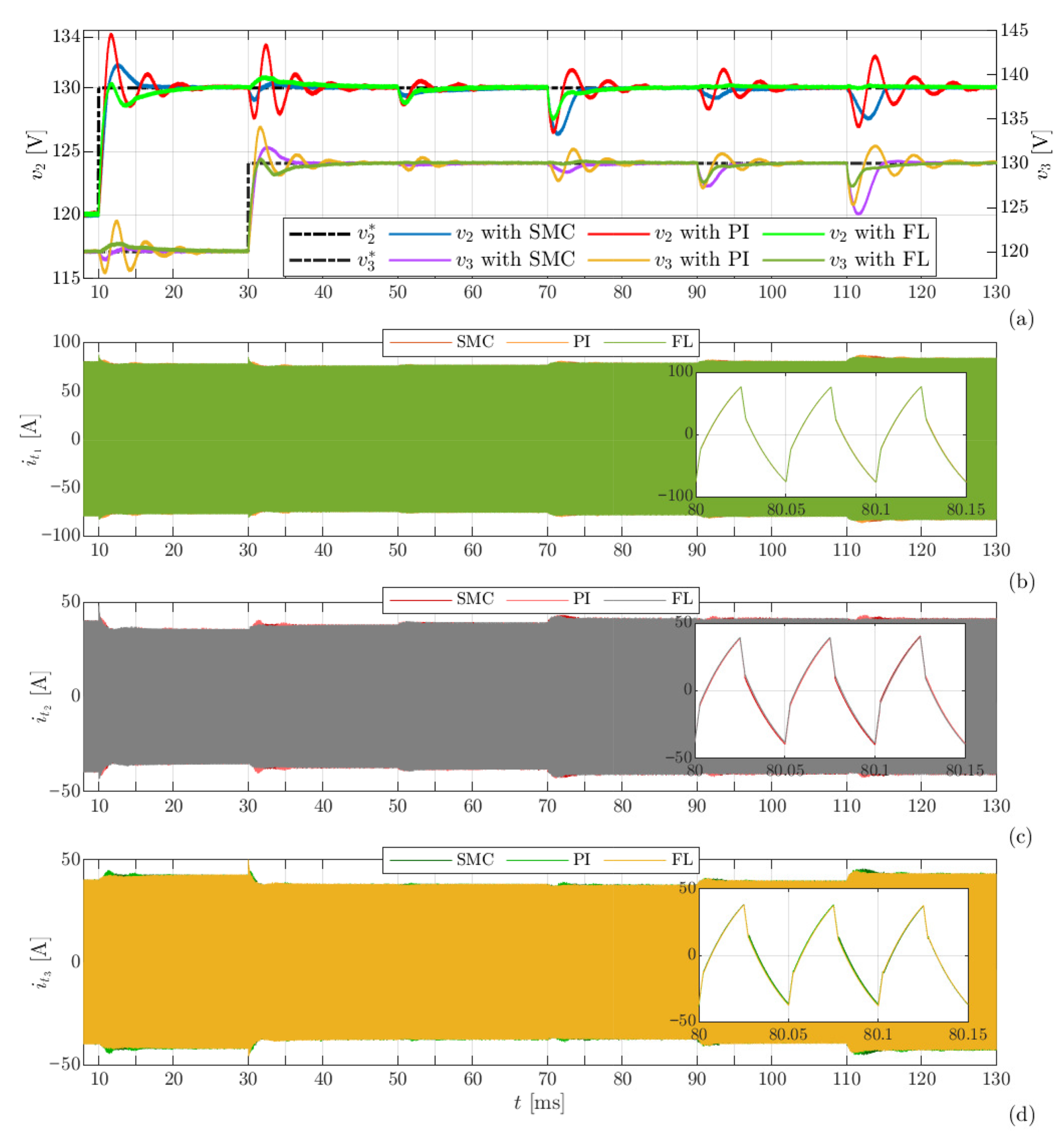
The dynamic response of the voltages of both ports ( and ) is shown in Figure 10a. The proposed FL controller exhibits the best performance, with the fastest recovery time and the lowest overshoot among the three techniques. The SMC shows a robust response but with slightly higher oscillations during transients compared to FL. On the other hand, due to the nonlinear nature of the system and the connected loads, the PI exhibits the more pronounced oscillations and the longest settling time after each disturbance. Specifically, during the current source connection at ms and ms, the FL strategy maintains the voltages and with significantly greater stability than the SMC and PI.
Figure 10.
Comparison of the proposed control strategy with a conventional PI controller [21], and SMC controller [30], in response to reference and load changes. (a) Voltages at ports 2 and 3. (b) Primary current of the HFT. (c) Secondary current () of the HFT. (d) Secondary current () of the HFT.
Finally, Figure 10b–d shows the HFT currents , , and , respectively. It can be seen that, in steady state, the HFT currents for the three controllers have a similar waveform (see details for each one), although the FL strategy achieves a response with fewer oscillations in response to changes in reference and load. The zoom-in views confirm that while the basic waveform is preserved, the FL controller provides a smoother transition between operating points.
To summarize the performance comparison, Table 3 presents a qualitative evaluation of the three control strategies based on the obtained results.
Table 3.
Performance comparison between PI, SMC, and the proposed FL controller.
5.4. Robustness Analysis Against Parametric Variations
To evaluate the reliability and robustness of the proposed control strategy, a parametric sensitivity analysis was performed. This test considers a variation of in the nominal values of the main passive components of the converter: the DC-bus capacitors (, , ), the leakage inductances of the high-frequency transformer (HFT), and the series resistances of its windings (). The objective is to demonstrate that the controller maintains stability and performance even under modeling uncertainties or component aging.
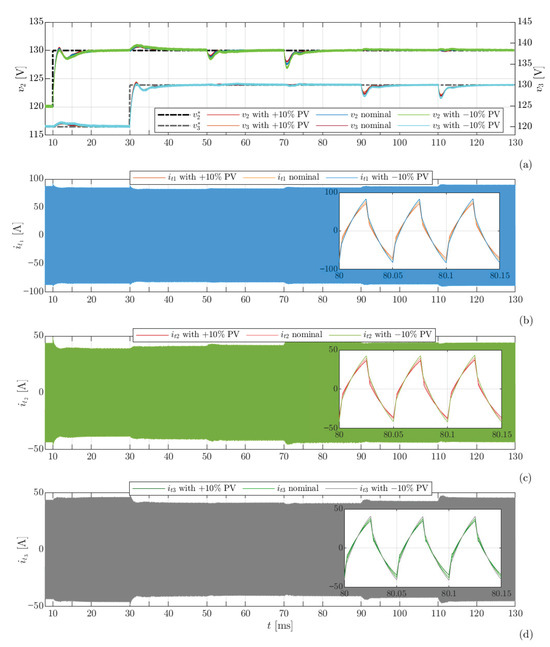
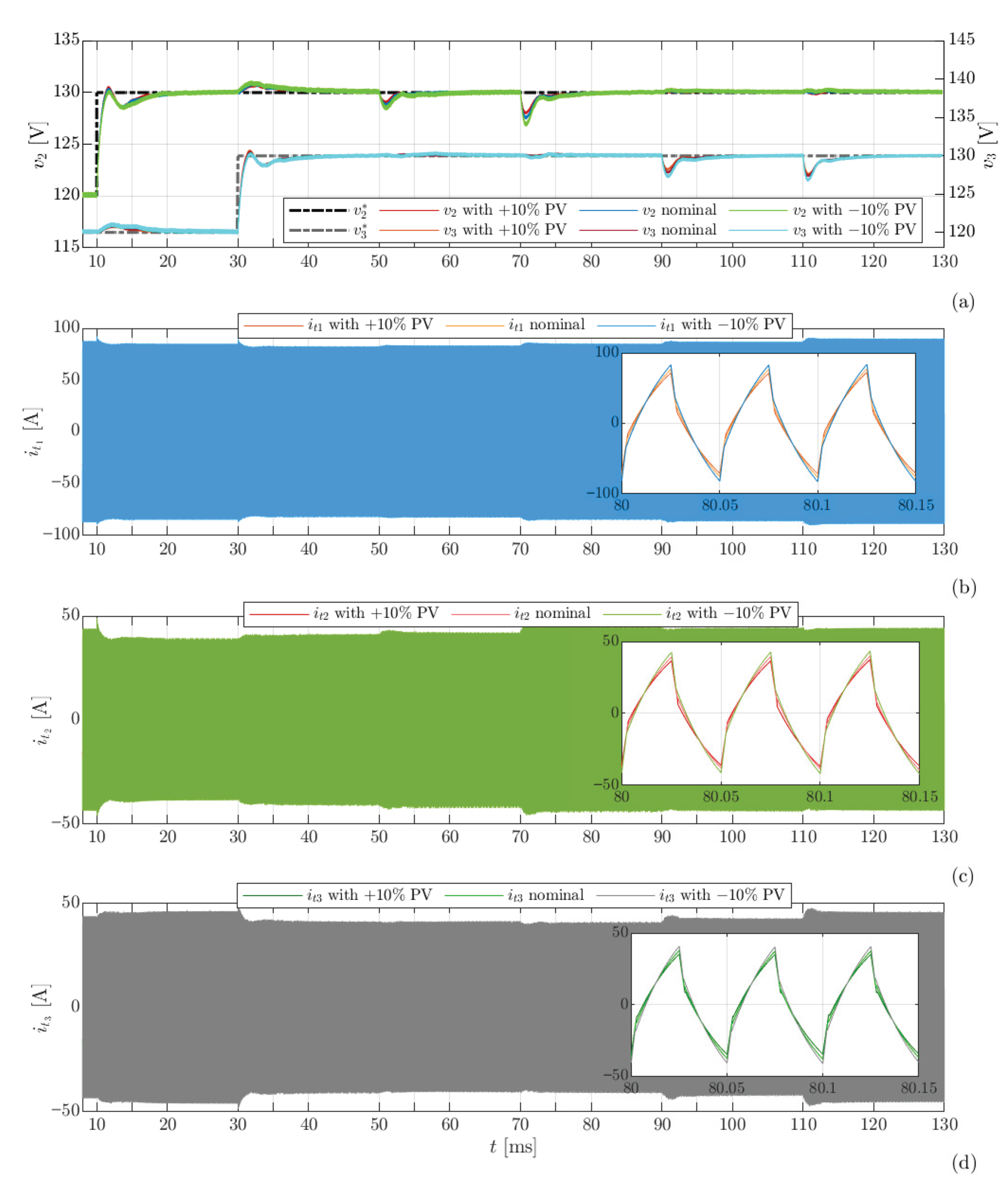
The test conditions are identical to those described in the Section 5.3 regarding reference steps and load disturbances, but focusing on the parametric variation (PV) effects. The dynamic response of the system is shown in Figure 11. It can be observed in Figure 11a that the output voltages and follow their respective references with negligible deviations, regardless of whether the parameters are at their nominal value, PV, or PV. The recovery time and the damping of the oscillations remain almost identical in the three cases, confirming the high robustness of the controller proposed in this work.
Figure 11.
Performance of the proposed control strategy under parametric variations of . (a) Voltages at ports 2 and 3. (b) Current of the HFT. (c) Current of the HFT. (d) Current of the HFT.
Furthermore, Figure 11b–d shows the HFT currents , , and . The zoom-in views provided in each subplot reveal that the current waveforms maintain their symmetry and phase-shift relations. Although the peak values of the currents exhibit minor variations due to the change in the leakage inductance (), the controller effectively compensates for these effects without degrading the voltage regulation at the output ports. These results indicate that the proposed strategy is suitable for practical applications where manufacturing tolerances or thermal effects may shift the passive component values, ensuring stable operation across a wide parametric range.
6. Conclusions
In this paper, a new control strategy was presented for a TAB DC-DC converter used to interconnect three buses of a DC MG. The designed controller allows the voltage to be regulated in two of the MG buses, to which generalized loads composed of components of constant impedance, constant current, and constant power, are connected. Unlike the works proposed in the literature, the converter was modeled based on the equivalent triangle circuit of the HFT and using GSSA. In this way, the dynamics of the fundamental AC component for the HFT currents and DC for the port voltages are captured, and the calculation of the midpoint voltage obtained with the star equivalent is avoided.
The controller was designed using a nonlinear FL-based technique, and thanks to the construction of a nested control scheme, with an internal loop for controlling the real and imaginary parts of the HFT currents and an external control loop for controlling the energy at ports 2 and 3, and thus regulating the voltage at both ports, a controller with good dynamic performance is obtained that ensures the stability of the system in the face of variations in reference and input voltages and large load excursions.
Simulation results demonstrate the superior dynamic performance of the proposed controller. The system exhibits a robust response to reference changes and input voltage perturbations. Furthermore, it ensures stable operation even under high inherent instability caused by the interaction between constant power (CPL) and constant current (ICC) loads, while maintaining zero steady-state error. Finally, comparative studies involving conventional PI and SMC strategies reveal that the proposed nonlinear FL control achieves enhanced dynamic performance and faster convergence, similar to the SMC. Furthermore, unlike the PI scheme, which exhibits degraded performance due to port cross-coupling, the proposed strategy ensures precise regulation and robustness under large-scale load variations, offering a superior balance between implementation simplicity and transient response for TAB-based DC microgrids.
Author Contributions
Conceptualization, F.D.E., F.M.S., E.M.A., G.L.M. and J.C.H.; Methodology, F.D.E., F.M.S., E.M.A., G.L.M. and J.C.H.; Validation, F.D.E., F.M.S., E.M.A., G.L.M. and J.C.H.; Formal analysis, F.D.E., F.M.S., E.M.A., G.L.M. and J.C.H.; Investigation, F.D.E., F.M.S., E.M.A., G.L.M. and J.C.H.; Data curation, J.C.H.; Writing—original draft, F.D.E., F.M.S., E.M.A., G.L.M. and J.C.H.; Writing—review & editing, F.D.E., F.M.S., E.M.A., G.L.M. and J.C.H. All authors have read and agreed to the published version of the manuscript.
Funding
This research received no external funding.
Data Availability Statement
The original contributions presented in this study are included in the article. Further inquiries can be directed to the corresponding author.
Acknowledgments
The authors acknowledge the support provided by the Thematic Network 723RT0150 “Red para la integración a gran escala de energías renovables en sistemas eléctricos (RIBIERSE-CYTED)” financed by the call for Thematic Networks of the CYTED (Ibero-American Program of Science and Technology for Development) for 2022.
Conflicts of Interest
The authors declare no conflicts of interest.
References
- Azeem, O.; Ali, M.; Abbas, G.; Uzair, M.; Qahmash, A.; Algarni, A.; Hussain, M.R. A comprehensive review on integration challenges, optimization techniques and control strategies of hybrid AC/DC microgrid. Appl. Sci. 2021, 11, 6242. [Google Scholar] [CrossRef] [Scilit]
- Ayten, K.; Savrun, M.M. A comprehensive review of DC electric spring structures for sustainable new-generation DC microgrids: Topologies, control methods, challenges and opportunities. Comput. Electr. Eng. 2026, 129, 110841. [Google Scholar] [CrossRef] [Scilit]
- Salem, C.E.; Et-taleby, A.; Chaibi, Y.; Ayadi, N.; Elkari, B.; Benslimane, M.; Chalh, Z. Exploring DC microgrid: Advanced applications and their control strategies. Energy 360 2025, 3, 100019. [Google Scholar] [CrossRef] [Scilit]
- Al-Ismail, F.S. A critical review on DC microgrids voltage control and power management. IEEE Access 2024, 12, 30345–30361. [Google Scholar] [CrossRef] [Scilit]
- Shabbir, G.; Hasan, A.; Javed, M.Y.; Shahid, K.; Mussenbrock, T. Review of DC microgrid design, optimization, and control for the resilient and efficient renewable energy integration. Energies 2025, 18, 6364. [Google Scholar] [CrossRef] [Scilit]
- Adegboyega, A.W.; Sepasi, S.; Howlader, H.O.R.; Griswold, B.; Matsuura, M.; Roose, L.R. DC microgrid deployments and challenges: A comprehensive review of academic and corporate implementations. Energies 2025, 18, 1064. [Google Scholar] [CrossRef] [Scilit]
- Ali, S.; Zheng, Z.; Aillerie, M.; Sawicki, J.P.; Péra, M.C.; Hissel, D. A review of DC microgrid energy management systems dedicated to residential applications. Energies 2021, 14, 4308. [Google Scholar] [CrossRef] [Scilit]
- Hassan, M.A.; Chi, C.; Li, J.; Li, X.; Amanullah, M. DC shipboard microgrids with constant power loads: A review of advanced nonlinear control strategies and stabilization techniques. IEEE Trans. Smart Grid 2022, 13, 3422–3438. [Google Scholar] [CrossRef] [Scilit]
- Huang, M.; Song, X.; Wu, J.; Li, W.; Zhang, X. Enhanced dynamic performance of DC microgrids in more electric aircraft via hybrid energy storage system. Chin. J. Aeronaut. 2025, 38, 103885. [Google Scholar] [CrossRef] [Scilit]
- Ahmadi, F.; Bizzarri, F.; Batmani, Y.; Brambilla, A.M.; Bevrani, H. Observer-based adaptive controller design for DC/DC buck converter interfaced DC microgrids feeding constant power loads. Electr. Power Syst. Res. 2026, 254, 112629. [Google Scholar] [CrossRef] [Scilit]
- Deng, H.; Wen, W.; Zhang, Y.; Long, S.; Jin, L. Stability control of the DC/DC converter in DC microgrids considering negative damping and parameter uncertainties. Energies 2026, 19, 697. [Google Scholar] [CrossRef] [Scilit]
- Du, P.; Wang, H.; Li, R.; Hu, B.; Fang, J. A novel hierarchical optimization energy management strategy of intelligent multi-port energy router in expressway DC microgrid. Results Eng. 2026, 29, 109520. [Google Scholar] [CrossRef] [Scilit]
- Wang, Q.; Gunawardane, K.; Li, L. A review of multi-port converter architecture in hydrogen-based DC microgrid. Energies 2025, 18, 6487. [Google Scholar] [CrossRef] [Scilit]
- Salagiannis, G.; Tatakis, E. Review on non-isolated multiport converters for residential DC microgrids. Energies 2024, 17, 222. [Google Scholar] [CrossRef] [Scilit]
- Meher, J.; Roy, K.; Ghosh, A. Application of triple active bridge converter on DC micro grid. In Proceedings of the 2024 IEEE 4th International Conference on Sustainable Energy and Future Electric Transportation (SEFET), Hyderabad, India, 31 July–3 August 2024; pp. 1–5. [Google Scholar]
- Pham, V.L.; Wada, K. Applications of triple active bridge converter for future grid and integrated energy systems. Energies 2020, 13, 1577. [Google Scholar] [CrossRef] [Scilit]
- Koohi, P.; Watson, A.J.; Clare, J.C.; Soeiro, T.B.; Wheeler, P.W. A survey on multi-active bridge DC-DC converters: Power flow decoupling techniques, applications, and challenges. Energies 2023, 16, 5927. [Google Scholar] [CrossRef] [Scilit]
- Mukherjee, S.; Sarkar, I. A brief review on triple active bridge DC-DC converter. In Proceedings of the 2023 IEEE International Students’ Conference on Electrical, Electronics and Computer Science (SCEECS), Bhopal, India, 18–19 February 2023; pp. 1–6. [Google Scholar]
- Uttam, V.; Kudaravalli, V.R.; Iyer, V.M. Generalised harmonic model for a triple active bridge DC-DC converter. In Proceedings of the 2022 IEEE Energy Conversion Congress and Exposition (ECCE), Detroit, MI, USA, 9–13 October 2022; pp. 1–7. [Google Scholar]
- Henao-Muñoz, A.C.; Debbat, M.B.; Pepiciello, A.; Domínguez-García, J.L. Triple active bridge modeling and decoupling control. Electronics 2025, 14, 4224. [Google Scholar] [CrossRef] [Scilit]
- Henao-Muñoz, A.C.; Pepiciello, A.; Domínguez-García, J.L. Control strategy for a triple active bridge converter: A generalized average model approach. In Proceedings of the 2023 IEEE PES Innovative Smart Grid Technologies Europe (ISGT EUROPE), Grenoble, France, 23–26 October 2023; pp. 1–5. [Google Scholar]
- Bossi, G.; Campagna, N.; Boi, M.; Miceli, R.; Damiano, A. An inherent decoupled triple-active bridge converter for all-electric aircraft DC power systems. Energies 2024, 17, 6368. [Google Scholar] [CrossRef] [Scilit]
- Debbat, M.B.; Henao-Muñoz, A.C.; Pepiciello, A.; Domínguez-García, J.L. Sliding-mode based control technique for triple active bridge DC-DC converter. In Proceedings of the 2024 XV International Symposium on Industrial Electronics and Applications (INDEL), Banja Luka, Bosnia and Herzegovina, 6–8 November 2024; pp. 1–6. [Google Scholar]
- Adam, A.H.A.; Chen, J.; Xu, M. Model predictive control based on single-phase shift modulation for triple active bridge DC-DC converter. Sci. Rep. 2024, 14, 30284. [Google Scholar] [CrossRef] [Scilit]
- Fantino, R.A.; Busada, C.A.; Solsona, J.A. Power Decoupling of an AC-Side Voltage Sensorless Three-Phase Converter Under Unbalanced Grid Conditions. IEEE Trans. Power Electron. 2026, 41, 8612–8623. [Google Scholar] [CrossRef] [Scilit]
- Huang, S.; Wang, L.; Xiong, L.; Zhou, Y.; Gao, F.; Huang, W.; Li, Y.; Guo, H.; Wang, F. Hierarchical Robustness Strategy Combining Model-Free Prediction and Fixed-Time Control for Islanded AC Microgrids. IEEE Trans. Smart Grid 2025, 16, 4380–4394. [Google Scholar] [CrossRef] [Scilit]
- Özden, M.; Ertekin, D. A Levenberg–Marquardt Learning-Based Artificial Neural Network Controller for Battery Charging in Hydrogen and Solar-Powered Electric Vehicle Stations. Fuel Cells 2026, 26, 100043. [Google Scholar] [CrossRef] [Scilit]
- Qi, Q.; Ghaderi, D.; Guerrero, J.M. Sliding mode controller-based switched-capacitor-based high DC gain and low voltage stress DC-DC boost converter for photovoltaic applications. Int. J. Electr. Power Energy Syst. 2021, 125, 106496. [Google Scholar] [CrossRef] [Scilit]
- Adam, A.H.A.; Al-Shetwi, A.Q.; Chen, J.; Xu, M.; Alkhalaf, S.; Rezk, H. Power decoupling enhancement of a triple active bridge converter with feedforward compensation based on model predictive control and fuzzy logic controller in DC microgrid systems. IEEE Access 2024, 12, 140310–140328. [Google Scholar] [CrossRef] [Scilit]
- Han, J.; Li, X.; Sun, Y.; Gong, S.; Huang, S. Optimal design and decoupling control of series DC-link voltages for quadruple-active-bridge based UPQC. Int. J. Electr. Power Energy Syst. 2022, 140, 108038. [Google Scholar] [CrossRef] [Scilit]
- Bacha, S.; Munteanu, I.; Bratcu, A.I. Power Electronic Converters Modeling and Control: With Case Studies; Springer: London, UK, 2014. [Google Scholar]
- Busada, C.A.; Gomez Jorge, S.; Solsona, J.A. Feedback Linearization of a Grid-Tied Synchronverter. IEEE Trans. Ind. Electron. 2023, 70, 147–154. [Google Scholar] [CrossRef] [Scilit]
- Esteban, F.D.; Serra, F.M.; De Angelo, C.H.; Montoya, O.D. Nonlinear control for a DC–DC converter with dual active bridges in a DC microgrid. Int. J. Electr. Power Energy Syst. 2023, 146, 108731. [Google Scholar] [CrossRef] [Scilit]

Disclaimer/Publisher’s Note: The statements, opinions and data contained in all publications are solely those of the individual author(s) and contributor(s) and not of MDPI and/or the editor(s). MDPI and/or the editor(s) disclaim responsibility for any injury to people or property resulting from any ideas, methods, instructions or products referred to in the content. |
© 2026 by the authors. Licensee MDPI, Basel, Switzerland. This article is an open access article distributed under the terms and conditions of the Creative Commons Attribution (CC BY) license.