Article

Terahertz ISAC with Simultaneous Fast-Swept FMCW Radar and High-Speed Wireless Link Using a Single UTC-PD


1
Graduate School of Information Science and Electrical Engineering, Kyushu University, Fukuoka 819-0395, Japan
2
NTT Device Technology Laboratories, NTT Corporation, Atsugi 243-0198, Japan
*
Author to whom correspondence should be addressed.
Electronics 2026, 15(8), 1608; https://doi.org/10.3390/electronics15081608
Submission received: 4 February 2026 / Revised: 6 April 2026 / Accepted: 8 April 2026 / Published: 13 April 2026
(This article belongs to the Section Optoelectronics)

Abstract

With ongoing advancements toward 6G networks, the terahertz (THz) band is expected to serve as an essential platform for realizing integrated sensing and communication (ISAC). In particular, maintaining high-data-rate communication while ensuring highly responsive, real-time radar operation in dynamic environments is a critical requirement. This study presents a THz-band ISAC architecture that utilizes a high-speed wavelength-tunable laser for photomixing, enabling simultaneous generation of a fast frequency-swept frequency-modulated continuous-wave (FMCW) radar signal and amplitude-shift keying (ASK) communication. The wavelength-tunable laser enables sub-microsecond frequency sweeps and supports high repetition rates suitable for real-time operation. To address the limitations in waveform design efficiency in conventional time-division ISAC, we experimentally investigate two transmission strategies for simultaneous operation. The first is a frequency-division scheme that reduces mutual interference between radar and communication signals, and the second is a joint-waveform scheme in which both functions share the same THz carrier. Using a single THz transmitter, the proposed system achieves sub-centimeter ranging accuracy together with 15-Gbit/s data transmission. These findings demonstrate that the presented ISAC approach enables efficient integration of radar and communication functions while lowering overall system complexity and implementation cost, offering substantial potential for deployment in future 6G infrastructures.

1. Introduction

Future sixth-generation (6G) wireless networks are expected to advance communication capabilities by achieving extremely high data rates, low-latency and ultra-reliable connections, and enhanced support for emerging applications such as immersive media and massive IoT [1,2]. In parallel, radar sensing technologies are expected to evolve toward finer spatial resolution, improved robustness against interference, and faster target tracking for applications such as autonomous driving and environmental monitoring [3,4,5]. As a result, integrated sensing and communication (ISAC) has been identified as a key use case in 6G, as reflected in various standardization roadmaps [6]. Electromagnetic waves in the terahertz (THz) range (0.1–3 THz) are considered strong candidates for use in future 6G systems. Owing to their extremely wide bandwidth, THz waves can support ultra-high-capacity wireless links, and research on THz communication has been actively pursued in recent years [6,7,8,9,10,11,12,13,14,15,16,17,18]. At the same time, THz-band frequency-modulated continuous-wave (FMCW) radar has attracted significant attention, owing to its exceptional range resolution, strong interference robustness, and excellent signal-to-noise characteristics. These capabilities have enabled applications in areas such as medical imaging, material characterization, security screening, and a wide range of motion-related sensing applications [19,20,21,22]. Consequently, the THz band has become a particularly important focus for ISAC research, as it uniquely enables both high-capacity communication and high-resolution sensing [23,24].
However, realizing high-performance ISAC in the THz band remains challenging. Electronic THz sources struggle to realize wideband operation due to device limitations, while photonic approaches based on photomixing enable flexible frequency generation from optical carriers. For 6G use cases such as autonomous vehicles, unmanned aerial vehicles (UAVs), human motion tracking, automated guided vehicles (AGVs), and hazard detection, radar sensing requires high update rates and continuous operation in dynamic environments. Many existing THz-ISAC demonstrations rely on pulsed radar systems [25,26,27,28], which inherently limit the real-time performance. To address this limitation, this work focuses on FMCW radar, which enables continuous range measurements and, in principle, can support simultaneous velocity estimation without interrupting operation. To fully exploit these advantages, FMCW radar must employ fast frequency sweeps to achieve high update rates and low-latency sensing. In addition, prior THz-band ISAC studies have implemented frequency-swept radar approaches using arbitrary waveform generators (AWGs) [29,30], but such systems tend to be large and expensive, and they offer limited flexibility in tuning range and modulation bandwidth.
In this study, we propose a fast-swept THz FMCW radar system enabled by photomixing driven by a high-speed wavelength-tunable laser. This approach eliminates the need for AWGs or external modulators and enables FMCW modulation in a simple and low-cost manner through direct control of the laser wavelength. Specifically, we employ a reflection-type transversal filter laser diode (RTF-LD) [31] that can switch wavelengths on a nanosecond timescale via the electro-optic effect while maintaining a narrow linewidth of approximately 350 kHz. By applying continuous electrical drive signals, the RTF-LD enables rapid wavelength sweeping, allowing the FMCW sweep duration to reach the sub-microsecond regime. The resulting sweep speed far surpasses that of conventional thermo-optic or current-injection tunable lasers, leading to a substantial improvement in real-time performance for THz sensing applications. Although the proposed architecture possesses the inherent capability for high-speed dynamic tracking, the experimental scope of this initial study focuses on static targets to establish the fundamental performance of the simultaneous ISAC transmission. Demonstrations of real-time dynamic ranging and velocity estimation remain as important future work. In our previous work, we demonstrated a THz-band ISAC system based on FMCW radar and frequency-shift keying (FSK) communication [32]. However, this approach exhibited limited spectral efficiency, and the data rate was limited to 2 Gbit/s. In this work, we significantly improve the previous approach by achieving high-data-rate communication while maintaining fast-swept FMCW radar operation with sub-centimeter-level ranging performance. Furthermore, the proposed system introduces a more integrated and simplified waveform design, enabling more efficient use of the spectrum and reducing overall system complexity. A performance comparison of the proposed THz-ISAC system with representative prior works is summarized in Table 1.
Next, the waveform design of the ISAC system is examined. A simple approach is to use time-division, where communication and radar functions are allocated to separate transmission intervals [30]. However, such temporal separation imposes fundamental limitations on the efficient use of the available signal resources. To address this, we investigate two simultaneous transmission schemes using a single transmitter. The first is a frequency-division scheme, which we implemented as an initial feasibility demonstration. By placing the radar and communication signals in separate frequency bands, the two can be transmitted simultaneously with reduced mutual interaction. This frequency-division scheme is well suited for photomixing-based THz generation, which can generate multiple carriers with independently tunable frequencies. This capability provides multiple degrees of freedom for designing flexible multi-carrier ISAC configurations. In our experimental receiver for the frequency-division scheme, heterodyne detection is employed, which preserves both amplitude and phase of the received signal and is suitable for high-order modulation formats. In this study, we select ASK modulation as the primary test case because it provides a robust and straightforward baseline to clearly validate the fundamental concept of simultaneous ISAC transmission. While the practical demonstration of QAM-level performance is beyond the scope of this initial work, the inherent compatibility of our platform with such advanced formats opens up promising avenues for future capacity scaling. However, this frequency-division scheme requires the receiver to perform frequency-selective processing to separate the signal components. In addition to this approach, we also examine a second scheme, the joint-waveform scheme, in which communication symbols are superimposed on the chirped radar waveform. The joint-waveform scheme enables the communication signal to be received by simple direct detection without requiring frequency-selective processing at the receiver. It also reduces the number of lasers used for photomixing, which simplifies the transmitter architecture. In this work, we realize the joint-waveform scheme by using a continuous FMCW radar signal as the carrier and superimposing amplitude-shift keying (ASK) modulation onto it, achieving a simple implementation with highly efficient spectrum utilization.
Using these methods, we experimentally demonstrate sub-centimeter ranging performance together with multi-Gbit/s communication. The joint-waveform scheme achieves 15 Gbit/s with a bit error rate (BER) below the hard-decision forward error correction (HD-FEC) threshold. These results confirm that the proposed THz-band ISAC framework provides a practical and scalable approach for next-generation 6G systems.

2. Principles

2.1. Photomixing-Based Modulation of THz Waves Using a Wavelength-Tunable Laser

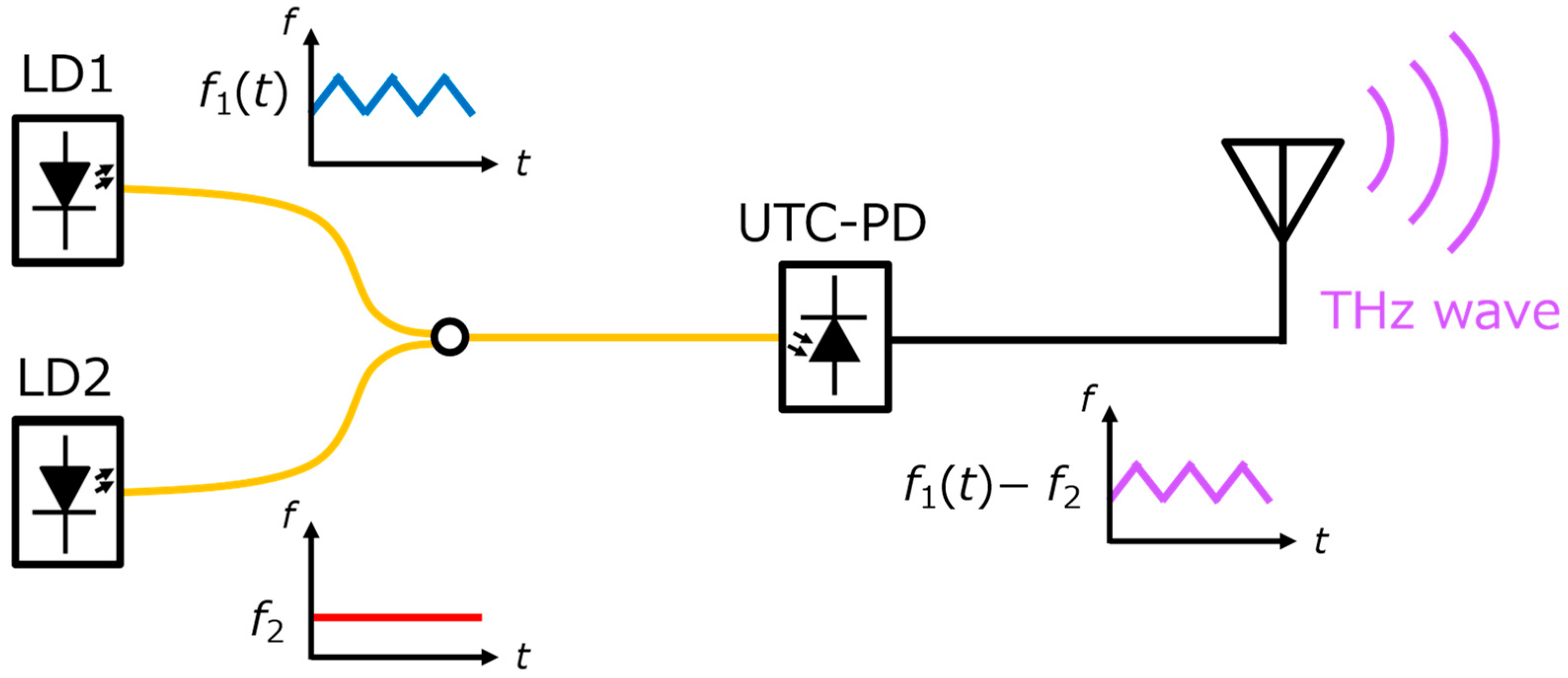
In photomixing-based THz generation, an electrical signal corresponding to the frequency difference between two lightwaves is produced [33], enabled by a uni-traveling-carrier photodiode (UTC-PD) [34,35]. Figure 1 illustrates a schematic of THz-wave generation through photomixing using a wavelength-tunable laser. The electric fields of the two lightwaves emitted from the lasers can be written as follows, where A1 and A2 represent their amplitudes and φ1 and φ2 denote their initial phases.
E 1 = A 1 exp j 2 π f 1 t   t + φ 1 ,
E 2 = A 2 exp j 2 π f 2 t + φ 2 .
Here, E1 is generated by the wavelength-tunable laser, whereas E2 is generated by the fixed-wavelength laser. The optical frequency f1(t) varies continuously in time, following a sweep pattern such as that illustrated in Figure 1, while f2 remains constant. When these two lightwaves are combined and injected into the UTC-PD operating as a photomixer, the square-law detection generates a photocurrent I given by
I E 1 + E 2 2 = A 1 2 + A 2 2 + 2 A 1 A 2 cos 2 π f 1 t f 2 t + φ 1 φ 2 .
If the frequency difference f1(t) − f2 is set within the RF bandwidth of the UTC-PD, a THz wave is generated. As illustrated in Figure 1, the THz frequency directly follows the tuning of the wavelength-tunable laser, and thus frequency modulation of the THz wave can be achieved through photomixing. Therefore, in the proposed photonic THz-FMCW radar, the sweep bandwidth and sweep period of the wavelength-tunable laser are key parameters. Furthermore, photomixing allows the amplitude and phase of the generated THz wave to inherit those of the lightwaves, as implied by (3). This property enables THz communication signals to be generated simply by modulating the lightwaves using standard optical communication devices such as electro-optic modulators. In addition, photomixing enables the generation of multiple THz signals simply by increasing the number of lightwave pairs, providing a flexible way to realize multi-frequency THz operation. By controlling the optical inputs, this approach supports flexible THz-wave generation while maintaining seamless compatibility with optical networks, positioning photomixing as an essential technique for future 6G wireless systems.

2.2. Michelson Interferometer-Based THz-FMCW Ranging

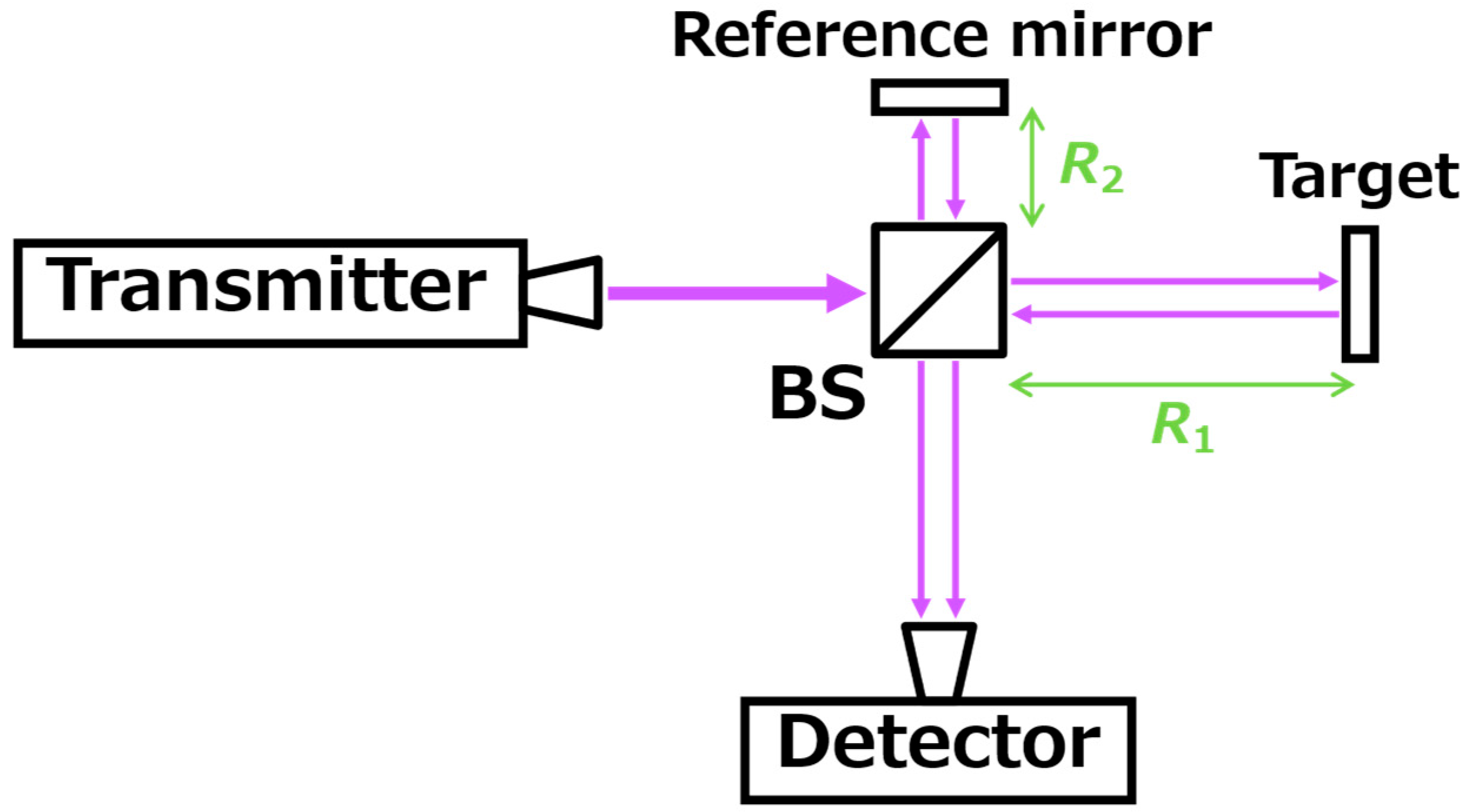
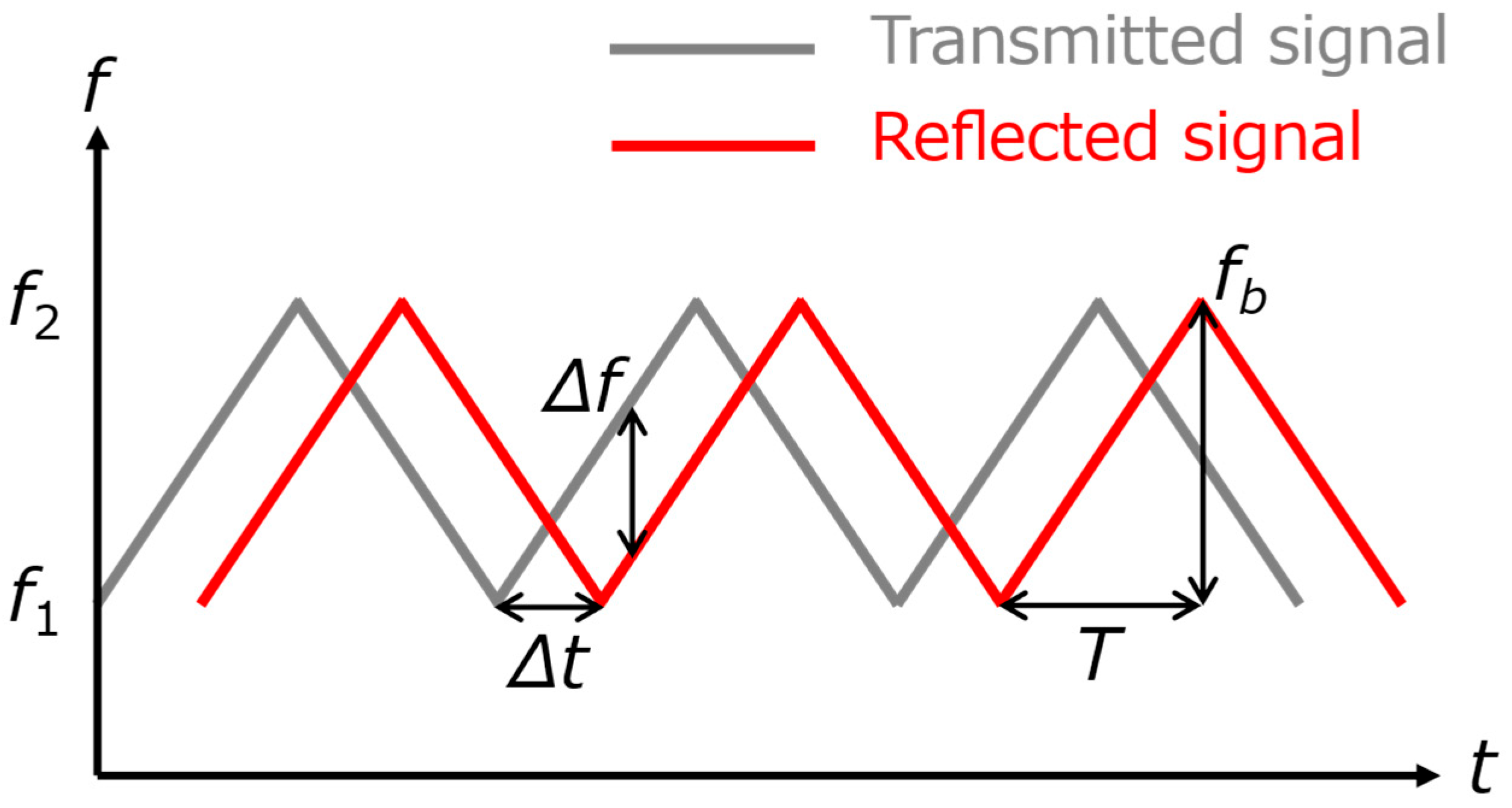
Figure 2 illustrates the configuration of a Michelson interferometer employed for ranging in a THz-FMCW radar system. The interferometer consists of a THz-FMCW signal source (transmitter), a beam splitter (BS), a target, a reference mirror, and a detector. By using this interferometer, the path length difference between the propagation paths from the BS to the target (R1) and to the reference mirror (R2) can be measured. When R2 is fixed and known in advance, the target distance R1 can be determined from the measured path length difference. When the THz-FMCW signal transmitted from the source is continuously swept from frequency f1 to f2, the reflected signals from the reference mirror and the target are illustrated in Figure 3. Defining the path length difference as ΔR = R1R2 and the sweep bandwidth as fb = f2f1, the relationships among the beat frequency Δf, the time delay Δt, the speed of light c, and the sweep duration T are given by
f t = f b T ,
c t = 2 R .
From these relations, ΔR can be expressed as
R = c t 2 = c T 2 f b f .
Since c, T, and fb are known parameters, ΔR can be obtained experimentally by measuring the beat frequency Δf. In the performance of a THz-FMCW radar, the sweep bandwidth fb and the sweep duration T are key parameters. A larger sweep bandwidth fb improves the range resolution. In addition, a shorter sweep duration T enhances the temporal resolution, thereby improving real-time ranging performance for fast-moving targets.

3. Frequency-Division Scheme for THz ISAC

3.1. Experimental Setup

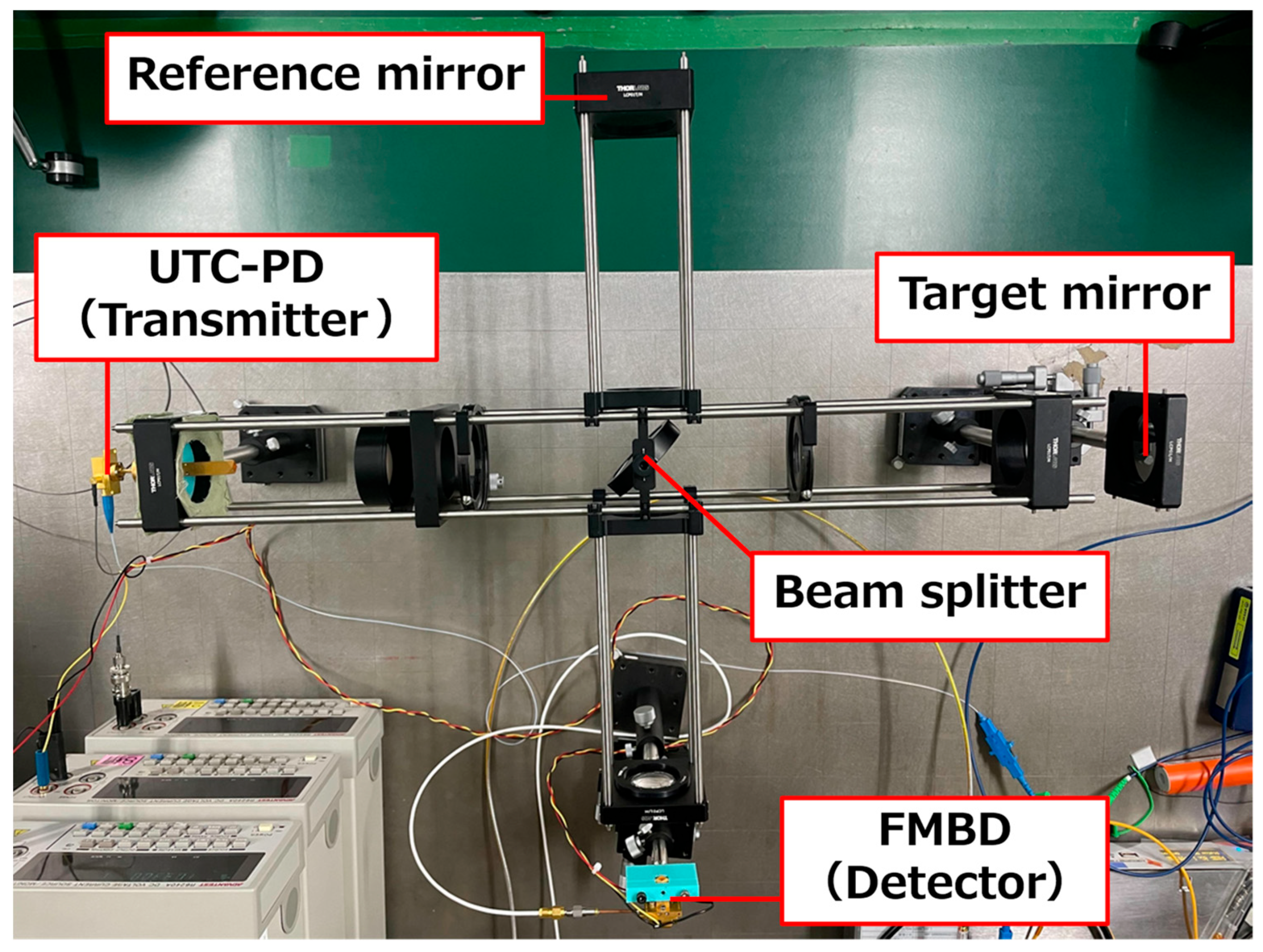
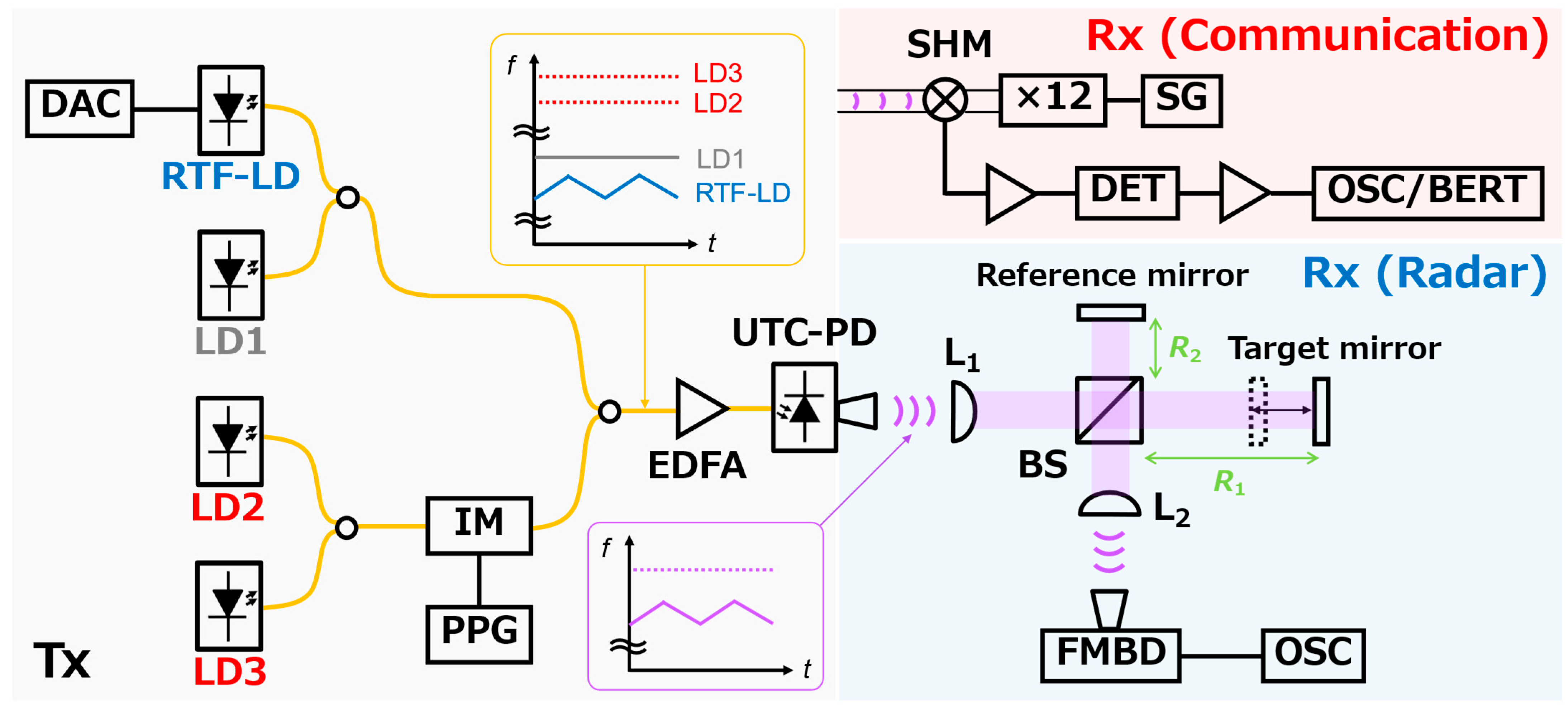
As a simultaneous transmission approach using a single transmitter for THz-band ISAC, we first describe the frequency-division scheme. Figure 4 illustrates the overall configuration of the experimental system. At the transmitter, a triangular voltage waveform with an 800 ns period was produced using a digital-to-analog converter (DAC) and applied to the wavelength control electrode of the RTF-LD, enabling continuous chirping of the laser frequency. As a result, the lasing frequency was linearly swept from 192.4684 THz to 192.4746 THz. Meanwhile, a fixed-wavelength laser diode (LD1) operating at 192.7100 THz was combined with the chirped lightwave via an optical coupler. For ASK modulation, two additional lasers (LD2 and LD3) with optical frequencies of 193.7100 THz and 193.9850 THz, respectively, were combined and intensity-modulated by an optical intensity modulator (IM) driven by a pseudo-random binary sequence (PRBS, length 27 − 1) generated by a pulse pattern generator (PPG). All the lightwaves were combined, amplified by an erbium-doped fiber amplifier (EDFA), and then injected into a UTC-PD, which served as a photomixer. Within the UTC-PD, mixing of the optical frequencies simultaneously generated a 240-GHz FMCW radar signal from the RTF-LD/LD1 pair and a 275-GHz ASK signal from the LD2/LD3 pair. Two different receiver configurations were employed for FMCW ranging and ASK data transmission, respectively. The measurement setup of the Michelson interferometer-based ranging system is shown in Figure 5. For the radar measurement, the THz wave radiated from a horn antenna was collimated by lens 1 (L1, focal length 100 mm) and then split by a BS in a Michelson interferometer configuration toward a reference mirror and a measurement target. The THz waves reflected from each path were subsequently collected by lens 2 (L2, focal length 100 mm) and detected by a Fermi-level managed barrier diode (FMBD) [36], where the resulting beat frequency was observed using an oscilloscope (OSC). A time delay caused by the difference between the target distance R1 and fixed reference distance R2 = 6.5 cm resulted in a measurable beat signal. The target position R1 was set to six discrete distances (20, 25, 30, 35, 40, and 45 cm) for the ranging measurements. For communication performance evaluation, the received THz wave was mixed with a 305-GHz local oscillator (LO) generated by a signal generator (SG) followed by a frequency multiplier (×12), using a sub-harmonic mixer (SHM). The resulting 30-GHz ASK intermediate-frequency (IF) signal was selectively amplified using an amplifier with a bandwidth of 38 GHz. The baseband signal was then extracted using an envelope detector (DET), further amplified, and its quality evaluated using an OSC and a bit-error-rate tester (BERT).

3.2. Results and Discussion

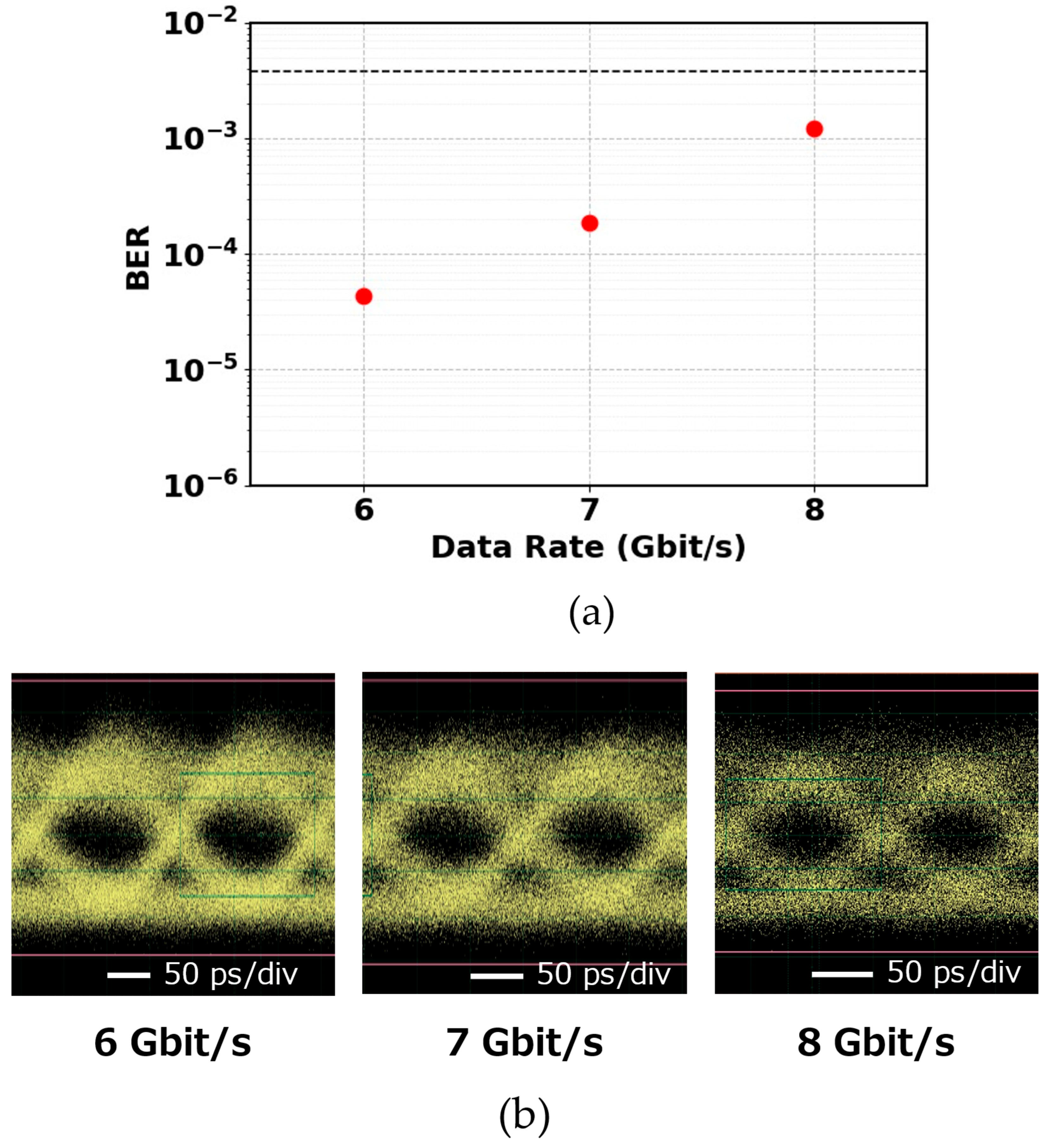
Figure 6 shows the communication performance of the proposed system. Figure 6a plots the measured BER as a function of data rate. At a data rate of 8 Gbit/s, the BER was measured to be 1.2046 × 10⁻³, which is lower than the HD-FEC threshold of 3.8 × 10⁻³. Figure 6b presents the eye diagrams obtained at data rates of 6, 7, and 8 Gbit/s. The eye diagrams observed on the oscilloscope exhibit a clear opening, indicating that the received signals have sufficient quality. Overall, communication performance satisfying the HD-FEC threshold was achieved at data rates of up to 8 Gbit/s. The limitation on the achievable data rate is mainly attributed to the receiver-side signal processing in the IF domain after down-conversion. In this experiment, a LO frequency of 305 GHz was employed for both the 240 GHz FMCW radar signal and the 275 GHz ASK communication signal, resulting in down-converted IF signals at 65 GHz and 30 GHz, respectively. Subsequently, an amplifier with an operating bandwidth of 38 GHz was used to suppress the 65 GHz FMCW component while selectively amplifying the 30 GHz ASK signal. In this configuration, the amplifier effectively behaved as a non-ideal low-pass filter, which may have introduced waveform distortion in the ASK signal. In addition, the amplifier used after the DET had a bandwidth of 10 GHz, which may have further limited the BER performance at 8 Gbit/s. Since this limitation is due to the experimental hardware rather than any theoretical constraints of the proposed scheme, further enhancement of the achievable data rate is expected by improving these receiver-side components, including the filtering and amplification.
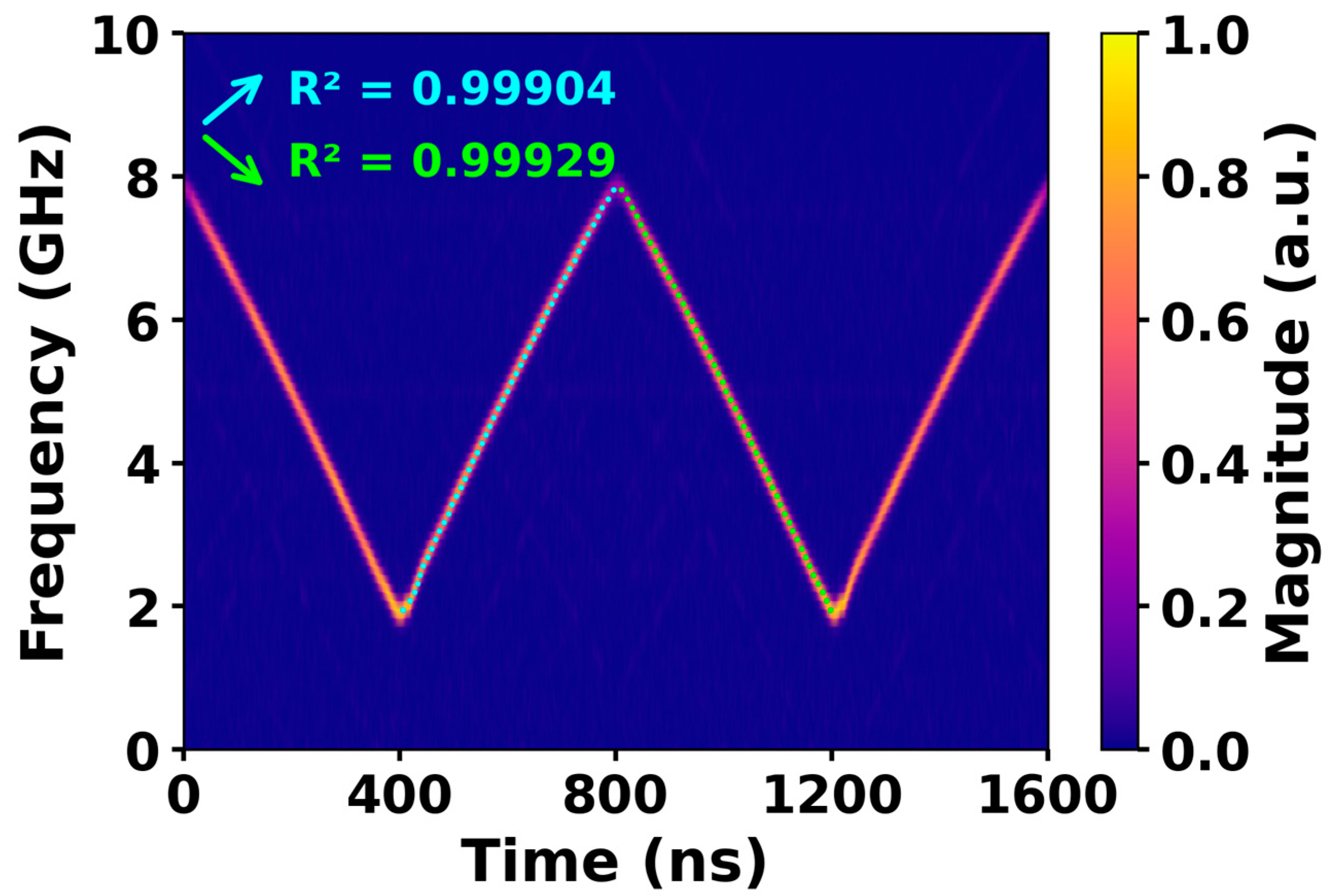
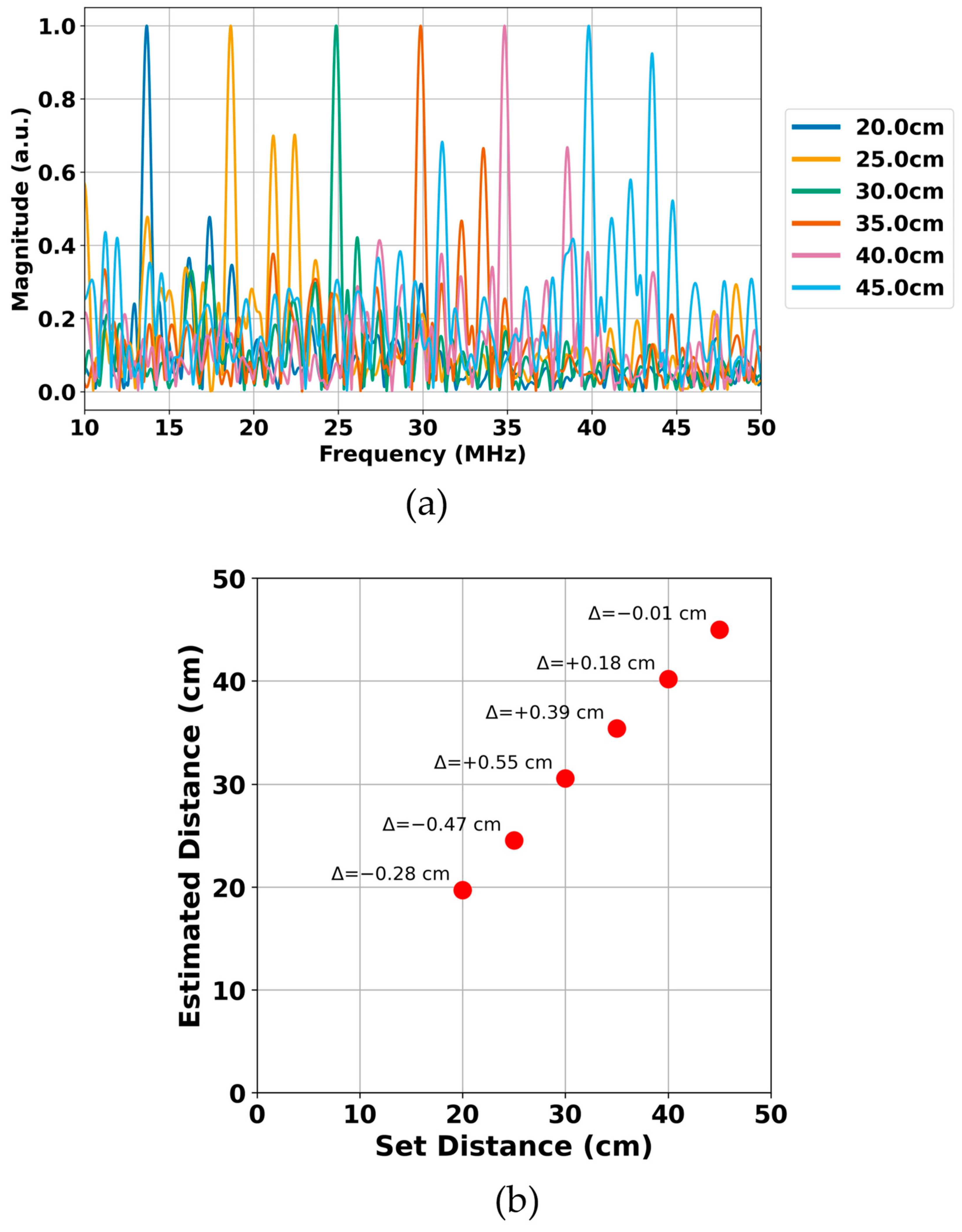
Figure 7 shows the short-time Fourier transform (STFT) of the THz-FMCW signal. The STFT was obtained from the IF signal down-converted by a SHM and recorded with an OSC. The analyzed FMCW signal had a sweep bandwidth of 6.2 GHz, and the frequency sweep exhibited high linearity over time. This linearity was further quantified by extracting the peak-frequency trajectories from the STFT for both the up-chirp and down-chirp and fitting them with linear functions, yielding coefficients of determination (R2) exceeding 0.999 in both cases. In addition, the sweep duration for a single chirp was 400 ns, demonstrating the successful generation of a THz-FMCW signal with an extremely fast frequency sweep. Figure 8a shows the beat-frequency spectra obtained for different target distances using a Michelson interferometer. The signals were detected by a FMBD and then processed by Fourier transform. Distinct spectral peaks were observed at all six measurement points, confirming successful distance estimation at each target position. By extracting the peak frequency from each spectrum, the target distance was calculated using Equation (6). Figure 8b plots the estimated distances as a function of the set target distances. Across the six measurement points, the maximum ranging error was limited to 0.55 cm, indicating highly accurate distance estimation at the sub-centimeter level. Importantly, all of these results were obtained under simultaneous generation of the ASK communication signal and the FMCW radar signal, thereby experimentally validating the effectiveness of the proposed THz-band ISAC system. In the frequency-division scheme, the radar and communication signals are allocated to different frequency bands. Therefore, mutual interference between the two functions is inherently suppressed, and signal distortion due to communication load is expected to be negligible. While the experimental validation in this study focuses on static targets to establish the fundamental performance, the proposed system is extensible to dynamic target tracking, and there are no fundamental limitations preventing this.

4. Joint-Waveform Scheme for THz ISAC

4.1. Experimental Setup

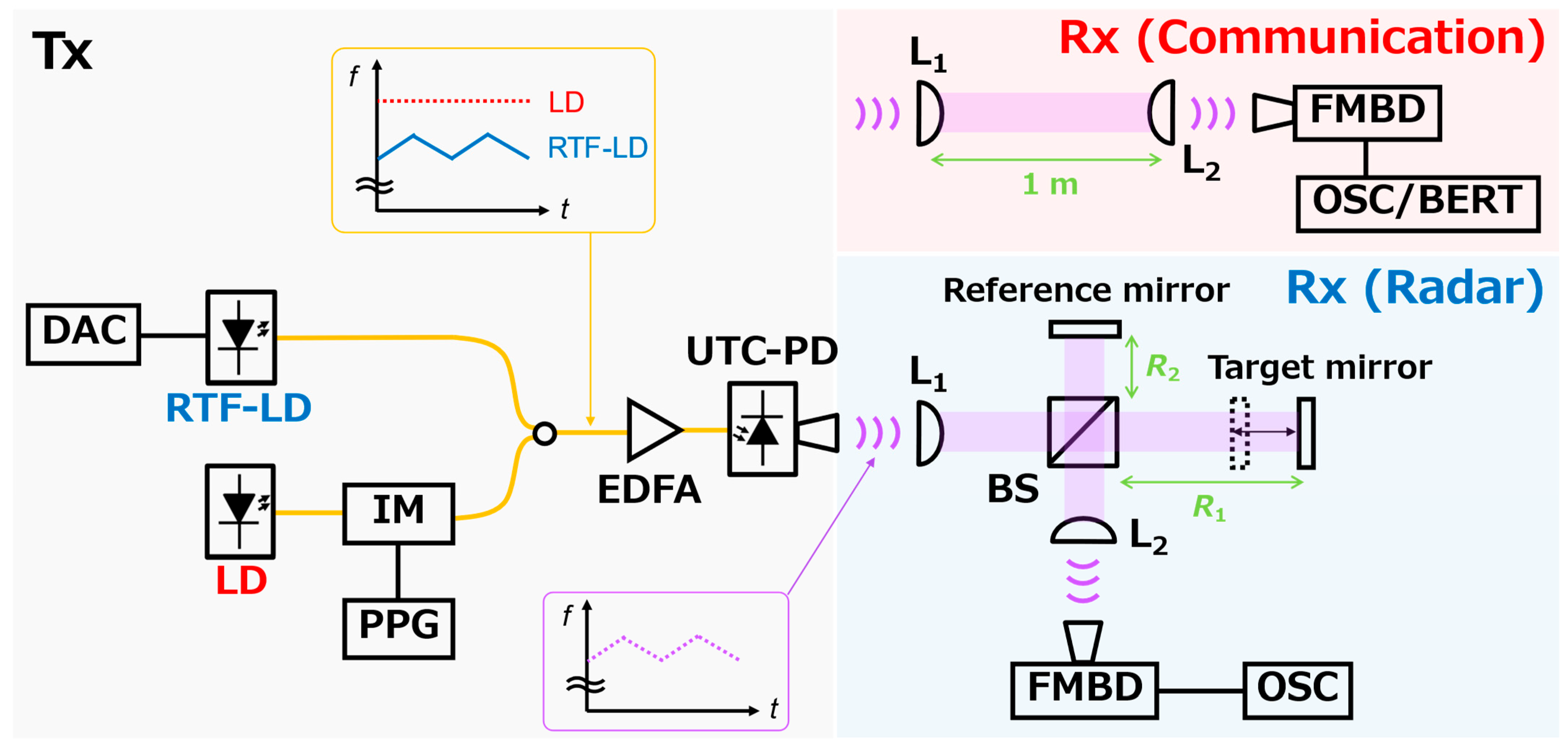
In this section, we describe a second simultaneous transmission approach for THz-ISAC using a single transmitter based on a joint-waveform scheme, which offers enhanced integration and improved waveform-design efficiency. Figure 9 illustrates the overall configuration of the experimental system. At the transmitter, a triangular voltage waveform with an 800 ns period was produced using a DAC and applied to the wavelength control electrode of the RTF-LD, enabling continuous chirping of the laser frequency. Consequently, the lasing frequency was linearly swept from 192.5477 THz to 192.5539 THz. Subsequently, the lightwave emitted from a fixed-wavelength laser diode (LD) operating at 192.8160 THz was combined with the chirped lightwave using an optical coupler. For ASK modulation, the optical signal was intensity-modulated using an IM driven by a PRBS (length 27 − 1) generated by a PPG. The modulated optical signal was then amplified by an EDFA and injected into a UTC-PD, which served as a photomixer. As a result, a THz wave swept from 262.1 GHz to 268.3 GHz, corresponding to the optical frequency difference between the RTF-LD and the LD, was generated. The generated THz wave was both intensity-modulated and frequency-modulated. Two different receiver configurations were employed to evaluate FMCW ranging and ASK data transmission, respectively. For radar measurements, distance estimation was performed using a Michelson interferometer under conditions similar to those described in Section 3.1. For ASK communication, the THz wave radiated from a horn antenna was first collimated by lens 1 (L1, focal length 100 mm). After propagating through 1 m of free space, the THz signal was focused by lens 2 (L2, focal length 100 mm) and detected by a FMBD. Finally, the signal quality was evaluated using an OSC and a BERT.

4.2. Results and Discussion

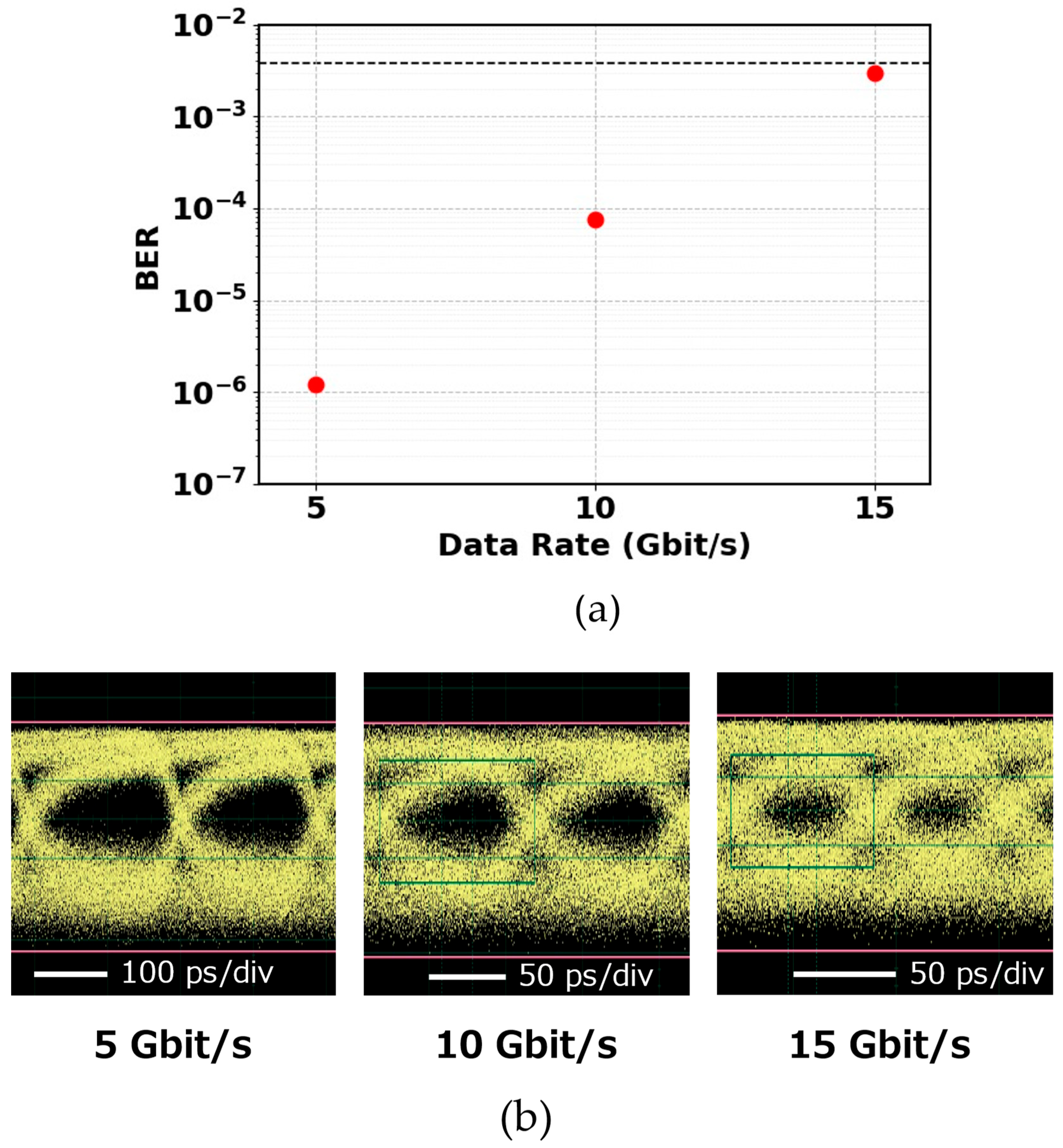
Figure 10 illustrates the communication performance of the proposed system. Figure 10a shows the measured BER as a function of data rate. At a data rate of 15 Gbit/s, the BER was measured to be 2.97 × 10⁻³, which is below the HD-FEC threshold. Figure 10b presents the eye diagrams obtained at data rates of 5, 10, and 15 Gbit/s. The eye diagrams observed on the OSC exhibit a clear opening, indicating that the received signals have sufficient quality. Overall, HD-FEC-compliant communication was successfully demonstrated at data rates of up to 15 Gbit/s. The limitation on the achievable data rate is mainly attributed to the frequency sweeping of the THz carrier used for communication. In the present implementation, the carrier frequency varies over a bandwidth of 6.2 GHz, and the non-ideal frequency response of devices such as the UTC-PD over this swept range may affect the communication performance. As a result, the simultaneous operation with the FMCW radar signal leads to a slight degradation in BER at higher data rates; however, sufficient high-speed communication up to 15 Gbit/s is achieved. Regarding spectral efficiency, while the FMCW sweep bandwidth is 6.2 GHz, the 15-Gbit/s ASK modulation occupies a main lobe bandwidth of approximately 30 GHz. Consequently, the total occupied bandwidth of the joint waveform is roughly 36.2 GHz, yielding a spectral efficiency of approximately 0.41-bit/s/Hz. Although this efficiency reflects standard ASK modulation, the key advantage of this joint-waveform approach is the ability to simultaneously perform high-speed communication and continuous radar sensing using a highly simplified transmitter architecture, avoiding the spectral and temporal inefficiencies of time-division multiplexing.
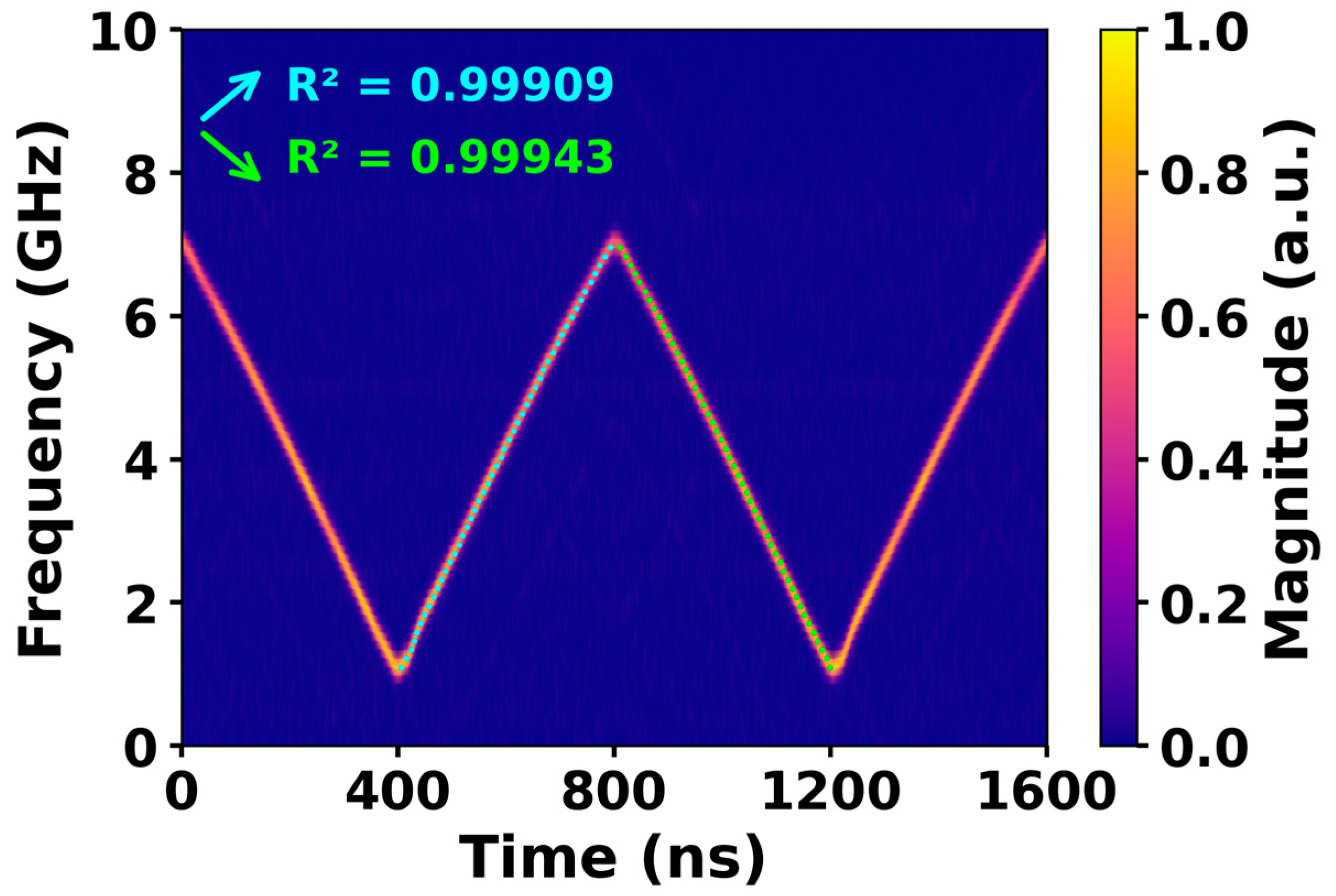
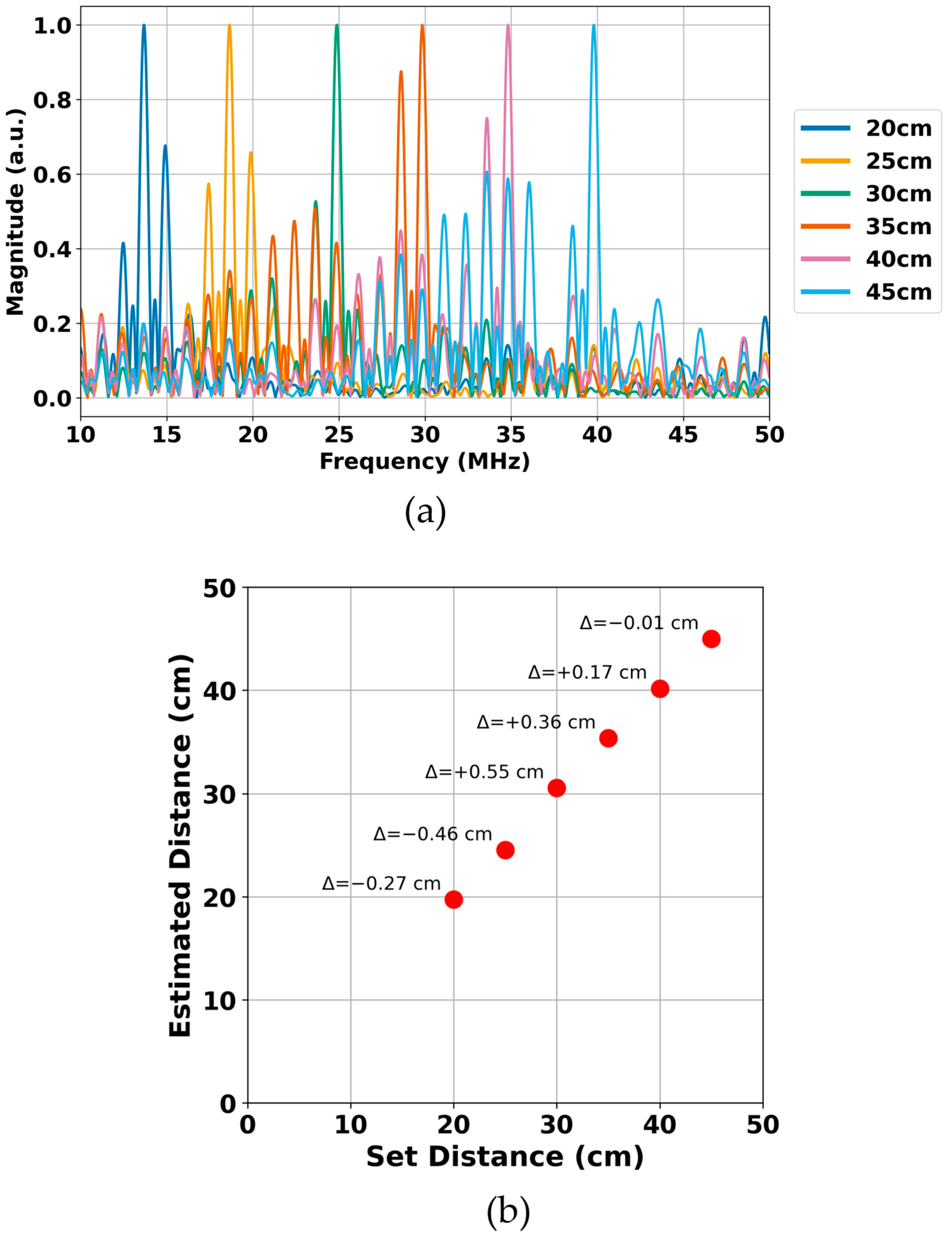
Figure 11 presents the STFT of the THz-FMCW signal. The STFT was obtained from the IF signal after down-conversion using a SHM. The analyzed FMCW signal had a sweep bandwidth of 6.2 GHz, with a sweep duration of 400 ns per chirp. This waveform is consistent with the FMCW waveform observed in the frequency-division scheme shown in Figure 7, indicating that the FMCW characteristics are preserved even when ASK modulation is superimposed on the same carrier in the joint-waveform scheme. The sweep linearity was also evaluated in the same manner, and the coefficient of determination (R2) exceeded 0.999 for both the up-chirp and down-chirp. These results demonstrate that a THz-FMCW signal with an extremely fast frequency sweep was successfully generated while simultaneously performing ASK modulation. Figure 12a shows the beat-frequency spectra obtained for different target distances. As a result of Fourier transform processing, distinct spectral peaks were clearly observed at all six measurement points, confirming correct distance estimation for each target position. Figure 12b plots the estimated distances calculated from Figure 12a as a function of the set target distances. Across all six measurement points, the maximum ranging error was limited to 0.55 cm. Quantitatively, the employed sweep bandwidth of 6.2 GHz corresponds to a theoretical range resolution of approximately 2.4 cm ( c / 2 f b ). The maximum ranging error of 0.55 cm achieved in our experiment demonstrates highly accurate detection well within this theoretical limit. Compared with the frequency-division scheme, no noticeable degradation in ranging performance was observed when the joint-waveform scheme was employed. All of these results were obtained with simultaneous ASK and FMCW modulation. Furthermore, the choice of modulation parameters involves specific trade-offs. For instance, increasing the FMCW sweep bandwidth ( f b ) would improve the range resolution; however, it would also expand the frequency variation in the THz carrier, potentially causing signal distortion due to the uneven frequency response of the receiver components over a wider band, thereby degrading the ASK BER. Conversely, increasing the ASK data rate significantly beyond 15 Gbit/s would broaden the signal spectrum, which could eventually raise the noise floor in the radar beat-frequency spectrum. The current parameters were selected to balance these effects, achieving sub-centimeter accuracy without noticeable degradation compared to the frequency-division scheme. Overall, the proposed THz-band ISAC system experimentally demonstrated performance that is remarkable in achieving simultaneous 15-Gbit/s communication and sub-centimeter-level ranging.

5. Conclusions

In this study, we developed a photonics-based THz ISAC architecture based on a high-speed wavelength-tunable laser and a single UTC-PD. The proposed system exploits high-speed wavelength tuning of the laser to generate fast-swept FMCW signals with a sweep duration of 400 ns, enabling high responsiveness for real-time sensing. To simultaneously integrate sensing and communication, we investigated two transmission schemes. One is a frequency-division scheme that allocates separate carriers for radar and data, and the other is a joint-waveform scheme in which communication information is superimposed on the radar chirp. Experimental results confirmed that both schemes enable high-speed data transmission with BERs below the HD-FEC threshold, while the joint-waveform scheme achieved a data rate of 15 Gbit/s using a more integrated and simplified waveform structure. Furthermore, the radar performance achieved sub-centimeter ranging accuracy across various target positions, even under simultaneous ASK and FMCW modulation. These results indicate that the proposed system provides a simplified yet practical framework for future 6G networks, in which high-capacity wireless communication and high-precision, real-time sensing can coexist. While this study focuses on the transmitter-side waveform generation, practical deployment of such THz ISAC systems in future 6G networks will likely involve large-scale antenna arrays (e.g., XL-MIMO). In such scenarios, particularly under low-SNR conditions, advanced channel estimation addressing near-field effects will be a critical requirement [37].

Author Contributions

Conceptualization, R.K. and K.K.; methodology, R.K., Y.K., S.Y., Y.W., Y.M., Y.U. and K.K.; validation, R.K., Y.K., S.Y., Y.W., Y.M. and K.K.; investigation, R.K., Y.K., S.Y., Y.W., Y.M. and K.K.; resources, Y.U. and K.K.; data curation, R.K.; writing—original draft preparation, R.K.; writing—review and editing, Y.M. and K.K.; visualization, R.K.; supervision, Y.M. and K.K.; project administration, K.K.; funding acquisition, Y.M. and K.K. All authors have read and agreed to the published version of the manuscript.

Funding

This work was supported in part by the commissioned research by the MIC/FORWARD (JPMI241010003), NICT JPJ012368C02801, JPJ012368C00901, and JSPS KAKENHI, grant numbers JP23K17751 and JP24H00319.

Institutional Review Board Statement

Not applicable.

Informed Consent Statement

Not applicable.

Data Availability Statement

Data are available upon request.

Conflicts of Interest

Author Yuta Ueda was employed by the company NTT Corporation. The remaining authors declare that the research was conducted in the absence of any commercial or financial relationships that could be construed as a potential conflict of interest.

References

  1. Chowdhury, M.Z.; Shahjalal, M.; Ahmed, S.; Jang, Y.M. 6G wireless communication systems: Applications, requirements, technologies, challenges, and research directions. IEEE Open J. Commun. Soc. 2020, 1, 957–975. [Google Scholar] [CrossRef]
  2. Alsabah, M.; Naser, M.A.; Mahmmod, B.M.; Abdulhussain, S.H.; Eissa, M.R.; Al-Baidhani, A.; Noordin, N.K.; Sait, S.M.; Al-Utaibi, K.A.; Hashim, F. 6G wireless communications networks: A comprehensive survey. IEEE Access 2021, 9, 148191–148243. [Google Scholar] [CrossRef]
  3. Zheng, Z.; Li, W.; Zou, K. Airborne radar anti-jamming waveform design based on deep reinforcement learning. Sensors 2022, 22, 8689. [Google Scholar] [CrossRef] [PubMed]
  4. Bott, J.; Pohl, N. Emerging trends in radar: Silicon-based THz MIMO systems. IEEE Aerosp. Electron. Syst. Mag. 2025, 40, 18–22. [Google Scholar] [CrossRef]
  5. Spielmann, R.; Schöffl, T.; Kaitna, R.; Aaron, J. Sorting and surging: 3D LiDAR and pulse-Doppler radar analysis of a natural debris flow. J. Geophys. Res. Earth Surf. 2025, 130, e2025JF008450. [Google Scholar] [CrossRef]
  6. Liu, F.; Zheng, L.; Cui, Y.; Masouros, C.; Petropulu, A.P.; Griffiths, H.; Eldar, Y.C. Seventy years of radar and communications: The road from separation to integration. IEEE Signal Process. Mag. 2023, 40, 106–121. [Google Scholar] [CrossRef]
  7. Hua, B.; Zhu, M.; Li, J.; Zhang, J.; Xie, Z.; Ding, J.; Lei, M.; Cai, Y.; Chen, X.; Zou, Y.; et al. Real-time demonstration of 8 × 125 Gbit/s point-to-multipoint photonics-assisted THz-over-fiber PON based on an optical wavelength routing scheme. Opt. Express 2025, 33, 37462–37473. [Google Scholar] [CrossRef]
  8. Zhang, H.; Yang, Z.; Lyu, Z.; Yang, H.; Zhang, L.; Ozolins, O.; Pang, X.; Zhang, X.; Yu, X. 300 GHz photonic-wireless transmission with aggregated 1.034 Tbit/s data rate over 100 m wireless distance. In Proceedings of the 2024 Optical Fiber Communications Conference and Exhibition (OFC), San Diego, CA, USA, 24–28 March 2024. [Google Scholar] [CrossRef]
  9. Li, W.; Yu, J.; Zhu, B.; Wang, F.; Ding, J.; Zhang, J.; Zhu, M.; Zhao, F.; Xie, T.; Wang, K.; et al. Photonic terahertz wireless communication: Towards the goal of high-speed kilometer-level transmission. J. Light. Technol. 2024, 42, 1159–1172. [Google Scholar] [CrossRef]
  10. Tokizane, Y.; Okada, S.; Nishimoto, K.; Okamura, Y.; Kishikawa, H.; Minamikawa, T.; Hase, E.; Fujikata, J.; Haraguchi, M.; Kanno, A.; et al. Terahertz wireless communication in a 560-GHz band using a Kerr micro-resonator soliton comb. Opt. Contin. 2023, 2, 1267–1275. [Google Scholar] [CrossRef]
  11. Shu, H.; Shen, B.; Chang, L.; Tao, Y.; Xie, W.; Jin, M.; Netherton, A.; Zhang, X.; Qin, J.; Chen, R.; et al. Microcomb based silicon photonics data link with 100Gbps/Lane PAM4 transmission. In Proceedings of the 2024 Conference on Lasers and Electro-Optics (CLEO), San Jose, CA, USA, 15–20 May 2022. [Google Scholar] [CrossRef]
  12. Jia, K.; Cai, Y.; Yi, X.; Qin, C.; Zhao, Z.; Wang, X.; Liu, Y.; Zhang, X.; Cheng, S.; Jiang, X.; et al. Low-noise frequency synthesis and terahertz wireless communication driven by compact turnkey Kerr combs. Nat. Commun. 2025, 16, 6253. [Google Scholar] [CrossRef] [PubMed]
  13. Li, W.; Yu, J.; Zhao, X.; Lu, X.; Wei, Y.; Zhou, W.; Zhu, M.; Zhang, J.; Wang, K.; Zhao, F.; et al. 120 Gbit/s PDM-16QAM terahertz signal over 850 m using 2 × 2 MIMO links and advanced DSPs. Opt. Lett. 2025, 50, 4482–4485. [Google Scholar] [CrossRef]
  14. Ye, S.; Masutomi, N.; Li, B.; Matsumoto, R.; Kaide, R.; Tang, H.; Kamiura, Y.; Che, M.; Mikami, Y.; Ueda, Y.; et al. Photonic frequency hopping driven by high-speed wavelength tunable laser for secure terahertz-wave communication. In Proceedings of the 2024 Optical Fiber Communications Conference and Exhibition (OFC), San Diego, CA, USA, 24–28 March 2024. [Google Scholar] [CrossRef]
  15. Ye, S.; Masutomi, N.; Li, B.; Kamiura, Y.; Kaide, R.; Doi, R.; Wang, Y.; Che, M.; Mikami, Y.; Ueda, Y.; et al. Ultra-fast photonic frequency hopping driven by reflection-type transversal filter laser for anti-jamming terahertz communications. Opt. Lett. 2025, 50, 3070–3073. [Google Scholar] [CrossRef]
  16. Ye, S.; Kaide, R.; Kamiura, Y.; Masutomi, N.; Li, B.; Wang, Y.; Che, M.; Mikami, Y.; Ueda, Y.; Kato, K. Photonic frequency hopping and de-hopping system by ultra-fast wavelength tunable laser for secure terahertz wireless communication. J. Light. Technol. 2025, 43, 9901–9911. [Google Scholar] [CrossRef]
  17. Abdo, I.; Jyo, T.; Pander, A.; Wakita, H.; Shiratori, Y.; Muto, M.; Hamada, H.; Nagatani, M.; Gomez, C.D.; Wang, C.; et al. 300-GHz-band four-element CMOS-InP hybrid phased-array transmitter with 36° steering range. IEEE Microw. Wirel. Technol. Lett. 2023, 33, 887–890. [Google Scholar] [CrossRef]
  18. Wang, C.; Herdian, H.; Zheng, W.; Liu, C.; Mayeda, J.; Liu, Y.; Yong, O.A.; Wang, W.; Zhang, Y.; da Gomez, C.; et al. 24.3 A 236-to-266GHz 4-element amplifier-last phased-array transmitter in 65nm CMOS. In Proceedings of the 2024 IEEE International Solid-State Circuits Conference (ISSCC), San Francisco, CA, USA, 18–22 February 2024. [Google Scholar] [CrossRef]
  19. Sengupta, N.; Grzeslo, M.; Iwamatsu, S.; Tebart, J.; Haddad, T.; Stöhr, A. Ultra-broadband photonic THz transceiver IC for high range-resolution FMCW RADAR. In Proceedings of the 4th URSI Atlantic Radio Science Meeting (AT-RASC), Meloneras, Spain, 19–24 May 2024. [Google Scholar] [CrossRef]
  20. Li, Y.; Kaname, R.; Mizuno, R.; Li, Y.; Fujita, M.; Ito, H.; Nagatsuma, T. Ultra-wideband frequency modulated continuous wave photonic radar system for three-dimensional terahertz synthetic aperture radar imaging. J. Light. Technol. 2022, 40, 6719–6728. [Google Scholar] [CrossRef]
  21. Liebermeister, L.; Nellen, S.; Kohlhaas, R.B.; Lauck, S.; Deumer, M.; Breuer, S.; Schell, M.; Globisch, B. Optoelectronic frequency-modulated continuous-wave terahertz spectroscopy with 4 THz bandwidth. Nat. Commun. 2021, 12, 1071. [Google Scholar] [CrossRef]
  22. Zhang, H.; Wang, S.; Jia, S.; Yu, X.; Jin, X.; Zheng, S.; Chi, H.; Zhang, X. Experimental generation of linearly chirped 350 GHz band pulses with a bandwidth beyond 60 GHz. Opt. Lett. 2017, 42, 5242–5245. [Google Scholar] [CrossRef] [PubMed]
  23. Lyu, Z.; Zhang, L.; Deng, Q.; Fang, X.; Bai, L.; Sun, Y.-T.; Ozolins, O.; Liu, G.; Pang, X.; Yu, X. Exploring photonic THz-ISAC systems with integrated waveforms. J. Light. Technol. 2025, 44, 868–877. [Google Scholar] [CrossRef]
  24. Lyu, Z.; Zhang, L.; Deng, Q.; Fang, X.; Bai, L.; Ozolins, O.; Zhang, H.; Liu, G.; Pang, X.; Yu, X. Photonic chirp spread spectrum THz-ISAC: Constraints and design considerations. IEEE Trans. Microw. Theory Techn. 2025, 74, 920–930. [Google Scholar] [CrossRef]
  25. Sümen, G.; Kurt, G.K.; Görçin, A. A novel LFM waveform for terahertz-band joint radar and communications over inter-satellite links. In Proceedings of the 2022 IEEE Global Communications Conference (GLOBECOM), Rio de Janeiro, Brazil, 4–8 December 2022. [Google Scholar] [CrossRef]
  26. Lyu, Z.; Zhang, L.; Zhang, H.; Yang, Z.; Yang, H.; Li, L.; Zhang, C.; Bobrovs, V.; Ozolins, O.; Pang, X.; et al. Preamble-free synchronization based on dual-chirp waveforms for photonic THz-ISAC. J. Light. Technol. 2024, 42, 2657–2665. [Google Scholar] [CrossRef]
  27. Lyu, Z.; Zhang, L.; Zhang, H.; Yang, Z.; Zhang, C.; Yang, H.; Li, N.; Bobrovs, V.; Ozolins, O.; Pang, X.; et al. Multi-channel photonic THz-ISAC system based on integrated LFM-QAM waveform. J. Light. Technol. 2024, 42, 3981–3988. [Google Scholar] [CrossRef]
  28. Wu, G.; Zhang, F.; Yu, X.; Yan, X.; Wang, H.; Yu, Y.; Pan, S. Integrated sensing and communication with LFM-ASK waveform generation by P1 laser dynamics. In Proceedings of the 16th International Photonics and Optoelectronics Meeting (POEM 2025), Wuhan, China, 19 August 2025. [Google Scholar] [CrossRef]
  29. Jia, S.; Wang, S.; Liu, K.; Pang, X.; Zhang, H.; Jin, X.; Zheng, S.; Chi, H.; Zhang, X.; Yu, X. A unified system with integrated generation of high-speed communication and high-resolution sensing signals based on THz photonics. J. Light. Technol. 2018, 36, 4549–4556. [Google Scholar] [CrossRef]
  30. Wang, Y.; Li, W.; Ding, J.; Zhang, J.; Zhu, M.; Zhao, F.; Wang, M.; Yu, J. Integrated high-resolution radar and long-distance communication based-on photonic in terahertz band. J. Light. Technol. 2022, 40, 2731–2738. [Google Scholar] [CrossRef]
  31. Ueda, Y.; Saito, Y.; Shindo, T.; Kanazawa, S.; Kobayashi, W.; Matsuzaki, H.; Ishikawa, M. Hitless wavelength switching of semiconductor optical amplifier-integrated reflection-type transversal filter laser with suppressed frequency error. J. Light. Technol. 2023, 41, 2765–2774. [Google Scholar] [CrossRef]
  32. Kaide, R.; Ye, S.; Wang, Y.; Mikami, Y.; Ueda, Y.; Kato, K. Integrated terahertz FMCW radar and FSK communication enabled by high-speed wavelength tunable lasers. Photonics 2025, 12, 977. [Google Scholar] [CrossRef]
  33. Nagatsuma, T. Photodetectors for microwave photonics. In Photodetectors; Elsevier: Amsterdam, The Netherlands, 2023; pp. 467–484. [Google Scholar]
  34. Ishibashi, T.; Ito, H. Uni-traveling-carrier photodiodes. J. Appl. Phys. 2020, 127, 031101. [Google Scholar] [CrossRef]
  35. Nagatsuma, T.; Gao, W.; Kawamoto, Y.; Ohara, T.; Ito, H.; Ishibashi, T. InP-based integrated circuits on SiC/Si substrates for terahertz communications. J. Light. Technol. 2025, 43, 9765–9774. [Google Scholar] [CrossRef]
  36. Ito, H.; Ishibashi, T. InP/InGaAs Fermi-level managed barrier diode for broadband and low-noise terahertz-wave detection. Jpn. J. Appl. Phys. 2017, 56, 014101. [Google Scholar] [CrossRef]
  37. Wang, H.; Yan, T.; Zhou, N.; Li, X.; Wen, F.; Du, W. Enhanced polar-domain channel estimation for near-field XL-MIMO in low-SNR scenarios. IEEE Trans. Veh. Technol. 2025, 74, 19407–19419. [Google Scholar] [CrossRef]
Figure 1. Schematic of THz-wave generation by photomixing using a wavelength-tunable laser.
Electronics 15 01608 g001
Figure 2. Configuration of the Michelson interferometer for THz-FMCW ranging.
Electronics 15 01608 g002
Figure 3. Frequency–time relationship of reflected THz-FMCW signals.
Electronics 15 01608 g003
Figure 4. Experimental setup of the frequency-division scheme for THz ISAC.
Electronics 15 01608 g004
Figure 5. Measurement setup of the Michelson interferometer-based THz FMCW ranging system.
Electronics 15 01608 g005
Figure 6. Communication performance versus data rate: (a) BER; (b) eye diagrams.
Electronics 15 01608 g006
Figure 7. STFT of the generated THz-FMCW signal.
Electronics 15 01608 g007
Figure 8. Ranging results of the THz-FMCW radar: (a) beat-frequency spectra for different target distances; (b) estimated versus set target distance.
Electronics 15 01608 g008
Figure 9. Experimental setup of the joint-waveform scheme for THz ISAC.
Electronics 15 01608 g009
Figure 10. Communication performance versus data rate: (a) BER; (b) eye diagrams.
Electronics 15 01608 g010
Figure 11. STFT of the generated THz-FMCW signal.
Electronics 15 01608 g011
Figure 12. Ranging results of the THz-FMCW radar: (a) beat-frequency spectra for different target distances; (b) estimated versus set target distance.
Electronics 15 01608 g012
Table 1. Performance comparison of THz ISAC systems.
YearISAC SchemeData RateRanging
Accuracy
Radar
Type
Complexity
2022 [30]Time Division38.1 Gbit/s
(Offline)
≈1.6 cmPulsedHigh
2025 [32]Frequency Division2 Gbit/s
(Online)
≈1 cmFMCWLow
2026
(This work)
Frequency Division/Joint Waveform15 Gbit/s
(Online)
≈0.5 cmFMCWLow
Disclaimer/Publisher’s Note: The statements, opinions and data contained in all publications are solely those of the individual author(s) and contributor(s) and not of MDPI and/or the editor(s). MDPI and/or the editor(s) disclaim responsibility for any injury to people or property resulting from any ideas, methods, instructions or products referred to in the content.