1. Introduction
The representation of space and time is fundamental to knowledge modeling, geographic information systems (GIS), artificial intelligence, and the Semantic Web. Many real-world phenomena are inherently spatio-temporal: objects occupy locations, events occur at specific times, and processes unfold across both space and time. Consequently, the development of formal ontologies capable of representing spatial and temporal dimensions has become a central research problem in knowledge representation and information systems.
Early research in artificial intelligence established formal foundations for temporal reasoning, notably through interval-based models such as Allen’s interval algebra [
1]. In parallel, spatial reasoning research developed qualitative and topological representations of regions, boundaries, and spatial relations, including region-based calculi and formal spatial logics. These strands evolved largely independently before converging in efforts to construct unified spatio-temporal ontological frameworks capable of representing dynamic phenomena. At the conceptual level, ontology-driven approaches such as SNAP/SPAN [
2] emphasized the distinction between enduring entities (continuants) and processes (occurrents), highlighting the philosophical and logical complexity of integrating space and time. Within GIScience, event-based models such as the Geospatial Event Model [
3] further advanced the view that geographic phenomena are often better represented as transitions and processes rather than static object descriptions.
Within the Semantic Web community, standardized vocabularies such as OWL-Time [
4] and GeoSPARQL [
5] have enabled interoperable representations of temporal and spatial information in RDF/OWL environments. OWL-Time provides a formal ontology of instants, intervals, and temporal relations, while GeoSPARQL defines RDF vocabularies and query extensions for representing and reasoning over geometric data. Together, these standards have established core building blocks for Web-based spatio-temporal representation. Description logics and OWL-based ontology engineering further provide formal mechanisms for specifying semantic constraints and enabling automated reasoning.
In contrast, this review adopts an explicitly ontology-centered perspective. Rather than surveying database systems or embedding models, it examines how spatial and temporal dimensions are conceptually grounded, formally represented, and semantically constrained within ontology-driven frameworks. The paper synthesizes foundational ontological distinctions (e.g., continuants and occurrents), formal spatial and temporal calculi (e.g., interval algebras and region-based logics), description logic implementations, and Web standards such as OWL-Time and GeoSPARQL within a unified analytical structure. By integrating these strands, the review clarifies conceptual assumptions, evaluates trade-offs between logical expressiveness and computational tractability, and identifies unresolved challenges in achieving fully integrated spatio-temporal ontology design.
Despite substantial progress, the literature remains fragmented across disciplines. Foundational ontology research, GIS modeling traditions and Semantic Web standards approaches often operate with differing assumptions, terminologies, and design goals. As a result, there is a need for a structured and integrative review that synthesizes these perspectives while maintaining a clear focus on formal ontology and semantic representation.
This paper presents a comprehensive review of spatial and temporal ontologies. Specifically, it aims to (i) examine foundational theoretical approaches to spatial and temporal representation, (ii) analyze formal spatio-temporal ontology frameworks and description logic–based implementations, (iii) evaluate Semantic Web standards for spatial and temporal interoperability, and (iv) identify open challenges and future research directions in the development of ontology-driven and interoperable spatio-temporal knowledge systems. Through this integrative and ontology-theoretic orientation, the review seeks to bridge formal ontology research and Semantic Web practice, distinguishing itself from GIS-centric and embedding-focused spatio-temporal surveys.
2. Related Work
Literature Search Methodology
This survey follows a systematic yet selective literature-review protocol. We searched Google Scholar, Scopus, Web of Science, and the Semantic Web community archives (CEUR-WS, ISWC, ESWC proceedings) using the keyword sets: (“spatio-temporal ontology” OR “spatial ontology” OR “temporal ontology” OR “4D fluents” OR “Event Calculus” OR GeoSPARQL OR “OWL-Time”) combined with (“foundational” OR “Semantic Web” OR “knowledge graph” OR “description logic”). The search covered peer-reviewed journal articles, conference papers, and standards documents published between 2000 and March 2026, with emphasis on post-2020 developments. We prioritized works that (i) provide formal ontological commitments, (ii) implement Semantic Web standards, or (iii) demonstrate engineering trade-offs. The final corpus contains 51 core references, ensuring comprehensive coverage while maintaining a clear ontology-theoretic orientation. Research on spatial–temporal ontologies spans multiple communities, including knowledge representation, the Semantic Web, and geographic information science (GIS). Prior work can broadly be organized around three interconnected strands: (i) foundational temporal reasoning and time ontologies, (ii) spatial semantics and geospatial standards for RDF data, and (iii) ontology-driven spatio-temporal conceptualizations centered on objects, processes, and events.
Temporal representation has long been studied in artificial intelligence. Interval-based formalisms such as Allen’s interval algebra provide a canonical set of qualitative relations (e.g., before, overlaps, during) for reasoning about temporal intervals [
1]. Building on such foundations, the Semantic Web community standardized reusable temporal vocabularies. OWL-Time, for example, provides an ontology of instants, intervals, durations, and temporal relations, enabling interoperable temporal annotations of resources in RDF/OWL environments [
4]. These efforts establish the core formal and vocabulary-level infrastructure for temporal modeling on the Web.
Spatial ontologies, in parallel, define entities such as features and geometries, together with qualitative and quantitative spatial relations. Within the Semantic Web, GeoSPARQL has emerged as a key standard, specifying an RDF/OWL vocabulary and SPARQL extension functions for representing and querying geospatial data, including topological relations and geometry encodings [
5]. GeoSPARQL and related geospatial standards provide the operational basis for interoperable spatial reasoning across heterogeneous systems.
Beyond treating space and time separately, ontology-driven spatio-temporal conceptualizations address persistence, change, and event participation. A prominent ontological proposal distinguishes snapshot-like views of enduring entities from processual extensions in time (often framed as SNAP versus SPAN), motivating a dynamic interpretation of spatial entities and their temporal behavior [
2]. In GIScience, event-based and process-oriented models argue that many geographic phenomena are better captured as sequences of events and state transitions rather than static object descriptions, thereby providing a conceptual foundation for reasoning about change [
3].
Because spatio-temporal modeling appears in multiple paradigms—location-based, object-based, event-based, and process-based—survey literature has played a key role in organizing the field. For example, a widely cited review of Temporal GIS synthesizes decades of modeling proposals and proposes a taxonomy of spatio-temporal modeling trends [
6]. Such surveys highlight both the richness of available approaches and the ongoing fragmentation across research traditions, motivating the integrative perspective adopted in this paper. Unlike GIS-centric surveys, qualitative reasoning reviews, or embedding-focused STKG surveys, this review adopts an ontology-theoretic perspective that integrates foundational ontologies, formal spatial-temporal calculi, Semantic Web standards, and knowledge graph deployment patterns within a unified analytical taxonomy.
3. Taxonomy of Spatial–Temporal Ontologies
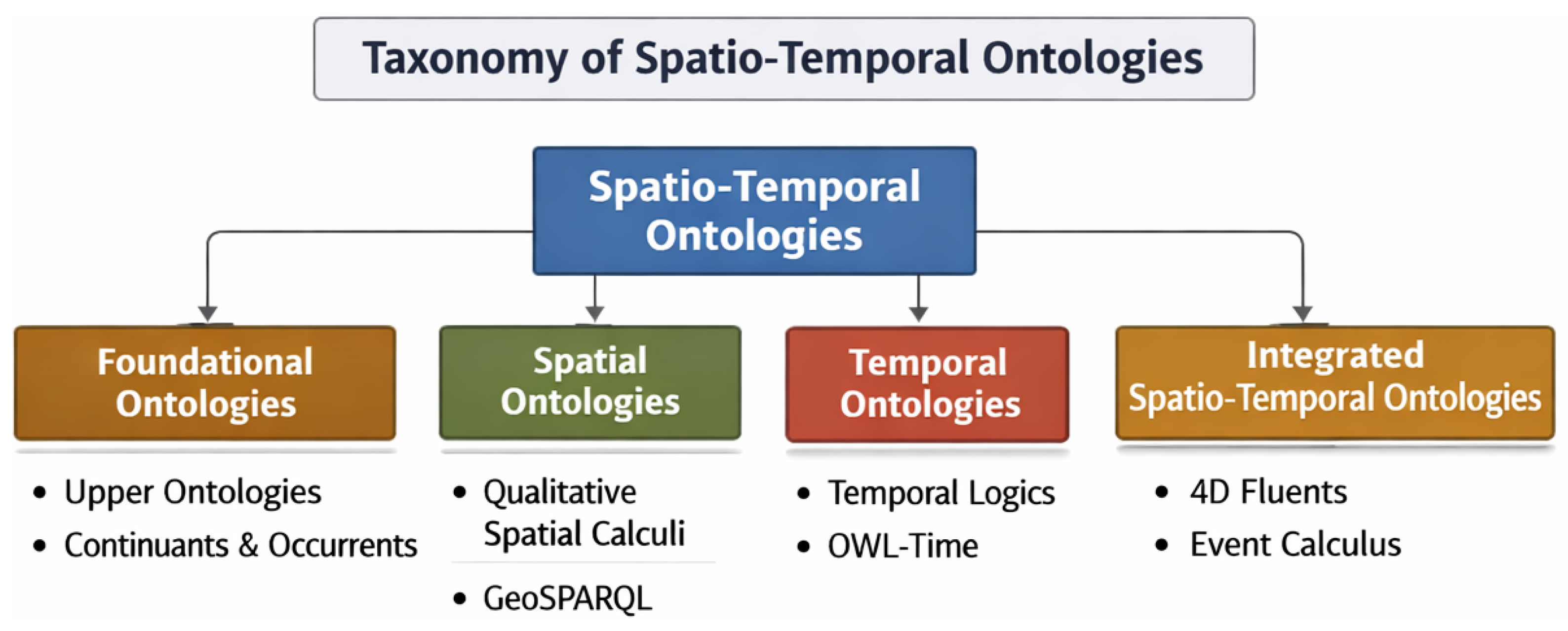
Given the diversity of approaches to modeling space and time, it is useful to classify spatial–temporal ontologies according to their conceptual assumptions, modeling strategies, and intended use contexts. Rather than focusing on specific logical formalisms, this section presents a conceptual taxonomy that distinguishes four major categories: (1) foundational ontologies, (2) spatial-centric models, (3) temporal-centric models, (4) integrated spatio-temporal (
Figure 1).
3.1. Foundational Ontologies
Foundational (or upper-level) ontologies provide abstract categories that can be specialized for spatial and temporal domains. These ontologies define high-level distinctions such as objects, processes, qualities, and relations. A prominent example is the distinction between continuants (entities persisting through time) and occurrents (processes unfolding in time) [
2].
Such foundational models are not inherently spatial or temporal; rather, they provide meta-ontological commitments regarding identity, persistence, and change. Domain-specific spatial or temporal ontologies are typically constructed as specializations of these upper-level frameworks.
3.2. Spatial-Centric Ontologies
Spatial-centric ontologies emphasize the representation of geometric and topological relations among entities. These frameworks model regions, boundaries, coordinates, and spatial predicates such as containment, adjacency, and overlap.
In the Semantic Web domain, GeoSPARQL provides a standardized vocabulary for representing spatial data in RDF [
5]. Spatial-centric ontologies are widely used in GIS, environmental monitoring, and location-based services.
However, these models often treat time as an external annotation rather than as an integrated structural dimension. Primary Focus: Spatial configuration and topology. Strength: Strong representation of geometric relations. Limitation: Limited modeling of temporal evolution.
3.3. Temporal-Centric Ontologies
Temporal-centric ontologies focus on modeling time as a structured domain consisting of instants, intervals, durations, and ordering relations. Allen’s interval algebra provides a foundational qualitative model of temporal ordering [
1], while OWL-Time formalizes temporal concepts within OWL-based systems [
4].
These ontologies support event modeling, historical reasoning, and process tracking but do not inherently capture spatial dynamics.
Primary Focus: Temporal ordering and duration. Strength: Formal treatment of time structures. Limitation: No explicit representation of spatial change.
3.4. Integrated Spatio-Temporal Ontologies
Integrated spatio-temporal ontologies explicitly model the coupling between spatial configurations and temporal evolution. Rather than simply attaching timestamps to static objects or treating space and time as independent annotation layers, these frameworks represent entities whose spatial properties, topological relations, and geometries may change over time.
Such approaches address not only when properties hold, but how spatial structures evolve, how identities persist under boundary modification or movement, and how events initiate or terminate spatial relations. Early conceptual foundations such as SNAP/SPAN [
2] and event-based GIS models [
3] emphasize persistence, identity conditions, and state transitions across time. More recent ontology engineering patterns—including 4D fluents [
7] and Event Calculus–based ontologies [
8]—provide architectural mechanisms for representing spatio-temporal change in RDF/OWL knowledge graphs, enabling explicit modeling of time-indexed spatial relations and event-driven spatial transformation.
Primary Focus: Explicit interaction between spatial topology, geometry evolution, and temporal dynamics.
Strength: Rich modeling of dynamic change, persistence, and causal propagation of spatial transitions.
Limitation: Increased conceptual and computational complexity, particularly when combining qualitative topology (e.g., RCC), geometric reasoning (e.g., GeoSPARQL), and temporal constraint formalisms within decidable ontology profiles.
3.5. Comparative Summary
Table 1 summarizes the distinguishing characteristics of each category.
4. Foundational Frameworks: BFO, DOLCE, SNAP/SPAN, and UFO
Foundational ontologies impose high-level ontological commitments that constrain how domain ontologies represent identity, persistence, dependence, and change. For spatio-temporal modeling, foundational choices influence (i) whether change is represented via processes, time-indexed relations, or temporal parts; (ii) how spatial and temporal regions are treated (as entities, as dimensions, or as representational artifacts); and (iii) how participation, parthood, and dependence are axiomatized across time.
This section analyzes four influential foundational approaches—BFO, DOLCE, SNAP/SPAN, and UFO—with attention to their ontological commitments, their treatment of time and change, and their implications for spatio-temporal ontology engineering.
4.1. Basic Formal Ontology (BFO)
4.1.1. Core Ontological Commitments
BFO is a realist top-level ontology whose primary commitment is the disjoint division between continuants and occurrents. Continuants persist through time while maintaining identity, whereas occurrents unfold in time and include processes as well as temporal and spatio-temporal regions. This commitment operationalizes a strong stance on persistence: continuants do not have temporal parts in the same sense as occurrents, and change is typically modeled as continuity of a continuant through its participation in occurrents.
BFO-2020 is a major milestone because it is standardized as a top-level ontology hub via ISO/IEC 21838-2:2021 and is provided with formalizations in OWL 2 and Common Logic (CL) [
9]. The standard explicitly frames BFO as supporting interoperability, consistency, and non-redundancy across domain ontologies through shared upper-level categories (e.g., object, quality, process, spatial region, temporal region, spatiotemporal region).
4.1.2. Time, Relations, and “Temporalization”
A distinctive feature of BFO-2020 is the provision of
temporalized relations: the ISO documentation describes binary “at-all-times” and “some-time” variants used to connect continuant-level assertions with their temporal qualifications [
9]. This design choice reflects a pragmatic compromise: OWL lacks native temporal operators, so BFO supplies a pattern-like relation layer that can be interpreted consistently in both OWL and CL contexts.
The Applied Ontology overview by Otte et al. positions BFO as a minimal, domain-neutral top-level ontology (dozens of classes) and illustrates how common forms of change can be represented via universals, defined classes, and relations within the BFO framework [
10]. This is important for spatio-temporal modeling because many GIS/IoT/biomedical use cases require capturing state changes of continuants (e.g., location change, quality/value change) without reifying every temporal slice.
4.1.3. Post-2020 Discussions: Representing Change Explicitly
A recurring critique is that representing change solely through time-indexed relations can imply that change happened without modeling the change itself as an entity. “Representing change in BFO” explicitly highlights the gap between inferring that a change occurred (from time-indexed assertions) and explicitly representing change processes/types. This line of work matters for spatio-temporal ontologies because many spatial changes (boundary shifts, deformation, land-use transitions) are naturally modeled as structured changes rather than merely as two time-stamped states.
4.1.4. Implications for Spatio-Temporal Modeling
Strengths
BFO provides a clean, rigorous persistence stance, supports interoperability, and offers formal artifacts aligned with an ISO standard [
9]. For spatio-temporal applications, treating temporal and spatiotemporal regions as occurrents offers a principled place to locate processes and events.
Limitations
BFO does not, by itself, provide a full mereotopology of spatio-temporal regions, and OWL-based implementations rely on relation patterns rather than native temporal logics. This creates pressure on downstream modeling to (i) adopt reification patterns for temporally qualified facts, or (ii) combine BFO with specialized spatial calculi/standards.
4.2. DOLCE
4.2.1. Core Ontological Commitments
DOLCE (Descriptive Ontology for Linguistic and Cognitive Engineering) is a foundational ontology designed to capture the categories underlying natural language, cognition, and commonsense conceptualization. Its design emphasizes explicit ontological choices, rich axiomatization, and methodological guidance (e.g., OntoClean). A contemporary presentation highlights DOLCE’s stability and continued reuse across domains such as socio-technical systems, standards, and cultural heritage [
11].
DOLCE distinguishes endurants (entities wholly present at any time they exist) and perdurants (entities extended in time), enabling systematic treatment of participation, dependence, and temporal qualification. This endurant/perdurant stance is conceptually close to the continuant/occurrent family but is motivated via cognitive/linguistic analysis rather than strict realism.
4.2.2. Time, Qualities, and Participation
DOLCE offers explicit conceptual tools for modeling qualities and their “value” manifestations (often via quality spaces), which is important for spatio-temporal modeling where properties such as location, shape, and measured values change over time. Participation relations connect endurants to perdurants, supporting event/process-centered modeling.
4.2.3. Post-2020 Technical Direction: DOLCE in OWL
A key practical barrier for foundational ontologies is faithful deployment in OWL. Recent work on “DOLCE in OWL” focuses on the core theory and how to encode DOLCE commitments in a form suitable for Semantic Web toolchains while preserving intended semantics as much as possible [
12]. For spatio-temporal ontologies, this is especially relevant: implementers often need OWL-level artifacts that can interoperate with GeoSPARQL, OWL-Time, and KG systems.
4.2.4. Implications for Spatio-Temporal Modeling
Strengths
DOLCE’s conceptual richness provides strong modeling leverage for events, observations, qualities, and context-dependent conceptualization [
11]. Its methodology is valuable when aligning heterogeneous spatio-temporal datasets (e.g., narratives, sensor observations, administrative records).
Limitations
DOLCE’s expressiveness and axiom richness can increase modeling and reasoning complexity; and many deployments require simplifications or OWL encodings that approximate the original formal theory [
12].
4.2.5. DOLCE Spatial Primitives and DOLCE-Derived Spatial Extensions (DLP/DUL)
Although DOLCE is often introduced primarily through its endurant/perdurant (endurant–perdurant) stance and its treatment of qualities, several DOLCE-derived artifacts provide explicit modeling hooks for spatial localization that are frequently reused in Semantic Web practice. Early DOLCE-aligned modeling explicitly treats space and time locations as qualities, enabling location to be represented as a quality with a corresponding region/value in a suitable quality space [
13]. A practical engineering manifestation of this view appears in DOLCE-Lite-Plus (DLP), which introduces constructs for physical place and geographical localization patterns (e.g., q-location in geographic coordinates) [
14]. More widely deployed in linked-data systems, DOLCE+DnS Ultralite (DUL) provides lightweight classes such as
dul:SpaceRegion as reusable anchors for localization, alongside simplified spatial and temporal relations suited to OWL toolchains [
15].
For spatio-temporal ontology engineering, these DOLCE-derived spatial primitives matter in two ways. First, they provide a principled interpretation of location as a quality/value (rather than solely as an external coordinate annotation), which supports alignment between object-centered models and observation-centered models where measurements and locations are recorded as qualities. Second, they offer pragmatic, OWL-friendly “spatial slots” that can be bridged to GeoSPARQL geometry encodings when a system requires both conceptual rigor and operational geospatial querying. Accordingly, DOLCE-derived spatial extensions complement BFO-style region categories by emphasizing the quality/value view of location and by supplying lightweight vocabulary that is often easier to integrate with KG-scale pipelines.
4.3. SNAP/SPAN (Dynamic Spatial Ontology)
4.3.1. Core Ontological Commitments
SNAP/SPAN is a modular stance for dynamic spatial ontology:
SNAP captures snapshot views of continuant-like entities at a time, while
SPAN captures processes and temporally extended entities. The key insight is that dynamic spatial ontology must combine inventories of (i) entities that persist and (ii) entities of change/process [
2].
This is not merely a classification: it is a strategy for reconciling three-dimensional persistence intuitions (enduring objects) with four-dimensional process perspectives (extended happenings), and it explicitly motivates how cross-ontology relations should connect SNAP and SPAN components.
4.3.2. Post-2020 Usage in Spatio-Temporal Ontology Discussions
Recent work in the foundational-ontology community continues to use SNAP/SPAN as a reference point when evaluating spatio-temporal integration strategies. For example, a FOUST paper explicitly discusses SNAP/SPAN as a harmonization attempt between 3D and 4D perspectives and analyzes how BFO adopts SNAP/SPAN-like notions while leaving gaps in spatiotemporal mereotopology [
16]. This illustrates SNAP/SPAN’s continuing relevance as a conceptual “bridge” even when the original proposal predates 2020.
4.3.3. Implications for Spatio-Temporal Modeling
Strengths
SNAP/SPAN gives a clear conceptual architecture for separating state inventories from process inventories, which maps naturally to many spatio-temporal data practices (time slices vs. event logs). It also clarifies why purely snapshot models struggle with representing change mechanisms.
Limitations
SNAP/SPAN is a stance rather than a turnkey implementation framework: it does not directly provide modern OWL artifacts, scalable KG patterns, or standardized spatial/temporal query vocabularies. In practice, it is most useful when paired with (i) an upper ontology that operationalizes the distinction (e.g., BFO), and (ii) spatial and temporal standards (e.g., GeoSPARQL, OWL-Time).
4.4. Unified Foundational Ontology (UFO)
4.4.1. Core Ontological Commitments
UFO is an ontological framework designed to provide foundational support for conceptual modeling. It integrates insights from formal ontology, philosophical logics, cognitive science, and linguistics, and it is developed as a family of micro-theories targeting modeling notions such as types, roles, relational dependence, and complex relations [
17].
A key differentiator is UFO’s tight coupling with conceptual modeling languages (e.g., OntoUML). This makes UFO particularly attractive when the goal is not only semantic integration but also high-quality model construction and validation.
4.4.2. Events, Dispositions, Roles, and Dependence
For spatio-temporal modeling, UFO’s treatment of roles, relators, and dependence is valuable for representing context-sensitive participation (e.g., a vehicle as a “transport asset” in one context and “pollution source” in another), institutional facts (e.g., administrative boundaries), and social objects (e.g., legal entities) that are central in many geo-social datasets.
4.4.3. Post-2020 Consolidation
The Applied Ontology paper “UFO: Unified Foundational Ontology” (2022) presents the current state of UFO, including formalization and case analyses intended to facilitate comparison with other foundational ontologies [
17]. This post-2020 consolidation is particularly useful as a citable reference for UFO’s mature scope and for positioning UFO relative to BFO/DOLCE in survey work.
4.4.4. Implications for Spatio-Temporal Modeling
Strengths
UFO excels when spatio-temporal modeling must integrate events/processes with institutional or socio-technical structures (e.g., logistics, smart cities, risk governance). Its conceptual modeling orientation often yields clearer, better-validated domain models.
Limitations
UFO is less directly tied to standardized geospatial/temporal query languages out of the box; implementers frequently need explicit bridges to GeoSPARQL/OWL-Time and to KG deployment patterns for scalable querying.
4.5. Comparative Synthesis for Spatio-Temporal Ontology Engineering
Across these foundational approaches, a practical gradient emerges:
(i)
BFO provides an ISO-standardized, minimalist realist backbone with a clear persistence split and temporalized relation patterns [
9,
10]. (ii)
DOLCE provides richer cognitive/linguistic categories and methodological guidance, with ongoing efforts toward OWL operationalization [
11,
12]. (iii)
SNAP/SPAN provides a conceptual architectural stance for combining snapshot inventories with process inventories and remains a reference point in modern spatio-temporal ontology debates [
2,
16]. (iv)
UFO provides a mature, modeling-oriented foundation with strong tools for roles, dependence, and conceptual model quality [
17].
For spatio-temporal systems, these choices have direct consequences for how one models (a) changing location and geometry, (b) object identity under change, (c) event/process granularity, and (d) interoperability between logic-based reasoning and KG-scale analytics.
5. Spatial-Centric Frameworks: RCC Variants, GeoSPARQL Implementations, and OGC-Based Ontologies
Spatial-centric frameworks prioritize the representation and computation of spatial configuration. In spatio-temporal settings, they are commonly used as the spatial projection layer that can be combined with temporal annotation (e.g., OWL-Time) or event/process models. This section analyzes three interrelated strands: (i) qualitative mereotopology via RCC-8 and its variants, (ii) GeoSPARQL as the dominant Semantic Web standard for spatial RDF, and (iii) the broader family of OGC standards and emerging OGC semantic artifacts that provide interoperable spatial encodings, identifiers, and API-level building blocks.
5.1. RCC-8 and Variants: Qualitative Mereotopology at Different Granularities
5.1.1. RCC-8 as a Computational Core
The Region Connection Calculus (RCC) provides a qualitative account of spatial topology using primitive connection and derived relations. RCC-8 is the most widely deployed fragment in AI and GIS practice, defining eight jointly exhaustive and pairwise disjoint base relations between regions (e.g., disconnected, externally connected, partial overlap, tangential proper part, non-tangential proper part and their inverses). The appeal of RCC-8 is that it supports symbolic reasoning (consistency checking, entailment) through composition tables and constraint propagation, while remaining close to human commonsense descriptions of spatial configuration.
Contemporary surveys emphasize that RCC-8 remains foundational within Qualitative Spatial and Temporal Reasoning (QSTR), especially as a reusable component in hybrid symbolic–statistical pipelines [
18]. This is particularly relevant for knowledge graphs and geospatial question answering, where symbolic relations can act as a compact abstraction layer over noisy or heterogeneous coordinate data.
5.1.2. Refinements and “Variants” of RCC-8
In practice, RCC-8 is often adapted in one of three ways:
- (1)
Coarser or Finer Relation Sets
Coarser sets (e.g., RCC-5) collapse boundary distinctions, improving robustness under geometric uncertainty but reducing expressive power. Finer sets (e.g., RCC-11-like refinements) introduce additional distinctions such as different types of boundary contact, which can be important for cartographic sketches, indoor navigation, and certain GIS retrieval tasks. The modeling trade-off is direct: finer calculi can encode application-relevant distinctions but can increase reasoning complexity and data demands (since more specific relations must be asserted or inferred).
- (2)
Probabilistic and Uncertain RCC Reasoning
Post-2020 work increasingly treats RCC relations as uncertain observations rather than crisp facts. Duckham et al. propose probabilistic spatial logics by combining qualitative calculi with probabilistic graphical models, enabling graded belief in topological relations inferred from noisy evidence [
19]. Closely related empirical studies investigate probabilistic QSR in GeoQA scenarios, contrasting conventional (crisp) QSR with probabilistic variants under increasingly challenging conditions [
20]. These approaches are important for spatio-temporal applications because spatial relations inferred from sensor data, remote sensing products, and administrative datasets often have uncertainty that should be propagated into downstream reasoning.
- (3)
RCC in Large-Scale Graph Querying and Distributed Reasoning
A major practical question is whether RCC-style qualitative reasoning can scale to knowledge graph sizes. Mantle et al. study qualitative spatial reasoning as a query-time enhancement over large knowledge graphs and present a distributed query engine that supports GeoSPARQL-style spatial querying while leveraging qualitative reasoning (including RCC) to address sparsity and scale issues [
21]. This line of work supports the view that RCC reasoning is not only a knowledge-representation tool but also a query optimization and approximation layer for large geospatial KGs.
5.1.3. Implications for Ontology Engineering
For ontology-driven systems, RCC-8 and its variants typically appear in one of two roles: (i) as an explicit topology vocabulary (storing qualitative relations as RDF triples), or (ii) as a derived relation layer computed from geometry (e.g., by GIS engines) and injected into RDF/KG as needed. The second pattern is increasingly common because it avoids storing all pairwise qualitative relations while still enabling symbolic reasoning for selected query contexts.
5.2. GeoSPARQL: Standardized Spatial RDF and Query Semantics
5.2.1. GeoSPARQL 1.1 as the Current Reference
GeoSPARQL is the dominant OGC standard for representing and querying geospatial data in RDF. The approved GeoSPARQL 1.1 standard (published 29 January 2024) defines (i) a core RDF/OWL ontology for spatial features and geometries, (ii) SPARQL extension functions for spatial computation, and (iii) supporting resources such as Simple Features vocabularies and SHACL shapes for RDF validation [
22]. GeoSPARQL 1.1 explicitly supports both quantitative geometry-based computation and qualitative relation vocabularies, making it a natural bridge between coordinate geometry and RCC-style symbolic relations.
The motivations and main changes leading to GeoSPARQL 1.1 are discussed in the decadal update paper by Car et al., which documents alignments, additional resources (e.g., SHACL, JSON-LD contexts), and implementation expectations [
23].
5.2.2. Implementation Landscape and Compliance Benchmarking
A persistent issue for standards-driven spatial semantics is variability across implementations: different triplestores and libraries support different subsets of functions and entailment rules. Recent work provides practical implementation guidance and documents current limitations and workarounds. For example, Bin and Stadler present an applied account of modeling geospatial data in RDF and executing GeoSPARQL queries using Apache Jena, explicitly discussing the current state of GeoSPARQL 1.1 support and typical integration patterns [
24].
Complementing practitioner guidance, benchmarking work examines conformance and performance aspects. Habgood et al. implement and benchmark DGGS-enabled GeoSPARQL support (as an extension of Jena-based GeoSPARQL), using compliance benchmarking to quantify which parts of the standard are correctly implemented and where gaps remain [
25]. This is significant for modern applications (e.g., global-scale environmental monitoring) because DGGS representations provide an alternative to traditional coordinate geometries that can improve scalability and indexing behavior.
5.2.3. Design Patterns in GeoSPARQL Deployments
In deployed systems, GeoSPARQL commonly appears in one of three architecture patterns:
- (1)
Native Triplestore Geometry Indexing
Spatial literals (WKT/GeoJSON) are stored in RDF and indexed by the triple store. Queries call geof: functions directly over indexed geometries. This is the “cleanest” pattern but is dependent on vendor support.
- (2)
Federated or Hybrid Execution
RDF stores feature identity and semantics while a spatial DB/GIS engine performs geometry operations. The results (e.g., candidate features, computed relations) are joined back into SPARQL evaluation. This pattern is common when GeoSPARQL support is partial.
- (3)
Materialized Qualitative Relations
For selected datasets or query workloads, qualitative relations (e.g., RCC-8) are precomputed from geometry and stored as triples. This enables fast symbolic querying and can support explainable query results but may incur maintenance cost under geometry updates.
5.3. OGC-Based Ontologies and Emerging Semantic Artifacts
5.3.1. From Standards to Ontologies: What “OGC-Based” Typically Means
OGC has historically standardized encodings (GML, WKT), service interfaces (WMS, WFS), and, more recently, modular Web APIs (OGC API family). Within the Semantic Web ecosystem, GeoSPARQL is the primary OGC ontology standard. However, recent OGC work increasingly recognizes semantic artifacts as first-class deliverables: machine-readable vocabularies, SHACL shapes, JSON-LD contexts, and “building blocks” meant to be reusable across standards.
5.3.2. OGC Building Blocks and RDF Packaging
The OGC Building Blocks framework is a packaging approach intended to improve discovery and reuse of specification components. Of particular relevance for ontology engineering are RDF-only building blocks, which can publish TTL/JSON-LD examples, SHACL shapes, and validation workflows as reusable components [
26,
27]. For geospatial ontology engineering, this framework is important because it promotes conformance assets (e.g., SHACL) alongside conceptual models, which can reduce ambiguity in cross-implementation semantics.
5.3.3. OGC Engineering Reports on Semantic Model Engineering
OGC Testbeds frequently publish Engineering Reports (ERs) that prototype semantic model engineering for geospatial domains. For example, the Testbed-17 SIF Semantic Model Engineering ER documents practices and artifacts for semantic model development in OGC innovation activities [
28]. While ERs are not standards, they are often precursors to standardization and provide practical guidance for ontology authors working within OGC ecosystems.
5.3.4. OGC Domain Standards as Semantic Anchors: GeoPose
Some OGC implementation standards define interoperable spatial constructs that can act as semantic anchors even when not published as OWL ontologies. GeoPose 1.0 standardizes exchange of position and orientation (pose) within reference frames [
29]. In spatio-temporal KGs, such standards inform how to model orientation, frames, and pose observations as structured data that can be aligned with GeoSPARQL geometries and time-indexed observations.
5.4. Observation-Centric Spatial Modeling: SOSA/SSN 2023 Edition
Beyond geometry vocabularies and spatial query standards, many contemporary spatio-temporal knowledge systems are driven by observations (sensing and sampling) in which spatial context is intrinsic to data meaning. The Semantic Sensor Network Ontology—2023 edition—defines a modular stack in which SOSA provides lightweight core terms (Sensor, Observation, Sample, Actuator) and SSN adds richer axiomatization, supporting diverse observation scenarios and alignment modules [
30]. This edition is widely used as the semantic backbone for observation-centric ST pipelines (e.g., environmental monitoring, smart cities, and Web of Things deployments), where observations are linked to features of interest and are situated in time and space through the modeled entities and their locations.
For spatio-temporal ontology engineering, SOSA/SSN complements GeoSPARQL in a pattern-oriented way: GeoSPARQL provides interoperable representations and query functions for geometries and topological relations, while SOSA/SSN structures the observation act and its participants (sensor/sampler, procedure, feature-of-interest, observed property, result), allowing spatial information to be attached either to the observed feature, the sampling feature, or the sensing/sampling platform. This observation-centric view is essential for bridging from ontology-driven semantics to STKG-scale data integration, because many ST datasets are fundamentally streams of situated measurements rather than evolving object-state records.
Comparative Observation
Spatial-centric frameworks show a layered structure: RCC provides symbolic topological semantics; GeoSPARQL provides standardized RDF vocabulary and query functions for geometry and spatial relations; and OGC-based artifacts provide packaging, conformance, and domain-specific spatial constructs. Post-2020 trends emphasize (i) uncertainty-aware qualitative reasoning [
19,
20], (ii) GeoSPARQL 1.1 as the current interoperability baseline [
22,
23], and (iii) conformance-aware semantic assets (SHACL, reusable building blocks) as practical enablers for scalable, standards-aligned deployments [
26,
27].
The spatial-centric frameworks reviewed above provide robust mechanisms for representing and querying static or slowly evolving geometries and topologies. However, many real-world phenomena require explicit modeling of when these spatial configurations hold and how they evolve. The following section therefore shifts focus to temporal-centric frameworks, which supply the complementary “time layer.”
Section 7 will subsequently demonstrate how these two layers are coupled in integrated spatio-temporal architectures.
5.5. Spatio-Temporal Uncertainty Modeling
While
Section 5.1.2 already discusses probabilistic RCC reasoning [
19,
20], a broader treatment of uncertainty is essential for real-world spatio-temporal systems. Fuzzy spatio-temporal ontologies extend RCC-style relations with membership degrees to handle vague boundaries and gradual transitions (e.g., “partially overlapping” regions) [
31]. Possibilistic extensions of OWL 2 allow epistemic uncertainty to be attached to spatial and temporal assertions, modeling expert confidence or incomplete data [
32]. Probabilistic ontologies further propagate uncertainty through Bayesian or Markov logic layers, particularly useful in sensor streams and remote-sensing applications. These approaches complement GeoSPARQL’s crisp geometry functions and can be hybridized via RDF-star annotations or SHACL constraints, enabling uncertainty-aware querying in knowledge graphs.
While spatial-centric frameworks such as RCC variants and GeoSPARQL provide powerful mechanisms for representing geometric structures and topological relations, they largely treat time as an external annotation rather than an intrinsic modeling dimension. As a result, they capture where entities are and how they relate spatially, but offer limited support for expressing when these relations hold or how they evolve. To address this limitation, temporal-centric ontologies introduce formal models of time, including instants, intervals, and ordering relations, enabling the representation of events, processes, and temporal constraints. The following section therefore shifts the focus from spatial configuration to temporal structure, examining how temporal ontologies complement spatial models and provide the necessary foundations for representing dynamic, time-dependent phenomena.
6. Temporal-Centric Frameworks: Temporal Description Logic Variants and OWL-Time Extensions
Temporal-centric approaches focus on representing ordering, duration, and temporal validity as first-class modeling constructs. In spatio-temporal ontology engineering, they typically provide the “time layer” that is later combined with spatial encodings (e.g., GeoSPARQL) or event/process models. This section analyzes (i) major Temporal Description Logic (TDL) variants, emphasizing post-2020 work on query answering and complexity, and (ii) the evolving OWL-Time standard plus its W3C extensions and recent post-2020 domain-driven extensions.
6.1. Temporal Description Logic (TDL) Variants
6.1.1. Why Temporalize Description Logics?
Classical DLs (OWL 2 DL, OWL 2 QL, etc.) are atemporal: axioms hold globally, and ABox assertions are interpreted as static facts. Yet many knowledge bases are inherently time-indexed (e.g., a sensor observation is valid at a time instant; a regulation applies during an interval). TDLs add temporal operators that let axioms and/or assertions vary with time, enabling (i) validity intervals for facts, (ii) temporal constraints on classes/roles, and (iii) temporal query answering. The central tension is the expressivity–decidability–rewritability trade-off: temporal operators can rapidly push reasoning beyond what is computationally feasible for large-scale KGs.
6.1.2. Axis 1: Point-Based vs. Interval-Based Temporalization
TDL formalisms differ in their time domain.
Point-Based (Linear Time) Temporalization
Many modern TDLs combine a DL (often DL-Lite or -like fragments) with linear temporal logic (LTL) over discrete time. Temporal operators (e.g., □ always, ⋄ eventually, ◯ next, until) control when axioms/constraints hold. This family is especially relevant to Ontology-Based Data Access (OBDA), because it supports reductions to first-order query answering when restricted appropriately.
A key post-2020 line of work studies ontology-mediated queries (OMQs) where the ontology contains LTL constraints and the data are timestamped. Artale et al. develop a hierarchy of temporal OMQ languages and characterize when query answering is first-order rewritable (hence answerable via SQL-style evaluation over temporal tables), distinguishing FO(<), FO(<,E) (adding modular arithmetic predicates), and FO(RPR) (primitive recursion) as target rewriting languages [
33,
34]. These rewritability boundaries are practically important: FO-rewritability is what makes OBDA scale, whereas non-rewritable fragments may require automata-based or tableau-like procedures with much higher cost.
Interval-Based Temporalization
Interval temporal logics (e.g., Halpern–Shoham-style [
35]) treat intervals as primitives and allow relations between intervals (often aligned with Allen relations). Interval-based temporal DLs can more naturally represent events with duration, overlapping activities, and non-convex validity patterns. However, interval temporalization often increases reasoning complexity. As a result, many interval-based approaches pursue carefully chosen fragments and tractable sublanguages rather than full generality.
6.1.3. Axis 2: Which Components Are Temporalized? (TBox vs. ABox vs. Both)
TDLs also differ in where time enters:
Temporal ABox, Static TBox (Validity Annotation Pattern)
A common engineering pattern timestamps ABox assertions while keeping the ontology static. This is easy to implement (you can reify facts with validity intervals) but sacrifices the ability to express constraints like “every employee must eventually submit a report” at the schema level.
Temporal TBox (Schema-Level Dynamics)
Here, axioms themselves are time-dependent (e.g., a subsumption holds only during a regulation period). This is valuable for legal/compliance KGs and evolving scientific ontologies. But temporal TBoxes can quickly break decidability if combined with expressive role inclusions and unrestricted temporal operators.
Two-Dimensional (2D) Temporalization: DL × LTL
A major post-2020 trend is 2D temporal OBDA, where one combines a DL family (often DL-Lite variants) with LTL over time, producing languages that can constrain both the object domain and its evolution. The JAIR 2022 paper by Artale et al. studies two-dimensional temporal ontology-mediated queries and provides fine-grained results on FO-rewritability, circuit complexity, and decidability/complexity of consistency for various fragments (Horn/Krom restrictions, Boolean role inclusions, etc.) [
34]. This work is especially relevant for KGs that need both (i) relational structure at each time and (ii) temporal constraints across times (e.g., lifecycle constraints).
6.1.4. Axis 3: Rigidity, Metric Constraints, Branching Time, and Nonmonotonicity
Beyond the baseline point-vs-interval distinction, several orthogonal extensions appear frequently:
Rigid vs. Flexible Roles/Concepts
In temporal settings, one often distinguishes rigid symbols (must interpret identically at all times) from flexible ones (may vary). Rigidity is important for identity and reference (e.g., a person ID remains the same across time). But adding rigid roles can raise complexity substantially, so many TDLs restrict where rigidity may appear (e.g., only in limited TBox forms) or target lightweight DLs for tractability.
Metric Temporal Constraints
Some applications require constraints like “within 5 days” rather than just qualitative order. Metric temporal logics (MTL-like) increase expressiveness but can impair rewritability and decidability. In practice, metric features are often implemented via rule languages or specialized engines rather than OWL DL.
Branching-Time Operators
Branching time (CTL/CTL*-style) supports reasoning about alternative possible futures (planning, verification). This can be useful for workflows and policies but is typically far heavier computationally than linear time and is therefore rarer in large KG deployments.
Nonmonotonic Temporal Reasoning
Recent work explores combining temporal DLs with defeasible reasoning (e.g., typicality) so that default rules can hold over time but be overridden by exceptions. A representative post-2020 example combines LTL-based temporal DLs with preferential reasoning/typicality operators [
36].
6.1.5. Post-2020 Emphasis: Temporal OMQ Answering and Learning/Query Synthesis
A striking post-2020 focus is temporal OMQ answering and query synthesis/learning over temporal data. For example, work on reverse engineering temporal queries mediated by temporal ontologies reflects a growing interest in tool support: instead of only asking “can we answer temporal queries?”, researchers also ask “can we help users
formulate them?” [
37]. This direction matters for interdisciplinary domains (e.g., food safety monitoring, veterinary epidemiology) because end-users often need high-level temporal questions but cannot write LTL-style queries directly.
6.2. OWL-Time and OWL-Time Extensions
6.2.1. OWL-Time (Current Standard Baseline)
OWL-Time is the W3C/OGC time ontology for representing instants, intervals, durations, and topological relations among temporal entities. The current W3C Candidate Recommendation Draft (15 November 2022) explicitly notes the addition of new classes and properties, including support for generalized temporal reference systems beyond the Gregorian calendar and new features such as
time:hasXSDDuration [
4]. From an engineering standpoint, OWL-Time is attractive because it provides a stable vocabulary that interoperates well with RDF/OWL tooling and supports a wide variety of temporal annotation patterns (instant-based, interval-based, duration-based).
6.2.2. W3C Interest Group Notes (2020): Entity Relations and Temporal Aggregates
Two W3C Interest Group Notes (both dated 7 July 2020) address practical gaps that arise in real datasets:
- (1)
Extensions for Additional Entity Relations
The entity relations note adds relations that complement OWL-Time’s original set, including
time:equals,
time:hasInside,
time:disjoint, and
time:notDisjoint, supporting richer topological constraints between temporal entities without requiring full temporal DL machinery [
38].
- (2)
Extensions for Temporal Aggregates
The temporal aggregates note introduces vocabulary for representing aggregates of temporal entities (useful for recurrences, collections of intervals, and grouped temporal patterns). These extensions are important because many applied problems (monitoring schedules, inspections, recurring events) are naturally expressed as sets or patterns of times rather than a single interval.
6.2.3. Post-2020 OWL-Time Extensions in the Literature: Recurring Time and Complex Patterns
A persistent limitation in lightweight time ontologies is representing complex recurrence (e.g., “every first Monday of the month except holidays”, “three times per week during summer”, “intermittent near-periodic events”). Recent work proposes OWL-time-compatible extensions that introduce new classes/properties for recurrence rules and structured periodicity. A representative post-2020 example is the ontology proposal, which explicitly extends OWL-Time with constructs for complex recurring temporal information and evaluates completeness/expressiveness relative to recurring-time use cases [
39]. Even when such extensions are domain-driven and not standards, they illustrate how OWL-Time is used as the stable core onto which application-specific temporal expressivity is layered.
6.2.4. Engineering Patterns: When to Use TDLs vs. OWL-Time Extensions
Temporal-centric systems typically adopt one of two strategies:
Standards-First (OWL-Time + Extensions + Rules)
Use OWL-Time (plus W3C extension notes) for modeling, then implement constraint checking and query answering with SHACL, SPARQL property paths, or rule engines. This is often the pragmatic choice for knowledge graphs because it keeps the ontology within OWL 2 DL/EL/QL profiles.
Logic-First (TDLs for Schema Constraints + OBDA)
Use temporal DLs (often DL-Lite/LTL families) when the application requires schema-level temporal constraints and scalable OBDA answering with formal rewritability guarantees [
33,
34]. This is common in settings where temporal constraints are as important as the data (policies, workflows, regulated processes) and where query answering must be provably reducible to database evaluation.
Comparative Observation
Post-2020 research sharpens the boundary between (i) declarative temporal constraints with rewritability guarantees (temporal OMQ/TDL lines) and (ii) interoperable temporal vocabularies for linked data (OWL-Time and its extensions). In practice, many systems combine both: OWL-Time for data-level annotation and a restricted temporal logic/ruleset for higher-level validation and inference.
6.3. Temporal Database Traditions: Chronons, Valid-Time/Transaction-Time, and Bitemporality
A complementary lineage to temporal description logics is the temporal database tradition, which focuses on representational semantics and query support for time-varying facts under explicit time dimensions and granularities. A core idea is the chronon: a smallest representable time unit at a chosen granularity, used to interpret timestamps and interval boundaries consistently in implementation models [
40]. In this tradition, facts are commonly associated with (i)
valid time (when a fact holds in the modeled world), (ii) transaction time (when the fact is stored/recorded), or both (
bitemporality) [
41]. These distinctions support practical requirements such as auditing, correction of historical records, and non-destructive updates.
From the perspective of spatio-temporal ontologies and knowledge graphs, chronon-based semantics highlight two engineering constraints often under-emphasized in OWL-centric approaches. First, the chosen temporal granularity becomes a semantic commitment that affects equality, overlap, and boundary reasoning (e.g., when events “share” a boundary at day vs. second resolution). Second, bitemporal modeling frequently matches operational data realities (e.g., sensor backfills, delayed reports), suggesting that KG patterns should distinguish world-valid intervals from record-valid intervals when provenance and compliance matter. Consequently, integrating chronon-style temporal database insights with OWL-Time (for vocabulary interoperability) and with temporal OBDA/TDL results (for constraint/query reasoning) yields a more complete account of temporal representation trade-offs in deployed ST systems.
7. Integrated Spatio-Temporal Modeling: 4D Fluents and Event Calculus Ontologies
Integrated spatio-temporal (ST) approaches treat space and time as coupled dimensions of representation rather than as external annotations. Two families are particularly influential in Semantic Web and ontology engineering practice: (i) 4D fluents (perdurantist/temporal-part modeling in OWL/RDF [
42,
43,
44]), and (ii) Event Calculus (EC) ontologies and rule-based formalisms that represent state change by explicitly modeling events and their effects on fluents. Although both address change over time, they differ fundamentally in what is made explicit: 4D fluents make temporal parts/validity slices explicit in the ABox, whereas Event Calculus makes change and causation explicit as rules over time.
7.1. 4D Fluents: Temporal Parts for Time-Varying Properties
7.1.1. Core Idea and Ontology Pattern
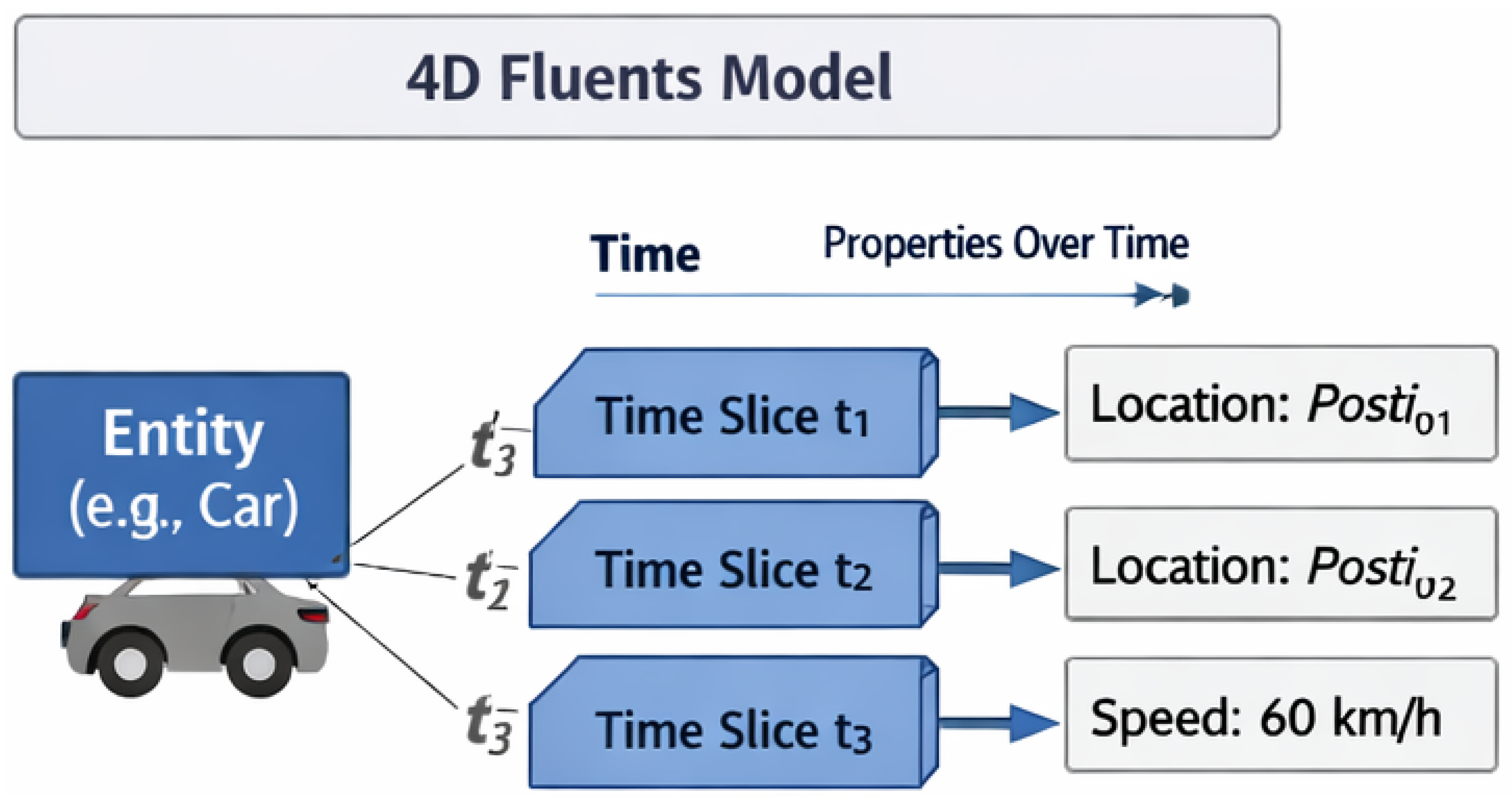
The 4D fluents (
Figure 2) represents a time-varying property (a
fluent) by reifying a temporally qualified context in which the property holds. The canonical OWL pattern introduces: (i) a
TimeSlice (or temporal part) class, (ii) a relation from the endurant individual to its temporal slice (e.g.,
hasTimeSlice), (iii) a relation from the slice to a temporal entity (instant or interval, often via OWL-Time), and (iv) property assertions attached to the slice rather than to the endurant directly. In this way, “
x is located at
y during interval
t” is modeled as “
x has a time-slice
;
is valid During
t;
has Location
y”.
This pattern can be viewed as an OWL-friendly instantiation of perdurantism: entities are represented through their spatio-temporal extensions (via slices), and persistence is captured by linking multiple slices to a single enduring identifier. The result is monotonic data growth (new slices are added, rather than overwriting old facts), which is attractive for audit trails, compliance, and historical querying.
7.1.2. Engineering Trade-Offs: Reification vs. Temporal Parts
A practical question is whether to reify (n-ary) temporally qualified assertions or to use temporal parts. A detailed design analysis by Katsumi and Fox highlights that temporal representations in OWL involve systematic trade-offs among modeling overhead, query complexity, and the ability to express identity under change [
45]. In particular:
- (1)
Query Complexity and Join Patterns
4D fluents systematically increase the number of joins required for retrieval because nearly every time-varying fact is mediated by an intermediate slice node. This can be mitigated by (i) indexing time slices, (ii) materializing convenience properties (views), or (iii) using SPARQL property paths and query templates. In knowledge-graph deployments, query templates are often essential to keep the approach usable for domain experts.
- (2)
Identity and “Same Entity, Different Times”
4D fluents cleanly separates entity identity (the enduring individual) from state descriptions (time slices). This is advantageous when one must preserve stable identifiers while allowing attribute changes (e.g., address, jurisdiction, or geometry updates).
- (3)
Update Semantics and Provenance
Because 4D fluents is additive, it aligns naturally with provenance and versioned records. However, additive modeling can produce large graphs and requires maintenance strategies (slice pruning, coalescing adjacent equal states, or interval-merging).
7.1.3. Post-2020 Work: Patterns for Spatiotemporal Validity Statements
Recent post-2020 work increasingly positions 4D fluents as one option within a portfolio of temporal-validity patterns rather than as the only solution. Carboni (2024) compares patterns for representing the validity of spatiotemporal statements in knowledge graphs, explicitly contrasting 4D (perdurantist) solutions with alternatives such as RDF-star-based annotation and domain-driven 4D logics (e.g., CIDOC-CRM [
46,
47] perdurantist commitments) [
48]. This perspective matters for ST ontologies because it highlights that many projects adopt hybrid models: 4D fluents for core identity-under-change, and lighter annotations for “secondary” time qualifiers.
Practical deployments illustrate the value of this pattern. In smart-city mobility applications, 4D fluents have been used to track vehicle positions and jurisdiction changes over time while preserving stable entity identifiers [
49]. In environmental monitoring, the same approach models dynamic water-body extents and land-use transitions, enabling historical queries on ephemeral features
A second post-2020 trend is using temporal-part modeling in support of ontology evolution and longitudinal data integration. For example, Canito et al. (accepted 2025) study ontology evolution from RDF streams and discuss time-dependent data as a driver of incremental changes; this type of scenario often benefits from explicit time-slice organization to preserve earlier conceptualizations while accommodating new ones [
50].
7.1.4. When 4D Fluents Is the Right Choice
4D fluents is typically the strongest choice when: (i) historical states must remain queryable, (ii) entity identity must be preserved across change, (iii) temporal validity is central to correctness (audit/compliance), and (iv) the system can tolerate modeling overhead and relies on reusable query templates.
It is less appropriate when: (i) the primary need is causal explanation (why did a state change?), (ii) event ordering and triggering are central, or (iii) one needs compact representations for extremely large-scale streaming data.
7.2. RDF-Star/SPARQL-Star Implications for Spatio-Temporal Statement Patterns
RDF-star introduces quoted triples to enable compact statements about statements (e.g., attaching validity time, provenance, uncertainty, or spatial confidence directly to a base triple) without full RDF reification. The RDF-star community specification extends both RDF syntax/semantics and SPARQL to query and update such quoted triples [
51]. More recently, W3C standardization efforts have moved toward integrating RDF-star features into updated RDF and SPARQL recommendations (often described as RDF 1.2 and SPARQL 1.2 trajectories).
For spatio-temporal modeling, RDF-star/SPARQL-star affects the design space of ST patterns in at least three ways. First, it provides a lightweight alternative to n-ary reification and (some) 4D fluent constructions for representing time-qualified assertions, reducing graph bloat when the system primarily needs to annotate facts (e.g., locatedIn, observedAt) with validity intervals or provenance metadata. Second, it shifts complexity from model structure to query patterns: temporal slicing becomes a matter of matching quoted triples and filtering on attached interval/instant metadata, rather than traversing explicit slice individuals. Third, it changes interoperability and execution assumptions: SPARQL-star querying support varies by engine and profile, and query optimization may differ from classic SPARQL joins used in 4D fluent or named-graph approaches.
Accordingly, RDF-star is best viewed as a pragmatic ST annotation mechanism that can complement (rather than replace) ontology-centered change models. In hybrid architectures, RDF-star can be used to annotate high-volume observational and derived relational assertions, while 4D fluents or event-based ontologies are reserved for identity-under-change and causal/state-transition representations where explicit temporal parts or event effects are required.
7.3. Event Calculus Ontologies: Events as Drivers of Fluent Change
7.3.1. Core Idea: Explicit Change and Inertia
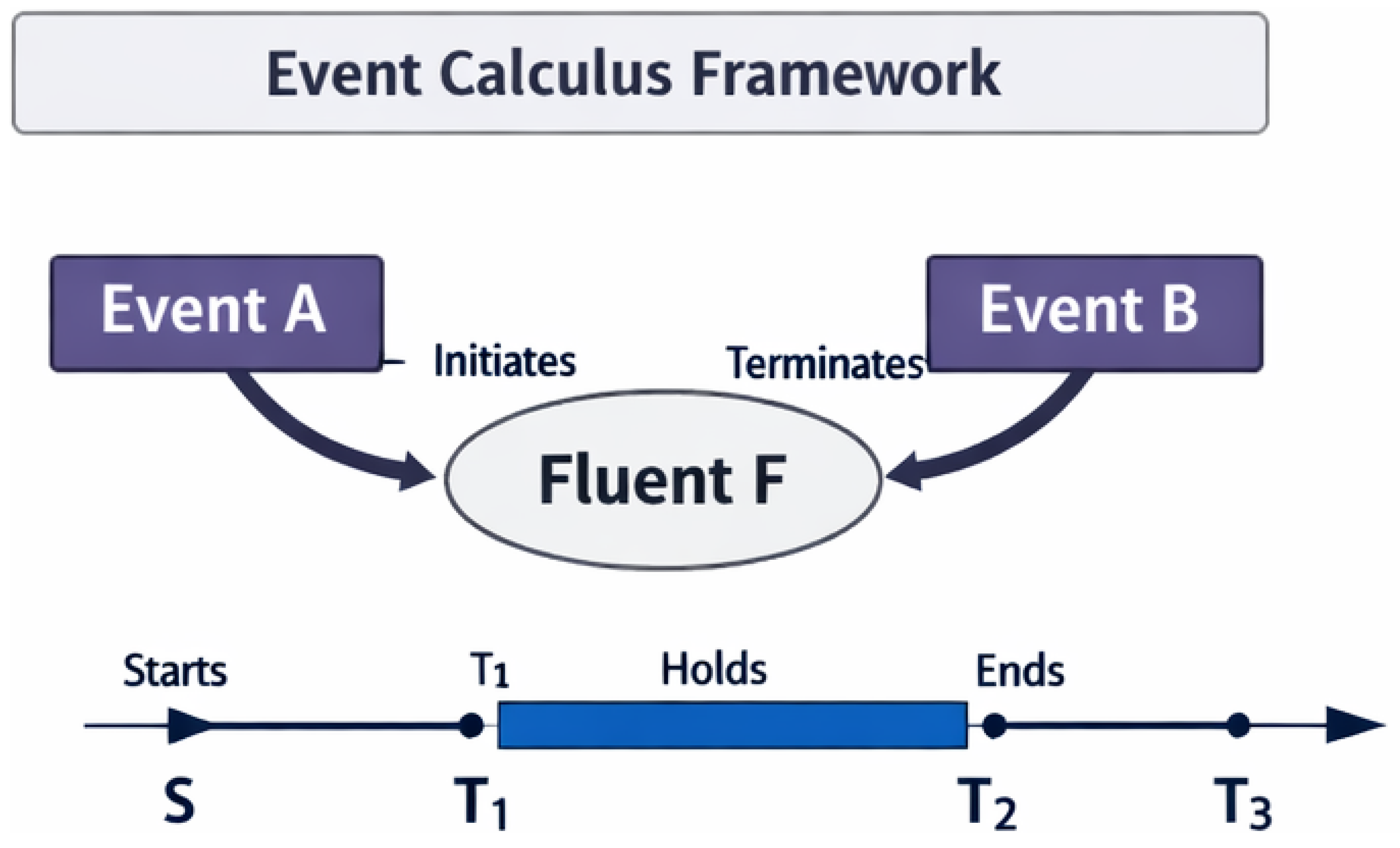
Event Calculus (EC) is a logic for representing and reasoning about actions and their effects over time. The central modeling vocabulary distinguishes: Events (things that happen), Fluents (time-varying properties), and time points/intervals. Axioms typically encode: (i) when an event initiates or terminates a fluent, and (ii) inertia (a fluent persists unless affected by a terminating event). This gives EC a major advantage over pure temporal annotation patterns: it makes the transition explicit and supports causal/explanatory queries.
7.3.2. Event Calculus + Ontologies: OWL/Rules Hybridization
Because OWL is monotonic and has no native nonmonotonic inertia operator, Event Calculus (
Figure 3) is often deployed as a hybrid: OWL models types and static constraints; rules (ASP/LP/Datalog-like) implement EC axioms and temporal propagation.
Baumgartner (2021) proposes combining Event Calculus with Description Logic reasoning via logic programming, allowing time-stamped ABoxes to be manipulated as fluents while interfacing with DL constraints [
8]. This is important for integrated ST systems because it offers a pathway to enforce ontological constraints (DL) while computing temporal evolution (EC).
7.3.3. Post-2020: EC as an Analytic Layer over Evolving Semantics
A prominent post-2020 application pattern is using EC not only for classic action reasoning but as an analytic layer over evolving knowledge graphs. Krause et al. (2023) explicitly combine Event Calculus with the analysis of empirical semantic drift, motivated by the observation that domain semantics in KGs often do not reflect the events that caused dynamic transitions [
52]. This direction aligns well with ST knowledge engineering: it treats event models as first-class explanations for change in concepts, not only in individuals.
7.3.4. Post-2020: EC-Inspired Ontologies in Applied Reasoning Systems
Event-calculus-inspired ontological cores also appear in applied reasoning systems where one needs both contextual modeling and rule-based temporal propagation. Moulouel et al. (2023) propose an ontology-based framework whose core ontology uses EC concepts (Event, Fluent, etc.) and couples a TBox/ABox with a rule layer to handle context abnormalities in uncertain environments [
53]. While not a “pure” EC ontology paper, it is representative of how EC ontologies function in practice: as a bridge between typed knowledge (OWL) and temporal inference (rules).
7.3.5. Comparative Synthesis: 4D Fluents vs. Event Calculus
Representation Focus
4D fluents emphasizes validity of statements (which values hold when), whereas EC emphasizes state transitions (what events cause which changes).
Reasoning Style
4D fluents is typically query-centric (retrieve states at times) and monotonic, while EC is typically explanation/derivation-centric and uses rule-based inertia and temporal propagation.
Best-Fit Integration Patterns
A practical hybrid architecture is common in integrated ST systems:
use 4D fluents to store historically valid states and support efficient time-slice queries;
use Event Calculus rules to derive new states, detect inconsistencies, and provide causal explanations;
materialize (or cache) derived states as new time slices for downstream consumption.
This hybrid view is consistent with recent pattern comparisons and EC + KG analytic work [
48,
52].
Real-world examples further demonstrate the complementarity. Event Calculus rules have powered flood-monitoring systems (Dynamic Flood Ontology) by deriving states from sensor events. In digital-twin platforms for critical infrastructure, EC handles causal propagation of maintenance events while 4D fluents maintain the historical state slices [
45,
52,
53].
7.4. Spatial Dynamics and Spatio-Temporal Coupling
While this section analyzed temporal validity and event-driven change, a fully integrated spatio-temporal (ST) framework must also model the evolution of spatial configurations themselves. In many real-world domains, spatial relations are not static annotations but dynamic properties whose change carries semantic significance. Administrative boundaries shift, moving objects alter topological relations, and environmental regions undergo deformation or fragmentation. Accordingly, integrated ST ontologies must represent not only when properties hold, but how spatial structures evolve over time.
7.4.1. Time-Indexed Spatial Relations
Spatial predicates such as containment, adjacency, overlap, and disjointness are frequently time-dependent. A region may partially overlap another at time and become disconnected at time . Two principal modeling strategies appear in ontology-driven systems:
Temporal Qualification of Qualitative Relations
Qualitative relations (e.g., RCC-8 predicates) can be temporally qualified using: (i) 4D fluents (attaching the spatial relation to a time-slice individual), (ii) n-ary reification patterns, or (iii) RDF-star statement annotations. This approach preserves compatibility with OWL reasoning but increases modeling overhead.
Derived Relations from Time-Stamped Geometries
Alternatively, geometries may be time-indexed using OWL-Time, with spatial relations computed dynamically via GeoSPARQL functions at query time. In this pattern, topological relations are not permanently stored but derived from geometry evolution. This improves scalability but shifts reasoning from symbolic inference to query execution.
The design trade-off reflects a broader tension between explicit symbolic representation and computational efficiency.
7.4.2. Geometry Evolution and Identity Under Spatial Change
Beyond relational change, integrated ST modeling must address geometry evolution and identity conditions. Spatial entities may:
Change boundary shape without losing identity,
Split into multiple entities,
Merge with other regions,
Undergo gradual deformation.
These phenomena raise ontological questions concerning persistence. Within 4D-fluent approaches, geometry changes are modeled as distinct temporal slices associated with different geometries. Event-based approaches instead treat boundary modification as the effect of an event that initiates or terminates specific spatial configurations.
A critical issue is whether identity is preserved across spatial transformations. Foundational ontologies differ in their treatment of such cases, depending on their stance on persistence, parthood, and mereotopology.
7.4.3. Spatio-Temporal Regions and 4D Mereotopology
True integration requires modeling space-time regions rather than merely attaching timestamps to spatial objects. In a 4D perspective, entities occupy spatio-temporal regions whose parts may be analyzed both spatially and temporally. This introduces the need for:
Spatio-temporal parthood relations,
Topological relations between 4D regions,
Formal treatment of region continuity across time.
However, expressive 4D mereotopological calculi are rarely implemented within OWL-based systems due to decidability constraints. As a result, most Semantic Web deployments approximate spatio-temporal reasoning by layering temporal validity models over spatial standards such as GeoSPARQL, rather than employing unified spatio-temporal logics.
7.4.4. Event-Driven Spatial Transformation
Event Calculus approaches provide a complementary mechanism for spatial integration. Events such as “boundary redefinition”, “movement”, or “land-use conversion” can be modeled as initiating or terminating spatial fluents. In this pattern:
Events cause changes in spatial relations,
Fluents represent time-dependent spatial predicates,
Inertia axioms ensure persistence unless modified.
This architecture enables causal explanation of spatial transitions, rather than merely recording successive geometric states. Hybrid systems may therefore combine: (i) 4D fluents for validity tracking, (ii) GeoSPARQL for geometric computation, and (iii) Event Calculus rules for causal propagation of spatial change.
7.4.5. Comparative Observation
The analysis reveals that fully integrated ST modeling remains rare in practice. Most deployed systems adopt a layered architecture: spatial representation (GeoSPARQL), temporal annotation (OWL-Time or slices), and optional rule-based reasoning (Event Calculus or SHACL constraints).
Unified spatio-temporal logics offering native treatment of spatial topology and temporal evolution within a single decidable formalism remain an open research challenge. Consequently, contemporary ST ontology engineering typically relies on architectural composition rather than a single integrated formal theory.
7.5. Recent Unified Spatio-Temporal Frameworks (2023–2025)
Several recent proposals move beyond layered composition toward more tightly integrated frameworks. WasGeo [
54] unifies SQL, SPARQL, and OWL reasoning in a single geospatial architecture, achieving 95% reasoning accuracy on million-triple datasets while balancing scalability and depth. [
55] present a virtual-knowledge-graph framework that extends GeoSPARQL for raster data cubes, enabling natural SPARQL-based spatio-temporal queries. The Unified Time Framework (UTF) [
56] provides a systematic parsing layer for temporal expressions in geosciences knowledge systems. These works illustrate the ongoing convergence of the modular patterns discussed earlier and serve as concrete blueprints for next-generation ST ontologies.
8. Critical Synthesis and Discussion
This review has examined spatial, temporal, and spatio-temporal ontologies from foundational theory to Semantic Web standards and contemporary knowledge graph implementations. While substantial progress has been achieved in the individual dimensions of space and time modeling, fully integrated and universally adopted spatio-temporal frameworks remain elusive. The literature reveals persistent conceptual, technical, and methodological limitations that also define a clear agenda for future work. Accordingly, this section combines critical synthesis with discussion of implications and research directions.
8.1. Convergence and Persistent Fragmentation Across Traditions
A central observation is the partial convergence of three major traditions: formal ontology and knowledge representation, Geographic Information Science (GIS), and Semantic Web / knowledge graph engineering. Temporal logics and spatial calculi provide rigorous formal foundations, while GIScience contributes event-based and process-oriented perspectives on geographic change. Semantic Web standards and knowledge graphs, in turn, enable interoperable and scalable deployment in real-world systems.
However, this convergence remains incomplete. Each tradition continues to optimize for different priorities: formal soundness in ontology research, practical applicability in GIS, and scalability and analytics in knowledge graph systems. Differences in terminology, evaluation criteria, and modeling assumptions (e.g., persistence and identity under change) still impede reuse and alignment. A key direction is cross-disciplinary harmonization that links ontological commitments to implementable patterns and architectures.
8.2. Expressiveness Limits and Temporal Modeling Gaps
Despite the availability of standardized temporal vocabularies, core Semantic Web languages remain limited for representing dynamic change. In particular, OWL lacks native temporal operators, so temporal constraints are typically encoded via reification, time-indexed individuals, or external rule layers. This preserves decidability but constrains expressiveness for temporal dependencies, causality, and evolving schemas.
Future progress requires (i) expressive yet decidable temporal extensions (e.g., carefully restricted point- or interval-based formalisms), and (ii) practical tooling that supports efficient reasoning and query answering over evolving knowledge bases. An additional requirement is better integration between temporal validity patterns (annotation/reification/slices) and the constraint languages used in deployment (SHACL, rules, OBDA mappings), so that temporal semantics are both explicit and operational.
8.3. Spatio-Temporal Integration and the Challenge of Change
A recurring difficulty is that spatial and temporal reasoning, while individually mature, are technically complex to integrate. Spatial relations may evolve over time, which necessitates explicit representations of state transitions, versioning strategies, or event/process structures. Static object-centric models are often insufficient for phenomena such as urban growth, infrastructure transformation, mobility dynamics, or environmental processes.
Event-based and process-oriented approaches provide conceptual leverage but can introduce modeling and computational overhead. Moreover, reasoning about continuous change, propagation, and causal structure frequently exceeds the capabilities of many current implementations. A core research direction is the formal alignment of spatial predicates with temporal evolution mechanisms in a way that supports scalable querying and maintainable updates.
8.4. Trade-Offs Between Formal Rigor and Scalability
One of the most persistent themes is the tension between expressive formal models and computational scalability. Description logic-based ontologies support logical consistency and inferential guarantees, yet they can struggle with large-scale, rapidly changing instance data. Conversely, knowledge graph systems enable massive graph processing and predictive analytics, but often relax strict logical semantics or shift meaning into embeddings and statistical models.
This landscape motivates hybrid and layered architectures that separate schema-level semantic commitments from instance-level data management and analytics. In such designs, ontologies define the conceptual backbone and constraints, while scalable graph engines and learning-based components handle high-volume data and predictive tasks. A key open problem is principled alignment between symbolic semantics and embedding-based representations, including explanations and error bounds when the two diverge.
8.5. Interoperability, Standardization, and Reuse of Patterns
Standards such as OWL-Time and GeoSPARQL have improved interoperability, yet they remain largely modular rather than natively integrated. In the absence of a comprehensive spatio-temporal standard, many systems adopt custom modeling patterns, which hinders reuse, portability, and cross-domain compatibility.
Progress will likely depend on (i) clearer community-endorsed modeling patterns for integrated spatio-temporal statements (e.g., validity, change, causality, uncertainty), (ii) tighter coordination between standards bodies, ontology engineers, and domain practitioners, and (iii) conformance artifacts and validation practices that reduce ambiguity in implementation.
8.6. Evaluation and Benchmark Deficits
Another major limitation is the lack of standardized evaluation methodology. Existing assessments tend to emphasize either logical properties (e.g., consistency, entailments) or application performance (e.g., query latency, throughput), but rarely both in a controlled and comparable manner.
A field-level priority is to establish shared benchmark datasets, standardized reasoning/query tasks, and metrics that jointly assess logical soundness, scalability, interoperability, and maintainability under updates. Benchmarking should explicitly cover dynamic scenarios (streaming, revisions, temporal granularity changes) and integrated spatio-temporal queries.
Evaluation Frameworks and Benchmarks for Spatio-Temporal Ontologies and GeoKGs
A persistent gap is the absence of standardized evaluation methodology. Existing assessments focus either on logical properties (consistency, entailment) or operational metrics (query latency, scalability), but rarely both. Future benchmarks should include: (i) dynamic update scenarios (streaming data, revisions), (ii) integrated spatio-temporal queries combining RCC, GeoSPARQL, and temporal operators, (iii) uncertainty propagation accuracy, and (iv) maintainability under ontology evolution. Conformance suites for GeoSPARQL 1.1 and SHACL shapes already exist; extending them to full ST pipelines (including 4D fluents and Event Calculus rules) would provide a common yardstick for quality assessment of both ontologies and deployed GeoKGs.
8.7. Multi-Scale, Context-Aware, and Uncertainty-Aware Modeling
Spatio-temporal phenomena often span multiple scales, yet many ontologies assume fixed spatial granularity and uniform temporal resolution. This is especially limiting for urban systems, climate analysis, and mobility analytics, where meaningful abstractions vary by context and scale.
Future frameworks should support hierarchical spatial abstraction, adaptive temporal resolution, and context-sensitive reasoning, while also accommodating uncertainty in observations and derived spatial relations. Doing so without sacrificing semantic coherence and tractability remains an open design and engineering challenge.
8.8. Toward Integrated Spatio-Temporal Intelligence
The broader trajectory of research suggests a shift toward integrated spatio-temporal intelligence systems that combine symbolic reasoning, graph analytics, and machine learning. These systems aim not only to represent where and when events occur, but also to explain why they occur and to support robust prediction under uncertainty and change.
Key directions include:
Formal integration of event-driven and process-oriented semantics;
Representation of causality and uncertainty in spatio-temporal processes;
Neuro-symbolic architectures combining logical reasoning with machine learning;
Lightweight spatio-temporal description logics: restricted DL-Lite/LTL fragments that remain first-order rewritable for OBDA-scale querying [
34];
Practical GeoSPARQL + OWL-Time integration schemes: hybrid patterns that use 4D fluents or RDF-star for validity annotation while delegating geometric computation to GeoSPARQL 1.1 functions and SHACL for constraint validation;
Adaptive ontology versioning and incremental reasoning mechanisms.
8.9. Synthesis
Collectively, these findings indicate that no single framework currently maximizes formal rigor, dynamic expressiveness, scalability, interoperability, and adaptability. Progress will require interdisciplinary collaboration across ontology engineering, GIScience, Semantic Web research, and artificial intelligence, alongside the development of shared evaluation resources and implementation-ready modeling patterns.
9. Conclusions
This review has presented a structured synthesis of spatial, temporal, and integrated spatio-temporal ontologies, bridging foundational ontology, qualitative spatial and temporal calculi, description logic formalisms, and Semantic Web standards. By organizing the literature into a conceptual taxonomy and critically analyzing trade-offs between expressiveness, scalability, interoperability, and adaptability, the paper clarifies the design space of ontology-driven spatio-temporal modeling.
The analysis shows that while individual components—formal foundations, spatial and temporal standards, and ontology engineering patterns—have reached considerable maturity, their coherent integration into scalable, dynamically evolving systems remains incomplete. No single framework currently reconciles logical rigor, computational tractability, and real-world deployment demands.
Future progress will depend on principled hybridization: combining ontology-based semantic commitments with scalable graph infrastructures, event-driven representations, and adaptive reasoning mechanisms. Advancing such integrated approaches is essential for supporting intelligent systems capable of representing and reasoning about complex, evolving phenomena across space and time.