Article

StegoPadding: A Steganographic Channel with QoS Support and Encryption for Smart Grids Based on Wi-Fi Networks

Institute of Telecommunications and Cybersecurity, AGH University of Krakow, Al. Mickiewicza 30, 30-059 Krakow, Poland
*
Author to whom correspondence should be addressed.
Electronics 2026, 15(7), 1504; https://doi.org/10.3390/electronics15071504
Submission received: 4 March 2026 / Revised: 30 March 2026 / Accepted: 1 April 2026 / Published: 3 April 2026
(This article belongs to the Special Issue Communication Technologies for Smart Grid Application)

Abstract

Wi-Fi networks used in smart grids are essential for enabling communication between smart meters and data aggregation units. A key challenge, however, is the ability to hide the existence and traffic patterns of these communications, so that sensitive information exchanges cannot be easily detected or intercepted. Unfortunately, most existing solutions do not provide support for traffic prioritization and steganographic channel encryption. In this paper, we propose a novel covert channel with Quality of Service (QoS) and encryption support for smart grid environments based on the IEEE 802.11 standard. We introduce an original steganographic approach that leverages the backoff mechanism, the Enhanced Distributed Channel Access (EDCA) function, frame aggregation, and the StegoPaddingCipher algorithm. This design ensures QoS-aware traffic handling while enhancing security through encryption of the transmitted covert data. The proposed protocol was implemented and evaluated using the ns-3 simulator, where it achieved excellent performance results. The system maintained high efficiency even under heavily saturated network conditions with additional background traffic generated by other nodes. The proposed covert channel offers an innovative and secure method for transmitting substantial volumes of QoS-related data within smart grid environments.

1. Introduction

Wireless communication has become an indispensable component of modern digital infrastructure, supporting everything from personal devices and home networks to enterprise systems and Smart Grids (SG). Among the various wireless technologies, Wi-Fi—formalized through the IEEE 802.11 [1] family of standards—remains the dominant solution for providing flexible, high-speed, and cost-effective connectivity. Its widespread adoption can be attributed to its ease of deployment, the continuous evolution of standards, and its ability to support a diverse range of applications, including multimedia streaming, real-time communication, Internet of Things (IoT) systems, and cloud-based services. As Wi-Fi networks continue to expand in scale and importance, ensuring their security and resilience against various forms of misuse or attack becomes increasingly critical. Security within Wi-Fi environments faces unique challenges due to the broadcast nature of wireless communication. Unlike wired networks, where an attacker must physically tap into a cable, Wi-Fi signals propagate through the air and can be intercepted by any device within range. Consequently, a variety of security mechanisms have been introduced over the years, from encryption protocols such as Wired Equivalent Privacy (WEP), Wi-Fi Protected Access (WPA), and WPA2/3, to authentication frameworks and intrusion detection systems. These measures aim to protect data confidentiality, integrity, and availability. However, despite these advances, Wi-Fi networks remain vulnerable to a number of threats.
The Smart Grid (SG) [2] employs modern communication solutions to improve the performance, dependability, and environmental viability of power delivery networks. Through the combination of diverse communication infrastructures, SG systems facilitate continuous supervision, management, and optimization of processes related to electricity production, transmission, distribution, and end-use consumption. The SG standard IEC 61850 enables smooth data exchange over Local Area Networks (LANs), ensuring compatibility and effective interoperability between different system components [3]. Due to advantages such as relatively low deployment costs, rapid data transmission rates, and straightforward implementation, Wireless Local Area Network (WLAN) solutions are gaining increasing attention from energy providers. Wi-Fi technology can function as a communication backbone for SG components, including intelligent meters, measurement sensors, and supervisory control units [4]. By utilizing pre-existing WLAN infrastructure or installing dedicated Wi-Fi-capable equipment, utility operators can create dependable communication pathways that support immediate data transfer, thereby enhancing oversight and operational control of grid activities. Because SG infrastructures depend extensively on information exchange and remote management capabilities, comprehensive cybersecurity strategies are indispensable to defend against digital attacks and to preserve data confidentiality and integrity. Techniques such as strong encryption protocols, multi-factor authentication, and intrusion detection mechanisms are implemented to protect vital assets and sensitive operational information. Although Wi-Fi delivers flexibility and accessibility, maintaining security is particularly crucial in safety-critical SG deployments. Energy providers must therefore adopt stringent protective measures to secure WiFi-connected devices and to block unauthorized intrusion or manipulation of grid systems. Moreover, forthcoming SG applications will demand reliable support for data transmission accompanied by suitable Quality of Service (QoS) guaranties.
The concept of hiding information within seemingly legitimate communications is not new and is closely related to the field of steganography. Steganography is the practice of concealing information within another medium in such a way that the presence of the hidden message is undetectable to unintended observers. Historically, steganography has relied on techniques such as embedding text within images, manipulating audio samples, or altering file structures to encode secret data without noticeably affecting the original content. However, in digital networks, steganography often takes the form of embedding hidden information within protocol fields, timing patterns, or control mechanisms at various layers of the Open Systems Interconnection (OSI) model. It is important to distinguish steganography from encryption, as the two serve different purposes. Encryption aims to protect the content of a message by transforming it into an unreadable form that can only be interpreted by parties possessing the appropriate decryption key. Although encrypted data may be secure in terms of confidentiality, its presence is obvious—an observer can easily recognize that encrypted communication is taking place. Steganography, on the other hand, focuses on concealing the existence of the message. A well-designed steganographic communication should appear indistinguishable from normal traffic, making detection significantly more challenging. When steganographic methods are applied to network protocols, the resulting hidden communication channels are commonly referred to as covert channels.
Covert channels in Wi-Fi networks take advantage of the rich set of features and control fields defined by IEEE 802.11 to transmit information secretly between devices. These channels can be created by manipulating timing intervals, modifying specific header fields, controlling retransmission behavior, or altering other parameters of the Media Access Control (MAC) layer in ways that remain compliant with the protocol. Because Wi-Fi standards are complex and include numerous optional and vendor-specific features, they offer fertile ground for embedding covert communication without raising suspicion. Although some covert channels require specialized hardware or firmware modifications, many can be implemented entirely in software, making them more accessible to both attackers and researchers. This study is dedicated to designing a hidden communication mechanism with QoS and encryption support for the SG environment that operates over Wi-Fi networks. Since the IEEE 802.11 standard relies on a common transmission medium shared by multiple participants, it naturally creates opportunities for unauthorized interception. Within such a setting, concealed communication techniques may be applied to securely exchange cryptographic keys, confirm the authenticity of users, or deliver other sensitive information without attracting attention. The primary objective of this work is to introduce a collection of original algorithms enabling secret data transfer with correct traffic prioritization and encryption by embedding information at the MAC layer of the IEEE 802.11 standard. The proposed approach assures excellent efficiency for both normal and covert communication while ensuring high resistance to stegoanalysis. In this paper, we present the following contributions:
  • The proposal of the first covert channels that uses the ’Padding’ field of the aggregated MAC frame to hide covert data.
  • The proposal of a first QoS covert channel that uses a virtual Enhanced Distributed Channel Access (EDCA) function to prioritize different types of covert traffic.
  • The proposal of the first covert channels that uses enhanced encryption mechanism based on multi-phase stream cipher architecture to improve the security of hidden data.
  • A comprehensive evaluation of the performance of covert channels under varying network parameters (payload size, offered load, background load), covert channel configurations (number of background nodes, QoS classes), and the impact of the RTS/CTS mechanism.
  • An examination and discussion of the effects of network saturation and loads imposed by neighboring stations on covert channel performance.
By focusing exclusively on features available within the data link layer, the proposed methods remain feasible for implementation on commodity hardware and standard operating systems, while offering high transmission reliability and low detectability. The goal of this work is to contribute to the growing body of research on network steganography by demonstrating how subtle manipulations of IEEE 802.11 behavior can be harnessed to create an efficient and stealthy covert communication channel.
The remainder of the paper is organized as follows. Section 2 concentrates on the relevant literature regarding other covert channels. Section 3 presents the technical aspects of the mechanisms from the IEEE 802.11 standard that were used in the proposed implementation. The concept of the Stego-Padding covert channel, including all proposed algorithms, is described in Section 4. The simulation environment and channel performance evaluation are covered in Section 5. Section 6 focuses on the limitations and risks related to the proposed algorithm. Lastly, Section 7 contains the conclusions of the research and the possibilities for future work.

2. State of the Art

In recent years, there have been more and more works and projects concerning the implementation and analysis of various types of hidden channels in Wi-Fi networks. One of the first proposals was the HICCUPS (HIdden Communication system for CorrUPted networkS) [5] steganographic system, in which the authors suggested the use of three hidden data channels. The first was based on the WEP algorithm initialization vectors [1], the second used MAC addresses, and the third was based on a data integrity checking mechanism, e.g., checksums. The performance of the system was then tested under saturation conditions in [6]. In this follow-up study, the performance of HICCUPS was analyzed using a Markov chain-based model of the IEEE 802.11 Carrier Sense Multiple Access with Collision Avoidance (CSMA/CA) protocol. The analysis demonstrated that HICCUPS can achieve significant steganographic bandwidth with minimal impact on network performance.
Many covert channel proposals and implementations are based on specific frame fields at the data link layer. The authors of the paper [7] proposed 2 covert channels. The first one uses part of the Sequence Control field in the frame header. This field consists of two parts: Sequence Control (12 bits) increases with each subsequent frame, and Fragment Control (4 bits) increases with each subsequent frame fragment. To reduce the chance of detecting the channel by stegoanalysis, the authors decided to use only 8 bits from the Sequence control part. The second channel is based on the initialization vector (IV) of the WEP encryption algorithm. This is a 3-byte random value that the RC4 algorithm uses to encrypt data and must be sent to the recipient so that it can decrypt the data. Due to the fact that it is a random value, the authors used the entire IV to send the data. Then, in [8], the authors implemented a system using the aforementioned covert channels and performed performance tests.
The authors of [9] proposed the WiPad (Wireless Padding) method, which consists of inserting hidden information into the padding of Orthogonal Frequency Division Multiplexing (OFDM) symbols at the physical layer level in IEEE 802.11 networks. These padding bits are used to align frame lengths to symbol boundaries and are typically ignored by receivers, making them an ideal carrier for covert data. WiPad takes advantage of this redundancy without altering legitimate traffic or affecting the error rate noticeably. Analytical modeling using a Markov chain-based CSMA/CA protocol showed that the method can achieve throughput up to 1.1 Mbps for data frames. In another work related to steganography in OFDM symbols [10], the authors proposed modifying cyclic prefixes (CP) to send hidden information. The CP is a copy of the end of each OFDM symbol, inserted at the beginning to combat inter-symbol interference, and can be slightly modified without significantly affecting signal integrity. By selectively altering the CP, hidden information can be transmitted covertly alongside normal data traffic. The authors demonstrate that this approach provides a high capacity covert channel with minimal detectability due to the inherent redundancy of the CP. Simulations confirmed that the method maintains reliable communication while achieving high steganographic throughput. The researchers in [11] proposed a different implementation of a covert channel at the physical layer. The idea is to send covert messages at low rates (QPSK or BPSK) through dirty constellations. To achieve that, they implemented a covert QPSK constellation with additional constellation points. If the receiver is aware of this and has sufficient SNR (Signal to Noise Ratio), then they are able to decode the covert message. Unaware users, meanwhile, will treat the covert constellation points as a random dispersed sample of low-rate modulation. During the analysis, the authors achieved a data rate up to 9 Mbps with QPSK modulation using 3 / 4 encoding rate. One of the main issues with this method is that the receiver needs a high-enough SNR to be able to successfully decode the information in the covert channel, especially when used with higher constellations (256-QAM, etc.).
In another work [12], the authors proposed using the Distributed Coordination Function (DCF) to send hidden messages. Before information can be sent, it is necessary to analyze traffic in the WLAN network, and then determine the codebook that will be used in communication—both parties must know it. Then, based on the analysis and the codebook, the station sends messages after a specified backoff time, defined in the codebook. Due to the randomness of the backoff mechanism, the method is resistant to stegoanalysis. However, manipulating the backoff mechanism violates the principles of fair access to the channel provided by the DCF function. In addition, sending information in this way can be limited by the number of stations in the wireless network—the more stations, the lower the throughput of such a channel.
In another paper [13], the authors proposed to implement a covert channel based on forged Clear-To-Send (CTS) and Acknowledgment (ACK) frames. The information is carried in a two-bit Protocol Version field, located in the Frame Control field in the frame header. Additionally, the authors decided to use the Forward Error Correction (FEC) mechanism to reduce the number of errors in transmission, and also improved the channel efficiency by using bit interleaving. The author of [14] proposed and conducted an analysis of the efficiency of a covert channel implemented in the IEEE 802.11e network. To signal the beginning and end of the covert transmission, three unused bits were used in the Association and Reassociation Request frames, respectively, while the hidden data are transmitted in the Traffic Identifier (TID) and Transmission Opportunity (TXOP) parameters in the QoS Control field in the QoS frame headers.
In [15], the authors presented two concepts of using a covert channel to authenticate access points. The first channel uses the four least significant bits of the Timestamp field in the Beacon frame, which is sent periodically by the access point. In place of these four bits, the Access Point (AP) places a fragment of the established authentication stream. Then the station must collect a sufficient number of Beacon frames to assemble the entire stream and for the AP to be able to authenticate. The second proposal is to appropriately modify the time in the Timestamp field, so that after comparing it with the time from the previous Beacon frame, the client station can calculate their difference and gradually recreate the authentication key on this basis. Both proposals provide low throughput −40 bps in the first case and 20 bps in the second. However, due to the intended use of the channel, a higher throughput is not required.
The researchers in [16] proposed a covert timing channel (CTC) using off-the-shelf wireless cards called Covert-DCF. The idea is to send covert messages, by transmitting frames at previously specified and known by the sender and receiver back-off intervals. In this method, the authors used a total of 255 time slots and used them to encode 16 symbols (from 0 to 15). In this way, each symbol represents 4 bits, which implies 28.125 time slots per bit. After practical tests, the researchers decided to fine-tune their method and changed the configuration to 2 bits per symbol and the total number of back-off slots to 50, with the first ten serving as guard interval, to not employ a low back-off, which implies 12.5 time slots per bit. The maximum throughput achieved by the covert channel was 2.28 Kbps, but was decreased to 46 bps to create a channel with proper reliability. The main issue with this method is back-off manipulation, which violates the principles of fair access to the channel. In addition, the usable throughput is rather low, but it stands out among other CTCs.
The authors of [17] proposed another method for developing a covert channel. Instead of modifying the values of fields such as Timestamp, Duration/ID, Sequence Control, etc., the authors based their idea on the time that elapses between the delivery of specific frames (interarrival time)—CTC. In this case, Probe Request and Beacon frames were used. The first step is to define the codebook according to which the information will be encoded: sending a frame in a specified time interval means sending a specific sequence of bits. The sender then sends frames in specified time intervals and the recipient decodes the message using the codebook. In order to prevent errors resulting from lost frames, the authors decided to send frames multiple times. Finally, a throughput of 50 bps was achieved with a symbol transmission error rate below 2 % . It should be noted that although the channel throughput is small, its implementation is easy—it only requires changes in the configuration, and channel detection is possible only at the physical layer. A similar approach was used in the work [18]. The authors proposed a method for creating a steganographic channel using the relative order of the frames. In the case of communication between two stations A and B, if station A sends a frame before station B does, then it means sending a hidden “0”. On the other hand, if station B sends a frame first and then A, it means sending a hidden “1”. This method is not limited to only two stations; it is possible to involve more devices. The main disadvantages of this method are the problem of synchronization—it is necessary to determine the event after which the stations will start transmitting hidden messages, susceptibility to errors—an error correction mechanism should be used, and low channel throughput.
Another approach described in [19] is to develop a covert channel operating in the physical layer. The transmitter—A, instead of sending a weak hidden signal, sends the message with superposed hidden signals to the receiver—B. In order to do that, A generates the DFT-precoded (discrete Fourier transform) OFDM signal as a cover signal and sends it along with the secret signal. Studies have shown that detecting, and ultimately uncovering the secret message mainly depends on the third party’s SNR. Moreover, by increasing the power of the cover signal, the sender can increase the third party’s detection error probability. The performance of the covert channel has not yet been analyzed, but the receiver’s SNR should also be considered.
The authors of StegoBackoff [20] proposed using the back-off mechanism to send single bits of information in a covert channel for use in Smart Grid Networks, where sending a frame after an even number of time slots means sending a 0 bit in the covert channel, while if the number of time slots is odd, it means sending 1. The covert channel offers low throughput, but due to the target application, it is sufficient. The authors of StegoDCF [21] extended the work of [20] by adding the three least significant bits of the Duration/ID field from the MAC header to the covert channel, which increased the channel efficiency by 300 % . Additionally, this work pioneers extending the idea by adding support for QoS traffic. Unfortunately, both StegoDCF and StegoBackoff have certain limitations. In order to increase the throughput of the covert channel, it is best to send short frames, which, however, negatively affects the channel efficiency. Additionally, by increasing the offered load, we can increase the channel capacity, but beyond a certain point it has an unfavorable effect on the whole network.
The authors of [22] used the MAC address randomization mechanism used in IEEE 802.11 networks to send hidden information. The hidden message is sent in the Source Address field in the Probe Request frame. In order to distinguish whether the frame came from a hidden station or a normal station, Cyclic Redundancy Check 8-bit (CRC-8) was used, and the appropriately set Sequence Number carried in the Sequence Control field. After performing a performance analysis, the channel throughput obtained was 1.95–4.8 Kbps. The limitation of using this channel is the dependence on the AP as the recipient of hidden messages to ensure reliability. The authors of StegoEDCA [23] combined many mechanisms to create a hybrid covert channel. In order to send data in the covert channel, the authors used a modified version of StegoDCF, aggregated frames, and QoS frames—the IEEE 802.11e standard defines four traffic classes, so sending a QoS frame in a specific traffic class involves sending 2 bits of information, and a TXOP period, where sending the appropriate number of frames in one TXOP period is equivalent to sending a maximum of 3 bits. As a result, the authors obtained a covert channel with high throughput and, thanks to the use of many steganographic mechanisms, resistant to stegoanalysis.
The authors in [24] proposed an implementation of a practical CTC with the ability to recover two lost bits called a ping-pong covert timing channel (PPCTC), which uses the normal and modified beacon interval (BI) to send covert information. Typically, the BI ( B I O —overt beacon interval) of the AP is initially set to 102.4 ms, while the modified value ( B I C —covert beacon interval) was set to 102.37 ms and 102.43 ms. If a beacon packet is received after B I O , this means the transmitted bit is 1; otherwise it is the transmitted bit 0. However, in order to ensure reliability, the information bits 1 ^ and 0 ^ are composed of 01111 and 01 transmitted bits, respectively. Moreover, the authors developed a covert frame structure, which in turn is encrypted with a hash-based XOR cipher to ensure confidentiality. One of the frame fields also includes the CRC to ensure integrity. After the analysis, it was concluded that the channel excels in terms of covertness, robustness, confidentiality and integrity. In terms of throughput, the PPCTC exhibits 2.79 bps with 0.07 % bit error rate. The researchers in [25] proposed a similar implementation of a robust CTC with self-bit recovery, with the ability to recover two lost bits, taking advantage of inter-packet delay (IPD). In IEEE 802.11ac, packets are transmitted with an IPD set to 102,400 μs. The authors defined this time as T. They also defined times T + = T + α and T = T α where α = 40 μs. Then they implemented an algorithm according to which the sender transmits packets at specific times depending on the covert message he wants to send. During the analysis, the researchers evaluated the channel in terms of correctness, robustness and performance, and then compared the results with other existing methods. In terms of correctness they have proven that the receiver is able to recover two lost bits of the message. In terms of robustness, the analysis implied that the proposed scheme has superior covertness than the existing ones. In terms of performance, they have concluded that this scheme can transmit 3.25 bps. Compared to prior CTCs, the proposed method demonstrates substantial improvements in terms of correctness, robustness, and performance.
Table 1 presents an overview of existing covert channels. Although a variety of covert channel techniques have been proposed in the literature, substantial scope remains for the development of novel architectures and the performance optimization of existing implementations. Moreover, there has been only one attempt to implement limited QoS support in the covert channel [21] and only a few take into account the problem of encrypting covert data [7,24,25]. The primary objective of this paper is to develop a covert communication channel that achieves high throughput, maintains a low probability of detection through covert channel encryption, imposes negligible overhead on legitimate network traffic, and fully leverages QoS mechanisms.

3. Background

To fully understand how the proposed steganographic algorithm operates, it is necessary to analyze the particular aspects of the IEEE 802.11 standard that will be used to establish a hidden communication channel. The IEEE 802.11 standard is part of the broader IEEE family, which defines the physical layer and the MAC sublayer of WLANs. Throughout its evolution, this standard has developed into a sophisticated framework that encompasses a wide range of mechanisms and procedures, which makes it well suited for the development of innovative steganographic techniques.

3.1. Backoff Mechanism

The Backoff mechanism in Wi-Fi is a collision avoidance technique used in IEEE 802.11 networks to manage how multiple devices share the same wireless channel. This task is handled by the DCF and EDCA functions. Since Wi-Fi is a shared medium, only one device can transmit at a time. The backoff mechanism ensures that when two or more devices want to transmit simultaneously, they wait for random time intervals before trying again, reducing the chance of repeated collisions. This process is part of the CSMA/CA protocol, which is the core of how Wi-Fi handles medium access.
During subsequent transmission attempts, or when the medium is busy, the Wi-Fi station must perform the backoff procedure. This mechanism introduces a random delay before the station can try to access the channel again. The backoff interval is expressed in time slots, whose duration depends on the specific IEEE 802.11 standard being used. The backoff value represents the number of these time slots the station must wait before retransmitting, and it is calculated as:
B a c k o f f = r a n d o m _ i n t ( 0 , C W 1 )
where C W (Contention window) is determined based on the number of retransmission attempts (n), as well as the minimum and maximum size of the contention window ( C W m i n and C W m a x ):
C W = m i n ( 2 n × C W m i n , C W m a x )
The contention window starts at C W m i n and doubles after each failed transmission, up to the maximum limit C W m a x . Both C W m i n and C W m a x are configurable parameters that can differ between various IEEE 802.11 standards. The backoff timer decreases only when the channel is idle. The medium is considered idle after a period equal to the Distributed Inter-Frame Space (DIFS) has passed without any detected transmissions. Both DCF and EDCA can employ the RTS (Request-To-Send) and CTS (Clear-To-Send) mechanism, which mitigates the hidden node problem and improves network performance when a large number of stations transmit very long data frames under heavy traffic load [26].

3.2. EDCA Function

The EDCA function is a key QoS mechanism introduced in the IEEE 802.11e [27] amendment to prioritize different types of network traffic, ensuring that time-sensitive applications (such as voice, video, or gaming) receive better performance than less critical ones (such as file downloads or web browsing). Without the EDCA function, QoS support based on the DCF mechanism of the IEEE 802.11 standard is possible only through traffic queuing at Layer 3 and measurements performed at the MAC layer. QoS helps manage bandwidth, latency, jitter, and packet loss, making the network more efficient and reliable, especially when multiple devices share the same wireless medium.
In a wireless network, all devices compete for access to the same channel. Without the EDCA function, all packets are treated equally, meaning that high-priority traffic (such as a voice call) might be delayed by lower-priority traffic (such as a large file transfer). The EDCA function ensures: prioritization of important traffic (e.g., voice, video), reduced latency for real-time applications, fair resource allocation among devices, and efficient use of bandwidth. It divides traffic into four Access Categories (AC), each with different priority levels as described in Table 2. These categories determine how quickly frames can access the medium, giving preference to latency-sensitive traffic.
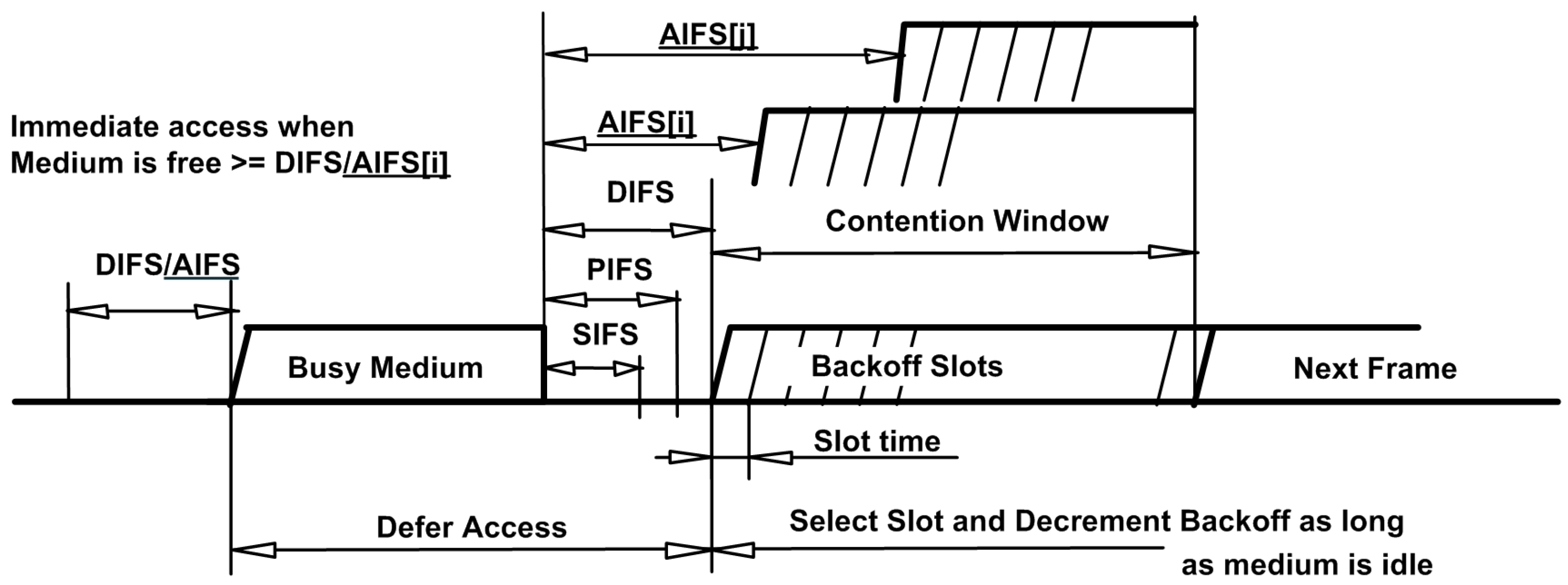
EDCA provides traffic prioritization by extending the CSMA/CA mechanism to include four independent priority queues, each configured with distinct parameters: Arbitration Inter-Frame Space (AIFS), minimum contention window ( C W m i n ) and maximum contention window ( C W m a x ). The AIFS defines how long a queue must wait after the channel becomes idle before it can begin its backoff countdown. Higher-priority queues are assigned shorter AIFS values, allowing them to attempt transmission sooner than lower-priority ones. Likewise, smaller values of C W m i n and C W m a x are given, reducing their average backoff duration and further increasing their chances of accessing the channel. Through this differentiated configuration, EDCA ensures that latency-sensitive traffic, such as voice and video, gains preferential access to the wireless medium compared to less time-critical data, thus improving overall QoS. The EDCA channel access procedure is shown in Figure 1.
The IEEE 802.11e amendment also introduces the concept of TXOP. A TXOP represents a specific time interval during which a station that has successfully gained access to the wireless medium is allowed to send multiple data frames, provided that their combined transmission time does not exceed the assigned TXOP limit. This feature enables a station to transmit several high-priority frames consecutively without performing additional backoff procedures between them. If the TXOP limit for a particular queue is set to zero, the station may transmit only one frame before it must reenter the contention process and initiate a new backoff. By allowing grouped transmissions, the TXOP mechanism significantly reduces the overhead and delay associated with repeated backoff periods, thus improving the efficiency of high-priority traffic transmission. The default values for the access categories defined in the IEEE 802.11e amendment are described in Table 3.

3.3. Frame Aggregation

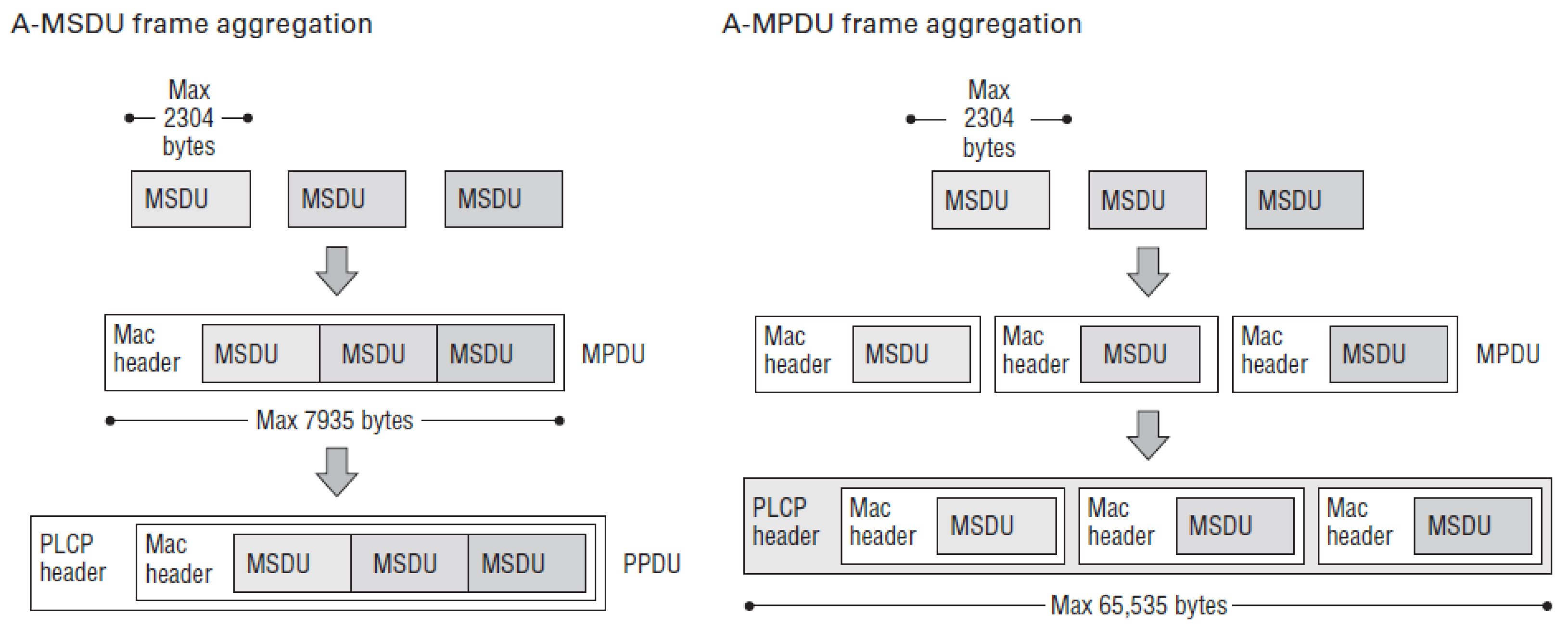
The IEEE 802.11n [28] amendment was designed to improve the overall performance of Wi-Fi networks. To boost data throughput, one of its key innovations was the introduction of frame aggregation, which enables multiple frames to be sent in a single transmission using one Physical Layer Convergence Protocol (PLCP) header, thereby minimizing signaling overhead. The amendment specified two types of aggregation: MAC Service Data Unit (MSDU) aggregation, which produces aggregated MSDUs (A-MSDUs), and MAC Protocol Data Unit (MPDU) aggregation (A-MPDUs). Both types of aggregation are shown in Figure 2.
In an A-MSDU, all subframes share a common PLCP header and a single MAC header. This approach effectively reduces transmission overhead, but removes the individual Frame Check Sequence (FCS) for each subframe, potentially weakening error detection. In contrast, an A-MPDU also shares one PLCP header across subframes, but each subframe maintains its own MAC header. Although this approach offers a smaller reduction in overhead, it preserves the ability to perform error detection on each subframe individually, maintaining higher data integrity. In addition, this method introduces an optional 3 byte padding field at the end of every subframe, which is used to make the subframe a multiple of 4 bytes in length (see Figure 3). According to the standard, the content of this field is not specified.

3.4. WPA

WPA is a security protocol designed to enhance the protection of Wi-Fi networks compared to earlier solutions like WEP [30]. It was introduced as an intermediate step before the more robust WPA2 standard became widely available [31]. WPA maintains compatibility with legacy hardware while significantly improving security mechanisms. It uses the Temporal Key Integrity Protocol (TKIP) to provide dynamic encryption for transmitted data. TKIP is built on the RC4 cipher (designed by Ron Rivest in 1987 for RSA Security [32]) but incorporates additional safeguards against known vulnerabilities. One of its main features is the per-packet key mixing function, which generates a unique key for each frame. This function combines the Temporal Key, the transmitter’s MAC address, and a sequence counter known as the TKIP Sequence Counter (TSC). The first phase of the key mixing process applies nonlinear operations such as XOR and modular addition. These operations ensure that small changes in the input lead to significant changes in the output. As a result, the system achieves better diffusion and reduces the risk of key recovery attacks. In the second phase, the intermediate key is further combined with the lower bits of the sequence counter. This produces the final key used as the seed for the RC4 keystream generator. The two-phase design ensures that each packet is encrypted with a distinct keystream. Another important component of WPA is the Michael Message Integrity Code algorithm. Michael is designed to provide data integrity and detect packet tampering. It processes the message using simple operations such as bitwise shifts, XORs, and additions. Although it is less complex than modern cryptographic hash functions, it offers better protection than the CRC mechanism used in WEP. WPA also includes a rekeying mechanism to periodically refresh encryption keys. This limits the amount of data encrypted with a single key and reduces exposure to attacks. Authentication in WPA can be performed using a pre-shared key or through an enterprise system based on IEEE 802.1X. During the authentication process, a 4-way handshake is executed to derive fresh session keys. This handshake ensures that both the client and the access point share the same secret credentials. It also generates temporal keys used for encrypting subsequent traffic. Replay protection is achieved by using the sequence counter, which prevents attackers from reusing captured packets. Each received packet is checked to ensure that its sequence number is greater than the previous one. This mechanism effectively blocks replay attacks. Overall, WPA improves wireless security by integrating encryption, integrity protection, and key management into a unified protocol.

4. Stego-Padding Algorithm Proposal

The A-MPDU frame aggregation specified in the IEEE 802.11 standard amendment can be exploited to transmit covert data in the padding field of each A-MPDU subframe. Each padding field can be filled with a maximum of 3 bytes and is used to make the subframe a multiple of 4 octets in length. According to the standard, the content of this field is not specified, which in turn allows the hidden STA to transmit covert data. To utilize the maximum length of the padding field, the payload must be set to specific values.
For the recipient to receive the covert message from different access categories correctly, a hidden header is introduced. This header has a length of 2 bits and is located at the beginning of each padding field in the A-MPDU subframe, as depicted in Figure 4. This allows mapping four different access categories, as described in Table 4.
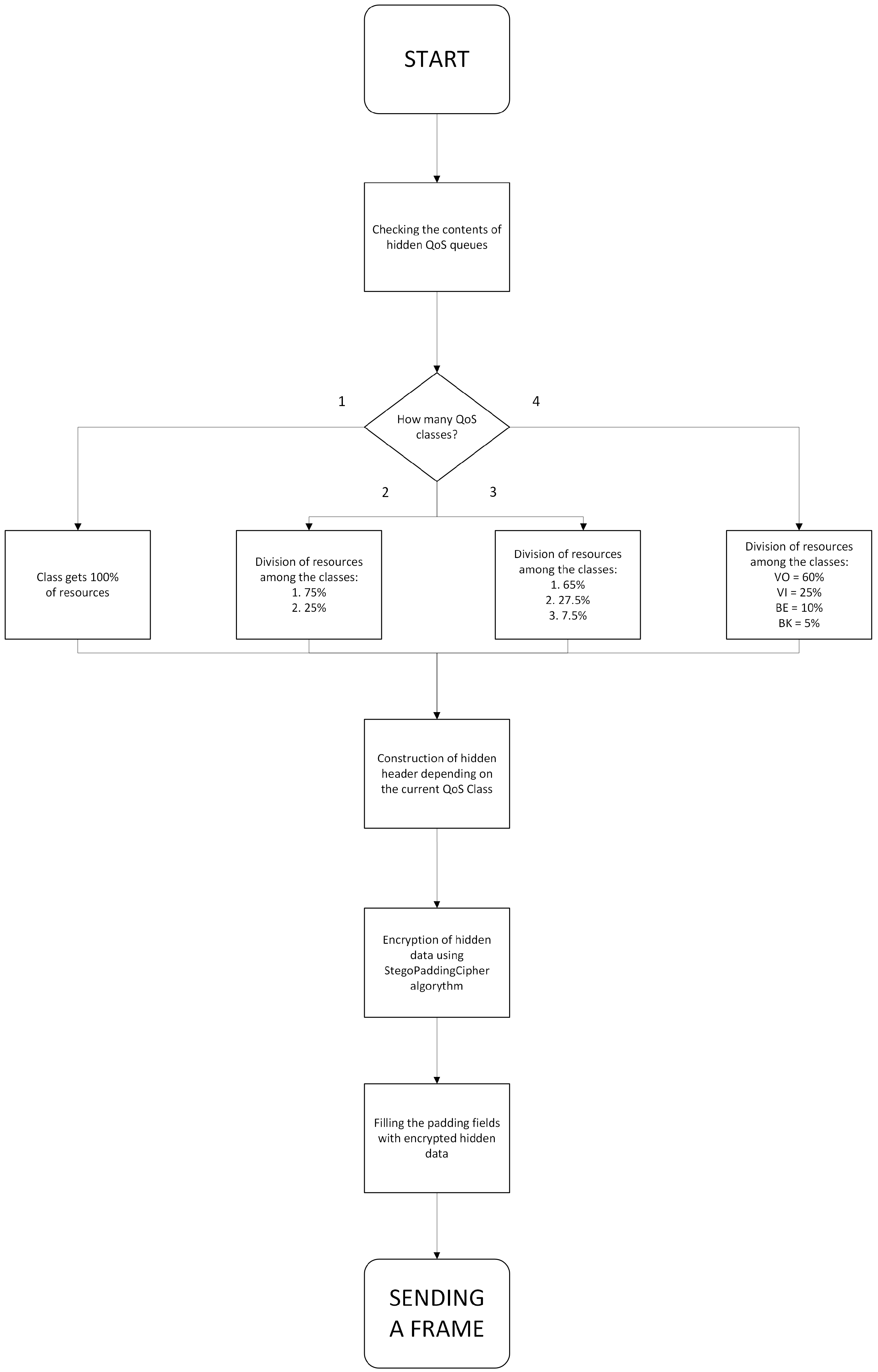
To ensure QoS support, the proposed algorithm uses one of two methods. The first utilizes a virtual EDCA like function based on the one introduced in the IEEE 802.11e amendment. Firstly, this function creates four virtual queues for covert frames: Voice, Video, Best Effort, and Background, as in normal EDCA. Then, using a virtual backoff mechanism, it decides the bits of covert frames from which covert access categories should be sent first. The second method sets the distribution of covert bits in the padding fields according to Table 5. For performance evaluation purposes, the covert channel proposed in this paper uses the second method of distribution of covert bits. The proposed percentage distribution of covert bits per AC can be modified, but for the purposes of the research presented in this paper, a distribution was adopted that reflects the share of a given traffic class within the regular EDCA function under saturation conditions. It is worth noting that, according to the IEEE 802.1Q [33] and IEEE 802.11e standards, there exists a mapping of eight priorities into four traffic classes. This mapping implies, for example, that the Network Control (NC) class is assigned to the Voice queue. Thus, our goal was to enable the provision of several services with different communication characteristics over a single steganographic channel, which has not been possible before. For example, one may consider a scenario within a smart grid where three services need to be transmitted simultaneously: relay protection signals, readings of energy production from prosumer installations, and historical energy consumption data. Implementing QoS makes it possible to transmit system relay protection signals in the Voice class (with the highest priority), energy production readings from prosumer installations in the Video class (with the high priority), and energy consumption data in the Best Effort class (with the low priority).
To avoid sending covert messages in plain text, the proposed algorithm introduces a unique StegoPaddingCipher encryption algorithm that uses the SSID name and a random number of backoff slots (counted from the end of the last transmission to the start of transmission by the station transmitting the covert data) in addition to the key, frame number, and MAC address of the transmitting station to generate a unique keystream for each data frame. It is important to emphasize that the proposed mechanism leverages principles similar to those used in WPA2/WPA3, where padding and certain frame fields are protected by encryption. It follows that the padding field is encrypted twice: first using the newly proposed StegoPaddingCipher algorithm to avoid transmitting covert data in plain text, and second using WPA2/WPA3 methods, which secure all data during transmission over the radio channel. As a result, the statistical properties of the modified padding field are expected to be indistinguishable from those of encrypted payload data, which is inherently designed to resemble random noise. In this context, the use of an encryption-based approach significantly reduces the risk of detection, as any embedded data is encrypted by cryptographic transformations.
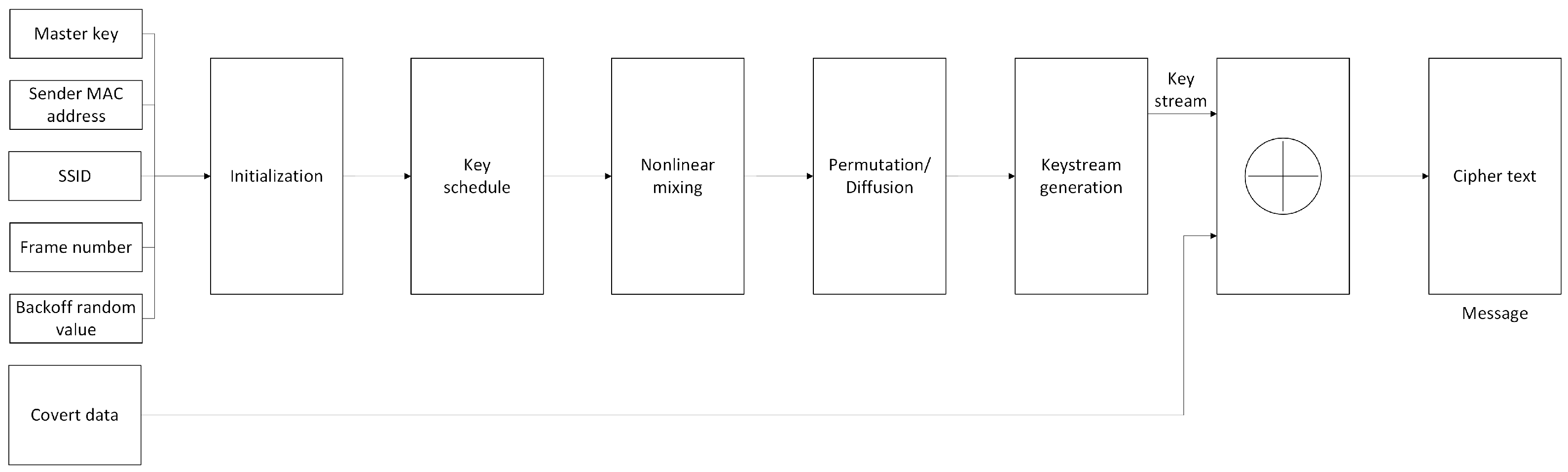
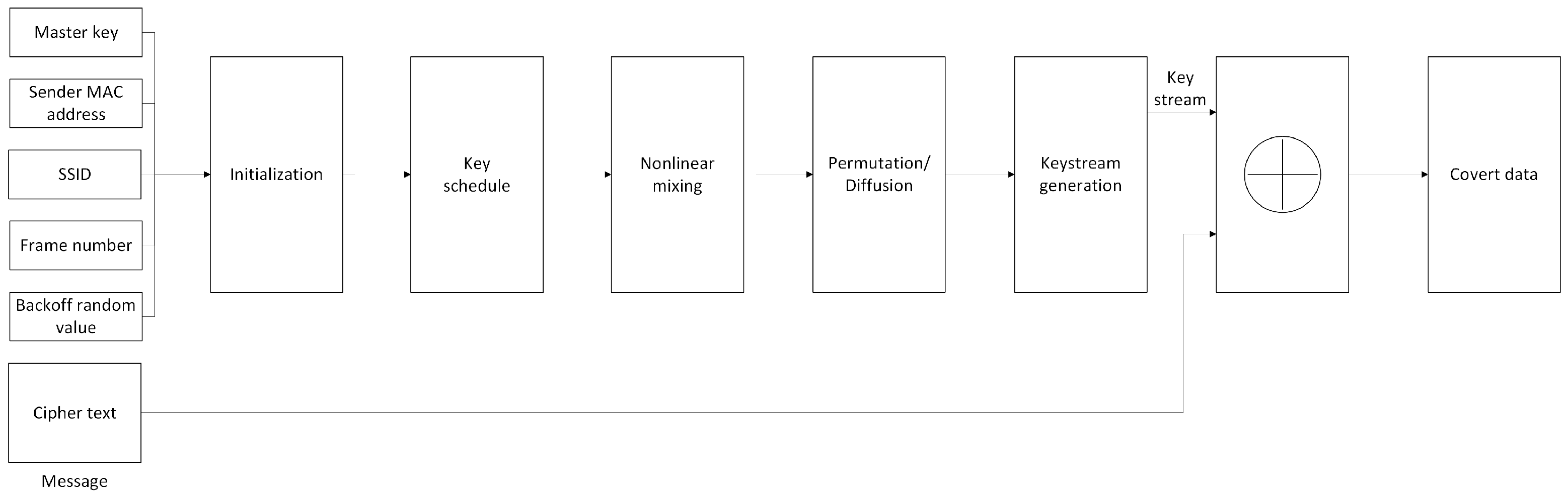
The StegoPaddingCipher is a six-phase stream cipher designed to encrypt covert data in IEEE 802.11 environments. Its design combines Addition–Rotation–XOR (ARX) operations with a structured, multi-phase architecture to provide high diffusion, nonlinearity, and frame-level uniqueness. The algorithm leverages several contextual inputs, including the master key, sender MAC address, SSID, frame number, and a backoff-derived random value which is counted from the end of the last transmission to the start of transmission by the station transmitting the covert data, to ensure each frame generates a unique and unpredictable keystream. The description and the operation of the algorithm is as follows. The Phase 1 Initialization (Absorption Phase) serves as the foundation of the cipher. In this phase, all input parameters are concatenated and divided into fixed-size words forming the internal state. The main purpose of this phase is to incorporate all relevant information, including frame-specific randomness, into the cipher’s starting state. The key feature is that it ensures uniqueness and unpredictability for each frame, preventing keystream reuse and tying the encryption to the specific network context. This phase establishes a secure and distinctive starting point for all subsequent transformations. Phase 2: Key Schedule (Subkey Expansion) derives multiple subkeys from the initialized state. Each state word is combined with rotated versions of other words and constants to produce four subkeys. The advantage of this phase lies in its ability to introduce early diffusion and nonlinearity, ensuring that even small changes in the input affect all subkeys. This expansion increases the complexity of the internal state and prevents simple relationships that could be exploited by attackers. Phase 3: Nonlinear Mixing (ARX Rounds) applies multiple rounds of ARX operations to the internal state. Each round involves additions, rotations, and XOR operations between state words, effectively spreading the influence of every input bit across the entire state. The key feature of this phase is the strong avalanche effect, where a small change in any input or key bit propagates throughout the state, maximizing diffusion. This provides robustness against differential and linear attacks and ensures that the state becomes highly nonlinear and unpredictable. Phase 4: Permutation/Diffusion Layer further scrambles the internal state through cross-lane mixing, cyclic word permutations, and additional ARX transformations. By mixing words across positions and applying rotations, this phase destroys structural correlations that may exist after the nonlinear mixing rounds. The advantage of this phase is that it enhances diffusion and resistance to structural cryptanalysis, making it computationally infeasible for an attacker to isolate any single component of the state or predict its evolution. Phase 5: Keystream Generation produces the pseudorandom stream used for encryption. For each byte of plaintext, the algorithm combines the current state with the derived subkeys to generate a keystream element. The internal state is then evolved with ARX operations, and a counter is injected to ensure that each keystream word is unique, even within the same frame. The key feature is that the keystream is highly unpredictable and unique for each position, providing strong security for the XOR-based encryption. Finally, Phase 6: Encryption/Decryption applies the generated keystream to the input data by performing a bitwise XOR. This operation is reversible, allowing the same function to be used for both encryption and decryption. The advantage of this phase is its simplicity and efficiency, while security relies entirely on the robustness and unpredictability of the keystream produced in the previous phases.
Overall, the StegoPaddingCipher algorithm achieves high diffusion, frame-specific uniqueness, and resistance to basic cryptanalytic attacks by combining structured ARX-based nonlinear mixing, permutation, and keystream generation. Each phase contributes a distinct cryptographic property: initialization ensures uniqueness, the key schedule introduces subkey complexity, nonlinear mixing and permutation maximize diffusion and nonlinearity, keystream generation produces unpredictable masks, and encryption provides efficient, reversible data protection. This structured, phased approach makes StegoPaddingCipher a flexible and secure method for wireless communication environments while still remaining computationally efficient.
Lastly, the code section responsible for frame aggregation is modified in such a way that when the padding field is added, instead of filling it with 0 bits, it is filled with bits from the covert message. The pseudocodes for encryption and encoding, as well as decryption and decoding, are described in Algorithm 1 and Algorithm 2, respectively, while the pseudocode for the implementation of the StegoPaddingCipher is presented in Algorithm 3. The detailed process of encryption and decryption of covert data using the implemented StegoPaddingCipher algorithm is depicted in Figure 5 and Figure 6. The whole process of sending and receiving a covert frame is illustrated in Figure 7 and Figure 8.
Algorithm 1 Pseudocode for encrypting and encoding covert bits in padding field
  1: Input/Output: f—Frame to send
  2: Input: n—Bits to encrypt and encode
  3: Input: q—Access category—hidden header
  4: procedure EncryptionAndEncoding(f, n, q)
  5:       D a t a —Data to be encoded
  6:      if f.isAggregation then
  7:          if f.padding > 0 then
  8:                D a t a .addAtEnd(q)
  9:                D a t a .addAtEnd(n)
10:              S t e g o P a d d i n g C i p h e r .initialization(f.header[0 to 127])
11:              S t e g o P a d d i n g C i p h e r .process( D a t a )
12:             f.addAtEnd( D a t a )
13:          end if
14:       end if
15:       return f
16: end procedure
Algorithm 2 Pseudocode for decrypting and decoding covert bits from padding field
  1: Input: f—Received frame
  2:Output: n—Decoded bits
  3:Output: q—Access category—hidden header
  4: procedure DecryptionAndDecoding(f)
  5:      if f.isAggregation then
  6:           if f.padding > 0 then
  7:                S t e g o P a d d i n g C i p h e r .initialization(f.header[0 to 127])
  8:                S t e g o P a d d i n g C i p h e r .process(f.padding)
  9:                q f .padding[0 to 1]
  10:              n f.padding[2 to 23]
11:         end if
12:    end if
13:    return q, n
14: end procedure
Algorithm 3 Pseudocode for the implementation of the StegoPaddingCipher
  1: Input: K—master key; M A C —sender MAC address; S S I D —Service Set Identifier; F N —frame number; B O —backoff random value; D—input data (plaintext or ciphertext)
  2: Output: R—output data (ciphertext or plaintext)
  3: function StegoPaddingCipher(K, MAC, SSID, FN, BO, D)
  4:     // Phase 1: Initialization
  5:      S K | | M A C | | S S I D | | F N | | B O
  6:      ( s 0 , s 1 , s 2 , s 3 ) split _ into _ words ( S )
  7:     // Phase 2: Key Schedule
  8:     for  i 0 to 3 do
  9:            s i s i ( s ( i + 1 ) mod 4 ( 3 + i ) )
10:          s i s i + ( 0 x 9 E 3779 B 9 i )
11:     end for
12:      ( K 0 , K 1 , K 2 , K 3 ) ( s 0 , s 1 , s 2 , s 3 )
13:     // Phase 3: Nonlinear Mixing (ARX Rounds)
14:     for  r 1 to 8 do
15:          s 0 s 0 + s 1
16:          s 1 ( s 1 5 ) s 0
17:          s 2 s 2 + s 3
18:          s 3 ( s 3 8 ) s 2
19:          s 0 s 0 + s 3
20:          s 3 ( s 3 13 ) s 0
21:          s 2 s 2 + s 1
22:          s 1 ( s 1 7 ) s 2
23:     end for
24:     // Phase 4: Permutation/Diffusion
25:     for  r 1 to 4 do
26:          s 0 s 0 s 2
27:          s 1 s 1 s 3
28:          s 0 s 0 + ( s 1 9 )
29:          s 2 s 2 + ( s 3 11 )
30:          ( s 0 , s 1 , s 2 , s 3 ) ( s 2 , s 0 , s 3 , s 1 )
31:          s 1 s 1 ( s 0 3 )
32:          s 3 s 3 ( s 2 5 )
33:     end for
34:     // Phase 5 & 6: Keystream Generation & Encryption
35:      R a r r a y o f l e n g t h | D |
36:     for  i 0 to | D | 1  do
37:          // generate key stream word
38:           t 0 s 0 + K 0
39:           t 1 s 1 + K 1
40:           t 2 s 2 + K 2
41:           t 3 s 3 + K 3
42:           K S t 0 t 1 t 2 t 3
43:          // encrypt / decrypt
44:           R [ i ] D [ i ] K S
45:          // evolve state for next byte
46:           s 0 s 0 + s 1
47:           s 1 ( s 1 5 ) s 0
48:           s 2 s 2 + s 3
49:           s 3 ( s 3 8 ) s 2
50:          // incorporate counter
51:           s 0 s 0 i
52:           s 2 s 2 + ( i 1 )
53:     end for
54:     return R
55: end function

5. Performance Evaluation

5.1. Simulation Environment

The covert channel has been implemented and analyzed in the NS-3 (Network Simulator version 3), version 3.46 [34]. Ns-3 is a discrete event network simulator designed for research, development and education in networking. It is the modern successor to ns-2, offering a more realistic, flexible, and modular framework to simulate wireless and wired communication systems, such as Wi-Fi (IEEE 802.11). Ns-3 is open source free software, licensed under the GNU GPLv2 license, and is maintained by a worldwide community.
To implement the covert channel, changes were needed in the ns-3 source code. Firstly, to be able to encode the information in the padding fields, fragment of the code that added the field itself was changed, that if the frame was aggregated, instead of filling the field with zeroes, it would fill it with the covert data. Additionally, to ensure QoS support, the covert data was divided into four access categories: Voice, Video, Best Effort, and Background, and the hidden header was added according to the covert category. Lastly, to encrypt the covert data before sending, an implementation of the StegoPaddingCipher was added to the code.
For the receiver to be able to correctly read the covert message, additional changes in the source code were needed. When the station receives the padding field, it automatically drops it, since normally it does not carry information. To prevent this, a code was added that before deleting the padding field, it would decrypt its contents using the previously implemented StegoPaddingCipher algorithm. Since the implementation of the covert channel was made on the MAC layer, it did not cause any undesirable effects on the behavior of the covert station.
To force the covert station to always send aggregated frames with 3-byte padding field, the payload of the frames was set to values of 47 B, 511 B, 1019 B and 1535 B, depending on the current simulation. In addition, during multi-station scenarios, payload of the background stations was set to 1024 B. Lastly, research data such as average jitter and average delay was collected using a built-in to ns-3 application called Flow Monitor. To measure channel efficiency, the throughput of channels built on frames with different payload sizes was measured and then compared with the best performing channel. In addition, further measurements were made between channels operating with and without the RTS and CTS frames. Other simulation parameters are presented in Table 6.

5.2. Simulation Scenarios

5.2.1. Scenario 1—Non-Competitive Environment Without QoS

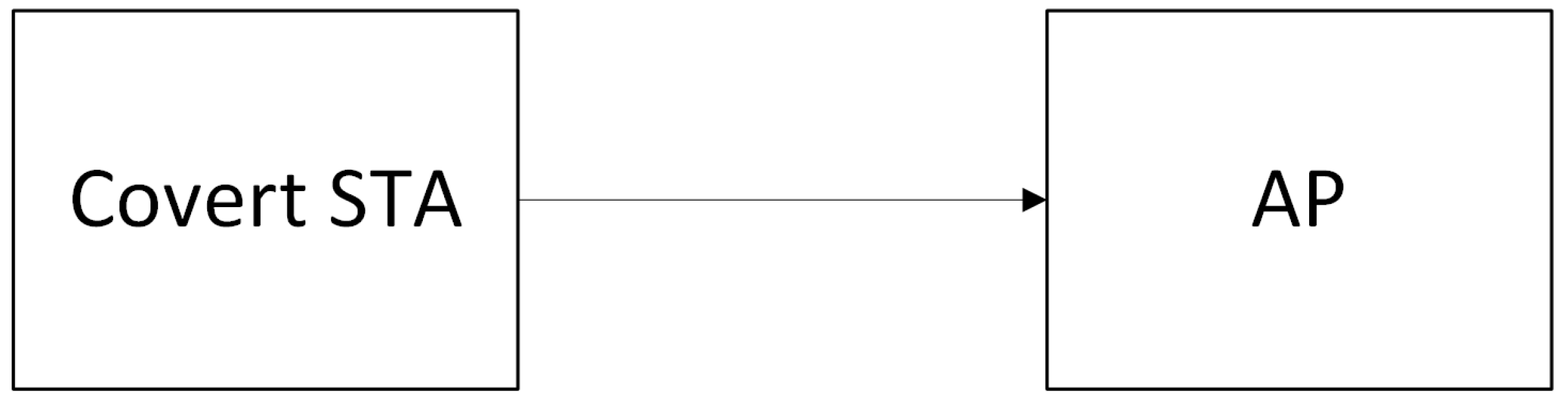
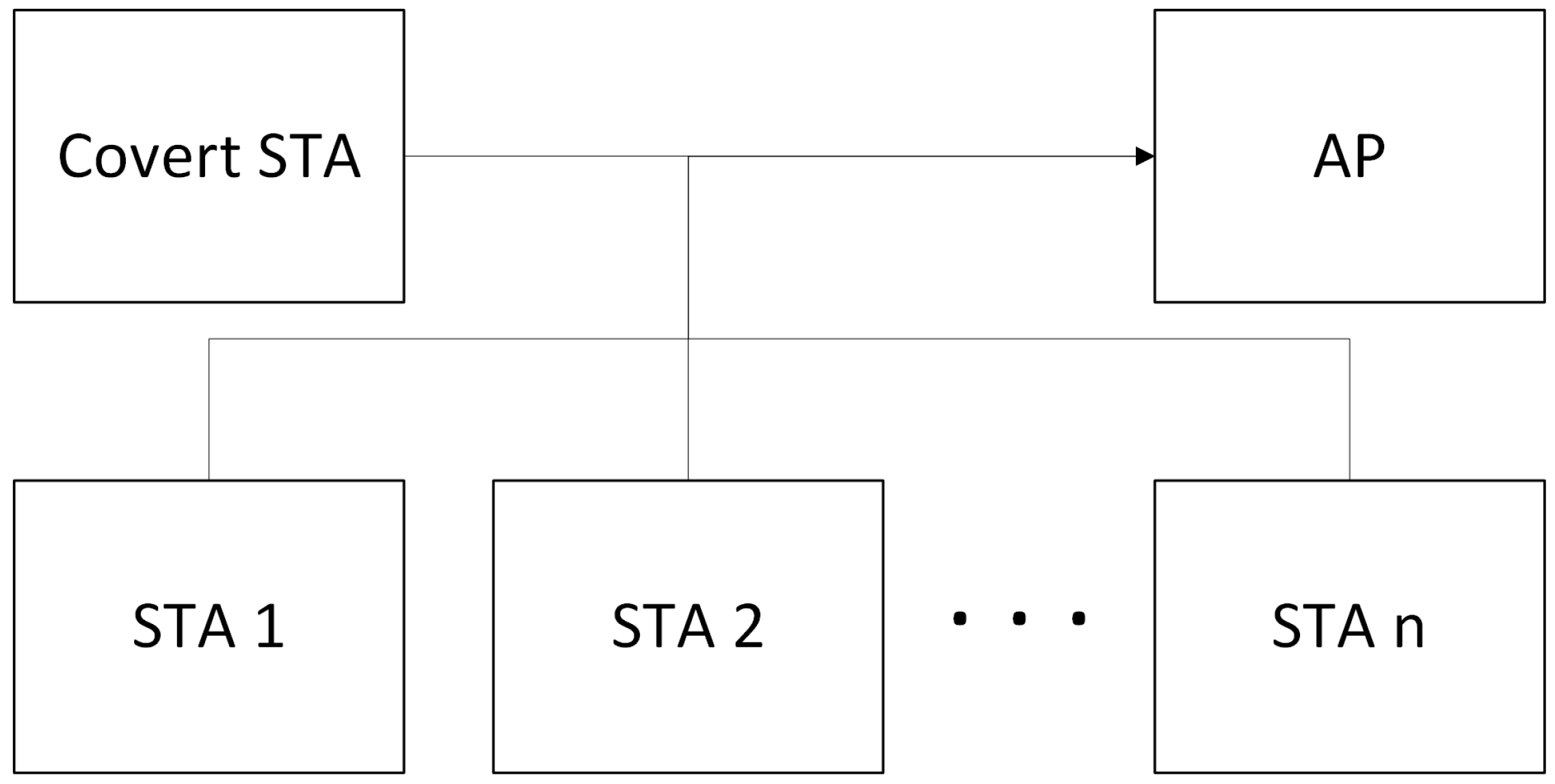
The network topology in the first scenario consists of a covert station and an AP, as depicted in Figure 9. The main goal of this simulation was to evaluate the performance of the covert channel in a non-competitive environment depending on payload size, offered load, and enabled or disabled RTS/CTS mechanism.
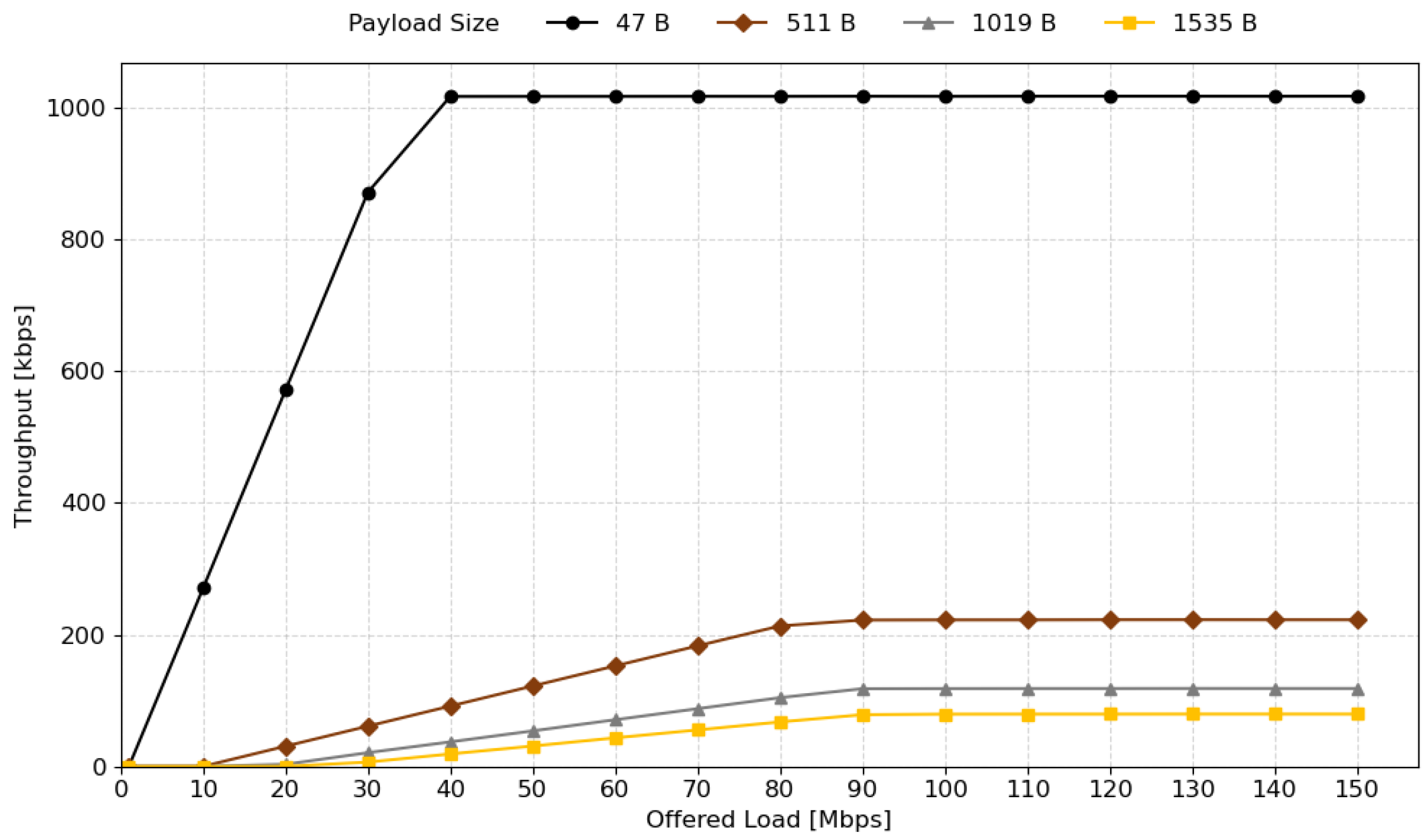
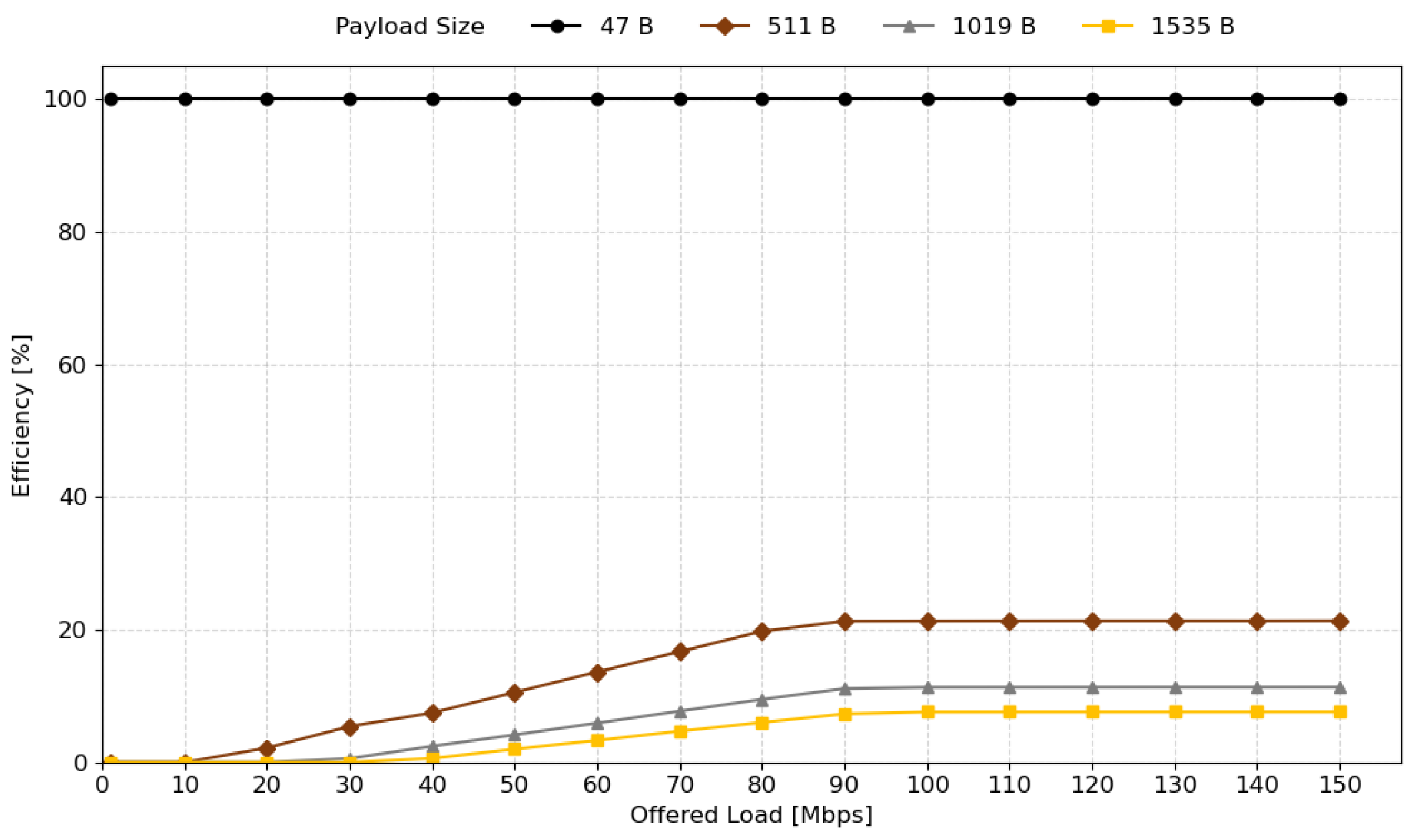
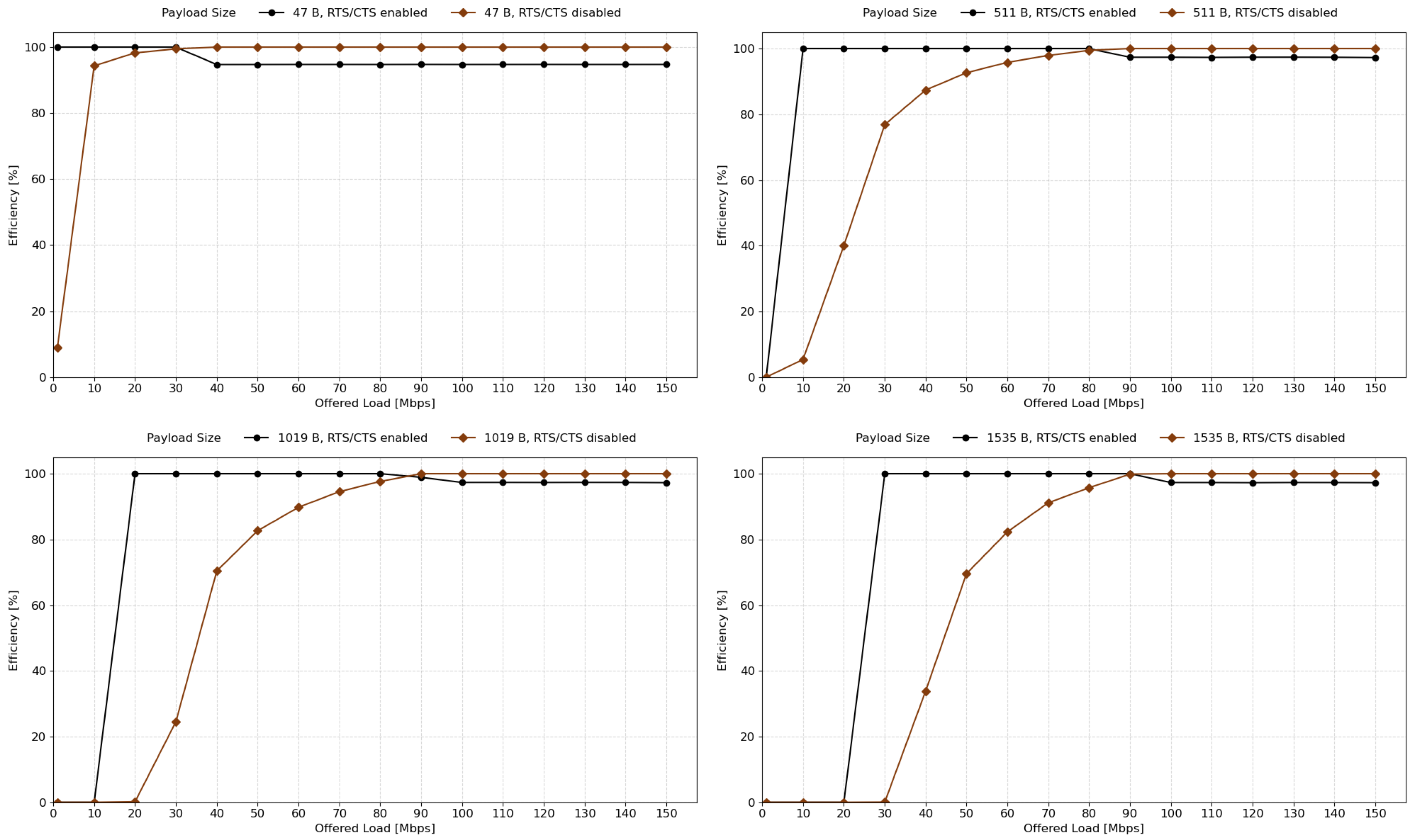
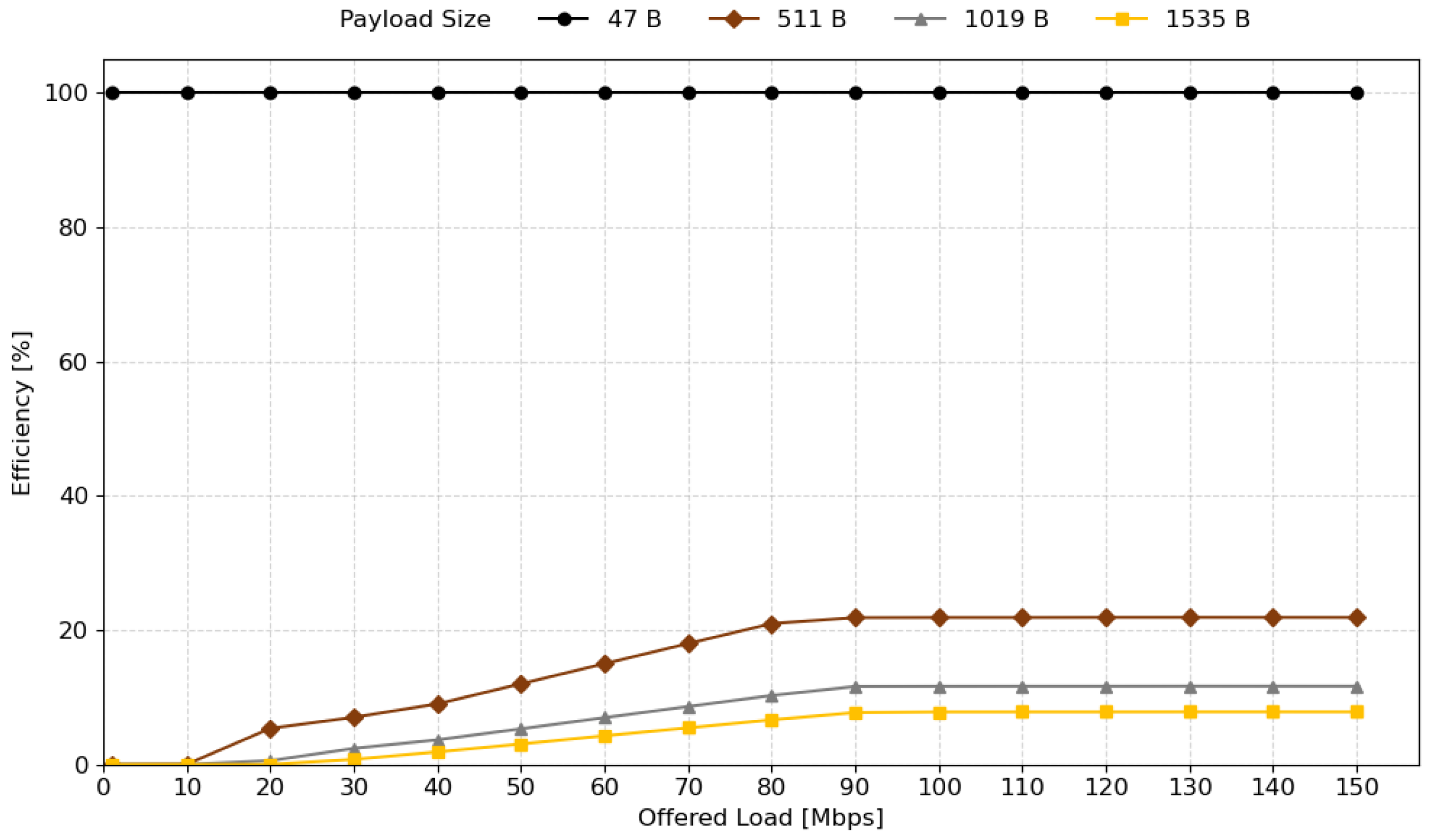
The throughput of a covert channel with RTS/CTS frames is shown in Figure 10. Since the channel depends on aggregated frames, with a lower offered load, establishing the covert channel is difficult or even impossible, especially with a larger payload. In addition, with more frames sent, the higher throughput can be observed, which benefits smaller frames. This can be further confirmed in Figure 11, which presents the exact comparison of the efficiency of covert channels built in frames with different payload sizes.
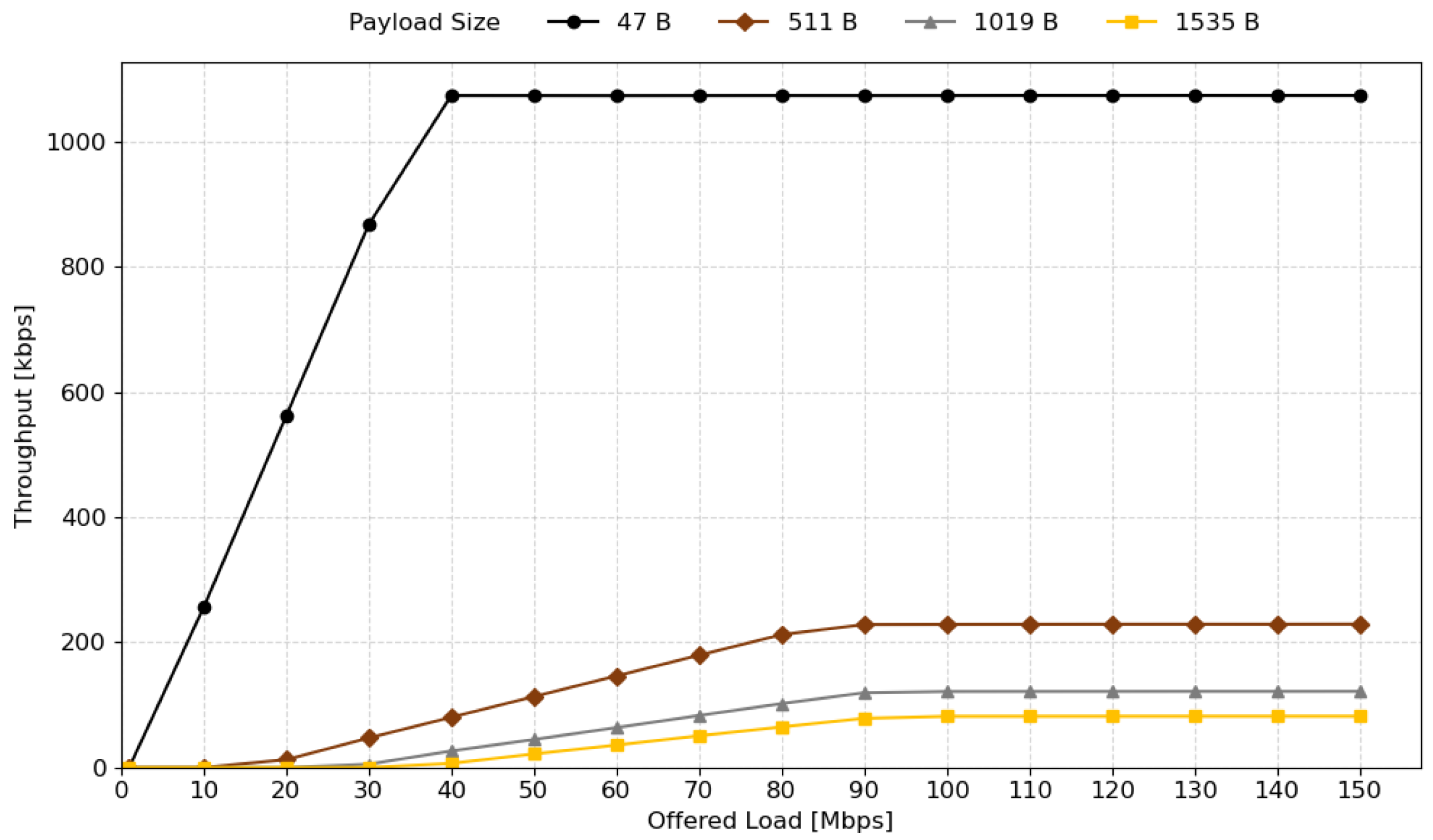
A similar observation can be made by analyzing the throughput and efficiency graphs with disabled RTS and CTS frames, as shown in Figure 12 and Figure 13. However, it can be observed that, unless the channel is under saturation conditions, the throughput without RTS/CTS frames is lower than that of the previous one. This case, for covert channels created with frames with different payload sizes, is presented more clearly in Figure 14. The reason for this is that while the covert station exchanges the RTS/CTS frames with the access point, it gives more time to generate data frames, which can be aggregated and sent through the channel, which in turn increases throughput of the covert channel. With this mechanism disabled, the station sends data frames as soon as they are generated, which in a lower offered load results in little to no frame aggregation, so it is difficult to establish a covert channel, or it simply cannot be created. The covert station without RTS/CTS frames can reach higher throughput only when the channel is under saturation, which is only achievable in a non-competitive environment; however, in the multi-station scenarios presented later in this chapter, it will be shown that such a station will always achieve worse performance.
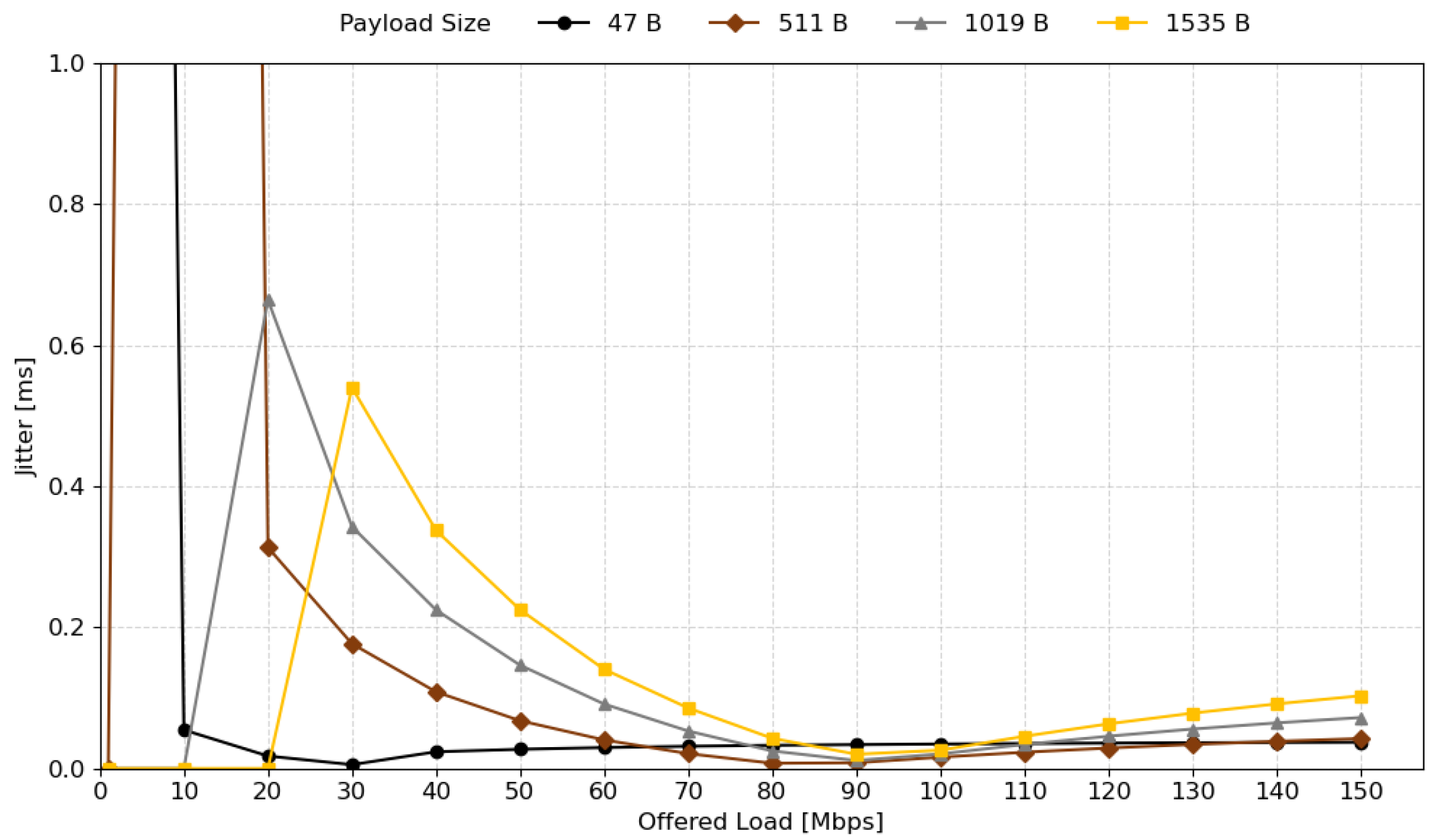
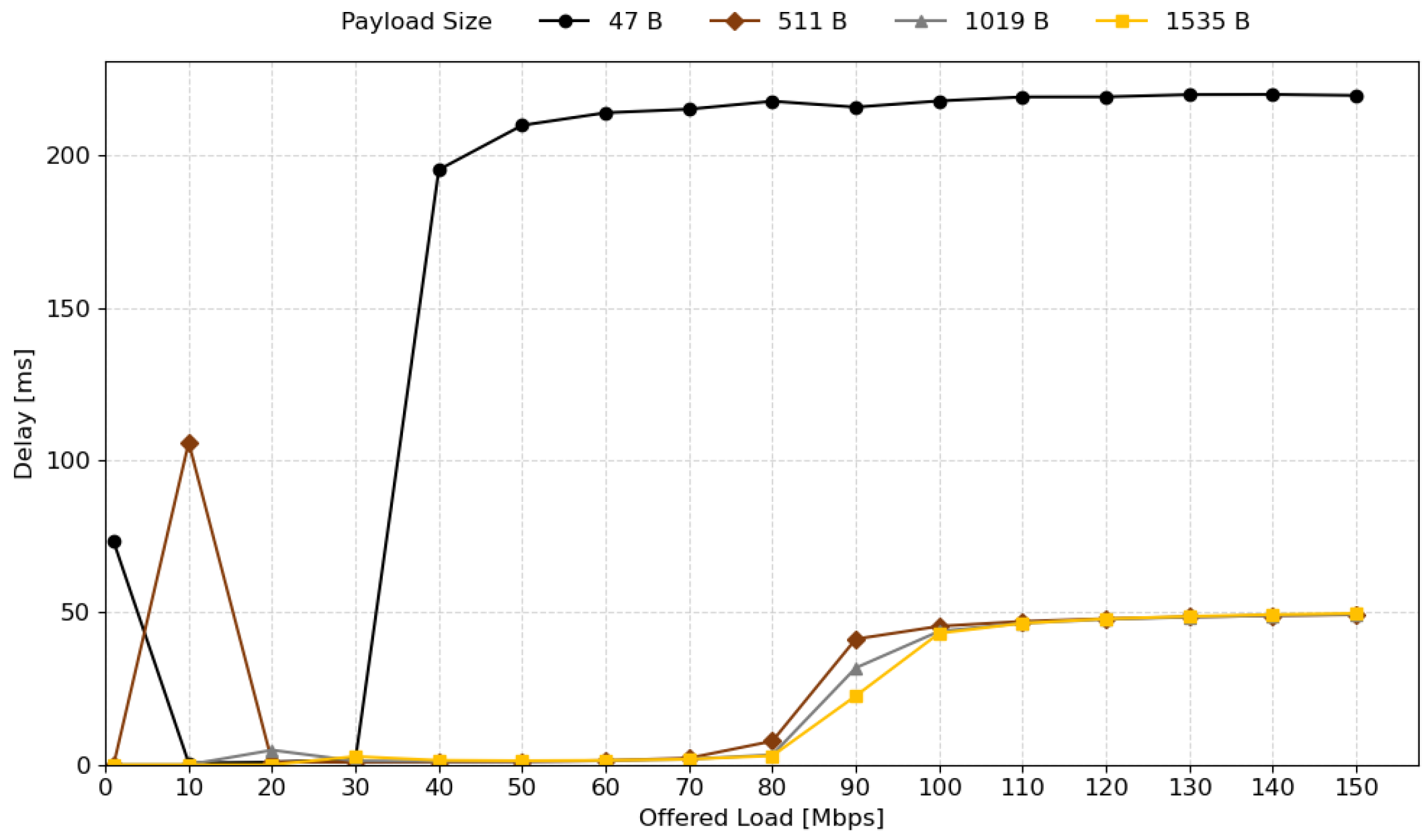
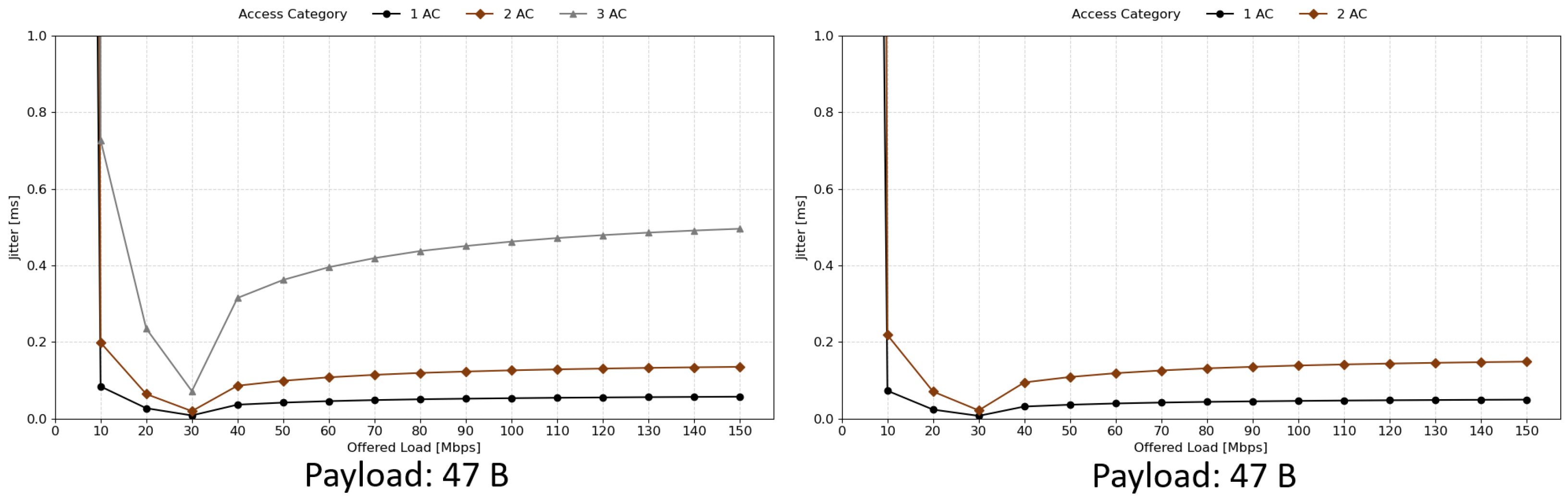
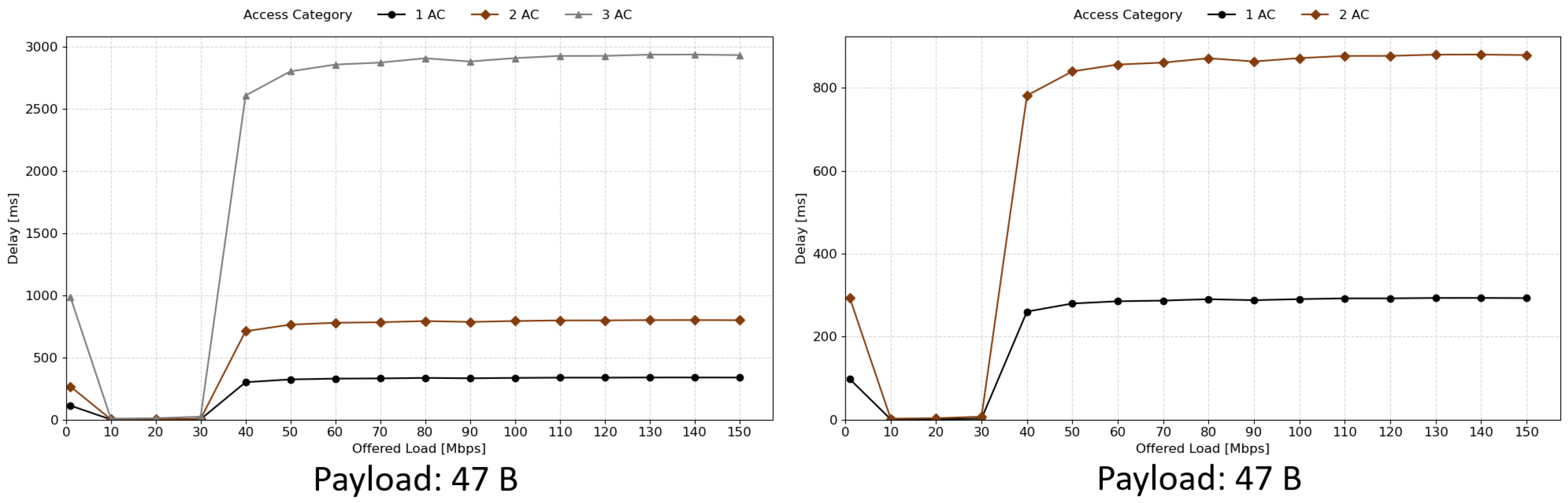
The mean frame jitter and delay of the covert channel is shown in Figure 15 and Figure 16, respectively. Very high jitter and delay values with low offered load are the consequence of the difficulty of establishing a covert channel, while zero values mean that a channel could not be created. The jitter value decreases with the offered load, to the point where the throughput of the station reaches saturation, and then starts increasing again. However, the delay once the covert channel is established stays low, nearly zero, only increasing under saturation conditions, but then it remains stable.

5.2.2. Scenario 2—Non-Competitive Environment with QoS

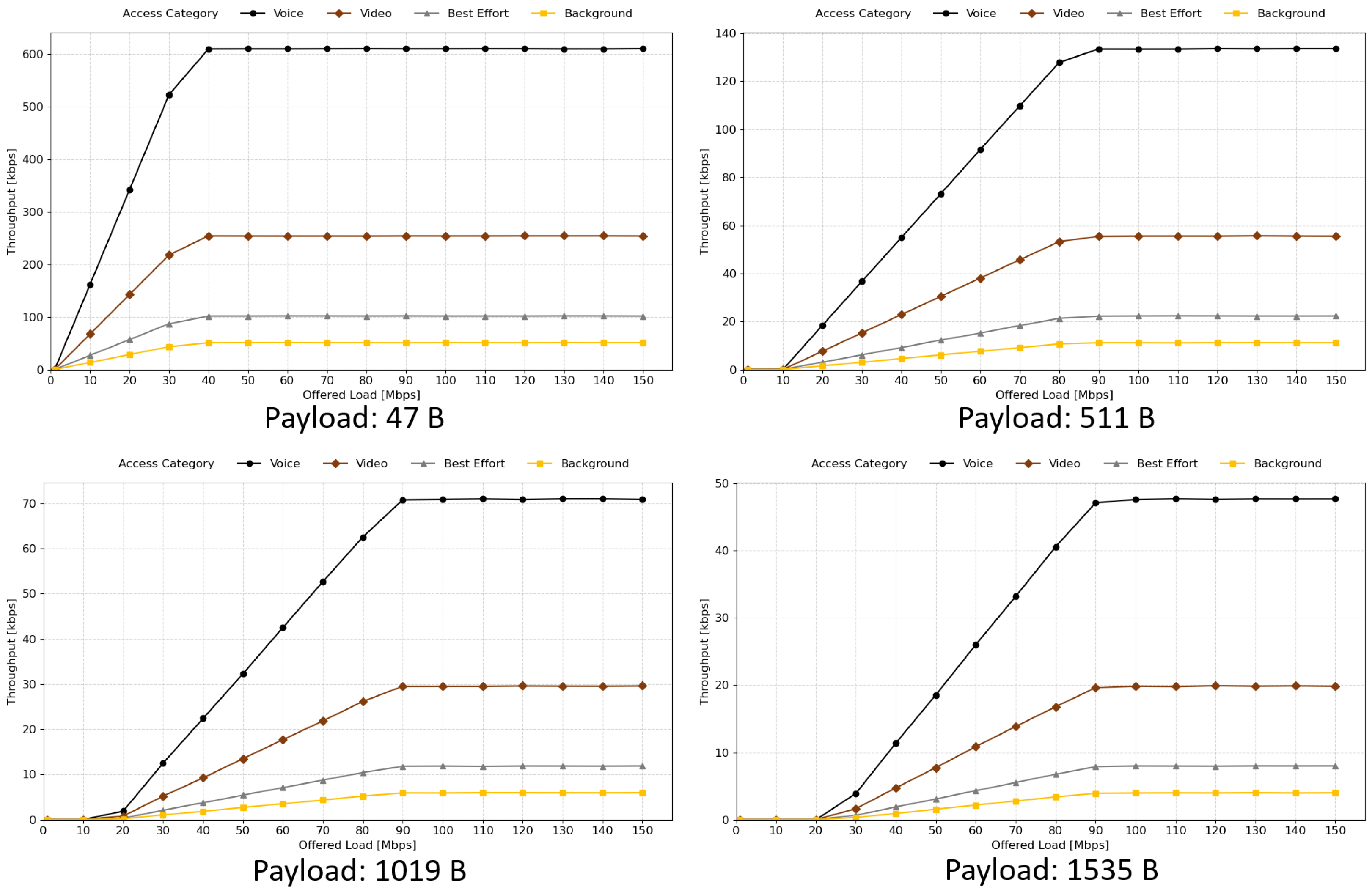
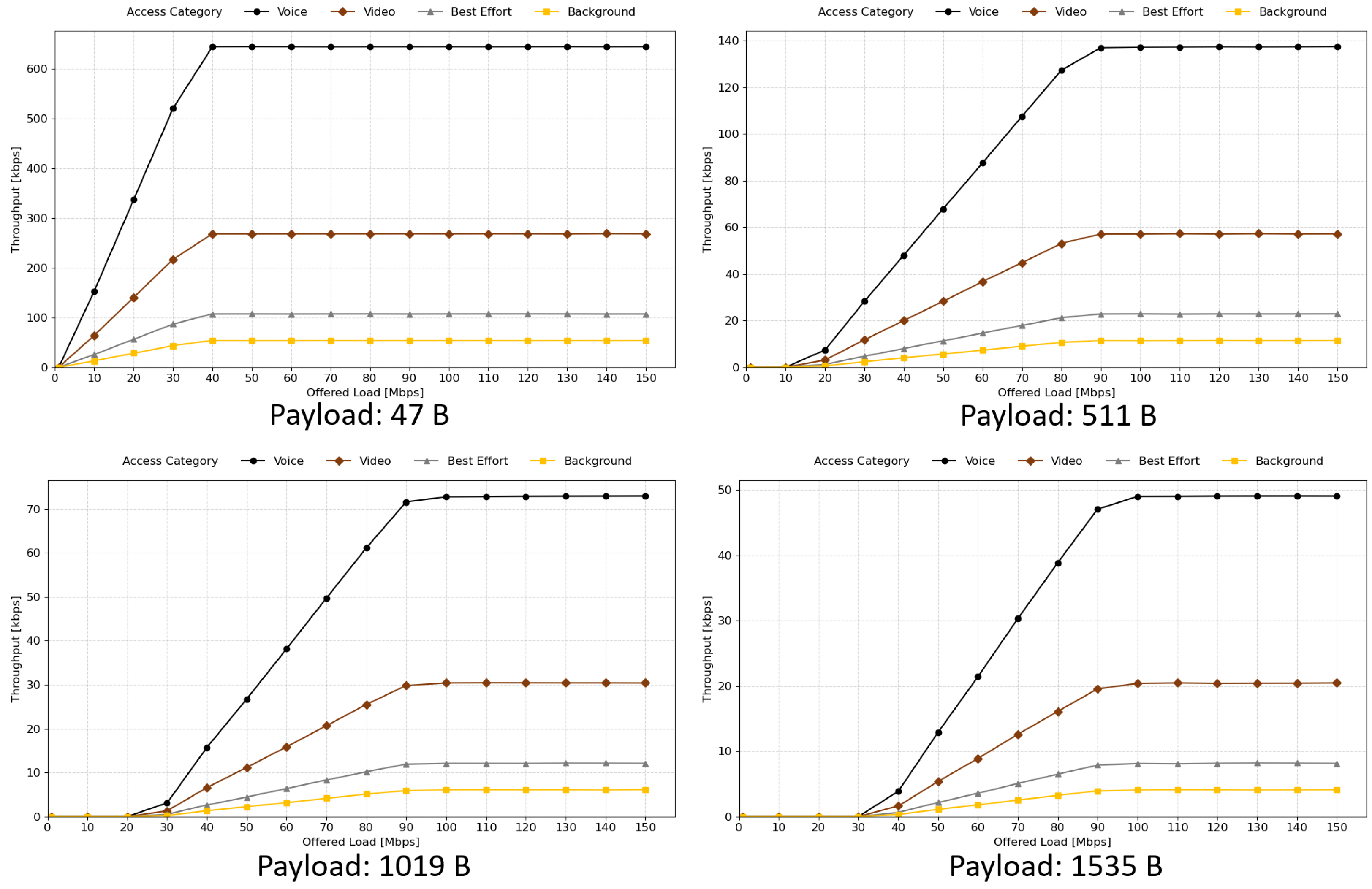
In the second scenario, the research focuses on evaluating the performance of different QoS classes. The network topology stays the same as in the first scenario. The throughput of the covert channel with four QoS classes for different payload sizes is presented in Figure 17 as well as Figure 18 with the disabled RTS/CTS mechanism. It can be observed that for lower priority access categories, such as background, the throughput is much lower than that of the higher priorities. It is also very clear that with the lower offered load of the covert station for all payload sizes, except 47 B, it is difficult or even impossible to establish a covert channel. This is even more visible without the RTS/CTS frames.
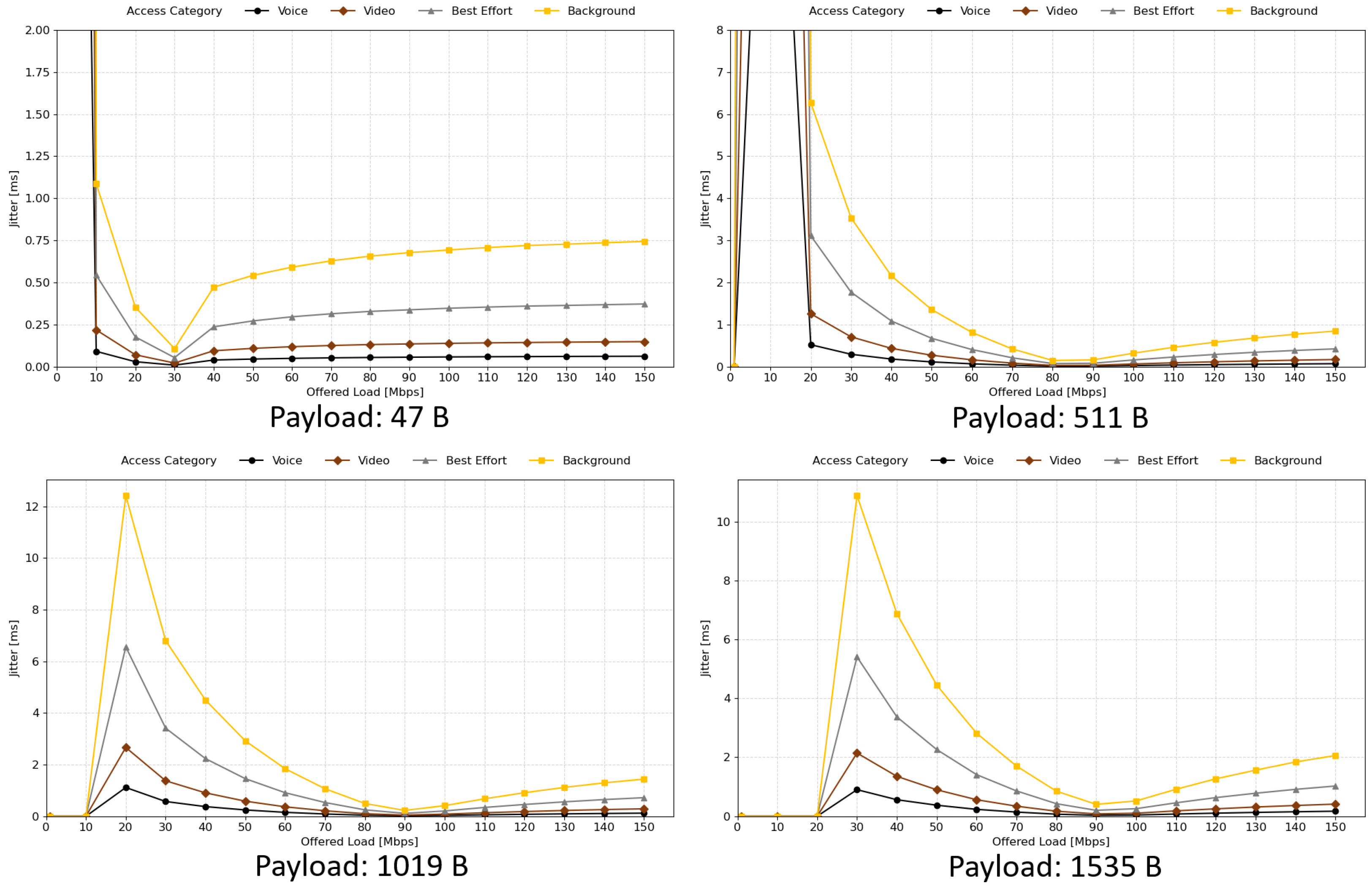
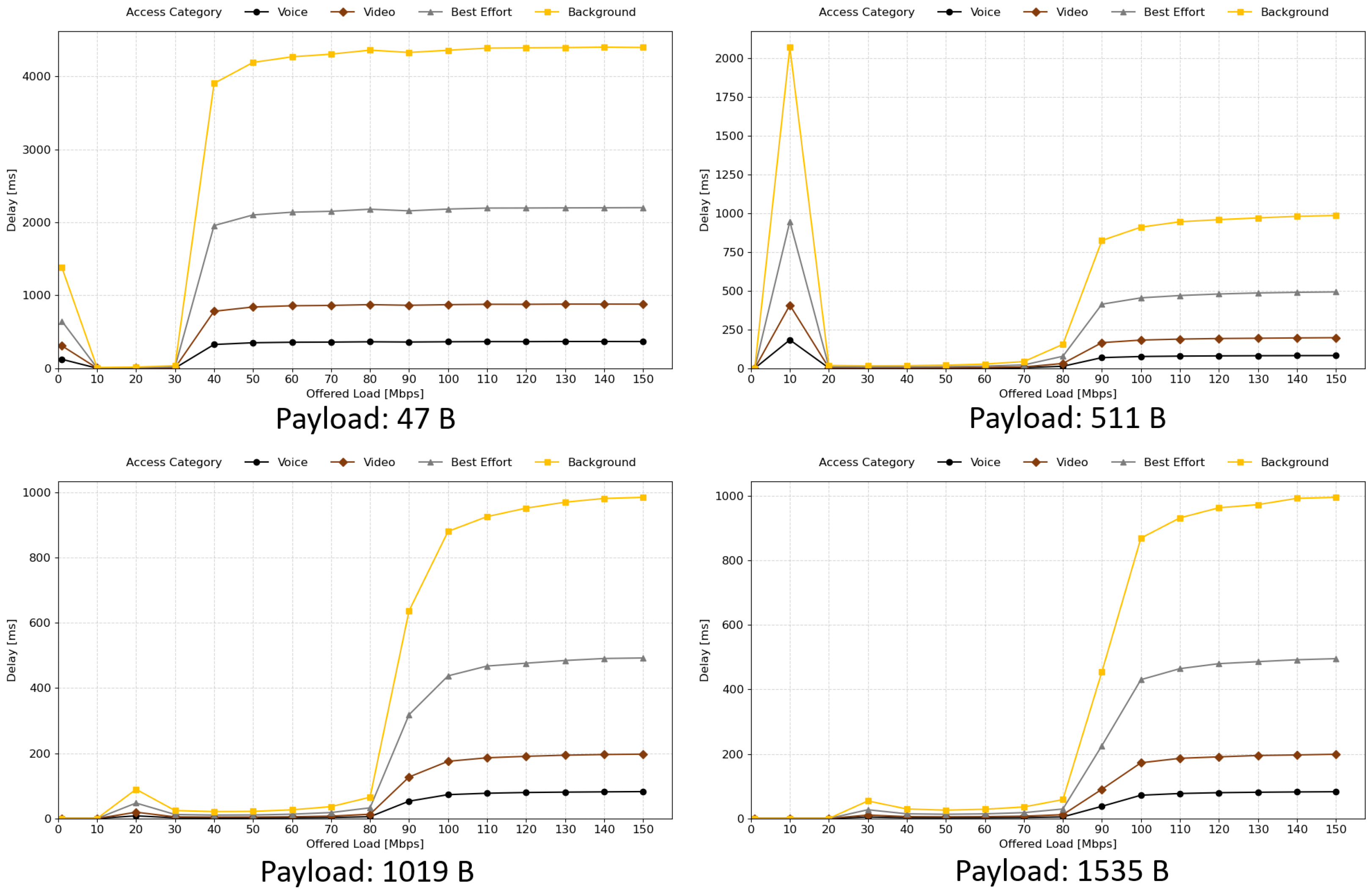
Similar conclusions can be drawn from the graphs for the average jitter and delay of each access category, as depicted in Figure 19 and Figure 20. Once again, with a lower offered load, the values of average jitter and delay are very high or zero. Then the jitter value of each QoS class decreases to the moment when the covert station reaches the maximum throughput and then starts increasing with the offered load. The delay values of each access category behave similarly to delay values of the whole covert channel, meaning after creating a channel they stay low and increase only in saturation conditions, and then are fairly stable. It is worth noting that access categories with lower throughput, such as background, reach higher jitter and delay values.
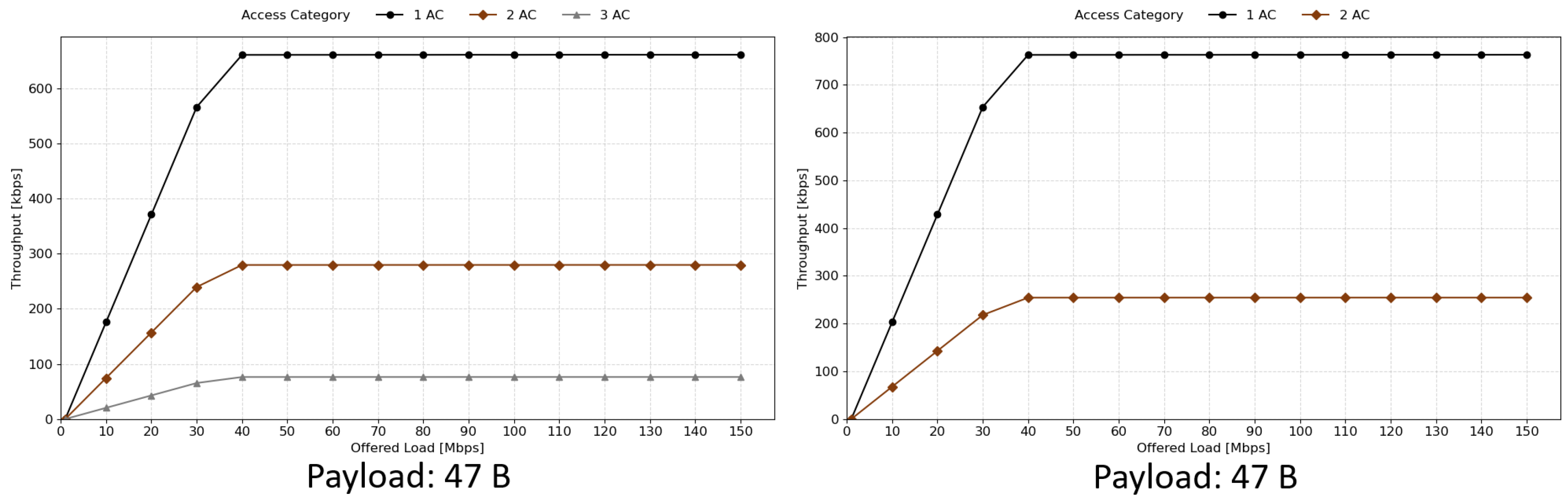
In a situation where there are only two or three access categories present, channel resources are divided accordingly, as shown in Figure 21, Figure 22 and Figure 23, which results in higher throughput and lower average jitter and delay per access category. In case of only one access category being sent through the covert channel, this category receives all of the resources, so its performance is identical to the whole channel. In addition, the conclusions that can be drawn from these situations are similar to those in Scenario 2.

5.2.3. Scenario 3—Competitive Environment Without QoS

The main goal of this scenario was to evaluate the performance of the covert channel in a competitive environment, with a network topology as shown in Figure 24. All background stations have the same load and frame size of 1024 B while the covert station’s offered load was set to 100 Mbps.
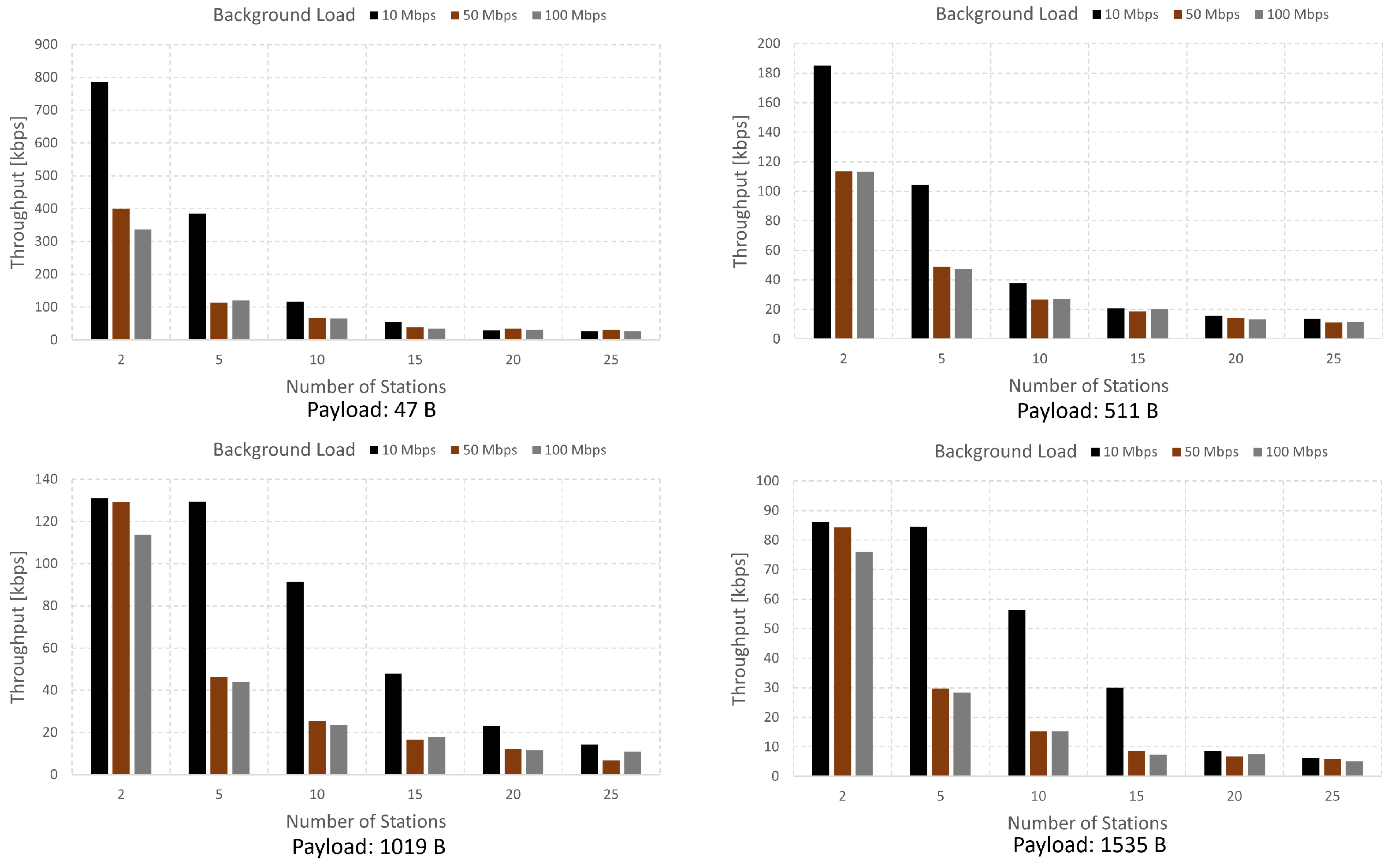
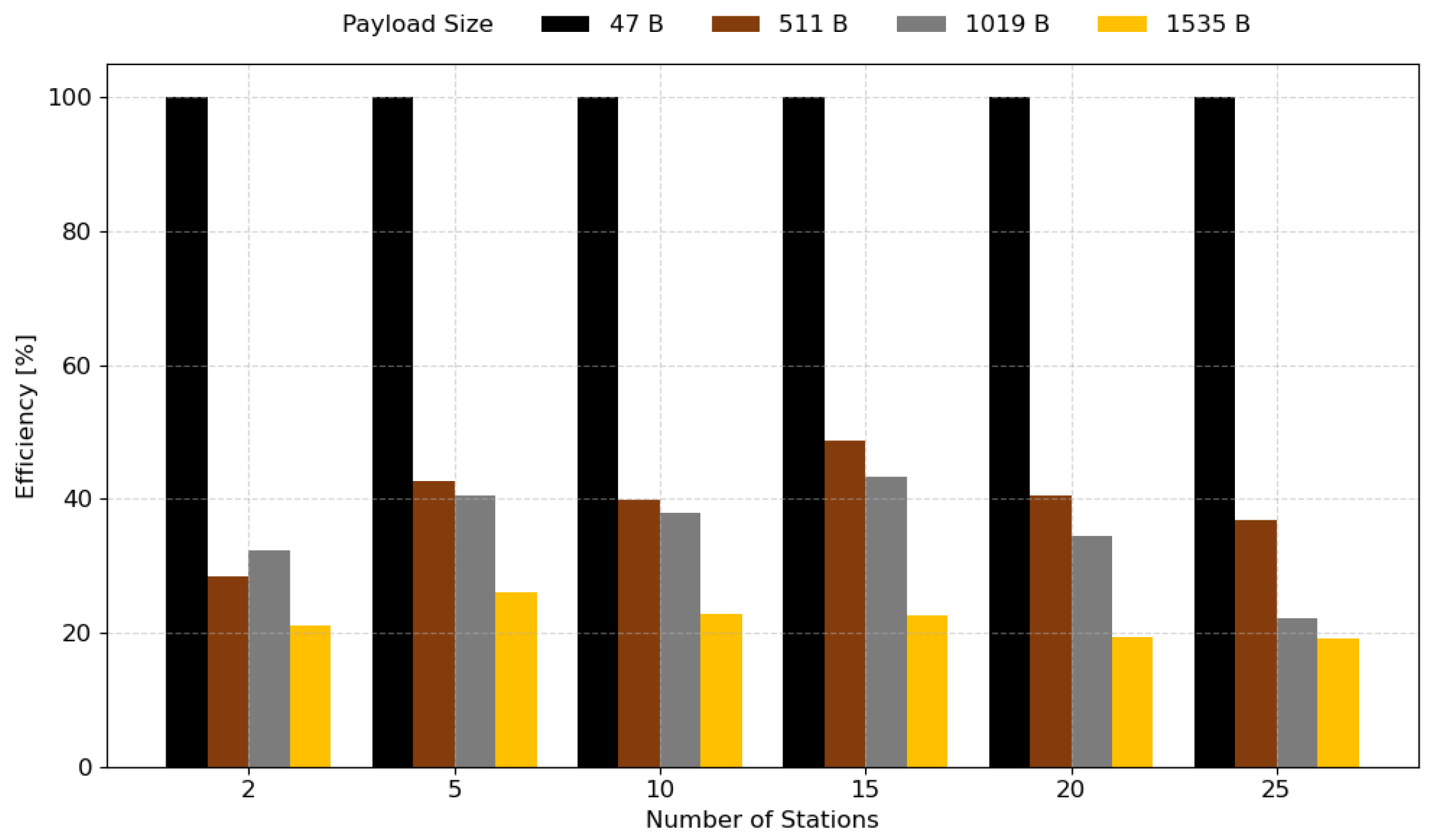
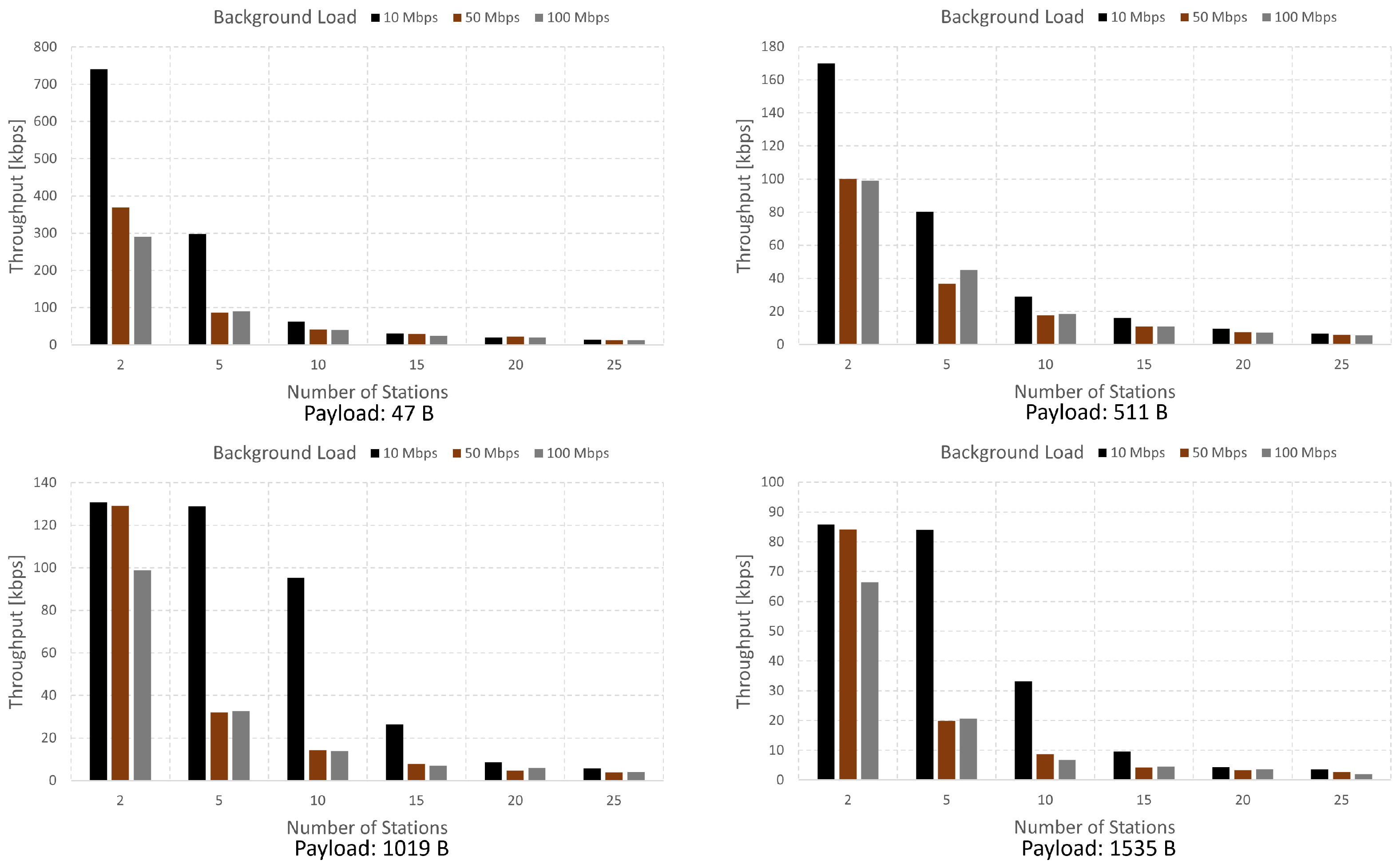
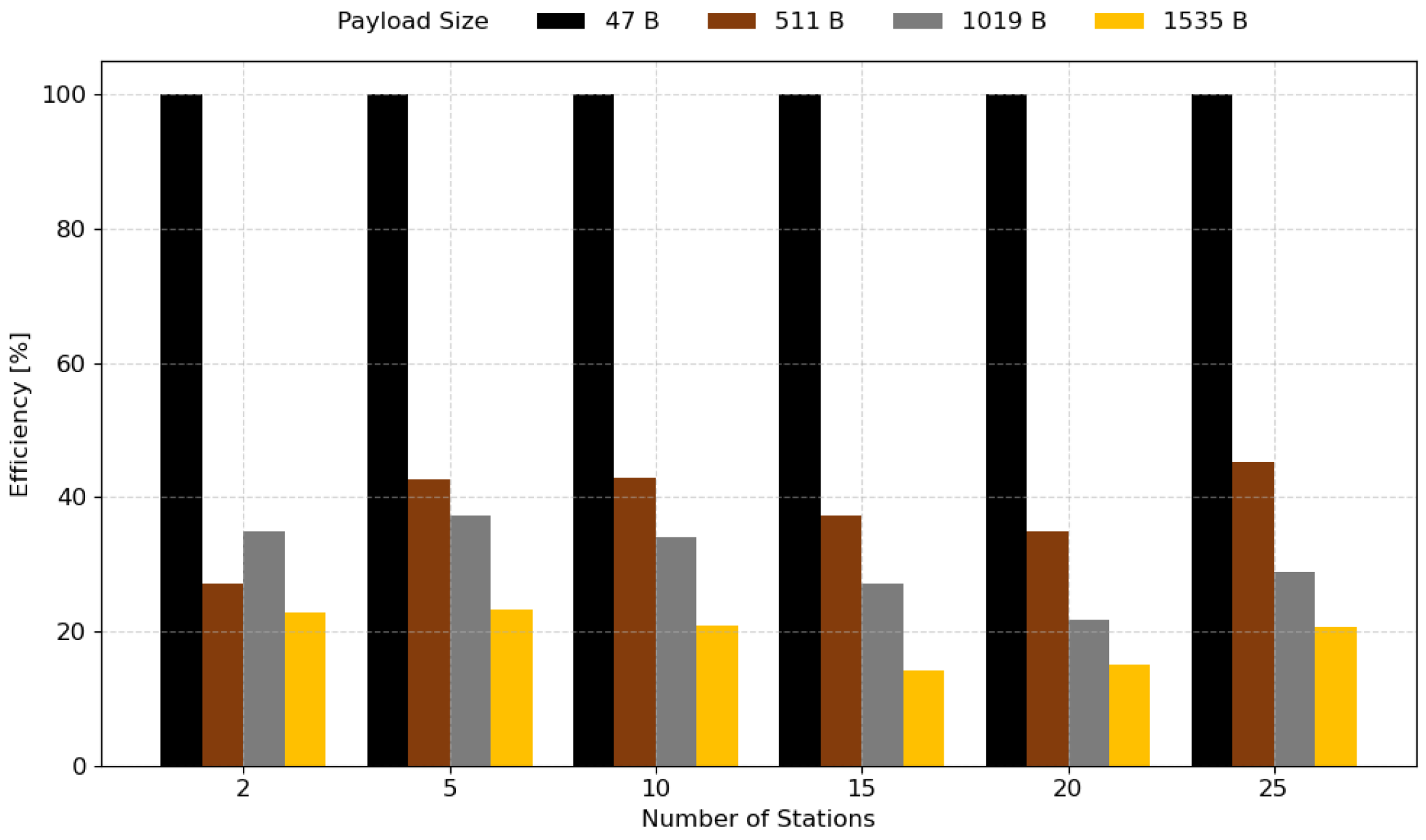
The throughput of the covert channel for different number of background stations with four different frame sizes and three different background loads is shown in Figure 25. Since more stations are competing over the access to the channel, it can be seen that with more stations on the network and a higher background load, the covert channel throughput is rapidly decreasing. In addition, covert channel throughput decreases with increasing frame size, as the covert station is able to send fewer frames. This behavior is presented more clearly in Figure 26, which shows the efficiency graph for channels established with four different payload sizes, with background load set to 50 Mbps.
The simulation yielded similar results with the RTS/CTS mechanism disabled at the covert station, as depicted in Figure 27. There is also a similarity to previous scenarios, where the covert station with RTS/CTS frames disabled achieved worse results than the one with the mechanism enabled, which is even more apparent with more stations in the background, as shown in Figure 28.
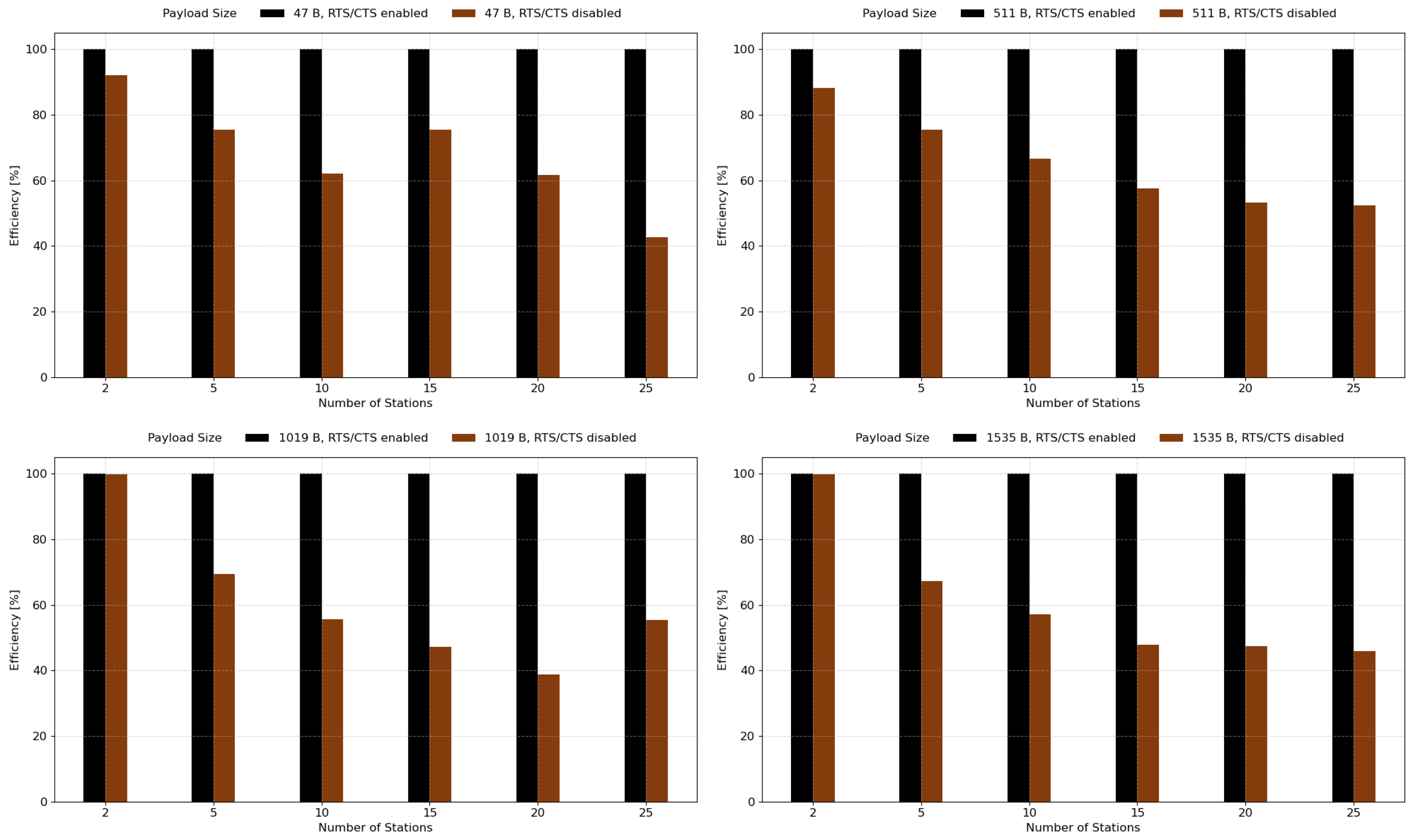
A more accurate comparison of the covert channel efficiency for every payload size, with and without the RTS/CTS mechanism, is presented in Figure 29. It can be observed that, as mentioned previously, channel without RTS/CTS frames performs much worse than the other one. The reason being that with a greater number of stations present in the network, there is a much higher risk of frame collision. Transmitting RTS and CTS frames can prevent some of the collisions; however, sending data completely without them can easily disrupt the transmission, which results in worse performance.
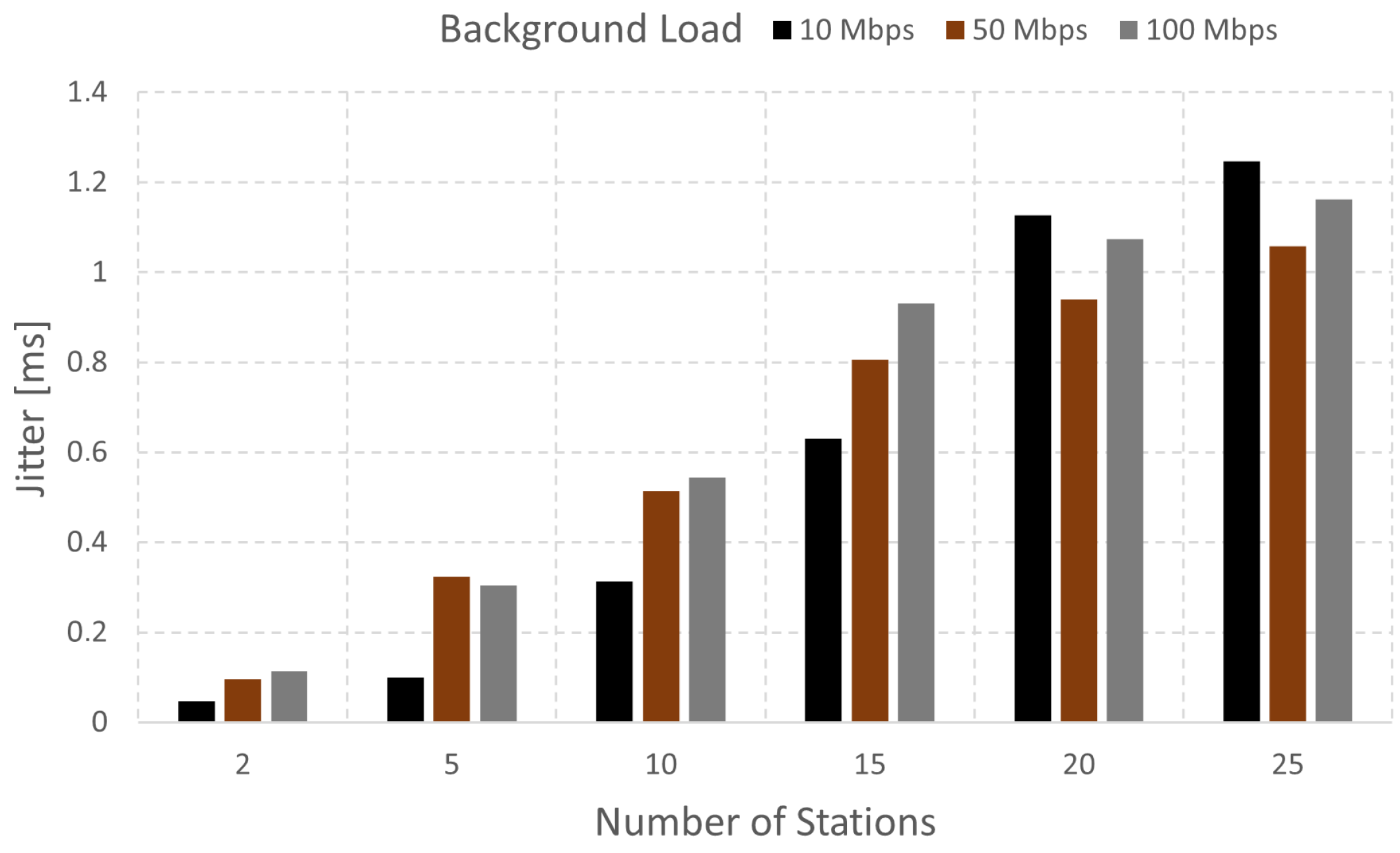
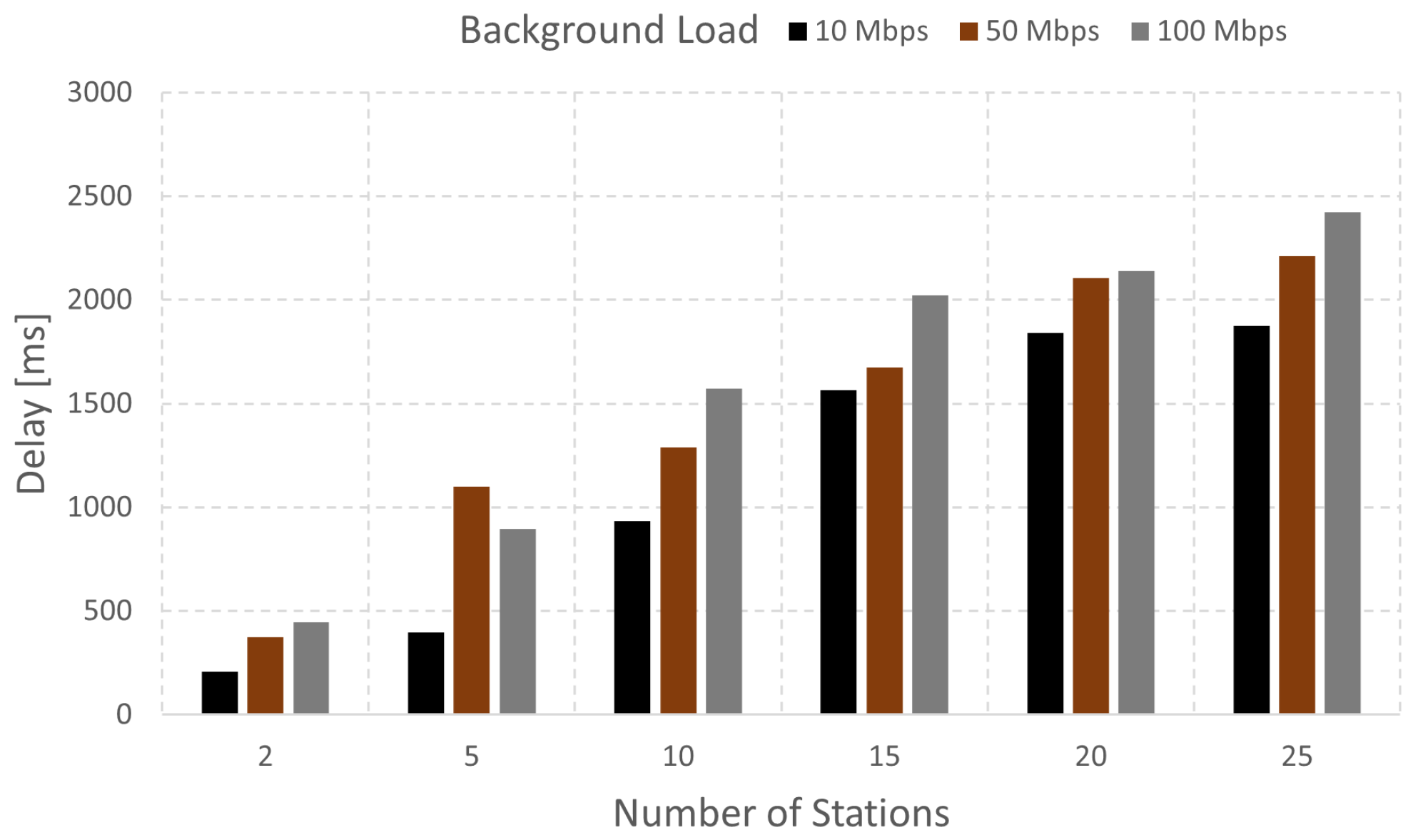
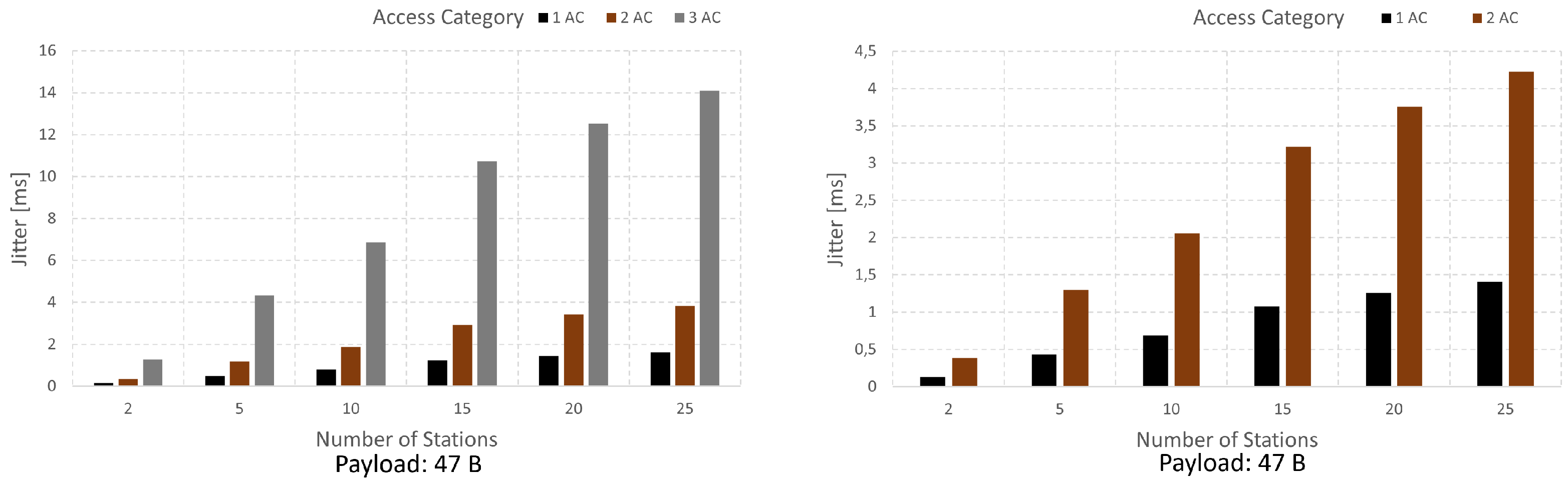
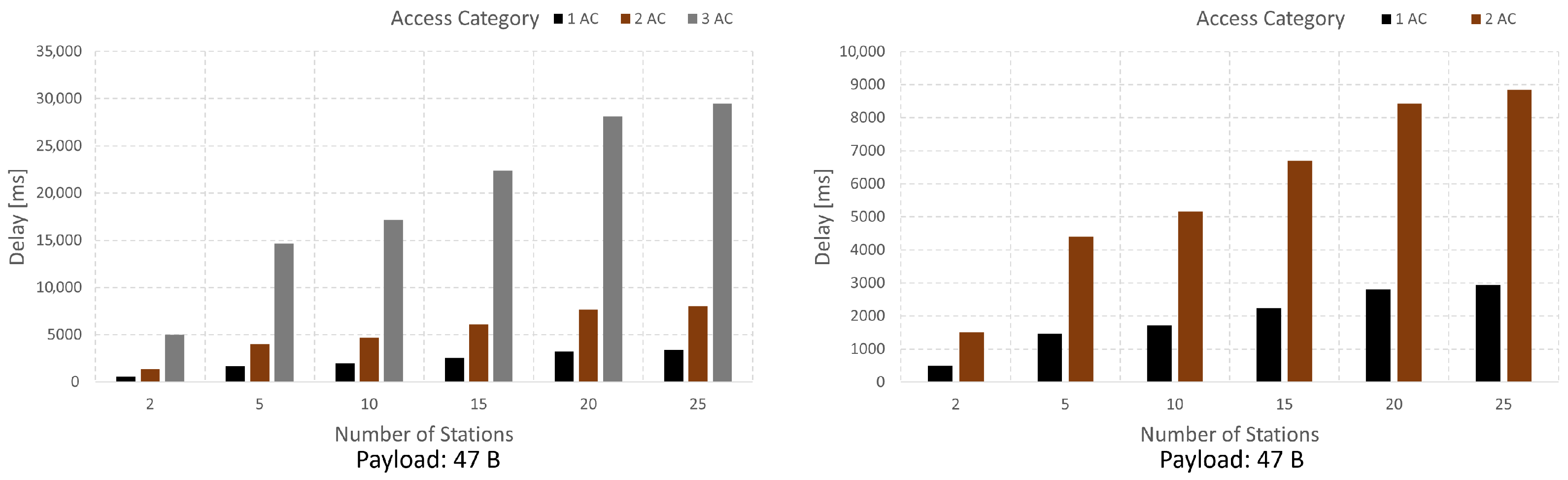
Figure 30 shows the average jitter for the covert station, while Figure 31 average frame delay for frames with payload size of 47 B. Since smaller frames achieve better results in both metrics due to the higher throughput of the covert channel, graphs with bigger payload sizes were omitted. It can be deduced that the more stations in the background with a higher load, both the average jitter and the average frame delay of the covert channel increase.

5.2.4. Scenario 4—Competitive Environment with QoS

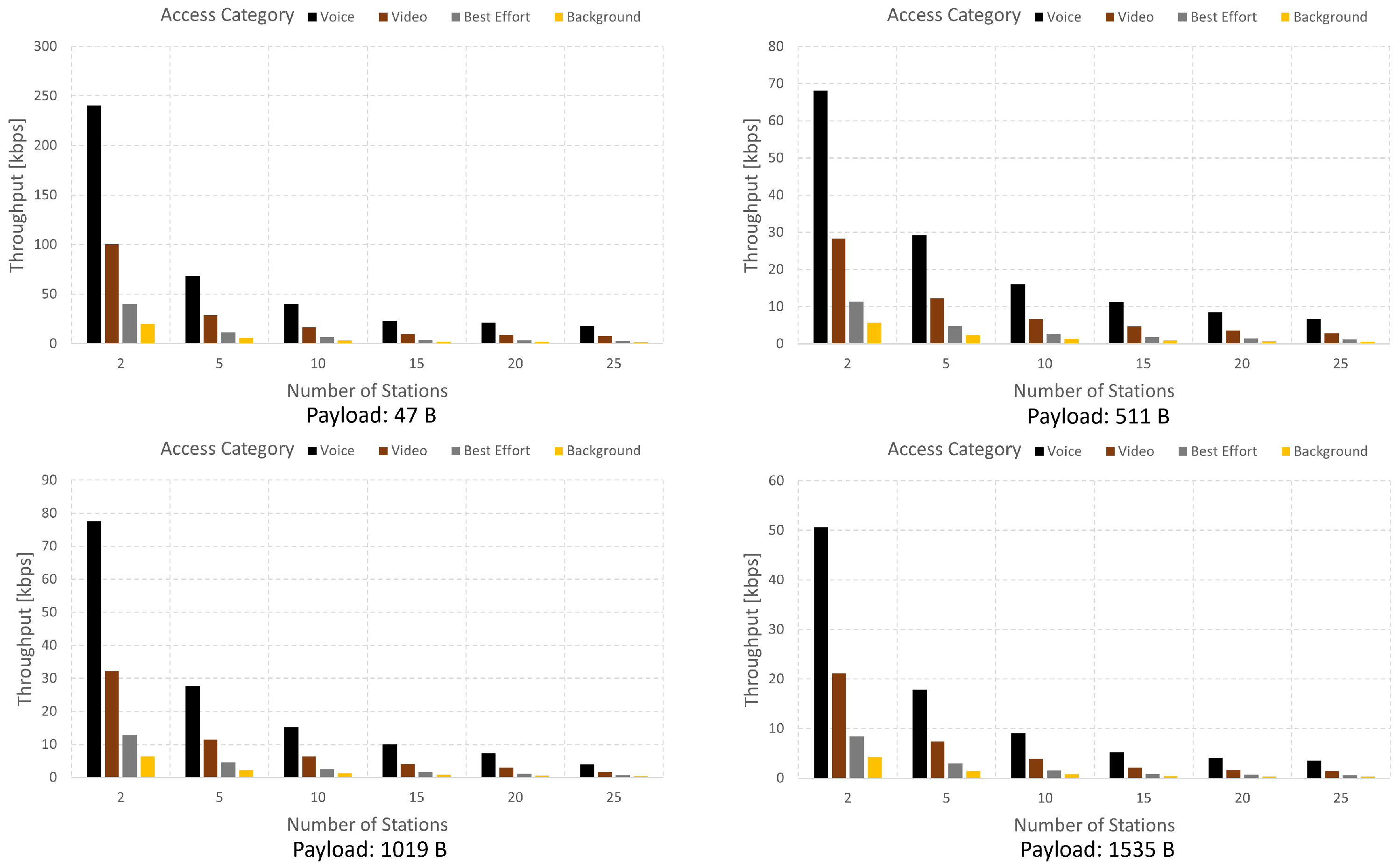
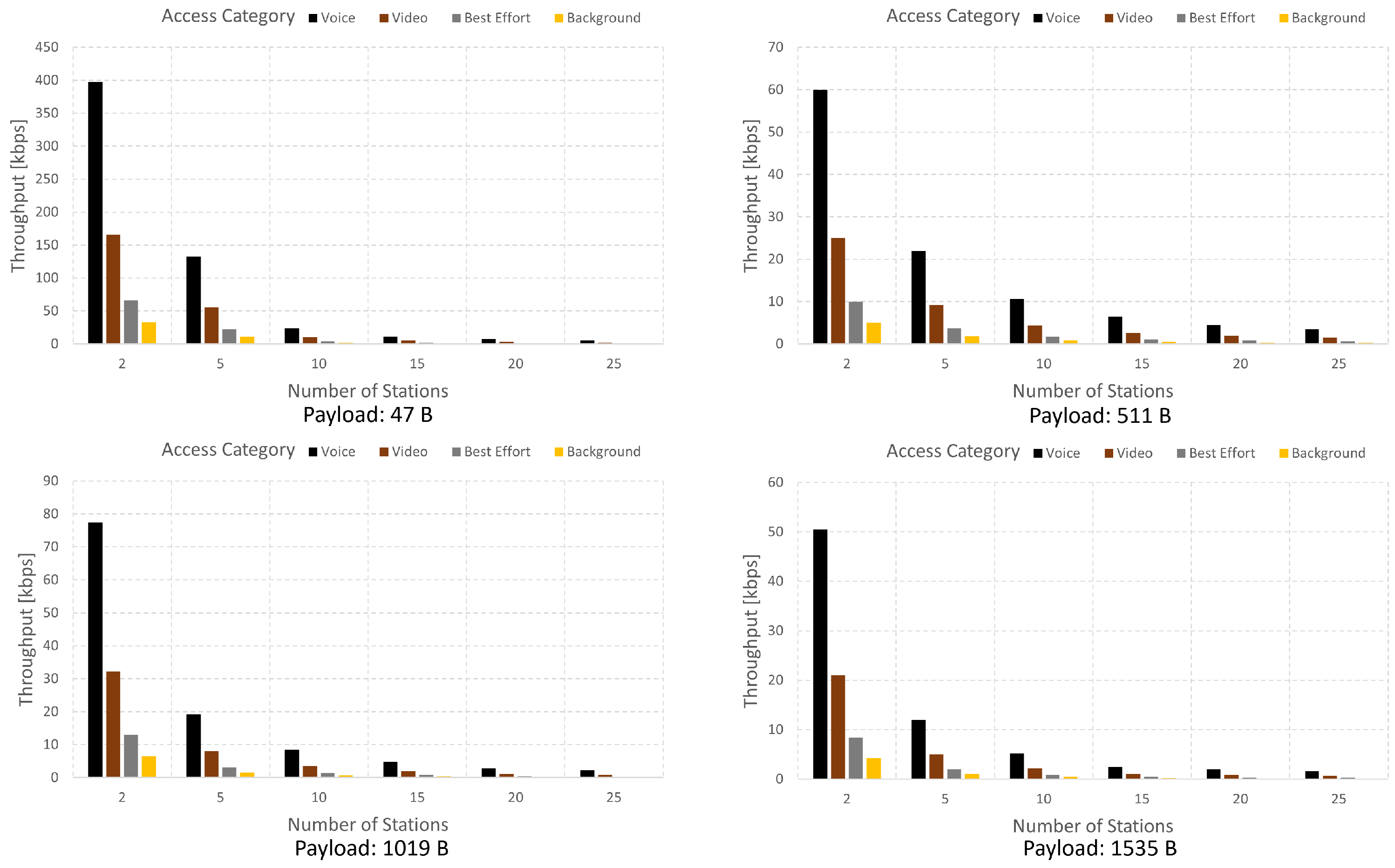
This subsection shows the performance analysis of the different QoS categories within the covert channel in a competitive situation. In this scenario, the offered load of the background stations has been set to 50 Mbps, while the other parameters remain the same as in Scenario 3. The throughput of the hidden channel is presented in Figure 32, which shows how the throughput of each access category is influenced by additional background stations. It can be seen that with more stations trying to communicate, the performance of the covert channel is rapidly decreasing, with lower priority categories reaching nearly 0 kbps.
Similar results can be observed with the disabled RTS/CTS mechanism, as depicted in Figure 33, however, as in previous scenarios, the results without RTS/CTS frames are clearly worse with an increasing number of stations, especially with lower priority access categories.
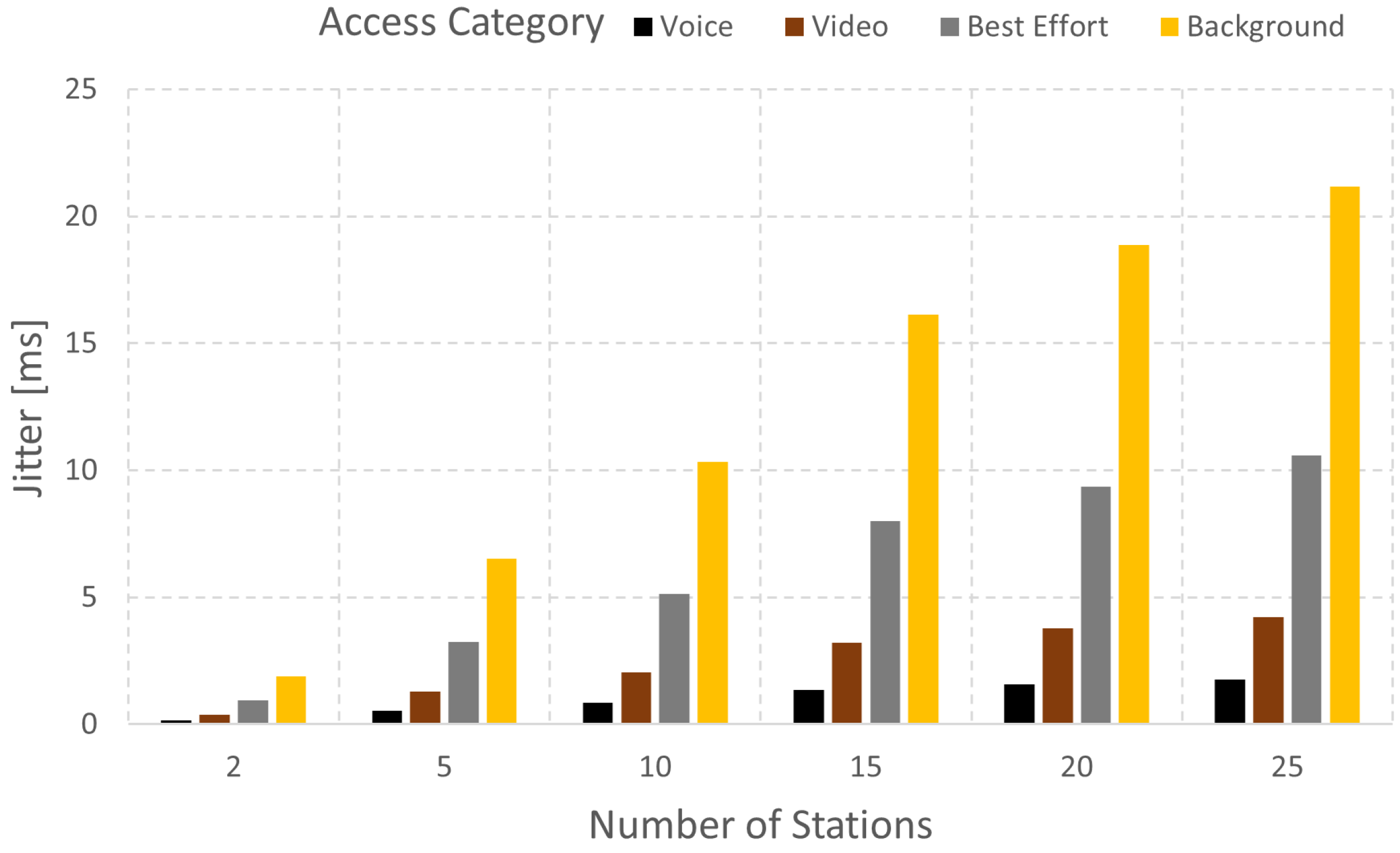
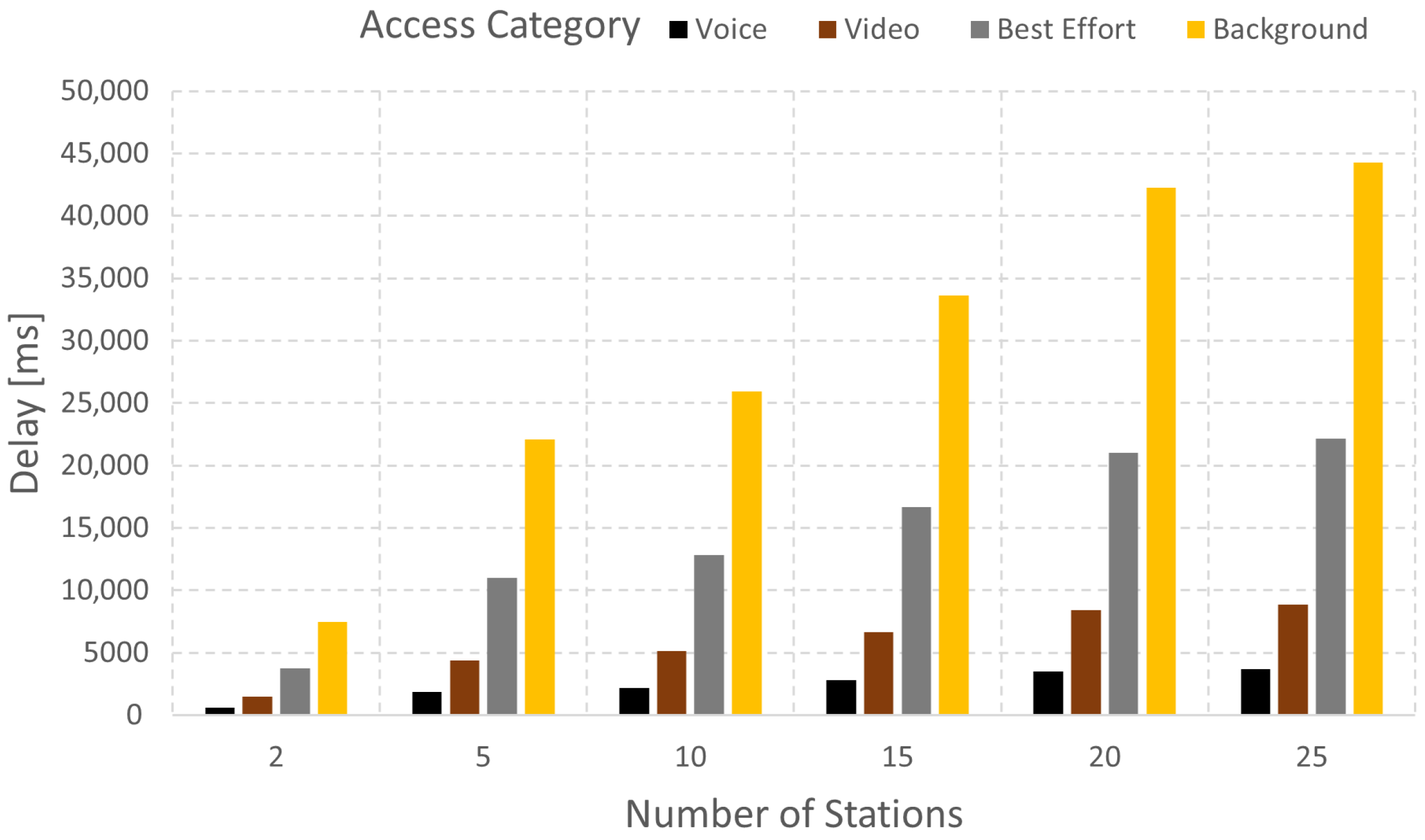
The average jitter and average frame delay of each access category for frames with payload size of 47 B are shown in Figure 34 and Figure 35 respectively. It can be observed that, for additional stations in the background, both the average jitter and the average frame delay of each QoS class increase. It can also be noted that these metrics achieve much worse results with lower priority categories, such as background and best effort.
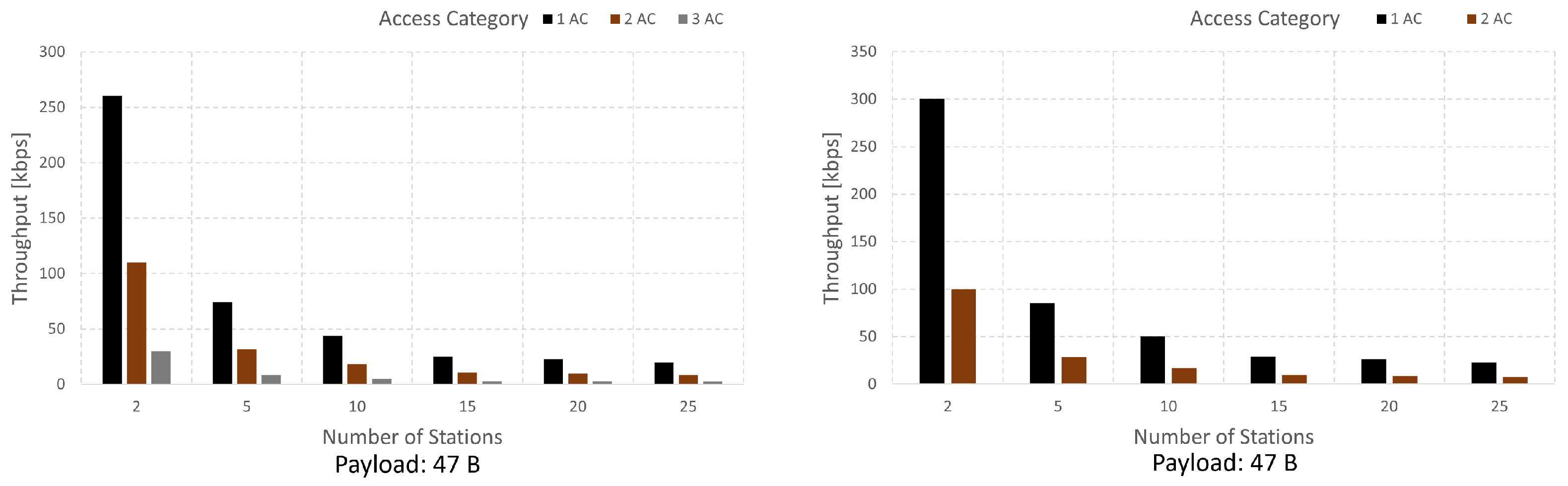
In a case where there are only two or three access categories present in the channel, similarly to a non-competitive environment, resources are divided among the existing categories, as presented in Figure 36, Figure 37 and Figure 38. Overall results are similar to previous simulations, but it can be seen that due to the smaller number of QoS classes present, each class receives more resources and therefore achieves better results, meaning higher throughput, lower average jitter, and lower average frame delay per access category. In a situation where only one access category was present in the covert channel, the results would be the same as the entire channel, as shown in Scenario 3.

6. Limitations and Risks

The StegoPadding algorithm proposed in this work has certain limitations, which is also not uncommon among other algorithms used to create covert channels. The main limitation of this algorithm is its dependence on the overall throughput of the covert station. Since hidden transmission depends on padding fields from the aggregation frames, if the throughput of the normal transmission is low, there will not be enough aggregated frames, which means not enough padding fields, which in turn means the covert channel will be difficult to establish or may even not be created. This can become an even greater problem if there are many stations other than the covert one nearby, connected to the same network. A solution to this would be to connect to networks with few other stations and also ensure that the covert station, as well as the access point, supports transmissions at higher throughput.
Another issue is the covert throughput itself. The transmission of covert information also depends on the number of aggregated frames, so it is preferred to transmit as many short frames as possible. Unfortunately, transmitting very short frames in a wireless network is inefficient due to the large overhead, which in turn can lower the throughput of normal transmission. Short frame transmission can also affect the overall performance of the network, but, because the proposed channel uses the aggregation mechanism, this should not be a problem. However, because short frames are usually associated with voice transmission and since voice does not require many resources, this method can raise some suspicions in the context of stegoanalysis.
There also remains the issue of the covertness of the channel. In normal transmission, padding fields have no real use except to ensure that the aggregated frame is exactly four octets long; therefore, the station discards the padding field after receiving such a frame. However, the contents of this field can still be displayed using network analysis tools such as Wireshark, which can expose the channel and covert transmission within. A way to solve this problem is to encrypt the hidden transmission so that its contents remain confidential, as in the proposed StegoPaddingCipher algorithm.
Lastly, because the presented covert channel approach relies solely on MAC layer mechanisms, implementing it on real hardware should be fully possible. In WLAN devices, the data link layer is usually handled partly by the driver and partly by the firmware. Implementing the proposed covert channel within Linux drivers should not pose significant difficulties. In contrast, modifying the firmware is far more challenging. Firmware is typically written in low-level languages such as assembly and is developed using specialized tools and libraries provided by WLAN chipset vendors such as Qualcomm or Intel. These development environments and firmware source code are often proprietary, costly, and restricted by licensing, making them inaccessible to most users.

7. Conclusions

This research proposes a novel covert channel aimed at enhancing transmission security while maintaining high throughput for both normal and covert communication. The proposed channel uses frame aggregation, a feature first introduced in IEEE 802.11n, to create a hidden channel and a WPA-like encryption mechanism for the security of hidden data. It is also capable of transmitting QoS traffic, enabled by the implementation of a virtual EDCA function for covert QoS data. Its resistance to stegoanalysis is mainly based on the fact that the padding fields in the aggregation frames do not carry any useful information and are discarded upon receipt by the station, as well as the fact that they are nothing out of the ordinary. This is additionally enhanced by implementing a sophisticated encryption mechanism with a key that relies on the master key, SSID, random number of backoff slots, frame number, and sender MAC address. Moreover, this channel operates without disrupting the performance of the normal network, which allows other stations to operate normally, while the covert station remains hidden. The channel was implemented and tested using the ns-3 network simulator. The tests were conducted to show how different payloads, offered load, and activity generated by background stations would impact channel performance. The conclusion of the simulations was that the channel can provide ample throughput in all scenarios, although it is preferable to use it in areas with less network traffic, as this will yield significantly better results.
The selection of throughput results for the single station scenario is presented in Table 7. In the multi station scenario, which is shown in Table 8, the offered load of the covert station was permanently set to 100 Mbps. In both scenarios, the RTS/CTS mechanism is enabled. These results present the best channel performance achieved during the simulations and show that despite some issues, this channel could be implemented on actual devices to strengthen the security of communication in wireless networks.

Future Work

This research can be expanded further to boost the performance of the covert channel. Developing additional methods of transmitting hidden data, on top of the already existing ones, can increase the throughput of the channel as well as its resistance to stegoanalysis. By implementing other hidden channels, more hidden traffic could be sent through, making it more difficult to track. For example, the location of the hidden header could be moved to a different channel. This approach would free 2 bits from the padding field, which, in turn, would increase channel throughput by approximately 8.3%. Another idea is to improve channel security by implementing a different, more sophisticated encryption algorithm. With a more secure algorithm, the data would be more resistant to brute force attacks. Another way to improve security is to change the way the keystream is formed. The keystream could be built from different network parameters or fields of the header each time a frame is sent. This would require an additional algorithm or a covert channel to inform the receiver which fields or parameters are used and in what order to form a keystream. We also plan to conduct a comprehensive evaluation of undetectability, including statistical analysis of frame fields (e.g., entropy, distribution tests) as well as confrontation with state-of-the-art steganalysis techniques. This will allow us to quantitatively assess the concealment properties of the proposed method. Lastly, this covert channel has only been tested in a simulation environment, so to obtain more accurate results, it would be best to try to implement it on real devices and test its performance in real-world scenarios.


Author Contributions

Conceptualization, M.N.; methodology, M.N. and P.R.; software, P.R.; validation, M.N. and P.R.; formal analysis, M.N. and P.R.; investigation, M.N. and P.R.; writing—original draft preparation, M.N. and P.R.; writing—review and editing, M.N.; visualization, P.R.; supervision, M.N.; project administration, M.N.; funding acquisition, M.N. All authors have read and agreed to the published version of the manuscript.

Funding

This research was supported by the National Research Institute, grant number POIR.04.02.00-00-D008/20-01, the “National Laboratory for Advanced 5G Research” (acronym PL-5G), as part of Measure 4.2, ‘Development of modern research infrastructure of the science sector’ 2014–2020, financed by the European Regional Development Fund.

Informed Consent Statement

Not applicable.

Data Availability Statement

The data presented in this study are available upon request from the corresponding author.

Conflicts of Interest

The authors declare no conflicts of interest.

Abbreviations

The following abbreviations are used in this manuscript:
ACaccess category
ACKacknowledgement
AIFSarbitrary inter-frame space
APaccess point
BEbest effort
BIbeacon interval
BKbackground
CPcyclic prefixes
CRCcyclic redundancy check
CTCcovert timing channel
CTSclear-to-send
CWcontention window
CSMA/CAcarrier sense multiple access/collision avoidance
DCFdistributed coordination function
DFTdiscrete fourier transform
DIFSdistributed inter-frame space
EDCAenhanced distributed channel access
FECforward error correction
HICCUPShidden communication system for corrupted networks
IEEEinstitute of electrical and electronics engineers
IoTinternet of things
IPDinter-packet delay
IVinitialization vector
MACmedium access control
MPDUmac protocol data unit
MSDUmac service data unit
OFDMorthogonal frequency division multiplexing
OSIopen systems interconnection
QoSquality of service
PPCTCping-pong covert timing channel
RC4rivest cipher 4
RTSrequest to send
SGsmart grid
STAstation
TIDtraffic identifier
TXOPtransmission opportunity
VIvideo
VOvoice
WEPwired equivalent privacy
WiPadwireless padding
WLANwireless local area network
WPAwi-fi protected access

References

  1. IEEE Std 802.11-2024 (Revision of IEEE Std 802.11-2020); IEEE Standard for Information Technology–Telecommunications and Information Exchange Between Systems Local and Metropolitan Area Networks–Specific Requirements Part 11: Wireless LAN Medium Access Control (MAC) and Physical Layer (PHY) Specifications. IEEE: Piscataway, NJ, USA, 2025; pp. 1–5956. [CrossRef]
  2. Borlase, S. Smart Grids: Infrastructure, Technology, and Solutions; Electric Power and Energy Engineering; CRC Press: Boca Raton, FL, USA, 2017. [Google Scholar]
  3. IEC 61850-1; IEC Standard for Communication Network and Systems in Substations, Part 1 Introduction and Overview. IEC: Geneva, Switzerland, 2003.
  4. Fang, X.; Misra, S.; Xue, G.; Yang, D. Smart Grid—The New and Improved Power Grid: A Survey. IEEE Commun. Surv. Tutor. 2012, 14, 944–980. [Google Scholar] [CrossRef]
  5. Szczypiorski, K. HICCUPS: Hidden communication system for corrupted networks. In Proceedings of the International Multi-Conference on Advanced Computer Systems; IEEE: Piscataway, NJ, USA, 2003; pp. 31–40. [Google Scholar]
  6. Szczypiorski, K. A performance analysis of HICCUPS—A steganographic system for WLAN. Telecommun. Syst. 2012, 49, 255–259. [Google Scholar] [CrossRef][Green Version]
  7. Frikha, L.; Trabelsi, Z. A new covert channel in WIFI networks. In 2008 Third International Conference on Risks and Security of Internet and Systems; IEEE: Piscataway, NJ, USA, 2008; pp. 255–260. [Google Scholar] [CrossRef]
  8. Frikha, L.; Trabelsi, Z.; El-Hajj, W. Implementation of a Covert Channel in the 802.11 Header. In 2008 International Wireless Communications and Mobile Computing Conference; IEEE: Piscataway, NJ, USA, 2008; pp. 594–599. [Google Scholar] [CrossRef]
  9. Szczypiorski, K.; Mazurczyk, W. Hiding Data in OFDM Symbols of IEEE 802.11 Networks. In 2010 International Conference on Multimedia Information Networking and Security; IEEE: Piscataway, NJ, USA, 2010; pp. 835–840. [Google Scholar] [CrossRef][Green Version]
  10. Grabski, S.; Szczypiorski, K. Steganography in OFDM Symbols of Fast IEEE 802.11n Networks. In 2013 IEEE Security and Privacy Workshops; IEEE: Piscataway, NJ, USA, 2013; pp. 158–164. [Google Scholar] [CrossRef]
  11. Dutta, A.; Saha, D.; Grunwald, D.; Sicker, D. Secret agent radio: Covert communication through dirty constellations. In Proceedings of the International Workshop on Information Hiding; Springer: Berlin/Heidelberg, Germany, 2012; pp. 160–175. [Google Scholar]
  12. Holloway, R.; Beyah, R. Covert DCF: A DCF-Based Covert Timing Channel in 802.11 Networks. In 2011 IEEE Eighth International Conference on Mobile Ad-Hoc and Sensor Systems; IEEE: Piscataway, NJ, USA, 2011; pp. 570–579. [Google Scholar] [CrossRef]
  13. Gonçalves, R.; Tummala, M.; McEachen, J.C. Analysis of a MAC layer covert channel in 802.11 networks. Int. J. Adv. Telecommun. 2012, 5, 131–140. [Google Scholar]
  14. Zhao, H. Covert channels in 802.11e wireless networks. In 2014 Wireless Telecommunications Symposium; IEEE: Piscataway, NJ, USA, 2014; pp. 1–5. [Google Scholar] [CrossRef]
  15. Sawicki, K.; Piotrowski, Z. The proposal of IEEE 802.11 network access point authentication mechanism using a covert channel. In 2012 19th International Conference on Microwaves, Radar Wireless Communications; IEEE: Piscataway, NJ, USA, 2012; Volume 2, pp. 656–659. [Google Scholar] [CrossRef]
  16. Radhakrishnan, S.V.; Selcuk Uluagac, A.; Beyah, R. Realizing an 802.11-based covert timing channel using off-the-shelf wireless cards. In 2013 IEEE Global Communications Conference (GLOBECOM); IEEE: Piscataway, NJ, USA, 2013; pp. 722–728. [Google Scholar] [CrossRef]
  17. Walker, T.O.; Fairbanks, K.D. An off-the-shelf, low detectability, low data rate, timing-based covert channel for IEEE 802.11 wireless networks. In 2017 14th IEEE Annual Consumer Communications & Networking Conference (CCNC); IEEE: Piscataway, NJ, USA, 2017; pp. 835–840. [Google Scholar] [CrossRef]
  18. Sawicki, K.; Bieszczad, G.; Piotrowski, Z. StegoFrameOrder—MAC Layer Covert Network Channel for Wireless IEEE 802.11 Networks. Sensors 2021, 21, 6268. [Google Scholar] [CrossRef] [PubMed]
  19. Yamaguchi, R.; Ochiai, H.; Shikata, J. A Physical-Layer Security Based on Wireless Steganography Through OFDM and DFT-Precoded OFDM Signals. In 2020 IEEE 91st Vehicular Technology Conference (VTC2020-Spring); IEEE: Piscataway, NJ, USA, 2020; pp. 1–5. [Google Scholar] [CrossRef]
  20. Teca, G.; Natkaniec, M. StegoBackoff: Creating a Covert Channel in Smart Grids Using the Backoff Procedure of IEEE 802.11 Networks. Energies 2024, 17, 716. [Google Scholar] [CrossRef]
  21. Natkaniec, M.; Dyrcz, J. StegoDCF: A New Covert Channel for Smart Grids Utilizing the Channel Access Procedure in Wi-Fi Networks. Energies 2024, 17, 2021. [Google Scholar] [CrossRef]
  22. Teca, G.; Natkaniec, M. A Novel Covert Channel for IEEE 802.11 Networks Utilizing MAC Address Randomization. Appl. Sci. 2023, 13, 8000. [Google Scholar] [CrossRef]
  23. Natkaniec, M.; Kępowicz, P. StegoEDCA: An Efficient Covert Channel for Smart Grids Based on IEEE 802.11e Standard. Energies 2025, 18, 330. [Google Scholar] [CrossRef]
  24. Seong, H.; Kim, I.; Jeon, Y.; Oh, M.K.; Lee, S.; Choi, D. Practical Covert Wireless Unidirectional Communication in IEEE 802.11 Environment. IEEE Internet Things J. 2023, 10, 1499–1516. [Google Scholar] [CrossRef]
  25. Son, S.; Kwon, D.; Lee, S.; Jeon, Y.; Park, Y. A Robust Covert Channel with Self-Bit Recovery for IEEE 802.11 Networks. IEEE Internet Things J. 2024, 11, 27356–27368. [Google Scholar] [CrossRef]
  26. Natkaniec, M.; Pach, A. An analysis of the influence of the threshold parameter on the IEEE 802.11 network performance. In 2000 IEEE Wireless Communications and Networking Conference. Conference Record (Cat. No.00TH8540); IEEE: Piscataway, NJ, USA, 2000; Volume 2, pp. 819–823. [Google Scholar] [CrossRef]
  27. IEEE Std 802.11e-2005 (Amendment to IEEE Std 802.11, 1999 Edition (Reaff 2003); IEEE Standard for Information Technology–Local and Metropolitan Area Networks–Specific Requirements–Part 11: Wireless LAN Medium Access Control (MAC) and Physical Layer (PHY) Specifications—Amendment 8: Medium Access Control (MAC) Quality of Service Enhancements. IEEE: Piscataway, NJ, USA, 2005; pp. 1–212. [CrossRef]
  28. IEEE Std 802.11n-2009; IEEE Standard for Information Technology–Local and Metropolitan Area Networks–Specific Requirements–Part 11: Wireless LAN Medium Access Control (MAC) and Physical Layer (PHY) Specifications Amendment 5: Enhancements for Higher Throughput. Amendment to IEEE Std 802.11-2007 as amended by IEEE Std 802.11k-2008, IEEE Std 802.11r-2008, IEEE Std 802.11y-2008, and IEEE Std 802.11w-2009. IEEE: Piscataway, NJ, USA, 2009; pp. 1–565. [CrossRef]
  29. INET Framework. IEEE 802.11 Frame Aggregation. Available online: https://inet.omnetpp.org/docs/_images/dataunits3.png (accessed on 3 March 2026).
  30. Lashkari, A.H.; Mansoor, M.; Danesh, A.S. Wired Equivalent Privacy (WEP) versus Wi-Fi Protected Access (WPA). In 2009 International Conference on Signal Processing Systems; IEEE: Piscataway, NJ, USA, 2009; pp. 445–449. [Google Scholar] [CrossRef]
  31. IEEE Std 802.11i-2004; IEEE Standard for Information Technology-Telecommunications and Information Exchange Between Systems-Local and Metropolitan Area Networks-Specific Requirements-Part 11: Wireless LAN Medium Access Control (MAC) and Physical Layer (PHY) Specifications: Amendment 6: Medium Access Control (MAC) Security Enhancements. IEEE: Piscataway, NJ, USA, 2004; pp. 1–190. [CrossRef]
  32. Stallings, W. Cryptography and Network Security, 4th ed.; Includes index; Pearson Education: New Delhi, India, 2009. [Google Scholar]
  33. IEEE Std 802.1Q-2022 (Revision of IEEE Std 802.1Q-2018); IEEE Standard for Local and Metropolitan Area Networks–Bridges and Bridged Networks. IEEE: Piscataway, NJ, USA, 2022; pp. 1–2163. [CrossRef]
  34. ns-3 Project. ns-3 Network Simulator. Available online: https://www.nsnam.org/ (accessed on 31 March 2026).
Figure 1. EDCA channel access [27].
Electronics 15 01504 g001
Figure 2. Aggregation methods: A-MSDU (left) and A-MPDU (right) [29].
Electronics 15 01504 g002
Figure 3. A-MPDU subframe format.
Electronics 15 01504 g003
Figure 4. Structure of the hidden header.
Electronics 15 01504 g004
Figure 5. Encryption of covert data.
Electronics 15 01504 g005
Figure 6. Decryption of covert data.
Electronics 15 01504 g006
Figure 7. Sending a frame.
Electronics 15 01504 g007
Figure 8. Receiving a frame.
Electronics 15 01504 g008
Figure 9. Network topology with single station.
Electronics 15 01504 g009
Figure 10. Covert channel throughput vs. offered load, RTS/CTS enabled.
Electronics 15 01504 g010
Figure 11. Covert channel efficiency for different payload sizes vs. offered load, RTS/CTS enabled.
Electronics 15 01504 g011
Figure 12. Covert channel throughput vs. offered load, RTS/CTS disabled.
Electronics 15 01504 g012
Figure 13. Covert channel efficiency for different payload sizes vs. offered load, RTS/CTS disabled.
Electronics 15 01504 g013
Figure 14. Comparison of covert channel efficiency for different payload sizes vs. offered load, RTS/CTS enabled and disabled.
Electronics 15 01504 g014
Figure 15. Covert channel average jitter vs. offered load, RTS/CTS enabled.
Electronics 15 01504 g015
Figure 16. Covert channel average frame delay vs. offered load, RTS/CTS enabled.
Electronics 15 01504 g016
Figure 17. Covert channel throughput per access category vs. offered load for different payload sizes, RTS/CTS enabled.
Electronics 15 01504 g017
Figure 18. Covert channel throughput per access category vs. offered load for different payload sizes, RTS/CTS disabled.
Electronics 15 01504 g018
Figure 19. Covert channel average jitter per access category vs. offered load for different payload sizes, RTS/CTS enabled.
Electronics 15 01504 g019
Figure 20. Covert channel average frame delay per access category vs. offered load for different payload sizes, RTS/CTS enabled.
Electronics 15 01504 g020
Figure 21. Covert channel throughput per access category vs. offered load for different number of access categories, RTS/CTS enabled.
Electronics 15 01504 g021
Figure 22. Covert channel average jitter per access category vs. offered load for different number of access categories, RTS/CTS enabled.
Electronics 15 01504 g022
Figure 23. Covert channel average frame delay per access category vs. offered load for different number of access categories, RTS/CTS enabled.
Electronics 15 01504 g023
Figure 24. Network topology with multiple stations.
Electronics 15 01504 g024
Figure 25. Covert channel throughput for different number of background stations, background load and payload sizes, RTS/CTS enabled.
Electronics 15 01504 g025
Figure 26. Covert channel efficiency for different number of background stations and payload sizes, RTS/CTS enabled, background load: 50 Mbps.
Electronics 15 01504 g026
Figure 27. Covert channel throughput for different number of background stations, background load and payload sizes, RTS/CTS disabled.
Electronics 15 01504 g027
Figure 28. Covert channel efficiency for different number of background stations and payload sizes, RTS/CTS disabled, background load: 50 Mbps.
Electronics 15 01504 g028
Figure 29. Comparison of covert channel efficiency for different number of background stations and payload sizes, RTS/CTS enabled and disabled, background load: 50 Mbps.
Electronics 15 01504 g029
Figure 30. Covert channel average jitter for different number of background stations, background load and payload size of 47 B, RTS/CTS enabled.
Electronics 15 01504 g030
Figure 31. Covert channel average frame delay for different number of background stations, background load and payload size of 47 B, RTS/CTS enabled.
Electronics 15 01504 g031
Figure 32. Covert channel throughput per access category for different number of background stations and payload sizes, RTS/CTS enabled.
Electronics 15 01504 g032
Figure 33. Covert channel throughput per access category for different number of background stations and payload sizes, RTS/CTS disabled.
Electronics 15 01504 g033
Figure 34. Covert channel average jitter per access category for different number of background stations and payload size of 47 B, RTS/CTS enabled.
Electronics 15 01504 g034
Figure 35. Covert channel average frame delay per access category for different number of background stations and payload size of 47 B, RTS/CTS enabled.
Electronics 15 01504 g035
Figure 36. Covert channel throughput per access category for different number of background stations and access categories, RTS/CTS enabled.
Electronics 15 01504 g036
Figure 37. Covert channel average jitter per access category for different number of background stations and access categories, RTS/CTS enabled.
Electronics 15 01504 g037
Figure 38. Covert channel average frame delay per access category for different number of background stations and access categories, RTS/CTS enabled.
Electronics 15 01504 g038
Table 1. Covert channels comparison.
Ref.YearCovert Channel ConceptMaximum ThroughputCovert Data EncryptionQoS Support
[5,6]2003Hiding covert data in WEP initialization vector, MAC address and CRC mechanism1,270,000 bpsNoNo
[7,8]2008Hiding covert data in Sequence Control field and WEP initialization vector24 bppYesNo
[9]2010Utilizing the padding of the OFDM symbols to send covert data—WiPad1,100,000 bpsNoNo
[12]2011Using DCF function to send covert messages after determined backoff time8000 bpsNoNo
[11]2012Using modified low-rate constellations with additional points to send hidden data—dirty constellations9,000,000 bpsNoNo
[15]2012Hiding covert data in Timestamp field of the Beacon frames40 bpsNoNo
[13]2012Using forged CTS and ACK frames to send covert data127.4 bpsNoNo
[10]2013Sending covert data in modified cyclic prefixes of the OFDM symbols19,500,000 bpsNoNo
[16]2013Covert Timing Channel utilizing previously defined backoff time to send covert data—Covert-DCF2280 bpsNoNo
[14]2014Hiding data in TID and TXOP parameters of the QoS Control field8 bpfNoNo
[17]2017Usage of interarrival time of the frames to send covert data50 bpsNoNo
[19]2020Sending a message with superposed hidden signals along with the cover signalN/ANoNo
[18]2021Usage of relative order of frames to send covert messages9.76 bpsNoNo
[22]2023Utilizing source MAC address randomisation mechanism to send covert data as supposedly random addresses4770 bpsNoNo
[24]2023Covert Timing Channel utilizing different Beacon intervals to send covert messages2.79 bpsYesNo
[20]2024Utilizing random backoff procedure to send single bits of covert data—StegoBackoff14,000 bpsNoNo
[21]2024Utilizing random backoff procedure and three bits of Duration/ID field to send covert data—StegoDCF144,800 bpsNoLimited
[25]2024Covert Timing Channel utilizing inter-packet delays to transmit hidden messages3.25 bpsYesNo
[23]2025Combination of random backoff procedure, Duration/ID field, aggregation frames and TXOP period to send hidden data—StegoEDCA248,260 bpsNoNo
This work2026Utilizing padding field of aggregation frames to transmit covert data1,073,530 bpsYesFull
Table 2. Access categories.
Access CategoryTypical TrafficPriority Level
Voice (AC_VO)VoIP, network controlHighest
Video (AC_VI)Streaming video, conferencingHigh
Best Effort (AC_BE)Web browsing, emailsNormal
Background (AC_BK)File downloads, updatesLowest
Table 3. Default values for access categories.
ACCWminCWmaxAIFSNTXOP Limit
Voice3721.504 ms
Video71523.008 ms
Best Effort15102330
Background15102370
Table 4. Contents of the hidden header.
Bit SequenceQoS Class
00Voice
01Video
10Best Effort
11Background
Table 5. Distribution of covert bits.
ACsDistribution of Covert Bits per AC
1 AC100%
1 AC75%
2 AC25%
1 AC65%
2 AC27.5%
3 AC7.5%
1 AC (VO)60%
2 AC (VI)25%
3 AC (BE)10%
4 AC (BK)5%
Table 6. Simulation parameters.
ParameterValue
IEEE Standard802.11ax
Transport protocolUDP
Frequency band5 [GHz]
Channel number36
Channel width20 [MHz]
Guard interval3.2 [μs]
TX power20 [dBm]
Time slot9 [μs]
SIFS16 [μs]
DIFS34 [μs]
AC_VO TXOP time limit1.504 [ms]
AC_VO CWmin3
AC_VO CWmax7
AC_VI TXOP time limit3.008 [ms]
AC_VI CWmin7
AC_VI CWmax15
MCS9
RTS and CTS framesEnabled/Disabled
Number of Tx and Rx antennas1
Propagation and Loss ModelLog-Distance Path Loss Model
Mobility modelConstant
Distance between AP and STA5 [m]
Table 7. Selected simulation results for single station scenario, RTS/CTS enabled.
Payload [B]Offered Load [Mbps]Throughput (Whole Channel) [kbps]
47501016.9
471001017.04
51150122.07
511100222.44
10195053.92
1019100118.14
15355030.94
153510079.39
Table 8. Selected simulation results for multi-station scenario, RTS/CTS enabled.
Payload [B]Background STABackground Load [Mbps]Throughput (Whole Channel) [kbps]
475100119.48
471510035.5
511510047.08
5111510020.22
1019510043.97
10191510017.78
1535510028.36
1535151007.31
Disclaimer/Publisher’s Note: The statements, opinions and data contained in all publications are solely those of the individual author(s) and contributor(s) and not of MDPI and/or the editor(s). MDPI and/or the editor(s) disclaim responsibility for any injury to people or property resulting from any ideas, methods, instructions or products referred to in the content.