1. Introduction
During the orbital flight of a spacecraft, the microgravity environment (commonly defined as below 10
−6 g) is extremely sensitive to vibrations. For instance, the imaging accuracy of optical remote sensing satellites must reach the sub-arcsecond level, while vibrations generated by equipment such as reaction wheels and thrusters (especially low-frequency vibrations in the 1–100 Hz range) can cause image blurring or data distortion [
1]. Traditional mechanical vibration isolation techniques (such as metal springs and rubber dampers) struggle to meet high-precision isolation requirements due to friction, wear, and stiffness limitations. For example, passive vibration isolation systems are prone to resonance amplification effects at low frequencies (<10 Hz), whereas active non-magnetic levitation systems (e.g., voice coil motors) require complex mechanical structures and suffer from energy losses [
2,
3]. Recent studies have further confirmed that these traditional techniques cannot meet the ultra-high precision requirements of new-generation spacecraft optical payloads [
4].
Maglev isolation achieves non-contact support through electromagnetic force, fundamentally eliminating mechanical coupling. Its core advantages include frictionless operation and a long service life, which avoid the wear issues of traditional bearings and make it suitable for long-term on-orbit missions, where equipment reliability directly determines mission success [
5]. Researchers from American institutions have proposed a new design of a six-degree-of-freedom vibration isolator and the corresponding control algorithm to stabilize passively unstable magnetic levitation systems. The system focuses on low-frequency isolation at the ten-hertz level, and the control algorithm is specifically designed to address the stability problem of passively unstable magnetic levitation systems, making it suitable for high-precision measurement and aerospace applications [
6,
7].
A new generation of satellites, including high-resolution remote-sensing satellites and deep-space probes, has imposed higher requirements on pointing accuracy and stability [
8]. In addition, maglev technology can be combined with other active control methods (such as piezoelectric actuators) to form an active–passive composite vibration isolation system, further optimizing its performance [
9,
10,
11]. A recent study demonstrated that such composite systems can reduce micro-vibration transmission by more than 90% in the 1–100 Hz range, significantly improving the stability of optical payloads [
12].
Maglev vibration isolation is a non-contact active vibration isolation technology. According to different application scenarios, maglev vibration isolation systems can be divided into two categories: ‘payload-level’ and ‘rack-level’ [
13,
14]. Subsequently, the “Disturbance-free Payload” (DFP) satellite was developed, a concept first proposed by Nelson Pedreiro of the Lockheed Martin Advanced Technology Center in 2002 [
15,
16]. The core concept of DFP technology is mainly reflected in non-contact, including non-contact position sensors and non-contact actuators [
17]. DFP uses non-contact sensors to measure the relative position and attitude between the payload module and the service module, and then generates control forces and control torques between them via non-contact actuators to adjust attitude and relative position [
18,
19].
Dongdong Li from Nanjing University of Aeronautics and Astronautics (NUAA) explored the vibration characteristics of FGP sandwich plates under moving mass, providing a theoretical basis for dynamic response analysis of structures subjected to time-varying loads [
20]. And Chen et al. proposed a vibration suppression method for rotating flexible beams using a moving actuator, which enriches the research on structural vibration control for aerospace applications [
21]. A 2025 study developed a DFP-based maglev control system with high redundancy, ensuring stable operation even in the event of sensor failure [
22].
This study focuses on the design, modeling, and performance verification of a maglev isolation system, particularly tailored for satellite applications. Based on the Newton–Euler equation, a dynamic model of the maglev isolation system was established, and the overall architecture of the system was designed concurrently. In addition, a dynamic model of the maglev actuator was constructed. To realize the design of the active control strategy, the proportional–integral–derivative control method was adopted, and the corresponding system control law was derived successfully.
Further, based on the established architecture of the satellite maglev isolation system and the determined maglev layout, mathematical models for the output force and torque of the system were developed. Utilizing these mathematical models, the robustness of the system under fault modes was analyzed in detail. The simulation results demonstrate that the proposed maglev isolation system possesses high isolation accuracy and excellent stability, which can effectively suppress the interference and shaking of both the platform and the payload, indicating strong robustness.
2. Maglev Vibration Isolation System Theory and Modeling
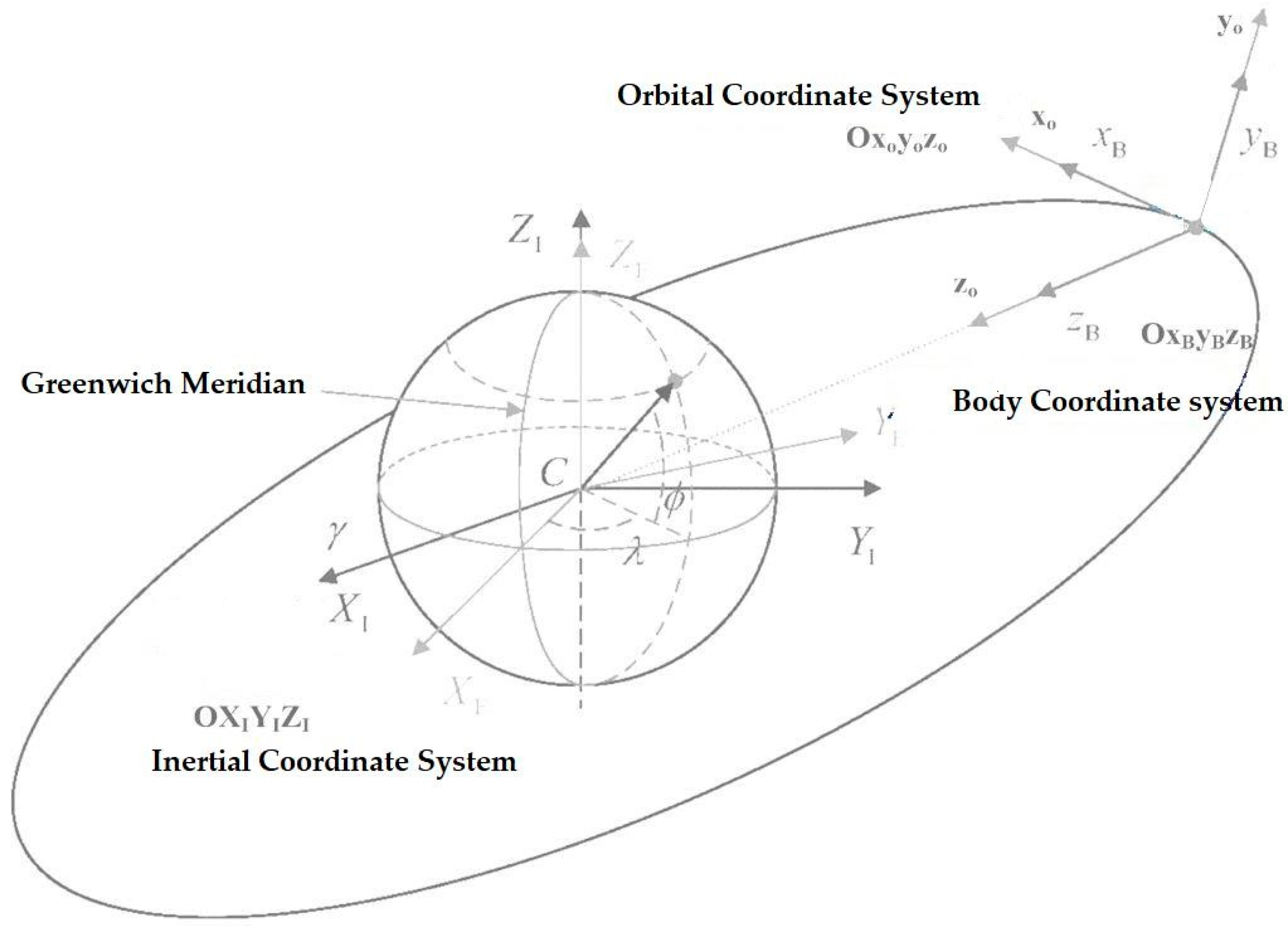
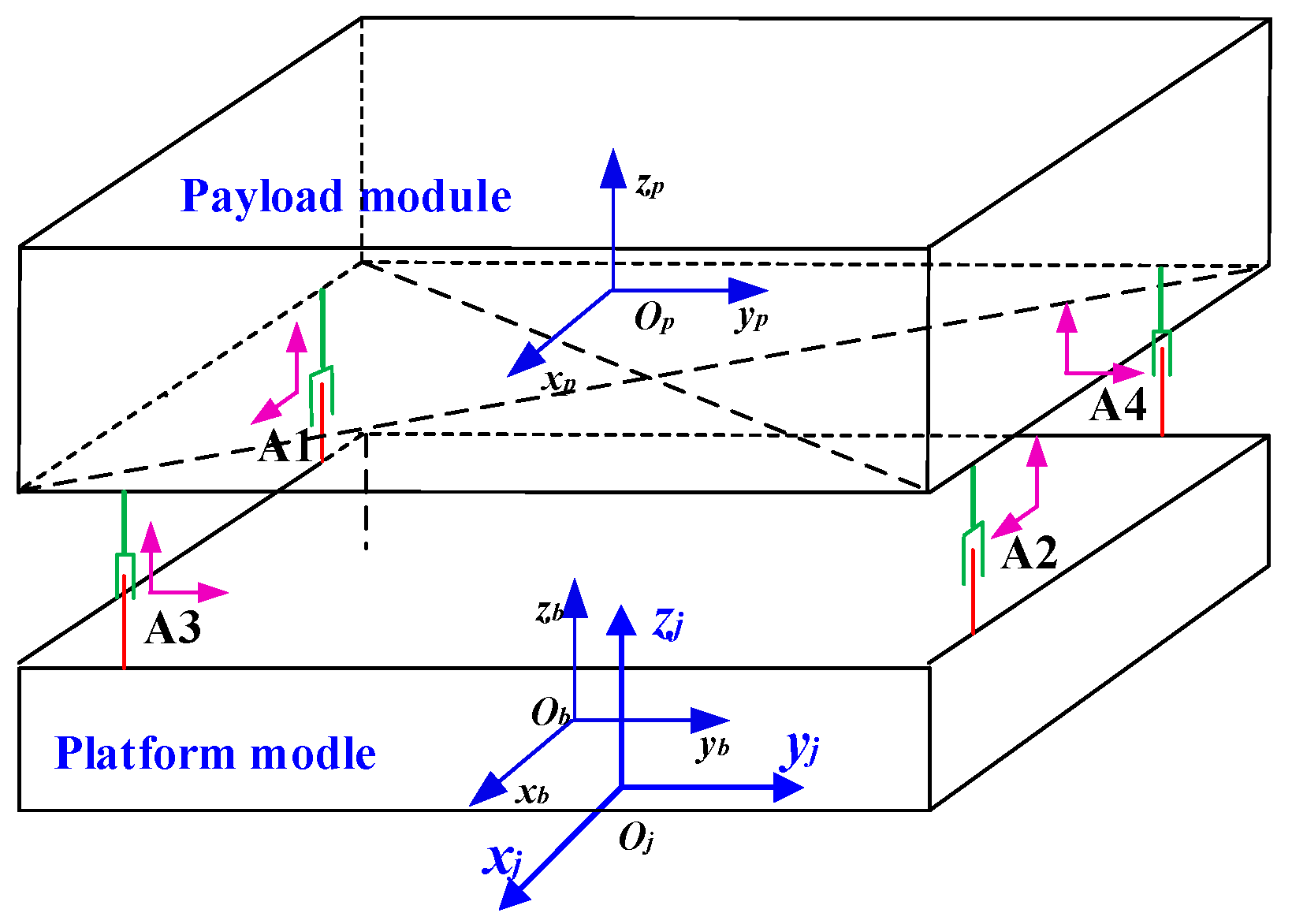
First, define 3 key coordinate systems:
Inertial Frame (O-X1Y1Z1): The origin O is usually taken from the center of the Earth, with the coordinate axis pointing towards the star and not rotating with the Earth.
LVLH Frame (O-XoYoZo): The origin O is located at the center of mass of the satellite, the Xo axis is in the direction of the satellite’s orbital velocity, the Zo axis points towards the center of the Earth, and the Yo axis forms a right-handed system with the Xo and Zo axes.
Body Frame (O-X
BY
BZ
B): The origin O is located at the center of mass of the satellite, and the coordinate axis is fixed on the satellite body, as shown in
Figure 1.
2.1. Satellite Centroid Motion Equation
According to Newton’s second law, the motion equation of the satellite’s center of mass can be expressed as
Among them, m denotes the mass of the satellite, r denotes the position vector of the satellite’s center of mass with respect to the inertial frame, and denotes the sum of all external forces acting on the satellite.
The Earth’s gravity is the main external force acting on satellites, which can be expressed by the following expression:
Among them, G represents the gravitational constant, M denotes the mass of the Earth, and stands for the distance from the satellite to the center of the Earth.
In low Earth orbit (LEO), atmospheric drag is a critical external perturbation, which can be approximated by the following expression:
Among them, denotes the atmospheric density, stands for the velocity of the satellite relative to the atmosphere, denotes the drag coefficient, denotes the upwind area of the satellite, and denotes the satellite velocity vector.
Satellite attitude and orbit control are usually provided by thrusters, and the control force can be expressed by the following expression:
Among them, denotes the force generated by the i-th thruster.
The force transmitted by the maglev isolation system can be expressed by the following expression:
Among them, , , and are the forces acting on the maglev isolation system in the x, y, and z directions, respectively.
Substitute all the external forces mentioned above into Newton’s second law to obtain the complete equation for the motion of the satellite’s center of mass:
2.2. Satellite Attitude Motion Equation
The satellite is approximated as a rigid body for dynamic modeling, and the attitude motion equations of the satellite are derived by combining the Euler angle description and the angular momentum theorem. The satellite’s attitude dynamics are described by the Euler equations, which form the core of the attitude dynamic model.
The gravitational gradient torque stemming from the Earth’s non-homogeneous gravitational field represents a significant perturbing torque in satellite attitude control and is mathematically expressed as
The inhomogeneous distribution of atmospheric drag over the satellite’s surface induces aerodynamic torque, which is mathematically approximated as
where
denotes the position vector from the center of pressure to the center of mass. The control torque generated by the thruster can be expressed as
Among them, denotes the position vector from the i-th thruster point to the center of mass.
The torque transmitted by the maglev isolation system can be expressed as
Among them, denotes the position vector from the point of magnetic levitation isolation to the center of mass.
Substitute all the external moments mentioned above into the Euler equation to obtain the complete equation of satellite attitude motion:
2.3. Collaborative Control Strategy
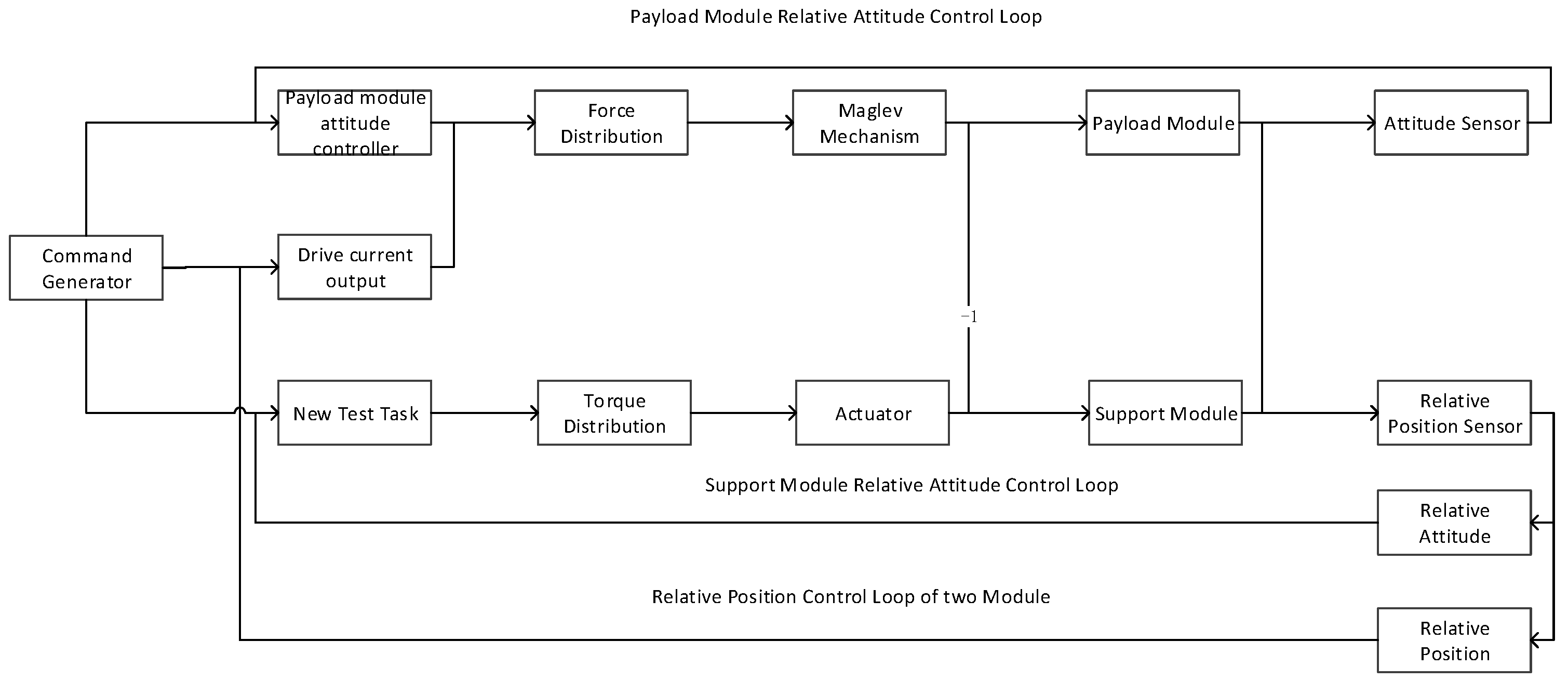
When the satellite’s payload module and service module are in the unlocked state, the attitude and orbit control expansion unit acquires the attitude angle and angular velocity data of the payload module via satellite sensors and fiber optic gyroscopes, and transmits this information to the attitude and orbit control management unit. A displacement sensor measures the relative position and attitude between the two modules and sends the measurement results to the management unit. After processing the collected measurement data, the attitude and orbit control management unit computes and outputs control commands to the maglev actuators. These commands drive the maglev actuators to generate corresponding control forces and torques, thereby realizing the hyperstability control of the payload module [
23]. The collaborative control strategy is illustrated in
Figure 2.
Figure 2 illustrates a closed-loop control architecture for regulating the relative attitude and position between a payload module and a support module, comprising three integrated control loops. Initiated by a central command generator, the payload module’s relative attitude control loop drives the module via an attitude controller, force distribution, and a maglev mechanism, with attitude feedback from an attitude sensor to close the loop. Concurrently, the support module’s relative attitude control loop executes torque distribution through an actuator, with relative position feedback from a position sensor for closed-loop adjustment. Additionally, a dedicated relative position control loop of the two modules monitors and regulates the relative attitude and position between the payload and support modules, ensuring coordinated and stable relative motion. Collectively, this multi-loop system integrates attitude control for individual modules and relative position control between them, achieving precise and robust relative motion regulation under command-driven operation.
The target attitude and angular velocity calculated by the maneuver path planning algorithm and attitude guidance algorithm are transmitted to the attitude and orbit control management unit. The feedback control command torque is formed by calculating the attitude deviation and angular velocity deviation. At the same time, the feedforward control command torque is calculated based on the feedforward attitude sensor (such as angular acceleration), and the total control command torque is distributed to each maglev actuator. The maglev actuator is used to achieve ultra-high precision and ultra-high stability control of the payload module.
The displacement sensor measures the relative position changes caused by the rotation of the two modules around their own center of mass and the rotation of the two modules around the center of mass of the entire star. Based on the deviation between the current relative position and the expected relative position, the three-axis translational control force is calculated and distributed to each maglev actuator. The closed-loop control of the relative position between the two modules is completed through the maglev actuator to avoid collision between the two modules.
Transfer the relative attitude of the two modules measured by the displacement sensor to the attitude and orbit control management unit, with zero relative attitude as the control target, and calculate the feedback control command torque. In order to improve the synchronization of the motion between the service module and the payload module and reduce collision risks, the feedforward control command torque is calculated based on the same feedforward angular acceleration, and the total control command torque is transmitted to the control torque gyroscope group to complete the attitude control of the service module.
2.4. Dynamic Model of Maglev Actuator
A dynamic model of the maglev isolation system was established based on the Newton–Euler equation [
24], while considering the influence of uncertain factors such as damping, stiffness, and load center of mass of the cables in the system on the system model. The impact of these factors on the dynamic characteristics of the system model was analyzed, and a state space equation containing uncertain terms was established for the control system, providing theoretical support for the design of the control system [
25,
26].
The dynamic model of the maglev actuator considers the effects of electromagnetic force, damping force, and spring force, and its force equation is as follows.
Among them,
represents the electromagnetic force output by the magnetic levitation actuator,
denotes the damping force,
stands for the external disturbance force,
refers to the spring force, and
indicates the force acting on the platform. Then, we have:
where
denotes the mass of the satellite platform,
represents the mass of the payload,
is the displacement response of the satellite platform,
is the displacement of the payload,
is the damping coefficient, and
is the equivalent spring stiffness. Then, the differential equations of motion for the platform and the payload are as follows:
The external disturbance force
is assumed to be a combination of sinusoidal and random disturbances, expressed as
The maglev actuator adopts a composite structure of permanent magnets and electromagnets, and the output electromagnetic force
consists of static force
and dynamic force
.
Among them,
is the current force coefficient,
is the coil current,
is the displacement force coefficient, and
is the relative displacement.
2.5. Active Control Strategy Design
The objectives of the control system include tracking the desired position of the payload and suppressing vibrations caused by external disturbances. Minimize the root mean square (RMS) of payload acceleration while ensuring system stability.
Compared with other complex advanced control methods (such as model predictive control, fuzzy control, neural network control), PID control has lower requirements on the computational complexity of the system and stronger engineering practicability. The maglev isolation system is intended for satellite applications, where the on-board computing resources are usually limited. PID control can achieve effective active control without relying on complex algorithms and large-scale computing, which is more in line with the practical application constraints of satellite-borne systems. Adopting PID control to achieve active control, the controller outputs coil current
, and the control law is
Among them, is the proportional gain, is the integral gain, and is the differential gain.
Substituting
into the
electromagnetic force Formula (18) yields:
3. Maglev Vibration Isolation System Simulation
3.1. Magnetic Vibration Layout and Simulation Parameter Initialization
The maglev vibration system adopts a four-bar actuator layout, with a single actuator having a bidirectional force output function. The actuators are mounted in two directions. The two degrees of freedom (output force) of each actuator are indicated by the purple arrows in
Figure 3.
According to the dynamic model of the maglev actuator, set the system physical parameters, with the initial parameters as shown in
Table 1.
3.2. Displacement Response Analysis
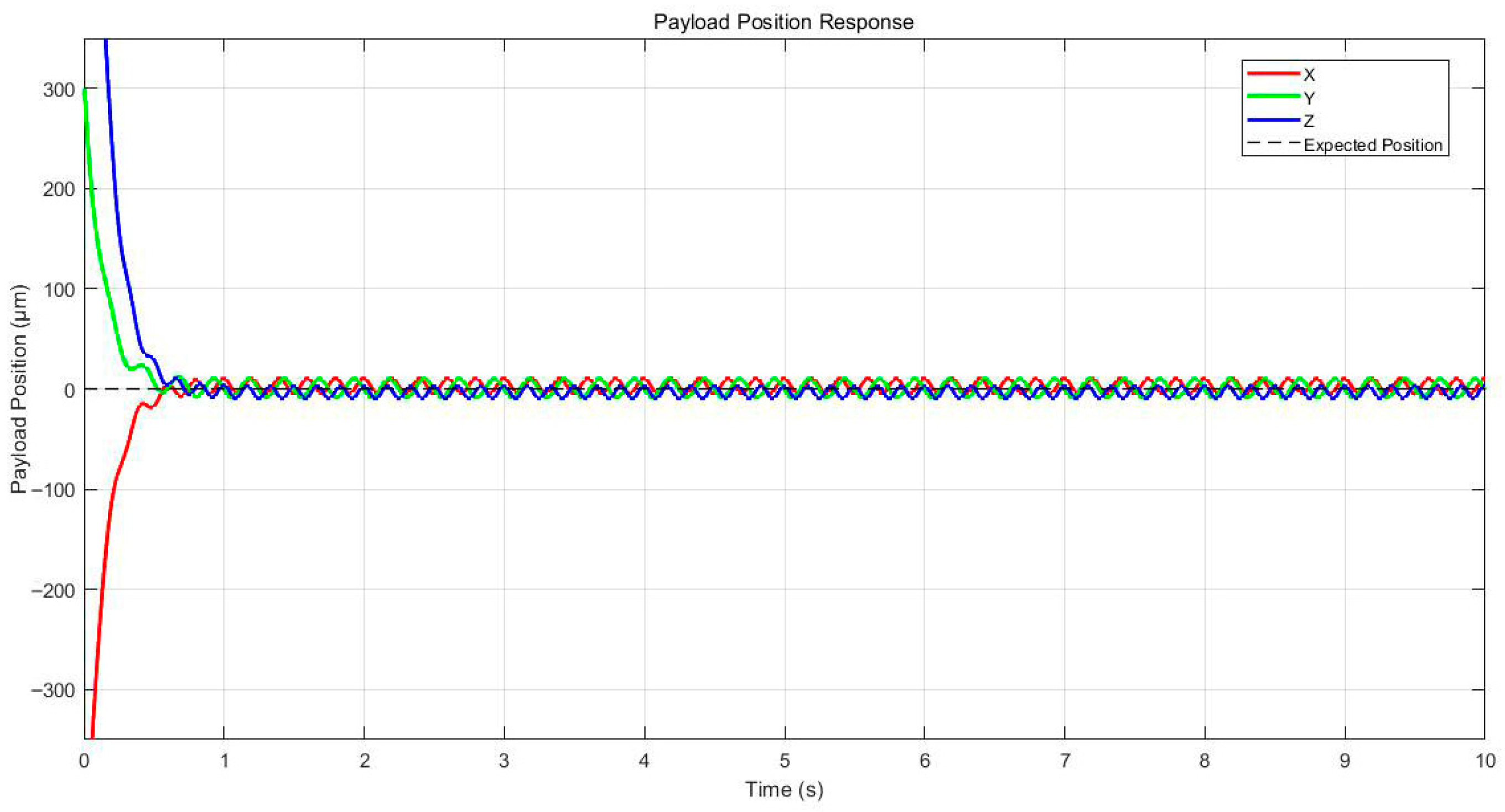
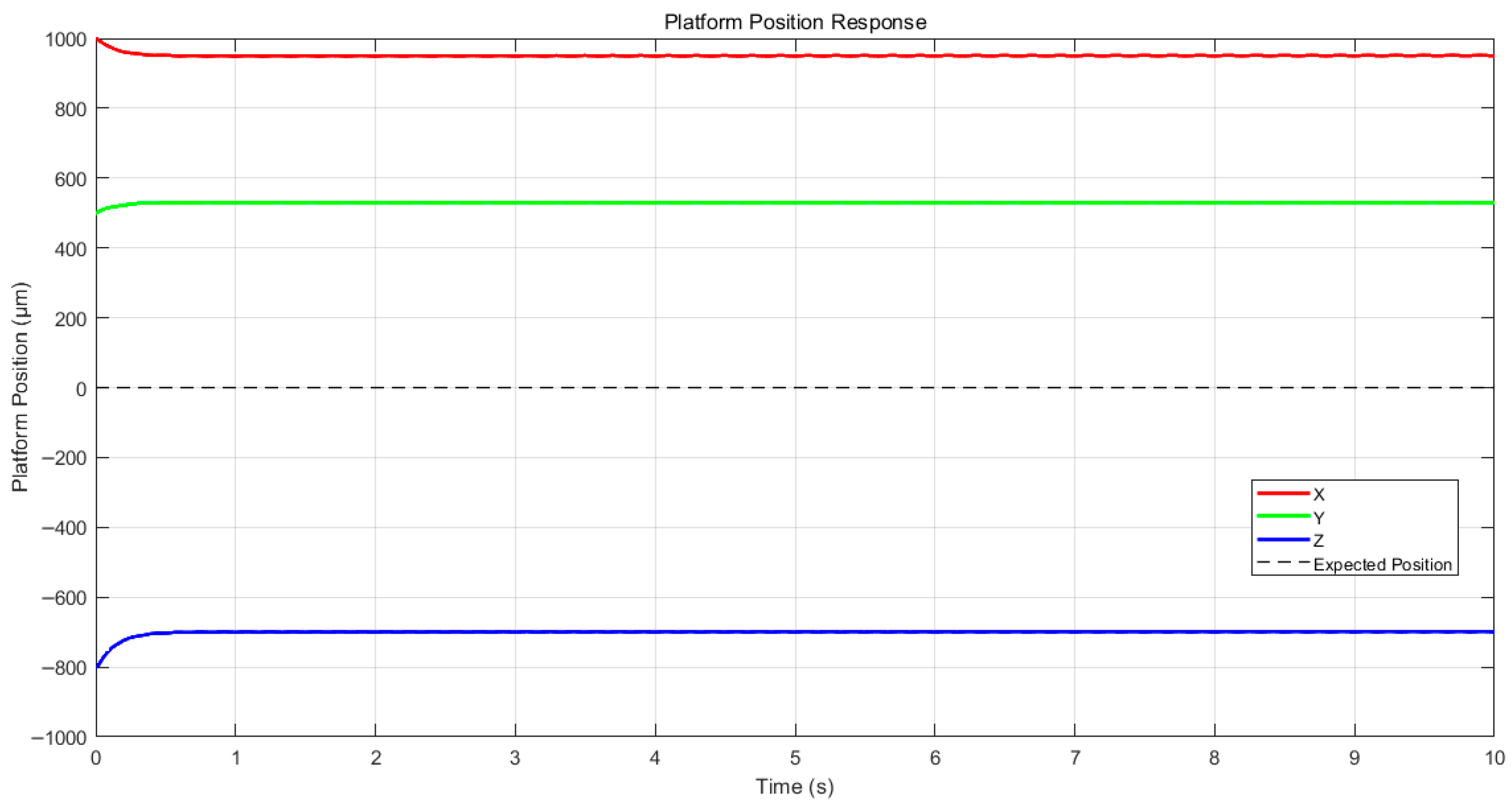
The platform position response
shows significant fluctuations in the first 0.4 s due to disturbance, and then converges. The fluctuation amplitude of platform displacement
and payload displacement
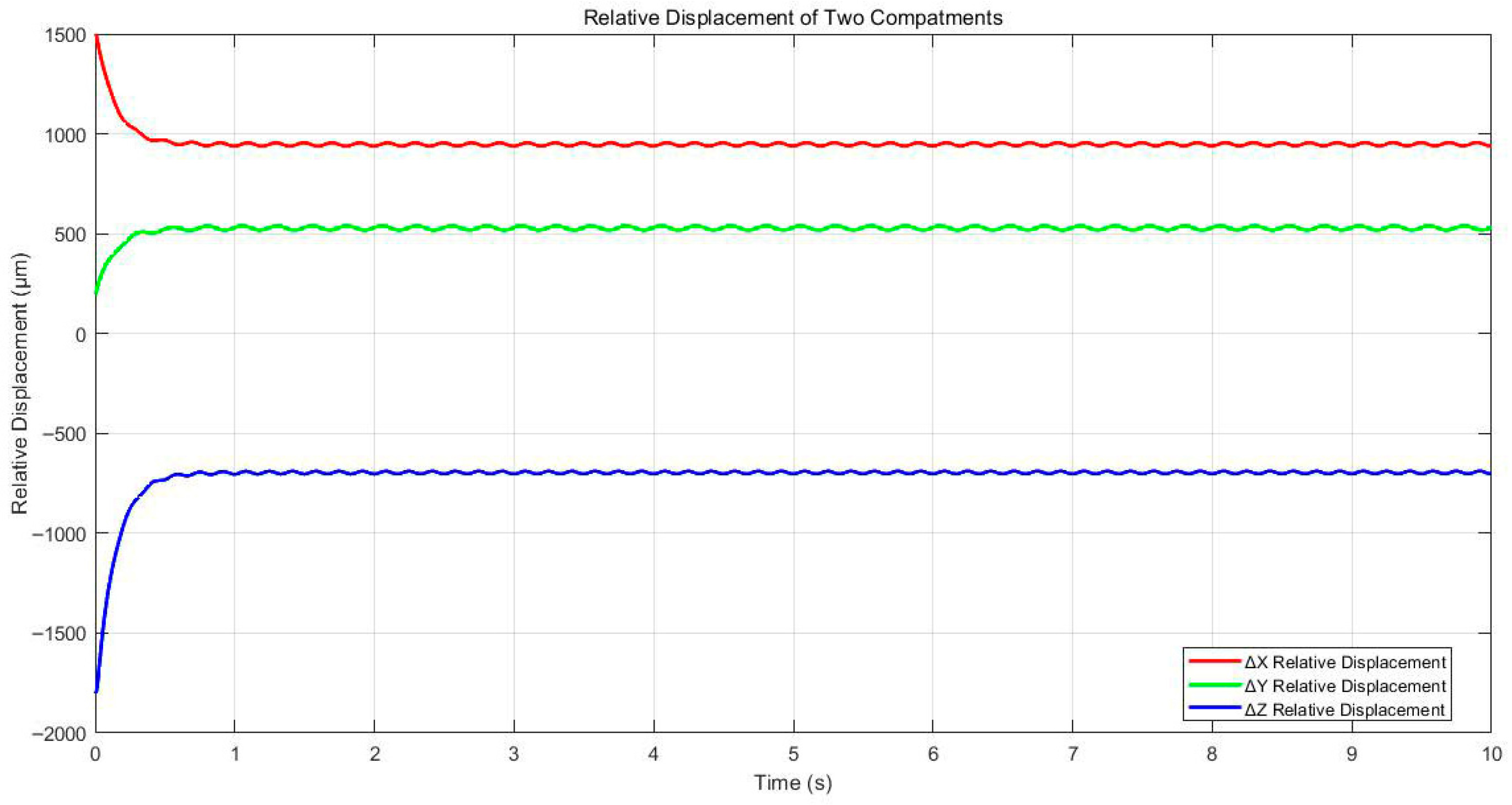
is only 0.02 mm, and the payload displacement is controlled to fluctuate near zero position, indicating that the system effectively suppresses the transmission of platform vibration to the payload. The relative displacement
is controlled within the range of 0.05 mm, meeting the maglev gap constraint (design allowable gap ± 5 mm). The position response curves of the platform and payload are shown in
Figure 4,
Figure 5 and
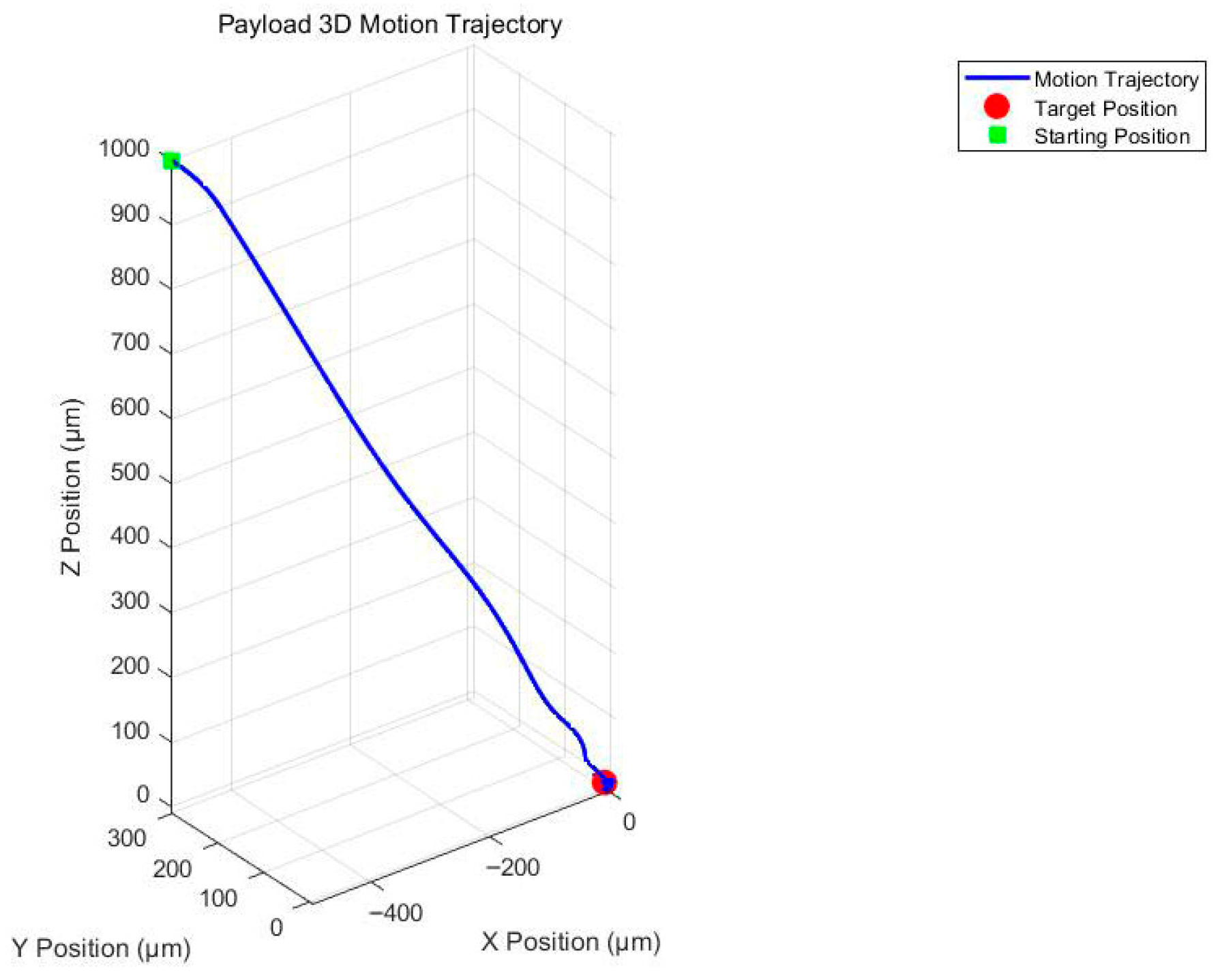
Figure 6. The 3D motion trajectory of the payload is shown in
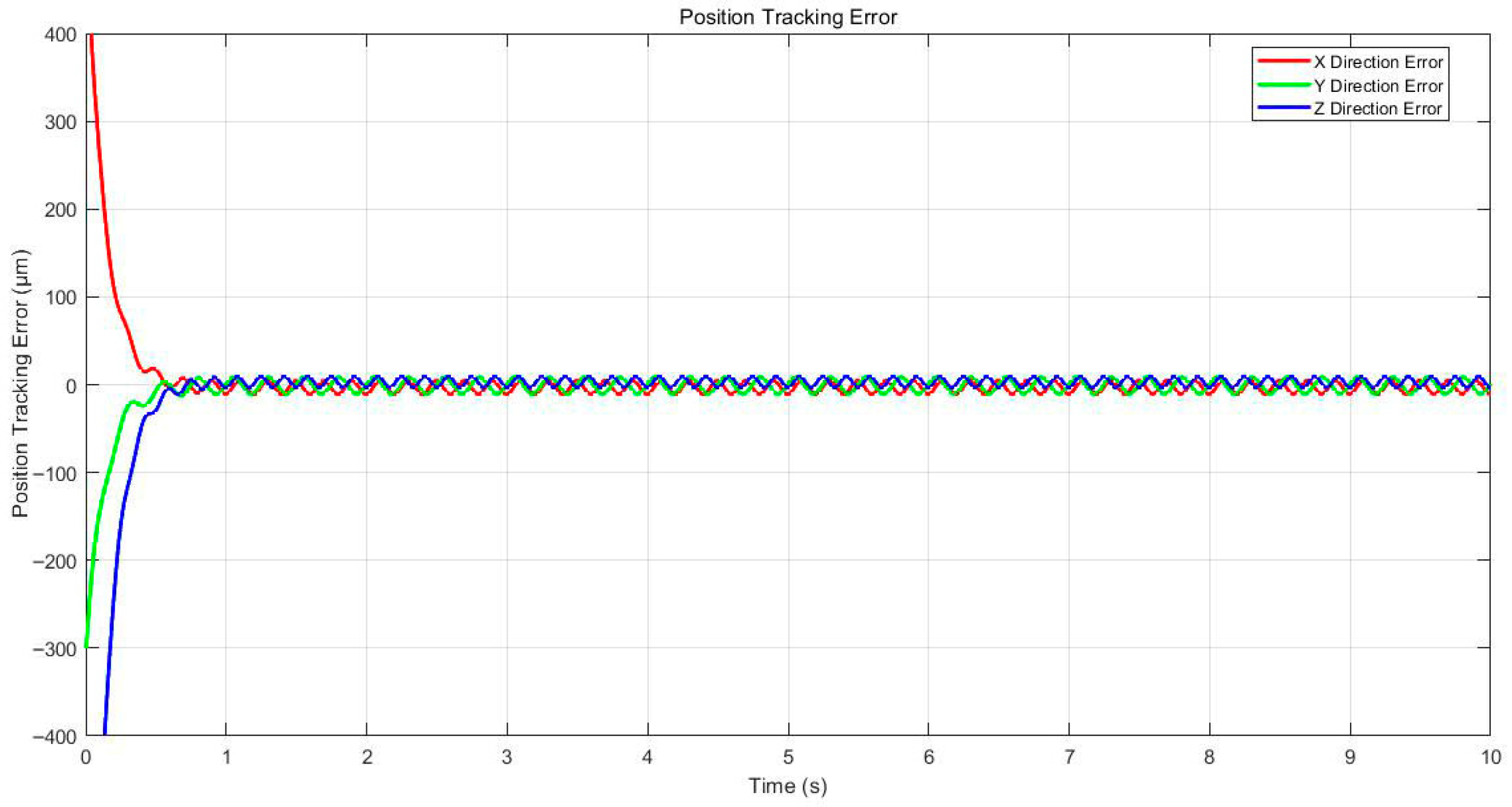
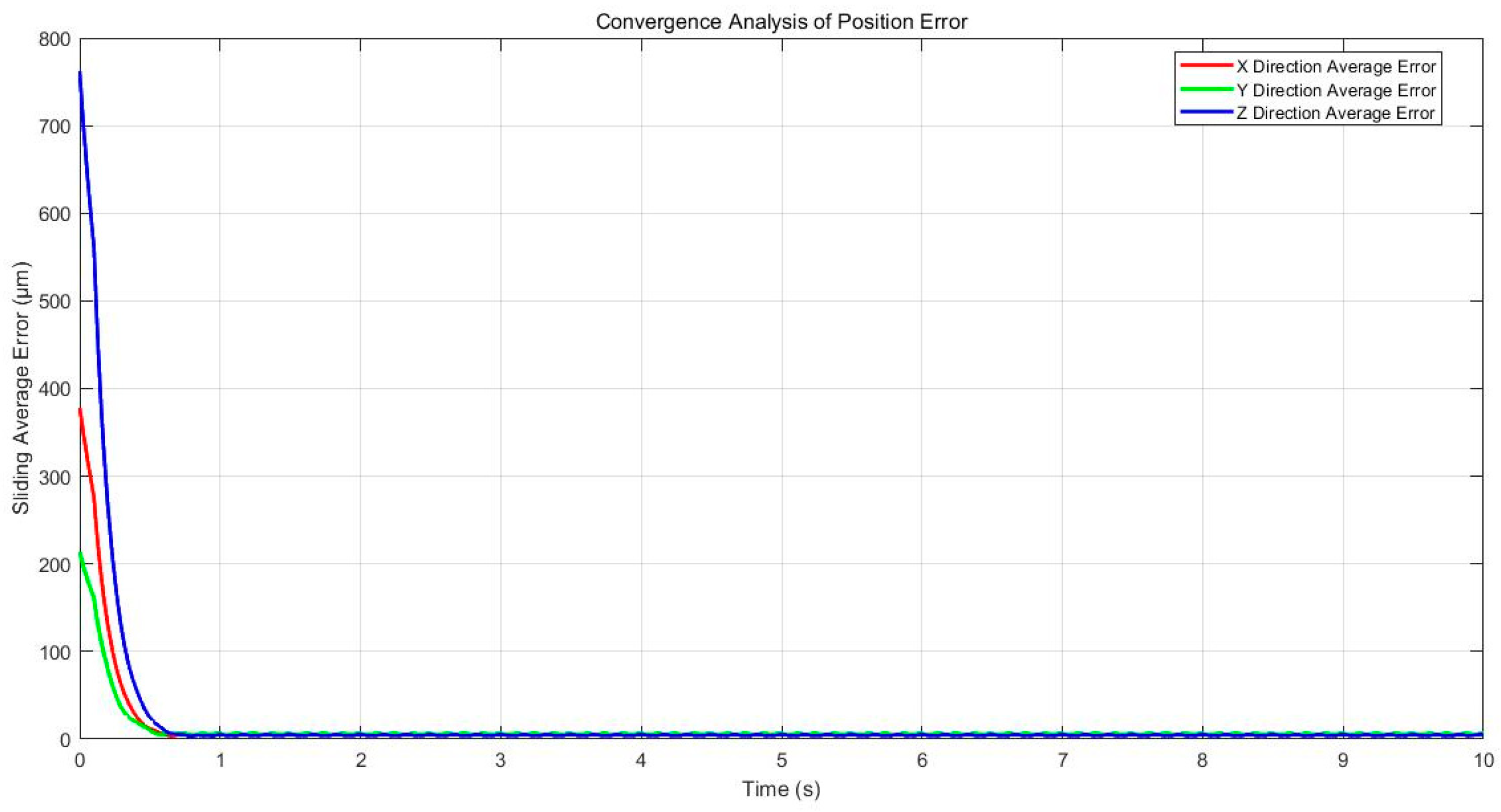
Figure 7. The analysis of position tracking error and convergence is shown in
Figure 8 and
Figure 9. The position tracking error converges to around 0 and has good convergence, indicating high isolation accuracy and system stability. The performance parameters of position control are shown in
Table 2.
Select three studies on maglev isolation systems, covering different control strategies (traditional inductive positioning, Kalman filter optimization, and intelligent algorithm optimized PID), and quantitatively compare and analyze their displacement error indicators with the data. The performance parameters comparison of the position control is shown in
Table 3.
Maximum Error (ME): The maximum errors of this study in the X, Y, and Z directions are 10.69 μm, 10.31 μm, and 9.55 μm, respectively. Compared with the cross-inductive loop method, they are reduced by 54.3%, 52.6%, and 52.1%, respectively; compared with the UKF weighted fusion method, they are reduced by 32.4%, 31.1%, and 30.0%, respectively; compared with the GA-PID method, they are reduced by 42.9%, 41.4%, and 41.3%, respectively. It is significantly superior to the existing traditional and optimized control methods, indicating that the system in this study has a stronger ability to suppress positioning errors.
RMS Error (RMSE): The RMSE of this study in all three directions is less than 8 μm, among which the Z direction is the lowest (5.47 μm). The reduction range compared with the other three strategies is more than 30%, indicating that the positioning accuracy of the system in this study is more stable and less affected by external interference.
Standard Deviation (SD): The standard deviation range of this study is 4.52 μm~6.62 μm, which is much lower than that of the three comparison strategies (6.98 μm~10.87 μm). It indicates that the positioning data of this study has smaller dispersion, and the system operation has better consistency and reliability, which can stably meet the requirements of the magnetic levitation gap constraint (design allowable gap ± 5 mm).
3.3. Attitude Response Analysis
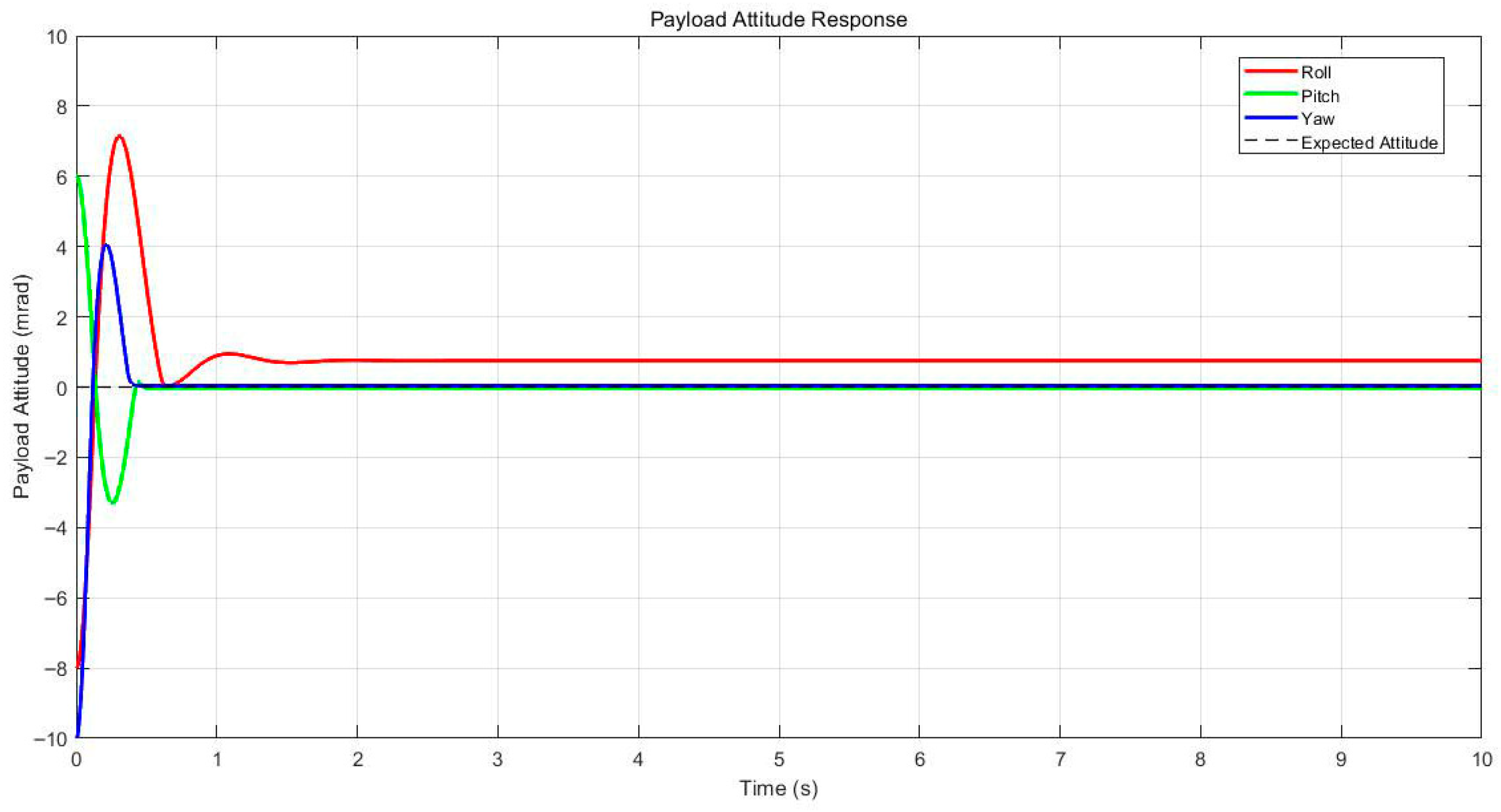
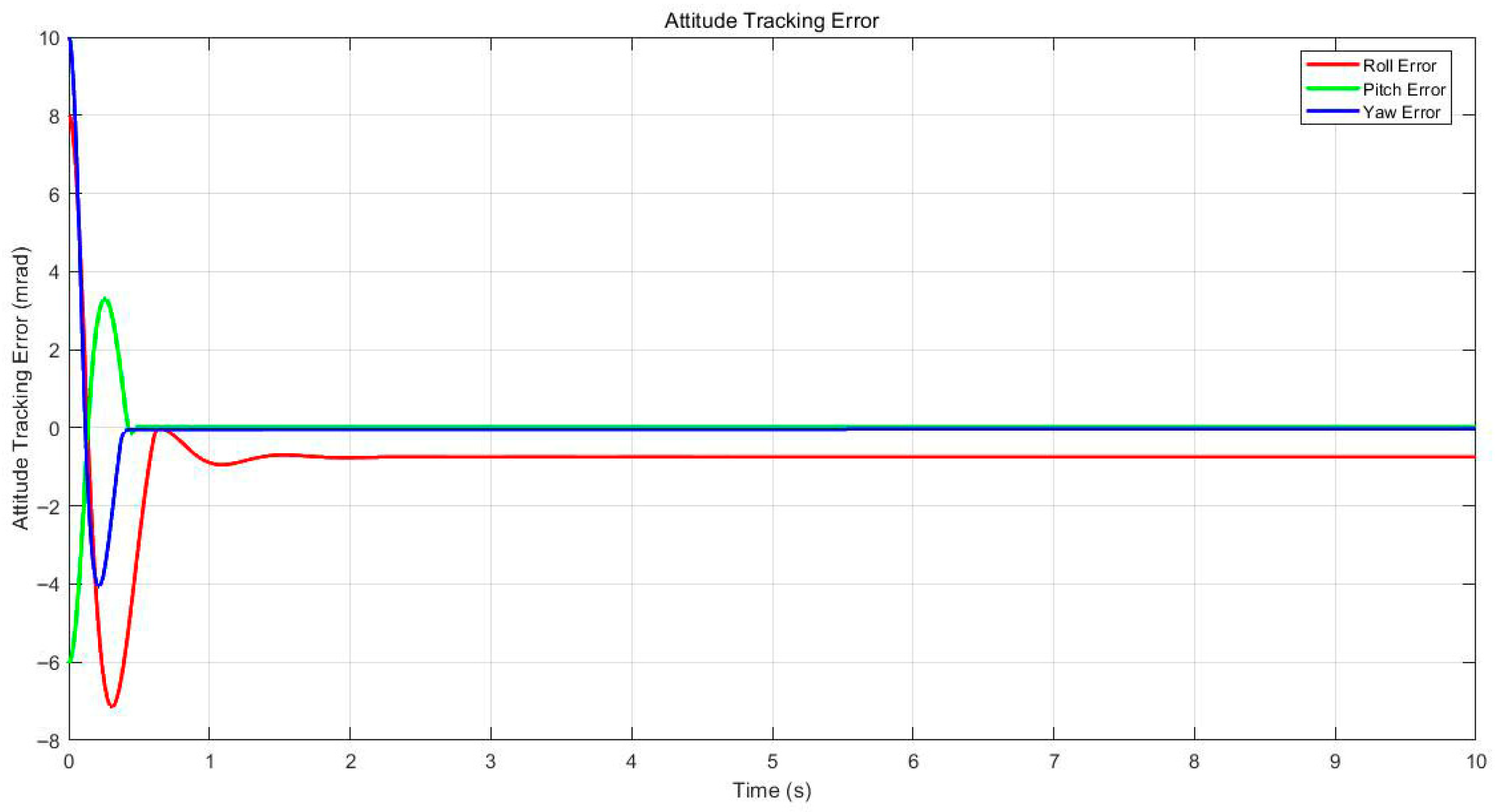
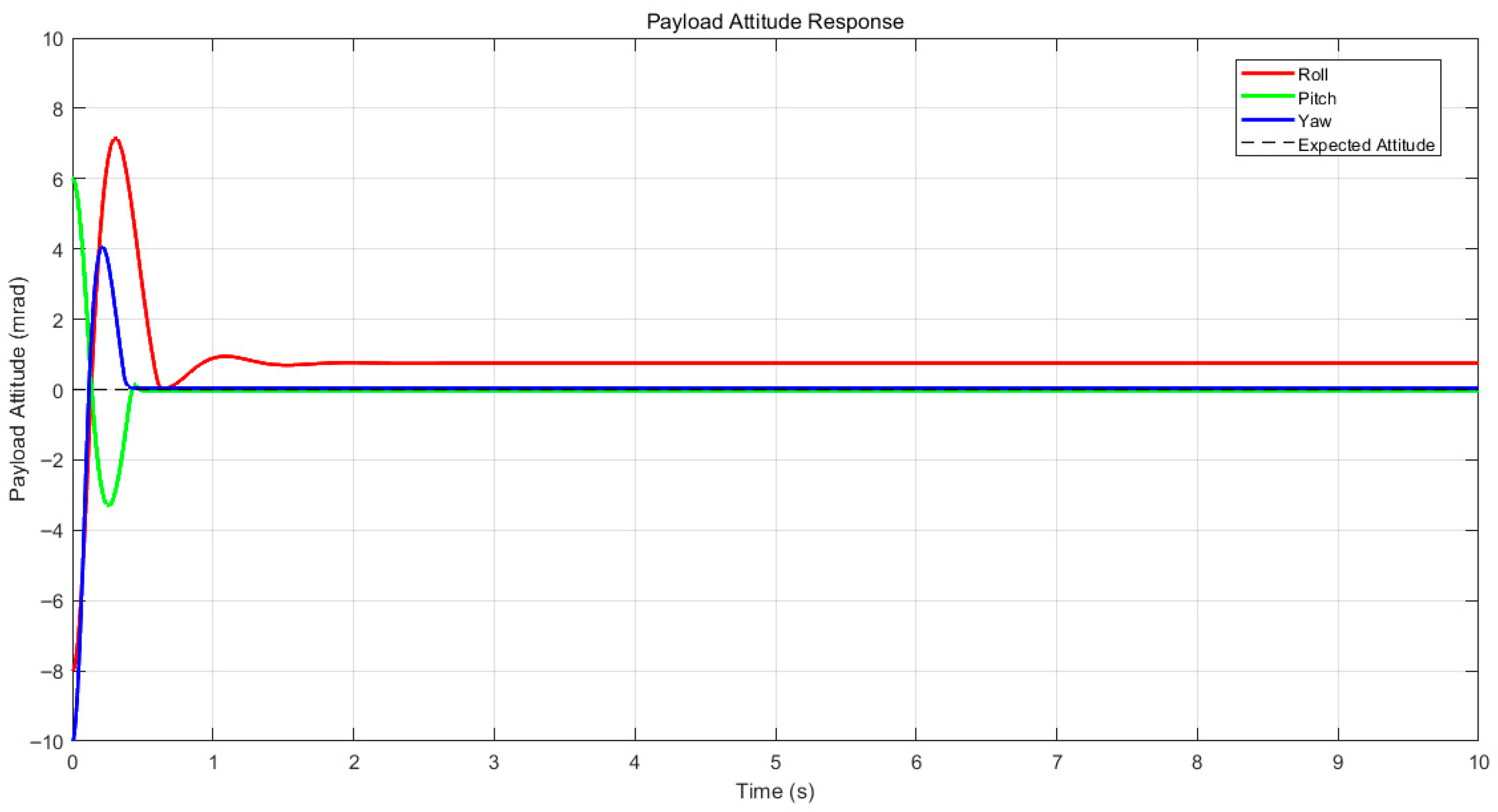
The payload attitude response shows significant fluctuations in the first 0.5 s due to disturbance, with a decrease in amplitude. Afterwards, the pitch, roll, and yaw axes converge to around 0, and the payload displacement is controlled to fluctuate near zero, indicating that the system effectively suppresses the attitude shake of the platform vibration towards the load. The attitude response curve and attitude tracking error curve of the payload are shown in
Figure 10 and
Figure 11. The performance parameters of attitude control are shown in
Table 4.
Select representative studies on maglev isolation systems attitude control, covering different control strategies (current vector control, proportional–differential fixed-point control, Particle Swarm Optimization–Tuned Fractional-Order PID control), quantitatively compare and analyze their attitude control error indicators with the data. The performance parameters comparison of attitude control is shown in
Table 5.
From
Table 5, it can be seen that the roll, pitch, and yaw attitude angles have smaller errors than CVC, PD control, and POS-FOFID control, indicating that the control method proposed in this paper has a strong ability to suppress attitude disturbances on the maglev platform.
3.4. Electromagnetic Force Response Analysis
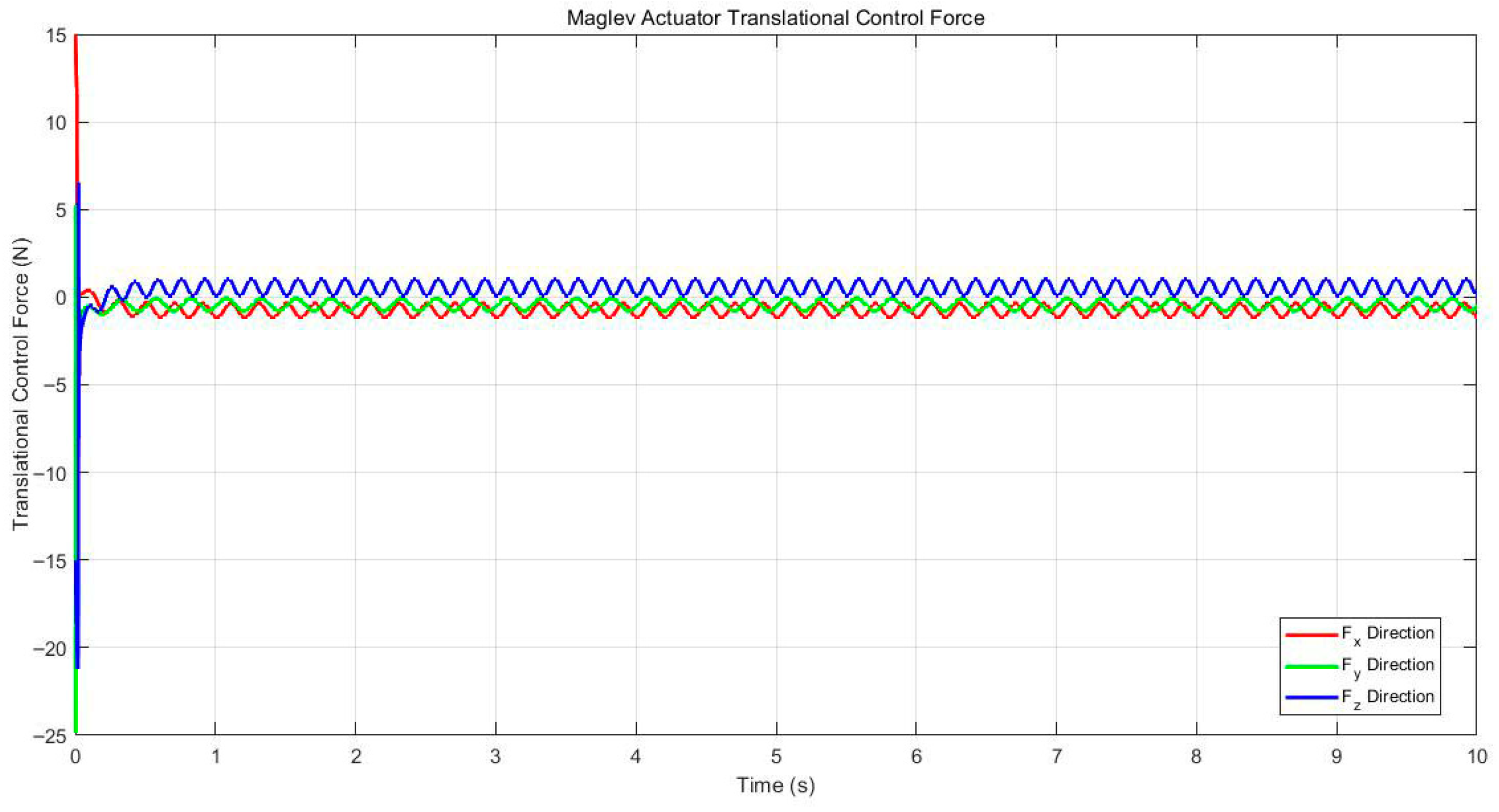
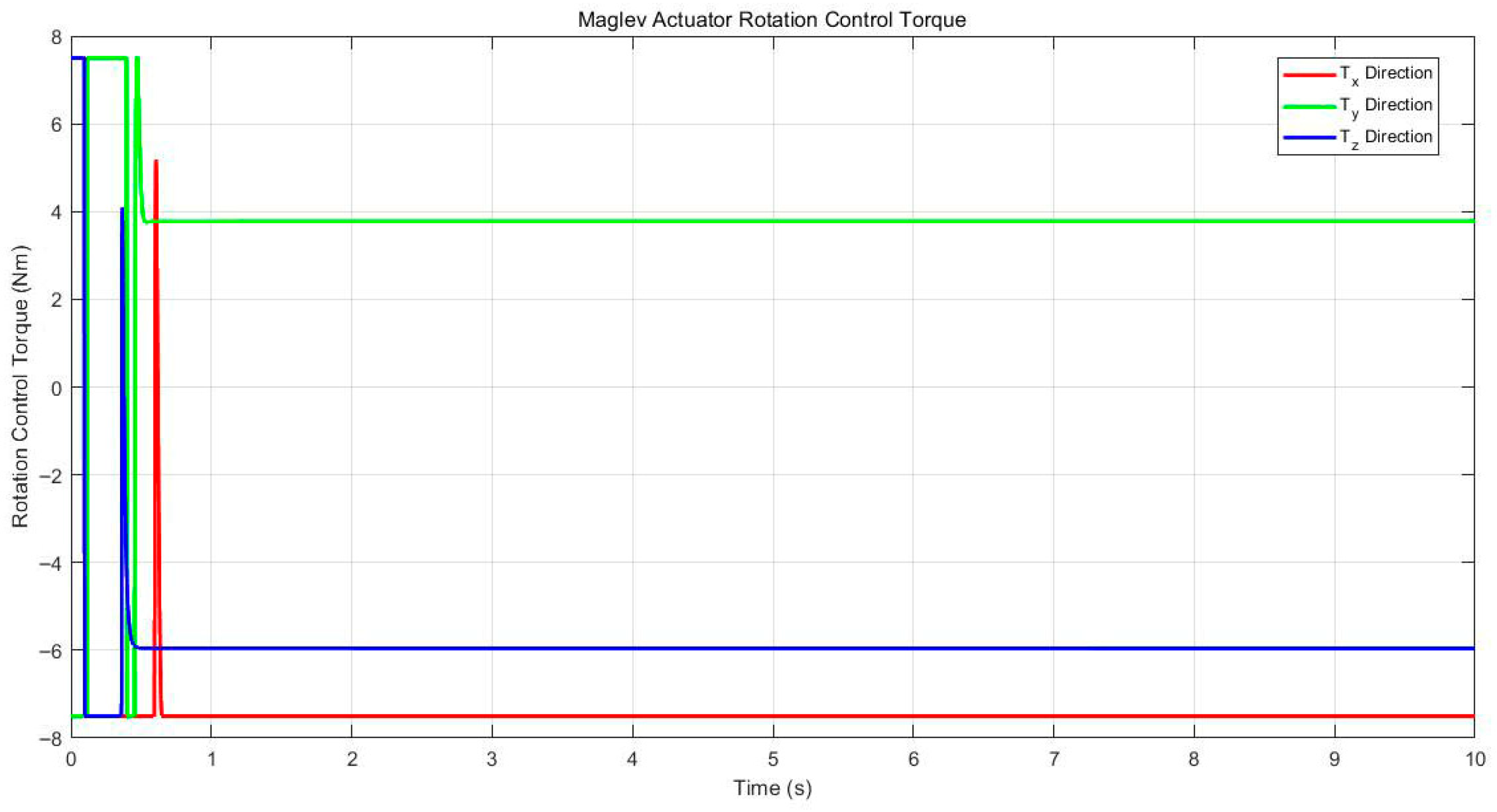
During the initial attitude establishment phase, the translational control force of the maglev actuator fluctuates within ±15 N, then exhibits only small oscillations near zero. The rotational control torque remains within ±8 Nm, indicating that the electromagnet operates in the unsaturated region with excellent force linearity and no risk of control instability. The translational control force and rotational control torque of the actuator are shown in
Figure 12 and
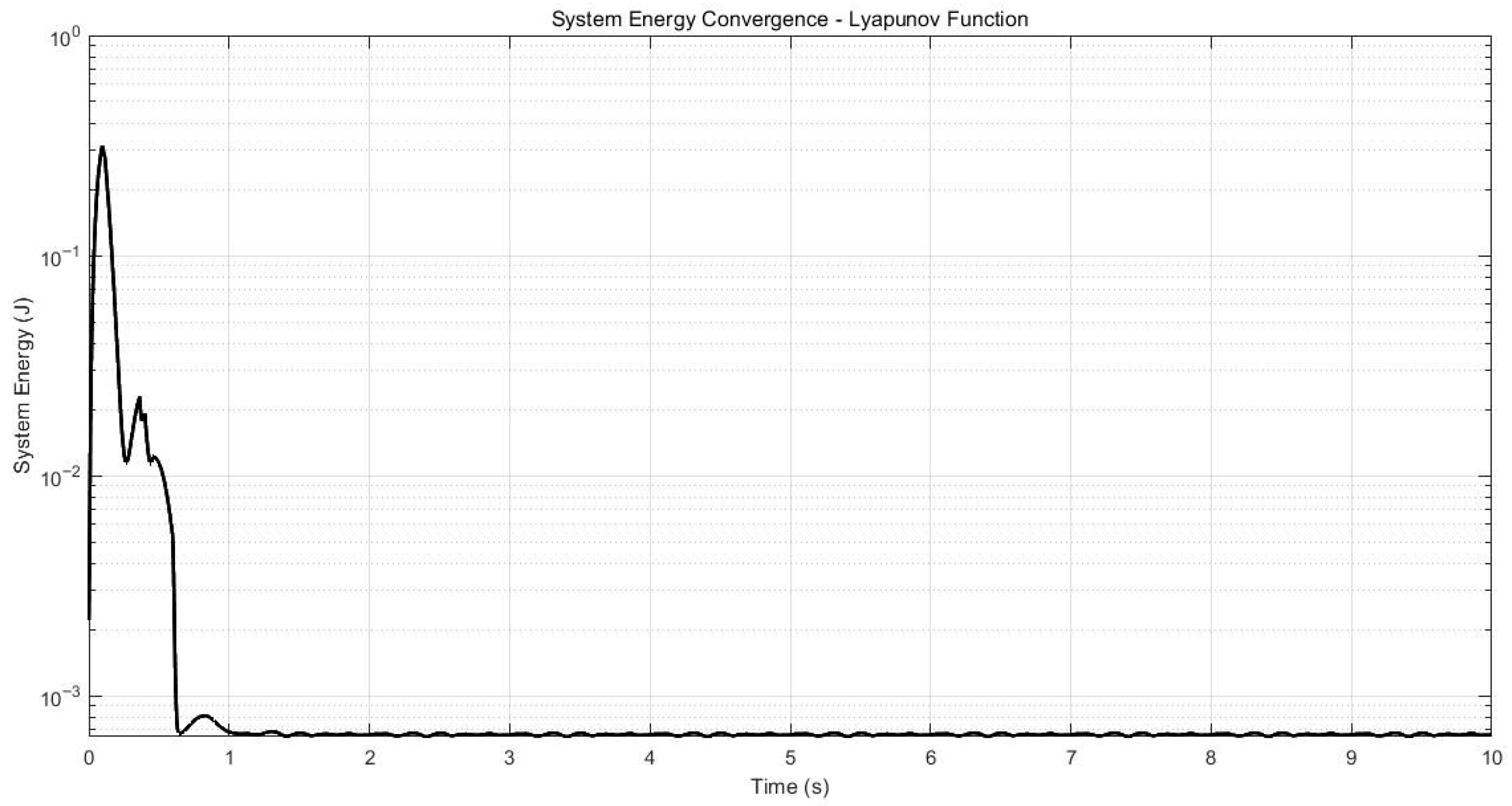
Figure 13. The total energy change trend of the system is reflected by the energy convergence graph, which quantitatively reflects the stability and vibration suppression effect of the system, as shown in
Figure 14. The energy gradually decreases from the initial value of 0.3 J and tends to stabilize within 0.6 s.
3.5. Robustness Testing
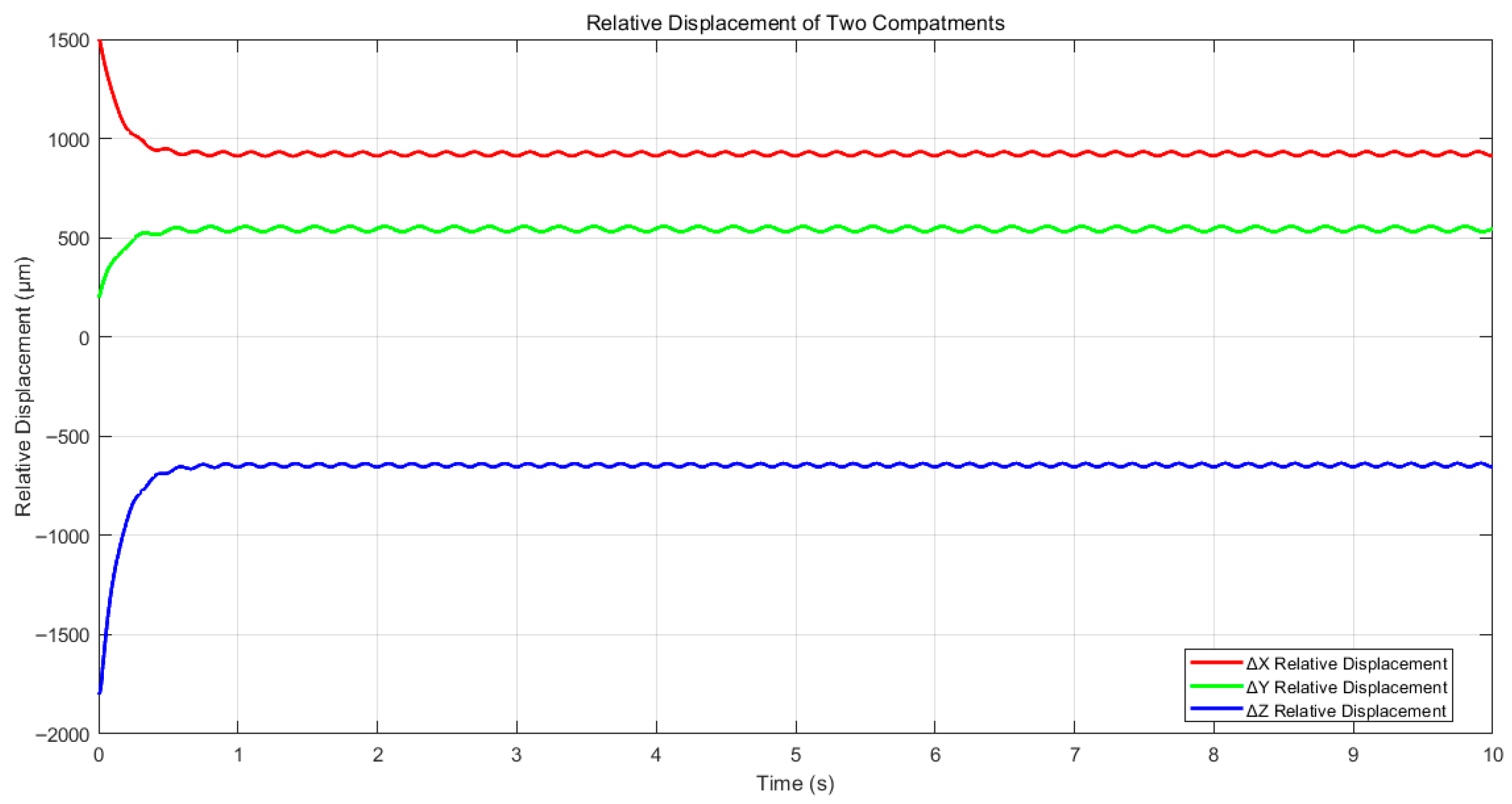
To verify the robustness of the system to parameter perturbations, a 20% perturbation analysis was conducted on the platform mass mp and load mass ml, respectively, and the results were re-simulated.
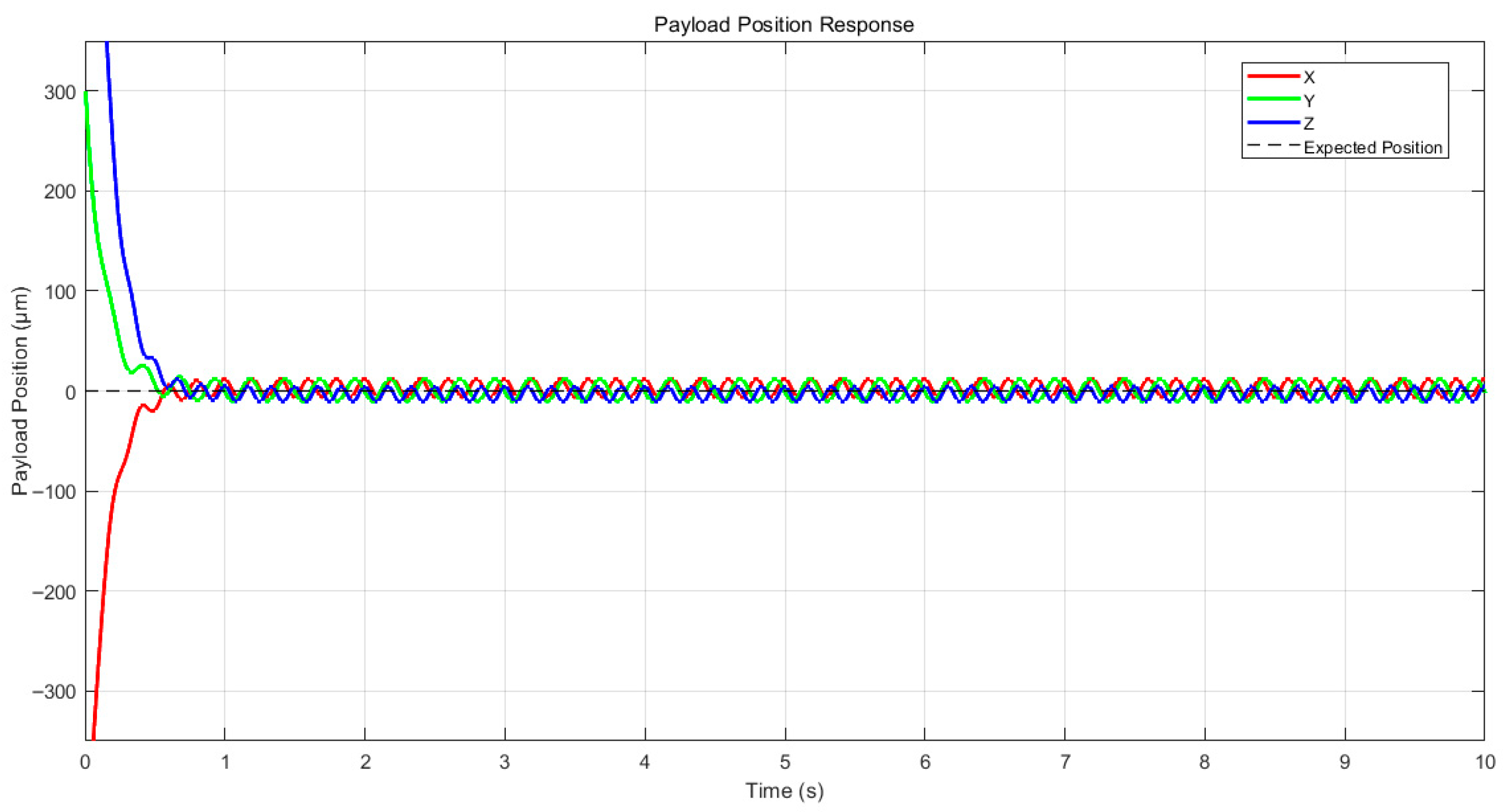
When m
p = 400 kg and m
l = 60 kg, there was no significant change in the payload position response, attitude response, and relative position between the two modules, as shown in
Figure 15,
Figure 16 and
Figure 17. The maximum error in position performance control parameters increased by 15%, the RMS error increased by 16%, and the standard deviation increased by 16%, as shown in
Table 6. The attitude performance parameters were not affected, as shown in
Table 7. This indicates that the system can maintain good vibration isolation performance even under 20% parameter perturbation, and its robustness meets engineering requirements.
4. Conclusions
Based on satellite attitude control theory, the equations governing the satellite’s center-of-mass motion, attitude motion, and overall dynamics are established. A collaborative control strategy is investigated, employing a hierarchical control scheme consisting of ultra-high precision and ultra-high stability control for the payload module, relative position control between the two modules, and attitude control for the service module. The desired attitude and angular velocity, generated by the maneuver path planning algorithm and attitude guidance algorithm, are sent to the attitude and orbit control management unit. By computing the attitude deviation and angular velocity deviation, a feedback control torque command is constructed. Meanwhile, a feedforward control torque command is derived from the feedforward angular acceleration. The total control torque is then allocated to each maglev actuator, by which the ultra-high precision and ultra-high stability control of the payload module is achieved.
A dynamic model of the maglev isolation system is developed using the Newton–Euler equation, and the overall system architecture is designed accordingly. Meanwhile, a dynamic model of the maglev actuator is established, which accounts for the influences of electromagnetic force, damping force, and spring force. On this basis, a PID-based active control strategy is designed, and the corresponding control law of the system is derived. However, the current dynamic model does not incorporate electromagnetic nonlinearities and sensor noise, resulting in insufficient fidelity. In terms of disturbance modeling, the external disturbance force is currently assumed to be the superposition of sinusoidal disturbances and random Gaussian white noise disturbances. These aspects can be further improved and refined in future work.
Based on the architecture of the satellite-borne maglev isolation system and its maglev actuator layout, mathematical models of the system output force and torque are established. On this basis, the robustness of the system under fault modes is analyzed. System parameters are configured, and simulation analyses are carried out on the dynamic responses of displacement, attitude and electromagnetic force, together with a 20% pull-bias robustness test. Simulation results demonstrate that the system achieves high isolation accuracy and stability, can effectively suppress disturbances and jitter of the platform and payload, and exhibits strong robustness.