Article

Numerical Simulation and Optimization of Dark Current Performance Through a Quaternary Barrier in InAs/GaSb Superlattice Photodetectors


1
Faculty of Artificial Intelligence, Shanghai University of Electric Power, Shanghai 201300, China
2
National Key Laboratory of Infrared Detection Technologies, Shanghai Institute of Technical Physics, Chinese Academy of Sciences, Shanghai 200083, China
*
Author to whom correspondence should be addressed.
Electronics 2026, 15(7), 1355; https://doi.org/10.3390/electronics15071355
Submission received: 4 March 2026 / Revised: 20 March 2026 / Accepted: 23 March 2026 / Published: 25 March 2026
(This article belongs to the Special Issue Feature Papers in Semiconductor Devices, 2nd Edition)

Abstract

In this work, a high-performance mid-wave infrared (MWIR) photodetector (PD) utilizing an InAs/GaSb Type-II superlattice absorber and a quaternary AlGaAsSb barrier is designed and analyzed based on numerical simulations aimed at determining an optimized detector structure. Through these simulations, the composition of the AlGaAsSb barrier is carefully designed to achieve lattice matching, high conduction band offset and zero valence band offset. By optimizing the barrier thickness and doping concentration, the depletion region is effectively shifted from the narrow-bandgap absorber to the wide-bandgap barrier; additionally, at 150 K and a reversed bias of 0.05 V, the dark current density in the PD with the barrier (pBn) is reduced to 1.83 × 10⁻⁵ A/cm2, about two orders of magnitude lower than that of the PD without the barrier. Furthermore, the effect of the barrier on the generation–recombination (G-R) and the trap-assisted tunneling (TAT) currents are analyzed and compared in detail, and it is found that the barrier structure is much more effective in suppressing the TAT current at low reversed bias when the electric field is low in the absorber layer. These results demonstrate the efficacy of the proposed AlGaAsSb barrier design for realizing high-operating-temperature MWIR PDs. It also provides an insight into the physical mechanism that leads to the performance enhancement of InAs/GaSb PDs.

1. Introduction

Photodetectors (PDs) have achieved significant advancements in material growth and device fabrication over the past decades [1,2]. Despite this progress, traditional HgCdTe technology remains limited by high costs and substrate constraints. Consequently, InAs/GaSb type-II superlattices (T2SL) have emerged as a premier alternative for mid-wave infrared (MWIR) detections [3,4]. The nearly lattice-matching between InAs and GaSb significantly reduces material defects and dislocation densities, fostering advancements in the InAs/GaSb T2SL research [5,6]. Crucially, the flexible bandgap engineering of T2SL enables the design of advanced barrier architectures, such as pBn structures. This capability allows for precise control over the depletion region to effectively suppress generation–recombination (G-R) and trap-assisted tunneling (TAT) currents, thereby facilitating the realization of high-operating-temperature devices.
InAs/GaSb T2SLs are distinguished by their unique properties, particularly their low Auger recombination rates and high effective masses, which significantly reduce the dark current. The type-II band alignment of InAs/GaSb heterostructures also provides a highly flexible and tunable band structure [7]. Despite their theoretical potential to surpass HgCdTe materials, T2SL-based infrared detectors face challenges due to the presence of Shockley–Read–Hall (SRH) recombination centers and short minority carrier lifetimes, resulting in elevated dark current levels. The dark current in SL devices has long been a key factor limiting their performance. The bulk dark current mainly consists of diffusion current, G-R current, and TAT current [8,9,10,11]. Therefore, the effective suppression of the dark current is of significant importance.
To suppress the dark current within the depletion regions of InAs/GaSb T2SL photodetectors, the incorporation of unipolar barriers has proven to be an effective approach. To date, researchers have explored various barrier structures and materials—including AlGaSb [12] and various superlattice (SL) configurations such as InAs/GaSb [13,14], InAs/GaSb/AlSb/GaSb [15,16,17], and AlSb/GaSb [18]—all aimed at enhancing device performance through dark current suppression. Wide-bandgap materials are usually used as barriers and are designed to impede the transportation of carriers. Although these barriers usually possess large conduction band offset (CBO), a valence band offset (VBO) remains between the absorber and barrier layers, which can severely degrade detector performance. AlGaSb is one of the commonly used barrier materials [13,14,19] in InAs/GaSb T2SL PDs. By tuning its composition, the VBO can be minimized. However, eliminating the VBO through compositional control is still challenging. Moreover, lattice mismatch between AlGaSb and T2SL induces strain, leading to defects that degrade epitaxial quality and increase dark current. To resolve the difficulties in eliminating lattice mismatch and the VBO between AlGaSb and T2SL, a quaternary semiconductor barrier of AlGaAsSb is implemented in the barrier structure in this study. By adjusting the Al/As ratios in AlGaAsSb, a large CBO can be maintained while the VBO can be eliminated, effectively enhancing detector performance. Additionally, while barrier suppression for the G-R current has been widely reported, its effect on the TAT current has only been addressed recently [20,21], and is not fully discovered. The TAT current is a key contributor to the dark current and therefore it is necessary to include it in the dark current analysis of PDs with barriers.
This study employs the Silvaco TCAD 2020 software platform to investigate the performance of an InAs/GaSb T2SL MWIR PD at 150 K [22,23], using a quaternary AlGaAsSb as the barrier. In the simulation, the ratios of the Al and As components in the AlGaAsSb alloy are firstly adjusted to ensure lattice matching while simultaneously attaining a large CBO and a negligible VBO. Then, the structural parameters of the barrier are further refined to suppress the PD’s dark current without degrading its quantum efficiency (QE). The performance of the barrier detector (pBn) is also compared to that of the structure without the barrier (pn), verifying the advantages of the optimized design. The effects of the barrier layer on the G-R and TAT current components are further analyzed and compared, and it is found that the TAT current is significantly suppressed at −0.05 V, which has a strong dependence on the electric field in the absorber. The quaternary barrier structure provides new insights for advancing InAs/GaSb T2SL in MWIR detection applications.

2. Materials and Methods

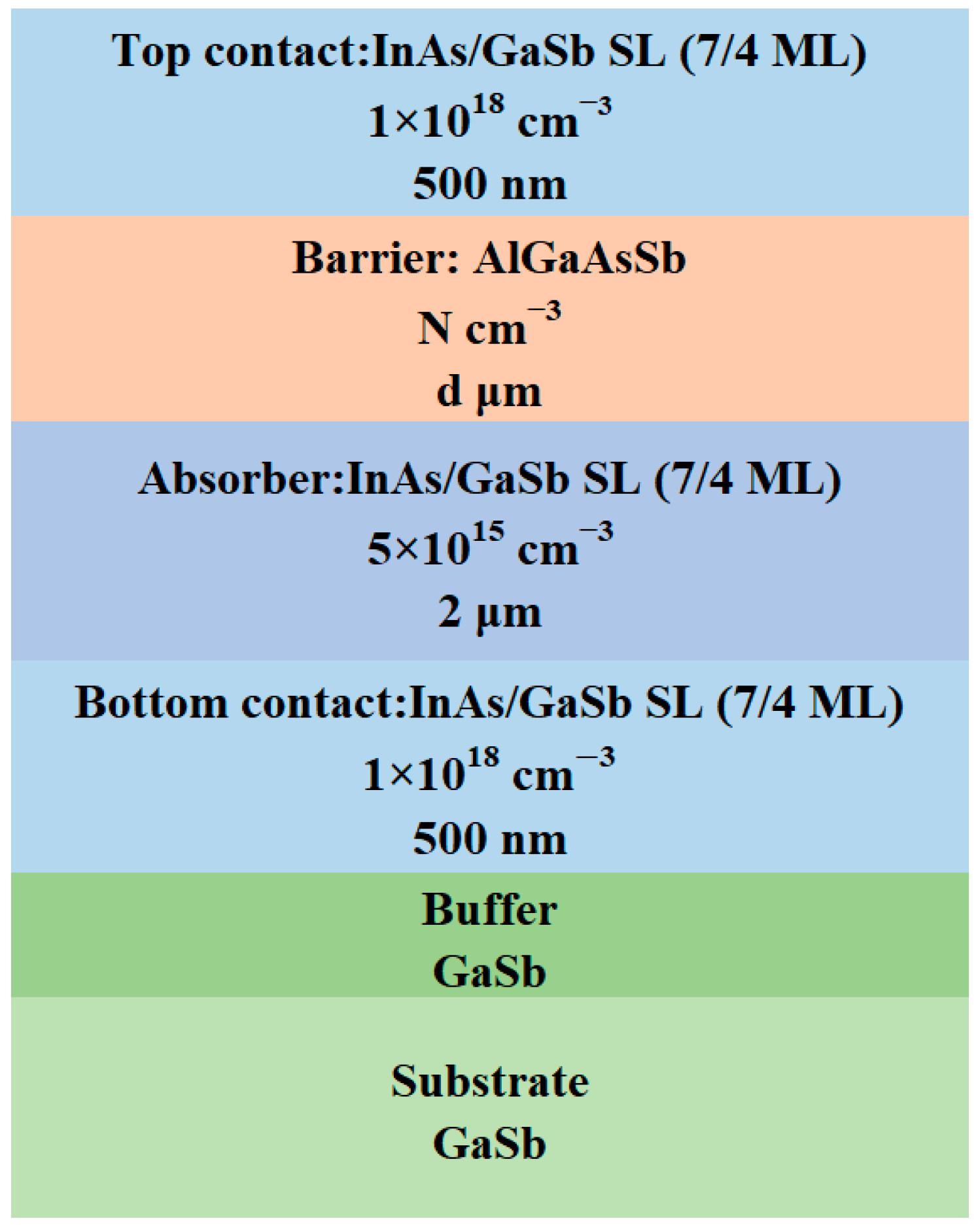
The schematic of the simulated pBn InAs/GaSb SL infrared PD is illustrated in Figure 1. It consists of four functional layers. The bottom contact layer is an n-type 7/4 ML InAs/GaSb SL, with a thickness of 0.5 μm and a doping concentration of 1 × 1018 cm−3. The absorber layer is also an n-type 7/4 ML InAs/GaSb SL, with a thickness of 2 μm and a doping concentration of 5 × 1015 cm−3. The barrier layer is a quaternary AlGaAsSb compound. The top contact layer is a p-type 7/4 ML InAs/GaSb SL with a thickness of 0.5 μm and doped to 1 × 1018 cm−3. In this study, we select the InAs-rich 7/4 ML InAs/GaSb T2SL as the absorber layer due to reported good performance compared to GaSb-rich and symmetric structures in both dark current and QE for the MWIR detection [24,25]. The thickness and doping concentration of the barrier layer are varied and optimized in the simulation, denoted as d μm and N cm−3, respectively.
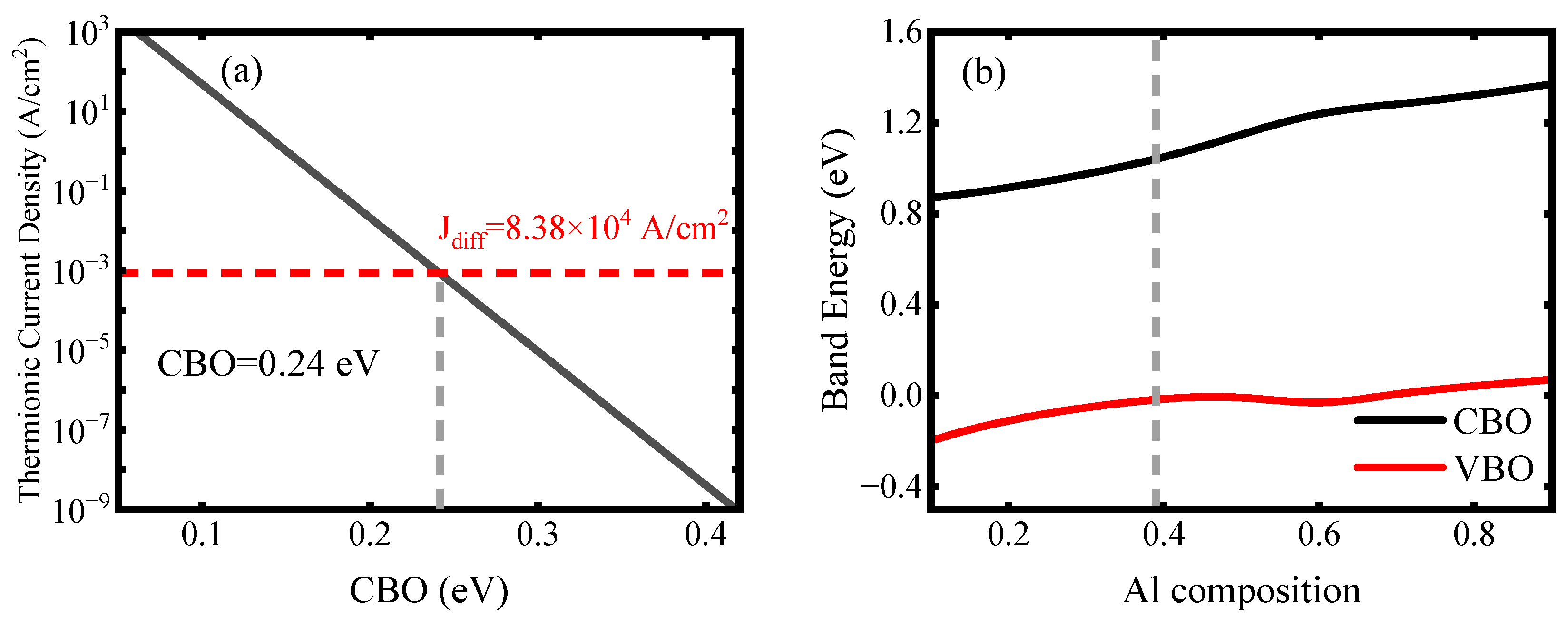
The quaternary composition of the AlGaAsSb barrier needs to be determined from the viewpoints of lattice constant and band offsets to the InAs/GaSb absorber. In the simulation, the InAs/GaSb SL absorber is treated as a bulk material in obtaining its material properties [26]. The electron affinity of the AlGaAsSb is extracted from ref. [27]. The lattice constant and energy bandgap of the AlGaAsSb quaternary alloy are calculated by interpolation scheme [28]. Thermionic emission enables majority electrons to migrate from the contact layer to the absorption region, thereby contributing to the overall thermionic current. The suppression of the thermionic current is dependent on the CBO at the contact-barrier heterojunction. The correlation between the CBO and the calculated thermionic current density is illustrated in Figure 2a. The diffusion current density at a reversed bias of 0.05 V is calculated [29] to be 8.38 × 10⁻⁴ A/cm2. When the CBO value is 0.24 eV, the thermionic current density equals to the diffusion current density. In the structure optimization, it is preferred that the thermionic current is much smaller than the diffusion current so that the thermionic current can be neglected. Therefore, the required CBO must be larger than 0.24 eV.
Furthermore, achieving lattice matching between the AlGaAsSb barrier layer and the InAs/GaSb absorber is essential for maintaining high crystalline quality. For lattice matching, when the Al composition is 0.39, the As composition is calculated to be 0.08. Therefore, the quaternary barrier layer is determined to be Al0.39Ga0.61As0.08Sb0.92. In addition, to allow the transportation of photogenerated carriers, the VBO between the barrier and the absorber layers must be less than 3 kT, which, at a temperature of 150 K, corresponds to a VBO smaller than 0.039 eV. The dependence of the CBO and VBO as a function of the Al composition in AlGaAsSb is calculated [30] in Figure 2b. As demonstrated in Figure 2b, an Al composition of 0.39 yields a CBO of 1.04 eV and a VBO of zero, which corresponds to the optimum band alignment.
The necessary material parameters for simulating the 7/4 ML InAs/GaSb SL at 150 K are outlined in Table 1. The m0 is the electron mass in vacuum. For the SRH and TAT recombinations, the trap energy level (Etrap) is the difference between the trap energy level and the intrinsic Fermi level. In the simulation, the default Etrap value is set to zero (mid-gap), corresponding to the most efficient recombination centers. The tunneling mass mt can affect the tunneling probability and it is calculated by m t = ( 1 / m e * + 1 / m h * ) 1 , where m e * and m h * are the electron and hole effective mass, respectively.
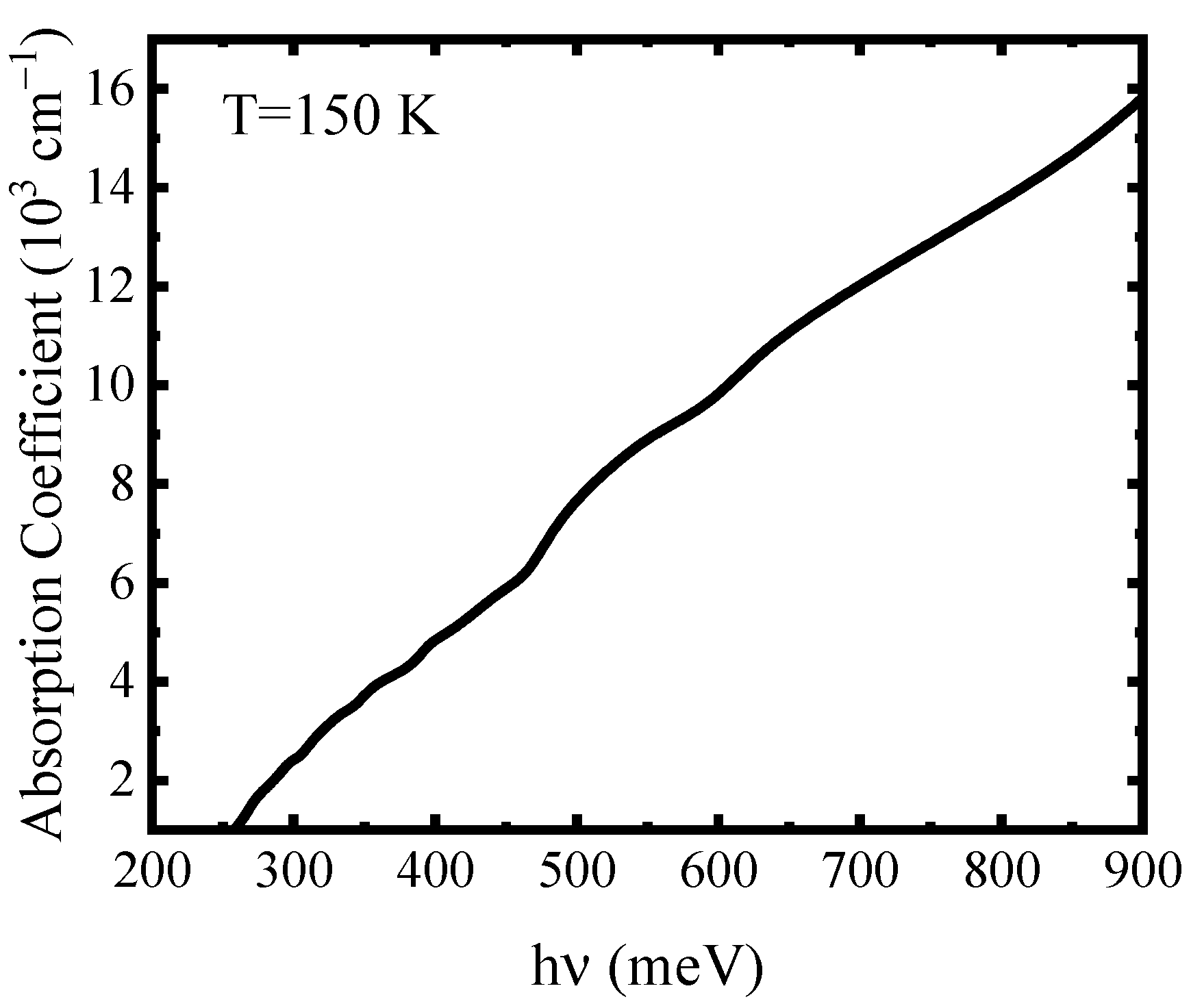
Figure 3 shows the dependence of the absorption coefficients on energy at 150 K for the 7/4 ML InAs/GaSb SL.
The overall dark current in PDs is determined by a combination of several physical mechanisms, including diffusion, G-R, TAT, band-to-band tunneling (BTBT), and surface leakage. Since the BTBT current becomes significant at high reverse bias (>−1 V) and the diffusion current dominates at elevated temperatures (>200 K), our simulation of the pBn PD at 150 K primarily focuses on the G-R and TAT currents.
The G-R process plays a crucial role in the generation of dark current, primarily due to the presence of traps within the depletion region. This phenomenon can be described mathematically using the SRH recombination rate expression by the following equation [33,34]:
R S R H = p n n i 2 τ p n + n i exp E t r a p k T L + τ n p + n i exp E t r a p k T L ,
where the variables n, p and ni stand for the electron, hole, and intrinsic carrier densities. Thermal and structural parameters include the Boltzmann constant k, the lattice temperature TL, and the trap level offset Etrap. With τn and τp representing the respective carrier lifetimes, the resulting G-R current density is calculated by [26]
J G R = q W R S R H d y ,
where w represents the thickness of the depletion layer.
The TAT current density is governed by the electric field and the trap states [35]. It can be accounted for by modifying the SRH recombination model. The mathematical representation of the mechanism can be expressed by the following equation [35]:
R T A T = p n n i 2 τ p 1 + Γ p n + n i exp E t r a p k T L + τ n 1 + Γ n p + n i exp E t r a p k T L ,
where Γn,p denotes the field enhancement factor for electrons or holes. The field enhancement factor describes the impact of phonon-assisted tunneling on electron and hole emission from traps [26] and it can be calculated by the following equation:
Γ n , p = Δ E n , p k T L 0 1 exp Δ E n , p k T L u K n , p u 3 2 d u ,
where Δn,p denotes the energy interval within which tunneling of carriers is feasible, and u is the variable of integration. The parameter Kn,p can be determined by the following relationship:
K n , p = 4 3 2 m t Δ E n , p 3 q h 2 π E ,
where the tunneling effective mass and electric field strength are given by mt and E [36].
The tunneling mass mt in Equation (5) plays an important role in the tunneling process. The field enhancement factor Γn,p in Equation (4) is highly sensitive to the tunneling mass mt due to the exponential decay relationship. Thus, a smaller tunneling mass could enhance the TAT recombination rate, leading to a higher TAT rate, particularly at high electric field.
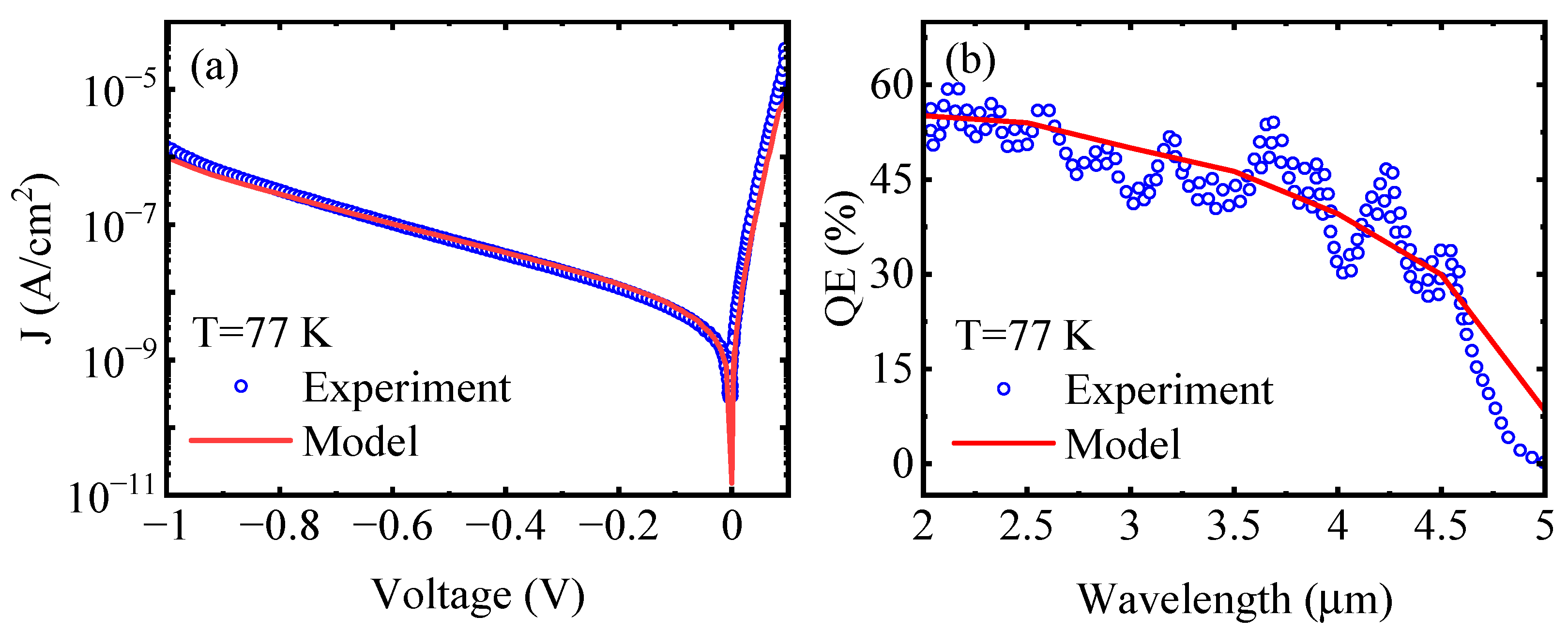
The J-V characteristics and QE are firstly simulated using our model for a 7/4 ML InAs/GaSb SL pin PD without the barrier at 77 K. The simulated results are compared with experimental results of the same pin structure [25,26], as shown in Figure 4. The agreements between the simulated and measured dark current density and QE curves confirm the accuracy of our model.

3. Results

3.1. Thickness, Doping Concentration of the Barrier Layer

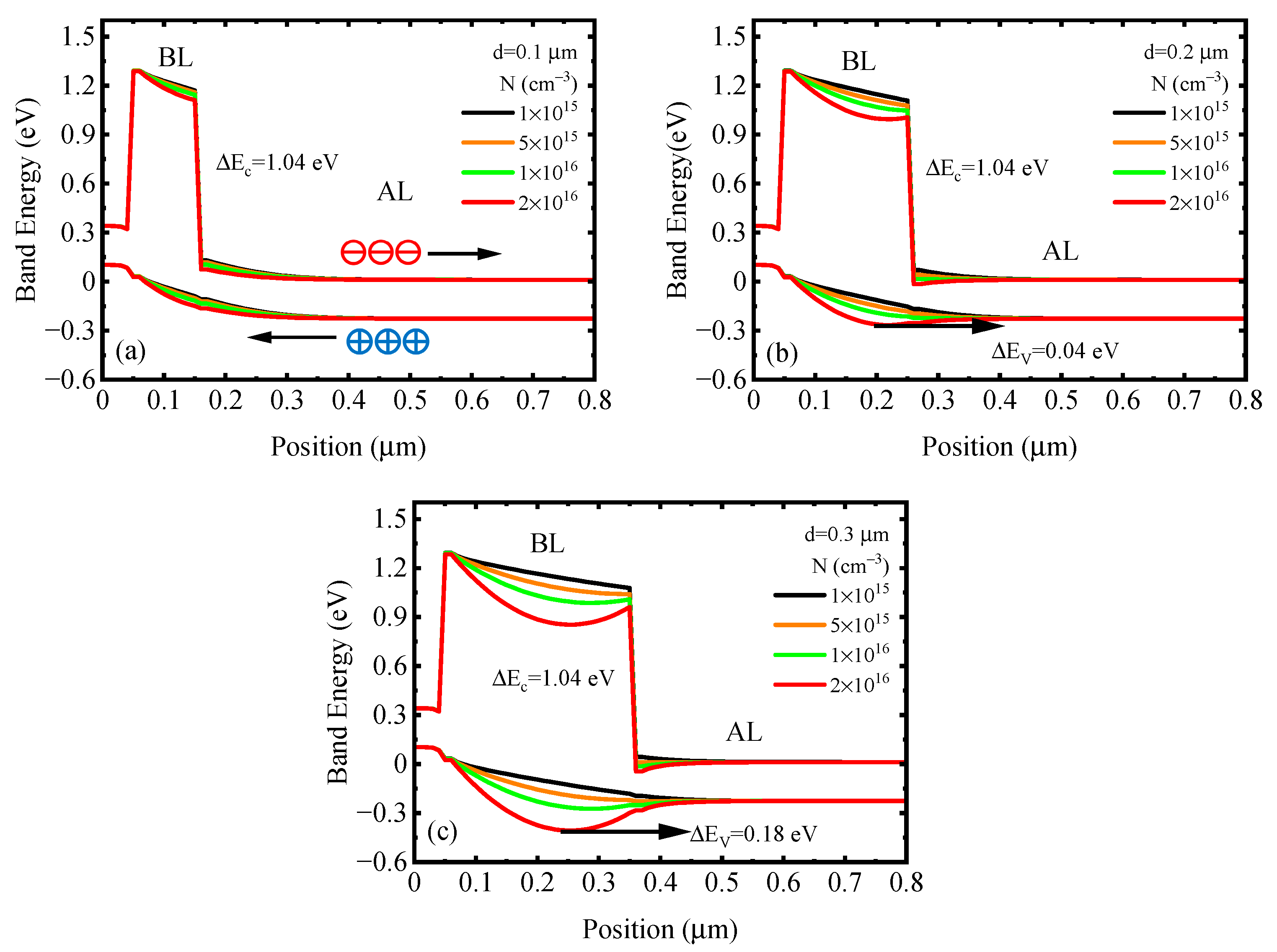
The energy band diagrams as a function of the barrier doping concentration are depicted in Figure 5. Three thicknesses of the AlGaAsSb barrier are compared: 0.1, 0.2, and 0.3 μm, respectively.
It is observed that the CBO remains 1.04 eV for the three barrier thicknesses, much larger than the CBO of 0.2 eV reported for InAs/GaSb SL PDs with InAs/GaSb SL barriers [21]. However, for the 0.1 μm barrier, the depletion region is still partly positioned at the absorber layer for all the doping concentrations, indicating not very low dark current. For the thicker barriers of 0.2 μm in Figure 5b and 0.3 μm in Figure 5c, it is seen that with the increasing of the barrier doping concentration, the depletion region is gradually removed from the absorber layer and positioned at the barrier layer, indicating reduced dark current.
The dependence of VBO on barriers with different thicknesses shows distinct trends. While the VBO for the 0.1 µm barrier is negligible (0 eV) regardless of the doping concentration, thicker barriers exhibit an observable increase in VBO at higher doping levels. Specifically, at a doping concentration of 2 × 1016 cm−3, the VBO values reach 0.04 eV and 0.18 eV for barrier thicknesses of 0.2 μm and 0.3 μm, respectively. A large VBO leads to substantial decline in QE. Thus, based on the band diagram, a thicker barrier with a not very high doping concentration is preferred in the pBn structure.
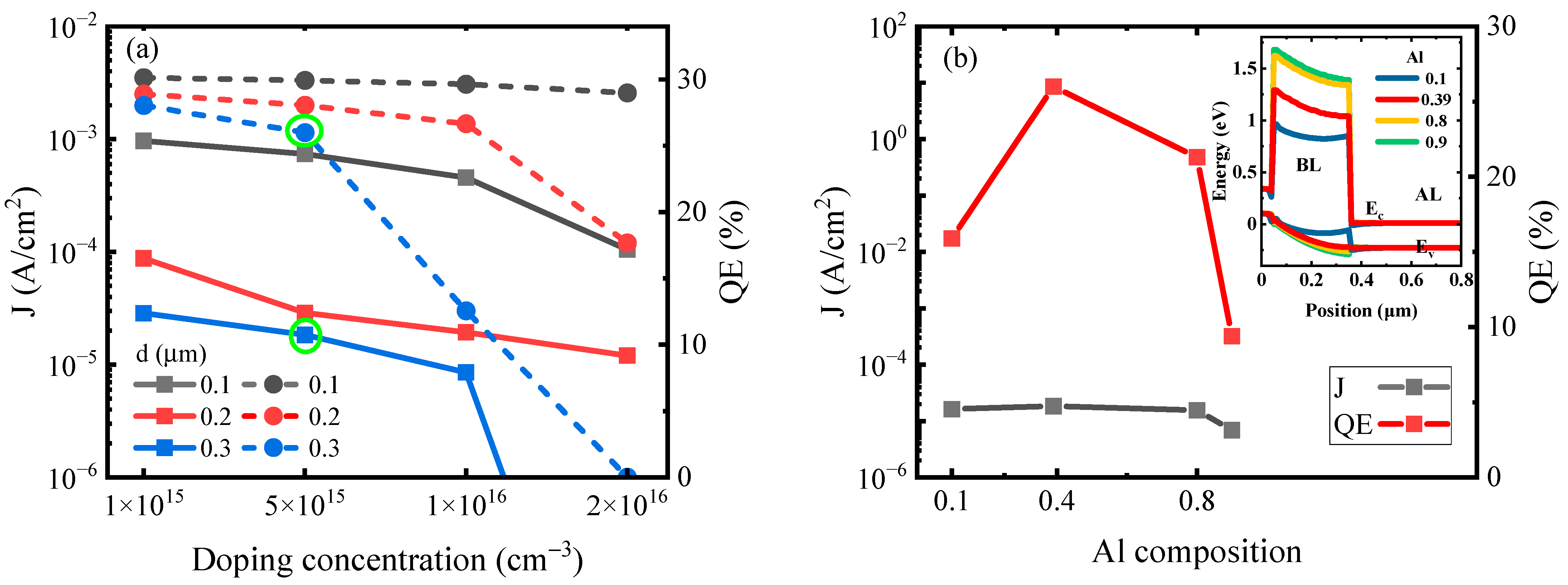
Moreover, Figure 6a illustrates how barrier thickness and doping concentration influence the dark current density and QE at a wavelength of 3.7 μm at the temperature of 150 K and bias of −0.05 V. Specifically, thicker barriers help to minimize dark current by reducing the absorber’s depletion width, and excessive doping causes a rise in VBO, which subsequently hinders hole collection and reduces QE, in agreement with the band structures in Figure 5. Consequently, an optimized barrier structure with a 0.3 µm thickness and 5 × 1015 cm−3 doping is adopted to ensure good device performance in both dark current and QE.
Figure 6b illustrates the comparison of dark current density and QE of the barrier detectors with different Al compositions in the AlGaAsSb alloy. As observed, the dark current density exhibits a negligible dependence on the Al composition within the range of 0.1 to 0.8, remaining stable at approximately 10−5 A/cm2. In contrast, the QE is highly sensitive to the Al fraction. It is highest at an Al composition of 0.39, due to zero VBO. For other Al compositions, VBOs are introduced, which hinder the collection of photo-generated carriers and consequently result in drops in the QEs.

3.2. Doping of the Contact Layer

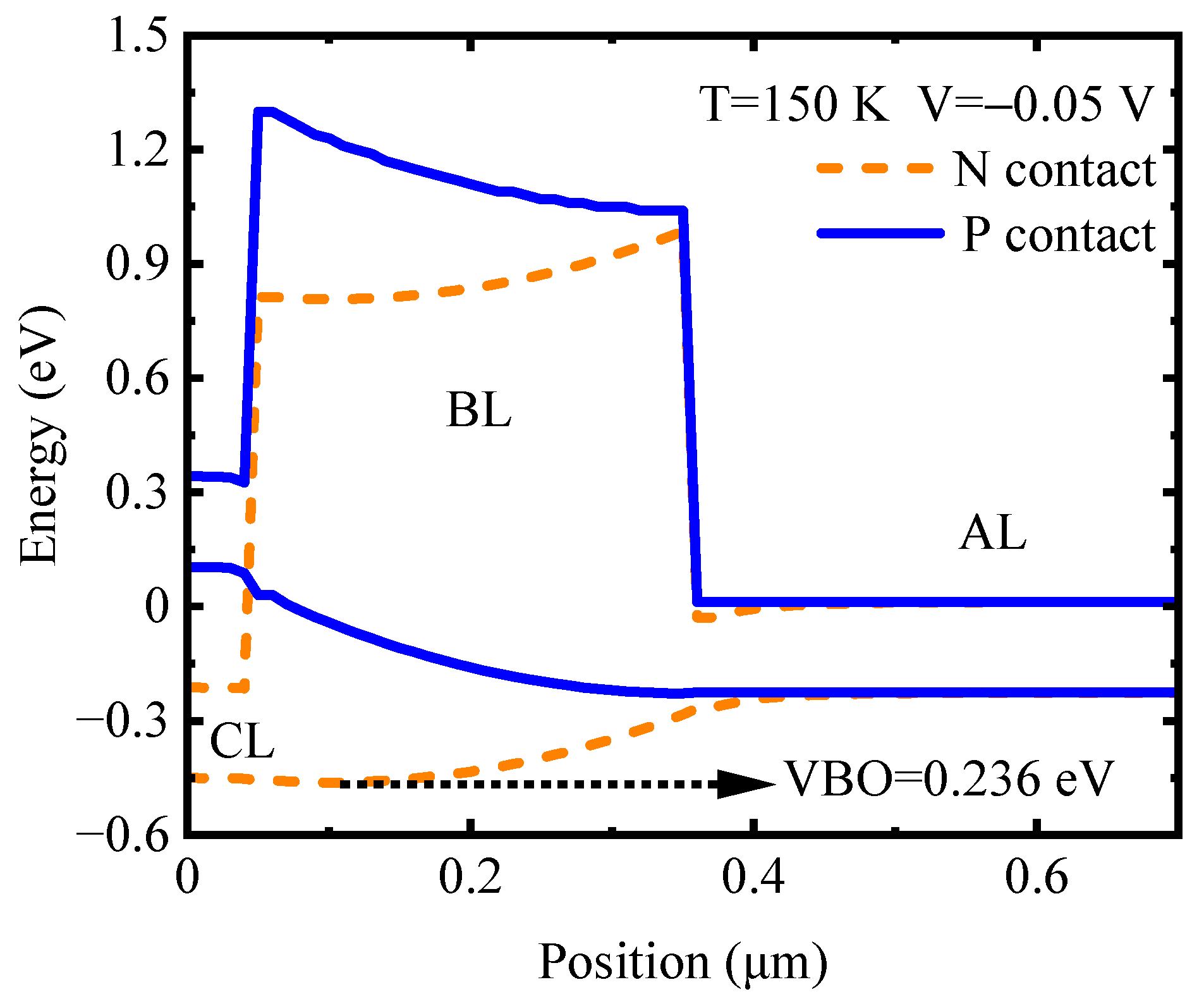
To justify the selection of a p-type contact layer, a comparative study of the energy band structures for both n-type and p-type contacts was conducted. Figure 7 illustrates the energy band diagrams at 150 K and a reverse bias of −0.05 V. When an n-type contact is employed, a large VBO of 0.236 eV is observed at the interface between the contact layer and the barrier layer. This VBO creates a large potential barrier that obstructs the transport of photogenerated holes toward the contact. In contrast, with the p-type contact layer, the VBO is facilitating the efficient collection of minority carriers. Consequently, the use of a p-type contact is critical for maintaining high responsivity and optimizing the overall performance of the pBn structure.

3.3. Comparison Between pBn and pn Structures

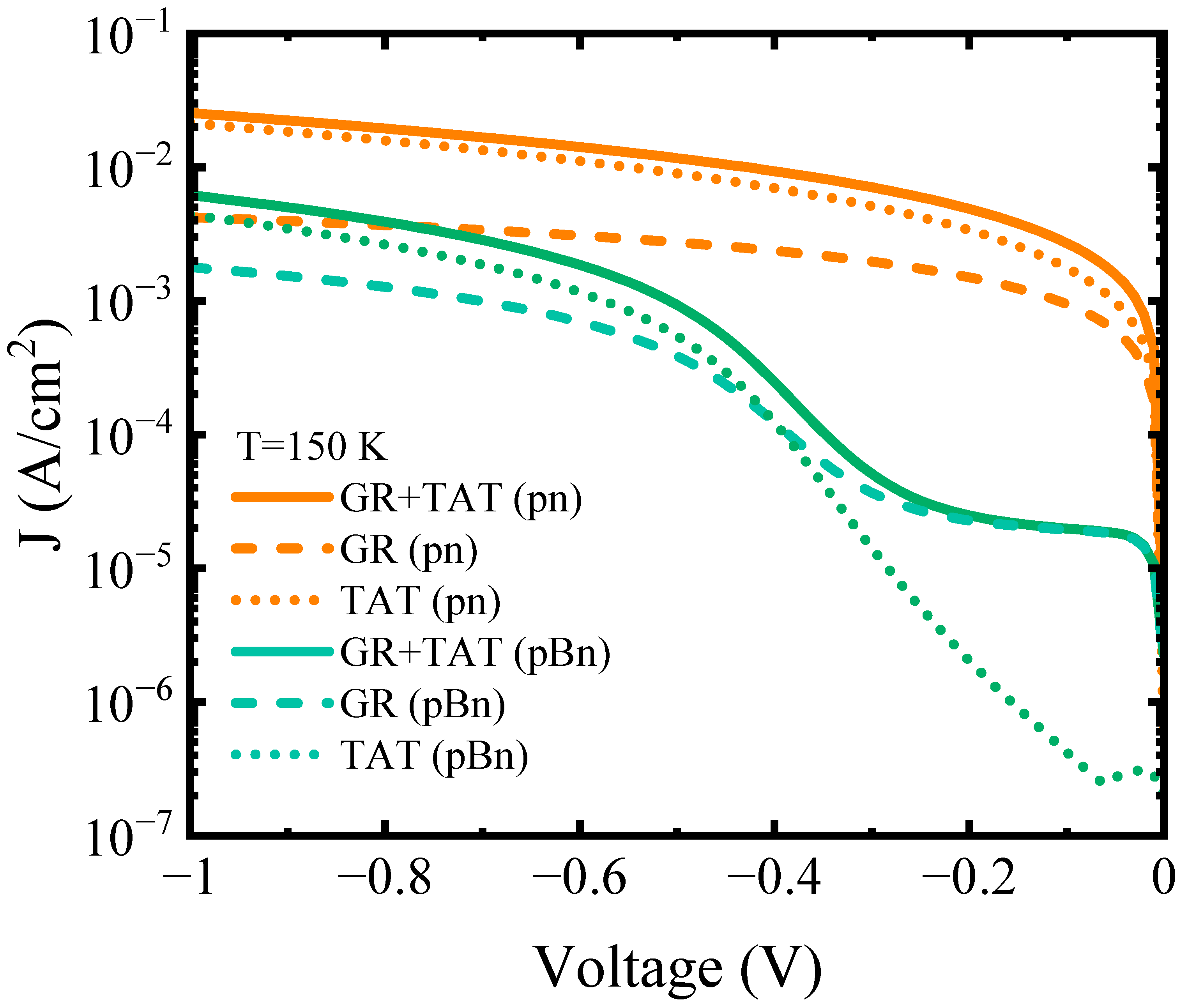
Then, for the optimum barrier thickness and doping concentration, the performance of the PD with the barrier is compared with that of the pn without the barrier at 150 K. Their dark currents and corresponding G-R and TAT components are all compared in Figure 8. It is seen clearly in Figure 8 that the total dark current and both the G-R and TAT components in the pBn structure are reduced compared to those in the pn structure. At −0.05 V, the total dark current density in the pBn structure is 1.83 × 10⁻⁵ A/cm2, about two orders of magnitude lower than that in the pn structure, which is 1.59 × 10⁻³ A/cm2. At −1 V, the total dark current density in the pBn structure is 6.18 × 10⁻³ A/cm2, about one fourth that of the pn structure of 2.55 × 10⁻² A/cm2. In the pn structure, the TAT current dominates for the whole voltage range of 0 to −1 V, while in the pBn structure, the dominance is dependent on the voltage. The G-R current dominates for the voltage range of 0 to −0.4 V. The TAT current density increases faster than the G-R one and gradually becomes the dominant current component at higher reversed voltages. At −0.05 V, the G-R current is reduced to 1.81 × 10⁻⁵ A/cm2 in pBn, about one third that of the pn structure of 6.02 × 10⁻⁴ A/cm2. More notably, the TAT current is reduced from 9.89 × 10⁻⁴ A/cm2 in pn to 2.7 × 10⁻⁷ A/cm2 in pBn, showing a reduction by more than three orders of magnitude. The reduction for the TAT current is about 100 times that of the G-R at −0.05 V. Whereas at −1 V, the magnitude of the reductions for the two current components is similar. Thus, the barrier structure is more effective in suppressing the TAT current at low reversed bias. The difference in the reduction will be further explained in Figure 9.
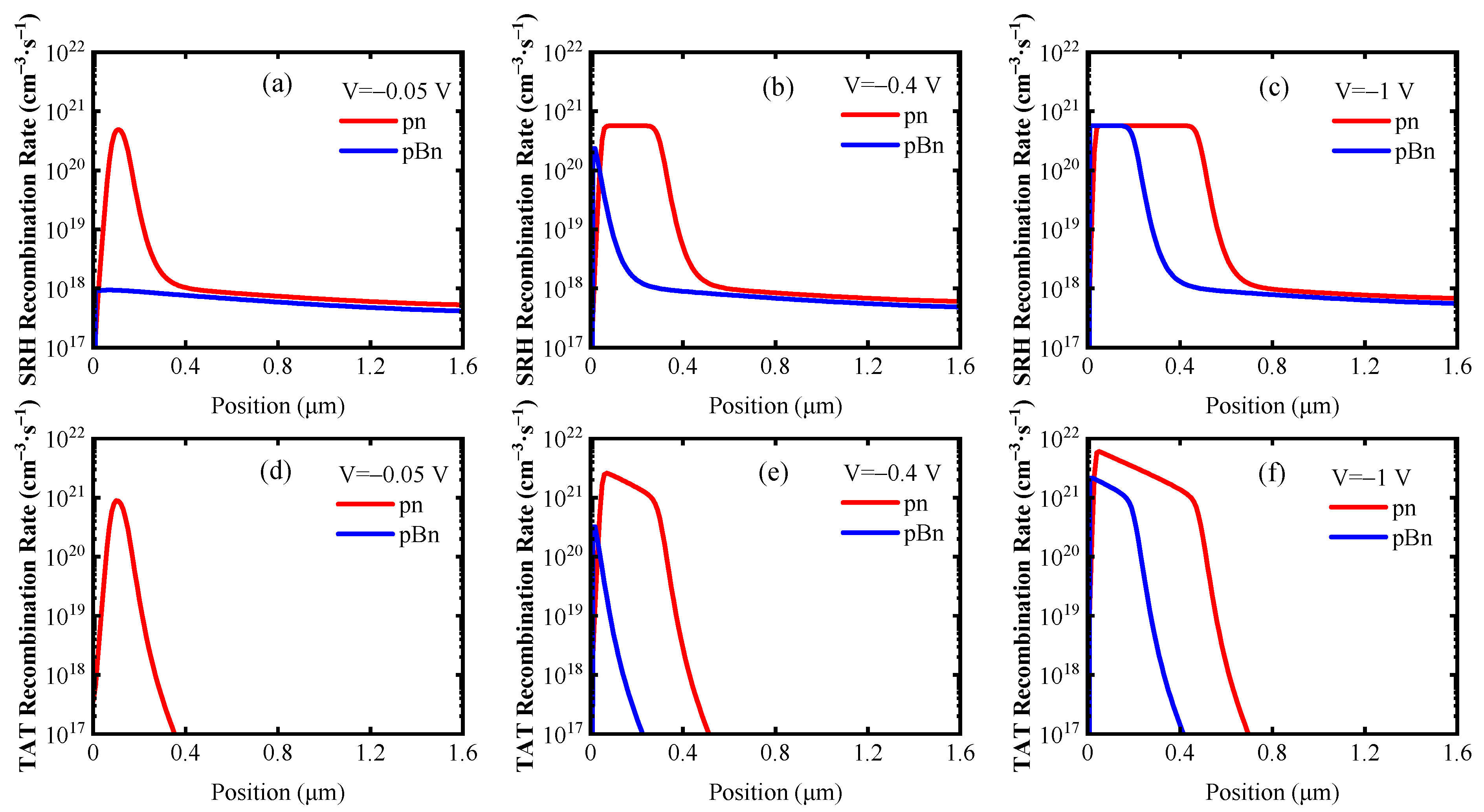
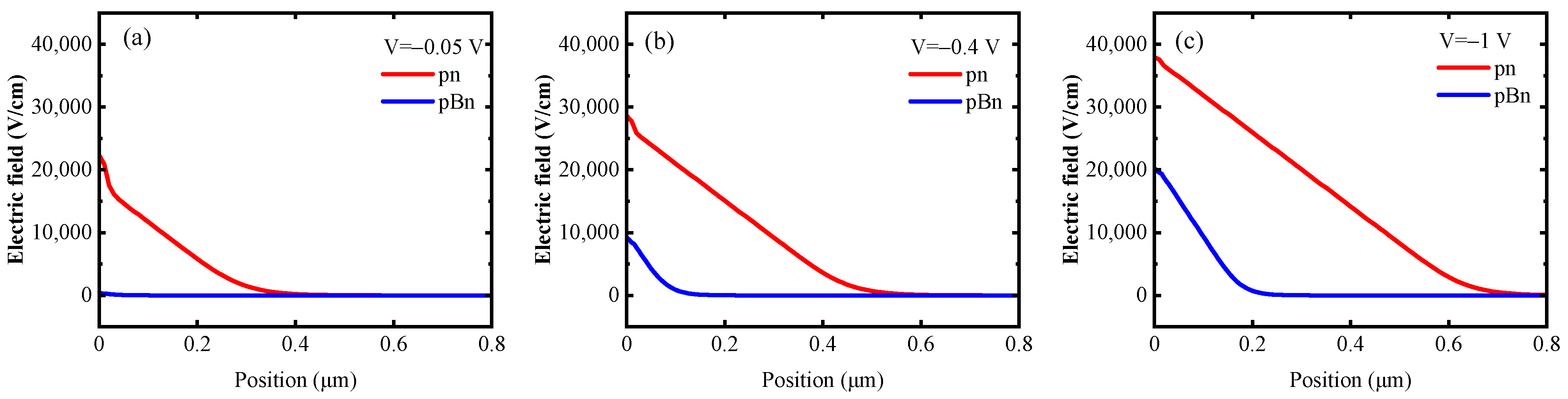
By incorporating a wide-bandgap barrier, the depletion region shifts into the barrier layer, which possesses a broader bandgap and thus reduces the dark current. The dominances of the G-R and TAT contributions are consistent with the SRH and TAT recombination rates occurring in the absorber. Based on the comparison in Figure 8, three voltages of −0.05, −0.4, and −1 V are selected to compare the recombination rates in Figure 9. The SRH and TAT recombination rates for both structures increase with increased reverse bias, and they occur over the whole depletion region as indicated by the electric field in Figure 9. However, for all the three voltages, both the SRH and the TAT recombination rates of the pBn structure are lower than those of the pn structure, and for the pn structure, the TAT recombination rates for all the three reversed biases are higher than the SRH recombination rate; while this is not the case for the pBn structure. For the pBn structure, the maximum SRH recombination rate at −0.05 V is 9.42 × 1017 cm−3 s−1 in Figure 9a, approximately 21 times higher than the maximum TAT recombination rate of 4.45 × 1016 cm−3 s−1 in Figure 9d, showing its dominance for the low reversed bias voltage. At −0.05 V, when the electric field is zero in the absorber in Figure 10a, the TAT recombination rate is suppressed most in the pBn. At the bias of −0.4 V, the maximum SRH recombination rate in the absorber layer is 2.35 × 1020 cm−3 s−1 in Figure 9b, approximately equal to the maximum TAT recombination rate of 3.21 × 1020 cm−3 s−1 in Figure 9e. With the increased reverse bias voltage, the maximum TAT recombination rate gradually surpasses the maximum SRH recombination rate. The maximum TAT recombination rate reaches 2.14 × 1021 cm−3 s−1 at the bias of −1 V in Figure 9f, which is approximately 4 times higher than the maximum SRH recombination rate of 5.75 × 1020 cm−3 s−1 in Figure 9c. The TAT recombination rate increases faster with the reversed bias due to the increased electric field in Figure 10, which strongly affect the confinement factor Γp in Equation (4). The tendencies for the two recombination rates are in agreement with the dark current densities in Figure 8.
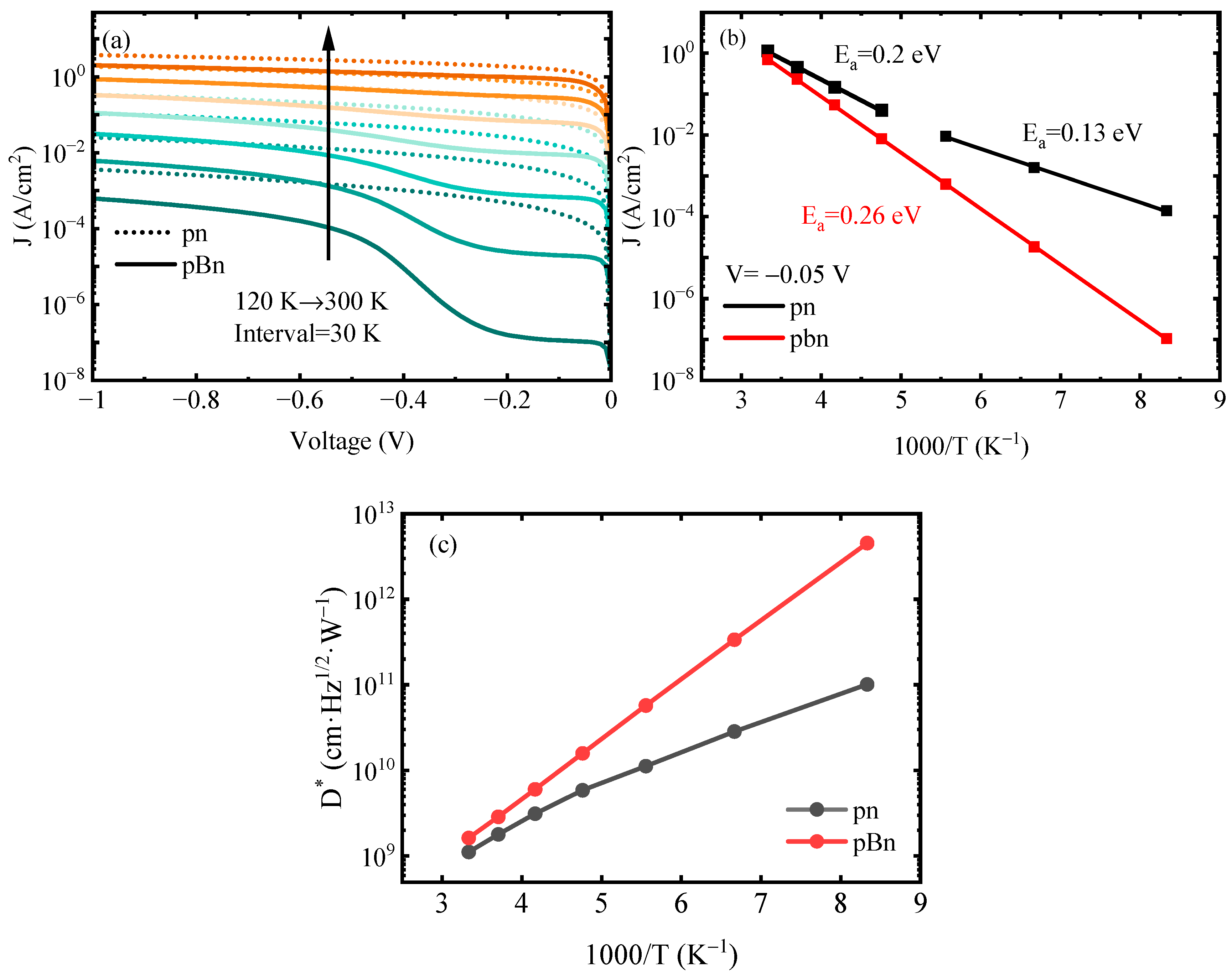
The thermal behaviors of the pn and pBn architectures are illustrated in Figure 11. For both structures, the dark current densities are reduced as the temperature decreases from 300 K to 120 K. A significant reduction in dark current is observed for the pBn structure at 120 K. The pBn structure exhibits a dark current density of 1.05 × 10⁻⁷ A/cm2, achieving nearly three orders of magnitude suppression compared to the pn counterpart (1.4 × 10⁻⁴ A/cm2). However, this suppression for the dark current is weakened at 300 K. At 300 K, the dark current density of the pBn structure is 0.69 A/cm2, only a little bit lower than that of the pn structure. Such temperature-sensitive variations are dictated by the competition between G-R and diffusion currents. While both currents are related to temperature, their rates of change are different. The diffusion current follows an exp(−Eg/kT) relationship, while the G-R current is proportional to exp(−Eg/2kT). Consequently, the diffusion current component governs the dark current at high temperatures, but as the temperature drops, the G-R current component eventually dominates due to its weaker temperature dependence. At the low temperature range of 120–180 K, the G-R current dominates and is suppressed by the barrier in the pBn; thus the total current is more reduced.
The fitted activation energies for both structures are presented in Figure 11b. For the pn structure, the activation energies are different for the whole temperature range, indicating different current components in dominance. For the pBn structure, the fitted activation energy is 0.26 eV across the entire temperature range, close to the bandgap of the absorber layer, indicating that the G-R and TAT currents are suppressed by the barrier successfully, and the device is dominated by the diffusion current.
Besides the dark current, the specific detectivity (D*) is also analyzed and compared to the pn structure from 120 K to 300 K.
The D*, as a key figure of merit, is calculated from the measured responsivity (Ri) and dark current density as follows:
D * = R i 2 q J d + 4 k T R A ,
where the variables Ri, Jd and A correspond to the responsivity, dark current density, and device effective area, respectively. Furthermore, the differential resistance R is calculated via the relation (dI/dV)−1. The effective area A is set to 10 × 10 μm2. The responsivity Ri is given by the following equation:
R i = λ q η h c ,
where the parameters λ, q, and η represent the wavelength, electron charge, and QE. At 150 K and −0.05 V, the specific detectivity at 3.7 µm of the pBn structure is calculated to be 3.37 × 1011 cm·Hz1/2·W−1, which is nearly an order of magnitude higher than that of the pn structure (2.84 × 1010 cm·Hz1/2·W−1). This improvement is primarily attributed to the effective suppression of the dark current.
As shown in Figure 11c, both structures exhibit a decrease in D* with increasing temperature. Notably, at 150 K, the D* of the pBn structure is 3.37 × 1011 cm·Hz1/2·W−1, which is nearly an order of magnitude higher than that of the pn structure. At 300 K, the D* of the pBn structure is 1.62 × 109 cm·Hz1/2·W−1, only about 1.5 times the D*of the pn structure (1.11 × 109 cm·Hz1/2·W−1). The improvement in the dark current and detectivity is more pronounced for the low temperature range (120–180 K), also due to the different dominance of the dark current components with temperatures.
The barrier structure could reduce G-R, TAT and BTBT currents by removing the electric field from the narrow absorption layer to the large-bandgap barrier. These dark current components are all related to defects in the absorption layer, so their reduction is more obvious for the low temperature range. In addition, because the barrier is placed on top of the absorption layer, it could serve as a passivation layer and reduce surface leakage current [37], even at high temperatures.
Therefore, the AlGaAsSb barrier could effectively reduce dark current and improve the performance of the PD at both low and high temperatures.
As summarized in Table 2, the pBn PD in our work could suppress dark current by a factor of 86.9 compared to its pn counterpart, while maintaining a competitive specific detectivity level. The performance is also compared to the other four barriers in InAs/GaSb SL PDs in Table 2. Comparable or better improvement in the dark current density is obtained. The dark current density and specific detectivity in our work are of the same magnitude as those in traditional AlGaSb [38] and InAs/GaSb SL [39] barriers, validating the simulation models and parameters for the proposed structure.
Compared to traditional AlGaSb and SL barriers, the AlGaAsSb quaternary barrier offers more flexibility in achieving zero VBO to the absorber by tuning both Al and As components in the alloy. Furthermore, compared to the InAs/GaSb SL barrier, the growth process of the AlGaAsSb quaternary alloy demonstrates relatively less complexity. The growth of the InAs/GaSb SL has difficulties in precise interface engineering, narrow temperature window control, and inherent defect formation. In contrast, the primary difficulty for quaternary compounds predominantly lies in achieving precise compositional uniformity across the material system.

4. Conclusions

In this work, a high-performance MWIR pBn PD based on a quaternary AlGaAsSb barrier was designed and analyzed. Through detailed calculation, an Al0.39Ga0.61As0.08Sb0.92 barrier layer was selected to achieve lattice matching and optimal band alignment, offering a high CBO of 1.04 eV to block majority electrons and a zero VBO to ensure efficient hole transport. The device structure was further optimized, with a barrier thickness of 0.3 µm and a doping concentration of 5 × 1015 cm−3 as the ideal parameters to suppress dark current without compromising QE.
The optimized pBn detector achieves a dark current density of 1.83 × 10⁻⁵ A/cm2 at 150 K, approximately two orders of magnitude lower than that of the pn structure. The analysis of the recombination rates suggests that both the G-R and TAT currents could be reduced and the reduction for the TAT is more pronounced under low reversed biases. The results are helpful in understanding the effect of the barrier in reducing different dark current components and the simulation of the pBn PD demonstrates the potential of the designed AlGaAsSb barrier in realizing high-operating-temperature InAs/GaSb SL infrared detectors.

Author Contributions

Conceptualization, Z.J. and Y.G.; methodology, Z.J. and G.Z.; software, Z.J. and G.Z.; formal analysis, Z.J., G.Z. and X.J.; validation, T.L. and X.L.; investigation, B.L., T.L. and X.L.; resources, Y.G., B.L., T.L. and X.L.; writing—original draft preparation, Z.J. and G.Z.; writing—review and editing, Z.J., G.Z. and Y.G.; supervision, Y.G.; funding acquisition, Z.J., Y.G., T.L. and X.L. All authors have read and agreed to the published version of the manuscript.

Funding

This research was funded by the National Natural Science Foundation of China (grant numbers 62274169 and 62475272), the National Key R&D Program (grant numbers 2022YFB3904803).

Data Availability Statement

The data presented in this study are available on request from the corresponding author.

Conflicts of Interest

The authors declare no conflicts of interest.

References

  1. Plis, E.A. InAs/GaSb Type-II Superlattice Detectors. Adv. Electron. 2014, 2014, 246769. [Google Scholar] [CrossRef]
  2. Rogalski, A.; Martyniuk, P. Mid-Wavelength Infrared nBn for HOT Detectors. J. Electron. Mater. 2014, 43, 2963–2969. [Google Scholar] [CrossRef]
  3. Mailhiot, C.; Smith, D.L. Long-Wavelength Infrared Detectors Based on Strained InAs–Ga1−xInxSb Type-II Superlattices. J. Vac. Sci. Technol. A Vac. Surf. Film. 1989, 7, 445–449. [Google Scholar] [CrossRef]
  4. Rogalski, A. New Material Systems for Third Generation Infrared Photodetectors. Opto-Electron. Rev. 2008, 16, 458–482. [Google Scholar] [CrossRef]
  5. Smith, D.L.; Mailhiot, C. Proposal for Strained Type II Superlattice Infrared Detectors. J. Appl. Phys. 1987, 62, 2545–2548. [Google Scholar] [CrossRef]
  6. Razeghi, M.; Nguyen, B.-M. Band Gap Tunability of Type II Antimonide-Based Superlattices. Phys. Procedia 2010, 3, 1207–1212. [Google Scholar] [CrossRef]
  7. Rogalski, A.; Martyniuk, P.; Kopytko, M. InAs/GaSb Type-II Superlattice Infrared Detectors: Future Prospect. Appl. Phys. Rev. 2017, 4, 031304. [Google Scholar] [CrossRef]
  8. Steenbergen, E.H.; Connelly, B.C.; Metcalfe, G.D.; Shen, H.; Wraback, M.; Lubyshev, D.; Qiu, Y.; Fastenau, J.M.; Liu, A.W.K.; Elhamri, S.; et al. Significantly Improved Minority Carrier Lifetime Observed in a Long-Wavelength Infrared III-V Type-II Superlattice Comprised of InAs/InAsSb. Appl. Phys. Lett. 2011, 99, 251110. [Google Scholar] [CrossRef]
  9. Pellegrino, J.; DeWames, R. Minority Carrier Lifetime Characteristics in Type II InAs/GaSb LWIR Superlattice n+ Πp+ Photodiodes. In Proceedings of the Infrared Technology and Applications XXXV, Orlando, FL, USA, 13–17 April 2009; p. 72981U. [Google Scholar]
  10. Jiao, Z.; Guo, T.; Zhou, G.; Gu, Y.; Liu, B.; Yu, C.; Li, T.; Li, X. Study on the Quaternary Unipolar Barrier in Metamorphic InGaAs Photodetectors. Opt. Laser Technol. 2025, 192, 113613. [Google Scholar] [CrossRef]
  11. Jiao, Z.J.; Guo, T.Y.; Gu, Y.; Liu, B.W.; Chu, F.H.; Ma, Y.J.; Shao, X.M.; Li, X. Recombination Lifetimes and Mechanisms of In0.75Ga0.25As and In0.53Ga0.47As as a Function of Doping Density. Infrared Phys. Technol. 2024, 141, 105462. [Google Scholar] [CrossRef]
  12. Martyniuk, P.; Wróbel, J.; Plis, E.; Madejczyk, P.; Kowalewski, A.; Gawron, W.; Krishna, S.; Rogalski, A. Performance Modeling of MWIR InAs/GaSb/B–Al0.2 Ga0.8 Sb Type-II Superlattice nBn Detector. Semicond. Sci. Technol. 2012, 27, 055002. [Google Scholar] [CrossRef]
  13. Li, Y.; Xiao, W.; Wu, L.; Xie, X.; Lu, P.; Wang, S. Dark Current Characteristic of P-i-n and nBn MWIR InAs/GaSb Superlattice Infrared Detectors. In Proceedings of the 2019 IEEE 4th Optoelectronics Global Conference (OGC), Shenzhen, China, 3–6 September 2019; pp. 70–75. [Google Scholar]
  14. Jang, A.; Lee, H.J.; Kim, Y.H.; Jung, H.; Bidenko, P.; Kim, S. Effect of Barrier Layer on InAs/GaSb Type-II Superlattice nBn Detector. In Proceedings of the 2021 International Conference on Electronics, Information, and Communication (ICEIC), Jeju-si, Republic of Korea, 31 January–3 February 2021; pp. 1–3. [Google Scholar]
  15. Nguyen, B.-M.; Hoffman, D.; Delaunay, P.-Y.; Razeghi, M. Dark Current Suppression in Type II InAs∕GaSb Superlattice Long Wavelength Infrared Photodiodes with M-Structure Barrier. Appl. Phys. Lett. 2007, 91, 163511. [Google Scholar] [CrossRef]
  16. Razeghi, M.; Haddadi, A.; Hoang, A.M.; Chen, G.; Bogdanov, S.; Darvish, S.R.; Callewaert, F.; Bijjam, P.R.; McClintock, R. Antimonide-Based Type II Superlattices: A Superior Candidate for the Third Generation of Infrared Imaging Systems. J. Electron. Mater. 2014, 43, 2802–2807. [Google Scholar] [CrossRef]
  17. Delmas, M.; Rossignol, R.; Rodriguez, J.B.; Christol, P. Design of InAs/GaSb Superlattice Infrared Barrier Detectors. Superlattices Microstruct. 2017, 104, 402–414. [Google Scholar] [CrossRef]
  18. Gomółka, E.; Markowska, O.; Kopytko, M.; Kowalewski, A.; Martyniuk, P.; Rogalski, A.; Rutkowski, J.; Motyka, M.; Krishna, S. Mid-Wave InAs/GaSb Superlattice Barrier Infrared Detectors with nBnN and pBnN Design. Bull. Pol. Acad. Sciences. Tech. Sci. 2018, 66., 317–323. [Google Scholar]
  19. Kim, H.S.; Plis, E.; Rodriguez, J.B.; Bishop, G.D.; Sharma, Y.D.; Dawson, L.R.; Krishna, S.; Bundas, J.; Cook, R.; Burrows, D.; et al. Mid-IR Focal Plane Array Based on Type-II InAs∕GaSb Strain Layer Superlattice Detector with nBn Design. Appl. Phys. Lett. 2008, 92, 183502. [Google Scholar] [CrossRef]
  20. Zhang, Y.; Shan, Y.; Chang, F.; Liang, Y.; Zhang, X.; Yang, C.; Li, D.; Xie, R.; Yao, L.; Wang, G.; et al. High Operating Temperature Mid-Wavelength Infrared Detectors Based on InAs/InAsSb Superlattices with Electron Block Interfacial Graded Doping. Opt. Express 2025, 33, 36672. [Google Scholar] [CrossRef]
  21. Kawde, P.; Singh, A.; Muralidharan, B. Dark Current Performance Enhancement in Type-II Superlattice Photodetectors via pBn Barrier Engineering. IEEE Trans. Electron Devices 2024, 71, 7628–7636. [Google Scholar] [CrossRef]
  22. Banerjee, K.; Huang, J.; Ghosh, S. Modeling and Simulation of Long-Wave Infrared InAs/GaSb Strained Layer Superlattice Photodiodes with Different Passivants. Infrared Phys. Technol. 2011, 54, 460–464. [Google Scholar] [CrossRef]
  23. Abautret, J.; Perez, J.P.; Evirgen, A.; Martinez, F.; Christol, P.; Fleury, J.; Sik, H.; Cluzel, R.; Ferron, A.; Rothman, J. Electrical Modeling of InSb PiN Photodiode for Avalanche Operation. J. Appl. Phys. 2013, 113, 183716. [Google Scholar] [CrossRef]
  24. Taalat, R.; Rodriguez, J.-B.; Delmas, M.; Christol, P. Influence of the Period Thickness and Composition on the Electro-Optical Properties of Type-II InAs/GaSb Midwave Infrared Superlattice Photodetectors. J. Phys. D Appl. Phys. 2014, 47, 015101. [Google Scholar] [CrossRef]
  25. Giard, E.; Ribet-Mohamed, I.; Jaeck, J.; Viale, T.; Haïdar, R.; Taalat, R.; Delmas, M.; Rodriguez, J.-B.; Steveler, E.; Bardou, N.; et al. Quantum Efficiency Investigations of Type-II InAs/GaSb Midwave Infrared Superlattice Photodetectors. J. Appl. Phys. 2014, 116, 043101. [Google Scholar] [CrossRef]
  26. Delmas, M.; Rodriguez, J.-B.; Christol, P. Electrical Modeling of InAs/GaSb Superlattice Mid-Wavelength Infrared Pin Photodiode to Analyze Experimental Dark Current Characteristics. J. Appl. Phys. 2014, 116, 113101. [Google Scholar] [CrossRef]
  27. Anwar, A.F.M.; Webster, R.T. Energy bandgap of AlxGa1−xAs1−ySby and conduction band discontinuity of AlxGa1−xAs1−ySby/InAs and AlxGa1−xAs1−ySby/InGaAs heterostructures. Solid-State Electron. 1998, 42, 2101–2104. [Google Scholar]
  28. Zhang, Y.L.; Li, C.; Guo, D.Q.; Cheng, K.M.; Shen, K.; Wu, J. High-performance In0.83Ga0.17As extended shortwave infrared photodetector with AlGaAsSb barrier structure. IEEE Sens. J. 2024, 24, 34259–34264. [Google Scholar]
  29. Singh, A.; Pal, R. Performance Simulation of Unipolar InAs/InAs1−xSbx Type-II Superlattice Photodetector. J. Electron. Mater. 2018, 47, 4653–4662. [Google Scholar] [CrossRef]
  30. Krijn, M.P.C.M. Heterojunction Band Offsets and Effective Masses in III-V Quaternary Alloys. Semicond. Sci. Technol. 1991, 6, 27–31. [Google Scholar] [CrossRef]
  31. Ting, D.Z.; Soibel, A.; Khoshakhlagh, A.; Gunapala, S.D. Theoretical Analysis of nBn Infrared Photodetectors. Opt. Eng. 2017, 56, 091606. [Google Scholar] [CrossRef]
  32. Steveler, E.; Verdun, M.; Portier, B.; Chevalier, P.; Dupuis, C.; Bardou, N.; Rodriguez, J.-B.; Haïdar, R.; Pardo, F.; Pelouard, J.-L. Optical Index Measurement of InAs/GaSb Type-II Superlattice for Mid-Infrared Photodetection at Cryogenic Temperatures. Appl. Phys. Lett. 2014, 105, 141103. [Google Scholar] [CrossRef]
  33. Hall, R.N. Electron-Hole Recombination in Germanium. Phys. Rev. 1952, 87, 387. [Google Scholar] [CrossRef]
  34. Shockley, W.; Read, W.T. Statistics of the Recombinations of Holes and Electrons. Phys. Rev. 1952, 87, 835–842. [Google Scholar] [CrossRef]
  35. Hurkx, G.A.M.; De Graaff, H.C.; Kloosterman, W.J.; Knuvers, M.P.G. A New Analytical Diode Model Including Tunneling and Avalanche Breakdown. IEEE Trans. Electron Devices 1992, 39, 2090–2098. [Google Scholar] [CrossRef]
  36. Le Thi, Y.; Kamakura, Y.; Mori, N. Simulation of Dark Current Characteristics of Type-II InAs/GaSb Superlattice Mid-Wavelength Infrared p–i–n Photodetector. Jpn. J. Appl. Phys. 2019, 58, 044002. [Google Scholar] [CrossRef]
  37. Maimon, S.; Wicks, G.W. N B n Detector, an Infrared Detector with Reduced Dark Current and Higher Operating Temperature. Appl. Phys. Lett. 2006, 89, 151109. [Google Scholar] [CrossRef]
  38. Martyniuk, P.; Wróbel, J.; Plis, E.; Madejczyk, P.; Gawron, W.; Kowalewski, A.; Krishna, S.; Rogalski, A. Modeling of Midwavelength Infrared InAs/GaSb Type II Superlattice Detectors. Opt. Eng. 2013, 52, 061307. [Google Scholar] [CrossRef]
  39. Zhu, H.; Liu, J.; Zhu, H.; Huai, Y.; Li, M.; Liu, Z.; Huang, Y. High Operating Temperature InAs/GaSb Superlattice Based Mid Wavelength Infrared Photodetectors Grown by MOCVD. Photonics 2021, 8, 564. [Google Scholar] [CrossRef]
  40. Czuba, K.; Ciura, Ł.; Sankowska, I.; Papis-Polakowska, E.; Jasik, A. The Role of Noise in Specific Detectivity of InAs/GaSb Superlattice MWIR Bariodes. Sensors 2021, 21, 7005. [Google Scholar] [CrossRef]
  41. Pour, S.A.; Huang, E.K.; Chen, G.; Haddadi, A.; Nguyen, B.-M.; Razeghi, M. High Operating Temperature Midwave Infrared Photodiodes and Focal Plane Arrays Based on Type-II InAs/GaSb Superlattices. Appl. Phys. Lett. 2011, 98, 143501. [Google Scholar] [CrossRef]
Figure 1. Illustration of the simulated pBn InAs/GaSb SL PD.
Electronics 15 01355 g001
Figure 2. (a) Dependence of thermionic current on the CBO of the AlxGa1−xAsySb1−y barrier at 150 K. The gray dashed line represents a CBO value of 0.24 eV, where the thermionic current density equals to the diffusion current density. (b) Dependence of the CBO and the VBO of the AlxGa1−xAsySb1−y barrier lattice-matched to the InAs/GaSb SL on the Al composition.
Electronics 15 01355 g002
Figure 3. Absorption coefficient as a function of energy used in the simulation for the InAs/GaSb (7/4 ML) SL structure [32].
Electronics 15 01355 g003
Figure 4. Experimental [25,26] (open circles) and simulated (solid line) (a) J-V curves and (b) QE spectra at 77 K.
Electronics 15 01355 g004
Figure 5. Dependence of energy band profiles on barrier doping concentrations for the Al0.39Ga0.61As0.08Sb0.92 layer at 150 K with thicknesses of (a) 0.1 µm, (b) 0.2 µm, and (c) 0.3 µm. The reversed bias voltage is 0.05 V. BL: barrier layer, AL: absorber layer. The transport directions of electrons and holes are indicated in (a).
Electronics 15 01355 g005
Figure 6. (a) Dependence of the dark current density (solid lines) and the QE (dashed lines) on the doping concentration of the barrier for different barrier thicknesses at a reversed bias of 0.05 V. The optimal barrier configuration (d = 0.3 μm and N = 5 × 1015 cm−3) is indicated by solid circles. (b) Dependence of the dark current density and QE on the Al composition of the AlxGa1−xAsySb1−y barrier layer for the optimal barrier configuration. Inset: The energy band diagram of different Al compositions for the AlxGa1−xAsySb1−y barrier layer. Ec and Ev denote the conduction band and valence band, respectively. BL: barrier layer, AL: absorption layer.
Electronics 15 01355 g006
Figure 7. Energy band diagram of the n-type and p-type contact layers at 150 K and a bias of −0.05 V. CL: contact layer, BL: barrier layer, AL: absorber layer.
Electronics 15 01355 g007
Figure 8. Dark current density and its G-R and TAT components with respect to varying reverse bias voltages for the pn and pBn structures.
Electronics 15 01355 g008
Figure 9. The SRH and TAT recombination rates of the absorber at the temperature of 150 K for the pn and pBn structures. The SRH recombination rates of the absorber at 150 K for the reversed biases of (a) 0.05 V, (b) 0.4 V and (c) 1 V. The TAT recombination rates of the absorber at 150 K for the the reversed biases of (d) 0.05 V, (e) 0.4 V and (f) 1 V. The TAT recombination rate for the pBn at −0.05 V is lower than 1017 and thus is not shown in (d).
Electronics 15 01355 g009
Figure 10. Electric field at (a) −0.05 V, (b) −0.4 V and (c) −1 V at a temperature of 150 K for the pn and pBn structures.
Electronics 15 01355 g010
Figure 11. (a) Temperature-dependent dark current density for both pn and pBn structures (120–300 K). (b) Extraction of Arrhenius plots for the pn and pBn dark current densities at −0.05 V. (c) Comparison of the specific detectivity D* for the pn and pBn structures (120–300 K).
Electronics 15 01355 g011
Table 1. Key material constants adopted for the numerical modeling at 150 K [23,24,26,31].
ParameterUnit7/4 ML InAs/GaSb SLAl0.39Ga0.61As0.08Sb0.92
BandgapeV0.2381.26
Electron density of statescm−34.1 × 10167.1 × 1016
Hole density of statescm−34.1 × 10173.8 × 1018
Electron mobilitycm2/(VS)1000200
Hole mobilitycm2/(VS)10027
G-R Lifetime electronsec4 × 10−95 × 10−10
G-R Lifetime holesec4 × 10−95 × 10−10
Electron effective mass 0.0254 m00.081 m0
Hole effective mass 0.245 m00.61 m0
Tunneling mass 0.025 m0
EtrapmeV0 (mid-gap)
Table 2. The comparison of our work to other MWIR InAs/GaSb PDs with barriers.
BarrierDark Current Density Without the Barrier (A/cm2)Dark Current Density with the Barrier (A/cm2)Factor of ReductionSpecific Detectivity (cm·Hz1/2·W−1)
This work1.59 × 10−31.83 × 10−586.93.37 × 1011
Al0.2Ga0.8Sb [38]9 × 10−31 × 10−4901 × 1011
InAs/GaSb SL [39]5.53 × 10−31 × 10−455.31.28 × 1011
AlSb [40]0.8 × 10−21.5 × 10−453.3N/A
M Barrier [41]0.91 × 10−41.14 × 10−57.985.7 × 1011
Disclaimer/Publisher’s Note: The statements, opinions and data contained in all publications are solely those of the individual author(s) and contributor(s) and not of MDPI and/or the editor(s). MDPI and/or the editor(s) disclaim responsibility for any injury to people or property resulting from any ideas, methods, instructions or products referred to in the content.