Article

Research on Inertial Navigation-Aided GNSS Integrity Monitoring Algorithm Under Constraints

1
School of Automation, Beijing Information Science and Technology University, Beijing 100192, China
2
Aerospace Information Research Institute, Chinese Academy of Sciences, Beijing 100094, China
*
Author to whom correspondence should be addressed.
Electronics 2026, 15(6), 1333; https://doi.org/10.3390/electronics15061333
Submission received: 11 February 2026 / Revised: 12 March 2026 / Accepted: 20 March 2026 / Published: 23 March 2026

Abstract

To address the challenge that prolonged interruptions of Global Navigation Satellite System (GNSS) signals—such as those caused by urban obstructions—hinder signal re-locking and thereby reduce the number of available satellites for integrity monitoring algorithms, this study proposes an inertial navigation-assisted GNSS re-locking method based on vehicle motion information constraints. This method leverages vehicle motion constraints to confine the primary direction of Inertial Navigation System (INS) velocity errors to the vehicle’s forward direction. Upon GNSS signal recovery, frequency error compensation is employed to mitigate Doppler errors of the previously obstructed satellites. Simulation results show that this method significantly improves the re-lock capability after a long period of satellite signal interruption, increasing the number of available satellites from 7 to 10 and optimizing the satellite geometry. At a horizontal alarm threshold of 80 m, the availability of the GNSS integrity monitoring algorithm reaches 95.7%, which is 53.7 percentage points higher than the unassisted scheme. Moreover, it can achieve 100% fault detection and identification rate even with a pseudorange deviation of 82 m, significantly improving the performance of the integrity monitoring algorithm.

1. Introduction

The Global Navigation Satellite System (GNSS) provides users with high-precision positioning services globally and in all weather conditions, serving as a core pillar of modern navigation systems [1,2]. However, in complex obstructed environments—such as urban canyons, tunnels, and tree-lined avenues—GNSS signals are prone to shielding, reflection, and multipath effects, which can lead to a significant degradation in signal quality or even long-term interruptions [3,4]. Such signal anomalies not only reduce positioning accuracy but also severely compromise the integrity of the navigation system, defined as the system’s ability to promptly alert users when it is unsuitable for navigation [5]. As a core performance indicator of navigation systems, integrity is on par with accuracy, continuity, and availability, and is directly related to user safety [6]. This is particularly true in high-reliability application scenarios such as autonomous driving and aerospace, where extremely strict requirements are imposed on integrity [7,8].
To improve navigation reliability in complex environments, GNSS/INS integrated navigation technology is widely adopted. Inertial Navigation Systems (INS) offer advantages such as strong autonomy, high short-term accuracy, and high output frequency, which can effectively compensate for positioning information during temporary GNSS signal interruptions and enhance the system’s dynamic tracking capability [9,10]. Within the framework of integrated navigation systems, deep integration technology can significantly improve the tracking robustness of GNSS receivers under weak signal conditions by directly assisting the receiver’s signal tracking loop with carrier dynamic information calculated by the INS [11,12].
While GNSS/INS deep integrated navigation systems excel in improving navigation accuracy and continuity, their integrity monitoring capability still faces significant challenges. On the one hand, the deep integration architecture tightens the coupling between GNSS and INS. If an INS sensor fails, its errors will directly contaminate GNSS observations, potentially leading to tracking loop lock loss or even complete system divergence [13,14,15]. Traditional Receiver Autonomous Integrity Monitoring (RAIM) algorithms struggle to effectively handle such complex failure modes. On the other hand, frequent and prolonged signal interruptions in urban environments drastically reduce the number of available satellites, severely limiting the availability of RAIM algorithms that rely on satellite redundancy [16,17,18]. Existing studies have introduced vehicle motion constraints or adopted new filtering architectures (e.g., factor graph optimization) to suppress INS error divergence and improve positioning accuracy [19,20,21,22]. However, these methods have not yet proposed an effective solution to the key problem of “how to quickly re-lock satellites after signal recovery to rapidly restore the navigation system’s integrity monitoring capability.”.
To address the limitations of existing research, this paper proposes a constrained inertial navigation-assisted GNSS autonomous integrity monitoring algorithm. Unlike traditional methods, which require signal reacquisition after GNSS signal interruption [23,24], the GNSS/INS deep integrated navigation system employed in this study can perform open-loop tracking of satellite signals during interruptions [25,26]. Upon signal recovery, continuous tracking can be maintained without the need for reacquisition, significantly improving the probability of satellite re-locking.
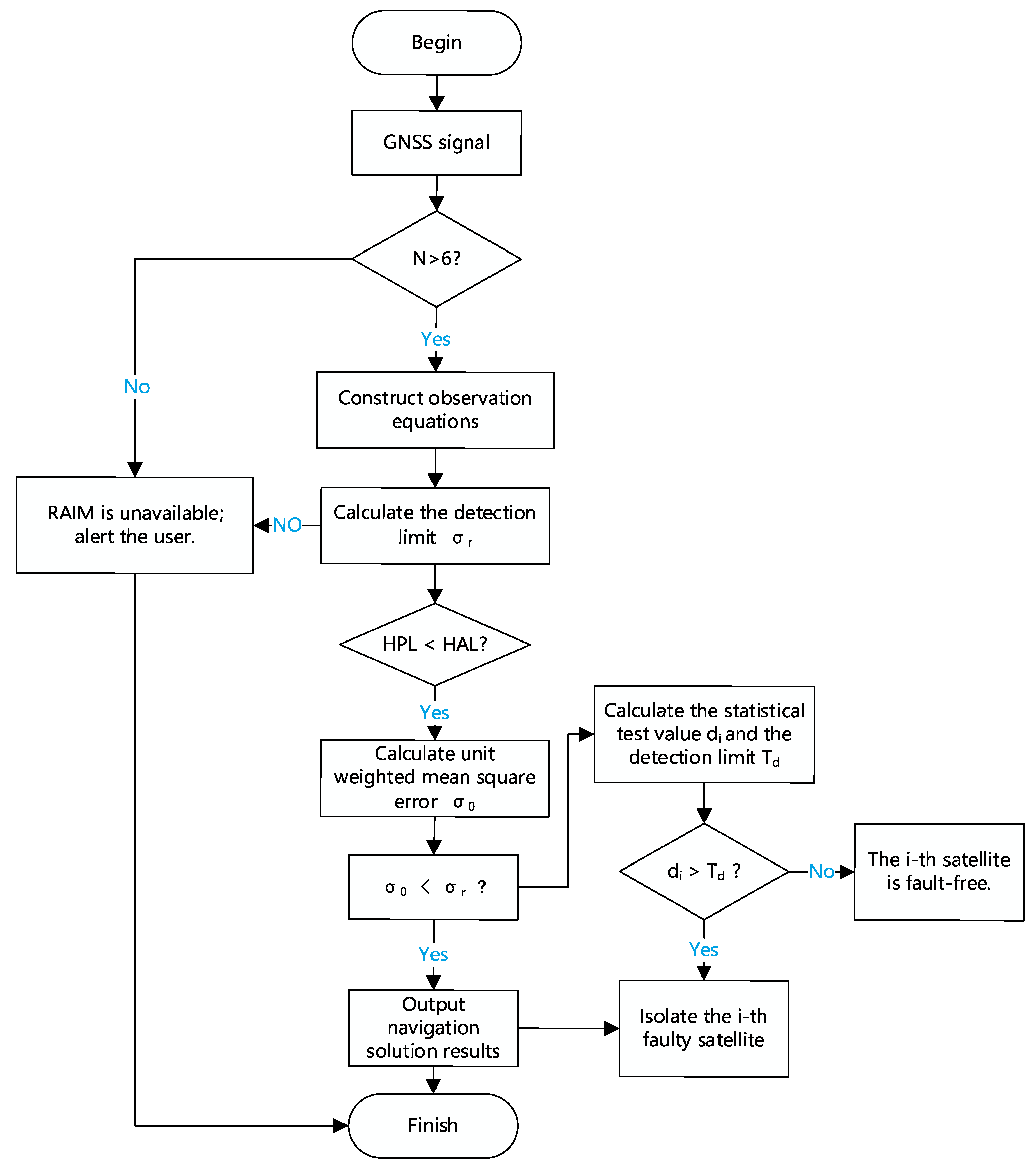
The specific implementation process is as follows: (1) During signal interruption, kinematic constraints are used to suppress the accumulation of INS errors. (2) After signal recovery, a frequency error compensation method is applied to the lost channels to assist in re-locking. (3) The least squares RAIM algorithm is utilized to detect and identify satellite faults, thereby verifying the practical effectiveness of the inertial navigation-assisted GNSS integrity monitoring algorithm.

2. GNSS/INS Deep Integrated Navigation System

2.1. Design of Constraint-Based Deep Combined Navigation Filter

Filter design is critical in GNSS/INS deep integrated navigation systems, Kalman filter is used in this paper. The filter’s state variable X includes multiple error components (epoch wise calculated updates of the INS state parameters, not the error estimates derived from the parameter covariance matrix), whose mathematical expression is given by Equation (1):
X = φ n T   δ v n T   δ r n T   δ b g T   δ b a T
where φ n denotes the attitude error vector, δ r n is the position error vector, δ v n is the velocity error vector, and δ b a and δ b g represent the gyroscope zero bias and accelerometer zero bias, respectively, and each error vector contains three components. The system’s state equation is constructed in discrete-time form, as shown in Equation (2):
X k + 1 = Φ k + 1 , k X k +   Γ k W k
where X k + 1 is the state vector at time k + 1 , W k is a zero-mean Gaussian system noise vector with a positive definite covariance matrix Q k , Φ k + 1 , k is the state transition matrix, and Γ k is the system noise matrix.
To suppress INS errors during GNSS signal interruptions, the measurement equations for the deep integrated navigation system under kinematic constraints are derived using the Non-Holonomic Constraint (NHC) principle and heading angular velocity constraint theory [27,28]. Based on the measurement matrix H k n h c , the measurement equation under kinematic constraints is established as shown in Equation (3):
Z k n h c = H k n h c X k + v k n h c
In the equation, Z k n h c is the system observation vector, specifically in the form V b ( 1 ) V b ( 3 ) Y a ω T , which consists of the carrier’s lateral velocity, vertical velocity, and heading angular rate. v k n h c denotes the system observation noise vector.
The specific forms of the measurement matrix H k n h c are presented in Equations (4)–(6):
H k n h c = M 1 1 , × M 2 1 , × M 1 3 , × M 2 3 , × 0 3 × 9 H 1 0 1 × 3
The measurement matrix H k n h c for kinematic constraints is a 3 × 15 dimensional matrix. M 1 and M 2 are both 3 × 3 dimensional core transformation matrices of the INS error state model, and the notation i , × denotes the i-th row (all columns) of the matrix (where i = 1 stands for lateral direction, i = 3 stands for vertical direction of the carrier). In Equation (4):
M 1 = C n b ,   M 2 = C n b ( V n × )
H 1 = sin θ sin ψ cos θ sin θ cos ψ cos θ 1
where θ and ψ are the pitch angle and heading angle, respectively.
In open environments where GNSS signals are received normally, the integrated navigation filter uses positioning solutions from the GNSS receiver as observations. In obstructed environments such as urban areas—where satellite signals may be interrupted for extended periods—the vehicle’s kinematic constraints serve as observations for the integrated navigation filter. By flexibly switching the Kalman filter’s measurement inputs between different environments, real-time estimation of INS errors can be achieved, and these errors can be fed back to the INS for correction.
In GNSS/INS deep integrated navigation systems, the INS assists the GNSS receiver in signal tracking. Therefore, suppressing INS error accumulation during GNSS signal interruptions using kinematic constraints can improve the GNSS receiver’s satellite signal tracking performance after signal recovery.

2.2. Principle of Loss-of-Lock Satellite Frequency Error Compensation

Figure 1 presents the block diagram of an inertial navigation-assisted GNSS receiver. It can be observed that when GNSS signals are interrupted, the carrier tracking loop cannot form a closed loop, causing the carrier frequency error output by the discriminator to gradually increase. At this point, the deep integrated navigation system breaks the closed-loop feedback mechanism of the carrier tracking loop (indicated by the red arrow in Figure 1) and adopts an open-loop mode for satellite signal tracking.
In Figure 1, IF represents the intermediate frequency signal, and NCO represents the numerically controlled oscillator.
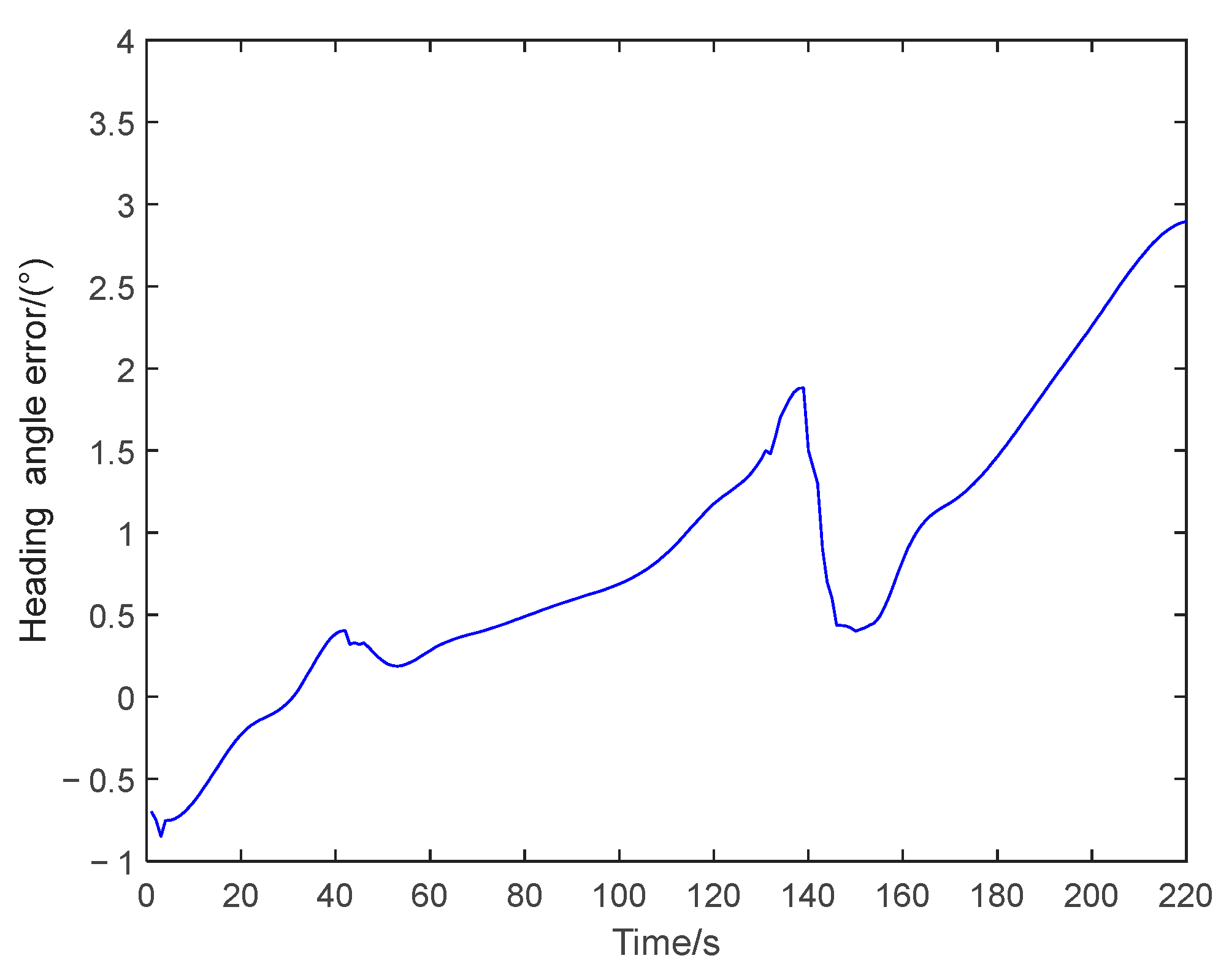
During GNSS signal interruptions, positioning results calculated by the GNSS receiver cannot be used to suppress INS errors. At this time, the GNSS tracking loop switches to open-loop tracking mode and utilizes kinematic constraint information to suppress the accumulation of INS errors. The gyro zero bias and accelerometer zero bias are 300 ° h 1 and 10 5   m s 2 respectively, and the angle random walk and speed random walk are 1 ° h 1 2 and 10   m s 1 h 1 2 respectively. The effect of kinematic constraint information on suppressing INS error accumulation was simulated under satellite signal interruption conditions. Figure 2 shows the trend of heading angle error during signal interruption. It can be seen that the heading angle error is kept in a relatively small range. It shows that the drift of inertial navigation attitude error is effectively suppressed. During 220 s GNSS signal interruption, the heading angle error is not more than 3°. For urban navigation scenarios, the 3° heading angle error is a relatively small and acceptable error within 220 s under the heading angle constraint.
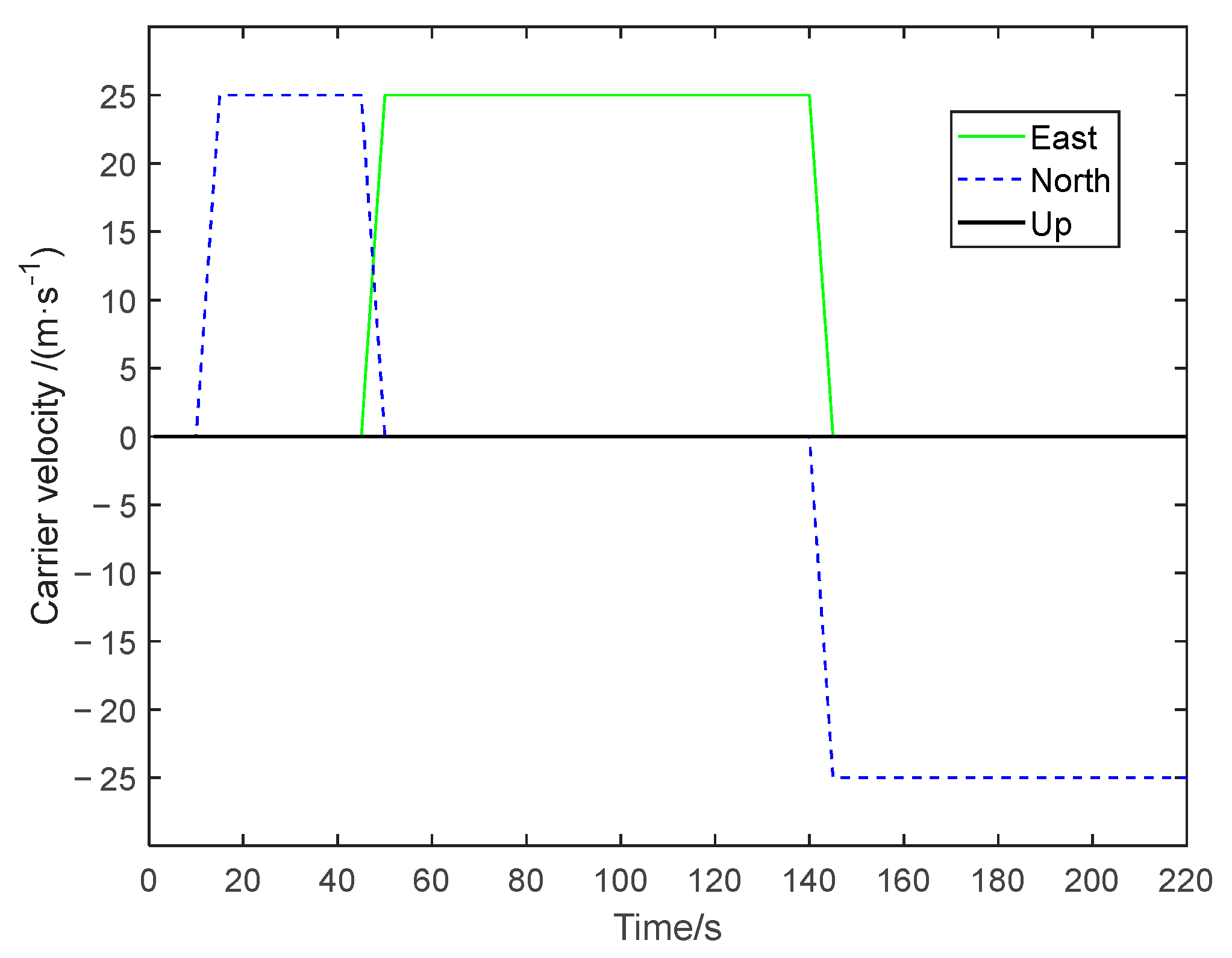
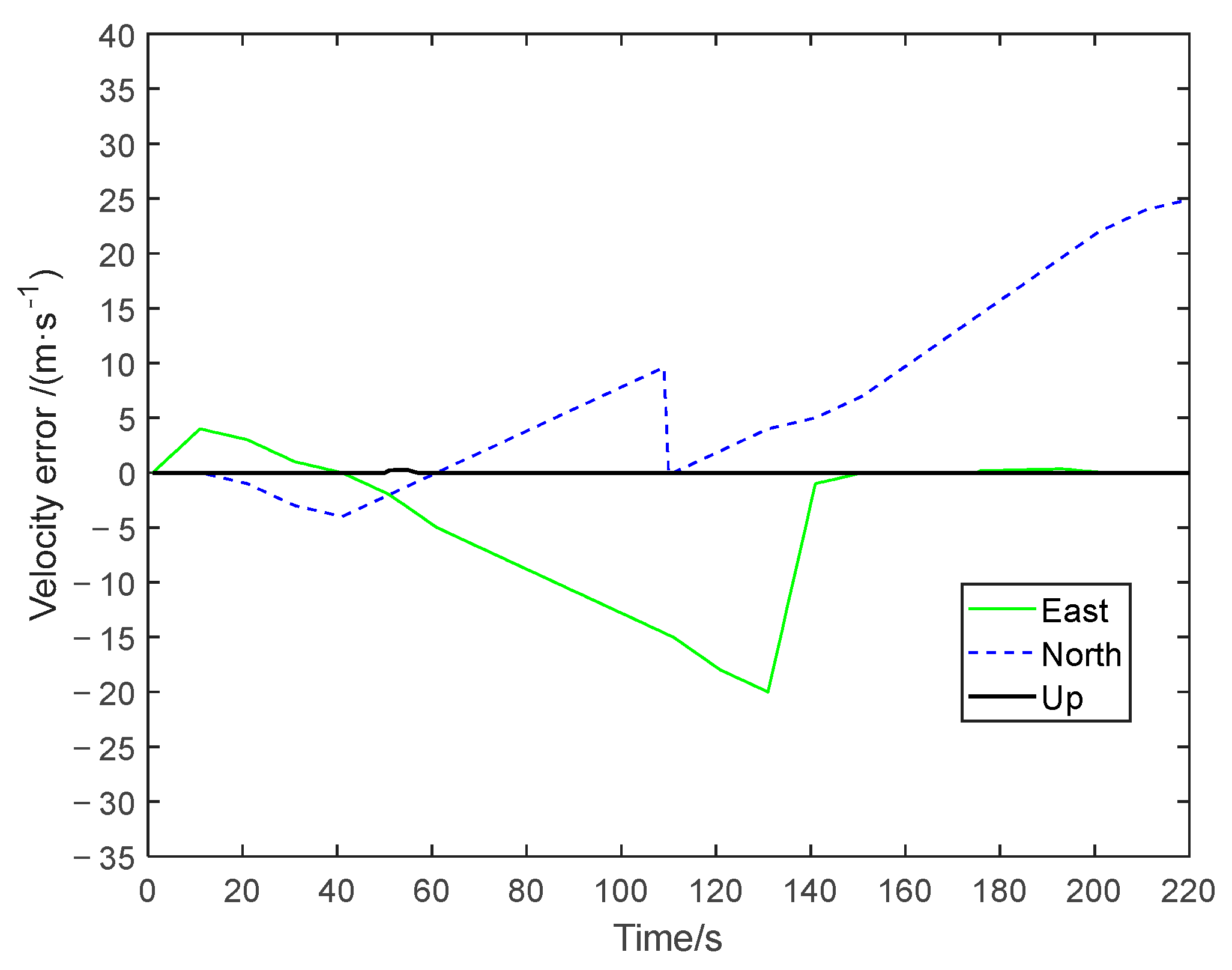
Figure 3 and Figure 4 illustrate the vehicle’s velocity variation and the cumulative distribution of INS errors in the East-North-Up (ENU) coordinate system during GNSS signal interruption, respectively. It can be observed that as time progresses, lateral and axial errors are gradually suppressed, and the direction of accumulated velocity errors remains consistent with the velocity direction. Further analysis indicates that only forward velocity errors accumulate, and they are in the same direction as the velocity vector. Given the initial velocity direction, the unit vector of the velocity error at any time can be derived.
The relative motion between satellites and the carrier causes a Doppler shift in the carrier frequency received by the GNSS receiver. The INS calculates a predicted carrier Doppler shift f d based on the computed carrier velocity to assist the GNSS receiver’s tracking loop. The calculation process of f d is shown in Equations (7) and (8):
f d = v i n s v s I l o s λ
I l o s = P s P i n s P s P i n s
where λ is the carrier wavelength, P i n s and v i n s are the carrier position and velocity calculated by the INS, P s and v s are the satellite position and velocity, and I l o s represents the unit vector of the line of sight (LOS) between the satellite and the carrier. Equation (7) can be rewritten as the difference between the Doppler shift predicted by the INS and the actual Doppler shift generated by satellite motion:
f d = f i n s f s
where f i n s and f s denote the Doppler values predicted by the INS and generated by satellite motion, respectively.
The carrier velocity v i n s calculated by the inertial navigation system consists of the actual velocity v r and the error δ v :
v i n s = v r + δ v  
Combining Equations (9) and (10), we can obtain:
f d =   v r   v s λ I l o s   + δ v     I l o s λ =   f p r e +   δ f
δ f = δ v     I l o s λ
where f p r e denotes the actual Doppler frequency, and δ f is the Doppler frequency error.
The absolute value of the Doppler frequency error δ f can be expressed as:
δ f = δ v I l o s c o s θ λ
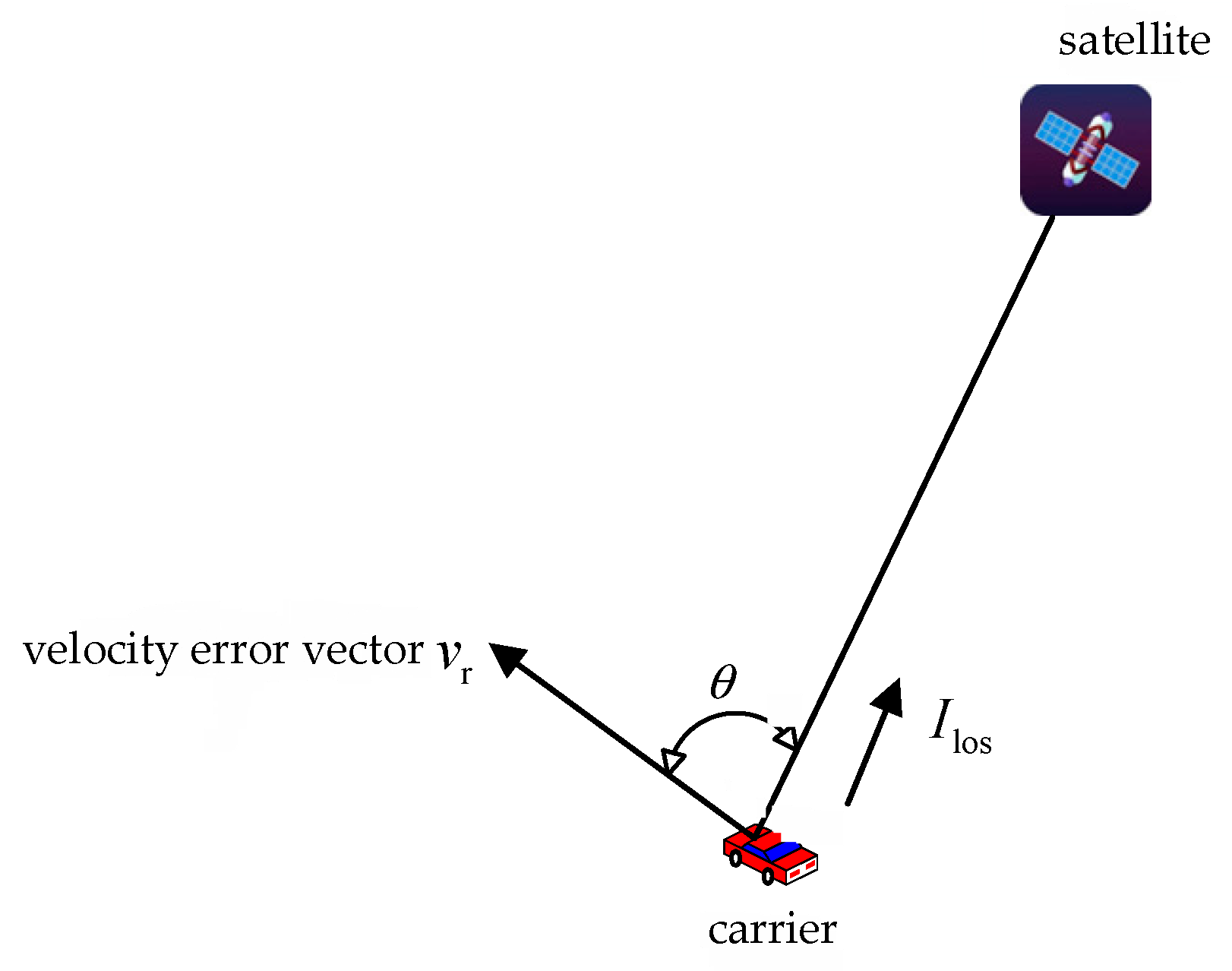
Here, θ is the angle between the velocity error vector v r and I l o s , and the value of θ ranges from 0° to 90°, as shown in Figure 5. Equation (13) shows that the larger the angle θ , the smaller the absolute value of the Doppler frequency error δ f , and the easier it is to recover tracking of the lost satellite channel. Once the first satellite channel is tracked again, the velocity error calculated by the inertial navigation system and the frequency errors of other lost channels can be calculated, as shown in Equation (14).
δ f 1 λ cos θ 1 = δ v = δ f 2 λ cos θ 2
where θ 1 and θ 2 are the angles between the I l o s of two different satellites and the inertial navigation velocity error vector v r , respectively, and δ f 1 and δ f 2 are the corresponding frequency errors.
According to Equation (14), once the first satellite resumes tracking, frequency error compensation can be performed on other lost satellite channels to increase the probability of resuming tracking of other lost satellite channels.

3. GNSS Autonomous Integrity Monitoring Methods

Among various methods for GNSS receiver autonomous integrity monitoring, the RAIM algorithm based on least squares residuals has become an important technical means to ensure navigation system safety due to its clear principles, stable implementation, and low computational cost [29,30]. This section elaborates on the theoretical basis, implementation process, and availability judgment method of this algorithm.

3.1. Fault Satellite Detection and Identification Based on Least Squares Residual Method

Linearizing the model that uses the receiver’s pseudorange as the observation quantity, it can be expressed as follows:
Y = G X + ε
In the formula, X is a 4 × 1 dimensional user state vector, including the position vector in three directions and one receiver clock error; Y is an n × 1 dimensional vector composed of pseudoranges from the corresponding n visible satellites; G is an n × 4 dimensional observation matrix; ε is an n × 1 dimensional measurement noise. ε is the observation random error following a normal distribution, with a mean of 0 and a variance of σ 0 2 . Therefore, the least squares solution for X can be obtained:
X ^ = G T G 1 G T Y ,   Y ^ = G X ^
The difference between the predicted value Y ^ and the actual observed value Y is used to obtain the pseudorange residual vector v :
v = Y Y ^ = I G G T G 1 G T ε =   Q v ε
Here, matrix Q v is called the pseudorange residual factor matrix. v contains satellite ranging error information and can be used as a basis for fault detection. Its posterior weighted mean square error statistic σ ^   can be expressed as:
σ ^ = v T v / ( n 4 ) = S S E / ( n 4 )
In Equation (18), σ ^   can be obtained from the sum of squares of the pseudorange residuals. When there is no fault in the system, the pseudorange residuals are small, and the posterior weighted mean error σ ^ is also small. If a fault occurs somewhere in the system, causing a large deviation in the pseudorange residuals, then σ ^ will also increase accordingly. Here we assume that the components of the pseudorange error ε are independent of each other and all follow a normal distribution with a mean of 0 and a variance of σ 0 2 . Then S S E / σ 0 2 follows a χ 2 distribution with n 4 degrees of freedom. If the pseudorange error components include faults, then S S E / σ 0 2 follows a non-centralized χ 2 distribution with n 4 degrees of freedom. Let λ be its non-centralization parameter, then we have:
λ = E ( S S E ) / σ 0 2
Based on this, we make the following binary assumption:
Fault-free assumption: H 0 : E ε = 0 , then:
S S E / σ 0 2 ~ χ 2 ( n 4 )
Assuming a fault exists: H 1 : E ε 0 , then:
S S E / σ 0 2 ~ χ 2 ( n 4 , λ )
When the system is fault-free, the pseudorange residual value is a small amount, and the system should be in a fault-free state. If the system alarms the user under these conditions, it is a false alarm. Given the false alarm rate P f a , we have [29]:
P r S S E / σ 0 2 < T 2 = 0 T 2 f χ 2 n 4 ( x ) d x = 1 P f a
The monitoring limit T of S S E / σ 0 2 is obtained from the above formula. Then the detection limit of the unit weighted mean square error σ ^ is
σ r = σ 0 × T / n 4
It can be seen that the threshold value σ r is only related to the pre-given false alarm rate P f a . During navigation calculation, the real-time calculated σ ^ is compared with the threshold value σ r . When σ ^ > σ r , it indicates that the system has detected a fault.
The system’s fault identification method uses the Balda data probing method, which constructs a test statistic based on the least squares residual vector. The presence of outliers in the residuals is determined by testing this statistic [30]. Let the test statistic d i be:
d i = | v i | σ 0 Q v i i
Make a binary hypothesis for the test statistic d i :
Fault-free assumption: H 0 : E ε = 0 , then:
d i ~ N ( 0 , 1 )
Assuming a fault exists: H 1 : E ε 0 , then:
d i ~ N ( δ i , 1 )
where δ i is the offset parameter of d i , and let b i be the pseudorange deviation of the i-th satellite, then:
δ i = Q v i i b i / σ 0
Given the false alarm rate P f a , the false alarm rate for each statistic is P f a / n , and the detection threshold T d can be obtained from Equation (28).
P r d > T d = 2 2 π T d e x 2 2 d x = P f a / n
where P r d > T d is the probability that the detection statistic is larger than the detection threshold; e x 2 2 / 2 π is the probability of a standard normal distribution.
Compare the detection statistics d i corresponding to the i-th satellite with the threshold T d . If d i > T d , it indicates that the i-th satellite has been identified as faulty and should be isolated when calculating the navigation solution.

3.2. Availability Assessment

Effective implementation of the RAIM algorithm requires two basic conditions: a sufficient number of satellites and a good geometric configuration [31,32]. Typically, fault detection requires at least 5 visible satellites, while fault identification requires more than 6. When the satellite geometric distribution is poor, even if the number meets the requirements, it is difficult to guarantee the reliability of the integrity monitoring algorithm. Therefore, the availability of the algorithm needs to be judged before implementing the RAIM algorithm.
In this paper, the Horizontal Protection Level (HPL) is used as the metric for assessing the availability of the integrity monitoring algorithm [31]:
H P L = S L O P E m a x × σ 0 × λ
where S L O P E m a x denotes the maximum slope value of visible satellites. S L O P E m a x is the core parameter used to calculate protection level HPL, reflecting the amplification of satellite geometry to positioning error. The calculated HPL value is compared with a preset Horizontal Alarm Limit (HAL). If H P L < H A L , the algorithm is considered available; otherwise, it is deemed unavailable. This judgment mechanism ensures the reliability of the GNSS integrity monitoring algorithm in complex environments.
Systematic implementation of the above methods enables rapid detection and accurate identification of GNSS faults, ensuring navigation safety. Figure 6 presents a flowchart of the inertial navigation-assisted GNSS integrity monitoring algorithm.

4. Simulation Analysis

To systematically evaluate the performance of inertial navigation-assisted GNSS signal tracking in urban obstructed environments, this study simulated a 300 s vehicle trajectory and simultaneously collected corresponding INS observation data. Simulation environment parameters were configured as shown in Table 1 to ensure consistent experimental conditions. A satellite navigation signal simulator was used to generate intermediate frequency (IF) navigation signals at the GPS L1 frequency. The number of visible satellites was set to 10, and the simulated signal was completely interrupted between 20 and 100 s to replicate long-term signal loss scenarios in urban obstructed environments. It can be seen from Figure 2 that the heading angle error does not exceed 1° within 80 s of satellite signal interruption under the constraint of kinematic information. A high-speed data acquisition device was employed to sample the simulated IF signals, yielding discrete IF data. Simulation experiments were conducted using the collected data to verify the performance of the proposed inertial navigation-assisted GNSS autonomous integrity monitoring algorithm.

4.1. Integrity Monitoring Algorithm Availability Verification

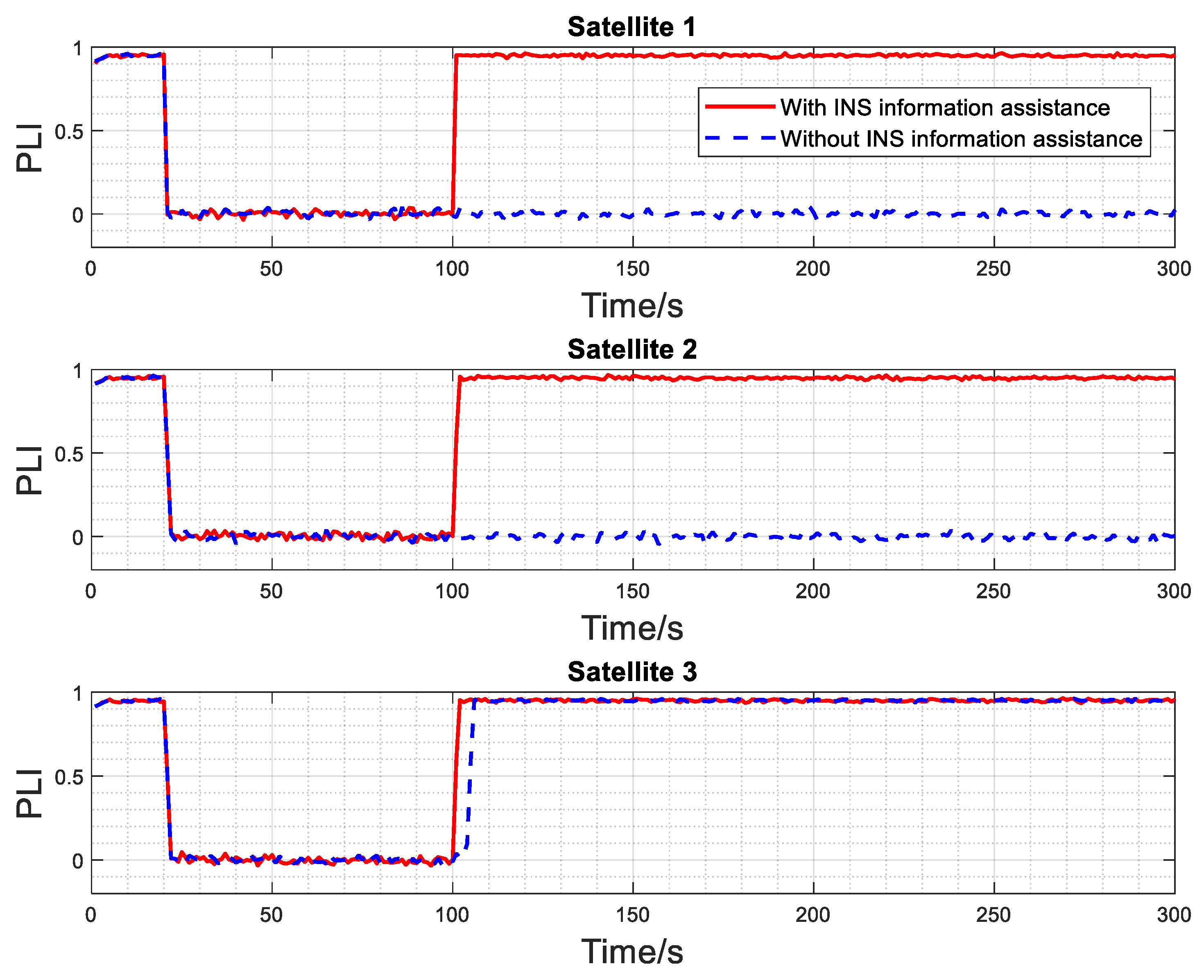
To quantify signal tracking performance, a phase locking index (PLI) is introduced into the signal tracking loop as an evaluation metric [33]. Typically, the approximate expression for PLI can be expressed according to Equation (30):
P L I c o s ( 2 δ φ )
where δ φ denotes the carrier phase error of the satellite signal tracking loop. As indicated by the equation, PLI ranges from −1 to 1. A PLI value of 1 indicates optimal satellite signal tracking.
Figure 7 shows the PLI values of Satellites 1, 2, and 3 over 300 s, with satellite signals interrupted between 20 and 100 s. The figure demonstrates that the PLI values of satellite signals assisted by inertial navigation information rapidly approached 1 after 100 s, indicating that Satellites 1, 2, and 3 successfully regained stable tracking. In contrast, satellites without inertial navigation assistance exhibited poor tracking performance after signal recovery: Satellites 1 and 2 failed to re-lock the signal, and Satellite 3 recovered more slowly than those with assistance.
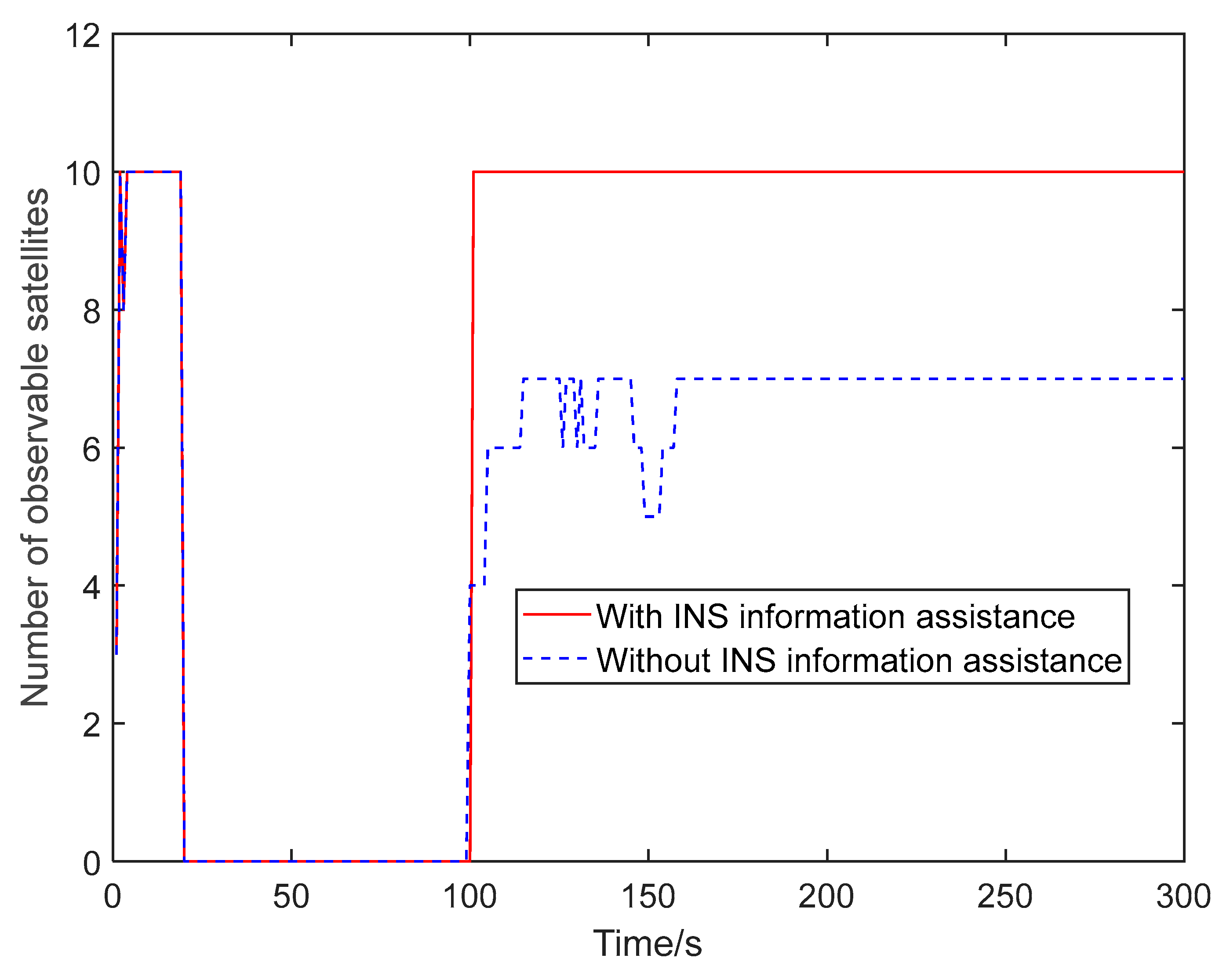
The locking threshold of the phase locking factor PLI was set to 0.9 to determine whether the satellite channel was lost and to count the change in the number of normally tracked satellites. The results are shown in Figure 8.
As illustrated in Figure 8, with inertial navigation assistance, all 10 satellites maintained stable tracking after signal recovery. In contrast, the GNSS receiver without inertial navigation assistance could only recover tracking of 7 satellites. Seven satellites can also meet the basic redundancy requirements of RAIM (support fault detection and identification), and meet the actual number of satellites recovered in urban occlusion scenarios. Following an 80 s satellite signal interruption, the number of usable satellites increased from 7 to 10 with inertial navigation assistance, significantly improving the information redundancy of the GNSS integrity monitoring algorithm. This is particularly suitable for obstructed environments such as urban canyons and tunnels, ensuring the continuity and safety of the navigation system.
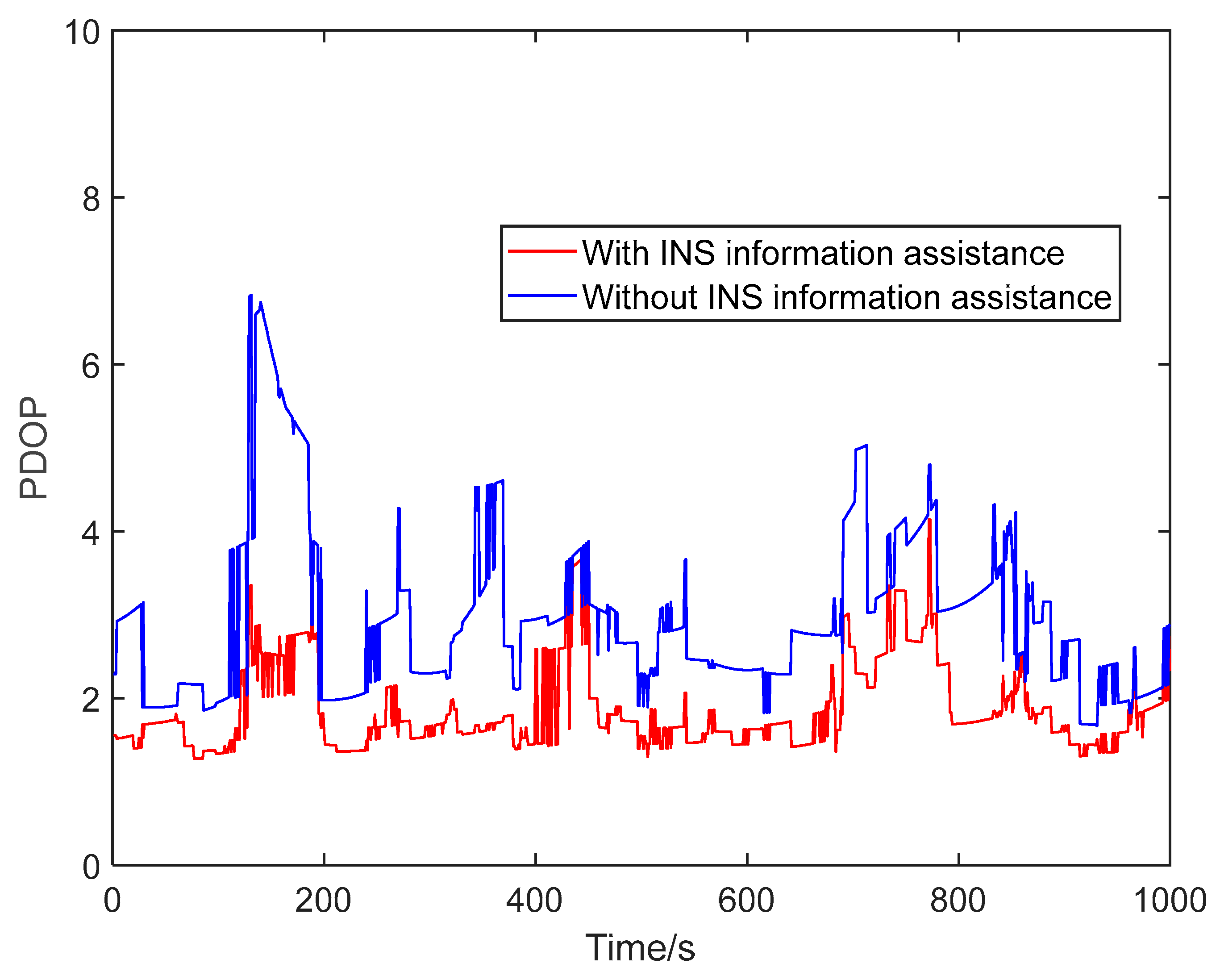
To verify the effect of inertial navigation assistance on improving the availability of the integrity monitoring algorithm, two sets of 1000 s satellite signals were generated using a GNSS signal simulator under the parameters in Table 1. The number of visible satellites was set to 7 (without inertial navigation assistance) and 10 (with inertial navigation assistance), respectively. Figure 9 presents a comparison of Position Dilution of Precision (PDOP) curves under the two conditions.
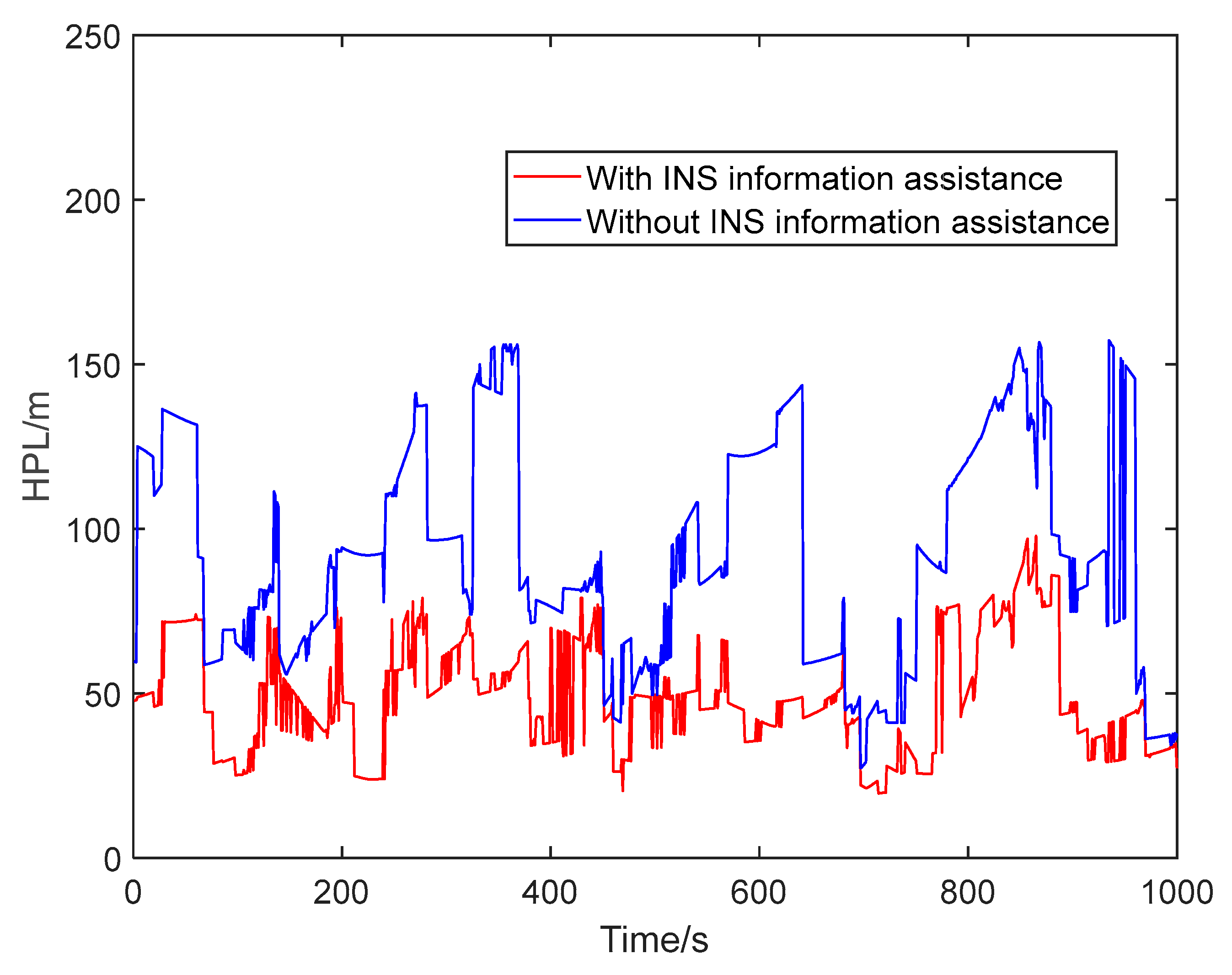
As shown in the figure, PDOP values for the 10 satellites with inertial navigation assistance were consistently lower than those for the 7 satellites without assistance. This indicates that inertial navigation assistance effectively optimizes satellite geometry, thereby improving the availability of the GNSS integrity monitoring algorithm. Figure 10 presents a comparison of HPL values before and after inertial navigation assistance.
As illustrated, HPL values fluctuated between 19.6 m and 97.8 m with INS assistance, compared to 28.3 m to 156.7 m without assistance. Furthermore, HPL values with INS assistance were consistently lower than those without assistance. When the HAL was set to 80 m, the algorithm availability with INS assistance reached 95.7%, compared to only 42% without assistance. These results demonstrate the superior effectiveness of the GNSS integrity monitoring algorithm with INS assistance.

4.2. Fault Detection and Identification

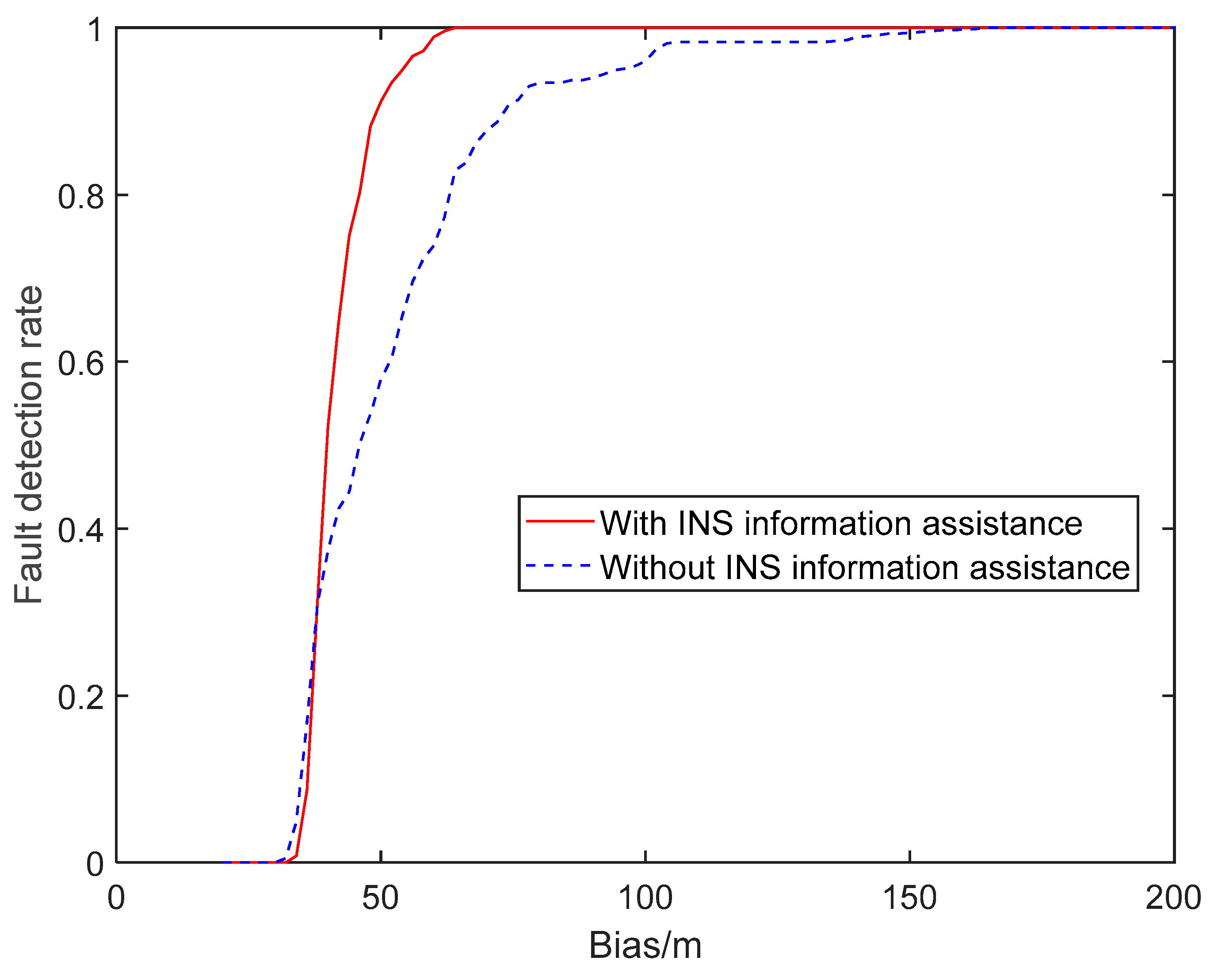
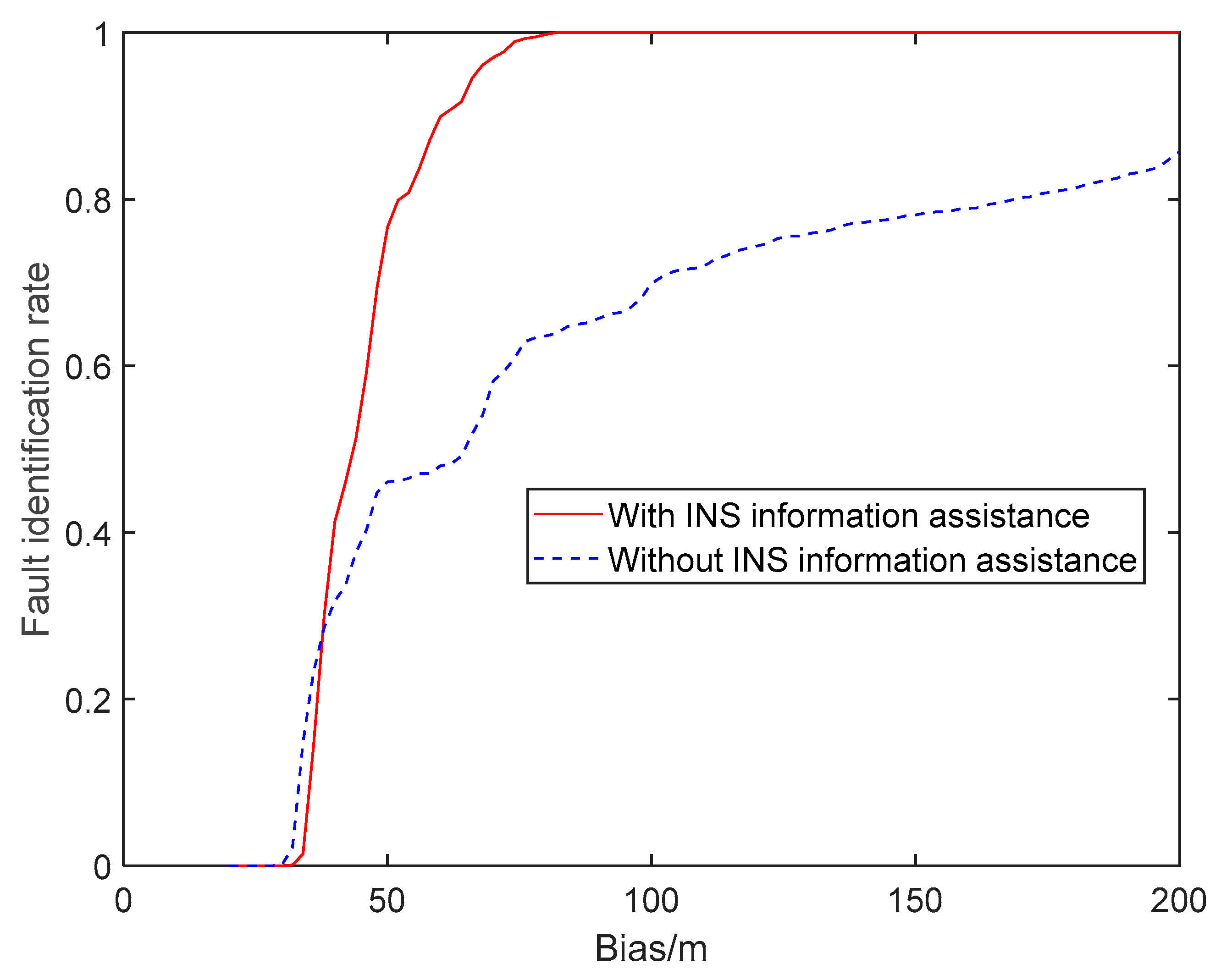
Satellite fault detection and identification were verified using simulated data under fault-free conditions. Pseudorange biases were artificially injected to simulate satellite faults, and the performance of the inertial navigation-assisted GNSS integrity monitoring algorithm was evaluated. The false alarm rate was set to P f a = 1 × 10 6 , the missed alarm rate to P m d = 1 × 10 6 , and the pseudorange error variance to σ 0 = 5   m . Simulation analysis of fault detection and identification rates was conducted using the two sets of 1000 s satellite navigation data generated in Section 4.1. Pseudorange biases ranging from 20 m to 200 m were injected into Satellite 5; the simulation results are shown in Figure 11 and Figure 12.
As shown in the figures, when the pseudorange bias reached 82 m, both the fault detection and identification rates of the algorithm with inertial navigation assistance reached 100%. In contrast, without assistance, pseudorange biases of 164 m and 200 m were required to achieve a 100% fault detection rate and an 85.7% fault identification rate, respectively. This indicates that the GNSS integrity monitoring algorithm with inertial navigation assistance exhibits superior satellite fault detection and identification performance.

5. Conclusions

This paper proposes a constrained inertial navigation-assisted GNSS autonomous integrity monitoring algorithm, enabling real-time and accurate detection of satellite navigation system faults in urban obstructed environments. This improves the positioning reliability of GNSS/INS deep integrated navigation systems in urban settings.
When satellite signals are interrupted for extended periods due to tall buildings or tunnel environments, INS assistance can quickly restore tracking of multiple satellites, increasing the number of available satellites. Consequently, INS assistance directly enhances the information redundancy and availability of the GNSS integrity monitoring algorithm, which uses the least squares RAIM algorithm to detect and identify faulty satellites.
Based on simulated data generated by a satellite signal simulator, the algorithm’s performance was verified in terms of availability, fault detection, and fault identification capabilities. Simulation results show that with INS assistance, the GNSS integrity monitoring algorithm exhibits superior availability, achieving 100% satellite fault detection and identification rates even with relatively small pseudorange biases.
It should be noted that this study has certain limitations. Firstly, the current performance verification is based on simulated data, lacking field tests in real urban canyon scenarios, and has not fully incorporated practical interference factors such as multipath effects and NLOS propagation that exist in real environments. Secondly, the research mainly focuses on the integration of GPS single system and INS, and has not explored the integration potential with other satellite navigation systems, leaving room for optimization in multi-system collaborative performance.
In conclusion, the proposed INS-assisted GNSS integrity monitoring algorithm effectively improves navigation and positioning performance in urban obstructed environments, providing a solid guarantee for driving safety.

Author Contributions

Conceptualization, J.Z. and Z.F.; methodology, J.Z.; software, J.Z. and J.Y.; validation, J.Z. and Z.F.; data curation, J.Z.; writing—original draft preparation, J.Z.; writing—review and editing, Z.F.; visualization, J.Z.; funding acquisition, Z.F. All authors have read and agreed to the published version of the manuscript.

Funding

This research was funded by Strategic Priority Research Program of the Chinese Academy of Sciences, grant number XDA0350403.

Data Availability Statement

Data are contained within the article.

Acknowledgments

We are grateful to everyone for their constructive suggestions for improving the manuscript.

Conflicts of Interest

The authors declare no conflicts of interest.

Abbreviations

The following abbreviations are used in this manuscript:
GNSSGlobal Navigation Satellite System
INSInertial Navigation System
NHCNon-holonomic Constraint
LOSLine of Sight
NLOSNo Line of Sight
RAIMReceiver Autonomous Integrity Monitoring
HPLHorizontal Protection Level
HALHorizontal Alarm Limit
PLIPhase Locking Index
IFIntermediate Frequency
NCONumerically Controlled Oscillator
GPSGlobal Positioning System

References

  1. Yang, M.; Wang, Y.; Fang, Z.; Chen, J.; Liu, Y.; Lei, M.; Xu, Y. A Novel Doppler Estimation Approach Using ORBCOMM Signals for High-Precision Positioning. Electronics 2024, 13, 4882. [Google Scholar] [CrossRef]
  2. Zhao, L.; Lei, M.; Liu, Y.; Wang, Y.; Ge, J.; Guo, X.; Fang, Z. LEO-SOP Differential Doppler/INS Tight Integration Method Under Weak Observability. Electronics 2025, 14, 250. [Google Scholar] [CrossRef]
  3. Xu, Y.; Liu, Y.; Lei, M.; Gao, M.; Fang, Z.; Jiang, C. Joint pseudo-range and Doppler positioning method with LEO Satellites‘ signals of opportunity. Satell. Navig. 2025, 6, 10. [Google Scholar] [CrossRef]
  4. Lei, M.; Liu, Y.; Gao, M.; Fang, Z.; Chen, J.; Xu, Y. Robust Helmert Variance Component Estimation for Positioning with Dual-Constellation LEO Satellites’ Signals of Opportunity. Electronics 2025, 14, 3437. [Google Scholar] [CrossRef]
  5. Yan, J.; Fang, Z.; Sun, R.; Gao, M.; Mao, Y.; Jiang, C.; Xu, Y. ARAIM Protection Level Optimization Based on Feedback-Structure Subset Grouping. IEEE Sens. J. 2025, 25, 11823–11838. [Google Scholar] [CrossRef]
  6. Chen, X. Research on GNSS Receiver Autonomous Integrity Monitoring Technology. Master’s Thesis, Nanjing University of Aeronautics and Astronautics, Nanjing, China, 2016. [Google Scholar]
  7. Viveiros, I.; Silva, H.; Andrade, Y.; Pendão, C. Smart GNSS Integrity Monitoring for Road Vehicles: An Overview of AI Methods. IEEE Access 2025, 13, 20278–20296. [Google Scholar] [CrossRef]
  8. Zheng, X.; Xu, C.; Wang, Y.; Zou, H.; Lv, X.; Zhao, S.; Shi, Y.; Shu, Q. A Dynamic-Data-Driven Method for Improving the Performance of Receiver Autonomous Integrity Monitoring. IEEE Access 2021, 9, 55833–55843. [Google Scholar] [CrossRef]
  9. Ban, Y.L. Research on the High Dynamic Tracking Technology of GNSS/INS Deep Integration. Ph.D. Thesis, Wuhan University, Wuhan, China, 2016. [Google Scholar]
  10. Shao, Q.; Liu, X.; Cheng, X.; Yu, H.; Li, X. Self-Aided Navigation Strategy: An Underwater Integrated Navigation Algorithm Based on INS and Trajectory Constraints. IEEE/ASME Trans. Mechatron. 2025. early access. [Google Scholar] [CrossRef]
  11. Lou, N.Y.; Liu, W.; Hu, Y.; Wang, S.Z.; Hsieh, T.-H.; Han, B. The robust ultra-tightly coupled integrated navigation optimization method based on deep learning for USV. Measurement 2026, 266, 120512. [Google Scholar] [CrossRef]
  12. Gao, W.; Yang, R.; Huang, J.; Zhan, X. Quasi-Deep Integration for DPE/INS in GNSS Navigation Domain: Framework Design and Optimization. IEEE Trans. Aerosp. Electron. Syst. 2025, 61, 6774–6793. [Google Scholar] [CrossRef]
  13. Sun, J.R.; Meng, F.C.; Wang, D.Y. Code phase fault diagnosis and reconstitution algorithm of SINS/GNSS deeply integrated navigation. J. Chin. Inert. Technol. 2023, 31, 563–568. [Google Scholar]
  14. Zhao, T.D. Research on the Fault Detection and Exclusion Technology of Deep Coupled Based on Vector Tracking. Ph.D. Thesis, China Academy of Launch Vehicle Technology, Beijing, China, 2021. [Google Scholar]
  15. Wang, W.T. The Vector Tracking Based Ultra-Tightly Coupled Navigation System and Its Autonomous Integrity Monitoring. Master’s Thesis, Beijing Institute of Technology, Beijing, China, 2018. [Google Scholar]
  16. Li, Y.; Tang, W.; Deng, C.; Zou, X.; Zhang, S.; Li, Z.; Wang, Y. Integrity Monitoring for BDS/INS Real-Time Kinematic Positioning Between Two Moving Platforms. Remote Sens. 2025, 17, 2766. [Google Scholar] [CrossRef]
  17. Cappello, G.; Gioia, C.; Angrisano, A.; Del Pizzo, S.; Portelli, G.; Gaglione, S. Reliability of Smartphone Positioning in Harsh Environment. Eng. Proc. 2023, 54, 44. [Google Scholar] [CrossRef]
  18. Angrisano, A.; Gaglione, S. Smartphone GNSS Performance in an Urban Scenario with RAIM Application. Sensors 2022, 22, 786. [Google Scholar] [CrossRef]
  19. Wang, Z.; Liu, J.; Jiang, J.; Wu, J.; Wang, Q.; Liu, J. An Adaptive Combined Filtering Algorithm for Non-Holonomic Constraints with Time-Varying and Thick-Tailed Measurement Noise. Remote Sens. 2025, 17, 1126. [Google Scholar] [CrossRef]
  20. Xu, Y.; Wang, K.; Jiang, C.; Li, Z.; Yang, C.; Liu, D.; Zhang, H. Motion-Constrained GNSS/INS Integrated Navigation Method Based on BP Neural Network. Remote Sens. 2023, 15, 154. [Google Scholar] [CrossRef]
  21. Guo, M.; Wang, B.; Wei, L.; Zhang, M.; Zhang, C.; Lu, H. Robust INS/GNSS/DVL Integrated Navigation for MASS Based on Gradient-Adaptive Factor Graph Optimization. Electronics 2026, 15, 634. [Google Scholar] [CrossRef]
  22. Qiu, H.; Zhao, Y.; Wang, H.; Wang, L. A Study on Graph Optimization Method for GNSS/IMU Integrated Navigation System Based on Virtual Constraints. Sensors 2024, 24, 4419. [Google Scholar] [CrossRef]
  23. Xu, Y.L. Research on Vector Tracking Technology in Navigation Signal. Master’s Thesis, Hebei University of Science and Technology, Shijiazhuang, China, 2023. [Google Scholar]
  24. Jing, C.; Huang, G.; Zhang, Q.; Li, X.; Bai, Z.; Du, Y. GNSS/Accelerometer Adaptive Coupled Landslide Deformation Monitoring Technology. Remote Sens. 2022, 14, 3537. [Google Scholar] [CrossRef]
  25. Zhang, T.S. Research on the Tracking Technology of GNSS/INS Deep Integration Based on Hardware Prototype. Ph.D. Thesis, Wuhan University, Wuhan, China, 2013. [Google Scholar]
  26. Hu, R. Research and Realization of SINS-Aided GPS Deeply Integrated Navigation System. Ph.D. Thesis, Nanjing University of Science & Technology, Nanjing, China, 2010. [Google Scholar]
  27. Ma, H.Y.; Cheng, P.F.; Huang, H.D. Research on the complete integrated GPS/INS navigation system of position velocity and attitude. Bull. Surv. Mapp. 2016, 3, 10–14. [Google Scholar]
  28. Dong, P. Research on Improving Accuracy of SINS/GNSS Integrated Navigation System Under Abnormal Measurement Signals. Ph.D. Thesis, Harbin Engineering University, Haerbin, China, 2021. [Google Scholar]
  29. Ma, X.; Montillet, J.-P.; He, X. Equivalence Proof and Performance Analysis of Weighted Least Squares Residual Method and Weighted Parity Vector Method in RAIM. IEEE Access 2019, 7, 97803–97814. [Google Scholar] [CrossRef]
  30. Wang, W.; Xu, Y. A Modified Residual-Based RAIM Algorithm for Multiple Outliers Based on a Robust MM Estimation. Sensors 2020, 20, 5407. [Google Scholar] [CrossRef] [PubMed]
  31. Li, Z.; Fan, L.; Zou, D.; Tu, R.; Zhang, R.; Han, J.; Wang, S.; Dong, R. RAIM Availability of GPS/BDS/Galileo Multi-Frequency Combination. Gyroscopy Navig. 2025, 16, 159–173. [Google Scholar] [CrossRef]
  32. Li, R.; Li, L.; Li, M.; Cheng, L.; Wang, L.; Zhang, J. Integrity-directed fault exclusion based on maximum a posteriori probability for multi-constellation advanced RAIM. GPS Solut. 2025, 29, 99. [Google Scholar] [CrossRef]
  33. Peng, H.; Dai, W.J.; Yu, W.K.; Pan, L.; Zheng, B. Quality analysis of GNSS observations and phase lock detector. J. Navig. Position. 2022, 10, 115–123. [Google Scholar]
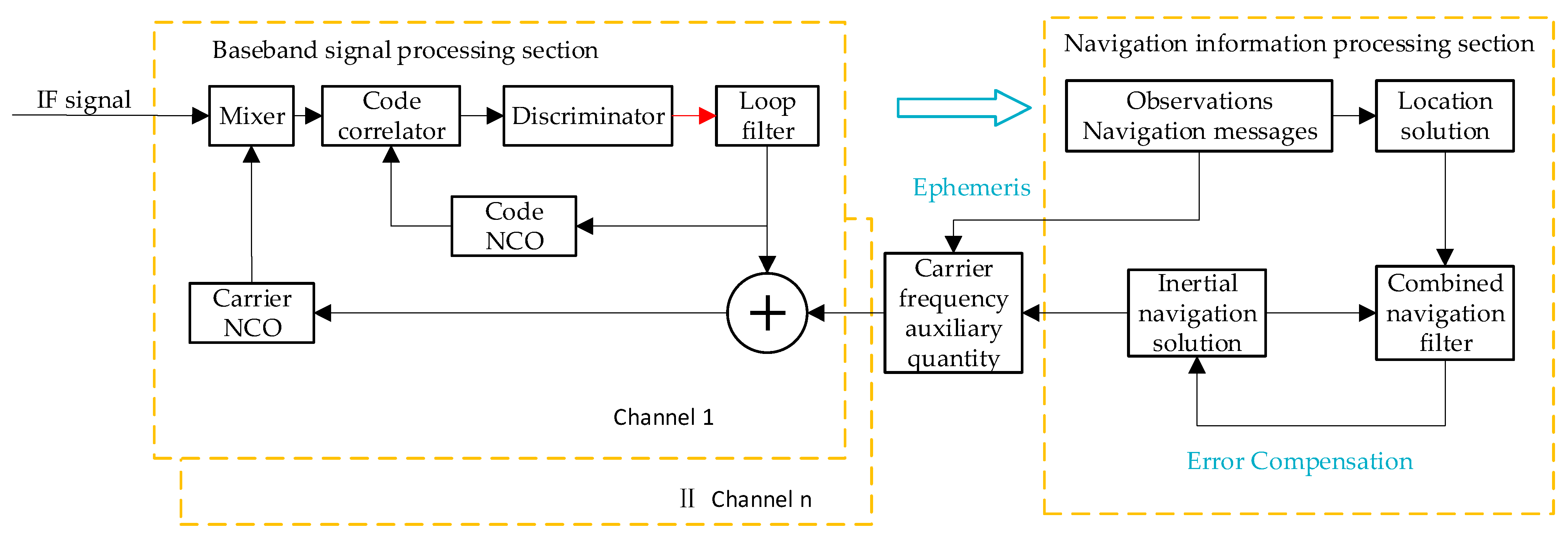
Figure 1. Block diagram of inertial navigation-assisted GNSS receiver.
Electronics 15 01333 g001
Figure 2. Variation in heading angle error under kinematic constraints.
Electronics 15 01333 g002
Figure 3. Velocity change in the ENU direction.
Electronics 15 01333 g003
Figure 4. Velocity error with kinematic constraints applied.
Electronics 15 01333 g004
Figure 5. Schematic diagram of the angle between the velocity error vector v r and I l o s .
Electronics 15 01333 g005
Figure 6. Flowchart of inertial navigation-assisted GNSS integrity monitoring algorithm.
Electronics 15 01333 g006
Figure 7. Changes in PLI values of satellite tracking channels 1, 2, and 3.
Electronics 15 01333 g007
Figure 8. Changes in the number of observable satellites.
Electronics 15 01333 g008
Figure 9. PDOP curve comparison.
Electronics 15 01333 g009
Figure 10. HPL curve comparison.
Electronics 15 01333 g010
Figure 11. Comparison of fault detection rates.
Electronics 15 01333 g011
Figure 12. Comparison of fault identification rate.
Electronics 15 01333 g012
Table 1. Simulation environment parameters.
Performance ParametersParameter Value
gyroscope zero bias 300 ° h 1
accelerometer zero bias 10 5   m s 2
angle random walk 1 ° h 1 2
velocity random walk 10   m s 1 h 1 2
carrier frequency f 1575.42   M H z
intermediate frequency f I F 4   M H z
sampling frequency f s 15   M H z
coherent integration time T c o h 1   m s
noise bandwidth B L 15   H z
Disclaimer/Publisher’s Note: The statements, opinions and data contained in all publications are solely those of the individual author(s) and contributor(s) and not of MDPI and/or the editor(s). MDPI and/or the editor(s) disclaim responsibility for any injury to people or property resulting from any ideas, methods, instructions or products referred to in the content.