1. Introduction
The modular multilevel converter with excellent voltage construction and frequency active support capability has become a key technical carrier for offshore wind power delivery. However, due to the randomness and volatility of offshore wind power output, in actual operation, it is often accompanied by power fluctuations and deloading, and other working conditions [
1,
2]. Previous studies have shown that the arm current [
3], energy distribution, and sub-module capacitor voltage characteristics of MMC are closely related to the power operating conditions. When the power transmission conditions change, the operating point of the MMC will migrate accordingly, resulting in significant changes in the instantaneous power and energy distribution of the arm, and changes in the sub-module capacitor voltage characteristics. Although significant progress has been made in data-driven MMC fault diagnosis methods [
4], there is still a clear gap in the study of time-varying drift scenarios for deloading conditions of offshore wind farms. The existing research mainly has the following three limitations:
First, the mainstream deep learning model is difficult to balance the engineering requirements of high precision and lightweight [
5]. Represented by a convolutional neural network CNN [
6] and long short-term memory network LSTM [
7], although high-precision end-to-end diagnosis is achieved through automatic feature extraction, its large number of parameters and complex matrix operation logic bring huge computational overhead.
Second, most of the existing models are based on the assumption of static distribution and lack adaptive ability to dynamic condition drift [
8]. Most of the existing algorithms assume that the training set and the test set are independent and identically distributed. Reference realized fault identification and location by comparing the deviation between the predicted value and the measured value [
9]. When the power fluctuation or unloading causes the MMC to change rapidly, the arm current, sub-module capacitor voltage, and internal power are susceptible to unstable disturbances. These disturbances primarily stem from the complex overlap between
transients and the dynamic adjustments of the internal control loops. Although the literature alleviates the problem of changes in working conditions to a certain extent through transfer learning [
10], most of them rely on offline domain adaptation and cannot update the model in real time through online incremental learning, resulting in a significant decrease in the generalization ability of the model over time.
In addition, class imbalance and weak feature problems under deloading conditions are often ignored. In this context, the unsteady operation process will further affect the stability of the internal electrical characteristics of MMC. The amplitude of the bridge arm current decreases and converges to similar patterns, so that the difference in voltage characteristics between the fault sub-module and the healthy sub-module is significantly weakened. When operating at low power, the fault characteristics are easily submerged by noise, and the fault samples are extremely scarce [
11]. The traditional methods based on resampling or loss weighting fail to fully consider the physical particularity of deloading conditions, resulting in a high missed detection rate of open-circuit faults.
Although the existing deep learning models perform well under conventional conditions, they often suffer from severe accuracy degradation due to weak features in active unloading scenarios, and the time cost of retraining is extremely high. In contrast, by introducing WPD-PCA for physical denoising and combining XGBoost ‘s incremental learning mechanism, the proposed framework theoretically breaks through the bottleneck of traditional static models that are difficult to adapt to the continuous drift of working points.
Therefore, it is urgent to study a kind of adaptive fault location method that can not only adapt to the dynamic condition drift of offshore wind power with incremental learning ability, but also meet the lightweight requirement. Therefore, this paper proposes a lightweight MMC open-circuit fault location method for deloading operation of offshore wind farms and verifies the correctness of the proposed method under steady-state and deloading conditions in MATLAB/Simulink platform.
The main contents are as follows.
(1) The operating point drift law of MMC fault characteristics under the deloading condition of offshore wind power is revealed. Aiming at the problem that the large fluctuation and reversal of offshore wind power lead to the non-stationarity and noise inundation of MMC open-circuit fault characteristics, the correlation mechanism between the active offloading operation of offshore wind farms and the stable and transient characteristics of MMC is explored.
(2) A deloading fault feature enhancement and decoupling method based on WPD-PCA is proposed. Aiming at the problem that the fault impact is easily masked by the working condition disturbance and noise in the weak power grid with a low signal-to-noise ratio, the time-frequency localization capability of the wavelet packet decomposition method is used to accurately extract the fault energy characteristics and realize the frequency domain decoupling of the fault signal and the working condition fluctuation. In order to achieve low-distortion compression of fault spectrum features, high-dimensional data is projected to a low-dimensional subspace by PCA, and feature dimension reduction is completed while filtering out physical noise, so as to significantly reduce storage and computing overhead while maintaining key fault information.
(3) A lightweight XGBoost incremental learning fault location model for condition drift is constructed: Aiming at the problem of power fluctuation under deloading conditions of offshore wind farms, an adaptive diagnosis strategy based on severity weighting and incremental updating is proposed [
12]. The model uses an improved XGBoost algorithm and a multi-label output structure to achieve end-to-end fine positioning of the bridge arm-submodule-device [
13]. It meets the lightweight requirements of offshore wind power generation. The key parameters in the formulas mentioned in this paper are shown in
Table 1.
2. System and Fault Feature Characterization of MMC
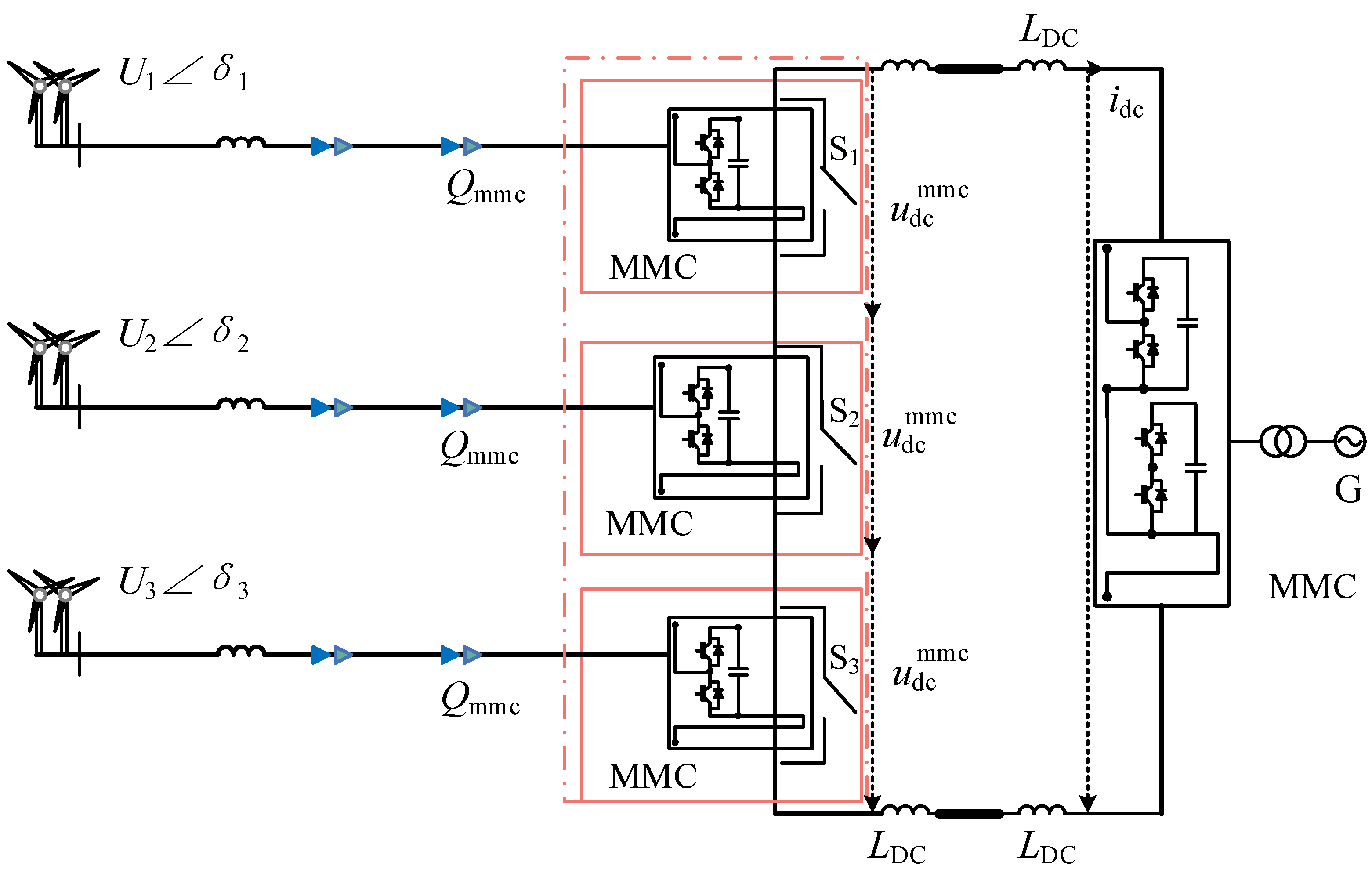
As shown in
Figure 1, MMC is applied to the offshore wind power grid-connected system, and there is a close coupling relationship between the two at the level of power transmission and control. In practical engineering, MMC is usually deployed on the offshore wind farm side and the onshore power grid side to complete long-distance, large-capacity power transmission. This paper focuses on the open-circuit fault location of the switch-level IGBT of the wind farm side (front-end) MMC. The operating conditions of this location are more significantly affected by wind speed fluctuations and power scheduling strategies, and the fault characteristics show stronger non-stationarity and time-varying.
In order to systematically analyze the operation characteristics of MMC under the deloading condition of offshore wind power and its influence on fault diagnosis, this section first introduces the topology and mathematical model of the MMC system, which provides a unified modeling basis for subsequent fault mechanism analysis and feature extraction. Then, the deloading operation mechanism of offshore wind farm is expounded, and the influence of wind power scheduling strategy on MMC operation point, power flow direction, and electrical quantity distribution is analyzed, and the variation law of MMC operation characteristics under deloading condition is revealed [
1,
2]. On this basis, the formation mechanism of the MMC switch-level IGBT open-circuit fault is further analyzed. Combined with the deloading operation characteristics, the electrical signal characteristics in the fault state are characterized, which lays a theoretical foundation for the subsequent data-driven fault feature enhancement and location method [
14].
2.1. MMC System Topology and Mathematical Model
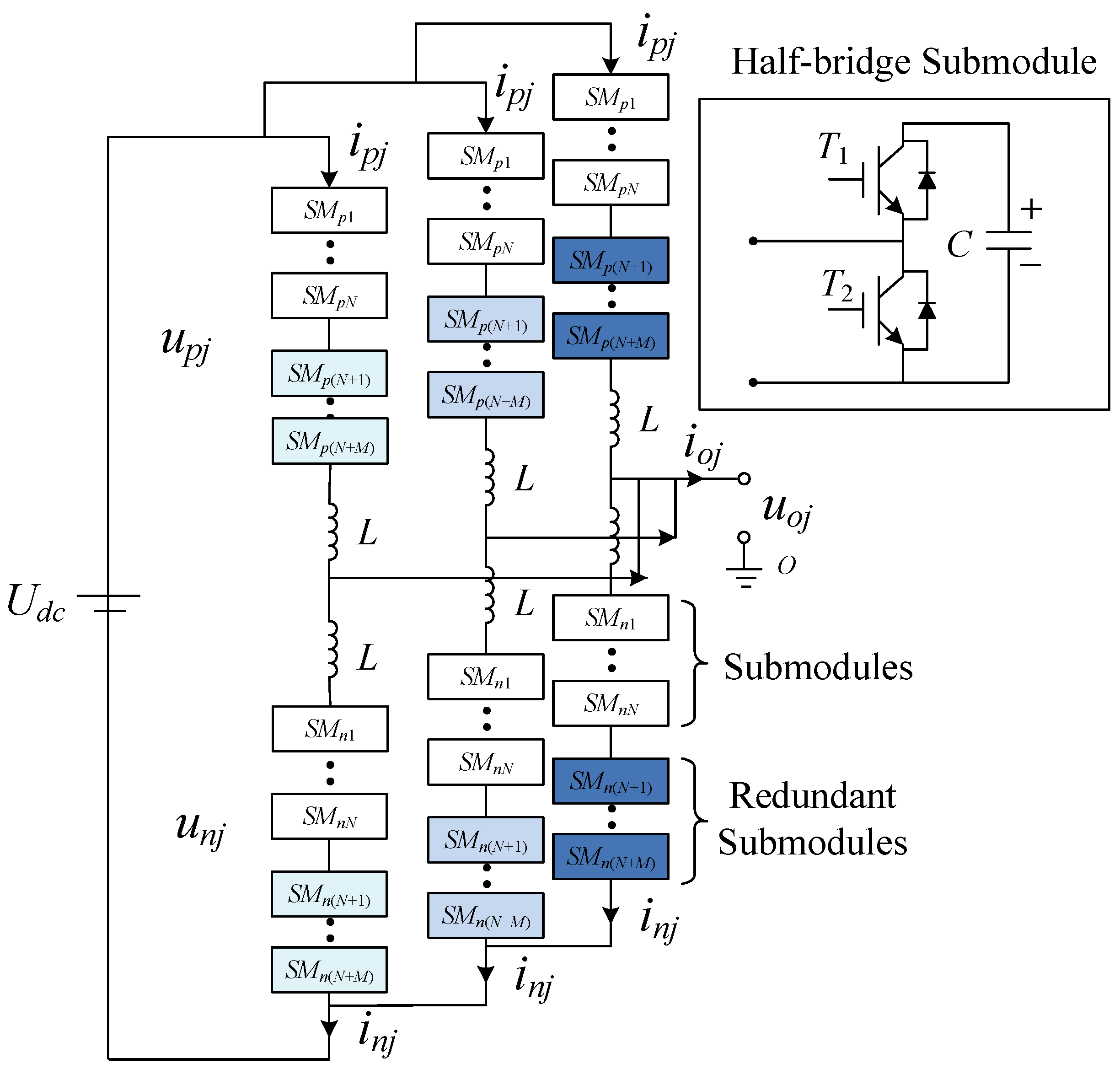
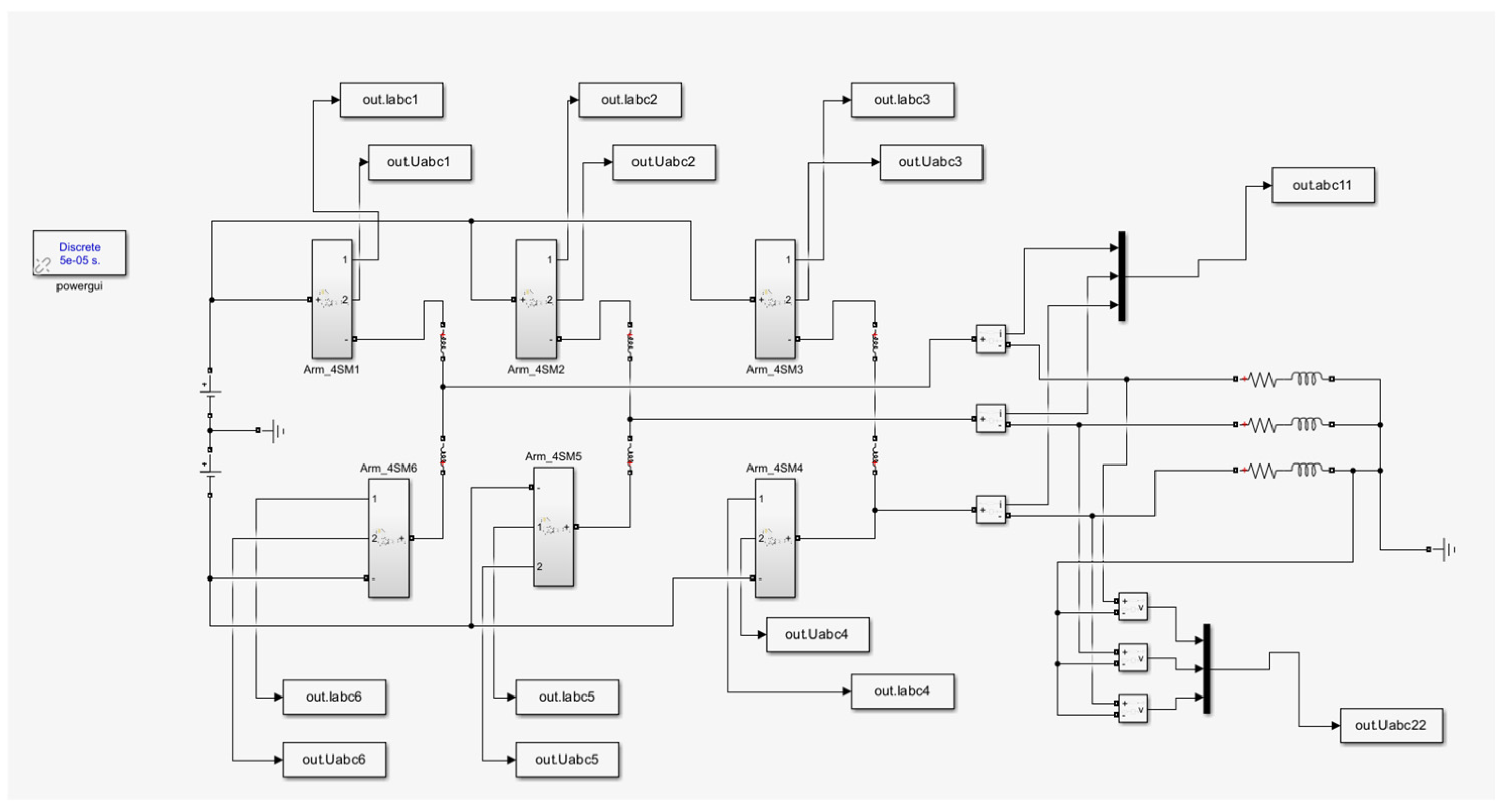
The three-phase MMC topology is shown in
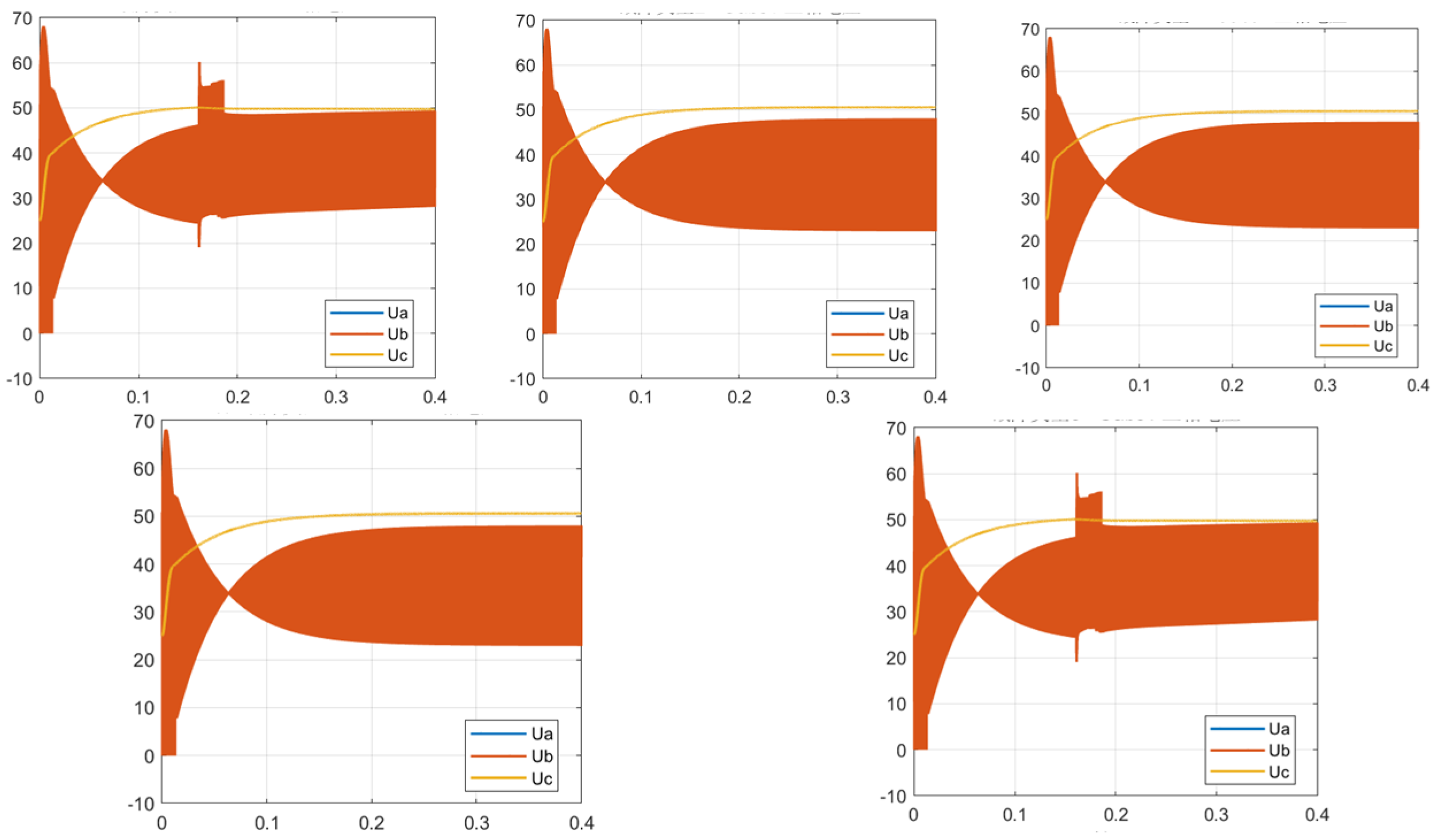
Figure 2. The dynamic behavior analysis of the capacitor of the IGBT open-circuit fault of the MMC sub-module shows that once the T1 tube fails, the energy storage capacitor in the power unit will lose the discharge circuit and only retain the charging path, resulting in a continuous rise in the terminal voltage. On the contrary, if the T2 tube has an open-circuit fault, the capacitor will superimpose an additional charging stage on the basis of normal operating conditions, thereby making the voltage amplitude higher than the rated state.
Figure 2 shows the three-phase MMC topology and its power unit structure: each phase valve arm consists of an N-stage cascaded sub-module SM and a bridge arm reactor L.
According to Kirchhoff’s voltage law, it can be seen from
Figure 1 that the inductance voltage equation of each phase arm of MMC is
In the formula, the subscripts p and n represent the upper and lower bridge arms respectively; and are the total capacitance voltages of all the sub-modules in the upper and lower bridge arms of phase j (j = u, v, w) respectively; is the output voltage of phase j; and is the DC side voltage.
2.2. Mechanism of Deloading Operation of Offshore Wind Farms and Its Impact on MMC
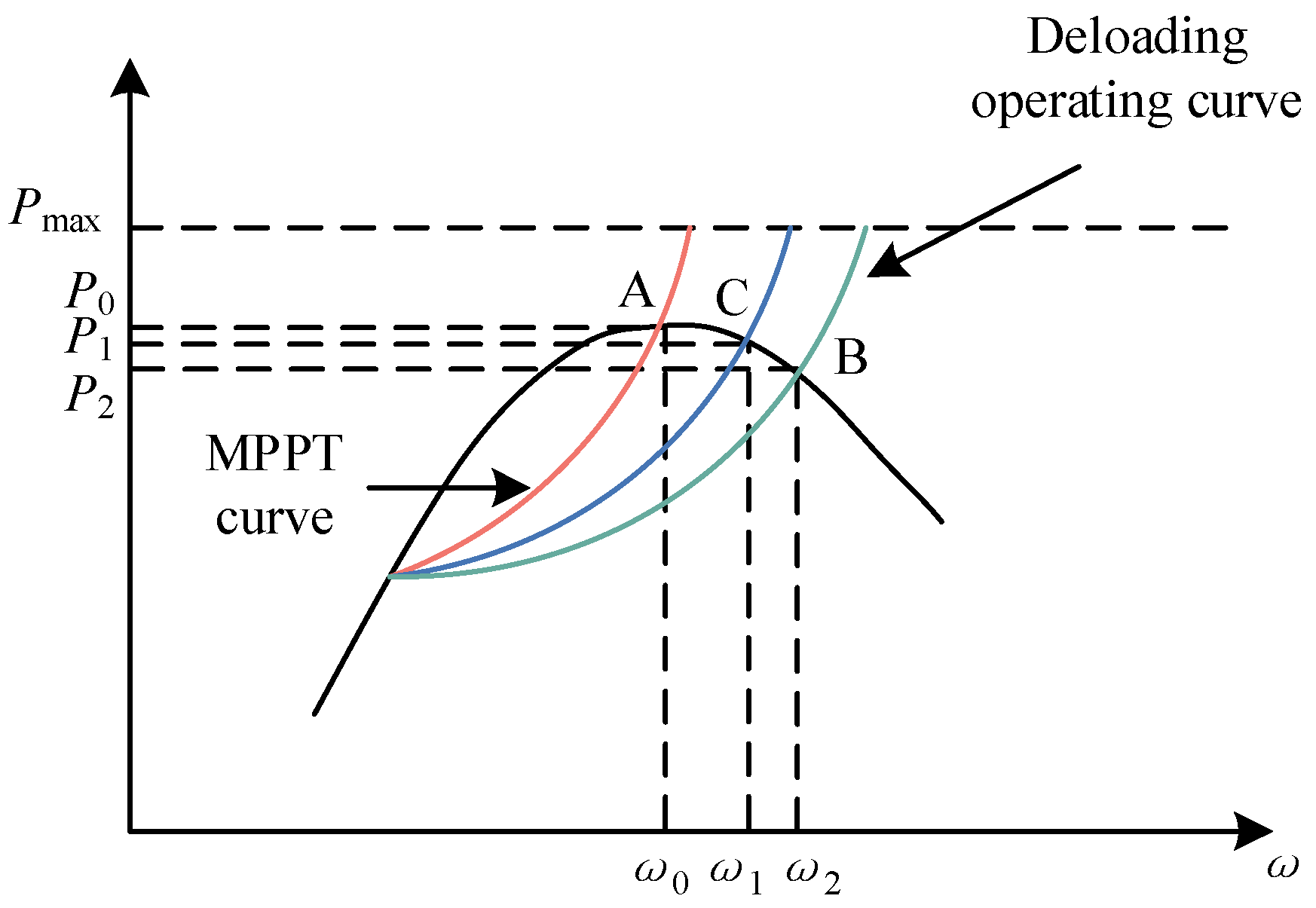
When the offshore wind farm participates in the frequency support of the power grid or faces the curtailment of wind power, it needs to actively enter the deloading operation mode. As shown in
Figure 3, the wind turbine makes the operating point deviate from the MPPT curve by overspeed control or variable pitch control [
1,
2].
For the MMC sending system, the active power regulation on the wind farm side is directly manifested by the large fluctuation and significant reduction in the input power on the DC side of the MMC. In this paper, the condition that the MMC transmission power is less than 20% of the rated power is defined as the deloading condition (<0.2 pu).
This low-power operation state will cause feature distribution offset to the fault diagnosis of MMC: the randomness of wind speed and the dynamic change in frequency modulation command make the internal energy exchange mode of MMC change frequently, and even the power reverse occurs. This leads to a strong non-stationarity in the statistical distribution of key fault observations, such as sub-module capacitor voltage.
2.3. Open-Circuit Fault Mechanism and Fault Characteristics
To elucidate why static models often fail during power fluctuations or load transients, the physical mechanisms of these non-stationary disturbances can be systematically categorized into three core aspects [
4,
15]:
(1) Direct Current Coupling: During severe power fluctuations, load transients (e.g., sudden current drops or violent surges) can inadvertently mimic or mask the actual electrical impacts of an open-circuit fault. Recent studies have demonstrated that under specific operating scenarios, such as low modulation index or reactive power compensation, the physical fluctuations in arm currents and capacitor voltages fundamentally alter the fault signatures. This causes the feature distributions of healthy and faulty states to highly overlap, rendering conventional thresholds ineffective.
(2) Internal Control Dynamics: When the system responds to sudden power shifts, the active regulation mechanisms (such as capacitor voltage balancing algorithms or state observer tracking) inherently inject harmonic jitter into the feature signals. This control-induced jitter acts as a non-stationary noise that heavily distorts the diagnostic characteristics during the transient period.
(3) Spectral Leakage: Rapid power shifts inevitably lead to micro-fluctuations in the system’s electrical frequencies. During signal processing, these frequency shifts cause spectral leakage, which smears and blurs the frequency-domain features that static diagnosis models traditionally rely upon.
Consequently, the superposition of direct current coupling, internal control dynamics, and spectral leakage provides a rigorous theoretical basis for why conventional static models fail under complex transients, thereby necessitating the proposed incremental learning approach to continuously adapt to these non-stationary disturbances.
2.3.1. Open-Circuit Fault Characteristics of T1 Under Stationary and Deloading Conditions
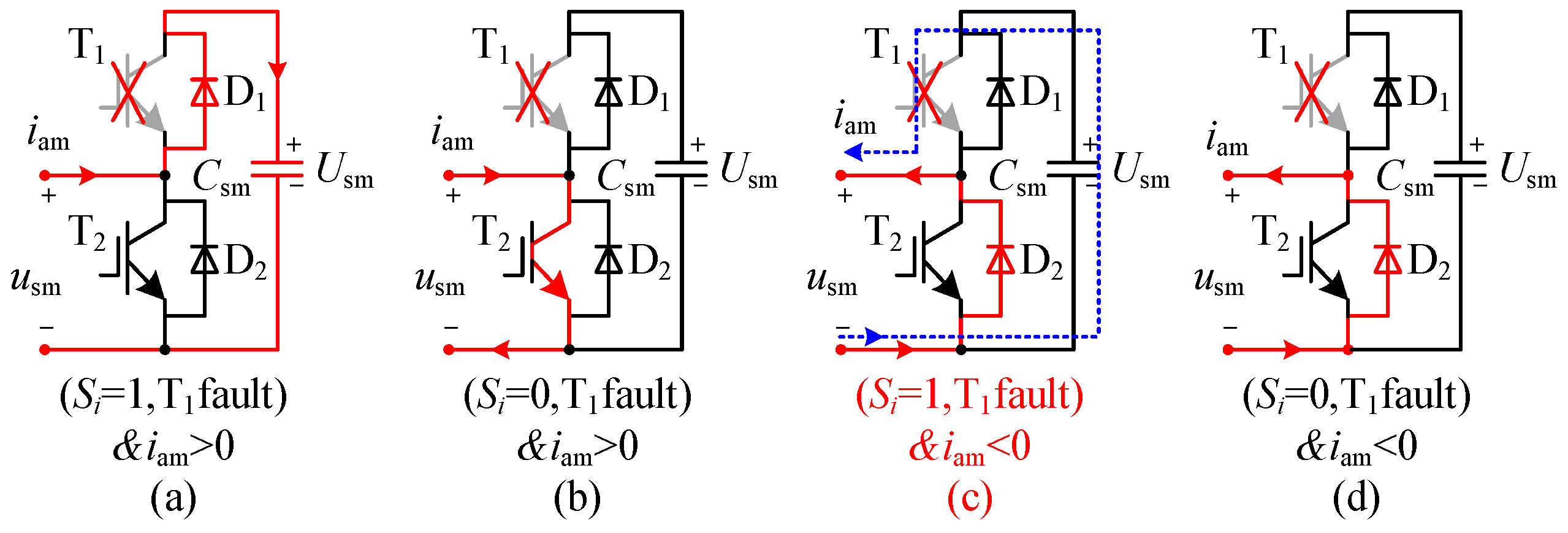
The T1 open circuit fault will block the normal discharge path of the capacitor. As shown in
Figure 4, during the normal operation of SM, if S = 1 and
< 0, the power device T1 should be turned on to discharge the capacitor and reduce the voltage; once the T1 open circuit failure occurs, the current will be forced to change through the diode D2 to form a bypass, and the capacitor will be isolated and the voltage will remain constant. The capacitor voltage that should have declined will show an abnormal constant characteristic due to the fault.
However, under the deloading condition of offshore wind power, due to the extremely small amplitude of the bridge arm current
, the discharge rate under normal operating conditions.
It is very slow. This results in a very small trajectory difference between the fault state and the normal low-power state. In addition, when the measurement noise is superimposed, this weak voltage retention feature is easily masked, resulting in a significant decrease in the sensitivity of the traditional detection method based on the voltage slope.
2.3.2. Open-Circuit Fault Characteristics of T2 Under Stationary and Deloading Conditions
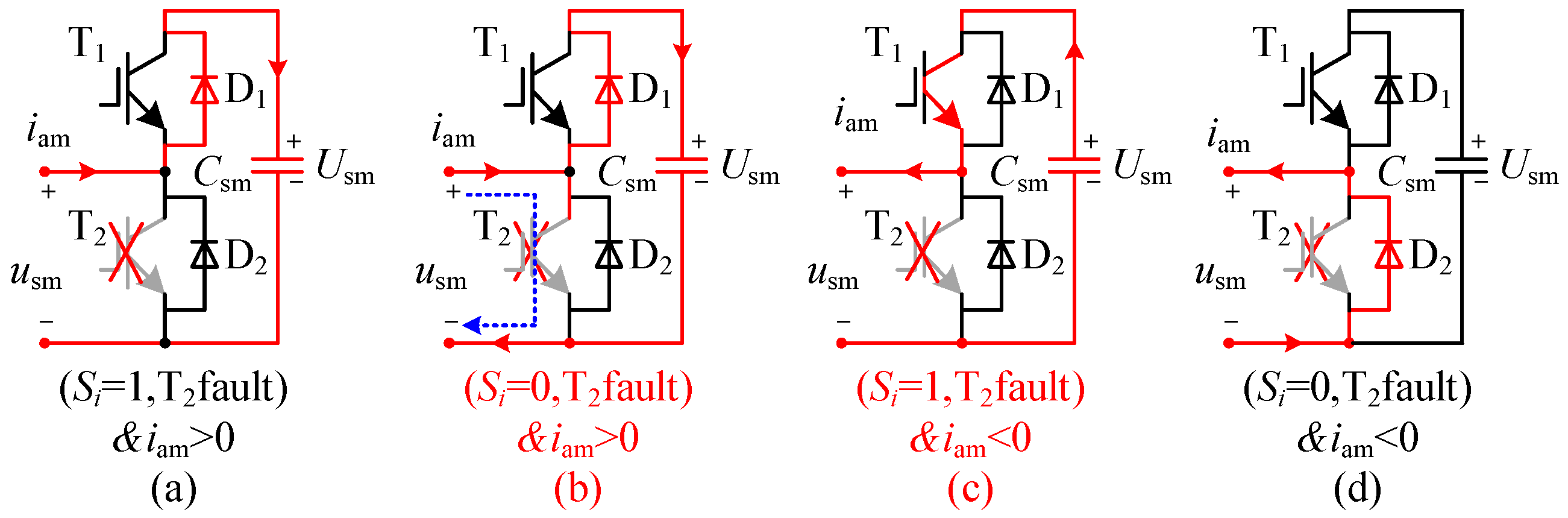
The T2 open circuit fault will force the establishment of an unexpected capacitor charging circuit. As shown in
Figure 5, under normal operating conditions (S = 0 and
> 0), the T2 tube is turned on to bypass the capacitor and the voltage remains constant; once the open circuit of the T2 tube fails (see
Figure 5), the current will be forced to turn to charge the capacitor through D1, resulting in an abnormal rise in the capacitor that should have maintained a stable voltage.
Similarly, due to the influence of deloading, the charging current after the fault occurs is very small, resulting in a significant delay in the voltage accumulation effect caused by the fault.
Due to near zero or even intermittent, the ascending process becomes extremely slow. In the early stage of the fault, this weak voltage drift is often less than the sensor noise level, which makes the fault latency longer and difficult to be locked in the early stage.
In the deloading mode, the maximum load-reducible active power of offshore wind turbines is as follows
Among them, is the active power of the turbine at the optimal rotor speed at the current wind speed, is the active power of the turbine at the rated rotor speed at the current wind speed, and is also the active power at the maximum load shedding. For the air density, for the rotor radius, and are the maximum wind energy utilization rate of the turbine and the maximum wind energy utilization rate at the maximum load reduction, and are the optimal tip speed ratio of the turbine and the maximum reserve tip speed ratio.
The active power of the load shedding is transmitted to the MMC. Considering the formula, the instantaneous power of the upper arm and the lower arm is derived, respectively. MMC operates under steady-state conditions, and power transmission is performed from the DC side to the AC grid. In this way, the DC current of MMC is in the same direction as the AC current.
By replacing the voltage and current of the upper arm and the lower arm with DC component and AC component, respectively, the power equation can be expressed as
The DC voltages of the upper and lower bridge arms are set
and
respectively, which
are the DC current flowing through the MMC bridge arm, the angle between the AC grid voltage and the current
, and the phase shift between the grid voltage phases
.
Among them, UkCu, lref is the arm voltage reference value, that is, the value of the DC link voltage, and CSM is the sub-module capacitor.
Therefore, the power of the active offloading mode will be transmitted to the MMC and affect the fault characteristic parameters of the MMC.
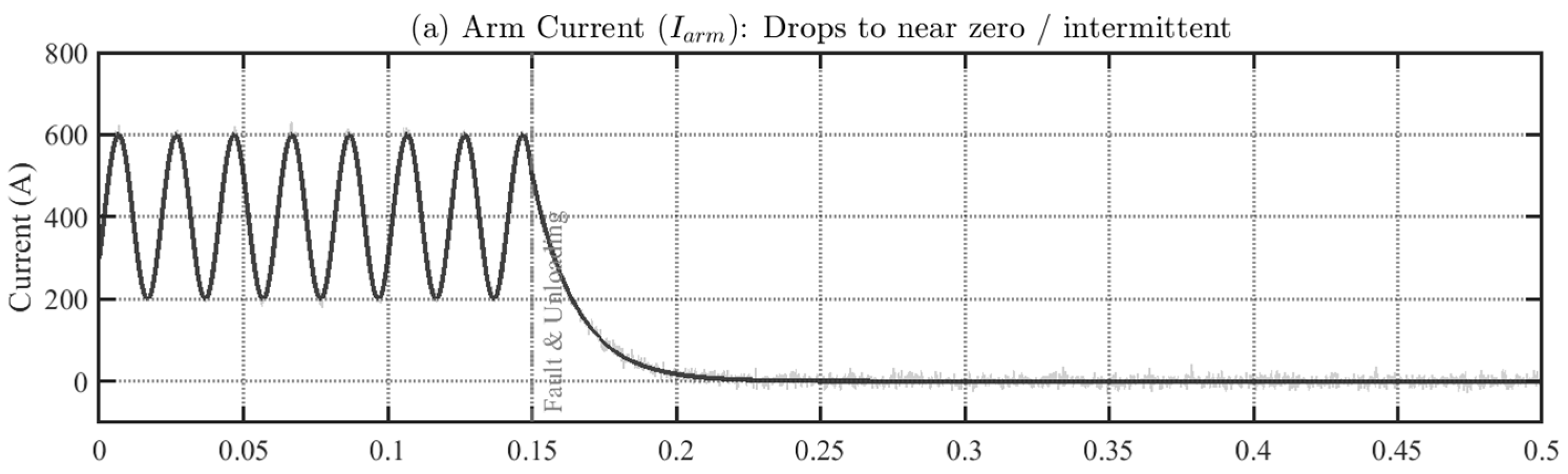
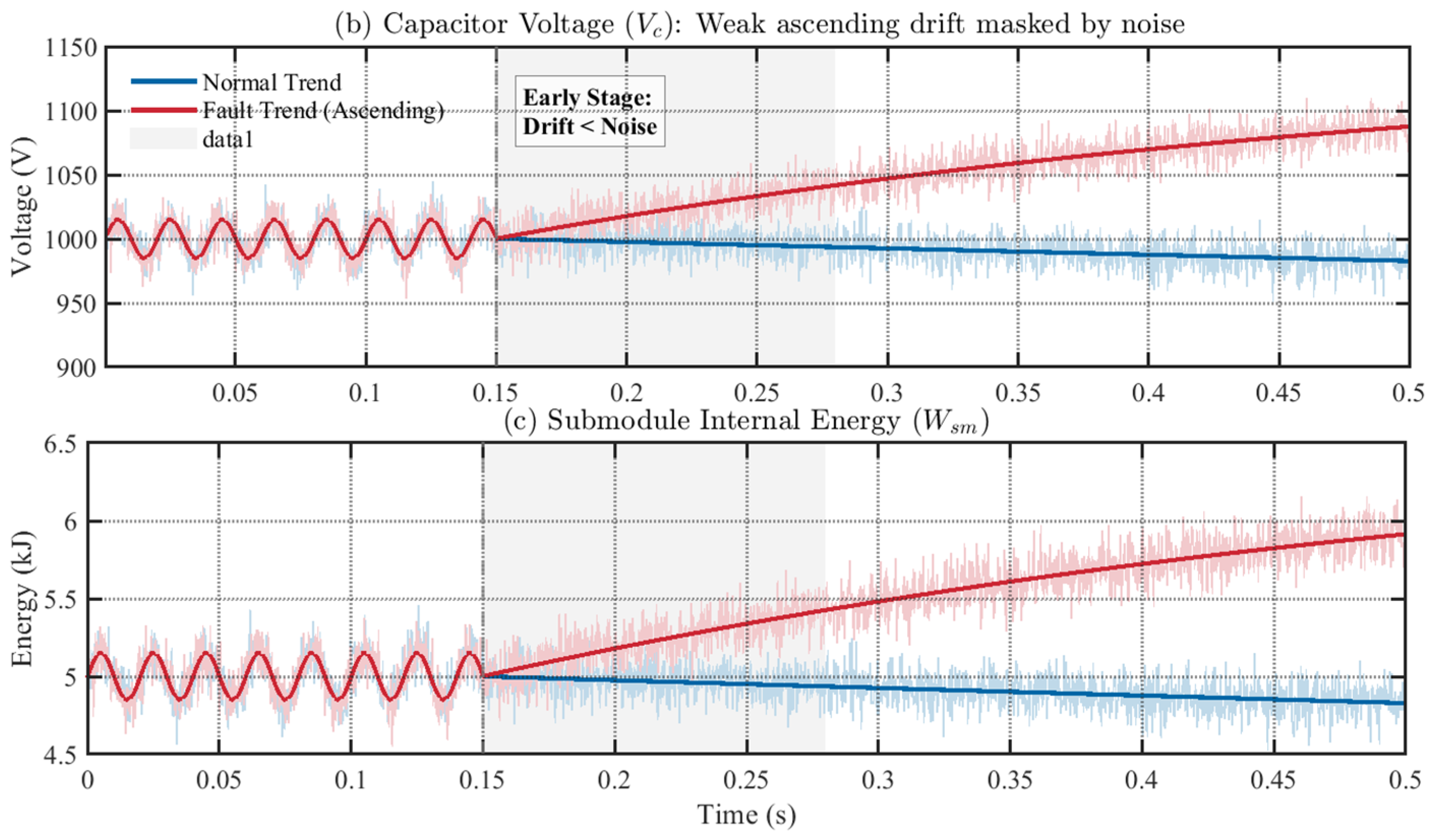
To intuitively illustrate this masking effect under deloading conditions,
Figure 6 visually presents the dynamic behavior of the submodule during a T2 open-circuit fault. As shown in
Figure 6a, the arm current is severely limited and intermittent throughout the process, faithfully reflecting the low-power operation of the offshore wind farm. When the fault occurs at 0.15 s, the capacitor voltage in the normal state remains strictly constant due to the intact bypass path (
Figure 6b). Conversely, in the fault state, the unintended charging through D1 forces an abnormal but extremely slow ascending drift in
. Crucially, as highlighted by the shaded “Early Stage” region, this weak voltage trajectory is completely submerged in the background sensor noise. The submodule internal energy
exhibits a similarly delayed divergence (
Figure 6c). This visual evidence corroborates the severe failure of traditional threshold-based detection methods under deloading conditions, underscoring the necessity for the advanced data-driven feature enhancement strategy proposed in this paper.
3. Capacitor Voltage Analysis of SM IGBT Failure Adaptive Lightweight Fault Location Method Based on Improved XGBoost
Under the unloading operation condition of the offshore wind power system, the open-circuit fault characteristics of the modular multilevel converter are easily masked by working conditions and difficult to decouple. Therefore, this paper proposes a multi-label improved XGBoost adaptive lightweight fault location method based on WPD-PCA feature enhancement [
12,
13]. Combined with the analysis of the IGBT open circuit fault characteristics and mechanism in the MMC sub-module in the previous section, the fast and accurate positioning of the fault is realized.
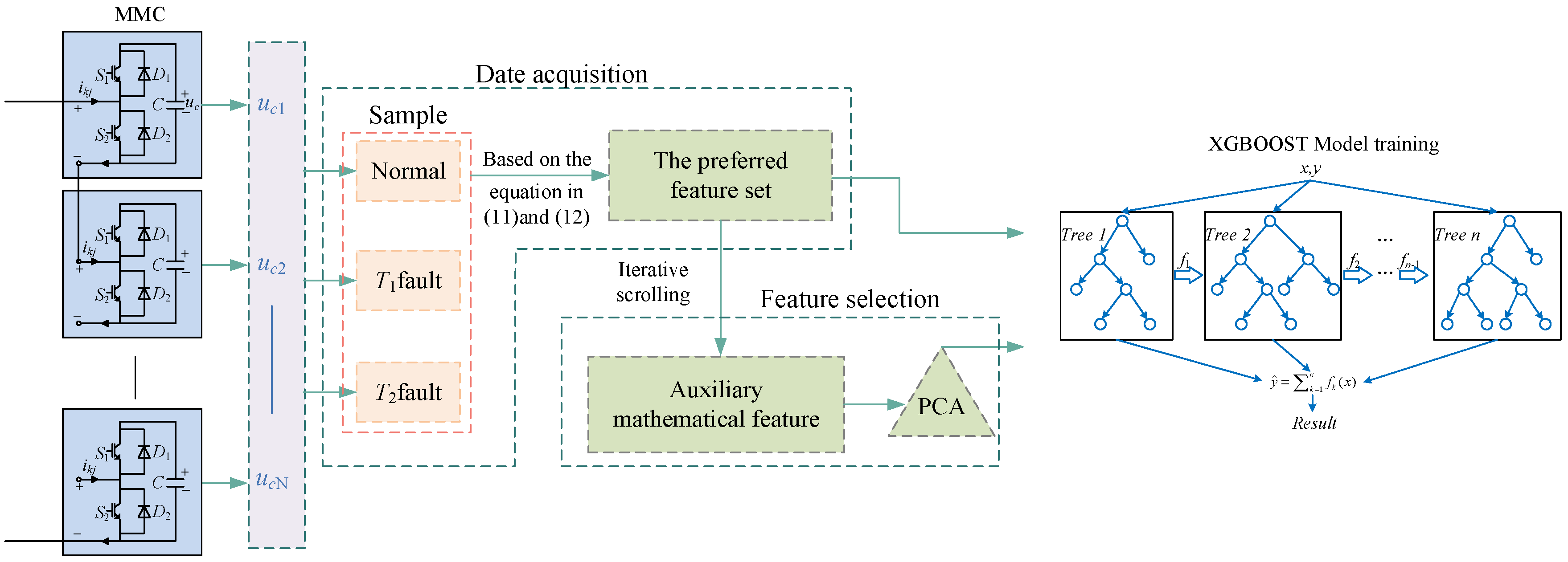
As shown in
Figure 7, firstly, aiming at the problem that the fault signal is easily submerged under the active unloading condition, the wavelet packet decomposition WPD is used to extract the multi-scale time-frequency power feature, and the weak high-frequency component of the fault feature is accurately extracted. Then, the principal component analysis PCA is introduced to reduce the dimension, and the high-identification fault feature reconstruction under the active unloading condition is realized, which provides effective fault features for the subsequent fault location model to improve the location accuracy.
Aiming at the problem of continuous drift of wind power and modular multilevel converter operating point caused by active unloading conditions, an incremental learning mechanism based on hot start is introduced. Through a small number of newly collected samples, online adaptive updating can effectively prevent the decrease in positioning accuracy caused by working condition drift, so as to improve the accuracy of the fault location method.
3.1. Data-Driven Feature Enhancement and Lightweight Preprocessing
In this section, a multi-label time-varying wavelet frequency feature extraction and reconstruction method based on WPD-PCA is proposed to extract high-resolution fault features in a low signal-to-noise ratio environment.
Specifically, the multi-label classification mechanism is first introduced. Starting from the system topology and fault evolution characteristics, the switch-level IGBT open-circuit fault is labeled and modeled to meet the diagnostic requirements of multiple sub-modules and multiple faults. Subsequently, the original electrical signal is preprocessed, and the multi-scale power characteristics are extracted by WPD to describe the time-frequency distribution characteristics of the fault signal under deloading conditions. Furthermore, PCA is used to reduce the dimensionality and physical denoising of high-dimensional features, so as to suppress noise and redundant components while retaining the main fault information. Finally, combined with the influence degree of fault on the system operation, the severity index is constructed, and the sample weighting strategy is introduced to provide optimized training samples for the subsequent fault location model.
3.1.1. Multi-Label Classification Mechanism
In view of the limited on-site acquisition of MMC fault samples, small-sample training is prone to induce network over-fitting. To this end, a multi-label coding paradigm is constructed to give the sample multiple attribution characteristics of cross-regional fault categories, and achieve ‘end-to-end’ lightweight positioning [
16].
The label of each sample is defined as a triple.
Upper/Lower Arm Tags (Upper/Lower Arm)
Sub-module index label (SM Index)
Through this coding method, a single model can output the fault location and type at the same time, which greatly reduces the storage requirements of the controller.
Table 2 presents the typical fault labels.
In this paper, the sub-module capacitor voltage
is used as the main measurement index of fault location [
15]. On the one hand, it can directly reflect the sub-module insertion/bypass behavior and related charging and discharging process, and is more sensitive to the energy exchange caused by the open circuit of the switching device. On the other hand, compared with the measurement indexes such as bridge arm current, the capacitor voltage is less affected by the disturbance of the external power grid and the fluctuation of operating conditions to a certain extent, which is conducive to extracting stable and discriminative sub-module-level fault characteristics under the complex condition of deloading of offshore wind power generation studied in this paper.
3.1.2. Signal Preprocessing and Energy Feature Extraction Based on WPD
Firstly, in order to eliminate the amplitude scale drift caused by the large fluctuation of wind power, the collected sub-module capacitor voltage is normalized by a sliding window.
Among them, and are the mean and standard deviation in the window, is to avoid the zero error.
Subsequently, WPD is introduced for time-frequency localization analysis. Although the voltage distortion of the IGBT open-circuit fault in the time domain may be submerged by the ripple under deloading, in the frequency domain, the switching frequency sideband energy mutation caused by the fault has a significant degree of discrimination.
The db3 wavelet is used to decompose the above signals into three layers of wavelet packets to separate the characteristics of each frequency band of the third layer. The m-th original signal is
The m-th sub-module capacitor voltage signal is decomposed into the i-th layer and the j-th node.
The results are as follows:
Given the capacitor voltage
time series data of the m-th sub-module, the db3 wavelet is used to perform three-scale decomposition on it. The energy distribution of the decomposed signal can reflect the fault impact characteristics. Define the frequency band power of the j-th node at the i-th layer as
As shown above, the wavelet packet decomposition coefficient is characterized , and the number of sampling points is characterized .
At this time, the fault feature vector corresponding to the m-th signal is
Then all fault feature vectors are
Among them, the fault feature vector for each fault is
According to the above formula, the dimension of the fault feature vector extracted by wavelet packet decomposition is related to the number of sub-modules, and the obtained multi-scale energy feature dimension increases linearly with the number of sub-modules.
3.1.3. PCA-Based Feature Denoising and Physical Denoising
Since the MMC topology contains a large number of sub-modules, the high-dimensional sparsity of the original WPD energy feature vector will directly lead to a computational dimension disaster, which does not meet the lightweight design requirements. In addition, the deloading signal contains a large amount of redundant noise caused by the switching frequency [
17].
Therefore, PCA is introduced to map the high-dimensional feature space to the low-dimensional orthogonal subspace.
PCA retains the key discriminant information while compressing the feature dimension. The normalization must only be carried out on the training data, and the use of all samples to calculate the normalization parameters will lead to the leakage of test set information, thus reducing the generalization performance of the model. Therefore, the fault feature data set should be divided into a training set and a test set:
The training sample data after PCA dimensionality reduction can be obtained:
where μ is the mean vector
; r represents the feature vector matrix of all the training samples after sorting. Similarly, the feature expression of the test set after PCA dimensionality reduction is
3.1.4. Severity Index and Sample Weighting
The fault samples under deloading conditions are very similar to normal fluctuations, which can easily lead to missed judgments. In order to solve the problem of ‘difficult to separate samples‘ and category imbalance, a weighting strategy based on the severity index is proposed.
The severity index in the time window is defined as follows to quantify the degree of deviation of the current working condition from the rated point:
A piecewise weighting function is constructed to give higher training weights to low-power (difficult to identify features) or high-severity samples, so as to force the model to focus on ‘difficult-to-classify samples‘ at the objective function level.
The sample weights
are distributed according to the piecewise function:
The threshold can be set by engineering classification or data quantile.
3.2. Incremental Learning Strategy for Deloading Conditions
The wind speed of the offshore wind farm has strong time-varying and randomness, which leads to the long-term dynamic drift of MMC. The static model of offline training is difficult to adapt to the offset of data distribution, and the accuracy will gradually decrease after long-term operation. To this end, this paper designs a lightweight incremental learning strategy based on the addition model characteristics of XGBoost.
3.2.1. Fault Location Strategy Based on Improved XGBOOST
The core idea of XGBoost is to gradually construct a regression tree model in an additive manner [
12]. The newly generated regression trees in each iteration are trained on the basis of the prediction residuals of the previous model to correct the existing prediction errors. Finally, the predicted values are obtained by accumulating the output results of all regression trees.
Let the training data set be
The tree integration model of XGBOOST can be expressed as
where
represents the regression tree function space,
is the tree structure mapping function, which is used to map the samples to the corresponding leaf nodes,
is the total number of leaf nodes, and
is the weight vector of leaf nodes. Different from the traditional classification decision tree, each leaf node of the regression tree corresponds to a continuous output value, which is used to characterize the prediction score of the leaf node.
In order to learn the optimal model, XGBoost minimizes the following regular objective function:
Among them,
is a differentiable convex loss function, which is used to measure the error between the predicted value and the true value; the regular term
is used to constrain the complexity of the model, which is usually defined as
Since the objective function contains tree structure parameters, it cannot be solved by the traditional Euclidean space optimization method. XGBoost uses an additive training strategy for model learning. In the t-th iteration, by introducing a new regression tree
, the following objective function is minimized:
Using the second-order Taylor expansion of the loss function, the above target can be approximately expressed as
Represents first-order and second-order gradient statistics, respectively.
Let the sample set corresponding to the j-th leaf node be , then, under the condition of a fixed tree structure q(x), the optimal weight of leaf nodes can be analytically solved as follows:
Based on this, the optimal value of the corresponding objective function can be calculated, which is usually used to evaluate the gain of the candidate split nodes, so as to guide the growth process of the regression tree.
Substituting it into the leaves, the final prediction result is calculated by adding the scores in the corresponding leaves. In order to learn the set of functions used in the model, we minimize the following regularization objective.
This means that we greedily add the ft that can best improve our model according to the formula. In general, the second-order approximation can be used to quickly optimize the objective:
where
and
are the first-order and second-order gradient statistics of the loss function. We can get the following simplified target by removing the constant term in step t.
is defined as a set of instances of leaf j. By expanding Ω, the expression (26) can be rewritten as
For a fixed structure q(x), the optimal weight
of leaf j can be calculated by the following formula:
And the corresponding optimal value is obtained by calculation.
3.2.2. Incremental Learning Strategy for Working Condition Drift
The incremental update mechanism is used to perform a hot start on the basis of the existing model, and a limited number of lifting trees are added to the newly collected samples to avoid completely retraining from scratch:
which
indicates the number of trees added when the update
is made
6. Conclusions
In this paper, a lightweight fault location method for the sub-module of the MMC [
18,
19] system is proposed, which is suitable for the deloading scenario of offshore wind power generation. Based on the WPD energy feature and PCA dimension reduction, the capacitor voltage fault feature index is constructed. Combined with the peak clipping sensing sampling weight and the warm start incremental XGBoost update mechanism, the robustness can be improved under the condition of distribution offset, and there is no need to retrain.
Based on the proposed fault location method, a MMC model based on the deloading condition of wind power generation is built in Matlab/Simulink, and multi-dimensional open-circuit faults are injected. Input a lightweight fault location method based on improved XGBoost and compare it with existing fault location methods. The results show that the proposed method can accurately and quickly locate the bridge arm-submodule-device (T1/T2) under the condition of power fluctuation caused by active unloading and demonstrates superior performance compared to the evaluated baseline methods under these specific deloading conditions.
Compared with the existing data-driven IGBT open-circuit fault location method in MMC sub-modules, the fault location strategy proposed in this paper shows significant advantages in accuracy and calculation time when facing active unloading conditions. The introduced incremental learning mechanism can achieve dynamic model updating without retraining from scratch. Quantitatively, in the comparative experiment, the proposed method achieves a test accuracy of 99.6% in the S2 scenario. In addition, multi-label classification and PCA dimension reduction contribute to the lightness of the model. The training time is reduced by 26.1% (to 11.3 ms), and the single-sample inference delay is only 1.8 ms.
In addition, although this study mainly studies IGBT open-circuit faults under active unloading conditions, the proposed WPD-PCA-XGBoost framework has theoretical scalability for other typical MMC faults. For capacitor degradation faults that usually exhibit low-frequency voltage ripple anomalies, the WPD module can be adaptively adjusted to extract features with discrimination from lower frequency bands. For sensor faults, the PCA mechanism can effectively capture the destruction of the spatial dimension between related electrical quantities. When dealing with multiple simultaneous faults, the multi-label decoding strategy can independently evaluate the probability of each fault dimension to achieve multi-fault location. Extending the framework to achieve comprehensive condition monitoring for these diverse fault types will be a core direction of our follow-up research.