Article

Interleaved High-Gain DC-DC Converters with Low Input Ripple and Voltage Stress for Passenger Fuel Cell Vehicles

Suihua University Key Laboratory of Mechanical and Electrical Engineering Materials Preparation and Application, Suihua University, Suihua 152000, China
*
Author to whom correspondence should be addressed.
Electronics 2026, 15(6), 1222; https://doi.org/10.3390/electronics15061222
Submission received: 19 February 2026 / Revised: 10 March 2026 / Accepted: 12 March 2026 / Published: 14 March 2026
(This article belongs to the Section Power Electronics)

Abstract

Passenger fuel cell vehicles (FCVs) require high-gain DC/DC converters to achieve voltage matching between the low-power fuel cell (FC) stack (50–200 V) and the vehicle DC bus (400–800 V). To address the challenges in existing step-up DC/DC converters in relation to balancing the requirements of high voltage gain, wide input voltage range, low input current ripple and voltage stress, the common ground of input–output, and high efficiency in passenger FCV applications, this paper proposes three types of high-gain DC/DC converters based on an interleaved structure, incorporating quadratic Boost, quasi-Z source, and switched-inductor impedance networks. These designs effectively balance the scenario requirements of passenger FCVs. Meanwhile, taking one of the proposed converters (Interleaved-Quadratic Boost; I-QB) as an example, its steady-state performance such as voltage gain is analyzed and compared in detail with existing voltage step-up DC/DC converters. Furthermore, a scaled-down SiC-based experimental platform is constructed. Steady-state experiments validate the converter’s maximum voltage step-up capability of ten times, wide input voltage range of 30–80 V, input current ripple of less than 0.3 A, and low voltage stress on devices (≤Uo/2), thereby confirming the feasibility of these converters and the correctness of the performance analysis. The dynamic experimental results indicated that under input voltage step changes of 50–80 V and 100–50% load step changes, the I-QB converter exhibits a minor voltage overshoot with settling time under 200 ms. The prototype achieves a peak efficiency of 94.2%, confirming these converters’ suitability for passenger FCV powertrains.

1. Introduction

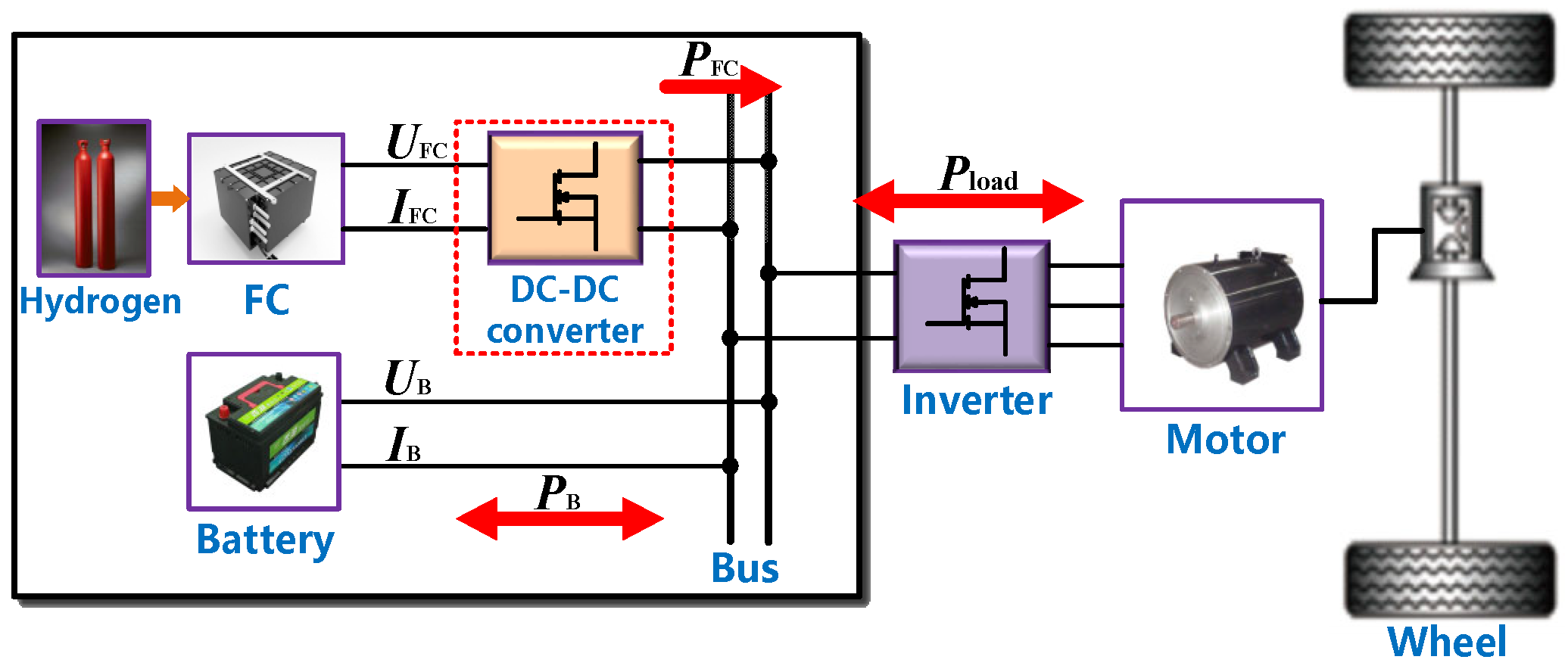
The energy crisis and environmental issues have compelled the rapid development of the new energy vehicle industry. Mainstream new energy vehicles currently on the market primarily include electric vehicles (EVs), hybrid electric vehicles (HEVs), plug-in hybrid electric vehicles (PHEVs), range-extended electric vehicles (RE-EVs), and fuel cell vehicles (FCVs) [1]. Among these, FCVs are gaining increasing user favor due to their fast-refueling capability, the minimal impact of temperature on their driving range, and water being their only by-product. A typical structure of the FCV powertrain is shown in Figure 1; due to the slow dynamic response of FCs, they are used to deliver average power. The power battery is directly connected to the vehicle’s DC bus and is responsible for delivering and recovering instantaneous power [2]. FCVs come in two forms: commercial vehicles and passenger vehicles. Due to sufficient installation space, commercial FCVs are equipped with high-power (150–300 kW) fuel cell (FC) stacks, mainly used for mountainous terrain, heavy loads, and long-distance driving conditions. Conversely, passenger FCVs have limited installation space and are equipped with low-power FC engines (below 50 kW), serving as a supplement to EVs and primarily being used for flat terrain, light loads, and short-distance driving conditions. FCs typically operate in a constant-current output mode, where the stack current is related to factors such as the fuel supply rate, pressure, temperature, and humidity, etc. [3]. The rated power of an FC determines its output voltage level. Therefore, in passenger FCVs, a high-gain step-up converter is required to achieve voltage matching between the low-power FC stack and the vehicle’s DC bus (400–800 V).
The application scenario of passenger FCVs imposes the following “three requirements” on the DC/DC converter: (1) a high voltage gain, preferably achieved at a relatively low duty cycle (0.6–0.7) to enable precise output voltage control under a flat d-M (duty cycle–voltage gain) curve [4]; (2) a wide input voltage range, as the FC exhibits “soft” output attribute, necessitating a broad voltage regulation range from the DC/DC converter [5]; (3) a low input current ripple—over prolonged operation periods, the performance of FC gradually deteriorates due to intricate driving conditions and component ageing (high input current ripple exacerbates this performance degradation), requiring the input current ripple of the directly connected DC/DC converter to be as low as possible [6,7]. As a power conversion device, the following “three requirements” should also be considered. (1) Low voltage stress, as high stress increases the risk of device failure, reduces overall vehicle reliability, and raises converter cost and volume [8]. (2) Common ground of input–output; considering vehicle driving safety, EMI should be minimized, requiring the DC/DC converter to have a common ground attribute of input–output. (3) High efficiency, maintaining efficient operation across the full load range to improve vehicle’s overall energy utilization and driving range.
Considering factors such as efficiency, vehicle space, and stress, non-isolated DC/DC converters are typically utilized in FCVs. The theoretical high gain of a conventional non-isolated Boost is difficult to achieve in practice, due to limitations from parasitic parameters, making it unsuitable for the actual requirements of FCV powertrains [9]. To address these issues, researchers have designed various high-gain DC/DC converters. Initially, the goal was simply to enhance the voltage gain of DC/DC converters. Ref. [9] combined quasi-Z sources with switched capacitors, Ref. [10] cascaded Z sources and switched capacitors, while Ref. [11] cascaded switched inductors with voltage multipliers. However, these topologies lack a common ground attribute. To avoid extra EMI, it is necessary to enhance the voltage gain while simultaneously addressing the issue of common ground of input–output. Ref. [5] cascaded a half Z source (IWJ structure [12]) with voltage multipliers, Ref. [13] mixed a voltage lifting circuit with a quadratic Boost converter, and Ref. [14] combined a Z source with a voltage multiplier. Although the issue of input–output common ground was resolved, these topologies exhibited pulsating input current. Furthermore, to address the issue of pulsating input current while enhancing the voltage gain, Ref. [15] cascaded the interleaved structure with the switched capacitor, and Ref. [16] cascaded Boost and a clamped capacitor with a three-level structure. In Refs. [17,18], the Boost converter was combined with a modified voltage multiplier, while in Refs. [19,20], the Cuk converter was integrated with a quadratic Boost or Boost converter, achieving high voltage gain under a continuous input current. However, these topologies, in turn, introduced the previous issue of the non-common ground of input–output. So, can the voltage gain be enhanced while ensuring both conditions—continuous input current and the common ground of input–output? Ref. [21] employed a hybrid structure interleaving with a voltage multiplier. However, the voltage stresses of the capacitors were large. Finally, to address the issue of high voltage stress, in Ref. [22], the quasi-Z source structure was cascaded with the three-level structure, which improved the voltage gain with the premise of ensuring the continuous input current, common ground, and low device voltage stress, but the duty cycle range was 0.5–0.75, which increased the difficulty in controller design. The resolution of existing issues is frequently accompanied by the emergence of new challenges. Despite significant efforts to enhance voltage gain through various approaches, existing high voltage step-up converters for passenger FCVs struggle to simultaneously achieve continuous input current, common grounding, and low voltage stress. This persistent trade-off among key performance indicators—ranging from pulsating input current and non-common ground configuration to high device voltage stress and limited duty cycle ranges—reveals a critical research gap in developing a DC/DC converter that holistically satisfies all practical FCV powertrain requirements.
Therefore, this study is dedicated to designing DC/DC converters that address the current research gap. Based on the author’s previous research [8], the quadratic Boost, quasi-Z source, and switched-inductor impedance networks demonstrate outstanding voltage step-up capabilities, continuous input current, and common ground attributes, effectively balancing the requirements of passenger FCVs. Considering that the interleaved structure can achieve ripple elimination, this paper rationally integrates these impedance networks to construct three high-gain DC/DC converters: the Interleaved-Quadratic Boost (I-QB), the Interleaved-Quasi-Z source (I-QZS), and the Interleaved-Switched-Inductor (I-SI). Detailed analysis, modeling, and experimental verification are performed using the I-QB converter as an example. The results demonstrate that the I-QB converter has the following advantages:
Extremely high voltage gain under a flat d-M curve;
Practically achievable wide input voltage range;
Low input current ripple with inductor currents cancellation;
Low voltage stress;
Common ground of input–output;
Satisfactory efficiency.
In Section 2, three types of high-voltage-gain DC/DC converters are given. The steady-state characteristics of the I-QB converter are analyzed in Section 3. Section 4 provides the comparisons. In Section 5, the experimental validation is provided. Section 6 discusses the conclusions.

2. The Proposed Topologies

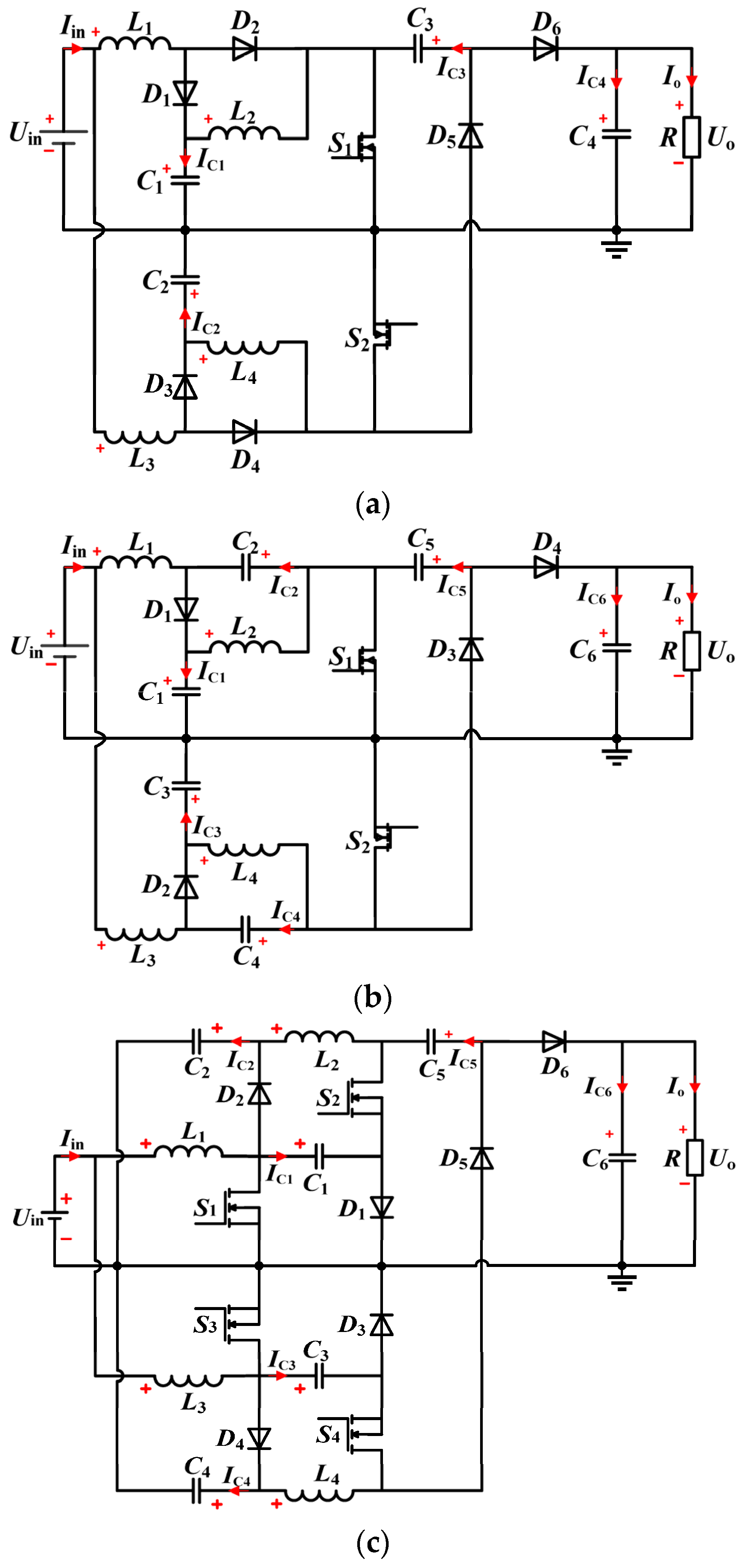
The three novel topologies are shown in Figure 2. Figure 2a depicts the I-QB topology, Figure 2b shows the I-QZS topology, and Figure 2c illustrates the I-SI topology.

3. Analysis of the I-QB Topology

3.1. Topology Selection

Due to space constraints, this paper will select one topology for analysis and verification. Introducing a quasi-Z source impedance network would introduce (1-2d) in the denominator of the converter’s voltage gain function. This would result in an extremely steep d-M curve. While this avoids the occurrence of the limit duty cycle, even minor changes in the duty cycle would cause significant fluctuations in the output voltage. When system disturbances require adjusting the duty cycle, unacceptable output voltage overshoot could easily occur, posing challenges for controller design. Moreover, the I-SI converter requires significantly more components than the I-QB and I-QZS converters. Although the I-SI converter offers a higher voltage gain, the excessive component count makes it challenging to improve the efficiency and power density. After weighing the trade-offs, this paper selects the I-QB topology as an example to demonstrate the feasibility and effectiveness of the proposed topologies. The analysis method for I-QB topology is applicable to both the I-QZS and I-SI topologies. The conclusions obtained for the I-QB topology can be appropriately extended to the I-QZS and I-SI topologies.

3.2. Topology and Operating Principles

The I-QB converter consists of four inductors (L1–L4), six diodes (D1–D6), four capacitors (C1–C4), and two switches (S1 and S2). Uin is the input voltage, and Uo is the output voltage. The interleaved structure consisting of inductor L1 and inductor L3 in parallel can reduce the input current ripple. The step-up structure, which consists of inductors L1 and L2, diodes D1 and D2, and capacitor C1 (or inductor L3 and inductor L4, diodes D3 and D4, and capacitor C2), can expand the input voltage operating range and enhance the voltage gain. The voltage multiplier cell consisting of capacitor C3, diode D5, and D6 can further increase the voltage gain.
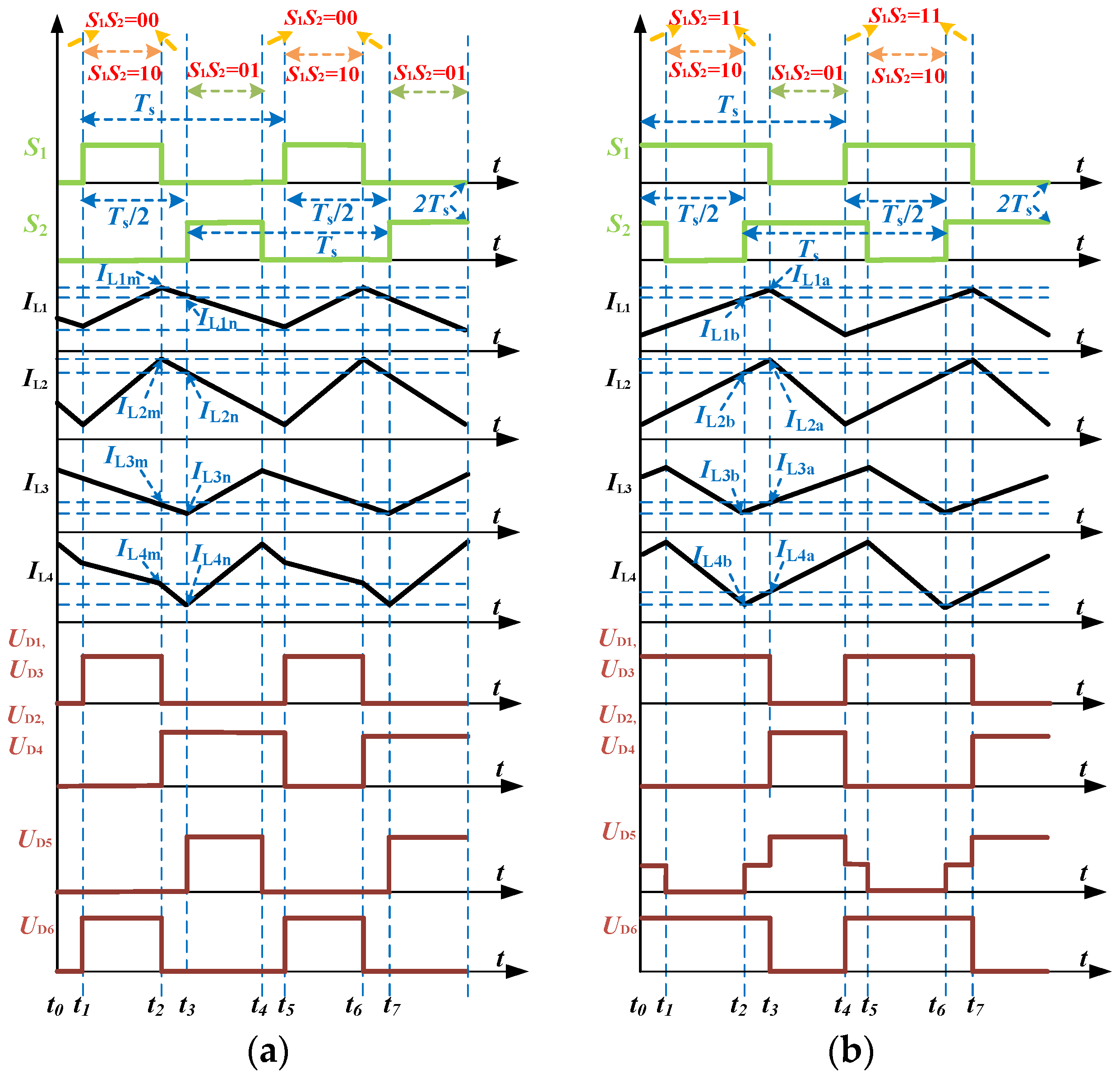
Assume that all devices in the I-QB converter are ideal, meaning that all power semiconductor devices have zero on-resistance, no current flows when they are turned off, and the turn-on time and turn-off time of switches are zero. We also ignore the equivalent series resistance (ESR) of the inductors and capacitors. The relationship between d1 and d2 can be recorded as d1 = d2 = d, where d1d2 denote the duty cycles of S1–S2, respectively. The phase difference between the gate–source driving signals of S1 and S2 is 180. When the I-QB converter operates in the continuous conduction mode (CCM), there are four switching states recorded as “S1S2” in a switching cycle, S1S2 = {00,01,10,11}. Moreover, the sequence of the switching states in one cycle is related to the duty cycle ranges of S1 and S2. The sequence I “10-00-01-00-10” appears within the duty cycle range of 0–0.5, while the sequence II “11-10-11-01-11” is obtained within the duty cycle range of 0.5–1.
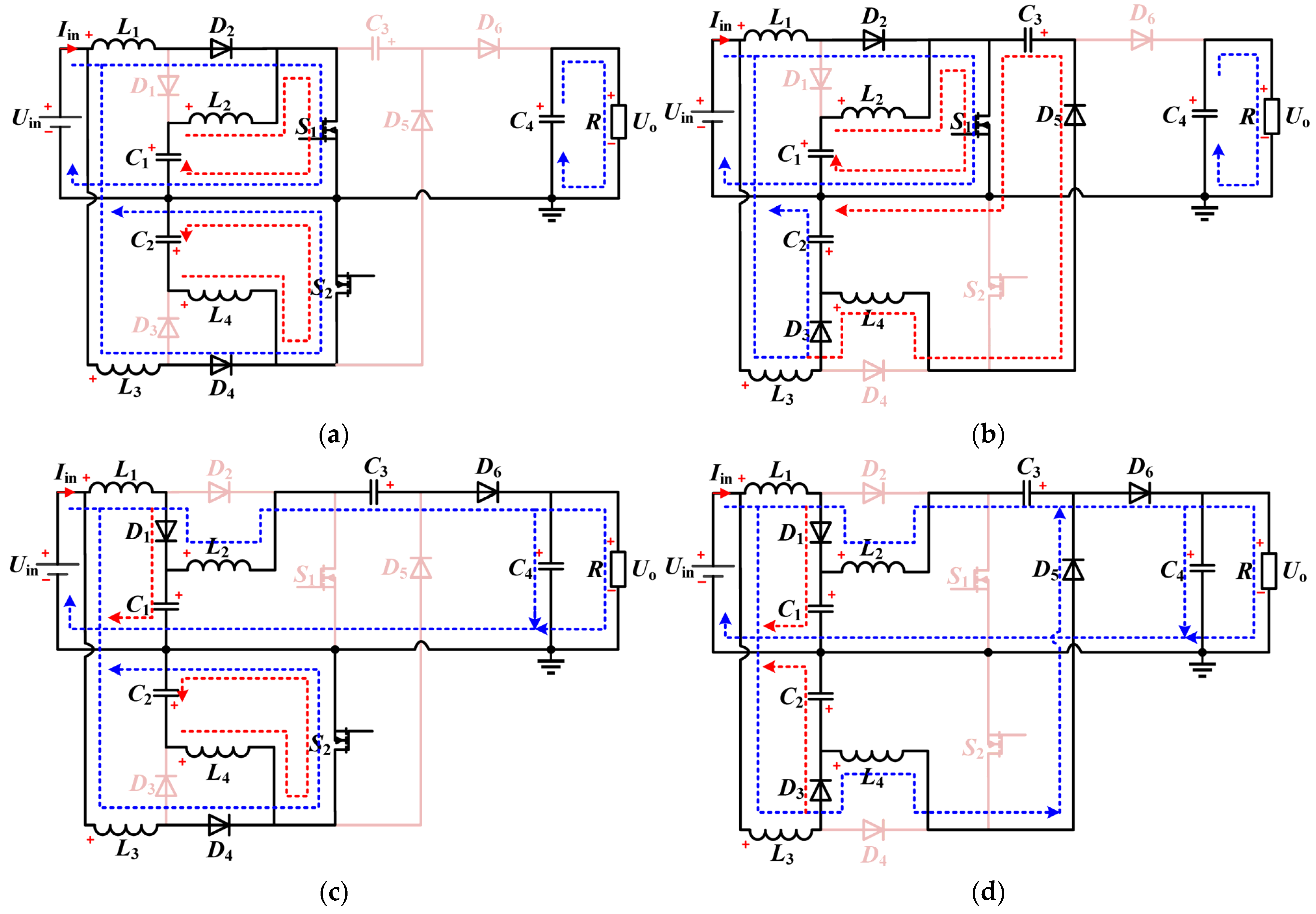
The key operating waveforms of the I-QB converter are shown in Figure 3. The output current is Io, and the currents of L1, L2, L3, and L4 are IL1, IL2, IL3, and IL4. Define the voltage between the cathode and the anode of the diode as the voltage stress of the diode. TS indicates the period of the PWM driving signal. The energy flows and equivalent circuit diagrams of the I-QB converter in different operating modes are shown in Figure 4.

3.2.1. S1S2 = 11 (S1 and S2 Are ON)

As shown in Figure 4a, in this state, diodes D1, D3, D5, and D6 are reversed biased and there are five current loops in the circuit: (1) DC-source Uin is charged to L1 through D2 and S1; (2) C1 charges L2 through S1; (3) DC-source Uin charges L3 through D4 and S2; (4) C2 charges L4 through S2; and (5) the capacitor C4 supplies energy to the load R. Moreover, the currents IL1, IL2, IL3, and IL4 increase linearly.

3.2.2. S1S2 = 10 (S1 Is ON, S2 Is OFF)

As shown in Figure 4b, diodes D1, D4, and D6 are reverse biased and there are five current loops in the circuit: (1) DC-source Uin charges L1 by D2 and S1; (2) the inductor L2 is charged by the capacitor C1 through S1; (3) DC-source Uin and inductor L3 charge capacitor C2 through diode D3; (4) DC-source Uin, inductor L3 and inductor L4 are connected in series to charge C3 through D3, D5, and S1; and (5) the capacitor C4 supplies energy to the load R. In addition, the inductor currents IL1 and IL2 increase linearly, and IL3 and IL4 decrease linearly.

3.2.3. S1S2 = 01 (S1 Is OFF, S2 Is ON)

As shown in Figure 4c, diodes D2, D3, and D5 are reverse biased and the circuit has five current loops: (1) DC-source Uin and inductor L1 charges capacitor C1 through D1; (2) DC-source Uin, inductors L1, L2 and capacitor C3 are connected in series to supply the load R; (3) DC-source Uin, inductors L1, L2 and capacitor C3 are connected in series to supply power to capacitor C4; (4) inductor L3 charged by DC-source Uin through D4 and S2; (5) and capacitor C2 charges L4 through S2. Moreover, the inductor currents IL1 and IL2 decrease linearly, while IL3 and IL4 increase linearly.

3.2.4. S1S2 = 00 (S1 Is OFF, S2 Is OFF)

As shown in Figure 4d, diodes D2 and D4 are reverse biased and the circuit has six current loops: (1) DC-source Uin and inductor L1 charges capacitor C1 through D1; (2) DC-source Uin and inductor L3 charge capacitor C2 through diode D3; (3) DC-source Uin, inductors L1, L2 and capacitor C3 are connected in series to supply the load R; (4) DC-source Uin, inductors L1, L2 and capacitor C3 are connected in series to supply power to capacitor C4; (5) DC-source Uin, inductors L3, L4 are connected in series to supply the load R; and (6) DC-source Uin, inductors L3, L4 are connected in series to supply power to capacitor C4. Moreover, the currents IL1, IL2, IL3, and IL4 decrease linearly.

3.3. Voltage Gain

Within the range 0 < d < 0.5, assuming the parasitic parameters of all power devices are negligible, the capacitance value and the inductance value are sufficiently large. Where Uin/Uo denotes the input/output voltage. The voltages across capacitors C1–C4 are UC1, UC2, UC3, and UC4, respectively. When S1S2 = 10, the inductor voltages across L1–L4 are UL110, UL210, UL310, UL410, respectively. When S1S2 = 01, the inductor voltages across L1–L4 are UL101, UL201, UL301, UL401, respectively. When S1S2 = 00, the inductor voltages across L1–L4 are UL100, UL200, UL300, UL400, respectively. When S1S2 = 11, the inductor voltages across L1–L4 are UL111, UL211, UL311, UL411, respectively. By applying KVL to Figure 4b–d, (1)–(3) can be obtained for S1S2 = 10, S1S2 = 01 and S1S2 = 00, respectively.
U L 110 = U in U L 210 = U C 1 U L 310 = U in U C 2 U L 410 = U C 2 U C 3
U L 101 = U in U C 1 U L 201 = U C 1 + U C 3 U o U L 301 = U in U L 401 = U C 2
U L 100 = U in U C 1 U L 200 = U C 1 + U C 3 U o U L 300 = U in U C 2 U L 400 = U C 2 U o
According to Figure 3a, by applying the volt-second balance principle to the inductors L1–L4, (4) can be obtained.
U L 110 d T s + U L 101 d T s + U L 100 ( 1 2 d ) T s = 0 U L 210 d T s + U L 201 d T s + U L 200 ( 1 2 d ) T s = 0 U L 310 d T s + U L 301 d T s + U L 300 ( 1 2 d ) T s = 0 U L 410 d T s + U L 401 d T s + U L 400 ( 1 2 d ) T s = 0
Substitute (1)–(3) into (4), and (5) can be obtained as follows:
U C 1 = 1 1 d U in = ( 1 d ) 2 U o U C 2 = 1 1 d U in = ( 1 d ) 2 U o U C 3 = d ( 1 d ) 3 U in = d U o U C 4 = 1 ( 1 d ) 3 U in = U o
Within the range of 0.5 d < 1, by applying KVL to Figure 4a, (6) can be obtained for S1S2 = 11.
U L 111 = U in U L 211 = U C 1 U L 311 = U in U L 411 = U C 2
According to Figure 3b, by applying the volt-second balance principle to the inductors L1–L4, (7) can be obtained.
U L 110 ( 1 d ) T s + U L 101 ( 1 d ) T s + U L 111 ( 2 d 1 ) T s = 0 U L 210 ( 1 d ) T s + U L 201 ( 1 d ) T s + U L 211 ( 2 d 1 ) T s = 0 U L 310 ( 1 d ) T s + U L 301 ( 1 d ) T s + U L 311 ( 2 d 1 ) T s = 0 U L 410 ( 1 d ) T s + U L 401 ( 1 d ) T s + U L 411 ( 2 d 1 ) T s = 0
Substitute (1), (2) and (6) into (7) and (8) can be obtained as follows:
U C 1 = 1 1 d U in = 1 d 2 U o U C 2 = 1 1 d U in = 1 d 2 U o U C 3 = 1 ( 1 d ) 2 U in = 1 2 U o U C 4 = 2 ( 1 d ) 2 U in = U o

3.4. Voltage Stress

The voltage and current stresses are important criteria for selecting electronic devices, as the stresses will impact the durability and lifetime of the converter.
Ignore the forward voltage drop and the other parasitic parameters of the semiconductor devices. When d is within 0–0.5, according to (2) and Figure 4, the voltage stresses of all devices in the I-QB converter are expressed in Table 1. UD1UD6 denote the voltage stresses across diodes D1–D6, respectively. US1 and US2 represent the voltage stresses of switches S1 and S2, respectively.
As indicated in Table 1, within the interval of 0 < d < 0.5, S2, D5, and C4 exhibit the highest voltage stress, equivalent to the output voltage. D2, D4, and C3 achieve their maximum voltage stress at d = 0.5, corresponding to 0.25 times, 0.75 times, and 0.5 times the output voltage, respectively. The voltage stress on the other components decreases as the duty cycle increases, remaining below 0.5 times the output voltage. Therefore, assuming a vehicle DC bus voltage of 300 V, to ensure sufficient margin and device reliability, C3 and C4 are selected as electrolytic capacitors with a withstand voltage of 900 V (achieved through the series–parallel connection of capacitors), while C1 and C2 are chosen as electrolytic capacitors with a withstand voltage of 450 V. All power devices are selected with a withstand voltage of 1200 V. However, in actual passenger FCVs, due to the relatively low voltage of the FC, high voltage stress typically does not occur in the low duty cycle range. Consequently, this paper should also focus on the results within the interval of 0.5 ≤ d < 1 during component selection.
When d is within 0.5–1, according to (4) and Figure 4, the voltage stresses of all devices in the I-QB converter are expressed in Table 2.
From Table 2, with the exception of D5 and C4, whose voltage stress is equivalent to the output voltage, the voltage stress on all other components is less than half of the output voltage. Assuming a vehicle bus voltage of 300 V, the aforementioned component selection remains reasonable and meets the requirements. Given that the DC/DC converter in passenger FCVs typically operates at a relatively high duty cycle, this paper will focus on the results within the interval of 0.5 d < 1.

3.5. Current Stress

In the range of 0 < d < 0.5, IL1IL4 denote the current flowing through L1L4, and Io/Iin denotes the output/input current. When S1S2 = 10, the average currents through capacitors C1–C4 are IC110, IC210, IC310 and IC410, respectively. When S1S2 = 01, the average currents through capacitors C1–C4 are IC101, IC201, IC301 and IC401, respectively. When S1S2 = 00, the average currents through capacitors C1–C4 are IC100, IC200, IC300 and IC400, respectively. When S1S2 = 11, the average currents through capacitors C1–C4 are IC111, IC211, IC311 and IC411, respectively. By applying KCL to Figure 4b–d, (9)–(11) can be obtained for S1S2 = 10, S1S2 = 01 and S1S2 = 00, respectively.
I C 110 = I L 2 I C 210 = I L 3 I L 4 I C 310 = I L 4 I C 410 = I o
I C 101 = I L 1 I L 2 I C 201 = I L 4 I C 301 = I L 2 I C 401 = I L 2 I o
I C 100 = I L 1 I L 2 I C 200 = I L 3 I L 4 I C 300 = I L 2 I C 400 = I L 2 + I L 4 I o
According to Figure 3a, by applying the ampere-second balance principle to the capacitors C1–C4, (12) can be obtained.
I C 110 d T s + I C 101 d T s + I C 100 ( 1 2 d ) T s = 0 I C 210 d T s + I C 201 d T s + I C 200 ( 1 2 d ) T s = 0 I C 310 d T s + I C 301 d T s + I C 300 ( 1 2 d ) T s = 0 I C 410 d T s + I C 401 d T s + I C 400 ( 1 2 d ) T s = 0
Substitute (9)–(11) into (12); then, (14) can be derived as follows:
I L 1 = d ( 1 d ) 3 I o I L 2 = d ( 1 d ) 2 I o I L 3 = 1 ( 1 d ) 2 I o I L 4 = 1 1 d I o
I in = I L 1 + I L 3 = 1 ( 1 d ) 3 I o
Within the range of 0.5  d < 1, by applying KVL to Figure 4a, (15) can be obtained for S1S2 = 11.
I C 111 = I L 2 I C 211 = I L 4 I C 311 = 0 I C 411 = I o
According to Figure 3b, by applying the ampere-second balance principle to the capacitors C1–C4, (16) can be obtained.
I C 110 ( 1 d ) T s + I C 101 ( 1 d ) T s + I C 111 ( 2 d 1 ) T s = 0 I C 210 ( 1 d ) T s + I C 201 ( 1 d ) T s + I C 211 ( 2 d 1 ) T s = 0 I C 310 ( 1 d ) T s + I C 301 ( 1 d ) T s + I C 311 ( 2 d 1 ) T s = 0 I C 410 ( 1 d ) T s + I C 401 ( 1 d ) T s + I C 411 ( 2 d 1 ) T s = 0
Substitute (9), (10) and (15) into (16); then, (18) can be derived as follows:
I L 1 = I L 3 = 1 ( 1 d ) 2 I o I L 2 = I L 4 = 1 1 d I o
I in = I L 1 + I L 3 = 2 ( 1 d ) 2 I o
In the range of 0 < d < 0.5, the current stresses of all devices can be calculated as shown in Table 3. In this paper, the current stresses of all semiconductor devices are defined as the maximum average current in all operating modes.
As shown in Table 3, the current stress of all components increases monotonically with the duty cycle, reaching its peak at a duty cycle of 0.5. At this point, the maximum current stress on the inductors, switches, and diodes is four times, eight times, and four times the output current, respectively. Considering that the current stress on components continues to increase within the interval 0.5 d < 1, it is not feasible to select components based on Table 3.
In the range of 0.5 d < 1, the current stresses of all devices can be calculated as shown in Table 4.
As indicated in Table 4, the current stress on all components also increases monotonically with the duty cycle. Based on the power, load, and output voltage, at a duty cycle of 0.8, the maximum current stress on the inductors, switches, and diodes is 16.67 A, 16.67 A, and 35 A, respectively. To enhance the devices’ reliability and ensure a sufficient margin, this paper selects the inductors with a maximum operating current of 20 A. To minimize device losses and heat generation, SiC devices with low on-resistance (Rds(on)) are chosen. Considering the devices’ current-carrying capacity and design margin, diodes with IF = 88 A and switches with ID = 65 A are selected. Based on the aforementioned voltage results, the selected diodes and switches are SCTWA50N120 and C4D30120D, respectively. It is evident that utilizing wide-bandgap devices to build DC/DC converters will become a trend.

3.6. Current Ripple

In the range of 0.5 d < 1, the input current ripple ΔIin can be presented as (19).
Δ I in = ( I L 1 a + I L 3 a ) ( I L 1 b + I L 3 b ) = ( I L 1 a I L 1 b ) + ( I L 3 a I L 3 b )
where IL1a are IL1b are the values of IL1 at t3 and t2, respectively; IL3a and IL3b are the values of IL3 at t3 and t2, respectively. When the I-QB converter is in the S1S2 = 11 and operates in the t2t3 stage (see Figure 3b), (20) can be obtained.
I L 1 a I L 1 b = ( 2 d 1 ) U in T s 2 L 1 I L 3 a I L 3 b = ( 2 d 1 ) U in T s 2 L 3
When inductors L1 and L3 have the same inductance, the input current ripple ΔIin can be obtained by substituting (20) into (19), as shown in (21).
Δ I in = ( 2 d 1 ) U in T s L 1 = ( 2 d 1 ) ( 1 d ) 2 U o T s 2 L 1
Similarly to the analysis of the input current ripple, the current ripples of inductors L1, L2, L3 and L4 can be expressed as (22).
Δ I L 1 = d U in T s L 1 Δ I L 2 = d U C 1 T s L 2 Δ I L 3 = d U in T s L 3 Δ I L 4 = d U C 2 T s L 4
In the range of 0 < d < 0.5, using the similar method, (23) can be obtained. The current ripples of inductors L1L4 are the same as that in the range of 0.5  d < 1 (Equation (22)).
Δ I in = d ( 1 2 d ) U in T s ( 1 d ) L 1 = d ( 1 2 d ) ( 1 d ) 2 U o T s L 1

3.7. Power Losses

To examine the efficiency of the prototype with the designed topology, the power losses of the I-QB converter are investigated. The power losses of the converter mainly include the switching, conduction, and driving losses of switches, the switching and conduction losses of diodes, the ESR losses of capacitors, and the iron and copper losses of inductors, which are denoted by PS_switch, PS_cond, PS_drive, PD_switch, PD_cond, PC, PFe, and PCu, respectively.
To simplify the calculation, the voltage/current ripples across the inductors/capacitors are ignored. Moreover, it is assumed that there are no differences between the identical parasitic parameters of the same components.
The losses of the switches PS can be calculated in (24) and (25).
P S = P S _ switch + P S _ cond + P S _ drive P S _ switch = d P o f s 2 ( 1 d ) 3 T S _ on + T S _ off + d ( 2 d ) P o f s 2 ( 1 d ) 2 T S _ on + T S _ off P S _ cond = d P o r S ( 1 d ) 6 R + d ( 2 d ) 2 P o r S ( 1 d ) 4 R P S _ drive = 2 U S _ drive Q S _ gate f s ;   0 < d < 0.5
P S = P S _ switch + P S _ cond + P S _ drive P S _ switch = d ( 3 2 d ) P o f s 2 ( 1 d ) 2 T S _ on + T S _ off + d ( 2 d ) P o f s 2 ( 1 d ) 2 T S _ on + T S _ off P S _ cond = d ( 3 2 d ) 2 P o r S ( 1 d ) 4 R + d ( 2 d ) 2 P o r S ( 1 d ) 4 R P S _ drive = 2 U S _ drive Q S _ gate f s ;   0.5 d < 1
where TS_on represents the turn-on delay time of S1 and S2; TS_off represents the turn-off delay-time of S1 and S2; US_drive represents the drive voltages of S1 and S2; QS_gate represents the gate charges of S1 and S2; rS represents the MOSFET’s (S1S2) on-resistances; and fs denotes the switching frequency. The losses of diodes PD can be derived using (26) and (27).
P D = P D _ switch + P D _ cond P D _ switch = 2 Q D ( 1 d ) 2 U o f s + Q D d ( 1 d ) U o f s + Q D d ( 2 d ) U o f s + Q D U o f s + Q D ( 1 d ) U o f s P D _ cond = d 2 V F I o ( 1 d ) 3 + 3 d V F I o ( 1 d ) 2 + d V F I o 1 d + V F I o 1 d ;   0 < d < 0.5
P D = P D _ switch + P D _ cond P D _ switch = Q D ( 1 d ) U o f s + Q D d U o f s + Q D U o f s + Q D U o f s 2 P D _ cond = 2 V F I o 1 d + 2 d V F I o 1 d + 2 d V F I o ( 1 d ) 2 ;   0 . 5 d < 1
where QD is the reverse recovery charge of diodes D1D6, and VF is the diodes’ (D1D6) threshold voltage. The losses of capacitors PC can be calculated in (28) and (29).
P C = d 3 P o R ESR _ C ( 1 d ) 5 R + 2 d P o R ESR _ C ( 1 d ) 3 R + d ( 2 4 d + d 2 ) P o R ESR _ C ( 1 d ) 3 R ;   0 < d < 0.5
P C = 2 d P o R ESR _ C ( 1 d ) 3 R + 2 P o R ESR _ C ( 1 d ) R + d P o R ESR _ C ( 1 d ) R ;   0 . 5 d < 1
where RESR_C is the equivalent series resistances of capacitors C1C4. The losses of the inductors PL can be calculated in (30) and (31).
P L = P Cu + P Fe P Cu = d 2 P o r L ( 1 d ) 6 R + d 2 P o r L ( 1 d ) 4 R + P o r L ( 1 d ) 4 R + P o r L ( 1 d ) 2 R P Fe = 4 l e A e a B b f s c ;   0 d < 0.5
P L = P Cu + P Fe P Cu = 2 P o r L ( 1 d ) 4 R + 2 P o r L ( 1 d ) 2 R P Fe = 4 l e A e a B b f s c ;   0.5 d < 1
where rL is the ESR of inductors L1–L4. le is the length of the magnetic path and Ae is the cross-section of the core. a, b and c are the empirical parameters fitted according to the magnetic core data manual, and B is half of the AC flux swing.
Thus, the efficiency of the I-QB converter can be calculated in (32).
η = P o P o + P S + P D + P C + P L

4. Comparisons

To prove the advantages of the I-QB converter in FCV application, a comparison with other existing DC/DC converters is performed in terms of voltage gain, the input current ripple, device stress, device number, and common ground or not, etc. The comparisons are summarized in Table 5. From Table 5, only Refs. [4,19,22,23,24,25] and the I-QB converter meet the requirements of continuous input current and common ground attribute. Moreover, the converter in Ref. [25] and the I-QB converter can reduce the input current ripple.
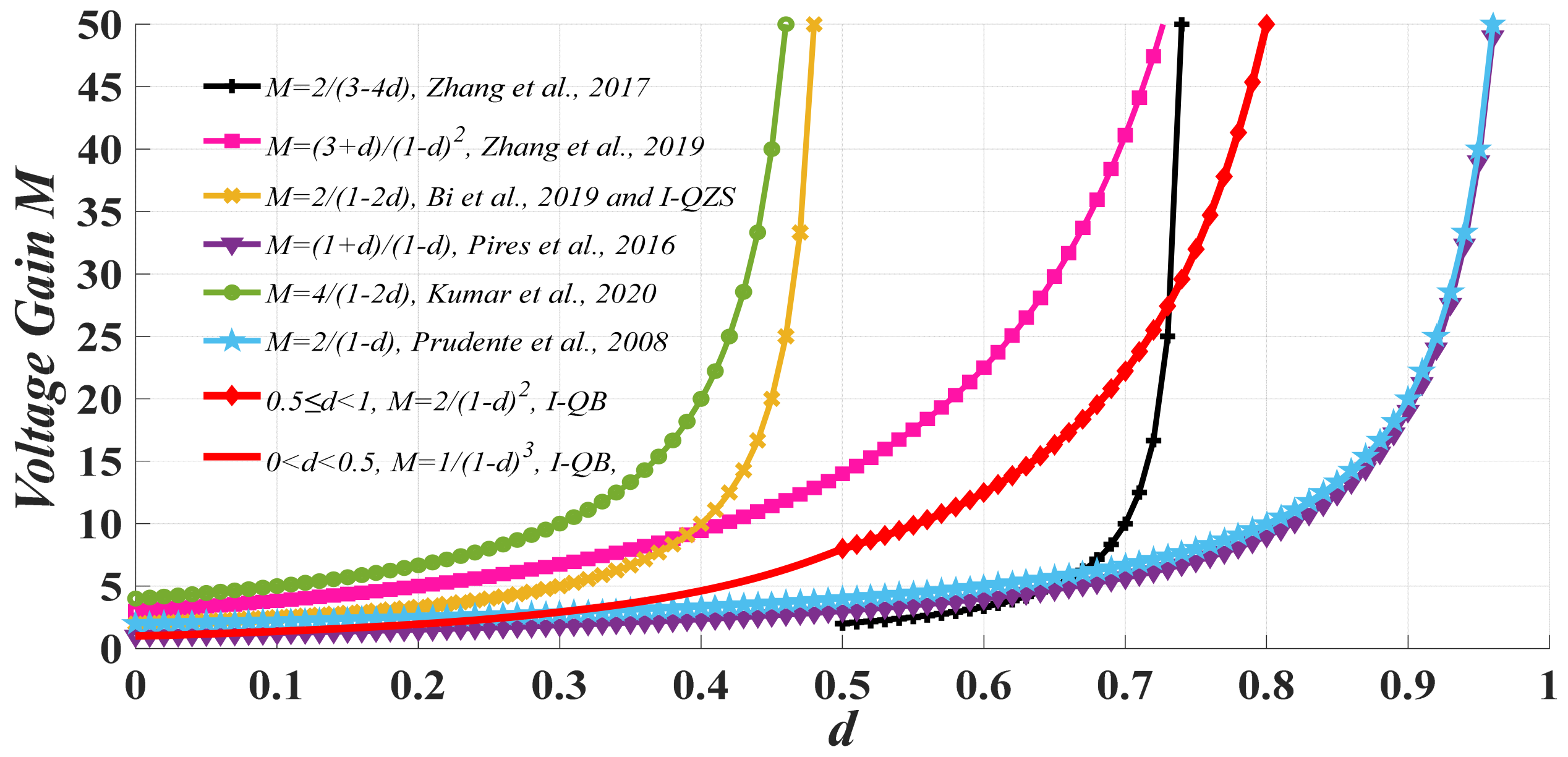
Figure 5 compares the voltage gain (M represents voltage gain) of Refs. [4,19,22,23,24,25] and the I-QB converter. It can be seen from Figure 5 that the slope of voltage gain in Refs. [22,23,24] is large. Although high voltage gain can be obtained in theory, the control difficulty increases. When duty cycle d > 0.8, the voltage gain of Refs. [19,25] is lower than ten, and it is necessary to continue increasing the duty cycle to obtain the voltage gain, but with the increase of the voltage gain, the parasitic power losses will decrease the efficiency so that the theoretical high voltage gain cannot be obtained in practice. Therefore, only the I-QB converter and Ref. [4] can obtain more than 50 times voltage gains in practice. Meanwhile, it was observed that the duty cycle ranges in Refs. [22,23,24] are relatively narrow (0.5–0.75 for Ref. [22], and 0–0.5 for Refs. [23,24]), posing challenges for converter’s controller design. When input voltage varies over a wide range, an inadequately designed controller may cause significant overshoot in the output voltage.
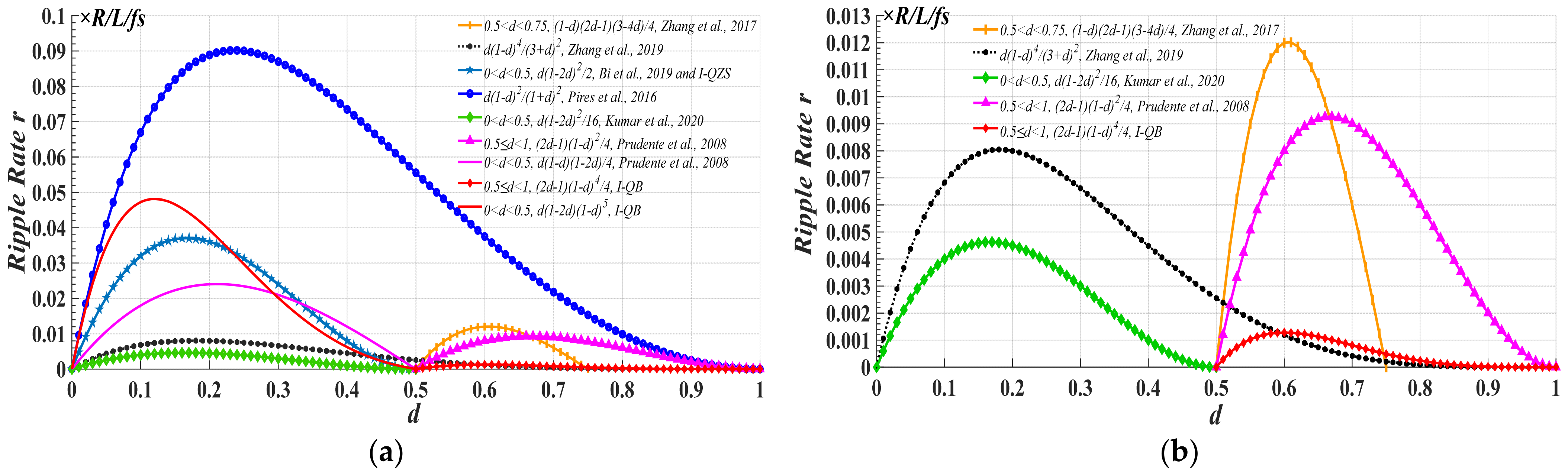
Figure 6 shows the input current ripple rate curves of Refs. [4,19,22,23,24,25] and the I-QB converter. As shown in Figure 6, when d is in the range of 0.5–1 (under a high voltage gain), the input current ripple rate of the I-QB converter is the smallest (see Figure 6b). When the duty cycle d is around 0.6, the maximum input current ripple rate of the I-QB converter is about 0.0012R/L/fs, thereby well suppressing the input current ripple, reducing the adverse effects on the FC lifespan.
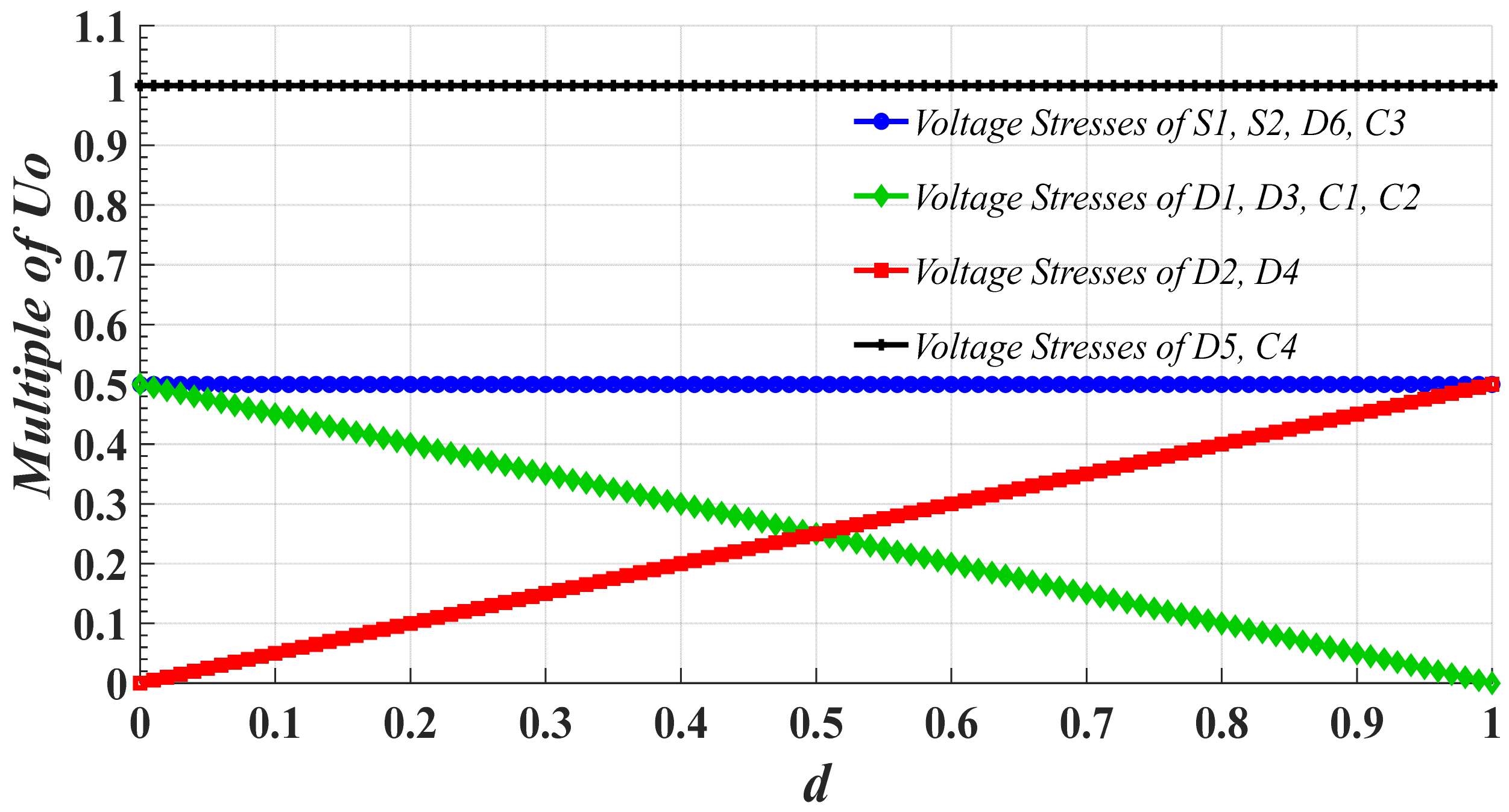
Figure 7 shows the voltage stress versus duty cycle curve for the I-QB converter. As shown in Figure 7, only diode D5 and capacitor C4 experienced voltage stresses equal to the output voltage, while the voltage stresses on all other components remained below half the output voltage value. This ensures that the majority of devices in the I-QB converter operate under low voltage stress conditions. Under conditions where components experience low voltage stress, even with a slightly higher number of components, the power density of the converter may not decrease significantly.

5. Modeling and Controller Design

5.1. Small-Signal Modeling

To analyze the dynamic response of the I-QB converter, the small-signal model is derived. uin(t) is defined as the input voltage variable, uo(t) is the output voltage variable, d(t) is the control variable, and iL1(t)–iL4(t) and uC1(t)–uC4(t) are the state variables of L1–L4 and C1–C4, respectively.
According to Figure 4, the state equation operating in S1S2 = 11, S1S2 = 10, S1S2 = 01, and S1S2 = 00 can be obtained, as described in (33)–(36), respectively.
d i L 1 ( t ) d t d i L 2 ( t ) d t d i L 3 ( t ) d t d i L 4 ( t ) d t d u C 1 ( t ) d t d u C 2 ( t ) d t d u C 3 ( t ) d t d u C 4 ( t ) d t = 0 0 0 0 0 0 0 0 0 0 0 0 1 L 2 0 0 0 0 0 0 0 0 0 0 0 0 0 0 0 0 1 L 4 0 0 0 1 C 1 0 0 0 0 0 0 0 0 0 1 C 2 0 0 0 0 0 0 0 0 0 0 0 0 0 0 0 0 0 0 0 1 C 4 R i L 1 ( t ) i L 2 ( t ) i L 3 ( t ) i L 4 ( t ) u C 1 ( t ) u C 2 ( t ) u C 3 ( t ) u C 4 ( t ) + 1 L 1   0 1 L 1   0   0   0   0   0 u in ( t ) u o ( t ) = 0 0 0 0 0 0 0 1   i L 1 ( t ) i L 2 ( t ) i L 3 ( t ) i L 4 ( t ) u C 1 ( t ) u C 2 ( t ) u C 3 ( t ) u C 4 ( t ) T
d i L 1 ( t ) d t d i L 2 ( t ) d t d i L 3 ( t ) d t d i L 4 ( t ) d t d u C 1 ( t ) d t d u C 2 ( t ) d t d u C 3 ( t ) d t d u C 4 ( t ) d t = 0 0 0 0 0 0 0 0 0 0 0 0 1 L 2 0 0 0 0 0 0 0 0 1 L 3 0 0 0 0 0 0 0 1 L 4 1 L 4 0 0 1 C 1 0 0 0 0 0 0 0 0 1 C 2 1 C 2 0 0 0 0 0 0 0 1 C 3 0 0 0 0 0 0 0 0 0 0 0 1 C 4 R i L 1 ( t ) i L 2 ( t ) i L 3 ( t ) i L 4 ( t ) u C 1 ( t ) u C 2 ( t ) u C 3 ( t ) u C 4 ( t ) + 1 L 1   0 1 L 3   0   0   0   0   0 u in ( t ) u o ( t ) = 0 0 0 0 0 0 0 1   i L 1 ( t ) i L 2 ( t ) i L 3 ( t ) i L 4 ( t ) u C 1 ( t ) u C 2 ( t ) u C 3 ( t ) u C 4 ( t ) T
d i L 1 ( t ) d t d i L 2 ( t ) d t d i L 3 ( t ) d t d i L 4 ( t ) d t d u C 1 ( t ) d t d u C 2 ( t ) d t d u C 3 ( t ) d t d u C 4 ( t ) d t = 0 0 0 0 1 L 1 0 0 0 0 0 0 0 1 L 2 0 1 L 2 1 L 2 0 0 0 0 0 0 0 0 0 0 0 0 0 1 L 4 0 0 1 C 1 1 C 1 0 0 0 0 0 0 0 0 0 1 C 2 0 0 0 0 0 1 C 3 0 0 0 0 0 0 0 1 C 4 0 0 0 0 0 1 C 4 R i L 1 ( t ) i L 2 ( t ) i L 3 ( t ) i L 4 ( t ) u C 1 ( t ) u C 2 ( t ) u C 3 ( t ) u C 4 ( t ) + 1 L 1   0 1 L 3   0   0   0   0   0 u in ( t ) u o ( t ) = 0 0 0 0 0 0 0 1   i L 1 ( t ) i L 2 ( t ) i L 3 ( t ) i L 4 ( t ) u C 1 ( t ) u C 2 ( t ) u C 3 ( t ) u C 4 ( t ) T
d i L 1 ( t ) d t d i L 2 ( t ) d t d i L 3 ( t ) d t d i L 4 ( t ) d t d u C 1 ( t ) d t d u C 2 ( t ) d t d u C 3 ( t ) d t d u C 4 ( t ) d t = 0 0 0 0 1 L 1 0 0 0 0 0 0 0 1 L 2 0 1 L 2 1 L 2 0 0 0 0 0 1 L 3 0 0 0 0 0 0 0 1 L 4 0 1 L 4 1 C 1 1 C 1 0 0 0 0 0 0 0 0 1 C 2 1 C 2 0 0 0 0 0 1 C 3 0 0 0 0 0 0 0 1 C 4 0 1 C 4 0 0 0 1 C 4 R i L 1 ( t ) i L 2 ( t ) i L 3 ( t ) i L 4 ( t ) u C 1 ( t ) u C 2 ( t ) u C 3 ( t ) u C 4 ( t ) + 1 L 1   0 1 L 3   0   0   0   0   0 u in ( t ) u o ( t ) = 0 0 0 0 0 0 0 1   i L 1 ( t ) i L 2 ( t ) i L 3 ( t ) i L 4 ( t ) u C 1 ( t ) u C 2 ( t ) u C 3 ( t ) u C 4 ( t ) T
Based on (4) and (12), combining (34)–(36) (i.e., S1S2 = 10, S1S2 = 01, and S1S2 = 00 states) obtains the state-space average equation for duty cycles between 0 and 0.5, as shown in (37). Similarly, based on (7) and (16), combining (33)–(35) (i.e., S1S2 = 11, S1S2 = 10, and S1S2 = 01 states) obtains the state-space average equation for duty cycles between 0.5 and 1, as shown in (38).
d i L 1 ( t ) d t d i L 2 ( t ) d t d i L 3 ( t ) d t d i L 4 ( t ) d t d u C 1 ( t ) d t d u C 2 ( t ) d t d u C 3 ( t ) d t d u C 4 ( t ) d t = 0 0 0 0 1 d t L 2 0 0 0 0 0 0 0 1 L 2 0 1 d t L 2 1 d t L 2 0 0 0 0 0 1 d t L 3 0 0 0 0 0 0 0 1 L 4 d t L 4 1 2 d t L 4 1 d t C 1 1 C 1 0 0 0 0 0 0 0 0 1 d t C 2 1 C 2 0 0 0 0 0 1 d t C 3 0 d t C 3 0 0 0 0 0 1 d t C 4 0 1 2 d t C 4 0 0 0 1 C 4 R i L 1 ( t ) i L 2 ( t ) i L 3 ( t ) i L 4 ( t ) u C 1 ( t ) u C 2 ( t ) u C 3 ( t ) u C 4 ( t ) + 1 L 1   0 1 L 3   0   0   0   0   0 u in ( t ) u o ( t ) = 0 0 0 0 0 0 0 1   i L 1 ( t ) i L 2 ( t ) i L 3 ( t ) i L 4 ( t ) u C 1 ( t ) u C 2 ( t ) u C 3 ( t ) u C 4 ( t ) T
d i L 1 ( t ) d t d i L 2 ( t ) d t d i L 3 ( t ) d t d i L 4 ( t ) d t d u C 1 ( t ) d t d u C 2 ( t ) d t d u C 3 ( t ) d t d u C 4 ( t ) d t = 0 0 0 0 1 d t L 2 0 0 0 0 0 0 0 1 L 2 0 1 d t L 2 1 d t L 2 0 0 0 0 0 1 d t L 3 0 0 0 0 0 0 0 1 L 4 1 d t L 4 0 1 d t C 1 1 C 1 0 0 0 0 0 0 0 0 1 d t C 2 1 C 2 0 0 0 0 0 1 d t C 3 0 1 d t C 3 0 0 0 0 0 1 d t C 4 0 0 0 0 0 1 C 4 R i L 1 ( t ) i L 2 ( t ) i L 3 ( t ) i L 4 ( t ) u C 1 ( t ) u C 2 ( t ) u C 3 ( t ) u C 4 ( t ) + 1 L 1   0 1 L 3   0   0   0   0   0 u in ( t ) u o ( t ) = 0 0 0 0 0 0 0 1   i L 1 ( t ) i L 2 ( t ) i L 3 ( t ) i L 4 ( t ) u C 1 ( t ) u C 2 ( t ) u C 3 ( t ) u C 4 ( t ) T
The state variables, input variable, output variable, and control variable can be described by introducing small-signal disturbance variables, which can be given in (39), where IL1IL4, UC1UC4, Uin, Uo, and d are the steady-state components. i ^ L 1 t i ^ L 4 t , u ^ C 1 t u ^ C 4 t , u ^ in t , u ^ o t , and d ^ o t are the small-signal disturbance variables.
i L 1 ( t ) = I L 1 + i ^ L 1 ( t ) i L 2 ( t ) = I L 2 + i ^ L 2 ( t ) i L 3 ( t ) = I L 3 + i ^ L 3 ( t ) i L 4 ( t ) = I L 4 + i ^ L 4 ( t ) u C 1 ( t ) = U C 1 + u ^ C 1 ( t ) u C 2 ( t ) = U C 2 + u ^ C 2 ( t ) u C 3 ( t ) = U C 3 + u ^ C 3 ( t ) u C 4 ( t ) = U C 4 + u ^ C 4 ( t ) u in ( t ) = U in + u ^ in ( t ) u o ( t ) = U o + u ^ o ( t ) d ( t ) = d + d ^ ( t )   and   i ^ L 1 ( t ) < < I L 1 i ^ L 2 ( t ) < < I L 2 i ^ L 3 ( t ) < < I L 3 i ^ L 4 ( t ) < < I L 4 u ^ C 1 ( t ) < < U C 1 u ^ C 2 ( t ) < < U C 2 u ^ C 3 ( t ) < < U C 3 u ^ C 4 ( t ) < < U C 4 u ^ in ( t ) < < U in u ^ o ( t ) < < U o d ^ ( t ) < < d
By substituting (39) into (37) or (38), separating the disturbance signals, and ignoring the second-order infinitesimals, the small-signal models with duty d < 0.5 and d 0.5 can be obtained, as shown in (40)–(41), respectively.
d i ^ L 1 ( t ) d t d i ^ L 2 ( t ) d t d i ^ L 3 ( t ) d t d i ^ L 4 ( t ) d t d u ^ C 1 ( t ) d t d u ^ C 2 ( t ) d t d u ^ C 3 ( t ) d t d u ^ C 4 ( t ) d t = 0 0 0 0 1 d L 1 0 0 0 0 0 0 0 1 L 2 0 1 d L 2 1 d L 2 0 0 0 0 0 1 d L 3 0 0 0 0 0 0 0 1 L 4 d L 4 1 2 d L 4 1 d C 1 1 C 1 0 0 0 0 0 0 0 0 1 d C 2 1 C 2 0 0 0 0 0 1 d C 3 0 d C 3 0 0 0 0 0 1 d C 4 0 1 2 d C 4 0 0 0 1 C 4 R i ^ L 1 ( t ) i ^ L 2 ( t ) i ^ L 3 ( t ) i ^ L 4 ( t ) u ^ C 1 ( t ) u ^ C 2 ( t ) u ^ C 3 ( t ) u ^ C 4 ( t ) + 1 L 1   0 1 L 3   0   0   0   0   0 u ^ in ( t ) + 0 0 0 0 1 L 1 0 0 0 0 0 0 0 0 0 1 L 2 1 L 2 0 0 0 0 0 1 L 3 0 0 0 0 0 0 0 0 1 L 4 2 L 4 1 C 1 0 0 0 0 0 0 0 0 0 1 C 2 0 0 0 0 0 0 1 C 3 0 1 C 3 0 0 0 0 0 1 C 4 0 2 C 4 0 0 0 0 I L 1 I L 2 I L 3 I L 4 U C 1 U C 2 U C 3 U C 4 u ^ o ( t ) = 0 0 0 0 0 0 0 1   i ^ L 1 ( t ) i ^ L 2 ( t ) i ^ L 3 ( t ) i ^ L 4 ( t ) u ^ C 1 ( t ) u ^ C 2 ( t ) u ^ C 3 ( t ) u ^ C 4 ( t ) T d ^ t
d i ^ L 1 ( t ) d t d i ^ L 2 ( t ) d t d i ^ L 3 ( t ) d t d i ^ L 4 ( t ) d t d u ^ C 1 ( t ) d t d u ^ C 2 ( t ) d t d u ^ C 3 ( t ) d t d u ^ C 4 ( t ) d t = 0 0 0 0 1 d L 1 0 0 0 0 0 0 0 1 L 2 0 1 d L 2 1 d L 2 0 0 0 0 0 1 d L 3 0 0 0 0 0 0 0 1 L 4 1 d L 4 0 1 d C 1 1 C 1 0 0 0 0 0 0 0 0 1 d C 2 1 C 2 0 0 0 0 0 1 d C 3 0 1 d C 3 0 0 0 0 0 1 d C 4 0 0 0 0 0 1 C 4 R i ^ L 1 ( t ) i ^ L 2 ( t ) i ^ L 3 ( t ) i ^ L 4 ( t ) u ^ C 1 ( t ) u ^ C 2 ( t ) u ^ C 3 ( t ) u ^ C 4 ( t ) + 1 L 1   0 1 L 3   0   0   0   0   0 u ^ in ( t ) + 0 0 0 0 1 L 1 0 0 0 0 0 0 0 0 0 1 L 2 1 L 2 0 0 0 0 0 1 L 3 0 0 0 0 0 0 0 0 1 L 4 0 1 C 1 0 0 0 0 0 0 0 0 0 1 C 2 0 0 0 0 0 0 1 C 3 0 1 C 3 0 0 0 0 0 1 C 4 0 0 0 0 0 0 I L 1 I L 2 I L 3 I L 4 U C 1 U C 2 U C 3 U C 4 u ^ o ( t ) = 0 0 0 0 0 0 0 1   i ^ L 1 ( t ) i ^ L 2 ( t ) i ^ L 3 ( t ) i ^ L 4 ( t ) u ^ C 1 ( t ) u ^ C 2 ( t ) u ^ C 3 ( t ) u ^ C 4 ( t ) T d ^ t

5.2. Controller Design

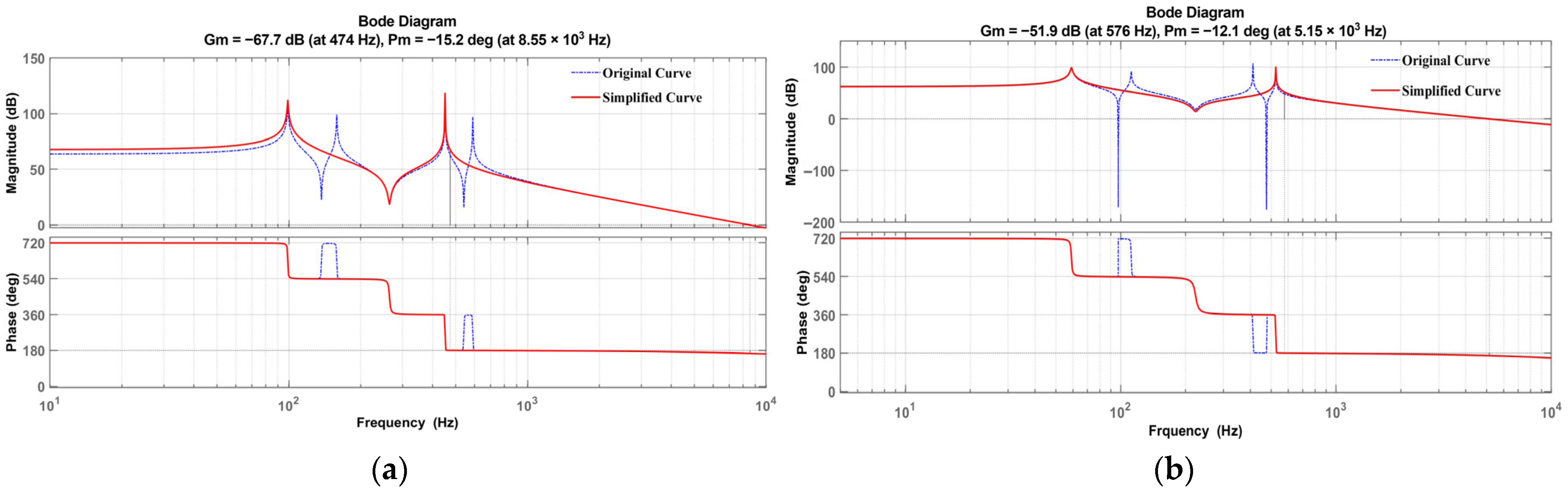
Using the small-signal model of the I-QB converter, the transfer function from the duty cycle to output voltage can be derived. When the input voltage is 60 V, the transfer function is given by (42), with the calculation parameters listed in Table 6. To simplify analysis, the original transfer function in (42) is reduced from eight to four order to obtain the simplified transfer function in (43). By the appropriate pole-zero elimination method, the (s2 + 2.232s + 7.414 × 10⁵) and (s2 + 6.226s + 1.157 × 10⁷) in the numerator and the (s2 + 2.642s + 9.961 × 10⁵) and (s2 + 3.391s + 1.375 × 10⁷) in the denominator are eliminated in (42). The BODE diagram curves of (42) and (43) are shown in Figure 8a. Similarly, when the input voltage is 30 V, the simplified transfer function after order reduction can also be obtained using the zero-pole elimination method, as shown in (44). From Figure 8, it can be seen that the original and simplified curves are approximately the same. However, both the phase margin and magnitude margin of the I-QB converter are negative, indicating the system’s instability. Therefore, a closed-loop controller must be designed to ensure the system’s stability. This paper uses a PI controller, which is designed based on (45).
G d U o , 60 V ( s ) = u ^ o ( s ) d ^ ( s ) u ^ in ( s ) = 0 = 14045 ( s 1.979 × 10 5 ) ( s 2 + 2.232 s + 7.414 × 10 5 ) ( s 2 22.77 s + 2.754 × 10 6 ) ( s 2 + 6.226 s + 1.157 × 10 7 ) ( s 2 + 3.287 s + 3.872 × 10 5 ) ( s 2 + 2.642 s + 9.961 × 10 5 ) ( s 2 + 0.7809 s + 8.051 × 10 6 ) ( s 2 + 3.391 s + 1.375 × 10 7 )
G d U o , 60 V ( s ) = u ^ o ( s ) d ^ ( s ) u ^ in ( s ) = 0 = 14045 ( s 1.979 × 10 5 ) ( s 2 22.77 s + 2.754 × 10 6 ) ( s 2 + 3.287 s + 3.872 × 10 5 ) ( s 2 + 0.7809 s + 8.051 × 10 6 )
G d U o , 30 V ( s ) = u ^ o ( s ) d ^ ( s ) u ^ in ( s ) = 0 = 6772.7 ( s 1.499 × 10 5 ) ( s 2 58.91 s + 1.96 × 10 6 ) ( s 2 + 4.809 s + 1.377 × 10 5 ) ( s 2 + 2.226 s + 1.089 × 10 7 )
G PI ( s ) = K P + K I s
where the KP is the proportional coefficient and KI is the integral coefficient.
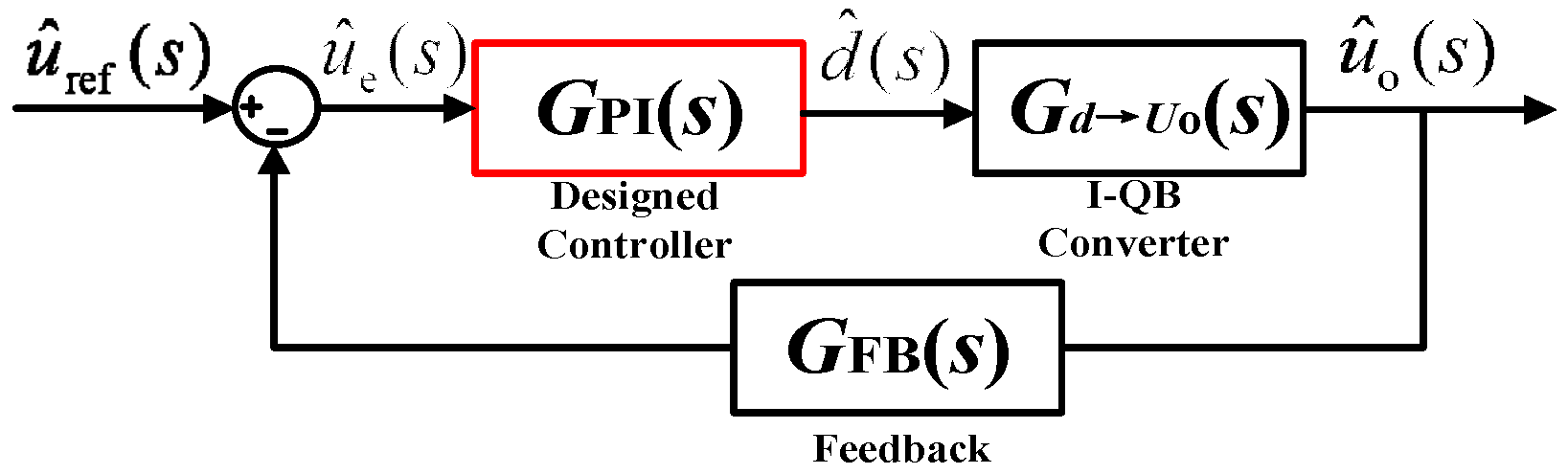
The block diagram of the closed-loop system is shown in Figure 9. GFB(s) is the feedback transfer function. The prototype adopts the Hall sensor to collect the output voltage Uo, and the feedback transfer function is GFB(s) = 1/200. GdUo(s) is the transfer function of the I-QB from control to output. GPI(s) is the transfer function of the designed PI controller.
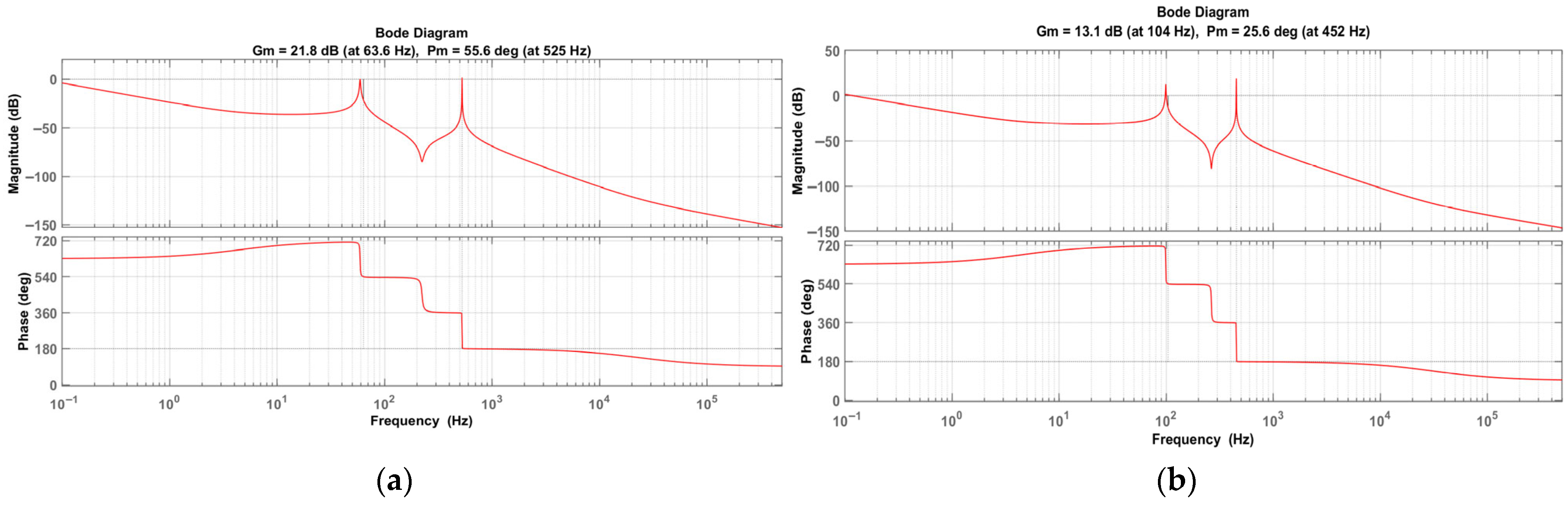
In this work, Kp = 0.0000105 and KI = 0.0003. When the input voltage is 60 V, the Bode diagram of closed-loop system is shown in Figure 10a. The phase margin and magnitude margin of the closed-loop system are 55.6° and 21.8 dB, respectively, indicating that the system is stable. When the input voltage is 30 V, the Bode diagram of the closed-loop system is shown in Figure 10b. The phase margin and gain margin of the closed-loop system is 25.6° and 13.1 dB, respectively. As indicated by the Bode diagram, although the converter system remains stable after the operating point shift, its control performance degrades and only marginally meets the basic requirements for passenger FCV applications. This limitation arises because fixed-parameter PI controllers struggle to achieve optimal performance simultaneously across the different operating points of the converter. Therefore, future research should explore control strategies that are insensitive to controlled converters, such as sliding mode control or hybrid control strategies, etc. [29,30].

6. Experiments

Wide-bandgap devices such as SiC and GaN offer high breakdown voltage, fast switching speed, and low losses, making them well-suited for achieving high-frequency and high-efficiency converter operation. To validate the performance of the I-QB converter, a scaled-down prototype based on SiC devices was developed and tested, demonstrating its steady-state and dynamic characteristics.

6.1. Parameters Selection

To ensure that the I-QB converter operates in the CCM condition, the values of inductors L1, L2, L3, and L4 should be designed to satisfy (46)–(48).
L = U L d t d I L
L 1 = ( 1 d ) 6 R 2 f s ,   L 2 = ( 1 d ) 4 R 2 f s L 3 = d ( 1 d ) 5 R 2 f s ,   L 4 = d ( 1 d ) 3 R 2 f s ;       0 < d < 0.5  
L 1 = L 3 R d ( 1 d ) 4 4 f s L 2 = L 4 R d ( 1 d ) 2 4 f s ;       0.5 < d < 1
where L is the inductance, dt = d/fs, and dIL = ΔIL. According to Table 3 and Table 4 and (49), the calculation of all capacitors in the I-QB converter can be obtained in (50) and (51).
C = I C d t d U C
C 1 d 2 I o ( 1 d ) 2 Δ U C 1 f s C 2 = C 3 d I o ( 1 d ) Δ U C 2 / C 3 f s ;       0 < d < 0.5 C 4 d I o Δ U C 4 f s
C 1 = C 2 d I o ( 1 d ) Δ U C 1 f s C 3 I o Δ U C 3 f s C 4 d I o Δ U C 4 f s ;       0.5 < d < 1
where C is the capacitance, dt = d/fs, and dUC = ΔUC. The voltage fluctuations in capacitors C1C4 are ΔUC1, ΔUC2, ΔUC3, and ΔUC4, respectively.
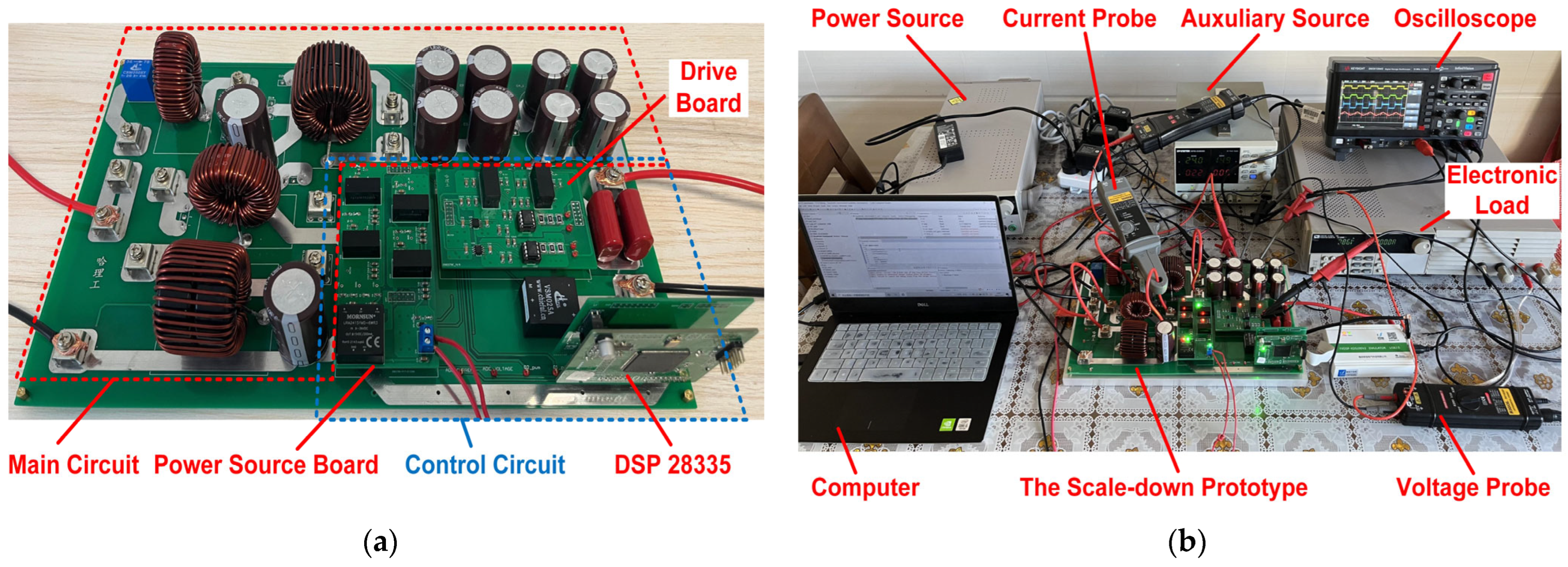
Incorporating the parameters in Table 1 and Table 3 and Equations (47), (48), (50) and (51), it can be obtained that the critical values of inductors in the five times voltage step-up state are L1 = 90.2 μH, L2 = 263.5 μH, L3 = 63.9 μH, and L4 = 186.9 μH. When the ripples of voltage are 0.02 V, the values of capacitors are C1 = 167.8 μF, C2 = 236.5 μF, C3 = 236.5 μF, and C4 = 138.3 μF. Incorporating the parameters in Table 2 and Table 4 and Equations (47), (48), (50) and (51), it can be obtained that the critical values of inductors in the ten times voltage step-up state are L1 = 24.8 μH, L2 = 124.3 μH, L3 = 24.8 μH, and L4 = 124.3 μH. When the ripples of voltage are 0.02 V, the values of capacitors are C1 = 412.5 μF, C2 = 412.5 μF, C3 = 333.5 μF, and C4 = 184.5 μF. To ensure that the I-QB converter consistently operates in CCM, and considering that the sum of the currents through L1 and L3 equals the input current, the following values are selected to further reduce the input current ripple while maintaining a sufficient margin: L1–L4 = 300 μH, C1–C2 = 680 μF, C3 = 390μF, and C4 = 220μF. Based on the analysis in Table 1, Table 2, Table 3 and Table 4 and Section 3.4 and Section 3.5, the switches and diodes are selected as SCTWA50N120 and C4D30120D, respectively. The parameters of the experimental platform are listed in Table 6, the SiC-based prototype of the I-QB converter is shown in Figure 11a, and the test platform is shown in Figure 11b. The controller chip utilizes TI’s TMS320F28335, and the voltage sampling circuit adopts the Hall sensor. The driving circuit adopts ADuM1200 and IXDD609 to realize galvanic isolation and high-frequency drive, respectively.

6.2. Steady-State Performance

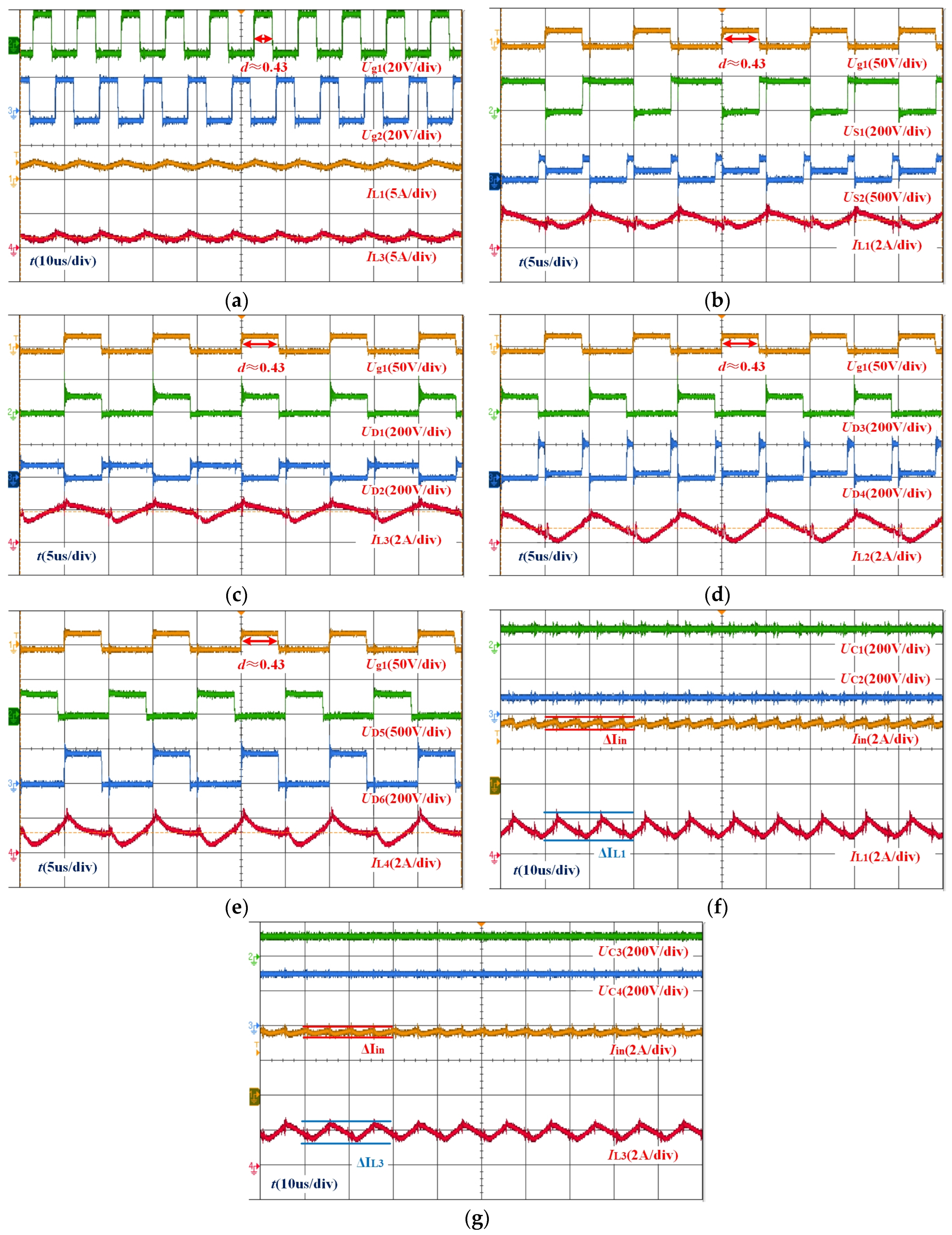
When the Uin is 60 V and the reference voltage Uref of the closed-loop system is 300 V, the converter works in a low voltage conversion ratio (ie. d < 0.5 and M = 5). The results are recorded in Figure 12. From Figure 12, it can be seen that the switching frequency fs is 100 kHz and the duty cycle d is 0.43 (due to the parasitic parameters, it is slightly greater than 0.415). The inductor average currents are IL1 = 1.4 A, IL2 = 0.9 A, IL3 = 2.0 A, IL4 = 1.2 A, and Iin = 3.4 A, respectively, which are largely in agreement with the theoretical predictions. The Uo of the I-QB converter stabilizes at the Uref of 300 V. The voltage stresses of power switches S1–S2, diodes D1–D6, and capacitors C1–C4 are shown in Figure 12a–g, which are basically consistent with the theoretical prediction and verify the correctness of the topology analysis. As shown in Figure 12f,g, the I-QB converter operates in an interleaved mode, and the current ripples of inductor L1 and L3 are compensating each other, resulting in a low ripple of the input current Iin, which is only 0.3 A.
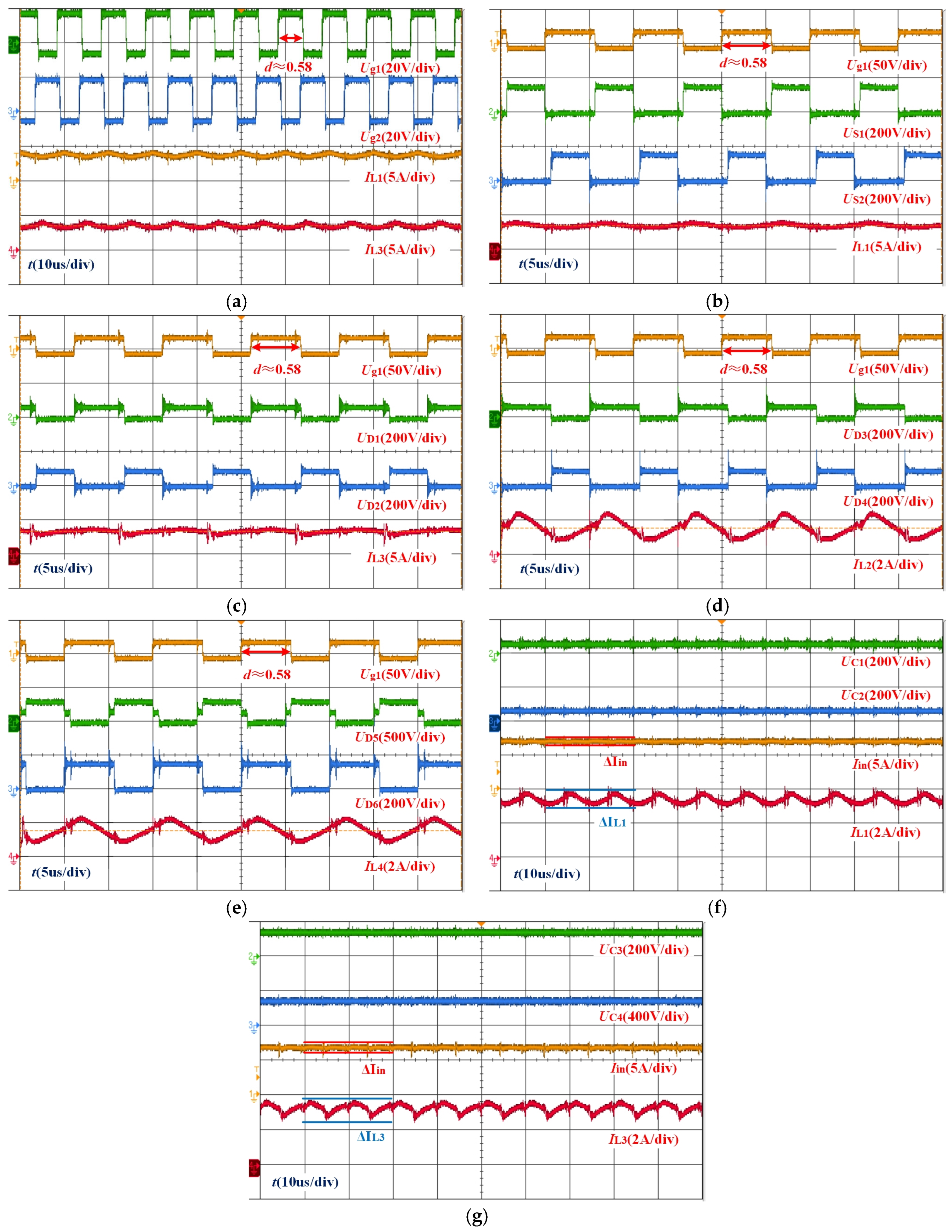
When the Uin is 30 V and the Uref of the closed-loop system is 300 V, the converter works in a high voltage conversion ratio (ie. d > 0.5 and M = 10). The waveforms are recorded in Figure 13 where the fs is 100 kHz and the d is 0.58 (due to the parasitic parameters, it is slightly greater than 0.553). The inductor average currents are IL1 = 3.5 A, IL2 = 1.5 A, IL3 = 3.5 A, IL4 = 1.5 A, and Iin = 7 A, respectively, which verify the theoretical analysis. The Uo of the I-QB converter stabilizes at the Uref of 300 V. The voltage stresses of switches S1–S2, diodes D1–D6, and capacitors C1–C4 are shown in Figure 13a–g, which are largely in agreement with the theoretical predictions and verify the correctness of the topology analysis. As shown in Figure 13f,g, the I-QB converter operates in an interleaved mode, and the current ripples of inductor L1 and L3 are compensated by each other, resulting in no significant input current ripple being observed.

6.3. Dynamic Performance Analysis

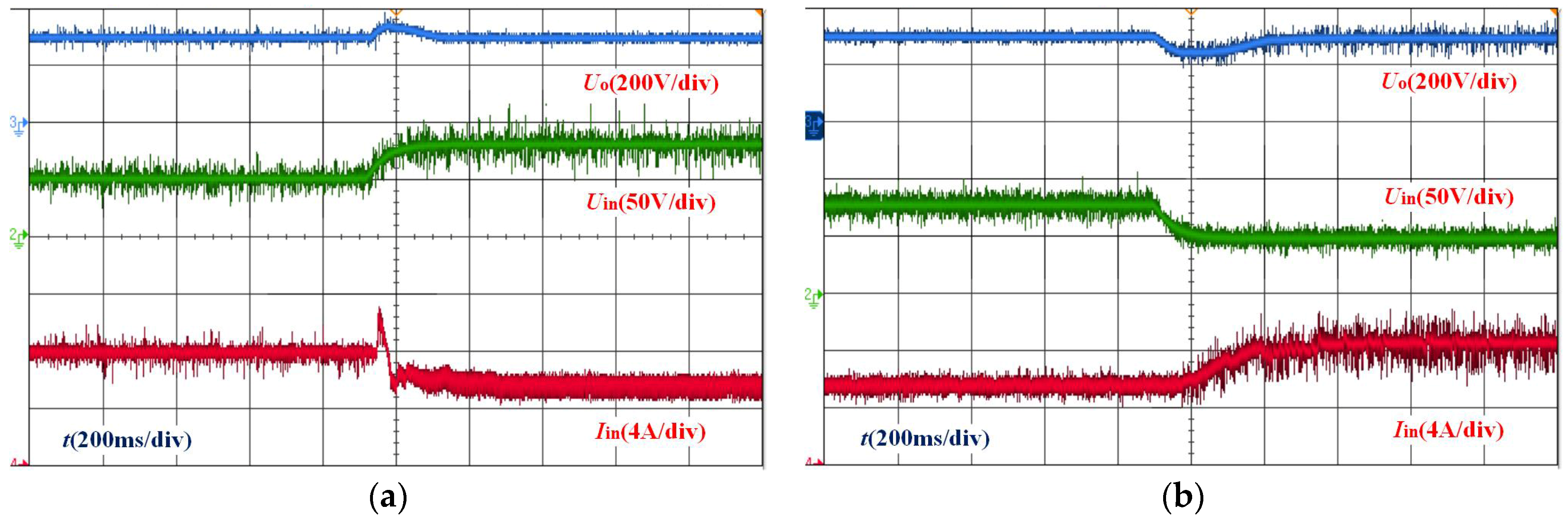
To verify the dynamic performance of the I-QB converter and simulate extreme FC voltage drop conditions, experiments with the I-QB converter under the input voltage step change are conducted. When the Uref is set as 300 V and the rated power Po is 200 W, we change the Uin between 50 V and 80 V. The waveforms are recorded in Figure 14. From Figure 14, when the Uin step changes in a wide range, the overshoot of Uo is less than 50 V, and the voltage can stabilize within 200 ms.
The settling time is influenced by the following factors. (1) Control bandwidth limitation: From Figure 10, the system’s control bandwidth is approximately 60 Hz. Due to the inverse relationship between settling time and control bandwidth, the inherent response speed is restricted. Although a higher bandwidth could shorten the settling time, it might compromise the system’s stability. This conflicts with the requirement for the converter to operate over a wide input voltage range, as changing the operating point already causes a reduction in the system’s stability margin. Moreover, non-ideal factors such as LC filtering, sampling, and PWM delays further prolong the settling time. (2) Passive component sizing: As mentioned in Section 6.1, the values of the inductors and capacitors are larger than their theoretical critical values. This is primarily to ensure that the converter operates in CCM and to minimize input current ripple. While these larger component values effectively suppress ripple, they inherently introduce larger time constants, further limiting the bandwidth, consequently leading to a longer settling time. (3) Experimental setup constraints: To ensure stable operation under all working conditions and maintain the anti-interference ability, the bandwidth cannot be designed too high, which objectively limits the dynamic response speed.
Since FCs primarily deliver average power while instantaneous power is supplied and recovered by the power battery (as shown in Figure 1), a settling time of 200 ms is acceptable for the DC/DC converter, as any resulting bus voltage overshoot can be offset by the power battery. Moreover, the experimental conditions for the input voltage step test are more stringent than the actual output characteristics of an FC. When the output voltage of an FC decreases slowly as the input current increases, the converter is expected to achieve an even better dynamic performance.
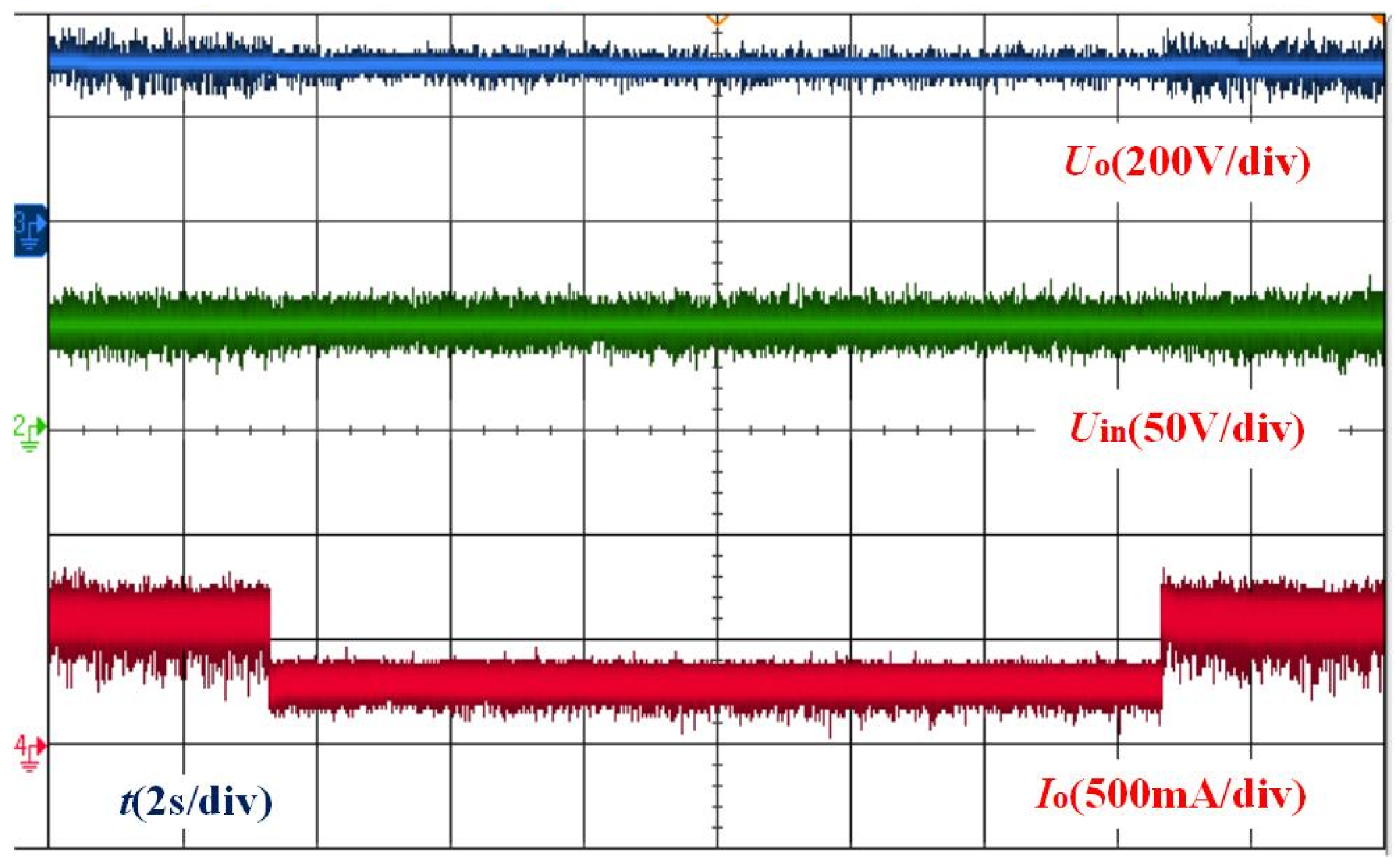
To verify the dynamic performance of the I-QB converter under sudden steps in vehicle driving conditions (load steps), we set the Po to 200 W and the output resistor step change between 450 Ω and 900 Ω. The waveforms are recorded in Figure 15. From Figure 15, it can be seen that when the load steps are between 100% and 50%, the Uo has no obvious fluctuation. Thus, it is verified that the I-QB converter has a good dynamic response.

6.4. Efficiency Testing

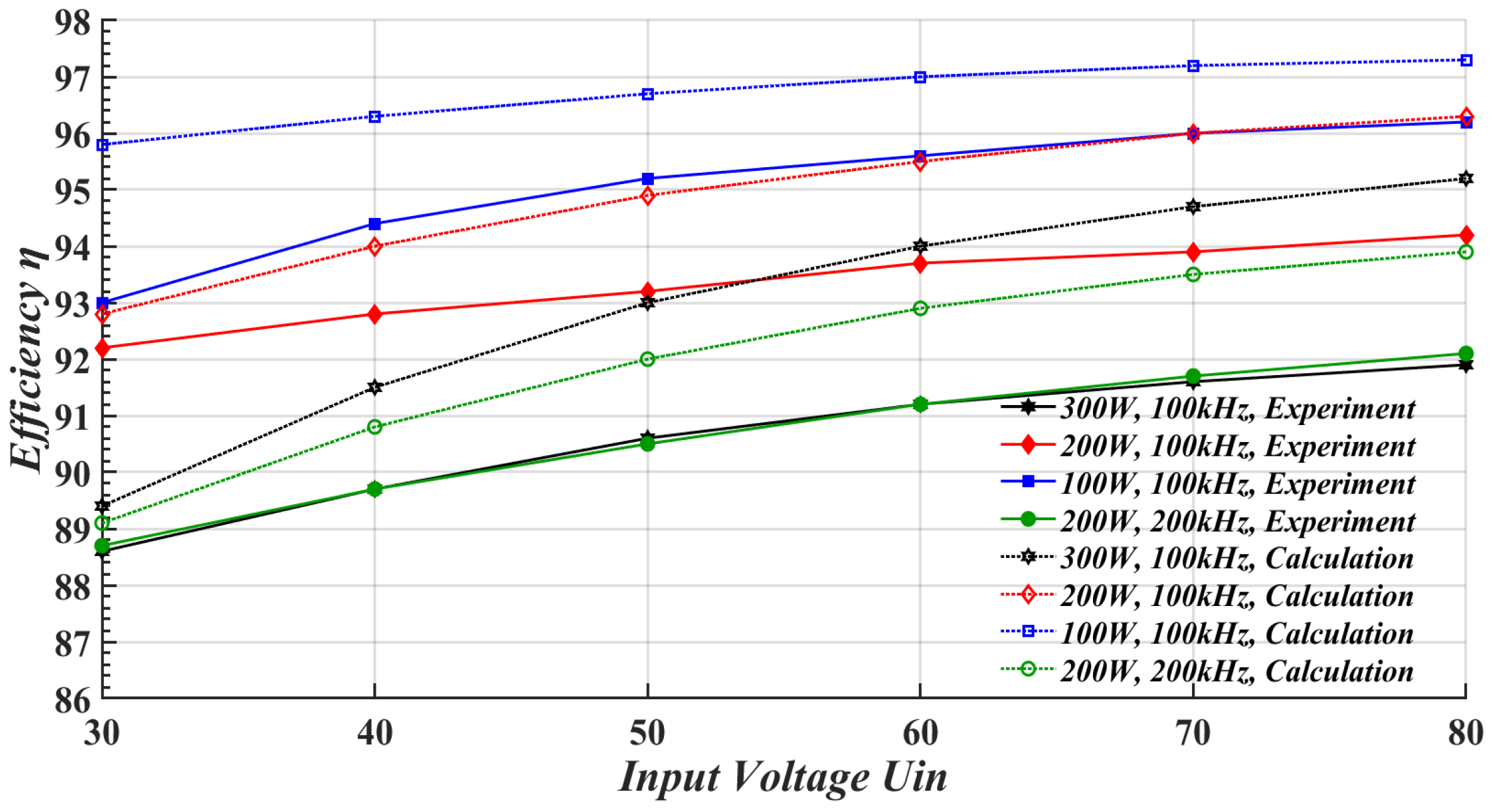
The efficiency curves of this prototype are experimentally derived and shown in Figure 16. The Po is 100 W, 200 W and 300 W, the Uin increases from 30 V to 80 V, the Uref is set to 300 V, and the fs is 100 kHz or 200 kHz.
Figure 16 shows that the theoretical and experimental results have good consistency, with the theoretical efficiency values slightly higher than the measured efficiency values. The maximum measured efficiency reaches 96.2%, occurring when the Uin is 80 V and the Po is 100 W. At the rated power of 200 W, the maximum measured efficiency is 94.2%. At a power of 300 W, the maximum measured efficiency further decreased to 91.9%. The efficiency decreases when the Uin drops at a constant output power, as the resulting increase in the Iin leads to higher losses. Similarly, with the Uin fixed, raising Po raises the Iin and consequently reduces efficiency. The peak efficiency of 92.1% occurs at Po = 200 W and fs = 200 kHz. For a constant Po, the efficiency declines with a rising fs due to greater switching losses from more frequent switching events. The experimental results validate that the overall efficiency of the I-QB converter is relatively high, and the energy loss of FCV powertrains can be potentially reduced by employing the I-QB converter.
It is worth noting that efficiency is correlated with factors such as the switching frequency, rated power, stress, component count, and device materials, etc. The 94.2% efficiency achieved in this SiC-based prototype cannot be regarded as extremely high efficiency. However, considering the component count, existing experimental conditions, PCB fabrication constraints, and other design requirements that the converter must balance, this efficiency level is satisfactory. For future researchers aiming to further improve efficiency, measures such as soft switching technology, synchronous rectification technology, optimized PCB layout, and EMI suppression could be considered. However, these aspects are not the primary focus of this study, as this prototype is intended solely to validate the feasibility and effectiveness of the I-QB converter.

6.5. Loss Analysis

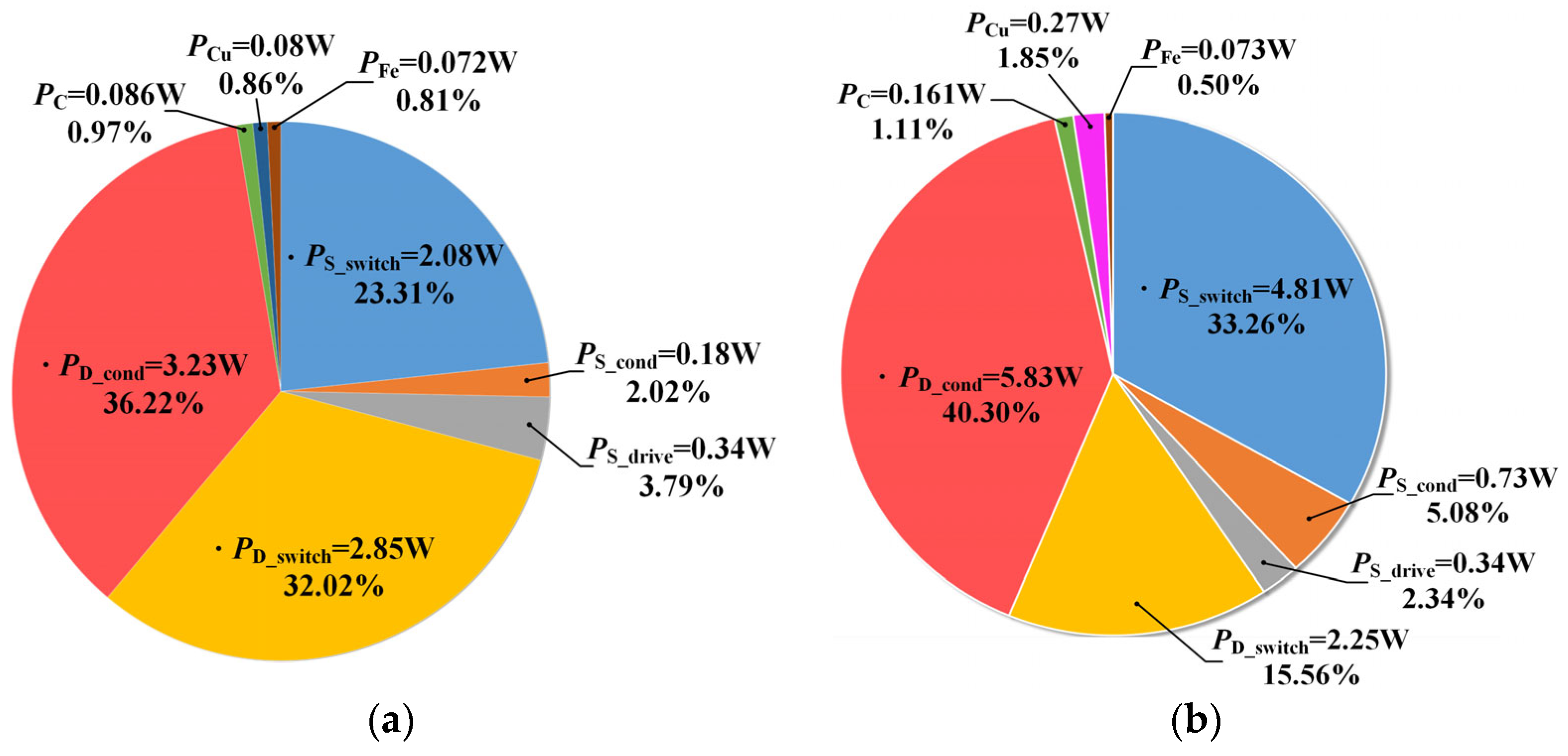
Based on the parameters in Table 6, with VF = 1.4 V, RESR_C = 0.02 Ω, rL = 0.01 Ω, rS = 0.021 Ω, the calculated loss distributions under Uin = 30 V/60 V, Uo = 200 V, fs = 100 kHz and Po = 200 W are shown in Figure 17. The results in Figure 17 indicate that the switching losses of switches and diode losses account for a substantial portion of the total losses. The proportion of switching loss increases with the increasing device stress. The conduction loss of the diodes increases with higher duty cycles, because the VF is almost constant in a wide current range, and the conduction loss is determined by the diode’s current.
To further demonstrate the consistency between theory and experiment, this paper directly compares the theoretical and experimental values of the voltage gain, input current ripple, and efficiency, as shown in Table 7. From Table 7, the theoretical and experimental values exhibit good consistency. The errors are all within an acceptable range. Several reasons explain the errors between theoretical and experimental values. (1) The effects of parasitic parameters are neglected when calculating the voltage gain and input current ripple. (2) Although parasitic parameters are considered in the loss analysis, only average values are used, and the impact of devices’ temperature rise is not included in the calculations. (3) It is challenging to incorporate the effects of EMI on the converter during calculations. (4) Inevitable measurement noise and instrument errors affect the experimental results.

6.6. Discussion

It should be further clarified that the rated power of the experimental prototype in this paper is 200 W, which is relatively low compared to the kilowatt-level power (e.g., 50 kW) required for practical passenger FCVs powertrains. This prototype is intentionally designed as a scaled-down concept validation, aimed to verify the operating principles and control strategy of the I-QB converter under safe and cost-controllable conditions. The primary contribution of this work lies in demonstrating its functionality and feasibility, rather than immediately achieving full-power operation.
The proposed topologies can be adapted to higher power levels through two main engineering approaches. First, by employing SiC power modules with higher rated power (e.g., Cree EDB003M06TM3, Cree CAB500M17HM3) and optimizing magnetic components (e.g., using nanocrystalline ring magnetic core), along with corresponding thermal management upgrades—such as replacing the passive air cooling system with a forced liquid cooling system that meets automotive industry standards. Second, the modular attribute of these topologies supports power scaling by interleaving or directly paralleling multiple converter units. These strategies not only increase the total power capacity but also offer additional advantages such as a reduced input current ripple and enhanced system fault tolerance. Although these scaling pathways are conceptually sound and based on mature industrial practices, their experimental validation at kilowatt power levels remains a key direction for future work.


7. Conclusions

To address the voltage matching issue between the FC stack and the vehicle’s DC bus in passenger FCVs, this paper proposes three high-gain DC/DC converters based on an interleaved structure, integrated with the quadratic Boost, quasi-Z source, switched-inductor impedance networks, and named I-QB, I-QZS, and I-SI respectively. Meanwhile, taking the I-QB converter as an example, a scaled-down experimental platform is constructed based on steady-state analysis and comparisons. Steady-state experimental results demonstrate that the waveforms closely align with theoretical analysis, validating the feasibility of these converters and correctness of the steady-state analysis. The dynamic response results indicate that the I-QB converter exhibits an excellent dynamic performance under step changes in input voltage and load, with a maximum voltage overshoot of less than 50 V and a settling time of within 200 ms. The peak measured efficiency of this SiC-based prototype at rated power is 94.2%. These test results further demonstrate that all three converters can balance the “six requirements” for DC/DC converter design in passenger FCV scenarios, offering the following merits:
(1)
Up to 50 times voltage gain in theory (d = 0.8);
(2)
Experimentally verified 30–80 V input voltage range;
(3)
Input current ripple rate less than 0.05 × R/L/fs;
(4)
Voltage stress of the S1–S2, C1–C3, and D1–D4, D6: ≤0.5 times output voltage;
(5)
Common ground of input–output;
(6)
94.2% measured efficiency at rated conditions.
In conclusion, the proposed DC/DC converters are well-suited for passenger FCV scenarios.

Author Contributions

Data curation, Y.W.; funding acquisition, J.W.; methodology, J.W.; project administration, J.S.; supervision, Y.L.; writing—original draft, J.W.; and writing—review and editing, X.B. All authors have read and agreed to the published version of the manuscript.

Funding

This research was funded by the Fundamental Research Foundation for Universities of Heilongjiang Province (YWF10236240122).

Data Availability Statement

The data generated or analyzed during this study are available from the corresponding author upon reasonable request.

Acknowledgments

The authors would like to thank Zhengxin Liu from Harbin Engineering University, and Zhensheng Lu from Suihua University.

Conflicts of Interest

The authors declare no conflicts of interest.

Abbreviations

The following abbreviations are used.
FCVs Fuel Cell Vehicles
FCFuel Cell
EMIElectromagnetic Interference
I-QBInterleaved-Quadratic Boost
I-QZSInterleaved-Quasi-Z Source
I-SIInterleaved-Switched-Inductor
CCMContinuous Conduction Mode
ESREquivalent Series Resistance
d-MDuty Cycle–Voltage Gain

References

  1. Chan, C.C. The State of the Art of Electric, Hybrid, and Fuel Cell Vehicles. Proc. IEEE 2007, 95, 704–718. [Google Scholar] [CrossRef]
  2. Zhang, Y.; Fu, C.; Sumner, M.; Wang, P. A Wide Input-Voltage Range Quasi-Z-Source Boost DC–DC Converter with High-Voltage Gain for Fuel Cell Vehicles. IEEE Trans. Ind. Electron. 2018, 65, 5201–5212. [Google Scholar] [CrossRef]
  3. Wang, J. Wide Input Voltage DC-DC Converter and Control Strategy for Fuel Cell Vehicles. Doctoral Dissertation, Harbin University of Science and Technology, Harbin, China, 2024. [Google Scholar]
  4. Zhang, Y.; Liu, H.; Li, J.; Sumner, M.; Xia, C. DC–DC Boost Converter with a Wide Input Range and High Voltage Gain for Fuel Cell Vehicles. IEEE Trans. Power Electron. 2019, 34, 4100–4111. [Google Scholar] [CrossRef]
  5. Wu, X.; Yang, M.; Zhou, M.; Zhang, Y.; Fu, J. A Novel High-Gain DC-DC Converter Applied in Fuel Cell Vehicles. IEEE Trans. Veh. Technol. 2020, 69, 12763–12774. [Google Scholar] [CrossRef]
  6. Meng, X.; Mei, J.; Tang, X.; Jiang, J.; Sun, C.; Song, K. The Degradation Prediction of Proton Exchange Membrane Fuel Cell Performance Based on a Transformer Model. Energies 2024, 17, 3050. [Google Scholar] [CrossRef]
  7. Meng, X.; Sun, C.; Mei, J.; Tang, X.; Hasanien, H.M.; Jiang, J.; Fan, F.; Song, K. Fuel Cell Life Prediction Considering the Recovery Phenomenon of Reversible Voltage Loss. J. Power Sources 2025, 625, 235634. [Google Scholar] [CrossRef]
  8. Wang, J.; Wang, B.; Zhang, L.; Wang, J.; Shchurov, N.I.; Malozyomov, B.V. Review of Bidirectional DC–DC Converter Topologies for Hybrid Energy Storage System of New Energy Vehicles. Green Energy Intell. Transp. 2022, 1, 100010. [Google Scholar] [CrossRef]
  9. Haji-Esmaeili, M.M.; Babaei, E.; Sabahi, M. High Step-Up Quasi-Z Source DC–DC Converter. IEEE Trans. Power Electron. 2018, 33, 10563–10571. [Google Scholar] [CrossRef]
  10. Shindo, Y.; Yamanaka, M.; Koizumi, H. Z-Source DC-DC Converter with Cascade Switched Capacitor. In Proceedings of the IECON 2011—37th Annual Conference of the IEEE Industrial Electronics Society, 7–10 November 2011; IEEE: Piscataway, NJ, USA, 2011; pp. 1665–1670. [Google Scholar]
  11. Tang, Y.; Wang, T.; He, Y. A Switched-Capacitor-Based Active-Network Converter with High Voltage Gain. IEEE Trans. Power Electron. 2014, 29, 2959–2968. [Google Scholar] [CrossRef]
  12. Mishra, S.; Adda, R.; Joshi, A. Inverse Watkins–Johnson Topology-Based Inverter. IEEE Trans. Power Electron. 2012, 27, 1066–1070. [Google Scholar] [CrossRef]
  13. Kumar, G.G.; Sundaramoorthy, K.; Karthikeyan, V.; Babaei, E. Switched Capacitor–Inductor Network Based Ultra-Gain DC–DC Converter Using Single Switch. IEEE Trans. Ind. Electron. 2020, 67, 10274–10283. [Google Scholar] [CrossRef]
  14. Rostami, S.; Abbasi, V.; Kerekes, T. Switched Capacitor Based Z-Source DC–DC Converter. IET Power Electron. 2019, 12, 3582–3589. [Google Scholar] [CrossRef]
  15. Lin, G.; Zhang, Z. Low Input Ripple High Step-Up Extendable Hybrid DC-DC Converter. IEEE Access 2019, 7, 158744–158752. [Google Scholar] [CrossRef]
  16. Bi, H.; Wang, P.; Che, Y. H-type Structural Boost Three-Level DC-DC Converter with Wide Voltage-Gain Range for Fuel Cell Applications. J. Power Electron. 2018, 18, 1303–1314. [Google Scholar]
  17. Elsayad, N.; Moradisizkoohi, H.; Mohammed, O. A New SEPIC-Based Step-Up DC-DC Converter with Wide Conversion Ratio for Fuel Cell Vehicles: Analysis and Design. IEEE Trans. Ind. Electron. 2021, 68, 6390–6400. [Google Scholar] [CrossRef]
  18. Elsayad, N.; Moradisizkoohi, H.; Mohammed, O.A. A New Single-Switch Structure of a DC–DC Converter with Wide Conversion Ratio for Fuel Cell Vehicles: Analysis and Development. IEEE J. Emerg. Sel. Top. Power Electron. 2020, 8, 2785–2800. [Google Scholar] [CrossRef]
  19. Pires, V.F.; Foito, D.; Baptista, F.R.B.; Silva, J.F. A Photovoltaic Generator System with a DC/DC Converter Based on an Integrated Boost-Ćuk Topology. Sol. Energy 2016, 136, 1–9. [Google Scholar] [CrossRef]
  20. Pires, V.F.; Cordeiro, A.; Foito, D.; Silva, J.F. High Step-Up DC–DC Converter for Fuel Cell Vehicles Based on Merged Quadratic Boost–Ćuk. IEEE Trans. Veh. Technol. 2019, 68, 7521–7530. [Google Scholar] [CrossRef]
  21. Prabhala, V.A.K.; Fajri, P.; Gouribhatla, V.S.P.; Baddipadiga, B.P.; Ferdowsi, M. A DC–DC Converter with High Voltage Gain and Two Input Boost Stages. IEEE Trans. Power Electron. 2016, 31, 4206–4215. [Google Scholar] [CrossRef]
  22. Zhang, Y.; Shi, J.; Zhou, L.; Li, J.; Sumner, M.; Wang, P.; Xia, C. Wide Input-Voltage Range Boost Three-Level DC–DC Converter with Quasi-Z Source for Fuel Cell Vehicles. IEEE Trans. Power Electron. 2017, 32, 6728–6738. [Google Scholar] [CrossRef]
  23. Bi, H.; Wang, P.; Che, Y. A Capacitor Clamped H-Type Boost DC-DC Converter with Wide Voltage-Gain Range for Fuel Cell Vehicles. IEEE Trans. Veh. Technol. 2019, 68, 276–290. [Google Scholar] [CrossRef]
  24. Kumar, A.; Wang, Y.; Pan, X.; Kamal, S.; Xiong, X.; Zhang, R.H.; Bao, D. A High Voltage Gain DC–DC Converter with Common Grounding for Fuel Cell Vehicle. IEEE Trans. Veh. Technol. 2020, 69, 8290–8304. [Google Scholar] [CrossRef]
  25. Prudente, M.; Pfitscher, L.L.; Emmendoerfer, G.; Romaneli, E.F.; Gules, R. Voltage Multiplier Cells Applied to Non-Isolated DC–DC Converters. IEEE Trans. Power Electron. 2008, 23, 871–887. [Google Scholar] [CrossRef]
  26. Tang, Y.; Fu, D.; Wang, T.; Xu, Z. Hybrid Switched-Inductor Converters for High Step-Up Conversion. IEEE Trans. Ind. Electron. 2015, 62, 1480–1490. [Google Scholar] [CrossRef]
  27. Alzahrani, A.; Ferdowsi, M.; Shamsi, P. High-Voltage-Gain DC–DC Step-Up Converter with Bifold Dickson Voltage Multiplier Cells. IEEE Trans. Power Electron. 2019, 34, 9732–9742. [Google Scholar] [CrossRef]
  28. Wang, P.; Zhou, L.; Zhang, Y.; Li, J.; Sumner, M. Input-Parallel Output-Series DC-DC Boost Converter with a Wide Input Voltage Range, For Fuel Cell Vehicles. IEEE Trans. Veh. Technol. 2017, 66, 7771–7781. [Google Scholar] [CrossRef]
  29. Zhang, W.; Sun, C.; Wang, Y.; Song, K. A Novel Voltage-Power Coordinated Control Strategy for Grid-Connected Inverters in Low-Voltage Microgrids Based on Fast Non-Singular Terminal Sliding Mode. Electr. Power Syst. Res. 2026, 251, 112183. [Google Scholar] [CrossRef]
  30. Zhang, W.; Sun, C.; Alharbi, M.; Hasanien, H.M.; Song, K. A Voltage-Power Self-Coordinated Control System on the Load-Side of Storage and Distributed Generation Inverters in Distribution Grid. Ain Shams Eng. J. 2025, 16, 103480. [Google Scholar] [CrossRef]
Figure 1. Typical structure of FCV powertrains.
Electronics 15 01222 g001
Figure 2. The proposed topologies: (a) I-QB; (b) I-QZS; and (c) I-SI.
Electronics 15 01222 g002
Figure 3. The key waveforms of the I-QB: (a) 0 < d < 0.5; (b) 0.5 ≤ d < 1.
Electronics 15 01222 g003
Figure 4. The operating modes of the I-QB: (a) S1S2 = 11; (b) S1S2 = 10; (c) S1S2 = 01; and (d) S1S2 = 00.
Electronics 15 01222 g004
Figure 5. Comparison of voltage gain with other converters. Data from Zhang et al., 2017 [22], Zhang et al., 2019, [4], Bi et al., 2019 [23], Pires et al., 2016 [19], Kumar et al., 2020 [24], Prudente et al., 2008 [25].
Electronics 15 01222 g005
Figure 6. Comparison of the ripple rate curves of input currents: (a) overall curves; (b) local curves when r < 0.013R/L/fs. Data from Zhang et al., 2017 [22], Zhang et al., 2019, [4], Bi et al., 2019 [23], Pires et al., 2016 [19], Kumar et al., 2020 [24], Prudente et al., 2008 [25].
Electronics 15 01222 g006
Figure 7. The voltage stress versus duty cycle curves for the I-QB converter.
Electronics 15 01222 g007
Figure 8. Open-loop system Bode diagram of the I-QB converter: (a) Uin = 60 V; (b) Uin = 30 V.
Electronics 15 01222 g008
Figure 9. The block diagram of the closed-loop system of the I-QB converter.
Electronics 15 01222 g009
Figure 10. Closed-loop system Bode diagram of the I-QB converter: (a) Uin = 60 V; (b) Uin = 30 V.
Electronics 15 01222 g010
Figure 11. The scale-down SiC prototype and test platform: (a) prototype; (b) test platform.
Electronics 15 01222 g011
Figure 12. Experimental waveforms when the Uin is 60 V and the Uref is 300 V (d < 0.5). (a) Driving voltage Ug1, Ug2, IL1 and IL3; (b) Ug1, voltage stresses across S1 and S2, and IL1; (c) Ug1, voltage stresses across D1 and D2, and IL3; (d) Ug1, voltage stresses across D3 and D4, and IL2; (e) Ug1, voltage stresses across D5 and D6, and IL4; (f) voltage stresses across C1 and C2, and Iin and IL1; and (g) voltage stresses across C3 and C4, and Iin and IL3.
Electronics 15 01222 g012
Figure 13. Experimental waveforms when the Uin is 30 V and the Uref is 300 V (d > 0.5). (a) Driving voltage Ug1, Ug2, IL1 and IL3; (b) Ug1, voltage stresses across S1 and S2, and IL1; (c) Ug1, voltage stresses across D1 and D2, and IL3; (d) Ug1, voltage stresses across D3 and D4, and IL2; (e) Ug1, voltage stresses across D5 and D6, and IL4; (f) voltage stresses across C1 and C2, and Iin and IL1; and (g) voltage stresses across C3 and C4, and Iin and IL3.
Electronics 15 01222 g013
Figure 14. The waveforms of the Uo, Uin and Io when the Uin changes. (a) The waveform during the Uin step-rise from 50 V to 80 V. (b) The waveform during the Uin step drop from 80 V to 50 V.
Electronics 15 01222 g014
Figure 15. Shows, when the load steps between 100% and 50%, the waveforms of the Uin, Uo and Io.
Electronics 15 01222 g015
Figure 16. The curves of efficiency versus input voltage.
Electronics 15 01222 g016
Figure 17. Calculated loss distributions of experimental prototype: (a) Uin = 60 V; (b) Uin = 30 V.
Electronics 15 01222 g017
Table 1. Voltage stress of power devices (0 < d < 0.5).
Device S1S2D1D2
Voltage Stress ( 1 d ) U o U o ( 1 d ) 2 U o d ( 1 d ) U o
DeviceD3D4D5D6
Voltage Stress ( 1 d ) 2 U o d ( 2 d ) U o U o ( 1 d ) U o
DeviceC1C2C3C4
Voltage Stress ( 1 d ) 2 U o ( 1 d ) 2 U o d U o U o
Table 2. Voltage stress of power devices (0.5 d < 1).
DeviceS1S2D1D2
Voltage Stress U o 2 U o 2 1 d 2 U o d 2 U o
DeviceD3D4D5D6
Voltage Stress 1 d 2 U o d 2 U o U o U o 2
DeviceC1C2C3C4
Voltage Stress 1 d 2 U o 1 d 2 U o U o 2 U o
Table 3. Current stress of power devices (0 < d < 0.5).
DeviceS1S2D1D2
Current Stress I o ( 1 d ) 3 2 d ( 1 d ) 2 I o d ( 1 d ) 3 I o d ( 1 d ) 3 I o
DeviceD3D4D5D6
Current Stress I o ( 1 d ) 2 I o ( 1 d ) 2 I o 1 d I o ( 1 d ) 2
DeviceL1L2L3L4
Current Stress d ( 1 d ) 3 I o d ( 1 d ) 2 I o I o ( 1 d ) 2 I o 1 d
Table 4. Current stress of power devices (0.5 d < 1).
DeviceS1S2D1D2
Current Stress 3 2 d ( 1 d ) 2 I o 2 d ( 1 d ) 2 I o I o ( 1 d ) 2 I o ( 1 d ) 2
DeviceD3D4D5D6
Current Stress I o ( 1 d ) 2 I o ( 1 d ) 2 I o 1 d I o 1 d
DeviceL1L2L3L4
Current Stress I o ( 1 d ) 2 I o 1 d I o ( 1 d ) 2 I o 1 d
Table 5. Comparisons among different DC/DC converters.
PaperVoltage GainRipple Rate of
Input Currents
Input Current Voltage Stress ofNumber ofCommon Ground
Switches
(VQ/Vo)
Diodes
(VD/Vo)
Capacitors
(VC/Vo)
CLSD
Ref. [22]
(0.5 < d < 0.75)
2 3 4 d ( 1 d ) ( 2 d 1 ) ( 3 4 d ) R 4 L f s Non-pulsatingS1/
S2
1/2D1–D31/2C1 d 1 / 2 4223Yes
C2 1 d
C31/2
C41
Ref. [4] 3 + d ( 1 d ) 2 d ( 1 d ) 4 R ( 3 + d ) 2 L f s Non-pulsatingS1 1 d 3 + d D1/D2 1 d 3 + d C1/
C2
1 d 3 + d 5225Yes
S2 1 + d 3 + d D3–D5 2 3 + d C3/
C5
2 3 + d
C4 1 + d 3 + d
Ref. [23]
(0 < d < 0.5)
2 1 2 d d ( 1 2 d ) 2 R 2 L f s Non-pulsatingS1/
S2
1/2D1–D51/2C1
C4
1/24125Yes
Ref. [19] 1 + d 1 d d ( 1 d ) 2 R ( 1 + d ) 2 L f s Non-pulsatingS 1 1 + d D11/2C1/
C2
1/23212Yes
D2 1 1 + d C3 1 1 + d
Ref. [20] 1 + d ( 1 d ) ( 1 d ) 2 d ( 1 d ) 4 R ( 1 + d d 2 ) 2 L f s Non-pulsatingS 1 1 + d ( 1 d ) D1/D4 1 d 1 + d ( 1 d ) C114314No
D2 d 1 + d ( 1 d ) C2 d ( 1 d ) 1 + d ( 1 d )
D3 1 1 + d ( 1 d ) C3/
C4
1 d 1 + d ( 1 d )
Ref. [26] 1 + 3 d 1 d /PulsatingS1/
S2
d 1 + 3 d D1–D4 d 1 + 3 d C11424No
Ref. [14]
(0 < d < 0.5)
3 2 d 1 2 d /PulsatingS 1 3 2 d D1–D4 1 3 2 d C1
C3
1 d 3 2 d 5214No
C4 1 3 2 d
C5 2 2 d 3 2 d
Ref. [13] 2 d ( 1 d ) 2 /PulsatingS 1 ( 1 d ) 2 D1 d ( 1 d ) 2 C1 d ( 1 d ) 2 d 3214Yes
D2 1 1 d
D3/D4 1 ( 1 d ) 2 C2 1 d 2 d
C31
Ref. [10]
(0 < d < 0.5)
1 + d 1 2 d /PulsatingS 1 d 1 2 d D1 d 1 + d C1/
C2
1 d 1 + d 5313No
D2 1 1 + d C3/
C4
1 1 + d
C51
Ref. [27] 6 1 d ( 2 d 1 ) ( 1 d ) 2 R 36 L f s
(d > 0.5)
Low input current rippleS1/
S2
1/6D1
–D6
1/3C1/
C2
1/66226No
C3/
C4
1/3
C5/
C6
1/2
Ref. [17] 2 + 2 d 1 d d ( 1 d ) 2 R ( 2 + 2 d ) 2 L f s Non-pulsatingS 1 2 + 2 d D1
D5
1 2 + 2 d C1,2,6,7 d 2 + 2 d 7315No
C3
C5
1 2 + 2 d
Ref. [24]
(0 < d < 0.5)
4 1 2 d d ( 1 2 d ) 2 R 16 L f s Non-pulsatingS1 1 1 2 d D1,2,61/4C1/
C2
1/45126Yes
S2 2 1 2 d D3/
D5
1/2C3
C5
1/2
Ref. [25] 2 1 d d ( 1 d ) ( 1 2 d ) R 4 L f s
( 2 d 1 ) ( 1 d ) 2 R 4 L f s
Low input current rippleS1/
S2
1/2D1/
D2
1C1/
C2
1/23224Yes
D3/
D4
1/2C31
Ref. [28] 2 1 d d ( 1 d ) ( 1 2 d ) R 4 L f s
( 2 d 1 ) ( 1 d ) 2 R 4 L f s
Low input current rippleS1/
S2
1/2D1–D31/2C1
C3
1/23223No
I-QB 1 ( 1 d ) 3
2 ( 1 d ) 2
d ( 1 2 d ) ( 1 d ) 5 R L f s
( 2 d 1 ) ( 1 d ) 4 R 4 L f s
Low input current rippleS1/
S2
1/2D1/D3 1 d 2 C1/
C2
1 d 2 4426Yes
D2/D4 d / 2
D51C31/2
D61/2C41
I-QZS
(0 < d < 0.5)
2 1 2 d d ( 1 2 d ) 2 R 4 L f s Low input current rippleS1/
S2
1/2D11/2C1/
C3
1 d 2 6424Yes
D21/2C2/
C4
d 2
D31/2C51/2
D41/2C61
I-SI 1 + 2 d d 2 ( 1 d ) 3
3 + d ( 1 d ) 2
d ( 1 2 d ) ( 1 d ) 5 R ( 1 + 2 d d 2 ) 2 L f s
( 2 d 1 ) ( 1 d ) 4 R ( 3 + d ) 2 L f s
Low input current rippleS1/
S3
1 d 3 + d D1–D4 1 d 3 + d C1
C4
1 d 3 + d 6446Yes
S2/
S4
1 + d 3 + d D5 2 3 + d D5 2 3 + d
D6 2 d 3 + d D61
Table 6. Experimental parameters.
Parameters and DevicesModels and Values
Input Voltage Uin30–80 V
Duty Cycle Range0.356–0.553
Output Voltage Uo300 V
Voltage Gain M3.75–10
Rated Power PO200 W
Rated Load R450 Ω
Switching Frequency fs100 kHz
Switches S1, S2ST SCTWA50N120 (SiC)
Diodes D1D6CREE C4D30120D (SiC)
Capacitors C1, C2680 µF/450 V
Capacitors C3, C4390 µF/220 µF/900 V
Inductors L1L4300 µH/20 A
Table 7. Comparison of theoretical and experimental values for voltage gain, input current ripple, and efficiency.
IndicatorTheoretical ValueExperimental ValueError Value
Voltage Gain60 V to 300 V54.750.25
30 V to 300 V109.430.57
Input Current RippleM = 5 (60 V to 300 V)0.240.3 A0.06 A
M = 10 (30 V to 300 V)0.1Not observed/
EfficiencyPo = 100 W, fs = 100 kHzM = 597.0%95.6%1.4%
M = 1095.8%93.0%2.8%
Po = 200 W, fs = 100 kHzM = 595.5%93.7%1.8%
M = 1092.8%92.2%0.6%
Po = 300 W, fs = 100 kHzM = 594.0%92%2%
M = 1089.4%88.6%0.8%
Po = 200 W, fs = 200 kHzM = 592.9%91.2%0.7%
M = 1089.1%88.7%0.4%
Disclaimer/Publisher’s Note: The statements, opinions and data contained in all publications are solely those of the individual author(s) and contributor(s) and not of MDPI and/or the editor(s). MDPI and/or the editor(s) disclaim responsibility for any injury to people or property resulting from any ideas, methods, instructions or products referred to in the content.