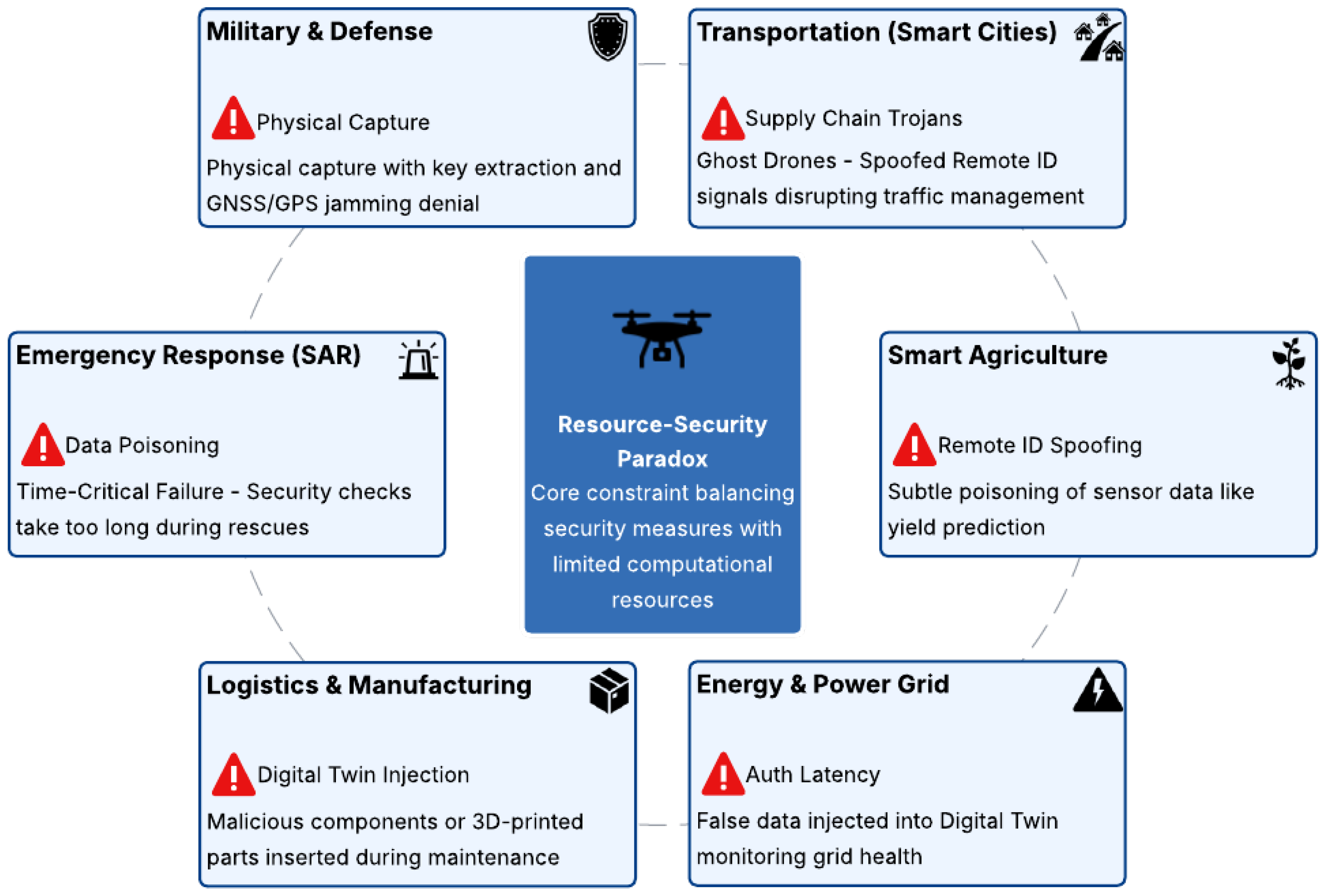
Securing Unmanned Devices in Critical Infrastructure: A Survey of Hardware, Network, and Swarm Intelligence


Abstract
1. Introduction
1.1. Survey Scope and Contribution
- A structured classification of security challenges across the UAV ecosystem, emphasizing the interdependence among communication subsystems, embedded artificial intelligence, and power-constrained hardware platforms.
- A critical review of the evolution of security mechanisms, ranging from traditional lightweight cryptographic techniques to AI-driven intrusion detection and agent-based autonomous anti-jamming strategies.
- An analysis of attack surfaces and associated security implications in high-impact application domains, including precision agriculture, smart transportation systems, and time-sensitive emergency response scenarios.
- Identification of open research challenges, such as the Resource–Security Paradox and the safety of autonomous decision-making logic, accompanied by a forward-looking research roadmap for secure unmanned critical infrastructure.
1.2. Literature Search Methodology
1.2.1. Search Strategy and Data Sources
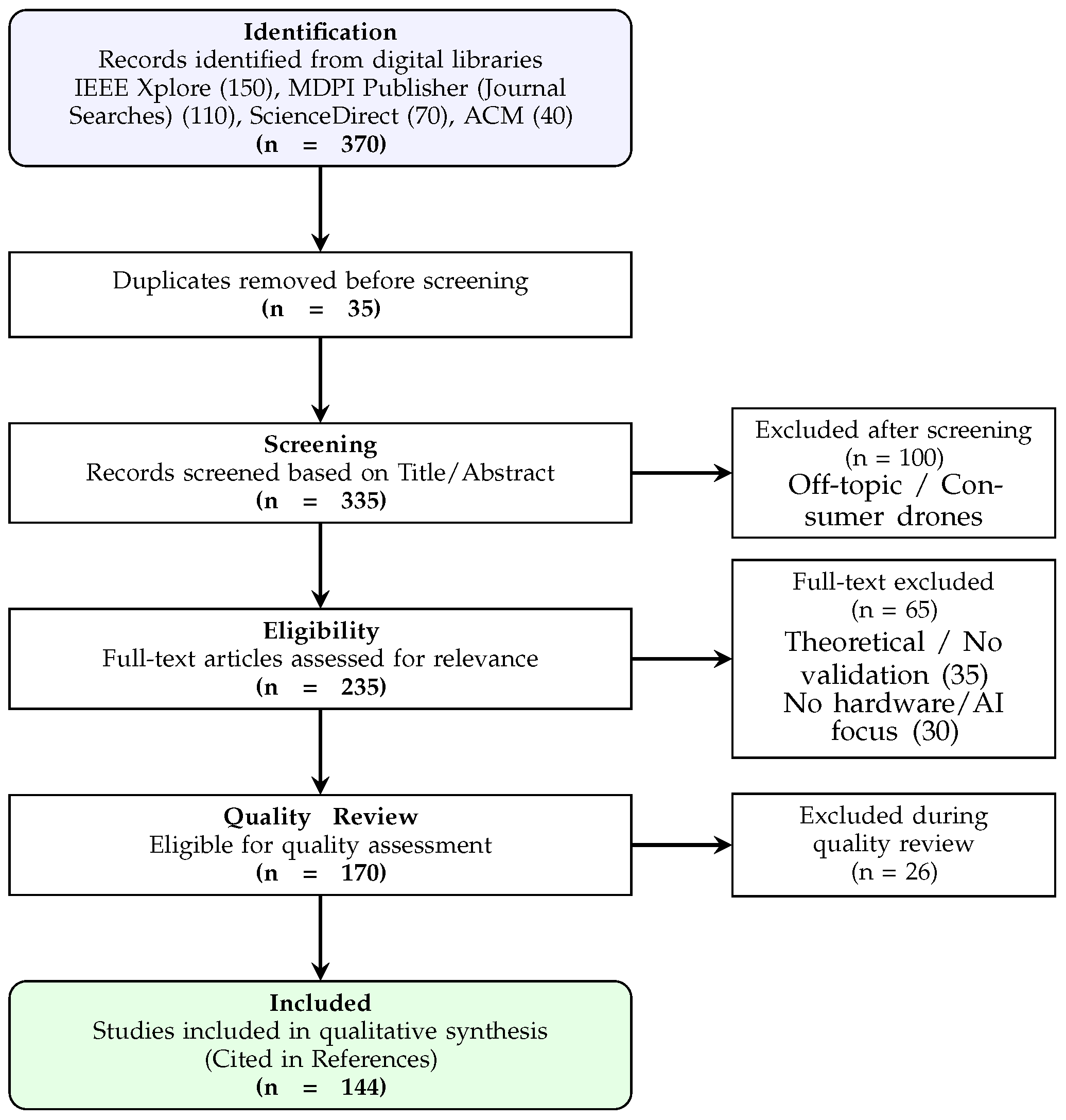
1.2.2. Eligibility and Screening Process
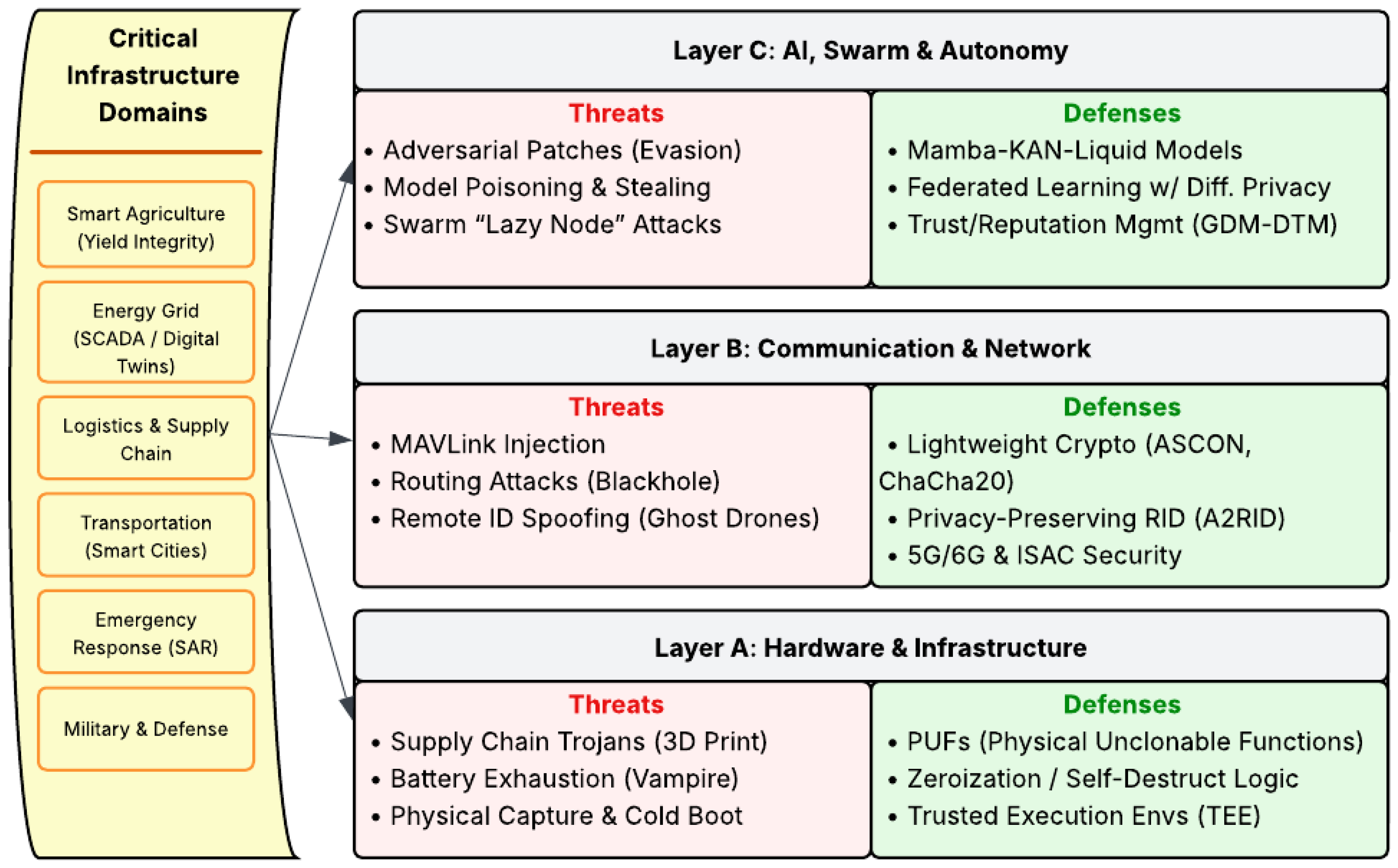
1.2.3. Taxonomy and Classification
1.3. Organization of the Paper
2. Background: Architecture and Threat Landscape
2.1. Modern UAV Architectures: Edge, Swarm, and ISAC
2.2. Taxonomy of Threats and Adversaries
Beyond Standard IoT Taxonomies: A Multi-Dimensional Framework
2.3. Real-World Threat Landscape and Economic Impact
2.4. From Single UAVs to Cooperative Swarms
3. Hardware and Infrastructure Security
3.1. Trusted Execution and Hardware Roots of Trust (RoT)
3.2. Firmware Analysis, Fuzzing, and Hardware-in-the-Loop Emulation
3.3. Supply Chain Resilience and Additive Manufacturing
3.3.1. 3D Printing and Design Injection
3.3.2. Digital Twin Verification
3.4. Resource Security and Vampire Attacks
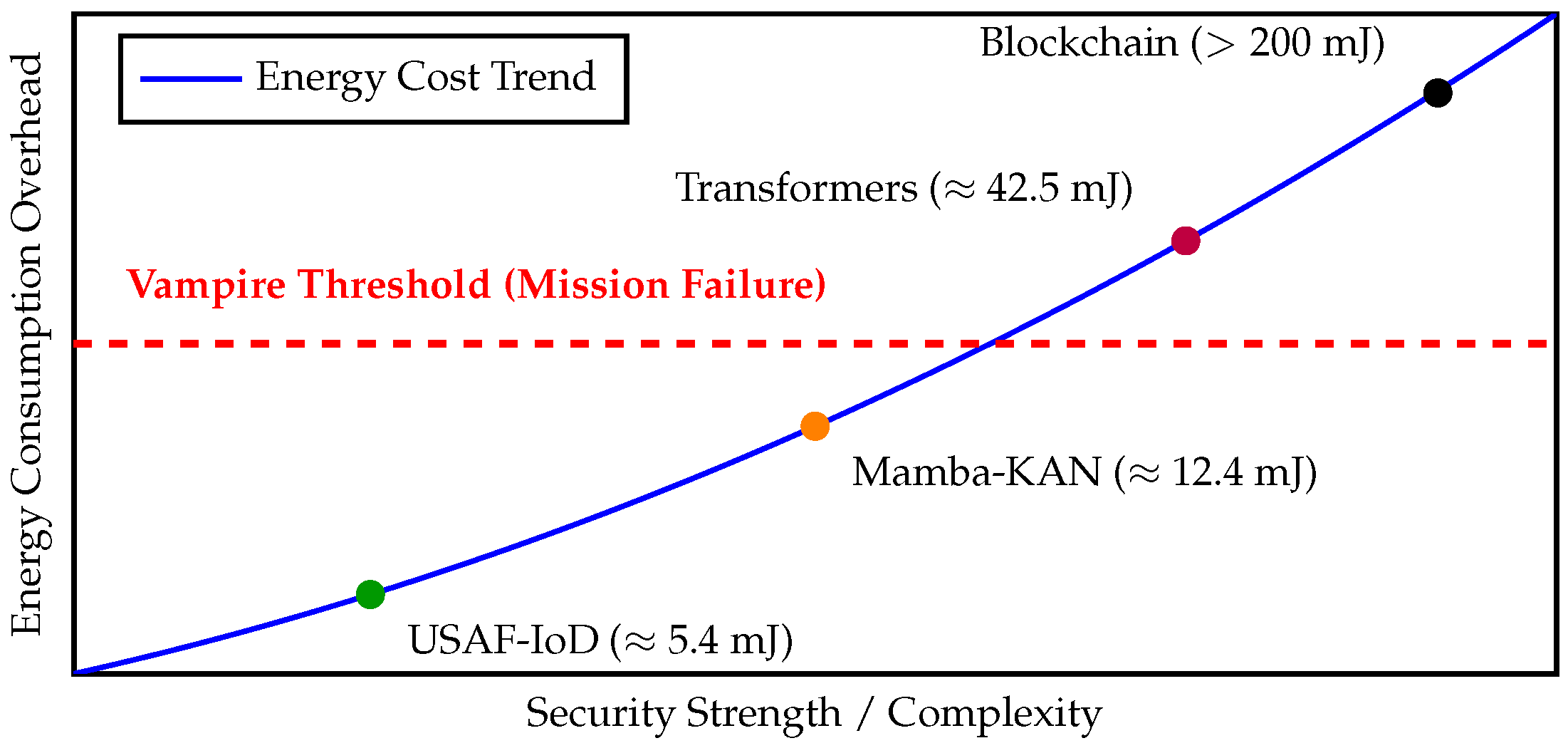
3.5. Physical Anti-Tampering Mechanisms
3.6. The Economics of Security: Cost–Benefit Analysis
4. Communication and Network Security
4.1. Secure Link Architectures: FANETs and SDN
Protocol Hardening: MAVLink Security
4.2. Edge Computing Security in UAV-MEC Networks
4.3. Lightweight Cryptography
4.4. Identity Management and Remote ID (RID) Security
4.5. Physical Layer Security, ISAC, and Next-Gen Links
4.6. Advanced Authentication and Zero-Trust
4.7. Delay-Tolerant and Relay Security
4.8. Low-Power Wide-Area Network (LPWAN) Security
4.9. Hardware and Cryptographic Deployment Limitations
5. AI, Autonomy, and Swarm Intelligence
5.1. AI Architectures for Edge Security
State-of-the-Art Edge Architectures
5.2. AI Architectures for Perception and Control
5.3. Adversarial AI: The Attack Surface
5.3.1. Evasion and Model Poisoning
5.3.2. Inference Attacks and Model Stealing
5.4. Swarm Intelligence Security: Trust and Consensus
5.4.1. Emergent Failure Modes in Swarm Dynamics
5.4.2. Dynamic Trust and Reputation Management
5.4.3. Decentralized Consensus and Learning Integrity
6. Cross-Cutting Defense: Physical Resilience and Forensics
6.1. Navigation Security (GNSS Denial/Spoofing)
6.2. From Cyber Failure to Physical Catastrophe (Scenario-Level Threats)

| Mechanism | Layer | Threat Focus | Overhead | Decentralization | Key Trade-Off |
|---|---|---|---|---|---|
| ASCON/ChaCha20 [11,15,16] | Crypto | Telemetry eavesdropping; command tampering | Low | Centralized | Speed and energy efficiency vs. cryptographic margin. |
| ECC-256 [36,59] | Crypto | Key compromise; impersonation | Medium | Centralized | Strong security guarantees vs. handshake latency. |
| Quantum-safe authentication [61,112] | Crypto | Post-quantum attacks | High | Centralized | Long-term resilience vs. hardware maturity and deployment cost. |
| Salted Temporal Keys (STK) [28,88] | Swarm | Byzantine behavior; Sybil attacks | Medium | High (leaderless) | Self-healing authentication vs. convergence delay. |
| Group Decision-Making based Dynamic Trust Management [48,87] | Swarm | Lazy nodes; behavioral evasion | Medium | Hybrid | Trust accuracy vs. memory and update overhead. |
| SDN-Based Network Deception [46,53] | Network | Jamming; node isolation | Low | Centralized | Global visibility vs. single-point-of-failure risk. |
| Decentralized Auditable Logging [29,102] | Forensics | Log tampering; evidence repudiation | High | High (blockchain) | Auditability and traceability vs. storage and bandwidth cost. |
Scenario-Level Threats: Stealthy Data Integrity and Logic Attacks
6.3. Digital Forensic Readiness (DFR)
Immutable Logging Architectures
6.4. Deployment Assessment and Failure Analysis of Defense Mechanisms
6.5. Deployment Challenges: The Sim-to-Real Gap and Empirical Failures
6.5.1. The Telemetry and Network Data Shift
6.5.2. Visual Perception and Environmental Degradation
6.5.3. Live-Fire Hardware and Protocol Failures
7. Application-Level Use Cases: Critical Infrastructure Domains
7.1. Smart Agriculture: Ensuring Economic Integrity
7.1.1. Crop Health Assessment and Yield Estimation
7.1.2. Security Risks and Data Integrity
7.2. Energy Infrastructure: Grid, Wind, and Solar
7.2.1. Secure Air-Ground Data Handover
7.2.2. Thermal Inspection and Heating Grids
7.2.3. Monitoring of Power Grids, Wind, and Solar Assets
7.2.4. Cooperative Coverage and Resource Allocation
7.2.5. Resilience Under Adversarial Conditions
7.3. Logistics, Warehousing, and Manufacturing
7.3.1. GPS-Denied Indoor Navigation and Positioning
7.3.2. Blockchain-Enabled Supply Chain Traceability
7.3.3. Swarm Coordination and Physical Safety
7.3.4. Insider Threats in Industrial Deployments
7.3.5. Secure Integration with Industrial Control Systems
7.4. Transportation and Smart Cities
7.4.1. UAV-Based Traffic Monitoring and Management
7.4.2. Accident Detection and Communication Relay
7.4.3. Security Implications and Infrastructure Assessment
7.5. Emergency and Disaster Response
7.5.1. Search and Rescue and Disaster Monitoring
7.5.2. Operations in Communication-Denied Environments
7.5.3. Security and Forensics Under Time-Critical Constraints
7.6. Military and Dual-Use Defense Operations
7.6.1. Surveillance and Reconnaissance in Adversarial Environments
7.6.2. Communication Relay and Spectrum Security
7.6.3. Resilience and Threat Mitigation in Contested Scenarios
7.6.4. Resilience Under Coordinated or Cascading Attacks
8. Open Challenges, Roadmap, and Conclusions
8.1. Closing the Sim-to-Real Security Gap
8.2. Balancing the Resource-Security Paradox
8.3. Standardization of Drone Forensics and Digital Forensic Readiness
8.4. Privacy-Preserving and Post-Quantum Identity for Remote ID
8.5. Limitations of the Survey
8.6. Roadmap Summary
8.7. Conclusions
Author Contributions
Funding
Data Availability Statement
Conflicts of Interest
References
- Jakubiak, M.; Sroka, K.; Maciuk, K.; Abazeed, A.; Kovalova, A.; Santos, L. Unmanned Aerial Vehicles (UAVs) in the Energy and Heating Sectors: Current Practices and Future Directions. Energies 2025, 19, 5. [Google Scholar] [CrossRef]
- McEnroe, P.; Wang, S.; Liyanage, M. A survey on the convergence of edge computing and AI for UAVs: Opportunities and challenges. IEEE Internet Things J. 2022, 9, 15435–15459. [Google Scholar] [CrossRef]
- Khan, M.A.; Kumar, N.; Mohsan, S.A.H.; Khan, W.U.; Nasralla, M.M.; Alsharif, M.H. Swarm of UAVs for network management in 6G: A technical review. IEEE Trans. Netw. Serv. Manag. 2023, 20, 741–761. [Google Scholar] [CrossRef]
- Yang, H.; Liu, Y.; Li, X.; Bai, Z.; Yang, L.; Pan, G.; Liu, H. Physical layer security and covert communication in UAV-ISAC networks: A comprehensive survey. J. King Saud Univ. Comput. Inf. Sci. 2025, 37, 312. [Google Scholar] [CrossRef]
- Lyu, M.; Zhao, Y.; Huang, C.; Huang, H. Unmanned aerial vehicles for search and rescue: A survey. Remote. Sens. 2023, 15, 3266. [Google Scholar] [CrossRef]
- Tsao, K.Y.; Girdler, T.; Vassilakis, V.G. A survey of cyber security threats and solutions for UAV communications and flying ad-hoc networks. Ad Hoc Netw. 2022, 133, 102894. [Google Scholar] [CrossRef]
- Yu, Z.; Wang, Z.; Yu, J.; Liu, D.; Song, H.H.; Li, Z. Cybersecurity of Unmanned Aerial Vehicles: A Survey. IEEE Aerosp. Electron. Syst. Mag. 2023, 39, 182–215. [Google Scholar] [CrossRef]
- Sarkar, S.; Shafaei, S.; Jones, T.S.; Totaro, M.W. Secure Communication in Drone Networks: A Comprehensive Survey of Lightweight Encryption and Key Management Techniques. Drones 2025, 9, 583. [Google Scholar] [CrossRef]
- Desnitsky, V.; Kotenko, I. Simulation and Assessment of Battery Depletion Attacks on Unmanned Aerial Vehicles for Crisis Management Infrastructures. Simul. Model. Pract. Theory 2021, 107, 102244. [Google Scholar] [CrossRef]
- Tlili, F.; Fourati, L.C.; Ayed, S.; Ouni, B. Investigation on vulnerabilities, threats and attacks prohibiting UAVs charging and depleting UAVs batteries: Assessments & countermeasures. Ad Hoc Netw. 2022, 129, 102805. [Google Scholar]
- Islam, M.; Mahmoud, A.S.; Sheltami, T.R. AI-Enhanced Intrusion Detection for UAV Systems: A Taxonomy and Comparative Review. Drones 2025, 9, 682. [Google Scholar] [CrossRef]
- Tlili, F.; Ayed, S.; Chaari Fourati, L. Advancing UAV security with artificial intelligence: A comprehensive survey of techniques and future directions. Internet Things 2024, 27, 101281. [Google Scholar] [CrossRef]
- Bithas, P.S.; Michailidis, E.T.; Nomikos, N.; Vouyioukas, D.; Kanatas, A.G. A survey on machine-learning techniques for UAV-based communications. Sensors 2019, 19, 5170. [Google Scholar] [CrossRef]
- Adil, M.; Song, H.; Mastorakis, S.; Abulkasim, A.; Farouk, M.; Jin, Z. UAV-Assisted IoT Applications, Cybersecurity Threats, AI-Enabled Solutions, Open Challenges with Future Research Directions. IEEE Trans. Intell. Veh. 2024, 9, 4583–4605. [Google Scholar] [CrossRef]
- Badshah, A.; Abbas, G.; Waqas, M.; Tu, S.; Abbas, Z.H.; Muhammad, F.; Chen, S. Usaf-iod: Ultralightweight and secure authenticated key agreement framework for internet of drones environment. IEEE Trans. Veh. Technol. 2024, 73, 10963–10977. [Google Scholar] [CrossRef]
- Tychola, K.A.; Rantos, K. Cyberthreats and security measures in drone-assisted agriculture. Electronics 2025, 14, 149. [Google Scholar] [CrossRef]
- Yan, X.; Fu, T.; Lin, H.; Xuan, F.; Huang, Y.; Cao, Y.; Hu, H.; Liu, P. UAV detection and tracking in urban environments using passive sensors: A survey. Appl. Sci. 2023, 13, 11320. [Google Scholar] [CrossRef]
- Aldaej, A.; Ahanger, T.A.; Atiquzzaman, M.; Ullah, I.; Yousufudin, M. Smart cybersecurity framework for IoT-empowered drones: Machine learning perspective. Sensors 2022, 22, 2630. [Google Scholar] [CrossRef] [PubMed]
- Page, M.J.; McKenzie, J.E.; Bossuyt, P.M.; Boutron, I.; Hoffmann, T.C.; Mulrow, C.D.; Shamseer, L.; Tetzlaff, J.M.; Akl, E.A.; Brennan, S.E.; et al. The PRISMA 2020 statement: An updated guideline for reporting systematic reviews. BMJ 2021, 372, n71. [Google Scholar] [CrossRef]
- Kitchenham, B.; Charters, S. Guidelines for Performing Systematic Literature Reviews in Software Engineering; Technical Report EBSE Technical Report EBSE-2007-01; Keele University: Keele, UK; Lincoln University: Lincoln, UK, 2007. [Google Scholar]
- Altaweel, A.; Mukkath, H.; Kamel, I. GPS Spoofing Attacks in FANETs: A Systematic Literature Review. IEEE Access 2023, 11, 55562–55585. [Google Scholar] [CrossRef]
- Chaffilla, R.; Alvito, P.; Basiri, M. Collaborative Infrastructure-Free Aerial–Ground Robotic System for Warehouse Inventory Data Capture. Drones 2025, 9, 792. [Google Scholar] [CrossRef]
- Ekici, M.; Seçkin, A.Ç.; Özek, A.; Karpuz, C. Warehouse drone: Indoor positioning and product counter with virtual fiducial markers. Drones 2022, 7, 3. [Google Scholar] [CrossRef]
- Bui, T.T.; Nguyen, L.D.; Kha, H.H.; Vo, N.S.; Duong, T.Q. Joint clustering and resource allocation optimization in ultra-dense networks with multiple drones as small cells using game theory. Sensors 2023, 23, 3899. [Google Scholar] [CrossRef]
- Šimon, O.; Götthans, T. A survey on the use of deep learning techniques for UAV jamming and deception. Electronics 2022, 11, 3025. [Google Scholar] [CrossRef]
- Xi, H.; Ru, L.; Tian, J.; Wang, W.; Zhu, R.; Li, S.; Zhang, Z.; Liu, L.; Luan, X. Towards Robust Physical Adversarial Attacks on UAV Object Detection: A Multi-Dimensional Feature Optimization Approach. Machines 2025, 13, 1060. [Google Scholar] [CrossRef]
- Khan, A.A.; Khan, M.M.; Khan, K.M.; Arshad, J.; Ahmad, F. A blockchain-based decentralized machine learning framework for collaborative intrusion detection within UAVs. Comput. Netw. 2021, 196, 108217. [Google Scholar] [CrossRef]
- Zou, Z.; Yang, T.; Wang, P. STK: A Salted Temporal Key Scheme for Dynamic Swarm Security. Drones 2025, 9, 856. [Google Scholar] [CrossRef]
- Sarenche, R.; Aghili, F.; Yoshizawa, T.; Singelée, D. DASLog: Decentralized auditable secure logging for UAV ecosystems. IEEE Internet Things J. 2023, 10, 20264–20284. [Google Scholar] [CrossRef]
- Burbank, J.; Toro, C.; Emmanuela, A.; Naima, K. Detection and Mitigation of Cyber Attacks on UAV Networks. Electronics 2026, 15, 317. [Google Scholar] [CrossRef]
- Li, Y.; Pawlak, J.; Price, J.; Al Shamaileh, K.; Niyaz, Q.; Paheding, S.; Devabhaktuni, V. Jamming detection and classification in OFDM-based UAVs via feature-and spectrogram-tailored machine learning. IEEE Access 2022, 10, 16859–16870. [Google Scholar] [CrossRef]
- Mohammed, U.M.; Omolara, E.O.; Abiodun, O.I.; Rasheed, J.; Osman, O.; Oyadiran, P.A.; Owolabi, O.; Anjorin, T.S.; Dada, K.V.; Obafisoye, D.; et al. Cyber threat in drone systems: Bridging real-time security, legal admissibility, and digital forensic solution readiness. Front. Commun. Netw. 2025, 6, 1661928. [Google Scholar] [CrossRef]
- Abdulridha, J.; Min, A.; Rouse, M.; Kianian, S.; Isler, V.; Yang, C. Evaluation of stem rust disease in wheat fields by drone hyperspectral imaging. Sensors 2023, 23, 4154. [Google Scholar] [CrossRef]
- Ahmad, S.M.; Samie, M.; Honarvar Shakibaei Asli, B. Building Trust in Autonomous Aerial Systems: A Review of Hardware-Rooted Trust Mechanisms. Future Internet 2025, 17, 466. [Google Scholar] [CrossRef]
- Kim, Y.; Cho, K.; Kim, S. Challenges in Dynamic Analysis of Drone Firmware and Its Solutions. IEEE Access 2024, 12, 106593–106604. [Google Scholar] [CrossRef]
- Pandey, V.K.; Prakash, S.; Ranjan, A.; Jha, S.K.; Liu, X.; Rathore, R.S. An Efficient Framework for Secure Communication in Internet of Drone Networks Using Deep Computing. Designs 2025, 9, 61. [Google Scholar] [CrossRef]
- Zaharia, S.M.; Pascariu, I.S.; Chicos, L.A.; Buican, G.R.; Pop, M.A.; Lancea, C.; Stamate, V.M. Material extrusion additive manufacturing of the composite UAV used for search-and-rescue missions. Drones 2023, 7, 602. [Google Scholar] [CrossRef]
- Badea, G.P.; Frigioescu, T.F.; Dombrovschi, M.; Cican, G.; Dima, M.; Anghel, V.; Crunteanu, D.E. Innovative Hybrid UAV Design, Development, and Manufacture for Forest Preservation and Acoustic Surveillance. Inventions 2024, 9, 39. [Google Scholar] [CrossRef]
- Celik, H.K.; Elham, A.; Cinar, R.; Erbil, M.A.; Entwistle, R.; Rennie, A.E.; Akinci, I. Development of a CAD–FEA Integrated Automation Add-In for DfAM-Aware Topology Optimization: A Case Study on an Additively Manufactured Pusher Duct Support Bracket for a Novel UAV Prototype. Appl. Sci. 2025, 15, 12341. [Google Scholar] [CrossRef]
- García-Gascón, C.; Castelló-Pedrero, P.; García-Manrique, J.A. Minimal surfaces as an innovative solution for the design of an additive manufactured solar-powered unmanned aerial vehicle (UAV). Drones 2022, 6, 285. [Google Scholar] [CrossRef]
- Chung, P.H.; Ma, D.M.; Shiau, J.K. Design, manufacturing, and flight testing of an experimental flying wing UAV. Appl. Sci. 2019, 9, 3043. [Google Scholar] [CrossRef]
- Al-Rakhami, M.S.; Al-Mashari, M. A blockchain-based trust model for the internet of things supply chain management. Sensors 2021, 21, 1759. [Google Scholar] [CrossRef]
- Zhang, J.; Campbell, J.F.; Sweeney, D.C., II; Hupman, A.C. Energy consumption models for delivery drones: A comparison and assessment. Transp. Res. Part D Transp. Environ. 2021, 90, 102668. [Google Scholar] [CrossRef]
- Li, S.; Hu, X.; Du, Y. Deep reinforcement learning for computation offloading and resource allocation in unmanned-aerial-vehicle assisted edge computing. Sensors 2021, 21, 6499. [Google Scholar] [CrossRef]
- Khor, J.H.; Sidorov, M.; Chong, M.J.Y. Secure LoRa Drone-to-Drone Communication for Public Blockchain-Based UAV Traffic Management. Sensors 2025, 25, 5087. [Google Scholar] [CrossRef]
- Batur Dinler, Ö. UAV Cybersecurity with Mamba-KAN-Liquid Hybrid Model: Deep Learning-Based Real-Time Anomaly Detection. Drones 2025, 9, 806. [Google Scholar] [CrossRef]
- Arsalaan, A.S.; Fida, M.R.; Nguyen, H.X. UAVs relay in emergency communications with strict requirements on quality of information. IEEE Trans. Veh. Technol. 2024, 74, 4877–4892. [Google Scholar] [CrossRef]
- Al-Haddad, L.A.; Khalid, W.; Tariq, S.Z.; Mrah, M.M.; Flah, A.; Tazay, A.F.; Jaber, A.A. Reliability-oriented framework for UAV-based inspection missions in modern power and energy systems. Sci. Rep. 2025, 16, 958. [Google Scholar] [CrossRef]
- Ahmim, I.; Ghoualmi-Zine, N.; Bouakkaz, F.; Rachedi, A. 2AS-DS: Anonymous Authentication Scheme Based on Physical Unclonable Function for Drone Swarms. In Proceedings of the 2024 4th International Conference on Embedded & Distributed Systems (EDiS), Bechar, Algeria, 3–5 November 2024; pp. 199–204. [Google Scholar]
- Stierlin, N.; Risch, M.; Risch, L. Current advancements in drone technology for medical sample transportation. Logistics 2024, 8, 104. [Google Scholar] [CrossRef]
- Vedrtnam, A.; Negi, H.; Kalauni, K. Materials and energy-centric life cycle assessment for drones: A review. J. Compos. Sci. 2025, 9, 169. [Google Scholar] [CrossRef]
- Tan, X.; Zuo, Z.; Su, S.; Guo, X.; Sun, X. Research of security routing protocol for UAV communication network based on AODV. Electronics 2020, 9, 1185. [Google Scholar] [CrossRef]
- Tan, Y.; Liu, J.; Wang, J. How to protect key drones in unmanned aerial vehicle networks? An SDN-based topology deception scheme. IEEE Trans. Veh. Technol. 2022, 71, 13320–13331. [Google Scholar] [CrossRef]
- Airlangga, G.; Liu, A. A study of the data security attack and defense pattern in a centralized UAV–cloud architecture. Drones 2023, 7, 289. [Google Scholar] [CrossRef]
- Agnew, D.; Del Aguila, A.; McNair, J. Enhanced network metric prediction for machine learning-based cyber security of a software-defined UAV relay network. IEEE Access 2024, 12, 54202–54219. [Google Scholar] [CrossRef]
- Zhu, C.; Zhu, X.; Qin, T. An efficient privacy protection mechanism for blockchain-based federated learning system in UAV-MEC Networks. Sensors 2024, 24, 1364. [Google Scholar] [CrossRef] [PubMed]
- Shin, Y.A.; Jeong, I.R.; Byun, J.W. Identity-Based Multiproxy Signature with Proxy Signing Key for Internet of Drones. IEEE Internet Things J. 2023, 11, 4191–4205. [Google Scholar] [CrossRef]
- Huang, W. ECC-based three-factor authentication and key agreement scheme for wireless sensor networks. Sci. Rep. 2024, 14, 1787. [Google Scholar] [CrossRef]
- Jeong, J.Y.; Kang, H.W.; Jeong, I.R. Concurrent two-party key exchange with forward unlinkability in internet of drones. IEEE Access 2024, 12, 77250–77256. [Google Scholar] [CrossRef]
- Gope, P.; Sikdar, B. An efficient privacy-preserving authenticated key agreement scheme for edge-assisted internet of drones. IEEE Trans. Veh. Technol. 2020, 69, 13621–13630. [Google Scholar] [CrossRef]
- Abulkasim, H.; Goncalves, B.; Mashatan, A.; Ghose, S. Authenticated secure quantum-based communication scheme in internet-of-drones deployment. IEEE Access 2022, 10, 94963–94972. [Google Scholar] [CrossRef]
- Jeong, J.Y.; Byun, J.W.; Jeong, I.R. Key agreement between user and drone with forward unlinkability in internet of drones. IEEE Access 2022, 10, 17134–17144. [Google Scholar] [CrossRef]
- ASTM F3411-22a; Standard Specification for Remote ID and Tracking. ASTM International: West Conshohocken, PA, USA, 2022.
- Nozomi Networks Labs. Spoofing Drone Locations by Manipulating Remote ID Protocols and Communications. 2023. Available online: https://www.nozominetworks.com/resources/spoofing-drone-locations-by-manipulating-remote-id-protocols-and-communications (accessed on 1 January 2026).
- Wisse, E.; Tedeschi, P.; Sciancalepore, S.; Di Pietro, R. A 2 RID—Anonymous Direct Authentication and Remote Identification of Commercial Drones. IEEE Internet Things J. 2023, 10, 10587–10604. [Google Scholar] [CrossRef]
- Brighente, A.; Conti, M.; Schotsman, M.; Sciancalepore, S. Obfuscated Location Disclosure for Remote ID Enabled Drones. arXiv 2024, arXiv:2407.14256. [Google Scholar] [CrossRef]
- Shen, A.; Luo, J.; Ning, J.; Li, Y.; Wang, Z.; Duo, B. Safeguarding UAV networks against active eavesdropping: An elevation angle-distance trade-off for secrecy enhancement. Drones 2023, 7, 109. [Google Scholar] [CrossRef]
- Xia, Y.; Liu, W.; Zhang, K.; Xu, C.; Huang, D. Bounding the Path Loss in UAV-Assisted Wireless Sensor Networks. IEEE Antennas Wirel. Propag. Lett. 2024, 23, 2341–2345. [Google Scholar] [CrossRef]
- Yuan, Z.; Yang, Y.; Wang, D.; Ma, X. Energy-efficient trajectory optimization for UAV-enabled cellular communications based on physical-layer security. Aerospace 2022, 9, 50. [Google Scholar] [CrossRef]
- Yang, S.; Ma, H. Security Performance Analysis of Full-Duplex UAV Assisted Relay System Based on SWIPT Technology. Appl. Sci. 2024, 14, 4987. [Google Scholar] [CrossRef]
- Ibrahim, O.; Di Pietro, R. Drone-Mag: UAV Identification and Authentication via Electromagnetic Emissions. ACM Trans.-Cyber-Phys. Syst. 2025, 9, 23. [Google Scholar] [CrossRef]
- Alshaer, N.; Ismail, T. Performance evaluation and security analysis of UAV-based FSO/CV-QKD system employing DP-QPSK/CD. IEEE Photonics J. 2022, 14, 7324911. [Google Scholar] [CrossRef]
- Koulianos, A.; Paraskevopoulos, P.; Litke, A.; Papadakis, N.K. Enhancing unmanned aerial vehicle security: A zero-knowledge proof approach with zero-knowledge succinct non-interactive arguments of knowledge for authentication and location proof. Sensors 2024, 24, 5838. [Google Scholar] [CrossRef]
- Huang, M.; Mi, W.; Wang, Y. Edgs-yolov8: An improved yolov8 lightweight uav detection model. Drones 2024, 8, 337. [Google Scholar] [CrossRef]
- Pathak, S.; Shrestha, S.; AlMahmoud, A. Model Agnostic Defense against Adversarial Patch Attacks on Object Detection in Unmanned Aerial Vehicles. In Proceedings of the 2024 IEEE/RSJ International Conference on Intelligent Robots and Systems (IROS), Abu Dhabi, United Arab Emirates, 14–18 October 2024; pp. 2586–2593. [Google Scholar]
- Wang, S.; Jiang, H.; Li, Z.; Yang, J.; Ma, X.; Chen, J.; Tang, X. PHSI-RTDETR: A lightweight infrared small target detection algorithm based on UAV aerial photography. Drones 2024, 8, 240. [Google Scholar] [CrossRef]
- Kong, F.; Li, J.; Jiang, B.; Wang, H.; Song, H. Trajectory optimization for drone logistics delivery via attention-based pointer network. IEEE Trans. Intell. Transp. Syst. 2022, 24, 4519–4531. [Google Scholar] [CrossRef]
- Tahir, N.U.A.; Long, Z.; Zhang, Z.; Asim, M.; ELAffendi, M. PVswin-YOLOv8s: UAV-based pedestrian and vehicle detection for traffic management in smart cities using improved YOLOv8. Drones 2024, 8, 84. [Google Scholar] [CrossRef]
- Zhao, L.; Zhu, M. MS-YOLOv7: YOLOv7 based on multi-scale for object detection on UAV aerial photography. Drones 2023, 7, 188. [Google Scholar] [CrossRef]
- Zheng, Q.; Tian, X.; Yu, Z.; Ding, Y.; Elhanashi, A.; Saponara, S.; Kpalma, K. MobileRaT: A lightweight radio transformer method for automatic modulation classification in drone communication systems. Drones 2023, 7, 596. [Google Scholar] [CrossRef]
- Huang, X.; Huang, D. Performance Analysis of Blockchain Consensus Algorithm in Unmanned Aerial Vehicle Ad Hoc Networks. Drones 2025, 9, 334. [Google Scholar] [CrossRef]
- Kose, K.; Zhou, B. Adversarial Training for Aerial Disaster Recognition: A Curriculum-Based Defense Against PGD Attacks. Electronics 2025, 14, 3210. [Google Scholar] [CrossRef]
- Al-Sabbagh, A.; El-Bokhary, A.; El-Koussa, S.; Jaber, A.; Elkhodr, M. Enhancing UAV security against GPS spoofing attacks through a genetic algorithm-driven deep learning framework. Information 2025, 16, 115. [Google Scholar] [CrossRef]
- Zhang, Y.; Zhang, Y.; Qi, J.; Bin, K.; Wen, H.; Tong, X.; Zhong, P. Adversarial patch attack on multi-scale object detection for UAV remote sensing images. Remote. Sens. 2022, 14, 5298. [Google Scholar] [CrossRef]
- Chen, L.; Zhai, W.; Bu, X.; Sun, M.; Zhu, C. A Lightweight Robust Training Method for Defending Model Poisoning Attacks in Federated Learning Assisted UAV Networks. Drones 2025, 9, 528. [Google Scholar] [CrossRef]
- Gao, Y.; Feng, H.; Chen, J.; Li, J.; Wei, Z. A scalable distributed control algorithm for bearing-only passive UAV formation maintenance. Sensors 2023, 23, 3849. [Google Scholar] [CrossRef]
- Hu, Y.; Gan, Y.; Wu, H.; Wang, C.; Ma, M.; Xiong, C. GDM-DTM: A Group Decision-Making-Enabled Dynamic Trust Management Method for Malicious Node Detection in Low-Altitude UAV Networks. Sensors 2025, 25, 3982. [Google Scholar] [CrossRef]
- Gharrad, H.; Jabeur, N.; Yasar, A.U.H. Hierarchical Analysis Process for Belief Management in Internet of Drones. Sensors 2022, 22, 6146. [Google Scholar] [CrossRef]
- Feng, C.; Liu, B.; Yu, K.; Goudos, S.K.; Wan, S. Blockchain-empowered decentralized horizontal federated learning for 5G-enabled UAVs. IEEE Trans. Ind. Inform. 2021, 18, 3582–3592. [Google Scholar] [CrossRef]
- Tan, Y.; Wang, J.; Liu, J.; Kato, N. Blockchain-assisted distributed and lightweight authentication service for industrial unmanned aerial vehicles. IEEE Internet Things J. 2022, 9, 16928–16940. [Google Scholar] [CrossRef]
- Valikhanli, O.; Abdullayeva, F. Securing UAV Flight Data Using Lightweight Cryptography and Image Steganography. Int. J. Adv. Comput. Sci. Appl. 2025, 16, 278–289. [Google Scholar] [CrossRef]
- Patel, A.; Cherukuri, A.K. Analysis of Light-Weight Cryptography Algorithms for UAV-Networks. arXiv 2025, arXiv:2504.04063. [Google Scholar] [CrossRef]
- Nair, A.; Thampi, S. A location-aware physical unclonable function and Chebyshev map-based mutual authentication mechanism for internet of surveillance drones. Concurr. Comput. Pract. Exp. 2023, 35, e7564. [Google Scholar] [CrossRef]
- Al-Mekhlafi, Z.G.; Altmemi, J.M.; Al-Shareeda, M.A.; Al-Hchaimi, A.A.J.; Homod, R.Z.; Mohammed, B.A.; Alshammari, G.; Al-Dhlan, K.A.; Alrashdi, R.; Alkhabra, Y.A. ChebIoD: A Chebyshev polynomial-based lightweight authentication scheme for internet of drones environments. Sci. Rep. 2025, 15, 32897. [Google Scholar] [CrossRef]
- Badhib, A.; Alshehri, S.; Cherif, A. IoT Authentication in Federated Learning: Methods, Challenges, and Future Directions. Sensors 2025, 25, 7619. [Google Scholar] [CrossRef] [PubMed]
- Pu, C.; Wall, A.; Choo, K.K.R.; Ahmed, I.; Lim, S. A lightweight and privacy-preserving mutual authentication and key agreement protocol for Internet of Drones environment. IEEE Internet Things J. 2022, 9, 9918–9933. [Google Scholar] [CrossRef]
- Jiao, J.; Chen, B.; Hu, F.; Wu, Y. A Lightweight and Dynamic Authentication Scheme Based on Blockchain and aSVC for UAV Swarm. Drones 2025, 9, 654. [Google Scholar] [CrossRef]
- Naziri, S.; Wang, X.; Yu, G.; Liang, C.J.; Ni, W. ZAPS: A Zero-Knowledge Proof Protocol for Secure UAV Authentication with Flight Path Privacy. arXiv 2025, arXiv:2508.17043. [Google Scholar] [CrossRef]
- Jačionis, T.; Urbanavičius, V.; Katkevičius, A.; Abromavičius, V.; Serackis, A.; Sledevič, T.; Plonis, D. UAV detection using thrust engine electromagnetic spectra. Drones 2022, 6, 306. [Google Scholar] [CrossRef]
- Morge-Rollet, L.; Le Jeune, D.; Le Roy, F.; Canaff, C.; Gautier, R. Drone detection and classification using physical-layer protocol statistical fingerprint. Sensors 2022, 22, 6701. [Google Scholar] [CrossRef] [PubMed]
- Ortega, J.C.Ú.; Rodríguez-Molina, J.; Martínez-Núñez, M.; Garbajosa, J. A proposal for decentralized and secured data collection from unmanned aerial vehicles in livestock monitoring with blockchain and IPFS. Appl. Sci. 2022, 13, 471. [Google Scholar] [CrossRef]
- Alqarni, M.A. Secure UAV adhoc network with blockchain technology. PLoS ONE 2024, 19, e0302513. [Google Scholar] [CrossRef]
- Abdel-Malek, M.A.; Akkaya, K.; Bhuyan, A.; Ibrahim, A.S. A proxy signature-based drone authentication in 5G D2D networks. In Proceedings of the 2021 IEEE 93rd Vehicular Technology Conference (VTC2021-Spring), Virtual, 25–28 April 2021; pp. 1–7. [Google Scholar]
- Sung, Y.H.; Park, S.J.; Kim, D.Y.; Kim, S. GPS spoofing detection method for small UAVs using 1D convolution neural network. Sensors 2022, 22, 9412. [Google Scholar] [CrossRef]
- Ma, T.; Zhang, X.; Miao, Z. Detection of UAV GPS spoofing attacks using a stacked ensemble method. Drones 2024, 9, 2. [Google Scholar] [CrossRef]
- Sun, Y.; Yu, M.; Wang, L.; Li, T.; Dong, M. A deep-learning-based GPS signal spoofing detection method for small UAVs. Drones 2023, 7, 370. [Google Scholar] [CrossRef]
- Samir, M.; Assi, C.; Sharafeddine, S.; Ebrahimi, D.; Ghrayeb, A. Age of information aware trajectory planning of UAVs in intelligent transportation systems: A deep learning approach. IEEE Trans. Veh. Technol. 2020, 69, 12382–12395. [Google Scholar] [CrossRef]
- El Haber, E.; Alameddine, H.A.; Assi, C.; Sharafeddine, S. UAV-aided ultra-reliable low-latency computation offloading in future IoT networks. IEEE Trans. Commun. 2021, 69, 6838–6851. [Google Scholar] [CrossRef]
- Wubben, J.; Morales, C.; Calafate, C.T.; Hernández-Orallo, E.; Cano, J.C.; Manzoni, P. Improving UAV mission quality and safety through topographic awareness. Drones 2022, 6, 74. [Google Scholar] [CrossRef]
- Elsisi, M.; Yu, J.T.; Lai, C.C.; Su, C.L. A drone-assisted deep learning-based IoT system for monitoring ship emissions in ports considering adversarial attacks. IEEE Trans. Instrum. Meas. 2024, 73, 9506111. [Google Scholar] [CrossRef]
- Hedayati, M.; Barzegar, A.; Rahimi, A. Fault Diagnosis and Prognosis of Satellites and Unmanned Aerial Vehicles: A Review. Appl. Sci. 2024, 14, 9487. [Google Scholar] [CrossRef]
- Vangala, A.; Agrawal, S.; Das, A.K.; Pal, S.; Kumar, N.; Lorenz, P.; Park, Y. Big data-enabled authentication framework for offshore maritime communication using drones. IEEE Trans. Veh. Technol. 2024, 73, 10196–10210. [Google Scholar] [CrossRef]
- Dixit, B.; Ananthapadmanabhan, A.; Thahsin, A.; Pathak, S.; Kasbekar, G.S.; Maity, A. A Novel Cipher for Enhancing MAVLink Security: Design, Security Analysis, and Performance Evaluation Using a Drone Testbed. IEEE Open J. Commun. Soc. 2025, 6, 9027–9051. [Google Scholar] [CrossRef]
- Krump, M.; Stütz, P. Deep learning based vehicle detection on real and synthetic aerial images: Training data composition and statistical influence analysis. Sensors 2023, 23, 3769. [Google Scholar] [CrossRef] [PubMed]
- Zidane, Y.; Silva, J.S.; Tavares, G. Jamming and spoofing techniques for drone neutralization: An experimental study. Drones 2024, 8, 743. [Google Scholar] [CrossRef]
- Sun, W.; Xu, N.; Wang, L.; Zhang, H.; Zhang, Y. Dynamic digital twin and federated learning with incentives for air-ground networks. IEEE Trans. Netw. Sci. Eng. 2020, 9, 321–333. [Google Scholar] [CrossRef]
- Sapkota, S.; Paudyal, D.R. Growth monitoring and yield estimation of maize plant using unmanned aerial vehicle (UAV) in a hilly region. Sensors 2023, 23, 5432. [Google Scholar] [CrossRef]
- Prey, L.; Ramgraber, L.; Seidl-Schulz, J.; Hanemann, A.; Noack, P.O. The transferability of spectral grain yield prediction in wheat breeding across years and trial locations. Sensors 2023, 23, 4177. [Google Scholar] [CrossRef] [PubMed]
- Rančić, K.; Blagojević, B.; Bezdan, A.; Ivošević, B.; Tubić, B.; Vranešević, M.; Pejak, B.; Crnojević, V.; Marko, O. Animal detection and counting from UAV images using convolutional neural networks. Drones 2023, 7, 179. [Google Scholar] [CrossRef]
- Liang, H.; Gao, W.; Nguyen, J.H.; Orpilla, M.F.; Yu, W. Internet of Things data collection using unmanned aerial vehicles in infrastructure free environments. IEEE Access 2019, 8, 3932–3944. [Google Scholar] [CrossRef]
- Hoque, M.A.; Hossain, M.; Noor, S.; Islam, S.R.; Hasan, R. IoTaaS: Drone-based Internet of Things as a service framework for smart cities. IEEE Internet Things J. 2021, 9, 12425–12439. [Google Scholar] [CrossRef]
- Zhang, H.; Xi, S.; Jiang, H.; Shen, Q.; Shang, B.; Wang, J. Resource allocation and offloading strategy for UAV-assisted LEO satellite edge computing. Drones 2023, 7, 383. [Google Scholar] [CrossRef]
- Karadeniz, T.N.; Ekici, S.; Avci, E. Deep learning-based detection of power transmission lines using YOLOv4 and YOLOv8. Sci. Rep. 2025, 16, 2382. [Google Scholar] [CrossRef]
- Godio, S.; Carrio, A.; Guglieri, G.; Dovis, F. Resolution and frequency effects on UAVs semi-direct visual-inertial odometry (SVO) for warehouse logistics. Sensors 2022, 22, 9911. [Google Scholar] [CrossRef]
- Alajami, A.A.; Moreno, G.; Pous, R. Design of a UAV for Autonomous RFID-Based Dynamic Inventories Using Stigmergy for Mapless Indoor Environments. Drones 2022, 6, 208. [Google Scholar] [CrossRef]
- Fernández-Caramés, T.M.; Blanco-Novoa, O.; Froiz-Míguez, I.; Fraga-Lamas, P. Towards an autonomous industry 4.0 warehouse: A UAV and blockchain-based system for inventory and traceability applications in big data-driven supply chain management. Sensors 2019, 19, 2394. [Google Scholar] [CrossRef] [PubMed]
- Han, C.; Jeon, H.; Oh, J.; Lee, H. Dynamic order picking method for multi-UAV system in intelligent warehouse. Remote. Sens. 2022, 14, 6106. [Google Scholar] [CrossRef]
- Tubis, A.A.; Ryczyński, J.; Żurek, A. Risk assessment for the use of drones in warehouse operations in the first phase of introducing the service to the market. Sensors 2021, 21, 6713. [Google Scholar] [CrossRef]
- Torres-Barriuso, J.; Lasarte, N.; Piñero, I.; Roji, E.; Elguezabal, P. Digitalization of the Workflow for Drone-Assisted Inspection and Automated Assessment of Industrial Buildings for Effective Maintenance Management. Buildings 2025, 15, 242. [Google Scholar] [CrossRef]
- Zhang, H.; Wang, F.; Feng, D.; Du, S.; Zhong, G.; Deng, C.; Zhou, J. A Logistics UAV Parcel-Receiving Station and Public Air-Route Planning Method Based on Bi-Layer Optimization. Appl. Sci. 2023, 13, 1842. [Google Scholar] [CrossRef]
- Ulin Hernandez, E.J.; Saucedo Martinez, J.A.; Marmolejo Saucedo, J.A. Optimization of the distribution network using an emerging technology. Appl. Sci. 2020, 10, 857. [Google Scholar] [CrossRef]
- Han, P.; Sui, A.; Wu, J. Lightweight Secure Communication Supporting Batch Authentication for UAV Swarm. Drones 2025, 9, 139. [Google Scholar] [CrossRef]
- Li, H.; Li, P.; Liu, J.; Zhang, P. Secure Communication and Dynamic Formation Control of Intelligent Drone Swarms Using Blockchain Technology. Information 2025, 16, 768. [Google Scholar] [CrossRef]
- Alahvirdi, D.; Tuci, E. Traffic monitoring and management system based on a swarm of drones and adaptive traffic units. Front. Future Transp. 2025, 6, 1662822. [Google Scholar] [CrossRef]
- Zaman, A.A.U.; Abdelaty, A.; Yamany, M.S. Applications of UAV Technologies in Assessment of Transportation Infrastructure Systems. CivilEng 2025, 6, 32. [Google Scholar] [CrossRef]
- Maljkovic, M.; Geroliminis, N. On Learning-Based Traffic Monitoring with a Swarm of Drones. arXiv 2025, arXiv:2503.21433. [Google Scholar] [CrossRef]
- Almujally, N.A.; Wu, T.; Alhasson, H.F.; Hanzla, M.; Jalal, A.; Liu, H. UAV-based intelligent traffic surveillance using recurrent neural networks and Swin transformer for dynamic environments. Front. Neurorobotics 2025, 19, 1681341. [Google Scholar] [CrossRef]
- Miao, W.; Luo, C.; Min, G.; Mi, Y.; Wang, H. Unlocking the potential of 5G and beyond networks to support massive access of ground and air devices. IEEE Trans. Netw. Sci. Eng. 2021, 8, 2825–2836. [Google Scholar] [CrossRef]
- Al-Rubaye, S.; Tsourdos, A.; Namuduri, K. Advanced air mobility operation and infrastructure for sustainable connected evtol vehicle. Drones 2023, 7, 319. [Google Scholar] [CrossRef]
- Kukliński, S.; Szczypiorski, K.; Chemouil, P. UAV support for mission critical services. Energies 2022, 15, 5681. [Google Scholar] [CrossRef]
- Partheepan, S.; Sanati, F.; Hassan, J. Autonomous unmanned aerial vehicles in bushfire management: Challenges and opportunities. Drones 2023, 7, 47. [Google Scholar] [CrossRef]
- Hebbar, V.; Langbort, C. A Model for Tacit Communication in Collaborative Human-UAV Search-and-Rescue. Entropy 2021, 23, 1027. [Google Scholar] [CrossRef] [PubMed]
- Tang, Z.; Jiao, Y.; Wang, X.; Pan, X.; Peng, J. Research on Scheduling Return Communication Tasks for UAV Swarms in Disaster Relief Scenarios. Drones 2025, 9, 567. [Google Scholar] [CrossRef]
- Luo, W.; Zhao, Y.; Shao, Q.; Li, X.; Wang, D.; Zhang, T.; Liu, F.; Duan, L.; He, Y.; Wang, Y.; et al. Procapra Przewalskii tracking autonomous unmanned aerial vehicle based on improved long and short-term memory Kalman filters. Sensors 2023, 23, 3948. [Google Scholar] [CrossRef] [PubMed]
- Borodacz, K.; Szczepański, C. Impact of motion-dependent errors on the accuracy of an unaided strapdown inertial navigation system. Sensors 2023, 23, 3528. [Google Scholar] [CrossRef]

| Reference | Year | Hardware & Energy Focus | Swarm & Autonomy Scope | Critical Infrastructure (CI) Context | Digital Forensics Coverage |
|---|---|---|---|---|---|
| Sarkar et al. [8] | 2025 | Computational Cost: Focuses solely on crypto algorithm overhead. | Routing: Focuses on FANET routing and key management. | General IoD: Generic “Internet of Drones” scenarios. | Not Addressed |
| Yang et al. [4] | 2025 | RF Hardware: Focuses on antenna design and signal power ratios. | Single Link: Focuses on point-to-point physical layer security. | General Comms: Focuses on wireless channel capacity. | Not Addressed |
| Tychola & Rantos [16] | 2025 | Sensors: Focuses on specific agricultural sensor vulnerabilities. | Single Agent: Focuses on individual crop-spraying drones. | Single Domain: Agriculture Only. | Not Addressed |
| Lyu et al. [5] | 2023 | Payload: Focuses on cameras and SAR-specific sensors. | Cooperative: Focuses on multi-UAV coverage patterns. | Single Domain: Emergency Response (SAR) Only. | Not Addressed |
| Yan et al. [17] | 2023 | Passive Sensors: Focuses on radar/acoustic detection hardware. | Detection: Focuses on detecting swarms, not securing them. | Urban Security: Focuses on city/airport protection. | Not Addressed |
| Aldaej et al. [18] | 2022 | Edge Compute: Focuses on ML processing capabilities. | Network: Focuses on IDS for standard networks. | General IoT: Generic smart city applications. | Not Addressed |
| This Work | 2026 | Resource-Security Paradox: Bridges battery endurance with crypto/AI overhead. | Swarm Intelligence: Covers Batch Auth, Formation Control, Hive Logic. | Multi-Domain: Taxonomy across Energy, Ag, Logistics, Maritime, Military. | Forensic Readiness: Covers Legal Admissibility, Data Preservation. |
| Year | Target/Sector | Attack Vector | Documented Consequences/Damage |
|---|---|---|---|
| 2025 | Commercial Delivery | GPS Spoofing | $9.0 Million in estimated damages |
| 2024 | Law Enforcement | Command Hijacking | $5.4 Million damage to surveillance drone |
| 2024 | Consumer/Commercial | De-authentication | Parrot A.R. drone hijacked and fully compromised |
| 2023 | Critical Infrastructure | Data Breach | $4.2 Million (survey drone data compromised) |
| 2022 | General Aviation | Malware Attack | $3.8 Million (drone crash in South Korea) |
| 2021 | Agriculture | Swarm Jamming | $2.5 Million in damages to farming operations |
| 2018 | Entertainment (Swarm) | GPS Jamming | 46 drones crashed simultaneously in Hong Kong |
| 2012 | General Aviation | GPS Spoofing | Hornet Mini Rotorcraft crashed |
| 2011 | Military (RQ-170) | GPS Spoofing | Unintended landing and capture of UAV in Iran |
| 2011 | Military GCS | Malware (Keylogger) | US Army ground control station infrastructure infected |
| 2010 | Military Surveillance | Eavesdropping | Intercepted video feeds led to fatal ambush |
| 2009 | Military Surveillance | Eavesdropping | Predator video feeds intercepted by insurgents |
| Architecture | Target Application | Hardware/System Optimization | Security and Robustness Benefit |
|---|---|---|---|
| Mamba-KAN-Liquid [46] | Intrusion and anomaly detection | Adaptive time-series neurons with Liquid Time-Constants; suitable for MCU, FPGA, and micro-edge deployment | Mitigates concept drift and models non-stationary telemetry patterns associated with stealthy and evolving attacks. |
| Hybrid CNN-Transformer Backbones [78,79] | Urban traffic and object monitoring | Swin-Transformer backbone with windowed self-attention for efficient onboard vision processing | Improves robustness against occlusion, cluttered backgrounds, and highly dynamic urban scenes. |
| PHSI-RTDETR [76] | Infrared and thermal surveillance | Patch-based attention with hybrid spectral integration optimized for low-SNR sensing | Preserves weak thermal signatures of micro-UAVs and targets under low-contrast and noisy conditions. |
| MobileRaT/RF-Pipeline [80,81] | Signal and Jamming Classification | Lightweight radio transformer optimized for micro-edge devices and RF pipelines | Achieves high classification accuracy under jamming, interference, and adverse channel noise. |
| A-Ptr-Net [77] | Secure logistics and swarm routing | Attention-based pointer network with embedded battery and resource constraints | Enables energy-aware and attack-resilient routing decisions for cooperative UAV missions. |
| Attention U-Net Pre-processor [75] | Object detection (surveillance) | Lightweight autoencoder-based front-end with model-agnostic deployment; incurs only ∼4% added latency per image | Treats adversarial patches as occlusions to be removed, reducing attack success rate by ∼30% without retraining the core detector. |
| ResNet-50 w/PGD Training [82] | Aerial disaster recognition | Curriculum-based adversarial training (50/50 clean–PGD split) to preserve edge deployability | Prevents catastrophic degradation under digital PGD attacks (93% → 21% drop), maintaining >75% operational accuracy. |
| Mechanism/Protocol | Category | Primary Security Goal | Key Feature/Advantage | Ref. |
|---|---|---|---|---|
| ASCON/ChaCha20/ Steganography | Cryptography | Telemetry confidentiality | Combines lightweight authenticated encryption with image steganography for covert data transmission. | [8,15,91,92] |
| ChebIoD(Chebyshev)/ Chaotic | Cryptography | Session key generation | Chaotic non-linearity reduces adversarial inference of key material during lightweight key exchange. | [93,94,95,96] |
| STK/aSVC-Auth | Swarm Auth | Dynamic group management | Supports non-interactive, self-healing re-authentication for high-mobility swarms, eliminating repeated handshakes during node re-entry. | [28,36,97,98] |
| Electromagnetic Spectra | Physical layer | Device identification | Electromagnetic emissions are used to fingerprint motors and actuators for device provenance. | [71,99,100] |
| A2RID/OLO-RID | Privacy | Remote ID compliance | Obfuscates identity and location while preserving ASTM Remote ID interoperability. | [65,66] |
| IPFS-Livestock | Forensics | Incident accountability | Anchors Merkle-tree logs into decentralized storage to ensure immutable audit trails and prevent retrospective tampering. | [29,101,102] |
| Proxy Security | Swarm Security | Command validation | Combines proxy-signatures for delegated authority with PBFT consensus for high-throughput command verification in 5G-D2D. | [57,81,103] |
| Defense Mechanism | Target Attack Type | Computational/Energy Cost | Detection Accuracy/Security Strength | Deployment Readiness | Known Limitations/Failure Modes |
|---|---|---|---|---|---|
| SecureDrone (Hybrid AI + ECC) [36] | Replay, MITM, impersonation, DoS | 31.8 ms compute time; 42.5 mJ energy consumption | 99.8% authentication success; no false attacks (formally verified) | Simulation (NS2) | Lacks Hardware-in-the- Loop (HITL) validation under real environmental noise. |
| Mamba-KAN-Liquid (MKL) [46] | Zero-day, DDoS, GPS spoofing, jamming, sensor manipulation | 47.3 ms inference latency; 12.4 mJ per sample; 96 MB memory | 94.5% F1-score; 89.4% zero-day detection | Simulation (Cortex-A72/synthetic telemetry) | No HITL validation; sensitive to real-world noise. |
| USAF-IoD (PUF + ASCON) [15] | Physical capture, tampering, key compromise, impersonation | Ultra-low: ≈5.16 ms execution time; 5.388 mJ | High (formally proven semantic security via ROR model) | Hardware emulation (Raspberry Pi) | Sensitive to environmental variations affecting PUF reliability. |
| GDM-DTM [87] | Collusion attacks, fake data injection | Low (lightweight onboard computation) | 85.04% accuracy; 91.66% F1-score (30% malicious nodes) | Simulation (ONE simulator) | Primarily evaluated in idealized software simulations. |
| Salted Temporal Keys (STK) [28] | Sybil attacks, node reintegration exploits, trajectory poisoning | Lightweight; verification complexity; latency depends on missed consensus cycles | High (forward secrecy and second-preimage resistance) | Real platform (Raspberry Pi 3 UAV)/Cloud emulation | Recovery latency after outages; cannot distinguish disconnect types. |
| Deep Convolutional Attention (DCA) [11] | Network intrusion, packet replay, packet flooding | High (deep learning training and inference overhead) | Severe drop to 21% F1-score under cross-dataset validation (sim-to-real gap) | Offline analysis (simulated logs) | Severe sim-to-real gap; low real-world F1-score (21%). |
| DASLog [29] | Log tampering, evidence repudiation | High (BFT consensus overhead); up to 8000 records/s | Very high (immutable Merkle-based verification) | Proof-of-concept (Hyperledger on EC2) | High BFT consensus overhead restricts fully onboard swarm deployment. |
| MAVShield Cipher [113] | MITM, Replay, Eavesdropping | 1.03% CPU, 12.92% battery | High (Successfully thwarts over-the-air MITM) | Real hardware (Pixhawk Cube Orange+) | ARX-based; reduced resilience to quantum attacks (e.g., Grover). |
| Post-Quantum Crypto (McEliece) [8] | Quantum decryption, key compromise | High memory and bandwidth | Very High (Quantum-resistant) | Theoretical/lab | Large keys (>100 KB) limit UAV deployment. |
| Domain | Critical Asset | Unique Threat Vector | Operational Impact | Defense Mechanism |
|---|---|---|---|---|
| Smart Agriculture | Yield prediction models | Sensor data poisoning | Incorrect harvest timing and yield estimation, leading to crop loss and economic disruption. | Spectral index validation [16] |
| Energy Grid | SCADA control loops | False data injection | Grid instability and cascading control errors, potentially resulting in widespread service outages. | Dynamic digital twins [116] |
| Logistics | Battery and controller | Supply chain Trojans | Mid-mission power or control failure, reducing delivery reliability and increasing operational risk. | Blockchain traceability [42] |
| Military | Command link | Intelligent jamming | Loss of situational awareness and degraded coordination, compromising mission execution. | Bearing-only formation control [86] |
| Transportation | Airspace deconfliction | Remote ID spoofing | Increased collision risk due to misidentification and degraded situational awareness in shared airspace. | Privacy-preserving RID [65] |
Disclaimer/Publisher’s Note: The statements, opinions and data contained in all publications are solely those of the individual author(s) and contributor(s) and not of MDPI and/or the editor(s). MDPI and/or the editor(s) disclaim responsibility for any injury to people or property resulting from any ideas, methods, instructions or products referred to in the content. |
© 2026 by the authors. Licensee MDPI, Basel, Switzerland. This article is an open access article distributed under the terms and conditions of the Creative Commons Attribution (CC BY) license.
Share and Cite
Kose, K.; Kose, N.A.; Liang, F. Securing Unmanned Devices in Critical Infrastructure: A Survey of Hardware, Network, and Swarm Intelligence. Electronics 2026, 15, 1204. https://doi.org/10.3390/electronics15061204
Kose K, Kose NA, Liang F. Securing Unmanned Devices in Critical Infrastructure: A Survey of Hardware, Network, and Swarm Intelligence. Electronics. 2026; 15(6):1204. https://doi.org/10.3390/electronics15061204
Chicago/Turabian StyleKose, Kubra, Nuri Alperen Kose, and Fan Liang. 2026. "Securing Unmanned Devices in Critical Infrastructure: A Survey of Hardware, Network, and Swarm Intelligence" Electronics 15, no. 6: 1204. https://doi.org/10.3390/electronics15061204
APA StyleKose, K., Kose, N. A., & Liang, F. (2026). Securing Unmanned Devices in Critical Infrastructure: A Survey of Hardware, Network, and Swarm Intelligence. Electronics, 15(6), 1204. https://doi.org/10.3390/electronics15061204