1. Introduction
The ability to accurately distinguish between indoor and outdoor mobile users is a critical requirement for fifth-generation (5G) mobile technology and beyond [
1]. This capability is essential for optimizing network resource allocation, improving localization services, and enhancing the performance of mobile applications. For example, knowing whether a user is indoors or outdoors can be crucial for emergency services in smart cities or for optimizing handover in dense urban environments. Effective indoor–outdoor detection (IOD) enables network operators to dynamically adjust power levels, handover strategies, and spectrum allocations, resulting in more efficient network operations and an improved user experience [
2].
2. Related Work
IOD has been studied using both network-side and device-side measurements. Existing approaches can broadly be grouped into three families: network-based signal analysis, device-sensor-based methods, and hybrid AI-driven approaches. Network-based methods analyze cellular signal properties such as received signal strength, signal-to-interference-plus-noise ratio (SINR), and pilot interference ratios, providing centralized and cost-effective solutions for environment detection [
3]. Device-based approaches, by contrast, rely on smartphone sensors, including global positioning system (GPS), Wi-Fi, accelerometers, and light sensors, often combined with machine learning classifiers [
4,
5]. In practice, GPS and Wi-Fi introduce additional complexity and energy cost at the terminal: GPS requires continuous satellite-signal correlation and is unreliable indoors, while Wi-Fi commonly depends on active scans and site-specific fingerprints that must be collected and maintained. These approaches therefore operate at the device level and rely on sensing modalities that are not part of standard cellular operation, unlike the cellular-only measurements leveraged in this work.
It is worth noting that several Wi-Fi-based IOD methods also rely on simple power-domain features such as received signal strength indicator (RSSI) or SINR-like indicators. However, despite the apparent simplicity of the measurement, such methods remain fundamentally device-centric: they typically require active Wi-Fi scanning, labeled training data or fingerprint construction, and in some cases fusion with GPS or inertial sensors. As a result, the overall deployment and energy complexity at the terminal remains significantly higher than for purely network-side solutions.
Recent advancements in IOD have incorporated AI-driven methods, such as deep learning and hybrid models that combine network and device data [
6,
7]. Recent studies have also explored data-driven radio analytics and context-aware positioning techniques for indoor–outdoor inference in 5G and beyond networks [
8,
9,
10]. Although these approaches have demonstrated near-perfect accuracy in controlled settings, deploying them in real-world scenarios remains a challenge. This is primarily due to the high computational costs, variability in sensor performance, and the need for large labeled datasets [
11].
To address these limitations, this paper proposes a statistical-signal-processing-based framework for IOD using SINR measurements. Unlike AI-driven methods, which require extensive model training, large datasets, and computational resources, the proposed approach is lightweight, interpretable, and well-suited for real-time deployment. The core idea is to enhance the reliability of SINR as a classification metric by mitigating fluctuations caused by power control and environmental variations. Our design is opportunistic and network-side: it leverages measurements already available in cellular operation and runs at the base station, introducing no additional pilots, signaling, or user-equipment (UE)-side sensing overhead.
To achieve this, we employ a Kalman filter to smooth SINR measurements, enhancing their stability by correcting fluctuations and preserving long-term interference characteristics. Based on this refined SINR metric, we introduce a likelihood-based hypothesis test to classify users as indoor or outdoor, leveraging distinct SINR distribution patterns. This approach maximizes detection accuracy while minimizing false alarms, and unlike machine learning classifiers, it is adaptable, requires minimal parameter tuning, and does not need retraining for different network conditions.
Although Kalman filtering and likelihood-ratio detection are classical tools in statistical signal processing, their direct application to SINR streams reported in operational cellular networks is not straightforward. In practice, reported SINR measurements are affected by fast fading, reporting jitter, and power-control dynamics, which violate the stationary Gaussian assumptions typically required by likelihood-based detectors. The contribution of this work, therefore, lies in the joint design of a Kalman-based distribution regularization stage and a lightweight variance-adaptive statistical test, enabling reliable indoor–outdoor detection using only standard cellular Key Performance Indicators (KPIs) while preserving a prescribed false-alarm rate. The formal derivation of the detector and its threshold design are presented in
Section 3. Importantly, the proposed detector operates entirely on network-side measurements and requires neither additional sensing modalities nor training datasets, which makes it suitable for real-time deployment in operational cellular networks.
Simulation results demonstrate that our method achieves high detection accuracy with a low false alarm rate, making it a practical and efficient solution for mobile networks. By leveraging statistical signal processing principles, the proposed framework provides a computationally efficient alternative to AI-based approaches while maintaining high reliability in real-world network conditions.
A practical scenario where accurate IOD can have an immediate impact is emergency response in smart cities. For instance, when an emergency call is made from a mobile device, the network must quickly determine whether the caller is inside a building or outdoors. This distinction helps dispatchers route responders more effectively: if the user is indoors, rescue teams may require building access or indoor localization tools; if outdoors, standard GPS positioning may suffice. Similarly, in daily network operations, mobile operators in dense urban areas can adjust handover strategies between macro- and small cells depending on whether users are inside office buildings or walking in the streets. These examples illustrate how a lightweight and real-time method, such as the one proposed here, can directly improve both service quality and public safety.
3. System Model and Problem Formulation
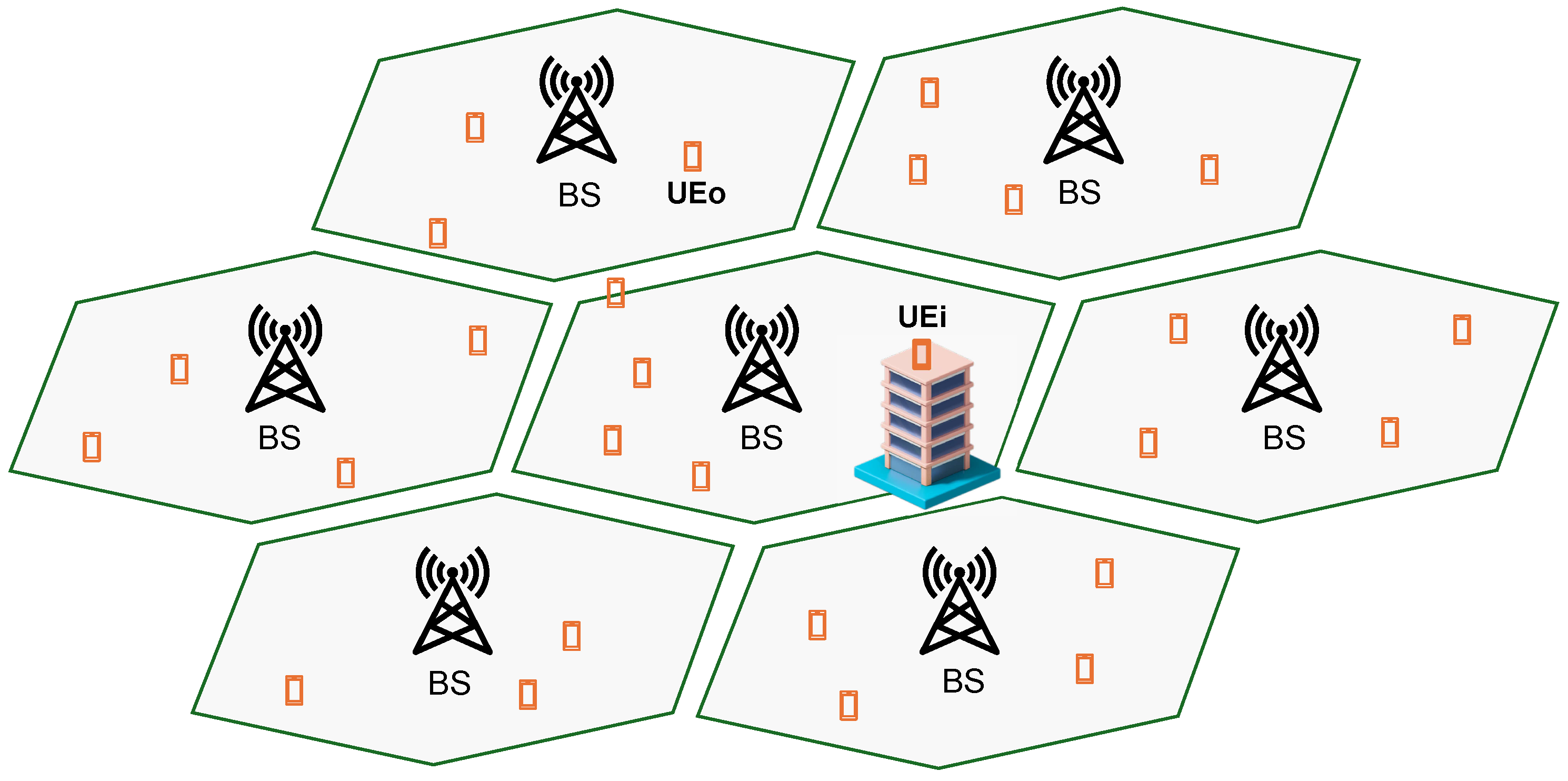
The system depicted in
Figure 1 consists of mobile users equipped with smartphones capable of measuring and reporting received signal strength (RSS) and SINR. These users are connected to base stations (BSs) with varying transmission power and coverage characteristics. The network infrastructure collects these measurements for processing, aiming to classify users as either indoor or outdoor.
The primary objective is to achieve accurate, real-time indoor–outdoor detection by utilizing SINR values, which are affected by external factors (like environmental conditions) and internal factors (such as device-specific characteristics). The SINR is defined as follows:
where
is the power of the desired signal,
is the power from interfering signals, and
is the background noise power.
In indoor environments, higher levels of interference and noise—stemming from factors such as signal reflection, diffraction, and absorption by walls—result in lower SINR values compared to outdoor settings. Additionally, variations in signal propagation, device movement, and network load further affect SINR. To improve measurement stability and reliability for classification, a Kalman filter is applied. This recursive technique refines SINR estimates by executing two primary steps:
- 1.
Prediction: The next SINR measurement is predicted based on the previous value and expected system dynamics.
- 2.
Update: The predicted SINR is adjusted using the actual measured value, accounting for noise and system changes.
The Kalman filter effectively balances measurement noise and system dynamics, yielding a stable SINR value that better reflects long-term environmental conditions, making it more suitable for IOD classification. The task then is to classify a user as either indoor or outdoor based on the filtered SINR data.
We formalize the classification problem as follows: Let
represent the filtered SINR measurements, where
n is the number of observations. We assume that the SINR distributions for indoor and outdoor environments follow distinct patterns:
for indoor and
for outdoor. The goal is to classify the user as either indoor or outdoor by calculating the likelihood of the observed SINR measurements belonging to each distribution. This is framed as a hypothesis test:
To make this decision, we apply the likelihood ratio test (LRT):
The user is classified as indoor if , and as outdoor if , where is a threshold.
4. Methods
This section outlines the steps and algorithms developed to implement the IOD problem formulated in the previous section. From a statistical detection perspective, the proposed approach can be interpreted as a two-stage detector. The Kalman filter first acts as a distribution-regularization stage that suppresses fast fading and reporting noise in the SINR stream, producing a slowly varying statistic suitable for hypothesis testing. The subsequent Generalized likelihood ratio test (GLRT) stage then performs optimal binary decision-making under the Neyman–Pearson framework for prescribed false-alarm probability .
4.1. Kalman Filter Model
In wireless communication, especially within 5G networks, SINR is frequently represented as a lognormal random variable, which implies that its value in decibels (dB) follows a normal distribution [
12,
13]. Throughout this paper, the term SINR will refer to its dB representation. Assuming this normal distribution, a Kalman filter can be applied to estimate the “true” SINR by filtering out noise and fluctuations that are not attributable to indoor/outdoor variations.
The Kalman filter can be understood as a “smart averaging tool”. Unlike a simple average, which smooths out noise but also loses responsiveness, the Kalman filter balances two factors: what we expect the signal to be (based on past values) and what we actually observe (the noisy measurement). We model the true SINR (in dB) as slowly varying due to mobility, shadowing, and power-control transients, while the reported measurements include fast fading and reporting noise; in this setting, the filter blends the prediction from recent history with the current observation. If the measurement is very noisy, the filter relies more on the prediction; if the measurement looks reliable, it adapts more quickly. This balance makes the filtered SINR both stable and responsive to real changes, which is exactly what is needed for robust indoor–outdoor detection. This motivates the use of a constant-state model in the Kalman filter, where the SINR is assumed locally stationary over short time intervals while evolving slowly due to mobility and shadowing dynamics.
Let denote the raw SINR measurement at time k and the filtered SINR estimate. We adopt the following notation: represents the predicted state at time k given observations up to , and denotes the updated state estimate at time k. Similarly, and are the predicted and updated error covariances, respectively. The process-noise parameter Q captures how much the true SINR is expected to drift between samples (reactivity to genuine changes), while the measurement-noise parameter R captures fast fluctuations and report noise (amount of smoothing).
The Kalman filter equations are reformulated as follows:
Here, acts as an adaptive weight: when measurements are noisy (large R), becomes small, and the filter trusts its prediction; when measurements are reliable (small R), becomes larger and the filter reacts more quickly. It is also useful to monitor the innovation , which quantifies how surprising the new observation is relative to the prediction. Small, zero-mean innovations indicate well-chosen noise settings; sustained large innovations typically coincide with regime changes such as entering or leaving a building, naturally prompting the filter to rely more on the current measurement.
The resulting filtered SINR is less affected by short-term fluctuations and noise. Consequently, this signal serves as a robust input for the IOD classification algorithm. Given that the Kalman filter is an optimal linear estimator under Gaussian noise and linear system assumptions, applying it to a normally distributed SINR ensures a similarly distributed filtered estimate. In the next section, the filtered estimate is fed directly to the decision rule, which benefits from the reduced short-term variance relative to raw .
Practical Tuning
The measurement-noise covariance
R is estimated from a short outdoor reference sequence by computing the empirical variance of the raw SINR reports
, which captures reporting jitter and fast fading effects. The process-noise covariance
Q controls how quickly the filter adapts to genuine SINR variations caused by user mobility or transitions between propagation conditions. In practice,
Q is selected so that the filter can track a typical indoor–outdoor SINR change (e.g., wall attenuation) within a few samples without reintroducing fast fading fluctuations. Using this procedure, the values
were found to provide a stable smoothing–reactivity trade-off for the considered deployment scenario.
Section 5 further evaluates the robustness of the detector around these parameter values.
4.2. GLRT Detection
As demonstrated in [
14], a Neyman–Pearson hypothesis test was initially applied to raw metrics for indoor–outdoor classification. In our work, we extend this approach by applying the test to filtered SINR estimates
to detect transitions between indoor and outdoor environments. Expanding on this foundation, we develop a robust decision metric to enhance user state classification and improve detection performance. We assume that
follows distinct distributions under the two conditions:
Outdoor:
Indoor:
where and represent the means and and the variances of the outdoor and indoor filtered SINR, respectively. We define a new statistic metric and a new parameter , so the test is based on two hypotheses:
(Outdoor):
(Indoor):
Applying this to the T under each hypothesis gives the following:
The likelihood ratio
is as follows:
The Neyman–Pearson decision rule is to compare
against a threshold
to control the false alarm probability:
4.2.1. Generalized Likelihood Ratio Test
In most practical scenarios, it is not possible to know the likelihood functions exactly because of uncertainty about one or more parameters in these functions. Hypothesis testing in the presence of uncertain parameters is known as “composite” hypothesis testing. One useful method is using the GLRT for such applications. In our case, we may not know
,
, or
in the hypothesis testing problem just discussed. So, we can apply the GLRT test as follows:
For
, we calculate the maximum likelihood estimate (MLE) under
:
Since the Gaussian function is maximized when the exponent is zero, the optimum is achieved when
, i.e.,
. For analytical tractability, we assume that the variances under both hypotheses are approximately equal after Kalman filtering, i.e.,
. This approximation is reasonable because Kalman smoothing suppresses most short-term fading fluctuations and reporting jitter, leaving residual variations mainly driven by measurement noise and slow propagation changes. In this regime, indoor–outdoor transitions appear primarily as shifts in the mean SINR level rather than significant changes in variance. The common variance is therefore estimated as
from a training set of
T values obtained under stable indoor and outdoor conditions. Substituting these estimates into the GLRT and taking the logarithm yields the quadratic decision rule:
For a given false alarm rate
, the threshold
for this quadratic test statistic can be determined. Under
,
follows a scaled chi-square distribution with one degree of freedom:
Thus, the threshold is set using the
-quantile of the chi-square distribution with one degree of freedom:
Finally, the test can be written as follows:
Here, denotes the -quantile of the chi-square distribution with one degree of freedom, which is obtained once from standard statistical tables or software for a chosen false-alarm probability and then kept fixed. The factor is an estimate of the variance of T under ; in practice, we use pooled sample variances computed from labeled indoor/outdoor sequences, as detailed in the next subsection.
4.2.2. RSRQ-Assisted Single-Variance GLRT (Light Context)
We keep the scalar GLRT unchanged and use the 3GPP reference signal received quality (RSRQ, in dB) only to set the variance that enters the threshold. Let be a short-time average of RSRQ over the last L reports (typically ). Offline, we partition the range of into coarse bins (quartiles) and, on a training split made of stable indoor/outdoor snippets with a guard around transitions, estimate one pooled variance of the decision variable for each (with a minimum of samples per bin). These pooled variances play the role of in the GLRT threshold above.
At run time, the detector operates on one filtered SINR sample per step. For each
k: (i) compute
and its bin index
; (ii) if
, initialize
; (iii) form the statistic
and the threshold
Note that the threshold is
not fixed: it adapts to slow propagation and load variations through the online updates of
, providing a lightweight adaptive thresholding mechanism that maintains approximately constant false-alarm behavior. We then decide
(indoor) if
and
(outdoor) otherwise. After an
decision, we apply guarded exponentially weighted moving-average (EWMA) updates to track slow drifts while avoiding indoor contamination:
with a small
(e.g.,
). This light context uses an existing 3GPP KPI to modulate only the variance (not the test statistic), so it adds no UE burden, preserves the scalar GLRT structure, and maintains robustness against slow propagation changes. Quartile binning balances robustness and simplicity and reduces overfitting while adapting to load/propagation conditions.
The entire process is detailed in Algorithm 1, which outlines the key steps of the proposed IOD method, including Kalman filter initialization, adaptive threshold computation, real-time SINR processing, and GLRT-based classification.
| Algorithm 1 Indoor–Outdoor detection using Kalman filtering and RSRQ-assisted GLRT. |
- 1:
Inputs: false-alarm target ; Kalman parameters ; EWMA factor ; RSRQ averaging length L; RSRQ bins ; offline variance pool . - 2:
Initialization: outdoor baseline; compute initial RSRQ average and bin ; ; precompute ; . - 3:
while a new SINR report arrives do - 4:
Kalman filtering: obtain from . - 5:
Decision statistic: . - 6:
Context update: compute short-term RSRQ average (last L reports) and bin . - 7:
Threshold computation: . - 8:
if then - 9:
Decision: indoor (). - 10:
Keep unchanged; . - 11:
else - 12:
Decision: outdoor (). - 13:
Guarded EWMA update: ; . - 14:
end if - 15:
. - 16:
end while
|
4.3. Design Rationale
Although the proposed detector relies on classical tools, its contribution lies in how these tools are combined to ensure statistically consistent indoor–outdoor detection under realistic 5G SINR reporting dynamics. The objective is to construct a decision statistic that is approximately Gaussian under the outdoor hypothesis , with a known and slowly varying variance, so that the GLRT retains its optimality and constant-false-alarm behavior.
Let denote the reported SINR in dB and the corresponding Kalman estimate introduced previously. In practice, raw SINR reports are affected by fast fading, reporting jitter, and power-control transients, which distort the Gaussian and stationarity assumptions usually invoked for SINR in dB. The Kalman filter acts as a distribution-regularization stage: under slowly varying outdoor propagation, the filtered estimates and the associated innovations become approximately zero-mean Gaussian with stable variance. This restores, to first order, the statistical model assumed by the GLRT.
Therefore, the decision variable is normally distributed under with variance . The resulting quadratic statistic follows a distribution with one degree of freedom, so the GLRT based on maximizes the detection probability for a prescribed false-alarm rate .
In the proposed implementation, the adaptive threshold maintains approximately constant false-alarm behavior as long as the variance estimate tracks slow changes in the outdoor propagation environment. Updating the variance (and outdoor mean) only after outdoor decisions prevents bias contamination by indoor samples, which would otherwise inflate the threshold and degrade detection sensitivity. Conditioning the variance on coarse RSRQ regimes further improves robustness to load and interference variability while preserving the scalar-test structure and per-sample decision latency. Although this mechanism does not satisfy the strict theoretical conditions of classical constant-false-alarm-rate (CFAR) detectors, the slow EWMA updates ensure that the threshold adapts gradually to propagation and interference variations while maintaining a stable operating point in practice.
In summary, the Kalman filter regularizes the SINR distribution so that the GLRT model assumptions hold in practice, while the adaptive variance estimation maintains approximately constant false-alarm behavior using only standard network KPIs. This principled design enables a theoretically justified and computationally negligible indoor–outdoor detector suitable for real-time deployment.
For comparison, we also evaluate two simplified KPI-only detectors that apply the same fixed-variance GLRT directly to the reported SINR and to a short moving-average , but without Kalman smoothing or adaptive variance conditioning.
5. Results and Discussion
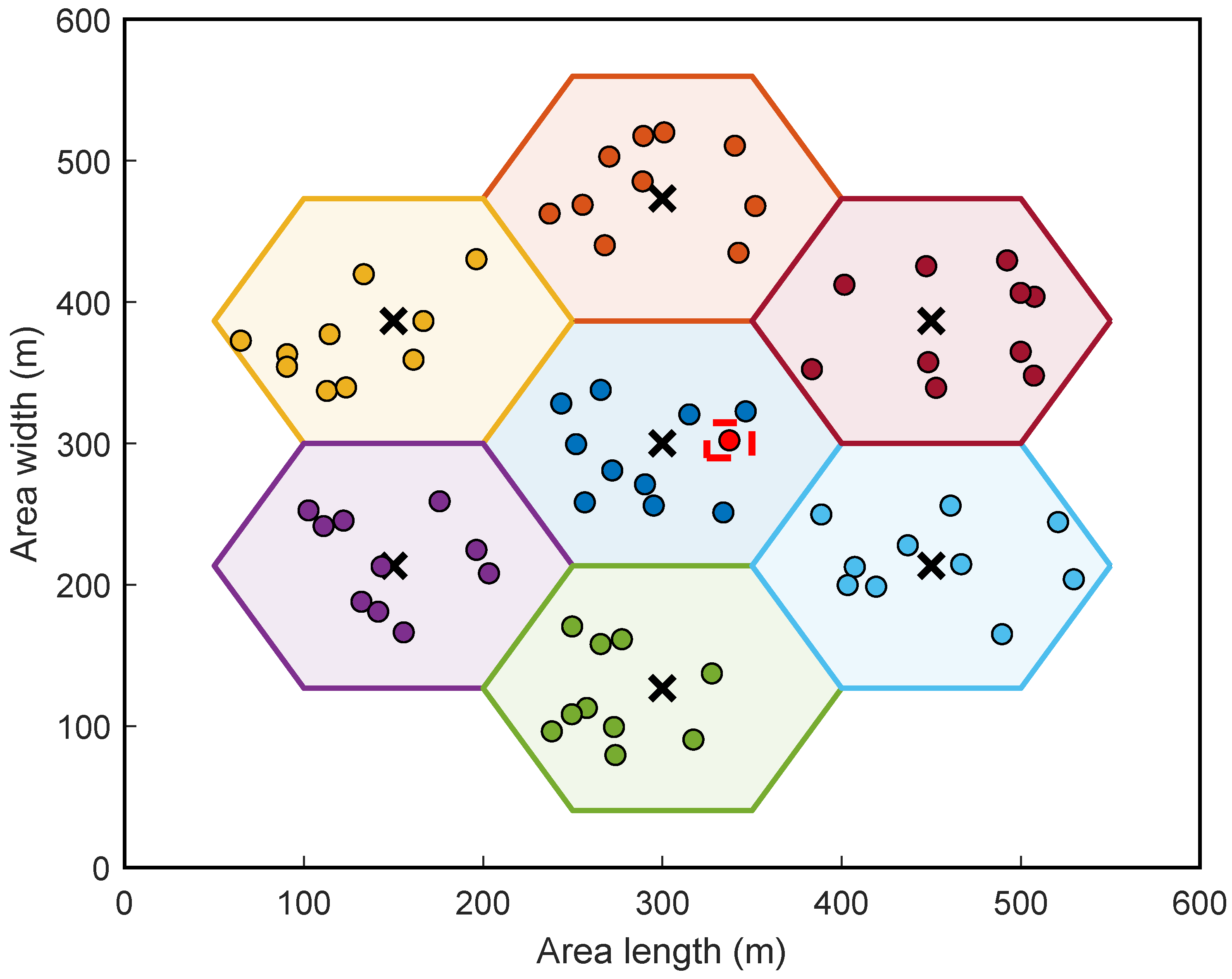
The simulation scenario, illustrated in
Figure 2, models a user transitioning between outdoor and indoor environments within a cellular network. The setup consists of a central cell served by a BS at its center, surrounded by six neighboring cells arranged in a hexagonal grid, each with a radius of 100 m. Each tri-sectorial BS is equipped with directional antennas and serves ten randomly distributed users per cell. A target user, whose indoor–outdoor transitions are tracked, is positioned within a
m bounding box in the central cell to capture localized mobility patterns. User positions and mobility patterns are modeled within these coverage areas, with outdoor users moving up to 3 m per iteration and indoor users constrained to a maximum displacement of 0.5 m.
The simulation setup is summarized in
Table 1 and reflects realistic 5G deployment scenarios. To assess statistical robustness, each experiment was repeated over
independent Monte Carlo realizations, where user positions, fading seeds, and mobility traces were re-generated at each run. The performance metrics reported in the following tables correspond to the Monte Carlo mean values. The resulting 95% confidence intervals were narrow (typically within
for precision, recall, and F1-score), indicating limited variability across realizations. The system operates at a carrier frequency of 3.5 GHz with a bandwidth of 40 MHz, following 3GPP Urban Macro (UMa) guidelines [
15]. The baseline results use the configuration in
Table 1; robustness experiments vary only the channel/environment parameters listed below. Users transmit in the uplink with power levels ranging from 0 to 20 dBm, initialized at 10 dBm, and employ a simple power control mechanism targeting a 10 dB SINR threshold. The wireless channel is modeled using Rayleigh fading, with an optional Rician component (K-factor of 10 dB), and path loss is calculated considering both line-of-sight (LOS) and non-line-of-sight (NLOS) conditions. Each BS employs a sectorial antenna pattern with a peak gain of 0 dB along the main lobe and up to 20 dB attenuation outside it. Wall attenuation and user mobility parameters are set to reflect typical urban and indoor environments, while Kalman filter parameters (Q = 30, R = 1000) were tuned to balance responsiveness and stability. Reported SINR includes zero-mean measurement jitter and rare outliers to emulate practical reporting noise, which stresses the non-filtered baseline. In the simulations, we emulate RSRQ as a short-time average of a proxy derived from the reported SINR with a fixed offset; this is sufficient to bin the operating regimes.
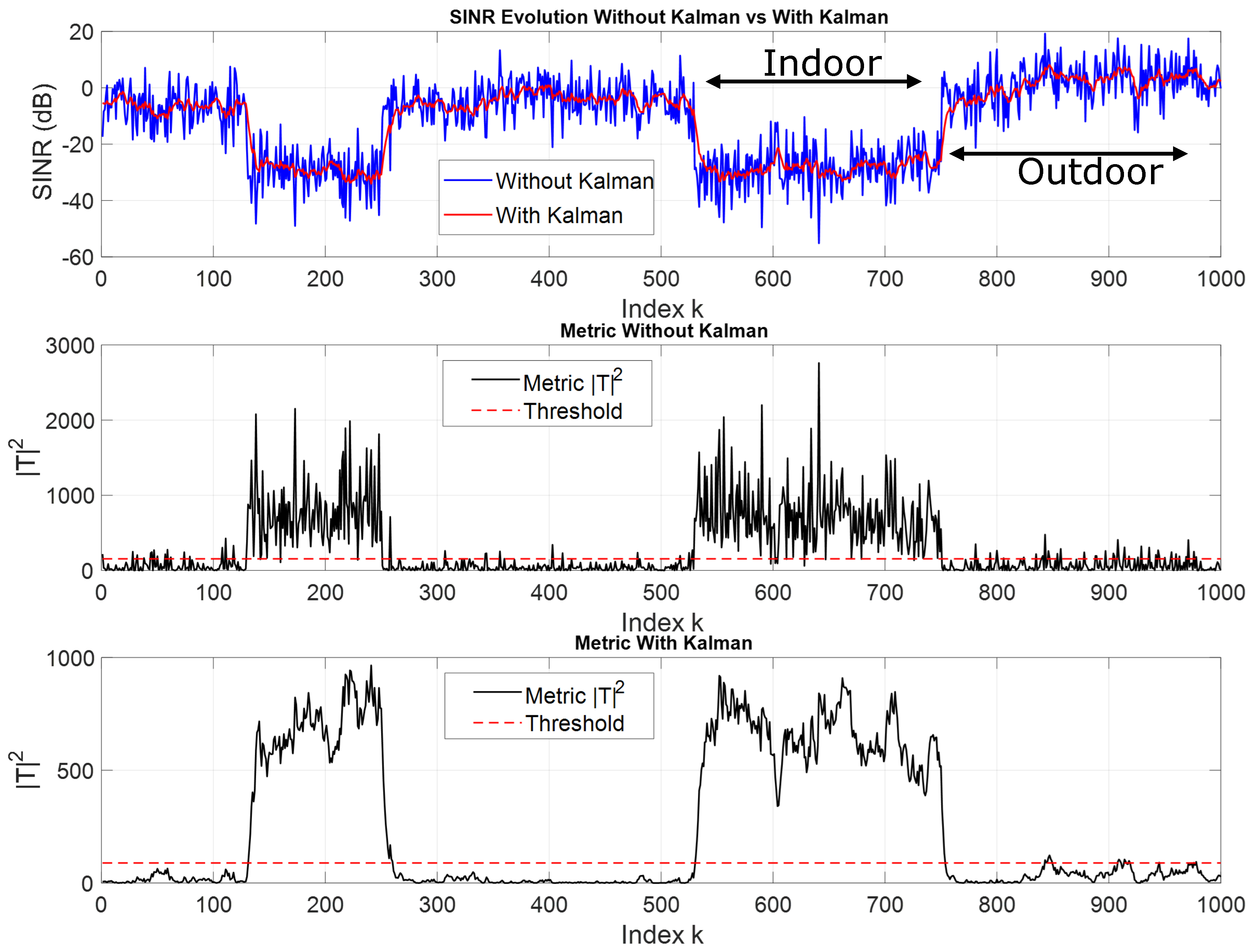
Each simulation iteration processes a single SINR measurement to account for user mobility and channel variations. The target user transitions between outdoor and indoor environments at specific iterations (130, 250, 530, and 750), with indoor conditions modeled by adding 20 dB wall attenuation and 10 dB random indoor attenuation to the path loss. The simulation evaluates false alarm rates from to . Sweeping the false-alarm probability across this range would produce the classical receiver operating characteristic (ROC) curve. In this work, however, we report discrete operating points corresponding to specific values, which are more representative of practical network deployments where the false-alarm target is fixed by design.
Although the detection trace is illustrated for a representative target UE, Monte Carlo runs randomize the target trajectory and the set of interfering users across realizations, so the reported metrics reflect averaged performance over many stochastic network instances rather than a single deterministic user scenario.
To isolate the effect of Kalman smoothing,
Figure 3 and
Table 2 report the baseline fixed-variance GLRT; the adaptive, context-conditioned threshold is evaluated separately in the robustness experiments discussed in
Section 5.1.
To further contextualize the benefit of Kalman smoothing relative to very simple KPI-based detectors, we additionally evaluate two baseline schemes operating directly on the reported SINR stream
: (i) a fixed-variance threshold test on
, and (ii) the same test applied to a short moving-average
. Both use the same false-alarm target
and decision statistic as the GLRT but omit Kalman regularization and adaptive variance conditioning.
Table 3 reports the corresponding precision, recall, and F1-score.
These results show that simple KPI-only detectors can achieve high recall at loose false-alarm settings, but their performance degrades sharply as
becomes more stringent: recall falls below
at
and
, even when moving-average smoothing is applied. In contrast, the proposed Kalman-regularized GLRT in
Table 2 maintains both high precision and very high recall in this regime (recall
at
and >89% at
). This confirms that Kalman smoothing does not merely stabilize the trace but materially improves detection robustness under tight false-alarm constraints, which is essential for network-side deployment.
5.1. Robustness to Channel and Environment
To further verify the robustness of the proposed detector, we conducted a sensitivity analysis with respect to representative propagation conditions and channel parameters. In particular, we evaluate the detector performance across several standard 5G deployment environments and wall-attenuation levels while keeping the algorithm parameters unchanged. To keep the analysis focused and reproducible, we evaluate three standard 5G channel families with a single representative setting per channel, while holding user density, cell layout, mobility (3 km/h), and the target false-alarm rate
fixed. For UMa and urban micro (UMi), we use mixed LOS/NLOS at 3.5 GHz with shadowing
dB, Rician
dB in LOS (Rayleigh in NLOS), and indoor episodes modeled with wall loss
dB. For indoor hotspot (InH), we use mostly NLOS with
dB,
dB for occasional LOS, and
dB. The adaptive, context-conditioned GLRT is used in these experiments. The resulting detection performance across these representative channel conditions is summarized in
Table 4.
UMa and UMi yield nearly identical performance (precision , recall , F1 ), which is expected given the shared geometry, density, and mixed LOS/NLOS characteristics; in both cases, the adaptive, context-conditioned threshold preserves high recall at while incurring a small precision loss primarily at indoor–outdoor transitions and occasional short-time RSRQ binning mismatches. InH achieves similarly high recall () with slightly lower precision (), leading to an F1 score of ≈94%. This is consistent with the larger wall loss ( dB), which increases indoor–outdoor mean separation (favoring recall), while stronger NLOS fluctuations and sporadic reporting spikes can trigger a few additional false alarms (reducing precision). Overall, the detector maintains balanced precision–recall performance across distinct propagation families using the same per-sample test and false-alarm target, supporting robustness to environmental variability.
5.2. Computational Complexity and Comparative Analysis
The computational efficiency and comparative performance of the proposed IOD method are analyzed against AI-, sensor-, and hybrid-based approaches. The method processes a sequence of SINR measurements but operates on one observation at a time, applying a scalar Kalman filter update and a GLRT threshold comparison. Each iteration, therefore, requires only operations for inference. If extended to process a batch of M measurements, the total inference cost scales linearly as . The method also requires no training, since it relies entirely on statistical signal processing with predefined parameters, yielding training complexity.
In contrast, AI-based methods such as deep learning or sequence models [
6,
16] typically incur heavy training costs, on the order of
, and demand large labeled datasets. Their inference is also linear in
M, but with substantial constant factors due to model complexity. Sensor-based methods, including GSM- and GPS-based detection [
4], avoid heavy training but depend on device-level sensors that can be energy-intensive, device-specific, or unreliable in indoor settings. Hybrid approaches [
6,
7] combine AI and sensor modalities, sometimes reporting very high or even perfect accuracy, but they inherit both the training burden of AI and the integration overhead of sensor fusion.
Table 5 summarizes representative IOD families, including their features, F1-scores, complexity levels, and methodological characteristics. These families of methods reflect fundamentally different operational paradigms—ranging from device-level sensing and multi-modal fusion to purely network-side statistical processing—so their comparison naturally emphasizes required inputs, computational implications, and deployment constraints rather than performance on a shared dataset. It shows that while AI- and hybrid-based methods can achieve strong detection performance, they come with high training and deployment costs. Sensor-based methods are computationally lighter but remain constrained by hardware availability and indoor reliability. The proposed statistical method, in contrast, achieves competitive performance (recall of up to 99%, F1 ≈ 98%) with no training and constant inference-time per measurement, making it particularly attractive for real-time deployment in resource-constrained cellular networks. All reported results for our method correspond to a 7-cell hexagonal layout at 3.5 GHz with 10 users per cell (cell radius 100 m, per-cell density ≈318 users/km
2) and a fixed false-alarm target
; comparisons should be interpreted with this deployment context in mind.
6. Conclusions and Future Work
This paper presents a robust and efficient method for IOD in cellular networks, leveraging a Kalman filter and GLRT to process single SINR measurements. Simulation results demonstrate that the method achieves high recall (up to 99%) and F1-scores of around 98% across a wide range of false-alarm targets, significantly outperforming non-filtered approaches, particularly at stringent operating points.
Simple KPI-only detectors based on raw or averaged SINR were also evaluated. While these baselines remain competitive at loose false-alarm targets, their recall and F1-score degrade sharply when the false-alarm constraint becomes more stringent. In contrast, the proposed Kalman-regularized GLRT maintains balanced precision–recall performance across all operating points, including and , confirming a clear robustness gain over straightforward SINR thresholding.
Compared to AI-based methods, such as deep learning or sequence models, and sensor- or hybrid-based approaches, the proposed method offers an exceptional balance of accuracy and computational efficiency. It requires no training () and supports constant inference-time per measurement (), in contrast to the quadratic training complexity () and linear inference of typical AI-based methods. This lightweight, real-time capability makes it particularly well-suited for deployment in resource-constrained cellular networks. These results confirm that the proposed detector maintains reliable indoor–outdoor discrimination even under stringent false-alarm constraints (–), where simple SINR-based detectors fail.
While the proposed method demonstrates strong performance in simulations, some limitations must be acknowledged. The statistical modeling implicitly relies on the fact that, under outdoor conditions, the Kalman filter regularizes the reported SINR stream so that the GLRT operates on an approximately Gaussian decision statistic. Although this approximation is well supported by the results, departures from Gaussianity may arise in highly dynamic or interference-limited scenarios. Extending the framework to explicitly account for heavier-tailed or mixture distributions, therefore, constitutes an interesting direction for future work, together with multi-user extensions and the use of complementary signal features such as angle-of-arrival or Doppler shift.