Prediction of Acoustic Impedance of Submarine Sediments in the Middle Area of the South Yellow Sea Using on a Random Forest Algorithm

 and
and
Abstract
1. Introduction
2. Study Area and Data Sources
2.1. Study Area Location
2.2. Data Sources
3. Principle and Implementation of the Random Forest Model
3.1. Data Preprocessing
3.1.1. Data Cleaning
3.1.2. Feature Extraction
3.1.3. Data Partitioning
3.2. Model Training and Parameter Tuning
3.3. Model Interpretation
4. Discussion
4.1. Single-Parameter Models
4.2. Acoustic Impedance and Physical–Mechanical Parameter Models
4.2.1. Acoustic Impedance and Sediment Basic Physical Parameter Models
4.2.2. Acoustic Impedance and Sediment Particle Size Parameter Models
4.2.3. Acoustic Impedance and Sediment Mechanical Property Models
4.2.4. Acoustic Impedance and Sediment Consistency Boundary Model
5. Conclusions
- (1)
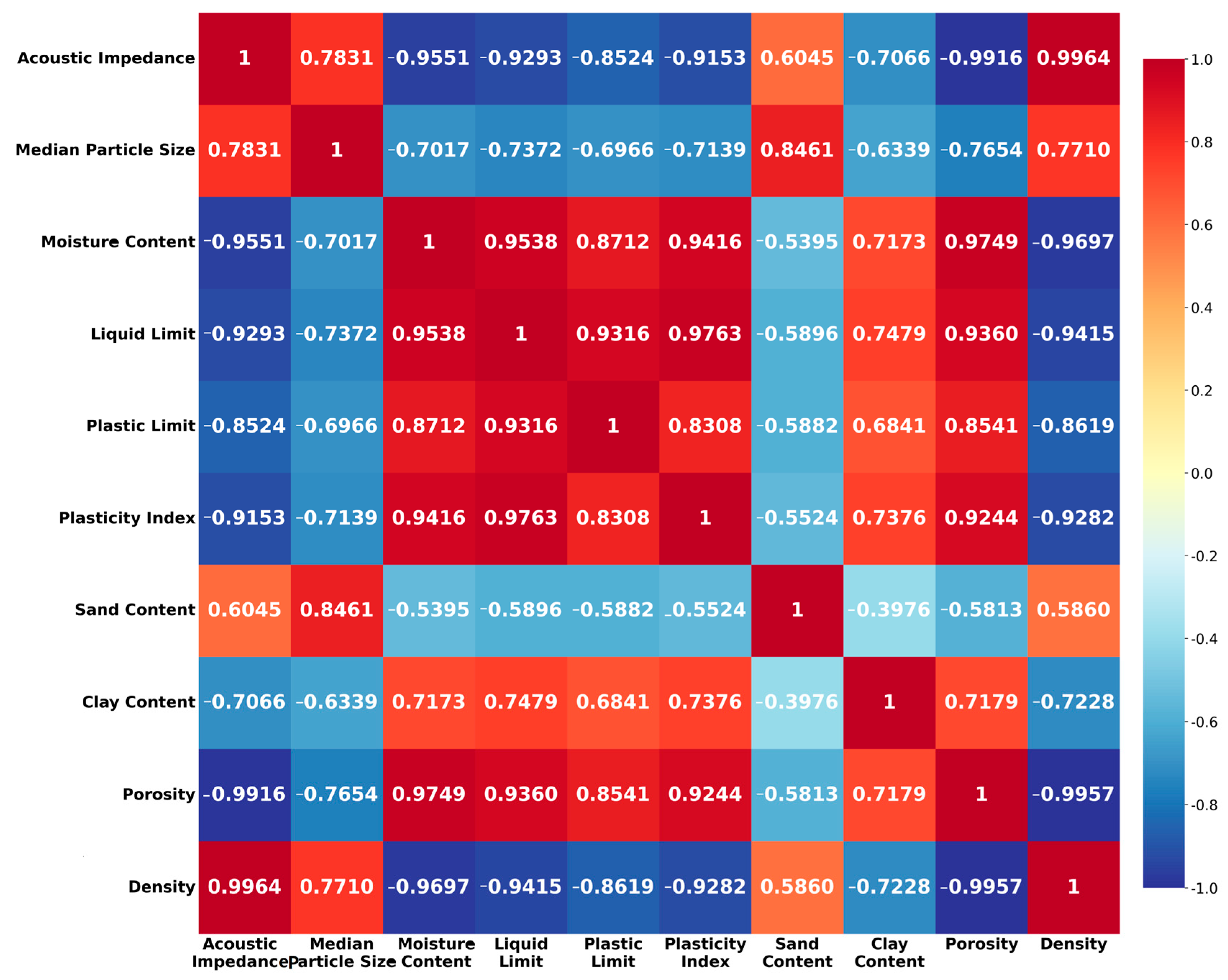
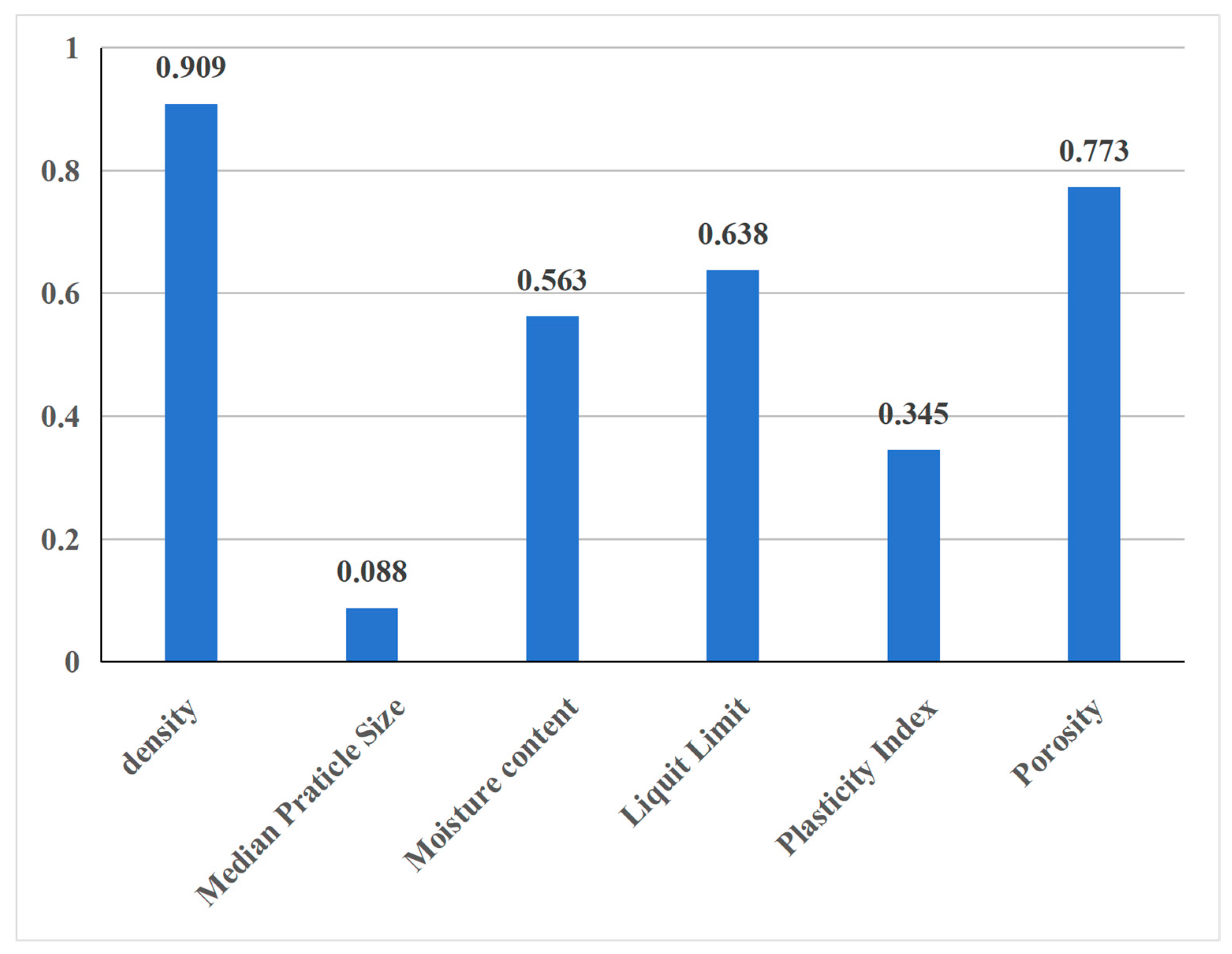
- The Random Forest model exhibits superior predictive performance compared to traditional single-parameter empirical regression equations. Both MAE and MAPE are substantially lower, indicating a marked improvement in prediction accuracy. The six feature elements used for model training are ranked in descending order of importance: density, porosity, liquid limit, moisture content, plasticity index, and median particle size. This ranking is consistent with the Pearson correlation coefficient analysis.
- (2)
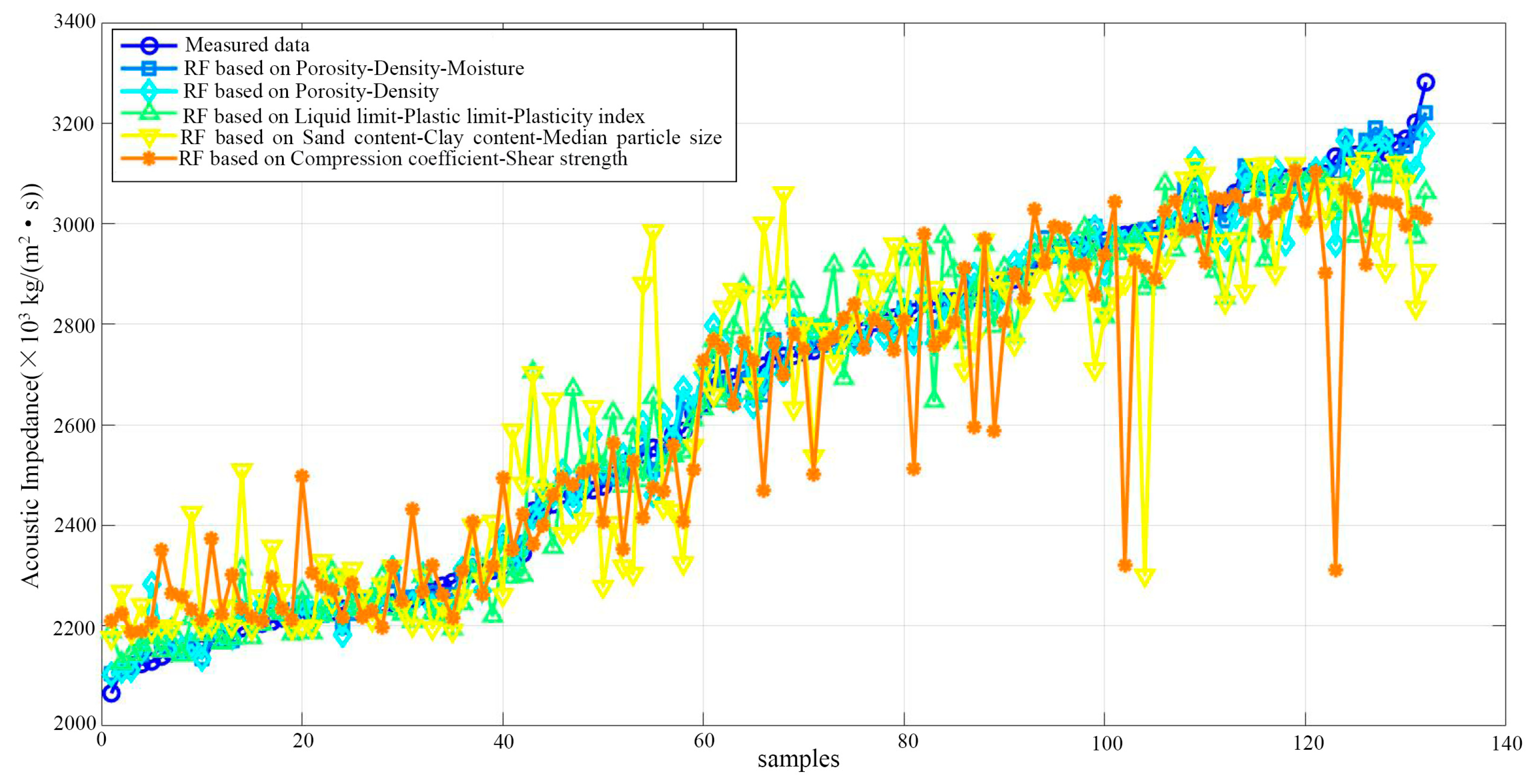
- Acoustic impedance is strongly correlated with basic physical properties such as density, moisture content, and porosity, but poorly correlated with shear strength. Further analysis reveals that basic physical properties and mechanical properties significantly influence acoustic impedance, whereas grain size parameters contribute less effectively. The compression coefficient shows substantial predictive value, and there is a strong negative correlation between acoustic impedance and consistency limits (liquid limit, plastic limit, and plasticity index), leading to higher prediction accuracy.
Author Contributions
Funding
Data Availability Statement
Conflicts of Interest
Abbreviations
| RF | Random forest |
| MAE | Mean absolute error |
| MAPE | Mean absolute percentage error |
| PVC | Polyvinyl chloride |
References
- Hou, Z.Y. Study on Acoustic Properties of Seabed Sediments and Correlation with Physical Parameters in the Southern South China Sea. Ph.D. Thesis, Graduate University of Chinese Academy of Sciences (Institute of Oceanology), Qingdao, China, 2016. (In Chinese) [Google Scholar]
- Hamilton, E.L. Geoacoustic modeling of the sea floor. J. Acoust. Soc. Am. 1980, 68, 1313–1340. [Google Scholar] [CrossRef]
- Orsi, T.H.; Dunn, D.A. Sound velocity and related physical properties of fine-grained abyssal sediments from the Brazil Basin (South Atlantic Ocean). J. Acoust. Soc. Am. 1990, 88, 1536–1542. [Google Scholar] [CrossRef]
- Lu, B.; Li, G.X.; Sun, D.H.; Huang, S.J.; Zhang, F.S. Acoustic physical properties of marine sediments and their correlation in the southeastern China seas. J. Trop. Oceanogr. 2006, 2, 12–17. (In Chinese) [Google Scholar]
- Zou, D.P.; Wu, B.H.; Lu, B. Analysis and research on the empirical equation of sound speed in seabed sediments. J. Oceanogr. 2007, 29, 43–50. (In Chinese) [Google Scholar]
- Kan, G.M.; Su, Y.F.; Li, G.B.; Liu, B.H.; Meng, X.M. Correlation between in-situ sound speed and physical properties of seabed sediments in the central-western Yellow Sea. J. Oceanogr. 2013, 35, 166–171. (In Chinese) [Google Scholar]
- Zhou, Q.J.; Li, X.S.; Liu, L.J.; Liu, Y.T.; Gao, S.; Zhou, H.; Wang, J.Q.; Li, T.G. Physical properties of the seabed inversed based on Chirp data and the Biot-Stoll model in the northern continental slope of the South China Sea. Haiyang Xuebao 2020, 42, 72–82. (In Chinese) [Google Scholar]
- Lu, J.J.; Jiang, L.X.; Wang, J.L.; Chun, L.; Le, C.X.; Kong, F.Q.; Liu, S.Q.; Kan, G.M. Seafloor sediment acoustic property inversion from reflection coefficients with a PSO-BP neural network approach. Front. Mar. Sci. 2025, 12, 1635127. [Google Scholar] [CrossRef]
- Kan, G.M.; Su, Y.F.; Liu, B.H.; Li, G.B.; Meng, X.M. Acoustic impedance characteristics of seafloor sediments in the middle area of the South Yellow Sea. J. Jilin Univ. (Earth Sci. Ed.) 2014, 44, 386–395. (In Chinese) [Google Scholar]
- Jackson, D.R.; Richardson, M.D. High-Frequency Seafloor Acoustics; Springer: New York, NY, USA, 2007. [Google Scholar]
- Chen, W.J.; Guo, C.S.; Wang, J.Q.; Hou, Z.Y. Sound speed prediction of seabed sediments based on genetic BP neural network. J. Oceanogr. 2016, 38, 116–123. (In Chinese) [Google Scholar]
- Hou, Y.Z.; Wang, Q.J.; Chen, Z.; Yan, W.; Tian, Y.H. Sound Velocity Predictive Model Based on Physical Properties. Earth Space Sci. 2019, 6, 1561–1568. [Google Scholar] [CrossRef]
- Chen, M.J.; Meng, X.M.; Kan, G.M.; Wang, J.Q.; Li, G.B.; Liu, B.H.; Liu, C.G.; Liu, Y.G.; Liu, Y.X.; Lu, J.J. Predicting the Sound Speed of Seafloor Sediments in the East China Sea Based on an XGBoost Algorithm. J. Mar. Sci. Eng. 2022, 10, 1366. [Google Scholar] [CrossRef]
- Chen, M.J.; Meng, X.M.; Kan, G.M.; Wang, J.Q.; Li, G.B.; Liu, B.H.; Liu, C.G.; Liu, Y.G.; Meng, W.J. Predicting the sound speed of seafloor sediments in the Middle area of the Southern Yellow Sea based on a BP neural network model. Mar. Georesources Geotechnol. 2023, 41, 662–670. [Google Scholar] [CrossRef]
- Kan, G.M.; Zhang, Y.F.; Su, Y.F.; Li, G.B.; Meng, X.M. Measurement of shear wave velocity of seabed sediments in the central part of the southern Yellow Sea and its relationship with physical and mechanical property parameters. Adv. Mar. Sci. 2014, 32, 335–342. (In Chinese) [Google Scholar]
- Cai, D.L.; Shi, X.F.; Zhou, W.J.; Liu, W.G.; Zhang, S.F.; Cao, Y.N.; Han, Y.B. Sources and transportation of suspended matter and sediment in the southern Yellow Sea: Evidence from stable carbon isotopes. Chin. Sci. Bull. 2003, 48, 21–29. [Google Scholar] [CrossRef]
- Meng, X.M.; Liu, B.H.; Kan, G.M. An experimental study on acoustic properties and their influencing factors of marine sediment in the southern Huanghai Sea. Acta Oceanol. Sin. 2012, 34, 74–83. (In Chinese) [Google Scholar]
- Breiman, L. Random forests. Mach. Learn. 2001, 45, 5–32. [Google Scholar] [CrossRef]
- Wang, J.Q.; Hou, Z.Y.; Chen, Y.L.; Li, G.B.; Kan, G.M.; Xiao, P.; Li, Z.L.; Mo, D.H.; Huang, J.Y. The acoustic attenuation prediction for seafloor sediment based on in-situ data and machine learning methods. J. Ocean Univ. China 2025, 24, 95–102. [Google Scholar] [CrossRef]
- Lu, B.; Liang, Y.B. Statistical correlation between physical parameters of marine sediments in southeastern China and sound speed. Sci. China (Ser. B Chem. Life Sci. Earth Sci.) 1994, 5, 556–560. (In Chinese) [Google Scholar]



| Parameter | Max | Min | Ave |
|---|---|---|---|
| (g/cm3) | 2.02 | 1.399 | 1.686 |
| (%) * | 127.54 | 27.03 | 66.12 |
| (%) * | 77.3 | 41.4 | 60.76 |
| d50 (mm) * | 0.067 | 0.001 | 0.014 |
| (%) | 53.9 | 0 | 10.04 |
| (%) | 91.4 | 4.6 | 39.45 |
| (%) * | 75 | 23.2 | 44 |
| (%) * | 44.3 | 12.8 | 24 |
| (%) * | 42.6 | 6 | 20.01 |
| (MPa) * | 6.73 | 0.28 | 1.71 |
| (kPa) * | 10.54 | 0.24 | 2.36 |
| (m/s) | 1654.1 | 1359.4 | 1529.5 |
| (103 kg/(m2·s)) | 3326.99 | 2065.14 | 2590.38 |
| Prediction Model | Tolerance Range (×103 kg/(m2·s)) | MAE (×103 kg/(m2·s)) | MAPE (%) |
|---|---|---|---|
| −58.94~98.76 | 24.18 | 0.91 | |
| −175.49~170.11 | 62.17 | 2.32 | |
| −86.60~64.45 | 30.50 | 1.18 | |
| −285.21~143.66 | 72.06 | 2.72 | |
| 43.54~453.27 | 290.78 | 12.00 | |
| −475.49~241.36 | 127.27 | 5.08 | |
| RF | −72.36~50.40 | 23.15 | 0.90 |
| Parameter of Feature | Importance of Feature | MAE (×103 kg/(m2·s)) | R2 |
|---|---|---|---|
| 0.908 | 0.30 | 0.992 | |
| 0.866 | |||
| 0.870 |
| Parameter of Feature | Importance of Feature | MAE (×103 kg/(m2·s)) | R2 |
|---|---|---|---|
| 1.308 | 0.55 | 0.974 | |
| 1.289 |
| Parameter of Feature | Importance of Feature | MAE (×103 kg/(m2·s)) | R2 |
|---|---|---|---|
| d50 | 1.711 | 2.16 | 0.643 |
| 1.211 | |||
| 0.841 |
| Parameter of Feature | Importance of Feature | MAE (×103 kg/(m2·s)) | R2 |
|---|---|---|---|
| 2.504 | 1.09 | 0.905 | |
| 0.812 |
| Parameter of Feature | Importance of Feature | MAE (×103 kg/(m2·s)) | R2 |
|---|---|---|---|
| 0.859 | 1.08 | 0.895 | |
| 0.881 | |||
| 0.860 |
Disclaimer/Publisher’s Note: The statements, opinions and data contained in all publications are solely those of the individual author(s) and contributor(s) and not of MDPI and/or the editor(s). MDPI and/or the editor(s) disclaim responsibility for any injury to people or property resulting from any ideas, methods, instructions or products referred to in the content. |
© 2026 by the authors. Licensee MDPI, Basel, Switzerland. This article is an open access article distributed under the terms and conditions of the Creative Commons Attribution (CC BY) license.
Share and Cite
Li, X.; Zhang, L.; Liang, Y.; Hu, X.; Han, K.; Kan, G.; Meng, X.; Chen, Y. Prediction of Acoustic Impedance of Submarine Sediments in the Middle Area of the South Yellow Sea Using on a Random Forest Algorithm. Electronics 2026, 15, 995. https://doi.org/10.3390/electronics15050995
Li X, Zhang L, Liang Y, Hu X, Han K, Kan G, Meng X, Chen Y. Prediction of Acoustic Impedance of Submarine Sediments in the Middle Area of the South Yellow Sea Using on a Random Forest Algorithm. Electronics. 2026; 15(5):995. https://doi.org/10.3390/electronics15050995
Chicago/Turabian StyleLi, Xianfeng, Linqing Zhang, Yiming Liang, Xinfeng Hu, Kaifeng Han, Guangming Kan, Xiangmei Meng, and Yong Chen. 2026. "Prediction of Acoustic Impedance of Submarine Sediments in the Middle Area of the South Yellow Sea Using on a Random Forest Algorithm" Electronics 15, no. 5: 995. https://doi.org/10.3390/electronics15050995
APA StyleLi, X., Zhang, L., Liang, Y., Hu, X., Han, K., Kan, G., Meng, X., & Chen, Y. (2026). Prediction of Acoustic Impedance of Submarine Sediments in the Middle Area of the South Yellow Sea Using on a Random Forest Algorithm. Electronics, 15(5), 995. https://doi.org/10.3390/electronics15050995